Contents
- 01Quick Specs Comparison, Deluxe Reverb vs Twin Reverb
- 02The Wattage Gap, What 22W vs 85W Actually Means
- 03Circuit History, Blackface and Silverface Variants You Need to Know
- 04Playing Context, Which Amp Is Right for Your Gig?
- 05Pedal Platform Performance, Deluxe Reverb vs Twin Reverb
- 06Notable Players, Who Used What and Why
- 07Deluxe Reverb vs Twin Reverb vs Super Reverb, Where Does the Super Fit?
- 08Buying Guide, Vintage vs Reissue Pricing and What to Look For
- 09FAQ, Deluxe Reverb vs Twin Reverb
- 10Which Amp Fits Your Gig
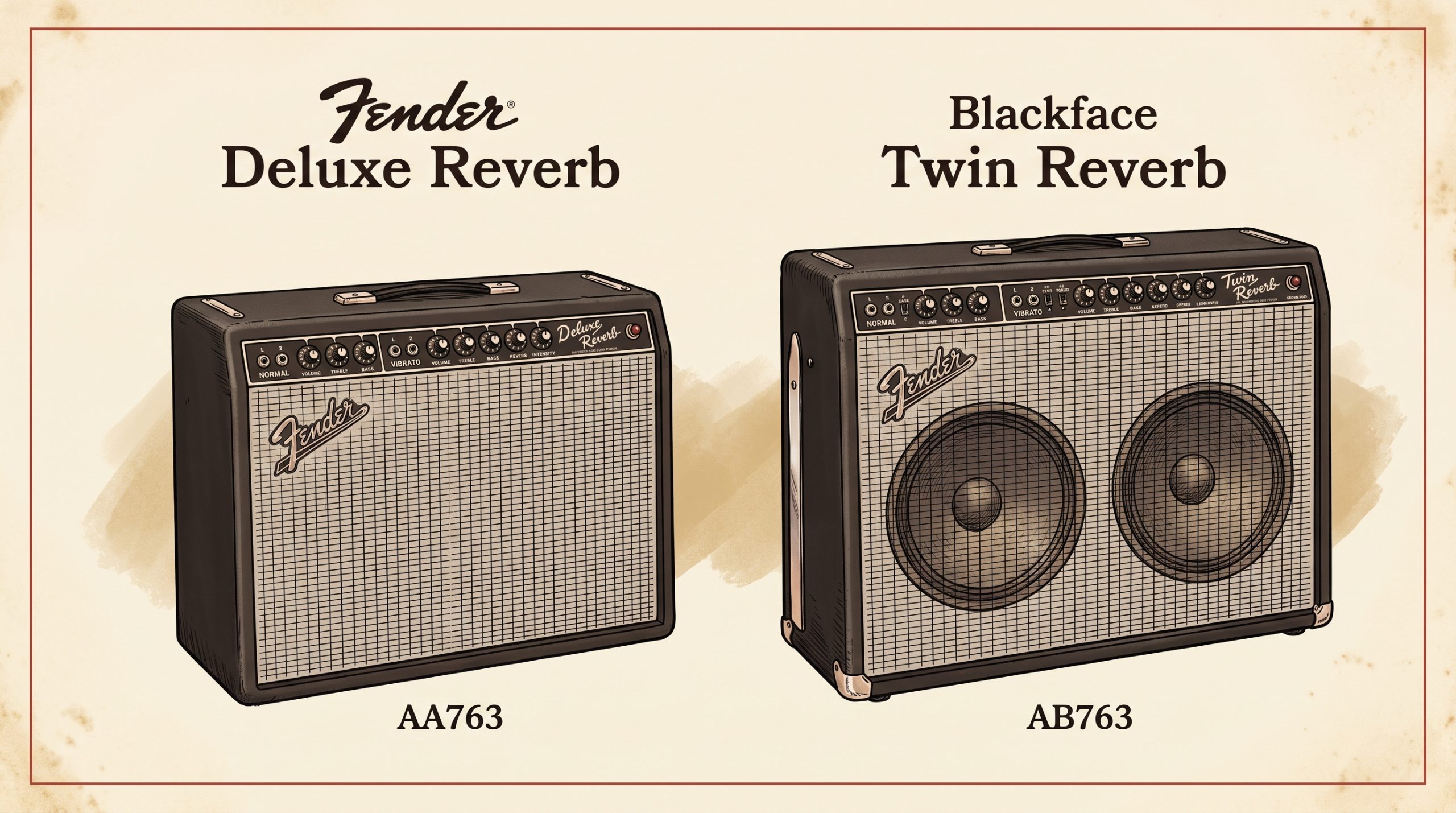
Quick Specs Comparison, Deluxe Reverb vs Twin Reverb
Before getting into what those specs mean on a stage, here’s the full side-by-side picture. Circuit numbers varied across production runs, for full date code verification, the Fender tube amp dating reference covers transformer EIA codes, tube chart stamps, and chassis codes for both models across every production year.
| Spec | Fender Deluxe Reverb | Fender Twin Reverb |
|---|---|---|
| Output Power | 22 watts | 85 watts |
| Output Tubes | 2× 6V6 | 4× 6L6GC |
| Preamp Tubes | 4× 12AX7, 2× 12AT7 | 4× 12AX7, 2× 12AT7 |
| Rectifier | GZ34 tube rectifier | Solid-state (5AR4 on select early units) |
| Speaker Config | 1×12 | 2×12 |
| Stock Speaker (Blackface) | Oxford 12K5-6, Jensen C12N, or CTS | Oxford 12T6 or Jensen C12N pair |
| Output Impedance | 8 ohm | 4 ohm |
| Channels | 2 (Normal, Vibrato) | 2 (Normal, Vibrato) |
| Weight | ~36–42 lbs (vintage originals ~36–37 lbs; current ’65 Reissue rated 42 lbs) | ~67 lbs |
| Blackface Circuit Code | AA763 (1963–65), AB763 (1965–67) | AB763 (1963–1967) |
| Silverface Circuit Code | AA1270, AA1172 (1977–79 Boost variant also exists) | AA769, AA270 |
| Production Start | 1963 | 1963 (with reverb) |
The Wattage Gap, What 22W vs 85W Actually Means
Decibels Don’t Scale Linearly
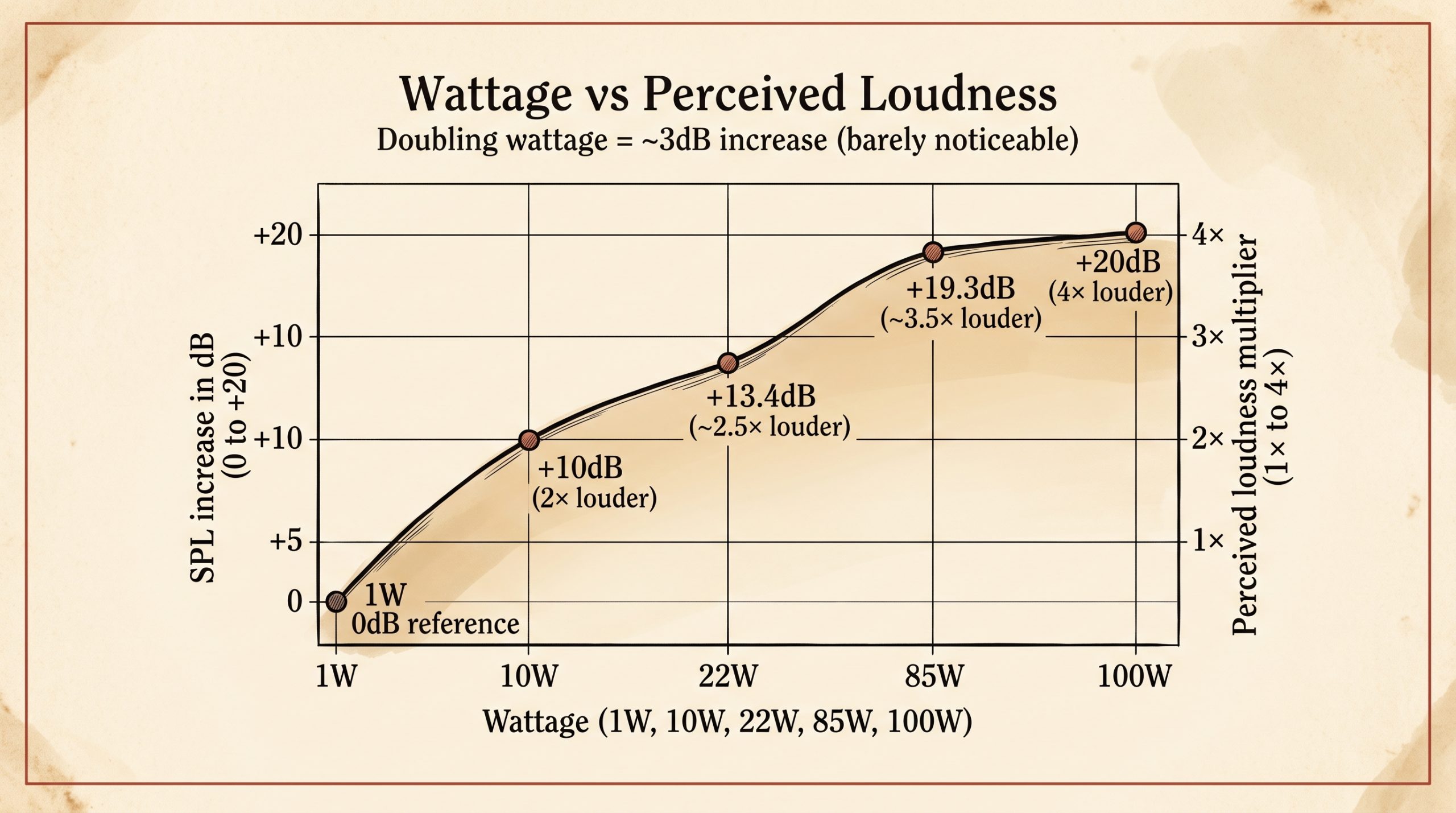
Doubling wattage produces roughly a 3dB increase in sound pressure level, which is barely perceptible to most ears. To double perceived loudness, you need approximately ten times the wattage. The Twin Reverb’s 85 watts is around 5.9dB louder than the Deluxe Reverb’s 22 watts at maximum output. Audible and meaningful on a loud stage. Not the chasm the wattage numbers suggest.
| Wattage | Approx. SPL Increase vs 1W Reference | Perceived Change |
|---|---|---|
| 1W | 0 dB | Reference |
| 10W | +10 dB | 2× as loud |
| 22W | +13.4 dB | ~2.5× as loud |
| 85W | +19.3 dB | ~3.5× as loud |
| 100W | +20 dB | 4× as loud |
Headroom, The Real Difference
Headroom is the volume ceiling before an amp starts to distort. That’s where these two amps genuinely diverge. The Deluxe Reverb’s pair of 6V6 output tubes begins to compress and saturate at moderate stage volumes, producing warm, harmonically dense breakup that responds to pick attack and playing dynamics. The Twin Reverb’s quad of 6L6GC tubes has a higher saturation threshold, at any realistic club or bar volume, the Twin stays clean. Genuinely clean. Spanky attack without a hint of hair.
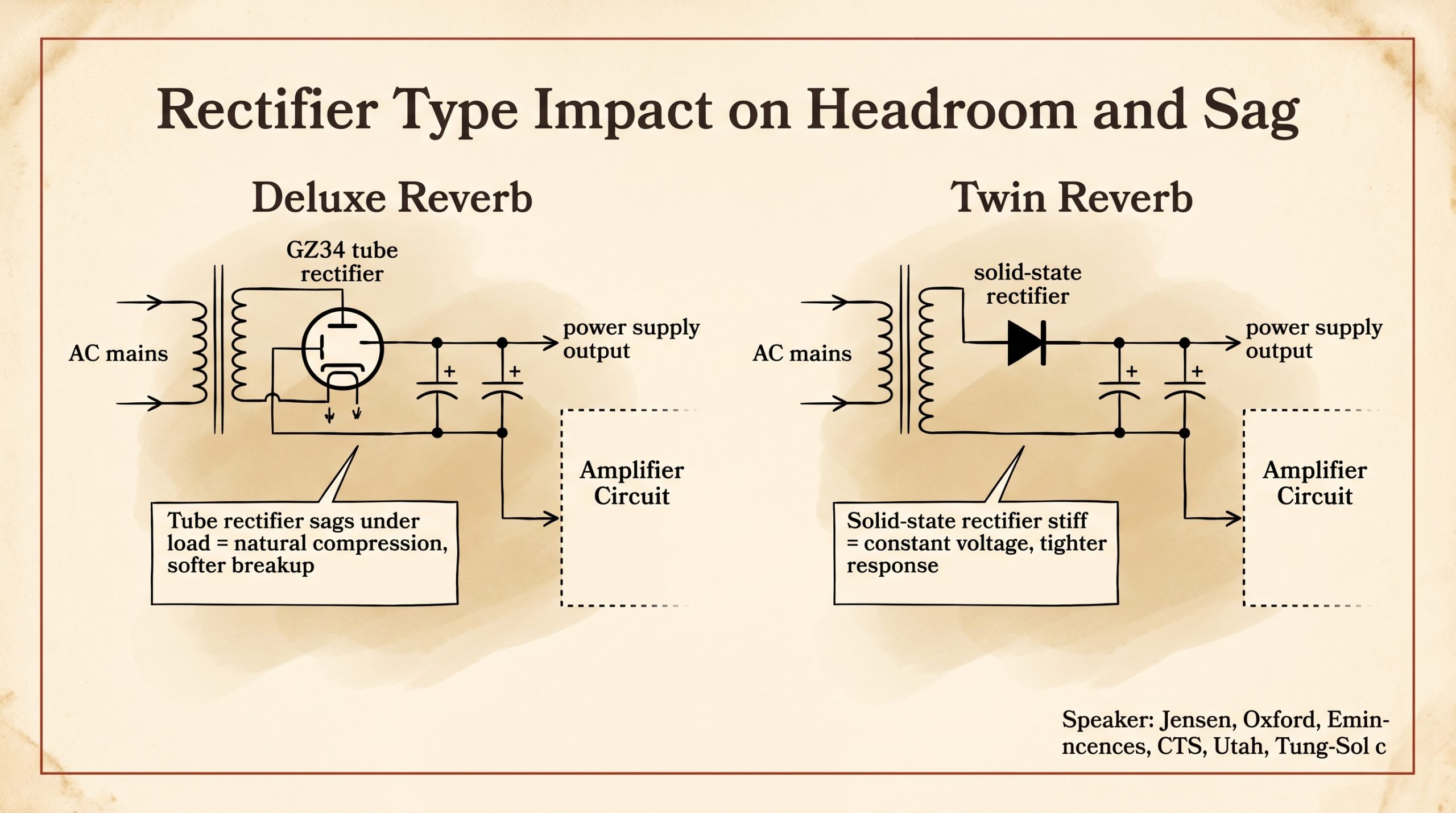
The rectifier difference compounds this. The Deluxe Reverb’s GZ34 tube rectifier introduces voltage sag under high-current demands, that spongy compression that feels musical under a hard pick attack. The Twin’s solid-state rectifier on blackface AA769 and most silverface production runs has zero sag. Tighter, stiffer response. Some players love it. Some find it unforgiving.
For a detailed breakdown of how 6V6 and 6L6 output tubes differ in bias behavior and tonal character, the 6V6 tube guide covers plate dissipation, compression characteristics, and what to expect when substituting between the two families.
Circuit History, Blackface and Silverface Variants You Need to Know
Fender Deluxe Reverb, Circuit Evolution
The Deluxe Reverb entered production in 1963 with the AA763 circuit, which ran through approximately 1965. The AB763 circuit followed from 1965 through 1967, representing the blackface era most collectors target. Both share the GZ34 tube rectifier and cathode-biased output stage. Speaker loading varied by production date, Oxford 12K5-6, Jensen C12N, and CTS 12-inch units all appeared in the chassis during this window. EIA speaker codes stamped on the magnet identify the manufacturer and production week in a 6-digit MMM-YWW format: a code reading 137-732, for example, decodes as CTS (manufacturer code 137), year digit 7, week 32, indicating a CTS speaker from week 32 of 1967.
The silverface era began in 1968; documented schematic revisions include AA1270 (through late 1972) and AA1172 (from December 1972), with a 1977–79 Boost variant also on record. Fender added the aluminum grille trim and, from 1977 onward, a pull-boost switch on the bass knob. Master volume versions appeared in the late 1970s. The general consensus among technicians who’ve traced both circuits, documented in Greg Gagliano’s research series for 20th Century Guitar Magazine, is that later silverface Deluxe Reverbs run somewhat brighter and less compressed than the AB763 blackface versions. The Deluxe Reverb never received the Ultralinear output-transformer treatment Fender applied to the larger Twin Reverb and Pro Reverb chassis, that circuit change is specific to those bigger amps.
Fender Twin Reverb, Circuit Evolution
The blackface Twin Reverb ran on the AB763 circuit through 1967. Four 6L6GC output tubes, solid-state rectifier, and 85 watts into a pair of 8-ohm speakers wired to a 4-ohm load. The presence and bright controls interact with a higher negative feedback (NFB) loop than the Deluxe Reverb, which contributes to the Twin’s flatter, more hi-fi frequency response. Teagle and Sprung note in Fender Amps: The First Fifty Years that the Twin’s higher NFB gives it a more controlled, damped bass response compared to lower-power models in the same era lineup.
The silverface era for the Twin ran from 1968 through 1981 under codes AC568, AA769, and AA270 (Twin Reverb II, a Rivera-designed 105-watt channel-switching amp, is a distinct later product produced 1982–86, not a continuation of the silverface Twin Reverb line). The 1972 through 1976 master-volume Twin (100 watts) is widely considered the least desirable of the silverface variants tonally, owing to circuit modifications that altered the output stage operating point; the true Ultralinear-transformer version, rated 135 watts, followed from 1976 through 1981. Later silverface Twin Reverbs with pull-boost and master volume controls can often be returned closer to blackface performance through modification, though originality-conscious buyers should check for those changes before purchase.
Playing Context, Which Amp Is Right for Your Gig?
The Deluxe Reverb Is Better If…
You play clubs, bars, or small theaters under roughly 300 capacity, especially without full PA support for the guitar amp. The Deluxe Reverb is a player’s amp in the most direct sense: it rewards touch dynamics. Back off your pick attack, it cleans up; dig in, it barks when pushed. At venue volumes where a mic is on the cabinet and going to front-of-house, a Deluxe Reverb at volume 5 can fill a room. The weight difference alone makes it the default working musician’s choice. Roughly 36 pounds versus sixty-seven pounds matters on load-in night after a two-hour drive. Genre fit runs wide: blues, Americana, indie rock, country, and classic rock with a drive pedal in front all live comfortably through a Deluxe.
The Twin Reverb Is Better If…
You need pristine headroom at any stage volume and won’t be satisfied with anything less. Large venues without PA support for the guitar amp, country and jazz settings where sparkle-clean tone is non-negotiable, and complex pedal boards all favor the Twin’s solid-state rectifier and higher power. The Twin is one of the best pedal platforms Fender ever produced. Its stiff power supply, zero-sag response, and wide clean headroom mean incoming pedal signals hit the preamp with full dynamics intact. Surf, country, and jazz players who share backline at festivals or have unpredictable stage volumes should reach for the Twin.
The Paradox, Why the Louder Amp Can Feel More Manageable at Low Volumes
Forum discussions about the Deluxe Reverb vs Twin Reverb at low volumes often produce a counterintuitive observation: players frequently prefer how the Twin sounds at bedroom or rehearsal levels. This isn’t myth. The Twin’s higher NFB loop produces a flatter, more balanced frequency response at low SPL, it sounds more complete with the volume at 2. The Deluxe Reverb’s tone shifts more dramatically as volume climbs because its entire voicing is designed around a moderate-to-high operating point where the 6V6 tubes and GZ34 rectifier are contributing their sag and compression. At low volume, the Deluxe can sound slightly thin and midrange-forward before it reaches its sweet spot. The Twin, paradoxically, delivers a fuller picture at low settings. Not the recommendation most players expect. Worth knowing before you buy.
Pedal Platform Performance, Deluxe Reverb vs Twin Reverb
The Twin’s solid-state rectifier and 85-watt headroom make it the superior pedal platform of the two. Overdrive and fuzz pedals hit the Deluxe’s preamp against an output stage that’s already contributing its own soft-clipping character, stacking multiple drives into a Deluxe can get muddy faster than you’d expect. A clean boost into a Deluxe at volume 6 naturally saturates the output stage; the same boost into a Twin stays clean and adds volume.
Modulation, delay, and reverb pedals preserve their dynamics better into the Twin’s headroom. When the Deluxe is pushed, the amp’s natural compression colors incoming effect signals, sometimes pleasantly, sometimes not. For complex signal chains running delay, multi-drive stages, and wah in sequence, the Twin keeps each layer distinct. For one or two pedals plus amp interaction, the Deluxe Reverb’s natural compression can be a feature rather than a limitation. The choice really does depend on how you build your rig.
Notable Players, Who Used What and Why
Deluxe Reverb Players
Eric Clapton’s association with the Deluxe Reverb spans studio sessions where the amp’s controlled breakup suited the recording environment better than higher-wattage alternatives. Mike Campbell of the Heartbreakers used the Deluxe Reverb as a primary touring amp for years, often running it into a variety of speaker cabinets to scale the output. Neil Young has paired Deluxe Reverbs with other amplifiers in multi-amp rigs, using the amp’s compression character for specific textural roles rather than as a standalone voice.
Twin Reverb Players
Jimi Hendrix used the Twin Reverb during his early US career before relocating to London and transitioning to Marshall stacks. Documented studio sessions from 1966 and early 1967 show Twin Reverb use prior to the Marshall-heavy setup that defined his recorded sound from late 1967 onward. Kurt Cobain’s live rig centered on a Mesa Boogie Studio preamp driving power amps into Marshall cabinets; a Fender Twin Reverb (documented in several equipment guides as a Twin Reverb II) shows up more prominently in his studio work and only occasionally live, rather than as a constant simultaneous three-amp blend. Stevie Ray Vaughan’s rig was built primarily around a pair of Vibroverbs and later a Dumble Steel String Singer; the Twin Reverb had a narrower, more occasional role, most documented on his 1985 Japan tour (used in place of the Dumble) and briefly again in 1987 in place of the Vibroverb combos, rather than running alongside them as a constant three-amp blend.
Deluxe Reverb vs Twin Reverb vs Super Reverb, Where Does the Super Fit?
The Fender Super Reverb sits at 40 to 45 watts between these two models, built around the AB763 circuit family with a GZ34 tube rectifier and a 4×10 speaker configuration. That makes the power spectrum run Deluxe (22W, 1×12) to Super (45W, 4×10) to Twin (85W, 2×12). The Super’s tube rectifier introduces sag similar to the Deluxe, but the four 10-inch speakers, each contributing to the total dispersion, produce a brightness and sparkle that neither the Deluxe’s single 12 nor the Twin’s paired 12s quite replicate. If you want Twin-level projection without the Twin’s solid-state rectifier stiffness and without sacrificing touch sensitivity, the Super Reverb is the answer most players overlook. Fewer people carry them. Heavier than a Deluxe, lighter than a Twin. Not a bad compromise.
Buying Guide, Vintage vs Reissue Pricing and What to Look For
Vintage Market (Blackface and Silverface)
Blackface AB763 Deluxe Reverbs from the 1965 to 1967 window have been trading in the $2,000 to $3,500 range depending on originality, with higher prices for fully original transformers, speaker, and undisturbed capacitors. The critical inspection points are the power transformer EIA code (confirming correct date-range transformer), the speaker code stamped on the magnet, and cap job history, a well-executed re-cap doesn’t reduce value significantly, but a botched recap with wrong-value components does. Original AA763 Deluxes from 1963 to 1965 carry a premium from collectors but aren’t necessarily superior-sounding to AB763 units.
Blackface Twin Reverbs (AB763 and AA769) trade higher in the $2,500 to $4,500 range for originals in good condition. Common issues include worn filter capacitors, reverb tank deterioration, and output transformer fatigue from decades of high-power use. The output transformer in a Twin Reverb takes real stress, confirming its originality via EIA code and checking for thermal discoloration around the laminations is worth the effort before purchase. Silverface versions of both amps generally run lower than blackface equivalents; an AB763-converted silverface Deluxe is a popular modification that brings the circuit closer to blackface spec without blackface pricing.
Reissues and Modern Equivalents
The Fender ’65 Deluxe Reverb Reissue reproduces the AB763 circuit with a Jensen C12K speaker and a solid-state rectifier substituted for the original GZ34. The rectifier change is the most discussed departure from original spec, some players swap in a GZ34 to restore the sag character. Street price runs around $1,100 to $1,300 new. The ’65 Twin Reverb Reissue covers the 85-watt circuit with Jensen C12K pair at a street price around $1,600 to $1,800.
The Tone Master versions replace the tube output stage with DSP modeling. Guitar World’s review of both units notes that the Tone Master Deluxe Reverb uses a 100-watt Class D output stage to simulate the original 22-watt 6V6 design, while the Tone Master Twin Reverb runs 200 watts of solid-state output power to replicate the 85-watt original, the power disparity exists because the digital modeling requires headroom above the simulated clipping point to function accurately. For weight-sensitive touring situations or fly dates where checking a vintage amp isn’t an option, the Tone Master series is a practical solution. For players who want the actual rectifier sag and tube compression of the originals, they don’t substitute. Different tools.
Which Amp Fits Your Gig
The wattage gap between these two amps is real, but the practical implications depend almost entirely on context. The Deluxe Reverb is the right amp for players who want the amp itself to be part of the tone, touch-sensitive, responsive to dynamics, reaching its sweet spot at volumes where a club mic can do the rest of the work. The Twin Reverb is the right amp for players who need a clean, high-headroom platform that stays out of the way of complex pedal rigs or demands pristine sparkle at any stage volume. Both circuits are well-documented and well-supported by the vintage amp community. Both are genuine long-term investments in instruments that don’t go out of fashion. For full production history, date codes, and circuit identification on both models, the Fender Deluxe Reverb complete model guide and the Fender Twin Reverb guide cover the specs you need to buy confidently in either the vintage or reissue market.
Frequently asked questions
Did Jimi Hendrix use a Twin Reverb?
Yes. Documented session and live records from Hendrix's early US career in 1966 and early 1967 show Twin Reverb use as part of his amp setup before he relocated to London. Once in the UK, Marshall stacks became the primary amplification, and by late 1967 the Marshall-heavy rig was established as his signature setup. The Twin Reverb period represents a distinct early phase rather than a sustained long-term relationship with the amp.
What makes a Fender Deluxe Reverb special?
The combination of a 22-watt 6V6 output stage, GZ34 tube rectifier sag, and open-back 1×12 cabinet creates one of the most touch-responsive transitions from clean to breakup in production amplifier history. The AB763 circuit's voicing hits a sweet spot where the amp's natural compression engages at volumes that are actually usable on small to medium stages. It's not an amp that sounds its best with the volume at 2, it opens up from 4 onward, and that's where the reputation comes from.
Did Kurt Cobain use a Twin Reverb?
Occasionally. Cobain's primary live rig centered on a Mesa Boogie Studio preamp into power amps and Marshall cabinets; a Fender Twin Reverb (documented as a Twin Reverb II in several equipment guides) shows up more in his studio work and only occasionally in the live setup, rather than as a constant simultaneous three-amp blend. His approach to amp blending is documented in gear retrospectives covering Nirvana's production setup from the 1991 to 1994 touring period.
What is the Fender Deluxe Reverb equivalent in modern production?
The Fender '65 Deluxe Reverb Reissue is the most direct equivalent, reproducing the AB763 circuit with the most significant departure being the solid-state rectifier substitution. The Tone Master Deluxe Reverb covers the same footprint and feature set with a digital output stage. In the boutique market, Victoria Amplifier's Double Deluxe is a point-to-point-wired interpretation of the circuit. None of them replicate a mint original AB763 exactly, but the reissue is a functional starting point for players who want the platform without vintage-market pricing.
Is the Twin Reverb worth it over the Deluxe Reverb for gigging?
For venues over 300 capacity without full front-of-house PA support for the guitar cabinet, the Twin's headroom is genuinely useful and not overkill. For most bar and club gigs where the amp is mic'd to front-of-house, the Deluxe Reverb at moderate volume through a good mic is sufficient and considerably easier to transport. The roughly 30-pound weight difference is a real consideration for working musicians doing four-nights-a-week gigs. If clean headroom at any practical volume is a non-negotiable requirement, the Twin earns its weight. If touch-sensitive breakup is part of the tone, the Deluxe gets you there without the backache.