Contents
- 01What Is an EIA Speaker Date Code?
- 02The 6-Digit EIA Code Format Decoded
- 03Manufacturer Codes: Oxford, Jensen, CTS, and Others
- 04Reading the Date: Week and Year, Worked Examples
- 05Era Cross-Reference Guide
- 06Red Flags, Edge Cases, and Common Misreads
- 07Using Speaker Codes to Date Your Amp
- 08FAQ: Fender Amp Speaker Date Codes
- 09What to Check First
That six-digit stamp on your speaker basket isn’t just a parts number. It’s a timestamp that can place your amp’s assembly within a two-week window, often more precisely than the serial number alone. Fender serial numbers from the 1950s through the 1970s are notoriously ambiguous, especially during the CBS transition years. Speaker codes give you a second anchor point that holds up to scrutiny.
Fender outsourced speaker manufacturing to three primary suppliers: Oxford, Jensen, and CTS. Secondary suppliers including Utah, Rola, Eminence, and JBL appeared in certain models and eras. All of them stamped to the same EIA (Electronic Industries Alliance) standard. Once you understand the format, you can decode any of them without a lookup tool.
For a broader picture of how speaker codes fit into the full amp dating picture, the Fender tube amp serial number and date code guide covers transformer codes, tube chart stamps, and pot codes in one place.
- Code format: [3-digit manufacturer EIA code][1-digit year][2-digit week]
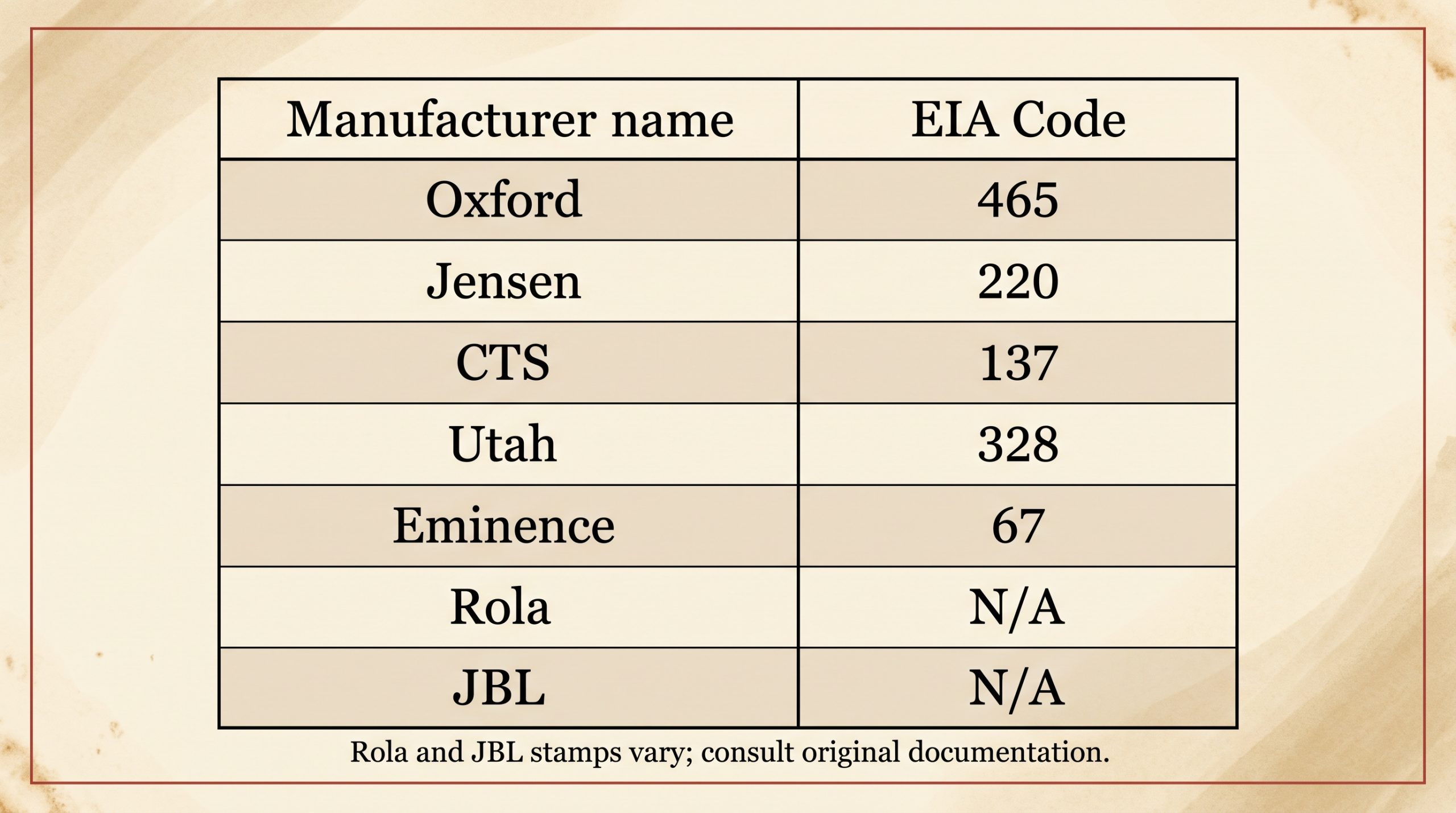
- Oxford EIA code: 465 | Jensen: 220 | CTS: 137 | Utah: 328 | Eminence: 67
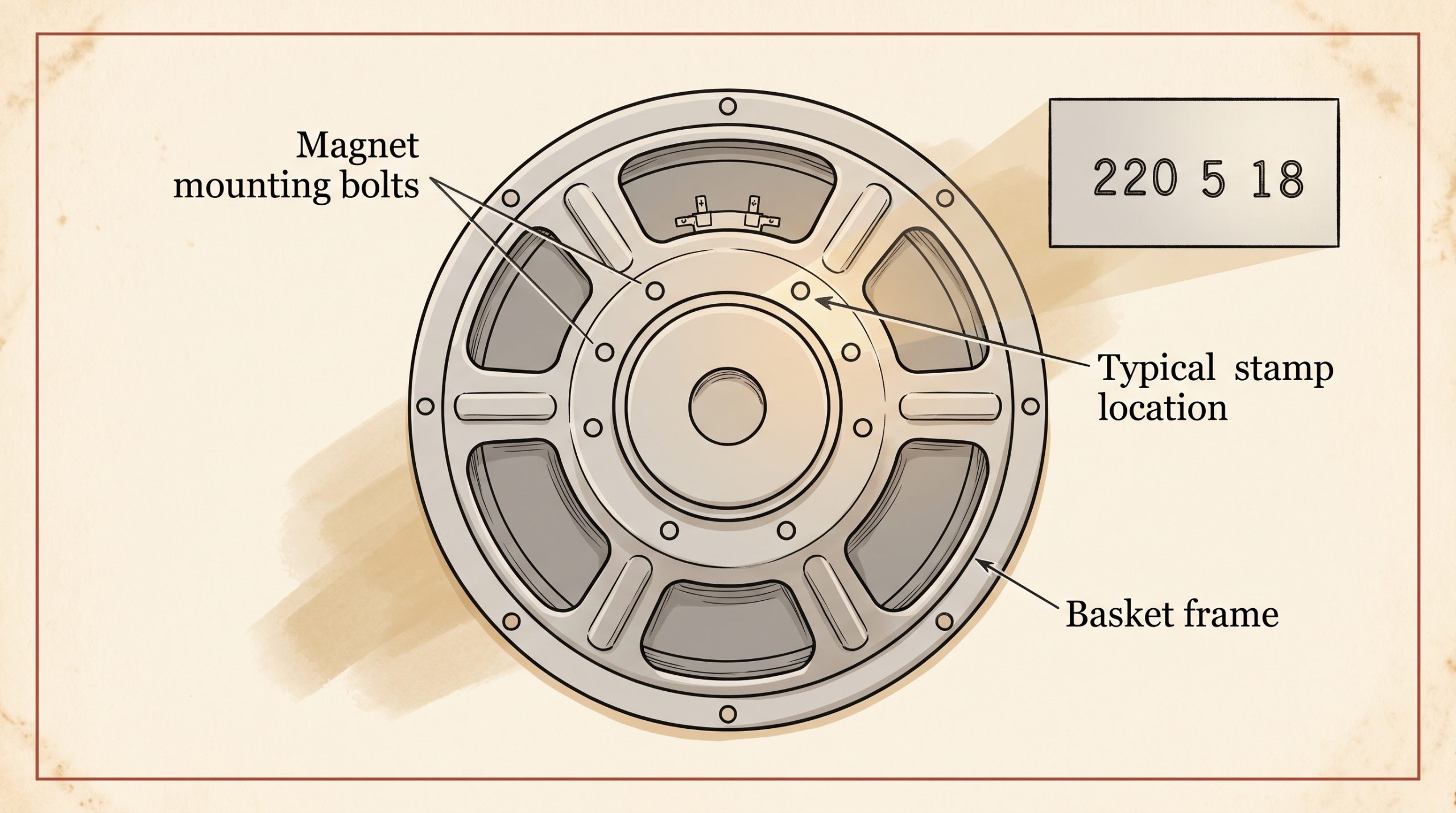
- Stamps found on the speaker frame/basket near the magnet mounting bolts
- The year digit is a single digit (0–9), ambiguous across decades without context
- CTS code 137 also appears on potentiometers, context determines which component it is
- A speaker code that post-dates all other component codes by years signals a replacement speaker
- Reconed speakers retain the original basket and its EIA code, the code no longer reflects a reliable build date
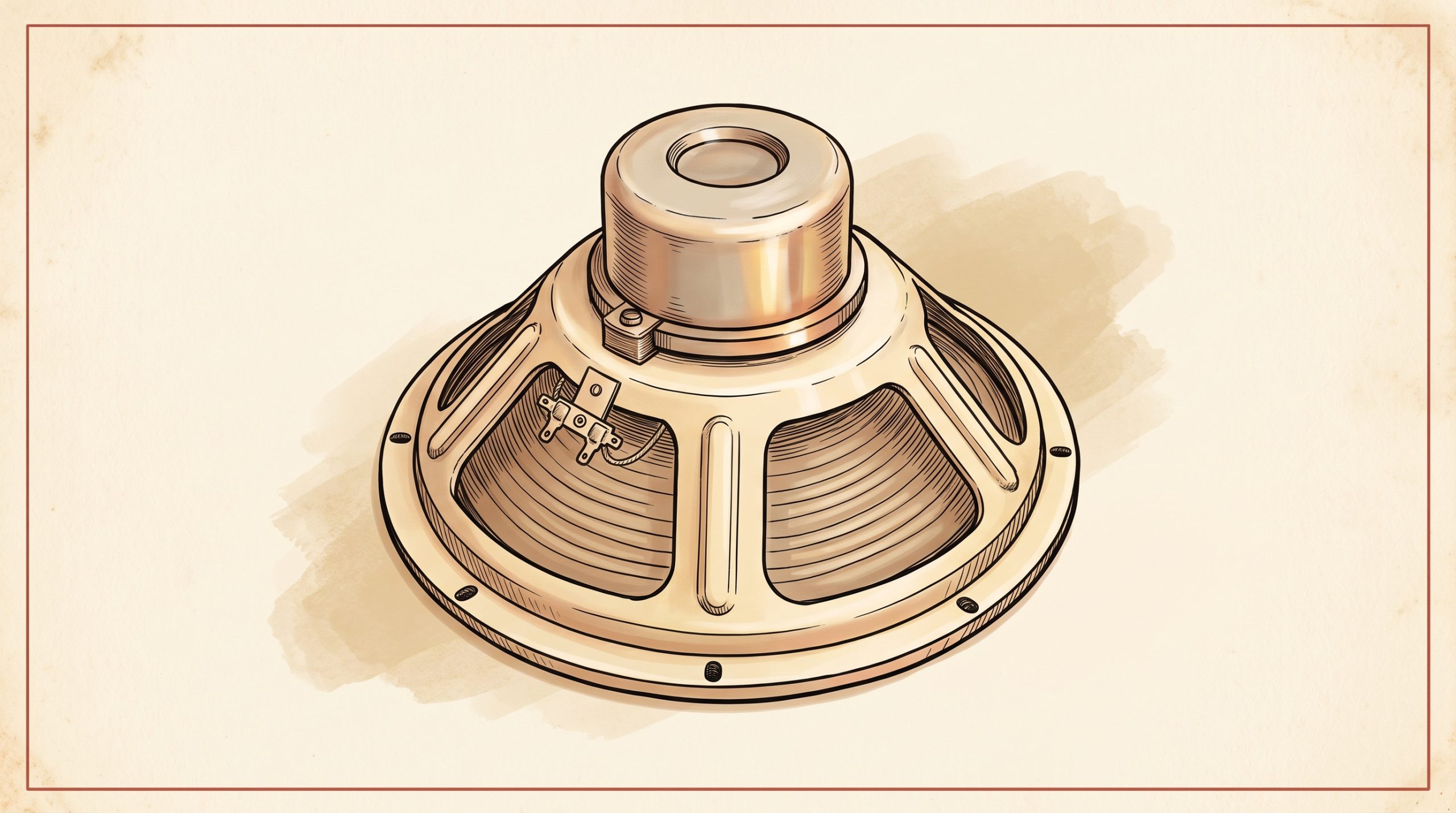
What Is an EIA Speaker Date Code?
The EIA (Electronic Industries Alliance) manufacturer code system was originally established by the Radio Manufacturers Association (RMA) in the late 1940s. The RMA became the EIA in 1957, but the coding convention carried forward unchanged. Every major OEM speaker manufacturer supplying Fender adopted it, which is why a single decoding method works across Oxford, Jensen, CTS, and the rest.
This system isn’t Fender-specific. It’s an industry-wide standard that Fender happened to benefit from because they sourced speakers externally rather than winding them in-house. Modern Fender amps manufactured after 1990 include a QA sticker on the rear chassis with a date code, but that’s a chassis-level stamp, not a speaker-level one. Vintage speakers from the 1950s through the 1980s carry the EIA stamp on the component itself.
Where to Find the Stamp on a Fender Speaker
Oxford and Jensen speakers typically carry an ink stamp or embossed impression on the frame near the magnet mounting bolts, on the rear face of the basket ring. CTS speakers often appear on a small paper label glued to the basket and may also be embossed into the metal frame itself. Utah stamps are on the rear of the basket and run faint more often than not.
A flashlight held at a low raking angle is your best tool. Solder flux residue and decades of grime collect in exactly the spots where the stamp sits. Don’t clean before you photograph. Cleaning can degrade a marginal stamp further, and once it’s gone, it’s gone.
Replacement speakers are a constant complication. An aftermarket speaker dropped in during a 1970s repair will carry a code from that era even in a 1963 Princeton. That’s a red flag for originality, not a feature.
The 6-Digit EIA Code Format Decoded
The structure is consistent across all manufacturers that used the EIA system:
[3-digit MFR code] [1-digit year] [2-digit week]
       465               6              32
  = Oxford          = 1966        = Week 32 (early August)
Digits one through three identify the manufacturer. Digit four is the year, expressed as a single digit. Digits five and six are the production week of that year, running from 01 through 52 (occasionally 53 in long calendar years).
The Single-Digit Year Problem
This is the part that trips people up. Not great for a system meant to prevent ambiguity.
The year digit “6” could mean 1956, 1966, or 1976. There is no way to determine the decade from the speaker code alone. You resolve it by cross-referencing with everything else you know about the amp: the chassis style, the circuit number, the tube chart stamp, the cabinet construction, and the pot codes. A “6” on an Oxford speaker in a blackface Deluxe Reverb with an AA763 circuit number means 1966, not 1956 or 1976. Context does the work.
| Year Digit | Possible Years | Resolve With |
|---|---|---|
| 0 | 1950, 1960, 1970 | Amp era, pot codes |
| 1 | 1951, 1961, 1971 | Chassis style |
| 2 | 1952, 1962, 1972 | Tweed vs. blackface cabinet |
| 3 | 1953, 1963, 1973 | Transformer code |
| 4 | 1954, 1964, 1974 | Circuit number |
| 5 | 1955, 1965, 1975 | Tube chart stamp |
| 6 | 1956, 1966, 1976 | Cabinet construction |
| 7 | 1957, 1967, 1977 | Grille cloth style |
| 8 | 1958, 1968, 1978 | Knob style |
| 9 | 1959, 1969, 1979 | Speaker brand context |
The 2-Digit Week Code
Week 01 is the first full week of January. Week 52 (or 53) is late December. A practical worked example: 465 632 decodes as Oxford (465), year digit 6, week 32. Week 32 runs approximately August 8–14 in most years. Combined with a blackface circuit context, that places it at early August 1966.
| Week Range | Approximate Month |
|---|---|
| 01–04 | January |
| 05–08 | February |
| 09–13 | March |
| 14–17 | April |
| 18–21 | May |
| 22–26 | June |
| 27–30 | July |
| 31–35 | August |
| 36–39 | September |
| 40–43 | October |
| 44–47 | November |
| 48–52 | December |
Manufacturer Codes: Oxford, Jensen, CTS, and Others
Each supplier’s EIA code is fixed and permanent. Knowing the three-digit prefix tells you immediately who built the driver, which in turn tells you a lot about what you’re hearing tonally and what to expect from the cone if it needs work.
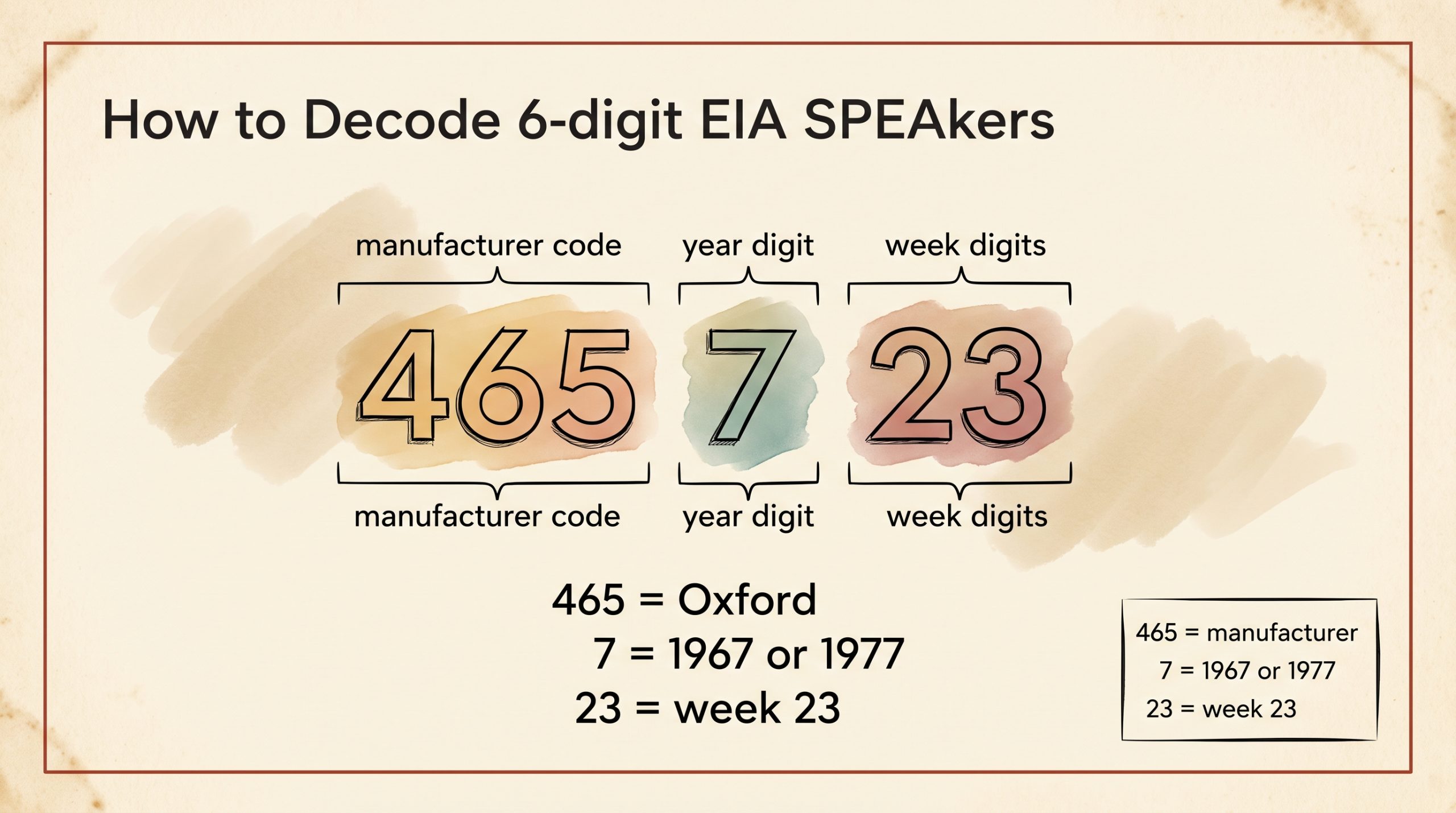
Oxford Speakers, EIA Code 465
Oxford Speaker Co. was based in Chicago, Illinois. The company became a major Fender supplier starting in the early 1960s and dominated mid-to-late blackface and silverface production.
Oxford speakers carried a reputation for a looser, warmer tone compared to Jensen alnico drivers. Thinner cone material contributes to a more compliant low end and slightly earlier cone breakup. Not everyone’s preference, but players chasing that slightly spongy compression in a blackface Deluxe Reverb are often hearing Oxford character specifically.
Common Fender applications using Oxford drivers:
- Oxford 10J4, Champ (5F2-A, AA964 circuits), Princeton
- Oxford 12M6, Deluxe Reverb (AA763, AB763, AB868 circuits), Vibrolux
- Oxford 12L6, documented in period listings on Deluxe Reverb and Bandmaster chassis (not Twin Reverb — see the Twin Reverb speaker chart below)
Pre-1957 Oxford stamps (RMA era) may appear shallower due to different embossing dies. If you encounter a stamp that reads like an Oxford code but the impression is faint and two-digit, you’re likely looking at a very early 1950s example.
Jensen Speakers, EIA Code 220
Jensen Manufacturing Co. was based in Chicago, Illinois, and served as Fender’s dominant OEM speaker supplier from approximately 1948 through 1966. Jensen ceased loudspeaker production in the late 1960s. Modern “Jensen” speakers sold today are manufactured in Italy and have no manufacturing lineage to the original Chicago operation. A vintage Jensen basket will carry the 220 EIA code. An Italian reissue will not.
Identification beyond the code: vintage Jensen cones typically feature a gray or silver dust cap. Reissue dust caps are bright white. That visual alone can save you from paying a premium for a non-original driver.
Common Fender applications:
- Jensen P10R, Princeton, Tremolux (tweed and early brownface)
- Jensen P12R / P12N, Bassman (5F6-A), Twin (tweed and early brownface)
- Jensen C12N, Blackface Super Reverb, Concert
The P-series designates alnico magnet construction. The C-series designates ceramic. Alnico Jensens have higher sensitivity, more tactile attack, and break up earlier under high SPL. Ceramic Jensens hold together cleaner at stage volume and deliver stiffer bass response. Both are desirable depending on context, but they’re not interchangeable for tonal purposes.
Some early 1950s Jensens were identified only via a paper label rather than a basket emboss. Label survival rate after 70-plus years is low. If the basket is clean of any stamp and a paper label is missing, provenance gets harder to establish.
CTS Speakers, EIA Code 137
Chicago Telephone Supply Co. (CTS) operated out of Elkhart, Indiana, and became a major Fender supplier from the mid-1960s through the silverface era. CTS also manufactured potentiometers, which creates a consistent source of confusion: the same three-digit EIA code, 137, appears on both CTS pots and CTS speakers. The component itself tells you which it is. Decoding the date works identically for both: [137][year digit][week digits].
CTS speakers generally run brighter and stiffer than Jensen alnico drivers. The vintage community’s criticism of silverface-era CTS speakers as “thin” compared to blackface-era Jensens has some basis in cone construction differences, but CTS drivers offer genuine advantages for clean headroom at stage-loud volumes. A silverface Princeton Reverb that refuses to ice-pick you in a small room owes some of that to the CTS 10-inch ceramic.
Common Fender applications:
- CTS 10″ ceramic, silverface Princeton Reverb (AA1164, AB1270 circuits)
- CTS 12″ ceramic, silverface Deluxe Reverb, Vibrolux Reverb
- CTS 15″, Bassman 50/100 (silverface era)
Secondary Manufacturers
| Manufacturer | EIA Code | Era Used by Fender | Common Applications |
|---|---|---|---|
| Utah | 328 | 1950s–mid 1960s | Some tweed and brownface models |
| Rola | 285 | Early 1960s | Occasional brownface production |
| Eminence | 67 | 1970s–present | Late silverface, reissue models |
| JBL | 73 | 1960s–1970s | Factory option: Twin Reverb, Showman |
JBL codes follow a slightly different format and JBL speakers were typically a factory-installed option rather than a standard fitment. Utah stamps occasionally appear as two-digit codes in early RMA-era production runs. Treat any two-digit prefix with extra caution and cross-reference heavily against other component dates.
Reading the Date: Week and Year, Worked Examples
Step-by-Step Decode Walkthrough
Example 1: 220 638
- 220 = Jensen
- 6 = year digit
- 38 = week 38
- Context: blackface Twin Reverb (AB763 circuit) = year is 1966, week 38 = mid-September 1966
Example 2: 137 412
- 137 = CTS
- 4 = year digit
- 12 = week 12
- Context: silverface Princeton Reverb (AA1164 circuit, introduced 1968) = year is 1974, week 12 = late March 1974
Example 3: 465 230
- 465 = Oxford
- 2 = year digit
- 30 = week 30
- Context: tweed-era Champ = year is 1952, week 30 = late July 1952
Cross-Referencing Speaker Codes with Pot and Transformer Codes
CTS potentiometers use EIA code 137, the same as CTS speakers. The date decodes identically: [137][year digit][week]. Transformer codes work the same way but with different manufacturer prefixes. Schumacher transformers carry EIA code 606. Triad transformers carry 022. A Schumacher output transformer stamped 606 620 decodes as Schumacher, year digit 6, week 20, approximately mid-May 1966 in a blackface context.
As Premier Guitar’s Ask Amp Man column documents, every component in a vintage Fender should show consistent production dates for the amp to be considered unmodified. A 1965 amp should show component dates from 1964 or 1965 across pots, transformers, and speaker. When one date sits well outside that window, you’ve found something worth investigating.
The rule that makes all of this work: the latest date code among all five components establishes the earliest possible assembly date. If a speaker is dated week 38 of 1966 but the transformer is dated week 12 of 1966, the amp couldn’t have left the factory before week 38. A speaker date that pre-dates everything else by six to eighteen months is also plausible, Fender occasionally ran new-old-stock drivers from the previous model year during production slowdowns.
Era Cross-Reference Guide
Era Classification by Speaker Brand
| Fender Era | Years | Dominant Speaker Brand | EIA Code | Typical Models |
|---|---|---|---|---|
| Tweed | 1948–1960 | Jensen (alnico) | 220 | Bassman 5F6-A, Champ 5F1, Deluxe 5E3 |
| Brownface | 1959–1963 | Jensen / Oxford | 220 / 465 | Princeton 6G2, Vibrolux 6G11 |
| Blonde | 1963–1964 | Oxford / Jensen | 465 / 220 | Bassman 6G6-B, Concert 6G12 |
| Blackface | 1963–1967 | Oxford / Jensen / CTS | 465 / 220 / 137 | Deluxe Reverb AA763, Twin Reverb AB763 |
| CBS Transition | 1965–1968 | Mixed | Multiple | Mixed supplier usage throughout |
| Silverface | 1967–1981 | CTS / Oxford / Eminence | 137 / 465 / 67 | Princeton Reverb AA1164, Deluxe Reverb AB868 |
The CBS transition years (1965–1968) are the messiest era for speaker identification. Fender’s supplier mix was genuinely in flux, and production records don’t always clarify which speaker went into which specific chassis. Multiple suppliers shipped simultaneously, and cost-driven substitutions were common. A blackface-era Deluxe Reverb from 1967 might carry a CTS where a collector expects an Oxford. That’s not wrong, it’s just the reality of that period.
Circuit Number to Speaker Cross-Reference
| Circuit Number | Model | Era | Original Speaker | EIA Code |
|---|---|---|---|---|
| AA763 | Deluxe Reverb | Blackface | Oxford 12M6 | 465 |
| AB763 | Deluxe Reverb | Blackface | Oxford 12M6 | 465 |
| AA1164 | Princeton Reverb | Silverface | CTS 10″ ceramic | 137 |
| AB1270 | Princeton Reverb | Silverface | CTS / Oxford | 137 / 465 |
| AB763 | Twin Reverb | Blackface | Jensen C12N (x2) | 220 |
| AB763 | Bandmaster Reverb | Blackface | Oxford 12M6 | 465 |
| AB868 | Deluxe Reverb | Silverface | Oxford 12M6 | 465 |
For circuit-level detail on the AA763 and AB763 Deluxe Reverb, the Fender Deluxe Reverb complete guide covers both blackface variants with production timelines. For AA1164 and AB1270 Princeton Reverb dating, the Princeton Reverb guide includes speaker and component breakdowns by year.
Red Flags, Edge Cases, and Common Misreads
When the Speaker Code Doesn’t Match the Amp
Replacement speakers are the most common explanation for a code mismatch. Most vintage Fender amps have had at least one speaker-related service event over 50-plus years. A code that post-dates all other component codes by a decade is almost certainly a replacement. Not a problem for players, but it matters significantly for originality-based valuation.
NOS speaker installations are the legitimate exception. Fender did install new-old-stock speakers during production slowdowns, meaning a speaker date can legitimately pre-date the chassis assembly by up to 18 months without indicating anything unusual. If the speaker date is earlier than pot and transformer codes, that’s within normal range.
Reconed speakers are a subtler complication. A recone replaces the cone, voice coil, and spider while leaving the original basket intact, including its EIA stamp. The basket still reads as a 1965 Oxford. The cone is from 2003. The code no longer accurately represents the speaker’s functional components. Look for recone service labels on the inside of the cabinet or on the speaker’s rear gasket area. Original cones typically show age-appropriate discoloration and brittleness at the surround.
Very early RMA-era stamps (pre-1954) occasionally used two-digit manufacturer codes rather than three. Treat these with caution and require additional corroborating evidence before dating conclusions.
Legibility Issues
Rust and oxidation on steel baskets are common on amps that have been stored in humid environments. A soft brass wire brush (never steel) can remove surface oxide without further damaging a marginal stamp. Always photograph before cleaning. If the stamp is visible at all in a photograph, boost the shadows in your image editor before deciding it’s illegible. A raking light source and RAW format capture reveals stamps that appear completely invisible under direct flash.
Record all digits before any cleaning or restoration work begins.
Using Speaker Codes to Date Your Amp
The 5-Point Dating Checklist
Speaker codes don’t work in isolation. They’re one anchor in a five-point system. Use all five before drawing conclusions.
- Tube Chart Date Stamp, ink-stamped inside the back panel; format is two letters where the first letter = year and the second = month (for example, OG = July 1965, per Fender’s documented tube chart coding system). Fender used this system from 1953 through 1970.
- Potentiometer Code, CTS pots carry EIA code 137; format decodes as [137][year digit][week], identical to CTS speaker codes.
- Speaker EIA Code, the system covered in this article.
- Output Transformer Code, Schumacher (EIA 606), Triad (EIA 022); same year-digit/week format.
- Power Transformer Code, same manufacturers; cross-reference the date against the speaker and pot codes.
The rule that holds across all five points: the latest date code among all five components is the earliest possible assembly date. A single late-dated component pushes your entire timeline forward.
Documentation Best Practices
Photograph every code before any restoration work. A spreadsheet with columns for component, location, raw stamp digits, decoded manufacturer, decoded year, and decoded week takes fifteen minutes to build and eliminates ambiguity later. If you’re dealing with an amp that may have collector-level value, submit your findings to the Vintage Amp Registry (vintageampregistry.com) for community corroboration. Cross-referencing your data against documented examples in Greg Gagliano’s research archive (available via the Wayback Machine archive of 20th Century Guitar Magazine) provides additional context that’s hard to get elsewhere.
What to Check First
If you’re standing in front of a vintage Fender amp and have five minutes to establish a build date, start with the tube chart stamp inside the back panel. It’s typically the most legible and gives you an immediate year-and-month anchor. Then pull the speaker and decode the EIA stamp. If those two dates align within a few weeks to a few months, you’ve got a strong case for originality. If they’re years apart, the speaker has likely been changed, and you need to keep looking. The full Fender amp dating framework, including transformer codes, chassis stamps, and pot codes, is documented in the Fender amp dating cheatsheet for quick reference across all eras. Speaker codes are one reliable piece of a system that works best when all five data points are checked together. No single stamp tells the complete story.
Frequently asked questions
How do you read a speaker code on a Fender amp?
Locate the 6-digit EIA stamp on the speaker basket, typically near the magnet mounting bolts. Split it as [3-digit manufacturer code][1-digit year][2-digit week]. Use the first three digits to identify the maker: 465 is Oxford, 220 is Jensen, 137 is CTS. The fourth digit is the production year (ambiguous across decades, resolve with amp era and other component codes). Digits five and six are the production week of that year, running 01 through 52.
What is the EIA code for Jensen speakers?
Jensen's EIA manufacturer code is 220. Any stamp beginning with 220 on a Fender speaker confirms it's a Jensen-manufactured driver from the original Chicago factory. Modern "Jensen" reissue speakers are produced in Italy and do not carry the 220 code. The visual distinction is also useful: original Jensen cones have a gray or silver dust cap; Italian reissue cones use a bright white dust cap.
What does the CTS code 137 mean on a Fender pot versus a speaker?
EIA code 137 belongs to Chicago Telephone Supply (CTS), which produced both potentiometers and speakers for Fender. The same 137 prefix appears on both components, which causes confusion regularly. The component itself tells you what you're looking at. The date decodes identically for both: [137][year digit][week]. On a potentiometer shaft housing, it's a pot code. On a speaker basket or paper label, it's a speaker code.
Can speaker date codes be used to spot a fake or refinished vintage Fender amp?
Yes. A speaker code that significantly post-dates all other component codes is a strong indicator of a replaced driver, which is common in amps "restored" for resale at a premium. An authentic, all-original amp typically shows speaker dates within four to eight weeks of pot and transformer dates. A speaker dated 1978 in an amp with 1965 pots and transformer codes is almost certainly a replacement, regardless of what the seller says about the amp's history.
What speakers did Fender use in blackface amps?
Blackface-era Fender amps (1963–1967) primarily used Oxford (EIA 465) and Jensen (EIA 220) speakers depending on the specific model and year. CTS began appearing in some blackface models by 1966–1967 as the CBS acquisition progressed and supplier contracts shifted. Oxford 12M6 drivers were standard in the AA763 and AB763 Deluxe Reverb circuits. Jensen C12N drivers appeared in the Concert and Super Reverb. The era cross-reference table above maps circuit numbers to specific speakers. For the Twin Reverb's AB763 circuit, two Jensen C12N drivers were standard fitment through the blackface run, with JBL D120F available as a factory option.