Contents
- 01Why Dating a Fender Amp Is More Complicated Than It Looks
- 02Step 1, Identify the Era by Appearance (Visual Triage)
- 03Step 2, Read the Tube Chart Date Code (Pre-1967 Amps)
- 04Step 3, Decode the Transformer EIA Codes (All Eras)
- 05Step 4, Check the Serial Number
- 06Step 5, Verify With Chassis Stamps and Circuit Board Codes
- 07Putting It All Together, The Verification Matrix
- 08Era-Specific Shortcuts and Common Dating Pitfalls
- 09Quick Reference, How to Date a Fender Guitar
- 10FAQ, Frequently Asked Questions About Fender Amp Dating
- 11Tools and Resources for Dating Your Fender Amp
- 12Your Next Step
If you’re standing in front of a vintage Fender at a garage sale, an estate auction, or a dealer’s floor and someone tells you it’s a “pre-CBS blackface,” you need more than their word. The difference between a genuine 1964 Deluxe Reverb and a silverface conversion can be hundreds of dollars in either direction. Knowing how to date a Fender amp yourself, using the physical evidence on and inside the amp, is the only way to verify those claims with any confidence.
Fender used different dating systems across different eras, and no single method works for every amp. This guide walks through all of them in a logical five-step sequence covering every production era: tweed (early 1950s through 1960), brownface (1960 through 1962), blonde (1962 through 1963), blackface (1963 through 1967), silverface (1967 through 1981), and post-1990 modern production. As documented at Premier Guitar’s vintage buying guide, the age of a Fender amp is determined by examining the tube chart, chassis serial number, and manufacturer codes on transformers and other internal components together, not in isolation.
- Step 1: Visual triage, identify era by cabinet covering, grille cloth, and control panel position
- Step 2: Read the two-letter tube chart date code (most reliable for pre-1967 amps)
- Step 3: Decode all transformer EIA codes, use the latest date as assembly reference
- Step 4: Check the serial number against era-specific reference ranges
- Step 5: Look for chassis ink stamps and circuit board codes to confirm
- Pre-CBS cutoff: Fender sold to CBS on January 5, 1965, amps before this date command a premium
- Serial number alone is the least reliable dating method across all eras
- Silverface amps converted to blackface appearance are common, visual triage alone is not enough
- Replaced transformers show date codes dramatically out of range versus the other three components
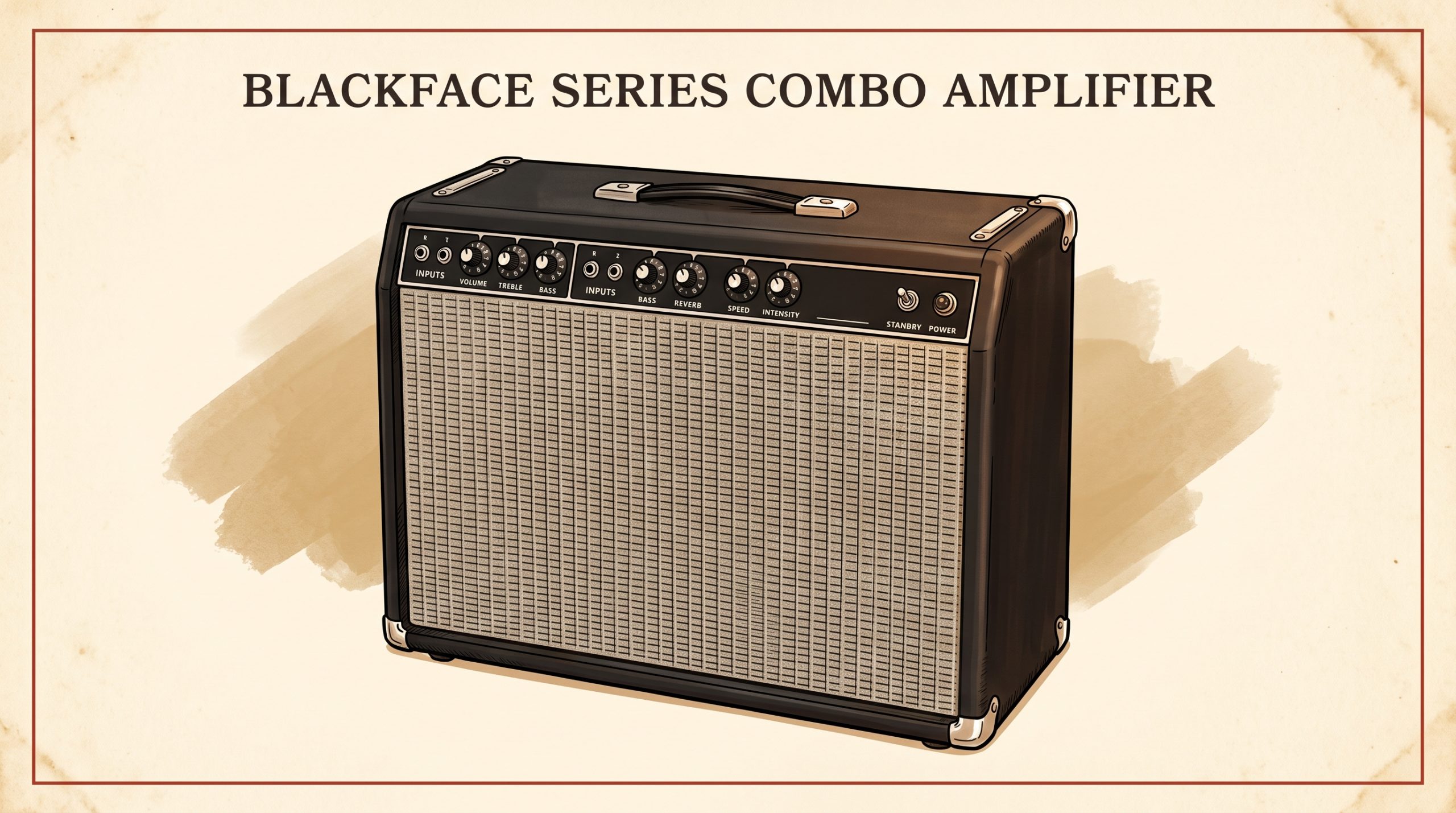
Why Dating a Fender Amp Is More Complicated Than It Looks
Fender ran a production-line operation, not a boutique shop. Parts were ordered in bulk, stored in bins, and pulled for assembly in no guaranteed chronological order. A transformer manufactured in week 23 of a given year could sit in a parts bin for six weeks before being installed in an amp. That amp might then sit in a warehouse for another month before shipping. None of this was unusual. It was standard manufacturing practice.
The result: the speaker code, transformer codes, and tube chart code on a single amp often disagree by several weeks, sometimes by two or three months. That’s normal. It doesn’t mean something is wrong or non-original. What it means is that you’re looking at the natural spread of a batch-production supply chain.
For pre-1967 amps, the tube chart two-letter date code is the most reliable single source. Greg Gagliano’s documentation series in 20th Century Guitar Magazine (1997 through 2000, archived via Wayback Machine) consistently identified the tube chart stamp as the primary dating anchor for tweed, brownface, and blackface production. For silverface amps (1967 through 1981), tube charts are often absent or blank. Transformers and chassis stamps become the primary evidence. Post-1990 amps carry a QA sticker with a direct date code that removes ambiguity entirely.
The key mental shift: you’re establishing a date range, not an exact date. Two or more sources that agree on the same month and year give you a confident identification. One source in isolation gives you a reasonable estimate. Understanding that distinction upfront saves a lot of frustration when the codes don’t line up perfectly.
Fender amp date codes are the foundation of all serious vintage valuation, and the Fender tube amp dating reference guide covers the full range of these code systems across every production era if you need a deeper lookup resource alongside this walkthrough.
Step 1, Identify the Era by Appearance (Visual Triage)
Before opening the back panel or pulling the chassis, a quick visual inspection narrows the date range by a decade or more. Not definitive. But fast, and it tells you which dating methods to focus on next.
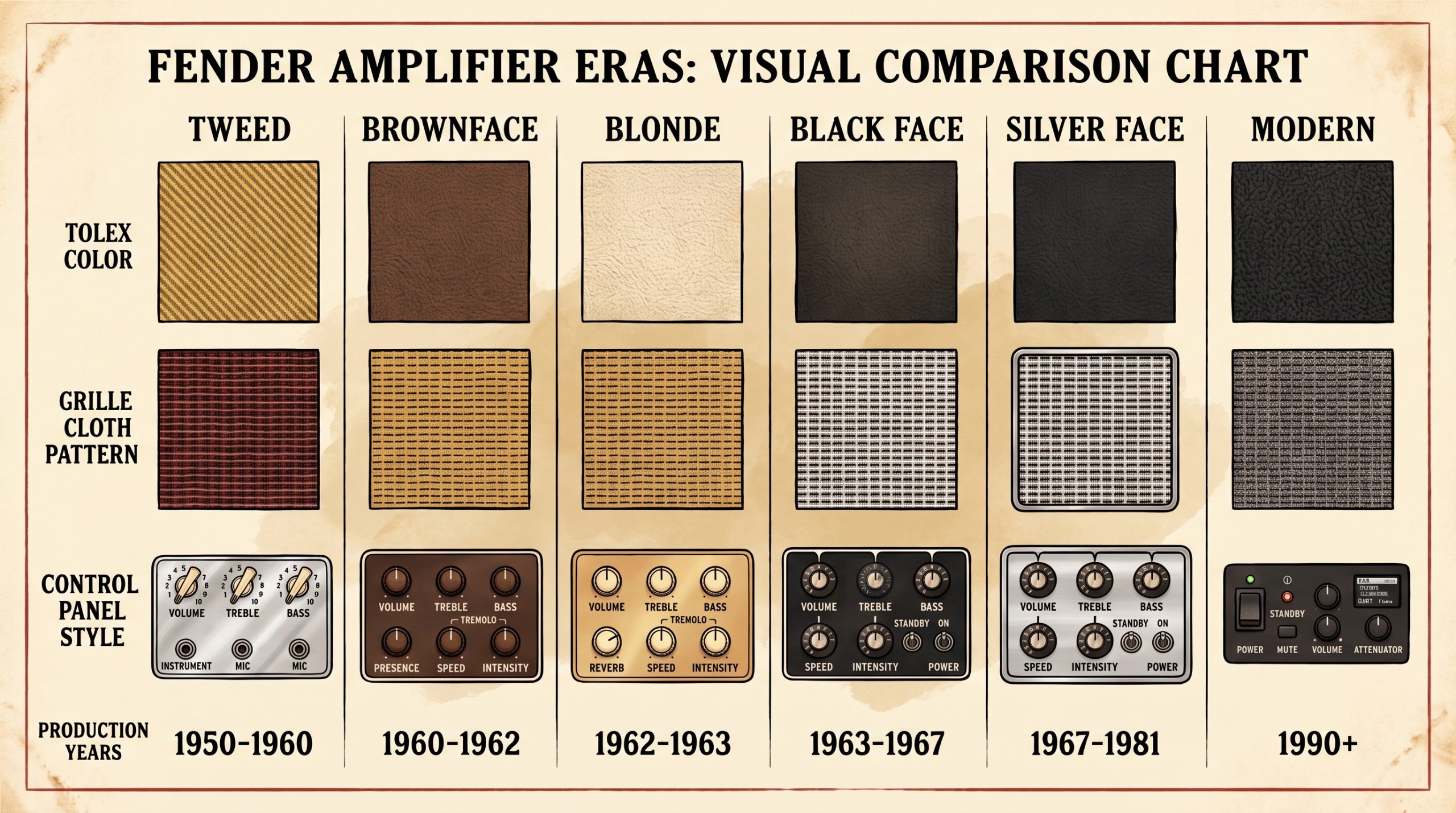
| Era | Years | Cabinet Covering | Grille Cloth | Control Panel | Distinguishing Detail |
|---|---|---|---|---|---|
| Tweed | 1948–1960 | Lacquered tweed | Brown/tan weave | Top-mounted | Script logo, no reverb |
| Brownface | 1960–1962 | Brown tolex | Brown/gold weave | Top-mounted | Skirted knobs, transition circuits |
| Blonde | 1962–1963 | Blonde tolex | Oxblood/tan weave | Top-mounted | Overlap with brownface on some models |
| Blackface | 1963–1967 | Black tolex | Silver/blue weave | Front-mounted | Black aluminum panel, no drip edge |
| Silverface | 1967–1981 | Black tolex | Silver/blue weave | Front-mounted | Silver/aluminum panel; drip edge on 1967–1969 |
| Modern | 1990–present | Varies by model | Varies by model | Front-mounted | QA sticker on rear chassis |
A few caveats worth knowing before you act on a visual ID alone. Some late-1962 amps are hybrid blonde/brownface builds, with one era’s cabinet and another era’s chassis. The drip-edge silverface (roughly 1967 through 1969) looks silverface cosmetically but sometimes retains AB763 blackface circuit internals. And re-covering is common on old amps. A tolex swap is a $200 job at any amp tech. Visual triage tells you where to look next, not what you’ve found.
Step 2, Read the Tube Chart Date Code (Pre-1967 Amps)
This is the single most reliable dating method for tweed, brownface, blonde, and blackface amps. The tube chart is a printed card glued inside the cabinet, usually visible when you open the back panel or partially pull the chassis. It shows which tubes go in which sockets and carries a two-letter date code stamp applied at the time of assembly.
How the Two-Letter Code Works
The first letter identifies the year. The second letter identifies the month. Both run alphabetically from A onward. Decode them separately, then combine.
- OB = O (1965) + B (February) = February 1965
- HH = H (1958) + H (August) = August 1958
- LK = L (1962) + K (November) = November 1962
- NA = N (1964) + A (January) = January 1964
The stamp reflects assembly date, not ship date. An amp could sit in a Fullerton warehouse for several weeks after the tube chart was stamped. Don’t treat the code as the date the amp left the building.
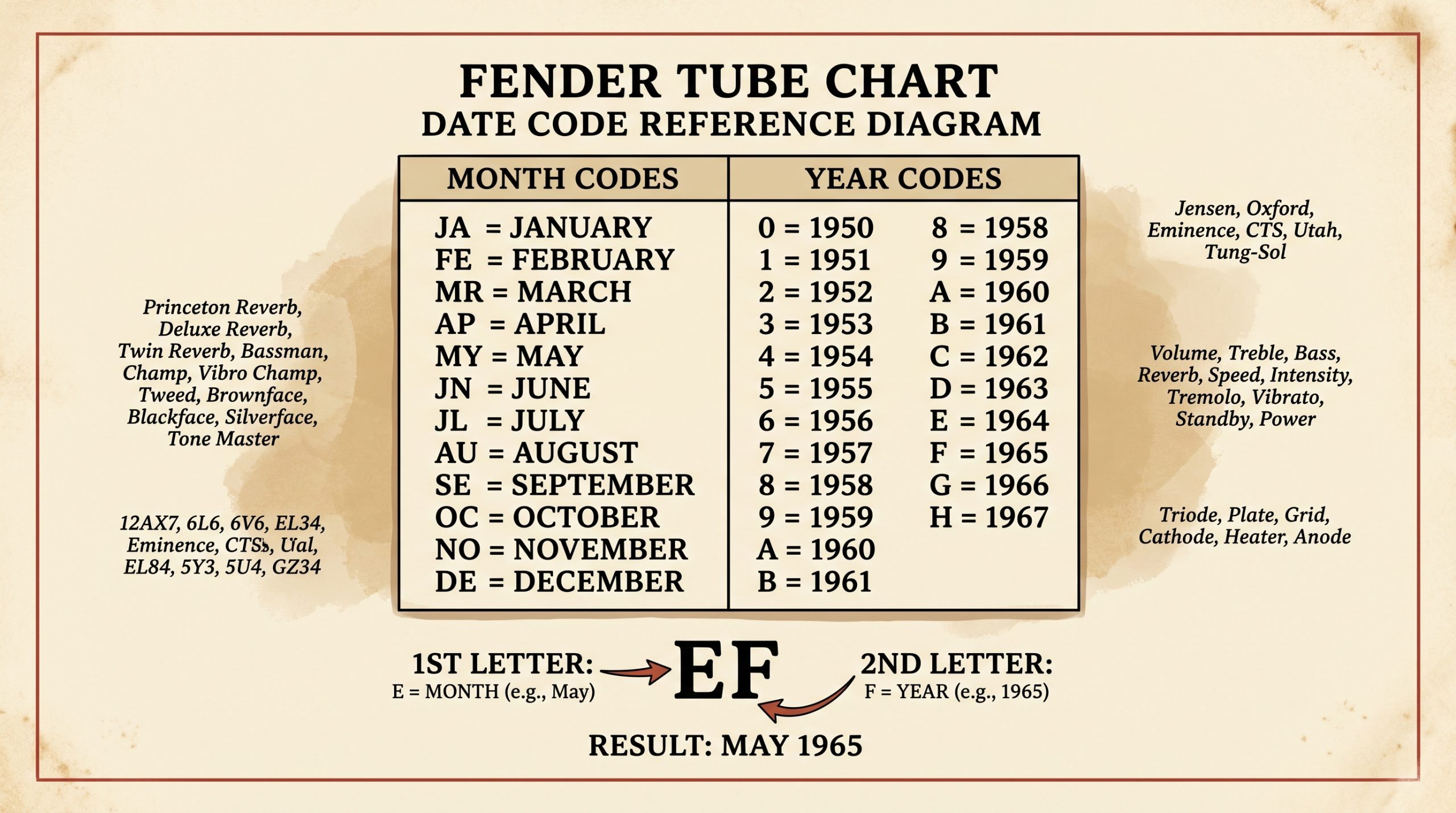
Complete Tube Chart Date Code Reference
| First Letter | Year | Second Letter | Month |
|---|---|---|---|
| A | 1951 | A | January |
| B | 1952 | B | February |
| C | 1953 | C | March |
| D | 1954 | D | April |
| E | 1955 | E | May |
| F | 1956 | F | June |
| G | 1957 | G | July |
| H | 1958 | H | August |
| I | 1959 | I | September |
| J | 1960 | J | October |
| K | 1961 | K | November |
| L | 1962 | L | December |
| M | 1963 | ||
| N | 1964 | ||
| O | 1965 | ||
| P | 1966 | ||
| Q | 1967 |
One known source of misreads: the letter “I” (September) is sometimes visually confused with “J” (October) on worn or partially inked stamps. If your decoded date feels slightly off given the amp’s other characteristics, check whether an I/J confusion could account for the discrepancy.
Silverface amps (post-1967) frequently have blank or unstamped tube charts. If yours has no stamp, skip directly to Step 3. A blank chart on a silverface is expected, not a red flag.
Step 3, Decode the Transformer EIA Codes (All Eras)
Transformer EIA codes work on every production era and are the primary dating tool for silverface amps where tube charts are blank. The codes are stamped into the metal casing of each transformer. You’ll need a flashlight and sometimes a magnifying loupe to read them clearly. Small and partially obscured is the norm. Worth the effort.
How the Schumacher EIA Code Works
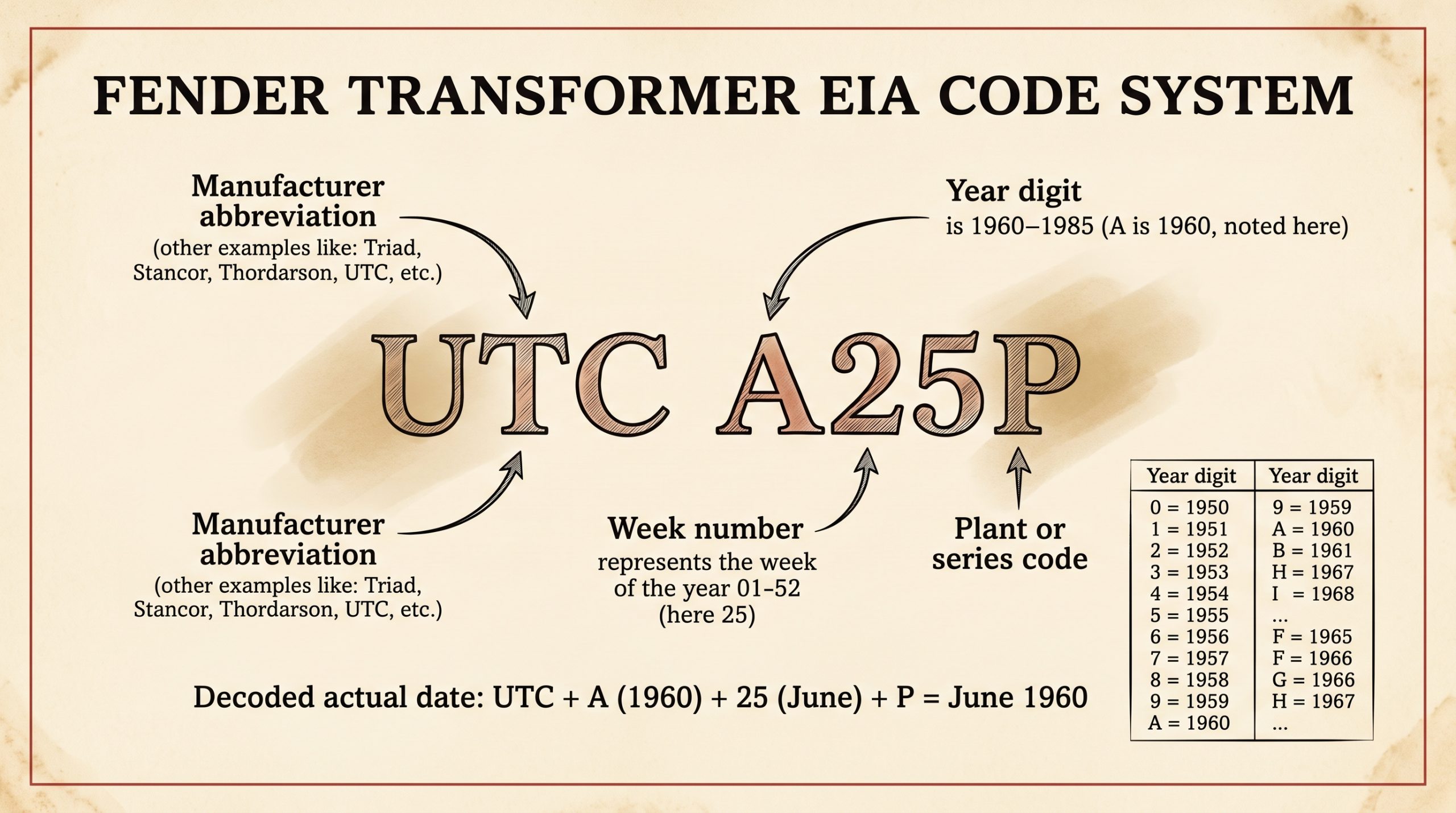
Most post-tweed Fender amps used transformers manufactured by Schumacher Electric, whose EIA manufacturer code is 606. The format looks like this: 606-645.
- The first three digits (606) identify Schumacher as the manufacturer
- The fourth digit (6 in this example) is the last digit of the production year, decade-ambiguous, resolved by era context
- The fifth and sixth digits (45 in this example) are the week of the year (01 through 52)
So 606-645 on a blackface amp = 1966, week 45, which puts manufacture at approximately early November 1966. The same code on a silverface amp would read as 1976, week 45. Era context resolves the decade. It’s not guesswork once you’ve done Step 1.
Multi-Transformer Cross-Reference Strategy
Fender reverb-equipped amps contain up to four transformer-type components with readable date codes: the power transformer, the output transformer, the choke, and the reverb transformer. Read all of them. Every one you can find.
Use the latest code as your closest-to-assembly date estimate. The logic is simple: if one transformer was manufactured in week 27 and another in week 41, the amp couldn’t have been assembled until at least week 41. Earlier codes represent parts that arrived first and sat in inventory.
A typical spread between earliest and latest transformer code is 2 to 8 weeks. That’s normal batch-production variation. A spread greater than 12 weeks should flag a question. It may indicate a replaced transformer, which is common on amps that have been serviced or repaired. A transformer code that’s dramatically out of range compared to the other three, say, three codes from 1966 and one from 1973, is almost certainly a replacement. It doesn’t affect the amp’s authenticity in any serious way, but it’s worth knowing before you buy.
The Fender amp dating cheatsheet includes a quick-reference table for EIA manufacturer codes across all Fender-era transformer suppliers if you encounter something other than the 606 Schumacher prefix.
Speaker EIA Codes as a Bonus Cross-Check
Speakers carry EIA date codes in exactly the same format as transformers. This method is underused and rarely discussed, but it’s genuinely useful as an additional data point. Common Fender speaker suppliers and their EIA codes:
| Manufacturer | EIA Code | Common Fender Era |
|---|---|---|
| Jensen | 220 | Tweed through mid-blackface |
| Oxford | 465 | Blackface and silverface |
| Utah | 328 | Silverface |
| CTS | 137 | Late blackface and silverface |
| JBL | 73 | Blackface (D-120F option) |
A Jensen code of 220-637 decodes as: Jensen, year ending in 6, week 37, which on a blackface amp is approximately September 1966. The format is identical to transformer codes.
Important caveat: speakers are the most commonly replaced component on any vintage amp. A mismatched speaker code doesn’t invalidate the other dating evidence. Note it, flag it to a buyer if you’re selling, and move on. An original-date speaker is a bonus. Not having one doesn’t change what the transformers and tube chart tell you.
Volume and tone pots also carry EIA date codes using the same format and serve as yet another cross-check point. The pot body will show a six or seven-digit code where the same year-digit and week-digits apply. Multiple data points all pointing to the same window is the most reliable dating outcome available.
Step 4, Check the Serial Number
The serial number is stamped on the rear panel of the metal chassis. On tweed-era amps it’s often on a small rear-mounted plate; on blackface and silverface amps it’s directly stamped on the aluminum chassis; on modern production amps (1990 and forward) it appears on the QA sticker. Finding it is straightforward. What it tells you is more limited.
Serial numbers are the least reliable single dating method for vintage Fender amps. Fender used shared number sequences across multiple models simultaneously. Chassis were stamped before assembly, so a serial number reflects when the chassis blank was numbered, not when the amp was built or shipped. Overlaps and gaps exist throughout the entire vintage production run. That said, serial numbers can confirm an era and sometimes narrow a date range, so they belong in the method. Just not at the top of it.
Serial Number Format Reference
| Era | Format Example | Reliability | Notes |
|---|---|---|---|
| Tweed (pre-1955) | 4–5 digits, no prefix | Low | Loose correlation only |
| Tweed/Brown (1955–1963) | 5 digits, no prefix | Low | Overlapping runs across models |
| Blackface (1963–1967) | 5–6 digits, no prefix | Moderate | Shared numbering across model lines |
| Silverface (1967–1976) | 6 digits, no prefix | Moderate | Continues from blackface sequence |
| Silverface (1976–1981) | A + 6 digits | Moderate | A-prefix introduced mid-production |
| Modern (1990–present) | Letter prefix + 5–6 digits | High | First letter is decade code; QA sticker adds direct date |
For modern production amps (1990 and forward), Fender’s official amplifier dating support page walks through the QA sticker format in detail and includes the decade code reference. That resource covers current and recent production clearly. For anything vintage, cross-reference it against transformer and tube chart evidence.
Mexico-made Fenders carry an MX-prefix serial number. “CR” prefix serials indicate Cyber series amps from the early 2000s. Both are straightforward once you know the prefix conventions.
Step 5, Verify With Chassis Stamps and Circuit Board Codes
This step is underused and produces some of the most precise dating information available on any vintage Fender. Many blackface and silverface amps have the exact date written in ink or paint marker on the interior chassis wall, typically near the power transformer or on the tag board. Factory inspectors initialed and dated their quality checks. When legible, you get month, day, and year in plain digits. Nothing more precise exists.
Location varies by model and year. On most blackface-era amps, look on the interior right-hand chassis wall when facing the amp from the rear. On late silverface amps with PCB construction (roughly 1977 onward), the date may appear on the PCB itself. PCB construction is itself a dating cue. Finding a PCB in your amp moves the assembly date to 1977 or later without needing to read a single code.
Key Fender Circuit Numbers and Date Ranges
The circuit number is printed on the PCB or tag board and narrows the date range to a 2 to 5 year window, useful when other codes are damaged or missing. Note that the blackface-era codes below aren’t model-exclusive: Fender ran AA763 and AB763 as parallel revision codes across several models at once rather than assigning one code per model, so a circuit number alone narrows the era but doesn’t by itself confirm which model you’re holding.
| Circuit Number | Era | Models | Approximate Years |
|---|---|---|---|
| 5E3 | Tweed | Deluxe | 1955–1960 |
| 6G2 | Brownface | Princeton | 1960–1961 |
| AA763 | Blackface | Deluxe Reverb, Twin Reverb, Super Reverb | 1963–1967 |
| AB763 | Blackface | Deluxe Reverb, Twin Reverb, Super Reverb, Bandmaster | 1963–1967 |
| AA864 | Blackface | Bassman | 1964–1967 |
| AA1164 | Blackface | Princeton Reverb (pre-CBS) | 1964–1965 |
| AA769 | Silverface | Twin Reverb | 1969–1972 |
| AB568 | Silverface | Super Reverb | 1967–1969 |
Finding an AB763 circuit code in a chassis that presents as silverface visually is a significant discovery. Some early drip-edge silverface amps (1967 through 1969) retained blackface circuit designs while adopting the new cosmetics. That’s a meaningful distinction for both tone and value.
Putting It All Together, The Verification Matrix
Dating confidence isn’t binary. It scales with how many independent sources agree. This matrix summarizes what level of certainty each combination of evidence actually delivers.
| Evidence Available | Confidence Level | Notes |
|---|---|---|
| Tube chart code only | Moderate | Good for pre-1967; may not match ship date by a few weeks |
| Tube chart + one transformer code | Good | Cross-reference confirms or flags a discrepancy |
| Tube chart + all transformer codes | High | Standard best practice for blackface amps |
| All transformer codes + chassis ink stamp | Very High | Two independent systems in agreement |
| All of the above + serial number range | Definitive | Maximum certainty available on a vintage amp |
| Serial number only | Low | Too many overlapping ranges to pin a date |
| Visual appearance only | Very Low | Re-covering and panel swaps are common |
If your tube chart code and transformer codes disagree by more than three months, that’s worth investigating before buying. A tube chart can be replaced during service. It’s not common, but it happens on heavily serviced amps. The transformer codes don’t lie, they were put on at the factory and are nearly impossible to fake convincingly. When in doubt, trust the transformers.
For buying or selling purposes: photograph every code before negotiating. Tube chart stamp, all transformer codes, serial number, chassis ink stamp if present. A dated photo file is documentation that protects both parties.
Era-Specific Shortcuts and Common Dating Pitfalls
Tweed Era (1948–1960)
Tube charts are the most reliable source here. Serial numbers are nearly useless for precise dating in this era, Fender’s production records from the early 1950s are incomplete, and the serial sequences weren’t model-specific. Jensen speaker codes (220-prefix) often provide the most useful transformer-era cross-check when the tube chart is damaged or missing. Also worth knowing: tweed covering was phased out model by model rather than all at once, so a 1960 amp being tweed doesn’t mean it’s a late-production tweed across all models.
Blackface Era (1963–1967)
All three primary methods are typically available and readable. This is the easiest era to date accurately. The pre-CBS cutoff matters here: Fender sold to CBS on January 5, 1965. Amps assembled before that date command a premium in the vintage market. A tube chart code of ND (January 1964) or NL (December 1964) places the amp firmly in pre-CBS territory. An OA (January 1965) or later code may or may not predate the sale depending on exact assembly week, so cross-reference transformer codes carefully if this distinction affects valuation.
Watch for silverface re-issues and blackface-converted silverface amps. A chassis that has been re-faced with a blackface panel but retains a post-1967 chassis stamp or silverface transformer codes is not a blackface. Not even close.
Silverface Era (1967–1981)
Tube charts are often blank. Go straight to transformers and chassis stamps. The drip-edge silverface (1967 through approximately 1969) retains some blackface circuit characteristics in certain models and is sometimes more desirable than later silverface production. The master volume control, added to many models in the mid-1970s, is itself a dating cue. Late silverface amps (post-1977) moved to PCB construction. PCB presence plus a master volume control puts you solidly in the late silverface window without needing to decode a single code.
Modern Era (1990–Present)
The QA sticker on the rear chassis is definitive. It carries a straightforward date code in year/week format. Fender’s official support documentation explains the sticker format clearly for anyone working with post-1990 production. The serial number lookup at fender.com/support is reliable for modern amps in a way it simply isn’t for vintage production.
Quick Reference, How to Date a Fender Guitar
The secondary search query “how to date a Fender guitar” gets asked alongside amp dating often enough that it’s worth a brief note. Guitar dating uses a different primary method: a penciled neck date stamp written inside the neck pocket of the body, visible when the neck is removed. No equivalent exists on amplifiers. The neck stamp gives month and year in plain handwriting and is the most direct dating source on a vintage Fender guitar.
Beyond the neck stamp, guitar dating relies on:
- Pot codes on volume and tone controls, using the same EIA format as amp transformers (same manufacturer code + year digit + week digits)
- Body date stamps, sometimes found inside the pickup routes
- Serial number references, which are more model-specific on guitars than on amps but still carry overlapping range caveats
- Neck plate stamping on bolt-on models
Note that pot codes appear on both amps and guitars and use the same decoding method. If you’re reading pot codes on an amp (the volume, treble, mid, bass, and reverb pots all carry EIA codes stamped on the pot body), they provide yet another independent cross-check for amp dating, one that the top search results on this topic consistently overlook.
Tools and Resources for Dating Your Fender Amp
A small handheld magnifying loupe (10x) is the single most useful physical tool for this work. Transformer and pot codes are stamped small, often at an angle, sometimes partially obscured by wiring. A loupe makes the difference between a confident read and a guess. Photograph every code you find before doing anything else, good lighting, close focus, multiple angles. That photo record becomes your documentation for future reference, insurance, or resale.
The Fender tube amp serial number and date code guide provides extended reference tables covering transformer EIA manufacturer codes, serial number range charts by era, and tube chart code cross-references across the full production history. For quick lookups without the full guide, the Fender amp serial number lookup tool covers era-by-era serial ranges in a fast-reference format. For modern production amps, Fender’s official support documentation handles serial lookups directly and is the appropriate resource for post-1990 amps.
Your Next Step
The five-step method works in sequence for a reason. Visual triage first, then tube chart code, then transformer codes, then serial number, then chassis stamps and circuit codes. Running all five on a single amp takes 20 to 30 minutes with a flashlight and loupe. What you get is a documented, cross-referenced date range that holds up whether you’re buying, selling, insuring, or just satisfying your own curiosity about what’s sitting in your living room. The more evidence you gather that points to the same window, the more confident your date. Two agreeing sources is good. Four is nearly bulletproof. And if you find all four transformer codes plus a chassis ink stamp that all land in the same month of the same year, you’ve done the most thorough amp dating job possible short of having a Fender factory record in your hands.
Frequently asked questions
What is the most reliable way to date a vintage Fender amp?
For pre-1967 amps, the two-letter tube chart date code is the most reliable single source. Pair it with transformer EIA codes for high confidence. For silverface-era amps (1967 through 1981), cross-referencing all four transformer codes and checking the interior chassis for an ink date stamp gives the strongest result. Using all available evidence together and looking for agreement across sources is the most accurate method regardless of era. One data point is a starting point. Three agreeing data points is a conclusion.
Where is the serial number on a Fender amp?
On vintage Fender amps, the serial number is stamped on the rear panel of the metal chassis. On tweed-era amps it may appear on a small rear-mounted chrome plate. On modern Fender amps (1990 and forward), the serial number also appears on the QA sticker affixed to the back of the chassis. If you're looking at the rear of the amp and can't locate it, check the bottom edge of the chassis where it meets the cabinet, some models placed it there.
What does "606" mean on a Fender transformer?
606 is the EIA manufacturer code for Schumacher Electric, the primary transformer supplier for Fender from the late 1950s through the 1970s. The digits following 606 identify the year (single digit, representing the last digit of the year) and week (two digits, representing the week of the year). So 606-645 decodes as: Schumacher, year ending in 6, week 45, which on a blackface amp is approximately early November 1966, and on a silverface amp is early November 1976.
Can I date a Fender amp by serial number alone?
Technically yes, but with low confidence. Fender used shared serial number sequences across multiple models simultaneously, stamped chassis blanks before assembly began, and had significant production overlaps throughout the vintage era. A serial number can confirm you're in the right decade and sometimes the right half of a decade, but it shouldn't be used as the primary dating evidence for any purchasing or valuation decision. Always cross-reference with tube chart codes and transformer EIA codes.
How do I date a silverface Fender amp with a blank tube chart?
Blank tube charts are standard on silverface-era amps. Move directly to the transformers. Locate the power transformer, output transformer, choke, and reverb transformer inside the chassis and read the EIA date codes stamped on each casing, a flashlight and a loupe help considerably. Record all four codes and use the latest one as your closest-to-assembly date estimate. Then check the interior chassis wall near the power transformer for an ink or paint marker date stamp left by the factory inspector. On many silverface amps, that stamp is the most precise date you'll find anywhere on the amp.