Contents
- 01What Is a Potentiometer Source-Date Code?
- 02How to Read a Fender Amp Pot Code
- 03Complete Fender Amp Pot Code Manufacturer Reference Chart
- 04The "Earliest Possible Date" Rule, A Critical Limitation
- 05Era-Specific Pot Code Patterns in Fender Amplifiers
- 06Cross-Referencing Pot Codes With Other Amp Date Codes
- 07Practical Walkthrough: Dating a Fender Deluxe Reverb Using Pot Codes
- 08Potentiometer Code Quick-Reference Card
- 09Frequently Asked Questions, Fender Amp Pot Codes
- 10What to Look For When You Pull the Chassis
You’ve pulled the chassis on a vintage Fender amp and you’re staring at a cluster of pots with numbers stamped into the metal. The seller said “all original, 1965,” but the chassis stamp is worn and the serial number range is ambiguous. Those stamped numbers on the back of each pot are exactly what you need.
Fender sourced potentiometers from American manufacturers throughout the vintage era, and every one of those suppliers used the Electronic Industries Alliance (EIA) source-date code system. Once you know how to read the format, a single potentiometer can tell you who made it, what year, and which week of that year. Combined with transformer and speaker codes, pot dates are one of the most reliable tools available for pinning down a build date on a vintage Fender amp. The Fender tube amp dating reference covers the full multi-source method, but this guide focuses specifically on decoding pot codes from the ground up.
What Is a Potentiometer Source-Date Code?
The EIA Standard Explained
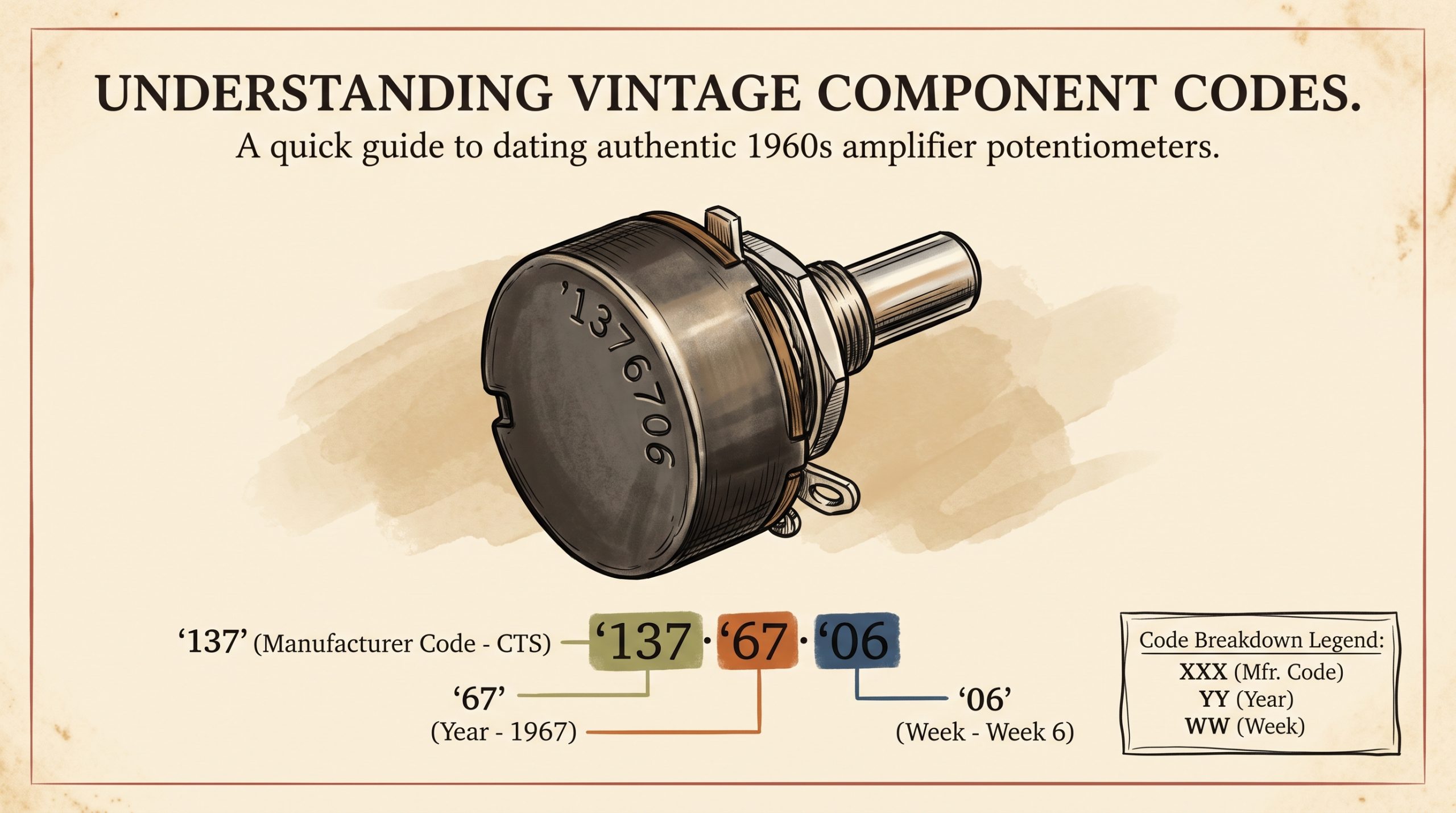
The EIA (Electronic Industries Alliance, formerly Electronic Industries Association) assigned a unique 3-digit source code to every American component manufacturer. That code appears at the front of the stamped string on any EIA-compliant pot. The complete format is: [3-digit manufacturer code] + [1 or 2 digit year] + [2-digit week], producing a 6 or 7 digit number total.
Take the code 1376706 as an example. The first three digits, 137, identify CTS (Chicago Telephone Supply). The next two digits, 67, give the year 1967. The final two digits, 06, represent the sixth week of that year, which falls in early February 1967. Simple once you know the structure. Some sources call these “source-date codes” rather than “pot codes.” Same thing.
Why Fender Used American-Made Pots
Fender sourced domestically through most of the vintage production run, roughly the 1950s through the mid-1970s. The primary suppliers were CTS, Centralab, Stackpole, and IRC, all assigned EIA codes and all subject to post-WWII American manufacturing standards that required component dating. This is why the codes exist at all.
After the late 1970s and into the 1980s, offshore sourcing increased and EIA codes become less consistent or disappear entirely on import pots. If you’re looking at a pot with no stamped code, suspect a post-vintage replacement or offshore manufacture. Speakers and transformers use the exact same EIA system, which opens up a cross-referencing approach covered later in this guide.
How to Read a Fender Amp Pot Code
Locating the Code on the Potentiometer
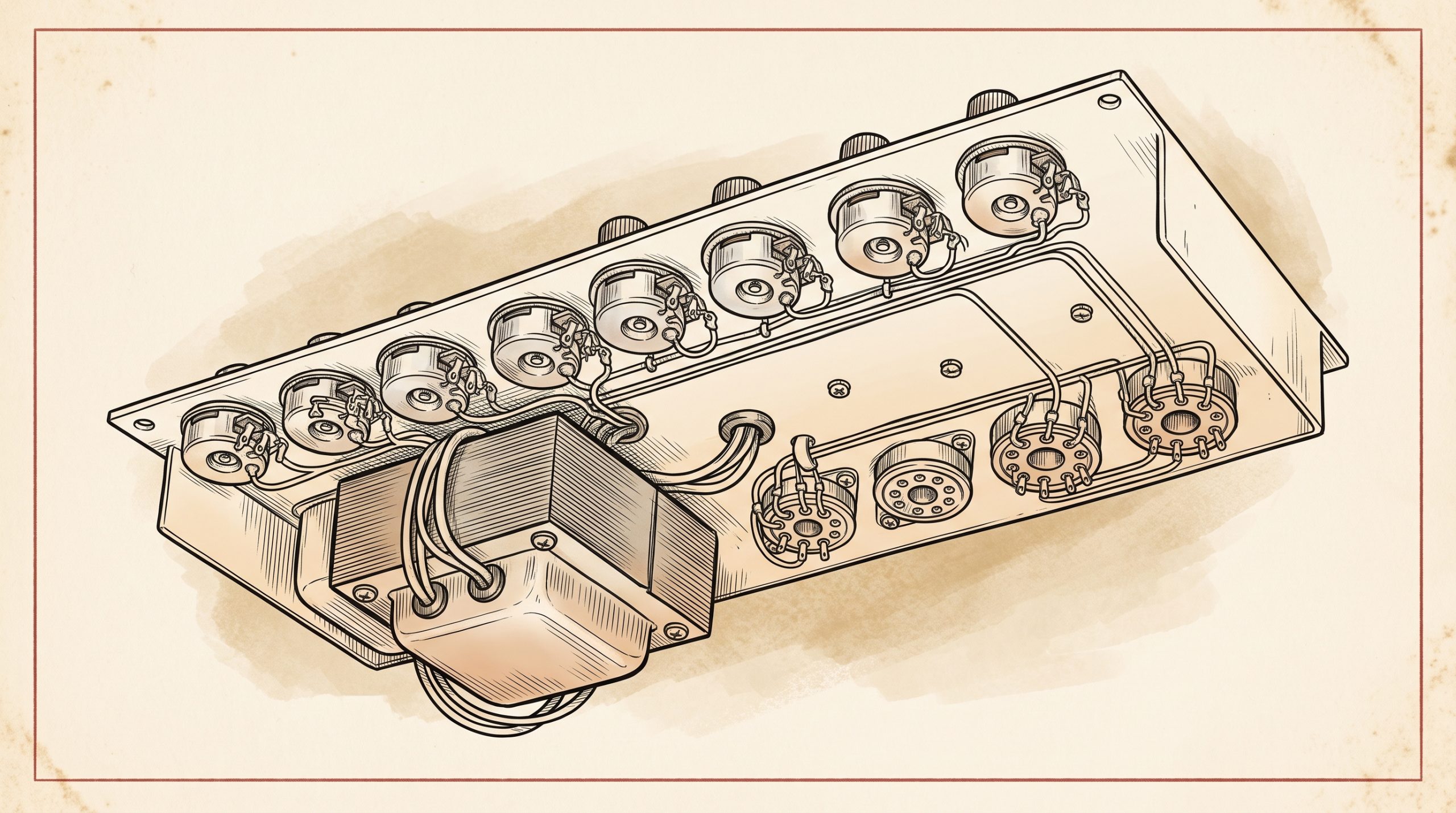
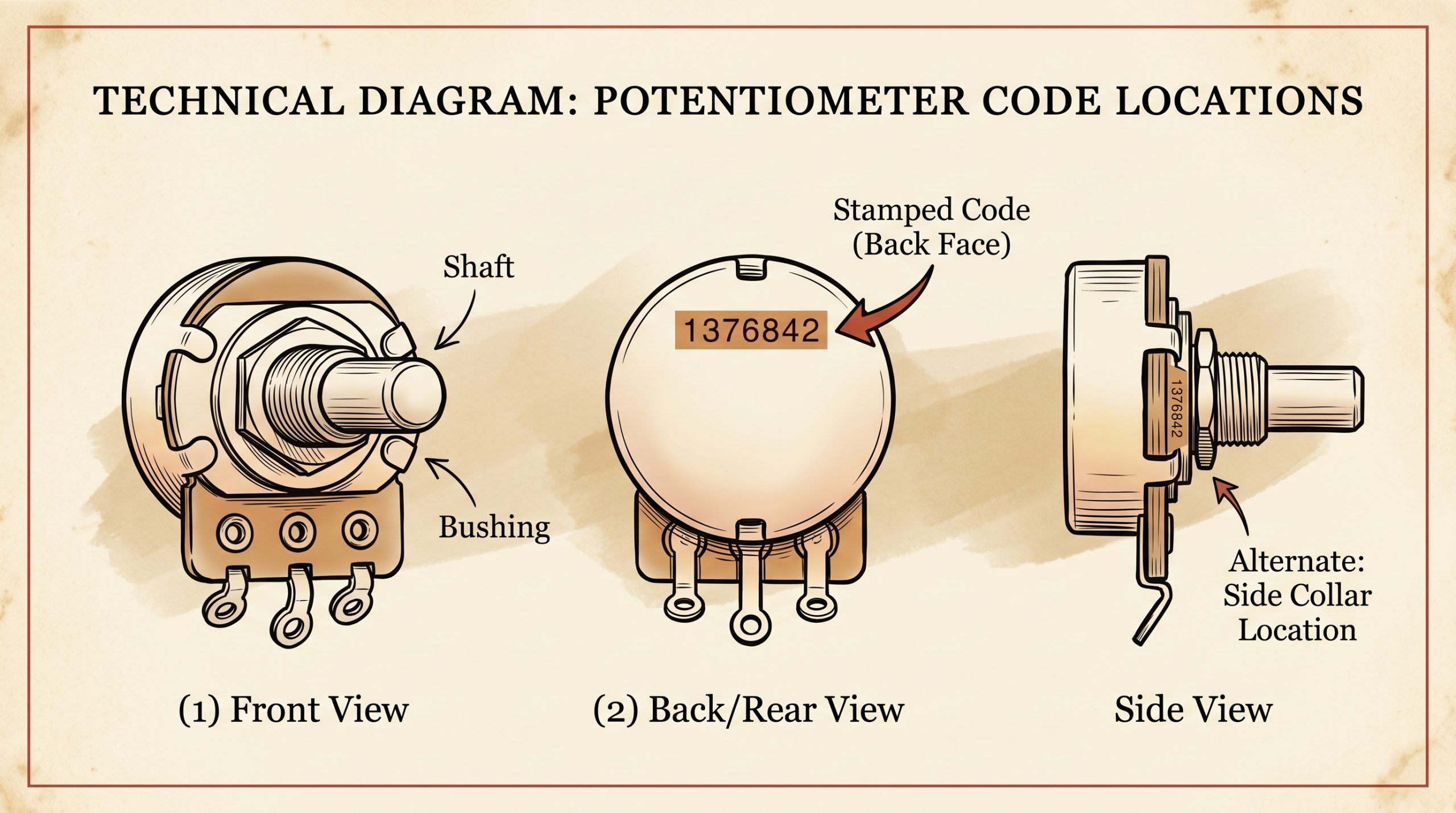
The code is stamped directly into the potentiometer body, usually on the back face opposite the shaft. It’s not printed or silkscreened. On some pots you’ll find it on the side collar near the shaft bushing instead. To get a clear look, you’ll need the chassis out of the cabinet and rotated so you’re looking up at the control plate from below.
Solder flux, corrosion, and decades of lead dress pressing against the pot body can obscure the stamp. A flashlight held at an angle often reveals digits that look blank in flat lighting. A jeweler’s loupe or phone camera in macro mode helps with heavily corroded examples. Don’t use abrasives to clean the stamp area. A cotton swab with a small amount of isopropyl alcohol is enough to cut through flux residue without damaging the digits.
Decoding the Number, Step by Step
Step 1: Isolate the first three digits. That’s the manufacturer EIA code. Cross-reference against the chart below.
Step 2: Identify the next one or two digits. This is the production year. Two-digit year codes (like 63, 67, 72) are unambiguous. One-digit year codes require context to resolve.
Step 3: The final two digits are the production week, running 01 through 52.
| Full Code | Mfr Code | Manufacturer | Year Digits | Year | Week Digits | Week |
|---|---|---|---|---|---|---|
| 1376706 | 137 | CTS | 67 | 1967 | 06 | Feb 1967 |
| 3044509 | 304 | Stackpole | 45 | 1945 | 09 | Mar 1945 |
| 1346312 | 134 | Centralab | 63 | 1963 | 12 | Mar 1963 |
| 1374908 | 137 | CTS | 49* | 1949 or 1969 | 08 | Feb, use context |
| 1896314 | 189 | IRC | 63 | 1963 | 14 | Apr 1963 |
*Single-digit or ambiguous two-digit year codes require cross-referencing with serial number ranges, transformer stamps, and speaker codes to resolve the decade.
The 1-Digit Year Ambiguity Problem
On some pots, particularly those from the tweed era, the year is stamped as a single digit rather than two. A stamp of “7” could mean 1957 or 1967. No shortcut exists here. The right approach is to use the latest plausible date given what else is known about the amp: the serial number prefix, the circuit code stamped inside the chassis, and the transformer date code. If all three independently point to 1957, you’re comfortable calling it 1957. If the serial number range spans both decades, you need more data.
The Fender amp dating cheatsheet includes a quick-reference breakdown of circuit codes by year range, which helps anchor ambiguous pot dates to the correct decade fast.
Complete Fender Amp Pot Code Manufacturer Reference Chart
EIA Manufacturer Code List
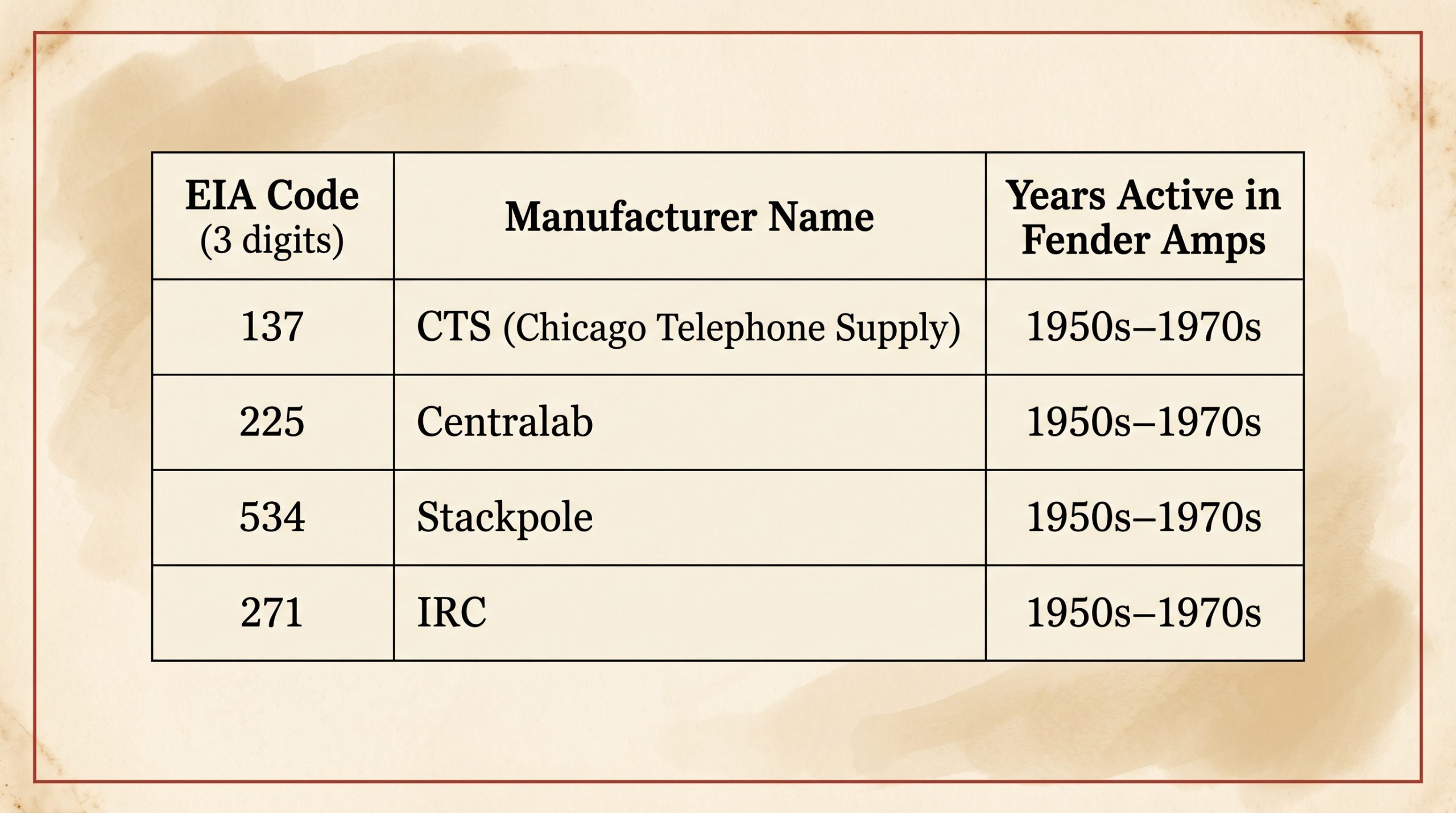
Most published lists stop at ten or twelve entries. The table below covers the full range of codes you’ll realistically encounter in vintage American amps, with a specific note on Fender relevance for each. The “Common in Fender Amps” column is the detail that the generic pot-code guides consistently skip.
| EIA Code | Manufacturer | Common in Fender Amps? | Notes |
|---|---|---|---|
| 106 | Allen-Bradley | Occasionally | Milwaukee, WI; high-quality construction |
| 134 | Centralab | YES, Tweed era primarily | Milwaukee, WI; dominant supplier pre-1960 |
| 137 | CTS (Chicago Telephone Supply) | YES, most eras | Most common Fender pot from mid-1950s onward |
| 140 | Clarostat | Occasionally | New York; less common in Fender production |
| 189 | IRC (International Resistance Co.) | YES, Blackface era | Philadelphia, PA; appears alongside CTS in AB763 amps |
| 270 | Bourns | Rare vintage; common modern replacement | Modern Bourns pots do not carry vintage-format EIA stamps |
| 304 | Stackpole | YES, Tweed and Brownface | Harrison, NJ; fades out by mid-1960s in Fender use |
| 381 | Piher | No (import) | Spanish manufacturer; appears post-1970s in budget gear |
| 615 | Shur-Lok | Rare | Specialty pots; not standard Fender production |
| 1452 | Spectrol | Rare | Trim pots only; not panel-mounted volume or tone controls |
| 117 | Cornell-Dubilier | Rare | More commonly seen as a capacitor supplier |
| 232 | Sprague | Rare in pots | Primary Fender capacitor supplier; pots uncommon |
A note worth adding: the EIA system covers speakers as well as pots. Jensen carried EIA code 220, Oxford used 465, Utah used 328, and JBL carried 73. Transformer manufacturers used the same system: Schumacher’s code is 606, Triad is 022. All decode identically to pot codes. That overlap is what makes the multi-source dating method possible.
The “Earliest Possible Date” Rule, A Critical Limitation
Why Pot Dates Are a Floor, Not a Ceiling
This is the point that causes the most confusion among new collectors. A pot date tells you the earliest the amp could have been assembled. Not the latest. Not the most likely. The earliest.
Fender’s purchasing department ordered pots in bulk, and components sat in inventory before reaching the assembly line. A lag of six to eighteen months between pot manufacture date and amp ship date was normal, not exceptional. Teagle and Sprung document in Fender Amps: The First Fifty Years that CTS specifically post-dated their pots four to eight weeks past actual manufacture date as standard practice. That means the date stamped on a CTS pot already runs slightly ahead of when the pot was physically made, and then additional shelf time accumulates on top of that before installation.
A pot stamped Week 6, 1967 could realistically appear in an amp assembled in mid-1968. Keep that range in mind.
How Much Lag Is “Normal”?
Typical pot-to-assembly lag in documented Fender production runs to roughly 3 to 9 months. Outlier cases up to 18 months are on record. The practical test is cluster analysis: if all pots in an amp date within a 6-month window of each other, that’s high confidence in a consistent production batch. If one pot is 12 or more months older than the others, that pot is either from an old inventory draw or it’s a replacement.
Not every outlier pot is a problem. But it needs explaining.
Identifying Replaced Pots
A single pot with a code five or more years different from the rest of the set is a red flag for a non-original component. Check secondary evidence: mismatched shaft knurl patterns, different body dimensions, a resistance value that seems off for that circuit position, or solder joints that look cleaner than the surrounding work. Replaced pots don’t invalidate dating an amp. Use the remaining original pots as your data cluster and note the anomaly separately. Originality affects value. It doesn’t prevent dating.
Era-Specific Pot Code Patterns in Fender Amplifiers
Tweed Era (1948–1960), Centralab and Early CTS
Through roughly 1957, Centralab (134) is the dominant pot supplier in tweed Fender production. CTS (137) begins appearing more consistently from 1956 onward and gradually displaces Centralab through the late tweed period. Common resistance values in tweed circuits run to 1MΩ audio taper for volume controls and 250kΩ for tone stages, though specific circuits vary.
Pot style in this era is distinctively Bakelite-bodied with a shorter shaft and no detent. The code format is typically 6 digits: the 3-digit manufacturer code, a single-digit year, and a 2-digit week. Single-digit year ambiguity is unavoidable here. Cross-referencing with the chassis stamp and transformer codes is the only clean resolution. The 5E3 Deluxe, 5F6-A Bassman, and 5B3 circuits all used Centralab pots heavily in early production runs. The Fender 5E3 Tweed Deluxe guide covers specific circuit details for that model’s production history.
Brownface and Blonde Era (1959–1963), Transition Period
CTS (137) takes over as the primary supplier. Centralab fades out of Fender use during this period, though it occasionally appears in early brownface production. Stackpole (304) shows up in some production runs during this transition window.
Resistance values shift slightly in brownface circuits: some tone control positions use 100kΩ where the later blackface standardized on 250kΩ. Two-digit year codes become more common during this period (60, 61, 62), which makes dating significantly cleaner than the single-digit tweed stamps. Pots in this era sometimes carry a separate Fender part number stamp alongside the EIA code. Record both when you find them. Notable brownface circuits include the 6G6-B Bassman, 6G15 Reverb Unit, and 6G3 Brown Deluxe.
Blackface Era (1963–1967), The Most Reliable Data
This is where pot codes become most useful. CTS (137) and IRC (189) dominate blackface production. The circuit numbers AB763, AA764, AA1164, AA864, and AA270 all specify CTS or IRC pots. Resistance values are standardized at 250kΩ audio taper throughout most of the production run.
Pot codes in the blackface era are nearly always 7 digits with unambiguous 2-digit years (63 through 67). Average pot-to-ship lag in this era runs approximately 4 to 7 months based on documented production examples. A code cluster in the range 1376305 through 1376752 (CTS, 1963 through 1967, various weeks) is what you’d expect to find in a correct blackface amp. Codes outside that range on a claimed blackface amp deserve scrutiny. The Fender Pro Reverb buyer’s guide covers the AB763 circuit in depth, including the transition to late blackface specs.
Silverface Era (1967–1981), Late CTS Dominance
CTS (137) is nearly the exclusive pot supplier across most of the silverface run. Circuit numbers AA1069, AB1270, and AA270 largely carry over the pot specifications from the preceding blackface designs. Perceived quality in pot construction declines in late silverface production (post-1973): stampings are often thinner and the body finish less consistent. Worth knowing if you’re trying to assess originality.
Post-1972 master volume silverface circuits add additional pots to the control complement, which gives you more data points for dating. More pots mean more code stamps mean a tighter cluster analysis. That’s actually a useful side effect of the more complex later circuits.
Cross-Referencing Pot Codes With Other Amp Date Codes
Speaker EIA Codes, The Same System
Speakers carry EIA source-date codes using the identical format as pots. The manufacturer prefix changes, but the year and week structure is exactly the same. Here are the speaker suppliers most commonly found in vintage Fender amps:
| EIA Code | Manufacturer | Common in Fender? | Notes |
|---|---|---|---|
| 220 | Jensen | YES, Tweed and Brownface | Chicago; P12R, P15N, C12N variants |
| 465 | Oxford | YES, Blackface and Silverface | Chicago; dominated mid-to-late blackface and silverface production |
| 328 | Utah | Occasionally | 1950s through mid-1960s; some tweed and brownface models |
| 285 | Rola | Rare | Occasional brownface production, early 1960s |
| 67 | Eminence | Post-1970s production | Harrodsburg, KY; late silverface and reissue models |
| 73 | JBL | Custom and high-end orders | D-series drivers in Twin Reverb, factory option |
Speaker codes are stamped on the speaker’s rear magnet frame or on a paper cone stamp visible through the cone. The cone stamp reads differently from the frame stamp on some Jensen and Oxford examples, so check both locations if one is hard to read.
Transformer Codes, The Third Data Point
Output and power transformers carry EIA codes in the same format. The dominant Fender transformer supplier was Schumacher (606). Triad (022) also appears in some production runs. Transformers are rarely replaced compared to pots, which makes transformer codes often the most reliable single dating source in the amp. A transformer that hasn’t been touched is a strong anchor point.
Transformer codes are typically found stamped or ink-marked on the transformer can itself. On some amps the code appears on a small tag attached to the transformer leads. Format: [mfr code][year][week], identical to pot and speaker codes.
The Three-Source Dating Method
Combining all three sources produces the most defensible date estimate available for a vintage Fender amp without primary documentation.
- Record all pot date codes and establish the date range they span.
- Record the speaker cone or frame EIA stamp date.
- Record the transformer EIA stamp date.
- Use the latest single component date as your earliest possible assembly date.
- Cross-check against any chassis ink stamp (date stamps inside the chassis, when present).
- Cross-check against the serial number range using the Fender tube amp serial number guide.
If pot dates, speaker date, and transformer date all fall within a 12-month window of each other, you have high confidence that the major components are original. Divergence beyond 18 months on any single source warrants investigation.
Practical Walkthrough: Dating a Fender Deluxe Reverb Using Pot Codes
Example, AB763 Deluxe Reverb, No Visible Chassis Date Stamp
Here’s what a real multi-source date analysis looks like on a claimed blackface Deluxe Reverb.
| Component | Code Found | Decoded | Date |
|---|---|---|---|
| Pot 1, Volume Ch. 1 | 1376503 | CTS / 1965 / Week 03 | Jan 1965 |
| Pot 2, Treble Ch. 1 | 1376508 | CTS / 1965 / Week 08 | Feb 1965 |
| Pot 3, Bass Ch. 1 | 1376514 | CTS / 1965 / Week 14 | Apr 1965 |
| Pot 4, Volume Ch. 2 | 1376512 | CTS / 1965 / Week 12 | Mar 1965 |
| Speaker | 220-652 | Jensen / 1965 / Week 52 | Late Dec 1965 |
| Output Transformer | 6066518 | Schumacher / 1965 / Week 18 | May 1965 |
The pots cluster tightly in January through April 1965, consistent with a single production batch. The transformer dates to May 1965. The speaker is the latest component at December 1965 (Week 52). That December speaker date establishes the earliest possible assembly date as late 1965 or, given typical 4 to 7 month pot-to-ship lag for the blackface era, more likely early 1966. The serial number range for this amp should be cross-checked against AB763 production records to confirm. All components from a single manufacturer (CTS pots, Jensen speaker, Schumacher transformer) with dates that make sequential sense. Solid original. No anomalies requiring explanation.
Potentiometer Code Quick-Reference Card
Keep this table handy when you’re working on a chassis. The manufacturer, era relevance, and typical resistance values Fender used in that supplier’s pots are summarized in one place.
| EIA Mfr Code | Manufacturer | Fender Era | Typical Values Used |
|---|---|---|---|
| 134 | Centralab | Tweed (1948–1960) | 1MΩ, 500kΩ, 250kΩ |
| 137 | CTS | All eras | 250kΩ and 1MΩ audio / linear taper |
| 189 | IRC | Blackface primarily | 250kΩ audio taper |
| 304 | Stackpole | Tweed and Brownface | Various; matches circuit spec |
| 140 | Clarostat | Occasional across eras | Various |
| 106 | Allen-Bradley | Occasional | High-quality specialty applications |
For additional manufacturer codes and cross-referenced EIA data, the guitarhq.com source-date code reference and schematicheaven.net are useful supplementary lookups. The Fender support documentation covers current production specs if you’re trying to distinguish vintage from reissue components.
What to Look For When You Pull the Chassis
The best approach is methodical. Pull all pot date codes before drawing any conclusions, record every code individually, and cluster-analyze the full set before deciding any single pot is an outlier. Then add the transformer stamp and speaker code to the analysis. A vintage Fender amp that’s genuinely original will tell a consistent story across all three data sources, with dates that cluster logically and a lag from pot manufacture to assembly date that falls within the documented 3 to 9 month range for that production era. When the story doesn’t add up, that’s when you ask harder questions about the amp’s history before any money changes hands.
Frequently asked questions
How do I read a Fender amp pot code?
Split the stamped number into three segments. The first three digits are the EIA manufacturer code (137 = CTS, 134 = Centralab, 189 = IRC, and so on). The next one or two digits are the production year. The final two digits are the production week, running from 01 to 52. A code of 1376706 decodes as CTS (137), 1967 (67), Week 06, early February 1967. Use the manufacturer reference chart above to identify any code you find.
What does CTS mean on a potentiometer?
CTS stands for Chicago Telephone Supply, founded in 1896 in Elkhart, Indiana. The company's EIA source code is 137. CTS became the dominant pot supplier to Fender from the mid-1950s onward and continued through the silverface era and beyond. Modern CTS pots are still manufactured, though they no longer carry the vintage-format EIA date stamps used in the original production runs. Presence of a CTS pot does not by itself confirm vintage origin.
What is the most common pot in vintage Fender amps?
CTS (EIA code 137) is the most common pot in blackface and silverface production. Centralab (EIA code 134) dominates tweed-era amps through roughly 1957, with CTS taking over increasingly from that point forward. If you're working on a claimed blackface amp and find a pot code starting with 137, that's exactly what the circuit spec called for. If you find 134 in a blackface amp, suspect a repair or a later replacement with old-stock Centralab inventory.
Can pot codes definitively date a Fender amp?
No. Pot codes establish the earliest possible build date, not the actual build date. They must be cross-referenced with the serial number range, transformer EIA stamp, and speaker code to produce a defensible estimate. Replaced pots will skew the cluster analysis, so checking for matching code clusters across all pots in the amp is the first step. A single outlier pot doesn't break the analysis. It just needs to be identified and set aside.
Do Fender reissue amps have pot codes?
Most modern Fender reissues use offshore pots that don't carry EIA source-date codes. Some American Vintage Reissue (AVRI) models used domestic CTS pots, and those do carry codes. The presence of a valid EIA code on a pot does not automatically confirm vintage origin, since replacement pots from NOS (new old stock) domestic inventory also carry period-correct codes. Always evaluate pot codes as part of a full originality assessment, not as standalone proof of vintage manufacture.