Contents
- 01Quick-Reference Specs: Pro Reverb by Era
- 02Production History and Era Classification
- 03Circuit Deep-Dive: What Makes the Pro Reverb Tick
- 04Tone Character and Playing Feel
- 05Fender Pro Reverb vs. the Blackface Family
- 06The '68 Custom Pro Reverb: Reissue Buyer's Guide
- 07Identifying and Dating Your Fender Pro Reverb
- 08Common Modifications and Upgrades
- 09What Players Actually Say About the Pro Reverb
- 10Is the Fender Pro Reverb Right for You?
- 11Frequently Asked Questions
The model ran from 1964 through 1981, covering three distinct circuit revisions: the AA165 blackface, the AB668 late blackface, and the AA1069 silverface. A reissue under the ’68 Custom label has been in production since approximately 2013. Each version has its own character, and knowing which one you’re looking at matters whether you’re buying vintage or new. You can cross-reference production years and serial ranges against the Fender tube amp serial number guide to pin down any specific unit.
- Power output: 40W RMS (all eras)
- Speaker configuration: 2×12, 4 ohms (vintage); 1×12, 8 ohms (’68 Custom reissue)
- Power tubes: 2x 6L6GC (fixed bias with adjustment pot)
- Rectifier: GZ34/5AR4 tube (blackface AA165, AB668); solid-state (silverface AA1069); GZ34 restored on ’68 Custom reissue
- Effects: 3-spring spring reverb, photoresistor (LDR) tremolo
- Vintage weight: approximately 50 to 52 lbs, not light
- Vintage blackface pricing: $900 to $1,800 depending on condition and originality
- ’68 Custom Pro Reverb MSRP: $1,679.99 new
- The Pro Tube Series (1987 to 1995) “Pro Reverb” is a 1×12, 65W unit, a completely different amp with a different circuit
- The ’68 Custom is based on the AB668 blackface circuit, NOT the 1968 AA1069 silverface, despite the model name
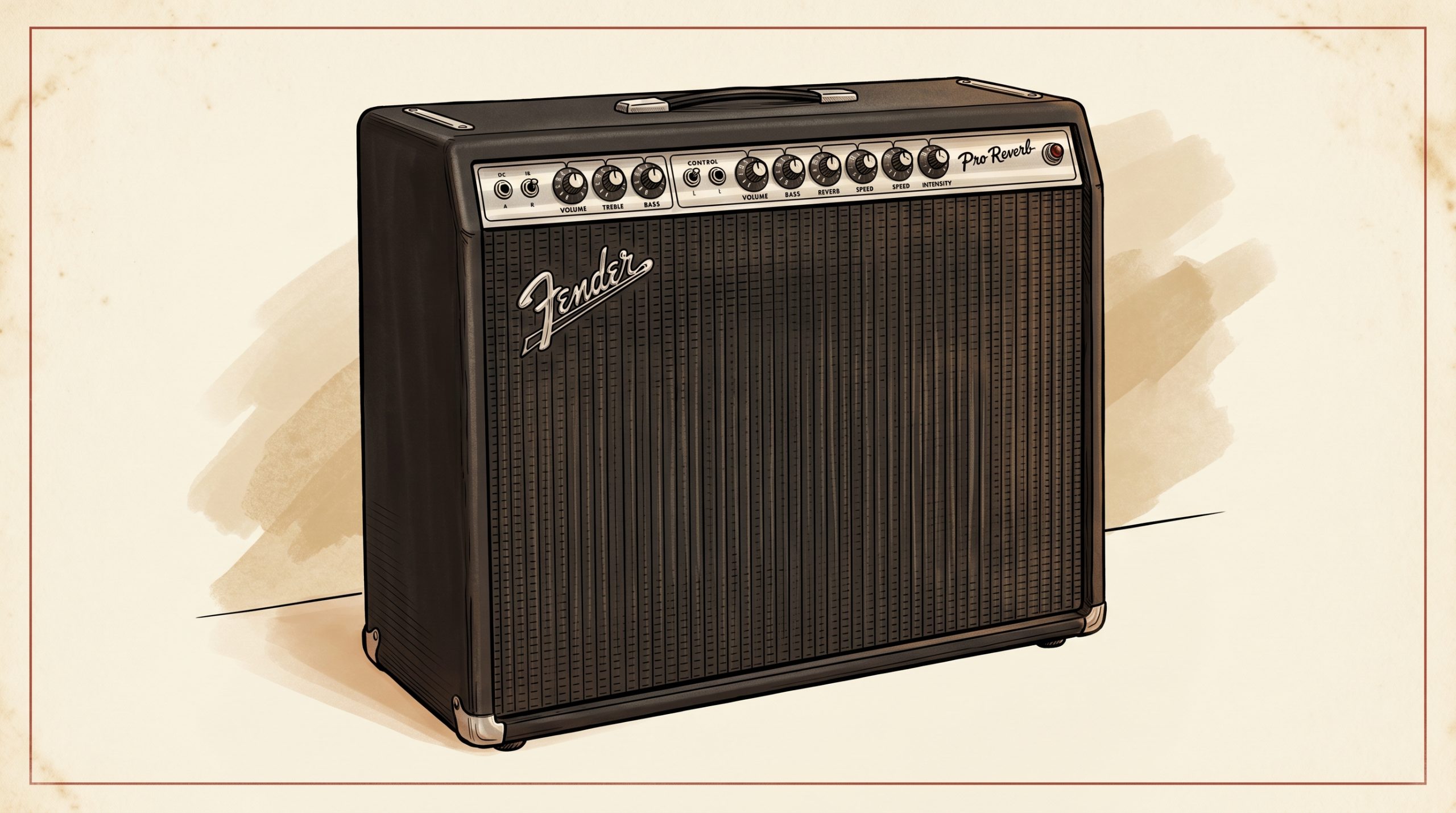
Quick-Reference Specs: Pro Reverb by Era
Four distinct production configurations across six decades of manufacturing. Here’s how they stack up spec for spec.
| Spec | Blackface AA165 (1964–1966) | Blackface AB668 (1966–1967) | Silverface AA1069 (1968–1981) | ’68 Custom Reissue (2013–present) |
|---|---|---|---|---|
| Circuit Number | AA165 | AB668 | AA1069 | Modified AB668 |
| Power Output | 40W RMS | 40W RMS | 40W RMS | 40W RMS |
| Power Tubes | 2x 6L6GC | 2x 6L6GC | 2x 6L6GC | 2x 6L6GC |
| Preamp Tubes | 4x 7025, 2x 12AT7 | 4x 7025, 2x 12AT7 | 4x 12AX7, 2x 12AT7 | 3x 12AX7, 2x 12AT7 |
| Rectifier | GZ34/5AR4 (tube) | GZ34/5AR4 (tube) | Solid-state diodes | GZ34 (tube) |
| Original Speakers | 2x Jensen C12N or Oxford 12L6 | 2x Jensen C12N or Oxford 12L6 | 2x Oxford or Utah 12″ | 1x 12″ Celestion G12 NEO Creamback |
| Speaker Impedance | 4 ohms | 4 ohms | 4 ohms | 8 ohms |
| Bias Type | Fixed w/ adj. pot | Fixed w/ adj. pot | Fixed w/ adj. pot | Fixed w/ adj. pot |
| Cabinet Dimensions | 19½” x 26½” x 9½” | 19½” x 26½” x 9½” | 19½” x 26½” x 9½” | 19¾” x 24″ x 10½” |
| Weight (approx.) | 50 to 52 lbs | 50 to 52 lbs | 48 to 52 lbs | 48 lbs |
| Vintage/Current Pricing | $900 to $1,800 used | $900 to $1,800 used | $400 to $900 used | $1,679.99 MSRP |
Production History and Era Classification
Pre-Reverb Origins (1946–1963)
The “Pro” nameplate predates the reverb-equipped version by almost two decades. Fender’s original Pro model ran as a single-speaker combo through the tweed era (late 1940s into the late 1950s) and into the brown and blonde face period of the early 1960s, typically loaded with a single 15″ speaker. That older “Pro” is a fundamentally different amplifier with different applications. Buyers searching for a 1965 Pro Reverb and accidentally landing on a 1960 brownface Pro should know they’re looking at different circuits, different cabinets, and different sonic territory. The 2×12 configuration and the reverb circuit didn’t arrive until 1964.
Blackface Era: AA165 Circuit (1964–1966)
Fender introduced the Pro Reverb around 1964, concurrent with the broader blackface lineup that included the AB763 Deluxe Reverb, Super Reverb, and Twin Reverb. The Pro Reverb used its own circuit number, AA165, rather than the AB763 shared across several sibling models. That’s because it means some component values differ from the Deluxe and Super Reverb, even though the overall topology is similar.
The AA165 runs a GZ34/5AR4 tube rectifier, a long-tailed-pair phase inverter using a 12AT7, and a photoresistor-based tremolo circuit. Original speaker pairings documented in Fender field guide references at Mojotone’s blackface Pro Reverb field guide include the Jensen C12N (EIA code 220-YYWW) and the Oxford 12L6 (EIA code 465-YYWW). Cosmetically: black Tolex, silver/black/white woven grille cloth, chrome and black script logo mounted to the grille. This is the configuration that defines the “classic” Pro Reverb for most collectors.
Late Blackface: AB668 Circuit (1966–1967)
The AB668 revision appeared in 1966 and ran through the end of the blackface cosmetic period in late 1967. The changes from AA165 are minor: a revised bias network, some capacitor value adjustments. Nothing dramatic. The GZ34 stays. The tube complement stays. Sonically, most players and technicians find the AA165 and AB668 indistinguishable in a blind test.
What makes the AB668 significant is its relationship to the current ’68 Custom Pro Reverb reissue, which is based on this circuit rather than the AA1069 silverface. Some late 1967 transitional units show pre-silverface cosmetics (brushed aluminum trim beginning to appear) while still carrying the AB668 circuit board inside. Dating those units carefully against transformer and speaker EIA codes matters for accurate identification.
Silverface Era: AA1069 Circuit (1968–1981)
The cosmetic shift to silverface arrived in 1968: brushed aluminum grille trim, blue and silver grille cloth, revised “tailored” script logo. The circuit change that accompanied it is the one that actually affects tone. The AA1069 replaces the GZ34 tube rectifier with solid-state diodes. Rectifier sag disappears. The feel gets stiffer under dynamic picking, the attack becomes more immediate, and the overall response leans cleaner and more linear. Not worse, necessarily. Just different.
Some silverface Pro Reverbs produced between 1969 and 1972 also received an ultra-linear output transformer on certain production runs, which further stiffens the bass response. Late silverface units from approximately 1978 onward gained a push-pull master volume control on some versions. Mojotone’s silverface field guide documentation notes that Pro Reverbs produced between late 1980 and 1982 carry a black control panel and revert to silver/black/white grille cloth. The silverface Pro Reverb is consistently the most affordable entry point into the model, with clean examples available in the $400 to $900 range.
Pro Tube Series (1987–1995)
Fender’s Pro Tube reissue series brought back the Pro Reverb name in the late 1980s, but the configuration changed significantly. This version runs 65 watts into a single 12″ speaker. A 1×12, 65W combo. If you’re searching for a Pro Reverb and land on a Pro Tube Series unit, you’ve found a different animal entirely. The vintage 2×12 configuration and the Pro Tube 1×12 share a name and not much else. Worth confirming before you buy.

Circuit Deep-Dive: What Makes the Pro Reverb Tick
Power Section
Two 6L6GC output tubes in a fixed-bias configuration, with an onboard bias adjustment pot accessible from the rear panel. Plate voltage on a healthy blackface unit runs approximately 430 to 450V DC, sitting between the Deluxe Reverb (around 415V) and the Super Reverb (around 455V). That voltage range, combined with the GZ34 tube rectifier, positions the Pro Reverb in a specific headroom window that its siblings can’t quite replicate.
The GZ34 rectifier creates 5 to 8 volts of sag under load when the amp is pushed. That’s the “give” players describe. It’s not a dramatic compression effect, but it’s perceptible in the way the amp responds to hard picking. The output transformer is sized larger than the Deluxe Reverb’s but smaller than the Super Reverb’s, which contributes to the earlier saturation compared to the Super while still offering more clean headroom than the 22W Deluxe. Bias the 6L6GCs to 35 to 37mA per tube for blackface spec, and verify plate voltage before adjusting.
Preamp and Tone Stack
The Normal channel runs a 7025/12AX7 gain stage into the tone stack, then a second 7025/12AX7 stage before the phase inverter. The Vibrato channel adds a reverb send and recovery circuit (12AT7 driver, half a 7025 for recovery) and the tremolo circuit using a 12AX7 with a photoresistor LDR. The long-tailed-pair phase inverter, driven by the 12AT7, is worth understanding because it contributes to the amp’s headroom character. A cathodyne phase inverter (as used in some lower-wattage designs) introduces its own clipping personality. The long-tailed-pair splits the signal more linearly, keeping the Pro Reverb’s clean tones cleaner before the power section takes over.
For anyone working from schematics, both the AA165 and AB668 documents are available through Mojotone’s field guide and archived at schematicheaven.net.
Reverb and Tremolo Circuits
The reverb tank is an Accutronics Type 4: a 3-spring, long decay pan. Compare that to the Deluxe Reverb’s Type 1 or Type 2 shorter-decay tanks and you’ll immediately understand why the Pro Reverb’s reverb sounds roomier and more lush. The 3-spring configuration with longer tank dimensions produces a more diffuse, spacious wash. According to Premier Guitar’s coverage of the Pro Reverb at premierguitar.com, the amp delivers bright, clear tones without harshness or brittleness and sits slightly mellow in the midrange character, a combination that lets the reverb and tremolo circuits breathe without fighting the dry signal.
The tremolo circuit uses a photoresistor (LDR) and neon bulb to modulate signal amplitude. This produces a smooth, rounded wave. Bias-varying tremolo designs, used in some other vintage circuits, have a more pulsing, choppy feel. The photoresistor approach here matches what Fender used across most blackface tremolo models and is responsible for the warm, undulating quality players prefer.
Tone Character and Playing Feel
Headroom and Break-Up Profile
Clean headroom runs through approximately 6 to 7 on the volume pot in typical stage conditions with efficient speakers loaded. That’s more than you’ll get from a Deluxe Reverb before it starts to compress and bark, and it’s measurably less than a Super Reverb’s larger-transformer setup. The Pro Reverb occupies a real tonal position in the blackface hierarchy:
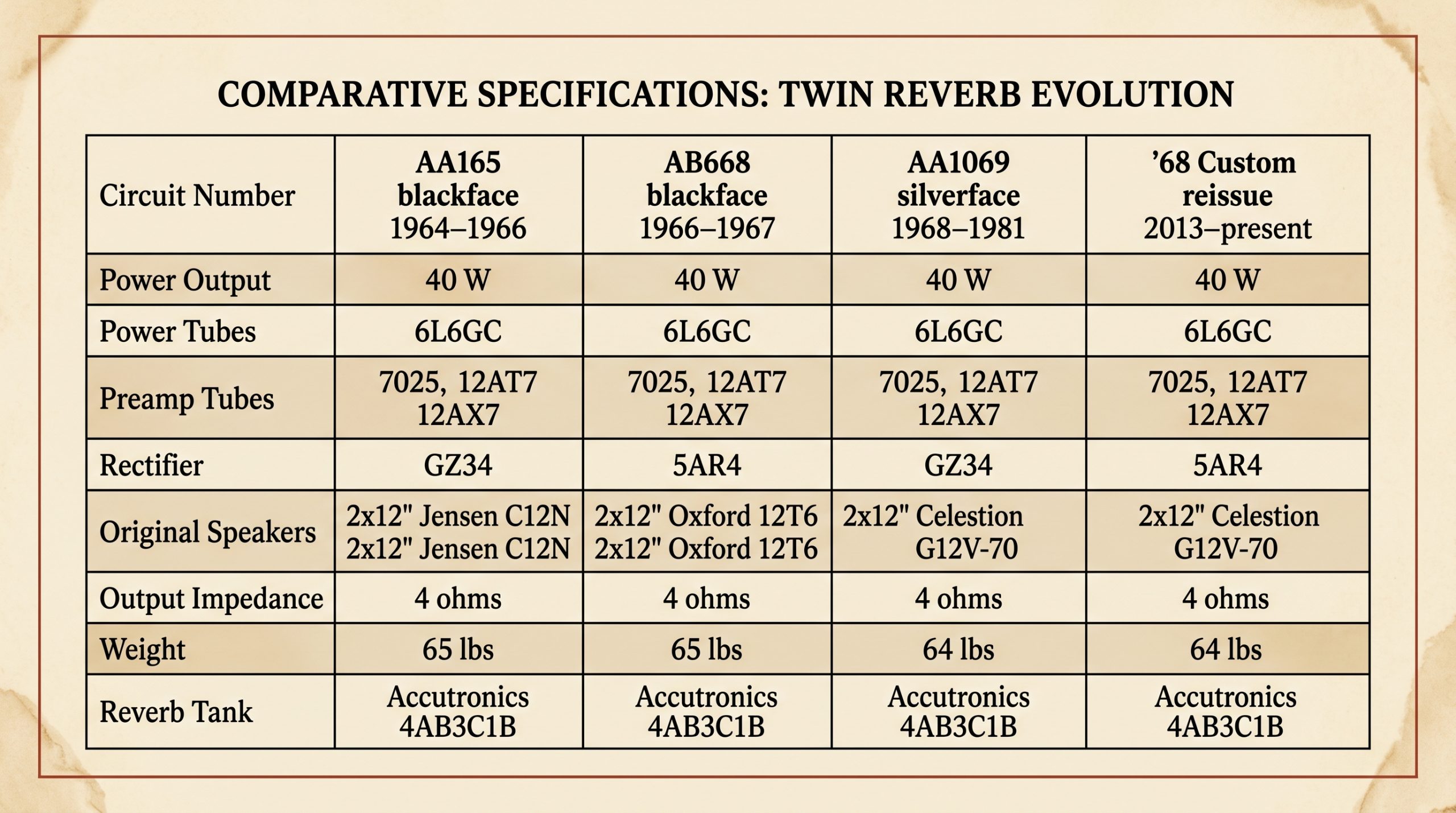
Deluxe Reverb (22W) to Vibrolux Reverb (35W) to Pro Reverb (40W) to Super Reverb (40W) to Twin Reverb (85W). Each step adds headroom and stiffens the feel slightly. The Pro Reverb’s saturation, when it comes, is smooth rather than aggressive. The GZ34 sag rounds the initial transient, which gives the overdrive a compressed, organic quality. Not ice-pick treble. Not the kind of breakup that cuts ears at close range. It’s a warm, controlled breakup that records well.
Speaker Interaction: 2×12 Voicing
The 2×12 cabinet spreads low-mids differently than a single 15″ (Super Reverb) or a 1×12 (Deluxe Reverb). Two 12″ cones push more air than a single driver while distributing frequencies more evenly across the cabinet width. The Jensen C12N, with its bright, punchy character and slightly scooped midrange, pairs well with the Fender bright switch and complements the natural sparkle of the clean tone. The Oxford 12L6 runs warmer and more compressed, which a lot of players prefer for recording because the low-mids sit more naturally in a mix without EQ correction.
Stock Oxford speakers that have been pushed hard can lose bottom-end solidity and start to fart out at higher volumes. Warehouse Guitar Speakers notes in their Pro Reverb coverage that a pair of ET-65s addresses that bottom-end flab directly. Other documented upgrade paths include the Celestion G12H-30 (55Hz resonance, adds low-mid density), and the Eminence Commonwealth (retains vintage voicing with improved reliability). Any speaker swap should account for the 4-ohm total impedance requirement of the original design. See the Fender Vibrolux guide for a comparable discussion of 2×10 vs. 2×12 speaker configurations in the blackface family.
Ideal Musical Contexts
Club and bar gig: the Pro Reverb has enough clean headroom to cut through a medium-loud stage without the weight penalty or sheer volume ceiling of a Twin Reverb. Stage-loud, but not oppressively so. Recording: the 2×12 spread with tube rectifier sag creates natural compression that works exceptionally well for roots, country, and blues. It doesn’t need much post-processing to sit correctly in a mix. Pedal platform: the transparent clean channel responds accurately to overdrive and boost pedals because it doesn’t impose strong coloration of its own at lower volumes. Bedroom player wanting to explore the tone at living-room levels? Probably overkill. A blackface Deluxe Reverb breaks up at friendlier volumes and weighs about 16 pounds less.
Fender Pro Reverb vs. the Blackface Family
The market prices the Pro Reverb lower than the Deluxe Reverb and the Super Reverb despite competitive technical specs. That’s anomalous, and it’s the core of the “sleeper” argument.
| Feature | Deluxe Reverb | Vibrolux Reverb | Pro Reverb | Super Reverb | Twin Reverb |
|---|---|---|---|---|---|
| Power | 22W | 35W | 40W | 40W | 85W |
| Speaker Config | 1×12 | 2×10 | 2×12 | 4×10 | 2×12 |
| Rectifier | GZ34 | GZ34 | GZ34 | GZ34 | Solid-state |
| Reverb Tank | 2-spring | 2-spring | 3-spring | 2-spring | 3-spring |
| Tremolo Type | Photoresistor | Photoresistor | Photoresistor | Photoresistor | None |
| Weight (approx.) | ~34 lbs | ~38 lbs | ~50 lbs | ~62 lbs | ~68 lbs |
| Vintage Used Price | $1,400 to $2,500 | $1,800 to $3,000 | $900 to $1,800 | $1,500 to $2,800 | $1,200 to $2,200 |
The Pro Reverb consistently underperforms on price relative to its actual capability. A 40W 2×12 with tube rectifier and a 3-spring reverb tank for $900 to $1,500 versus a 22W 1×12 Deluxe Reverb at $1,400 to $2,500 is a hard gap to justify on technical merits. The Pro Reverb’s size (it’s a large cabinet) and its historical position as a “working musician’s amp” rather than a boutique collector piece probably explain the discount. For gigging players and recording musicians, those factors don’t matter. The value case is genuinely strong. The Fender Super Reverb commands premium pricing partly because of its 4×10 speaker array’s unique sonic character, the Pro Reverb doesn’t have that specific identity, which likely contributes to the relative pricing gap as well.
The ’68 Custom Pro Reverb: Reissue Buyer’s Guide
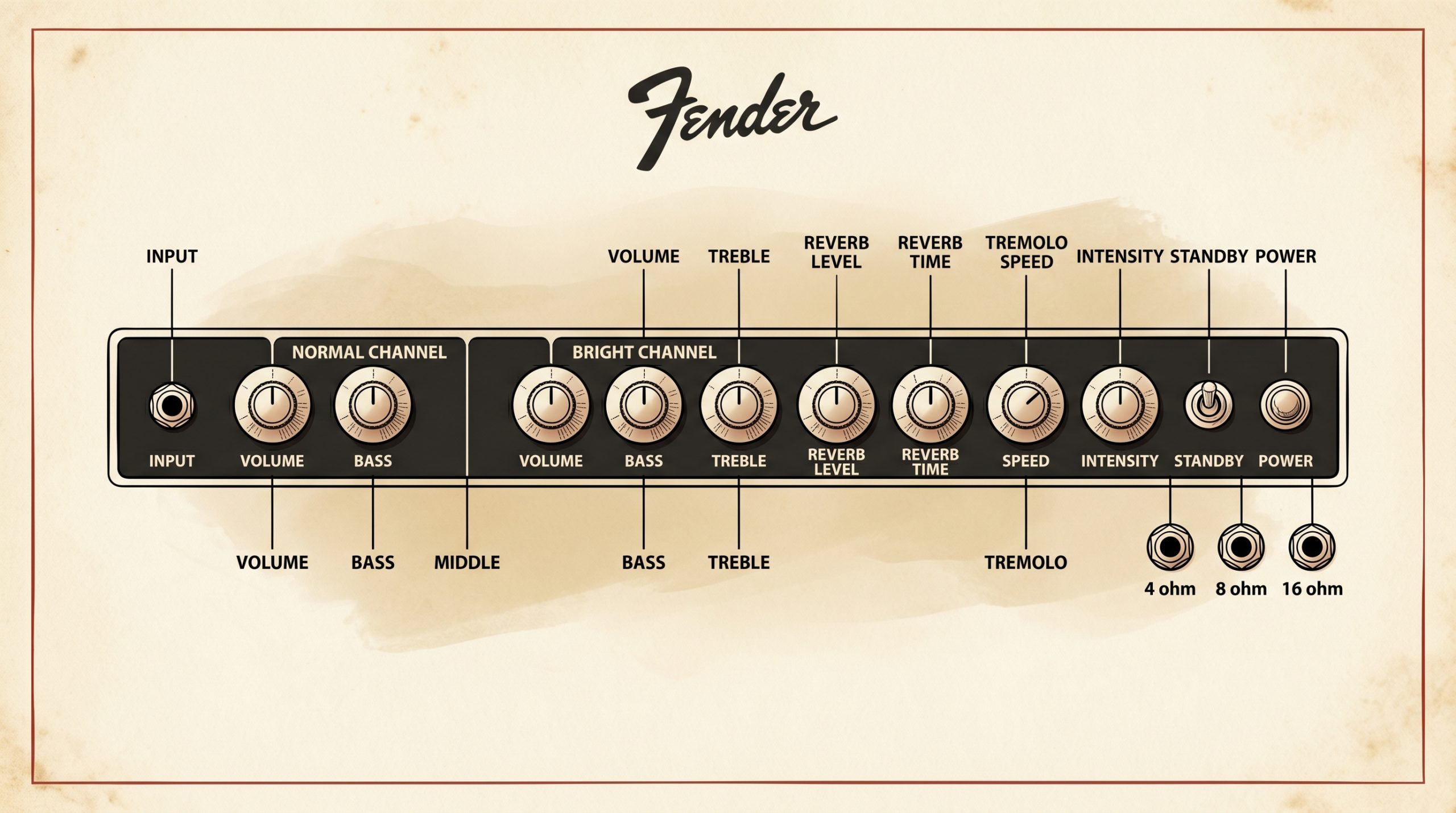
What Is the ’68 Custom Pro Reverb?
Released around 2013 as part of Fender’s ’68 Custom series, the ’68 Custom Pro Reverb is based on the AB668 late-blackface circuit rather than the 1968-era AA1069 silverface. The “68” in the name refers to the cosmetic styling (drip-edge cabinet trim, silver grille cloth) rather than the circuit inside. That’s a common point of confusion. Buyers expecting a silverface-spec amp based on the model name will find a blackface-derived circuit instead, which is actually the better outcome for most players.
The “Custom” designation adds a Bassman-derived EQ voicing to the Normal channel. The stock Vibrato channel follows the AB668 spec closely. MSRP sits at $1,679.99 as currently listed on fender.com. Full specs are covered in the table above.
’68 Custom Pro Reverb Common Problems and Issues
Several recurring issues appear across owner forums and tech discussions for this model. Hum and noise on some production runs: the first diagnostic step is a bias check (target 35mA per 6L6GC) before assuming a speaker problem. Some units simply run the bias too hot from the factory. Channel volume imbalance between the Normal and Vibrato channels is inherent to the “Custom” voicing design, where the Normal channel’s modified Bassman-style EQ can sit at a different perceived loudness level, this isn’t a fault but it does catch players off guard.
Reverb tank rattle at higher volumes is a documented complaint. The tank mounting and damping on production units isn’t always ideal, and a simple foam damping treatment around the tank often resolves it. Bias drift with new production tubes is standard behavior on any fixed-bias amp; check bias on any used unit before plugging in, and recheck it after the first ten hours on fresh tubes. These are manageable issues rather than structural defects, but knowing about them upfront avoids disappointment.
Vintage vs. Reissue: Which Should You Buy?
The vintage AA165 or AB668 delivers period-correct rectifier sag, original Jensen or Oxford speaker character, and the tonal variables that come from half a century of component drift, some positive (mellowed capacitors, broken-in speakers) and some requiring attention (caps that need replacing, worn pots). A clean, recently serviced blackface Pro Reverb in the $1,200 to $1,600 range with verified original speakers and transformers is hard to beat on pure tone-per-dollar. The reissue offers warranty coverage, consistent manufacturing, readily available parts support, and a known bias baseline. The Celestion G12 NEO Creamback in the current reissue is generally well-regarded, though some players prefer swapping it for a different speaker voice. If the new price of $1,679.99 puts the vintage and reissue prices within a few hundred dollars of each other, the vintage unit in good condition is the stronger long-term value for a player who’s comfortable with the maintenance reality of a 60-year-old amplifier.
Identifying and Dating Your Fender Pro Reverb
Serial Number Ranges
Blackface units (1964 to 1967) carry 5-digit serial numbers stamped on the rear chassis plate. Some early blackface units show an “A” prefix before the digits; chassis stamp records confirm this is era-consistent rather than indicative of a specific sub-run. Silverface production beginning in 1968 initially continued the A-prefix 5-digit format before transitioning to 6-digit numbers from approximately 1969 onward. For full serial number tables and transformer code cross-references covering every Fender production era, the Fender tube amp serial number guide documents the complete range. Greg Gagliano’s research series in 20th Century Guitar Magazine (1997 to 2000), archived via Wayback Machine, remains the primary reference for pre-CBS and transition-era chassis stamp documentation.
EIA Speaker and Transformer Codes
The EIA codes stamped on speakers and transformers are often more reliable for dating than serial numbers because they reflect the actual week and year of manufacture. The format is three digits (manufacturer code), two digits (year), two digits (week). For Pro Reverb speaker identification: Jensen C12N carries the 220 prefix, Oxford 12L6 carries 465, CTS uses 137, and Utah uses 328. The output transformer on most blackface Pro Reverbs carries the 606 prefix (Schumacher/Triad, Fender’s primary transformer supplier during this period). A transformer coded 606-6528 was manufactured by Schumacher in 1965, week 28. Cross-referencing two or more component dates gives a reliable production window even when the serial number is ambiguous. The Fender amp dating cheatsheet puts all these code tables in one place for quick reference.
Circuit Board and Chassis Identification Cues
AA165 units: look for the photoresistor mounted on a small phenolic board near the tremolo section, and confirm the GZ34 tube socket is present and populated. AB668: minor PCB trace differences from the AA165, still GZ34 socket, date codes on components should confirm 1966 to 1967. AA1069 silverface: no GZ34 socket anywhere on the chassis, solid-state rectifier diodes visible on the board, blue and silver grille cloth cosmetics outside. Transitional 1967 units with mixed cosmetic and circuit features do exist, those require transformer and speaker code dating to resolve definitively.
Common Modifications and Upgrades
Recapping and Bias
A Pro Reverb that hasn’t been serviced in 20 or more years needs new electrolytic capacitors. Filter caps are typically 22µF at 475V on the blackface circuit; cathode bypass caps in the preamp section vary by stage but are generally in the 25µF range. Replace the entire electrolytic complement at once rather than chasing individual failures. After recapping, set bias to 35 to 37mA per 6L6GC with the amp at operating temperature, verifying plate voltage first. A tech with a meter and a bias probe tool is the right approach here, don’t adjust bias blind. Not complicated. Just takes the right tools.
Speaker Swaps
The Jensen C12N is correct for blackface originality, but NOS examples are expensive and fragile. For a working gigging amp, modern alternatives that preserve the blackface voicing without the fragility include the Warehouse ET-65 (addresses bottom-end flab, adds definition), the Celestion G12H-30 at 55Hz resonance (more low-mid density, works well for blues and roots), and the Eminence Commonwealth (closest in character to the original Jensen spec with modern reliability). Always confirm 4-ohm total impedance with a matched pair before installing.
Silverface-to-Blackface Conversion
Converting an AA1069 silverface to approximate AB668 blackface specs involves replacing the solid-state rectifier with a GZ34 socket and tube, along with associated cap and resistor changes to accommodate the different voltage regulation. It’s a legitimate modification if you specifically want the tube rectifier sag. It’s also not mandatory. Many silverface Pro Reverbs sound excellent stock, and a well-maintained AA1069 with good tubes is a capable amp on its own terms. The conversion makes sense if the spongy compression feel is specifically what you’re after and the vintage blackface price premium isn’t workable.
What Players Actually Say About the Pro Reverb
Community consensus across player forums and Reddit threads is remarkably consistent for an amp that rarely gets magazine cover treatment. The characterization that appears most often: more headroom than you’d expect from 40 watts, better reverb than any other Fender combo, and a slightly neutral midrange character that can read as “flat and sterile” to players used to more mid-forward British or Tweed designs. That neutrality is actually what makes it an exceptional pedal platform and recording amp. It doesn’t impose its own midrange coloration on the signal chain.
The “flat and sterile” criticism that shows up in Reddit discussions is worth contextualizing. It usually comes from players comparing the Pro Reverb to an overdriven Tweed Deluxe or a mid-scooped Bassman, not to a clean reference standard. With the right speaker pairing (Oxford 12L6 or a warm modern replacement) and the bright switch off, the Pro Reverb has plenty of warmth in the low-mids. The perceived sterility often disappears after a speaker swap and a proper bias setting. Player sentiment on the ’68 Custom reissue runs positive on tone and reverb quality, with the main complaints centering on the channel volume balance issue noted above.
Is the Fender Pro Reverb Right for You?
The Pro Reverb fits a specific player profile well. Gigging player who needs clean headroom on medium to loud stages without hauling a Twin Reverb: yes. Recording musician who wants natural 2×12 spread with tube rectifier compression baked in: yes. Pedal-forward player building a transparent clean platform: yes. Collector focused on blackface originality at a price point below Deluxe Reverb and Vibrolux Reverb market rates: yes, the value case is genuine. Bedroom player who wants to push an amp into saturation at apartment volumes: not the right choice. A Deluxe Reverb or Princeton Reverb breaks up at more manageable levels and takes up less floor space.
The “sleeper” framing holds up under scrutiny. A 40W 2×12 with tube rectifier, 3-spring reverb, and photoresistor tremolo for $900 to $1,500 vintage is consistently underpriced relative to its siblings and its actual capability. That gap exists because the Pro Reverb never acquired the boutique mystique of the Deluxe Reverb or the tonal identity of the Super Reverb’s 4×10 array. For working players, that’s the market doing you a favor.
Frequently asked questions
What is the difference between the Fender Pro Reverb blackface and silverface?
The blackface Pro Reverb (1964 to 1967) runs either the AA165 or AB668 circuit with a GZ34/5AR4 tube rectifier, black Tolex cabinet, and silver/black/white woven grille cloth. The silverface Pro Reverb (1968 to 1981) uses the AA1069 circuit with solid-state rectifier diodes, brushed aluminum grille trim, and blue/silver grille cloth. The primary sonic difference is the loss of tube rectifier sag in the silverface, which produces a stiffer, more immediate attack and slightly more clean headroom feel. The silverface isn't inferior, it's a different amp character. Some 1967 transitional units show pre-silverface cosmetic trim with AB668 circuit boards inside, making accurate identification dependent on component date codes.
How much does a Fender Pro Reverb weigh?
Vintage blackface and silverface Pro Reverb units weigh approximately 50 to 52 lbs. The cabinet dimensions of 19½" x 26½" x 9½" are comparable in size to a Twin Reverb, though considerably lighter due to the smaller transformer and two-tube power section. The '68 Custom Pro Reverb reissue comes in at approximately 48 lbs. None of these are lightweight gigging options. A quality amp dolly is a reasonable investment if you're moving the amp regularly.
What is the difference between the vintage Fender Pro Reverb and the '68 Custom Pro Reverb?
The vintage Pro Reverb (AA165 or AB668 depending on production year) uses original Jensen C12N or Oxford 12L6 speakers, period-correct wiring, and transformer hardware that is now 55 to 60 years old. The '68 Custom reissue is based on the AB668 circuit but adds a "Custom" Normal channel voicing derived from the Bassman EQ, replaces the original 2x12 speaker configuration with a single Celestion G12 NEO Creamback in a 1x12 cabinet, and is built to current manufacturing tolerances with Fender warranty coverage. The '68 Custom name refers to the cosmetic styling (drip-edge trim, silver grille cloth) rather than the internal circuit, which is blackface-derived rather than silverface. Both run 40 watts with a GZ34 tube rectifier and two 6L6GC power tubes.
What speakers does the Fender Pro Reverb use?
Original blackface Pro Reverbs shipped with either Jensen C12N speakers (EIA code 220-YYWW) or Oxford 12L6 speakers (EIA code 465-YYWW), paired as a 2x12 configuration at 4 ohms total. Some late blackface and early silverface units received CTS (137-YYWW) or Utah (328-YYWW) speakers depending on production timing and supplier availability. The '68 Custom Pro Reverb reissue uses a single Celestion G12 NEO Creamback in a 1x12 configuration. Confirming the EIA code on any vintage unit's speakers is the most reliable way to determine whether the original speakers are still in place.
Is the Fender Pro Reverb a 1x12 or a 2x12?
The original vintage Pro Reverb (1964 to 1981) is a 2x12 configuration. The current '68 Custom Pro Reverb reissue is a 1x12 configuration with a single Celestion G12 NEO Creamback speaker. The Pro Tube Series reissue produced between approximately 1987 and 1995 is also a 1x12 unit running 65 watts, a completely different amp despite sharing the Pro Reverb name. This is the most common source of buyer confusion when shopping for the model. If a listing describes a Pro Reverb with a single 12" speaker and 65 watts of output, it's a Pro Tube Series unit. Confirm the speaker count and wattage before purchasing.