Contents
- 01What the Tone Master Is Trying to Replicate
- 02Fender Tone Master '59 Bassman: Full Specifications
- 03How Does It Sound? Honest Tone Assessment
- 04Tone Master '59 Bassman vs. Original 5F6A: Which Should You Buy?
- 05The XLR Output Deep Dive: Why This Changes Modern Gigging
- 06Power Scaling Science: What Those Wattage Settings Actually Mean
- 07Weight and Gigging Practicality: The Numbers That Matter
- 08Fender Tone Master '59 Bassman: Frequently Asked Questions
- 09Who Is the Tone Master Bassman Really For?
You’re staring down a four-hour load-in across a parking lot, and your ’59 Bassman reissue is sitting in the van weighing 55 pounds. That scenario has pushed a lot of players toward the Tone Master ’59 Bassman, Fender’s DSP-modeled take on what many consider the most influential combo amp ever built. The question isn’t whether it sounds like a Bassman. The question is how close it gets, and whether that’s close enough for you.
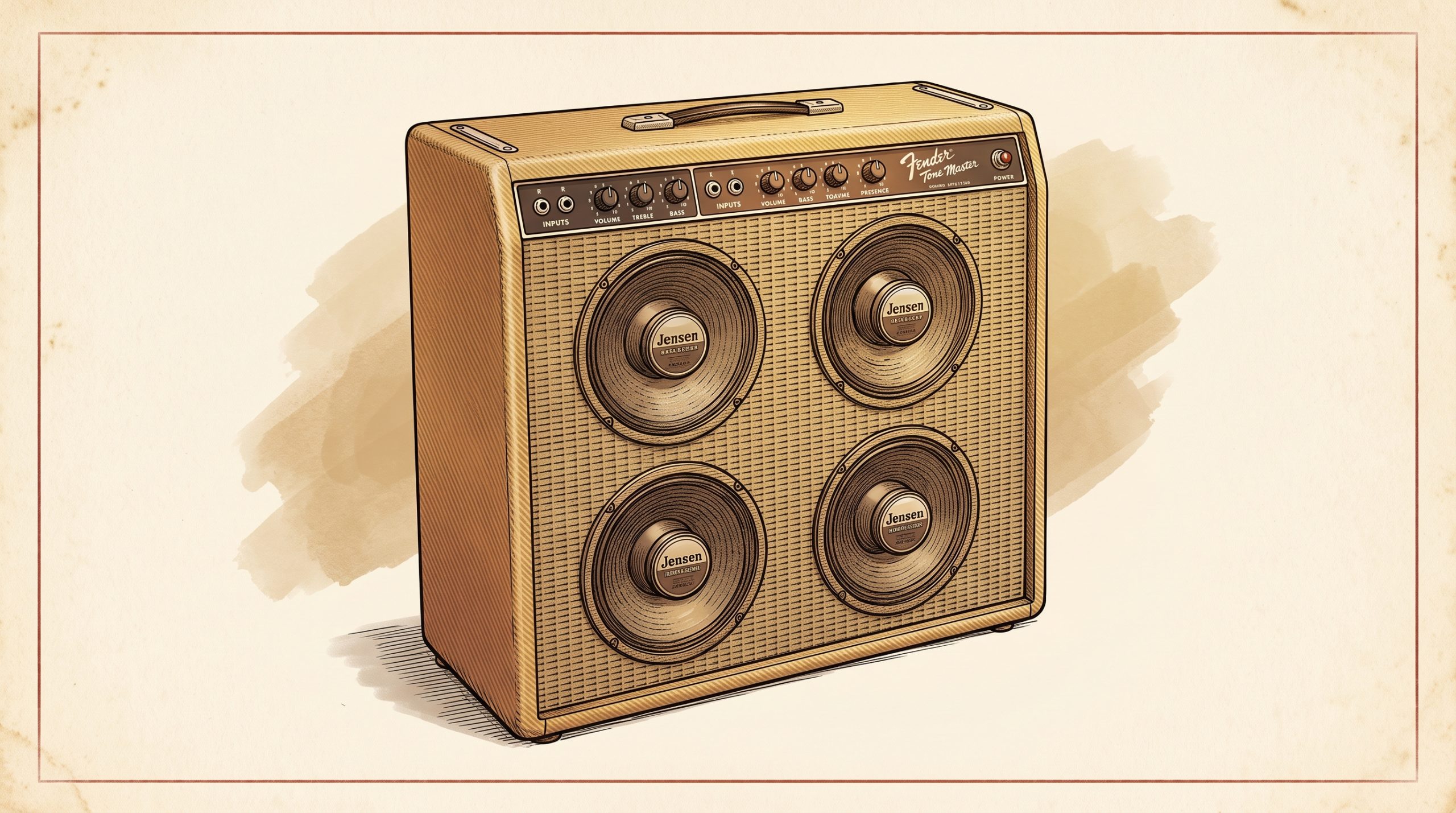
The Fender Tone Master ’59 Bassman is a solid-state, digitally modeled combo amplifier that replicates the circuit behavior of the 1958–1960 5F6A Bassman, including simulated power stages from 45W down to 0.5W, through a 200-watt Class D amplifier driving four 10-inch Jensen P10R alnico speakers in a tweed-covered pine cabinet. It weighs 32 lbs. Not a typo.
What the Tone Master Is Trying to Replicate
Circuit, Era, and Production History
The original Bassman that the Tone Master models carries the circuit designation 5F6A, produced from 1958 through 1960 during Fender’s tweed era (roughly 1948–1960). A pair of 6L6GC (5881) output tubes, a single 12AY7, and two 12AX7 preamp tubes drove roughly 45 watts into four Jensen P10R alnico 10-inch speakers. The output transformer was a Schumacher unit, and its iron character contributed as much to the tone as any tube in the circuit. For a full breakdown of how to date original production units by transformer codes and chassis stamps, the Fender tube amp serial number and dating reference covers the 5F6A alongside every other tweed-era circuit.
Leo Fender designed the 5F6A as a bass amplifier. Jim Marshall used it as the blueprint for his first amplifier. That lineage tells you everything about its position in amp history. As documented in Teagle and Sprung’s Fender Amps: The First Fifty Years, the 5F6A’s wide-range frequency response, stiff but musical low end, and four-input dual-channel layout made it equally useful for guitar, and players quickly discovered that.
One important note from verified Fender product documentation: the Tone Master ’59 Bassman is modeled after the current ’59 Bassman LTD, not an individual vintage specimen. That means the DSP circuit reference includes a 12AX7 in the V1 position, which reflects how the LTD reissue is configured rather than the original 12AY7-loaded V1 of a true vintage 5F6A. A subtle difference, but worth knowing if you’re chasing a specific vintage character.
What Made the 5F6A Special
The 5F6A runs fixed bias on its output tubes, which gives it a stiffer attack and more headroom than a cathode-biased design. The Schumacher output transformer colors the upper midrange in a way that’s difficult to quantify on paper but immediately apparent in a mix. And the rectifier tube, a GZ34/5AR4, introduces real voltage sag under heavy picking load. When you dig in hard, the supply voltage drops slightly and the amp compresses in a way that feels physical. Spongy compression that breathes with your playing. That sag behavior is one of the hardest things for any solid-state or DSP design to replicate convincingly, and it’s the central tension in evaluating the Tone Master.
Fender Tone Master ’59 Bassman: Full Specifications
Hardware Specs at a Glance
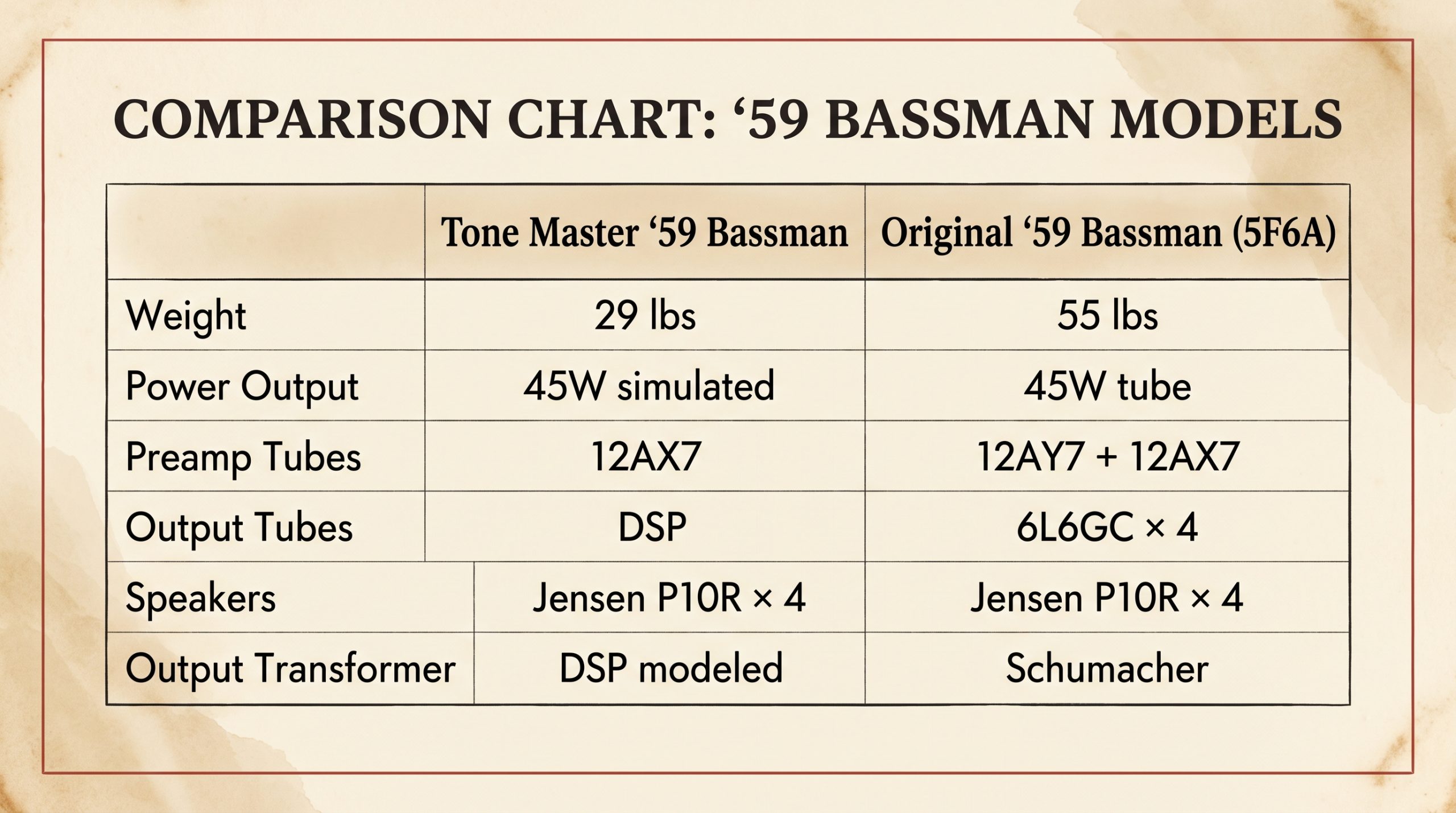
| Spec | Tone Master ’59 Bassman | Original ’59 Bassman (5F6A) |
|---|---|---|
| Circuit Type | Solid-state DSP | All-tube (5F6A) |
| Simulated Output | 45W / 22W / 12W / 5W / 1W / 0.5W | ~45W actual |
| Actual Power Stage | 200W Class D | ~45W (2x 6L6GC/5881) |
| Speakers | 4x 10″ Jensen P10R Alnico | 4x 10″ Jensen P10R Alnico |
| Weight | 32 lbs | ~60–65 lbs |
| Effects Loop | Yes (series) | No |
| Convolution Reverb | Yes (top panel control) | No |
| Cabinet | Tweed-covered pine | Tweed-covered pine |
| XLR DI Output | Yes (cab-simulated) | No |
| MSRP | ~$1,499.99 | Vintage: $3,000–$8,000+ |
| Tubes | None | 2x 6L6GC (5881), 1x 12AY7, 2x 12AX7 |
| Production Start | 2024 | 1958 |
One spec worth highlighting: the Tone Master uses the same Jensen P10R alnico speakers as the original. That’s not a marketing approximation. Fender’s product documentation confirms four Jensen P-10R alnico 10-inch drivers, which means the acoustic output of the cabinet is working with the same transducer character as a vintage unit. What changes is everything upstream of those speakers.
Controls and Features Breakdown
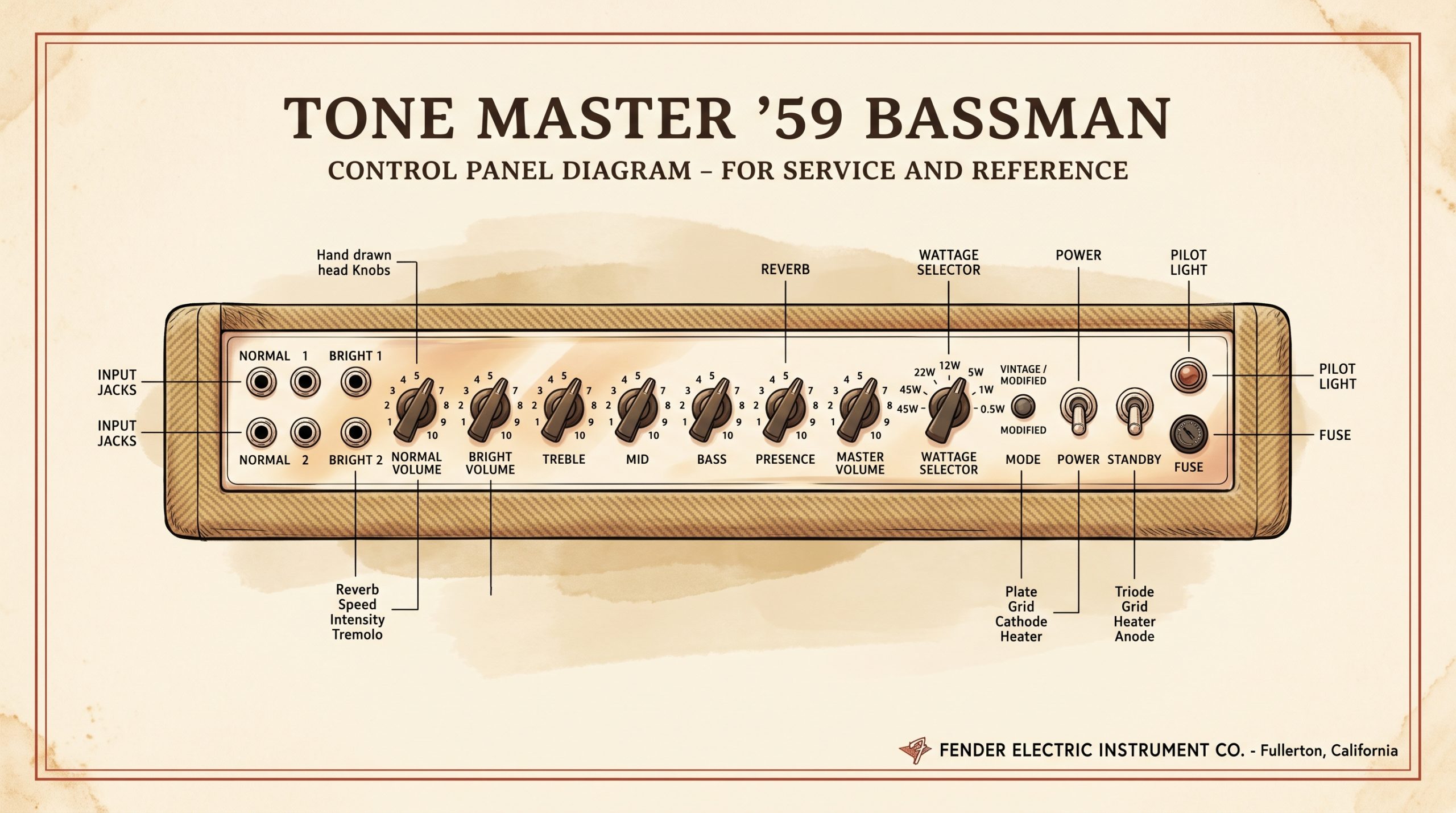
The control layout follows the original 5F6A configuration: Volume for the Normal channel, Volume for the Bright channel, Treble, Bass, Middle, and Presence. A top-panel convolution reverb control adds a feature the original never had, and it’s tasteful rather than gimmicky. The rear panel adds a “Vintage-Tight” switch (adjusting the low-end response characteristic of the modeled circuit), the power level selector, XLR output with cab simulation, effects loop jacks, and a ground lift.
The standby switch is present but functions as a behavioral simulation rather than an actual tube warm-up stage. No tubes to warm up. It’s a cosmetic nod to the original’s workflow.

How Does It Sound? Honest Tone Assessment
Clean Headroom and the Bassman Bloom
At the 45W simulation setting, the Tone Master delivers what most players would call a convincing Bassman voice. Full, articulate, with that characteristic low-end bloom when you push a chord and let it decay. Guitar World and MusicRadar reviewers note that the Tone Master has more brightness available than the original vintage model, which sounds darker and woolier with matched settings. That’s not a flaw in the Tone Master. It’s an accurate observation about what the original sounds like compared to what people think it sounds like. The 5F6A is a warm amp. Darker than many expect.
Drop the power setting to 12W or 5W and the breakup arrives earlier. Pick attack gets more aggressive. The question players genuinely debate is whether this feels like power amp compression or just gain increase with lower volume. Not the same thing.
Channel Jumping: Does It Work?
The original ’59 Bassman’s most documented trick is jumping the Normal and Bright channels with a short patch cable, combining both preamp voices into a single output for a richer, more harmonically complex tone. The Tone Master supports this exactly as the original does, with dual inputs on each channel. Jump them with a cable, and you get the expected interaction: the Normal channel’s warmth fills out the Bright channel’s top-end snap. Players on Reddit’s r/GuitarAmps report this as one of the Tone Master’s more convincing behaviors, noting that it behaves very similarly to a real Bassman, especially at lower wattage settings.
Touch Sensitivity and Dynamic Response
This is where the debate gets honest. The 5F6A’s GZ34 rectifier creates real voltage sag under load. When you hit a hard chord, the B+ voltage drops, the output tubes compress, and the amp gives back in a way that feels organic. Fender’s DSP attempts to model this behavior. And it’s not bad. Players who own both report the Tone Master gets reasonably close at moderate volumes, but at stage volume with a hard-picking right hand, the distinction becomes more apparent. The modeled sag feels slightly more uniform, less reactive to transient dynamics, compared to a real rectifier tube under stress.
For context: dedicated modelers like Fractal Audio’s Axe-Fx and Kemper also model sag behavior with varying degrees of success. None have fully cracked the physics of a real rectifier tube interacting with a real output transformer under real load. The Tone Master doesn’t either. Worth knowing before you buy.
Tone Master Bassman for Bass Guitar
The original 5F6A was designed for bass. The Tone Master reproduces the circuit behavior of that amp, and the four Jensen P10R drivers can handle low-frequency content without immediately falling apart. For casual bass practice or low-volume recording, it’s functional. For serious bass application at stage volume, a dedicated bass cabinet with more excursion capacity is a better choice. The Jensen P10Rs are voiced for guitar frequencies, and the cab simulation on the XLR output is tuned to that speaker/cab response. Using the Tone Master as a primary bass amp is possible but not its strength.
Tone Master ’59 Bassman vs. Original 5F6A: Which Should You Buy?
The Case for the Tone Master
Thirty-two pounds versus sixty-five pounds. That’s the first argument, and for many players it’s the only one they need. One-trip load-in with a guitar bag and a pedalboard is genuinely achievable. No re-tubing costs, no biasing, no capacitor failures. The built-in attenuation covers everything from full stage volume down to 0.5W without a load box. The XLR DI eliminates the need for a mic and a separate cab simulator at a gig or recording session. And the series effects loop, unavailable on any original Bassman, lets you run time-based effects in the correct signal path without compromising the preamp character.
For a detailed look at how the Tone Master series applies this approach to the Deluxe Reverb circuit, the Fender Tone Master Deluxe Reverb spec reference covers the methodology and hardware differences between models.
Price entry matters too. At ~$1,499.99 new, the Tone Master sits well below a playable vintage 5F6A ($3,000 to $8,000+ depending on condition and provenance) and roughly comparable to the current ’59 Bassman LTD reissue. Used Tone Masters are appearing in the $1,100–$1,400 range.
The Case for the Real 5F6A
Real tube rectifier sag isn’t modeled behavior. It’s a physical interaction between component mass, voltage supply, and the music you’re playing. The Schumacher output transformer in a real 5F6A colors the tone in a way that no current DSP chain has fully replicated, because output transformer distortion is a function of magnetic saturation physics, not an algorithm. A vintage Bassman also appreciates in value over time. The Tone Master depreciates. And for players who work by feel rather than by spec, the physical interaction of a real amp with real tubes matters in ways that don’t show up in A/B frequency plots.
The complete Fender Bassman model guide covers the full production history from the 5B6 through the Bassman 100, including how to identify original 5F6A units and distinguish them from later variants.
| Factor | Tone Master Winner | Vintage 5F6A Winner |
|---|---|---|
| Weight | ✓ | |
| Authentic rectifier sag | ✓ | |
| Output transformer character | ✓ | |
| Recording DI (no mic needed) | ✓ | |
| Long-term resale value | ✓ | |
| Maintenance costs | ✓ | |
| Effects loop | ✓ | |
| Price (entry point) | ✓ | |
| Tone at stage volume | Debated | Debated |
The XLR Output Deep Dive: Why This Changes Modern Gigging
Most amp reviews mention the XLR output exists. Few explain how to use it. The Tone Master’s XLR output isn’t a raw line-level signal. It’s a post-cabinet-simulation output that models the frequency response of the four-10-inch Jensen P10R cabinet, including the cab’s natural low-frequency rolloff and the interaction between the speaker’s alnico motor and the pine enclosure. What reaches the PA or the audio interface is what a microphone positioned in front of the cabinet would hear, minus the microphone’s own coloration.
For FOH use: set the XLR output level conservatively and use the ground lift if you encounter hum from the mains. The signal is cab-sim’d and ready for a channel strip without additional processing. For recording: the XLR feeds directly into an audio interface at microphone level, which means engaging your interface’s preamp. Latency is negligible since the processing is happening inside the Tone Master before the signal leaves. The cab simulation captures the power amp character as well as the preamp, so you’re not getting a flat preamp signal. You’re getting the full modeled signal chain.
This is the feature that makes the Tone Master genuinely useful for working musicians who record and gig from the same rig. No mic stands, no room treatment anxiety, consistent signal every performance. Fender’s official Tone Master ’59 Bassman product page documents the XLR specifications and rear panel layout.
Power Scaling Science: What Those Wattage Settings Actually Mean
The Tone Master offers six power settings: 45W, 22W, 12W, 5W, 1W, and 0.5W. Here’s the critical distinction that most reviews miss. These settings don’t reduce actual output power the way a hardware attenuator (THD HotPlate, Weber MASS, Fryette Power Station) does. They change the DSP model’s behavioral simulation. At 1W, the circuit model simulates how a 5F6A behaves when the output stage is working very hard at low power supply headroom. That’s a heavily compressed, earlier-breaking tone mode. Not simply a quieter clean signal.
Practical consequence: the 1W setting is not silent practice. It’s still audible in a quiet room. If you need genuine SPL reduction without changing the tonal character, a hardware attenuator on the speaker output is the correct tool. The Tone Master’s power settings are tone modes that simulate operating conditions at different power levels. They’re useful and musically effective. They’re just not attenuators in the traditional sense. Understanding the difference saves you a confused gig night.
The 0.5W setting is the most compressed, earliest-breaking option, and some players find it produces the most satisfying breakup for home use. Worth experimenting with before defaulting to the 45W mode for everything.
Weight and Gigging Practicality: The Numbers That Matter
Thirty-two pounds. Official. Fender’s spec sheet confirms it, and it’s consistent with what players report in real use. For reference: a vintage ’59 Bassman runs 60–65 lbs fully loaded with tubes and speakers. The current ’59 Bassman LTD reissue weighs approximately 55 lbs. Even a vintage Fender Vibrolux Reverb, not considered a heavy amp, comes in around 31 lbs. The Tone Master is lighter than that.
One-trip load-in with a guitar in a gig bag, a pedalboard over one shoulder, and the Tone Master in hand is realistic for most players. Not aspirational. Realistic. For a touring musician doing 200 dates a year, the cumulative wear reduction from 60-lb amp lifts versus 32-lb amp lifts is significant.
The external cabinet dimensions match the original ’59 Bassman footprint. Players with vintage risers, amp stands, or speaker isolation pads built for the original format will find the Tone Master fits without modification. Corner hardware and the carry handle on the production unit are reported by owners as solid, though handle attachment points on any heavy-use combo are worth inspecting before committing to a full tour schedule. Tweed covering on the production units has held up well in owner reports through 2024–2025 gigging conditions.
Fender Tone Master ’59 Bassman: Frequently Asked Questions
Is the Fender Tone Master Bassman worth the money?
At ~$1,499.99 MSRP, it’s a premium price point for a solid-state amplifier. The value calculation depends on what you’re comparing it to. A Fender Blues DeVille (see the Fender Blues DeVille guide for context) comes in around $1,099 and delivers real tube tone in a different circuit voice. A vintage 5F6A starts at $3,000 for a player-grade example and rises steeply for original-condition units. The ’59 Bassman LTD reissue runs approximately $2,199.99 MSRP new. Against those benchmarks, the Tone Master at $1,499.99 represents a realistic entry into the Bassman voice for gigging players who prioritize reliability, weight, and built-in DI. For players who need the real tube interaction, neither the price nor the feature set will close the deal.
Can the Fender Tone Master Bassman be used for bass guitar?
Yes, with caveats. The original 5F6A was designed for bass, and the Tone Master replicates that circuit’s wide-range frequency response. The four Jensen P10R alnico speakers can handle bass frequencies at moderate volumes without immediate failure. However, the Jensen P10Rs and the cabinet voicing are optimized for guitar. For serious bass use at stage volume, a dedicated bass cabinet with higher excursion capacity handles the job better. The XLR cab simulation output is also voiced for guitar speaker response, so the direct signal won’t behave like a bass-specific DI. It’s capable for practice and low-volume recording, not ideal as a primary bass rig.
How does the Tone Master Bassman compare to the original ’59 Bassman?
Tonally, the Tone Master gets the broad character right: the warmth, the low-end bloom, the dual-channel interaction. Guitar World and MusicRadar reviewers note it actually offers more brightness than the original vintage model, which sounds darker and woolier with equivalent settings. Where it diverges is in the physical feel under heavy playing loads. The original’s tube rectifier sag and Schumacher output transformer saturation are mechanical processes that respond to your playing in real time. The Tone Master approximates those responses via DSP. At moderate volumes in a mix, the difference is subtle. At stage volume with a hard-picking player, it’s more apparent. Neither is “wrong.” They’re different tools.
What speakers does the Fender Tone Master Bassman use?
Four Jensen P-10R alnico 10-inch speakers. This matches the speaker complement of the original 1959 Bassman and the current ’59 Bassman LTD reissue. It’s not a substitute driver. Fender’s product documentation confirms Jensen P-10R alnico units specifically. For players who want to further modify the tone, some owners have experimented with Weber alnico 10-inch drivers, though the Jensen P10R is already the period-correct choice. Speaker swaps on this unit are less commonly pursued than on Tone Master models using non-Jensen drivers.
Where can I find a Fender Tone Master Bassman for sale?
New units are available through Fender authorized dealers including Sweetwater (sweetwater.com) and Guitar Center. MSRP runs approximately $1,499.99. Used units began appearing on the secondary market starting in late 2024, following the Tone Master ’59 Bassman’s October 2024 launch; current used pricing on Reverb and eBay runs approximately $1,100–$1,400 depending on condition and included accessories. When buying used, verify the cosmetic condition of the tweed covering and the Jensen speakers, since both are more expensive to replace on this model than on standard solid-state combos.
Who Is the Tone Master Bassman Really For?
Three buyer profiles emerge clearly after working through the specs and player reports. The working gigging guitarist who needs a reliable, lightweight amp with a built-in DI and doesn’t want to carry 65 lbs across a parking lot: strong buy. The home recorder who wants Bassman tone directly into a DAW without microphone placement variables: very strong buy. The tone purist who needs real tube rectifier sag, real Schumacher transformer character, and the physical interaction of valves under load: buy the actual 5F6A or the LTD reissue. The Tone Master gets close. It doesn’t get there.
To restate the core fact worth anchoring to: the Tone Master ’59 Bassman is a DSP-modeled solid-state combo delivering 200 watts of Class D power through four Jensen P10R alnico speakers in a 32-lb tweed cabinet, simulating the 5F6A circuit at six power stages from 45W to 0.5W. That’s a genuinely useful amplifier for a broad range of players, and it should be evaluated on those terms rather than simply as a tube amp substitute. The full technical documentation at Fender’s product page covers spec details for players who want to verify specific parameters before purchasing.
- Original Circuit Modeled: 5F6A (based on current ’59 Bassman LTD)
- Era Classification: Tweed (1958–1960)
- Tone Master Production Start: 2024
- Simulated Power Stages: 45W / 22W / 12W / 5W / 1W / 0.5W
- Actual Power Stage: 200W Class D solid-state
- Speakers: 4x 10″ Jensen P10R Alnico
- Cabinet Covering: Tweed-covered pine
- Weight: 32 lbs
- Effects Loop: Yes (series)
- XLR DI: Yes (with cab simulation)
- Convolution Reverb: Yes (top panel)
- MSRP: ~$1,499.99 (used: $1,100–$1,400)
- Modeled on the ’59 Bassman LTD (12AX7 in V1), not a vintage 5F6A specimen (12AY7 in V1)
- Power settings are tone/behavior modes, not hardware attenuation. Still audible at 1W.