Contents
- 01Quick-Reference Specs: 410 vs. 212 Side by Side
- 02Production History and Model Timeline
- 03Circuit Design and Controls: What's Actually Inside
- 04The Two Configurations: 410 vs. 212 Compared
- 05How the Blues DeVille Sounds: Tonal Character and Genre Fit
- 06Known Issues, Reliability, and Common Problems
- 07Tubes, Biasing, and Upgrade Paths
- 08Who Should Buy a Fender Blues DeVille (And Who Shouldn't)
- 09Identifying Your Blues DeVille: Serial Numbers, Dating, and Variations
- 10Where the Blues DeVille Fits in the Fender Reissue Lineup
- 11Frequently Asked Questions
- 12What to Know Before You Buy
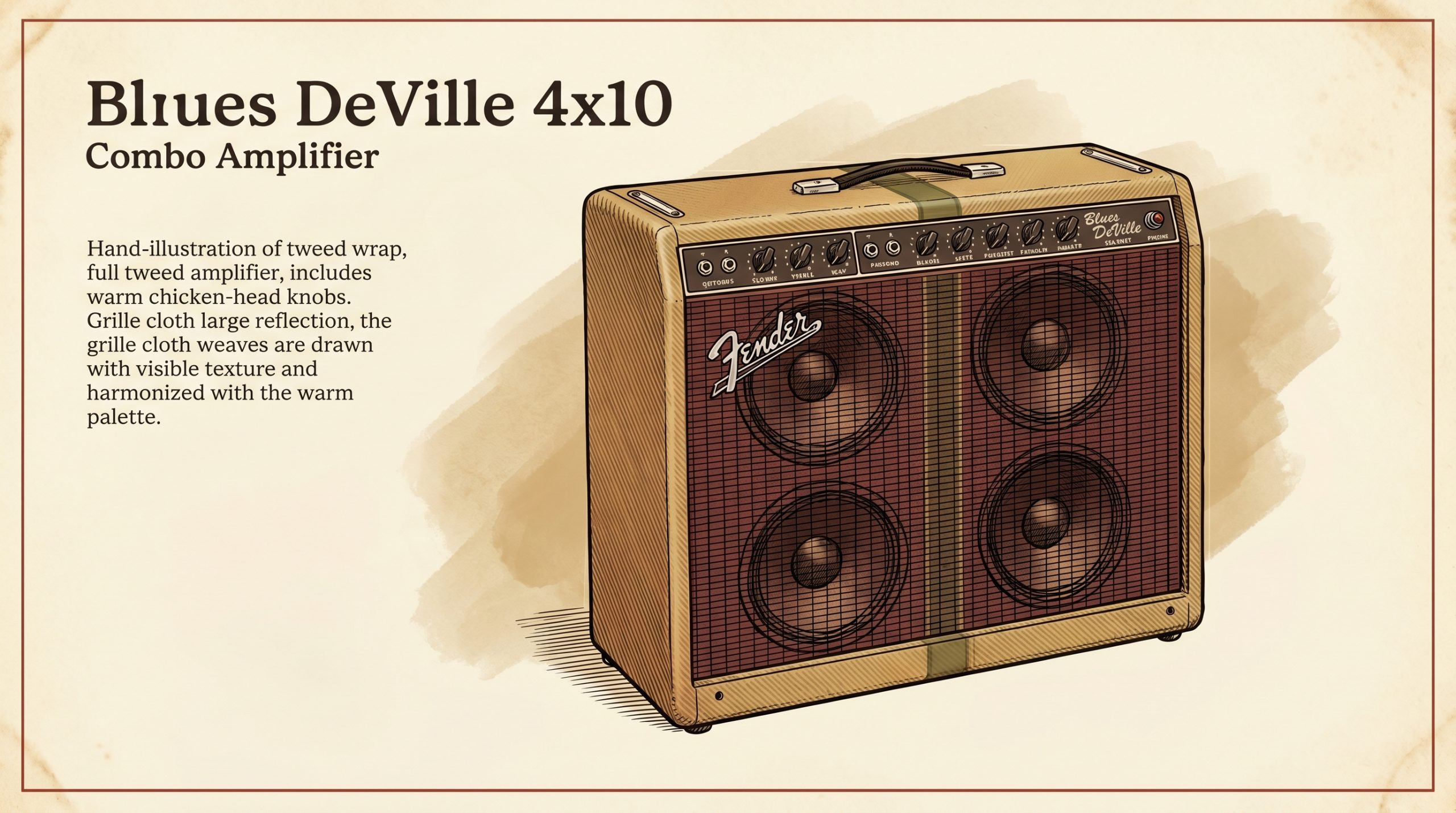
The Blues DeVille sits at the top of Fender’s early-1990s “Blues” series, positioned above the 15-watt Blues Junior and the 40-watt Blues Deluxe in both wattage and speaker count. It’s the working gigging player’s answer to “I need Fender clean tone at band volume without breaking the bank on a Hot Rod DeVille.” The tweed cabinet, oxblood grill cloth, and chicken-head knobs are a deliberate nod to 1950s Fender aesthetics. But make no mistake: this is a Reissue Era original design, not a point-to-point circuit clone of any vintage model.
- Power: 60 watts RMS, Class AB, all-tube
- Power tubes: 2× 5881 (fixed bias, solid-state rectifier)
- Preamp tubes: 3× 12AX7
- Configurations: 4×10 (Eminence alnico blue label) or 2×12 (Eminence gold label)
- Controls: two channels (Normal + Drive), spring reverb, presence, bright switch, effects loop
- Cabinet: tweed wrap with olive stripe, oxblood grill, script Fender logo
- Weight: ~65 lbs (4×10), ~60 lbs (2×12), not a one-trip load-in
- Used market: $400–$700 depending on year and condition
- Volume taper issue: jumps from near-silence to very loud between 1 and 3 on the dial
- No AA/AB vintage circuit designation, this is a modern Reissue Era design, not a blackface or tweed reissue
- Early USA-built (Scottsdale, AZ) vs. later Mexico-built (Ensenada), identification matters for used buyers
- Heat buildup is a documented failure driver in older units, see Known Issues section
Quick-Reference Specs: 410 vs. 212 Side by Side
Both configurations share the same chassis, tube complement, and circuit board. The differences come down to speaker complement, total load impedance, and tonal character.
| Spec | Blues DeVille 410 | Blues DeVille 212 |
|---|---|---|
| Production Years | 1993–1997 (original), reissued through mid-2010s (discontinued) | 1993–1997 (original), reissued through mid-2010s (discontinued) |
| Power Output | 60 watts RMS | 60 watts RMS |
| Power Tubes | 2× 5881 (fixed bias) | 2× 5881 (fixed bias) |
| Preamp Tubes | 3× 12AX7 | 3× 12AX7 |
| Rectifier | Solid-state | Solid-state |
| Speaker Complement | 4× 10″ Eminence alnico blue label | 2× 12″ Eminence gold label |
| Speaker Impedance | 2 ohms total | 4 ohms total |
| Cabinet Finish | Tweed with olive stripe | Tweed with olive stripe |
| Grill Cloth | Oxblood with gold stripe | Oxblood with gold stripe |
| Weight (approx.) | ~65 lbs | ~60 lbs |
| Effects | Spring reverb | Spring reverb |
| Circuit Designation | Modern (no AA/AB prefix) | Modern (no AA/AB prefix) |
One clarification worth spelling out: the Blues DeVille carries no vintage AA/AB circuit designation like the AB763 or AA164 codes used on blackface-era amps. If you’re using a Fender tube amp dating reference to cross-check chassis codes, you won’t find a matching circuit prefix for this model. The Blues DeVille is an original Reissue Era design, not a reissue of a specific vintage schematic.
Production History and Model Timeline
Origins: Why Fender Built the Blues DeVille (1993)
Fender’s early-1990s strategy centered on recapturing the vintage-amp market without the price tags of the boutique builders who had started filling that vacuum. The result was the “Blues” series, introduced in 1993: the Blues Junior (15 watts), the Blues Deluxe (40 watts), and the Blues DeVille at 60 watts. The DeVille was the headliner of the series. Most wattage, most speakers, most volume. It was built for the gigging musician who wanted Fender’s warm clean tones at volume levels that could keep up with a drummer and a loud bassist, without stepping up to the full price of the Hot Rod line.
The tweed wrap, oxblood grill, and chicken-head knobs were not accidental. They evoke the 1950s Fender look deliberately, referencing the era of the 5F6-A Bassman and the 5E3 Tweed Deluxe without being a circuit clone of either. It’s tweed-voiced. Not tweed-circuited.
Production Runs and Variants: What Changed Over the Years
The original Blues DeVille production run covered 1993 to 1997, as documented by Mojotone’s Fender Field Guide. Early units were built in Scottsdale, Arizona, USA production. Mid-production onward, manufacturing shifted to Ensenada, Mexico. That shift matters for used buyers because build quality, component accessibility, and PCB revision can differ between production eras.
Serial number prefixes help identify where your unit was made. Early USA-built units carry no prefix or an “M” prefix. Later Mexico-built units carry the “MX” prefix. The full serial number format also changed during the transition period. If you’re buying used and the seller can’t confirm origin, the rear panel label should confirm “Made in USA” or “Made in Mexico.” When that label is missing or unreadable, EIA source-date codes stamped on the speakers and output transformer (format: manufacturer code followed by year and week digits) can independently confirm the approximate production date.
PCB revisions between early and later production runs are relevant to repairability. Later boards can have tighter component spacing and more heat-stressed solder joints. More on that in the Known Issues section below. The Fender Hot Rod DeVille, which followed the Blues DeVille, shares some aesthetic DNA but uses a more modern voicing with channel switching focused on overdrive performance rather than clean headroom.
Circuit Design and Controls: What’s Actually Inside
Preamp and Power Amp Architecture
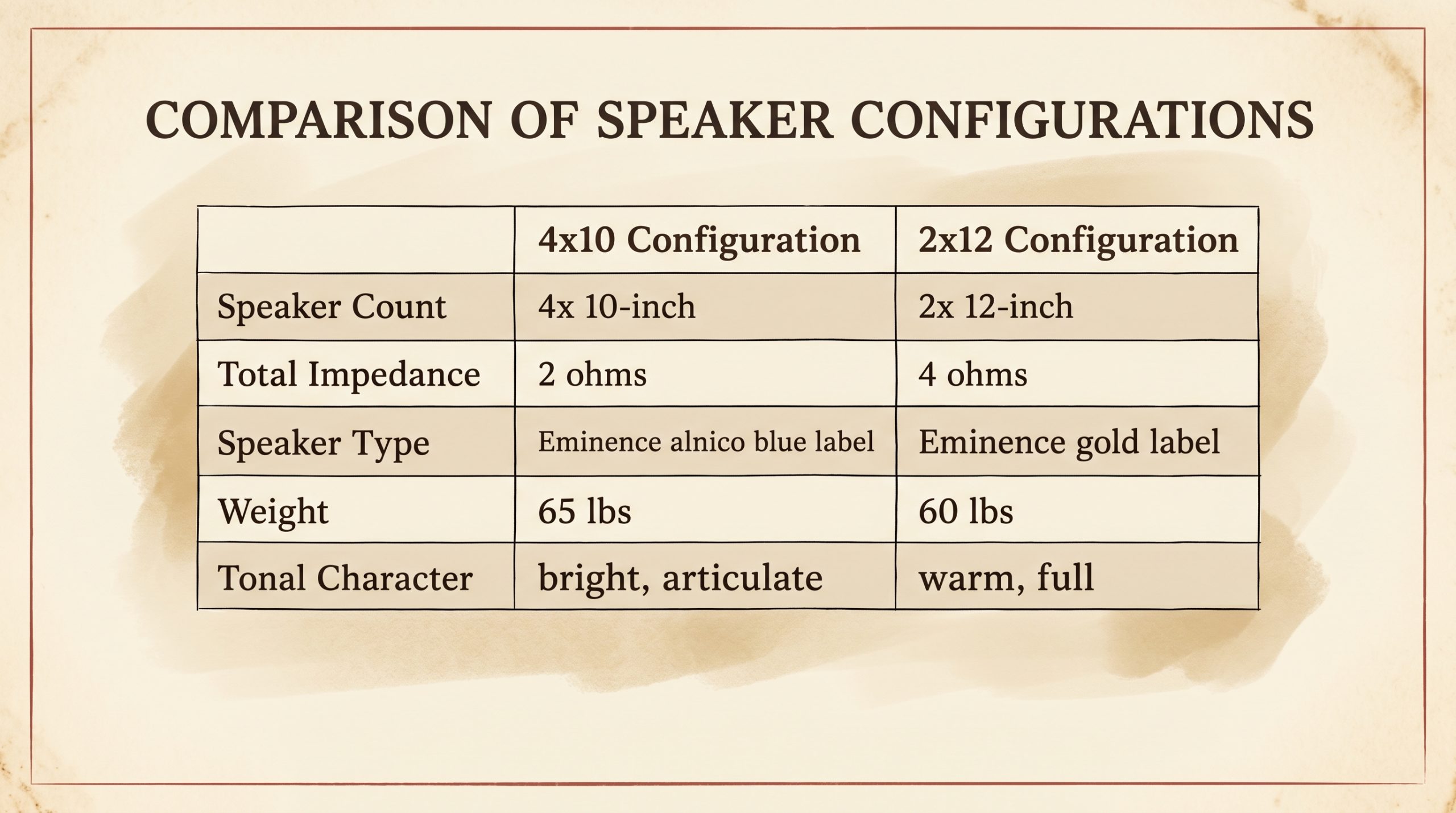
Three 12AX7 dual triodes handle the preamp duties. V1 covers the first gain stage for the Normal (clean) channel input. V2 handles the Drive channel gain stages. V3 serves as the phase inverter (phase splitter). The reverb circuit uses solid-state op-amp circuitry—not a tube reverb driver. Two 5881 output tubes push the power section. The 5881 is a military-specification ruggedized variant of the 6L6GC, same pin configuration, same basic operating parameters, same tone. You can swap 5881s with standard 6L6GCs directly. Most players do, and the sonic difference is marginal.
Fixed bias. Not cathode biased. That distinction matters enormously for power tube replacement: when you change the output tubes in a Blues DeVille, you need to check and set the bias afterward. Skipping this step risks running the tubes too hot or too cold, which shortens tube life and can cause transformer damage. The bias pot is accessible inside the chassis, but this isn’t a beginner job, it requires a multimeter, a bias probe, and some familiarity with live chassis voltages.
The rectifier is solid-state. No tube rectification here. The sonic implication is a tighter, stiffer low end with less sag and compression under heavy playing than you’d get from a 5AR4 or GZ34 rectified amp. Players moving from a blackface Deluxe Reverb or a tweed amp will notice the Blues DeVille doesn’t compress and breathe the same way at the edge of breakup. That’s a tradeoff, not a defect. For a clean platform, a stiff solid-state rectifier is often the right choice.
The circuit draws tonal inspiration from the 5F6-A Bassman topology in its clean channel voicing, but it is not a clone. Gain staging, component values, and the overall architecture are Reissue Era originals. For a detailed look at what the 6L6 tube family (of which the 5881 is a variant) contributes to tone and output, that guide covers the technical picture.
Full Control Panel Layout (Left to Right)
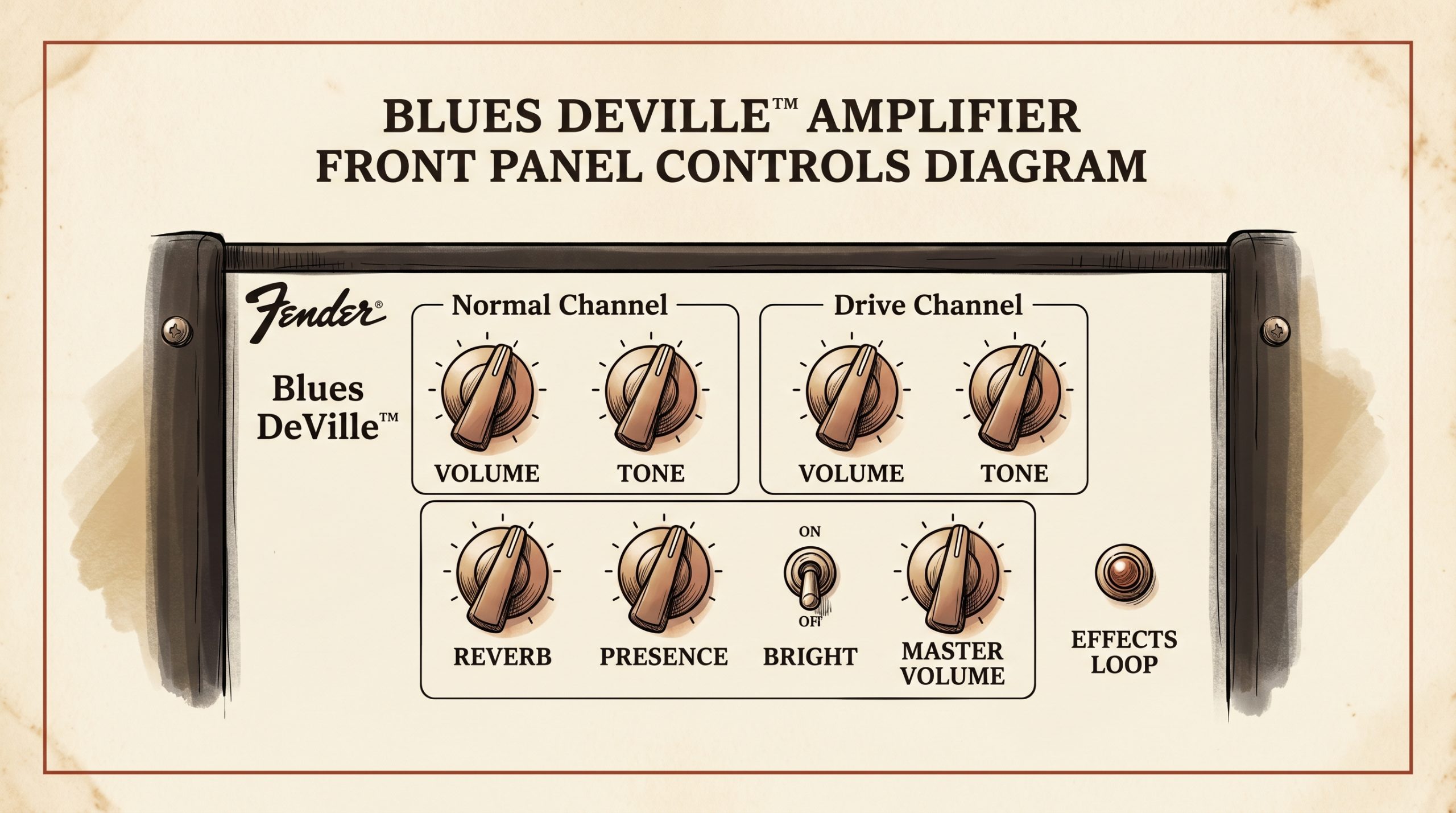
The top panel runs as follows: Power Switch, Standby Switch, Pilot Light, Power Amp In (effects return), Preamp Out (effects send), Footswitch Jack, Presence, Reverb, Master Volume, Middle, Bass, Treble, Drive LED, Drive, Drive Switch, Volume, Bright Switch, Input 1, Input 2.
Two channels. The Normal (clean) channel uses the Volume control, with the Bright Switch adding a capacitor-coupled treble boost. The Drive channel uses the Drive knob and Drive Switch, with the Master Volume controlling overall output for both channels. The effects loop is a series loop between Preamp Out and Power Amp In, high-impedance send, low-impedance return, best suited for time-based effects like delay and modulation. Pedals with high output impedance may see some level mismatch in the loop; check levels before the gig.
The footswitch jack controls channel switching between Normal and Drive, and toggles reverb on and off. The spring reverb tank is a medium-length unit. Functional. Not as lush as a vintage blackface Deluxe Reverb reverb circuit, but perfectly usable for studio and stage applications.
Output Transformer and Speaker Impedance Notes
The 4×10 configuration runs four 8-ohm speakers wired in parallel, producing a 2-ohm total load. That 2-ohm figure limits external cabinet options significantly, most extension cabs are 4-ohm or 8-ohm. Don’t run a mismatched impedance into the output transformer; it shortens transformer life. The 2×12 runs two 8-ohm speakers in parallel for a 4-ohm total, which is a more standard configuration and provides more flexibility for extension cab use.
The Two Configurations: 410 vs. 212 Compared
Fender Blues DeVille 4×10: Tone Character and Feel
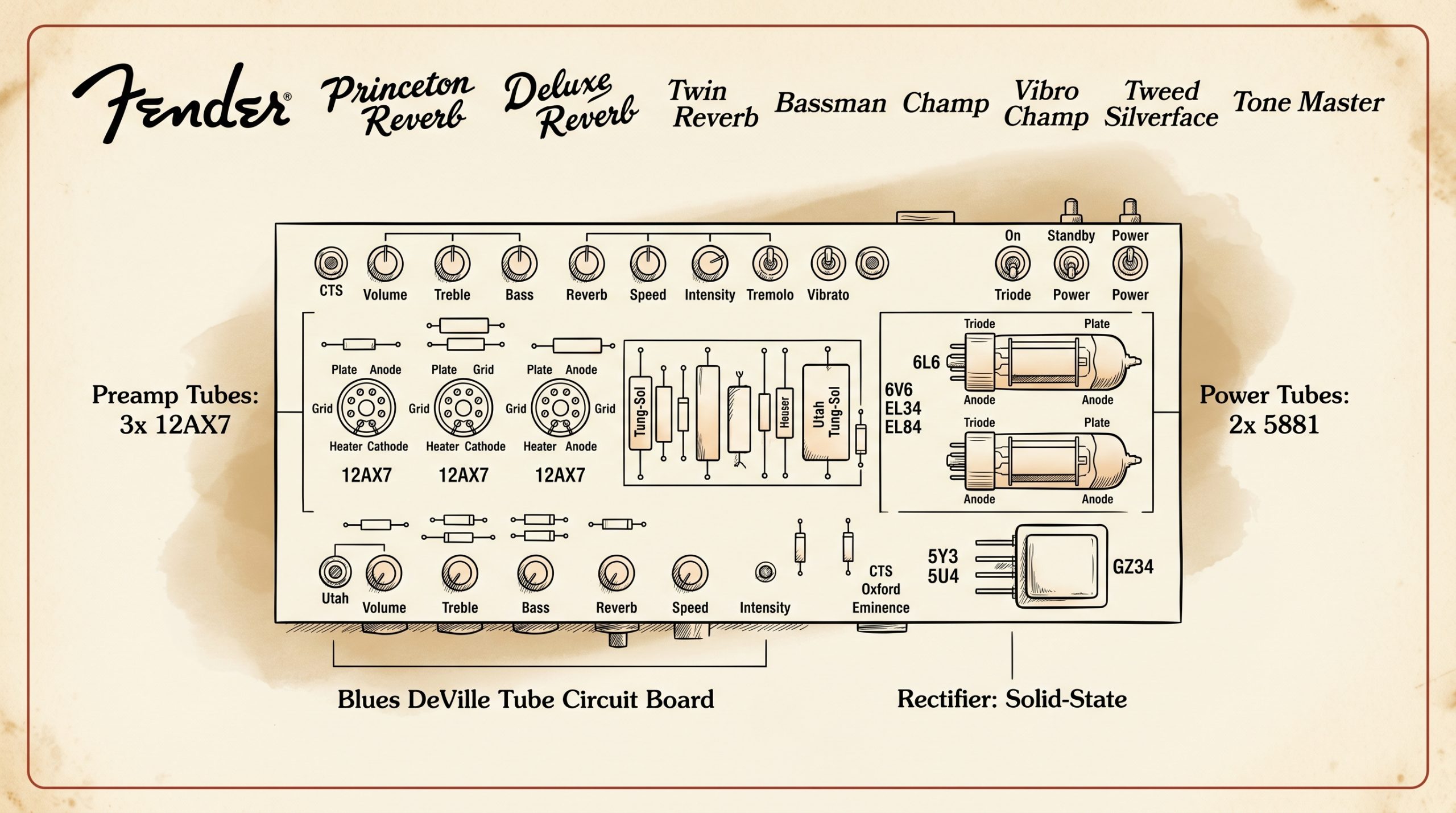
The Fender Blues De Ville specification sheet (fmicassets.com) describes the 4×10 speakers as four 10″ vintage reissue “blue-alnico” drivers. Eminence alnico speakers in a 4×10 configuration produce a clear, articulate high-mid presence with snappy attack. The low-end bloom is tighter and more controlled than a 12″ speaker, which suits country, rockabilly, and clean-edge blues styles where note definition in the midrange matters more than bottom-end weight.
Four speakers also create wider horizontal dispersion than a single 12″ or even two 12s. On a live stage, that wider sweet spot means the amp projects across more of the room without needing to be cranked. That’s a real practical advantage in smaller venues.
The weight isn’t. At approximately 65 pounds, the 4×10 is the heavier of the two configurations. Not great for the back. If you’re doing multiple load-ins per week, that number adds up fast. The 2-ohm output impedance also limits your external speaker cab options, this configuration is the less flexible of the two for gigging players who use secondary speaker cabs.
Fender Blues DeVille 2×12: Tone Character and Feel
The 2×12’s Eminence gold label 12″ speakers produce warmer tones with more low-mid weight and longer, more gradual speaker breakup compared to the alnico blue label 10s. Players moving from a Deluxe Reverb into the Blues DeVille territory will find the 212 more familiar in tonal character, more of that full-bodied push in the mids without the brightness peak the 410 produces.
Classic rock, heavier blues, and any style that benefits from extended low-end response will favor the 212. It’s also slightly lighter (~60 lbs vs. ~65 lbs) and runs at a 4-ohm impedance, which opens up extension cab use with far more available options. The 212 is the version most players recommend for general stage versatility when the genre question is undecided.
Quick Comparison: 410 vs. 212 Tone and Practical Differences
| Factor | 410 | 212 |
|---|---|---|
| Speaker Type | Eminence alnico blue label | Eminence gold label |
| Tone Character | Bright, articulate, snappy attack | Warm, full-bodied, more low-mid weight |
| Weight | ~65 lbs | ~60 lbs |
| Output Impedance | 2 ohms | 4 ohms |
| Best For | Country, clean blues, rockabilly | Classic rock, heavy blues, versatile use |
| Ext. Cab Flexibility | Limited (2-ohm match required) | More flexible (4-ohm match) |
How the Blues DeVille Sounds: Tonal Character and Genre Fit
Clean Channel Headroom and Breakup Behavior
Sixty watts of all-tube Class AB power means the Blues DeVille stays clean at volumes where a Deluxe Reverb (22 watts) or Blues Junior (15 watts) would already be barking when pushed. On a medium-sized stage with a moderately loud drummer, you can run the Volume control between 4 and 6 and still have clean headroom to spare. That’s genuinely useful.
One documented and widely reported quirk: the volume taper. The amp jumps from near-silence to very loud between positions 1 and 3 on the Volume dial. This is a pot-curve issue, the logarithmic taper of the volume potentiometer doesn’t distribute the control range evenly across the dial’s arc. Practically, it means bedroom-volume use is frustrating. You’re either too quiet or suddenly stage-loud with almost no gradual control in between. Not a deal-breaker for gigging players, but bedroom players will find it maddening.
The spring reverb is functional. Medium swell, moderate decay. It won’t replicate the lush, shimmering reverb of a vintage AB763 Deluxe Reverb, but it’s usable for stage work without sounding harsh or thin. The Presence control on the power amp section adds high-frequency content post-phase-inverter, and it’s effective for dialing in the right amount of top-end cut on a bright stage.
Drive Channel: Overdrive Quality and Limits
Honest assessment: the Drive channel is the weakest part of this amp. It’s mid-focused and somewhat compressed. It works for light crunch at moderate Drive settings, but pushed into higher-gain territory it loses definition and starts to sound one-dimensional. The Reddit community around this amp is consistent on this point.
Most Blues DeVille players use the Normal channel as their base and run overdrive pedals in front. That approach plays directly to the amp’s strengths. The stiff solid-state rectifier and 60-watt headroom give pedals a clean, transparent foundation that doesn’t color their tone unpredictably. The Drive channel is better thought of as a mild boost than a full-featured overdrive voice.
The Blues DeVille as a Pedal Platform
Clean headroom plus a neutral response equals a strong pedal platform. Overdrive and fuzz pedals respond well in front of the Normal channel. Compressors can add back some of the spongy compression the solid-state rectifier removes. Time-based effects (delay, modulation) belong in the series effects loop, which keeps them post-preamp and outside the primary gain structure.
One under-discussed use case: harmonica amplification. The Blues DeVille has a documented following among harmonica players. Its voiced midrange, substantial clean headroom before feedback, and stage-loud volume capability make it practical for players who need projection without a dedicated harp amp. That’s a niche, but a real one, and it shows up in related search data consistently.
Known Issues, Reliability, and Common Problems
Heat Buildup and Thermal Stress
The Blues DeVille runs hot. Not slightly warm. Hot. Internal chassis temperatures in enclosed environments can reach 80–90°C, as noted in a comment on Mojotone’s Fender Field Guide entry for this model. At those temperatures, electrolytic capacitors degrade faster, relay contacts corrode, and ICs fail earlier than their rated service life. The same commenter notes that adding a ventilation louvre above the chassis drops internal temperatures to 50–60°C and dramatically extends component life.
If you own or are buying an older Blues DeVille, consider this preventive maintenance before anything else. A cracking, intermittently cutting-out, or relay-switching-incorrectly Blues DeVille is often a heat-damaged Blues DeVille. Address the temperature first, then chase the symptoms.
PCB Construction and Repairability
Later production Blues DeVilles use PCB-mounted components rather than the point-to-point or turret board construction of vintage Fender amps. PCB construction is a cost-of-production tradeoff. It’s not inherently bad, but it means that heat-cycling over years of use can lift PCB traces, crack solder joints, and make component access difficult during repair. A competent technician can service these boards, but it takes longer and costs more than the same repair on a hand-wired chassis.
Before buying any used Blues DeVille, have it inspected specifically for: filter capacitors (check for bulging or leakage), reverb pan connections (a common corrosion point), and the standby switch. Better to know before you pay.
Other Common Failure Points
Reverb tank connections corrode and cause crackling or complete reverb cutout. The fix is cleaning or replacing the connection terminals at the tank, which is a low-cost repair if caught early. The standby switch is a documented weak point across this generation of Fender amps, it wears mechanically and can fail in ways that leave the amp stuck in standby or bypass standby entirely. Power tube bias drift is another issue new owners overlook: because the Blues DeVille is fixed-bias, any power tube replacement requires a bias check and adjustment. Running drifted bias on fresh tubes damages them fast.
The Eminence alnico speakers in the 4×10 can develop voice coil rub after years of high-volume use, particularly if the amp has been driven hard. A speaker that sounds “raspy” or “farty” at certain frequencies needs inspection before the coil is fully gone.
Tubes, Biasing, and Upgrade Paths
Stock Tube Complement and Function Breakdown
| Position | Tube Type | Function |
|---|---|---|
| V1 | 12AX7 | First gain stage, Normal channel input |
| V2 | 12AX7 | Drive channel gain stages |
| V3 | 12AX7 | Phase inverter (phase splitter) |
| V4 | 5881 | Power tube (output stage) |
| V5 | 5881 | Power tube (output stage) |
The 5881 is a mil-spec ruggedized 6L6GC variant. Electrically and sonically, 5881 and 6L6GC are interchangeable in this circuit. The 12AX7 covers all preamp positions. For a deep look at what the 12AX7’s amplification factor and gain characteristics mean for Fender preamp stages, that guide covers the technical and practical sides in full.
Recommended Tube Substitutions
Swapping 5881s for standard 6L6GCs is the most common upgrade path. Tung-Sol 6L6GC STR, JJ 6L6GC, and Sovtek 5881WXT are all documented substitutes. Check bias after any power tube swap. Target idle plate current of approximately 30mA per tube (factory spec: 60mV at test point T26 across the 2-ohm sense resistor) at the circuit’s approximately 470V plate voltage; confirm with your specific unit’s trim pot, and get a technician to do this if you’re unfamiliar with live high-voltage work.
Speaker Upgrade Options
The 4×10 wiring runs four 8-ohm speakers in parallel to produce the 2-ohm total load. Most aftermarket 10″ speakers are 8-ohm, so four standard replacement 10s will maintain the correct impedance. Popular options include the Celestion Ten 30 (ceramic, warmer than the stock alnico character) and the Jensen MOD 10-35 (budget-friendly, handles 35 watts per driver).
The 2×12 wires two 8-ohm speakers in parallel for a 4-ohm total. This is a standard configuration. Celestion G12H30 speakers add warmth and breakup character at moderate volumes. Weber 12A125 alnico drivers push the tone closer to vintage territory. Always match the total impedance to the amp’s output transformer rating. Don’t guess.
Who Should Buy a Fender Blues DeVille (And Who Shouldn’t)
Ideal Use Cases
The Blues DeVille is built for the working gigging musician who needs 60 watts of clean headroom and plans to shape their overdrive with pedals rather than the amp’s Drive channel. Country players, clean blues players, and classic rock players who use the amp as a transparent platform will get exactly what they need. Harmonica players seeking a warm, stage-loud combo with controllable midrange also find this a natural fit.
On the used market, Blues DeVilles typically sell for $400–$700 depending on production year, configuration, and condition. That’s genuine value for a 60-watt all-tube combo with spring reverb and a two-channel layout. MusicRadar notes, in their review of the Blues DeVille Reissue Combo, that the series represents one of Fender’s most successful product lines, with its alnico drivers delivering a bigger sound than the wattage figure alone suggests, though it commands a premium over smaller models in the Blues lineup (see the full review at MusicRadar).
When to Look Elsewhere
Bedroom players: pass. Sixty watts on a solid-state rectifier with a steep volume taper is not a bedroom amp. You won’t find a usable volume range at home without an attenuator, and even then you’re not getting natural power amp compression that makes Fender amps interesting at lower output.
Players who want amp-driven overdrive: the Drive channel won’t satisfy you. Players who prioritize lightweight touring rigs: 60–65 pounds is a significant nightly burden. Players who specifically want vintage sag and compression: the solid-state rectifier removes that characteristic. For those players, an AB763-circuit amp with tube rectification is a better fit, and our Fender amp dating cheatsheet can help you identify which vintage production runs carry those circuit codes.
Identifying Your Blues DeVille: Serial Numbers, Dating, and Variations
Serial Number Prefix Guide
Early USA-built Blues DeVilles (1993 to approximately 1995, Scottsdale, AZ production) carry no prefix or an “M” prefix on the serial number. Mid-production onward, once manufacturing shifted to Ensenada, Mexico, serial numbers carry an “MX” prefix. The serial number itself is located on the rear panel label or a chassis stamp depending on production year.
EIA source-date codes on the speakers and output transformer offer an independent production date confirmation. The format reads as a three-digit manufacturer code followed by a two-digit year and a two-digit week number. So a speaker stamped 67-394 (Eminence being code 67) followed by year and week digits confirms a specific production window independent of the serial number system. Cross-referencing both gives you the most accurate date range for a specific unit.
Visual Identification Checklist
- Tweed cabinet wrap with olive stripe: present on all Blues DeVille variants, all production years
- Oxblood grill cloth with gold stripe: stock on all configurations
- Script Fender logo mounted to the cabinet (not the chassis): distinguishes this series from the Hot Rod line
- Brown dog-bone carry handle with chrome glide feet
- Black chicken-head knobs on all controls
To distinguish a USA-built unit from a Mexico-built unit beyond the serial number, inspect the chassis solder work and PCB markings. USA-built early units show hand-touched solder joints on through-hole components. Later Mexico-built boards show more machine-consistent solder profiles. PCB silkscreen markings and board revision numbers are the most reliable indicators when the rear panel label is missing or damaged.
Where the Blues DeVille Fits in the Fender Reissue Lineup
The full Blues and Hot Rod series context looks like this:
| Model | Watts | Config | Power Tubes | Key Difference |
|---|---|---|---|---|
| Blues Junior | 15W | 1×12 combo | EL84 | Bedroom and small venue; cathode bias |
| Blues Deluxe | 40W | 1×12 combo | 6L6 | Mid-size, two channels (Normal + Drive), cleaner voice |
| Blues DeVille 212 | 60W | 2×12 combo | 5881 | Stage volume, two channels, warm voice |
| Blues DeVille 410 | 60W | 4×10 combo | 5881 | Stage volume, two channels, brighter voice |
| Hot Rod DeVille | 60W | 2×12 or 4×10 combo | 6L6 | More modern channel switching, drive-focused voicing |
The Blues Deluxe sits between the Junior and the DeVille in both wattage and intended venue size. Its two-channel layout and lower power ceiling make it more manageable for players who don’t need full stage volume. The Blues Deluxe guide covers that model’s circuit history and production differences in full detail. The Hot Rod DeVille shares the 60-watt output rating with the Blues DeVille but uses a more modern voicing optimized for channel switching and overdrive performance rather than clean-first platform use.
What to Know Before You Buy
The Blues DeVille earns its reputation as one of the better reissue-era Fender combos for working musicians who need stage volume and prioritize a clean, responsive platform for pedals over amp-driven overdrive. It’s genuinely loud, genuinely heavy, and genuinely capable at the job it was designed for. The Drive channel is a weakness. The volume taper is a quirk. The heat buildup in older units is a real maintenance concern that deserves attention before problems develop. Buy a used unit from a seller who can confirm it’s been serviced, inspect the filter caps and reverb connections, and add chassis ventilation if it’s running hot. Do those things and the Blues DeVille is a road-worthy stage amp that holds its value well in the $400–$700 used-market range. For players who want something smaller with less volume ceiling, the Blues Deluxe in 1×12 form is the natural step down from here.
Frequently asked questions
Is the Fender Blues DeVille a good amp?
Yes, with specific caveats. The Normal channel delivers excellent warm clean tones with plenty of headroom for a full band setting. As a pedal platform it's genuinely strong. The Drive channel is mediocre and most players ignore it in favor of external overdrive pedals. Older units can have heat-related reliability issues worth inspecting before purchase. For gigging blues, country, and classic rock players who prioritize clean headroom and pedal compatibility, it's a strong value at used-market prices.
How many watts is a Fender Blues DeVille?
60 watts RMS, all-tube, Class AB operation through two 5881 power tubes. In perceived loudness, 60 tube watts compares roughly to a 100-watt solid-state amplifier. It's genuinely loud. Not a bedroom amp without an attenuator in the signal chain.
What is the difference between the Blues DeVille 410 and 212?
Both run the same 60-watt circuit. The 4×10 uses Eminence alnico blue label 10" speakers producing a brighter, snappier sound with clearer high-mid articulation, runs at 2 ohms total impedance, and weighs approximately 65 pounds. The 2×12 uses Eminence gold label 12" speakers producing a warmer, fuller tone with more low-mid weight, runs at 4 ohms, and weighs approximately 60 pounds. The 2×12 is more flexible for external cabinet use due to its more common 4-ohm impedance rating.
What tubes does the Fender Blues DeVille use?
Stock tube complement: 3× 12AX7 in the preamp (V1 Normal channel input, V2 Drive channel, V3 phase inverter) and 2× 5881 in the output stage. The rectifier is solid-state, no rectifier tube. The 5881 is a direct 6L6GC equivalent; most players swap to standard 6L6GC variants without any modification, just a bias check after installation.
What are the most common Fender Blues DeVille problems?
Heat-related component failure tops the list, capacitors, relays, and ICs degrade faster than they should when internal temperatures reach 80–90°C in enclosed environments. Adding chassis ventilation significantly extends component life. Other common issues include the steep volume taper (near-silent to very loud between positions 1–3), reverb tank connection corrosion causing crackling or loss of reverb, standby switch mechanical failure, power tube bias drift after tube replacement (always check bias after a swap in this fixed-bias design), and PCB solder joint failure in heat-stressed units.