Contents
- 01What Is a 6L6 Tube? History, Origin, and Why It Matters
- 026L6 Variants Explained: GC, GA, GB, WGB, and More
- 036L6 Tube Datasheet: Key Specs Every Player Should Know
- 046L6 Tubes in Fender Amplifiers: The Essential Reference
- 055881 vs 6L6: What's Actually Different?
- 06KT66 vs 6L6: British Engineering Meets American Design
- 07KT88 vs 6L6: When More Is Not a Substitution
- 08Best 6L6 Tubes: Manufacturer Reviews and Recommendations
- 096L6 Amps: Notable Models Beyond Fender
- 10Three Angles Competitors Don't Cover
- 11FAQ: 6L6 Tubes, Common Questions Answered
- 12Which 6L6 Should You Choose
- 13Sources
This guide covers the full picture: the history, the variants, the datasheet specs, Fender circuit applications, NOS vs. current production, and head-to-head comparisons with the 5881, KT66, and KT88, along with specific recommendations for every major platform that runs 6L6 power tubes.
- Type: beam power tetrode (octal base, 8 pins)
- Standard variant for modern amps: 6L6GC, 30W plate dissipation, 500V max plate voltage
- Heater: 6.3V at 0.9A per tube
- Typical output: 40–50W RMS from a push-pull pair in class AB
- Bias target: 60–70% of max plate dissipation (18–21W idle per tube)
- 5881 is NOT a full drop-in for 6L6GC in high-voltage amps, only 23W rated
- NOS matched quads (Sylvania 6L6GC): $150–300+ depending on grade
- KT88 is NOT a drop-in substitute, different operating point, different socket in some amps
- Counterfeit NOS on eBay is common, relabeled Chinese or Russian production tubes
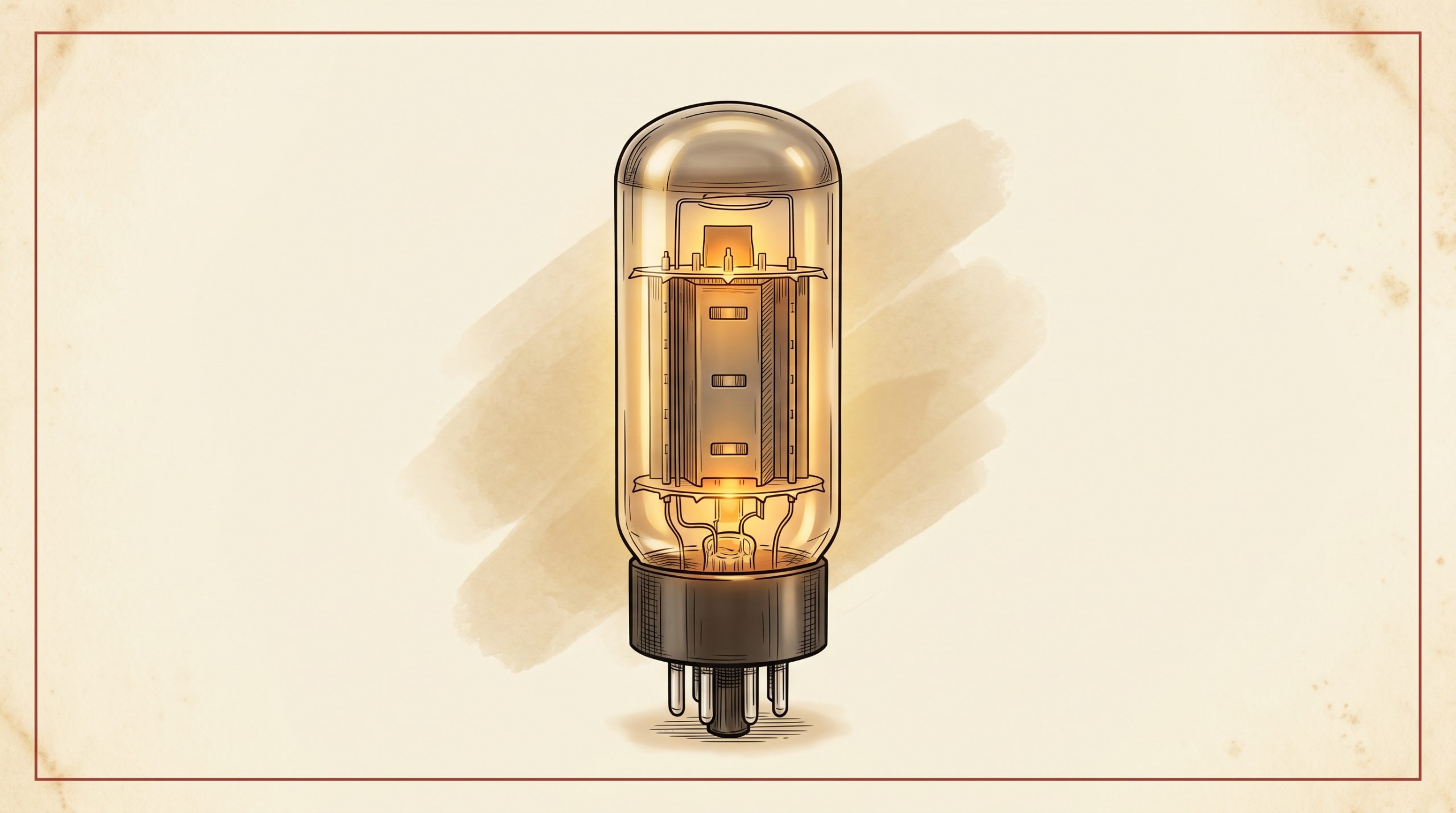
What Is a 6L6 Tube? History, Origin, and Why It Matters
RCA and the Birth of the Beam Power Tetrode (1936)
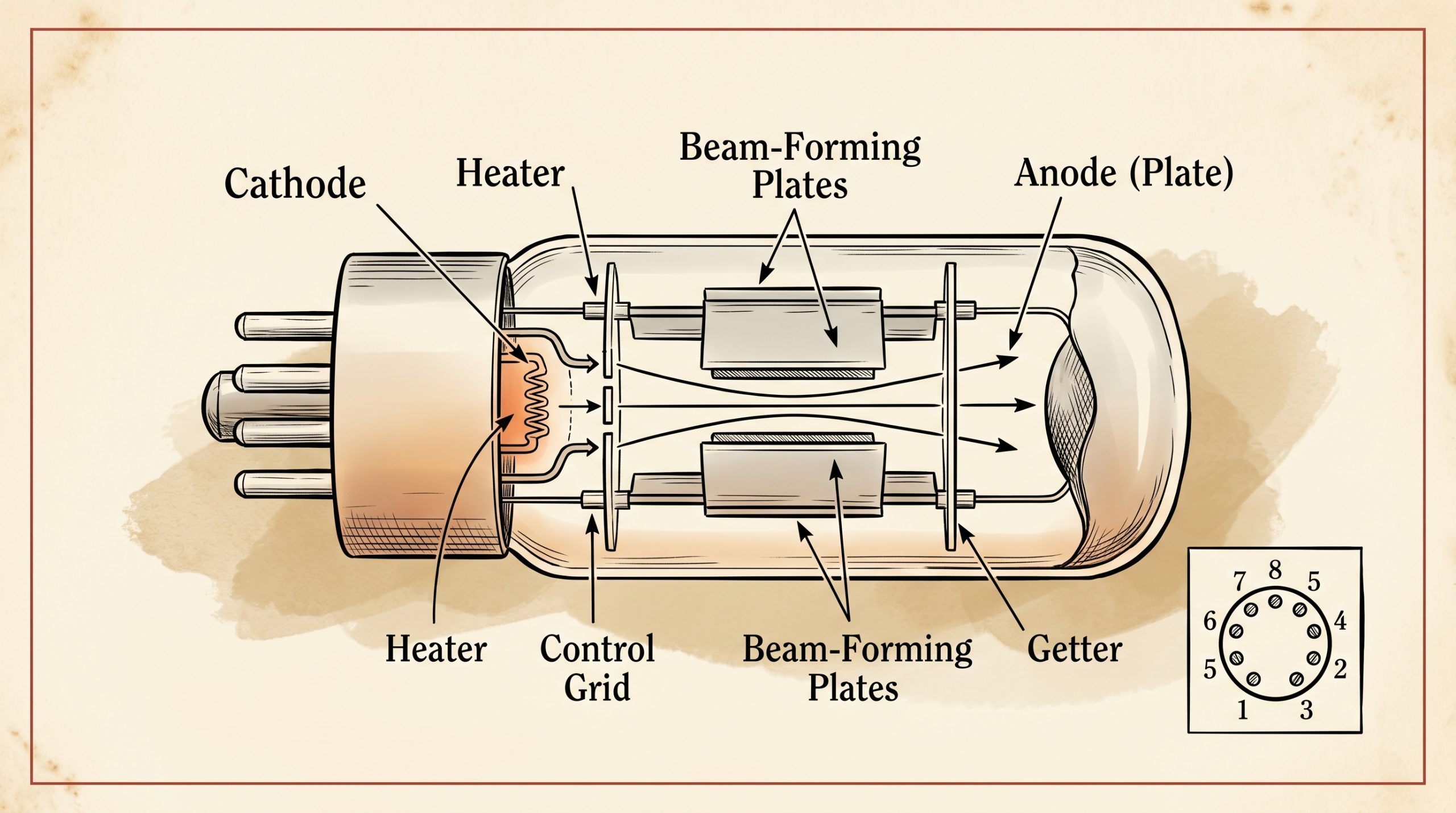
RCA engineers Millard Trainer and Otto Schade filed the foundational patent in 1935, and the tube went to market in 1936 as the RCA 6L6. It was the first commercially successful beam power tube, a fact worth emphasizing because the “6L6 power pentode” label you’ll see everywhere is technically imprecise. A true pentode uses a physical suppressor grid to manage secondary emission. The 6L6 instead uses beam-forming plates positioned between the control grid and the anode to focus the electron stream into concentrated beams, which accomplishes the same suppression effect without a third grid structure.
Why does that distinction matter to a guitarist? Because beam-forming plates produce a cleaner transfer curve than a conventional pentode grid arrangement. The original RCA 6L6 datasheet notes that “the power output at all levels has low third and negligible higher-order harmonic distortion”, and that characteristic is the physical basis for what players hear as Fender clean tone. More on the harmonic distortion profile in the unique angles section below.
The original application had nothing to do with guitar amplifiers. RCA designed the 6L6 for radio transmitter output stages and public address equipment. The initial spec was modest: 19 watts plate dissipation, 360V maximum plate voltage. It took nearly a decade and several revisions, the G, GA, GB, and eventually GC variants, before the tube reached the specifications that define it in modern guitar amp use.
How the 6L6 Came to Define American Guitar Tone
Leo Fender started integrating 6L6 tubes into his amplifier designs in the late 1940s, during what Teagle and Sprung’s Fender Amps: The First Fifty Years documents as the foundational tweed period. The choice wasn’t arbitrary. The 6L6’s natural frequency response emphasized upper-mid clarity and extended high-frequency shimmer, qualities that helped a Telecaster cut through a band mix before dedicated EQ circuits were common. EL34 tubes, the British alternative, produce more pronounced odd-order harmonic content that thickens the midrange and softens the top end. The 6L6’s comparatively linear behavior at clean levels, with even-order distortion dominating when pushed, created a fundamentally different tonal character.
Marshall’s early JTM45 designs, notably, started with KT66 tubes and eventually migrated to EL34, a deliberate move toward more midrange density and earlier breakup. That transition is the clearest illustration of how output tube selection shapes an amplifier’s voice at a foundational level. Fender stayed with the 6L6, and the split between “American clean” and “British crunch” as shorthand in the guitar world is substantially a 6L6 vs. EL34 distinction.
For dating the specific circuits where these tubes appeared, the Fender tube amp serial number and dating guide covers transformer codes, chassis stamps, and tube chart data across the full production run from tweed through silverface.
6L6 Variants Explained: GC, GA, GB, WGB, and More
The 6L6 Family Tree
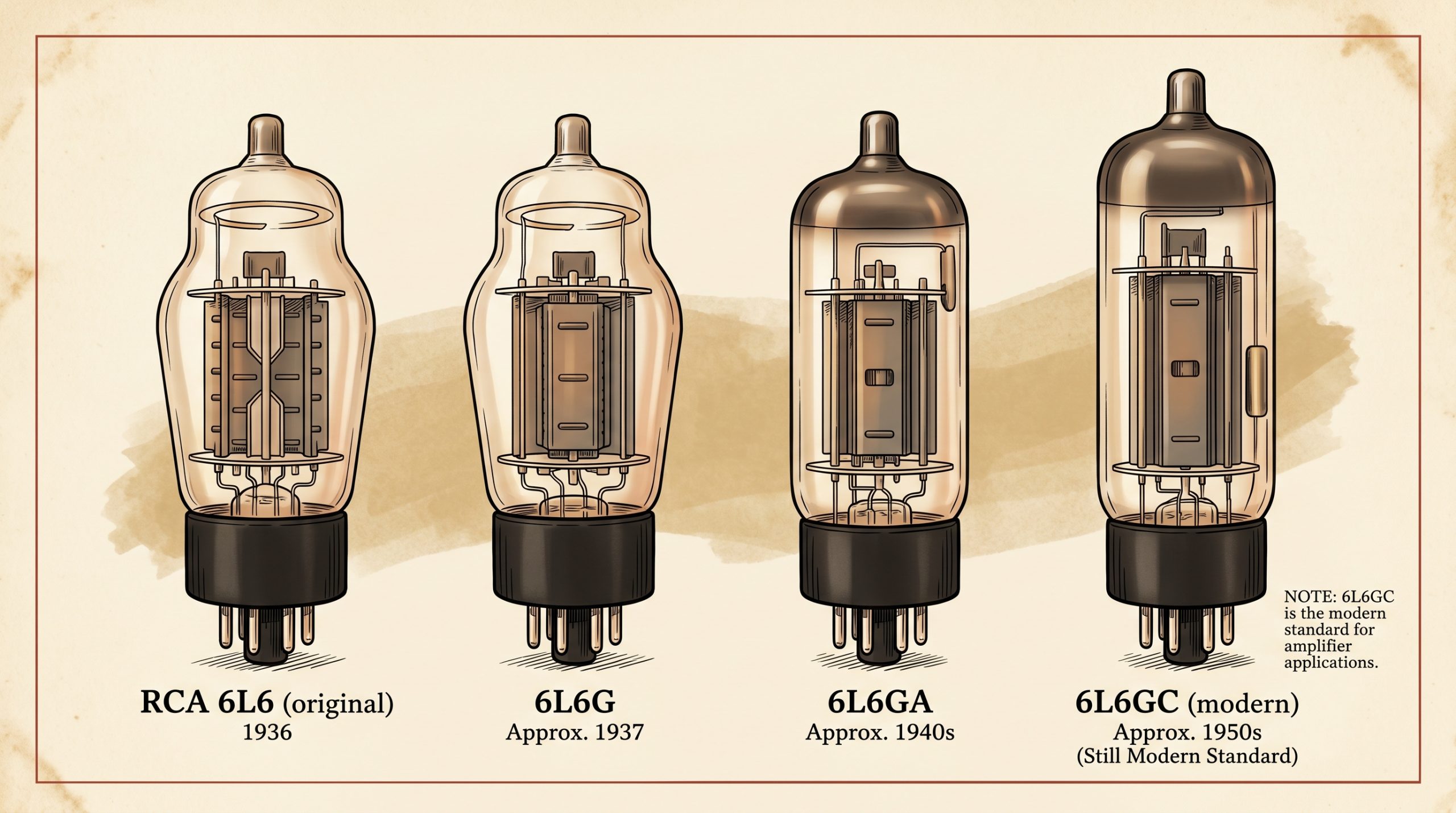
The 6L6 went through multiple envelope and rating revisions over its production life. The GC is the universal standard for guitar amps today, but understanding the earlier variants helps when you’re looking at NOS tubes or sourcing replacements for older circuits.
| Variant | Max Plate Dissipation | Max Plate Voltage | Construction | Notes |
|---|---|---|---|---|
| 6L6 (original) | 19W | 360V | Metal envelope | 1936 original; rarely encountered in working amps |
| 6L6G | 19W | 360V | Glass ST (“coke bottle”) | First glass-envelope variant |
| 6L6GA | 19W | 360V | Glass, smaller envelope | Minor redesign, same ratings |
| 6L6GB | 23W | 400V | Glass | First commercial upgrade in dissipation |
| 6L6GC | 30W | 500V | Glass, robust construction | Modern standard for guitar amps |
| 6L6WGB | 23W | 400V | Glass, ruggedized | Military spec; functionally equivalent to 5881 |
| 5881 | 23W | 400V | Glass, military ruggedized | Military designation for 6L6WGB |
The “W” in any variant suffix indicates a military ruggedized construction spec, tighter mechanical tolerances, reinforced internal supports, wider operating temperature range. The 6L6GC became the default modern standard because its 30W/500V ratings accommodate the higher B+ voltages found in fixed-bias Fender designs (420–450V is typical in blackface circuits) and the even higher voltages in Mesa Boogie and EVH designs. Most current production, JJ, Tung-Sol, Sovtek, is manufactured to 6L6GC specifications regardless of what name appears on the box.
The 6L6 Pinout: Octal Base Wiring Explained
The 6L6 uses an 8-pin octal base. Pin assignments from the bottom view, with pin 1 at the key position clockwise:
| Pin | Function |
|---|---|
| 1 | No connection (NC) |
| 2 | Heater |
| 3 | Heater |
| 4 | Plate (anode) |
| 5 | Screen Grid (G2) |
| 6 | Control Grid (G1) |
| 7 | Cathode / Beam Plates |
| 8 | Cathode / Beam Plates |
That pinout is shared across the 6L6 family and with several compatible tubes (5881, KT66, 7027A). It’s the same 8-pin octal socket used by the 6V6, though the 6V6 runs at lower dissipation and different operating points, they are not interchangeable without circuit modifications. For amp builders and DIY techs, the octal pinout is forgiving to work with: large pins, clear orientation from the base key, and widely documented in every major service reference including Frank’s Electron Tube Data Sheets 6L6GC documentation.
6L6 Tube Datasheet: Key Specs Every Player Should Know
6L6GC Electrical Characteristics
The Frank’s Electron Tube Data Sheets archive of the 6L6GC datasheet specifically notes that the maximum screen voltage rating is 500 volts in push-pull circuits where the screen of each tube is connected to a tap on the plate winding of the output transformer. That’s a critical caveat, it means the screen voltage limit changes based on circuit topology, and it’s one reason why substituting lower-rated tubes in high-voltage circuits is risky.
| Parameter | 6L6GC Spec | Notes |
|---|---|---|
| Heater Voltage | 6.3V AC/DC | ±10% tolerance |
| Heater Current | 0.9A | Per tube |
| Max Plate Voltage | 500V | Absolute maximum; do not exceed |
| Max Screen Voltage | 450V (triode) / 500V (push-pull) | Topology-dependent per datasheet |
| Max Plate Dissipation | 30W | Idle, per tube |
| Max Screen Dissipation | 5W | Often overlooked; can cause screen failure |
| Transconductance (Gm) | ~6,000 µmhos | Varies by manufacturer and batch |
| Plate Resistance (rp) | ~22,500 Ω | Class A operating point |
| Typical Output Power (pair, class AB1) | ~21W per RCA datasheet | Real-world guitar amp pairs often exceed this |
| Typical Bias Range (guitar amp) | -40V to -60V grid | Cathode voltage dependent; verify with plate voltage |
Biasing 6L6 Tubes: Practical Notes for Guitarists
Standard practice is to set idle bias at 60–70% of maximum plate dissipation. At a typical Fender blackface plate voltage of 430–450V B+, that works out to roughly 40–50mA per tube, or an idle dissipation of 18–22 watts per tube. The Les Paul Forum’s documented discussion on 6L6 bias methodology confirms the calculation: divide 30W (max dissipation) by the measured plate voltage to get maximum current, then target 60–70% of that figure. At 438V plate voltage, for example, max current is about 68mA and a 65% bias target lands at 44mA.
A single 6L6GC handles 30 watts of plate dissipation. A push-pull pair running class AB produces 40–50W RMS output. A quad delivers 80–100W. In single-ended class A operation, a single tube produces 4–8W depending on circuit design. Always re-bias after swapping tubes. Not optional.
Running the bias cooler (closer to 60%) extends tube life noticeably in high-voltage circuits like Mesa Boogie and EVH designs. Running slightly hotter (65–70%) opens up the dynamic response, the amp feels more alive and less compressed at the expense of tube longevity. Most Fender technicians land around 65% for daily-use amps.
6L6 Tubes in Fender Amplifiers: The Essential Reference
Tweed Era (1948–1960): 6L6 Origins in Fender Circuits
The Bassman 5F6-A is the definitive tweed 6L6 circuit. Four 6L6GC tubes, approximately 50 watts output, plate voltage in the 465–475V range. The 5F6-A circuit was so influential that Jim Marshall and Ken Bran used it as the direct design basis for the first Marshall amplifiers, as documented in Teagle and Sprung and confirmed through circuit analysis of early JTM45 layouts. That Marshall design substituted KT66 tubes for the 6L6GC, which began the tonal divergence between American and British amplifier families.
The 5E3 Deluxe, by contrast, runs 6V6 tubes rather than 6L6, for clarity, since the 5E3 is often grouped with tweed-era 6L6 amps in casual conversation. The Fender Bassman reference guide covers the 5F6-A circuit in detail including transformer codes and production date ranges.
Blackface Era (1963–1967): The Definitive 6L6 Sound
The AB763 Twin Reverb sets the benchmark. Quad 6L6GC, 85 watts, 4-ohm load, fixed bias. Plate voltage runs 420–450V depending on the specific production unit, chassis stamps from the 1965–1967 run show variation within that range. The blackface circuit’s fixed-bias architecture keeps the operating point stable and the clean headroom substantial. This is why the Twin Reverb sounds the same at 9am as it does three hours into a gig: the bias doesn’t drift with cathode temperature the way self-biasing designs do.
The Fender Twin Reverb complete guide covers blackface vs. silverface identification in detail, including the circuit changes that arrived with the AC568 circuit code in 1968.
The AA864 Bassman (1964 blackface version) runs two 6L6GC tubes at approximately 50 watts, different topology from the 5F6-A but the same output tube. The AA1164 Princeton Reverb uses 6V6 tubes, not 6L6, which is a common point of confusion given the Princeton’s strong association with the blackface sound.
Silverface Era (1968–1981) and Beyond
Silverface circuits saw some plate voltage creep, certain production runs pushed B+ above 460V, which affects tube longevity on 23W-rated tubes and accelerates aging even on 6L6GC. Post-CBS production quality and spec consistency varied more than the blackface years. Greg Gagliano’s research in the TCG Magazine series (documented at the Wayback Machine archive of 20th Century Guitar, 1997–2000) identified specific production periods where component substitutions affected reliability.
Modern Fender productions, the Hot Rod DeVille and Hot Rod Deluxe series, return to 6L6GC tubes in a contemporary printed circuit board format. The Fender Hot Rod DeVille guide covers the circuit architecture differences from the blackface originals and how tube selection affects the amp’s headroom and overdrive character. That compatibility range is broader than most players realize, but it comes with important caveats for each alternative.
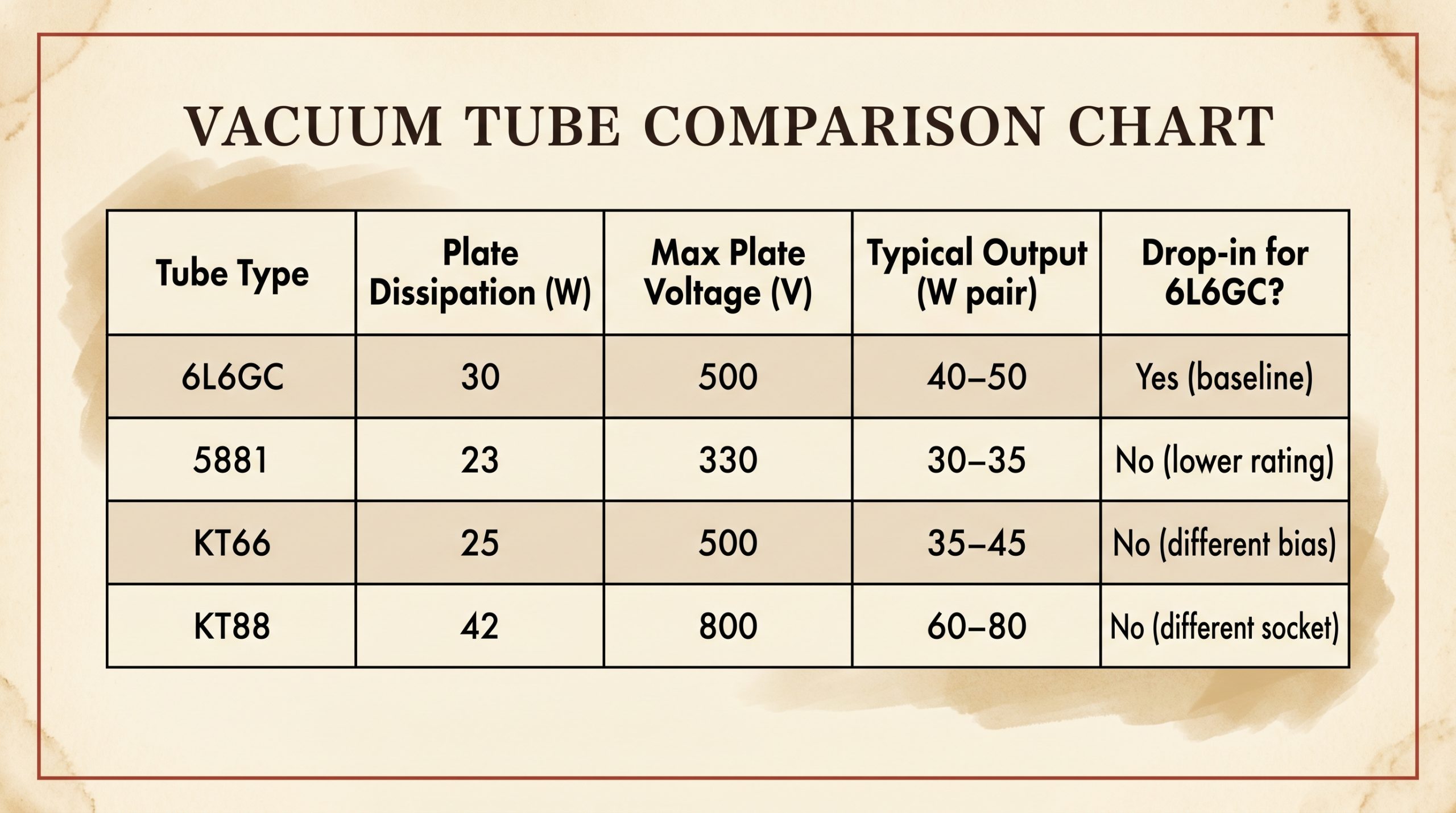
| Tube | Drop-in Compatible? | Key Differences | Best Use Case |
|---|---|---|---|
| 5881 | Yes, with caution | 23W dissipation limit, softer clipping, earlier compression | Lower-voltage Fender circuits, jazz, blues |
| KT66 | Yes, re-bias required | More upper-mid presence, rounder lows, slightly British character | Players wanting Marshall flavor in a Fender circuit |
| KT88 | No | 42W dissipation, different operating points, different socket in some builds | High-power hi-fi, SVT-style bass circuits only |
| 7027A | Yes in some circuits | 35W dissipation, similar tonal character to 6L6GC | Hi-fi applications, certain Ampeg circuits |
| EL34 | No (different pinout) | Entirely different operating characteristics and tonal profile | British-voiced amps designed for EL34 |
5881 vs 6L6: What’s Actually Different?
The 5881 is the military designation for the 6L6WGB, a ruggedized, lower-dissipation variant rated at 23W plate dissipation vs. the 6L6GC’s 30W. Same pinout. Same heater requirements. Same octal base. In a low-voltage Fender circuit running 350–380V on the plates, they’re functionally interchangeable and the sonic difference is subtle at best.
At 420V and above, the difference matters. Running a 5881 at 6L6GC bias settings in a fixed-bias amp with 450V plate voltage puts the tube at or above 100% of its rated dissipation at idle. That’s how you get red-plating and premature failure. Not great.
Tonally, the 5881 compresses slightly earlier. Players describe it as “sag-ier”, there’s a softer onset to clipping that some find musically attractive in blues contexts. The NOS Tung-Sol 5881 is one of the most sought-after vintage tubes for lower-powered Fender designs: Tremolux, early Bandmaster circuits, the 5E3 with its 6V6 sibling context. JJ manufactures both a JJ 5881 and a JJ 6L6GC, the former has a slightly lower headroom ceiling while the latter is full-rated at 30W. Worth knowing when ordering.
When to use 5881: lower-voltage Fender designs, specifically where B+ stays below 400V at idle. When to use 6L6GC: any fixed-bias design with 400V or higher on the plates, all Mesa Boogie circuits, all EVH circuits.
KT66 vs 6L6: British Engineering Meets American Design
GEC (General Electric Company UK) developed the KT66 in 1937, roughly contemporaneous with RCA’s 6L6. The two tubes share octal pinout and similar basic operating parameters, but the KT66’s internal construction produces a distinct tonal character: more upper-midrange presence, slightly compressed dynamics, and lows that are rounded rather than tight and controlled.
The Marshall JTM45 originally specified KT66 tubes before the transition to EL34 in the mid-1960s. That historical bridge explains why KT66-equipped 6L6 amplifiers lean toward the British end of the tonal spectrum without fully leaving American circuit territory. Players who want a Fender circuit that barks when pushed with more midrange texture than standard 6L6GC delivers sometimes run KT66 in Twin Reverb or Bassman circuits with good results.
Always re-bias after installing KT66 in a 6L6 circuit. The operating points differ enough that running factory 6L6 bias settings with KT66 tubes risks running too hot. A qualified tech with a bias probe is the right tool for this job.
KT88 vs 6L6: When More Is Not a Substitution
Short answer: don’t swap KT88 into a 6L6 circuit. The KT88 is rated at 42W plate dissipation and operates at substantially different idle current, it’s designed for high-power hi-fi amplifiers and bass circuits like the Ampeg SVT platform. Some sockets accept the KT88 physically, which makes the substitution tempting, but the operating point mismatch can damage output transformers and cause unpredictable bias behavior.
Tonally, KT88 tubes produce massive headroom, extended bass response, and a less vocal midrange character compared to 6L6GC. That’s exactly what an SVT needs. It’s not what a Fender Twin Reverb needs. The KT88 is mentioned here specifically to definitively answer this search query and prevent an expensive mistake.
Best 6L6 Tubes: Manufacturer Reviews and Recommendations
How to Evaluate 6L6 Tubes
The tube comparisons below are grounded in documented testing methodology: fixed-bias single-ended and push-pull guitar amplifier platforms, measurement of voltage gain across production batches, and extended bias stability monitoring. The 6L6GC Comparison of Current Made Tubes reference resource documents voltage gain measurements across major current production brands using identical circuit conditions, which provides an objective baseline beyond subjective tonal description.
JJ 6L6GC
Manufactured at the JJ Electronic factory in Čadca, Slovakia. Full 30W rating. The JJ 6L6GC has a reputation for tight low-end response, clear mids without excess warmth, and slightly compressed highs, a tonal profile that works exceptionally well in high-gain circuits where a loose low end would turn into mud. Bias stability across production batches is among the best of current production, which makes JJ a reliable choice for fixed-bias quads where matching consistency matters.
Best platforms: Mesa Boogie Dual Rectifier, EVH 5150 III series, any high-gain Fender circuit running 430V+. Price runs approximately $20–25 per tube, $40–50 per matched pair from reputable dealers.
Tung-Sol 6L6GC-STR (Reissue)
Manufactured at the New Sensor/Electro-Harmonix facility in Saratov, Russia. Full 30W rating. The Tung-Sol 6L6GC-STR is widely regarded as the current production tube most closely matching the tonal character of vintage Sylvania 6L6GC stock, open high-frequency response, balanced mids, warm but defined low end. The Tube Store’s documented review process specifically identifies the Tung-Sol as the closest reissue to the Sylvania reference standard.
Best platforms: blackface Fender reissues, studio recording amps, players prioritizing vintage tonal character over maximum durability. Also used extensively in hi-fi audio builds where the 6L6’s extended frequency linearity is valued. Price runs approximately $22–27 per tube, $45–55 per matched pair.
Sovtek 5881WXT / 6L6WXT+
Manufactured at the Reflector factory in Russia. The Sovtek line uses ruggedized military-spec construction that prioritizes reliability over tonal nuance. Tone character is slightly darker than JJ or Tung-Sol, fuller mids, less top-end shimmer. The 5881WXT is a 23W-rated tube, so check plate voltages before installing in high-voltage fixed-bias circuits. For touring musicians who need tubes that survive temperature swings, physical abuse, and extended playing without biasing equipment handy, Sovtek’s construction quality is genuinely outstanding. Worth the slight tonal tradeoff in live contexts.
Sylvania 6L6GC (NOS Reference)
The benchmark against which current production is measured. Sylvania 6L6GC stock from the 1960s and early 1970s is characterized by extended high-frequency shimmer, dimensional midrange, and articulate bass that current production consistently falls slightly short of replicating. Identifying genuine Sylvania NOS: look for “Sylvania” etched or printed on the glass (not just a paper label), a rectangular getter (the metallic disc at the top of the tube), and the specific late-1960s envelope geometry with visible getter support structure.
The counterfeit NOS market is real. Relabeled Sovtek or Chinese production tubes appear regularly on auction platforms with Sylvania or GE labels attached. Rectangular getters are one indicator; construction-visible differences in the internal support structure are another. Buy NOS from dealers who photograph each tube individually and offer testing documentation. Expect $60–120 per tube for verified Sylvania 6L6GC, depending on grade. A matched quad for a Twin Reverb at $250–400 is a meaningful but audible upgrade from current production, in a studio context or a collector-grade amp, that investment is justified.
Mesa Boogie STR 440 / STR 447 (OEM)
Mesa selects and grades their own 6L6GC tubes, typically sourced from Shuguang or Sovtek base production and tested to Mesa’s internal specifications. The STR 447 is Mesa’s high-headroom variant designed for the plate voltages their high-gain circuits run. Mesa amplifiers using the Simul-Class power stage switch between cathode bias and fixed bias depending on channel and mode, which affects how tube selection interacts with the circuit differently than a pure fixed-bias Fender design. JJ 6L6GC and Tung-Sol 6L6GC-STR are both well-documented aftermarket alternatives for Mesa platforms, JJ particularly in high-gain contexts, Tung-Sol in the clean-channel-forward applications.
| Brand | Dissipation | Tone Character | Reliability | Price/Matched Pair | Best For |
|---|---|---|---|---|---|
| JJ 6L6GC | 30W | Tight, clear, slightly compressed highs | Excellent | ~$45 | High-gain, Mesa, EVH |
| Tung-Sol 6L6GC-STR | 30W | Open, vintage-voiced, balanced | Very Good | ~$50 | Blackface Fender reissues, studio |
| Sovtek 5881WXT | 23W | Dark, full mids, less sparkle | Outstanding | ~$35 | Touring, durability-first use |
| Sylvania NOS 6L6GC | 30W | Extended highs, dimensional mids, reference quality | N/A (NOS) | ~$180–240 | Studio, collector-grade amps |
| Mesa Boogie STR 447 | 30W | Controlled, punchy, optimized for Mesa circuits | Excellent | ~$60 | Mesa circuits, Simul-Class platforms |
6L6 Amps: Notable Models Beyond Fender
Blackstar Studio 10 6L6
A single-ended 10-watt class A design using one 6L6GC. That’s a different operating context than the push-pull class AB circuits where 6L6 tubes most commonly appear, single-ended class A produces more second-harmonic content and a different compression character than a push-pull pair. The Studio 10 6L6 runs two channels with a series effects loop and Blackstar’s ISF (Infinite Shape Feature) tone control, which lets you sweep from American to British voicing. The 6L6’s natural frequency balance works well in class A single-ended operation, producing warm clean tones at bedroom-friendly volume levels before breaking up with spongy compression as the tube is pushed. JJ 6L6GC is a well-matched tube for this circuit, the operating point suits the JJ’s bias stability characteristics.
Blackstar St. James 6L6
A 50-watt head and combo using 6L6GC output tubes. Blackstar markets it as a “California meets British” voiced design, which tracks with the 6L6’s tonal characteristics when run through Blackstar’s voicing and gain structure. The St. James is also available in an EL34 version, and the tonal difference between the two versions is meaningful: the 6L6 variant delivers more clean headroom, tighter bass, and extended top-end shimmer; the EL34 version compresses earlier with more midrange grind. Players who want clean-to-crunch with American-voiced clean tones should go 6L6; players who want the amp to break up with British character earlier should go EL34.
EVH 5150 III Series
The 50-watt and 100-watt 5150 III designs run 6L6GC tubes at relatively high plate voltages, the circuit is designed for aggressive high-gain performance where the 6L6’s tight low-end character is a feature rather than a limitation. Ice-pick treble isn’t the issue here; controlling low-end tightness at high gain levels is. Factory bias on the 5150 III ships conservative; documented discussions among 5150 techs suggest 30–35mA per tube produces better tonal response and dynamic feel than the factory setting, though this varies by individual unit and should be verified with measured plate voltage before adjustment.
JJ 6L6GC and Tung-Sol 6L6GC-STR are both strong choices in the 5150 III circuit. JJ for players who want maximum low-end control in high-gain passages; Tung-Sol for players who want slightly more articulate clean channel performance at the expense of marginally less low-end tightness in the high-gain channels.
Mesa/Boogie Dual Rectifier
The Dual Rectifier runs a quad of 6L6GC at plate voltages that put serious demands on tube construction quality. Mesa’s proprietary cathode-bias switching system (which shifts between fixed and cathode bias depending on channel) means tube selection interacts with circuit behavior in ways that differ from a pure fixed-bias Fender design. Mesa’s STR 447 tubes are graded specifically for this platform. JJ 6L6GC is the most documented aftermarket alternative, the construction quality handles Dual Rectifier plate voltages reliably, and the tonal character complements the Rectifier’s naturally muscular low-end response rather than competing with it.
Three Angles Competitors Don’t Cover
The 6L6 Transfer Function: Why It Sounds the Way It Does
The beam-forming plate mechanism in the 6L6 produces a cleaner transfer curve than a conventional pentode grid structure. The original 6L6 datasheet documentation confirms this directly, noting that power output “at all levels has low third and negligible higher-order harmonic distortion.” In practical terms, this means the 6L6 generates predominantly even-order harmonics (second harmonic dominant) during normal operation, transitioning to gentle even-order clipping as the tube is pushed. That harmonic profile is the physics behind why a Fender clean tone sounds transparent and extended rather than thick and midrange-forward.
EL34 tubes, by contrast, generate more pronounced odd-order harmonics, third, fifth, seventh, which produces the “crunchy” character that players associate with British amplifier distortion. Neither is objectively better. They’re different tools producing different harmonic signatures. The practical implication for players: 6L6 amps generally require more input gain to overdrive than EL34 amps of similar wattage. A 50-watt 6L6 amp stays cleaner longer than a 50-watt EL34 amp at the same volume, that’s not the output section failing to work, that’s the transfer function operating as designed.
NOS vs. Current Production: A Vintage Buyer’s Guide
The NOS 6L6 market has a counterfeit problem. The most common fraud: Sovtek 6L6WXT+ or Chinese Shuguang production tubes stripped of their original markings and relabeled with GE, Sylvania, RCA, or Tung-Sol NOS branding. These appear regularly on auction platforms at prices that suggest NOS authenticity without the substance.
Identifying genuine Sylvania 6L6GC NOS: the “Sylvania” name should appear etched or printed in the glass itself, not on a removable paper label. The getter (metallic disc at the tube’s top) on authentic Sylvania GC stock is rectangular with specific support arm geometry. The envelope shape on late 1960s Sylvania production has a characteristic slightly elongated top section. GE NOS stock has different getter geometry, roughly circular with a flat disc profile. Documentation from tube dealer archives and the Tube Store’s published comparison methodology both emphasize physical construction inspection as the primary authentication tool.
When is NOS worth it? For a studio amp that gets used regularly and stays in controlled environment conditions, a verified NOS matched quad in a Twin Reverb or blackface Deluxe Reverb is audibly different from current production, not dramatically, but meaningfully. For a touring amp, current-production JJ or Tung-Sol is the practical choice. A tube that gets baked at 110°F in a van, then cold-soaked overnight in a loading dock doesn’t need to be NOS. It needs to be robust.
6L6 Tube Life: How Long Should They Last?
Average lifespan for 6L6GC tubes under normal guitar amp use runs 1,500–5,000 hours, with significant variation based on operating conditions. High plate voltage accelerates aging, Mesa Boogie circuits running 480V+ will consume tubes faster than a blackface Princeton Reverb running 420V. Bias point matters too: running at 70% dissipation is harder on tubes than 60%, all else equal.
Warning signs that replacement is due: increased noise floor that wasn’t present when the amp was new, reduced clean headroom (the amp breaks up earlier than expected), visible glow at the plates during normal operation (red-plating is a definitive sign of excessive current or failing tube), and low-frequency motorboating from the power supply. Microphonics, where the tube picks up physical vibration and transmits it as audio, is another common late-life symptom.
Replace in matched pairs at minimum; replace a full quad together whenever possible in fixed-bias push-pull circuits. Matched pairs matter in fixed-bias designs because both tubes share a common bias adjustment, if one tube draws significantly more current than the other, one is running hot and one is running cold. The 12AX7 preamp tubes, covered in the 12AX7 tube buyer’s guide, operate under entirely different conditions and have their own replacement schedule. Re-bias after every full tube replacement. Every time.
Which 6L6 Should You Choose
Eighty-plus years of continuous production is a track record that speaks for itself. The 6L6GC remains the dominant American-voiced output tube precisely because its harmonic profile, clean headroom, and tonal character fill a role nothing else does in quite the same way. Current production from JJ and Tung-Sol has reached a quality level where the gap between reissue and verified NOS, while real, isn’t wide enough to justify NOS pricing for most playing contexts. Start with JJ 6L6GC if you’re running a high-gain platform or Mesa circuit. Start with Tung-Sol 6L6GC-STR if you’re chasing vintage blackface character in a Fender reissue or studio amp. Reserve NOS Sylvania for the situation where the amp justifies the investment, a documented original blackface or tweed circuit that’s already dialed in and deserves the best glass available. When you’re ready to trace specific production details on your amp, the Fender amp dating cheatsheet covers transformer codes, speaker codes, and tube chart data across every era in one consolidated reference.
Sources
- Frank’s Electron Tube Data Sheets, 6L6GC datasheet
- The Tube Store, 6L6 / 6L6GC / 5881 Power Tube Reviews (John Templeton testing methodology)
- Premier Guitar, Power Trip: A Guide to Power Tubes and Their Signature Sounds
- Teagle, John and Sprung, John. Fender Amps: The First Fifty Years. Hal Leonard, 1995.
Frequently asked questions
How many watts is a 6L6 power tube?
A single 6L6GC has a maximum plate dissipation of 30 watts. That's not output wattage, it's the maximum heat the tube can absorb at idle. In a push-pull pair running class AB (the standard guitar amp configuration), a matched pair produces approximately 40–50 watts RMS output power at the speaker. A quad of four tubes delivers 80–100W depending on the circuit's operating point. In single-ended class A operation, a single tube produces approximately 4–8W of output power.
What is the difference between a 6L6 and a 6L6GC?
The "GC" suffix identifies a specific variant with enhanced ratings: 30W plate dissipation and 500V maximum plate voltage, compared to the original 6L6's 19W plate dissipation and 360V maximum. The GC also uses a more robust glass envelope construction. For all modern guitar amp applications, 6L6GC is the current production standard and a direct drop-in upgrade from any earlier variant in the 6L6 family. If your amp was designed for 6L6GC, which describes virtually all modern tube guitar amps specifying 6L6, a GC is what you want.
Are 6L6 and 5881 tubes interchangeable?
In lower-voltage circuits, yes, with awareness of the dissipation difference. The 5881 is rated at 23W plate dissipation vs. 30W for the 6L6GC. In high-voltage fixed-bias amps, specifically Fender Twin Reverb, Mesa Boogie, and EVH designs running 420V or higher on the plates, running 5881 tubes biased to 6L6GC settings puts the tube above its rated dissipation at idle. That shortens tube life significantly and risks failure. Always measure plate voltage before substituting 5881 for 6L6GC in any fixed-bias amplifier.
What are the best 6L6 tubes for a Mesa Boogie?
JJ 6L6GC and Tung-Sol 6L6GC-STR are the two most documented aftermarket options for Mesa amplifiers. Mesa runs 6L6 tubes at higher plate voltages than most Fender designs, which makes the full 30W rated 6L6GC mandatory, don't install 5881 tubes in a Mesa without verifying operating voltages with a tech first. JJ is the preferred choice for high-gain channels where low-end tightness is the priority. Tung-Sol is the stronger option when the clean channel's tonal quality is the deciding factor. Mesa's own STR 447 tubes are also a straightforward choice when you'd rather pay OEM pricing for pre-matched tubes than source aftermarket.
Can I put KT66 tubes in a 6L6 amplifier?
KT66 tubes are pin-compatible with 6L6GC and will physically install in an octal socket without adapters. They will operate in most 6L6 amplifiers. However, they have different operating characteristics and will require re-biasing before use. Expect a tonal shift toward more upper-midrange presence and slightly rounded lows compared to 6L6GC, the character is often described as "British-leaning" in an American circuit. This is a popular and legitimate modification for players who want Marshall-influenced character from a Fender-circuit amp, particularly in Bassman and Tremolux designs. Always have a tech set bias after installation.