Contents
- 01Key takeaways
- 02On this page
- 03What is the difference between a Fender Twin and a Twin Reverb?
- 04Blackface Twin Reverb (1963-1967, AB763 circuit)
- 05Silverface Twin Reverb (1968-1981) and the AB763 to AC568 transition
- 06Power output progression: 85W, 100W, 135W
- 07The long-tailed pair phase inverter and high-headroom design
- 08Tube complement and tube positions explained
- 09Original speakers by era (Jensen, Oxford, JBL, CTS)
- 10How do I date a Twin Reverb?
- 11'65 Twin Reverb Reissue (1993-present)
- 12'68 Custom Twin Reverb (2013-present)
- 13Tone Master Twin Reverb (2019-present)
- 14The modern Twin Amp and Twin Reverb II history
- 15The Red Knob Twin (1987-1992) and the '94 Twin Amp "Evil Twin"
- 16Twin Reverb 2026 market values
- 17Famous Twin Reverb players and recordings
- 18Twin Reverb vs Deluxe Reverb vs Princeton Reverb
- 19Restoration, service, and common modifications
- 20Frequently asked questions
- 21Sources and methodology
- 22Related guides
Fender Twin Reverb in one paragraph
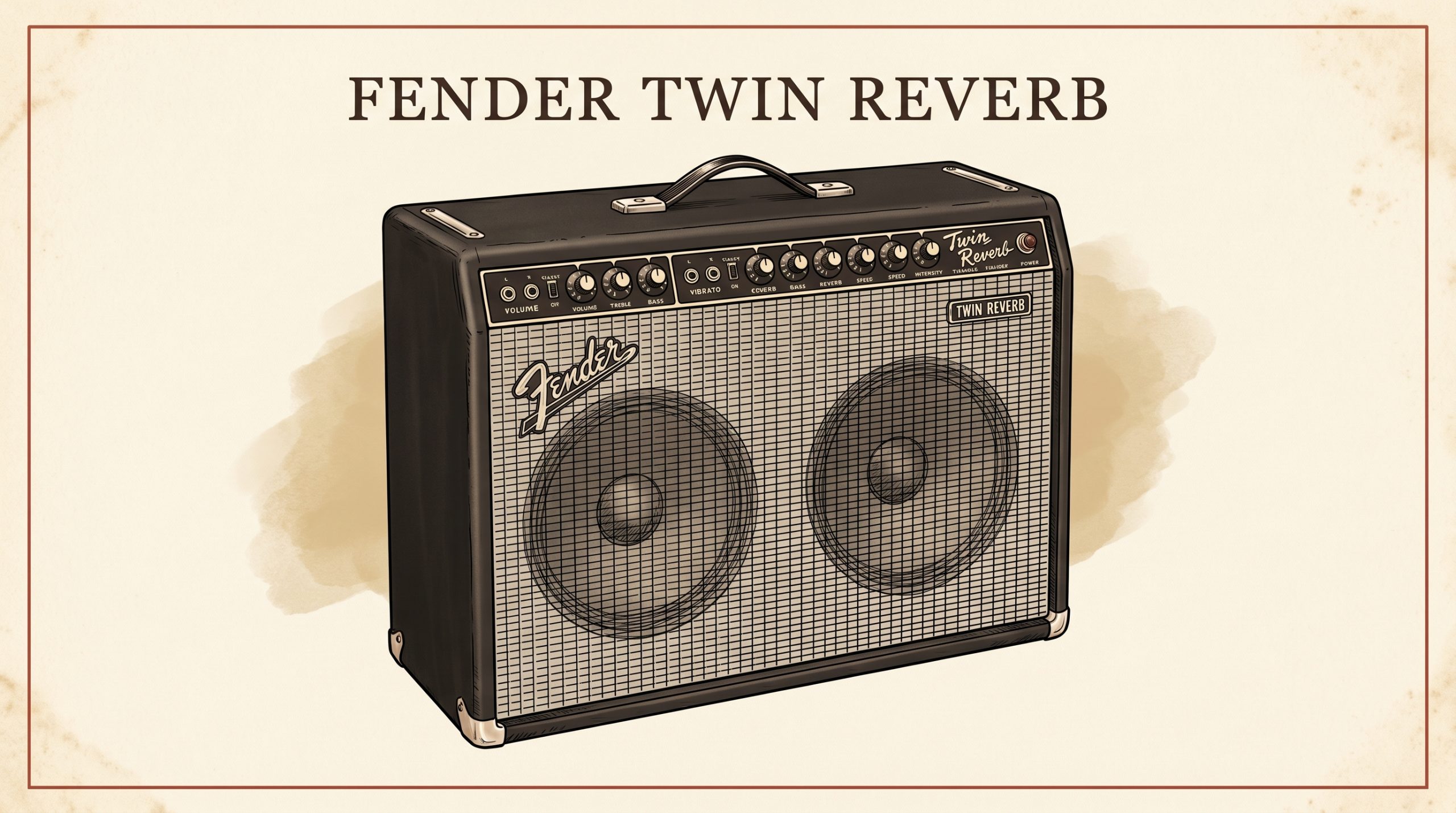
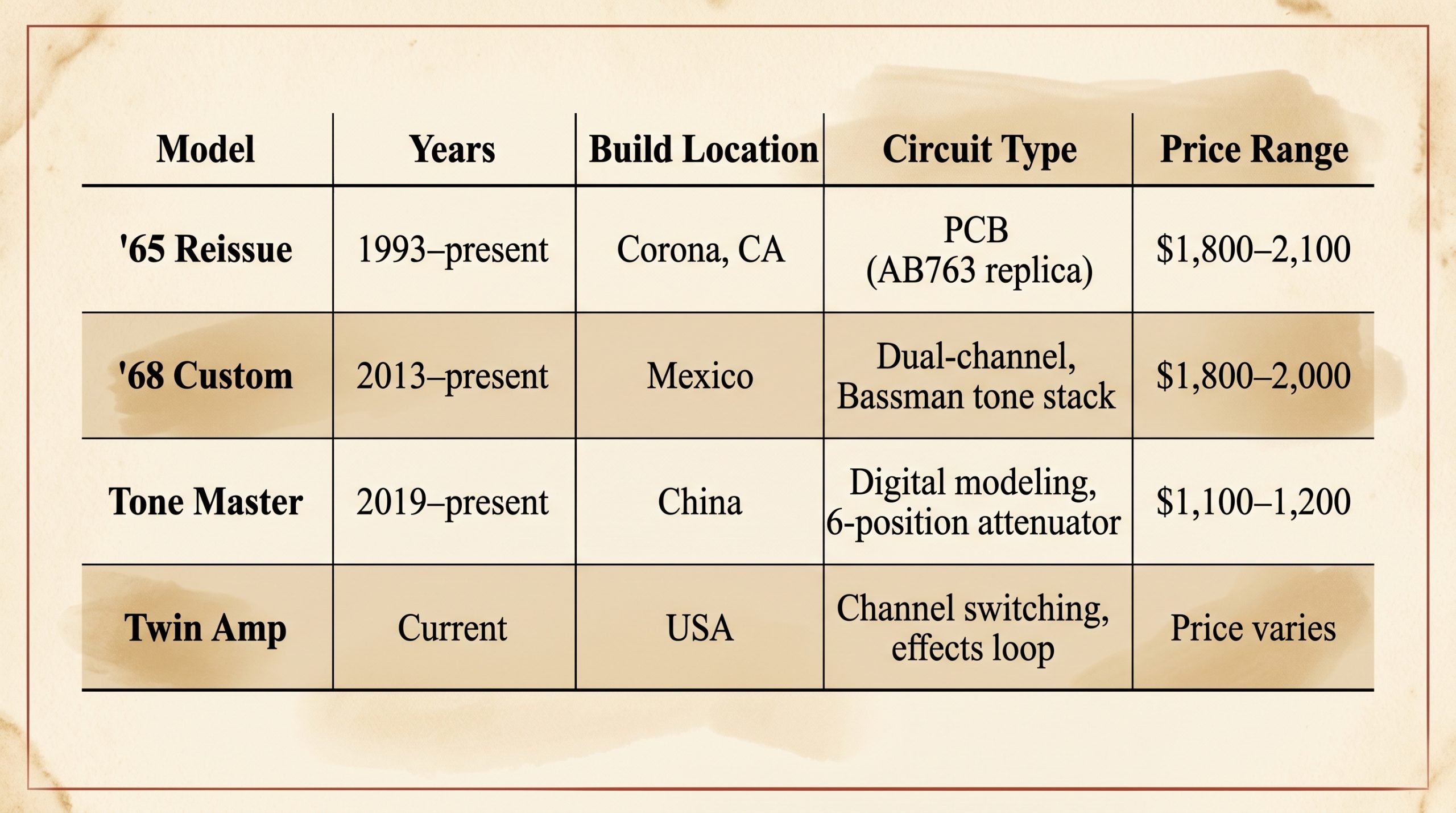
The Twin Reverb is an 85-watt two-channel tube combo with built-in spring reverb and bias-modulated tremolo, introduced in 1963 with the AB763 circuit. Tube complement: four 6L6GC power tubes, four 12AX7/7025 preamp tubes, two 12AT7 tubes (one for reverb send, one for the long-tailed pair phase inverter), and a solid-state rectifier. All Twin Reverbs from 1963 onward use solid-state rectification, not tube rectifiers. The first silverface Twin Reverbs (introduced 1968) retained the AB763 circuit until May 1968, when Fender switched to the AC568 circuit; the same tube chart was used during the transition so labeled AB763 silverface units from mid-1968 onward may actually be AC568 internally. Power output increased to 100 watts in 1972 (master volume variant, 470V plate) and 135 watts in 1976 (ultra-linear output transformer configuration, 520V plate). Four current production variants exist: the ’65 Twin Reverb Reissue (1993-present, Corona PCB, $1,800-2,100), the ’68 Custom Twin Reverb (2013-present, Mexico-built dual-channel with Bassman tone stack, $1,800-2,000), the Tone Master Twin Reverb (2019-present, China-built digital with six-position attenuator, $1,100-1,200), and the Twin Amp (current production, channel switching and effects loop).
Key takeaways
- Twin Reverb has the highest clean headroom in the blackface line. 85 watts through four 6L6 tubes and two 12-inch speakers, the Twin Reverb stays clean up to volume 6 where smaller Fenders break up at 4. The defining loud-clean Fender platform for country, jazz, fingerstyle, and pedal-platform applications since 1963.
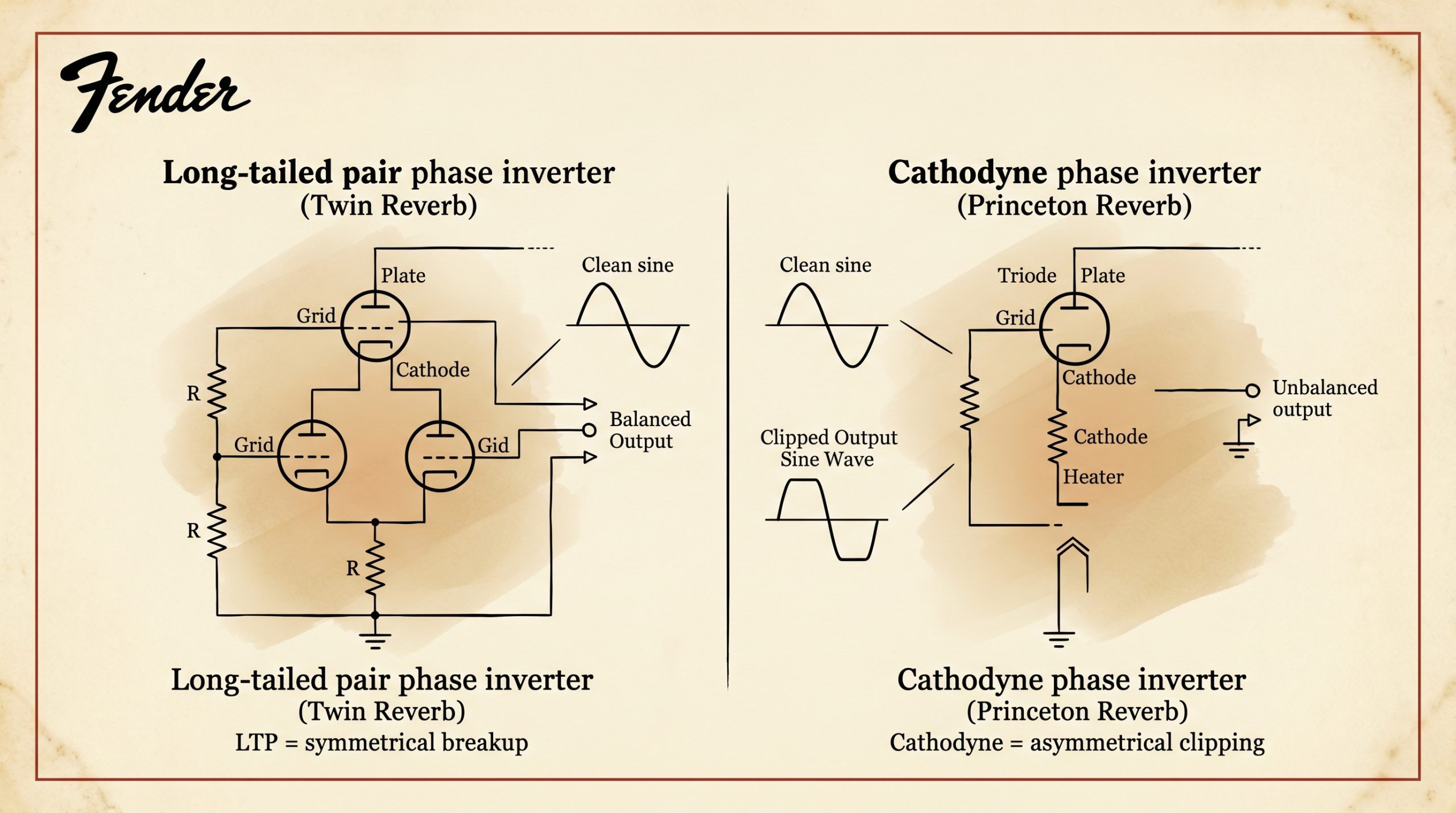
- Long-tailed pair phase inverter, not cathodyne. Unlike the Princeton Reverb, which uses a single-ended cathodyne phase inverter, the Twin Reverb uses a long-tailed pair (LTP) phase inverter built from a 12AT7. This is the architectural reason the Twin stays clean at high volumes and breaks up symmetrically rather than the asymmetric clipping character of the Princeton.
- Tube complement: 4× 6L6GC + 4× 12AX7/7025 + 2× 12AT7 = 10 tubes total. Per Wikipedia and FenderGuru documentation, the standard Twin Reverb layout from 1963 forward uses ten tubes total. All Twin Reverbs use solid-state rectification (no rectifier tube), differentiating them from smaller Fenders that retained tube rectifiers through the silverface era.
- The AB763 to AC568 circuit transition: May 1968. The first silverface Twin Reverbs (introduced January 1968 with the cosmetic transition) retained the AB763 blackface circuit until May 1968, when Fender switched to the AC568 silverface circuit. Per Wikipedia: “Since the tube complement was the same, Fender just used up their stock of printed tube charts saying AB763 until they ran out. Thus many silverface amps are mislabeled and this has created some confusion.”
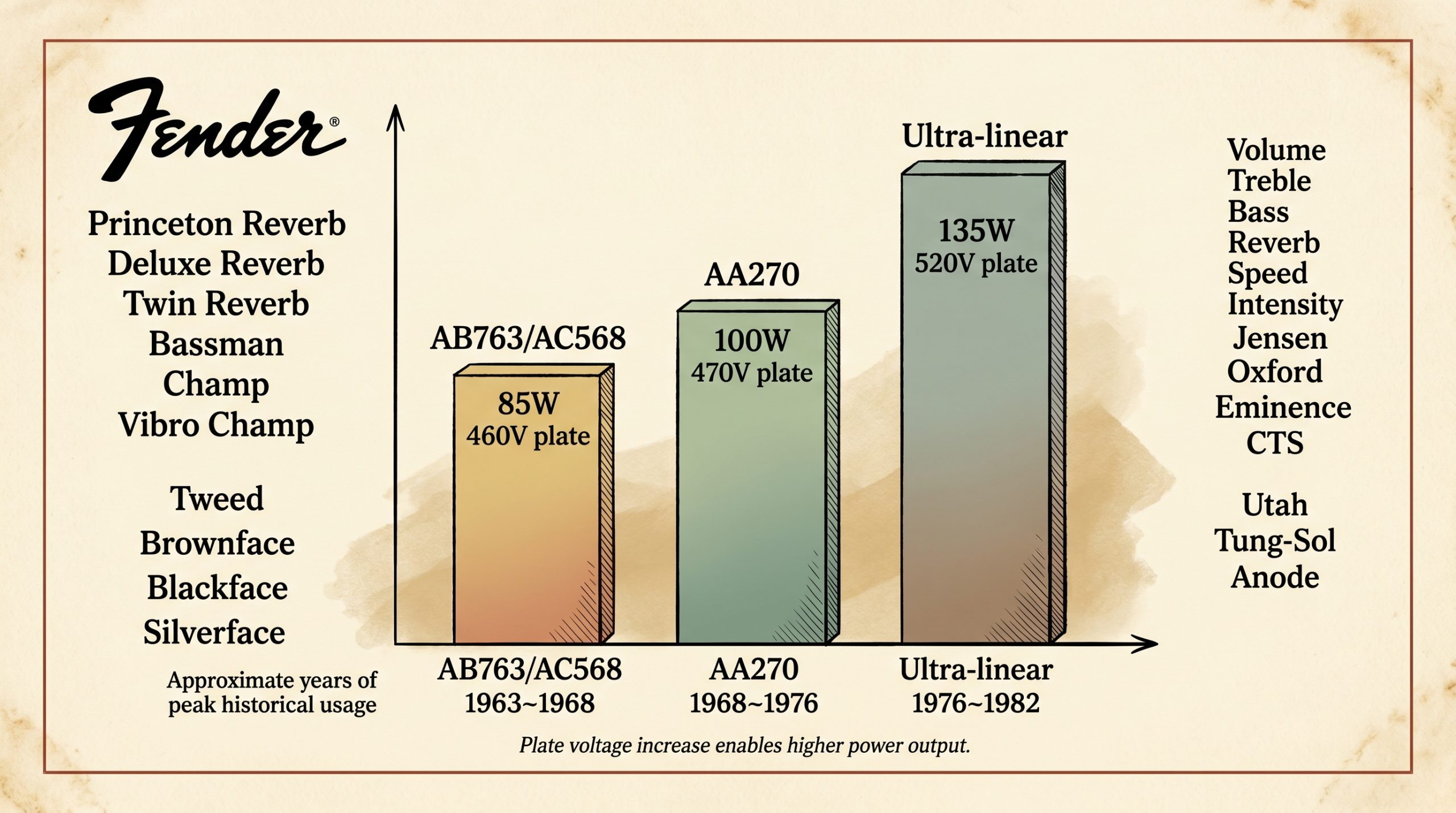
- Power output progression: 85W → 100W → 135W. AB763 and AC568 produce 85W at 460V plate voltage. Master volume Twin Reverbs from 1972 onward (AA270 circuit) produce 100W at 470V plate. Ultra-linear configuration Twin Reverbs from 1976 onward produce 135W at 520V plate. The 135W ultra-linear units are tonally controversial and command lower prices on the vintage market.
- Four modern variants currently in production. ’65 Reissue (1993-present, Corona PCB, $1,800-2,100), ’68 Custom (2013-present, Mexico, dual-channel with Bassman tone stack on custom channel, $1,800-2,000), Tone Master (2019-present, China, 200W digital simulating 85W tube with six-position attenuator, $1,100-1,200), and the current Twin Amp (channel switching and effects loop). The Tone Master is the practical choice for working players because it weighs 33 lbs (half the tube version’s 65 lbs).
What is the difference between a Fender Twin and a Twin Reverb?
The Twin (1952-1963) is the original high-power Fender combo without built-in reverb or tremolo. The Twin Reverb (1963-present) added a built-in spring reverb tank and bias-modulated tremolo to the same general platform. The two amps are different products with different model numbers, circuits, and market positions. A blackface Twin Reverb is the common amp; the brown-Tolex Twin from 1960-1963 is rarer and a distinct collector category.
This is the same naming-pattern confusion that affects the Princeton family. The Twin name has been on a Fender amp continuously since 1952, evolving through tweed Twins (5C8 through 5F8-A), brown and blonde Twins (6G8 and 6G8-A), the blackface Twin Reverb (AB763, 1963-1967), silverface Twin Reverb (1968-1981), and various reissue and reissue-derivative models. The Twin Reverb specifically refers to the reverb-and-tremolo-equipped 1963+ version that this guide covers.
Why does the distinction matter when buying or selling?
The Twin Reverb is the canonical model, in continuous production for 60+ years and the reference for “Fender Twin tone.” The Twin (non-reverb) brown-Tolex era (1960-1963) is a distinct collector category with its own pricing and tonal character. Tweed-era Twins (5F8-A and similar) are among the most expensive vintage Fender amps in any category, often $12,000-25,000 in clean original condition. Understanding which Twin you are looking at is critical to assessing value.
The non-reverb Twin from the brown era and earlier is a different amp than the Twin Reverb. The blackface and silverface AB763/AC568 Twin Reverb is the amp most players mean when they say “Fender Twin.” For this guide, we focus on the Twin Reverb specifically. For tweed Twins and brown/blonde Twins, see the dedicated era discussion in our Fender tube amp serial number guide.
Blackface Twin Reverb (1963-1967, AB763 circuit)
The blackface Twin Reverb was introduced in 1963 with the AB763 circuit (named for August 1963 schematic finalization, per Fender’s standard circuit naming convention). Black Tolex cabinet, black control panel with white silkscreen, silver-and-black grille cloth, cream chicken-head knobs. 85 watts through two 12-inch speakers. Standard speakers were Jensen C12N, with JBL D120F available as a factory-option upgrade. Pre-CBS production used “Fender Electric Instruments Co.” control panel; post-CBS production (April 1965 onward) used “Fender Musical Instruments.” Production ran through late 1967 before transitioning to silverface cosmetics.
The blackface era is what most players mean when they say “Twin Reverb.” Production ran from 1963 through late 1967, when Fender began transitioning the entire amp line to silverface cosmetics. Pre-CBS units (before April 1965) carry premium collector status due to perceived build quality differences, although the circuit itself is identical between pre-CBS and post-CBS blackface units.
What does the AB763 circuit designation mean?
AB763 is Fender’s internal designation for the August 1963 schematic revision of the blackface amplifier circuit family. Per the KR Sound technical reference: “The ‘763’ refers to July 1963 when the circuit was finalized.” The AB763 designation appears across the Fender blackface line, applied to the Deluxe Reverb, Twin Reverb, Vibrolux Reverb, Pro Reverb, Super Reverb, Bandmaster, Showman, and Vibroverb. Each model has model-specific component values within the AB763 architecture (different output transformer sizes, different speaker complements, different tube counts), but the basic topology is shared.
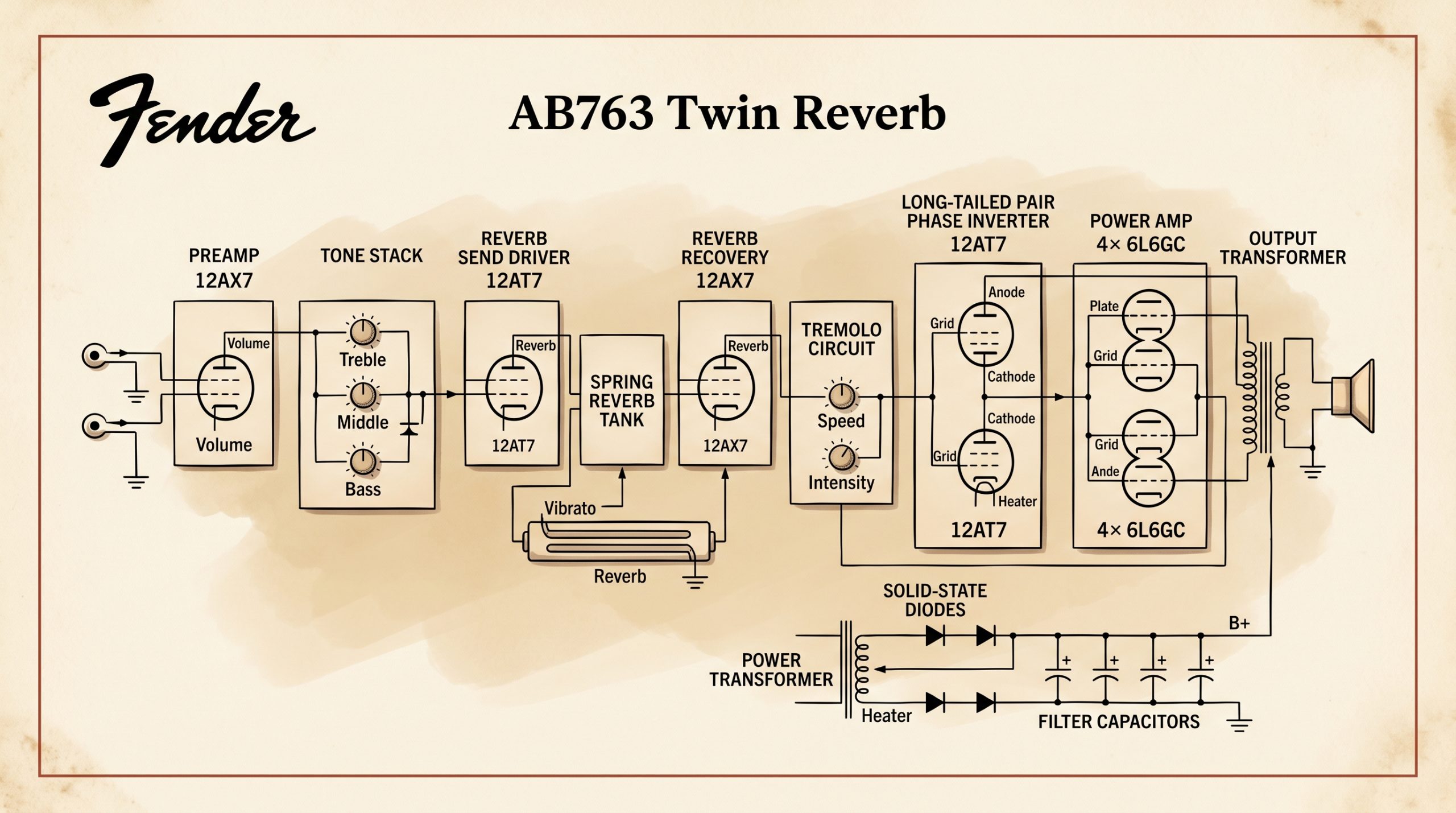
The AB763 architecture has four key design features:
- Two independent channels: Normal (no reverb or tremolo) and Vibrato (with reverb and tremolo). Each channel has Hi and Low inputs, Volume, Treble, Middle, Bass, and Bright switch.
- Long-tailed pair phase inverter: a 12AT7 wired in the long-tailed pair configuration with a tail resistor, providing high output swing capability and symmetric clipping behavior. Different from the cathodyne PI used in the Princeton Reverb.
- Push-pull Class AB output: 6V6 tubes in the Deluxe and Princeton; 6L6 tubes in the larger amps (Vibrolux Reverb uses 6L6 despite its smaller size; the Twin Reverb uses four 6L6GC tubes).
- Tube-driven spring reverb: a dedicated 12AT7 reverb send tube drives the spring tank, with one half of a 12AX7 recovering the reverb signal and mixing it back into the audio path.
What was the first-production Twin Reverb tube configuration?
Per Wikipedia, the first production Twin Reverb models in 1963 used an unusual 7355 power tube (a weaker cousin of the 6L6) alongside their concurrent smooth blonde and blackface Fender Showman amplifier. Production quickly transitioned to the standard 6L6GC, which became the canonical Twin Reverb power tube from 1964 onward. Documented 7355-equipped first-production Twin Reverbs are a niche collector category and command modest premiums for documentation of this transitional configuration.
If you encounter a documented 7355-equipped 1963 Twin Reverb, you have an early-production transitional unit. Most original 7355 tubes have been replaced with 6L6GC during service over the decades, so original-tube 7355 examples are vanishingly rare.
What were the original speakers in a blackface Twin Reverb?
Standard configuration: two 12-inch Jensen C12N speakers. Optional factory upgrade: two JBL D120F speakers. The JBL-equipped variant is the most collectible blackface Twin Reverb configuration, commanding 20-40% premiums over Jensen-equipped examples in the 2026 vintage market. JBL D120F speakers add significant weight (Twin Reverbs with JBLs can reach 70+ lbs versus 62 lbs for Jensen-equipped examples).
Identification on a vintage unit: read the EIA codes on the speaker frames. Jensen uses code 220 (full marker: 220-YWW format). Oxford uses 465. JBL uses 73 (full marker: 73-YWW format). Original speakers should date within a few months of the chassis production date for the amp to be fully original. Significant date gaps indicate replacement.
Silverface Twin Reverb (1968-1981) and the AB763 to AC568 transition
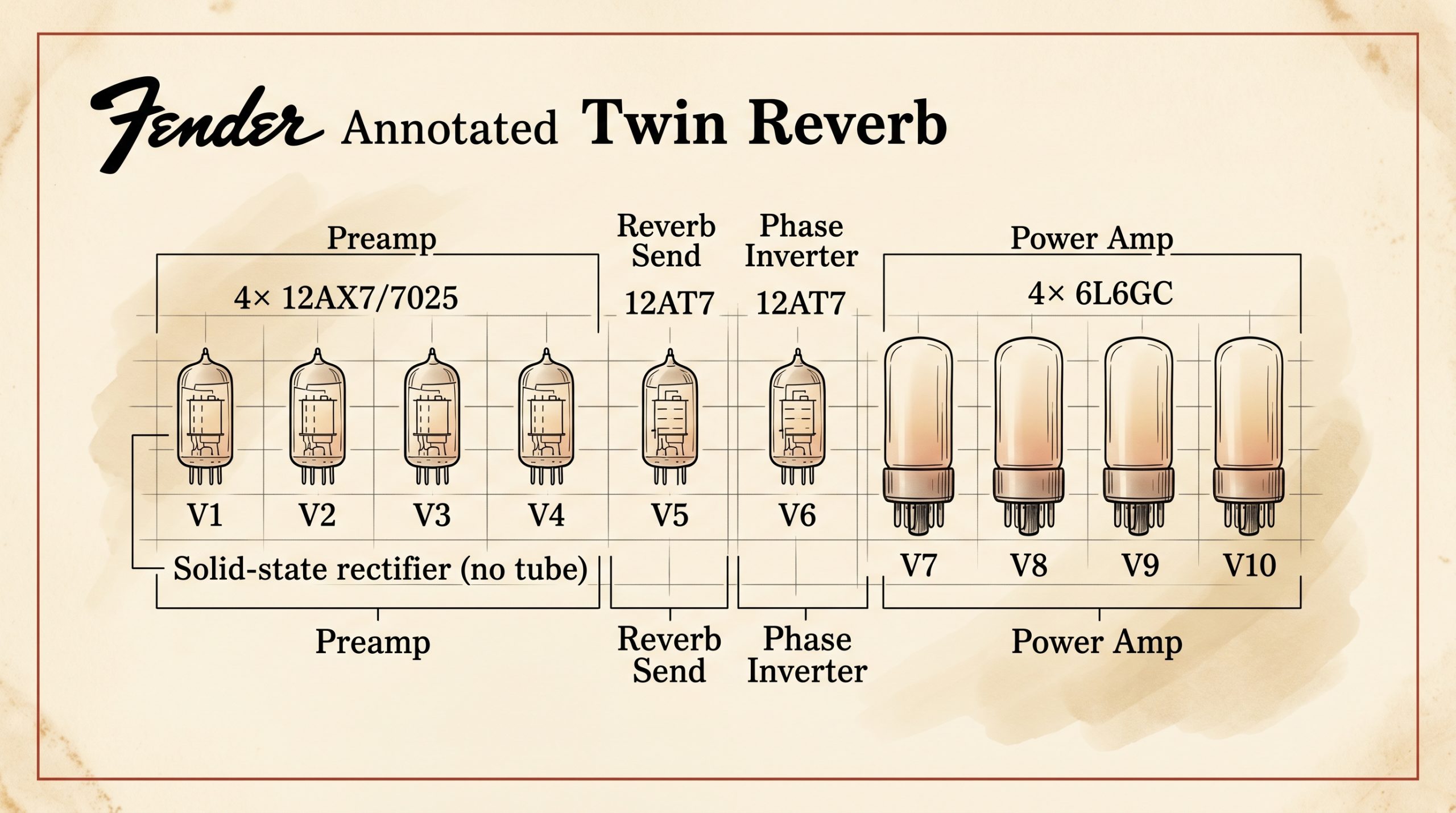
Silverface production began January 1968 with cosmetic changes: silver-and-blue control panel, aluminum drip-edge grille trim, and silver-with-blue-sparkle grille cloth. The first silverface Twin Reverbs retained the AB763 circuit until May 1968, when Fender switched to the AC568 circuit. Crucially, Fender continued to use AB763 tube charts during the transition, so labeled AB763 silverface Twin Reverbs from May 1968 onward may actually be AC568 internally. Subsequent silverface revisions (AA769, AA270, ultra-linear configurations) introduced progressive changes through the 1970s, culminating in the controversial ultra-linear 135W variants of 1976-1981.
What is the documented AB763 to AC568 circuit transition?
The exact transition occurred in May 1968. Per the Wikipedia Fender Twin article: “The first silverface Twins used the blackface AB763 circuit until May 1968, when Fender switched to the AC568. Since the tube complement was the same, Fender just used up their stock of printed tube charts saying AB763 until they ran out. Thus many silverface amps are mislabeled and this has created some confusion, causing some owners to think they have AB763 circuits when in fact they are AC568s.”
How can I tell if my “AB763” silverface Twin Reverb is actually AC568?
Check the production date first. Silverface Twin Reverbs produced before May 1968 are confirmed AB763 regardless of tube chart label. Silverface Twin Reverbs produced from May 1968 through 1969 with “AB763” tube charts are likely AC568 internally due to the documented tube chart inventory usage. Visual inspection of the chassis components (bias cap value, voltage divider resistors, phase inverter plate resistor values) by a qualified vintage tech is the only reliable way to confirm circuit identity for transitional-era units.
This is one of the most consequential nuances in silverface Twin Reverb assessment. A unit labeled “AB763” on the tube chart but produced in late 1968 or 1969 carries real ambiguity about its actual circuit. For buying purposes, assume any “AB763” silverface Twin Reverb from June 1968 onward could be either; for selling purposes, having a vintage tech confirm circuit identity (and documenting that confirmation) substantially affects buyer confidence.
What other silverface Twin Reverb circuit revisions appeared in the 1970s?
The AC568 continued through approximately 1971-1972 production. The AA769 circuit appeared as a minor revision. The AA270 circuit (1972) introduced the master volume feature and increased the plate voltage to 470V, producing 100 watts. The ultra-linear output transformer configuration (1976 onward) increased plate voltage further to 520V, producing 135 watts with substantially different tonal character. These progressive revisions affected the silverface Twin Reverb’s tonal character and current market value differently for each era.
The documented silverface era circuit progression:
| Years | Circuit | Power | Plate voltage | Key changes |
|---|---|---|---|---|
| 1963-1967 | AB763 | 85W | 460V | Original blackface spec, two 12″ Jensen C12N standard |
| Jan-May 1968 (drip edge) | AB763 (continued) | 85W | 460V | Same circuit, silverface cosmetics only |
| May 1968-1971 | AC568 | 85W | 460V | Bias cap, voltage dividers, 2200pF grid caps, cathode caps, PI plate resistors changed |
| 1971-1972 | AA769 | 85W | 460V | Minor revisions, transitional |
| 1972-1975 | AA270 | 100W | 470V | Master volume circuit introduced, pull-boost on some units, plate voltage increased |
| 1976-1981 | Ultra-linear | 135W | 520V | Ultra-linear output transformer configuration, fundamentally different output stage behavior |
What is the difference between early and late silverface Twin Reverbs?
Early silverface (January through May 1968, drip-edge, AB763) is sonically identical to blackface, trading at 80-90% of blackface value. Mid silverface (May 1968 through 1971, AC568) is close to blackface character with the AC568 modifications producing slightly tighter response; trades at 60-80% of blackface value. Late silverface (1972-1975, AA270 master volume 100W) introduces master volume tonal character; trades at 50-70% of blackface value. Ultra-linear silverface (1976-1981, 135W) is tonally controversial; trades at 40-60% of blackface value with documented “blackface conversions” recovering some value.
The practical implication: silverface Twin Reverbs span a wide range of tonal character and value. An early-1968 drip-edge silverface with the original AB763 circuit is a near-blackface bargain. A 1976 ultra-linear unit is a fundamentally different amp with substantially different tone. Always check the specific production year and confirm the circuit identity before assuming sonic equivalence to the blackface ideal.
Power output progression: 85W, 100W, 135W
Three distinct power tiers across the Twin Reverb’s vintage production. AB763 and AC568 produced 85W at 460V plate voltage (1963-1971). The 1972 AA270 master volume Twin Reverb produced 100W at 470V plate voltage. The 1976 ultra-linear Twin Reverb produced 135W at 520V plate voltage. All three configurations used four 6L6 power tubes; the power increases came from increased plate voltages and altered output transformer configurations, not from additional tubes.
How do I tell which power tier my Twin Reverb is from the chassis?
Three indicators: the production year on the tube chart or transformer codes (1963-1971 = 85W, 1972-1975 = 100W, 1976-1981 = 135W), the presence of a master volume control on the panel (introduced 1972 with the AA270), and the output transformer markings (the ultra-linear 1976+ units have different transformer specifications and physically larger transformers).
For buying purposes, the easiest visual identifier: blackface and pre-master-volume silverface amps (1963 through 1971) are 85W; master volume silverface amps from 1972 onward are 100W or 135W; ultra-linear units from 1976 onward are 135W and physically heavier due to the larger output transformer. The 135W ultra-linear units have a reputation for being tonally inferior to earlier Twin Reverbs and trade at substantially lower prices.
The long-tailed pair phase inverter and high-headroom design
The Twin Reverb uses a long-tailed pair (LTP) phase inverter built from a 12AT7 tube with a tail resistor. The LTP topology produces high output swing capability and symmetric clipping behavior, which contributes substantially to the Twin Reverb’s clean-at-high-volume character. This is fundamentally different from the cathodyne (split-load) phase inverter used in the Princeton Reverb, which produces asymmetric clipping at lower drive levels. The LTP is the standard Fender PI topology for the larger blackface amps (Deluxe Reverb, Twin Reverb, Super Reverb, Pro Reverb) and is one of the reasons these amps have such different overdrive character than the Princeton.
The phase inverter is the circuit stage that converts the single-ended preamp signal into the balanced push-pull signal driving the power tube grids. The choice between cathodyne (used in the Princeton Reverb) and LTP (used in the Twin Reverb and other larger blackface amps) significantly affects output power capability and overdrive character.
Why does the LTP phase inverter contribute to the Twin Reverb’s headroom?
The LTP produces nearly twice the output swing of a cathodyne PI before clipping. With higher PI output swing, the power tubes can be driven harder before they reach their clipping point. Combined with the Twin Reverb’s substantially larger output transformer (sized for 85-135 watt operation versus the Princeton’s 12-15 watt OT), the result is that the Twin Reverb stays clean at volume levels that would saturate a Princeton or Deluxe.
This is why the Twin Reverb is the canonical “clean headroom Fender” while the Princeton is the canonical “studio-volume overdrive Fender.” The Deluxe Reverb sits between them in power and PI topology (Deluxe Reverb also uses LTP, but with a smaller OT and only two 6V6 tubes producing 22W). The LTP gives the Deluxe and Twin more symmetric clipping when they do break up; the Princeton’s cathodyne gives it the asymmetric clipping character that defines its sound.
Tube complement and tube positions explained
Standard AB763/AC568 Twin Reverb tube layout (10 tubes total): V1 (12AX7) preamp Channel 1 (Normal); V2 (12AX7) preamp Channel 2 (Vibrato); V3 (12AT7) reverb send/drive; V4 (12AX7) reverb recovery + tremolo oscillator; V5 (12AT7) phase inverter (long-tailed pair); V6-V9 (4× 6L6GC) power tubes in push-pull pairs. Plus solid-state rectifier (no rectifier tube). The Vibrato channel has more gain stages than Normal because of the additional reverb circuit gain stage requirement.
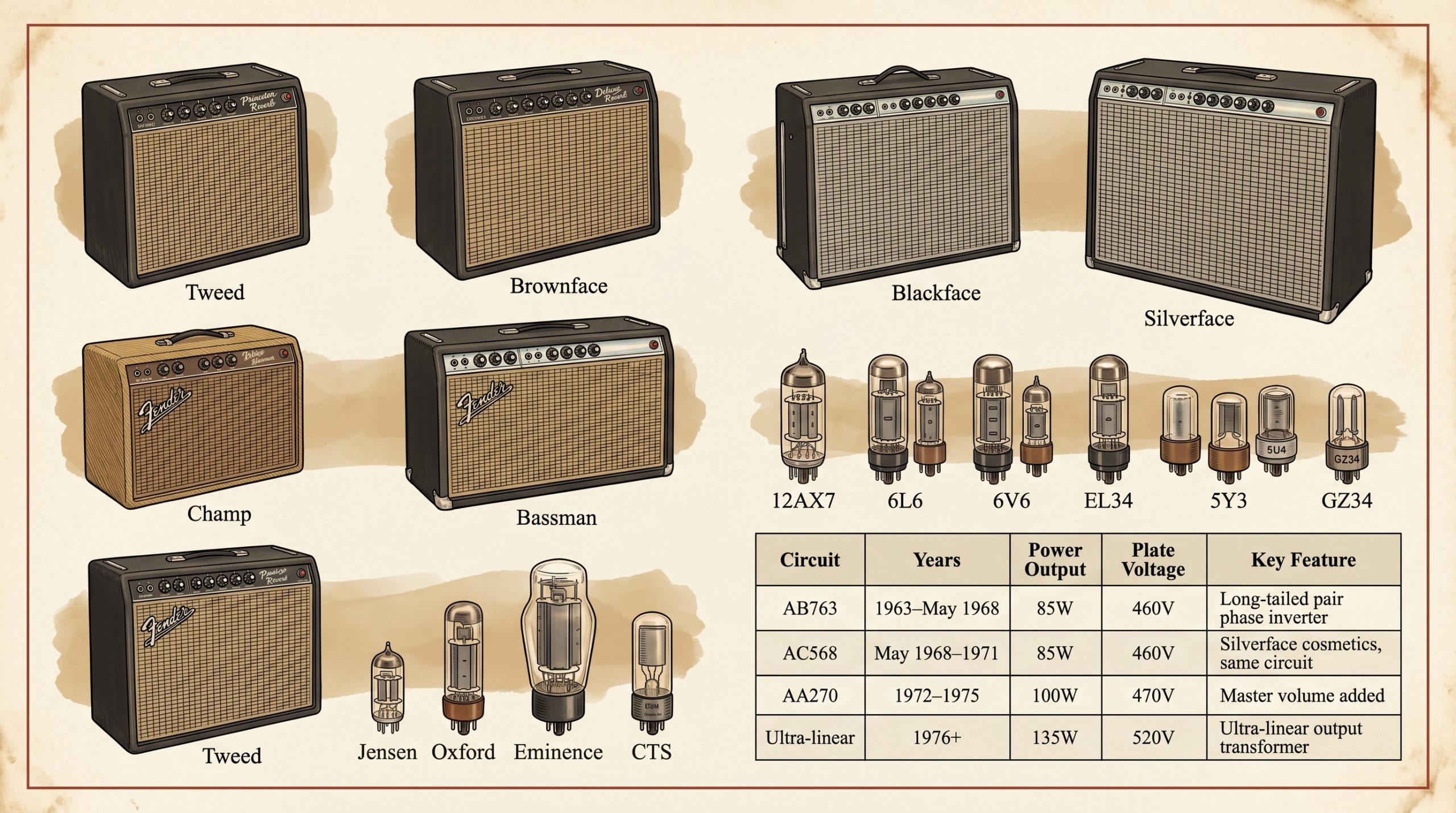
| Position | Tube type | Function |
|---|---|---|
| V1 | 12AX7 / 7025 | Normal channel first gain stage |
| V2 | 12AX7 / 7025 | Vibrato channel first gain stage |
| V3 | 12AT7 | Reverb send (drives spring tank with high current) |
| V4 | 12AX7 / 7025 | Reverb recovery mix + tremolo oscillator (bias modulation) |
| V5 | 12AT7 | Long-tailed pair phase inverter |
| V6-V9 | 4× 6L6GC | Power tubes in two push-pull pairs (4 tubes total) |
| Rectifier | Solid-state | No rectifier tube; silicon diode bridge rectifier |
Why does the Twin Reverb use solid-state rectification instead of a tube rectifier?
Power demands. The Twin Reverb’s 85-watt output stage at 460V plate voltage requires more sustained current than a tube rectifier can reliably supply without significant sag. Solid-state rectifiers provide tighter, more consistent power delivery suited to the Twin Reverb’s high-headroom design philosophy. Per the KR Sound technical reference, the Bandmaster also uses solid-state rectification “for tighter response and higher plate voltages”, which is the same design rationale applied to the Twin Reverb.
This is why the Twin Reverb has a different sonic character than the Deluxe Reverb at similar volume levels: the solid-state rectifier delivers full voltage without sag, contributing to the tight, clear response that defines the Twin’s high-headroom character. Tube-rectified amps (Deluxe Reverb, Princeton Reverb, Vibrolux Reverb) have more compression and “feel” because the rectifier sags under load.
Why does the Twin Reverb use two 12AT7s instead of two 12AX7s for the reverb send and phase inverter?
Both positions require higher current capability than the 12AX7 can provide. The 12AT7 has lower gain and higher current capability, making it suited to driving the spring reverb tank’s low impedance (V3 position) and to delivering balanced push-pull output to four 6L6 power tubes through the long-tailed pair phase inverter (V5 position). Substituting 12AX7s in either position degrades performance: reduced reverb output in V3, and reduced PI output swing in V5.
You can substitute 12AT7s in 12AX7 sockets (with reduced gain) but you should not substitute 12AX7s in 12AT7 sockets without expecting significant performance degradation. Stick with the original tube types unless you have a specific tonal goal and understand the consequence.
Original speakers by era (Jensen, Oxford, JBL, CTS)
Standard speakers: two 12-inch Jensen C12N (1963 through mid-silverface), two 12-inch Oxford 12T6 (late silverface), occasionally CTS units (1970s production). Optional factory upgrade: two 12-inch JBL D120F throughout blackface and most of silverface production. JBL-equipped Twin Reverbs command 20-40% premiums across all vintage eras due to their substantially higher output, brighter top-end response, and greater bass extension. Modern reissues use Jensen C-12K (Italian-made reissue ceramic) on the ’65 Reissue and Jensen N-12K (neodymium custom-spec) on the Tone Master.
| Era | Years | Standard speakers | Factory option |
|---|---|---|---|
| Blackface | 1963-1967 | 2× 12″ Jensen C12N | 2× 12″ JBL D120F |
| Early silverface | 1968-1971 | 2× 12″ Jensen C12N or Oxford 12T6 | 2× 12″ JBL D120F |
| Late silverface | 1972-1975 | 2× 12″ Oxford 12T6 or CTS ceramic | 2× 12″ JBL D120F (limited continuation) |
| Ultra-linear era | 1976-1981 | 2× 12″ Oxford 12T6 or Eminence ceramic | Limited JBL availability |
| ’65 Reissue | 1993-present | 2× 12″ Jensen C-12K (Italian reissue) | None standard |
| ’68 Custom | 2013-present | 2× 12″ Celestion G12V-70 | None standard |
| Tone Master | 2019-present | 2× 12″ Jensen N-12K neodymium | None standard |
| Modern Twin Amp | Current | Varies by production year | None standard |
What makes the JBL D120F upgrade so significant?
The JBL D120F is a 12-inch alnico-magnet speaker designed for higher power handling and brighter top-end response than the Jensen C12N standard speaker. JBLs add substantially more clean headroom (often allowing the Twin Reverb to be used at gig volumes without breakup), brighter and more articulate top end, and significantly more bass extension. The trade-off is weight: JBL D120F speakers add 6-8 lbs total compared to Jensen C12N pairs, putting JBL-equipped Twin Reverbs at 68-72 lbs versus 62-65 lbs for Jensen-equipped units. JBL D120F speakers in serviceable condition are increasingly difficult to find on the open market and command significant premiums independent of the amp itself.
For collectors and players seeking the most-prized Twin Reverb configuration: original JBL D120F-equipped blackface units are the holy grail. For working players who prioritize portability, original Jensen C12N units are typically the more practical choice (and lighter by 6-8 lbs). Reconed JBLs are acceptable and preserve more value than aftermarket replacements; documented professional reconing by recognized shops (Orange County Speaker, Weber, others) is the recommended approach when JBLs need rework.
How do I date a Twin Reverb?
For blackface and silverface units (1963-1981), cross-reference four data points: the tube chart date code on the cabinet sticker, the transformer date codes stamped on the bell ends (Schumacher EIA code 606), the speaker date codes on the frames (220 for Jensen, 465 for Oxford, 73 for JBL), and the chassis serial number. For modern reissues (1993-present), read the two-letter QA inspection sticker date code on the rear panel. The complete methodology is in our Fender tube amp serial number guide.
Twin Reverb dating follows the standard Fender methodology with one model-specific quirk: the May 1968 AB763-to-AC568 tube chart inventory issue means that silverface units from mid-1968 onward may have “AB763” tube charts even though the circuit is actually AC568. For confident circuit identification on transitional-era silverface Twin Reverbs (May 1968 through 1969), visual inspection of the chassis component values by a qualified vintage tech is the only reliable approach.
What dating quirks affect Twin Reverb identification specifically?
Three Twin Reverb-specific factors. First, the 1963 first-production 7355 power tube configuration (later replaced by 6L6GC) creates a niche collector category for documented first-year units. Second, the brown and blonde 1963 transition prototypes have been documented; one blonde prototype was given to Red Rhodes for testing at the Palomino Club in North Hollywood. Third, the May 1968 AB763-to-AC568 tube chart inventory issue creates documented circuit identification ambiguity for silverface units from mid-1968 through 1969.
For high-value vintage Twin Reverbs (pre-CBS or JBL-equipped), professional appraisal by a recognized vintage amp dealer or technician is recommended. The combination of original speakers, original transformers, original tube charts, and confirmed circuit identity all affect value substantially. A pre-CBS blackface Twin Reverb with original JBL D120F speakers and full documented originality can reach $7,500+ in 2026; the same amp with replacement speakers or unverified circuit identity might trade at $4,000-4,500.
’65 Twin Reverb Reissue (1993-present)
The ’65 Twin Reverb Reissue has been in continuous production since 1993, making it the longest-running Twin Reverb reissue. Manufactured in Corona, California with PCB-based construction (not hand-wired). 85 watts through two 12-inch Jensen C-12K speakers (Italian-made ceramic reissues). Tube-driven spring reverb. Black Tolex, silver-and-black grille cloth, blackface-style control panel. Standard configuration weighs approximately 65 lbs. Current retail $1,800-2,100, used $1,200-1,600.
The ’65 Reissue is the most affordable current-production tube Twin Reverb and the reference for “modern Twin Reverb tone.” It uses PCB construction with modern components and circuit topology derived from the AB763 blackface specification. The voice is recognizably Twin Reverb but slightly more polished and consistent than vintage blackface units. For working players who need a reliable Twin Reverb that gigs without the anxiety of carrying a $5,000+ vintage amp, the ’65 Reissue is the obvious tube choice.
How does the ’65 Reissue compare to a real vintage Twin Reverb?
Most players agree the ’65 Reissue captures 85-90% of vintage blackface Twin Reverb tone at roughly 30-40% of vintage blackface price. Differences include: slightly tighter low end (modern Jensen C-12K voicing is less low-end-heavy than vintage Jensen C12N), more consistent build (PCB construction reduces unit-to-unit variation), and somewhat less “compression character” in the power section (modern components tolerate less voltage sag). The ’65 Reissue’s voice is closer to vintage than the ’68 Custom’s intentionally-modified circuit, but slightly more refined than the vintage AB763 character.
For studio recording, the ’65 Reissue delivers excellent results that translate well to recordings. For live performance, the 65-lb weight remains the practical challenge; many working players who own ’65 Reissues for tone reasons also own Tone Master units for travel and gigging.
’68 Custom Twin Reverb (2013-present)
The ’68 Custom Twin Reverb was introduced in late 2013 as part of Fender’s ’68 Custom Series (alongside the ’68 Custom Deluxe Reverb and ’68 Custom Princeton Reverb). Manufactured in Mexico (Ensenada) with PCB construction. 85 watts through two 12-inch Celestion G12V-70 speakers. Tube complement: four 6L6 power tubes, four 12AX7 preamp tubes, two 12AT7 tubes. Two channels: Vintage (traditional silverface tone) and Custom (with modified Bassman tone stack). Both channels have reverb and tremolo (unlike vintage Twin Reverbs which only had reverb on the Vibrato channel). Reduced negative feedback for earlier breakup and increased touch sensitivity. Hand-wired tube sockets and custom Schumacher transformers. $1,800-2,000 retail.
The ’68 Custom is the silverface-cosmetic Twin Reverb with intentional circuit modifications. Fender is explicit in marketing materials that this is not a faithful 1968 reissue; it is a modified-circuit “Custom” series amp targeting players who want a pedal-friendly Twin Reverb with easier overdrive than the vintage AB763/AC568 spec provides.
How is the ’68 Custom Twin Reverb different from a real silverface?
Three main modifications. First, dual-channel design with the Custom channel using a modified Bassman tone stack instead of the standard blackface tone stack (giving the Custom channel a different EQ response with more low mids). Second, reverb and tremolo are routed to both channels (vintage Twin Reverbs only had reverb/tremolo on the Vibrato channel). Third, reduced negative feedback in the output stage, which makes the amp more touch-sensitive and overdrive at lower volumes than a vintage silverface would. Two 12-inch Celestion G12V-70 speakers are also different from any vintage Twin Reverb speaker complement (Celestions were never used in vintage Fenders).
The result is an amp that overdrives easier, takes pedals better on the Custom channel, and has more touch dynamics at moderate volumes than either a vintage silverface unit or the standard ’65 Reissue. Players who specifically want true 1968 silverface tone (AC568 circuit, Jensen or Oxford speakers, single-channel reverb/tremolo) should buy a real vintage silverface unit, not the ’68 Custom.
Where is the ’68 Custom Twin Reverb made?
Ensenada, Mexico (Country of Origin: MX per the official Fender specifications and Truetone Music product listings). This is different from the ’65 Reissue (Corona, California) and follows the same Mexico-build pattern as the ’68 Custom Princeton Reverb. The ’68 Custom Deluxe Reverb has been variably Mexico- and Corona-built depending on production year; the ’68 Custom Twin Reverb specifically has been Mexico-built since its 2013 introduction.
Tone Master Twin Reverb (2019-present)
The Tone Master Twin Reverb was introduced at Summer NAMM 2019 (alongside the Tone Master Deluxe Reverb) as Fender’s first generation of digital modeling combo amps in the Tone Master series. Manufactured in China with 200W solid-state Class D amplification configured to model the 85W tube Twin Reverb. Two 12-inch Jensen N-12K neodymium speakers (custom-spec for the digital amp, designed to match the traditional C-12K voice with reduced weight). Six-position power attenuator: 85W (Full), 40W, 22W, 12W, 5W, 1W. XLR line out with IR cabinet simulations. Solid pine cabinet. 33 lbs (nearly half the weight of the tube reissue’s 65 lbs). $1,100-1,200 retail.
The Tone Master Twin Reverb is the most significant development in modern Twin Reverb production since the ’65 Reissue itself, because it solves the Twin Reverb’s defining practical problem: weight. At 33 lbs, the Tone Master is a Twin Reverb that one person can carry comfortably without dropping it. For working players, this practical advantage alone justifies serious consideration.
What does the Tone Master Twin Reverb’s six-position attenuator do?
The six-position rotary switch reduces the amp’s modeled output power: 85W (full Twin volume), 40W (loud club volume), 22W (small club / studio volume), 12W (Deluxe Reverb equivalent), 5W (apartment-friendly), 1W (bedroom volume). Unlike attenuators on tube amps which reduce speaker output post-amplification, the Tone Master attenuator adjusts the modeled gain stages in the digital signal path. This means you get the cranked-Twin tone (modeled breakup, sag, compression) at any output level, which a tube Twin cannot achieve.
The 1W setting is the practical breakthrough: a tube Twin Reverb at 1W produces essentially no audible signal; the Tone Master at 1W reproduces the cranked-Twin tone at conversational volume. For home practice, late-night sessions, or recording, this capability transforms what the Twin Reverb can be used for. Working players who toured with tube Twin Reverbs for decades now use Tone Masters for the same gigs without the weight or maintenance overhead.
How does the Tone Master Twin Reverb compare to a real tube Twin Reverb?
The Tone Master holds up well at gig volumes and on recordings, with most working players reporting indistinguishable results in mixed contexts (band performance, recording through PA). Differences appear in close-listening contexts: the tube version retains slightly more dynamic feel and harmonic response that experienced players can detect. The Tone Master’s digital modeling is currently the strongest in the Fender lineup for the Twin Reverb voice specifically, supported by the 200W Class D output stage giving it substantial headroom even at modeled-85W settings. For working players, the Tone Master is the better choice for practical reasons; for studio purists who prioritize maximum tonal fidelity, tube versions remain the reference.
The Guitar World review of the Tone Master series at launch summarized the technical achievement: “The Tone Master Twin Reverb uses 200 watts to emulate a quartet of 6L6s producing around 85 watts.” This is the design philosophy in one sentence: maximum digital headroom to faithfully reproduce the tube version’s character.
The modern Twin Amp and Twin Reverb II history
The modern Twin Amp is Fender’s current-production Twin Reverb variant with channel switching, effects loop, and modern conveniences. The Twin Reverb II (1983-1985) was a Paul Rivera-designed CBS-era amp that briefly replaced the original Twin Reverb. The Twin Reverb II added channel switching and effects loop to the base Twin Reverb platform but is regarded as a transitional CBS-era model rather than a true reissue of the AB763 spec. Distinct from the modern Twin Amp despite shared general feature set.
The Twin Reverb II story is complicated. Per Wikipedia, the Twin Reverb II was introduced in 1982-1983 under CBS leadership as a modernization of the original Twin Reverb. It was replaced by “The Twin” (commonly but incorrectly called the “Evil Twin”) in 1987. The original Twin Reverb II is a distinct vintage product from the modern Twin Amp; the two share lineage but are not the same amp.
What is the difference between the original Twin Reverb II and the modern Twin Amp?
The original Twin Reverb II (1983-1985) is a Paul Rivera-designed CBS-era amp with channel switching and effects loop. It has F-prefix Rivera serial numbers and is generally regarded as a transitional model. The modern Twin Amp is the current-production version based on the ’65 Reissue platform with updated channel switching and effects loop features. These two amps share lineage and feature concept but are different products from different eras with substantially different circuits and market positions.
Vintage Twin Reverb II amps from 1983-1985 trade in the $700-1,200 range on the secondary market, a separate category from vintage blackface or silverface Twin Reverbs. The modern Twin Amp’s pricing varies by current retail tier; secondary market values are still establishing as the model ages.
The Red Knob Twin (1987-1992) and the ’94 Twin Amp “Evil Twin”
The Red Knob “The Twin” (1987-1992) was the post-CBS Schultz-era Twin variant featuring red rotary knobs, channel switching, and switchable 25W/100W output. Despite being called the “Evil Twin” by many players, per Wikipedia Fender has only officially used the “Evil Twin” name for the 1994 Twin Amp variant, not the Red Knob Twin. The Red Knob Twin developed its own following over the years and currently trades in the $600-1,000 range. The 1994 Twin Amp (the true “Evil Twin” by Fender’s definition) is a different amp with distinct circuit and feature set.
The Red Knob Twin and the ’94 Twin Amp are both post-CBS Twin variants that differ substantially from the AB763 blackface and AC568 silverface vintage Twin Reverbs. They have their own collector following but are distinct categories of Fender amp. For players seeking the classic Twin Reverb voice, these amps are not the answer; for players interested in 1980s-1990s Fender history and the Schultz-era recovery period, they are interesting documents of the company’s transitions.
Twin Reverb 2026 market values
2026 market ranges based on Reverb.com completed-sale data for good-to-excellent condition amps with documented originality. Mint condition commands 25-40% premium over these ranges; project-grade trades at 30-50% below. JBL D120F-equipped vintage units add 20-40% across all eras. Specific year-by-year variations are documented below.
Vintage Twin Reverb originals (2026)
- Pre-CBS blackface 1963-early 1965: $4,500-6,500 with Jensen C12N originals. JBL D120F-equipped premium examples: $5,500-8,000. Documented all-original 1965 pre-CBS units with full provenance can reach $7,500+. First-year 1963 7355-tube examples are niche collector territory.
- Post-CBS blackface 1965-1967: $3,500-5,000 with Jensen. JBL-equipped: $4,500-6,500.
- Early silverface January-May 1968 (drip-edge, AB763 circuit): $2,800-4,000. Sonically near-identical to blackface at meaningful discount. JBL: $3,500-5,000.
- Mid silverface May 1968-1971 (AC568 circuit): $2,200-3,500. JBL: $2,800-4,500.
- Late silverface 1972-1975 (AA270 master volume 100W): $1,600-2,800 unmodified. Blackface conversions add $200-500 typical.
- Ultra-linear silverface 1976-1981 (135W): $1,200-2,000. Tonally controversial; commands lower prices than earlier silverface eras.
Modern Twin Reverb production (2026)
- ’65 Twin Reverb Reissue: $1,800-2,100 new MSRP; $1,200-1,600 used in good condition.
- ’68 Custom Twin Reverb: $1,800-2,000 new MSRP; $1,300-1,700 used.
- Tone Master Twin Reverb: $1,100-1,200 new MSRP; $800-1,000 used. Holds value well due to weight advantage for working players.
- Modern Twin Amp: Variable depending on current retail tier and specific configuration.
Transitional and post-CBS Twin variants
- Twin Reverb II (1983-1985, Rivera-era): $700-1,200 used. Separate market category from vintage Twin Reverbs.
- Red Knob “The Twin” (1987-1992): $600-1,000 used. Niche following.
- ’94 Twin Amp (true “Evil Twin”): $700-1,400 used. Specific to the 1994 production.
- Cyber Twin (2001-2007): $400-800 used. Hybrid tube/digital, niche collector interest.
What drives Twin Reverb value the most?
For vintage units, in order of importance: originality of major components (chassis, transformers, original speakers, especially JBL D120F), production era (pre-CBS blackface most valuable, then early silverface, then descending through ultra-linear 1976+ as least valuable), cosmetic condition (Tolex without re-cover, original grille cloth, handles), working condition (recent cap job critical due to high voltages), and documented circuit identity (especially for transitional 1968-1969 units). For reissues, condition and service history matter most.
Famous Twin Reverb players and recordings
The Twin Reverb has been used by so many notable guitarists across so many genres that comprehensive listing is impractical. Documented users include: The Beatles (1968 silverface Twin Reverbs with AC568 circuit on Let It Be sessions and the famous rooftop concert), David Gilmour (silverface 1972-1976 on Dark Side of the Moon recording), Stevie Ray Vaughan (mid-1960s blackface on 1985 Japan tour), Mark Knopfler (Dire Straits, though his Sultans of Swing amp was actually a brown Vibrolux), Kurt Cobain (Bleach album), Chuck Berry, Buddy Holly, Jimi Hendrix, Eric Clapton, Peter Green, Keith Richards, Mick Taylor, Steve Jones (Sex Pistols), Jerry Garcia (Grateful Dead), James Burton, Mike Oldfield, Joe Bonamassa, Eric Johnson, Steve Howe, Johnny Marr, Jack White, Junior Brown, and Tommy Emmanuel.
The Beatles and the 1968 silverface Twin Reverbs
Per Wikipedia and confirmed by Beatles documentation, The Beatles used 1968 silverface Twin Reverbs with the AC568 circuit for the Let It Be album recording sessions in early 1969, including the famous rooftop concert at Apple Records on January 30, 1969. Both John Lennon and George Harrison played through silverface Twin Reverbs during these sessions. The AC568 circuit identification specifically dates these as post-May 1968 production units, despite any AB763 tube chart labels they might carry.
David Gilmour and Dark Side of the Moon
Per the Classic Albums documentary “Pink Floyd – The Making of The Dark Side of the Moon” and confirmed by guitar tone researcher Kit Rae’s “David Gilmour Tone Building” reference, David Gilmour used a Fender silverface Twin Reverb (1972-1976 era) for some recording sessions on Dark Side of the Moon. This is one of the most-listened-to silverface Twin Reverb recordings ever made. Note that Gilmour’s primary studio amp was a Hiwatt DR103, with the Twin Reverb appearing on specific tracks rather than throughout the album.
Kurt Cobain and the Nirvana Bleach album
Per Neutron Studios’ tone analysis and multiple Cobain equipment references, Kurt Cobain used a Fender Twin Reverb extensively during the recording of Nirvana’s debut album Bleach (1989), often paired with a Boss DS-1 distortion pedal. This combination contributed substantially to the early Nirvana “grunge” sound. The Twin Reverb’s clean platform with the DS-1’s distortion stacking demonstrates the Twin’s versatility as a pedal platform: clean enough to let pedal character through clearly, with enough headroom to handle high-gain pedal output without amp breakup.
Stevie Ray Vaughan and the 1985 Japan tour
Per Guitar World’s iconic-amps coverage, Stevie Ray Vaughan used a mid-1960s 85-watt blackface Twin Reverb during his 1985 tour of Japan. Vaughan’s reputation for combining vintage Strats with high-headroom Fender amps for sustained, dynamic blues-rock playing was built in part on the Twin Reverb’s ability to deliver loud clean signal that pedals (his TS-808, his Vibratone) could shape into his characteristic sound.
Other notable Twin Reverb users by genre
- Country and Americana: James Burton, Junior Brown, Brad Paisley
- Blues and rock: Stevie Ray Vaughan, Eric Clapton, Peter Green, Keith Richards, Mick Taylor, Joe Bonamassa, Eric Johnson
- Folk-rock and singer-songwriter: Mark Knopfler, Mike Oldfield
- Psychedelic and progressive: David Gilmour, Steve Howe, Jerry Garcia, Jimi Hendrix
- Punk and post-punk: Steve Jones (Sex Pistols), Kurt Cobain (Nirvana), Johnny Marr (The Smiths), Jack White (The White Stripes)
- British Invasion: The Beatles (Let It Be sessions and rooftop concert)
- Jazz and fusion: Larry Carlton (occasionally), Tommy Emmanuel
- Contemporary indie: Alex Turner (Arctic Monkeys, both blackface vintage and ’65 Reissue documented)
Twin Reverb vs Deluxe Reverb vs Princeton Reverb
The fundamental Fender amp comparison. Princeton Reverb (12W, 1×10″, cathodyne PI) is bedroom and studio focused. Deluxe Reverb (22W, 1×12″, LTP PI, GZ34/5AR4 rectifier) is the gigging standard with medium headroom. Twin Reverb (85W, 2×12″, LTP PI, solid-state rectifier) is the high-headroom big-stage amp. All three share AB763/AA1164 sonic DNA at very different power scales and overdrive characters. The choice depends entirely on volume needs and portability priorities.
| Spec | Princeton Reverb | Deluxe Reverb | Twin Reverb |
|---|---|---|---|
| Power output | 12 W | 22 W | 85 W (vintage) / 100W or 135W later |
| Speakers | 1× 10″ | 1× 12″ | 2× 12″ |
| Power tubes | 2× 6V6 | 2× 6V6 | 4× 6L6GC |
| Phase inverter | Cathodyne (split-load) | Long-tailed pair | Long-tailed pair |
| Rectifier | 5U4GB / 5AR4 tube | GZ34/5AR4 tube | Solid-state (always) |
| Tube count total | 7 | 9 | 10 (no rectifier tube) |
| Bedroom usable | Yes | Marginal | No (Tone Master version: yes) |
| Small club | With mic | Easily | Easily without mic |
| Loud band / theater | No | Marginal | Easily |
| Studio recording | Excellent | Excellent | Excellent with attenuator |
| Pedal platform | Excellent (clean volumes) | Excellent (any volume) | Excellent (highest headroom) |
| Headroom | Low (breakup ~5) | Medium (breakup ~7) | Highest (breakup ~6 of 10, but at much higher volume) |
| Weight (tube) | ~34 lb | ~42 lb | ~65 lb (~70 lb with JBLs) |
| Weight (Tone Master) | ~20 lb | ~23 lb | ~33 lb |
| Vintage value (blackface) | $2,800-4,500 | $3,500-6,000 | $3,500-6,500 (with JBL: $5,500-8,000) |
Which Fender amp should I buy first?
Depends entirely on playing context. For home and studio with occasional small-room playing: Princeton Reverb. For gigging without consistent mic support and home practice flexibility: Deluxe Reverb. For loud band, country, big stages, or pedal-platform applications requiring clean headroom: Twin Reverb. For one-amp-only ownership, the Deluxe Reverb is the most versatile because it works at volumes both Princeton and Twin cannot reach. For maximum versatility with weight savings, the Tone Master Twin Reverb covers everything from bedroom (1W) to big stage (85W).
The Twin Reverb’s specific superpower is clean headroom at high volumes. If your playing requires the amp to stay clean while loud (country session work, jazz with loud drummers, indie rock with extensive pedalboards, contemporary roots music), the Twin Reverb is the canonical answer. If your playing thrives on amp breakup as part of the sound (blues, classic rock, fuzz-heavy genres), the Deluxe or Princeton may be better suited.
Restoration, service, and common modifications
Standard service for a vintage Twin Reverb includes a complete cap job ($300-500 due to higher voltages and more caps than smaller Fenders), tube replacement and rebias ($200-300 for a matched quartet of 6L6GC plus bias adjustment), three-prong power cord installation, reverb tank assessment, and output transformer inspection. Common modifications include blackface conversion for late-silverface AC568 or AA270 units, Marshall-style speaker upgrades (Celestion Greenback or G12H), and JBL D120F installation for headroom upgrades.
What is a complete cap job on a vintage Twin Reverb?
The Twin Reverb’s higher voltages (460V plate on AB763/AC568, up to 520V on ultra-linear) and larger filter capacitor banks make a Twin Reverb cap job more involved than smaller Fender service. A complete cap job replaces all electrolytic capacitors in the power supply and filter network, typically 6-8 caps for a vintage Twin Reverb. Cost ranges from $300-500 for parts and labor by a qualified vintage tech. Critical maintenance because failing high-voltage electrolytics can fail catastrophically, damaging transformers and other components. An unserviced 50+ year old Twin Reverb is a performance liability and a fire risk.
Documented cap jobs by recognized vintage techs add value when reselling. Save the receipt and document the work performed (date, tech name, parts replaced). The cost is trivial relative to the protection against transformer damage or fire from failed capacitors.
What is a blackface conversion on a silverface Twin Reverb?
A blackface conversion reverts AC568 silverface circuit changes (bias cap value, voltage divider resistors, grid caps on 6L6s, phase inverter plate resistors) back to AB763 blackface specifications. For AA270 (1972-1975 master volume 100W) units, the conversion also reverses the master volume circuit and plate voltage changes. Work is reversible. Typical cost is $400-600 for parts and labor. Documented blackface conversions by recognized vintage techs add value on the secondary market; many silverface Twin Reverbs in the secondary market have been blackfaced over the decades.
The conversion most directly affects the bias and output stage behavior, returning the AC568 to AB763 character. Ultra-linear units from 1976 onward are much harder to blackface convert because the output transformer configuration is fundamentally different from blackface spec; some techs decline ultra-linear conversions or require additional transformer work.
Should I replace the speakers in my Twin Reverb?
Vintage Twin Reverbs: keep original Jensen C12N or JBL D120F speakers at any cost. JBL D120F speakers are increasingly hard to find and have independent value beyond the amp. A reconed original is acceptable (frame and magnet original, cone professionally replaced); document the reconing if you have the speaker rebuilt. Modern reissues and Tone Master: speaker replacement is less consequential to value but changes character; Tone Master users typically keep the stock Jensen N-12K because the digital modeling is tuned to that specific speaker.
If you want a different sound from a vintage Twin Reverb, store the original speakers and play through replacements. The amp can always be reverted to original speakers before selling, preserving the originality premium that vintage Twin Reverbs command. Outright loss of original JBL D120F speakers can reduce vintage value by $1,000-1,500 for a documented JBL-equipped blackface unit.
Sources and methodology
Heritage credit
The dating methodology, circuit identification framework, original speaker references, and documented factory anomalies in this guide derive from the original 1997-2000 five-part research series by Greg Gagliano, with co-research contributions from Devin Riebe and Greg Huntington, originally published in 20th Century Guitar Magazine. The research database includes more than 250 complete data sets contributed by Fender-specialist technician Jeff Lacio. We have rewritten the explanatory material entirely in our own words and added Twin Reverb-specific technical detail (AB763 to AC568 transition documentation, AA270 master volume circuit analysis, ultra-linear configuration details, and current production specifications) that has accumulated in the vintage community over the subsequent two and a half decades, but the spine of the dating methodology is theirs. Original work © 1997-2000, 20th Century Guitar Magazine.
Additional sources consulted for this guide:
- Wikipedia “Fender Twin” article for the documented production timeline, AB763 to AC568 transition (May 1968), tube chart inventory carryover issue, first-production 7355 power tube configuration, brown/blonde 1963 transition prototypes, and the comprehensive list of notable Twin Reverb users
- FenderGuru.com Twin Reverb technical reference, particularly the AC568 circuit modification documentation (bias cap, voltage dividers, 6L6 grid caps, phase inverter plate resistors) and the detailed blackface conversion methodology
- KR Sound technical reference for the AB763 architecture overview and the July 1963 circuit finalization date
- Steel Guitar Forum technical discussion for the plate voltage progression documentation (460V/470V/520V across AB763/AA270/ultra-linear eras) and the corresponding power output progression (85W/100W/135W)
- Wikipedia “Eric Clapton” and Beatles equipment references for the Let It Be sessions Twin Reverb documentation
- Kit Rae’s “David Gilmour Tone Building” reference for the silverface Twin Reverb usage during Dark Side of the Moon recording sessions
- Neutron Studios tone analysis for the Kurt Cobain / Nirvana Bleach album Twin Reverb documentation
- Guitar World “iconic guitar amps” coverage for the Stevie Ray Vaughan 1985 Japan tour blackface Twin Reverb documentation
- Fender Musical Instruments Corporation official product pages for current production ’65 Reissue, ’68 Custom, Tone Master, and Twin Amp specifications
- MusicRadar and Guitar World reviews for the Tone Master Twin Reverb (2019 Summer NAMM debut) and ’68 Custom Twin Reverb (late 2013 introduction) launch documentation
- Sweetwater, Guitar Center, Reverb.com, and zZounds product specifications for current production country of origin, weight, and attenuator detail confirmation
- Mark Knopfler Guitar Site for the Sultans of Swing amp clarification (Vibrolux, not Twin Reverb, despite common attribution)
- Equipboard ’65 Twin Reverb and Silverface Twin Reverb listings for famous-user documentation (Alex Turner, Pink Floyd Dark Side sessions, others)
- John Teagle and John Sprung, Fender Amps: The First Fifty Years (Hal Leonard, 1995) for production history and the Twin lineage from 1952 forward
- Reverb.com completed-sales data for 2024-2026 used to derive the 2026 market value ranges in this guide
- TDPRI (Telecaster Discussion Page Reissue) community threads for the AC568 vs AB763 circuit identification methodology and blackface conversion documentation
Where this guide and Fender’s official documentation disagree (most commonly on circuit identification of transitional-era silverface units), we have followed Wikipedia’s documented May 1968 AB763-to-AC568 transition and the FenderGuru technical analysis as primary. Errors of fact in this guide are ours alone, and we welcome corrections from readers with primary documentation. See our full Sources and Credits page for complete bibliography and acknowledgments.
Related guides
- Fender Tube Amp Serial Number Guide: complete dating methodology across all Fender amp models, with the AB763 to AC568 transition context, transformer date code interpretation, and original speaker reference chart
- Fender Deluxe Reverb dating and identification guide: the medium-power Fender with the same LTP phase inverter architecture but at 22W and through a single 12-inch speaker
- Fender Princeton Reverb dating and identification guide: the small Fender with the cathodyne phase inverter, the architectural contrast to the Twin’s long-tailed pair
- Fender Vibro Champ dating and identification guide: the smallest Fender combo, the bedroom-volume alternative to the Princeton, Deluxe, and Twin lineage
- Fender Super Champ X2 dating and identification guide: current production hybrid amp combining modeling and tube power
- Fender Amp Dating Cheatsheet: condensed one-page quick reference for tube charts, transformer codes, and modern QA sticker decoding
- About TCguitar: our mission, the heritage we carry forward, and the editorial approach behind this guide
Need help dating or assessing a specific Twin Reverb? If you have a Twin Reverb with markings you cannot decode or transitional-era silverface unit with circuit identity questions, send us a message with photos of the tube chart, chassis stamps, transformer codes, and speaker frames. We do not appraise commercially but we will help you read the evidence.
Frequently asked questions
How much does a Fender Twin Reverb weigh?
The '65 Twin Reverb Reissue weighs approximately 65 lbs (29.5 kg). Vintage tube Twin Reverbs from the 1960s and 1970s weigh between 62 and 72 lbs depending on speaker complement (JBL D120F speakers add 6-8 lbs over Jensen C12N) and cabinet construction. The '68 Custom Twin Reverb weighs approximately 64 lbs with Celestion G12V-70 speakers. The Tone Master Twin Reverb weighs 33 lbs (15 kg), roughly half the tube version, due to neodymium-magnet Jensen N-12K speakers, solid-state amplification, and no transformer.
How many watts is a Fender Twin Reverb?
Depends on the era. Pre-1972 vintage Twin Reverbs (AB763 blackface and AC568 early silverface) produce 85 watts at 460V plate voltage. Master volume Twin Reverbs from 1972 (AA270 circuit) produce 100 watts at 470V plate voltage. Ultra-linear Twin Reverbs from 1976 onward produce 135 watts at 520V plate voltage. The '65 Reissue and '68 Custom both produce 85W matching the blackface spec. The Tone Master Twin Reverb is rated at 200W of solid-state output configured to deliver approximately 85W of modeled tube-equivalent output, with adjustable power scaling down to 1W.
Can I use a Twin Reverb at home?
The tube Twin Reverb is genuinely loud and impractical for apartment or small-home use at any usable volume. For home use, the Tone Master Twin Reverb with its six-position attenuator (down to 1W) is the practical answer; it produces full Twin Reverb character at conversational volumes. For a player who wants Twin Reverb voice at home and occasional gigging, the Tone Master is significantly more practical than the tube version. At 33 lbs the Tone Master is also half the weight, addressing the second major impracticality of the tube Twin.
What is the difference between a blackface Twin Reverb and a silverface Twin Reverb?
Cosmetically: blackface has a black control panel with white silkscreen and silver-and-black grille cloth; silverface has a silver-and-blue control panel with aluminum drip-edge grille trim and silver-with-blue-sparkle grille cloth. Circuit-wise: blackface (1963-1967) uses AB763. Early silverface (January-May 1968) retains AB763 under silver cosmetics. From May 1968 onward, the AC568 circuit replaces AB763 with documented component changes (bias cap, voltage dividers, grid caps, PI plate resistors). From 1972 onward, AA270 master volume circuits and 1976+ ultra-linear configurations further differentiate later silverface tones. Most 1970s silverface units benefit from professional "blackface conversion" service work to restore the AB763 voice.
What speakers came in a vintage Fender Twin Reverb?
Standard configuration was two 12-inch Jensen C12N speakers throughout most of blackface and early silverface production. Two 12-inch Oxford 12T6 speakers appeared on later silverface units. Optional factory upgrade was two 12-inch JBL D120F speakers, available throughout blackface and most silverface production. JBL-equipped Twin Reverbs command 20-40% premiums on the vintage market and are the most collectible variant. Modern reissues use Jensen C-12K (Italian-made reissue ceramic on '65 Reissue), Celestion G12V-70 (British design on '68 Custom), or Jensen N-12K neodymium (custom-spec on Tone Master).
Did The Beatles really use Twin Reverbs on the rooftop concert?
Yes, both John Lennon and George Harrison played through 1968 silverface Twin Reverbs with the AC568 circuit during the Let It Be sessions, including the famous rooftop concert at Apple Records in London on January 30, 1969. The AC568 circuit identification specifically dates these as post-May 1968 production units, despite any AB763 tube chart labels they might carry. This is documented in Beatles equipment references and is one of the most-recorded Twin Reverb circuits in history. If someone tells you "The Beatles used blackface Twin Reverbs," they are incorrect for the Let It Be sessions; the units were silverface AC568.
How do I tell if my silverface Twin Reverb is AB763 or AC568?
For silverface units produced January-May 1968, the circuit is AB763 regardless of tube chart label. For silverface units produced May 1968 onward, the circuit is AC568 even if the tube chart says AB763 (because Fender used up AB763 tube chart inventory after the circuit switch). The only reliable way to confirm circuit identity on transitional-era units is visual inspection of the chassis component values by a qualified vintage tech: the bias electrolytic capacitor value (50µF/50V for AB763, 50µF/70V for AC568), the voltage divider resistors in the filter network, the phase inverter plate resistor values, and the presence or absence of 2200pF caps on the 6L6 grids.
What was Stevie Ray Vaughan's amp?
Stevie Ray Vaughan used multiple amps across his career, but for his 1985 tour of Japan he used a mid-1960s 85-watt blackface Fender Twin Reverb per Guitar World's documented coverage. He was also known to use Vibroverbs, Super Reverbs, and other Fender amps in different contexts. The blackface Twin Reverb specifically was his choice for the high-headroom clean-platform applications where his sustained, dynamic playing required maximum amp clarity at gig volumes.
Is the Tone Master Twin Reverb as good as a tube Twin Reverb?
For most working uses (gigging, recording, rehearsals), the Tone Master Twin Reverb is functionally equivalent to a tube Twin Reverb at roughly half the weight and one-fifth the maintenance overhead. The digital modeling sounds genuinely close to the tube version through PA microphones and on recordings. Players who prize the dynamic response and "feel" of tube amplification still prefer the tube version for studio close-listening contexts. For practical working use, the Tone Master makes the Twin Reverb gigging-friendly in a way the tube version never was; for purist tone fidelity, tube versions remain the reference.
What is the "Evil Twin" Fender amp?
Per Wikipedia, Fender has only officially used the "Evil Twin" name for the 1994 Twin Amp variant, not the Red Knob Twin (1987-1992) that many players colloquially call "Evil Twin." The Red Knob "The Twin" (1987-1992) is a post-CBS Schultz-era Twin variant with red rotary knobs, channel switching, and switchable 25W/100W output. The 1994 Twin Amp (true "Evil Twin") is a different amp with distinct circuit and feature set. Both are different from the vintage AB763 blackface and AC568 silverface Twin Reverbs that define the classic Twin Reverb voice.
What is the difference between the '65 Twin Reverb Reissue and the '68 Custom Twin Reverb?
The '65 Reissue uses PCB construction in Corona, California with a single-channel-equivalent (Normal + Vibrato channels per the original blackface design), 85W output, two Jensen C-12K speakers, and the AB763-derived circuit. Retail $1,800-2,100. The '68 Custom is Mexico-built with a dual-channel design (Vintage channel with traditional silverface tone, Custom channel with modified Bassman tone stack), 85W output, two Celestion G12V-70 speakers, reverb and tremolo on both channels (versus only Vibrato channel on the '65), and reduced negative feedback for earlier breakup. Retail $1,800-2,000. The '65 is closer to vintage blackface character; the '68 is intentionally modified for pedal-friendly modern playing.
Where is the Tone Master Twin Reverb made?
China, per Fender's official specifications and Guitar Center product listings. The '65 Twin Reverb Reissue is manufactured in Corona, California. The '68 Custom Twin Reverb is manufactured in Ensenada, Mexico. Country of origin affects price and value perception, with the Corona-built units commanding premium pricing relative to Mexico- and China-built variants.
Why does the Twin Reverb use solid-state rectification when smaller Fenders use tube rectifiers?
Power demand. The Twin Reverb's 85W output stage at 460V plate voltage requires more sustained current than a tube rectifier can reliably supply without significant voltage sag. Solid-state rectifiers provide tighter, more consistent power delivery suited to the Twin's high-headroom design philosophy. The Princeton Reverb and Deluxe Reverb use tube rectifiers (5U4GB/5AR4 on the Princeton, GZ34/5AR4 on the Deluxe) which contribute to the compression and sag character of those amps when pushed; the Twin's solid-state rectifier deliberately avoids that character to maintain maximum clean headroom.