Contents
- 01Key takeaways
- 02Quick reference table
- 03Deluxe Reverb history and lineage
- 04Deluxe Reverb by era
- 05Modern Deluxe Reverb reissues and variants
- 06Original speakers by era
- 07Deluxe Reverb dimensions, weight, and complete specifications
- 08Deluxe Reverb value reference (2026)
- 09Famous Deluxe Reverb players and recordings
- 10Deluxe Reverb vs Princeton Reverb vs Twin Reverb
- 11'65 Reissue versus '64 Custom versus '68 Custom: which one?
- 12Tone Master Deluxe Reverb vs tube Deluxe Reverb
- 13Restoration and modification
- 14Recommended tone settings
- 15Sources and methodology
- 16Frequently asked questions
- 17Related guides
Key takeaways
- Power. 22 watts for vintage blackface, silverface, and ’65 Reissue. 20 watts for ’64 Custom (modified circuit) and the Rivera-era Deluxe Reverb II. The Tone Master is a 100-watt digital amplifier configured to deliver 22 watts of modeled tube output.
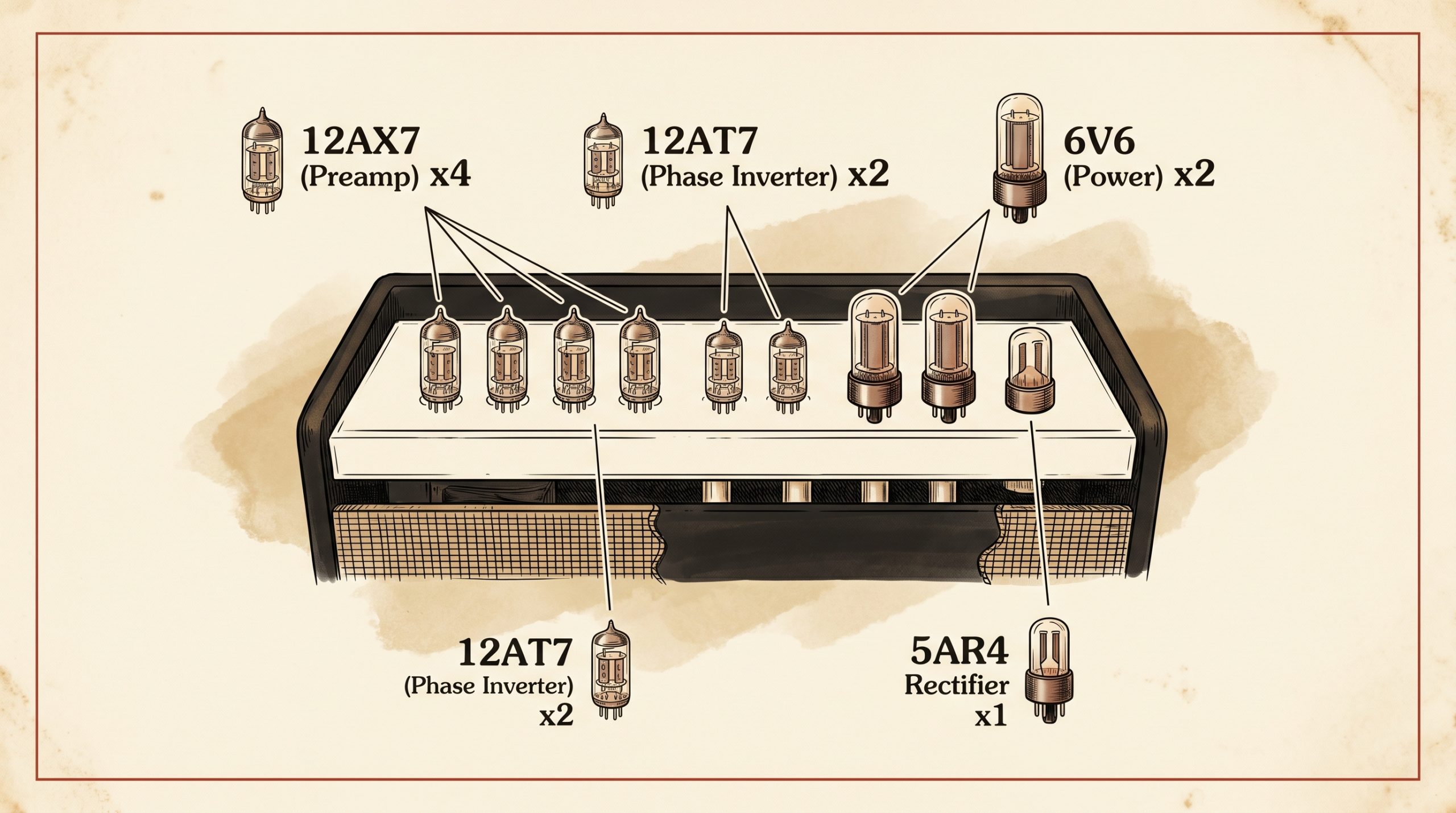
- Tubes. All current tube Deluxe Reverbs (vintage, ’65 Reissue, ’64 Custom, ’68 Custom) carry exactly nine tubes: four 12AX7-family preamp tubes (often factory-stamped 7025 in vintage units), two 12AT7 tubes, two 6V6 power tubes, and one 5AR4 (also marked GZ34) tube rectifier. The Deluxe Reverb II used a solid-state rectifier, not a tube rectifier.
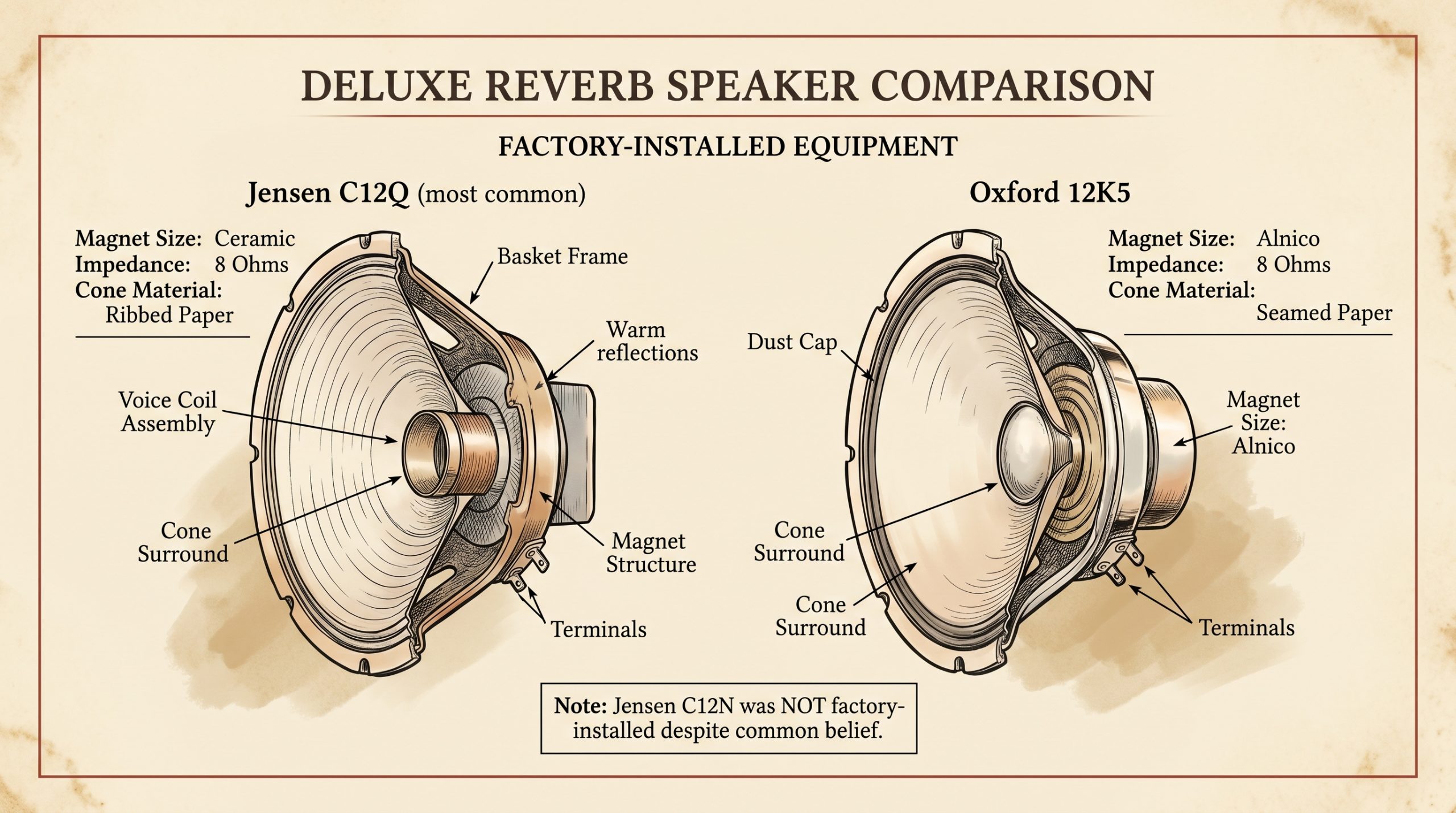
- Speaker (vintage). Blackface Deluxe Reverbs shipped with either a 12-inch Jensen C12Q (the most commonly documented original) or an Oxford 12K5. Contrary to common belief, the larger-magnet Jensen C12N was not factory-installed in Deluxe Reverbs by Fender. The ’64 Custom reissue uses the C12Q in tribute to the original spec.
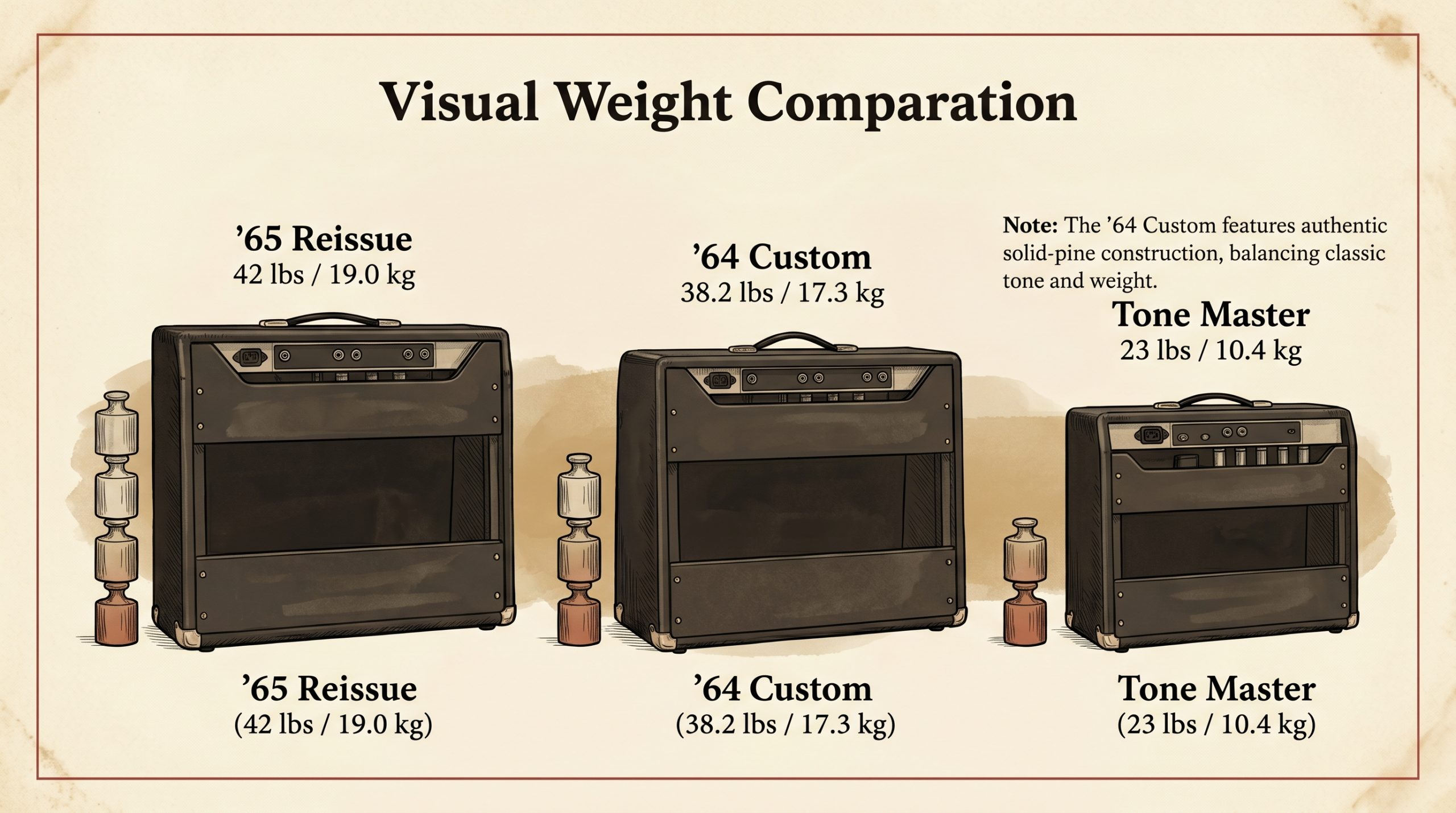
- Weight. 42 pounds (19.0 kg) for the ’65 Reissue and standard vintage units, 38.2 pounds (17.3 kg) for the lighter solid-pine ’64 Custom, and 23 pounds (10.4 kg) for the transformer-less Tone Master.
- Current production. Five variants are available new from Fender in 2026: ’65 Deluxe Reverb, ’64 Custom, ’68 Custom, Tone Master, and the ’65 Deluxe Reverb Head. The Deluxe Reverb II is not in current production and has not been manufactured since 1986.
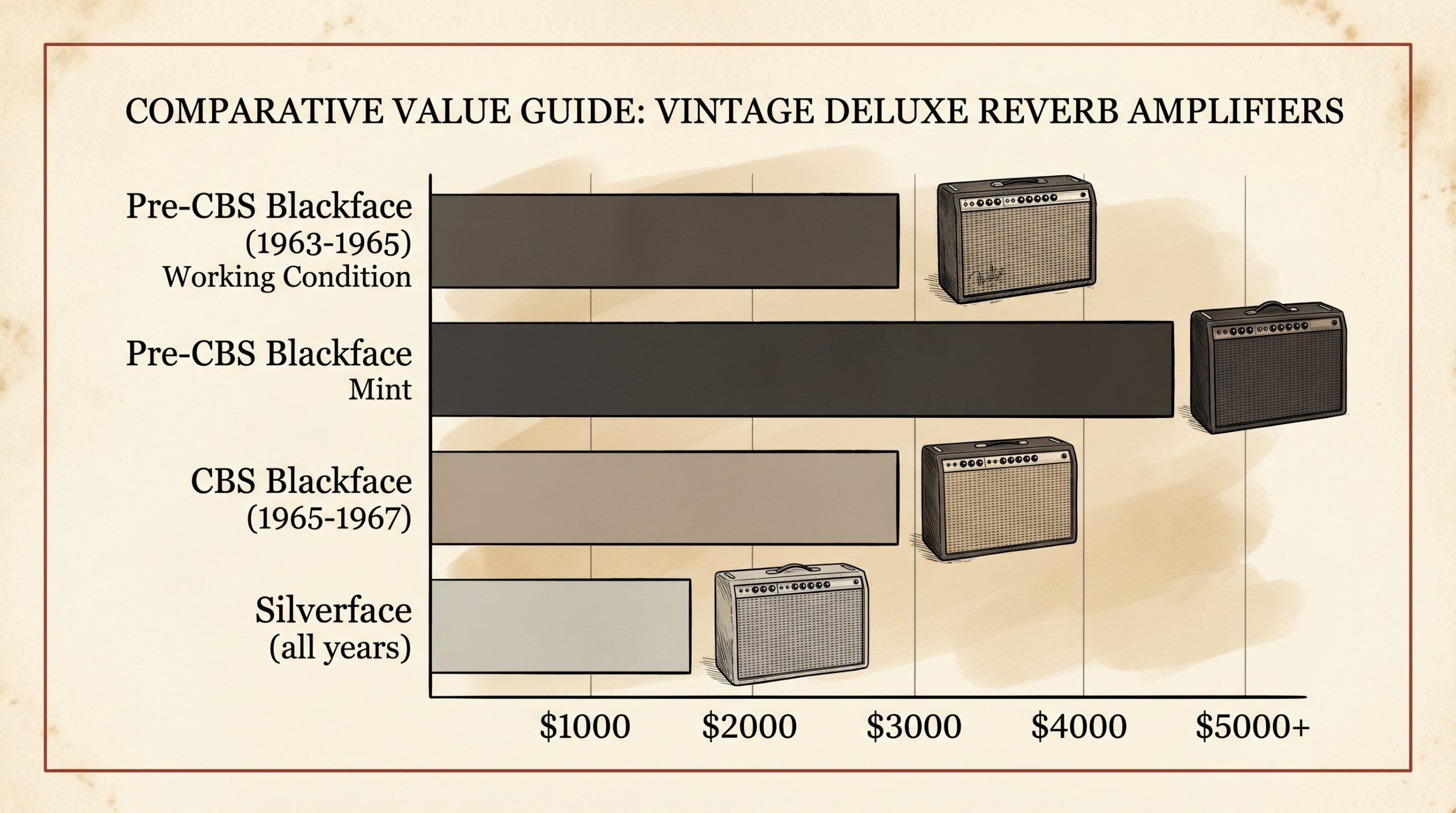
- Vintage value range (2026). Pre-CBS blackface examples from 1963 to early 1965 typically trade for $2,800 to $5,500 in working condition with documented originality; mint examples reach $5,500 to $8,500. CBS-era blackface examples from 1965 to 1967 range from $1,650 to $3,500. Silverface units run $900 to $3,000 depending on year and circuit.
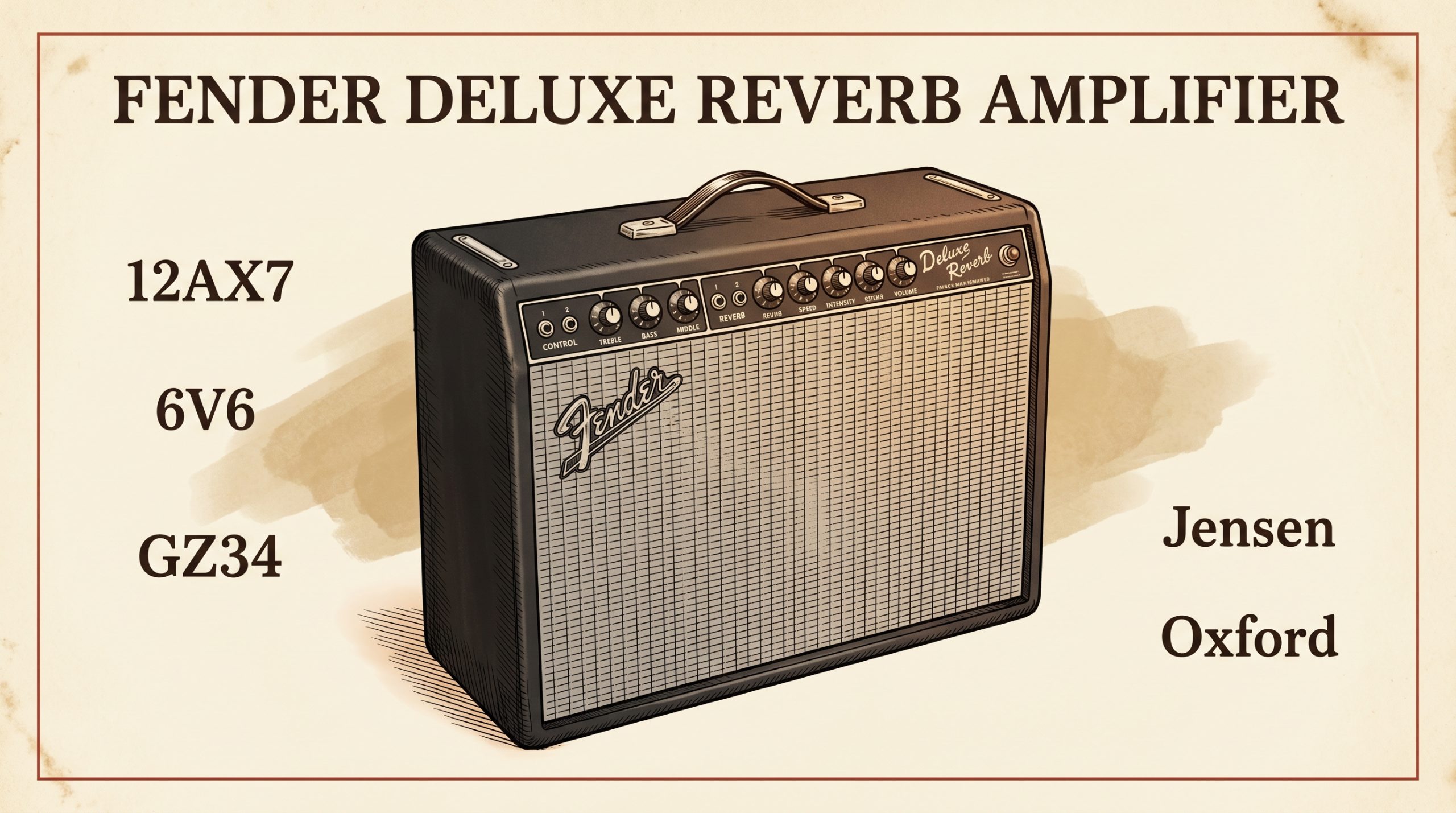
The Fender Deluxe Reverb is, by most measures, the most-recorded amp in popular music history. The AB763 circuit it carried through its blackface production years became the reference voice for clean American electric guitar, and the model has been in nearly continuous production, original, reissue, or both, for over six decades. If there is a single Fender amp every player should understand before buying, this is it.
What makes the Deluxe Reverb work is the balance: 22 watts through a 12-inch speaker is loud enough for small clubs and small theaters, light enough at 42 pounds to actually carry, and clean enough at moderate volumes to be a near-perfect pedal platform. At higher volumes the amp breaks up into the kind of singing 6V6 overdrive that defined countless recordings from the 1960s through to today. Every player who picks one up understands why this amp has the reputation it does within about thirty seconds.
This guide exists because the published specifications for the Deluxe Reverb are inconsistent across Fender’s marketing copy, dealer listings, and aftermarket documentation. Tube counts vary, watt ratings get swapped between models, speaker assignments are wrong on dealer pages, the introduction year for the ’65 Deluxe Reverb Head appears as 2013, 2014, and 2025 in different sources, and the Deluxe Reverb II is still occasionally listed as a current-production model when it has been out of production since 1986. We verified every specification in this guide against Fender’s official product documentation and corroborated against independent technical references including the Wikipedia entry, Premier Guitar’s announcement coverage, Mojotone’s Fender field guide, Ampwares amp database, and FenderGuru.com. Where Fender’s marketing copy and Fender’s own spec sheets disagree, we note the discrepancy and follow the spec sheet.
Quick reference table
If you arrived here looking for one specific fact, here it is. Detail follows below.
| Power output | 22 watts (vintage, ’65 Reissue, ’68 Custom) · 20 watts (’64 Custom and Deluxe Reverb II) · 100 W digital configured to 22 W modeled (Tone Master) |
|---|---|
| Tubes (vintage and ’65 Reissue) | 4× 12AX7 + 2× 12AT7 + 2× 6V6 + 1× 5AR4 = 9 tubes total |
| Speaker (vintage blackface) | 12-inch Jensen C12Q (most common original) or Oxford 12K5 (later production) |
| Weight (tube combos) | 42 lb (19.0 kg) standard · 38.2 lb (17.3 kg) for ’64 Custom · 23 lb (10.4 kg) for Tone Master |
| Dimensions | 17.5″ H × 24.5″ W × 9.5″ D (44.5 × 62.2 × 24.1 cm) for standard combos |
| Original production | 1963 to 1982 (blackface 1963 to 1967, silverface 1968 to 1981, brief 1982 blackface transition) |
| Out of production | 1986 (after Deluxe Reverb II) to 1992 |
| Current production (2026) | ’65 Deluxe Reverb Reissue · ’64 Custom · ’68 Custom · Tone Master · ’65 Deluxe Reverb Head |
Deluxe Reverb history and lineage
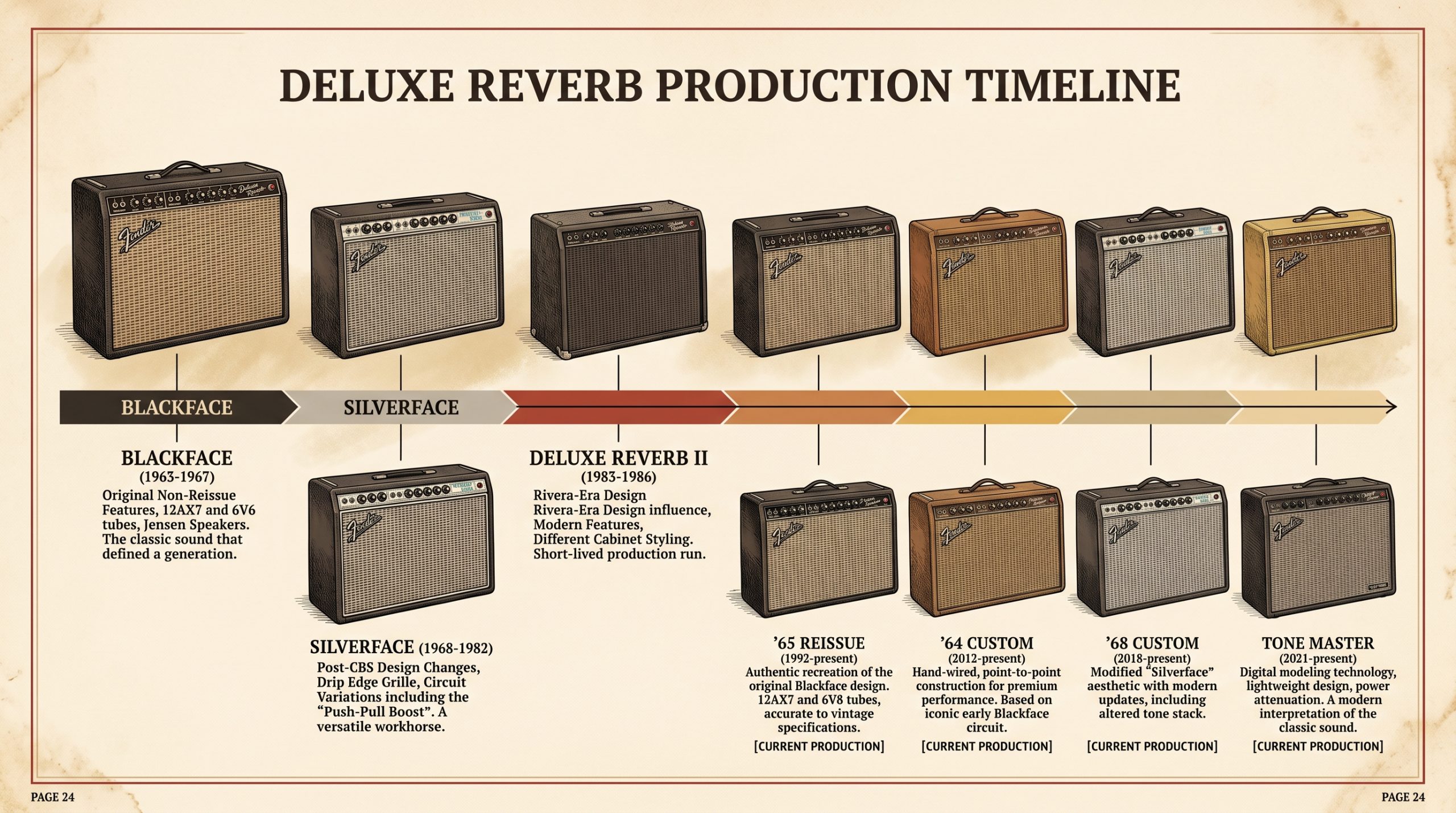
The Deluxe Reverb was introduced in 1963 as part of the second generation of Fender’s blackface-era amps, alongside the Princeton Reverb, Vibrolux Reverb, and Twin Reverb. It replaced the earlier brown-Tolex Deluxe (6G3 circuit, 1961 to 1963) and the long line of tweed-era Deluxes (5E3 and earlier, 1955 to 1960). The new amp added a built-in spring reverb and tube tremolo to what was already an accomplished medium-power Fender combo, and it found its way onto recordings almost immediately. Within a year of release it had become the default backline amp at recording studios across the country.
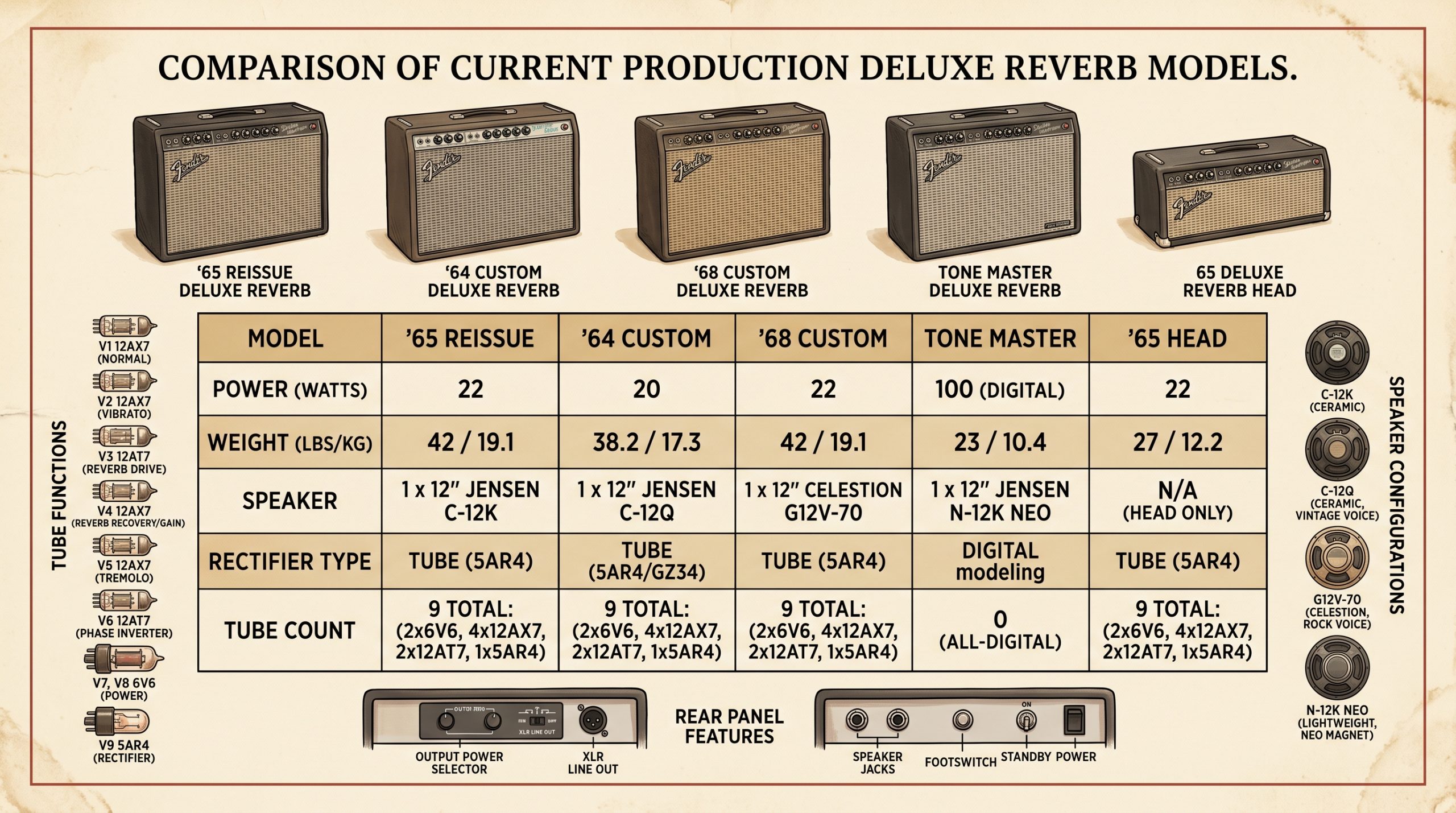
Production timeline at a glance:
- Blackface era (1963 to 1967): original AA763 then AB763 circuit, pre-CBS through early CBS production
- Silverface era (1968 to 1981): continued AB763 through 1970, then AC568 and related CBS-era modifications from the mid-1970s onward
- 1982 transition: brief blackface-cosmetic production run, then discontinued
- Deluxe Reverb II (1982 to 1986): Paul Rivera-designed redesign with master volume, gain channel, and a solid-state rectifier; no tremolo; then discontinued
- Out of production (1986 to 1992): no Deluxe Reverb in the Fender catalog
- ’65 Deluxe Reverb Reissue (1993 to present): continuously produced reissue of the 1965 blackface specification
- ’68 Custom Deluxe Reverb (2013 to present): silverface-cosmetic modified-circuit variant
- ’65 Deluxe Reverb Head (limited run summer 2013, permanent product January 2014 to present): head-only version of the ’65 Reissue
- ’64 Custom Deluxe Reverb (2018 to present): hand-wired pre-CBS-spec premium variant
- Tone Master Deluxe Reverb (2019 to present): digital modeling, no tubes
The model has never been more available than it is today. Between the original vintage market and Fender’s current production lineup, there are five distinct Deluxe Reverb configurations available new in 2026, with vintage examples spanning sixty-three years of production also active on the used market.
Deluxe Reverb by era
Blackface era, 1963 to 1967 (AA763 and AB763 circuits)
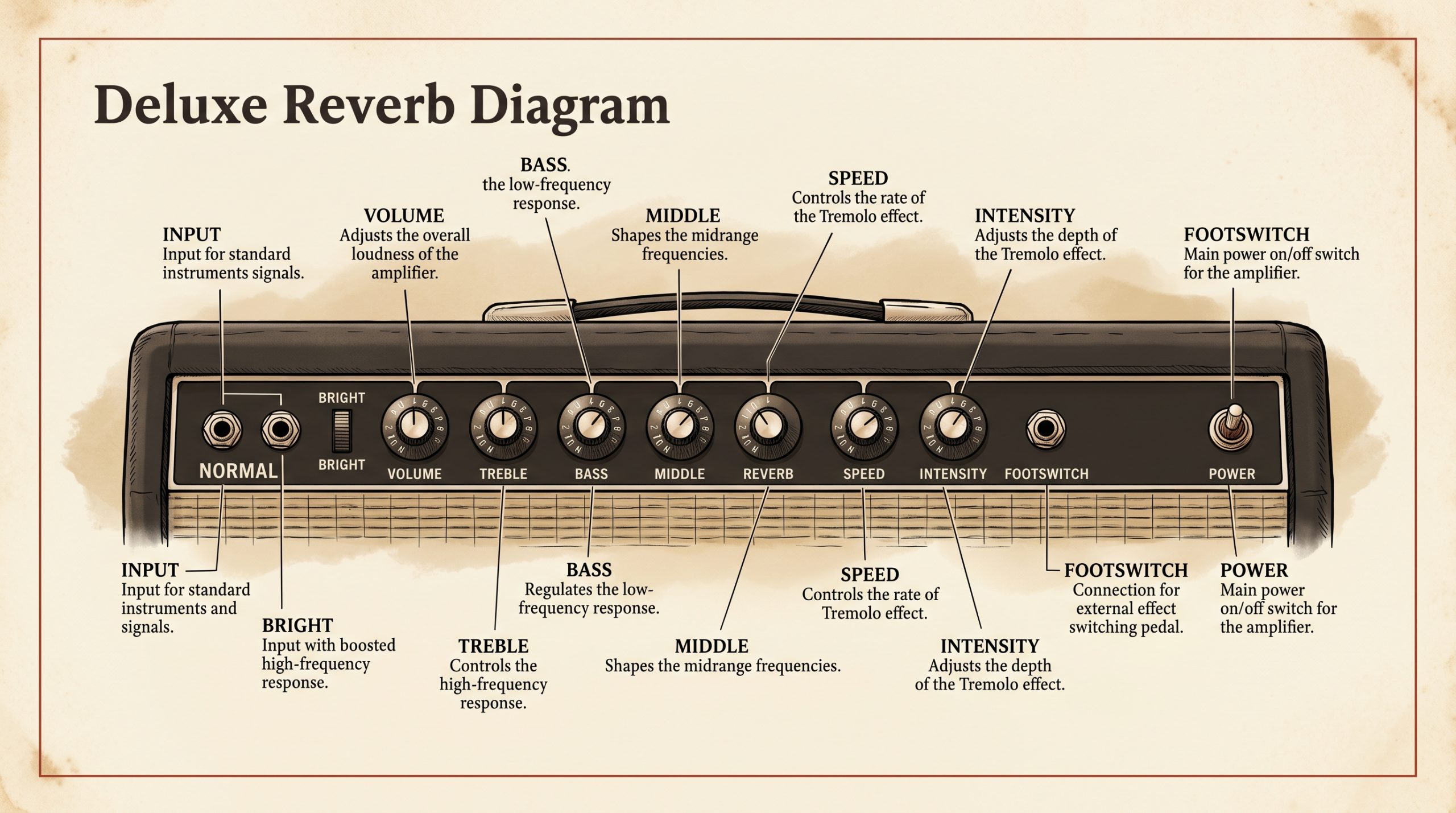
The original blackface Deluxe Reverb. Black Tolex covering, black control panel with white script reading “Fender Electric Instrument Co.” (pre-CBS, through January 1965) or “Fender Musical Instruments Corp.” (post-CBS, from January 1965 onward), silver-and-black sparkle grille cloth, cream chicken-head knobs. 22 watts of tube power through a single 12-inch speaker. Two channels: Normal (channel one) and Vibrato (channel two, with reverb and tremolo).
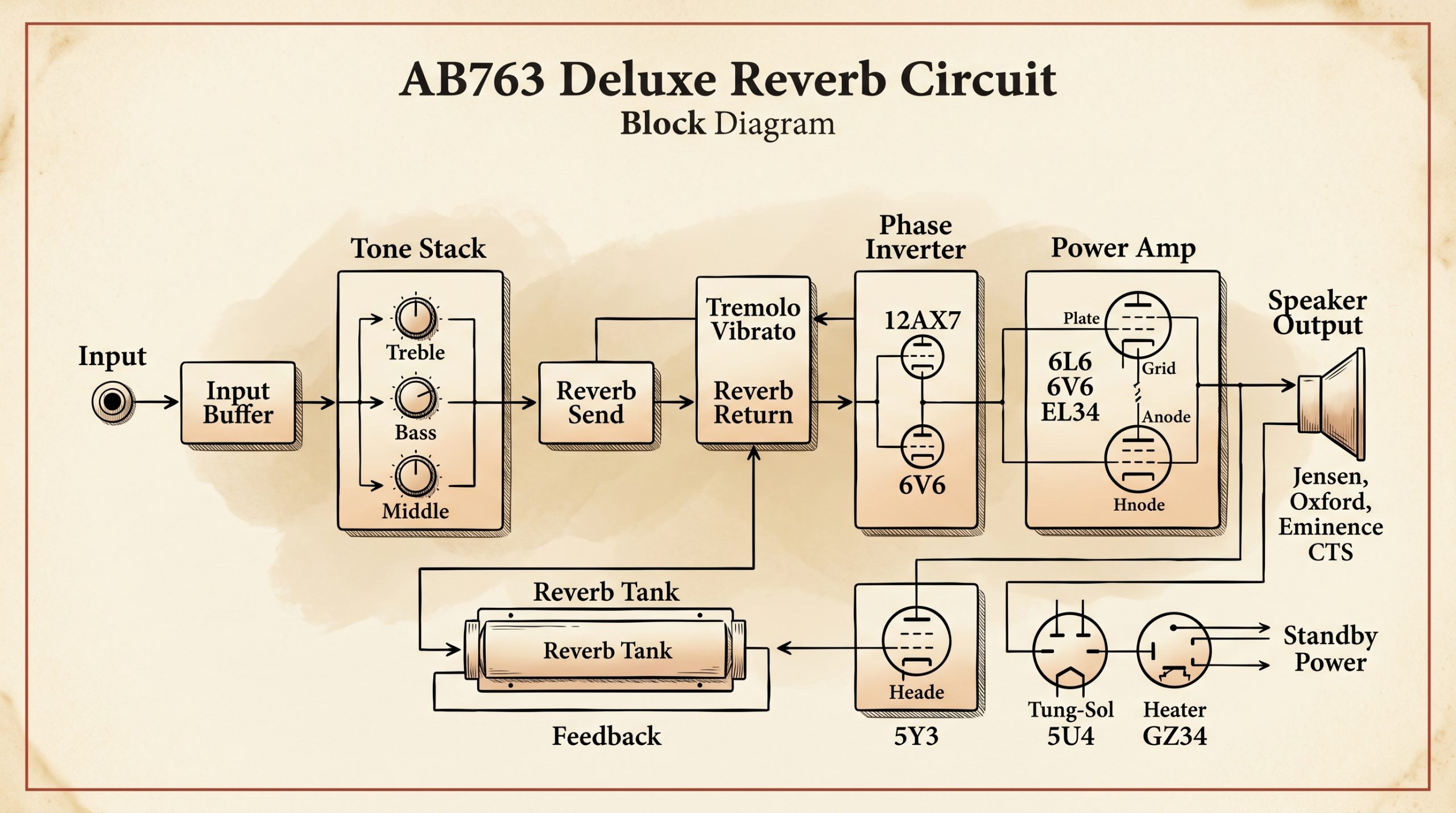
Circuit history. The first production Deluxe Reverbs from 1963 to early 1964 carried the AA763 designation. In 1964 Fender shifted to AB763, which changed the phase inverter resistor values (the 22k log-tail resistor became 27k, and the 12AT7 phase inverter “top side” plate resistor went from 100k to 82k) and slightly increased headroom. AA763 and AB763 sound essentially identical to the human ear in band-level use. Both are universally referred to as “blackface” Deluxe Reverbs and the AB763 circuit is the one Fender’s reissues are based on.
The 22-watt rating. Fender’s nominal 22-watt rating for the Deluxe Reverb is achieved by operating the 6V6 power tubes substantially above their factory-specified maximum plate voltage. This was a deliberate design choice that gives the amp its characteristic clipping behavior and harmonic richness when pushed, but it also means new-old-stock RCA or Sylvania 6V6 power tubes from the 1960s are running near their limits in this amp. Modern reissue 6V6 tubes (Tung-Sol, JJ, Sovtek, Electro-Harmonix) are designed to handle the higher plate voltages routinely and are the more reliable choice for working players.
Tube complement: four preamp tubes in the 12AX7 family (factory-marked in vintage units as 7025, which is a low-noise selected variant of the 12AX7, electrically identical), two 12AT7 tubes (one as reverb driver, one as phase inverter), two 6V6 power tubes, and one 5AR4 rectifier (sometimes marked GZ34, also electrically identical). Nine tubes total.
Position by position in an AB763 Deluxe Reverb:
| Position | Tube | Function |
|---|---|---|
| V1 | 7025 / 12AX7 | Normal channel preamp, first gain stage |
| V2 | 7025 / 12AX7 | Vibrato channel preamp, first gain stage |
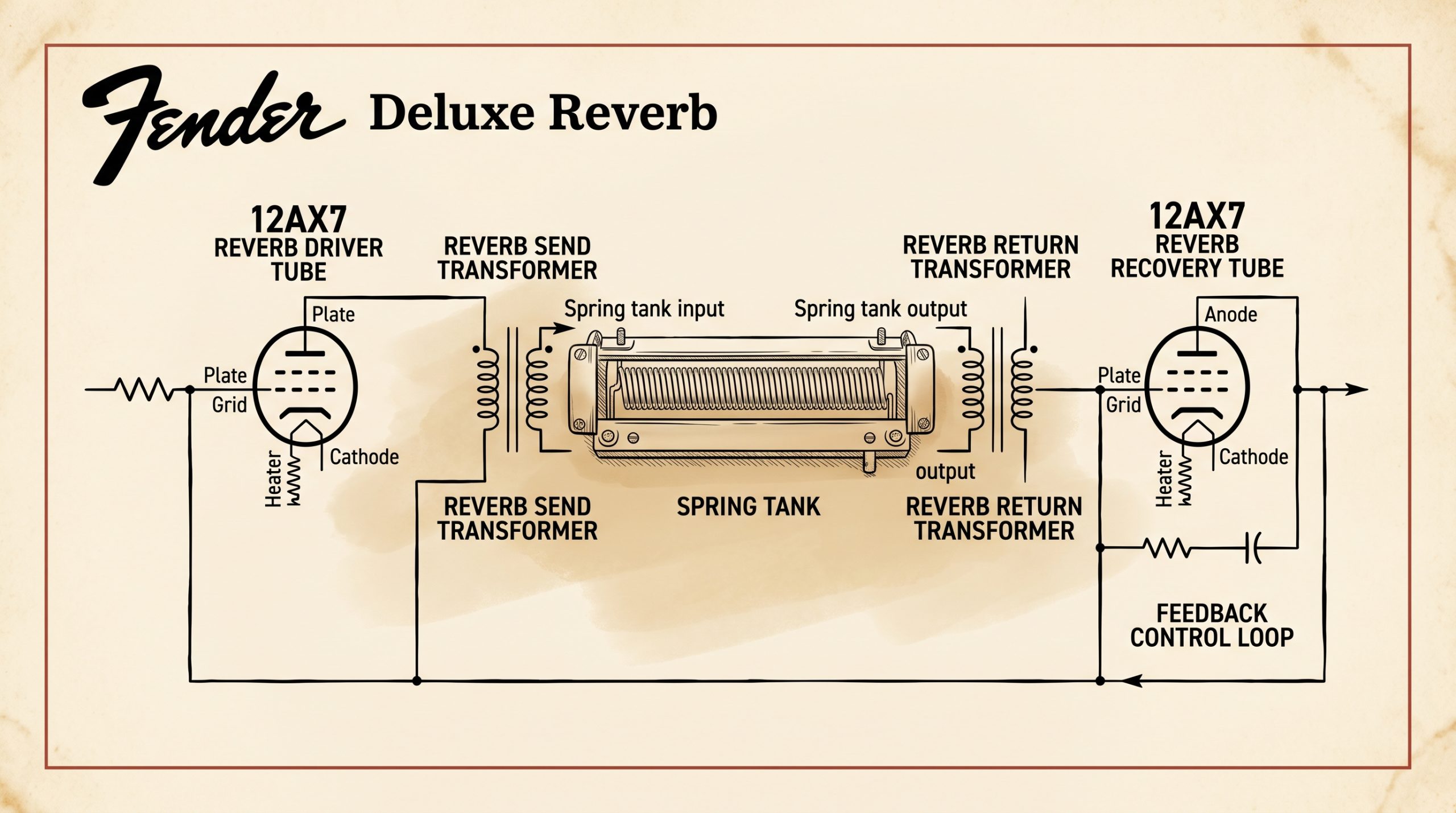
| V3 | 12AT7 | Reverb driver (drives the reverb tank transformer) |
| V4 | 7025 / 12AX7 | Reverb recovery + Vibrato channel second gain stage |
| V5 | 12AX7 | Tremolo oscillator (vibrato circuit) |
| V6 | 12AT7 | Phase inverter (long-tailed pair feeding the output tubes) |
| V7, V8 | 6V6GT | Output tubes (push-pull, 22 W into 8 Ω) |
| V9 | 5AR4 / GZ34 | Tube rectifier |
The “7025 in V1, V2, V4” configuration is the Fender factory original. Modern replacement tubes labeled 12AX7 work identically in those positions; the 7025 stamp simply indicates the lower-noise selection that Fender required in those high-gain positions. This matters when reading old documentation that refers to “three 7025 tubes” alongside “one 12AX7” in the original blackface Deluxe Reverb. The total is four 12AX7-family preamp tubes, regardless of which factory stamp they carry.
Original speakers. Blackface Deluxe Reverbs shipped most commonly with the 12-inch Jensen C12Q from 1963 through 1965, with Oxford 12K5 becoming more common from 1966 through 1967 as Jensen’s production quality declined and Fender shifted suppliers. Both are 12-inch ceramic-magnet speakers with comparable specifications but different sonic characters. Note the model designation carefully: the larger-magnet Jensen C12N, which is widely used in vintage Fender Twin and Pro Reverb cabinets, was not factory-installed in Deluxe Reverbs. The C12N appears in Deluxe Reverbs only as a later replacement by owners or techs seeking more headroom. Fender’s own ’64 Custom reissue uses the smaller-magnet C12Q in deliberate tribute to the original blackface spec.
Original speaker EIA codes (the three-digit prefix on the speaker frame label): Jensen 220-, Oxford 465-. The four digits following the EIA prefix decode the year and week of production. A speaker stamped 220548 was made by Jensen (220), in 1965 (5), week 48.
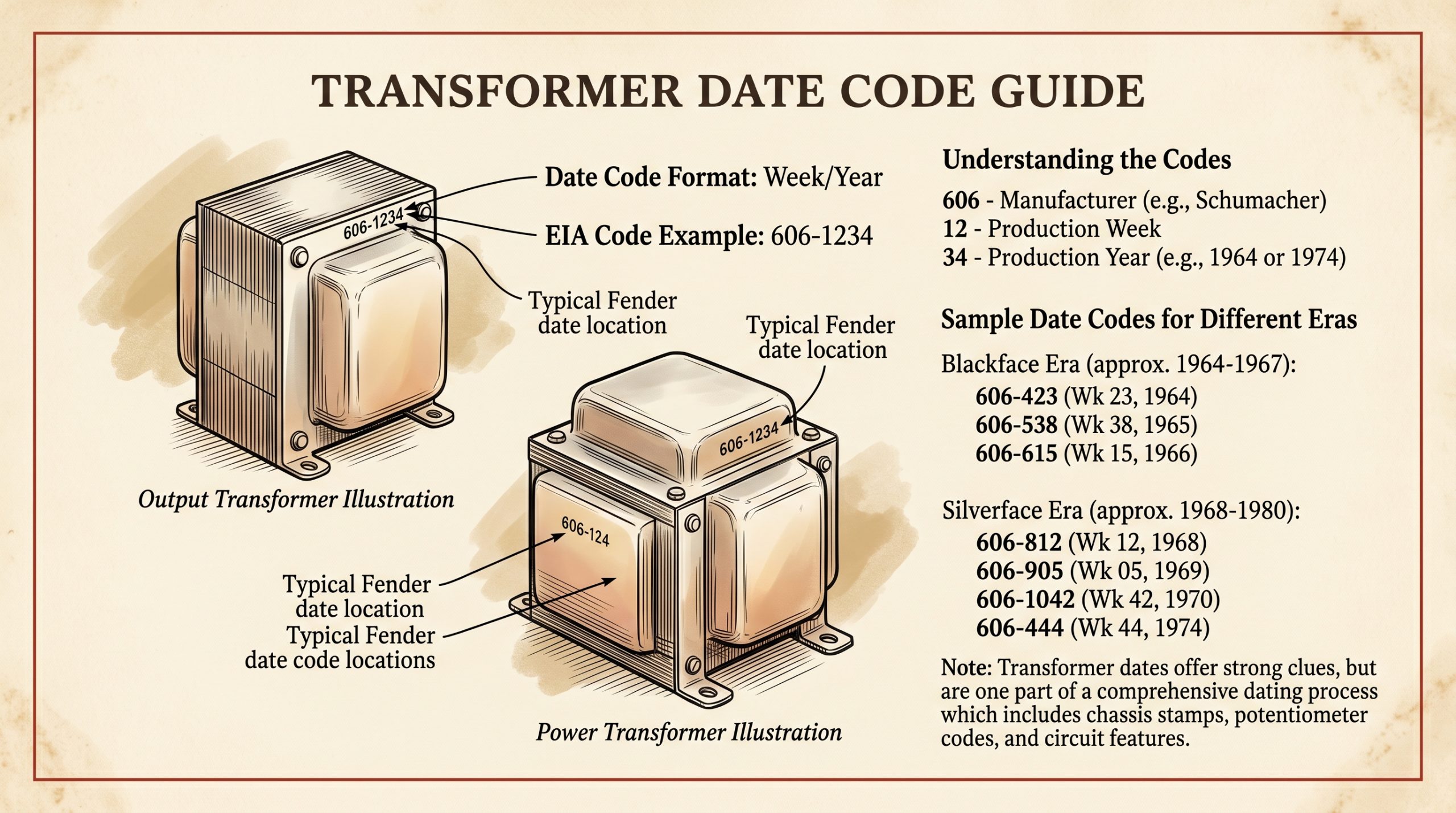
What to watch for. 1965 to 1966 examples in original condition with documented originality are the most sought-after blackface Deluxe Reverbs by working players. Verify the AB763 designation on the tube chart, the original chassis stamp, matching transformer date codes (Woodward-Schumacher EIA code 606 for power and output transformers), and a speaker date code falling within a few months of the chassis date. Re-Tolexed amps and amps with replacement speakers are extremely common; these affect value substantially even if the amp sounds good.
Pre-CBS versus early CBS. Fender was sold to CBS in January 1965. The back panel and faceplate change from “Fender Electric Instrument Co.” to “Fender Musical Instruments Corp.” is the cosmetic marker. Sonically, early CBS amps from 1965 are indistinguishable from late pre-CBS amps from 1964; the same workers were soldering the same components on the same workbenches. The pre-CBS premium is real but reflects collector preference rather than measurable sonic difference.
The “OA / OB” date code anomaly. Fender’s tube chart date codes use year-letter (first letter) + month-letter (second letter). January 1966 should be “PA” but the production team forgot to advance the year stamper, so January and February 1966 Deluxe Reverbs are stamped “OA” and “OB” in dark green ink instead of the usual black. If you see an OA or OB stamp, check the front and back panels. “Fender Electric Instruments” means 1965 (correct “O” year code). “Fender Musical Instruments Corp.” means the stamp is wrong and the amp is actually from 1966. Full detail and credit to Greg Gagliano in our dating pillar.
Silverface era, 1968 to 1981
Silverface Deluxe Reverbs split into two sub-eras with meaningful tonal implications.
Early silverface (1968 to 1971) retained the AB763 circuit under the new silver-and-blue cosmetics. These are essentially blackface amps in different paint, same tubes, same transformers, same circuit topology. The tube chart inside the cabinet will explicitly say AB763. Aluminum drip-edge grille trim was used from 1968 through 1969 and is a desirable cosmetic feature on the early silverface market. Original speakers in this period: Oxford 12T6 became common as Jensen production quality declined further. Early silverface Deluxe Reverbs are currently among the best vintage tone-for-dollar buys on the market, trading at $1,400 to $3,000 versus $2,500 to $5,500 for comparable blackface units while delivering essentially identical tone.
Mid-late silverface (1972 to 1981) received CBS-era circuit modifications. The bias adjust resistor values were changed, the tone stack values were adjusted, the negative feedback loop was modified, and 1976+ units used a different output transformer wiring sometimes called “ultra-linear” (technically not true ultra-linear in the audio sense, but Fender used the term in some documentation). These changes altered the tone away from the blackface ideal, making the amp cleaner, harder, and thinner at the same volume settings. A qualified vintage tech can reverse these modifications in what is sometimes called a “blackface conversion,” which restores the AB763 voice without affecting the amp’s vintage status.
The 1980 and 1981 production runs included some interesting variations: master volume circuits, pull-boost features, and other CBS-era experiments. These are not particularly collectible compared to earlier years but are interesting for completists. Late silverface units with pull-boost master volume are best understood as transitional amps that pointed toward what Paul Rivera would design in 1982.
The brief 1982 blackface reissue
In 1982 Fender briefly returned the Deluxe Reverb to blackface cosmetics before discontinuing the model. These transition amps are uncommon and trade at late silverface prices on the vintage market. The blackface-era amps from 1982 should not be confused with the redesigned Deluxe Reverb II, which appeared the same year as a completely different amplifier sharing only the name.
Deluxe Reverb II, 1982 to 1986 (Rivera era)
This is a frequently misunderstood amp. The Deluxe Reverb II is a Paul Rivera-designed redesign that shares only the name with the blackface and silverface Deluxe Reverbs. It is not in current production and has not been manufactured since 1986. Anyone selling a “current production Deluxe Reverb II” is mistaken or misrepresenting the product.
The Rivera-era Deluxe Reverb II specifications:
| Production | 1982 to 1986 |
|---|---|
| Power | 20 watts (reduced from the AB763 Deluxe Reverb’s 22 W) |
| Construction | Hand-wired (one of the last hand-wired Fender production amps) |
| Channels | Two: clean channel + high-gain channel with master volume |
| Tremolo | None (Rivera-era Fenders dropped tremolo across the line) |
| Reverb | Yes, on both channels |
| Channel switching | Push/pull switch on second channel volume pot, or footswitch |
| Tubes | Three 7025 preamp + two 6V6 power tubes |
| Rectifier | Solid-state (NOT a tube rectifier; this is a key change from the AB763 Deluxe Reverb) |
| Speaker | 12-inch Fender OEM ceramic |
| Weight | ~49 lb (heavier than blackface due to circuit complexity) |
| Features | Push/pull bright switch, push/pull mid-boost, presence control, recording/direct line out on rear panel |
The Deluxe Reverb II was Fender’s response to the Mesa/Boogie-driven boutique market of the early 1980s. The clean channel is recognizably Fender; the high-gain channel is a stylistic departure aimed at hard rock and metal players who would not have used a stock blackface amp. Sales were modest and the model was dropped after four years. Today the Deluxe Reverb II has a small but enthusiastic following among players who appreciate Rivera’s design work. Vintage value typically falls in the $900 to $1,800 range depending on condition, well below comparable blackface and silverface examples.
Modern Deluxe Reverb reissues and variants
’65 Deluxe Reverb Reissue (1993 to present)
The standard, continuously-produced tube Deluxe Reverb. Faithful to the 1965 blackface specification: black Tolex, silver-and-black grille, AB763-derived circuit, 22 watts, 12-inch Jensen C-12K ceramic-magnet speaker. Tube-driven spring reverb. Manufactured in Corona, California.
| Power | 22 watts RMS into 8 Ω |
|---|---|
| Channels | Two: Normal and Vibrato |
| Preamp tubes | Four 12AX7 + two 12AT7 |
| Power tubes | Two 6V6 (Groove Tubes factory-fitted) |
| Rectifier | One 5AR4 (tube rectification, not solid-state) |
| Speaker | One 12-inch Jensen C-12K with ceramic magnet |
| Cabinet | Birch plywood with black textured vinyl |
| Construction | PCB (printed circuit board), not hand-wired |
| Dimensions | 17.5″ H × 24.5″ W × 9.5″ D (44.5 × 62.2 × 24.1 cm) |
| Weight | 42 lb (19.0 kg) |
| Effects loop | None |
| Country of origin | Corona, California, USA |
| Current retail (2026) | $1,400 to $1,600 new |
The ’65 Reissue has been in production for more than thirty years, longer than the original blackface era and silverface era combined, and it has gone through subtle component variations over the years: different reverb tanks, different tube suppliers, different transformer specifications. Early reissue units (1993 to early 2000s) used different components than current production. None of these variations substantially affect tone, but collectors increasingly distinguish between “early reissue” and “modern reissue” Deluxe Reverbs. Early-1990s reissue units trade for $1,000 to $1,400 used in good condition.
Note on rectification: some older sources and forum posts incorrectly state that the ’65 Reissue uses solid-state rectification. It does not. The ’65 Reissue uses a 5AR4 tube rectifier, as Fender’s specification sheet confirms. The “PCB vs hand-wired” distinction is real and significant; the “tube vs solid-state rectifier” distinction does not apply to any current tube Deluxe Reverb in the Fender lineup (the ’65 Reissue, ’64 Custom, ’68 Custom, and ’65 Head are all tube-rectified). Solid-state rectification appears only in the 1982 to 1986 Deluxe Reverb II and in the Tone Master (which is entirely digital).
What the ’65 Reissue is good at: capturing the blackface Deluxe Reverb voice at a fraction of vintage pricing. The standard reissue is the right choice for most players who want the sound without the vintage hunt and the maintenance overhead of a sixty-year-old amp.
’65 Deluxe Reverb Head (limited run 2013, permanent product 2014 to present)
Originally produced as a Factory Special Run in the summer of 2013, the head-only version of the ’65 Deluxe Reverb was added to Fender’s permanent Vintage Reissue lineup in January 2014. Fender announced this addition at the time alongside a ’57 Deluxe head, presenting both as “fresh takes on perennial favorites” for players who wanted to pair classic Fender circuits with their own choice of speaker cabinet.
The ’65 Deluxe Reverb Head carries the identical 22-watt circuit as the combo (four 12AX7, two 12AT7, two 6V6 Groove Tubes, one 5AR4 rectifier, nine tubes total), the same Normal and Vibrato channels, the same tube-driven Fender reverb and tube vibrato. The only meaningful differences from the combo: no internal speaker, no combo cabinet (head-style cabinet only), and the consequence that you need to provide your own speaker cabinet rated to handle 22 watts with 8 Ω total impedance. Most players pair the head with a single 12-inch cabinet to retain the traditional Deluxe Reverb sonic profile, or with a 2×12 cabinet for added bass response and reduced speaker cone breakup at high volumes. Current retail in 2026 is approximately $1,200 to $1,400 new, with limited used market availability since the head has historically been the lower-volume seller compared to the combo.
’64 Custom Deluxe Reverb (2018 to present)
A pre-CBS-spec hand-wired variant of the Deluxe Reverb platform, priced at a meaningful premium over the standard ’65 Reissue and explicitly marketed as a “modified” rather than “faithful” reissue. Announced at summer NAMM 2017, released to retail in 2018.
| Fender model designation | PR 4826 (also model number 8180000000) |
|---|---|
| Power | 20 watts RMS into 8 Ω @ 10% THD, 1 kHz (not 22 W like the ’65 Reissue) |
| Channels | Two: Normal and Bright (not Normal and Vibrato like the ’65) |
| Reverb and tremolo | Both channels (the original 1964 had effects only on the Vibrato channel) |
| Preamp tubes | Four 12AX7 + two 12AT7 (per Fender’s current product page and Sweetwater) |
| Power tubes | Matched pair of 6V6 |
| Rectifier | One 5AR4 / GZ34 tube |
| Total tube count | Nine tubes |
| Speaker | One 12-inch Jensen C-12Q ceramic-magnet (tribute to the most common original blackface spec) |
| Tone capacitors | Fender Vintage Blue (recreating original Astron Blue Molded tone caps) |
| Cabinet | Solid pine (not birch plywood like the ’65 Reissue) |
| Construction | Hand-wired, point-to-point on eyelet board |
| Dimensions | 16.9″ H × 24.3″ W × 9.3″ D (42.9 × 61.7 × 23.6 cm) |
| Weight | 38.2 lb (17.3 kg) |
| Effects loop | None |
| Country of origin | Corona, California, USA |
| Includes | Two-button vintage-style footswitch, fitted cover |
| Current retail (2026) | $2,500 to $2,800 new |
Spec sheet clarification on preamp tube count. Fender’s current product page for the ’64 Custom Deluxe Reverb explicitly lists “Four 12AX7 and two 12AT7 preamp tubes; 5AR4/GZ34 rectifier tube; matched pair of 6V6 output tubes.” Sweetwater and most major retailers carry the matching four 12AX7 specification. A number of dealer listings (Lauzon Music, Long & McQuade, Alamo Music, Guitar Riot, and several others) carry an older “three 12AX7 and two 12AT7” specification that derives from an early dealer information sheet circulated when the amp was first announced. The Fender product page is the canonical source and confirms nine tubes total, matching the original AB763 circuit. The “Custom” in the name refers to the channel modifications (reverb and tremolo on both channels, Normal channel reconfigured for warmer tone, Bright channel using traditional 1960s tone circuit) rather than any tube count reduction.
The ’64 Custom is the right choice for players who specifically want the pre-CBS sonic character, hand-wired construction, solid pine cabinet resonance, and the modified effects-on-both-channels feature that the original 1964 amps did not have. The 20-watt rating (lower than the ’65 Reissue’s 22 watts) reflects the modified circuit and is a meaningful difference at high volumes. The price premium reflects the labor cost of hand-wiring plus premium components; whether the sonic difference justifies the cost is a personal decision.
’68 Custom Deluxe Reverb (2013 to present)
A silverface-cosmetic variant with an intentionally modified circuit designed for more breakup at lower volumes than the standard ’65 Reissue. The ’68 Custom is explicitly marketed as a “hot-rodded tribute” rather than a faithful 1968 reissue. Released alongside the original limited-run ’65 Deluxe Reverb Head in 2013.
| Power | 22 watts RMS @ 8 Ω |
|---|---|
| Channels | Two: Custom and Vintage |
| Vintage channel | Traditional silverface AB763-style operation |
| Custom channel | Modified Bassman tone stack |
| Reverb and tremolo | Both channels (shared) |
| Preamp tubes | Four 12AX7 + two 12AT7 |
| Power tubes | Two 6V6 (Groove Tubes) |
| Rectifier | One 5AR4 |
| Total tube count | Nine tubes |
| Speaker | One 12-inch Celestion G12V-70 |
| Transformers | Custom Schumacher (specified to original silverface design) |
| Construction | PCB with hand-wired tube sockets |
| Dimensions | 17.5″ H × 24.5″ W × 9.5″ D (44.5 × 62.2 × 24.1 cm) |
| Weight | 42 lb (19.05 kg) |
| Effects loop | None |
| Cosmetics | Silver-turquoise grille cloth, aluminum drip-edge grille trim, blue jewel pilot light, silverface control panel |
| Current retail (2026) | $1,500 to $1,700 new |
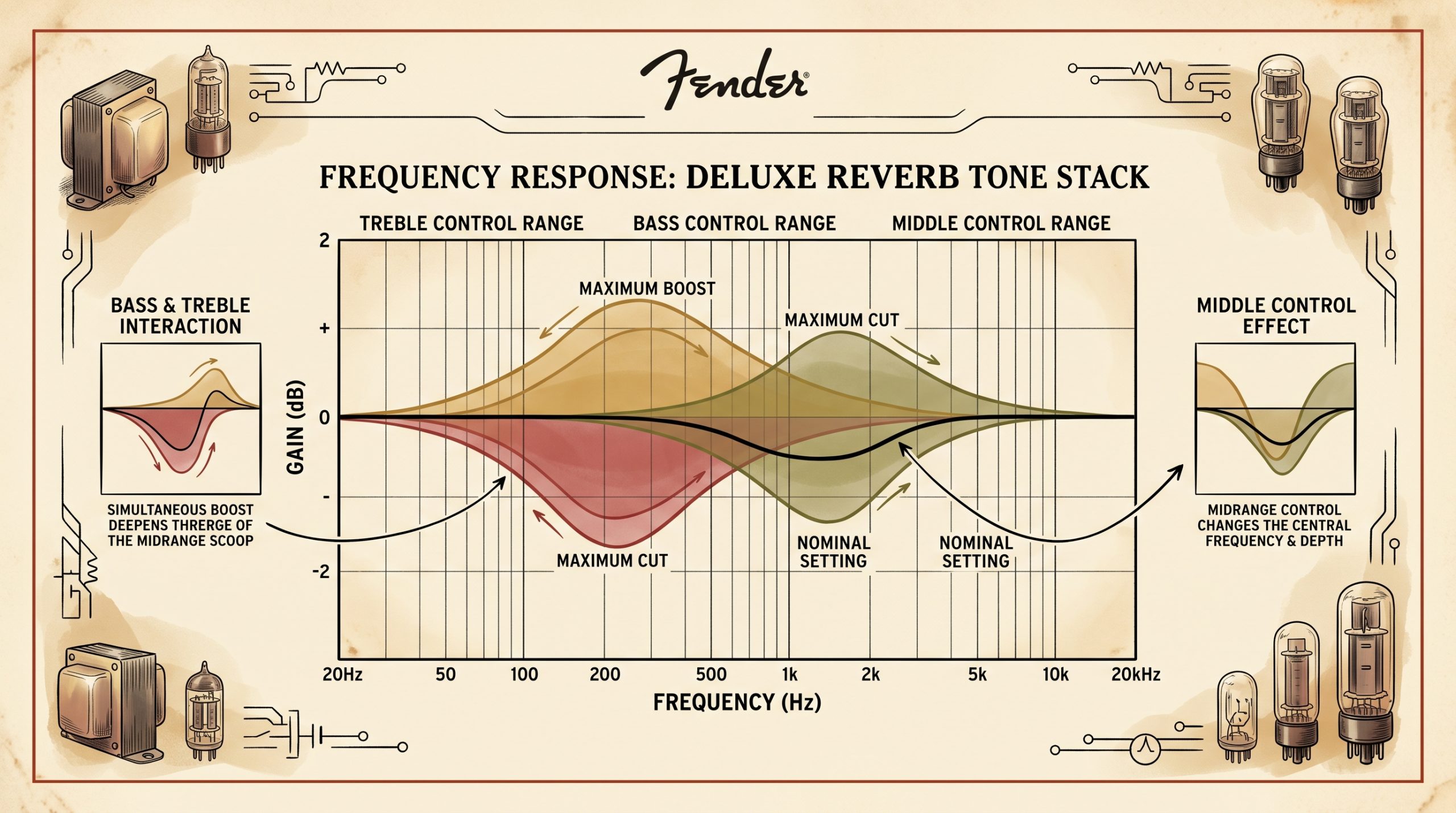
What “Custom” means in the name. Fender’s Custom series amps (the ’64 Custom, ’65 Custom Vibrolux, ’68 Custom variants) are explicitly modified from the original spec. The ’68 Custom in particular is not what a 1968 silverface Deluxe Reverb sounded like; it is a modern amp with silverface cosmetics and a deliberately altered circuit. The Custom channel’s Bassman tone stack moves the midrange forward and adds bark to the top end, making single notes cut through a band mix more effectively than the standard Deluxe voicing. The reduced negative feedback in the power section livens up touch response and brings the amp to breakup earlier.
The Celestion G12V-70 speaker (versus Jensen on the ’65 Reissue) shifts the voicing further from the standard Fender chime toward a punchier, more focused, more British-leaning character. This is the right amp for players who find the standard ’65 Reissue too clean, too pristine, and not enough Marshall.
Vintage Guitar Magazine’s 2016 review of the ’68 Custom Deluxe Reverb confirmed the spec details (Schumacher transformers, hand-wired tube sockets, Celestion speaker, modified tone stack, reduced negative feedback) and characterized the amp as a hot-rodded version of a historic classic rather than a faithful silverface reissue.
Tone Master Deluxe Reverb (2019 to present)
Fender’s digital modeling Deluxe Reverb. No tubes, no transformers, solid-state amplification with DSP-based convolution modeling of the ’65 Deluxe Reverb circuit topology. Released in 2019 and quickly accepted by working players as a credible substitute for the tube version in many contexts.
| Power | 100-watt digital power amp configured to deliver 22 watts of modeled tube output |
|---|---|
| Channels | Two: Normal and Vibrato (identical control layout to the ’65 Reissue) |
| Effects | Convolution-based reverb and tremolo modeling |
| Speaker | One 12-inch Jensen N-12K Neodymium (custom-spec for the Tone Master, designed to match the traditional C-12K voicing) |
| Cabinet | Solid pine (lighter than birch plywood, traditional Fender 1950s and 1960s material) |
| Weight | 23 lb (10.4 kg), approximately half the tube version |
| Power attenuator | Rear-panel 6-way switch: 22 W (full), 12 W, 5 W, 1 W, 0.5 W, 0.2 W (bedroom level) |
| Direct output | Balanced XLR with three-position IR cabinet simulation switch, level control, ground lift |
| Mute switch | Front-panel mute for silent stage or recording use |
| Connectivity | USB port for firmware updates |
| Voltage | Universal 100 V to 240 V worldwide operation |
| Includes | Two-button footswitch, fitted cover |
| Current retail (2026) | $1,000 to $1,100 new |
The Tone Master is the model that pushed Fender’s modeling line into mainstream acceptance. Working players consistently report that it holds up at gig volumes and on recordings well enough to replace the tube version for many use cases. Home and apartment players find the lower-power modes genuinely useful in a way that the tube version’s volume control is not (at any setting above “1,” a tube Deluxe Reverb is loud).
The Tone Master is not a profiling amp like a Kemper Profiler or a Neural DSP Quad Cortex; it is a Fender-engineered model of one specific amp, with a small set of features (six-way power attenuation, IR cabinet sim for the XLR output, mute switch) added to make it more useful in the modern recording and gigging environment. It does not model other amps. If you want a Deluxe Reverb voice in a 23-pound package with bedroom-volume capability and a balanced direct output, this is the amp. If you want a tube amp, buy a tube Deluxe Reverb.
Original speakers by era
| Era | Years | Original speakers |
|---|---|---|
| Blackface | 1963 to 1965 | Jensen C12Q (most common, EIA 220-) |
| Blackface | 1966 to 1967 | Oxford 12K5 (most common, EIA 465-), occasional Jensen C12Q |
| Silverface | 1968 to 1971 | Oxford 12T6 (most common), occasional Jensen |
| Silverface | 1972 to 1981 | CTS (EIA 137-), Utah (EIA 328-), Rola (EIA 285-), or Eminence (EIA 67-) in late production |
| ’65 Reissue | 1993 to present | Jensen C-12K (Italian-made reissue, ceramic magnet, 50 W rating) |
| ’64 Custom | 2018 to present | Jensen C-12Q (ceramic, original 1960s blackface spec tribute) |
| ’68 Custom | 2013 to present | Celestion G12V-70 (UK-built, neodymium-supplemented voicing) |
| Tone Master | 2019 to present | Jensen N-12K Neodymium (custom-spec lightweight) |
| Deluxe Reverb II | 1982 to 1986 | Fender OEM ceramic 12″ (various suppliers) |
Speaker date code references: the three-digit prefix (220, 465, 137, etc.) is the EIA manufacturer code. The following digits encode year + week (most manufacturers) or week + year + production number (some). Cross-reference against the chassis tube chart date code to verify originality. Speakers more than ten months out from the chassis date are likely replacements.
Clarifying the C12N versus C12Q confusion. A persistent misconception in the vintage Fender community is that blackface Deluxe Reverbs shipped with the larger-magnet Jensen C12N (the 28-ounce-magnet, 1.5-inch voice coil, ~50W-rated speaker famous from blackface Twin Reverbs, Pro Reverbs, and Bassmans). This is incorrect for Deluxe Reverbs specifically. Fender installed the smaller-magnet C12Q in Deluxe Reverbs (lower wattage handling, faster early breakup, lighter overall weight), reserving the larger C12N for higher-power amps with greater clean headroom demands. C12N speakers appear in vintage Deluxe Reverbs only as later replacements installed by owners or techs seeking more headroom and bass response. The presence of a vintage C12N in a vintage Deluxe Reverb is therefore a sign of period-but-non-original modification, not factory-original specification.
Deluxe Reverb dimensions, weight, and complete specifications
Useful for amp stands, gig bag sizing, shelf-space planning, and shipping calculations. The tube ’65 Reissue and vintage blackface dimensions are essentially identical; the ’64 Custom is slightly smaller; the Tone Master matches the ’65 Reissue cabinet size but at roughly half the weight.
| Specification | Vintage blackface | ’65 Reissue | ’64 Custom | ’68 Custom | Tone Master |
|---|---|---|---|---|---|
| Height | 17.5″ | 17.5″ | 16.9″ | 17.5″ | 17.5″ |
| Width | 24.5″ | 24.5″ | 24.3″ | 24.5″ | 24.5″ |
| Depth | 9.5″ | 9.5″ | 9.3″ | 9.5″ | 9.5″ |
| Weight | 42 to 46 lb | 42 lb (19.0 kg) | 38.2 lb (17.3 kg) | 42 lb (19.05 kg) | 23 lb (10.4 kg) |
| Power | 22 W tube | 22 W tube | 20 W tube | 22 W tube | 22 W modeled (100 W digital, attenuates to 0.2 W) |
| Speaker | Jensen C12Q or Oxford 12K5 | Jensen C-12K | Jensen C-12Q | Celestion G12V-70 | Jensen N-12K Neo |
| Tubes (count) | 9 | 9 | 9 | 9 | None (digital) |
| Preamp tubes | 4× 7025/12AX7, 2× 12AT7 | 4× 12AX7, 2× 12AT7 | 4× 12AX7, 2× 12AT7 | 4× 12AX7, 2× 12AT7 | n/a |
| Power tubes | 2× 6V6 | 2× 6V6 | 2× 6V6 | 2× 6V6 | n/a |
| Rectifier | 5AR4 / GZ34 | 5AR4 | 5AR4 / GZ34 | 5AR4 | n/a |
| Construction | Hand-wired eyelet board | PCB | Hand-wired eyelet board | PCB with hand-wired sockets | PCB digital |
| Cabinet material | Solid pine (early) / fir plywood (later) | Birch plywood | Solid pine | Birch plywood | Solid pine |
| Effects loop | None | None | None | None | None (XLR direct out instead) |
| External speaker jack | Yes (8 Ω parallel) | Yes (8 Ω parallel) | Yes (8 Ω parallel) | Yes (8 Ω parallel) | No (XLR balanced out) |
Deluxe Reverb value reference (2026)
Ranges reflect Reverb.com completed-sale data from 2024 to May 2026 for amps in good-to-excellent condition with documented originality. Mint condition with all original components commands 25% to 40% above these ranges; project-grade amps with significant non-original parts trade for 30% to 50% below. Pricing is in US dollars; European and Asian markets typically run 15% to 30% higher for vintage examples due to scarcity and shipping costs.
Vintage originals
| Era | Good | Excellent | Mint / Pre-CBS |
|---|---|---|---|
| Pre-CBS blackface (1963 to early 1965) | $2,800 to $3,800 | $3,800 to $5,500 | $5,500 to $8,500 |
| CBS blackface (1965 to 1967) | $1,650 to $2,500 | $2,500 to $3,500 | $3,500 to $5,000 |
| Early silverface AB763 (1968 to 1971) | $1,400 to $2,200 | $2,200 to $3,000 | $3,000 to $3,800 |
| Mid silverface AC568+ (1972 to 1976) | $1,000 to $1,500 | $1,500 to $2,200 | $2,200 to $2,800 |
| Late silverface (1977 to 1981) | $900 to $1,400 | $1,400 to $2,000 | $2,000 to $2,500 |
| 1982 blackface transition | $1,100 to $1,700 | $1,700 to $2,200 | $2,200 to $2,800 |
| Deluxe Reverb II (1982 to 1986) | $900 to $1,200 | $1,200 to $1,500 | $1,500 to $1,800 |
The 2024 to 2026 completed-sale data shows pre-CBS pricing has continued to rise gradually (about 8% to 12% year-over-year), while CBS blackface and silverface pricing has remained relatively flat. Pre-CBS demand is driven by the collector market more than by player demand; players choosing blackface for tone increasingly opt for the early silverface AB763 examples at meaningful savings, since the circuit and components are essentially identical to late blackface units.
Reissues and current production
| Model | New retail | Used (good) | Used (excellent) |
|---|---|---|---|
| ’65 Deluxe Reverb Reissue | $1,400 to $1,600 | $900 to $1,100 | $1,100 to $1,300 |
| ’64 Custom Deluxe Reverb | $2,500 to $2,800 | $1,800 to $2,000 | $2,000 to $2,300 |
| ’68 Custom Deluxe Reverb | $1,500 to $1,700 | $1,000 to $1,200 | $1,200 to $1,400 |
| Tone Master Deluxe Reverb | $1,000 to $1,100 | $700 to $850 | $850 to $950 |
| ’65 Deluxe Reverb Head | $1,200 to $1,400 | $800 to $1,000 | $1,000 to $1,200 |
What affects value most
- Originality of major components: chassis, transformers, original speaker. The Jensen C12Q or Oxford 12K5 specifically affects blackface Deluxe Reverb value substantially; replacing it with anything else takes $300 to $600 off the amp depending on era and condition.
- Cosmetic condition: original Tolex without re-cover, original silver-and-black grille cloth (which is delicate and often deteriorated), original handle, original chicken-head knobs, and original Fender logo. Re-Tolexed amps lose 15% to 25% of value regardless of how well the work was done.
- Working condition: recently serviced, electrolytic caps replaced, tubes biased, no hum or noise issues. A serviced vintage amp is worth $300 to $500 more than an unserviced one with the same physical condition.
- Documentation and provenance: original receipts, service history, or provenance from a known previous owner. Particularly relevant on pre-CBS examples above $4,000.
- Date code consistency: chassis stamp, transformer codes, speaker code, and tube chart all within a few months of each other. Mixed date codes suggest replaced components and reduce value 10% to 20%.
Famous Deluxe Reverb players and recordings
The Deluxe Reverb appears on more recordings than any other amplifier in the history of popular music, and the list of artists who have used it as a primary studio amp is essentially a roll call of American electric guitar across genres.
Mike Campbell, lead guitarist of Tom Petty and the Heartbreakers, recorded “American Girl” and much of the band’s first two albums through a blackface Deluxe Reverb that he purchased used in 1976. Campbell told Guitar Player that he bought the amp together with a 1950 Fender Broadcaster for $600 from Nadine’s Music in Hollywood, putting his band’s PA system on consignment to cover the purchase. The Broadcaster-through-blackface-Deluxe combination became the defining Heartbreakers studio sound through the late 1970s.
Eric Johnson uses Fender Deluxe Reverb and Twin Reverb amps for his signature clean channel, paired with a 100-watt Marshall Plexi Super Lead for lead tones. The Deluxe handles the bell-like clean arpeggios and Stratocaster fingerpicking that define songs like “Song for Lynette” and the clean passages of “Cliffs of Dover.”
Other widely documented Deluxe Reverb users include J.D. Simo (modern blues-rock), Larry Carlton (jazz-fusion and session work), Jimmy Vivino (Conan O’Brien’s Basic Cable Band, Bill Murray’s Blood Brothers), Wayne Krantz (jazz-fusion), and an essentially uncountable number of session guitarists working in Nashville, Los Angeles, New York, and London from the mid-1960s through today. The Deluxe Reverb is the most common amp on a Nashville session studio’s amp shelf and one of the two or three most common amps in Los Angeles studios alongside the Vox AC30 and a Marshall combo of one variety or another.
Deluxe Reverb vs Princeton Reverb vs Twin Reverb
The three core Fender amps that share the blackface AB763 sonic DNA. Choosing between them mostly comes down to volume requirements and weight tolerance.
| Spec | Princeton Reverb | Deluxe Reverb | Twin Reverb |
|---|---|---|---|
| Power | 12 W | 22 W | 85 W |
| Speaker | 1×10″ | 1×12″ | 2×12″ |
| Output tubes | 2× 6V6 | 2× 6V6 | 4× 6L6 |
| Total tube count | 7 (vintage) | 9 | 11 |
| Weight (current production) | ~34 lb | 42 lb | ~65 lb |
| Bedroom usable | Yes | Marginal (better with Tone Master) | No |
| Small club usable | With mic support | Easily without mic | Easily |
| Loud band usable | No | With mic support | Easily |
| Headroom | Lowest | Medium | Highest |
| Pedal platform | Excellent at clean volumes | Excellent across volumes | Excellent at any volume |
| Breakup character | Earliest, most singing | Mid-volume breakup | Stays clean until very high volumes |
The Deluxe Reverb sits in the middle of this triangle deliberately. For most working players who can only own one Fender amp, the Deluxe Reverb is the right choice: quiet enough to use in many contexts, loud enough to gig small to medium venues without mic support, light enough to carry to a third-floor walkup, and voiced with the canonical AB763 sound that defines clean Fender tone.
’65 Reissue versus ’64 Custom versus ’68 Custom: which one?
The most common comparison question among new buyers. Three tube Deluxe Reverbs in the current Fender lineup, all derived from the AB763 platform, but targeting different players at different price points.
| Spec | ’65 Deluxe Reverb Reissue | ’64 Custom | ’68 Custom |
|---|---|---|---|
| Cosmetics | Blackface (black panel) | Blackface (black panel) | Silverface (silver-and-turquoise panel) |
| Power | 22 W | 20 W | 22 W |
| Construction | PCB | Hand-wired | PCB with hand-wired sockets |
| Channels | Normal + Vibrato | Normal + Bright | Custom + Vintage |
| Reverb/tremolo | Vibrato channel only | Both channels | Both channels (shared) |
| Cabinet | Birch plywood | Solid pine | Birch plywood |
| Speaker | Jensen C-12K | Jensen C-12Q | Celestion G12V-70 |
| Weight | 42 lb | 38.2 lb | 42 lb |
| Voicing | Classic clean platform, Fender chime | Pre-CBS richer character, earlier breakup | British-leaning, breaks up earlier, more midrange |
| Best for | Country, pop, jazz, fingerstyle, pedal platforms | Hand-wired purists, players who want pre-CBS feel | Blues, indie rock, overdrive-leaning players |
| Price (new, 2026) | $1,400 to $1,600 | $2,500 to $2,800 | $1,500 to $1,700 |
Short decision tree:
- You want a Fender clean platform with reverb and vibrato, you’ll get your dirt from pedals, and you don’t want to spend more than you need to → ’65 Reissue.
- You specifically want hand-wired construction, solid pine cabinet, and the pre-CBS sonic character, and you don’t mind paying nearly twice the standard reissue price → ’64 Custom.
- You want the amp itself to break up earlier, you play blues or rock or indie, you prefer Celestion over Jensen, and you don’t mind silverface cosmetics → ’68 Custom.
- You need the lightest possible amp with the same voice and bedroom-volume capability → Tone Master.
- You want to pair the Deluxe Reverb circuit with your own speaker cabinet → ’65 Deluxe Reverb Head.
All five are excellent at what they’re voiced for. None is “better” overall; they’re different tools targeting different players. A working player who needs to gig three different rooms a week and rehearse in an apartment might reasonably own both a Tone Master and a tube reissue; a recording-focused player might prefer the ’64 Custom; a touring blues player might choose the ’68 Custom.
Tone Master Deluxe Reverb vs tube Deluxe Reverb
The decision that the most players have actually faced in the last five years. The Tone Master line has matured into a credible alternative to tube Fender amps for many use cases.
| Consideration | Tube (’65 Reissue) | Tone Master |
|---|---|---|
| Weight | 42 lb | 23 lb |
| Sound at gig volume | Tube-original | Convincingly close, especially mic’d |
| Sound at bedroom volume | Compromised (volume can’t go low enough) | Designed for it (0.2 W minimum) |
| Direct recording | Requires miking | XLR direct with IR cab sim built in |
| Tube maintenance | Yes (caps, tubes, bias every few years) | None |
| Long-term reliability on tour | Roadworthy with maintenance | Lower failure surface area |
| Resale value | Holds value well | Depreciates faster |
| Subjective “feel” | What players describe as tube response | Very close but not identical |
| Cost over 10 years (with tube replacements and one cap job) | $1,500 new + ~$500 maintenance = ~$2,000 | $1,050 new + zero maintenance = $1,050 |
| Universal voltage | No (region-specific transformers) | Yes (100 V to 240 V worldwide) |
The honest answer in 2026: for working players who gig regularly and need a light, reliable, low-maintenance amp that sounds like a Deluxe Reverb, the Tone Master is the practical choice. For recording purists, players who want maximum resale value, or players whose feel for the amp matters more than measurable performance, the tube version remains the preferred option. Both are correct answers depending on the use case.
Restoration and modification
Cap job
Any 50+ year old amp benefits from electrolytic capacitor replacement. The original blue Astron caps in blackface Deluxe Reverbs dry out, leak, and eventually fail. Symptoms include hum, reduced volume, weak bass response, and in advanced cases, the amp simply not working. A complete cap job on a vintage Deluxe Reverb typically costs $300 to $500 from a qualified vintage amp technician in 2026. Reliability improves substantially, tone is preserved, and value is maintained or improved. This is normal vintage amp maintenance and should not be considered a modification.
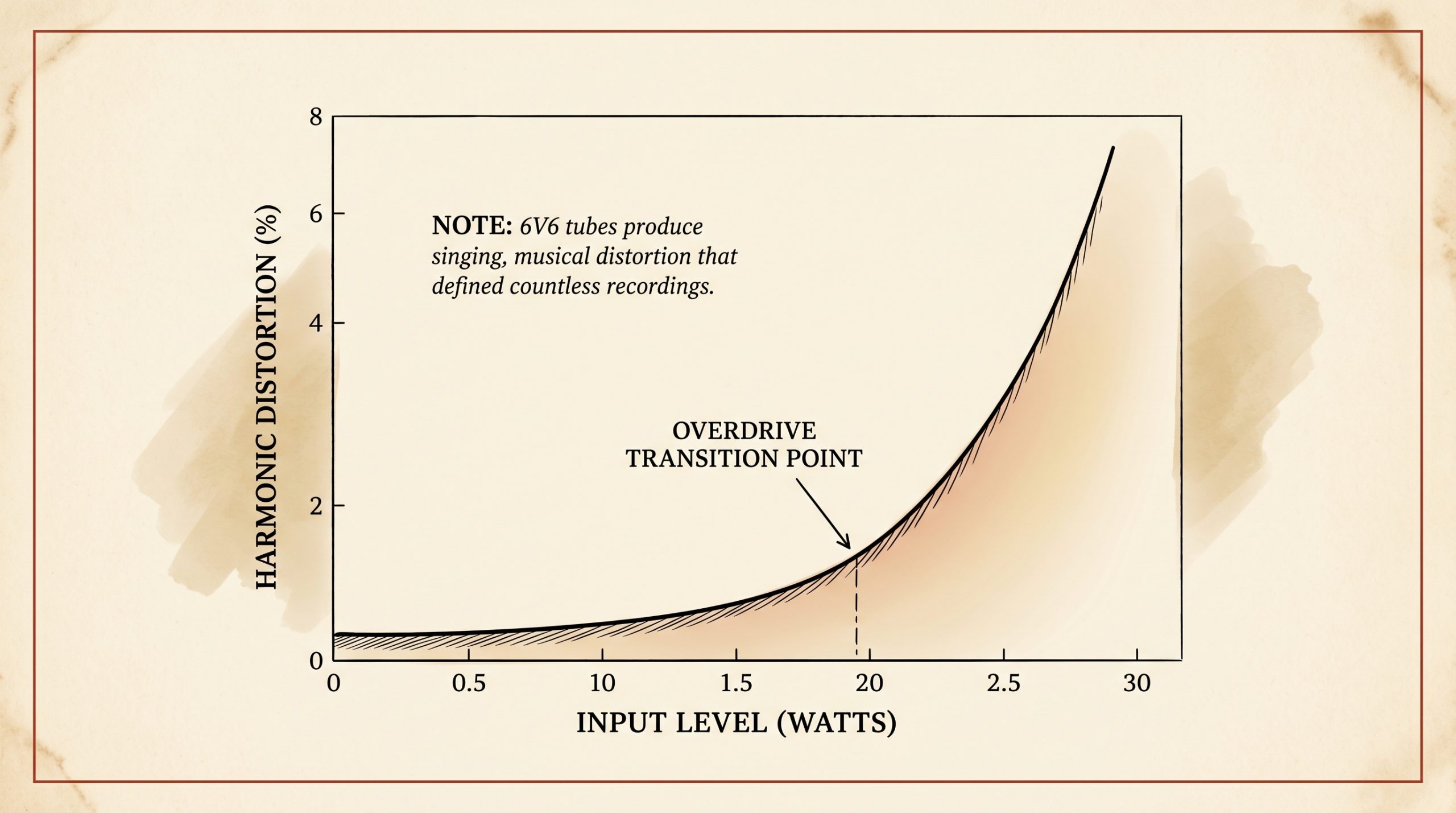
The standard cap job includes: filter capacitors in the power supply (typically four 20µF or 22µF caps at 450V to 500V), cathode bypass capacitors (10µF to 25µF at 25V to 50V), and coupling capacitors between gain stages if any show signs of leakage. The choke and reverb tank cables are typically left alone unless they show specific failure symptoms. Quality replacement caps cost $40 to $80 in parts; labor accounts for the bulk of the bill.
Tube replacement and biasing
The Deluxe Reverb uses fixed-bias 6V6 output tubes that need proper bias adjustment when tubes are replaced. The bias adjustment pot is accessible from the back of the chassis. A matched pair of quality 6V6 tubes (Tung-Sol, JJ, Sovtek, or Electro-Harmonix in 2026) plus bias adjustment runs $90 to $180 from a vintage tech. Skipping the bias adjustment risks damage to the tubes and output transformer; never just swap power tubes without checking bias.
Bias measurement basics. The Deluxe Reverb’s 6V6 power tubes should be biased at approximately 70% of their maximum plate dissipation. For a typical 6V6GT rated at 14 watts plate dissipation, this works out to roughly 25 to 32 milliamps of plate current per tube at typical Deluxe Reverb plate voltages (380V to 420V). The bias adjustment pot is rotated until the desired plate current is reached. Bias measurement requires either an in-tube bias probe (a specialty bias measurement tool that plugs into the tube socket between the tube and the chassis) or removal of the chassis and direct measurement at the output tube cathode resistor. Both methods are within reach of an experienced amateur but most owners reasonably prefer to have a technician handle this.
Preamp tubes can be swapped without re-biasing. Different brands have audible sonic differences; experimentation is encouraged. The traditional recommendation: NOS RCA, Mullard, or Telefunken in V1 and V2 for the most vintage tone; modern Tung-Sol or JJ ECC83S for reliability and affordability. Expect to pay $60 to $200 each for quality NOS 12AX7 or 7025 preamp tubes from a reputable vintage tube dealer in 2026, versus $15 to $30 for current production tubes.
Blackface conversion
For silverface Deluxe Reverbs from 1972 onward with CBS-era circuit modifications, a “blackface conversion” reverts the bias resistor values, tone stack components, and negative feedback loop to AB763 specifications. This is reversible work, typically $400 to $600 for parts and labor in 2026. Documented blackface conversions add value on the secondary market; many silverface Deluxe Reverbs have been blackfaced over the decades, and a quality conversion done by a known tech is considered a positive feature, not a modification penalty.
The conversion does not touch the cosmetics; the amp remains physically silverface with the silver control panel and silver-and-blue grille. Only the internal circuit values change. Sonically, a blackface-converted silverface amp is indistinguishable from a same-era blackface unit in band-level use.
Speaker replacement
Original 12-inch Jensen C12Q or Oxford 12K5 speakers in playable condition are worth keeping. A reconed original (frame and magnet original, cone and surround replaced by a qualified speaker tech such as Weber Speakers or Ted Weber-trained shops) is acceptable and preserves most of the original sonic character. Replacement speakers (Weber 12F125A, Eminence Maverick or Cannabis Rex, Celestion Vintage 30, modern Jensen reissues, Jupiter Ceramic, Warehouse G12C) alter tone and reduce vintage value. If you want a different sound, keep the original speaker for the amp’s lifetime and store it separately; the amp’s vintage value is bound up in the original speaker.
Popular speaker upgrades by player goal: For more headroom and bass response, a Weber 12A150 or modern Jensen C12N. For more midrange and overdrive character, a Celestion G12H Anniversary or Vintage 30. For more efficiency at low volumes, a Warehouse G12C or Eminence Maverick. All of these are tonal upgrades from a player’s perspective but vintage-value downgrades from a collector’s perspective.
Common circuit modifications
Some modifications are reversible and well-documented; others are not. Documented and respected:
- Bright-cap removal on Normal channel: removes the bright capacitor on the Normal channel volume control, producing a warmer voicing better suited for humbucker-equipped guitars. The ’64 Custom incorporates this mod from the factory.
- Reverb tank cable upgrade: replacing the original cheap RCA cables with braided shielded cable reduces hum and improves reverb clarity. Common, reversible, low-cost.
- Pull V1 mod: physically removing the V1 tube routes more preamp gain to the Vibrato channel. Reversible by reinserting V1. Some players prefer this for the slightly hotter Vibrato channel signal.
- Three-prong power cord: replacing the original two-prong cord with a modern three-prong grounded cord and removing the “death cap” (the small ceramic capacitor from one side of the AC input to chassis ground). This is essentially a safety upgrade and adds zero modification stigma; the original power cord is rarely retained on a working amp.
Not recommended without expertise: master volume installations, fixed-bias to cathode-bias conversion, output transformer changes, and any modification that drills the chassis. These reduce vintage value substantially even when reversible.
Recommended tone settings
The Deluxe Reverb is famously responsive to small adjustments, particularly around the volume knob’s sweet spot. These starting points reflect player consensus rather than absolute rules.
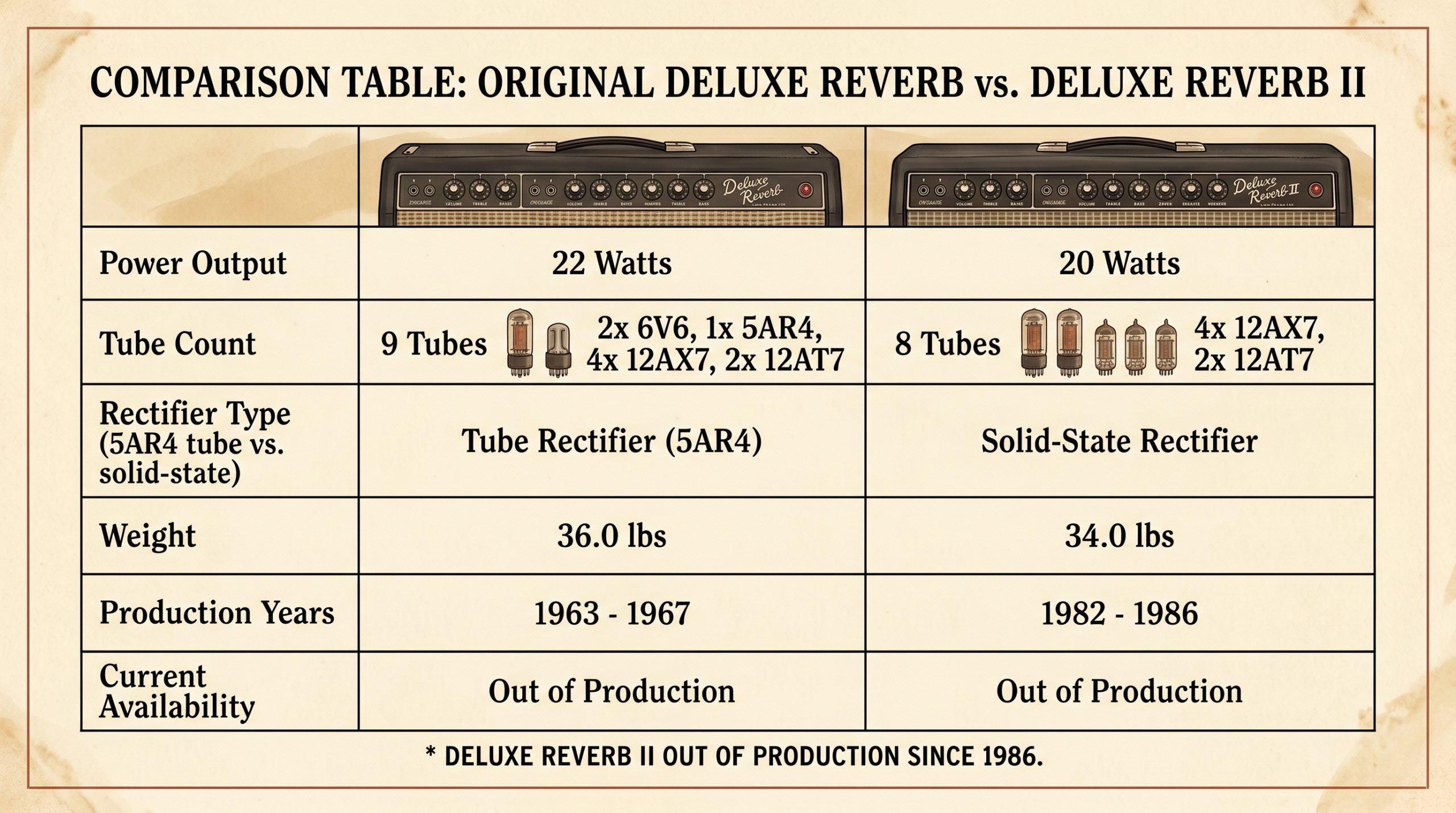
| Use case | Channel | Volume | Treble | Bass | Reverb | Notes |
|---|---|---|---|---|---|---|
| Telecaster, country/pop clean | Normal | 4 to 5 | 4 | 5 | n/a | Add pedal-based reverb if needed |
| Stratocaster, fingerpicking | Vibrato | 3 to 4 | 3 | 5 | 3 to 4 | Bridge pickup with tone rolled to 8 |
| Humbuckers, jazz comp | Vibrato | 3 to 4 | 3 | 6 | 2 to 3 | Neck pickup, tone at 7 |
| Pedal platform (TS / Klon) | Normal | 5 to 6 | 4 | 5 | n/a | Pedals do the dirty work |
| Stratocaster blues, breakup | Vibrato | 6 to 7 | 4 | 6 | 3 | The sweet spot for AB763 character |
| Recording studio direct sound | Vibrato | 5 | 4 | 5 | 2 to 3 | Mic with SM57 + R121 ribbon blend |
The Deluxe Reverb is most expressive between 4 and 7 on the volume knob; below 3 the amp feels stiff and unresponsive, above 7 it begins serious power-tube breakup that not all situations call for. Many players find the natural sweet spot around volume 5 with the treble slightly cut from noon. The Vibrato channel will always be slightly hotter than the Normal channel due to the extra gain stage; experienced players use the Vibrato channel as a built-in volume boost option.
Sources and methodology
Heritage credit
The dating methodology, original speaker references, transformer date code framework, and circuit identification details in this guide derive from the foundational 1997 to 2000 research series by Greg Gagliano, Devin Riebe, and Greg Huntington, published in 20th Century Guitar Magazine. We have rewritten the explanatory material in our own words and added information and 2024 to 2026 market data that has accumulated since, but the factual core, particularly the chassis serial number ranges, transformer EIA code interpretation, and the documentation of the OA / OB date stamp anomaly, is theirs.
Additional sources for this guide:
- Fender Musical Instruments Corporation, official product pages for the ’65 Deluxe Reverb, ’64 Custom Deluxe Reverb, ’68 Custom Deluxe Reverb, Tone Master Deluxe Reverb, and ’65 Deluxe Reverb Head (verified at fender.com on 16 May 2026)
- Fender Owner’s Manual for ’64 Custom Deluxe Reverb (model 8180000000) for canonical spec confirmation
- Wikipedia, “Fender Deluxe Reverb” article, for production timeline, tube complement specification, and Deluxe Reverb II solid-state rectifier confirmation (last verified 2 May 2026)
- John Teagle and John Sprung, Fender Amps: The First Fifty Years (Hal Leonard, 1995) for production history, factory specifications, and the 1963 to 1981 production timeline
- Premier Guitar, January 2014 announcement of the ’65 Deluxe Reverb Head’s addition to the permanent Vintage Reissue lineup, and January 2025 NAMM coverage
- Vintage Guitar Magazine, 2016 product review of the ’68 Custom Deluxe Reverb (Schumacher transformer specification, modified Bassman tone stack documentation)
- Mojotone Fender field guide and Ampwares amp database for Rivera-era Deluxe Reverb II specifications, production dates, and silverface circuit references
- FenderGuru.com technical reference for AB763 circuit topology, tube position functions, original speaker historical record, and silverface-to-blackface conversion methodology
- Rob Robinette’s ’65 Deluxe Reverb RI service manual and schematic references for current production circuit details
- Jensen Loudspeakers (jensentone.com) for C12Q, C12N, and C-12K specifications and historical context
- The Gear Page (TGP) and Telecaster Discussion Page Reissue (TDPRI) vintage amp restoration discussion threads for documented blackface conversion details and original speaker historical clarifications
- Reverb.com completed-sales data, 2024 to May 2026, used to derive the value ranges in this guide
- Guitar Player magazine, March 2025 interview with Mike Campbell, for documentation of the Mike Campbell / Tom Petty / blackface Deluxe Reverb / 1950 Fender Broadcaster studio session history on “American Girl”
- Gearnews.com August 2025 documentation of Eric Johnson’s Fender Deluxe Reverb / Twin Reverb / Marshall Plexi stereo amp setup
Methodology note. Specifications for current Fender production were verified against Fender’s published owner’s manuals and current product pages at fender.com. Where Fender’s marketing copy and Fender’s own spec sheets disagree (notably the ’64 Custom tube count, where a number of dealer listings carry an outdated 3× 12AX7 specification despite Fender’s current product page showing 4× 12AX7), we followed the current Fender product page and Sweetwater’s matching specification. The ’65 Deluxe Reverb Head introduction date was verified against Wikipedia and Premier Guitar’s January 2014 announcement article (limited Factory Special Run summer 2013, added to permanent Vintage Reissue lineup January 2014); some online sources incorrectly cite NAMM 2025 as the head’s introduction. The Deluxe Reverb II rectifier specification was verified against Wikipedia and confirms solid-state rectification, not the 5AR4 tube rectifier of the AB763 amps. Original blackface speaker specification (Jensen C12Q rather than C12N) was verified against Wikipedia, FenderGuru.com, The Gear Page consensus, TDPRI consensus, and the Cream City Music 1966 vintage listing photographic documentation. Vintage market values reflect Reverb.com completed-sale data from 2024 through May 2026 in US dollars; non-US markets typically run 15% to 30% higher due to scarcity and import overhead. All weights are Fender-published or manufacturer-published figures; actual unit weights can vary by a pound or two depending on cabinet wood density and component lot variation.
Related guides
- Fender Tube Amp Serial Number Guide: complete dating methodology across all Fender amp models, including year-letter codes, transformer EIA references, and pre-CBS vs CBS identification
- Fender Amp Dating Cheatsheet: condensed one-page reference for quick verification
- Fender Princeton Reverb Guide: the smaller, lower-watt blackface sibling, with the same AB763 sonic DNA in a more bedroom-friendly package
- Fender Twin Reverb Guide: the high-headroom Fender for loud band situations and pristine clean platform use
- Fender Vibro Champ Guide: bedroom-volume tube amp with tremolo (no reverb), the entry point to vintage Fender ownership
- Fender Super Champ X2 Guide: the modern lower-watt platform with modeling and tube power
- About TCguitar: our editorial approach, heritage credits, and methodology standards
→ Open the complete Fender amp dating guide
Or check the Dating Cheatsheet for the one-page version. For other Deluxe Reverb era confirmations or model-specific spec verification, contact the TCguitar Editorial Team.
Frequently asked questions
How much does a Fender Deluxe Reverb weigh?
The tube '65 Deluxe Reverb Reissue weighs approximately 42 pounds (19.0 kilograms). Original vintage Deluxe Reverbs from the 1960s and 1970s weigh between 42 and 46 pounds depending on cabinet wood density and transformer construction. The '64 Custom is lighter at 38.2 pounds (17.3 kilograms) due to its solid pine cabinet versus birch plywood. The Tone Master Deluxe Reverb weighs 23 pounds (10.4 kilograms), roughly half the tube version, due to no transformers, solid-state amplification, and a neodymium-magnet speaker. The Deluxe Reverb II is the heaviest at approximately 49 pounds due to additional transformers and circuit components.
How many watts is a Fender Deluxe Reverb?
22 watts for vintage tube Deluxe Reverbs (blackface and silverface) and the current '65 Reissue, '68 Custom, and '65 Reverb Head. The '64 Custom is 20 watts (Fender's spec sheet, PR 4826), reflecting its modified AB763 circuit. The Tone Master Deluxe Reverb has a 100-watt digital power amp configured to deliver approximately 22 watts of modeled tube output, with adjustable power scaling down to 0.2 watts for home use via a six-way rear-panel attenuator (22, 12, 5, 1, 0.5, 0.2 W). The Rivera-era Deluxe Reverb II (1982 to 1986) was 20 watts, not 22.
How many tubes does a Deluxe Reverb have?
Nine tubes total in the vintage blackface, vintage silverface, '65 Reissue, '64 Custom, '68 Custom, and '65 Reverb Head. The complement: four preamp tubes in the 12AX7 family (in vintage amps often factory-stamped as 7025, which is a low-noise selected 12AX7), two 12AT7 tubes (one as reverb driver, one as phase inverter), two 6V6 power tubes, and one 5AR4 rectifier (sometimes marked GZ34). Older documentation occasionally describes the tube complement as "three 7025 plus one 12AX7" instead of "four 12AX7-family," which produces the same total of four. The Tone Master has zero tubes (digital). The Rivera-era Deluxe Reverb II had three 7025 preamp tubes, two 6V6 power tubes, and a solid-state rectifier instead of a tube rectifier.
Is the Deluxe Reverb good for home use?
The tube Deluxe Reverb is loud. 22 watts of 6V6 tube power through a 12-inch speaker fills a small room quickly, and the amp's character is most expressive at moderate to high volume settings. For dedicated home use in apartments or small home studios, the Tone Master Deluxe Reverb with its six-way power attenuator (down to 0.2 watts) is a substantially better fit than the tube version. For home use with occasional gigging, a tube Deluxe Reverb is usable at lower volume settings but won't deliver the full blackface character at quiet levels. The breakup, compression, and harmonic richness that define the Deluxe Reverb voice depend on the power amp working hard.
Is a Deluxe Reverb loud enough to gig?
Yes. The Deluxe Reverb is the most common gigging amp in the Fender lineup for good reason. 22 watts of 6V6 tube power through a 12-inch speaker is enough for small to medium clubs (up to about 200 people) without PA mic support, and with mic support it covers any venue size up to arena scale. For consistently loud band situations (heavy rock, metal, very loud drummers), many players prefer the Twin Reverb at 85 watts, but the Deluxe Reverb is the right answer for the majority of working musicians playing club gigs.
What's the difference between the '64 Custom and the '65 Reissue?
The '64 Custom is hand-wired with solid pine cabinet, 20 watts, channels labeled Normal and Bright with reverb and tremolo on both channels, and Fender Vintage Blue tone capacitors recreating the original Astron Blue caps. It costs roughly $1,000 more than the standard '65 Reissue. The '65 Reissue is PCB-based with birch plywood cabinet, 22 watts, channels labeled Normal and Vibrato with effects only on the Vibrato channel (faithful to the 1965 production), and standard ceramic-disc capacitors. Sonically the '64 Custom is closer to a 1964 production unit with modifications; the '65 Reissue is closer to a 1965 unit as it shipped. Both target the late-blackface AB763 voice. For most players the '65 Reissue is more than enough; the '64 Custom is for players who specifically want hand-wired construction and are willing to pay for it.
What's the difference between the '65 Reissue and the '68 Custom?
Cosmetically: the '65 has black control panel and silver-and-black grille (blackface), the '68 has silver-and-turquoise control panel with aluminum drip-edge trim (silverface). Sonically: the '65 is voiced for clean Fender chime and serves as a pedal platform; the '68 has a modified Custom channel with a Bassman tone stack and reduced negative feedback for earlier breakup, plus a Celestion G12V-70 speaker for a punchier, more British-leaning voicing. The '65 is for country, pop, jazz, fingerstyle, and pedal-heavy rigs. The '68 is for blues, indie rock, and overdrive-leaning players who want the amp itself to do more of the dirty work.
Is the Tone Master Deluxe Reverb as good as the tube version?
For most use cases, yes. For some use cases, no. The Tone Master sounds extremely close to the tube version on recordings and through PAs, weighs about half as much, includes useful low-power modes for home use (down to 0.2 W via the six-way attenuator), has a balanced XLR direct output with cabinet simulation built in for silent recording, and requires no tube maintenance. The tube version retains the dynamic response, harmonic complexity, and subtle feel that some players prefer and that the most discerning listeners can identify in side-by-side comparison. For working players who need a reliable, lightweight, lower-maintenance amp that sounds like a Deluxe Reverb at gig volume, the Tone Master is increasingly the practical choice. For recording purists, players who specifically want the tube experience, or players concerned about long-term resale value, the tube version remains the better option.
How do I date a Fender Deluxe Reverb?
For blackface and silverface units, cross-reference four data points: the tube chart date code (a sticker inside the cabinet with a two-letter code where the first letter is the year and the second letter is the month), the transformer date codes (stamped on the bell ends of both power and output transformers, in the format EIA 606-Y-WW where Y is the year and WW is the week), the speaker date code (on the speaker frame, format varies by manufacturer), and the chassis serial number range. For blackface Deluxe Reverbs: A00100 to A00300 = 1963, A00300 to A03900 = 1964, A03900 to A13000 = 1965, A13000 to A19000 = 1966, A19000 to A24000 = 1967. For modern reissues, the QA inspection sticker on the rear panel carries a letter-prefix date code that decodes directly to a year. The complete methodology, year-letter chart, and EIA manufacturer code reference is in our Fender tube amp serial number guide.
What original speakers came in a blackface Deluxe Reverb?
Most commonly the 12-inch Jensen C12Q (early production through about 1965) or the Oxford 12K5 (later blackface production from 1966 through 1967). Both are 12-inch ceramic-magnet speakers with similar physical specifications but different sonic characters. Jensen C12Q speakers carry a "220-" EIA prefix; Oxford 12K5 speakers carry a "465-" EIA prefix. Speaker date codes should fall within a few months of the chassis production date for the amp to be considered fully original. Replacement speakers are extremely common and reduce vintage value substantially, particularly in pre-CBS examples. Note that the larger-magnet Jensen C12N was not factory-installed in Deluxe Reverbs; it appears only as a later replacement.
Was the Jensen C12N original in blackface Deluxe Reverbs?
No. The Jensen C12N (28-ounce magnet, 1.5-inch voice coil, ~50W rating) was used in blackface Twin Reverbs, Pro Reverbs, Bandmasters, and Bassmans, but not in Deluxe Reverbs. Fender installed the smaller-magnet Jensen C12Q in Deluxe Reverbs through 1965, then transitioned to the Oxford 12K5 for the 1966 and 1967 blackface production. The widespread belief that C12Ns came stock in Deluxe Reverbs is a community misconception, repeated across many forum posts and informal documentation. FenderGuru.com, the Wikipedia article on the Fender Deluxe Reverb, and consensus on The Gear Page and TDPRI all confirm the C12Q / Oxford 12K5 original specification. If you find a C12N in a vintage Deluxe Reverb, it is a replacement (typically a tonal upgrade installed by a previous owner seeking more headroom), not factory-original.
What is the AB763 circuit?
AB763 is the Fender circuit designation for the blackface-era Deluxe Reverb, Vibrolux Reverb, Pro Reverb, Super Reverb, Twin Reverb, and Vibroverb. It was introduced in 1964 as a refinement of the earlier AA763 (which had a 22k log-tail phase inverter resistor versus AB763's 27k). The circuit is the reference voice for Fender clean tone: high clean headroom at moderate volumes, sweet harmonic breakup when pushed, world-class tube reverb, and tube tremolo (which Fender called "vibrato" on this circuit family, though it's technically tremolo, an amplitude modulation rather than pitch modulation). The AB763 designation appears on the tube chart sticker inside the cabinet of all original blackface amps and most early silverface amps through 1970. The '65 Reissue, '64 Custom, '68 Custom, and '65 Reverb Head all derive from AB763, though the '64 Custom and '68 Custom have factory modifications to the original circuit.
Why did Fender discontinue the Deluxe Reverb in 1982?
The Deluxe Reverb was discontinued as part of a larger CBS-era product consolidation and the introduction of the Paul Rivera-designed amp lineup, which included the Deluxe Reverb II as the intended replacement. The Rivera-era amps were a strategic response to the boutique amp market (primarily Mesa/Boogie) and aimed to offer modern features like channel switching, master volume, and high-gain operation that the AB763 design did not have. Sales of the Rivera amps were modest compared to the classic Fender lineup, and the entire Rivera-era line was discontinued by 1986 when Fender was sold by CBS to a group of employees led by Bill Schultz. The Deluxe Reverb returned in 1993 as the '65 Reissue, faithful to the original blackface specification rather than continuing the Rivera-era design.
What's the best year for a vintage Deluxe Reverb?
From a collector standpoint: 1964 to early 1965 (pre-CBS, "Fender Electric Instrument Co." faceplate) commands the highest premiums. From a player standpoint: 1965 to 1966 (early CBS blackface with AB763 circuit) is often considered the best balance of consistent quality control and reasonable pricing. Tone-wise, there is no meaningful difference between late pre-CBS and early CBS examples; the same workers built the same circuits in the same factory. From a value-per-dollar standpoint: 1968 to 1970 silverface examples with the AB763 circuit still intact are the strongest buy in 2026, offering essentially blackface tone at $1,400 to $2,200 versus $2,500 to $5,000 for equivalent blackface units.
Is a reissue Deluxe Reverb worth it versus a vintage one?
For most players: yes. The '65 Reissue captures 85% to 90% of the vintage blackface voice at 30% of the price, with zero maintenance overhead, reliable reverb tank, modern grounded power cord, and warranty coverage. A vintage Deluxe Reverb sounds slightly richer, slightly more harmonically complex, and slightly more responsive to touch, but requires cap jobs every few decades, periodic tube replacement, and careful handling. The vintage premium is real but most pronounced in side-by-side A/B comparison; in a band mix the difference largely disappears. For collectors and players who specifically want the vintage experience: the original is the original. For working players who want to spend money on guitars instead of amp maintenance: the reissue is more than enough.
Does the Deluxe Reverb take pedals well?
Exceptionally well. The Deluxe Reverb is often described as the canonical pedal platform amp, particularly the '65 Reissue, which has high clean headroom, neutral voicing, and the right amount of compression to make overdrive and fuzz pedals sound natural rather than clipped. The classic pedalboard built around a Deluxe Reverb is: overdrive (Tube Screamer, Klon, or Timmy) → optional fuzz → optional modulation (chorus, phaser, vibe) → into the Normal channel. The '68 Custom takes pedals well also, but its Celestion G12V-70 speaker shifts the response in a more focused, less open direction than the Jensen on the '65 Reissue. The '64 Custom's earlier breakup at lower volumes makes it less of a pristine pedal platform and more of a "use the amp's own breakup" platform.
Does the Deluxe Reverb have an effects loop?
No. None of the tube Deluxe Reverbs (vintage, '65 Reissue, '64 Custom, '68 Custom, '65 Reverb Head) include a factory effects loop. The Tone Master does not have a traditional effects loop either, but it has a balanced XLR direct output with IR cabinet simulation that serves a similar purpose for recording and direct-to-PA workflows. Players who want an effects loop on a tube Deluxe Reverb have two options: either run all effects in front of the amp (which is how most Deluxe Reverb players have run their pedals for sixty years), or have a tech install an aftermarket effects loop. Aftermarket effects loop installations typically cost $200 to $400 and require chassis modification, which reduces vintage value on collectible amps. For modulation and time-based effects that benefit from being post-distortion (delay, reverb, chorus running cleanly), the front-of-amp routing works fine on a Deluxe Reverb because the amp itself adds modest harmonic content rather than heavy preamp distortion.
What footswitch does a Deluxe Reverb use?
All current production tube Deluxe Reverbs (the '65 Reissue, '64 Custom, '68 Custom, '65 Reverb Head) and the Tone Master Deluxe Reverb use the Fender two-button vintage-style footswitch with two RCA-style jacks (one for reverb on/off, one for tremolo on/off). Fender part number 0994058000 is the standard 2-button vintage footswitch included with current amps; the '64 Custom ships with part 7711022000 specifically. Vintage blackface and silverface amps used a single RCA-jack footswitch (just on/off for tremolo) in early production and a two-button version later. Note that the tremolo effect on all Deluxe Reverb variants requires the footswitch to be plugged in for the circuit to function; the tremolo will not work without the footswitch connected even if you don't intend to switch it during use.
Can I use the Deluxe Reverb with an external speaker cabinet?
Yes. The vintage Deluxe Reverb, the '65 Reissue, the '64 Custom, and the '68 Custom all have an external speaker jack on the back panel wired in parallel with the internal speaker. The combined impedance must remain at 8 ohms minimum (using two 16-ohm cabinets in parallel, or one 16-ohm internal + one 16-ohm external for an 8-ohm total). Running impedance below 8 ohms risks damage to the output transformer. The Tone Master Deluxe Reverb does not have an external speaker output; it has a balanced XLR direct output instead. The '65 Deluxe Reverb Head is designed specifically for use with external speaker cabinets, typically a single 12-inch cabinet rated at 8 ohms.
What's the cleanest, warmest tone setting on a Deluxe Reverb?
For a Telecaster or Stratocaster on the Normal channel: Volume around 4 to 5, Treble around 4, Bass around 5. For humbucker-equipped guitars on the Normal channel (or any guitar on the Vibrato channel): Volume around 3 to 4, Treble around 3 to 4, Bass around 6. For pedal platform use: Volume around 5 to 6, Treble at 4, Bass at 5, with pedals doing the dirty work. The Deluxe Reverb is most expressive between 4 and 7 on the volume knob; below 3 the amp feels stiff, above 7 it begins serious breakup. The "sweet spot" for most players is volume around 5 with the treble slightly cut from noon.
How do I know if my silverface Deluxe Reverb has the AB763 circuit or the later CBS modifications?
Two ways. Check the tube chart sticker inside the cabinet: if it explicitly says "AB763," the circuit is the early silverface AB763 (good news, this is essentially a blackface amp). If it says "AC568," "AA1069," or similar, the circuit has CBS-era modifications that can be reverted via blackface conversion. The second way: visual inspection of the printed circuit values inside the chassis. AB763 silverface amps have specific component values (1.5k cathode resistor at V4, specific bias resistor values, etc.) that a vintage tech can identify in five minutes. Production-year shorthand: 1968 to 1971 = mostly AB763, 1972 to 1981 = CBS-era modifications. A blackface conversion on a 1972+ silverface is a positive value-add, not a modification penalty.
What pedals work best with a Deluxe Reverb?
The Deluxe Reverb pairs well with virtually any pedal type but particularly shines with: moderate-gain overdrives (Tube Screamer TS9 or TS808, Klon Centaur and clones, Timmy, Boss BD-2 Blues Driver, Fulltone OCD), which extend the amp's natural breakup without smearing it; analog and tape-style delays (MXR Carbon Copy, Strymon El Capistan, Boss DM-2W), which complement the amp's tube spring reverb rather than competing with it; compressors (Origin Effects Cali76, Keeley Compressor Plus, Walrus Audio Deep Six), which level out single-coil dynamics without losing the Deluxe's responsiveness; and vintage-style fuzz (silicon Fuzz Face clones, Tone Bender clones, Big Muff variants), which work especially well into the high-headroom Normal channel. The amp does not pair as well with high-gain modern distortion pedals (Boss MT-2, Pro Co RAT at maximum settings, ProCo Turbo RAT), which can overwhelm the amp's modest power section. The pedals to avoid: dual-amp simulation pedals that include their own cabinet IR, which conflict with the Deluxe's natural speaker voicing.
How long do the tubes last in a Deluxe Reverb?
Power tubes (6V6) typically last 2,000 to 5,000 hours of playing time, equivalent to roughly 3 to 7 years for a working musician playing 8 to 12 hours per week. Preamp tubes (12AX7 and 12AT7) last substantially longer, often 10,000+ hours or 15+ years. Signs that power tubes need replacement: progressive loss of volume and presence even with the volume knob unchanged, increased hiss and noise, glassy or microphonic feedback, intermittent crackling, or visible signs of distress (red plating on the tube plates, discolored or cloudy glass, broken internal structure). Signs that preamp tubes need replacement: persistent hum or microphonic noise that doesn't go away with replacement of cabling and pedals, intermittent dropouts on one channel, or shorting noises during playing. Always replace 6V6 power tubes as a matched pair (both at once, matched plate currents) and have a tech check the bias after replacement.