The condensed quick-reference for dating a Fender tube amp. Print this, screenshot it on your phone, or bookmark it for the moment when you are standing next to an amp at a yard sale, in a store, or at home and need answers in 30 seconds. For the full methodology with circuit transitions, factory anomalies, and 2026 value ranges, the complete Fender tube amp serial number guide is the long-form reference. This page is the cheatsheet.
30-second amp dating decision tree
Step 1. Is there a black-and-silver QA inspection sticker on the rear panel with a two-letter code at the bottom? If yes, the amp is 1990 or later. Decode the letters using the modern table below. Step 2. If no QA sticker, look for the tube chart inside the cabinet. A two-letter date stamp on the chart decodes via the vintage table below. Step 3. If both stickers are missing or unreadable, you need the transformer code (606-YWW format), speaker code (220-YWW for Jensen, 465-YWW for Oxford, 73-YWW for JBL), and the cosmetic era. Cross-reference all three for a confident date.
Step 1. Identify the cosmetic era
| Era | Years | Cosmetic signature |
|---|---|---|
| Woodie | 1946-1948 | Bare wooden cabinet, no Tolex, simple grille |
| Tweed | 1948-1960 | Yellow lacquered tweed fabric covering, leather handle, woven grille |
| Brown / Blonde | 1960-1963 | Brown or off-white Tolex covering, oxblood or wheat grille |
| Blackface | 1963-1967 | Black Tolex, black control panel with white silkscreen, silver-and-black grille, cream chicken-head knobs |
| Silverface (drip edge) | 1968-1969 | Silver-and-blue control panel, silver-with-blue-sparkle grille cloth, aluminum drip-edge grille trim, vertical black lines on panel |
| Silverface (standard) | 1970-1976 | Drip edge removed, silver-and-blue panel continued, often with master volume from 1972 onward |
| Late silverface | 1977-1981 | Master volume standard, pull-boost circuits on some units, ultra-linear output transformer on some Twins from 1976 |
| Transition / Rivera | 1982-1985 | “II” series amps (Deluxe Reverb II, Princeton Reverb II, Twin Reverb II) with channel switching and effects loops, designed by Paul Rivera |
| Red Knob / Schultz era | 1986-1992 | Red rotary knobs, post-CBS Schultz era recovery production |
| Modern | 1990-present | QA inspection sticker on rear panel with two-letter date code, various reissue and current-production lines |
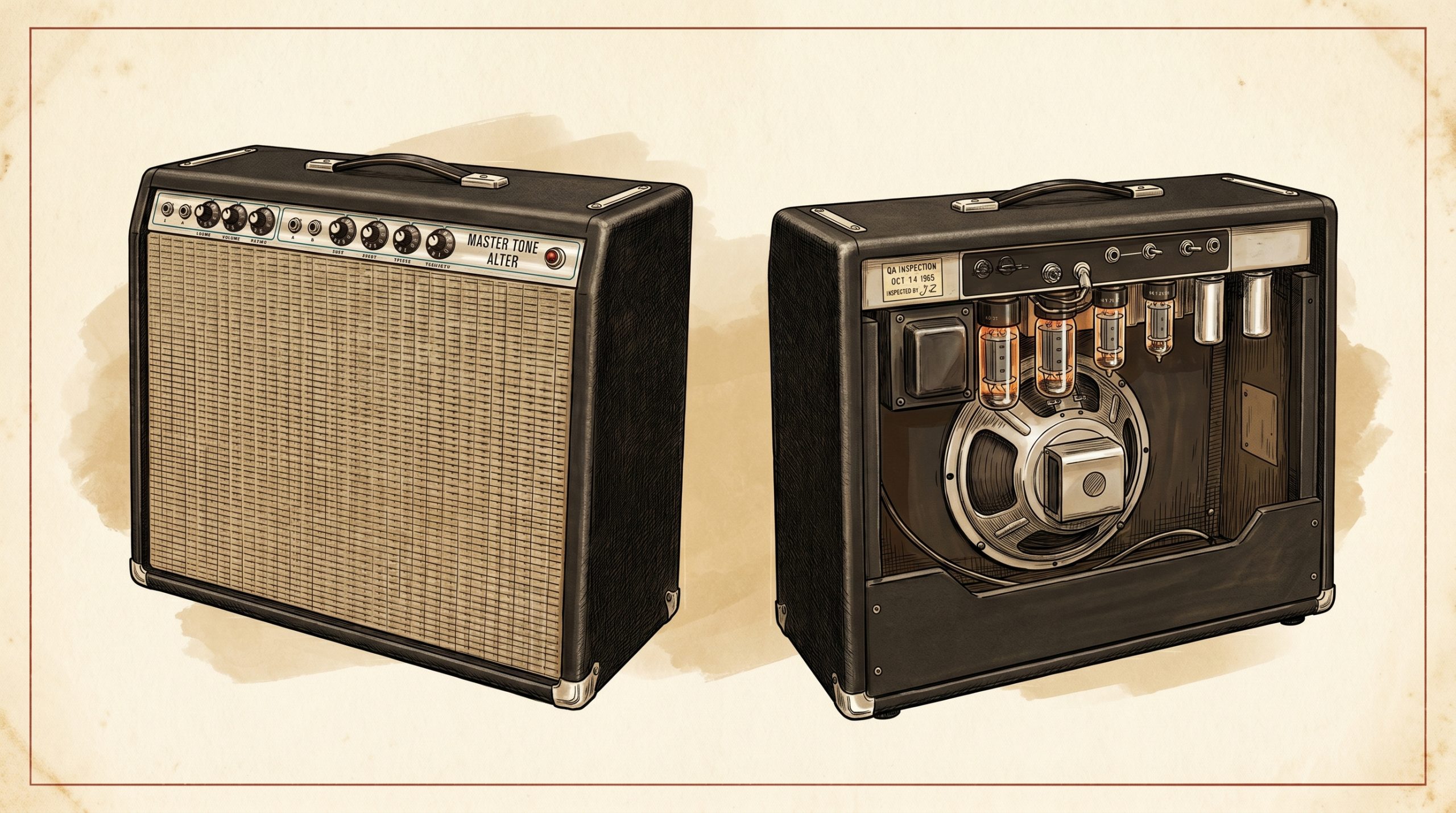
The cosmetic era determines which decoding table applies. Modern amps (1990+) use the modern QA sticker letter system. Pre-1990 amps use the vintage tube chart system. The systems share letter codes but the year letters refer to different decades, so cosmetic identification first is essential.
Step 2A. Modern amp letter prefix decoder (1990 onward)
For amps built since 1990, the two-letter date code at the bottom of the QA inspection sticker decodes directly: first letter = year (A=1990 onward), second letter = month (A=January through L=December). The sticker is on the rear panel or chassis.
| Year letter | Year | Year letter | Year | Year letter | Year |
|---|---|---|---|---|---|
| A | 1990 | L | 2001 | W | 2012 |
| B | 1991 | M | 2002 | X | 2013 |
| C | 1992 | N | 2003 | Y | 2014 |
| D | 1993 | O | 2004 | Z | 2015 |
| E | 1994 | P | 2005 | AA | 2016 |
| F | 1995 | Q | 2006 | BB | 2017 |
| G | 1996 | R | 2007 | CC | 2018 |
| H | 1997 | S | 2008 | DD | 2019 |
| I | 1998 | T | 2009 | EE | 2020 |
| J | 1999 | U | 2010 | FF | 2021 |
| K | 2000 | V | 2011 | continuing | 2022 onward |
Month letters (same for vintage and modern): A = January, B = February, C = March, D = April, E = May, F = June, G = July, H = August, I = September, J = October, K = November, L = December.
A QA sticker stamped “CE” decodes as year C = 1992 and month E = May. A sticker stamped “PJ” decodes as P = 2005 and J = October. A sticker stamped “EEH” or “EEA” indicates a two-letter year prefix (2020) and month letter (H = August or A = January, respectively).
Modern serial number prefix patterns
Serial number letter prefixes indicate production line or factory, not year. Common prefixes: CR (US-built tube amps including Hot Rod and Pro Tube series), LO (early 2000s production), M- (Mexican production / Ensenada), B- and ICE- / ICF- (Asian production, often Indonesia or China). For exact dates, always use the QA sticker letter code, not the serial prefix.
Step 2B. Vintage tube chart letter decoder (pre-1990)
The tube chart is a small paper sticker glued inside the cabinet (back panel above chassis, or on the bottom panel). A two-letter stamp on the chart decodes: first letter = year (A=1951, B=1952, continuing through S=1969), second letter = month (A=January through L=December). The system was used most consistently from 1953 through 1969, after which the date stamp gradually disappeared.
| Year letter | Year | Year letter | Year |
|---|---|---|---|
| A | 1951 | K | 1961 |
| B | 1952 | L | 1962 |
| C | 1953 | M | 1963 |
| D | 1954 | N | 1964 |
| E | 1955 | O | 1965 |
| F | 1956 | P | 1966 |
| G | 1957 | Q | 1967 |
| H | 1958 | R | 1968 |
| I | 1959 | S | 1969 |
| J | 1960 | none | System effectively ends |
A tube chart stamped “OL” decodes as O = 1965 and L = December. A chart stamped “NA” decodes as N = 1964 and A = January. A chart stamped “QH” decodes as Q = 1967 and H = August.
The OA / OB green-ink factory error (January-February 1966)
If your tube chart shows “OA” or “OB” in green ink (not black), the amp is from January or February 1966, not 1965. This is a documented factory error where the year letter from 1965 (O) was used into early 1966 before being corrected to P. The green ink is what alerted the factory to the mistake. After February 1966, production switched to “PA,” “PB,” and so on through the year in standard black ink.
Step 3. EIA manufacturer codes (transformer + speaker)
EIA codes are three-digit manufacturer prefixes followed by a date code. Format is mfr-YWW (single-digit year) or mfr-YYWW (two-digit year). Cross-reference the year digit against the amp’s cosmetic era to disambiguate decades (a “5” could be 1955, 1965, or 1975). Add about six months to the transformer date to estimate actual amp production, accounting for factory inventory time.
Transformer manufacturer codes
| Code | Manufacturer | Notes |
|---|---|---|
| 606 | Woodward-Schumacher (Schumacher) | Dominant Fender supplier, 1950s through 1980s |
| 022 | Triad | Less common, transitional periods |
| 125 | Stancor | Occasional appearance |
| 831 | Schumacher (alternate designation) | Some late-1960s output and reverb transformers |
Speaker manufacturer codes
| Code | Manufacturer | Notes |
|---|---|---|
| 220 | Jensen | Primary Fender supplier through 1965 |
| 465 | Oxford | Dominant blackface and silverface speaker supplier |
| 137 | CTS | Late silverface, also potentiometers |
| 328 | Utah | Primarily budget models |
| 67 | Eminence | 1970s onward, current production |
| 285 | Rola | Occasional appearance |
| 391 | Magnavox | Rare |
| 73 | JBL (James B. Lansing) | Premium factory-option upgrade on Twin Reverbs and Showmans |
Reading a transformer or speaker code
A transformer stamped 606-548 decodes as Schumacher (606), year-digit 5, week 48. The “5” disambiguates by amp era: blackface context = 1965, silverface context = 1975. A four-digit code like 606-6645 indicates 1966 (66), week 45 directly. A speaker stamped 220-820 decodes as Jensen, year-digit 8, week 20, which means 1958 or 1968 depending on amp era.
Common circuit designations by era
The circuit number appears on the tube chart sticker. Tweed-era circuits use the “5” prefix. Brown and blonde-era circuits use the “6G” prefix. Blackface and silverface circuits use the “AB” or “AA” prefix followed by a month-year code.
| Era | Circuit prefix | Key examples |
|---|---|---|
| Tweed | 5x and 5xx | 5E3 Deluxe, 5F1 Champ, 5F6-A Bassman, 5F8-A Twin, 5F4 Super |
| Brown / Blonde | 6G | 6G3 Deluxe, 6G12 Concert, 6G16 Vibroverb (1963), 6G2 Princeton |
| Blackface (1963-1967) | AA / AB | AB763 (Deluxe, Twin, Super, Pro, Vibrolux, Bandmaster, Vibroverb), AA1164 (Princeton Reverb), AA964 (Princeton non-reverb), AA864 / AA165 (Bassman), AA763 (transitional) |
| Early silverface (1968-1969) | AB763 retained | Same circuit as blackface under silver cosmetics. Tube charts often labeled AB763 even after Fender switched to AC568 in May 1968 (used up tube chart inventory) |
| Mid silverface (1969-1976) | AC568, AA764, AB1270 | AC568 Twin Reverb (May 1968 onward), AA764 Princeton Reverb (post-1969), AB1270 transitional Princeton Reverb. Bias and rectifier value changes from AB763. |
| Late silverface (1972-1981) | AA270, ultra-linear | AA270 master volume Twin Reverb (100W, 470V plate). Ultra-linear Twin Reverb (1976 onward, 135W, 520V plate). Various model-specific late revisions. |
| Rivera “II” era (1982-1985) | F-prefix serials | Deluxe Reverb II, Princeton Reverb II, Twin Reverb II, Champ II, Concert II. Completely different amps from the AB763 originals despite shared names. |
Pre-CBS vs post-CBS control panel script
Pre-CBS amps (before April 1965) read “Fender Electric Instrument Co.” on the control panel. Post-CBS amps read “Fender Musical Instruments” as the parent corporate name changed. The transition was not instant: “Fender Electric Instruments” panels continued through August 1965 due to inventory use-up, and Champ foil stickers continued reading “Fender Electric Instruments” into 1966.
Per Gagliano’s Part 3 research, the script transition began in April 1965 (when CBS took ownership effective from the January 1965 acquisition) and the new “Fender Musical Instruments” panels appeared from April 1965 onward. Existing panel inventory was used through August 1965, so some 1965 amps assembled in mid-year still carry the pre-CBS script. The “Fender Electric Instruments” script alone is not a reliable date marker without cross-reference to tube chart and transformer codes.
The Champ foil sticker exception
Champ and Vibro Champ amps used foil stickers on the chassis instead of panel-printed script. These foil stickers continued to read “Fender Electric Instruments” well into 1966, long after the panel-printed script on Deluxes and Twins had switched to “Fender Musical Instruments.” Cross-reference with tube chart and transformer codes for actual production date.
Model quick-reference table
Common Fender amp models with their tube count, power output, speaker complement, phase inverter topology, and rectifier type. Use this table to confirm a basic amp identification matches what the seller says it is.
| Model | Power | Speakers | Power tubes | Phase inverter | Rectifier |
|---|---|---|---|---|---|
| Champ (blackface/silverface) | ~5W | 1× 8″ | 1× 6V6 | None (single-ended) | 5Y3 tube |
| Vibro Champ | ~5W | 1× 8″ | 1× 6V6 | None (single-ended) | 5Y3 tube |
| Princeton Reverb | 12W | 1× 10″ | 2× 6V6 | Cathodyne (split-load) | 5U4GB pre-1969 / 5AR4 post-1969 |
| Deluxe Reverb | 22W | 1× 12″ | 2× 6V6 | Long-tailed pair | GZ34 / 5AR4 tube |
| Vibrolux Reverb | 40W | 2× 10″ | 2× 6L6 | Long-tailed pair | GZ34 / 5AR4 tube |
| Pro Reverb | 40W | 2× 12″ | 2× 6L6 | Long-tailed pair | GZ34 / 5AR4 tube |
| Super Reverb | 40W | 4× 10″ | 2× 6L6 | Long-tailed pair | GZ34 / 5AR4 tube |
| Twin Reverb | 85W (135W ultra-linear) | 2× 12″ | 4× 6L6 | Long-tailed pair | Solid-state (always) |
| Bandmaster | 40W | External (2× 12″ cabinet) | 2× 6L6 | Long-tailed pair | Solid-state |
| Showman | 85W | External (1× 15″ or 2× 15″ JBL) | 4× 6L6 | Long-tailed pair | Solid-state |
Authentication red flags
Six things to check before paying serious money for a vintage Fender amp. Each one can mean the difference between buying an original amp and paying vintage prices for an amp with replacement parts.
- Tube chart date mismatch. Tube chart should match cosmetic era. A “blackface” amp with an “S” (1969) tube chart letter is suspicious; an “AB763” tube chart on a 1972 chassis is likely a replacement chart.
- Transformer dates more than a year apart from chassis. Transformers should date within six months of chassis assembly (allowing for inventory time). Multiple transformers within one amp should date within a few weeks of each other; significant gaps indicate replacement.
- Speaker dates outside expected range. Original speakers should fall within a few months of chassis production. A 1980-dated speaker in a “1965” Princeton Reverb is a replacement.
- Hum that won’t quit after a cap job. If the amp is a 1972-1974 Princeton Reverb, check for the documented factory error: missing 100-ohm heater filament ground resistors. If the amp is a vintage Twin Reverb with persistent hum, check the rectifier (solid-state can fail) and the heater wiring.
- Re-Tolex without disclosure. Original Tolex is one of the value drivers; a re-covered cabinet reduces value 30-50%. Look for inconsistent adhesive lines, fresh seams, or visible repair where the new Tolex was applied.
- Mismatched logo style for the era. Logos with a tail (small flourish trailing from the lower right of the script) appear before 1973. Tailless logos appear after 1973. A tailed logo on a 1976 amp is a replacement; a tailless logo on a 1965 amp is also a replacement.
When the codes don’t match
Date mismatches usually mean one of three things: (1) a replacement part somewhere on the amp, (2) wider-than-typical assembly window where Fender used old-stock inventory, or (3) misread codes. Cross-check, and when in doubt, photograph everything and post to a vintage amp community for crowd verification.
The hardest cases are documented factory anomalies: OA/OB green-ink tube charts (January-February 1966), Colombia/Columbia rear-panel misprints (late 1965 to early 1966), AC568 Twin Reverb units with “AB763” tube charts (May 1968 onward), and 1972-1974 Princeton Reverbs with missing heater ground resistors. These are real Fender factory errors that look like mistakes but represent actual production reality. Cross-reference with the complete Fender amp dating guide for the full documentation on each anomaly.
When you need more than the cheatsheet
For complete coverage of any of these topics, the full Fender tube amp serial number guide has detailed treatment of each era, every documented factory anomaly, transformer code interpretation, original speaker reference chart, and the 2026 market value ranges. For model-specific deep dives:
- Fender Princeton Reverb dating guide: every era, every variant, current market values, cathodyne PI deep dive
- Fender Deluxe Reverb dating guide: ’64 Custom, ’65 Reissue, ’68 Custom, Tone Master variants
- Fender Twin Reverb dating guide: blackface AB763, silverface AC568 May 1968 transition, ultra-linear era, Beatles AC568 documentation
- Fender Vibro Champ dating guide: the entry-level vintage Fender combo
- Fender Super Champ X2 dating guide: current production hybrid amp
Heritage credit
This cheatsheet condenses the dating methodology originally compiled by Greg Gagliano, with co-research contributions from Devin Riebe and Greg Huntington, published in 20th Century Guitar Magazine (1997-2000). The OA/OB factory error documentation, the May 1968 AC568 transition, and the documented Champ foil sticker exception all come from the Gagliano research database, which includes more than 250 complete data sets contributed by Fender-specialist technician Jeff Lacio.
Need to dig deeper? The complete Fender tube amp serial number guide covers each topic in this cheatsheet at full depth, with the documented factory anomalies, transformer code interpretation, original speaker reference chart, and 2026 market value ranges.
Frequently asked questions
How do I decode a Fender amp date code letter?
Two systems depending on the amp's era. For modern amps (1990 onward), the QA inspection sticker on the rear panel has a two-letter code: first letter = year (A=1990, B=1991, continuing through the alphabet), second letter = month (A=January through L=December). For vintage amps (pre-1990), the tube chart sticker inside the cabinet has a two-letter stamp: first letter = year (A=1951, B=1952, continuing through S=1969), second letter = month (A through L for January through December). The tube chart system was used most consistently from 1953 through 1969.
Where is the Fender amp tube chart located?
Inside the cabinet, glued to the back panel above the chassis, or on the inside of the bottom panel near the chassis mount. The tube chart is a small paper sticker showing the model code (e.g., 'AB763 Deluxe Reverb'), the schematic revision, the tube layout diagram, and a two-letter date stamp. Many vintage tube charts have darkened with age and tobacco smoke to the point of being barely legible. A strong flashlight angled across the surface often reveals what at first looks like a blank label.
What is the EIA code 220 on a Fender amp speaker?
220 is the EIA manufacturer code for Jensen, the primary Fender speaker supplier through 1965. A speaker stamped 220-548 decodes as Jensen, year-digit 5 (1965 in blackface context), week 48. Other common Fender speaker EIA codes: 465 = Oxford (dominant blackface and silverface supplier), 137 = CTS, 328 = Utah, 67 = Eminence, 285 = Rola, 391 = Magnavox, and 73 = JBL (premium factory-option upgrade on Twin Reverbs and Showmans).
What does EIA code 606 mean on a Fender transformer?
606 is the EIA manufacturer code for Woodward-Schumacher (commonly 'Schumacher'), the dominant Fender transformer supplier from the 1950s through the 1980s. A transformer stamped 606-548 decodes as Schumacher, year-digit 5, week 48. The 'year-digit 5' disambiguates by amp era: blackface context means 1965, silverface context means 1975. Other transformer codes seen on Fender amps: 022 = Triad, 125 = Stancor, 831 = Schumacher alternate designation.
How can I tell if my Fender amp is pre-CBS or post-CBS?
Read the control panel script. Pre-CBS amps (before April 1965) say 'Fender Electric Instrument Co.' Post-CBS amps say 'Fender Musical Instruments.' The transition began April 1965 (when CBS took ownership effective from the January 1965 acquisition) but existing panel inventory was used through August 1965, so some 1965 amps still carry the pre-CBS script. The Champ and Vibro Champ used foil stickers on the chassis that continued to read 'Fender Electric Instruments' well into 1966, even after the panel-printed amps had switched.
What does OA or OB mean on a Fender tube chart?
OA indicates January 1966 production. OB indicates February 1966 production. Both appear in green ink rather than the standard black. These are documented factory errors where the year letter from 1965 (O) was carried over into early 1966 production before being corrected to P. The green ink is what alerted the factory to the mistake. After February 1966, production switched to the correct PA, PB, and so on through the year in standard black ink.
How do I add the six-month transformer inventory rule?
Per Fender's official support documentation, add approximately six months to the transformer date code when estimating actual amp production date. Transformers typically sat in factory inventory for several months between manufacture by Schumacher (or other suppliers) and installation in finished amps. A transformer dated week 12 of 1965 is typically in an amp assembled around week 35-40 of 1965. Multiple transformers within a single amp should date within a few weeks of each other; substantial gaps indicate replacement parts.
What letter prefix on a modern Fender amp serial number means what?
Modern Fender amp serial number prefixes indicate production line or factory, not year. Common prefixes: CR appears on a wide range of US-built tube amps including Hot Rod and Pro Tube series; LO appears on certain early-2000s production runs; M- prefix indicates Mexican production (Ensenada); B- prefix and certain ICE-/ICF- combinations indicate Asian production, often Indonesian or Chinese. For exact date, always read the two-letter QA inspection sticker date code at the bottom of the rear-panel sticker, not the serial number prefix.