Contents
- 01Key takeaways
- 02On this page
- 03What is the difference between a Fender Champ and a Vibro Champ?
- 04The Champ family lineage (1948-2026)
- 05Tweed Champ and the 5F1 circuit (1958-1964)
- 06Blackface and silverface Champ and Vibro Champ (1964-1982, AA764 circuit)
- 07The class A single-ended topology and why it matters
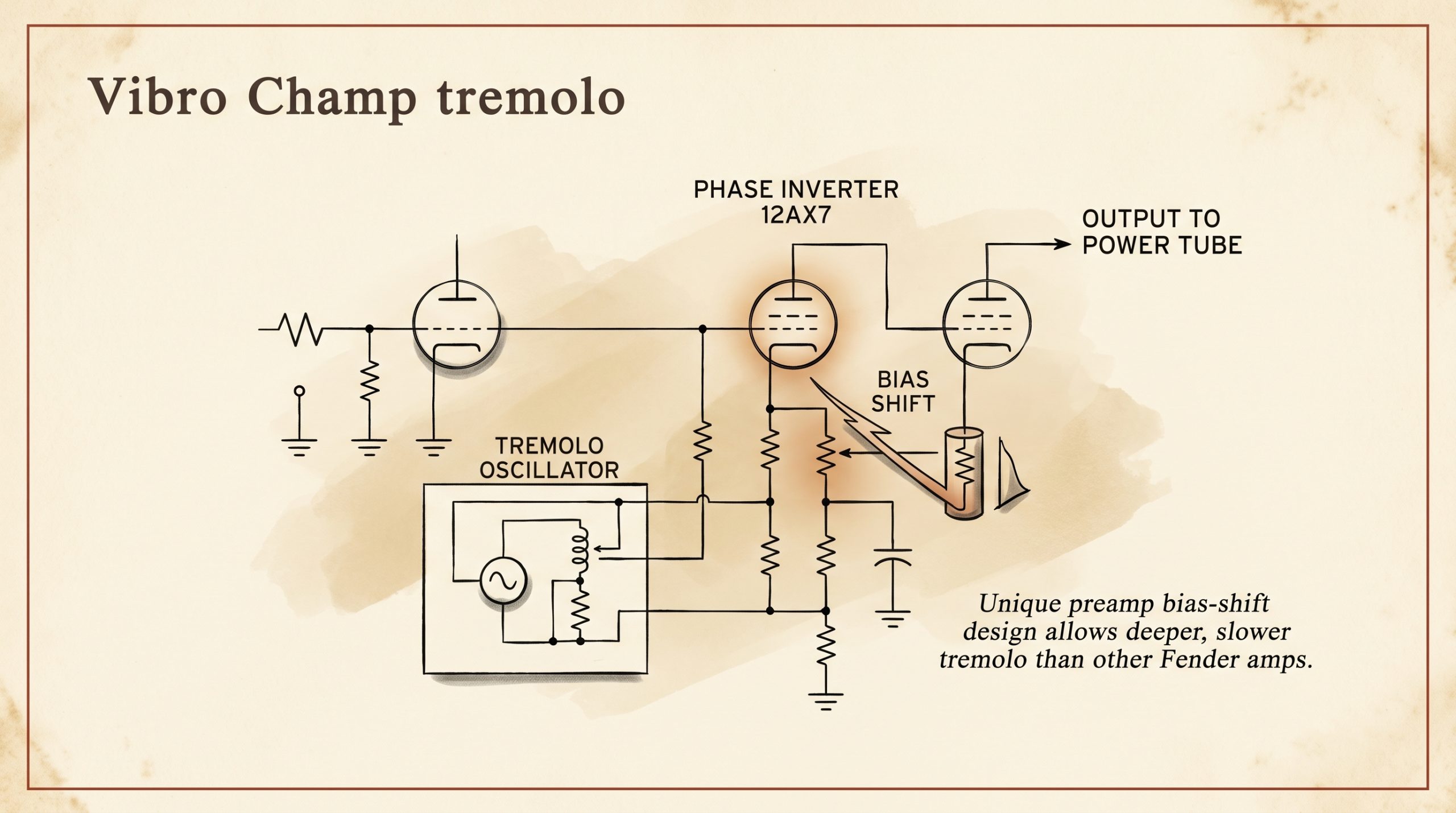
- 08The Vibro Champ's unique bias-shift tremolo
- 09Tube complement and tube positions explained
- 10How do I date a Champ or Vibro Champ?
- 11The 1982 Champ II and Super Champ (Paul Rivera era)
- 12The Fender Bronco (1967)
- 13Champion 600 Reissue (2006-2010, 2014-2016)
- 14Vibro Champ XD (2007-2012)
- 15EC Vibro Champ, the Eric Clapton signature (2011-2016)
- 16'57 Custom Champ (current production)
- 17'68 Custom Vibro Champ Reverb (2021-present)
- 18Champ and Vibro Champ 2026 market values
- 19Famous Champ and Vibro Champ players and recordings
- 20Vibro Champ vs Princeton Reverb vs Deluxe Reverb
- 21Restoration, service, and common modifications
- 22Frequently asked questions
- 23Sources and methodology
- 24Related guides
Fender Vibro Champ in one paragraph
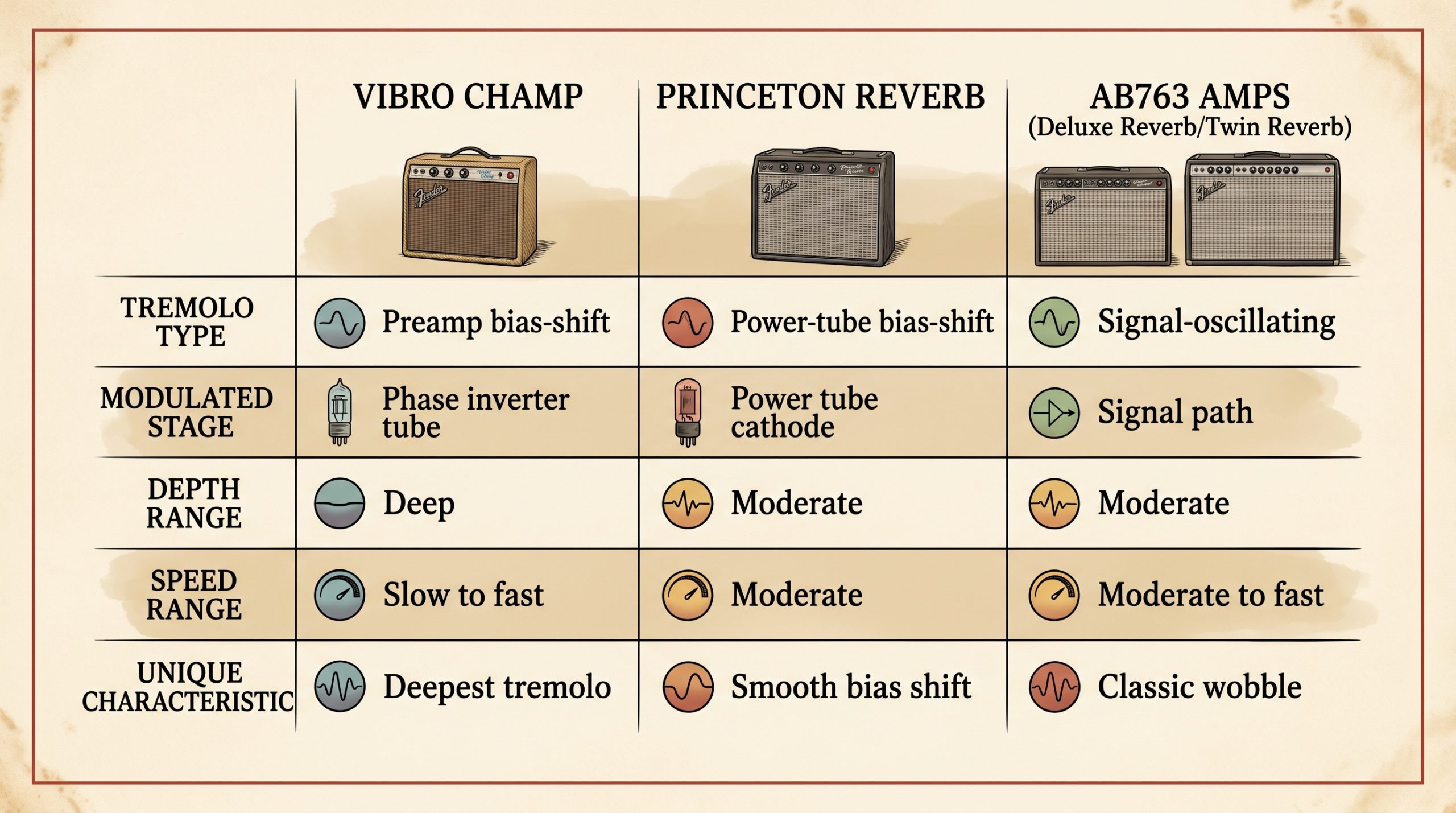
The Vibro Champ is the tremolo-equipped version of the Fender Champ, a 5-watt class A single-ended tube combo introduced in 1964 with the AA764 circuit. The AA764 circuit was used for BOTH the standard Champ AND the Vibro Champ (the only difference being the tremolo circuit), and the circuit remained essentially unchanged from blackface (1964-1967) through silverface (1968-1982). Tube complement: 1× 12AX7 preamp + 1× 6V6GT power + 1× 5Y3 rectifier on tweed-era Champs (3 tubes), plus an extra 12AX7 for the tremolo on Vibro Champ models (4 tubes). The Vibro Champ’s tremolo is unique among Fender amps because it uses preamp tube bias-shifting (the phase inverter position), not power-tube bias-shifting (like the Princeton Reverb) or signal-oscillating (like AB763 amps). Original production ended in 1982. Modern reissues include the ’57 Custom Champ (hand-wired tweed reissue), Champion 600 (2006-2010, 2014-2016), Vibro Champ XD hybrid (2007-2012), EC Vibro Champ Clapton signature (2011-2016), and the current ’68 Custom Vibro Champ Reverb (introduced January 2021).
Key takeaways
- Champ and Vibro Champ share the AA764 circuit. The blackface and silverface Champ AND Vibro Champ both use the AA764 circuit, introduced in 1964. The Vibro Champ adds an extra 12AX7 tube and tremolo circuit components; otherwise the two amps are circuit-identical. Do not confuse this with AA964 (which is the Princeton non-reverb circuit, not the Champ).
- Class A single-ended topology, no phase inverter. The Champ is Fender’s only class A amplifier. The single 6V6 power tube runs in class A mode at 100% bias all the time, which eliminates the need for a phase inverter and gives the Champ its distinctive harmonic character. The Princeton Reverb, Deluxe Reverb, Twin Reverb, and other Fender amps all use class AB push-pull with two or four power tubes and a phase inverter.
- Unique bias-shift tremolo via preamp tube. Per FenderGuru’s circuit analysis, the Vibro Champ’s tremolo uses preamp tube bias shifting (the phase inverter section), which is unique among Fender amps. The Princeton Reverb uses power tube bias shifting, and the AB763 amps (Deluxe Reverb, Twin Reverb, Vibrolux, Super, Pro) use signal-oscillating tremolo. The Vibro Champ’s tremolo can go deeper and slower than any other Fender’s tremolo because of this unique implementation.
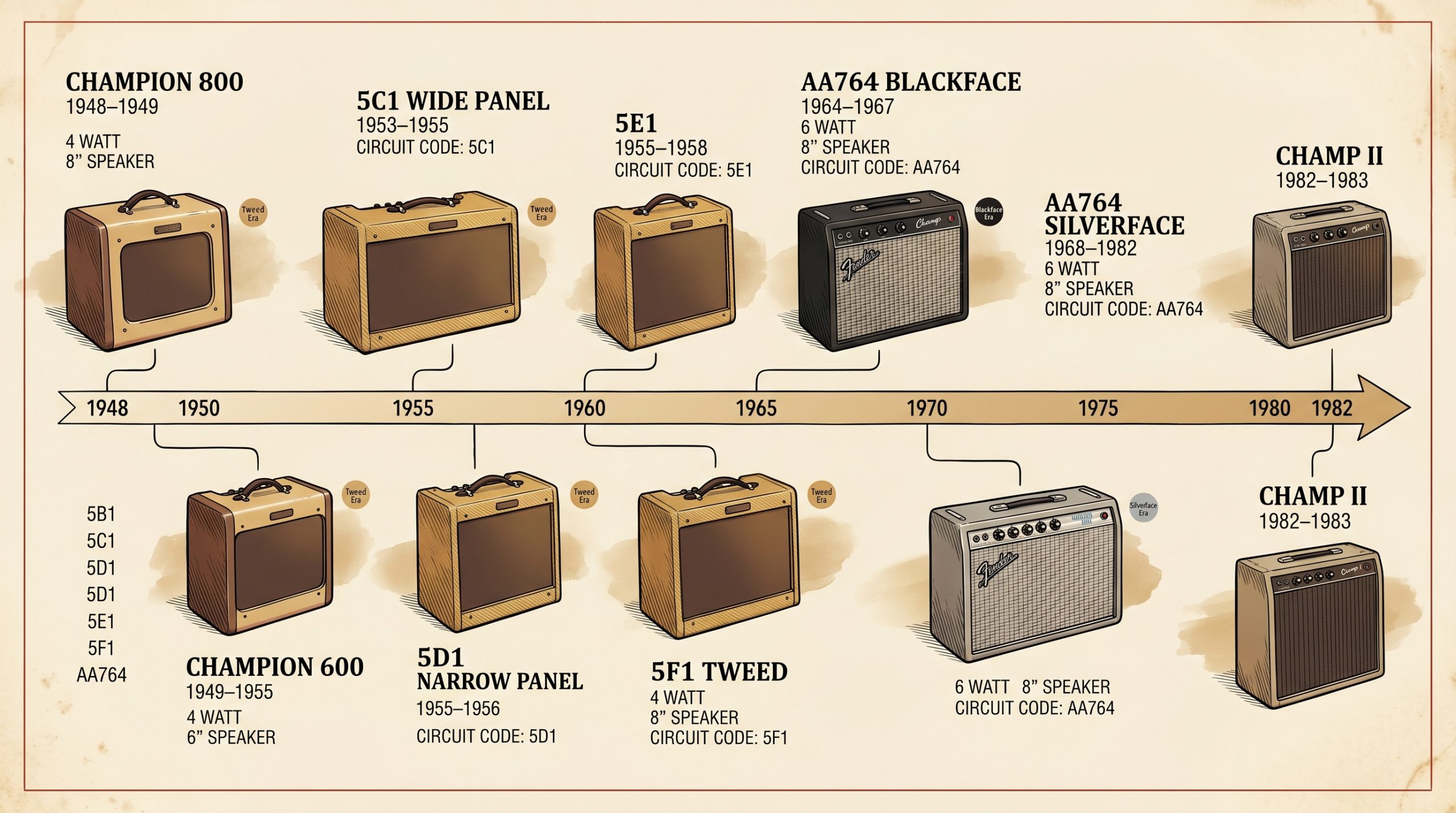
- The Champ family began in 1948 with the Champion 800. Champion 800 (1948-1949, 4W, 8″ speaker) → Champion 600 (1949-1955, 4W, 6″ speaker, 5B1 circuit) → 5C1 wide panel (1953-1955) → 5D1 narrow panel (1955-1956) → 5E1 (1955-1958, 6″ speaker through 1957) → 5F1 (1958-1964, 8″ speaker, the famous tweed) → AA764 blackface (1964-1967) → AA764 silverface (1968-1982) → Champ II (1982-1983) → Super Champ (1982-1985). Discontinued 1982 before Reissue era beginning 2006.
- Eric Clapton recorded Layla and 461 Ocean Boulevard through a tweed Champ. Per Fender’s own official history page: a tweed Champ was Clapton’s main studio amp for the 1970 Derek and the Dominos masterpiece Layla and Other Assorted Love Songs and for the 1974 solo album 461 Ocean Boulevard. The tracks “Layla,” “Bell Bottom Blues,” and “I Shot the Sheriff” were recorded through a Champ. Fender honored this with the EC Vibro Champ Eric Clapton signature in 2011.
- Current production: ’68 Custom Vibro Champ Reverb (2021-present) is the primary modern variant. Introduced January 2021, the ’68 Custom Vibro Champ Reverb modifies the classic Vibro Champ formula with a 10-inch Celestion Ten 30 speaker (versus original 8-inch), digital hall reverb (vintage Vibro Champs had no reverb), modified circuit, and Schumacher transformers. 5W, $749 MSRP. The ’57 Custom Champ remains in production as the hand-wired tweed reissue alternative.
What is the difference between a Fender Champ and a Vibro Champ?
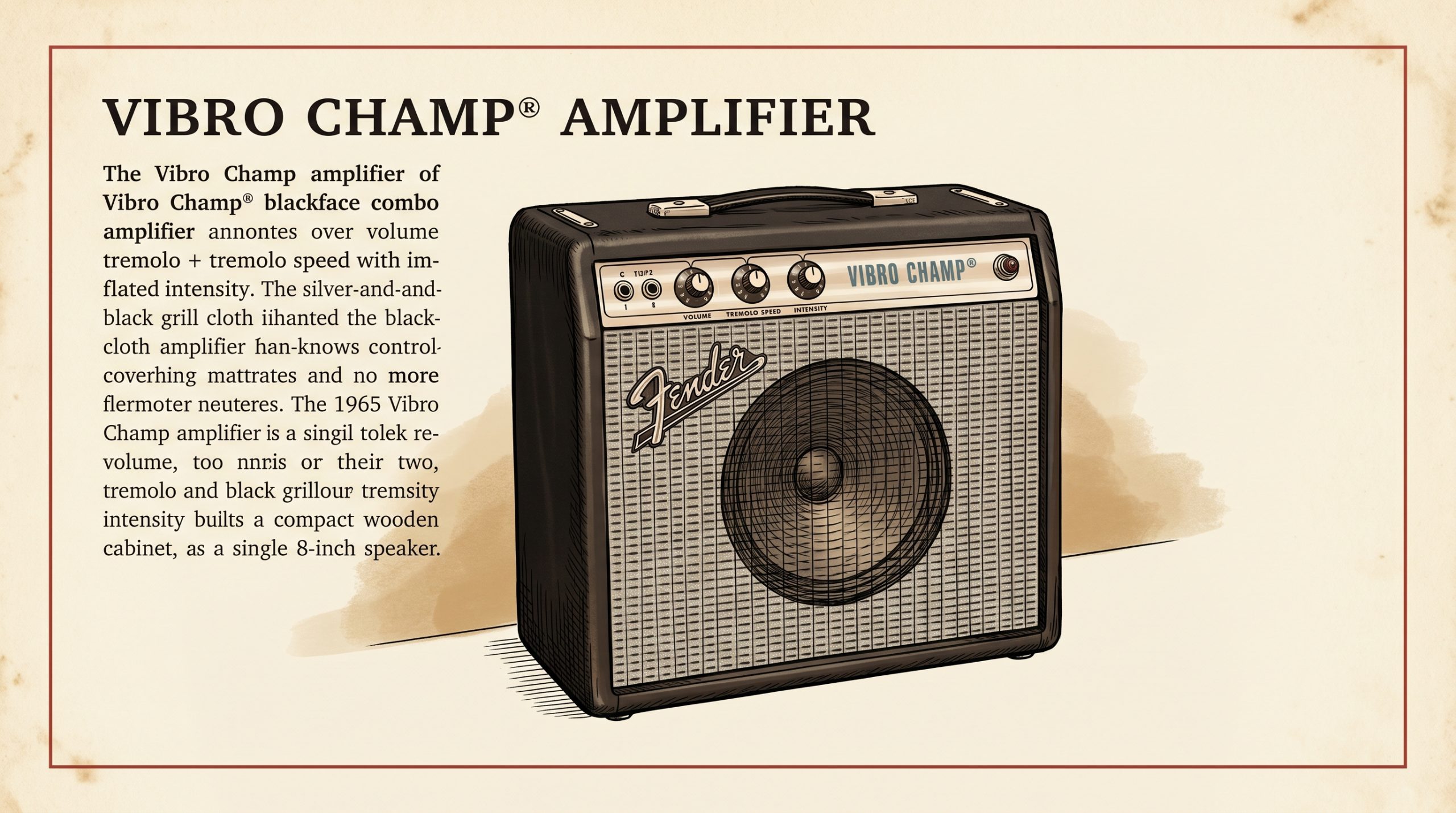
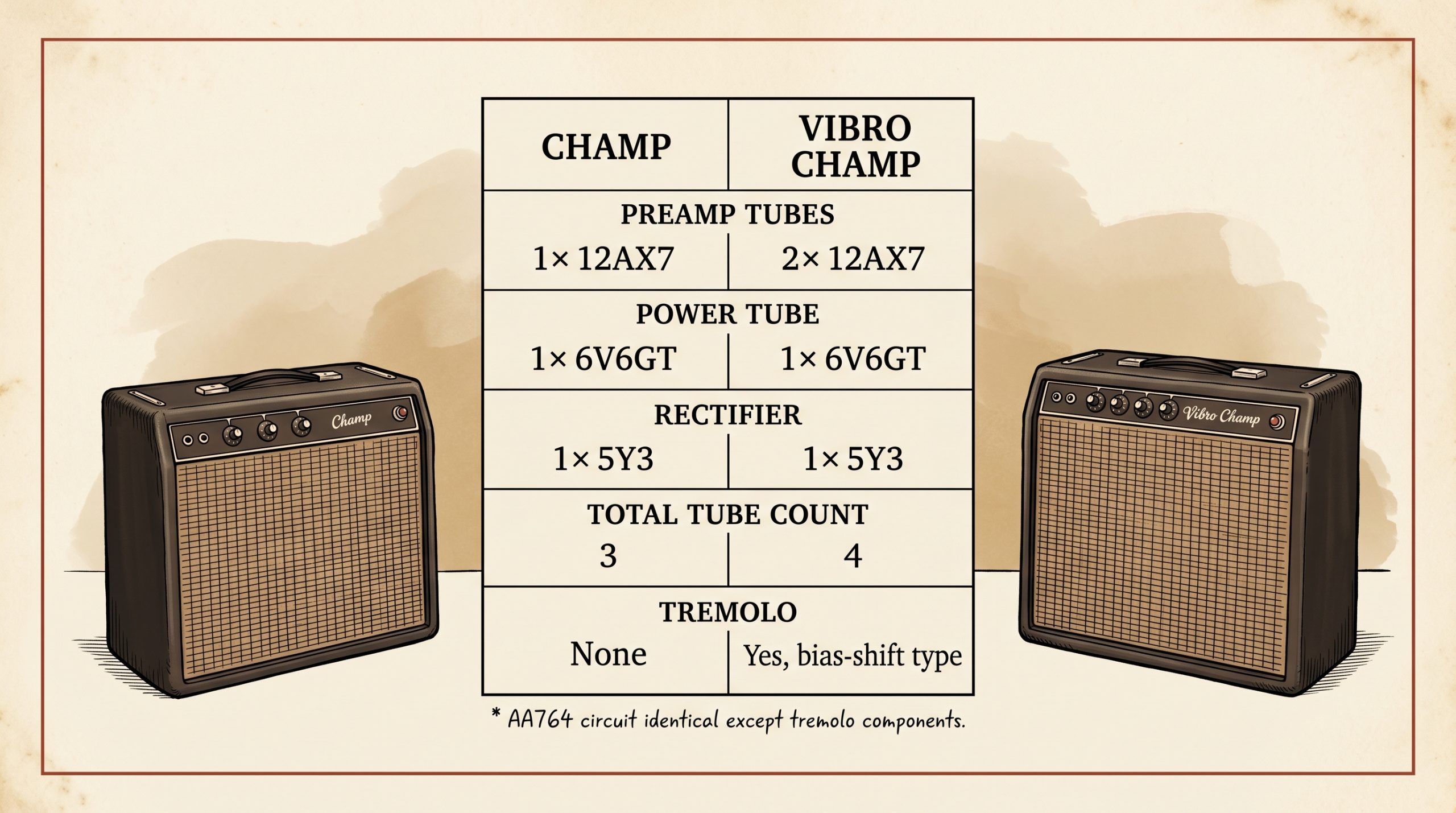
The Vibro Champ adds a tremolo circuit to the basic Champ design. Both amps share the AA764 circuit and use the same 5-watt single-ended 6V6 power section, the same 8-inch speaker, and the same blackface or silverface cosmetics. The Vibro Champ adds two extra knobs (Speed and Intensity for tremolo) and an extra 12AX7 tube to drive the tremolo oscillator. Otherwise identical. The Vibro Champ commands a modest price premium over the standard Champ in equivalent condition.
This is the simplest amp-naming distinction in the Fender catalog. The Champ has volume, treble, and bass controls plus high and low inputs. The Vibro Champ has the same controls plus speed and intensity for tremolo. Both have the same single 6V6 power tube, the same 8-inch speaker, the same single-ended class A power section, and the same AA764 circuit topology under the chassis. If you can play through a Champ, you can play through a Vibro Champ with two extra knobs that add tremolo when you want it.
Why does the Vibro Champ command a price premium over the standard Champ?
Tremolo. Players who want a small tube amp with tremolo have only one Fender option in the small-amp tier: the Vibro Champ. The Champ has no tremolo, the Princeton Reverb is more expensive and larger, and the Deluxe Reverb is significantly larger and louder. For home recording and small-room playing where tremolo is part of the desired tone, the Vibro Champ is the only Fender solution at this size and price point. The 2026 market reflects this with a typical $200-400 premium over equivalent-year Champs.
Vintage Vibro Champs in good-to-excellent condition trade for $700-1,200 in the silverface era and $1,300-2,000 in the blackface era. Vintage non-tremolo Champs trade for $500-900 silverface and $1,100-1,800 blackface. The premium is real but moderate; for players who don’t use tremolo, the standard Champ is meaningful value.
The Champ family lineage (1948-2026)
The Champ has been in Fender’s catalog continuously (with brief gaps) since 1948, making it the second-longest-running Fender amp model after the Princeton (introduced 1947). Eight distinct circuit generations spanning four cosmetic eras (tweed, brown/blonde, blackface, silverface) and three reissue generations.
| Model | Years | Circuit | Key notes |
|---|---|---|---|
| Champion 800 | 1948-1949 | n/a (pre-5-series) | 4W, 8-inch speaker, TV-front cabinet, original Champ ancestor |
| Champion 600 | 1949-1955 | 5B1 | 4W, 6-inch speaker, two-tone blonde/brown vinyl. Standalone name; replaced Champion 800 |
| Champ (wide panel) | 1953-1955 | 5C1 | Wide panel tweed, 6-inch speaker, “5C1” circuit designation introduced |
| Champ (narrow panel) | 1955-1956 | 5D1 | Narrow panel tweed transition, 6-inch speaker. “Champ Amp” name adopted |
| Champ 5E1 | 1955-1958 | 5E1 | Narrow panel tweed, 6-inch speaker through 1957 |
| Champ 5F1 | 1958-1964 | 5F1 | Narrow panel tweed, 8-inch speaker introduced. THE famous tweed Champ; Eric Clapton’s Layla amp. |
| Champ (blackface) | 1964-1967 | AA764 | Black Tolex, blackface cosmetics. Tone stack added (treble + bass) |
| Vibro Champ (blackface) | 1964-1967 | AA764 + tremolo | Tremolo with speed + intensity controls added |
| Champ (silverface) | 1968-1982 | AA764 | Silverface cosmetics, AA764 circuit retained essentially unchanged. Discontinued 1982. |
| Vibro Champ (silverface) | 1968-1982 | AA764 + tremolo | Silverface cosmetics with tremolo. Bronco (1967) student amp derived from this |
| Champ II | 1982-1983 | Rivera-era | 18W, 10-inch speaker, 2× 6V6 push-pull, master volume. Completely different amp. Only 1-2 years production |
| Super Champ | 1982-1985 | Rivera-era | 18W, 10-inch speaker, channel switching, spring reverb. Different model from Champ II |
| Champ 12 “Red Knob” | 1987-1992 | Post-CBS Schultz era | 12W, 12-inch speaker, solid-state rectifier, overdrive channel. Red rotary knobs |
| Champion 600 Reissue | 2006-2010, 2014-2016 | Modified Champ blackface | Double-discontinued. 5W, 6-inch speaker, solid-state rectifier (vs original 5Y3 tube) |
| Vibro Champ XD | 2007-2012 | Hybrid tube + DSP | 1× 12AX7 + 1× 6V6, DSP modeling preamp, 16 amp models, 8-inch speaker. Discontinued 2012 |
| ’57 Custom Champ | 2010-present | 5F1 hand-wired reissue | Faithful hand-wired tweed reissue of the 5F1 circuit. Current production |
| EC Vibro Champ | 2011-2016 | Eric Clapton signature | Tweed signature model commemorating Clapton’s Layla/461 Ocean Boulevard recordings |
| ’68 Custom Vibro Champ Reverb | 2021-present | Modified Vibro Champ + hall reverb | 5W, 10-inch Celestion Ten 30 speaker, DSP hall reverb. Current production primary Vibro Champ |
Is the Champ the longest-running Fender amp model?
Second longest. The Fender Princeton was introduced in 1947 (one year before the 1948 Champion 800), making the Princeton technically the longest-running Fender amp model. The Champ has been in Fender’s catalog continuously since 1948 with brief production gaps (1982-2006 main lineage, 2010-2014 Champion 600 break). Both the Champ and Princeton predate the Stratocaster (1954) and Telecaster (1950) by years.
Per Wikipedia’s Fender Princeton article: “The Fender Princeton was introduced in 1947 and was discontinued in 1979.” The original Princeton beat the Champion 800 to market by one year, though the Champion 800 entered the lap-steel beginner set in 1948 and quickly became known as the Champ. For practical purposes both amps share the “longest-running Fender amp” distinction; the Princeton edges it by twelve months on introduction date.
Tweed Champ and the 5F1 circuit (1958-1964)
The 5F1 Champ is the most-recorded small tube amp ever made. Single 12AX7 preamp tube (V1), single 6V6GT power tube (V2), single 5Y3 rectifier tube (V3), three tubes total. Class A single-ended power section, no phase inverter, no tone controls (volume knob only), no tremolo, no reverb. 5 watts through a single 8-inch Jensen P8R or Oxford speaker. Narrow panel tweed cabinet covering, leather handle, woven grille cloth. Hand-wired point-to-point construction.
The 5F1 was introduced in 1958 (the 8-inch speaker upgrade from the earlier 5E1’s 6-inch speaker) and ran through 1964 when the blackface AA764 replaced it. The 5F1 is the most copied amp circuit in modern boutique amp building. Victoria, Headstrong, Carr, Tungsten, Tone King, and countless other boutique brands all build amps that are direct 5F1 derivatives. Modern hand-wired 5F1 clones command $1,500-3,000 prices; original 5F1 tweeds in good condition trade $2,000-3,800.
What does the 5F1 designation mean?
Fender’s circuit naming convention: 5 = decade (1950s), F = sixth revision letter (A, B, C, D, E, F), 1 = Champ model designation. The 5F1 is the sixth revision of the Champ circuit from the 1950s. Earlier Champ designations: 5B1 (1949 Champion 600), 5C1 (1953 wide panel), 5D1 (1955 narrow panel transition), 5E1 (1955-1958). The 5F1 replaced the 5E1 in 1958 with the major change being the 8-inch speaker (the 5E1 had a 6-inch speaker through 1957 and transitional 8-inch from late-1957 onward).
The 5F1 circuit is extraordinarily simple. Per the Tube Depot 5F1 wiring documentation: V1 (12AX7) provides two stages of voltage amplification (one preamp stage feeding the volume control, one driver stage feeding the power tube). V2 (6V6GT) provides class A single-ended power amplification. V3 (5Y3) provides the rectifier. There is no phase inverter (single-ended class A doesn’t need one), no negative feedback loop, no tone stack (just a tone-shaping cathode bypass cap), and no reverb or tremolo. The entire circuit fits on a single eyelet board with about thirty components.
Why is the 5F1 so revered among modern boutique builders?
Simplicity, harmonic richness, and the way it interacts with overdrive pedals. The 5F1’s two-stage 12AX7 preamp feeding directly into a single-ended class A 6V6 power section produces a uniquely musical harmonic signature when pushed into overdrive. The cathode bypass cap on the volume pot acts as a kind of tone control through volume interaction. The natural compression of the class A 6V6 working at 100% bias adds touch sensitivity that push-pull amps cannot replicate. For pedal-platform applications, the 5F1’s voicing is forgiving and harmonically rich at all volume levels.
Players who own original 5F1 tweed Champs (or hand-wired modern clones) typically describe the amp’s tone in terms that don’t translate well to specifications. “Singing harmonic content at volume 8,” “compressed in a useful way,” “responds to picking like a guitar should,” “harmonic detail in the second-order content,” “perfect studio amp for recording at apartment volumes.” These descriptions reflect the unique combination of a simple circuit, class A single-ended power, and the small 8-inch speaker. None of the larger Fender amps (Princeton, Deluxe, Twin) produce quite the same harmonic signature when pushed into overdrive.
Blackface and silverface Champ and Vibro Champ (1964-1982, AA764 circuit)
In 1964 Fender transitioned the Champ to the AA764 circuit alongside the broader blackface line. Black Tolex cabinet, black control panel with white silkscreen, silver-and-black grille cloth, cream chicken-head knobs. The AA764 added a tone stack (treble + bass controls) that the tweed 5F1 lacked. The Vibro Champ was introduced simultaneously with the tremolo circuit added. The AA764 circuit was retained essentially unchanged through the silverface era (1968-1982), making this one of Fender’s longest unchanged production circuits.
Per FenderGuru’s Champ documentation: “Unlike most other amp models Fender kept the circuit almost unchanged during the silverface era.” This makes silverface Champs and Vibro Champs sonically very similar to blackface units, which has implications for value: silverface Champs trade at meaningful discounts to blackface (40-60% typically) while delivering essentially the same tone. For players seeking AA764 character on a budget, silverface units are excellent value.
What does the AA764 circuit designation mean?
Fender’s standard blackface-era naming: AA = schematic revision letter pair, 7 = July, 64 = year 1964. The AA764 designation appears on the tube chart sticker inside original blackface units. The circuit applies to BOTH the standard Champ AND the Vibro Champ (with the Vibro Champ adding the tremolo circuit and an extra 12AX7 tube). Important: AA764 is the Champ circuit. AA964 is the Princeton non-reverb circuit (September 1964 revision). These are separate amps with different circuit designations despite both appearing in the blackface era.
The AA764 schematic finalized in July 1964, with first production units appearing in fall 1964. By the start of 1965 the AA764 was full production. The circuit added a basic tone stack (bass and treble controls) to the tweed 5F1’s volume-only configuration, plus the negative feedback loop and slightly modified bias values that distinguish blackface from tweed character.
What is the AA764 tube complement?
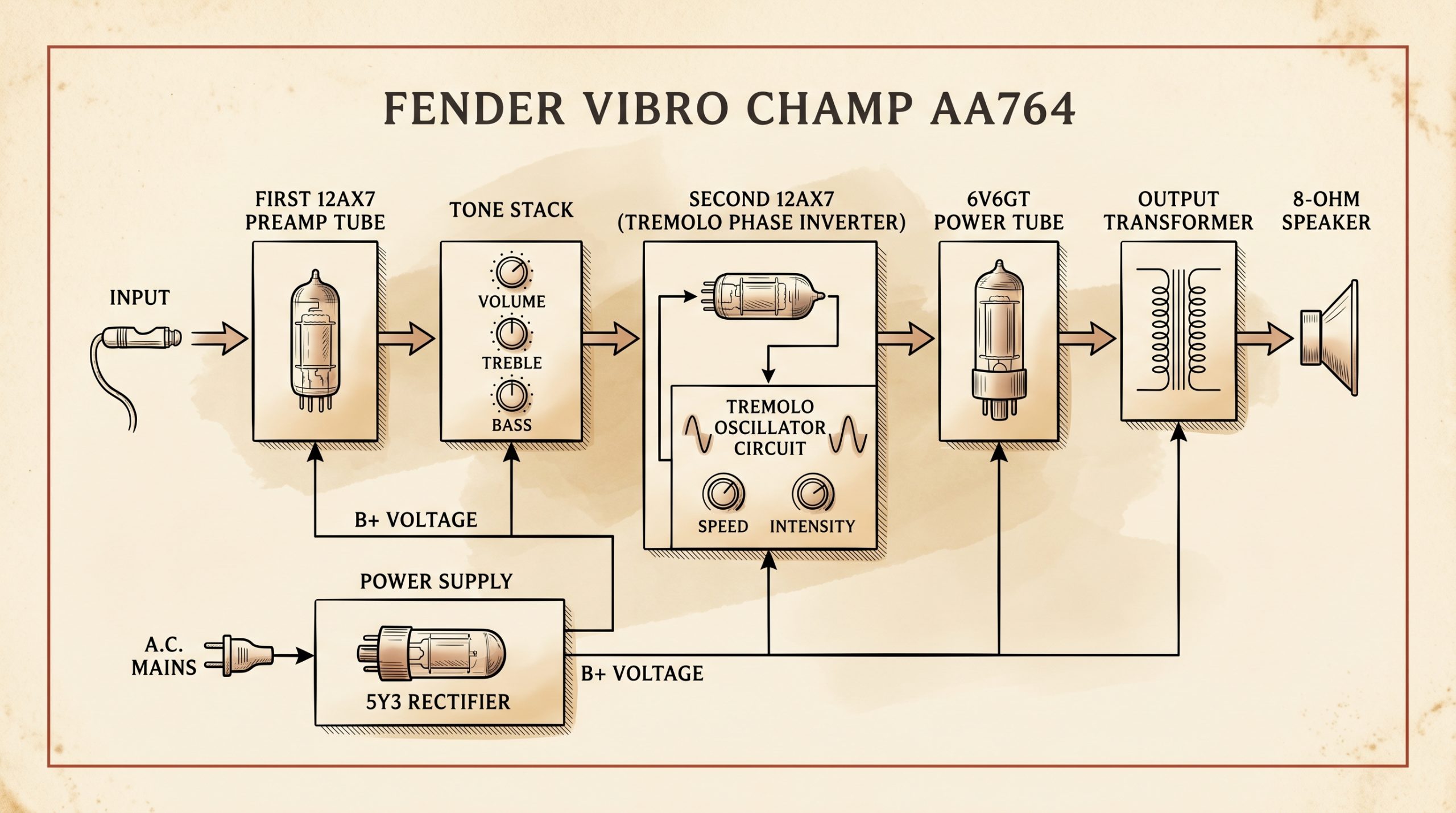
Standard AA764 Champ: V1 (12AX7) preamp, V2 (6V6GT) power tube, V3 (5Y3) rectifier, 3 tubes total, same as tweed 5F1. AA764 Vibro Champ: V1 (12AX7) preamp, V2 (12AX7) tremolo oscillator + phase inverter (used uniquely for the bias-shift tremolo circuit), V3 (6V6GT) power tube, V4 (5Y3) rectifier, 4 tubes total.
| Position | Tube type | Function (Champ) | Function (Vibro Champ) |
|---|---|---|---|
| V1 | 12AX7 / 7025 | Preamp (two gain stages) | Preamp (two gain stages) |
| V2 (Vibro Champ only) | 12AX7 / 7025 | Not present | Tremolo oscillator + bias-shift driver |
| V3 (V2 on standard Champ) | 6V6GT | Class A power tube | Class A power tube |
| V4 (V3 on standard Champ) | 5Y3 | Rectifier (tweed-style retained through silverface) | Rectifier (tweed-style retained through silverface) |
The 5Y3 tube rectifier was retained on AA764 Champs and Vibro Champs throughout both blackface and silverface eras, even though Fender shifted larger blackface amps (Bandmaster, Twin Reverb, Showman) to solid-state rectification in the 1960s. The 5Y3’s gentle sag and compression character is integral to the Champ’s voice and Fender chose to keep it.
What were the original speakers in vintage Champs and Vibro Champs?
8-inch Oxford 8EV through most of blackface and early silverface production (1964-mid 1970s), shifting to Oxford 8L4 and various budget speakers in later silverface production (1976-1982). Tweed-era 5F1 Champs used Jensen P8R or P8T speakers; some Oxford and CTS 8-inch speakers appear on transitional units. Original speakers carry EIA date codes on the frames: Oxford = 465-YWW, Jensen = 220-YWW.
The 8-inch speaker is integral to the Champ’s character. The small driver compresses earlier and adds harmonic content at lower volumes than larger speakers, contributing to the “small amp magic” that makes Champs ideal for home recording. Players who modify Champs with larger 10-inch or 12-inch speakers in custom cabinets gain volume and bass response but lose the distinctive small-speaker compression character.
The class A single-ended topology and why it matters
The Champ is Fender’s only class A amplifier. The single 6V6 power tube runs at 100% bias all the time, which eliminates the need for a phase inverter and produces harmonic content that push-pull class AB amps cannot replicate. All other Fender amps with multiple power tubes (Princeton, Deluxe, Twin, Super, Pro, Bassman, etc.) use class AB push-pull topology with a phase inverter.
The distinction matters for three reasons. First, harmonic content: class A produces more even-order harmonic distortion (which sounds musical) and less odd-order distortion (which sounds harsh) than class AB. Second, no crossover distortion: class AB amps have a small “crossover” region where one tube hands off to the other, which can introduce subtle distortion artifacts at low volumes. Class A has no crossover region. Third, simplicity: the absence of a phase inverter means fewer components, simpler circuit, and unique tonal signature that no class AB amp produces.
Why does class A operation make tubes wear faster?
The 6V6 power tube in a class A amp runs at full bias continuously, drawing maximum current the entire time the amp is powered on. This shortens tube life compared to class AB operation where each tube only fires for half of each waveform cycle. A typical class AB Fender amp might get 4,000-5,000 hours of use from a power tube; a class A Champ might get 2,000-3,000 hours. The trade-off is the tonal character that class A operation provides; players who treasure that tone accept the faster tube replacement cycle as normal maintenance.
This is also why the Champ runs hotter than most Fender amps for its size. The chassis warms substantially during use because the 6V6 is at 100% bias continuously. This is normal operation, not a fault. Champs that have been left running for many hours can become uncomfortably warm to touch, which is also normal.
The Vibro Champ’s unique bias-shift tremolo
The Vibro Champ uses preamp-tube bias shifting (the phase inverter position) for its tremolo effect. This is unique among Fender amps. The Princeton Reverb uses power-tube bias shifting (the power tube bias is wiggled). The AB763 amps (Deluxe Reverb, Twin Reverb, Vibrolux Reverb, Super Reverb, Pro Reverb) use signal-oscillating tremolo (the signal itself is multiplied by a varying gain). Three different tremolo topologies across the Fender amp line, and the Vibro Champ’s is the rarest.
The tremolo effect on a Vibro Champ has a distinctive character that does not transfer to other Fender amps. Players who love the Vibro Champ specifically for its tremolo often cite the depth and slowness of the effect as its main attraction. Per FenderGuru’s review: “The tremolo effect is huge in the Vibro Champ and allows you to go deeper and slower than on the AB763 amps.”
Can I get the Vibro Champ tremolo character in another Fender amp?
No, without modification. The bias-shift tremolo topology is integral to the Vibro Champ’s circuit design and is not present in any other Fender production amp. Boutique modders sometimes graft Vibro Champ-style preamp-tube bias-shift tremolo onto other amps; this is a substantial modification rather than a simple component swap. For players who want this specific tremolo character, owning a Vibro Champ (or a current production ’68 Custom Vibro Champ Reverb) is the simplest path.
Tube complement and tube positions explained
The Champ and Vibro Champ tube complements vary by era. Tweed-era 5F1 Champ: 1× 12AX7 + 1× 6V6GT + 1× 5Y3 (3 tubes total). Blackface and silverface AA764 Champ: same 3 tubes. Blackface and silverface AA764 Vibro Champ: 2× 12AX7 + 1× 6V6GT + 1× 5Y3 (4 tubes total, the extra 12AX7 is for tremolo). Modern ’68 Custom Vibro Champ Reverb: 2× 12AX7 + 1× 6V6 + solid-state rectifier (4 tubes total, no rectifier tube). Modern ’57 Custom Champ: hand-wired 5F1 reissue, same 3-tube complement as original tweed.
Why does the Vibro Champ use a second 12AX7 for tremolo?
The bias-shift tremolo topology requires an oscillator stage to generate the modulation waveform, plus a driver stage to apply the bias shift to the preamp tube. One half of the second 12AX7 generates the tremolo oscillation (controlled by the Speed and Intensity knobs); the other half drives the bias shift on V1’s phase inverter position. The standard non-tremolo Champ has no use for this tube and ships without it.
Tube substitution: you can use 12AT7 in V2 of a Vibro Champ in place of 12AX7 with mostly transparent results (slightly less tremolo intensity at maximum settings). You cannot substitute 12AT7 in V1 of a Champ or Vibro Champ. The preamp gain stages are tuned for 12AX7’s high mu. Sub 12AY7 or 12AT7 in V1 substantially reduces preamp gain.
Why does the Champ use 5Y3 instead of GZ34 like larger Fenders?
Current draw. The Champ’s small output transformer and 5-watt power section draw far less current than the Deluxe Reverb’s 22W or Twin Reverb’s 85W output sections. The 5Y3 provides plenty of capability for the Champ’s needs and has the gentle sag character that contributes to the amp’s compression and feel. GZ34 (5AR4) is a higher-current tube with less sag suited to larger amps. Substituting GZ34 in a Champ produces less sag and tighter response, which some players prefer for cleaner pedal-platform use.
The 5Y3 sag character at high volumes contributes meaningfully to the Champ’s character. As the 6V6 draws more current at cranked volumes, the 5Y3 sags slightly, dropping the plate voltage, which produces compression and a kind of “breathing” character that defines vintage Champ tone. This is the deliberate design choice that Fender made and that boutique builders preserve in 5F1 clones.
How do I date a Champ or Vibro Champ?
For tweed Champs (1953-1964), cross-reference the tube chart date code (inside the cabinet) and the transformer codes (Schumacher 606-YWW format on bell ends). For blackface and silverface Champs (1964-1982), use tube chart, transformer codes, speaker codes, and the chassis stamp. For modern reissues, read the QA inspection sticker on the rear panel. The complete methodology is in our Fender tube amp serial number guide.
Champ-specific dating quirks: the Champ and Vibro Champ used foil stickers on the chassis (rather than panel-printed control script) which is why the “Fender Electric Instruments Co.” designation continued into 1966 on these amps even after the larger amps had switched to “Fender Musical Instruments.” This is one of the documented anomalies in our pillar dating guide. If you encounter a 1966 Champ with “Fender Electric Instruments” foil sticker, it is not a pre-CBS unit; this is the Champ foil sticker exception, and the actual production date is from the chassis stamps and transformer codes.
What is the OA / OB green-ink tube chart anomaly on Champs?
If your Champ tube chart shows “OA” or “OB” in green ink, the amp is from January or February 1966. This is the documented factory error where the year letter O (1965) was carried over into early 1966 production before being corrected to P. The green ink is what alerted the factory to the mistake. This affects all Fender amps in the early 1966 production window, including Champs and Vibro Champs.
Documented in Greg Gagliano’s 20th Century Guitar Magazine Part 1 research. Champs and Vibro Champs with OA or OB green-ink stamps are January-February 1966 production, not 1965. The error was caught in February 1966 and production switched to the correct PA, PB pattern in standard black ink.
The 1982 Champ II and Super Champ (Paul Rivera era)
The original Champ and Vibro Champ were discontinued in 1982 when Paul Rivera arrived at Fender as marketing director and led the redesign of the entire amp line. The Champ II (1982-1983) and Super Champ (1982-1985) replaced the AA764 platform with completely different amps. Both are 18W, 10-inch speaker, push-pull class AB amps that share the Champ name but are unrelated to the original AA764 class A single-ended designs. The Champ II is among the rarest Fender amps of the era due to its 1-2 year production run.
The Rivera era is contentious in vintage Fender circles. Some players value the Champ II and Super Champ for their hand-wired eyelet board construction and Rivera-era character; others see them as departures from the original Champ design philosophy. Vintage market values reflect this split: Champ II units trade $1,000-1,500 in good condition, less than equivalent silverface Vibro Champs that share the original AA764 character.
What about the Champ 12 Red Knob (1987-1992)?
The Champ 12 was a post-CBS Schultz-era Champ-family amp. 12 watts through a 12-inch speaker, solid-state rectifier (departure from the tube rectifier tradition), and an overdrive channel that the original Champ family never had. Built between 1987 and 1992. Trades $400-700 on the vintage market. Separate amp from the AA764 Champ lineage despite the name.
The Champ 12 represents Fender’s mid-1980s and early-1990s recovery period when the company was rebuilding production after CBS sold the brand to William Schultz’s investor group in 1985. Production quality on Champ 12 units is variable; later production (1990-1992) is generally more consistent than earlier (1987-1989) units. For collectors of post-CBS Fender history, the Champ 12 is a worthwhile category; for players seeking original Champ character, the AA764 silverface Champs (1968-1982) deliver more authentic tone at similar or lower prices.
The Fender Bronco (1967)
The Fender Bronco was a 1967 student amplifier derived from the silverface Vibro Champ circuit. Marketed as part of the Bronco package (Bronco amp + Bronco student guitar), the amp shared the AA764-style platform with the Vibro Champ but was positioned as an entry-level option. Production was limited and the Bronco is now a niche collector category.
If you encounter a Fender Bronco amp, you have a 1967 student-line amp essentially equivalent to a silverface Vibro Champ in circuit topology. The Bronco’s collector value is modest ($500-900 typically) reflecting its limited production and niche positioning. For a player seeking Vibro Champ character, a standard silverface Vibro Champ usually offers better value and broader availability.
Champion 600 Reissue (2006-2010, 2014-2016)
Fender reissued the 1949 Champion 600 design in 2006 with two-tone blonde and brown vinyl covering (matching the original TV-front cabinet). 5W, 6-inch speaker, single 6V6 power tube, single 12AX7 preamp tube, solid-state rectifier (departure from original 5Y3 tube rectifier). Discontinued in 2010, reissued again in 2014, discontinued again in 2016. Used market $250-450 in good condition.
The Champion 600 reissue is the most affordable entry to the Champ family on the used market. The solid-state rectifier produces tighter response than vintage tube-rectified Champs, with less sag character. The 6-inch speaker is smaller than vintage 5F1 or AA764 8-inch speakers, producing thinner low-end response. Some modifications are popular: replacing the rectifier with 5Y3 (a complex modification), changing to an 8-inch speaker for fuller bass, and replacing the preamp tube section with a higher-grade 12AX7.
The double discontinuation reflects Fender’s commercial calculations rather than any quality concerns. The Champion 600 was a budget product that competed with the Vox AC4, Marshall MG10, and various low-watt entry-level amps. When demand softened, Fender pulled it from production; when demand returned in 2014, Fender brought it back; when demand softened again in 2016, Fender pulled it again. As of 2026 the Champion 600 is not in current production.
Vibro Champ XD (2007-2012)
The Vibro Champ XD was Fender’s first attempt at a hybrid tube/digital small amp. Introduced in 2007 as part of the Vintage Modified series. Tube output stage (single 12AX7 driver + single 6V6 power tube, no rectifier tube) combined with a DSP preamp providing 16 amp models and built-in effects (reverb, delay, chorus, tremolo, Vibratone). 5 watts through an 8-inch speaker. Discontinued in 2012 when Fender refocused on more traditional reissue designs.
The Vibro Champ XD attempted to make the small Champ format more versatile by adding modeled tones from larger Fender amps. The result is a hybrid amp with all-tube power stage character driven by a digital preamp that emulates blackface, tweed, Bassman, Twin Reverb, and other voicings. The execution was uneven: some modeling sounds quite good, others sound digital and dated. For 2007 the technology was advanced; by 2012 the modeling had aged enough that Fender pulled the product.
Used market: Vibro Champ XD units trade $250-400. The tube output stage retains some Champ character; the digital preamp is generally regarded as the weak point. For players who want versatility and don’t mind the hybrid construction, the Vibro Champ XD is an interesting niche choice. For players who want pure Champ tone, the ’57 Custom Champ or vintage AA764 Vibro Champ is the better choice.
EC Vibro Champ, the Eric Clapton signature (2011-2016)
Fender introduced the EC Vibro Champ (Eric Clapton signature) in 2011 to commemorate Clapton’s documented use of a tweed Champ on the Layla and Other Assorted Love Songs (1970) and 461 Ocean Boulevard (1974) albums. The amp was a tweed-cosmetic Champ built to specifications Clapton specified. Production ran 2011-2016. Used market $1,000-1,500 in good condition. The EC Champ is a separate model from the EC Twinolux (Clapton’s larger tweed Twin signature) and other Clapton signature Fender amps.
The EC Vibro Champ represents Fender’s recognition of the Champ’s role in Clapton’s studio history. Per Fender’s official history page, Clapton’s tweed Champ was his primary studio amp for the entirety of the Layla album (including “Layla,” “Bell Bottom Blues,” “I Looked Away,” and the other classic tracks) and continued in service for 461 Ocean Boulevard (“I Shot the Sheriff,” “Let It Grow,” and others). The EC Vibro Champ commemorated this documented studio relationship rather than recreating any specific year of tweed Champ.
’57 Custom Champ (current production)
The ’57 Custom Champ is Fender’s hand-wired tweed Champ reissue, part of the Custom Series. Faithful 5F1 circuit reproduction with hand-wired point-to-point construction (not PCB), period-correct components, and modern reliability improvements (three-prong power cord, modern speaker with vintage voicing). 5W through a single 8-inch Weber speaker. Built in Corona, California. Current retail $1,400-1,700. Used market $900-1,300.
The ’57 Custom Champ is the most authentic modern Champ available. The hand-wired construction, period-correct circuit values, and Weber 8-inch speaker recreate the tweed 5F1 character closer than any PCB-based reissue. For players who want vintage tweed Champ character without the vintage hunt and vintage pricing, the ’57 Custom Champ is the strongest current-production choice. For most home and studio applications, it delivers 90-95% of the way to a real 5F1 at significantly lower cost.
How does the ’57 Custom Champ compare to a real tweed 5F1?
Very close. The hand-wired construction, Vintage Blue tone capacitors, and Weber 8-inch speaker recreate vintage tweed character substantially. Players who have A/B compared the ’57 Custom Champ to a genuine 1960-1962 5F1 describe the differences as subtle: the modern reissue may be slightly tighter in the low end, slightly more consistent unit-to-unit, and slightly more reliable in long-term use. The vintage 5F1 retains a slight edge in harmonic complexity and “musical breakup” that experienced ears can detect, but the ’57 Custom Champ comes meaningfully close at one-third to one-half the price of a vintage 5F1.
’68 Custom Vibro Champ Reverb (2021-present)
The ’68 Custom Vibro Champ Reverb was introduced in January 2021 as the current-production Vibro Champ variant. Modified Vibro Champ circuitry, 10-inch Celestion Ten 30 speaker (versus original 8-inch), DSP digital hall reverb (vintage Vibro Champs had no reverb), tube-driven tremolo (preamp-tube bias-shift, unique to Vibro Champ), custom-made Schumacher transformers. 1968-style silverface cosmetics with aluminum drip-edge trim and silver-turquoise grille cloth. Tube complement: 2× 12AX7 + 1× 6V6, solid-state rectifier. 5W. MSRP $749. Built in Mexico.
The ’68 Custom Vibro Champ Reverb is the modern Vibro Champ that most players will encounter. Unlike the ’57 Custom Champ (which faithfully recreates the tweed 5F1), the ’68 Custom Vibro Champ Reverb is intentionally modified to be more practical for modern use. Key modifications from vintage Vibro Champ:
- 10-inch Celestion Ten 30 speaker (versus original 8-inch). The Ten 30 is a Celestion British design custom-spec for Fender with a 3.2-ohm impedance. The larger speaker provides fuller low end and more output than the original 8-inch.
- Built-in DSP hall reverb. Vintage Vibro Champs had no reverb at all. The Custom Vibro Champ adds a hall-emulating digital reverb with a level control, foot-switchable on/off.
- Bright switch added. The control panel includes a bright switch in addition to the standard volume, treble, bass, speed, intensity, and reverb level controls.
- Schumacher transformers (custom-made, faithful to original specifications)
- Tube-biased tremolo retained. The unique bias-shift tremolo is preserved on the ’68 Custom, which is one of the strongest reasons to choose this amp over alternatives.
What is the difference between the ’57 Custom Champ and the ’68 Custom Vibro Champ Reverb?
The ’57 Custom Champ is a faithful hand-wired tweed 5F1 reissue with no tone controls, no tremolo, no reverb, 8-inch speaker, Corona California production. $1,400-1,700. The ’68 Custom Vibro Champ Reverb is a Mexico-built modified silverface Vibro Champ with treble + bass + tremolo + digital hall reverb + bright switch + 10-inch Celestion speaker. $749. Different amps for different players. The ’57 Custom delivers vintage tweed character at premium price; the ’68 Custom delivers versatile modern small-amp performance at moderate price.
| Spec | ’57 Custom Champ | ’68 Custom Vibro Champ Reverb |
|---|---|---|
| Construction | Hand-wired | PCB |
| Country of origin | Corona, California | Mexico |
| Power | 5W class A single-ended | 5W class A single-ended |
| Speaker | 1× 8″ Weber | 1× 10″ Celestion Ten 30 |
| Tubes | 1× 12AX7 + 1× 6V6 + 1× 5Y3 (3 tubes, tube rectifier) | 2× 12AX7 + 1× 6V6, solid-state rectifier |
| Tone controls | None (volume only) | Treble + Bass + Bright switch |
| Tremolo | No | Yes (unique bias-shift) |
| Reverb | No | DSP hall reverb |
| MSRP | $1,400-1,700 | $749 |
Champ and Vibro Champ 2026 market values
2026 ranges reflect Reverb.com completed-sale data for amps in good-to-excellent condition with documented originality. Mint condition commands 25-40% premium over these ranges; project-grade trades at 30-50% below.
Vintage Champs and Vibro Champs (2026)
- Champion 800 (1948-1949): $3,500-6,500, the original Champ ancestor, increasingly rare
- Champion 600 (1949-1955): $1,800-3,500, with collectible TV-front cabinet, two-tone vinyl
- 5C1/5D1 wide and narrow panel tweed (1953-1956): $1,500-2,800
- 5E1 tweed Champ (1955-1958, 6-inch speaker through 1957): $1,800-3,200
- 5F1 tweed Champ (1958-1964): $2,000-3,800 in good condition. 1960-1962 production most-collected. Mint examples with original Jensen P8R or P8T speaker can reach $4,500+
- Blackface Champ (1964-1967): $1,100-1,800. Pre-CBS examples (1964-early 1965) command premium
- Blackface Vibro Champ (1964-1967): $1,300-2,000. Tremolo adds $200-400 premium over Champ
- Silverface Champ (1968-1981): $500-900. Excellent value entry into vintage Fender ownership
- Silverface Vibro Champ (1968-1981): $700-1,200. Most-affordable vintage Fender with tremolo
- 1980-1981 silverface Vibro Champ (reverted to blackface cosmetics): $600-900. Final-year vintage units
Rivera-era and post-CBS variants
- Champ II (1982-1983): $1,000-1,500 in good condition. Rare due to 1-2 year production
- Super Champ (1982-1985): $600-1,000. Channel switching and spring reverb
- Champ 12 Red Knob (1987-1992): $400-700
- Bronco amp (1967): $500-900. Niche collector category
Reissue and current production (2026)
- Champion 600 reissue (2006-2010, 2014-2016, used market): $250-450. Solid-state rectifier, 6-inch speaker
- Vibro Champ XD (2007-2012, used market): $250-400. Hybrid tube/digital, niche choice
- EC Vibro Champ Eric Clapton signature (2011-2016, used market): $1,000-1,500
- ’57 Custom Champ (current production): $1,400-1,700 new; $900-1,300 used
- ’68 Custom Vibro Champ Reverb (2021-present): $749 new MSRP; $500-650 used in good condition
What affects Champ value most?
For vintage units, in order of importance: originality of major components (chassis, transformers, original speaker, especially Jensen P8R or P8T on tweed, Oxford 8EV on blackface/silverface), cosmetic condition (tweed without re-cover, blackface/silverface Tolex intact, original handle), working condition (recent cap job critical on 50+ year amps), and documentation/provenance. For reissues, condition and service history matter most.
Original speakers specifically affect value substantially. A 1962 tweed 5F1 with its original Jensen P8R in playable condition is worth meaningfully more than the same amp with a replacement speaker. Document the original speaker even if you play through a different one for daily use, and keep the original stored for resale.
Famous Champ and Vibro Champ players and recordings
The Champ has been on more hit recordings than its 5-watt output would suggest. Documented users include Eric Clapton (Layla and Other Assorted Love Songs 1970, 461 Ocean Boulevard 1974), Joe Walsh (countless solo and Eagles sessions), Billy Gibbons (ZZ Top, blues sessions), Joe Bonamassa (modern blues recordings), Mike Campbell (Tom Petty studio work), David Hidalgo (Los Lobos), Brian May (Queen recording sessions), Marty Stuart, Steve Earle, John Mayer (early recordings), Ry Cooder (slide guitar studio work), and Robert Cray (occasional studio use).
Eric Clapton’s tweed Champ recordings
Per Fender’s official history page: “A tweed Champ was Clapton’s main studio amp for 1970 Derek and the Dominos masterpiece Layla and Other Assorted Love Songs and for acclaimed 1974 solo album 461 Ocean Boulevard. When you hear ‘Layla,’ ‘Bell Bottom Blues’ and ‘I Shot the Sheriff,’ you’re hearing an original-era Champ.” This is one of the most-played small-amp recordings in rock history and demonstrates the Champ’s role as a serious studio tool, not merely a practice amp.
Other notable Champ recordings and players
- Joe Walsh: tweed Champ on countless solo and Eagles sessions, often paired with overdrive pedals for fuller sound
- Billy Gibbons: tweed Champ documented on multiple ZZ Top studio sessions, particularly for slide guitar and clean Telecaster parts
- Mike Campbell: tweed Champ on Tom Petty studio recordings, particularly for slide and acoustic-electric overdubs
- Ry Cooder: tweed Champ on slide guitar work, including soundtrack sessions and his solo records
- Brian May: small Champ-style amps in Queen recording sessions, often miked through PA for studio character
- Steve Earle: blackface Vibro Champ documented in his studio sessions, particularly for tremolo-driven country and blues tracks
- Marty Stuart and Kenny Vaughan: Champ family amps on country sessions where small-amp character is desired
- John Mayer: small Fender amps including Champs in early studio work
- Robert Cray: occasional studio use for clean Strat tones requiring small-amp compression
Vibro Champ vs Princeton Reverb vs Deluxe Reverb
The Fender small-amp triangle. Vibro Champ (5W, 1×8″, class A single-ended, no phase inverter, bias-shift tremolo, no reverb on vintage) is the bedroom and home recording amp. Princeton Reverb (12W, 1×10″, cathodyne PI, power-tube bias-shift tremolo, spring reverb) is the studio and small-room amp. Deluxe Reverb (22W, 1×12″, LTP PI, signal-oscillating tremolo, spring reverb) is the gigging standard. All three are 6V6-based but at very different power scales and tonal characters.
| Spec | Vibro Champ | Princeton Reverb | Deluxe Reverb |
|---|---|---|---|
| Power | 5 W | 12 W | 22 W |
| Speaker | 1× 8″ (vintage), 1× 10″ (modern ’68 Custom) | 1× 10″ | 1× 12″ |
| Power tube count | 1× 6V6 (single-ended) | 2× 6V6 (push-pull) | 2× 6V6 (push-pull) |
| Operation class | Class A single-ended | Class AB push-pull | Class AB push-pull |
| Phase inverter | None (not needed for single-ended) | Cathodyne (split-load) | Long-tailed pair |
| Rectifier | 5Y3 tube | 5U4GB / 5AR4 tube | GZ34 / 5AR4 tube |
| Tube count total | 3-4 (Champ-Vibro Champ) | 7 | 9 |
| Tremolo topology | Preamp-tube bias-shift (unique) | Power-tube bias-shift | Signal-oscillating (AB763) |
| Reverb | None (vintage), DSP hall (’68 Custom) | Tube spring reverb | Tube spring reverb |
| Tone controls | None (5F1), Treble + Bass (AA764), full (modern ’68 Custom) | Treble + Bass | Treble + Bass |
| Bedroom usable | Yes, easily | Yes, with care | Marginal |
| Studio recording | Excellent (the small-amp recording reference) | Excellent | Excellent |
| Pedal platform | Excellent at clean volumes | Excellent | Excellent at any volume |
| Weight | ~20 lb (vintage), ~22 lb (Vibro Champ Reverb) | ~34 lb | ~42 lb |
| Vintage value (blackface) | $1,300-2,000 | $2,800-4,500 | $3,500-6,000 |
Which small Fender amp should I buy first?
Depends on use case. For pure home recording and apartment-volume practice: Vibro Champ. For studio and small-room playing with reverb requirements: Princeton Reverb. For one-amp-only ownership that can handle home, studio, and small gig contexts: Deluxe Reverb. The Vibro Champ is the most home-friendly Fender ever made (lightest, quietest, smallest); the Princeton is the most studio-versatile blackface; the Deluxe is the most gig-capable of the small Fenders.
Many serious players own all three. A Vibro Champ for home recording and apartment practice, a Princeton Reverb for studio sessions, and a Deluxe Reverb for live performance. Each amp covers a different volume range and tonal context. The triangle is genuine, with real performance differences rather than overlapping options.
Restoration, service, and common modifications
Standard service for a vintage Champ or Vibro Champ includes a complete cap job ($150-250, less than Princeton or Deluxe due to fewer caps), tube replacement and rebias if needed ($80-150 for tubes plus tech labor), three-prong power cord installation, and reverb tank assessment on modern variants. Common modifications include speaker upgrades, master volume installation, and 5F1-to-AA764 conversion or vice versa for tone preferences.
What is a complete cap job on a Champ?
The Champ’s power supply has fewer electrolytic caps than larger Fender amps because of its smaller power section. A typical cap job replaces 3-5 caps and costs $150-250 for parts and labor by a qualified vintage tech. Cheaper than Princeton ($200-350), Deluxe ($250-400), or Twin Reverb ($300-500) cap jobs because of the simpler power supply.
A cap job is essential maintenance on any 30+ year old Champ. Failing electrolytics produce hum, sag, and unreliable performance. A freshly-serviced vintage Champ is worth $100-200 more than an unserviced equivalent and gives years of additional reliable use.
Should I upgrade the speaker in my Vibro Champ?
Vintage Vibro Champs: keep the original Oxford 8EV speaker for value. A reconed original is acceptable; outright replacement reduces vintage value 20-30%. Modern ’68 Custom Vibro Champ Reverb users sometimes replace the stock Celestion Ten 30 with Jensen P10R alnico, Weber 10A125, or boutique 10-inch options for varied character. Modern reissues don’t have the originality premium that vintage units do, so speaker swaps are reversible without value implications.
The 8-inch speaker is integral to vintage Champ tone. Players who modify Champs with 10-inch or 12-inch speakers in custom cabinets fundamentally change the amp’s character (more bass, more headroom, less compression). This is not necessarily wrong but it is no longer authentic Champ tone. Keep the original speaker and the original cabinet to preserve the amp’s character and resale value.
Is the 5F1-to-AA764 conversion (or vice versa) a worthwhile modification?
Possible but rarely worthwhile. The 5F1 and AA764 are different enough circuits that conversion requires substantial work (component swaps, tone stack addition or removal, negative feedback loop changes). For most players, owning the right Champ for the desired tone is simpler than modifying an existing Champ. If you have a 5F1 tweed and want tone controls, get an AA764 blackface instead. If you have an AA764 and prefer the volume-only character, get a 5F1 tweed.
Sources and methodology
Heritage credit
The dating methodology, circuit identification framework, original speaker references, and documented factory anomalies in this guide derive from the original 1997-2000 five-part research series by Greg Gagliano, with co-research contributions from Devin Riebe and Greg Huntington, originally published in 20th Century Guitar Magazine. The research database includes more than 250 complete data sets contributed by Fender-specialist technician Jeff Lacio. We have rewritten the explanatory material entirely in our own words and added Champ-specific technical detail (class A single-ended topology analysis, bias-shift tremolo documentation, AA764 vs AA964 disambiguation, and current production specifications) that has accumulated in the vintage community over the subsequent two and a half decades, but the spine of the dating methodology is theirs. Original work © 1997-2000, 20th Century Guitar Magazine.
Additional sources consulted for this guide:
- Wikipedia “Fender Champ” article for the comprehensive production timeline (1948 Champion 800 through current production), Champ family lineage with all circuit designations (5B1 through AA764), the documented ’68 Custom Vibro Champ Reverb January 2021 introduction, the Vibro Champ XD 2007 introduction, and the Champ II Rivera-era 1982-1983 production window
- FenderGuru.com Champ technical reference, particularly the AA764 circuit retention documentation through the silverface era, the unique bias-shift tremolo analysis (preamp-tube bias-shift vs Princeton’s power-tube bias-shift vs AB763 signal-oscillating tremolo), and the 8-inch Oxford 8EV speaker dating
- Fender Musical Instruments Corporation official history page “A History of the Fender Champ Amplifier” for the Eric Clapton Layla and 461 Ocean Boulevard documentation, the Champion 800/600 lineage, and the EC Vibro Champ 2011 signature documentation
- Grokipedia Fender Champ article for the Class A single-ended topology explanation, the 1948 introduction date, and the 75+ year production history overview
- Tube Depot 5F1 wiring documentation for the canonical 5F1 tube layout (V1 12AX7, V2 6V6GT, V3 5Y3) and circuit explanation
- Warehouse Guitar Speakers analysis of the Champ II for the Paul Rivera era documentation, the 18W push-pull conversion, and the rarity-due-to-short-production-run context
- RetroFret Vintage Guitars first-year 1959 5F1 Champ listing and 1969 AA764 Vibro Champ listing for authentication detail and original-speaker documentation
- The Unique Guitar Blog Champ history compilation for the Champion 600 reissue solid-state rectifier change, the AA764 silverface 7025 preamp tube documentation, and the Champ II/Super Champ Rivera-era distinction
- Sweetwater, Guitar Center, and zZounds product listings for current ’68 Custom Vibro Champ Reverb specifications and Tone Master amp comparisons
- Fender official product page for ’68 Custom Vibro Champ Reverb for the Schumacher transformers, Celestion Ten 30 speaker, DSP hall reverb, and 1968-style silverface aluminum trim documentation
- MusicRadar and GuitarPlayer reviews for the ’68 Custom Vibro Champ Reverb 2021 launch and EC Vibro Champ context
- Guitar World announcement of the ’68 Custom Vibro Champ Reverb at January 2021 launch with $749 retail and April 2021 availability
- John Teagle and John Sprung, Fender Amps: The First Fifty Years (Hal Leonard, 1995) for production history and the 1948-1982 Champ family timeline
- Reverb.com completed-sales data for 2024-2026 used to derive the 2026 market value ranges in this guide
- TDPRI (Telecaster Discussion Page Reissue) community threads for the 5F1 vs AA764 comparison documentation, the Layla/461 Ocean Boulevard recording context, and the famous-Champ-users documentation
Where this guide and third-party sources disagree (most notably on the Vibro Champ XD introduction year (some sources cite 2009), we have followed Wikipedia’s documented 2007 introduction date and the broader vintage community consensus. Errors of fact in this guide are ours alone, and we welcome corrections from readers with primary documentation. See our full Sources and Credits page for complete bibliography and acknowledgments.
Related guides
- Fender Tube Amp Serial Number Guide: complete dating methodology across all Fender amp models, with the OA/OB tube chart anomaly, transformer code interpretation, and original speaker reference chart that this Champ guide draws on
- Fender Princeton Reverb dating and identification guide: the next size up from the Champ, with the cathodyne phase inverter and power-tube bias-shift tremolo (different from the Vibro Champ’s preamp-tube bias-shift)
- Fender Deluxe Reverb dating and identification guide: the medium-power Fender with the long-tailed pair phase inverter and signal-oscillating AB763 tremolo
- Fender Twin Reverb dating and identification guide: the high-headroom big-stage Fender with solid-state rectification and four 6L6 power tubes
- Fender Super Champ X2 dating and identification guide: the modern hybrid Champ-line variant combining tube power with digital modeling
- Fender Amp Dating Cheatsheet: condensed one-page quick reference
- About TCguitar: our mission, the heritage we carry forward, and the editorial approach behind this guide
Need help dating or assessing a specific Champ or Vibro Champ? If you have a Champ-family amp with markings you cannot decode or configuration questions, send us a message with photos of the tube chart, chassis stamps, transformer codes, and speaker frame. We do not appraise commercially but we will help you read the evidence.
Frequently asked questions
Is the Fender Vibro Champ good for home use?
Yes, the Vibro Champ is the most home-friendly Fender tube amp ever made. Five watts of class A 6V6 power through a single 8-inch speaker (or 10-inch on modern '68 Custom Vibro Champ Reverb) produces full tube tone at conversational volume levels. Both vintage and modern Vibro Champ variants are excellent for apartment and home-studio use. The modern '68 Custom Vibro Champ Reverb adds spring reverb and a 10-inch speaker that vintage Vibro Champs lack; the vintage models retain the original 8-inch character that defines classic Champ tone.
How many watts is a Fender Vibro Champ?
5 watts. This applies to vintage tweed, blackface, and silverface Vibro Champs, the '57 Custom Champ, the modern '68 Custom Vibro Champ Reverb, the Vibro Champ XD, and the Champion 600 reissue. Despite the low wattage, all of these amps produce full tube tone at moderate volumes. The class A single-ended power section and small speaker break up earlier than push-pull class AB amps, giving the Champ its distinctive harmonic character. The exceptions: Champ II (1982-1983) and Super Champ (1982-1985) produced 18W in push-pull class AB; Champ 12 (1987-1992) produced 12W.
What's the difference between a Champ and a Vibro Champ?
The Vibro Champ adds a tremolo circuit (called "vibrato" in Fender's marketing) with Speed and Intensity controls, plus an extra 12AX7 tube to drive the tremolo oscillator. The basic Champ has only volume, treble, and bass controls on the AA764 circuit (or volume only on the tweed 5F1). Both share the same fundamental circuit, the same 8-inch speaker, the same single 6V6 power tube, and the same 5-watt output. The Vibro Champ commands a modest price premium on the vintage market because of the tremolo capability.
What rectifier tube does a Champ use?
5Y3GT on all vintage Champs (tweed 5F1, blackface AA764, and silverface AA764). The 5Y3 is a small power-handling rectifier that contributes to the Champ's gentle sag and compression character. Modern reissues vary: the Champion 600 reissue (2006-2010, 2014-2016) uses solid-state rectification. The '57 Custom Champ uses 5Y3 (faithful to original spec). The '68 Custom Vibro Champ Reverb uses solid-state rectification. The Vibro Champ XD also uses solid-state rectification due to its hybrid construction.
Did Eric Clapton really record Layla through a tweed Champ?
Yes. Per Fender's official history page: "A tweed Champ was Clapton's main studio amp for 1970 Derek and the Dominos masterpiece Layla and Other Assorted Love Songs and for acclaimed 1974 solo album 461 Ocean Boulevard." The tracks "Layla," "Bell Bottom Blues," "I Shot the Sheriff," and "Let It Grow" were recorded through a tweed Champ. Note that Duane Allman's slide guitar overdubs on the same Layla sessions were recorded through a Princeton Reverb, not the Champ. Both small Fender amps contributed to the album's character. Fender honored Clapton's Champ relationship in 2011 with the EC Vibro Champ signature model.
What does the AA764 circuit designation mean?
Fender's standard blackface-era circuit naming: AA = schematic revision letter pair, 7 = July (month finalized), 64 = year 1964. The AA764 designation appears on the tube chart sticker inside original blackface units and applies to both the standard Champ and Vibro Champ. Important: AA764 is the Champ circuit. AA964 is the Princeton non-reverb circuit (September 1964 revision). Do not confuse the two; they are separate amps despite both appearing in the blackface era.
Why does the Vibro Champ have a unique tremolo?
The Vibro Champ uses preamp-tube bias shifting (modulating the bias on the phase inverter section of the second 12AX7) for its tremolo effect. This is unique among Fender amps. The Princeton Reverb uses power-tube bias shifting (modulating the bias on the 6V6 power tubes). The AB763 amps (Deluxe Reverb, Twin Reverb, Vibrolux Reverb, Super Reverb, Pro Reverb) use signal-oscillating tremolo (multiplying the audio signal by a varying gain). The Vibro Champ's preamp-tube bias-shift produces the deepest and slowest tremolo in the Fender catalog by topology, not by tuning.
Where are modern Fender Champ-family amps made?
It depends on the variant. The '57 Custom Champ is manufactured in Corona, California (USA) at Fender's American Hand Wired Series production line. The '68 Custom Vibro Champ Reverb is manufactured in Ensenada, Mexico. The Champion 600 reissue (when produced) was manufactured in China. The Vibro Champ XD was manufactured in Mexico. Country of origin affects price: Corona-built units command premium pricing over Mexico- and China-built variants.
Can I gig with a Vibro Champ?
For small acoustic-electric gigs, jazz combos, or quiet bar gigs without drums: yes, with a microphone running into the house PA. For loud band gigs with drummers: no, the Vibro Champ is fundamentally a home, studio, and recording amp. The Princeton Reverb or Deluxe Reverb makes more sense for gigging Fender tones at higher volumes. The Tone Master variants of Princeton or Deluxe also provide gigging capability at half the weight of tube versions.
Were 1972-1974 Champs affected by the heater ground resistor factory error?
No, the documented 1972-1974 humming factory error specifically affected Princeton Reverbs, not Champs. Per Greg Gagliano's 20th Century Guitar Magazine Part 3 research, the missing 100-ohm heater filament ground resistors issue is a Princeton Reverb-specific anomaly. Champ and Vibro Champ production during the same period did not exhibit this issue. If your 1972-1974 Vibro Champ has persistent hum after a cap job, the cause is more likely standard component drift or speaker issues rather than the factory error documented for Princetons.
What is the EC Vibro Champ Eric Clapton signature?
The EC Vibro Champ was a 2011-2016 Fender signature model commemorating Eric Clapton's documented use of a tweed Champ on the Layla and Other Assorted Love Songs (1970) and 461 Ocean Boulevard (1974) albums. The amp featured tweed cosmetics matching the original 5F1 production, hand-wired construction, and specifications Clapton specified. Discontinued in 2016. Used market $1,000-1,500 in good condition. Not currently in production; the '57 Custom Champ is the closest current equivalent for hand-wired tweed Champ character.