Contents
- 01Key takeaways
- 02On this page
- 03What is the difference between a Fender Princeton and a Princeton Reverb?
- 04Blackface Princeton Reverb (1964-1967, AA1164 circuit)
- 05Silverface Princeton Reverb (1968-1981)
- 06The cathodyne phase inverter, the secret to the Princeton's voice
- 07Tube complement and tube positions explained
- 08How do I date a Princeton Reverb?
- 09'65 Princeton Reverb Reissue (2008-present)
- 10'64 Custom Princeton Reverb (2020-present)
- 11'68 Custom Princeton Reverb (2013-present)
- 12Tone Master Princeton Reverb (2022-present)
- 13The 1982 Princeton Reverb II (Paul Rivera era)
- 14Princeton Reverb 2026 market values
- 15Famous Princeton Reverb players and recordings
- 16Princeton Reverb vs Deluxe Reverb vs Twin Reverb
- 17Restoration, service, and common modifications
- 18Frequently asked questions
- 19Sources and methodology
- 20Related guides
Fender Princeton Reverb in one paragraph
The Princeton Reverb is a 12-watt single-channel tube combo with built-in spring reverb and bias-modulated tremolo, introduced in 1964 with the AA1164 circuit and produced continuously through 1982 across blackface (1964-1967) and silverface (1968-1981) eras. The tube complement is three 12AX7/7025 preamp tubes, one 12AT7 reverb send tube, two 6V6GT power tubes, and one rectifier (5U4GB on pre-CBS AA1164, switched to 5AR4/GZ34 on the post-1969 AA764 silverface circuit). The phase inverter is a single-ended cathodyne (split-load), not the long-tailed pair used in the Deluxe Reverb, which is why a cranked Princeton sounds and behaves so differently from a cranked Deluxe. Four modern reissues are in production: the ’65 Princeton Reverb Reissue (2008-present, PCB construction), the ’64 Custom Princeton Reverb (2020-present, hand-wired Corona AA1164), the ’68 Custom Princeton Reverb (2013-present, silverface cosmetic with modified circuit, Mexico-built), and the Tone Master Princeton Reverb (2022-present, digital modeling, China-built).
Key takeaways
- Princeton vs Princeton Reverb are not the same amp. The Princeton (1947-1979) is a smaller, simpler amp with no reverb. The Princeton Reverb (1964-1982 vintage, 2008-present reissue) is the reverb-and-tremolo version with the AA1164 circuit. A blackface Princeton without reverb is worth significantly less than a Princeton Reverb of the same year.
- The cathodyne phase inverter defines the Princeton’s voice. The Princeton Reverb uses a single-ended cathodyne (split-load) phase inverter, not the long-tailed pair used in the Deluxe Reverb. This is the single most important circuit difference between the two amps and explains why a Princeton breaks up differently than a Deluxe at high volumes.
- Tube complement: three 12AX7/7025 + one 12AT7 + two 6V6GT + one rectifier. The three 12AX7s drive (1.5 stages) preamp, (0.5 stage) cathodyne phase inverter, one stage tremolo oscillator, and two stages reverb drive and recovery. The 12AT7 handles reverb send. The rectifier is 5U4GB on pre-CBS AA1164 (1964-1969) and 5AR4/GZ34 on post-1969 AA764 silverface.
- Rectifier transition: end of 1969. Per Wikipedia and FenderGuru documentation, Princeton Reverbs produced after the end of 1969 saw a rectifier change from 5U4GB to 5AR4/GZ34, along with bias resistor value changes that distinguish AA764 silverface from AA1164 blackface. The ’64 Custom hand-wired reissue uses 5AR4/GZ34, deliberately matching the post-1969 spec despite being marketed as a 1964 reissue.
- Vintage blackface (1964-1967) is the most collectible era. 2026 market values for original blackface Princeton Reverbs in good-to-excellent condition range from $2,800 to $4,500, with premium 1965-1966 examples with documented originality reaching $5,000+.
- Four modern variants in production. ’65 Reissue (PCB, $1,200-1,400), ’64 Custom (hand-wired Corona, $2,299), ’68 Custom (Mexico-built silverface cosmetic with modified circuit, $1,300-1,500), Tone Master (China-built digital with 6-position power attenuator, $899-999). Each targets a different player and budget.
What is the difference between a Fender Princeton and a Princeton Reverb?
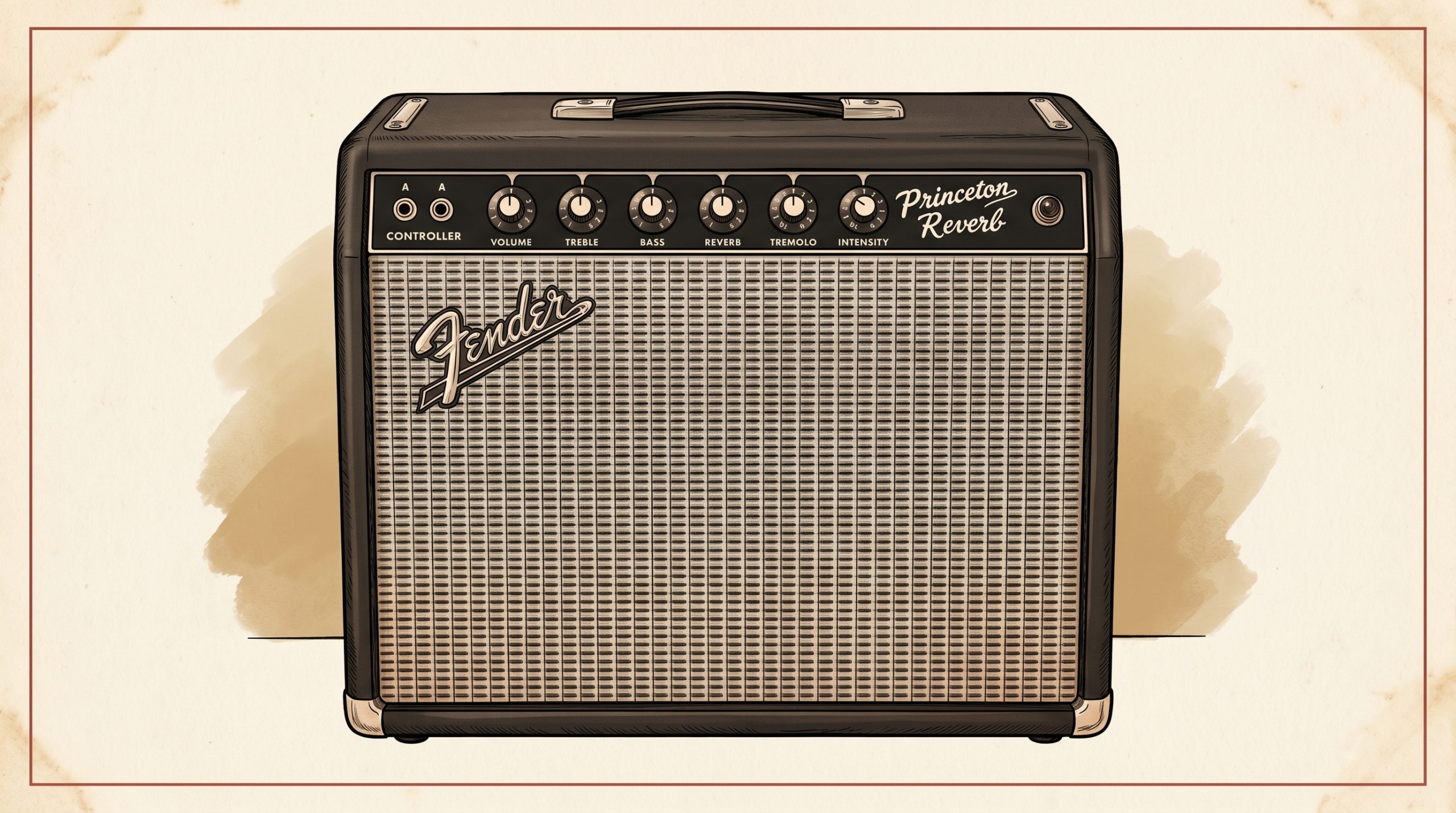
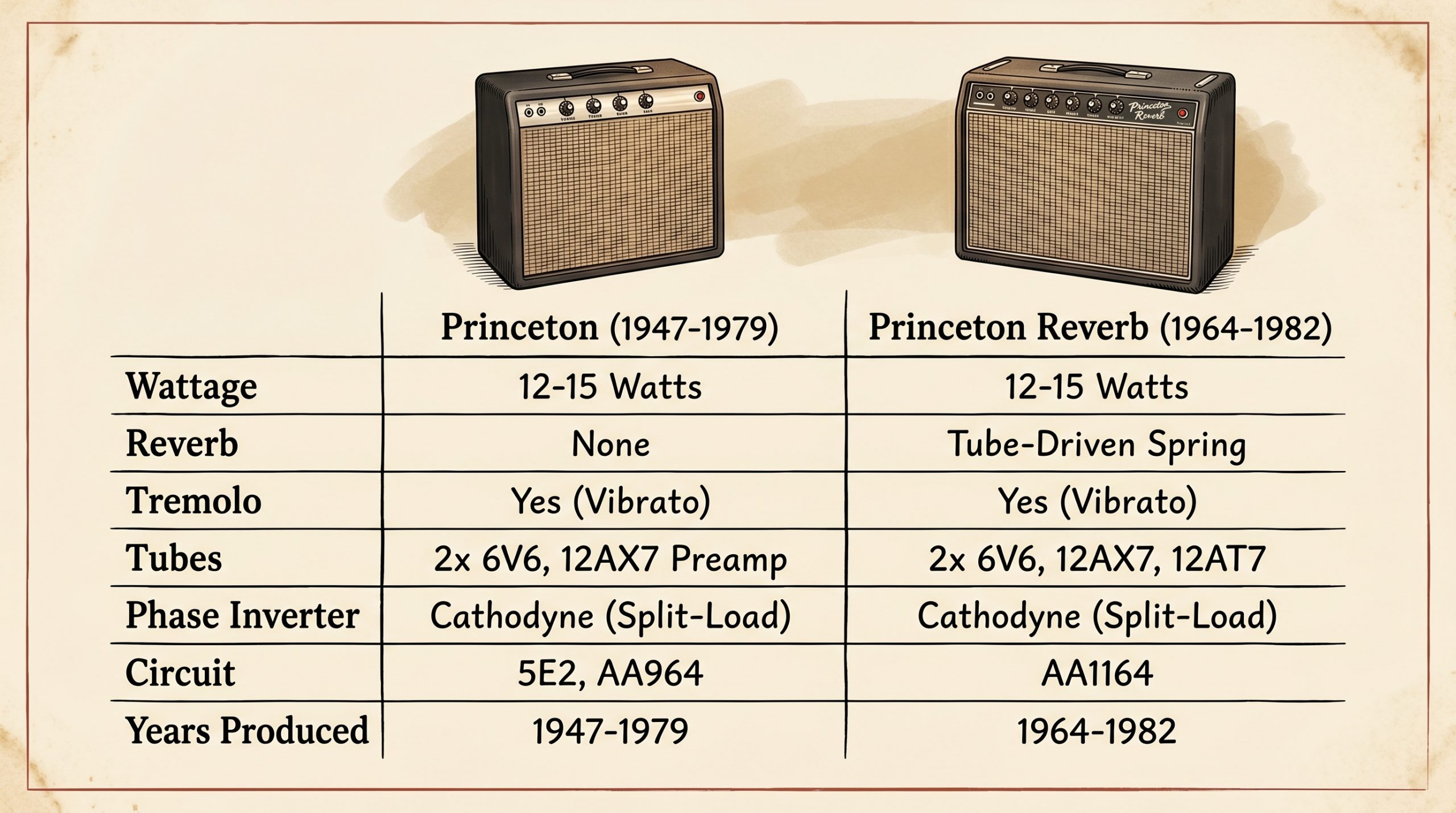
The Princeton (1947-1979) is a smaller, simpler amp without built-in reverb or tremolo. The Princeton Reverb (introduced 1964) is a separate model with built-in spring reverb and bias-modulated tremolo. They share the Princeton name and overall size but are different amps with different circuits, tube complements, and market values. A blackface Princeton without reverb is worth meaningfully less than a Princeton Reverb of the same year.
This is the single most common Princeton confusion, and it matters at every step of buying, selling, or identifying these amps. The original Princeton has been in production in various forms since 1947, starting as a small student amp in the original “Woodie” series and evolving through tweed, brown, blackface, and silverface eras. The Princeton Reverb is a separate model introduced in 1964, when Fender added a built-in spring reverb and tremolo circuit to what was already a successful small combo platform. The Reverb version was sold alongside the plain Princeton for the entire blackface and silverface eras, and the two amps were always treated as distinct products with different model numbers and different prices.
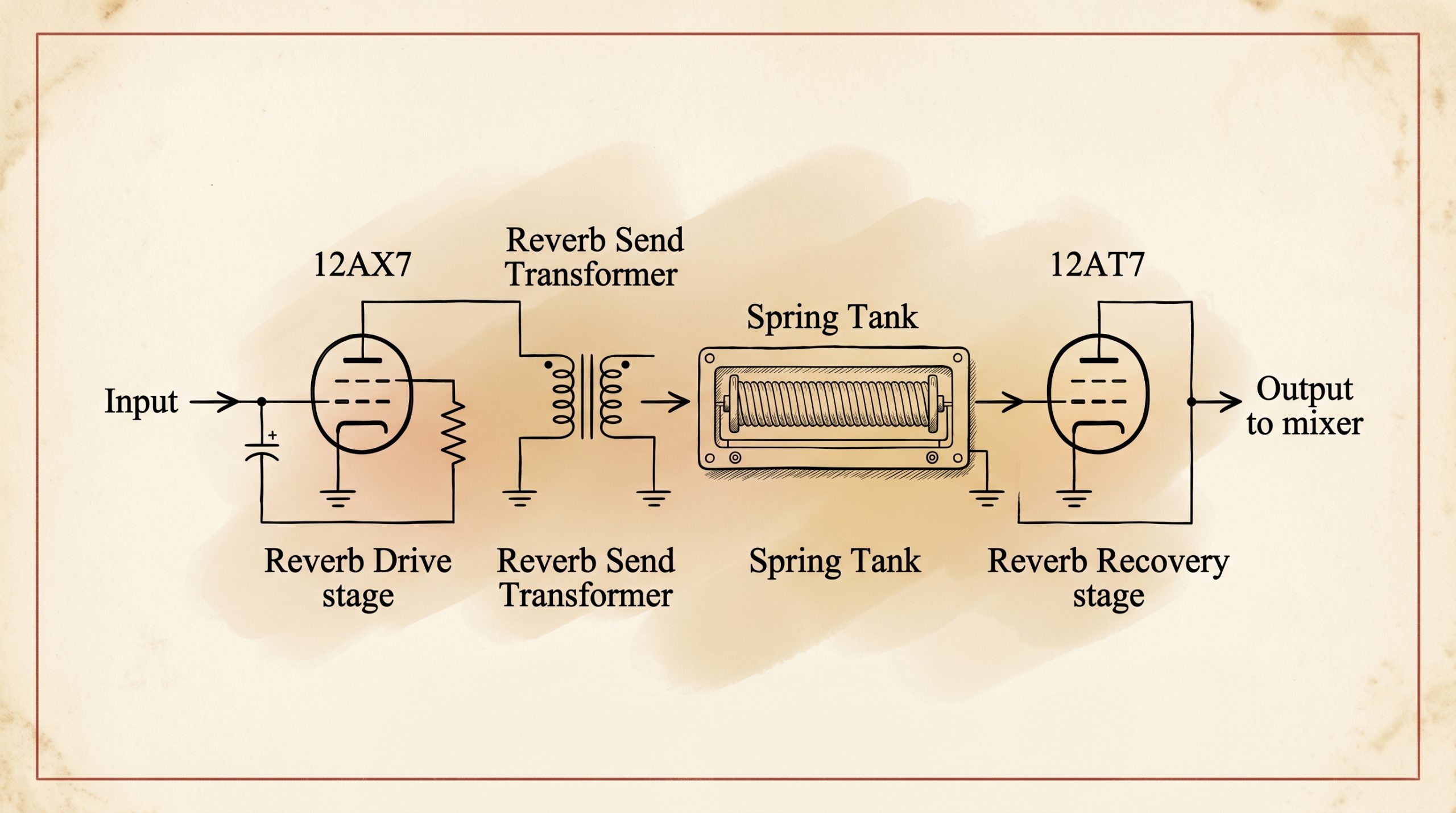
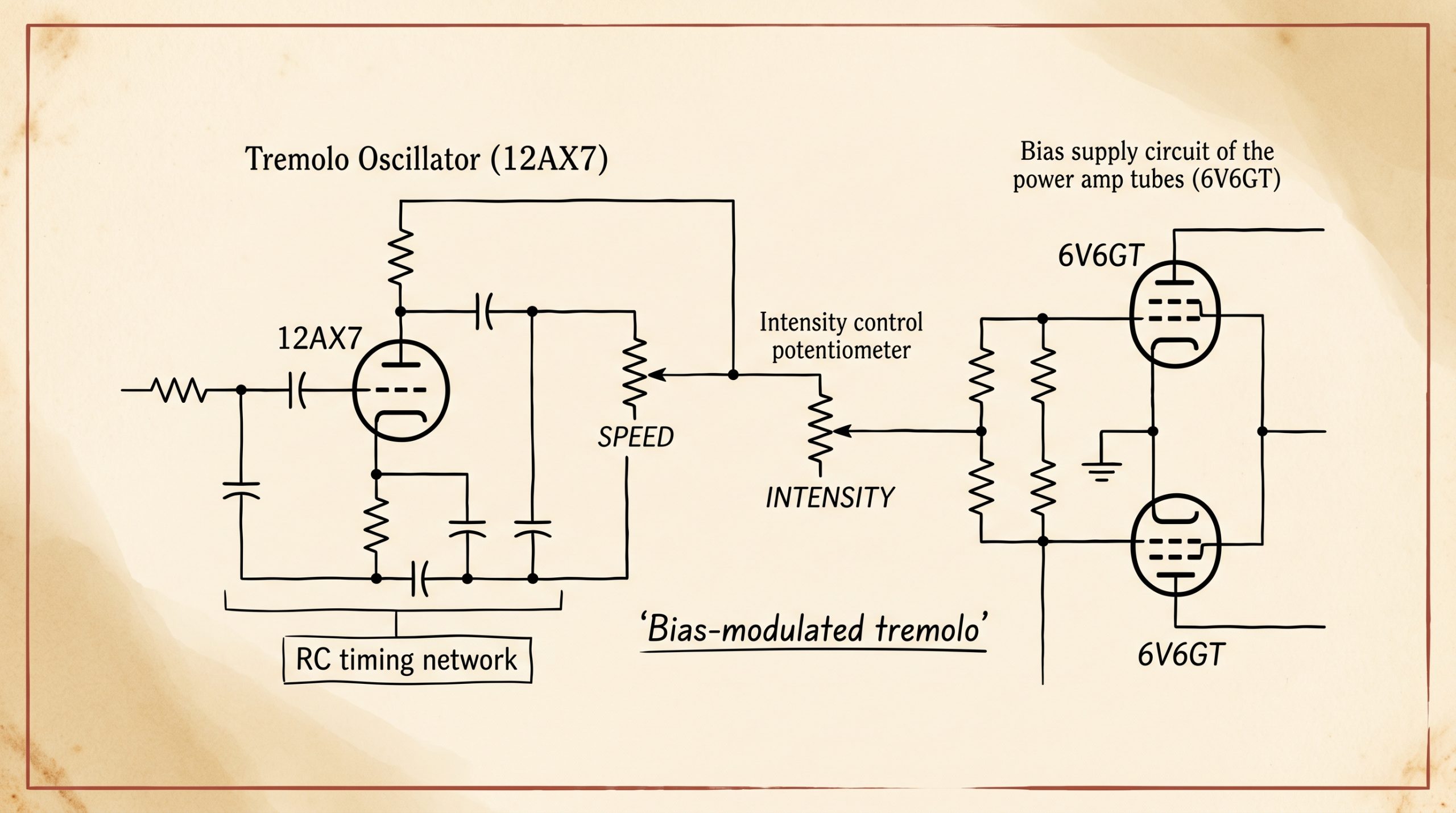
The Princeton Reverb adds three things to the basic Princeton platform that the non-reverb version lacks: a tube-driven spring reverb tank (driven by a dedicated 12AT7 send tube and recovered through one stage of the 12AX7 preamp tubes), a bias-modulated tremolo circuit (which modulates the bias voltage on the 6V6 power tubes through one stage of a 12AX7), and an extra preamp gain stage to feed the reverb circuit. The base Princeton has none of these. The two amps share the dual-6V6 power section, the 10-inch speaker format, and the basic blackface tone stack architecture, but the Princeton Reverb is a meaningfully more complex and capable amp.
Why does the distinction matter when buying or selling?
Vintage Princeton Reverbs trade at significantly higher prices than vintage Princetons without reverb, often double or more for the same era. A 1965 blackface Princeton Reverb in good condition is a $3,000+ amp. A 1965 blackface Princeton without reverb is typically $1,500-2,500. Misidentifying which amp you have (or are buying) can mean a difference of thousands of dollars.
Visually, the difference is on the control panel. The Princeton Reverb has six knobs: Volume, Treble, Bass, Reverb, Speed, and Intensity. The non-reverb Princeton has four knobs: Volume, Treble, Bass, Speed, and Intensity (no Reverb knob, since there is no reverb). The non-reverb Princeton may also lack the tremolo controls in earlier configurations, depending on era. The back panel of the Princeton Reverb has the reverb tank inside the cabinet bottom, with the reverb input and output RCA cables visible. The non-reverb Princeton has neither the tank nor the RCA cables.
Blackface Princeton Reverb (1964-1967, AA1164 circuit)
The blackface Princeton Reverb is the original, introduced in 1964 with the AA1164 circuit. Black Tolex cabinet, black control panel with white silkscreen, silver-and-black grille cloth, cream chicken-head knobs. 12 watts through a single 10-inch speaker. 1964-1967 production used “Fender Electric Instrument Co.” on the panel pre-CBS, transitioning to “Fender Musical Instruments” mid-1965 after the CBS acquisition.
The blackface era is what most players mean when they say “Princeton Reverb.” Production ran from late 1964 (December 1964 is the earliest documented first-year units, per The Music Emporium’s first-year production records) through approximately the third quarter of 1967, when Fender began transitioning the line to silverface cosmetics. Blackface Princeton Reverbs from this period are among the most consistently-built small combos Fender ever produced, with hand-wired construction, period-correct components, and the AA1164 circuit topology that has defined the amp’s voice for sixty years.
What does the AA1164 circuit designation mean?
AA1164 is Fender’s internal circuit designation for the original 1964-1967 blackface Princeton Reverb. The numbering follows Fender’s convention: AA indicates the schematic revision letter pair, 11 indicates November (the month the schematic was finalized), and 64 indicates the year 1964. The AA1164 designation appears on the tube chart sticker inside original blackface units and defines the standard against which all subsequent Princeton Reverb circuits are compared.
Other blackface-era Fender amps used parallel naming conventions. The Deluxe Reverb was AB763 (the August 1963 revision). The Twin Reverb was also AB763 in its blackface form. The Vibrolux Reverb was AB763. The non-reverb Princeton was AA964. The Bandmaster was AB763. The Bassman used AA864 or AA165 depending on production date. The point is that AA1164 is specific to the Princeton Reverb and signals the original circuit configuration that purists prize.
What is the original tube complement of a blackface Princeton Reverb?
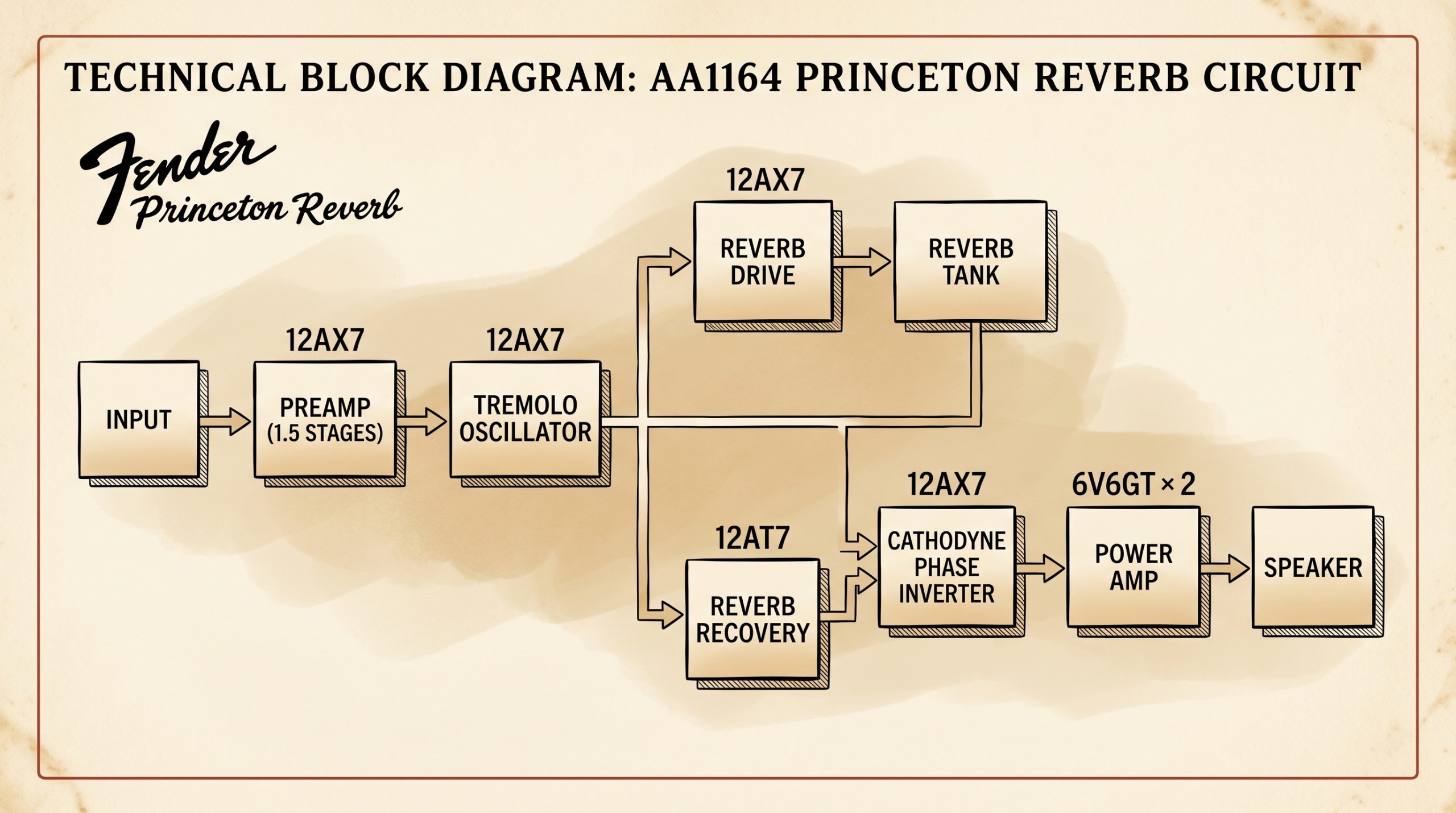
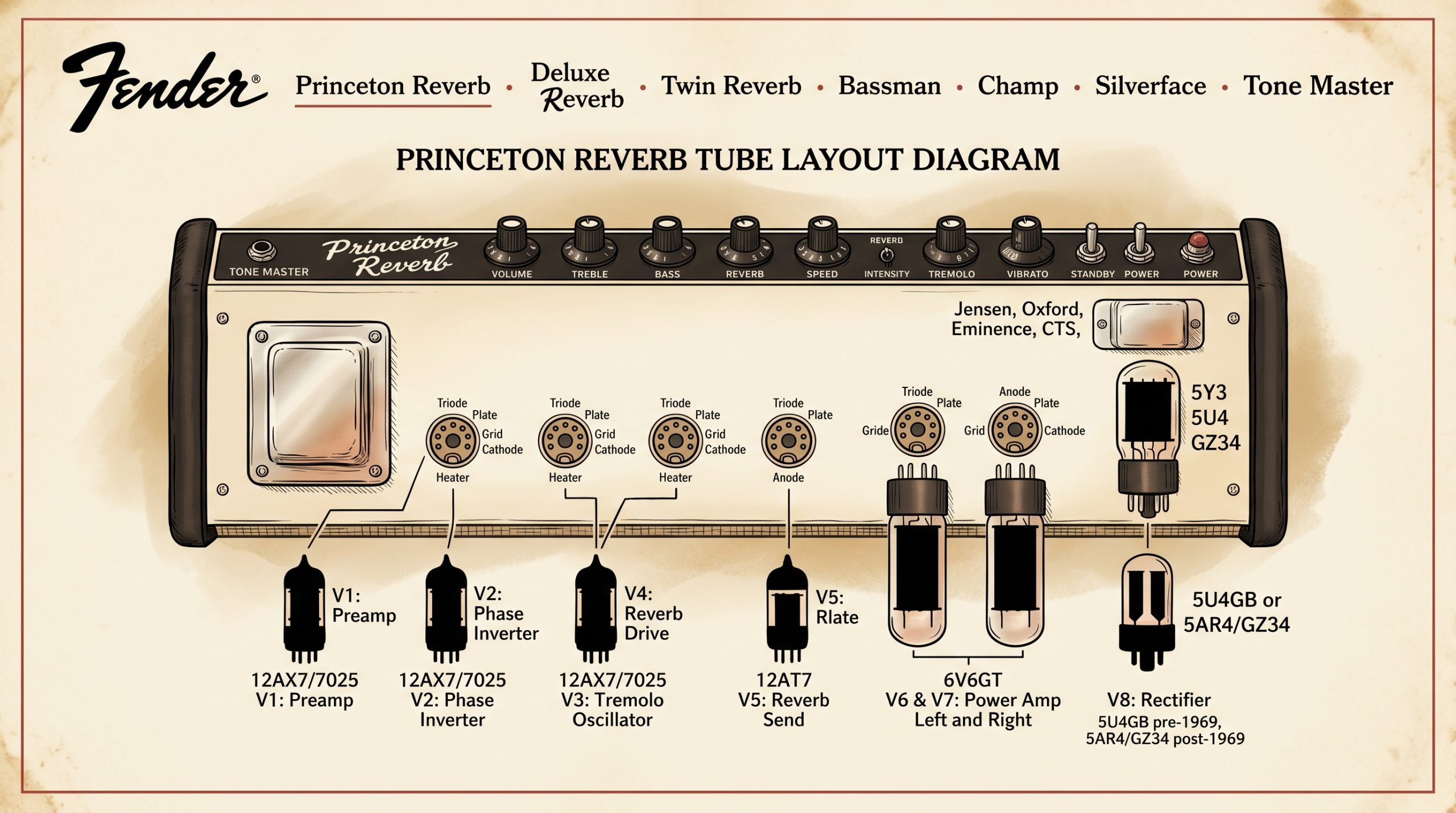
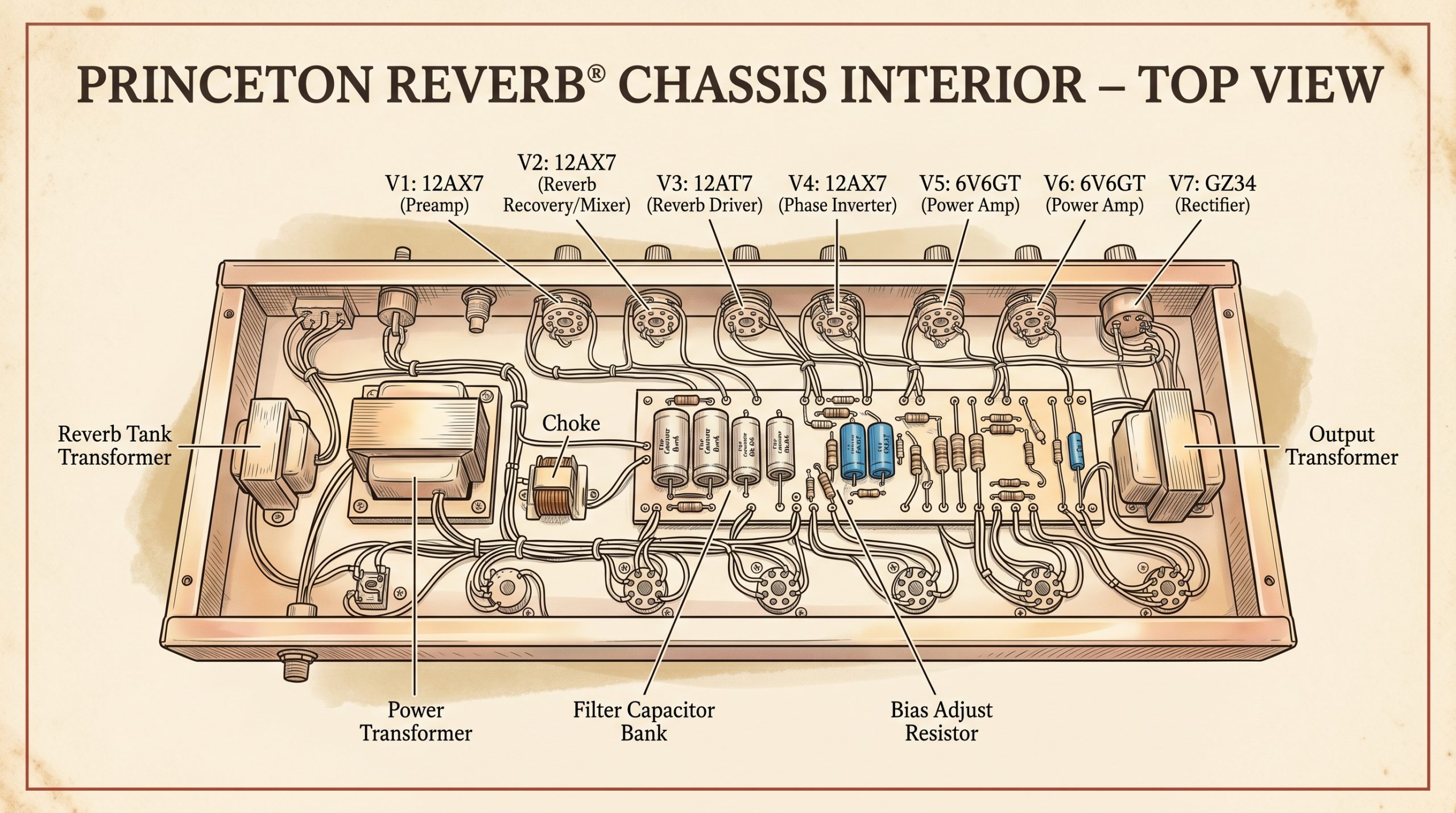
Three 12AX7/7025 preamp tubes, one 12AT7 reverb send tube, two 6V6GT power tubes, and one 5U4GB rectifier tube. Total of seven tubes. The three 12AX7s are distributed across multiple circuit functions: preamp gain (1.5 stages), cathodyne phase inverter (0.5 stage), tremolo oscillator (1 stage), and reverb drive plus recovery (2 stages).
The full tube layout, position by position, looking at the chassis from the rear:
| Position | Tube type | Function |
|---|---|---|
| V1 | 12AX7 / 7025 | Preamp gain stages (two stages of voltage amplification feeding the tone stack) |
| V2 | 12AX7 / 7025 | One half: reverb recovery / mix stage. Other half: tremolo oscillator (bias-wiggle modulation) |
| V3 | 12AT7 | Reverb send / reverb drive into the spring tank |
| V4 | 12AX7 / 7025 | One half: third gain stage. Other half: single-ended cathodyne phase inverter (split-load) |
| V5 | 6V6GT | Power tube (one half of push-pull pair) |
| V6 | 6V6GT | Power tube (other half of push-pull pair) |
| V7 | 5U4GB | Rectifier tube (pre-CBS AA1164 spec, changed to 5AR4/GZ34 after end of 1969) |
What were the original speakers in a blackface Princeton Reverb?
Original speakers were 10-inch Jensen C10R, Jensen C10N, Oxford 10J4, or later Oxford 10L5. The Jensen-equipped examples command small premiums on the vintage market. Per FenderGuru documentation, blackface Princeton Reverbs shipped with Jensens through early production and shifted toward Oxford speakers as Jensen production quality declined through 1965-1966.
Speaker identification on a vintage blackface unit requires reading the EIA code stamped or paint-marked on the speaker frame. Jensen speakers use EIA code 220 (the manufacturer prefix), Oxford uses 465, and the remaining digits encode year and week. A speaker stamped 220-548 decodes as Jensen, year-digit 5 (1965 in the blackface context), week 48. Speaker date codes should fall within a few months of the chassis production date for the amp to be considered fully original; significantly later speaker dates indicate replacement during service.
What does a pre-CBS blackface Princeton Reverb sound like?
Spanky, three-dimensional cleans at volumes 1 through 4 on the dial; progressive harmonic breakup from 5 through 7 (where the cathodyne phase inverter begins to compress and add character); thick, midrange-forward overdrive from 7 through 10 with the cathodyne PI clipping in a distinctive non-symmetric way that differs fundamentally from a Deluxe Reverb’s long-tailed pair clipping.
The voice is more compressed and less “clinical” than a Deluxe Reverb, with a slightly browner low midrange and a more touch-sensitive picking response. Players describe it as the “studio voice” of the blackface era because it produces a complete tone at moderate volumes that recording engineers can capture without fighting the amp’s volume. The reverb tank is the same Accutronics-style three-spring unit Fender used across the blackface line, and the tremolo is the same bias-wiggle circuit used on the larger amps, just driven by a smaller tube section.
Silverface Princeton Reverb (1968-1981)
Silverface production ran from 1968 through 1981. Early silverface units (1968-1969) retained the AA1164 circuit under silver-and-blue cosmetics; the drip-edge aluminum grille trim appeared during this period. Late 1969 saw the introduction of the AA764 circuit with a rectifier change from 5U4GB to 5AR4/GZ34 and bias resistor value changes. Cosmetically, 1968-1969 units have the drip edge; 1970+ units have a standard grille without aluminum trim. Production volume of silverface Princeton Reverbs was much higher than blackface, making these the more affordable entry point into vintage Princeton ownership.
The silverface era is more complicated than it first appears. The cosmetic transition from blackface to silverface happened in late 1967 and early 1968, but the circuit transitions happened on different timelines. Fender did not redesign the Princeton Reverb when it changed the cosmetics; the AA1164 circuit continued unchanged through the first year and a half of silverface production. Players and collectors who understand this can find “early silverface” Princeton Reverbs that are sonically identical to blackface units, at meaningfully lower prices.
What circuit revisions appeared in silverface Princeton Reverbs?
Early silverface (1968 through late 1969) retained the AA1164 blackface circuit. The AB1270 circuit appeared as a brief transitional revision with a 2000 pF highpass cap in the reverb recovery path and an updated tremolo electrolytic cap. From the end of 1969 onward, the AA764 circuit introduced the 5AR4/GZ34 rectifier change, bias resistor value changes, and increased tremolo electrolytic cap value. A pull-out “boost” switch on the volume pot was added in 1977.
The documented circuit transitions per Wikipedia and FenderGuru’s reference compilation:
| Years | Circuit | Key changes from prior revision |
|---|---|---|
| 1964-1967 | AA1164 | Original blackface spec. 5U4GB rectifier, 25 µF / 50V tremolo cap, no reverb recovery highpass cap |
| 1968-1969 (drip edge) | AA1164 (continued) | Same circuit as blackface. Cosmetics only: silver-and-blue panel, aluminum drip edge grille trim |
| 1969 transitional | AB1270 | 2000 pF highpass cap added in reverb recovery (slightly darker reverb). Tremolo cap increased to 50 µF / 70V |
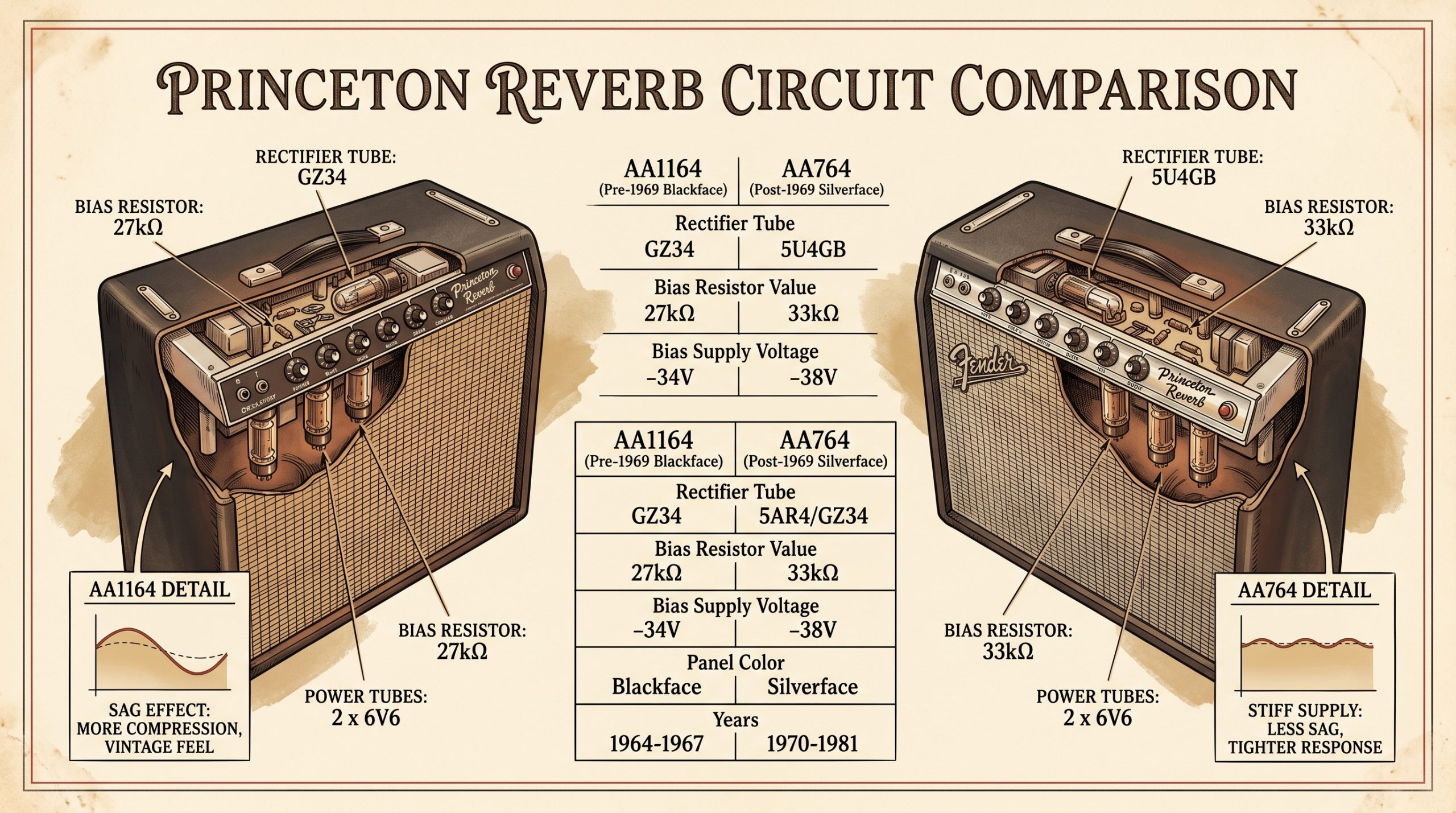
| Late 1969 – 1976 | AA764 | Rectifier changed from 5U4GB to 5AR4/GZ34. Bias resistor values changed. Tremolo electrolytic cap 50 µF / 70V |
| 1977-1981 | AA764 with boost mod | Pull-out “boost” switch added to volume pot. Continued AA764 base topology |
| 1980-1981 final | Late silverface | Cosmetically reverted to blackface for final two production years. Same AA764-base circuit internally |
What is the difference between early silverface and late silverface Princeton Reverbs?
Early silverface (1968-1969 with drip edge, AA1164 circuit) is sonically identical to blackface and trades at 60-80% of blackface value. Late silverface (1972+ with AA764 changes) is tonally different with tighter rectifier sag and altered bias values; trades at 40-60% of blackface value. A documented “blackface conversion” by a vintage tech can revert AA764 changes to AA1164 spec, typically adding $200-500 in value.
The practical implication: if you are buying a silverface Princeton Reverb, knowing which sub-era you are looking at substantially affects what you should pay and what you should expect to hear. A 1968 silverface with drip edge and an original AA1164-spec circuit is a near-blackface amp at a discount. A 1975 silverface AA764 with no service history is a project amp that needs a cap job and possibly a blackface conversion to reach its full potential.
What about the 1972-1974 humming Princeton Reverbs?
Per Greg Gagliano’s 20th Century Guitar research, certain Princeton Reverb production batches from 1972-1974 left the factory with the two 100-ohm heater filament ground resistors never installed. The result is excessive 60-cycle hum that capacitor replacement alone will not resolve. A qualified vintage tech can install the missing resistors and restore proper operation. This is documented as a real factory error, not a service modification.
If you encounter a 1972-1974 Princeton Reverb with hum that persists after a complete cap job, this is a likely cause. The fix is inexpensive and reversible. The error is discussed in detail in our Fender tube amp serial number guide as one of the documented CBS-era factory anomalies.
The cathodyne phase inverter, the secret to the Princeton’s voice
The Princeton Reverb uses a single-ended cathodyne (split-load) phase inverter built from half of a 12AX7 tube. The cathodyne has one input feeding both cathode and anode outputs that are inherently out of phase. The Deluxe Reverb, Twin Reverb, Super Reverb, and Pro Reverb all use long-tailed pair (LTP) phase inverters built from a full 12AX7 with a tail resistor. This single architectural difference is the most important reason a Princeton sounds different from a Deluxe at high volumes.
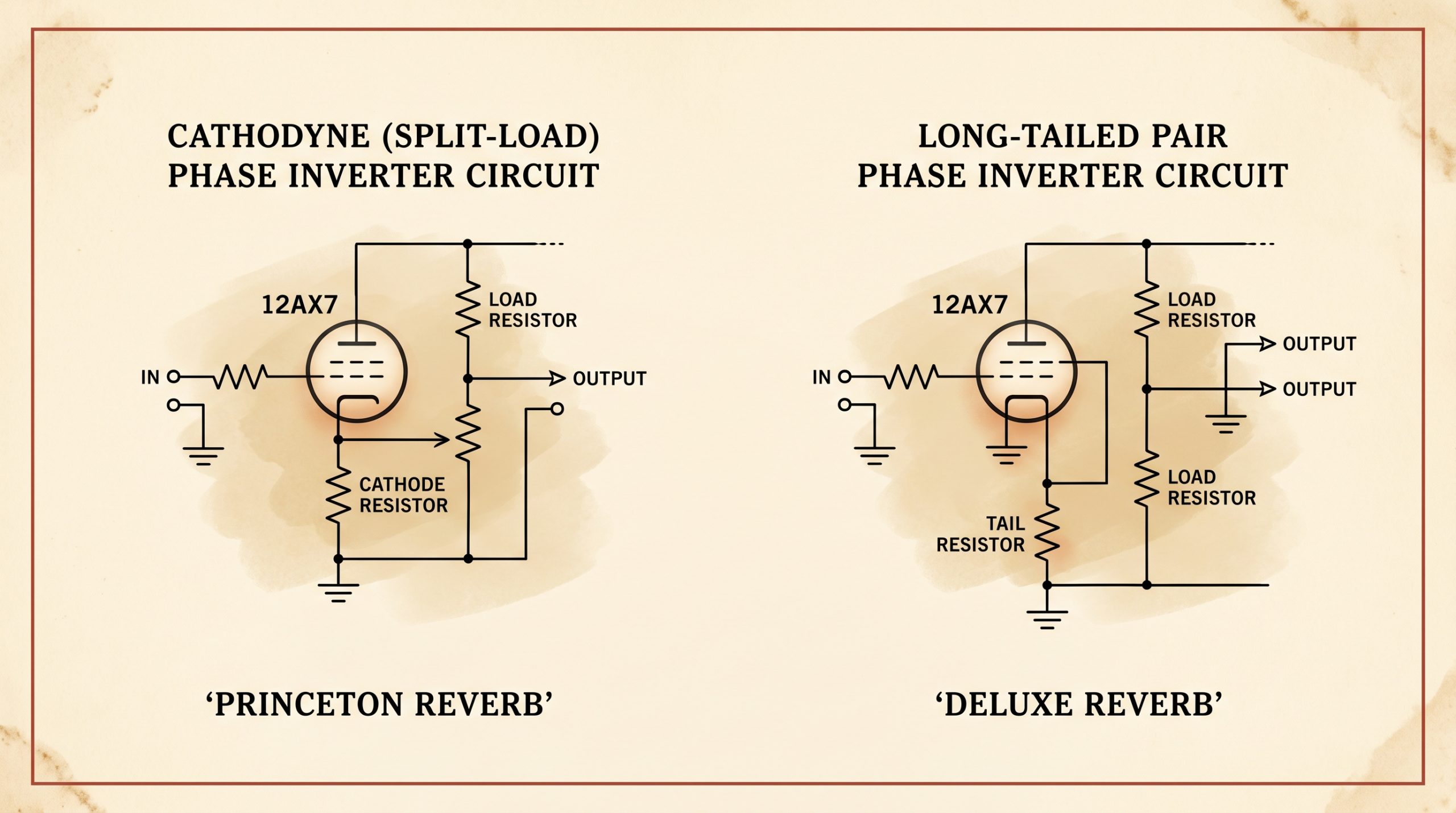
The phase inverter is the circuit stage that converts the single-ended signal coming out of the preamp into the balanced push-pull signal that drives the power tube grids. Every push-pull tube amp has one. The question is which topology it uses. The cathodyne is the simpler topology, requires fewer components, and uses only half a 12AX7. The long-tailed pair uses a full 12AX7, requires a tail resistor, and produces more output swing before it begins to clip. The cathodyne was used in tweed-era amps and small early-1960s Fenders; the long-tailed pair was Fender’s go-to topology from the blackface era onward for the larger amps.
Why does Fender use a cathodyne PI in the Princeton Reverb specifically?
Cost and circuit economy. The Princeton was designed as a budget amp in Fender’s lineup, and the cathodyne uses only half a 12AX7 (freeing the other half for additional preamp duties). The Deluxe Reverb, priced higher in Fender’s catalog, could afford the additional tube budget for a dedicated long-tailed pair phase inverter. Mojotone’s circuit analysis explains: “The Princeton was a budget amp for those who couldn’t afford a Deluxe Reverb which has a LTP PI.”
What does the cathodyne PI do tonally when the Princeton is overdriven?
When pushed hard, the cathodyne PI begins drawing grid current asymmetrically, producing a characteristic “nipple” or harsh clipping signature that many players recognize as core Princeton character. This is why aftermarket “Paul C” mods replace the cathodyne with a fixed-bias PI to clean up the clipping behavior. Other Princeton-specific mods (470k grid stopper resistor on the PI grid) tame the worst clipping artifacts without fundamentally changing the cathodyne topology.
The cathodyne PI is not a flaw to be fixed; it is the defining character of the amp. Players who want a “cleaned up” Princeton overdrive typically install the 470k grid stopper resistor on the PI grid (recommended by multiple TDPRI threads as the most musically useful Princeton mod). Players who want a fundamentally different overdrive character convert the cathodyne to a fixed-bias PI using the documented Paul C mod, which essentially turns the Princeton into a different amp. Both approaches are reversible; neither is required.
Tube complement and tube positions explained
The seven-tube Princeton Reverb layout: V1 (12AX7) preamp gain stages 1 and 2; V2 (12AX7) reverb recovery and tremolo oscillator (one stage each); V3 (12AT7) reverb send/drive; V4 (12AX7) third gain stage and cathodyne phase inverter (one stage each); V5 (6V6GT) power tube A; V6 (6V6GT) power tube B; V7 (5U4GB pre-1969 / 5AR4 post-1969) rectifier.
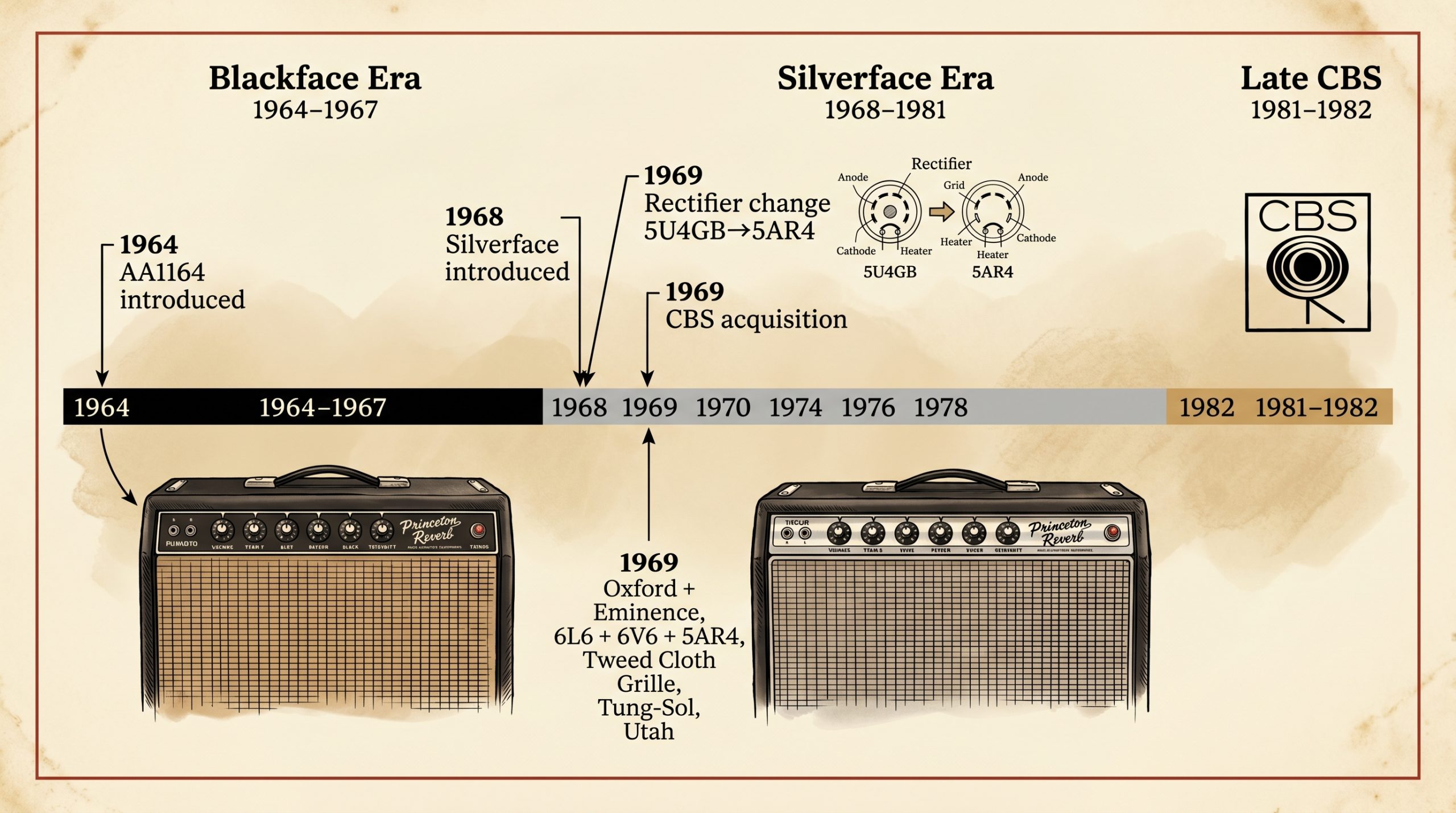
The interesting detail about the V4 12AX7 is that it serves two functions on a single tube: one triode is the third gain stage (which feeds into the reverb circuit and then to the PI input), and the other triode is the cathodyne phase inverter itself. This dual-duty use of the V4 tube is one of the things that distinguishes the Princeton Reverb’s tube layout from larger Fender amps, which dedicate full tubes to phase inverter duty.
Why does the Princeton Reverb use a 12AT7 instead of a 12AX7 for the reverb send?
The 12AT7 has lower gain and higher current handling than the 12AX7, making it better suited to driving the relatively low impedance of the spring reverb tank. Higher current means more drive capability into the spring transducer, which is necessary to produce the deep, lush reverb tail the amp is known for. The 12AT7 is used in this same role in the Deluxe Reverb, Twin Reverb, and other blackface-era Fender reverb amps.
You can substitute a 12AX7 in the V3 position, but the result will be a thinner, weaker reverb because the 12AX7 cannot drive the spring tank as effectively. This is one of the most common mistakes players make when “rolling tubes” in a Princeton Reverb; replacing the V3 12AT7 with a 12AX7 reduces reverb output rather than increasing it. Stick with 12AT7 in V3 unless you have a specific tonal goal in mind and understand the consequence.
How do I date a Princeton Reverb?
For blackface and silverface units (1964-1981), cross-reference four data points: the tube chart date code on the sticker inside the cabinet, the transformer date codes stamped on the bell ends, the speaker date code on the speaker frame, and the chassis serial number stamp. For modern reissues (2008-present), read the two-letter QA inspection sticker date code on the rear panel. The complete methodology for both vintage and modern dating is in our Fender tube amp serial number guide.
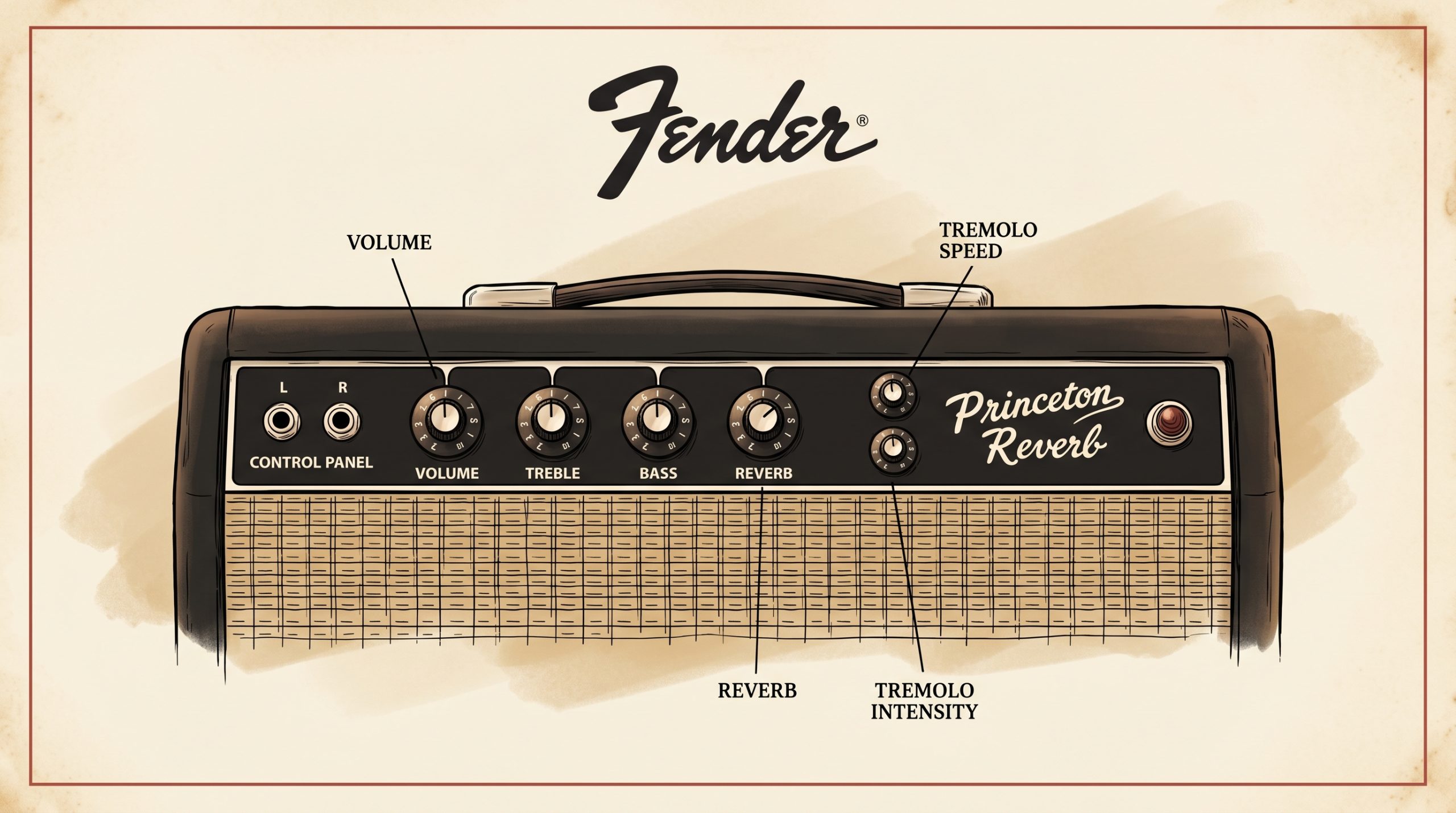
The Princeton Reverb follows the standard Fender dating methodology with no model-specific quirks beyond what affects the line generally. The tube chart system used by Fender from 1953 through 1969 places the date code as a two-letter stamp (first letter for year, A=1951 through S=1969; second letter for month, A=January through L=December). Blackface Princeton Reverbs from 1964 should have tube charts stamped with letter pairs beginning with N (1964), O (1965), P (1966), or Q (1967). A blackface-cosmetic Princeton Reverb with a tube chart outside this range is suspicious and warrants investigation.
What is the OA/OB green-ink stamp on Princeton Reverbs from early 1966?
OA stamps indicate January 1966 production. OB stamps indicate February 1966 production. Both appear in green ink rather than the standard black. These are documented factory errors per Greg Gagliano’s research where the year letter from 1965 (O) was carried over into early 1966 production before the factory corrected the stamp to P. By February or March 1966, production switched to the correct PA, PB pattern in standard black ink.
If you encounter a blackface Princeton Reverb with an OA or OB green-ink tube chart stamp, you are looking at a January or February 1966 unit, not a 1965 unit. The factory-error stamp is documented in our complete Fender amp dating guide and is one of the recognized markers that distinguishes legitimate vintage units from amps with replaced or non-original tube charts.
How do I verify a Princeton Reverb is fully original?
Cross-reference: tube chart date should match cosmetic era, transformer codes (606-YWW format for Schumacher) should date within six months of chassis assembly, speaker date code (220-YWW for Jensen, 465-YWW for Oxford) should date within a few months of the chassis, and the chassis serial number stamp should fall in the documented production range for the indicated year. Significant date gaps among components indicate replacement parts.
Originality affects vintage value substantially. A Princeton Reverb with matching dates across all components is worth meaningfully more than the same amp with a replacement transformer, speaker, or other major component. The Music Emporium’s first-year 1964 Princeton Reverb listing notes that the original Jensen speaker was kept boxed and replaced with a modern Jupiter M10C for playing duty, which is the right approach: preserve the original speaker for value while using a modern speaker for everyday playing.
’65 Princeton Reverb Reissue (2008-present)
The ’65 Princeton Reverb Reissue is the standard continuously-produced reissue, introduced in 2008 and still in production. Manufactured in Corona, California with PCB-based construction (not hand-wired). 12 watts through a 10-inch Jensen C-10R speaker (the Italian-made Jensen reissue, not vintage Chicago-made Jensen). Black Tolex, silver-and-black grille cloth, blackface-style control panel. Current retail $1,200-1,400, used $800-1,100.
The ’65 Reissue is the most affordable and most popular current-production Princeton Reverb. It is built on a modern printed-circuit-board chassis rather than hand-wired point-to-point construction, which keeps the price accessible and the build consistency high. The circuit is derived from the AA1164 blackface specification but adapted for modern component tolerances and PCB layout. The voice is recognizably “Princeton Reverb” but slightly more polished and less idiosyncratic than a vintage blackface unit.
What does the ’65 Reissue sound like compared to a real vintage Princeton Reverb?
The general voice is very close to vintage blackface, with the same dual-6V6 spank, blackface tone stack response, and cathodyne PI clipping character. Differences include: slightly tighter low end (modern Jensen C-10R is voiced with less low-end thump than vintage Jensens), more consistent build (PCB construction reduces unit-to-unit variation), and somewhat less “compression character” in the power section (modern components tolerate less sag). Most players agree the ’65 Reissue captures 85-90% of the vintage tone at 25-35% of the vintage price.
For working players who need a reliable Princeton Reverb that gigs without the anxiety of carrying a $4,000+ vintage amp, the ’65 Reissue is the obvious choice. For studio players who want the absolute closest match to vintage character, the ’64 Custom (covered below) is closer at roughly double the price. The ’65 Reissue’s sweet spot is the player who wants the Princeton Reverb voice for everyday use without paying vintage premiums or hand-wired premiums.
What should I watch for when buying a used ’65 Reissue?
Reverb tank condition (Accutronics tanks degrade after 8-10 years and may need replacement), tube wear (factory tubes are usable but not premium grade; consider upgrading), speaker condition (the Italian Jensen C-10R is acceptable but many owners upgrade to Jensen P10R alnico, Eminence Maverick, or Weber for improved tone), and footswitch (the included two-button footswitch is often lost over time; replacements are available from Fender).
Production runs from different years can vary in component sourcing (different reverb tank suppliers, different tube vendors). These variations are minor and do not substantially affect the amp’s voice or value. A clean ’65 Reissue from any production year between 2010 and 2024 is essentially equivalent for buying purposes.
’64 Custom Princeton Reverb (2020-present)
The ’64 Custom Princeton Reverb was introduced at NAMM January 2020 as Fender’s high-end hand-wired Princeton Reverb reissue. Built in Corona, California with hand-wired point-to-point construction, the hand-wired AA1164 circuit uses Fender Vintage Blue tone capacitors, three 12AX7 and one 12AT7 preamp tubes, a matched pair of 6V6 power tubes, a 5AR4/GZ34 rectifier, and a 10-inch Jensen alnico P10-R speaker. Solid pine cabinet, extra-heavy textured vinyl covering. 32 lbs. MSRP $2,299. Joined the American Hand Wired Series alongside the ’64 Custom Deluxe Reverb, ’57 Custom Champ, ’57 Custom Deluxe, and ’57 Custom Twin.
The ’64 Custom is Fender’s most expensive current-production Princeton Reverb, targeted at vintage tone enthusiasts who want the hand-wired construction and pre-CBS-style components without paying genuine vintage prices. The price point ($2,299 MSRP) is roughly double the standard ’65 Reissue, reflecting the hand-wired labor and premium component selection.
What does the ’64 Custom Princeton Reverb sound like compared to a real 1964 blackface?
Closer to vintage 1964 character than the ’65 Reissue can manage, but not identical. The hand-wired construction, Vintage Blue tone capacitors, and Jensen alnico P10-R speaker all contribute meaningfully to a more “vintage” voice. The 5AR4/GZ34 rectifier (instead of the original 1964’s 5U4GB) gives slightly tighter low-end response. Players who have A/B compared a ’64 Custom against a genuine 1965-1967 blackface unit describe the ’64 Custom as “95% of the way there” tonally, at roughly half the price of a genuine vintage blackface in equivalent condition.
For the player who specifically wants pre-CBS character and hand-wired build quality without the vintage hunt or the vintage anxiety, the ’64 Custom is the strongest current-production choice. For most players, the standard ’65 Reissue delivers enough Princeton character for everyday needs at significantly lower cost. The ’64 Custom is a serious purchase that rewards serious players.
’68 Custom Princeton Reverb (2013-present)
The ’68 Custom Princeton Reverb was introduced late 2013 as part of Fender’s ’68 Custom Series (alongside the ’68 Custom Twin Reverb and ’68 Custom Deluxe Reverb). Manufactured in Mexico (not Corona, despite frequent dealer mistake) with PCB construction. 12 watts, 10-inch Celestion Ten 30 speaker (not Jensen), three 12AX7 and one 12AT7 preamp tubes, two 6V6 power tubes, 5AR4 rectifier. Modified tone circuit and reduced negative feedback for greater pedal-friendliness and quicker overdrive onset. Silver-and-turquoise front panel, aluminum drip-edge trim. 34 lbs. Current retail $1,300-1,500. Schumacher transformers.
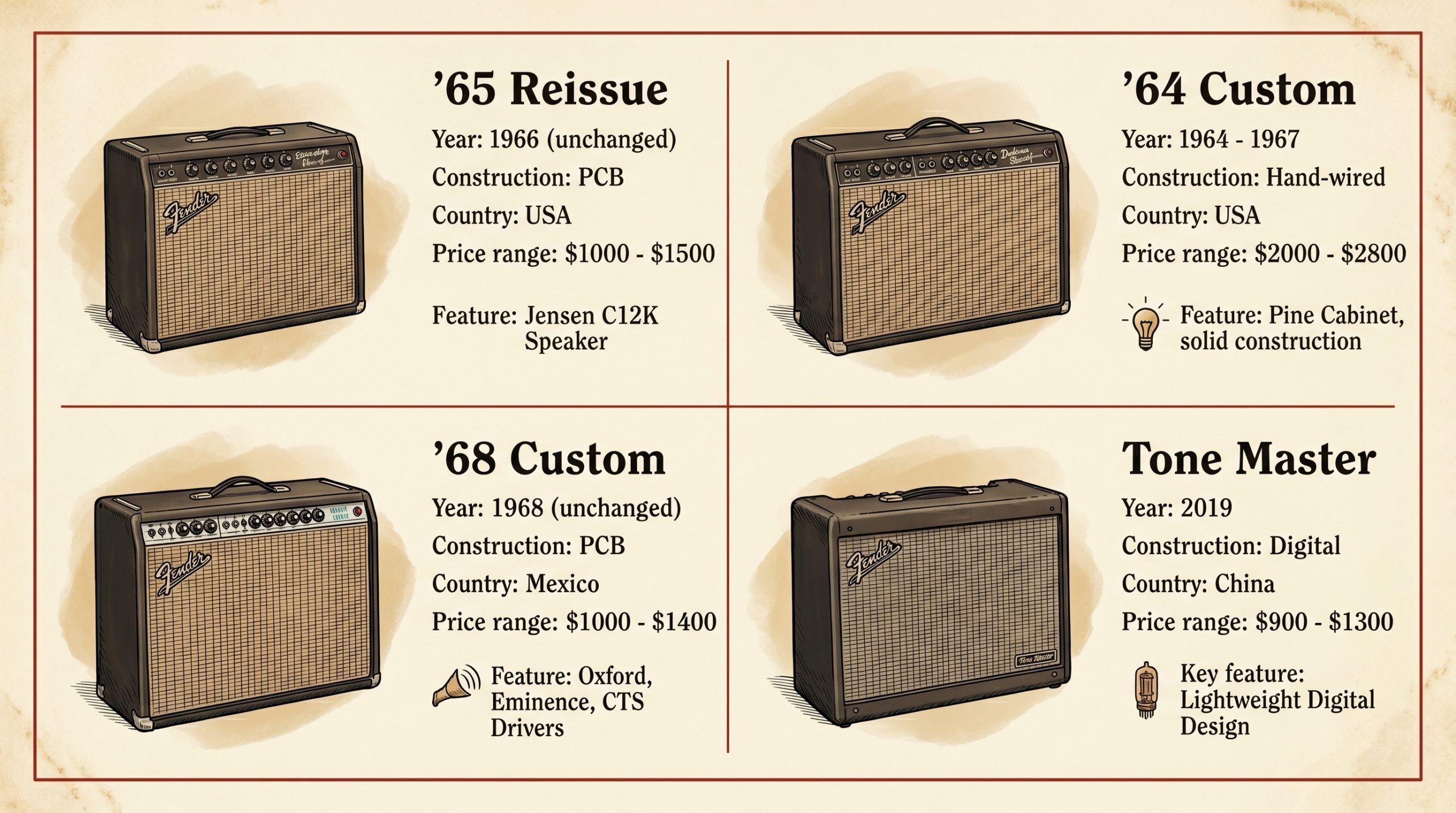
The ’68 Custom is the silverface-cosmetic Princeton Reverb with a modified circuit. Fender is explicit in marketing materials that this is not a faithful 1968 reissue; it is a “Custom” series amp with intentional circuit modifications targeting modern players who want a more pedal-friendly platform with easier overdrive. Per the MusicRadar review: “The amp is designed to break up a little earlier than its forebear, and features reduced negative feedback, which Fender’s marketing blurb claims will offer a greater degree of touch-sensitivity.”
How is the ’68 Custom Princeton Reverb circuit different from a real silverface?
Two main modifications. First, the tone stack is modified for greater interaction with pedals (slightly different cap values in the EQ section that respond differently to overdrive pedals). Second, the negative feedback loop is reduced, which makes the amp more touch-sensitive and starts to overdrive at lower volumes than a vintage silverface would. The 10-inch Celestion Ten 30 speaker (a British design produced in China) is also different from any vintage Princeton Reverb, which used Jensen, Oxford, or CTS speakers exclusively.
The result is an amp that overdrives easier, takes pedals better, and has more touch dynamics at moderate volumes than either a vintage silverface unit or the standard ’65 Reissue. It does not, however, sound like a real 1968 silverface Princeton Reverb (which would have had Oxford or CTS speakers and the unmodified silverface tone stack). Players who want true 1968 silverface tone should buy a real vintage silverface unit, not the ’68 Custom.
Where is the ’68 Custom Princeton Reverb made?
Mexico. Per the Reverb.com product listing and Sweetwater’s specifications, the ’68 Custom Princeton Reverb is manufactured at Fender’s Ensenada, Mexico facility, not Corona, California. This is a common dealer-listing mistake because the other ’68 Custom Series amps (Deluxe Reverb, Twin Reverb) include both Corona-built and Mexico-built variants depending on year. The ’68 Custom Princeton Reverb specifically has been Mexico-built since introduction.
Tone Master Princeton Reverb (2022-present)
The Tone Master Princeton Reverb is Fender’s digital modeling Princeton Reverb, introduced in 2022 (after the Tone Master Deluxe Reverb in 2019, the Tone Master Twin Reverb in 2020, and the Tone Master Super Reverb in 2021). Built in China with 50W solid-state amplification configured to model 12W of tube performance. 10-inch Jensen C10R speaker. Six-position power attenuator (0.3W, 0.75W, 1.5W, 3W, 6W, 12W). XLR line out with IR cabinet simulations captured with Shure SM57 and Royer R-121 microphones. Solid pine cabinet. 19-20 lbs (almost 15 lbs lighter than the tube version). $899-999 retail.
The Tone Master Princeton Reverb is the “latest addition to Fender’s acclaimed series of legendary amplifiers” per Fender’s own product description and the Guitar World announcement. It uses Fender’s proprietary DSP modeling process to reproduce the Princeton Reverb’s voice without tubes. The aim, according to Fender marketing, is “a like-for-like tonal recreation” of the tube version with the practical advantages of digital construction: significantly lighter weight, no tube maintenance, and a useful power attenuator for low-volume practice.
What are the practical advantages of the Tone Master over the tube Princeton Reverb?
Three main advantages. First, weight savings: 19-20 lbs versus 34 lbs for the tube reissue, useful for working players who carry amps to gigs. Second, the six-position power attenuator (0.3W, 0.75W, 1.5W, 3W, 6W, 12W) genuinely lets you crank the amp at apartment volumes, which the tube version cannot do. Third, the XLR balanced line output with IR cabinet simulations lets you record direct or run silent stage setups, useful for studio work and silent-rehearsal contexts.
The trade-offs are also real. The tube version retains the dynamic feel and harmonic response that some players prefer for studio recording. The Tone Master sounds genuinely close on recordings but has been described by Thomann reviewer comparison as “more compressed” and “less organic and lively” than a true vintage tube Princeton Reverb. For working players who prioritize practical advantages (weight, low-volume usability, direct recording), the Tone Master is the better choice. For studio players who prioritize maximum tonal fidelity and dynamic response, the tube versions remain the reference.
What does the Tone Master attenuator actually do?
The six-position rotary switch reduces the amp’s modeled output power: 0.3W (bedroom practice without disturbing anyone), 0.75W (apartment-friendly), 1.5W (light home use), 3W (moderate home/studio), 6W (small-room rehearsal), and 12W (full Princeton volume). Unlike attenuators on tube amps which reduce speaker output post-amplification, the Tone Master attenuator adjusts the modeled gain stages in the digital signal path. This means you get the cranked-amp tone (modeled breakup, sag, compression) at any output level, which a tube amp cannot easily achieve.
This is the Tone Master’s most genuinely useful feature for many players. A tube Princeton Reverb at 0.3W produces almost no audible signal; the Tone Master at 0.3W reproduces the cranked-Princeton tone at conversational volume. For players who live in apartments, shared housing, or who practice late at night, this capability alone can justify the digital construction.
The 1982 Princeton Reverb II (Paul Rivera era)
The Princeton Reverb II is a 1982-1986 Paul Rivera-designed amp that briefly replaced the original Princeton Reverb under CBS ownership. It is a completely different amp despite the shared name, with channel switching, treble boost, mid boost, switchable lead/overdrive, and significantly more output power. Designed by Ed Jahns under Paul Rivera’s leadership. Discontinued in 1986 when the Princeton Reverb II was itself replaced. Trades on the vintage market at $400-900 depending on condition.
The Princeton Reverb II appears in the Princeton lineage timeline but is essentially unrelated to the amp that the rest of this guide covers. Per the Wikipedia Princeton Reverb article, “This Paul Rivera-specified Fender guitar amplifier was introduced in 1982 to replace the Princeton Reverb. It was a completely different and significantly more powerful amplifier. Designed by Ed Jahns, it featured a built-in reverb, treble boost and mid boost controls, and a switchable lead (overdrive) effect.”
If you are shopping for a “Princeton Reverb” and a seller offers a “Princeton Reverb II” from the 1982-1986 era, understand that you are looking at a different amp than the AA1164/AA764 classic Princeton Reverb. The Reverb II has its own character (channel switching, modern feature set, F-prefix Rivera-era serial numbers) that some players appreciate, but it is not a substitute for an original AA1164-circuit Princeton Reverb if that is the tone you want.
Princeton Reverb 2026 market values
The 2026 market ranges below reflect Reverb.com completed-sale data and current retail pricing for amps in good-to-excellent condition with documented originality. Mint condition with complete documentation can command 25-40% above these ranges; project-grade amps with significant non-original parts trade at 30-50% below.
Vintage Princeton Reverb originals (2026)
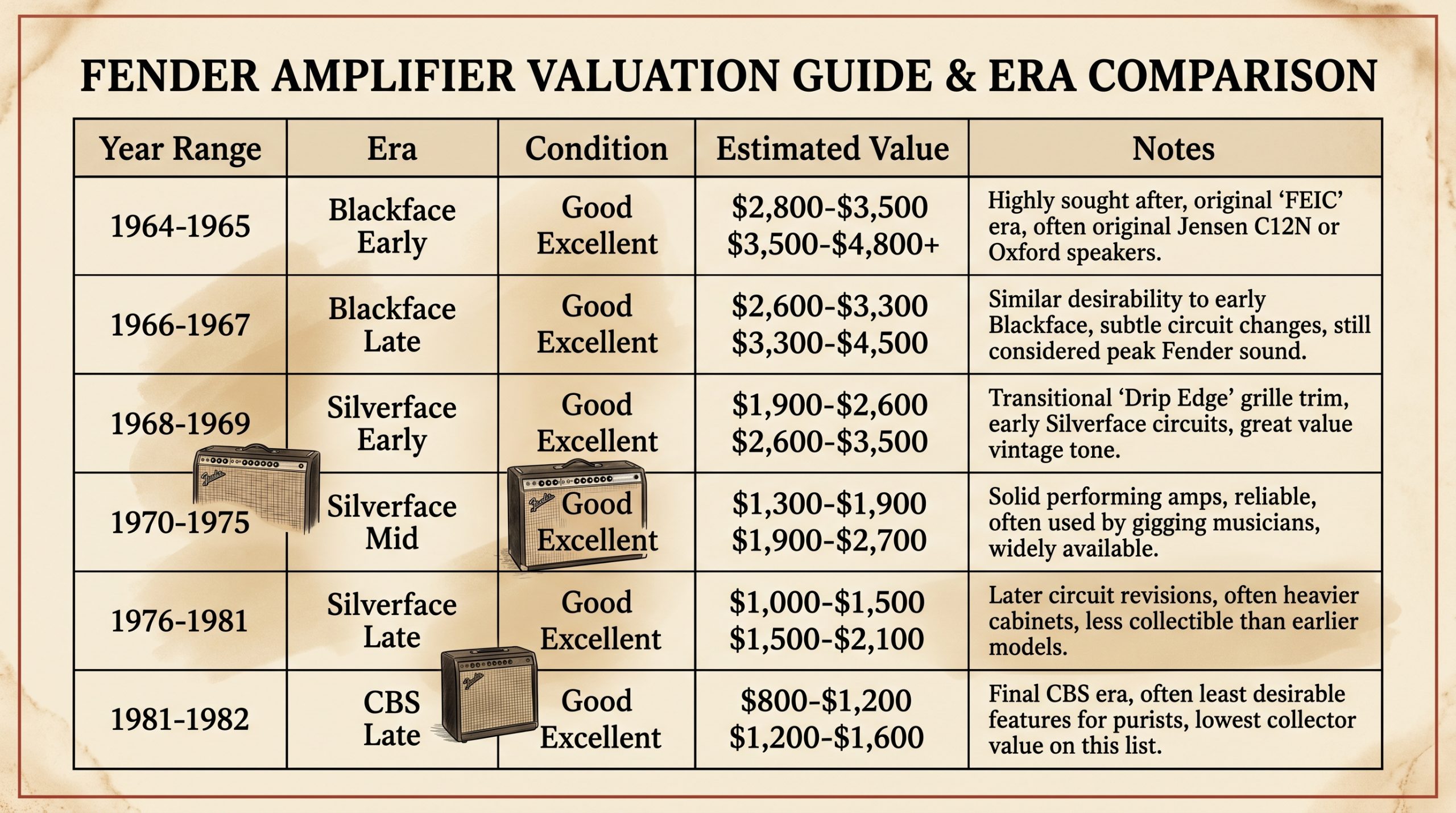
- Blackface 1964-1967 (AA1164): $2,800-4,500 in good-to-excellent condition with documented originality. Premium 1965-1966 examples with original Jensen speaker and full provenance reach $5,000+. First-year 1964 production units (December 1964 documented earliest) command additional collector premium.
- Early silverface 1968-1969 with drip edge and AA1164 circuit: $1,800-3,000. Strong relative value choice. Sonically very close to blackface at meaningful discount.
- Mid silverface 1970-1976 (AA764 circuit, no boost mod): $1,200-2,200 unmodified. Documented blackface conversions by recognized vintage techs add $200-500.
- Late silverface 1977-1981 with boost pull switch: $900-1,800 depending on cosmetic condition. The 1980-1981 cosmetically-reverted-to-blackface final-year units have a small niche collector following.
Modern Princeton Reverb production (2026)
- ’65 Princeton Reverb Reissue: $1,200-1,400 new MSRP; $800-1,100 used in good condition.
- ’64 Custom Princeton Reverb: $2,299-2,599 new MSRP; $1,800-2,200 used. Has held value remarkably well since 2020 introduction. One Long & McQuade reviewer noted his 2020-purchased ’64 Custom appreciated $800 by 2023.
- ’68 Custom Princeton Reverb: $1,300-1,500 new MSRP; $900-1,200 used.
- Tone Master Princeton Reverb: $899-999 new MSRP; $650-800 used.
What drives Princeton Reverb value the most?
For vintage units, in order of importance: originality of major components (chassis, transformers, original speaker), cosmetic condition (Tolex without re-cover, original grille cloth, original handle and knobs), working condition (recent cap job, properly biased tubes, no hum issues), and documentation/provenance. For reissues, condition and service history matter most; original components are usually present and unchanged.
Original speakers specifically affect value substantially on vintage blackface units. A 1965 Princeton Reverb with its original Jensen C10R in playable condition is worth meaningfully more than the same amp with a replacement speaker, even a high-quality reissue or boutique replacement. Document the original speaker even if you choose to play through a different one, and keep the original speaker stored for the amp’s future sale.
Famous Princeton Reverb players and recordings
The Princeton Reverb appears on more hit recordings than most players realize. Documented users include Duane Allman (slide on Derek and the Dominos’ “Layla”), Louie Shelton (Wrecking Crew sessions with a 1969 Princeton Reverb on countless hit recordings), Tommy Tedesco and Clarence White (Beach Boys recordings), Larry Carlton (Steely Dan, Joni Mitchell, The Crusaders sessions), Jim Campilongo (Telecaster virtuoso who built his career around the amp), Bill Frisell, Ryan Adams (Gold album), Mike Campbell, and Ed O’Brien of Radiohead.
Duane Allman and “Layla”
Per GuitarPlayer Magazine’s classic gear coverage, Duane Allman is documented as having used a Princeton Reverb for the slide guitar parts on Derek and the Dominos’ “Layla” (1970). Note: this was Allman’s choice for the slide overdubs at Criteria Studios in Miami, not Eric Clapton’s main amp for the album. Some online sources conflate the two players’ amp choices on the Layla sessions.
The Layla sessions are documented in detail in the Wikipedia Eric Clapton article: the Dominos worked at Criteria Studios in Miami with Atlantic producer Tom Dowd in 1970. Allman joined the sessions partway through after meeting Clapton at an Allman Brothers concert. Allman’s slide guitar contributions (“Layla”, “Tell the Truth”, “Nobody Knows You When You’re Down and Out”, “Key to the Highway”, and others) are credited to him on the Layla and Other Assorted Love Songs album, and the Princeton Reverb appears on the slide parts specifically.
Louie Shelton’s 1969 Princeton Reverb and the Wrecking Crew
Louie Shelton, a member of the Wrecking Crew (Los Angeles session musicians who played on hundreds of late-1960s and 1970s hit recordings), used a single 1969 Fender Princeton Reverb on countless hit recordings throughout his career. Per the MusicRadar feature, the Princeton was practical for sessions because the open-mic recording environment of the era required amps that could be cranked for tone without overpowering the drum and piano microphones.
Jim Campilongo and the modern Princeton Reverb canon
Jim Campilongo, the Telecaster virtuoso known for the Telecasters, is the contemporary player most associated with extreme Princeton Reverb usage. His instructional videos and live performances feature a Princeton Reverb almost exclusively, often run with all knobs cranked and the guitar volume used to control output dynamics. The “Campilongo move” of turning the Princeton’s volume, bass, and treble all the way up and controlling the amp from the guitar is widely referenced in tonebuilding tutorials.
Campilongo’s playing style depends on the Princeton’s specific overdrive character (the cathodyne PI clipping discussed above) and would not transfer cleanly to a Deluxe Reverb or other Fender amp. This is one of the clearest examples of how the Princeton’s cathodyne phase inverter is not a limitation but a feature that defines a specific musical vocabulary.
Larry Carlton and Steely Dan sessions
Larry Carlton used a Princeton Reverb on mid-1970s sessions with Joni Mitchell, Steely Dan, and The Crusaders, per TDPRI community documentation. Carlton’s reputation for clean, articulate single-coil tones with sophisticated harmonic content was built in part on the Princeton’s ability to deliver Fender voice at studio-friendly volumes.
Other notable Princeton Reverb users
- Tommy Tedesco and Clarence White: Beach Boys hit recordings, multiple sessions across the late 1960s
- Bill Frisell: confirmed Princeton Reverb user (per studio reports of a “house amp PR” he enjoyed during sessions)
- Ryan Adams: Gold album (2001) and subsequent releases reportedly used Princeton Reverbs extensively
- Kenny Vaughan: Marty Stuart’s longtime guitarist, documented Princeton Reverb user
- Eric Clapton: per Reverb’s blackface Fender guide and TONE3000 documentation
- Mike Campbell (Tom Petty and the Heartbreakers): per TONE3000, though primarily known for the non-reverb Princeton on certain sessions
- Ed O’Brien (Radiohead): per TONE3000
- Teenie Hodges: legendary Memphis soul session guitarist (per TDPRI, used blackface Princeton non-reverb specifically)
Princeton Reverb vs Deluxe Reverb vs Twin Reverb
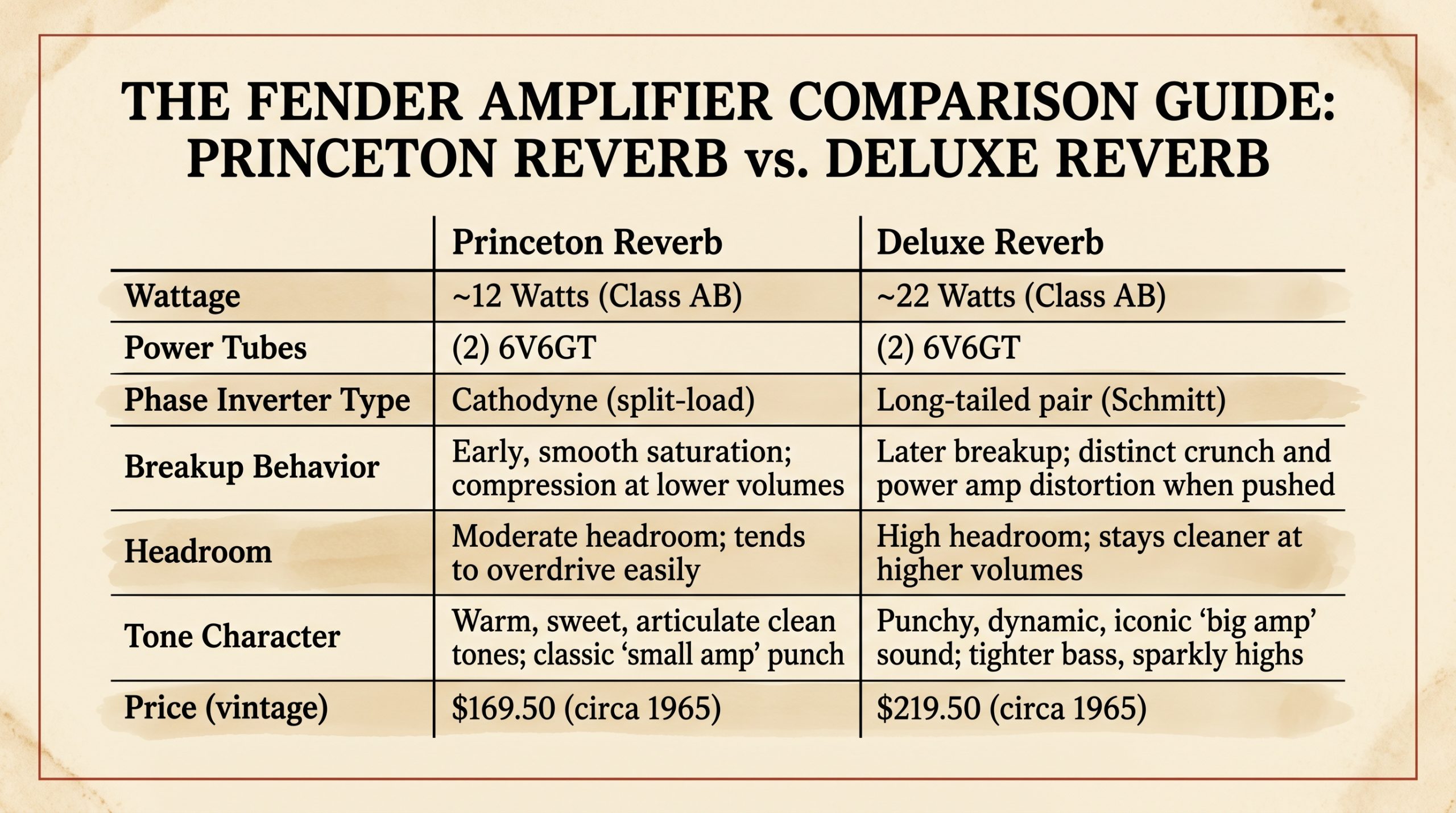
The single most common Fender amp comparison. Princeton Reverb (12W, 1×10″) is bedroom and studio focused with the cathodyne PI character. Deluxe Reverb (22W, 1×12″) is the gigging standard with the long-tailed pair PI and significantly more headroom. Twin Reverb (85W, 2×12″) is the high-headroom big-stage amp. All three share AB763/AA1164 sonic DNA but at very different power scales and overdrive characters.
| Spec | Princeton Reverb | Deluxe Reverb | Twin Reverb |
|---|---|---|---|
| Power output | 12 W | 22 W | 85 W |
| Speaker | 1× 10″ | 1× 12″ | 2× 12″ |
| Output tubes | 2× 6V6 | 2× 6V6 | 4× 6L6 |
| Phase inverter | Cathodyne (split-load, single-ended) | Long-tailed pair | Long-tailed pair |
| Rectifier | 5U4GB (pre-1969) / 5AR4 (post-1969) | GZ34/5AR4 | Solid state |
| Tube count (total) | 7 | 9 | 11 |
| Bedroom usable | Yes | Marginal | No |
| Small club usable | With mic | Easily | Easily |
| Loud band usable | No | Marginal | Easily |
| Studio recording | Excellent | Excellent | Excellent with attenuator |
| Pedal platform | Excellent at clean volumes | Excellent at any volume | Excellent at any volume |
| Headroom | Low (breakup begins ~5) | Medium (breakup begins ~7) | High (breakup begins ~9+) |
| Weight | ~34 lb (tube reissue) | ~42 lb | ~64 lb |
| Vintage value (blackface) | $2,800-4,500 | $3,500-6,000 | $2,500-5,000 |
Which Fender amp should I buy first?
Depends on your playing context. For home and studio with occasional small-room playing: Princeton Reverb. For gigging without consistent mic support, jam sessions with drummers, and small club work: Deluxe Reverb. For big stages, country bands, or anywhere clean headroom matters more than breakup character: Twin Reverb. For the player who only owns one Fender amp, the Deluxe Reverb is the most versatile because it works at all the volumes the Princeton can’t reach and isn’t so loud it can’t be used at home.
The Princeton Reverb’s specific superpower is the studio context: it produces full tube tone at volumes that respect open studio microphones, and it has been used on so many hit recordings precisely because of this. For home players who plan to record extensively, the Princeton makes more sense than the Deluxe. For gigging players who plan to perform regularly, the Deluxe makes more sense than the Princeton.
Restoration, service, and common modifications
Standard service for a vintage Princeton Reverb includes a complete cap job ($200-350), tube replacement and rebias ($100-200), three-prong power cord installation for safety, and reverb tank assessment. Common modifications include blackface conversion for AA764 silverface units, the 470k PI grid stopper resistor mod, and the Paul C mod for cathodyne-to-fixed-bias PI conversion.
What is a complete cap job and why does my Princeton Reverb need one?
A cap job replaces the electrolytic capacitors in the power supply filter chain (typically four to six caps depending on era). Electrolytic caps degrade over decades as the electrolyte dries out, leading to hum, sag, and reduced reliability. Any Princeton Reverb older than 30-40 years benefits from a cap job by a qualified vintage tech. Typical cost is $200-350 for parts and labor. This is normal maintenance, not a modification, and a freshly-serviced amp is worth more than an unserviced equivalent.
The cap job is the single most cost-effective improvement you can make to a vintage Princeton Reverb. It restores the amp to original electrical specifications, eliminates hum and noise issues, and ensures reliable operation for another 20-30 years before the next cap job is needed. Documented service history with date and shop name adds value when selling.
What is a blackface conversion on a silverface Princeton Reverb?
A blackface conversion reverts AA764 silverface circuit changes (bias resistor values, rectifier choice, tone stack components) back to AA1164 blackface specifications. The work is reversible (original components are documented and can be reinstalled). Typical cost is $200-400 for parts and labor. Documented blackface conversions by recognized vintage techs add value rather than reducing it.
Not all silverface Princeton Reverbs benefit equally from blackface conversion. Early silverface units (1968-1969 with drip edge) already have the AA1164 circuit and don’t need conversion. AA764 units (1970-1981) are the conversion candidates. The conversion most directly affects the rectifier sag character (switching from 5AR4/GZ34 back to 5U4GB), the bias values (returning to AA1164 spec), and the tone stack response. Players who want true pre-CBS blackface tone from a silverface chassis can get within 95% of the way there through a proper conversion at a fraction of the cost of buying a real blackface unit.
What is the Paul C mod for the Princeton Reverb?
The Paul C mod replaces the cathodyne phase inverter with a fixed-bias phase inverter. It is named after Paul Cochrane, who documented and popularized the modification. The result is increased clean headroom, more output power, and a cleaner overdrive character (essentially making the Princeton behave more like a small Deluxe Reverb at high volumes). The mod is reversible. Reduces “Princeton character” significantly, so consider whether you want the amp to sound like a Princeton or like something else before committing.
The Paul C mod is one of the most debated modifications in the vintage Fender community. Players who love the cathodyne PI’s distinctive clipping character avoid it entirely. Players who find the cathodyne’s hard clipping unmusical at high volumes consider it essential. There is no objectively correct answer; the modification fundamentally changes the amp’s character. For players who want to keep the cathodyne but tame its worst clipping behavior, the 470k PI grid stopper resistor is a smaller modification that helps without changing the topology.
Should I replace the speaker in my Princeton Reverb?
Vintage Princeton Reverbs: keep the original speaker for value, even if you don’t play through it. A reconed original (frame and magnet original, cone replaced by a professional shop) is acceptable and preserves more value than outright replacement. Modern reissues: speaker upgrades from the stock Jensen reissue to Jensen P10R alnico, Eminence GA10-SC64 (designed specifically for the ’65 Reissue), or Weber 10A125 are common and well-regarded; reissues don’t have the originality premium that vintage units do.
The Eminence GA10-SC64 is specifically voiced as a vintage-Jensen-style 10-inch speaker for Princeton Reverbs, and the Long & McQuade reviewer for the ’64 Custom Princeton Reverb specifically called out replacing the stock Jensen with the GA10-SC64 as a meaningful upgrade. For Tone Master units, speaker replacement is not particularly common since the digital modeling is tuned around the stock Jensen C10R; replacing the speaker changes the amp’s character in ways the digital tuning was not designed to accommodate.
Sources and methodology
Heritage credit
The dating methodology, circuit identification framework, and documented factory anomalies in this guide derive from the original 1997-2000 five-part research series by Greg Gagliano, with co-research contributions from Devin Riebe and Greg Huntington, originally published in 20th Century Guitar Magazine. The research database includes more than 250 complete data sets contributed by Fender-specialist technician Jeff Lacio. We have rewritten the explanatory material entirely in our own words and added Princeton Reverb-specific technical detail (cathodyne PI analysis, rectifier transition documentation, current production specifications) that has accumulated in the vintage community over the subsequent two and a half decades, but the spine of the dating methodology is theirs. Original work © 1997-2000, 20th Century Guitar Magazine.
Additional sources consulted for this guide:
- FenderGuru.com Princeton Reverb technical reference, particularly the AA1164 / AB1270 / AA764 circuit transition documentation and the rectifier change analysis
- Wikipedia “Fender Princeton Reverb” and “Fender Princeton” articles for the documented production timeline, the post-1969 rectifier change, and the Paul Rivera Princeton Reverb II clarification
- Wikipedia “Eric Clapton” article for the Layla sessions context and Duane Allman’s contribution timeline
- Mojotone field guides for the ’64 Custom Princeton Reverb (AA1164 with 5AR4/GZ34) and ’68 Custom Princeton Reverb (2013-present, Mexico-built) specifications
- Fender Musical Instruments Corporation official product pages for current production ’65 Reissue, ’64 Custom, ’68 Custom, and Tone Master Princeton Reverb specifications
- MusicRadar reviews for the ’64 Custom (2020 NAMM debut), ’68 Custom (late 2013 introduction), and Tone Master Princeton Reverb assessments
- Guitar World announcement of the Tone Master Princeton Reverb release
- Guitar Player Magazine classic gear coverage of the Princeton Reverb (Dave Hunter), including Duane Allman / Layla attribution and Wrecking Crew session context
- MusicRadar feature on Louie Shelton’s 1969 Princeton Reverb and its role in Wrecking Crew session work
- Premier Guitar editorial coverage by Jens Mosbergvik (FenderGuru) on Princeton Reverb design and tonal character
- TDPRI (Telecaster Discussion Page Reissue) community threads for the cathodyne PI analysis, Paul C mod documentation, blackface conversion methodology, and famous players documentation (Carlton, Frisell, Tedesco, Vaughan, Hodges)
- Mojotone circuit field guide for the cathodyne PI vs long-tailed pair comparison and the output power calculation explanation
- Robrobinette.com AA1164 schematic and 1964 blackface Princeton Reverb technical reference
- Equipboard 1963-1981 Princeton Reverb summary with cathodyne PI tube layout explanation
- The Music Emporium first-year 1964 Princeton Reverb production records and December 1964 documented first-year unit data
- Reverb.com completed-sales data for 2024-2026 used to derive the 2026 market value ranges in this guide
- Music Connection review of the ’64 Custom Princeton Reverb (with the AA673/AA1164 circuit identification correction noted)
Where this guide and Fender’s official documentation disagree (most notably on the ’64 Custom’s circuit, where Fender’s product page says AA1164 and at least one third-party review says AA673), we have followed Fender’s official documentation as primary. Where third-party sources disagree on the post-1969 rectifier change (some sources reverse the direction of the transition), we have followed Wikipedia’s documented change (“amps produced after the end of 1969 saw a change in the rectifier from a 5AR4 to a 5U4GB”) cross-referenced with FenderGuru’s analysis (which describes the same change as “5U4 to GZ34” in the opposite direction; both descriptions are consistent with the AA1164 having 5U4GB and the AA764 having 5AR4/GZ34). Errors of fact in this guide are ours alone, and we welcome corrections from readers with primary documentation. See our full Sources and Credits page for complete bibliography and acknowledgments.
Related guides
- Fender Tube Amp Serial Number Guide: complete dating methodology across all Fender amp models, with the OA/OB tube chart anomaly documentation, transformer date code interpretation, and original speaker reference chart that this Princeton Reverb guide draws on
- Fender Deluxe Reverb dating and identification guide: the Princeton’s bigger sibling, with the long-tailed pair phase inverter and 22-watt output, including the ’64 Custom, ’65 Reissue, ’68 Custom, and Tone Master variants
- Fender Twin Reverb dating and identification guide: the 85-watt big-stage amp with solid-state rectification and dual 12-inch speakers
- Fender Vibro Champ dating and identification guide: the smaller-still Fender combo, the bedroom amp for players for whom the Princeton Reverb is too loud
- Fender Super Champ X2 dating and identification guide: current production hybrid amp combining modeling and tube power
- Fender Amp Dating Cheatsheet: condensed one-page quick reference for tube charts, transformer codes, and modern QA sticker decoding
- About TCguitar: our mission, the heritage we carry forward, and the editorial approach behind this guide
Need help dating or assessing a specific Princeton Reverb? If you have a Princeton Reverb with markings you cannot decode or a configuration that seems inconsistent with the eras documented here, send us a message with photos of the tube chart, chassis stamps, transformer codes, and speaker frames. We do not appraise commercially but we will help you read the evidence.
Frequently asked questions
Why does the Princeton Reverb sound different from the Deluxe Reverb at high volumes?
Two factors. First, the phase inverter topology: Princeton uses a cathodyne (split-load) PI, Deluxe uses a long-tailed pair (LTP) PI. The cathodyne begins clipping asymmetrically at lower drive levels than the LTP, which produces the distinctive Princeton overdrive character. Second, the output transformer: Princeton's smaller OT is rated for 12-15 watts and saturates more easily than the Deluxe's larger OT. Both factors compound to make the Princeton Reverb's high-volume character meaningfully different from the Deluxe Reverb's despite the shared dual-6V6 power section.
Can the Princeton Reverb be used for gigs?
For most gigs, yes, with a microphone in front of the speaker running into the house PA. A Princeton Reverb without mic support is loud enough for solo acoustic-electric work, jazz combo work, fingerstyle ensemble work, and quiet small-room performance. For loud band gigs with drummers, the Deluxe Reverb or Twin Reverb makes more sense. Working players often use a Princeton Reverb for studio recording and reserve a Deluxe or Twin for live gigging where stage volume matters.
What is the difference between the '65 Princeton Reverb Reissue and the '64 Custom Princeton Reverb?
The '65 Reissue uses PCB (printed circuit board) construction with modern components and is built in Corona, California at the standard production line. Retail $1,200-1,400. The '64 Custom uses hand-wired point-to-point construction with Fender Vintage Blue tone capacitors and a Jensen alnico P10-R speaker; it is also built in Corona but on the American Hand Wired Series production line. Retail $2,299. Sonically, the '64 Custom is closer to a genuine vintage blackface unit; the '65 Reissue is a more accessible and consistent reproduction of the same general voice. Both use derivatives of the AA1164 circuit.
Why did Fender wait until 2022 to release the Tone Master Princeton Reverb?
Fender released the Tone Master Deluxe Reverb in 2019 as the first amp in the digital Tone Master series, followed by the Tone Master Twin Reverb in 2020 and the Tone Master Super Reverb in 2021. The Princeton Reverb came last in 2022. Fender has not publicly explained the staggered release sequence, but it likely reflected production capacity priorities (working through Deluxe and Twin volume first), DSP modeling development time (capturing the cathodyne PI's specific clipping character may have required additional development work), and market sequencing decisions.
Is the Tone Master Princeton Reverb made in the same factory as the tube version?
No. The Tone Master Princeton Reverb is manufactured in China per the official Fender specifications and Reverb.com product listing. The '65 Princeton Reverb Reissue and '64 Custom Princeton Reverb are manufactured in Corona, California. The '68 Custom Princeton Reverb is manufactured in Ensenada, Mexico. Country of origin affects price and value perception, with the Corona-built units commanding premium pricing.
Were 1972-1974 Princeton Reverbs really missing parts at the factory?
Yes, this is documented in Greg Gagliano's 20th Century Guitar Magazine Part 3 research. Certain Princeton Reverb production batches from 1972-1974 left the factory with the two 100-ohm ground resistors for the tube heater filaments never installed. The result is excessive 60-cycle hum that capacitor replacement alone will not resolve. A qualified vintage tech can install the missing resistors and restore proper operation. If you encounter a 1972-1974 Princeton Reverb with hum problems that persist after a cap job, this is the likely cause.
What rectifier does my Princeton Reverb use?
Depends on the era. Pre-CBS AA1164 (1964-1969) uses 5U4GB. Post-end-of-1969 silverface AA764 (1970-1981) uses 5AR4/GZ34. The '65 Reissue and '64 Custom modern reissues both use 5AR4/GZ34. The '68 Custom uses 5AR4. The Tone Master has no rectifier tube (digital modeling). Check the rectifier socket on your specific amp and consult the schematic for the appropriate replacement.
How many tubes does a Princeton Reverb have?
Seven tubes total. Three 12AX7/7025 preamp tubes, one 12AT7 reverb send tube, two 6V6GT power tubes, and one rectifier tube (5U4GB or 5AR4/GZ34 depending on era). The Tone Master Princeton Reverb has zero tubes (digital modeling).
Can I use a 5AR4 instead of a 5U4GB in my pre-CBS Princeton Reverb?
Technically yes, but it changes the amp's character. The 5AR4 (also called GZ34) has less voltage sag than the 5U4GB. Substituting 5AR4 for 5U4GB in a pre-CBS AA1164 unit makes the amp tighter, with less compression and less of the "vintage" sag character. Some players prefer this for cleaner pedal-platform use; purists prefer the original 5U4GB for authentic pre-CBS voice. The reverse substitution (5U4GB in place of 5AR4 in an AA764 silverface or modern reissue) is also possible and produces a more vintage-sag character. Both substitutions are safe electrically.
Are there Princeton Reverb signature editions?
Fender has produced various limited Princeton Reverb editions over the years, but no high-profile artist signature model for the Princeton Reverb specifically (unlike the Chris Stapleton '62 Princeton signature for the non-reverb Princeton, or the various signature Deluxe Reverbs and Stratocasters). Limited cosmetic editions of the '65 Reissue and Tone Master have included different Tolex colors, custom grille cloth, and limited tone capacitor configurations, but these typically do not command significant secondary-market premiums beyond the standard reissue pricing.
What is the Princeton Recording-Amp from 2006?
The Princeton Recording-Amp is a 2006-2009 Pro Tube Series model that combined a Princeton-style 1×10" combo with built-in overdrive, compressor, and a power attenuator. It is a distinct product from both the original vintage Princeton Reverb and the 2008+ '65 Reissue. Per Wikipedia, it was based on the blackface Princeton circuit with significant modifications for studio recording use. It was discontinued in favor of the regular Princeton Reverb '65 Reissue when Fender consolidated the lineup. Used market prices are typically $700-1,100 depending on condition.