Contents
- 01Key takeaways
- 02On this page
- 03The three different Super Champs that share the name
- 04Super Champ X2 (2012-2021)
- 05Super Champ X2 HD (head version)
- 06Super Champ XD (2007-2012)
- 07The FUSE software discontinuation (March 2020)
- 08Amp voicings and onboard effects
- 09Tube complement and replacement
- 10The hybrid tube/digital architecture and why it polarizes
- 11The original Paul Rivera Super Champ (1982-1985)
- 12The 6C10 compactron tube
- 13Super Champ 2026 market values
- 14Super Champ X2 vs Vibro Champ Reverb vs Princeton Reverb
- 15Famous Super Champ users and recordings
- 16Common issues and troubleshooting
- 17Frequently asked questions
- 18Sources and methodology
- 19Related guides
Fender Super Champ X2 in one paragraph
The Super Champ X2 is a 15-watt hybrid tube/digital practice amp produced 2012-2021. Tube complement: 1× 12AX7 preamp + 2× 6V6 power tubes (3 tubes total). Solid-state rectifier. Single 10-inch Fender Special Design speaker (combo) or external speaker (X2 HD head). Two channels: Channel 1 (clean Fender Blackface voice via tube preamp) and Channel 2 (16 digital amp voices via DSP modeling). 15 onboard effects (reverb, delay, chorus, tremolo, modulation). USB connectivity for FUSE software editing. Critical caveat: FUSE software was discontinued by Fender in March 2020, and current operating system support is unreliable. The amp itself functions perfectly standalone without FUSE; the limitation is in deep editing access. The X2 was discontinued in approximately 2021. Used market: $300-500 for combo, $250-400 for head, $400-600 for head with matching SC112 cab. Not to be confused with the 1982-1985 Paul Rivera-era Super Champ (different amp entirely, all-tube, 18W, with the rare 6C10 compactron tube).
Key takeaways
- Three different amps share the Super Champ name. The Super Champ X2 (2012-2021) and Super Champ XD (2007-2012) are modern hybrid tube/digital amps. The original Super Champ (1982-1985) is a Paul Rivera-designed all-tube amp with completely different circuitry. They share only the name. When buying used, verify which Super Champ you are looking at by year and tube complement.
- Super Champ X2 tube complement: 1× 12AX7 + 2× 6V6 (3 tubes total). The 12AX7 functions as both the preamp tube for Channel 1 (clean tube path) and as the analog tube interface for the digital modeling on Channel 2. Both 6V6 power tubes provide the 15W push-pull output stage. Solid-state rectifier (no rectifier tube). This is fundamentally different from the original 1982 Super Champ’s 1× 12AX7 + 1× 12AT7 + 1× 6C10 + 2× 6V6 (5-tube) configuration.
- FUSE software discontinued March 2020. Fender ended official support for the FUSE editing software in March 2020. The amp itself functions perfectly standalone using the front-panel knobs. The limitation is access to deeper parameter editing that required FUSE. Used Super Champ X2 buyers should be aware that USB-based editing depends on legacy software downloads from third-party archives (no longer available from Fender directly) and that compatibility with modern macOS and Windows is unreliable.
- The original 1982-1985 Super Champ uses the rare 6C10 compactron tube. Per Wikipedia: “The Super Champ utilized 1× 12AX7 for the first and second stage preamp, a 1× 12AT7 for spring reverb driver tube, whilst the three sections of the triple-triode 6C10 compactron serve as a recovery for the spring reverb, as a driver for the phase inverter, and as a split-load phase inverter.” The 6C10 is a triple-triode tube electrically equivalent to three 12AX7 sections in one tube. Hard to find replacements; 6D10 and 6AC10 are documented substitute candidates.
- Super Champ X2 was discontinued in approximately 2021. Multiple community sources (TheGearPage, TDPRI, Squier-Talk) confirm Fender quietly discontinued the X2 in early 2021 following the FUSE software shutdown in March 2020. The final 2020 production included Limited Edition variants (Ragin’ Cajun with Eminence speaker, Cabernet Blues with Celestion Greenback) that command modest premiums. The X2 is now only available on the used market.
- X2 HD (head version): 12AX7 + 2× 6V6, 18.5 lbs. The X2 HD head pairs with the optional SC112 1× 12 cabinet for a flexible head-and-cab configuration. Same circuit and modeling as the combo. Currently the most-affordable used Super Champ X2 option on the secondary market because the head requires a separate cab.
The three different Super Champs that share the name
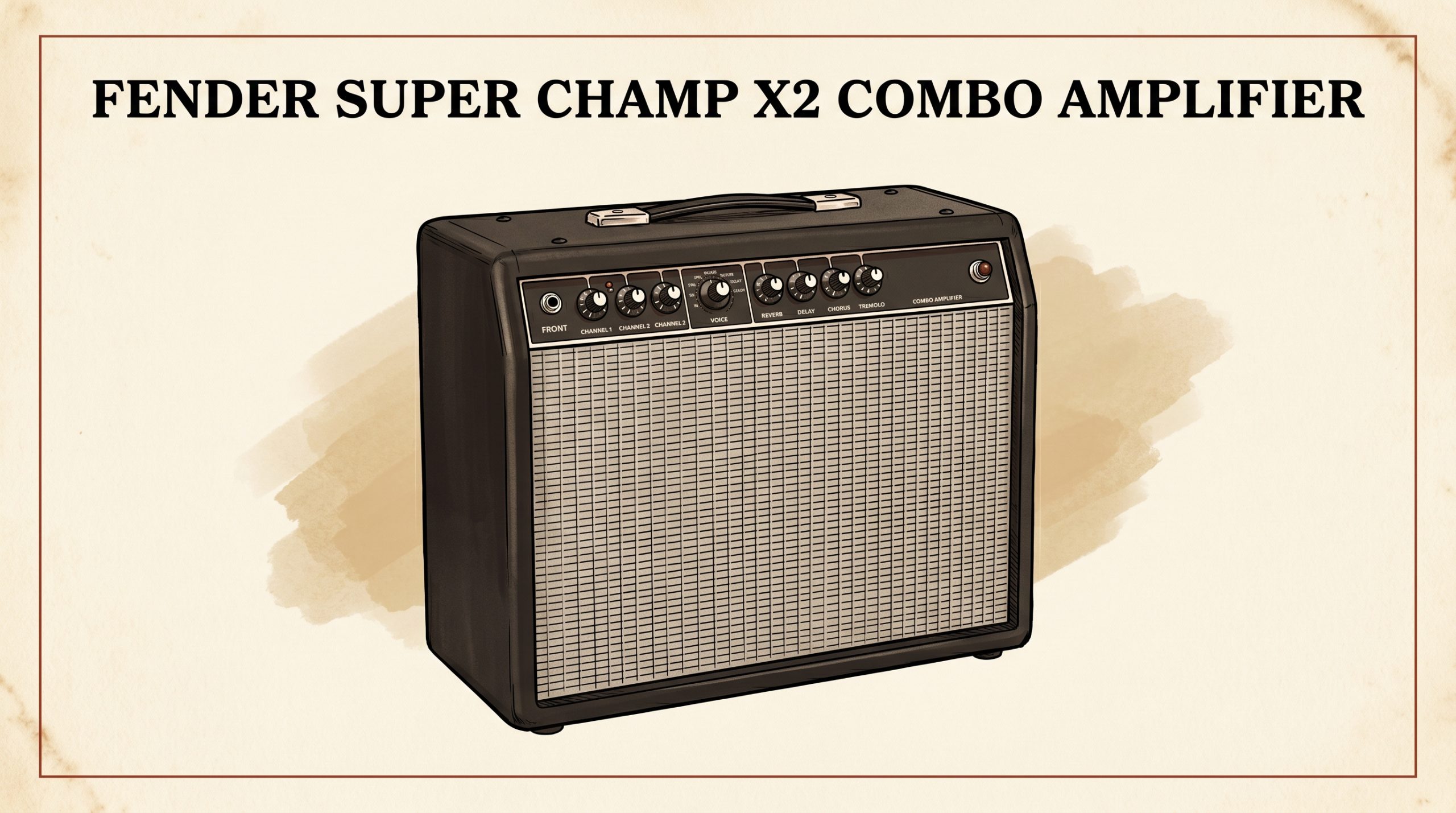
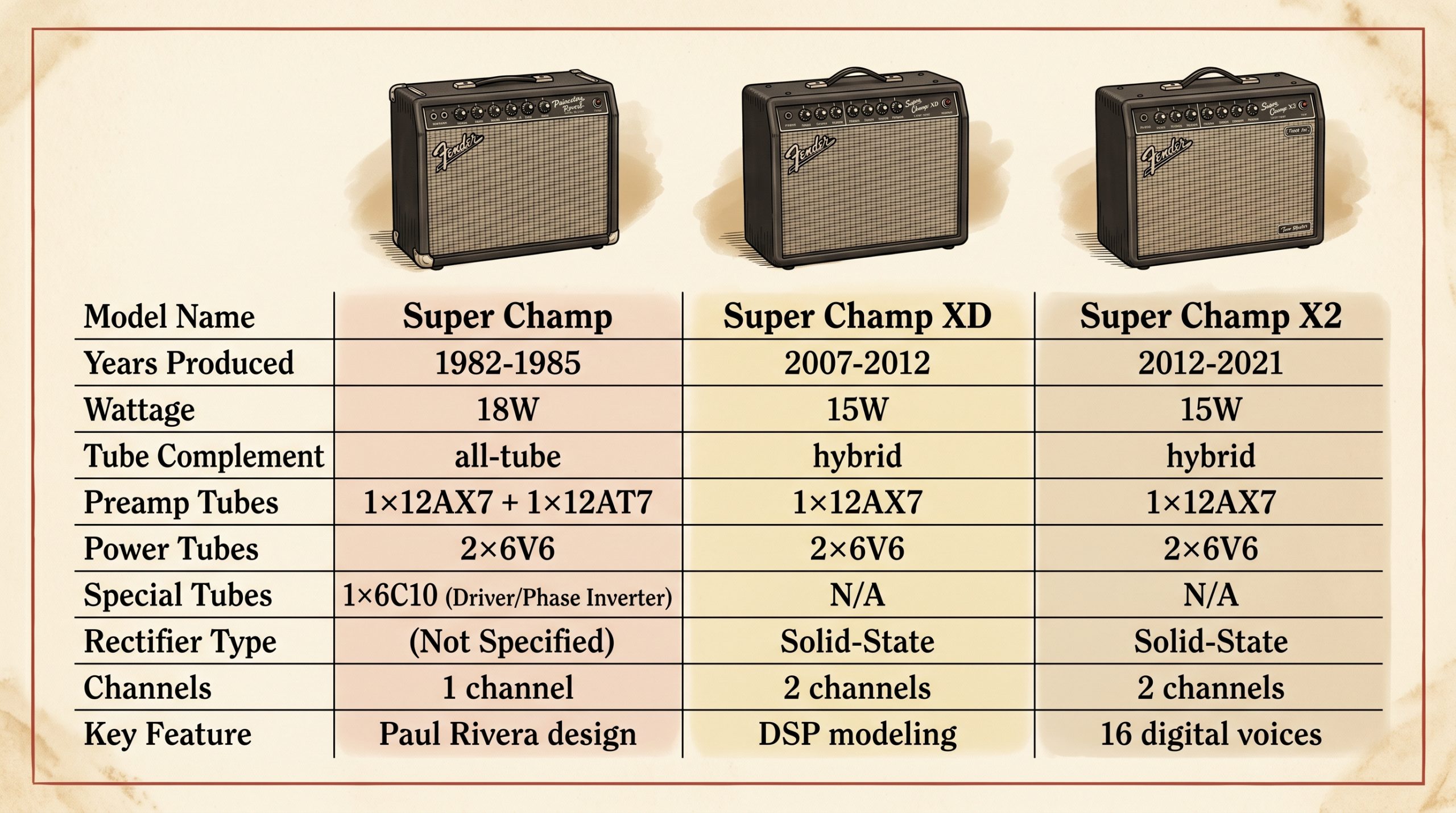
Fender has produced three completely different amps under the Super Champ name: the original Rivera-era Super Champ (1982-1985, all-tube, 18W, with the rare 6C10 compactron tube), the Super Champ XD (2007-2012, hybrid tube/digital, 15W), and the Super Champ X2 (2012-2021, hybrid tube/digital with USB and FUSE software, 15W). These three amps share the name but not the circuit, the tube complement, the era, or the tonal character. When buying used, always verify which Super Champ you are looking at by production year and tube complement.
| Model | Years | Architecture | Power | Tubes | Speaker |
|---|---|---|---|---|---|
| Original Super Champ (Rivera era) | 1982-1985 | All-tube push-pull | 18W | 1× 12AX7 + 1× 12AT7 + 1× 6C10 + 2× 6V6 (5 tubes) | 1× 10″ Fender Special Design |
| Super Champ XD | 2007-2012 | Hybrid tube/DSP | 15W | 1× 12AX7 + 2× 6V6 (3 tubes) | 1× 10″ Fender Special Design |
| Super Champ X2 (combo) | 2012-2021 | Hybrid tube/DSP + USB | 15W | 1× 12AX7 + 2× 6V6 (3 tubes) | 1× 10″ Fender Special Design |
| Super Champ X2 HD (head) | 2012-2021 | Hybrid tube/DSP + USB | 15W | 1× 12AX7 + 2× 6V6 (3 tubes) | External (8 ohm, optional SC112 1× 12 cab) |
Why does Fender reuse model names across different amps?
Brand equity. Names like “Champ,” “Vibro Champ,” “Super Champ,” “Princeton Reverb,” “Deluxe Reverb,” and “Twin Reverb” carry decades of player recognition. Fender uses these names on new amps to leverage that brand recognition, even when the new amp shares little with the original. The naming overlap can be confusing on the used market, where a buyer searching for “Super Champ” may encounter the 1982 tube amp, the 2007 hybrid, the 2012 hybrid, or any of the limited edition variants. Always verify by year and tube count.
Super Champ X2 (2012-2021)
The Super Champ X2 was Fender’s flagship hybrid tube/digital practice amp during the 2010s. Introduced 2012 as the successor to the Super Champ XD, the X2 added USB connectivity and FUSE software editing to the hybrid platform. 15W tube output stage with 1× 12AX7 preamp tube and 2× 6V6 power tubes. Digital DSP front-end with 16 amp voicings on Channel 2 (Channel 1 stays pure clean tube). 15 onboard effects. Two channels with footswitchable selection. Discontinued approximately 2021 following the FUSE software shutdown in March 2020.
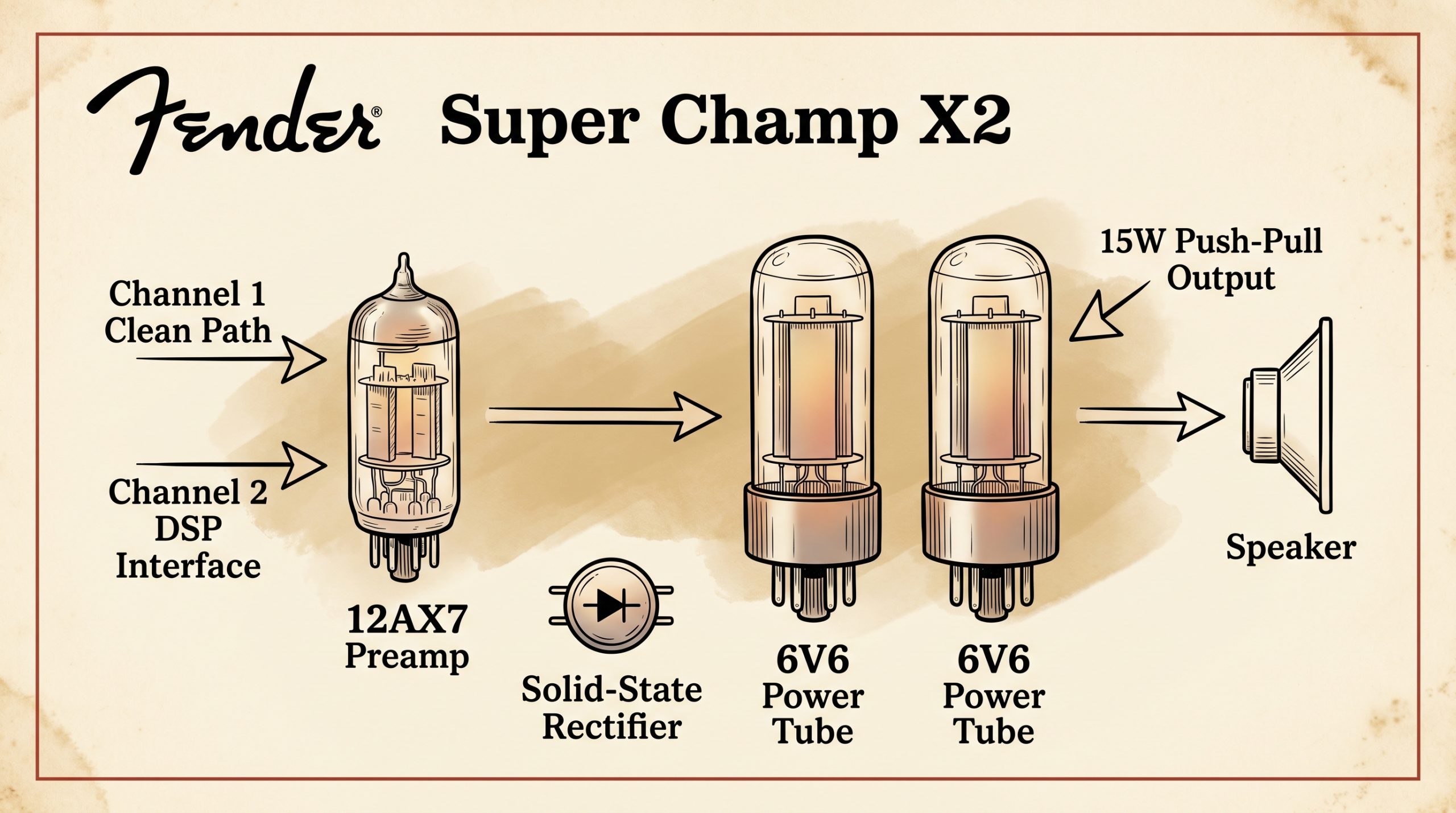
The Super Champ X2 occupies an interesting position in Fender’s history. It was the company’s primary entry into the modeling-amp space, predating the more polished Mustang GTX series and the Tone Master line by several years. The hybrid architecture (tube output + digital preamp) was unusual: most modeling amps of the era were fully solid-state (Line 6 Spider, Peavey Vypyr, Fender’s own earlier Cyber-Twin), while pure tube amps avoided digital entirely. The X2 attempted to combine the warmth of tube output with the versatility of digital modeling, which appealed to a specific subset of players.
How does the Super Champ X2’s two-channel design work?
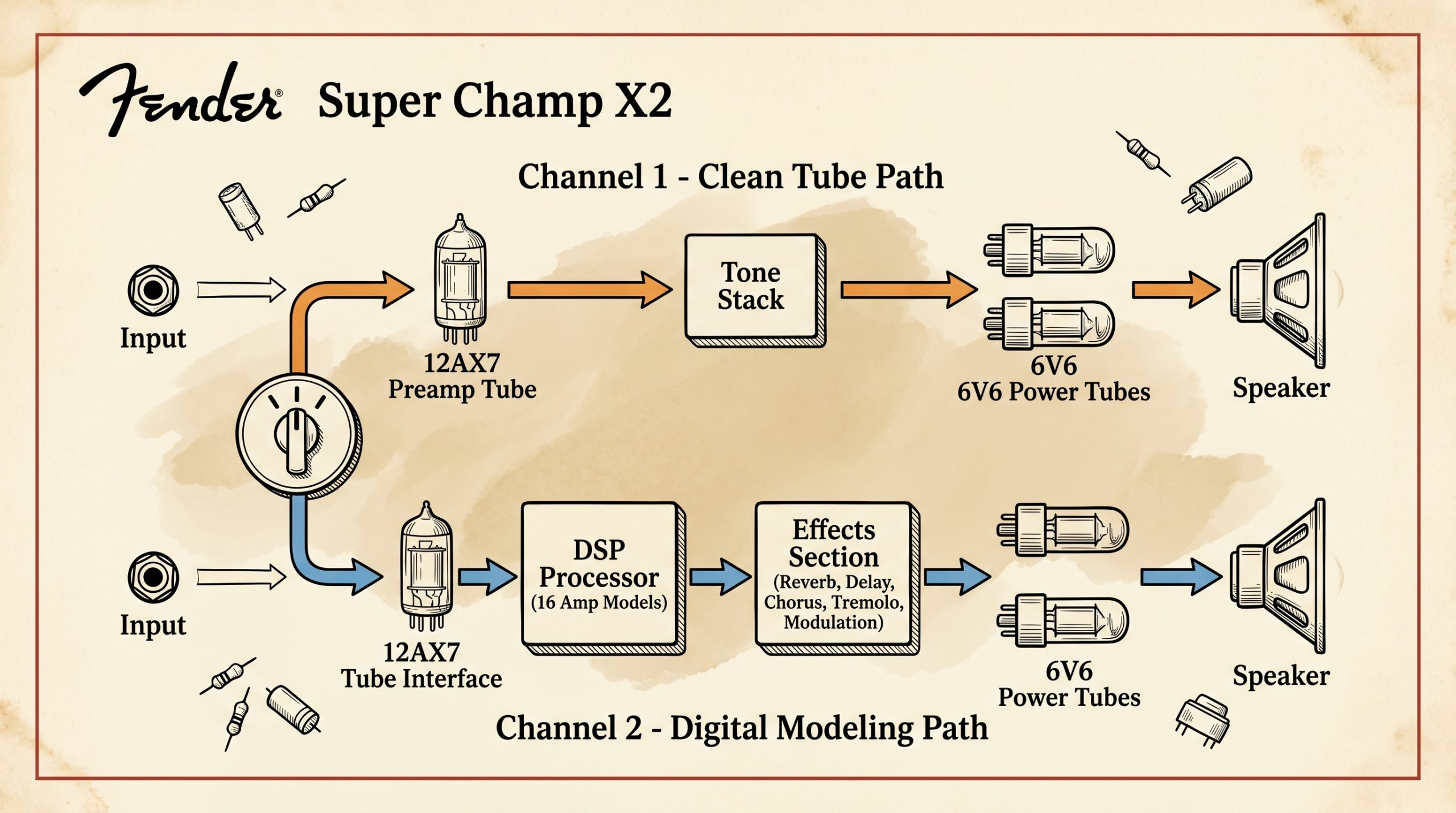
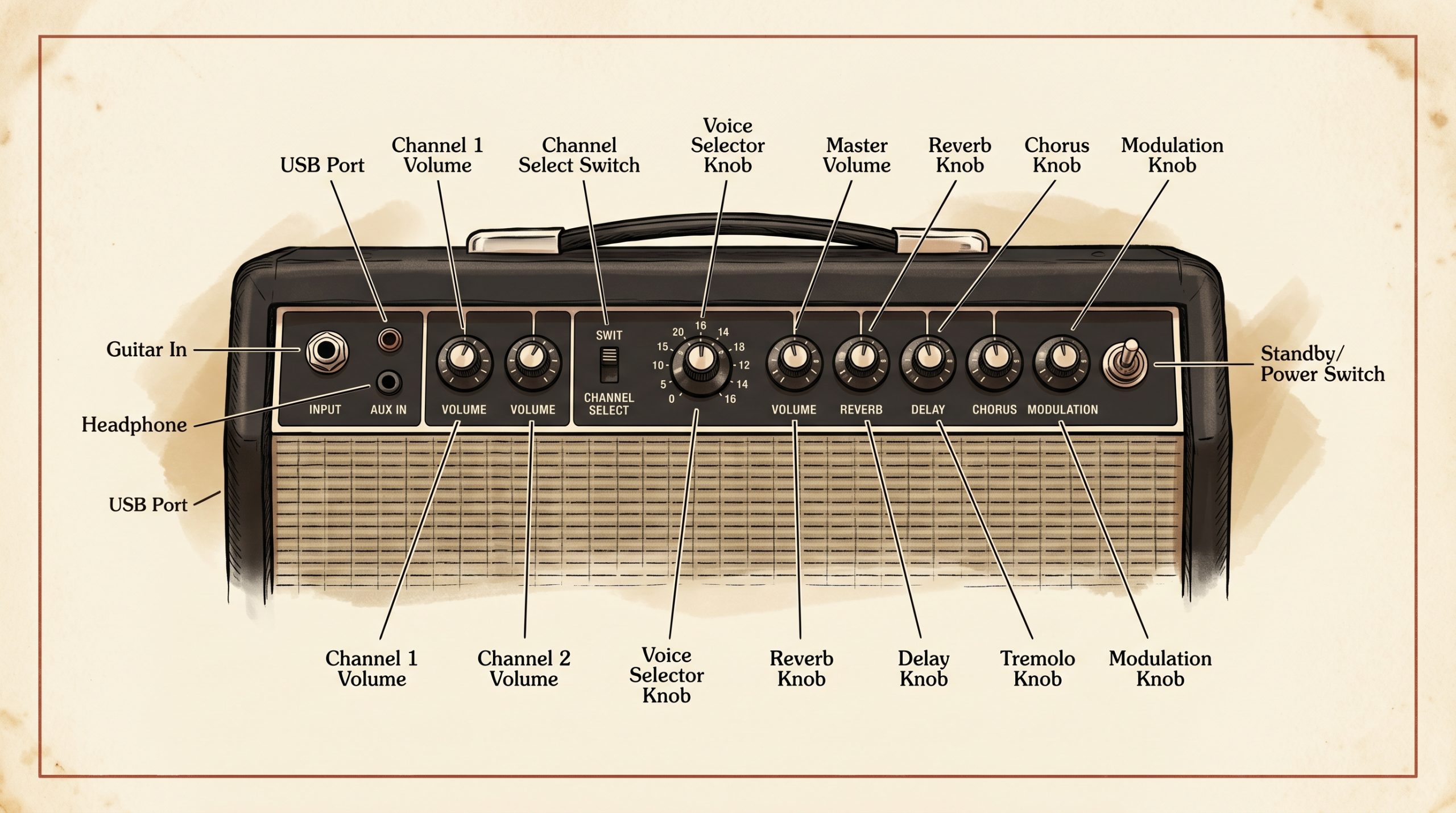
Channel 1 is a traditional Fender clean voice running through the tube preamp section. Treble, Bass, and Volume controls work in the standard analog tube-amp way. Channel 2 routes through the DSP digital modeling section first, then into the same tube output stage. On Channel 2, the Voice knob selects among 16 modeled amp voicings (Blackface, Tweed, British, American, high-gain, etc.) and the Gain knob drives the modeled preamp. Effects are accessible on both channels via the F/X Adjust and F/X Select controls. Footswitch toggles between channels and engages effects.
The practical implication: Channel 1 is the “honest tube Fender clean” path with no digital processing. Channel 2 is the modeling playground with 16 voicings ranging from “Tweed Champ” through “British 80s” through “Modern Metal.” For players who want both worlds (a clean tube Fender base plus digital modeling for variety), this dual-channel architecture is the X2’s distinguishing feature.
What are the 16 amp voicings on Channel 2?
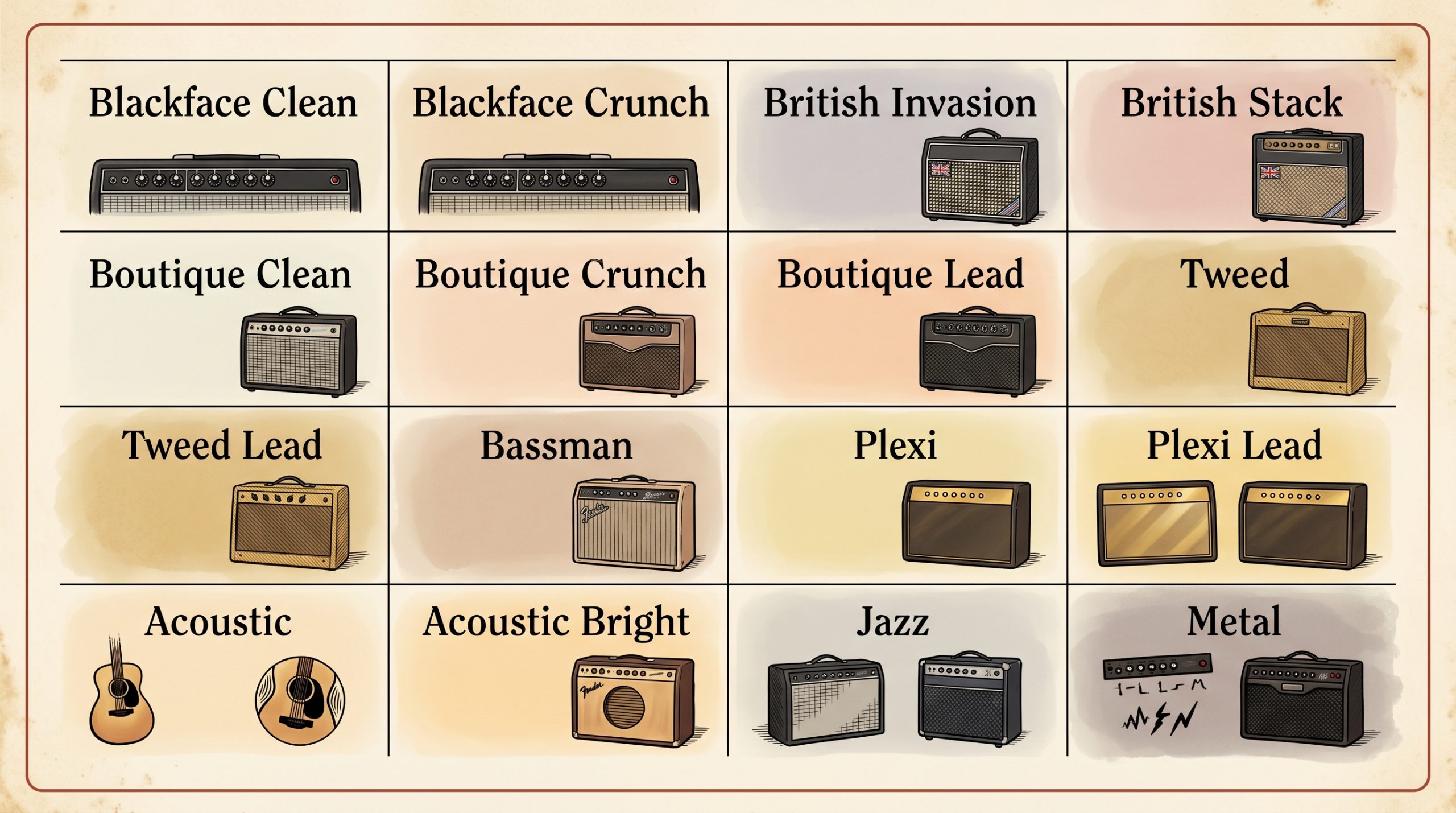
The 16 voicings include: Tweed Deluxe, ’57 Twin, ’65 Princeton, ’65 Twin, ’65 Bassman, ’65 Deluxe, Blackface Twin, British Plexi, British 800, British Top Boost, ’60s British Class A, ’90s American, Modern American Channel 1, Modern American Channel 2, High Gain, and Metal. Each voicing emulates the EQ curve, gain structure, and tonal character of the referenced amp at moderate volume. Effects are independent from voicings and can be combined with any voicing.
The fidelity of these models varies substantially. The Fender voicings (Tweed Deluxe, ’65 Twin, Blackface Twin, ’65 Princeton) tend to be the most convincing because Fender had detailed knowledge of their own circuits. The British voicings (Plexi, 800, Top Boost) are recognizable approximations but not exact recreations. The high-gain and metal voicings are functional but generic compared to dedicated modern modeling amps. For 2012 the modeling was solid; by 2020 newer models from Fender’s Mustang series and competitor modeling amps had exceeded the X2’s DSP capabilities.
What effects are built into the Super Champ X2?
Per Fender official documentation, the X2 includes 15 effects: standard hall reverb, plate reverb, spring reverb, delay (various subdivisions), chorus, flanger, phaser, tremolo, vibratone, Vibratone (rotating speaker emulation), tape echo, tube echo, and various combination effects. F/X Adjust controls the primary parameter (depth, time, rate) of the selected effect. F/X Select chooses the effect from the 15 options. Tap tempo control for delay timing.
The effects sound varies by type. The reverbs (hall, plate, spring) are functional. The tremolo and chorus are clean if generic. The delay implementations include some interesting tape-echo and tube-echo characters. For practice and home use, the onboard effects cover most common requirements without external pedals. For studio recording where effect quality matters, most users supplement with dedicated pedal-based effects.
Super Champ X2 HD (head version)
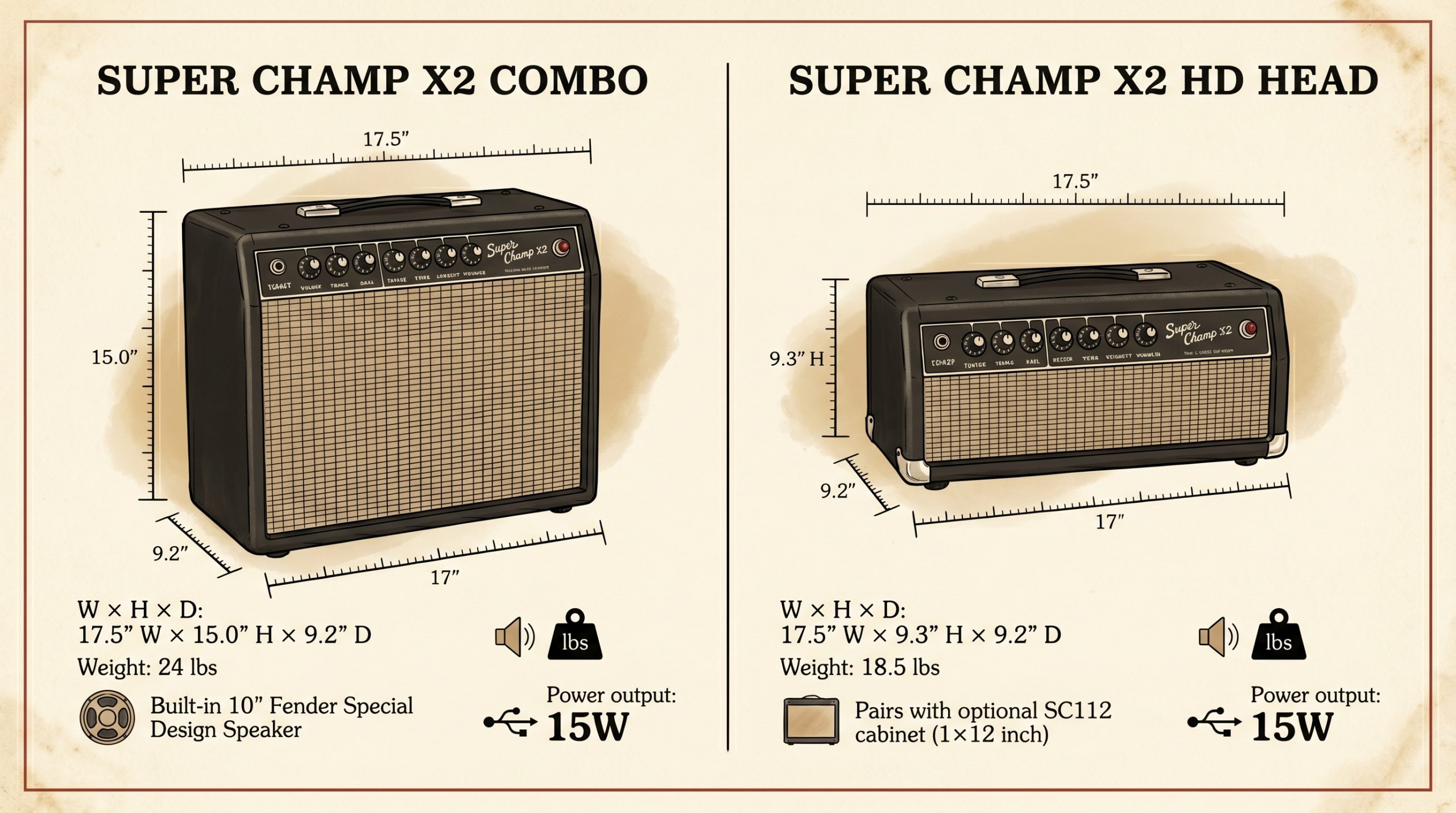
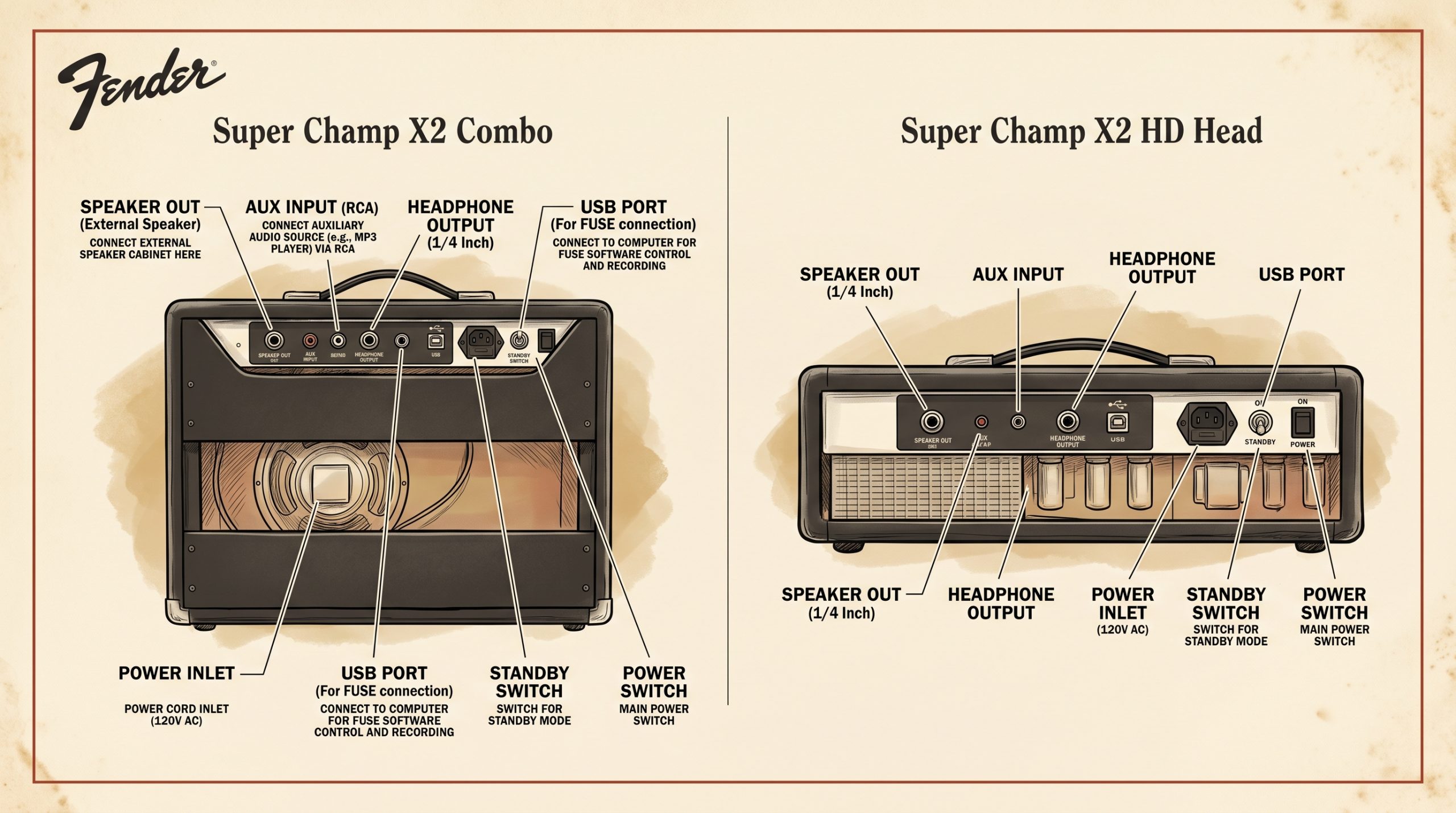
The Super Champ X2 HD is the head-only version of the X2. Same circuit, same tube complement (1× 12AX7 + 2× 6V6), same DSP modeling and effects, same FUSE software support, but requires an external speaker cabinet. Weight: 18.5 lbs. Paired with Fender’s optional SC112 (1× 12 ported cabinet) or any other 8-ohm guitar cab. Was popular among players who wanted the X2 features in a head-and-cab format for more speaker flexibility. Discontinued at the same time as the combo X2 (approximately 2021). Used market: $250-400 for the head alone; $400-600 with matching SC112 cab.
The X2 HD was specifically Fender’s first head-format Super Champ since the original 1982 Rivera-era model was combo-only. The head format provided some advantages: the head is lighter and easier to transport, and the player can pair it with their preferred speaker cab (12-inch Celestion-loaded cabs for British character, 10-inch Jensen-loaded cabs for traditional Fender character, etc.). For players experimenting with multiple speaker configurations, the X2 HD made more sense than the fixed combo.
Super Champ XD (2007-2012)
The Super Champ XD was the predecessor to the X2. Introduced in 2007 as part of Fender’s Vintage Modified series, the XD was the first generation of the hybrid tube/digital Super Champ platform. 15W tube output stage (same 1× 12AX7 + 2× 6V6 configuration), 16 amp voicings, 16 effects (the XD had one more effect than the later X2), but no USB connectivity or FUSE software support. Discontinued in 2012 when the X2 succeeded it.
Per Wikipedia: “In 2007, Fender resurrected the Super Champ name with the Super Champ XD, part of their ‘Vintage Modified’ series. The look is based on the blackface model. Although for a limited period of time a special edition Blonde version was produced, Fender’s Consumer Relations Department states that the blonde special edition Super Champ XD with oxblood grill was a FSR (factory special run) that was limited to only 1,000 produced. The blonde version is no longer available new and Fender has completed the amps’ production run so no more will be produced or available from Fender.”
How does the Super Champ XD differ from the Super Champ X2?
Three primary differences. First, USB connectivity: the X2 has USB, the XD does not. Second, FUSE software: the X2 supports FUSE editing software (with the March 2020 caveat below); the XD has no software editing path. Third, effect count: the X2 has 15 effects, the XD has 16. Functionally, the XD is the X2 without computer editing. Sonically the two are very close, differing primarily in some refinement of the DSP algorithms in the X2.
For buying purposes: the XD typically trades $100-150 below the X2 in equivalent condition. Players who don’t need software editing can get the same hybrid-amp experience for less money with the XD. Players who want the option of deep parameter editing (or who collect older Fender modeling amps) pay the premium for the X2.
The FUSE software discontinuation (March 2020)
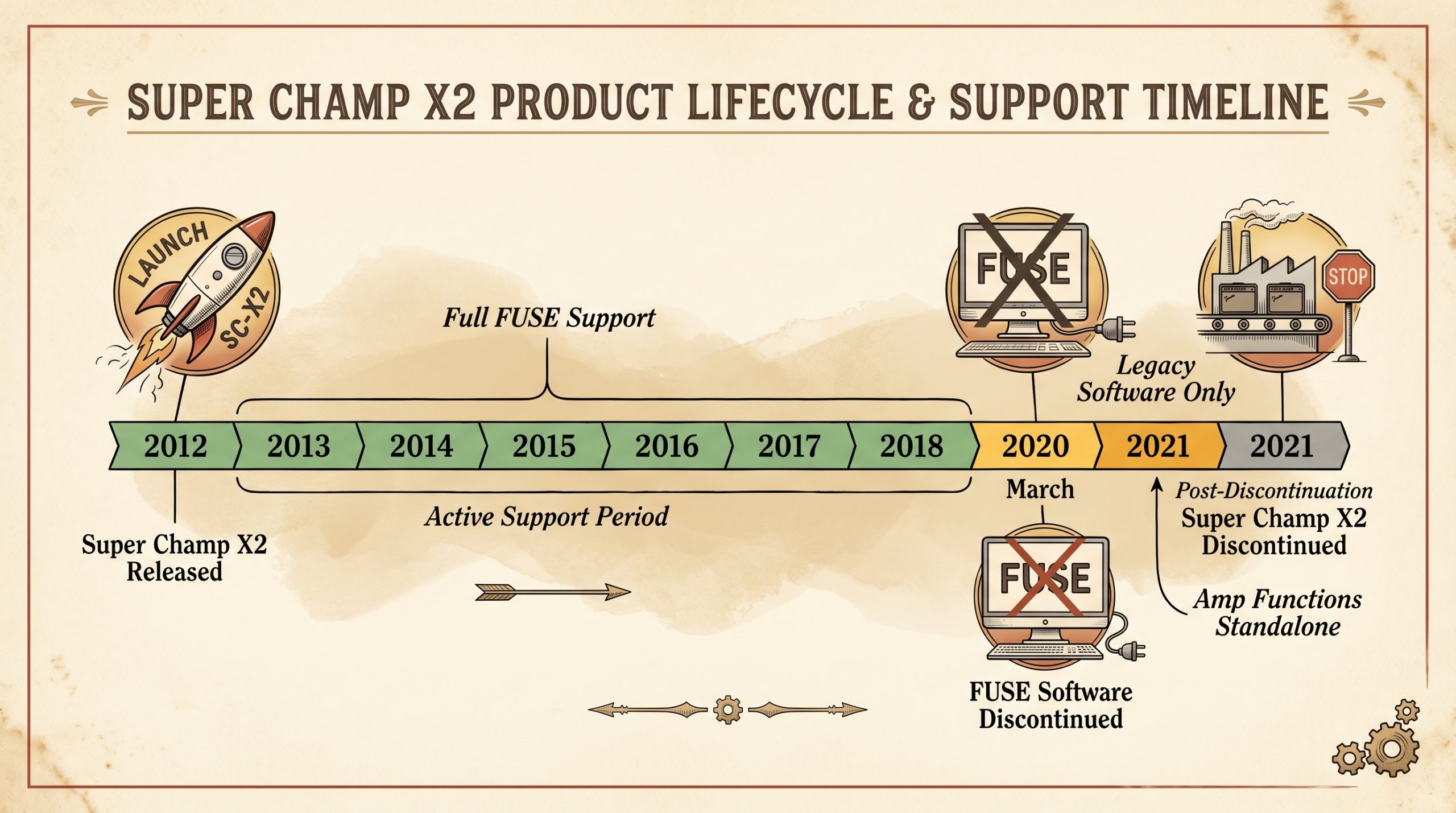
Fender ended official support for the FUSE editing software in March 2020. The Super Champ X2 hardware continues to function perfectly using the front-panel knobs (volume, gain, voice, treble, bass, FX adjust, FX select, channel select, tap tempo). The limitation is access to deeper parameter editing that required FUSE: mid-frequency controls, tube bias settings, noise gate adjustments, and effect chain ordering. Without FUSE, you operate the X2 using only the front-panel controls.
Can I still use FUSE on a Super Champ X2 today?
Technically possible but unreliable. FUSE software requires Windows or macOS versions that Fender supported before March 2020. Modern operating systems (macOS Sonoma, Windows 11) may not run FUSE reliably. Third-party archive sites still host the FUSE installer files for older systems. Some players have reported success running FUSE in virtual machines or older laptops dedicated to amp editing. Most current X2 owners simply use the front-panel controls and skip FUSE entirely.
For new used buyers: assume FUSE editing is unavailable when calculating value. If your intended use is standalone playing through front-panel controls, the X2 delivers full functionality. If you specifically needed deep editing access, consider a current modeling amp (Mustang GTX series with the modern Fender Tone app) that has active software support.
What is the Remuda Android alternative?
Remuda is a third-party Android app that provides FUSE-replacement functionality for the Super Champ X2 and Fender Mustang amps. Allows preset management, voicing editing, and effect parameter access from an Android tablet via USB connection. Not officially supported by Fender. Some forum users report success with Remuda; others have encountered compatibility issues. Cheap Android tablets ($50-100) make this a workable solution for X2 owners who want some editing capability.
Remuda is not a complete FUSE replacement. Deep parameter access (tube bias adjustments, noise gate settings) may not be fully implemented in Remuda. For most casual editing needs (voicing selection, effect parameter adjustment, preset management) Remuda is adequate.
Amp voicings and onboard effects
The Super Champ X2’s 16 amp voicings cover Fender (Tweed Deluxe, ’57 Twin, ’65 Princeton, ’65 Twin, ’65 Bassman, ’65 Deluxe, Blackface Twin), British (Plexi, 800, Top Boost, Class A), and high-gain (Modern American Ch1/Ch2, High Gain, Metal) territory. The 15 effects include reverb (hall, plate, spring), delay (multiple subdivisions, tape echo, tube echo), chorus, flanger, phaser, tremolo, vibratone, and combinations. F/X Adjust and F/X Select controls provide front-panel access; FUSE software (when functional) provides deeper editing.
Which voicings sound the best on the X2?
Per community consensus on TheGearPage and TDPRI: the Fender voicings (’65 Princeton, ’65 Deluxe, Blackface Twin, Tweed Deluxe, ’57 Twin) are the most convincing because Fender’s DSP team had detailed knowledge of their own circuits. The British voicings (Plexi, 800, Top Boost) are recognizable approximations that work for practice but won’t fool a tube purist. The high-gain voicings (High Gain, Metal) are functional but generic compared to dedicated modeling amps from Line 6, Boss, or Positive Grid. Users who buy the X2 for Fender clean tones and use Channel 1 most of the time are happiest with the amp.
For players who want a single amp covering many tones at home, the X2’s voice palette is genuinely broad. For studio recording where tonal authenticity matters, the X2’s modeled voicings are an obvious approximation rather than a recreation. The amp’s reputation as a “great practice amp, less convincing studio amp” reflects this trade-off.
Tube complement and replacement
Super Champ X2 (and XD) tube complement: 1× 12AX7 preamp + 2× 6V6 power tubes (3 tubes total). No rectifier tube (solid-state rectification). The 12AX7 functions as the preamp tube for Channel 1 (clean tube path) and as the analog interface between the DSP modeling output and the tube power section on Channel 2. Both 6V6 tubes provide the push-pull 15W output stage. Standard tube replacement parts; any quality 12AX7 (JJ ECC83S, Tung-Sol, Mullard reissue) and matched 6V6GT pair will work.
How long do tubes last in a Super Champ X2?
Standard tube life for 6V6 power tubes in class AB push-pull operation: 3,000-5,000 hours depending on volume usage and quality. The 12AX7 preamp tube typically lasts much longer (10,000+ hours). For most home and practice use, expect 5-10 years between power tube replacements. The X2’s tube output stage is similar to other 6V6 push-pull Fender amps in terms of wear patterns.
Symptoms of tube wear: hum increasing over time, channel imbalance between the two 6V6 tubes (matched pair becomes mismatched), reduced power output, gain stage hiss on Channel 1. When replacing 6V6 tubes, install a matched pair from a reputable tube vendor (TubeDepot, Eurotubes, Doug’s Tubes). Re-bias is recommended after tube replacement; a qualified tech can perform this.
Can I substitute 12AT7 or 12AU7 for the 12AX7 in a Super Champ X2?
Yes, with reduced gain. Substituting 12AT7 in V1 reduces preamp gain (Channel 1 will be cleaner, Channel 2 modeling will receive less drive). Substituting 12AU7 further reduces gain. These substitutions are reversible and audible; some players prefer the cleaner Channel 1 response with a 12AT7 substituted. The substitution affects both Channel 1 and Channel 2 because both channels use the same preamp tube.
The hybrid tube/digital architecture and why it polarizes
The Super Champ X2 occupies a tonal middle ground that polarizes players. Tube purists dislike the digital modeling on Channel 2, viewing it as an unnecessary compromise. Modeling-amp users find the X2’s modeling adequate but limited compared to dedicated DSP amps (Line 6, Positive Grid Spark, current Fender Mustang). The X2’s appeal sits between these two camps: players who specifically want a Fender clean tube tone plus digital versatility for practice and home use.
Why does the X2 polarize tube and modeling enthusiasts differently?
Tube purists prefer all-tube signal paths because of the dynamic response, harmonic content, and “feel” that tubes provide. The X2’s Channel 2 routes through DSP first, which loses some of these tube characteristics even though the output stage is tube. Modeling enthusiasts prefer dedicated DSP amps because they have more processing power, more voicings, more effects, and can be updated via software. The X2 has fewer DSP resources than dedicated modeling amps. The result is an amp that satisfies neither pure tube nor pure modeling enthusiasts completely, but works well for casual home players who want both.
This polarization is reflected in the X2’s secondary market. Tube enthusiasts dismiss the X2 as “not a real tube amp.” Modeling enthusiasts dismiss it as “old DSP technology.” Pragmatic players who use it as an everyday practice amp value it highly. The community split is real and affects both pricing and reputation.
What is the best use case for a Super Champ X2?
Home practice and casual recording where versatility matters more than authentic tone. Teachers and students who need a range of tones without a pedal collection. Players who want one amp to cover Fender clean, British rhythm, classic American leads, and basic high-gain without buying multiple amps. Apartment and home-volume use where 15W is plenty. Players who like Fender clean tones but want occasional access to other voices without buying separate amps.
The X2 is NOT the right amp for: pure Fender clean tone studio work (a Princeton Reverb, Deluxe Reverb, or Vibro Champ delivers this better), serious modeling/multi-effects use (a current Mustang GTX, Line 6 Helix, or Quad Cortex is more capable), pedal-platform players (the digital front-end on Channel 2 doesn’t respond to pedals like a pure tube preamp), or live gigging where consistent tone matters more than variety.
The original Paul Rivera Super Champ (1982-1985)
The original Super Champ is a Paul Rivera-designed all-tube combo amp produced 1982-1985. 18 watts of push-pull 6V6 power, single 10-inch Fender Special Design speaker, two channels with master volume and a switchable lead gain stage, Accutronics 3-spring reverb, mid-boost pull switch. The tube complement: 1× 12AX7 preamp + 1× 12AT7 reverb driver + 1× 6C10 compactron (triple-triode) + 2× 6V6 power tubes (5 tubes total). Solid-state rectifier. Class AB push-pull. The design intent, per the TDPRI community: “Paul Rivera’s concept for this amp was to update the Princeton Reverb and bring it into the ’80s.”
The original Super Champ is a genuinely good vintage Fender amp with a small but dedicated following. It is essentially a single-channel Fender Deluxe Reverb (with the AB763-derived clean voice) with a tacked-on switchable distortion stage but no tremolo, jammed into a Champ-size box and driving a 10-inch speaker. The clean voice is excellent, and the lead stage provides credible 1980s-era overdrive. The amp is rare on the vintage market due to its short production run.
What are the original 1982 Super Champ controls?
One input. Two channels with control layout: Volume (pull for lead boost), Treble (pull for mid boost), Bass, Reverb, Lead Level, Master Volume. The volume knob pull-switch engages the lead distortion stage. The treble knob pull-switch engages the mid boost. The reverb is the standard Accutronics 3-spring tank routed through the 6C10 compactron tube. Master volume allows quiet practice with cranked preamp character.
The control layout is dense for a single-channel amp. Players familiar with blackface or silverface Fenders sometimes find the Rivera-era controls confusing at first; once you understand the pull-switches and the master volume routing, the amp becomes versatile for both clean and overdrive use.
Does the original Super Champ have tremolo?
No. Despite the Vibro Champ naming convention that suggests tremolo on small Fender amps, the Rivera-era 1982 Super Champ does NOT have tremolo. It has spring reverb and a lead distortion stage but no tremolo circuit. This is a documented difference from the original tremolo-equipped Vibro Champ (which is a separate, smaller, simpler 5W amp from the AA764 era).
Players sometimes mistakenly expect tremolo on the Super Champ because of the Champ family association. The lead distortion and mid boost provide overdrive character; tremolo is not part of the design.
The 6C10 compactron tube
The 6C10 is a triple-triode “compactron” tube used in the original 1982-1985 Super Champ. Electrically equivalent to three 12AX7 sections in one tube. The Super Champ uses the 6C10’s three sections for reverb recovery (one section), phase inverter driver (one section), and the split-load phase inverter itself (one section). This consolidation allowed Fender to use fewer tube sockets while delivering more circuit functionality. The trade-off: the 6C10 is hard to find as a replacement tube. NOS prices range $20-100 depending on brand. Documented substitutes: 6D10 and 6AC10 compactron alternatives.
What is a compactron tube?
Compactron tubes are 12-pin tubes that combine multiple tube sections in a single envelope. Common in 1960s and 1970s television and amplifier designs where space and cost optimization mattered. The 6C10 is a triple-triode compactron with three independent triode sections, electrically similar to three 12AX7 sections combined in one tube. Other compactron tubes in audio use include the 6CG7 (dual triode) and 6JM6 (beam power). The 6C10’s three-section design made it suitable for circuits requiring multiple gain stages in a compact format.
Are there 6C10 alternatives available?
Per the TDPRI community: 6D10 and 6AC10 are documented substitute candidates for the 6C10. The 6D10 is electrically very similar to the 6C10. The 6AC10 has slightly different specifications but is documented as a working substitute in Super Champ applications. Both are easier to find than original 6C10 stock and trade at similar $20-50 prices. NOS 6C10 from reputable vintage tube vendors (TubeDepot, Antique Electronic Supply, eBay private sellers) is available but variable in price.
If you own a Rivera-era Super Champ and the 6C10 fails, buy two or three replacement candidates simultaneously. The amp does not work without a functioning triple-triode in this position, and the supply chain for these tubes is limited. A spare 6C10 in original packaging is a worthwhile inventory investment.
Super Champ 2026 market values
2026 ranges based on Reverb.com completed-sales data for amps in good-to-excellent condition with documented working DSP (for X2/XD) or original tubes (for Rivera Super Champ). Mint condition commands 25-40% premium; project-grade trades at 30-50% below.
Modern hybrid Super Champs
- Super Champ XD (2007-2012) combo: $200-350 in good condition
- Super Champ X2 (2012-2021) combo: $300-500 in good condition
- Super Champ X2 HD head: $250-400 head alone; $400-600 with matching SC112 cab
- 2020 Limited Edition Ragin’ Cajun (Eminence speaker, fawn vinyl, wheat grille): $400-600. Commands 20-30% premium over standard X2
- 2020 Limited Edition Cabernet Blues (Celestion Greenback speaker): $450-650. FSR (Factory Special Run) limited production
- Super Champ XD Blonde FSR (oxblood grille, limited to 1,000 units): $400-600
Original Paul Rivera Super Champ (1982-1985)
- Good condition with original 6C10 and speaker: $700-1,000
- Excellent condition with documentation: $1,000-1,300
- Mint with footswitch, manual, and provenance: $1,300-1,500
- Project condition (replaced 6C10, modified, cosmetic issues): $400-700
What affects Super Champ X2 value most?
For hybrid amps (XD and X2): working DSP and all 16 voicings functional, included footswitch, original speaker, included manual, completed FUSE software installer (if found), USB port functioning correctly. For original Rivera Super Champ: original 6C10 in functional condition, all five tubes intact, working spring reverb, original speaker (not replacement), cosmetic condition, included footswitch. For Limited Editions (Ragin’ Cajun, Cabernet Blues): documentation confirming FSR status and original speaker upgrades.
Super Champ X2 vs Vibro Champ Reverb vs Princeton Reverb
Three small Fender amps targeting overlapping but distinct use cases. Super Champ X2 (15W hybrid, 16 voices, discontinued) is the versatility-focused practice amp. Vibro Champ Reverb (5W all-tube, single Fender voice, currently produced) is the small home/studio tube amp with reverb. Princeton Reverb (12W all-tube, single Fender voice, currently produced as ’65 Reissue, ’64 Custom, ’68 Custom, and Tone Master variants) is the small-but-gig-capable studio Fender. Different design philosophies; different target users.
| Spec | Super Champ X2 | Vibro Champ Reverb | Princeton Reverb |
|---|---|---|---|
| Power | 15 W hybrid | 5 W all-tube | 12 W all-tube |
| Output tubes | 2× 6V6 (push-pull) | 1× 6V6 (single-ended) | 2× 6V6 (push-pull) |
| Preamp | Digital modeling (Ch 2) + tube (Ch 1) | All-tube | All-tube |
| Speaker | 1× 10″ Fender Special Design | 1× 10″ Celestion Ten 30 | 1× 10″ Jensen C-10R or P10R alnico |
| Voicings | 16 amp models | 1 (Fender clean Vibro Champ) | 1 (Fender blackface Princeton) |
| Effects | 15 (reverb, delay, modulation, etc.) | Reverb + Tremolo | Reverb + Tremolo |
| Software editing | FUSE (discontinued 2020) | None | None |
| Status | Discontinued (~2021) | Current production | Current production (multiple variants) |
| Best for | Versatility, practice, multiple genres | Authentic Fender clean tone, recording, pedal platform | Studio and small-room playing with reverb |
| Used market | $300-500 combo | $500-650 used | $800-1,100 used (’65 Reissue) |
Which small Fender amp should I buy?
Depends on use case. For one-amp practice variety: Super Champ X2 (used market only). For authentic Fender tube clean tone at home volumes: Vibro Champ Reverb. For studio recording, small-room playing, and the canonical Fender blackface voice: Princeton Reverb. For pure plug-and-play simplicity with the largest tone palette: a current Mustang GTX series. The Super Champ X2 is the right answer specifically for players who want tube output with digital modeling versatility in one box.
Famous Super Champ users and recordings
The Super Champ family is more of a workhorse practice amp than a flagship studio amp, but documented users include J Mascis (Dinosaur Jr., used the original Rivera-era Super Champ extensively, with the speaker disconnected and routed to an external EV-loaded Orange cab), various studio session players who use the X2 for songwriting and home demos, and many teachers and educators who appreciate the X2’s versatility for student instruction.
J Mascis and the Rivera-era Super Champ
Per Equipboard documentation and Noisey’s “Guitar Moves” interview series, J Mascis (Dinosaur Jr. founder, prolific session guitarist) uses the original 1982-1985 Paul Rivera-designed Super Champ extensively. His distinctive setup: the Super Champ with its internal speaker disconnected, routed through an external EV-loaded Orange cab. This combines the Rivera-era Super Champ’s distortion character and reverb with the larger cab’s bass response and projection.
The Mascis use of the Super Champ is the highest-profile documented use of the original Rivera-era model in modern rock. His preference for the older amp (over the modern X2 or other small Fenders) reflects the unique character of the 1982 design.
Common issues and troubleshooting
Common Super Champ X2 issues: DSP failure (some 16 voicings stop working), USB port damage, footswitch failure, tube wear (after 5-10 years), and FUSE software incompatibility with modern operating systems. Common original Rivera Super Champ issues: 6C10 tube failure (the most common problem), spring reverb tank failure, mid-boost switch wear, and the standard 40-year-old electrolytic capacitor degradation.
What do I do if some voicings on my Super Champ X2 stop working?
Symptom: certain of the 16 voicings produce no sound or distorted sound while others work normally. Likely cause: partial DSP failure. The DSP module on the X2 contains multiple stored voicing presets; degradation of the DSP storage or specific voicing memory locations can cause this. Diagnosis: try each voicing individually and document which work. Repair: a qualified amp tech may be able to replace the DSP module, but parts availability for the discontinued X2 is limited. In many cases, the practical solution is replacing the amp rather than repairing it.
What do I do if FUSE won’t connect to my Super Champ X2?
Verify USB cable is functioning (use a known-good cable). Verify USB port on the amp is not physically damaged. Try a different computer with an older operating system (Windows 7 or macOS Mojave) if available. Check that FUSE software is actually still installed; the software was discontinued in March 2020 and may have been removed by operating system updates. Last resort: use Remuda on an Android device as the alternative editing path.
What if my Rivera-era Super Champ’s 6C10 fails?
Replace the 6C10 with a NOS unit (if available) or a 6D10 / 6AC10 substitute. Order from TubeDepot, Antique Electronic Supply, or eBay vintage tube sellers. The 6C10 socket is the same as standard compactron sockets and the substitute tubes will work. Expect to pay $20-100 for an NOS 6C10 depending on brand and condition. Buy two or three simultaneously to have spares.
Sources and methodology
Heritage credit
The dating methodology framework and tube identification standards in this guide derive from the original 1997-2000 Greg Gagliano research series with Devin Riebe and Greg Huntington published in 20th Century Guitar Magazine. The Super Champ X2 specifically post-dates the original Gagliano research, but the methodology for identifying tube complements, dating modern amps via QA stickers, and assessing vintage amp authenticity all derive from that foundational work. We have extended the methodology to cover modern hybrid amps and the discontinued FUSE software ecosystem with current community documentation. Original work © 1997-2000, 20th Century Guitar Magazine.
Additional sources consulted for this guide:
- Wikipedia “Fender Champ” article for the original 1982 Paul Rivera Super Champ documentation, the 6C10 compactron tube circuit functions (reverb recovery + phase inverter driver + split-load PI), Paul Rivera’s role as marketing director, and the Ed Jahns + Bill Hughes engineering team attribution
- TheGearPage community thread “Fender Super Champ discontinued?” (February 2021) for the X2 discontinuation timeline and Sweetwater rep confirmation of the end-of-production
- Squier-Talk forum threads on the FUSE software end-of-life (March 2020) and the implications for X2 USB editing
- TDPRI community threads on the original Rivera-era Super Champ tube complement (1× 12AX7 + 1× 12AT7 + 1× 6C10 + 2× 6V6) and the J Mascis Super Champ usage
- Gearank technical reviews of both the Super Champ X2 combo and X2 HD head, with documented specifications, channel layout, and effect counts (15 effects on X2)
- Equipboard product listings for the original 1982-1986 Super Champ (with 6V6 power tubes, 6C10 compactron, and J Mascis user documentation) and the Super Champ X2 with full specifications
- Bax Music product documentation for the Super Champ X2 HD head and the Cabernet Blues Limited Edition FSR variant with Celestion Greenback speaker
- Pit Bull Audio product page for the 2020 Limited Edition Super Champ X2 Ragin’ Cajun variant with Eminence speaker
- Long & McQuade GearHunter listing for the 2020 Limited Edition Super Champ X2 Ragin’ Cajun in Blonde finish at $499 used
- Fender Musical Instruments Corporation official product documentation for the Super Champ X2 (2012-2021), Super Champ XD (2007-2012), and the original Super Champ (1982-1985) including specifications and footswitch documentation
- Reverb.com completed-sales data for 2024-2026 used to derive the 2026 market value ranges in this guide
- The vintage and modern amp community on TDPRI and The Gear Page for documented Super Champ X2 reviews, FUSE software compatibility patterns, Remuda Android alternative documentation, and condition-assessment data
Where this guide and Fender’s official documentation disagree on details, we have followed the broader community consensus and Wikipedia’s technical documentation as primary. Errors of fact in this guide are ours alone, and we welcome corrections from readers with primary documentation. See our full Sources and Credits page for complete bibliography and acknowledgments.
Related guides
- Fender Tube Amp Serial Number Guide: complete dating methodology across all Fender amp models, with the dating framework that this Super Champ guide draws on
- Fender Vibro Champ Guide: the all-tube small Fender combo, the closest current-production alternative to the discontinued Super Champ X2
- Fender Princeton Reverb dating and identification guide: the next size up from the Champ family, with all-tube circuit and gigging-capable power
- Fender Deluxe Reverb dating and identification guide: the medium-power Fender with the long-tailed pair phase inverter that the original Rivera Super Champ was designed to update
- Fender Twin Reverb dating and identification guide: the high-headroom big-stage Fender
- Fender Amp Dating Cheatsheet: condensed one-page quick reference for tube charts, transformer codes, and modern QA sticker decoding
- About TCguitar: our mission, the heritage we carry forward, and the editorial approach behind this guide
Need help identifying or troubleshooting a specific Super Champ? If you have a Super Champ-family amp with markings you cannot decode, tube questions, or FUSE software issues, send us a message with photos of the chassis, tube layout, and back panel. We do not appraise commercially but we will help you understand what you have.
Frequently asked questions
Is the Fender Super Champ X2 still in production?
No. The Super Champ X2 was discontinued in approximately 2021 following the FUSE software shutdown in March 2020. Multiple community sources (TheGearPage, TDPRI, Squier-Talk) confirm Fender quietly removed the X2 from their product line during 2020-2021. Final inventory cleared from retailers during 2021. The Super Champ X2 and XD are now only available on the used market. Fender's current small-tube-amp lineup centers on the all-tube Vibro Champ Reverb (2021-present), the Pro Junior IV, and various Mustang series modeling amps.
How many watts is a Super Champ X2?
15 watts. This applies to both the combo and X2 HD head configurations. The output stage uses two 6V6 power tubes in push-pull class AB; the front-end uses one 12AX7 preamp tube. The 15W rating is for the tube output stage; the DSP modeling stage processes the signal before the tube section but does not add wattage.
What tubes does a Super Champ X2 use?
Three tubes total: 1× 12AX7 preamp tube and 2× 6V6 power tubes. Solid-state rectifier (no rectifier tube). The 12AX7 serves dual duty: it functions as the preamp for Channel 1 (clean tube path) and as the analog interface between the DSP modeling output and the tube power section on Channel 2. Tube replacement is straightforward; any quality 12AX7 (JJ ECC83S, Tung-Sol, Mullard reissue, etc.) and matched 6V6GT pair will work. Re-bias is recommended after replacing the 6V6 pair.
Can I edit the Super Champ X2 from a computer?
Officially: no, since Fender discontinued the FUSE software in March 2020. Unofficially: yes, with caveats. The FUSE installer is available from third-party archive sites, but compatibility with modern macOS and Windows is unreliable. Some users run FUSE on dedicated older laptops with Windows 7 or macOS Mojave. The Remuda Android app provides FUSE-replacement functionality on Android tablets. For new used buyers: assume FUSE editing is unavailable when calculating value.
What's the difference between the Super Champ X2 and the Super Champ XD?
The X2 added USB connectivity and FUSE software editor; the XD has neither. Both are 15W hybrid tube/digital amps with the same 1× 12AX7 + 2× 6V6 tube complement, same 16 amp voicings, and similar effects (the XD has 16 effects; the X2 has 15). Sonically they are very close. The X2's USB-based software editing is the primary practical difference (subject to the FUSE software discontinuation). For buying purposes: the XD typically trades $100-150 below the X2 in equivalent condition.
What is the original 1982 Super Champ?
The original Super Champ (1982-1985) is a Paul Rivera-designed all-tube combo amp. 18 watts of push-pull 6V6 power through a 10-inch speaker. Two channels with master volume and a switchable lead gain stage. Spring reverb. Tube complement: 1× 12AX7 + 1× 12AT7 + 1× 6C10 compactron + 2× 6V6 (5 tubes). Designed as "an updated Princeton Reverb brought into the '80s" per the TDPRI community. Completely different amp from the modern X2 and XD despite the shared name. Trades $700-1,300 on the vintage market.
What is the 6C10 compactron tube?
The 6C10 is a 12-pin compactron tube containing three independent triode sections in one envelope. Electrically equivalent to three 12AX7 sections combined. Used in the original 1982 Super Champ for reverb recovery, phase inverter driver, and split-load phase inverter functions. Hard to find as a replacement; NOS prices range $20-100. Documented substitutes: 6D10 and 6AC10 compactron alternatives, both easier to source and similarly priced.
Can the Super Champ X2 be used for live gigs?
For small-venue gigs without drums, or with PA mic support: yes. 15 watts of tube power through a 10-inch speaker fills small rooms adequately for acoustic and quiet-band situations. For loud band gigs without PA support, the Super Champ X2 will struggle to be heard. The Princeton Reverb or larger Fender amp makes more sense for consistent gigging. For the Super Champ X2 specifically: it is fundamentally a practice and home recording amp that can be used for small gigs in supported venues.
Does the Super Champ X2 sound like a real Fender?
Channel 1 (the clean tube path) does sound like a Fender tube amp; it is using the 12AX7 preamp tube directly into the 6V6 push-pull output stage without DSP processing. Channel 2 (the digital modeling path) sounds like the modeled amp it is emulating, which may or may not be a Fender voicing. The 16 voicings include several Fender models (Tweed Deluxe, '65 Princeton, '65 Twin, Blackface Twin, '65 Deluxe) that approximate vintage Fender character. For authentic Fender clean tone at home volumes, the all-tube Vibro Champ Reverb or '57 Custom Champ is more authentic than the X2.
Where can I find the Super Champ X2 manual?
Fender's official documentation is available at support.fender.com (search for "Super Champ X2" to find the owner's manual and footswitch documentation). The original printed manual that shipped with the amp can also be found in PDF form via various amp-documentation archive sites. For FUSE software, the original installers are no longer hosted by Fender directly (the software was discontinued in March 2020); third-party archive sites may still host older versions.
Should I buy a Super Champ X2 or a Vibro Champ Reverb in 2026?
Depends on your priorities. If you want one amp covering many tones for home practice and casual recording, and you don't mind the FUSE software discontinuation: Super Champ X2 (used market, $300-500). If you want authentic Fender clean tube tone with current manufacturer support, built-in reverb, and full warranty: Vibro Champ Reverb ($749 new). The Vibro Champ Reverb is currently in production; the Super Champ X2 is not. For long-term ownership and service support, the Vibro Champ Reverb is the safer choice.
What happened to the Super Champ name after the X2?
Fender has not produced a "Super Champ" model since the X2 was discontinued in approximately 2021. The closest spiritual successors in Fender's current lineup are the Mustang series modeling amps (which evolved further from the X2's hybrid concept) and the Pro Junior IV (which is a small all-tube amp without modeling). Some community speculation about a future "Super Champ X3" exists but no Fender announcement has confirmed this as of 2026.