Contents
- 01What Is the 12AY7? Manufacturer History and Design Intent
- 02What Is the 12AX7? A Baseline for Comparison
- 0312AY7 vs 12AX7, Head-to-Head Specification Comparison
- 04The 12AY7 in Fender Tweed-Era Amplifiers
- 05Are 12AX7 and 12AY7 Interchangeable?
- 06The Full Substitution Ladder
- 07Bias and Operating Point Shifts When Swapping
- 08NOS Sourcing Guide for the 12AY7
- 09The 12AY7 in Non-Fender Contexts and Modern Amp Design
- 10FAQ, 12AY7 vs 12AX7 Common Questions
- 11Which Tube Belongs in Your V1?
- 12Sources
Most players researching a 5E3 Deluxe restoration get told “just swap in a 12AX7 if you can’t find a 12AY7.” That advice is half-right and half-wrong. The swap is physically safe. It won’t hurt your amp. But it fundamentally changes the gain structure of a circuit Leo Fender’s team designed specifically around the 12AY7’s lower mu. You end up with a modified tweed Deluxe, not a restored one.
The 12ax7 vs 12ay7 question cuts two ways: it matters for anyone chasing vintage correctness in a tweed-era Fender, and it matters for anyone trying to tame an overly aggressive modern amp with nothing but a screwdriver and a tube puller. Both use cases are valid. Both require understanding what the mu difference actually does inside the circuit, not just on paper. This guide covers the full picture: datasheet specs, Fender factory circuit history, safe substitution ranges, operating point shifts, NOS sourcing, and the full gain ladder from 12AU7 to 12AX7.
- 12AY7 mu: 44–45 / 12AX7 mu: 100
- Both use 9-pin noval base, direct pin-compatible drop-in swap, no rewiring
- 12AY7 is factory-spec V1 in Fender 5E3, 5F6A, 5F4, and other tweed circuits
- Swapping 12AX7 → 12AY7 reduces front-end gain by approximately 55% (~6dB)
- No bias adjustment required for either swap direction in standard Fender circuits
- NOS 12AY7 pricing: $25–$80/tube depending on brand and grade; no current production available
- Myth: swapping to 12AY7 increases headroom. It doesn’t. It reduces preamp saturation. The power amp ceiling stays the same.
- Dropping a 12AX7 into V1 of a tweed-spec circuit is a modification, not a restoration
What Is the 12AY7? Manufacturer History and Design Intent
Origins: A Low-Noise Variant Introduced Shortly After the 12AX7
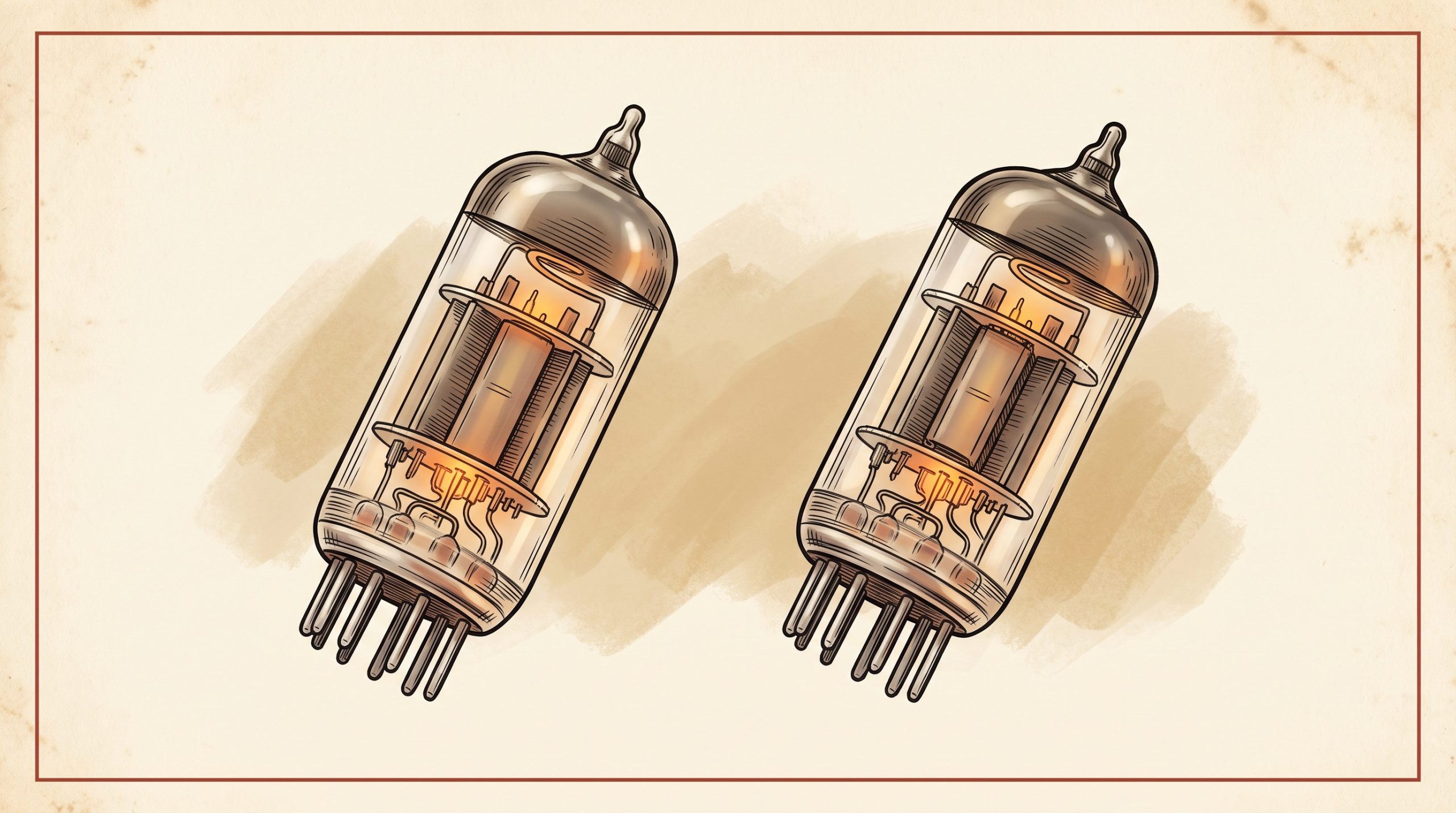
A claim that circulates on tube forums says the 12AY7 predates the 12AX7, as if it were the original design that a higher-gain 12AX7 later replaced. The registration record says otherwise: RCA registered the 12AX7 on the RMA Electron Tube Registration List on September 15, 1947, and registered the 12AY7 on December 7, 1948, about 14–15 months later. The 12AY7 wasn’t a budget alternative or a low-rent substitute, but it also wasn’t the earlier design. It was developed shortly after the 12AX7, specifically as a lower-gain, low-noise, low-microphonic dual-triode for premium audio preamplifier and telephony applications where the 12AX7’s higher gain wasn’t the design priority. That intent still explains why Fender’s engineers chose it for V1 in the tweed era: low noise, moderate gain, and efficient transconductance were exactly what those circuits needed.
The military and industrial world designated the same tube as the 6072 (sometimes 6072A for tighter-tolerance versions). When sourcing NOS stock, the 6072/6072A designation often signals better build quality and tighter noise specs than plain 12AY7 pulls. Worth knowing before you start buying.
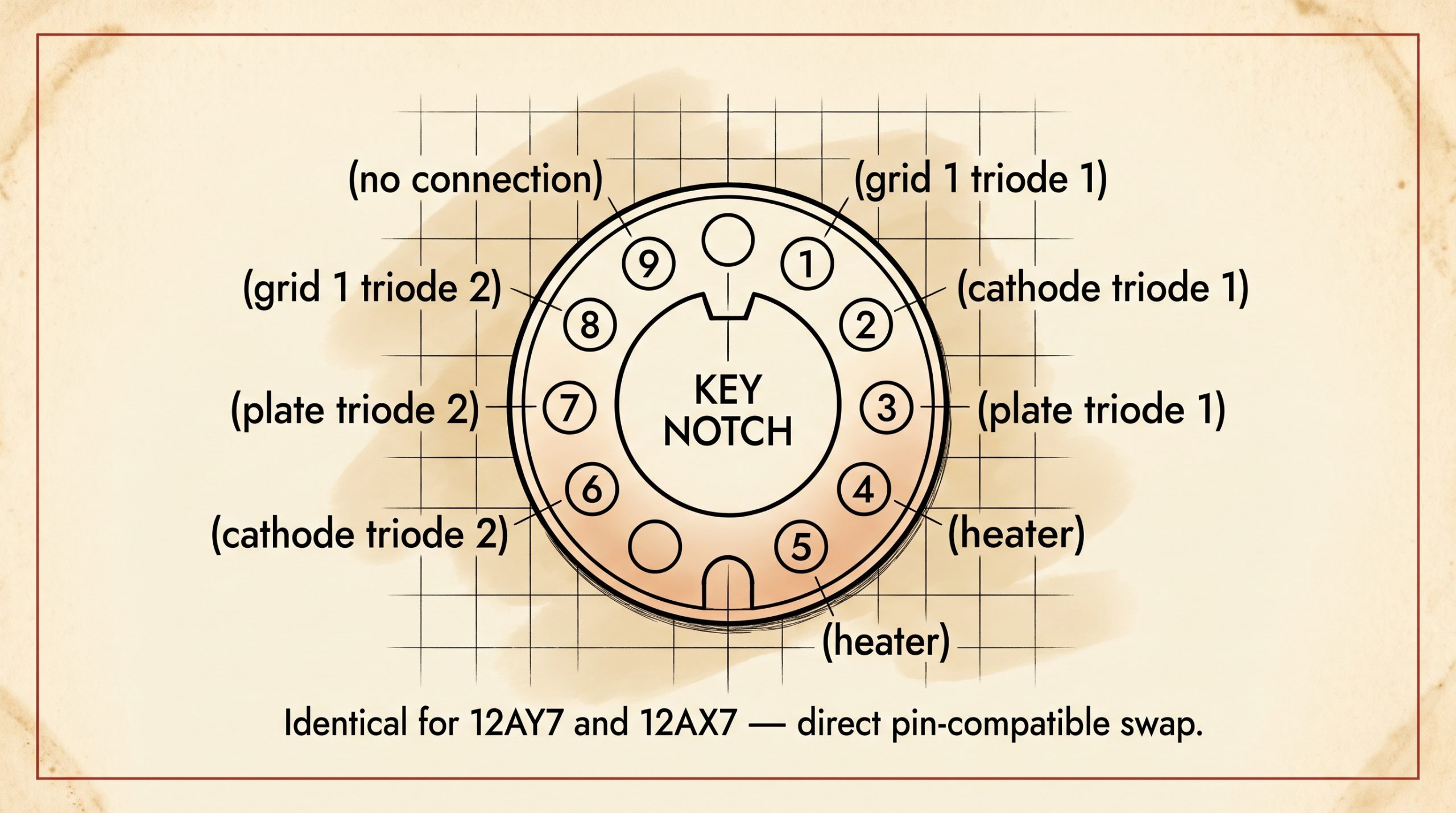
Format is identical to every tube in the 12AX7/12AT7/12AU7 family: 9-pin miniature noval base, dual-triode construction, 12.6V heater in series or 6.3V in parallel. Socket compatibility with the entire 12-series family is complete. Key NOS manufacturers include GE, RCA, Sylvania, Amperex, and Raytheon. Current production from major manufacturers like JJ, TAD, Electro-Harmonix, and Tung-Sol? Essentially nonexistent for the 12AY7. That scarcity has practical consequences covered in the sourcing section below.
Datasheet Specifications
The following figures are drawn from RCA published datasheets for the 12AY7/6072. These are the numbers that determine how the tube behaves inside a real amplifier circuit, and they’re the reason the 12AY7 and 12AX7 sound different even before you play a note.
| Parameter | 12AY7 / 6072 |
|---|---|
| Amplification Factor (mu) | 44–45 |
| Transconductance (gm) | ~1,750 µmhos |
| Plate Resistance (rp) | ~25,000 Ω |
| Heater Voltage | 12.6V series / 6.3V parallel |
| Max Plate Voltage | 300V (12AY7); 330V (premium 6072/6072A mil-spec) |
| Typical Operating Plate Voltage (guitar amp) | 100–250V |
| Military Designation | 6072 / 6072A |
One spec here trips up a lot of players: the 12AY7’s transconductance (gm) of ~1,750 µmhos is slightly higher than the 12AX7’s ~1,600 µmhos. Higher gm doesn’t mean more gain in a standard common-cathode stage. Voltage amplification is determined by mu, not gm. The 12AY7’s gm holding roughly even with the 12AX7’s, despite its much lower mu, means it drives subsequent stages efficiently and with low noise, which is exactly why it was chosen for telephony and audio preamp work. Low gain, clean drive. That’s the design brief.
What Is the 12AX7? A Baseline for Comparison
The Standard Preamp Tube
The 12AX7 entered commercial production after World War II and became the default guitar amplifier preamp tube through Fender’s blackface era and well beyond. European equivalent: ECC83. Other designations include 7025 (commercial low-noise grade, often used in higher-end audio equipment) and B339 (British military spec). NOS heavyweights include Mullard (UK), Telefunken (DE), RCA, GE, and Sylvania. Current production options are broad: JJ ECC83S, Tung-Sol 12AX7, Electro-Harmonix 12AX7EH, TAD RT001, and others.
The complete 12AX7 tube guide covers current-production brand comparisons, NOS sourcing, and Fender circuit placement in detail. For this comparison, the 12AX7 serves as the gain baseline against which every substitute is measured.
12AX7 Datasheet Specifications
| Parameter | 12AX7 / ECC83 |
|---|---|
| Amplification Factor (mu) | 100 |
| Transconductance (gm) | ~1,600 µmhos |
| Plate Resistance (rp) | ~62,500 Ω |
| Heater Voltage | 12.6V series / 6.3V parallel |
| Max Plate Voltage | 300V |
| Typical Operating Plate Voltage (guitar amp) | 100–300V |
| Other Designations | ECC83, 7025, B339 |
12AY7 vs 12AX7, Head-to-Head Specification Comparison
The numbers tell most of the story, but the relationship between mu, gm, and rp is what explains why these two tubes feel so different in the same socket. A quick note on framing: “55% less gain” and “45% of the gain” both describe the same mathematical reality. The 12AY7 sits at roughly 45 on a scale where 12AX7 equals 100. Both statements are correct. This article uses “45% of” throughout for consistency.
| Spec | 12AY7 (6072) | 12AX7 (ECC83) |
|---|---|---|
| Amplification Factor (mu) | 44–45 | 100 |
| Transconductance (gm) | ~1,750 µmhos | ~1,600 µmhos |
| Plate Resistance (rp) | ~25,000 Ω | ~62,500 Ω |
| Gain vs. 12AX7 | ~45% (–6dB) | 100% (baseline) |
| Max Plate Voltage | 300V | 300V |
| Pin Compatibility | Yes (9-pin noval) | Yes (9-pin noval) |
| Typical Application | Low-gain preamp V1, audio/telephony | High-gain preamp V1–V3, phase inverter |
| NOS Availability | Scarce / expensive | Moderate |
| Current Production | Very limited | Widely available |
| Plate Resistance Interaction | Low rp: efficient current drive | High rp: voltage gain maximized |
That plate resistance difference is significant and under-discussed. The 12AX7’s rp of ~62,500 Ω interacts with a typical 100kΩ plate load resistor to maximize voltage gain. The 12AY7’s rp of ~25,000 Ω, roughly 40% of the 12AX7’s, presents a very different load relationship: lower output impedance, less voltage swing, but the circuit sees it cleanly. No mush at the output. That’s a feature, not a limitation, in a circuit designed around it.
The 12AY7 in Fender Tweed-Era Amplifiers
Why Fender Specified the 12AY7
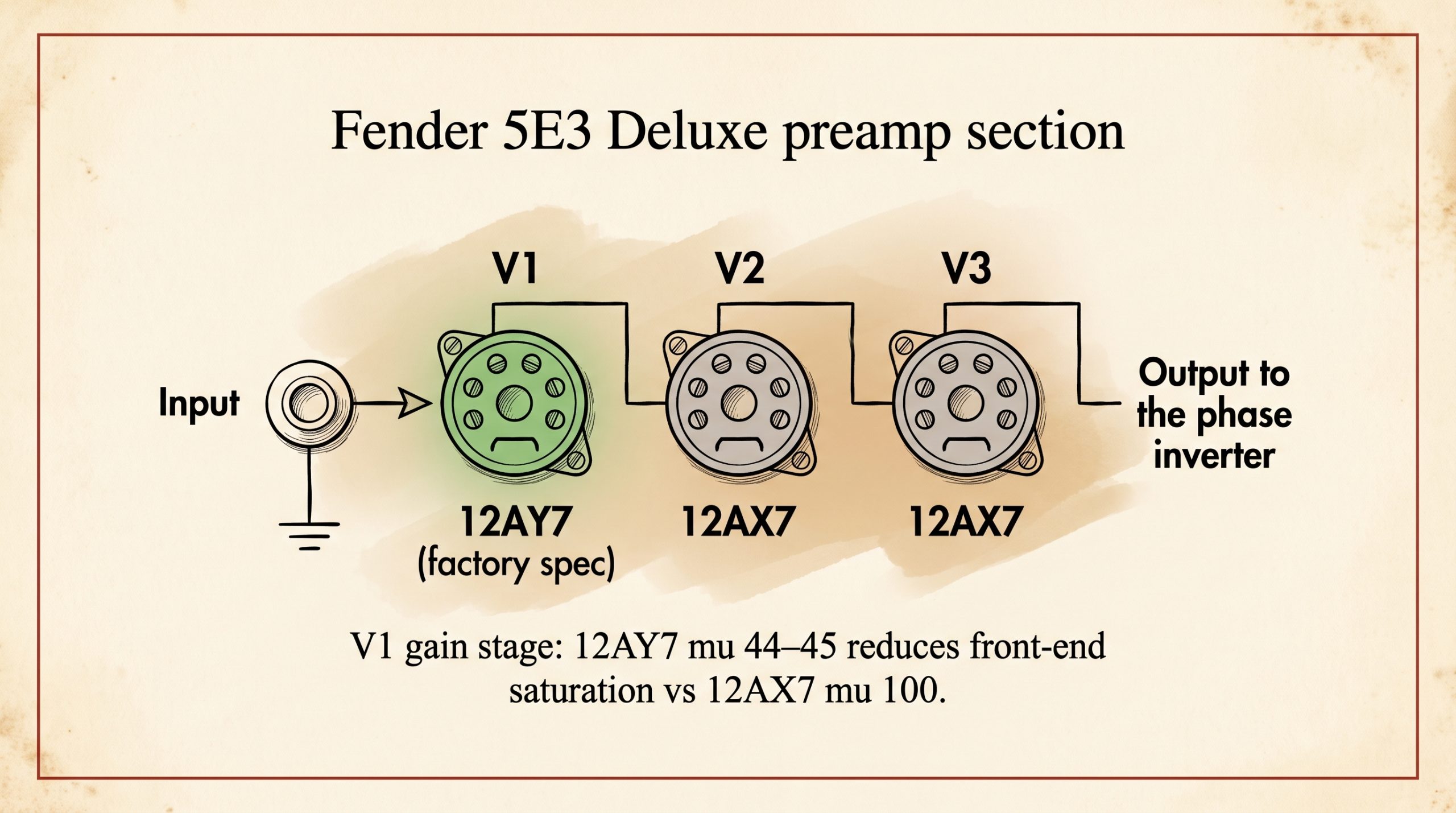
Fender’s tweed-era designers weren’t guessing. The B+ voltages in these power supplies typically ran 200–260V, lower than the 300V+ rails found in later blackface circuits. At those plate voltages, a 12AX7 in V1 compresses and saturates earlier than intended, pushing the amp toward breakup before the volume control reaches useful playing levels. The 12AY7’s moderate mu and low rp delivered the clean front-end gain these circuits needed, allowing the volume and tone controls to work through a realistic range before the preamp section contributed audible compression.
The circuit codes below are drawn from original Fender service documentation. Identifying the correct circuit code on your amp is the first step toward confirming factory tube spec. The Fender tube amp serial number and dating guide covers how to locate and decode circuit codes from chassis stamps and tube chart stickers across all eras.
Factory 12AY7 Amplifier Models
| Amplifier | Circuit Number | Production Years | Era | 12AY7 Position |
|---|---|---|---|---|
| Fender Deluxe | 5E3 | 1955–1960 | Tweed | V1 |
| Fender Super | 5F4 | 1956–1960 | Tweed | V1 |
| Fender Pro | 5E5A | 1956–1960 | Tweed | V1 |
| Fender Bassman | 5F6A | 1958–1960 | Tweed | V1 |
| Fender Twin (Low Power) | 5E8A | 1955–1957 | Tweed | V1 |
| Fender Twin (High Power) | 5F8A | 1958–1960 | Tweed | V1 |
| Fender Tremolux | 5G9 | 1957–1960 | Tweed | V1 |
| Fender Bandmaster | 5E7 | 1955–1960 | Tweed | V1 |
When Fender moved to brownface and then blackface circuit designs, the transition to 12AX7 in V1 followed the higher B+ voltages and cleaner headroom targets of those later circuits. It wasn’t an arbitrary change. The Fender 5E3 Tweed Deluxe reference guide covers the V1 circuit in detail, including cathode resistor values and the operating points that make the 12AY7 correct for that specific design. For the 5F6A Bassman, the Fender Bassman guide walks through the full tube complement and how that circuit differs from the Deluxe.
For a correct period restoration of any of the above models, the 12AY7 isn’t optional. It’s the spec.
Are 12AX7 and 12AY7 Interchangeable?
Pin Compatible. Not Tonally Equivalent.
Both tubes share the 9-pin noval base. You can pull one, drop in the other, power up, and play. No rewiring. No socket modification. No bias adjustment required in any standard Fender cathode-biased preamp stage. That part is genuinely simple.
What changes is significant. The gain at V1 drops by approximately 55% when swapping 12AX7 out for 12AY7. That’s roughly 6dB. In listening terms: the volume control becomes usable through a wider range before the preamp saturates, the attack cleans up, and the low-end response generally opens up. Some describe it as warmer with more body. That’s subjective. The gain reduction is not.
Swapping 12AX7 to 12AY7: Gain Reduction Use Case
Fender Blues Deluxe, Blues DeVille, Hot Rod Deluxe owners in particular report that V1 gain in those circuits is excessive for clean playing at stage volumes. A 12AY7 in V1 is the cheapest and most reversible fix available. No soldering, no mods, no voiding of warranties on older units.
Here’s the important clarification: this doesn’t increase headroom. Not technically. Headroom is the power section’s ability to produce clean output before the output tubes clip. Swapping V1’s 12AX7 for a 12AY7 delays preamp-stage saturation. The power amp ceiling stays exactly where it was. The amp feels cleaner at moderate volumes because less preamp gain is hitting the tone stack and phase inverter, not because the power section gained capacity. The distinction matters if you’re troubleshooting, even if the practical effect feels similar.
Tonal character: less front-end compression, less ice-pick treble on bright channel amps, more spanky attack on single-note lines. The 12AY7 doesn’t soften the amp, it just keeps the preamp section out of its own way until you push harder.
Swapping 12AY7 to 12AX7: Gain Increase in Tweed Circuits
Drop a 12AX7 into V1 of a 5E3, and it approximately doubles the gain at that stage. The amp breaks up earlier, at lower volume settings, with a different compression character. Plenty of players prefer it for small-room blues work where barks when pushed is the whole point. Not wrong. But not original either.
The plate voltages in tweed-era power supplies (typically 200–260V B+) are well within the 300V maximum plate voltage of the 12AX7. The swap is electrically safe. It’s just not a restoration, it’s a modification, and knowing the difference keeps your mental model of the circuit accurate.
The Full Substitution Ladder
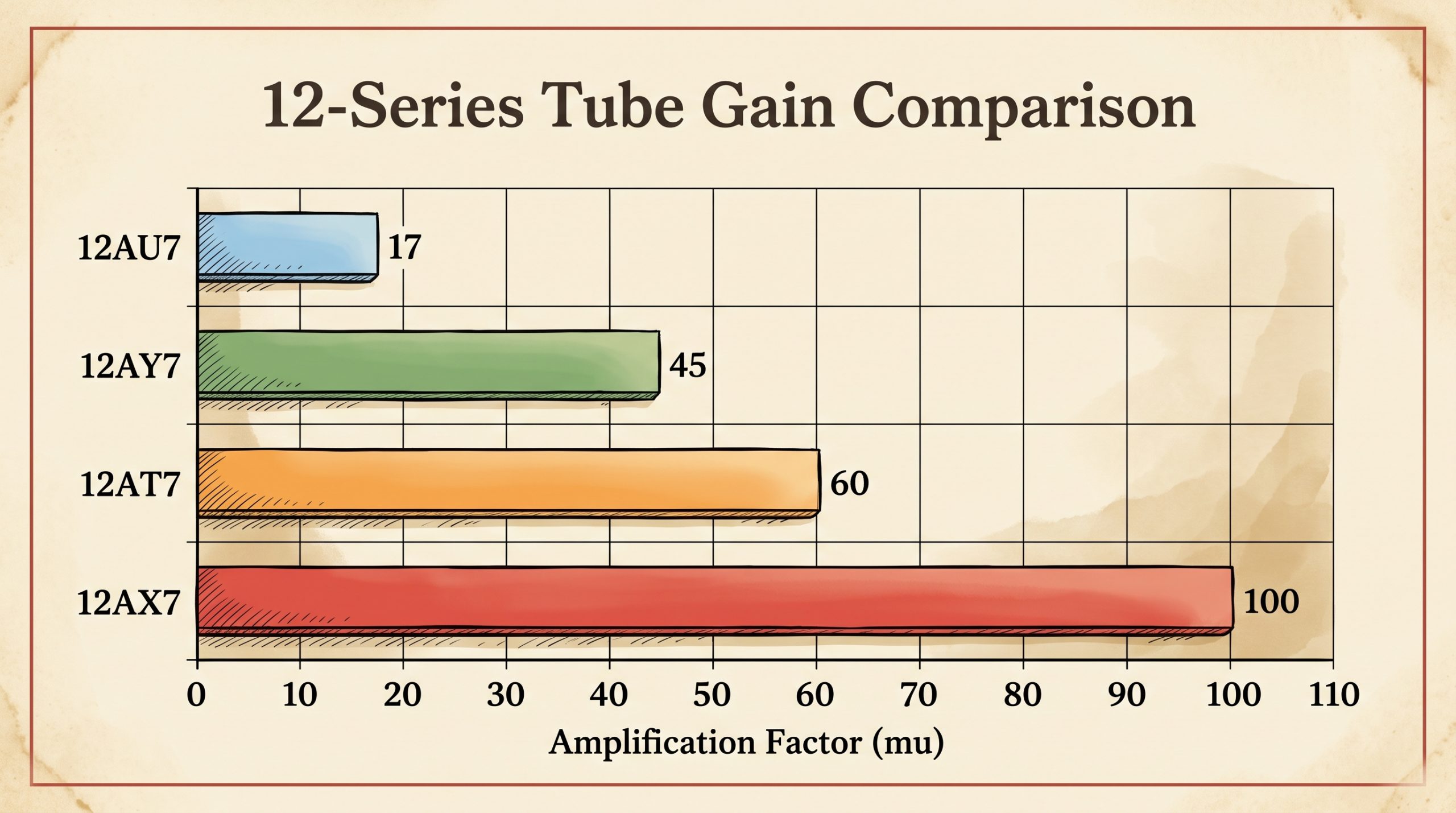
The 12AY7 sits midway down a gain ladder that most players never fully map out. When NOS 12AY7 stock is unavailable, or when you want more precise control over front-end gain, understanding the alternatives matters.
| Tube | Mu (Gain Factor) | % of 12AX7 Gain | Drop from 12AX7 | Notes |
|---|---|---|---|---|
| 12AX7 (ECC83) | 100 | 100% | Baseline | Standard guitar amp preamp |
| 12AT7 (ECC81) | 60 | 60% | –40% | High gm; better for reverb driver or phase inverter |
| 5751 | 70 | 70% | –30% | Military-spec 12AX7 sub; closest tonal match |
| 12AY7 (6072) | 44–45 | ~45% | –55% | Tweed-era Fender factory spec; low rp |
| 12AU7 (ECC82) | 17–20 | ~19% | –81% | Extreme reduction; circuit modification likely needed |
| 12DW7 (ECC832) | ~17 (one triode) | ~17–20% | ~–80% | Asymmetric dual triode; each half has different mu |
12AY7 vs 5751, The Closest 12AX7 Substitute
If you want gain reduction without leaving the 12AX7 family’s operating characteristics, the 5751 is the starting point. Military-spec designation, same basic pinout, operates at ~70% of 12AX7 gain. The difference between 5751 and 12AX7 is a tighter, slightly darker version of the same tube. Many players use 5751 in V1 before reaching for a 12AY7 precisely because the rp and operating point remain similar to the 12AX7.
The 12AY7 drops further, to ~45%, and changes the plate resistance interaction significantly. Different character, not just less gain. NOS 5751 from GE and Sylvania are well-regarded and more available than 12AY7 stock. Worth trying first if your goal is subtle taming rather than tweed-spec correctness.
12AY7 vs 12AT7
The 12AT7 (ECC81) sits at mu 60, between 12AY7 and 12AX7. Don’t let that number suggest it’s a good V1 substitute for either. The 12AT7 carries very high gm (~5,500 µmhos) and low rp, a design profile intended for RF applications, phase inverters, and reverb driver duty. In V1 of a guitar preamp, 12AT7 typically sounds thin and lacks the musical character of either the 12AX7 or 12AY7. The 12AT7 vs 12AX7 guide covers this in full, including the specific Fender positions where the 12AT7 belongs.
Don’t use it in V1 for gain reduction. It’s not designed for that role. Not recommended.
12AY7 vs 12AU7
The 12AU7 drops mu to ~17–20. That’s an 81% reduction from 12AX7. In most V1 circuits, the signal loss is too severe for practical use without circuit modification to compensate. The 12AU7 is useful in specific buffer and driver applications, but it doesn’t belong in a guitar amp’s V1 as a casual swap. Leave it alone.
Bias and Operating Point Shifts When Swapping
How the V1 Operating Point Changes
This is the part competitors skip, and it’s worth understanding. When you replace a 12AY7 with a 12AX7 in a fixed cathode-resistor circuit (no adjustable bias pot), the operating point shifts because the plate resistance changes from ~25,000 Ω to ~62,500 Ω.
In a typical tweed V1 stage with a 100kΩ plate load resistor and a 1.5kΩ cathode resistor: the 12AX7’s high rp places more of the B+ voltage across the tube itself, raising the quiescent plate voltage. The 12AY7’s low rp allows more current to flow, dropping the quiescent plate voltage and shifting the operating point toward a different region of the tube’s characteristic curves. In practical terms, this means the clipping behavior differs in ways that go beyond the simple gain differential. The 12AX7 tends toward harder, more asymmetric clipping in a tweed V1 stage. The 12AY7 clips more softly and more symmetrically at its operating point. That’s part of why tweed amps sound the way they do, the tube is doing a specific job at a specific operating point.
Voltage Caveats
Both tubes share 300V maximum plate voltage. Every standard Fender circuit, including the tweed-era power supplies with their 200–260V B+, sits comfortably within that limit for both tubes. No cathode resistor change is required in either swap direction for typical Fender applications. The swap is safe. The tonal and operating-point consequences are real; the voltage risk is not.
NOS Sourcing Guide for the 12AY7
Why 12AY7 NOS Stock Is Scarce
The 12AY7 was never produced in the volume of the 12AX7, 12AT7, or 12AU7. Its original application base, telephony, professional audio preamplifiers, military communications, was smaller and more specialized than the broad consumer electronics market that consumed millions of 12AX7s. Production wound down with the vacuum tube era and never resumed at scale.
As of current market conditions, no major manufacturer (JJ, TAD, Electro-Harmonix, Tung-Sol, Mullard reissue) produces a new-manufacture 12AY7 as a standard line item. Players who need a 12AY7 are buying NOS. That’s it.
Which Brands to Look For
For V1 low-noise applications in a tweed-spec restoration, the following NOS options are well-documented among collectors and restorers:
- GE 6072A: Military-spec designation, tighter noise tolerances, excellent low-noise floor. First choice for restoration work where minimizing microphonics matters.
- RCA 12AY7: Well-built, reliable, widely used in Fender factory production. Good specimens remain available through reputable dealers.
- Sylvania 12AY7: Clean build quality, consistent specs. Sylvania’s American production is generally regarded as reliable across the preamp tube family.
- Amperex 12AY7: Less common but well-regarded by collectors. Worth testing if you find graded stock.
Avoid unbranded “pulls” from unknown surplus equipment. In a low-gain V1 application, noise and microphonics are amplified directly into the signal path. A noisy tube in V1 is miserable. Unbranded stock with no testing history isn’t worth the gamble.
Typical NOS pricing runs $25–$80 per tube depending on brand, grade, and seller. GE 6072A tested pairs at the upper end. Ungraded RCA pulls closer to the lower. Budget for testing or buy from a dealer who tests and grades before shipping.
Antique Radio Supply (ARS) and Tube Depot carry tested NOS stock, though availability fluctuates. For datasheet-level specs on the 6072A specifically, the archived GE Essential Characteristics datasheet remains the primary reference document, available via radiomuseum.org’s tube data section.
The 12AY7 in Non-Fender Contexts and Modern Amp Design
Other Amplifiers That Used the 12AY7
Fender wasn’t alone in specifying the 12AY7. Vintage Ampeg and Gibson amplifiers used 12AY7 variants in preamp positions during the same era, particularly in designs targeting clean headroom with warm bottom-end response. The tube fit any circuit prioritizing low-noise audio amplification over maximum gain, which describes most early American amp design philosophy before the British high-gain era changed what players expected from a preamp stage.
Modern boutique builders working in tweed-replica territory use factory-correct 12AY7 in V1 as a matter of design integrity. Victoria Amp Company’s tweed-spec builds are documented examples. The tube’s scarcity is a production cost and sourcing challenge for manufacturers, but for single-unit boutique work, it’s standard practice among builders who understand what the original circuits were doing.
Why Modern Amp Designers Rarely Specify It
Simple supply chain reality. A production amplifier specifying a tube that’s only available as aging NOS stock creates a warranty and support problem. Most modern designs use 12AX7 throughout the preamp chain and adjust gain staging via resistor values and tone stack design. It’s easier to manage. For high-gain designs, the 12AX7’s full mu is useful at every stage. The 12AY7’s specific gain structure is only optimal in low-wattage, clean-focused, tweed-type circuits, a niche within a niche.
Which Tube Belongs in Your V1?
The core of the 12ay7 vs 12ax7 question is intent. A mu of 44 versus a mu of 100 is a simple number, but it represents a deliberate design choice Fender made for every tweed-circuit amplifier from the mid-1950s through 1960. The 12AY7 isn’t a compromise or a substitute, it’s the spec. Players restoring a 5E3 Deluxe or a 5F6A Bassman should source a tested NOS 12AY7 or 6072A and install it. The amp will behave the way it was designed to behave. Players running a Blues Deluxe or Hot Rod Deluxe who can’t get usable clean tone below the 3 o’clock position on the volume knob should try a 12AY7 in V1 before touching anything else. It’s a $30–$50 fix that costs nothing to reverse. Stock a GE 6072A for restoration work, keep a tested RCA or Sylvania on hand for modern-amp taming, and know which direction you’re going before you pull the tube. That clarity makes the difference between a useful modification and an accidental one.
Sources
- RCA 6072/12AY7 Essential Characteristics datasheet, frank.pocnet.net and amperatubes.com
- RCA Receiving Tube Manual, RC-29, 12AY7/6072 operating parameters, cross-referenced via nj7p.org tube database
- RMA Electron Tube Registration List entries for 12AX7 (1947) and 12AY7 (1948), radiomuseum.org
- Fender service bulletins and original tube chart documentation, circuit codes 5E3, 5F6A, 5F4, 5E5A, 5E7, 5E8A, 5F8A, 5G9 via schematicheaven.net and ampwares.com
- Teagle and Sprung, Fender Amps: The First Fifty Years, tweed-era production dates and circuit evolution
- Greg Gagliano’s 20th Century Guitar Magazine amplifier research series (1997–2000), archived via Wayback Machine
- Premier Guitar contributors, 12AY7 application and tweed-era historical context, premierguitar.com
Frequently asked questions
Are 12AX7 and 12AY7 interchangeable?
Physically, yes. Both use the 9-pin noval base, no rewiring, no socket modification, no bias adjustment required. Tonally and electrically, they're not interchangeable. The 12AY7 delivers approximately 45% of the gain of a 12AX7 (roughly –6dB), which produces a significant change in breakup threshold, volume feel, and preamp compression. Pin-compatible doesn't mean sonically equivalent.
What is a 12AY7 tube used for?
Originally designed for low-noise audio preamplifier and telephony applications shortly after the 12AX7's introduction. In the guitar amp world, it's the factory-spec V1 preamp tube in Fender's tweed-era amplifiers: the 5E3 Deluxe, 5F6A Bassman, 5F4 Super, and several others through 1955–1960. It's also used today as a deliberate gain-reduction substitute in V1 of overly aggressive modern amps, particularly the Blues Deluxe and Blues DeVille, where front-end gain is excessive for clean playing.
Will swapping to a 12AY7 give my amp more headroom?
Not technically. Headroom is the power section's ability to produce clean output before the output tubes clip. Swapping V1's 12AX7 for a 12AY7 reduces front-end gain, which delays preamp-stage saturation. The amp feels cleaner and more open at moderate volumes, but the power amp's clean ceiling doesn't change. The forum shorthand of "more headroom" is convenient but imprecise. More accurately: less preamp compression before the signal reaches the power stage.
What is the closest 12AY7 equivalent or substitute?
For exact 12AY7 replacement, the 6072 (military designation) is the same tube with tighter manufacturing tolerances. For a functional substitute when 12AY7 NOS isn't available, the 5751 is the closest match in terms of operating characteristics, though its mu of ~70 is higher than the 12AY7's 44–45. No current-production 12AY7 is widely available from major manufacturers. NOS stock from GE, RCA, and Sylvania remains the primary sourcing option.
Which is correct for a tweed Fender restoration, 12AY7 or 12AX7?
The 12AY7 is the factory-correct choice for any of the Fender tweed-era circuits listed above (5E3, 5F6A, 5F4, 5E5A, 5E8A, 5F8A, 5G9, 5E7). Using a 12AX7 in V1 of those circuits is a valid tonal modification and electrically safe, but it takes the amplifier outside its original design parameters. Both swaps are safe. Only one is a restoration.