Contents
- 01What Are the 12AX7 and 12AU7? The 9-Pin Dual-Triode Family
- 02Key Datasheet Specs: 12AU7 vs 12AX7 Side-by-Side
- 03Can You Actually Swap a 12AU7 for a 12AX7?
- 0412AU7 vs 12AX7 in Vintage Fender Amplifier Circuits
- 0512AU7 vs 12AT7: The More Practical Substitution
- 0612AU7 Applications: Where This Tube Actually Belongs
- 07Sonic Character: What Players Actually Hear
- 08What Tube Is Equivalent to the 12AU7?
- 09Which 12AU7 Sounds Best? Current Production vs. New Old Stock
- 10Practical Guide: When to Substitute and When Not To
- 11FAQ: 12AU7 vs 12AX7 Common Questions
- 12Picking the Right Tube for the Right Job
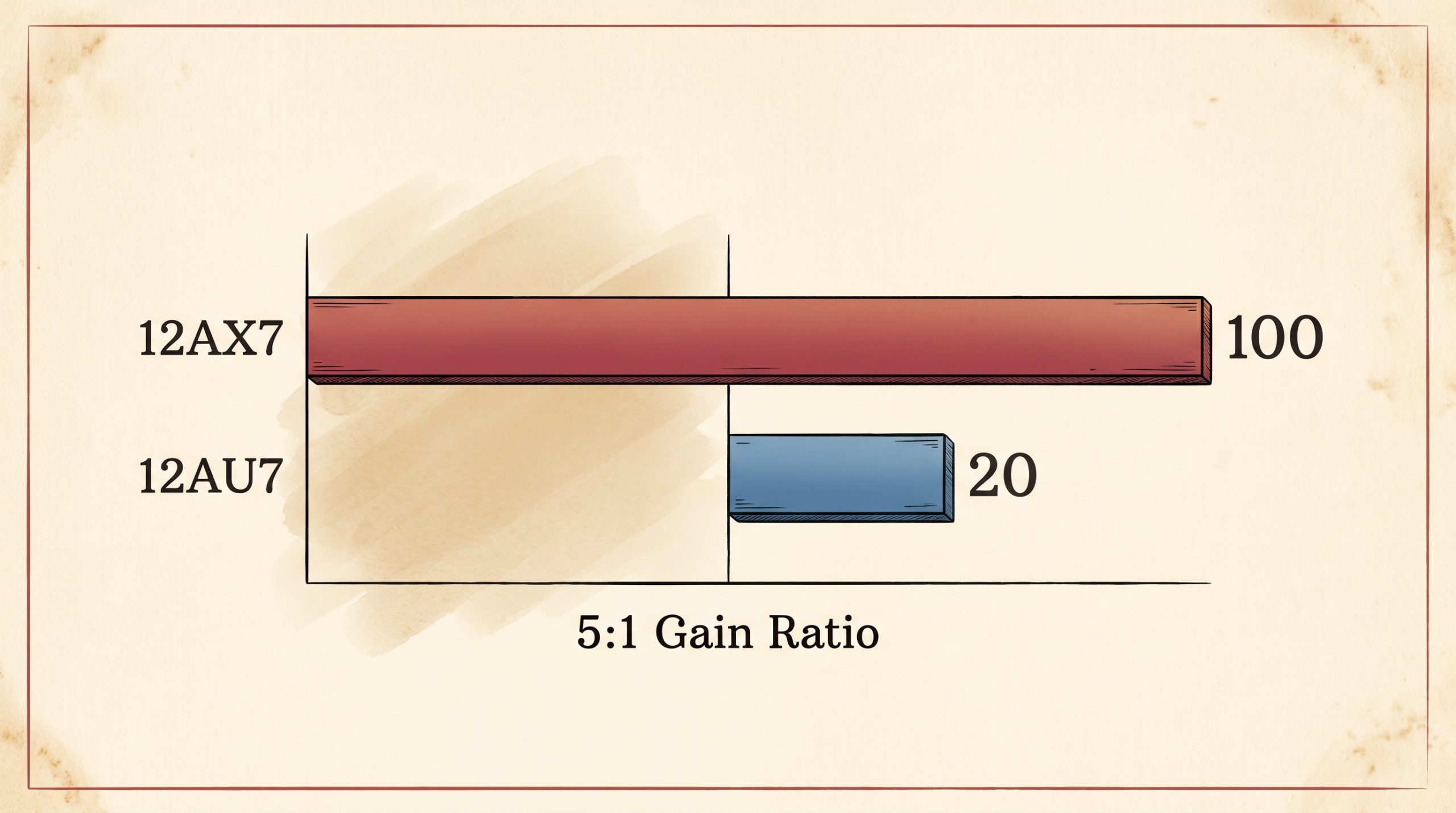
That roughly six-to-one gain ratio is the whole story in miniature. Both tubes slot into the same Noval socket. The heater current is identical. But the circuits around them are built for a 12AX7, and dropping a 12AU7 into a V1 position doesn’t just reduce gain, it shifts the operating point far enough that the tube runs outside its intended curve. The result isn’t “cleaner tone.” It’s a thin, hollow signal with compromised frequency response.
Here’s what the datasheet numbers actually mean for your amp, which positions can tolerate the swap, and where the 12AU7 genuinely belongs.
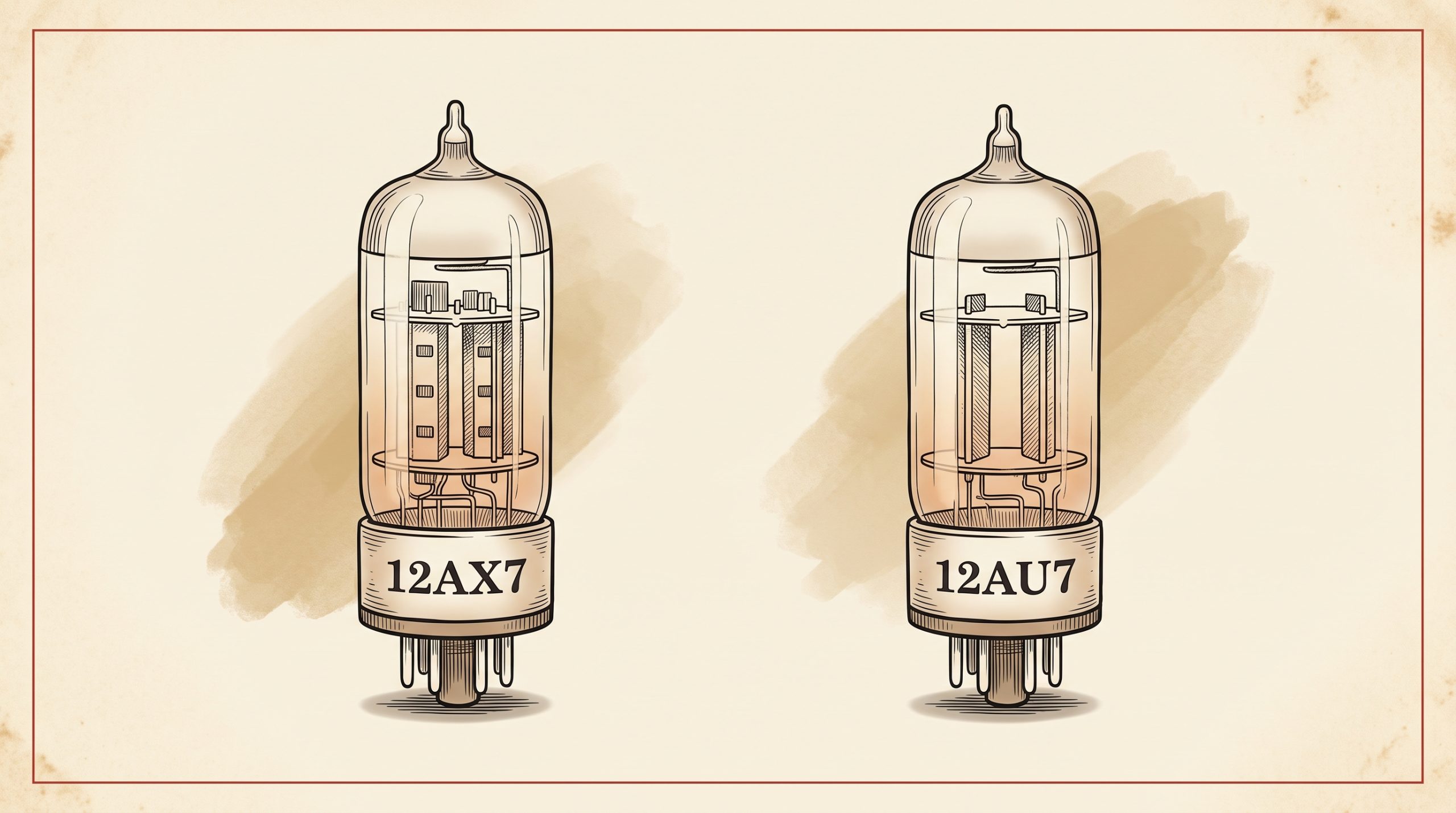
What Are the 12AX7 and 12AU7? The 9-Pin Dual-Triode Family
Manufacturer History of Both Tubes
RCA introduced the 12AU7 around 1946 and the 12AX7 around 1947. Both were developed for the postwar consumer electronics and hi-fi boom, and both found their way into instrument amplifiers as the market exploded through the 1950s. The European equivalents, ECC82 for the 12AU7 and ECC83 for the 12AX7, were produced by Mullard (Blackburn plant), Telefunken (Ulm), and Amperex. Telefunken’s diamond-bottom tubes from this era remain benchmarks for both designations.
Current production comes from JJ Electronic (Slovakia), Electro-Harmonix and Sovtek (both sourced from Saratov, Russia), and Tung-Sol (also Saratov). TAD (Tube Amp Doctor) sources from JJ and other Eastern European factories with additional sorting and testing.
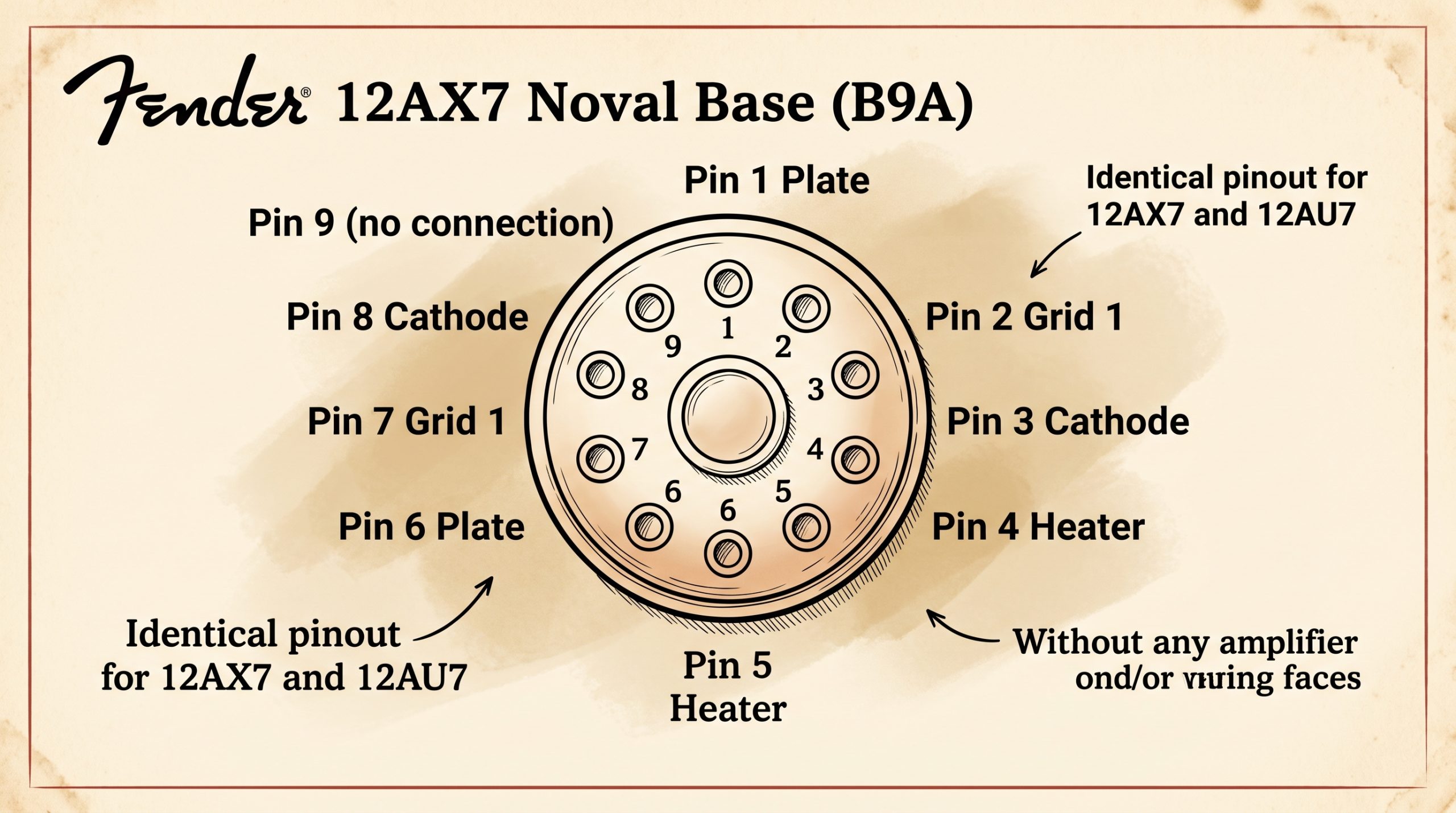
The reason the swap question exists at all: both tubes use the 9-pin Noval (B9A) base with identical pin assignments. Grid 1 on pin 2, plate on pin 1, cathode on pin 3, the pinout is identical across the entire 12A_7 family. Nothing stops you from physically inserting a 12AU7 into a 12AX7 socket. The circuit, however, will have opinions.
The 12A_7 Tube Family at a Glance
Three tubes define the family: the 12AX7 at µ=100, the 12AT7 at µ=60, and the 12AU7 at µ=17. Same base. Same heater requirements. Radically different operating characteristics. This article focuses on the 12AU7 vs 12AX7 comparison, with the 12AT7 and 12AU7 comparison covered in its own section below, because the 12AT7 is actually the more practical substitution question for most guitar players.
Key Datasheet Specs: 12AU7 vs 12AX7 Side-by-Side
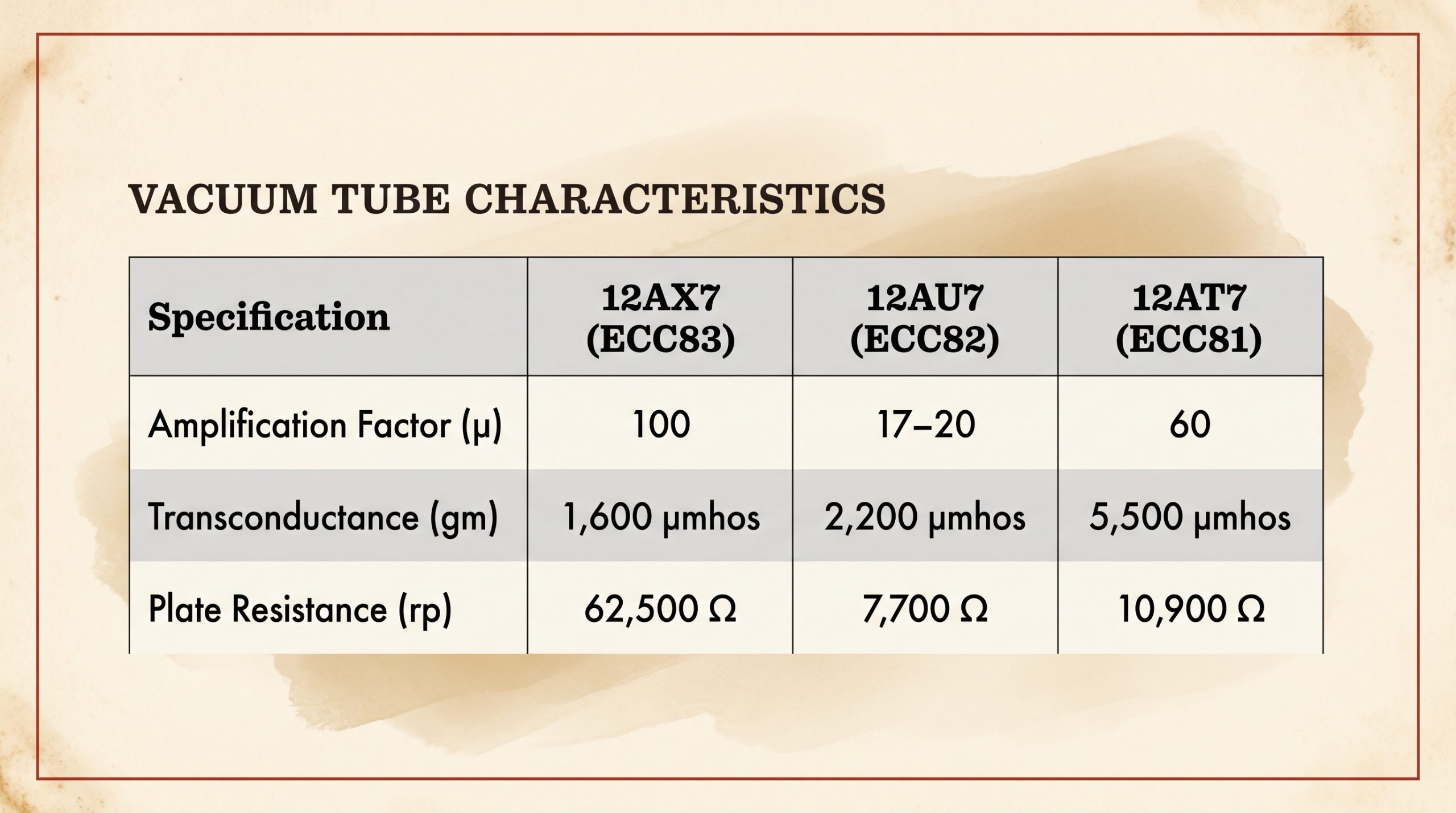
Three numbers matter most when comparing preamp tubes. The amplification factor (µ) is the ratio of change in plate voltage to change in grid voltage with plate current held constant, it’s the theoretical maximum voltage gain the tube can produce. Transconductance (gm) measures how effectively the grid controls plate current, expressed in micromhos (µmhos). Plate resistance (rp) is the tube’s internal resistance, which forms a voltage divider with the external plate load resistor, and this is where the 12AU7 vs 12AX7 difference becomes electrically critical.
| Specification | 12AX7 (ECC83) | 12AU7 (ECC82) | 12AT7 (ECC81) |
|---|---|---|---|
| Amplification Factor (µ) | 100 | 17–20 | 60 |
| Transconductance (gm) | 1,600 µmhos | 2,200 µmhos | 5,500 µmhos |
| Plate Resistance (rp) | 62,500 Ω | 7,700 Ω | 10,900 Ω |
| Typical Plate Voltage | 250V | 250V | 250V |
| Typical Cathode Current | 1.2 mA | 10.5 mA | 10 mA |
| Max Plate Dissipation | 1.0W | 2.75W | 2.5W |
| Heater Current | 150 mA (12.6V series) / 300 mA (6.3V parallel) | 150 mA (12.6V series) / 300 mA (6.3V parallel) | 150 mA (12.6V series) / 300 mA (6.3V parallel) |
| Heater Voltage | 6.3V / 12.6V | 6.3V / 12.6V | 6.3V / 12.6V |
Datasheet values sourced from original GE and RCA published specifications, available via Frank’s Electron Tube Data Sheets. Notice the heater current row: identical across all three tubes regardless of wiring mode, 150mA if the heaters are wired in 12.6V series, or 300mA if wired in the more common 6.3V parallel configuration found in most Fender blackface circuits. That’s why you can physically swap them without blowing a fuse or damaging a socket. But the plate dissipation difference, 1.0W max for the 12AX7 versus 2.75W for the 12AU7, signals how different these tubes’ intended operating environments actually are.
What Amplification Factor Actually Means for Guitar Tone
µ=100 for the 12AX7 means a 1mV signal at the grid produces 100mV at the plate before circuit loading factors in. Real-world loaded gain in a standard 100kΩ plate-load circuit runs closer to 60–70x for the 12AX7, because the plate load resistor and rp form a voltage divider.
The same calculation for the 12AU7 with its rp of 7,700Ω: loaded gain drops to roughly 15–19x in a 100kΩ plate load. That’s not a subtle difference. That’s roughly a 75-80% reduction in voltage gain, from a tube installed in a socket surrounded by resistor values chosen for the 12AX7’s operating characteristics. Not great, even before you account for the bias mismatch.
This gain differential is precisely why the 12AX7 dominates V1 in virtually every vintage Fender guitar amp. A passive single-coil pickup produces roughly 10–100mV at the input jack. The amp needs that signal amplified aggressively at V1 to properly drive the tone stack and phase inverter downstream. µ=100 does that job. µ=17 doesn’t.
Can You Actually Swap a 12AU7 for a 12AX7?
The Physical Reality, Pins Match, Circuits Don’t
The 9-pin Noval pinout is identical across the 12A_7 family. Inserting a 12AU7 into a 12AX7 socket won’t damage the socket or the heater winding on the power transformer. The heater draws the same current either way, 150mA at 12.6V series wiring, or 300mA at 6.3V parallel wiring, the configuration typical of Fender blackface preamp circuits. Physically, the swap goes in without resistance. The problem lives in the electrical relationship between the tube and the surrounding components.
What Happens to Bias When You Drop a 12AU7 into a 12AX7 Socket
In a standard Fender blackface V1 stage, the plate load resistor is 100kΩ. With a 12AX7’s rp of 62,500Ω, the effective load the signal sees is approximately 38.5kΩ, well within the 12AX7’s designed operating curve. Swap in a 12AU7 with its rp of 7,700Ω, and the effective load collapses to roughly 7.1kΩ. The tube is now operating in a region its plate characteristic curves weren’t designed for at those B+ voltages.
The cathode bias resistor compounds the problem. Fender blackface V1 stages typically use a 1.5kΩ cathode resistor sized for the 12AX7’s quiescent cathode current of 1.2mA. The 12AU7 wants to run at 10.5mA quiescent current, nearly nine times higher. That 1.5kΩ resistor generates way too much cathode voltage at that current, pushing the tube toward cutoff and restricting signal swing. Audible results include signal loss, frequency response changes weighted toward the high end, and in some circuits, motorboating or oscillation as bias conditions destabilize downstream stages.
The point: the bias mismatch can cause the tube to sound thin and wrong, and it’s not solvable by ear. You’d need to replace the cathode resistor and verify the new operating point against the 12AU7’s plate curves before calling it a working substitution.
Where the Swap Can Work With Caveats
Phase inverter positions are the most forgiving location for a 12AU7 in a Fender blackface amp. The PI receives a much larger signal than V1, it doesn’t need high voltage gain, it needs current drive and linearity. A 12AU7’s higher current capability and lower rp can actually benefit the PI stage by increasing headroom before the phase inversion clips. Some players deliberately run a 12AU7 in the PI for maximum clean headroom on the power section.
Reverb driver positions are another occasional use case, though 12AT7 is better suited there due to its higher transconductance. Driver tube positions in some vintage Fender designs are also more tolerant. General rule: the further downstream from V1, the less catastrophic the substitution. But none of these positions qualify as true “drop-in” swaps without at least checking the circuit’s operating conditions.
12AU7 vs 12AX7 in Vintage Fender Amplifier Circuits
How Fender Blackface Circuits Were Designed Around the 12AX7
Every major blackface Fender circuit specifies the 12AX7 for V1. The AB763 circuit used in the Deluxe Reverb, Super Reverb, and Twin Reverb (1963–1967), the AA964-family circuit used in the Vibrolux Reverb, the AA1164 in the Princeton Reverb (1964–1967), and the AA864 Bassman (1964) all share this architecture. It wasn’t arbitrary. Fender’s engineers calculated the full signal chain, pickup output to speaker cone, around a V1 gain factor appropriate for 12AX7 loaded operation.
The passive guitar signal at the input jack is weak. A single-coil pickup under normal playing conditions might deliver 20–50mV peak. The tone stack in a Fender blackface circuit is inherently lossy, it drops signal level by design to allow the control to work. You need plenty of gain ahead of the tone stack to compensate. µ=100 provides that margin. You can see the full circuit architecture and chassis codes documented in the Fender tube amp dating and identification reference, which cross-references production codes against factory schematic revisions.
For comparison: the 5E3 tweed Deluxe used a 12AY7 (µ=44) in V1 rather than a 12AX7, a deliberate factory choice to build in more clean headroom and a different breakup character. That decision reflects a design philosophy, not a parts substitution. The 5E3’s circuit values are sized for the 12AY7’s operating point throughout. This is documented in the Fender 5E3 Tweed Deluxe guide and confirms that Fender’s engineers absolutely knew how to design around lower-µ tubes when they wanted to, they just chose 12AX7 for the blackface lineup.
Where Fender Did Use Lower-Gain Tubes from the Factory
The 12AT7 appears in the reverb driver circuit of the AB763 reverb channel. The reverb tank transformer requires more current drive than a 12AX7 can deliver at normal operating conditions. The 12AT7’s transconductance of 5,500 µmhos (versus 1,600 µmhos for the 12AX7) and higher quiescent current make it correct for this position. That’s documented in original Fender service schematics for the AB763 reverb circuit.
The 12AU7 in Fender guitar amplifier signal paths was essentially nonexistent as a factory choice. It appears in hi-fi and organ applications, where line-level signals don’t need µ=100 amplification and where the 12AU7’s current capacity is genuinely useful. Its appearance in guitar amp V1 positions is always a field substitution, not a factory one.
12AU7 vs 12AT7: The More Practical Substitution
Why the 12AT7 Is a Better Substitute for the 12AX7 Than the 12AU7
If you want less gain in V1 without a circuit overhaul, the 12AT7 is a far more practical choice than the 12AU7. At µ=60, the 12AT7 retains a meaningful portion of the circuit’s intended gain structure. At µ=17, the 12AU7 removes so much gain that many amps lose the ability to drive their power sections into normal operating territory.
Real-world loaded gain in a 100kΩ plate load: a 12AT7 delivers roughly 40–50x versus the 12AX7’s 60–70x. A 12AU7 delivers 15–19x. In V1, a 12AT7 substitution reduces gain by around 40% and pushes breakup later, cleaner, more headroom, spanky attack rather than early saturation. A 12AU7 in the same slot reduces gain by roughly 75-80% and produces thin, hollow output that doesn’t represent “clean tone” so much as “insufficient signal.” Not great for most players.
Multiple sources covering preamp tube specifications, including notes compiled by Premier Guitar, confirm that the 5751 (µ=70) is the most practical lower-gain 12AX7 substitute, it’s a genuine drop-in with minimal operating-point disruption, used historically in military and industrial applications where the full 12AX7 gain wasn’t needed. The 5751 deserves the first look when the goal is taming a 12AX7 slot. The 12AT7 is second. The 12AU7 is a distant third for V1, and shouldn’t be first choice for any guitar preamp gain position.
| Tube | Relative V1 Gain | Headroom | Breakup Character | Best Position |
|---|---|---|---|---|
| 12AX7 | 100% | Low | Early, harmonically rich | V1 gain stage (factory correct) |
| 5751 | ~70% | Medium-Low | Slightly later than 12AX7 | V1 drop-in (true substitute) |
| 12AT7 | ~60% | Medium | Later, cleaner | V1 (swap), Reverb driver, PI |
| 12AU7 | ~20% | High | Very late, nearly clean | PI (with caution), Headphone driver |
12AU7 Applications: Where This Tube Actually Belongs
What the 12AU7 Is Actually Designed For
The 12AU7 isn’t an inferior 12AX7. It’s a tube designed for different electrical conditions. At line level, µ=17 is appropriate, you don’t need or want µ=100 amplifying a signal that’s already at 1V or higher. The 12AU7 was a workhorse of the hi-fi era precisely because it handled these line-level stages without the saturation issues a 12AX7 would introduce.
Headphone amplifiers use the 12AU7’s current capacity directly. At up to 10.5mA quiescent current, a 12AU7 can drive low-impedance headphone loads that would overwhelm a 12AX7’s 1.2mA output capability. Small DIY guitar amplifiers have used a 12AX7 for gain and tone shaping followed by a pair of 12AU7s in parallel push-pull for the output stage, yielding 2–3W into an efficient speaker. Stage-loud, that’s not. But for a bedroom-friendly volume project, the approach works.
Organ amplifiers use 12AU7s across all gain stages, Hammond, Wurlitzer, and others. The organ’s line-level output is already strong enough that µ=17 amplification handles the job without over-driving. Phase inverter positions in guitar amps with headroom priority are the closest the 12AU7 gets to mainstream guitar amplifier use. Recording and studio applications, DI boxes, tube compressors, tube microphone preamps, also rely on 12AU7 operating conditions.
Sonic Character: What Players Actually Hear
The 12AX7 Sound Profile
In a properly biased V1 circuit, the 12AX7 produces pronounced harmonic saturation when pushed. The second and third harmonics that develop as the tube approaches clipping add warmth on single notes and a bark when pushed hard into chords. Attack transients feel fast and sometimes aggressive in high-gain positions. The 12AX7’s sensitivity to the Miller capacitance effect means it interacts noticeably with the tone stack and the impedance of upstream pickups, high-output humbuckers can feel stiffer and harder-hitting at V1 input than low-output single-coils.
Early breakup is the defining characteristic. The 12AX7 in V1 starts introducing harmonic content well before the output tubes clip. That layered saturation is why the tube dominates guitar amplifier V1 positions worldwide.
The 12AU7 Sound Profile When Used Correctly
In the right circuit, the 12AU7 offers extended high-frequency response. The lower rp reduces Miller capacitance loading, which preserves treble content that a 12AX7 in the same position might round off slightly. At normal signal levels in a properly designed 12AU7 circuit, the tube sounds transparent and clean, no unwanted harmonic additions, no early compression.
In a phase inverter slot, some players report a wider perceived stereo image in stereo rigs and reduced phase error in the split signal. The increased headroom before PI clipping pushes the output tube breakup earlier in the chain of events, giving the power section more control over the amp’s overall character.
When forced into a V1 slot without circuit modifications: thin, weak, lacking mids. Ice-pick treble with no body behind it. That’s the wrong-application sound, not the tube’s actual character.
What Tube Is Equivalent to the 12AU7?
Confirmed Pin-Compatible Equivalents
The ECC82 is the direct European designation, identical tube, same operating characteristics. Mullard ECC82s from the Blackburn plant and Telefunken ECC82s are the most sought-after NOS equivalents. The 5814A is a military-ruggedized 12AU7 with tighter tolerances and lower microphonics, common in test equipment and industrial applications, and a solid choice for anyone who needs a 12AU7 in a high-vibration environment. The 6189 is another military-spec variant with similarly tight tolerances. The E82CC is a premium European version, with Telefunken’s premium long-life ECC82 (branded ECC802S on Telefunken tubes specifically) considered the top NOS option for audio work.
Not equivalent: the 12AX7 (ECC83), 12AT7 (ECC81), and 6072 (the military-spec, low-microphonics variant of the 12AY7) are all pin-compatible but run completely different operating points. The 6072 shares the 12AY7’s amplification factor of µ≈44, not the 5751’s µ=70, and is sometimes confused with the 12AU7 by less experienced buyers because both run well below the 12AX7’s gain. Double-check part numbers before purchasing NOS tubes from any source, Frank’s Tube Data Sheets has the original datasheets to cross-reference.
Which 12AU7 Sounds Best? Current Production vs. New Old Stock
New Old Stock Recommendations
The Telefunken ECC82 diamond-bottom is generally considered the gold standard for NOS 12AU7 work. Smooth extended highs, a low noise floor, and consistent construction quality from Telefunken’s Ulm plant. Pricing reflects the reputation, expect $100–$200+ for a tested, labeled diamond-bottom in genuine condition. Counterfeits exist. Verify by checking for the diamond embossed on the base.
Mullard ECC82 from the Blackburn plant (1960s production) offers a warmer midrange presentation suited to audio applications and phase inverter use in guitar amps. RCA 12AU7 “clear top” variants are reliable and musical, more widely available than the European NOS stock, typically $45–$100 per tube in tested condition. Amperex Bugle Boy ECC82 is detailed and open-sounding, popular in hi-fi circles for preamp line stages.
Current Production Options
JJ ECC82 runs warm with slightly rolled-off highs compared to NOS benchmarks. Solid build quality, good reliability. Best current production choice for guitar amp phase inverter use where you want the 12AU7’s headroom benefits without NOS pricing. Electro-Harmonix 12AU7 is brighter and more extended, better suited to audio applications than guitar PI use. Tung-Sol 12AU7 offers a balanced, accurate character that works well in studio and recording equipment where transparency matters. Current production specs for all three are documented by the manufacturers on their respective sites, including JJ Electronic’s ECC82 product page.
Practical Guide: When to Substitute and When Not To
Decision Matrix: Should You Swap Your 12AX7 for a 12AU7?
The swap is likely acceptable if you’re placing the 12AU7 in the phase inverter of a Fender blackface amp (AB763, AA1164) specifically to increase clean headroom in the power section drive. It’s also reasonable for building a DIY project whose circuit values are sized from scratch around 12AU7 operating conditions, or in an application like a spring reverb driver where current capacity matters more than voltage gain (though 12AT7 handles this better).
Don’t swap if the tube is in V1 and you want to preserve normal amp function. Don’t swap if you’re not prepared to verify cathode bias resistor values. Definitely don’t swap on a vintage original-condition amp where the goal is preservation, the circuit mismatch won’t damage the socket or heater winding, but it will stress the cathode resistor at unexpected current levels and it introduces uncertainty into a circuit that was working correctly.
Better alternatives for the goal of “cleaning up” a 12AX7 V1 slot: the 5751 (µ=70) is a genuine drop-in that reduces gain by 30% with minimal operating-point disruption. This tube was used in factory Fender circuits on occasion and represents a known quantity. Second choice: the 12AT7 (µ=60) reduces gain by roughly 40% with an operating point that, while not identical to 12AX7 conditions, is far closer than the 12AU7. For a thorough breakdown of which 12AX7 variants perform best across Fender blackface and silverface circuits, see the 12AX7 tube buyer and replacement guide.
Picking the Right Tube for the Right Job
The 12AU7 vs 12AX7 question isn’t about finding a better tube, it’s about matching a tube to the circuit conditions it was designed for. In V1 of a vintage Fender blackface amp, the 12AX7 is correct. Its µ=100 and rp of 62,500Ω are exactly what the surrounding component values expect. The 12AU7’s µ=17 and rp of 7,700Ω belong in hi-fi preamps, headphone amps, organ circuits, and, with care, Fender phase inverter positions where headroom is the priority over gain. Players looking to reduce gain in a blackface V1 without touching component values should look at the 5751 first, the 12AT7 second, and set the 12AU7 aside for applications it was actually built to handle. The tube is excellent in those contexts. It’s just not a substitute for the 12AX7 in guitar preamp gain stages.
Frequently asked questions
Can a 12AU7 replace a 12AX7?
Physically, yes, the 9-pin Noval pinout is identical and the heater current matches (150mA at 12.6V series wiring, or 300mA at 6.3V parallel, the typical Fender configuration). Electrically, no, not without circuit modifications. The 12AU7's lower plate resistance (7,700Ω vs 62,500Ω) shifts the operating point outside its intended range when combined with Fender blackface plate load values of 100kΩ, and the cathode bias resistor is typically too small for the 12AU7's quiescent current of 10.5mA. The result is thin, weak output. For gain reduction without circuit changes, the 5751 (µ=70) or 12AT7 (µ=60) are far better drop-in options.
What tube is equivalent to the 12AU7?
The ECC82 is the direct European equivalent, same tube, different designation. Confirmed pin-compatible substitutes with identical operating characteristics include the 5814A (military-ruggedized, lower microphonics), the 6189 (military spec with tighter tolerances), and the E82CC (premium European version, with Telefunken's version of this premium ECC82 category being particularly well regarded). The 12AX7 (ECC83) and 12AT7 (ECC81) are pin-compatible but not electrically equivalent, don't treat them as interchangeable in circuits designed for 12AU7 conditions.
Are 12AX7 and 12AU7 interchangeable?
Pin-compatible, yes. Interchangeable in a functioning guitar amp circuit, no. "Interchangeable" implies that one can replace the other without changing the amp's operating point, bias conditions, or tone, and that's not what happens. The gain difference (µ=100 vs µ=17) and the plate resistance difference (62,500Ω vs 7,700Ω) produce meaningfully different electrical conditions in any circuit sized for one tube but containing the other. Physically safe to try. Sonically and electrically, these are different tools for different jobs.
What are 12AU7 tubes used for?
Hi-fi line-level preamplifiers, headphone amplifiers, organ amplifiers (Hammond, Wurlitzer, and others use 12AU7s across all gain stages), reverb driver stages, phase inverters in guitar amps prioritizing clean headroom, small DIY guitar amplifiers in the output stage (parallel push-pull pairs for 2–3W), tube DI boxes, tube compressors, and tube microphone preamps. The 12AU7 is not optimized for high-gain guitar preamp V1 positions, that's the 12AX7's role.
What's the difference between 12AU7, 12AT7, and 12AX7 for bass guitar?
Bass players typically benefit from more clean headroom and later breakup, transient peaks on low strings are larger and more demanding than guitar signals, and early preamp clipping sounds muddy rather than musical on bass. That pushes the preference toward lower-µ tubes in V1. A 12AT7 (µ=60) or 5751 (µ=70) substitution in V1 is a practical approach: reduced gain, more headroom before preamp saturation, without the severe operating-point mismatch of a 12AU7. A 12AU7 in V1 goes too far in most bass amp circuits, the signal becomes thin rather than clean. Try a 5751 first.