Contents
- 01Manufacturer History and Origins
- 02Datasheet Specs Side by Side
- 03Tone Character, Where the Real Difference Lives
- 04Operating Conditions and Reliability
- 05Output Transformer Design and Its Effect on Each Tube's Character
- 06Cathode-Biased vs Fixed Bias and How It Changes the Debate
- 07Tube Substitutes and Replacements
- 08Recording Context, Which Tube Works Better in a Studio?
- 09Frequently Asked Questions
- 10Which Tube Should You Choose?
These two tubes define the tonal divide between American and British small-amp design. The 6V6 is the heartbeat of every classic Fender circuit from the tweed Champ to the blackface Deluxe Reverb. The EL84 powers every Vox AC15 and AC30 ever made, plus the original Marshall 18W combos. They’re not interchangeable. Different sockets, different operating voltages, different output transformer requirements, different everything. What you’re really choosing between is a design philosophy.
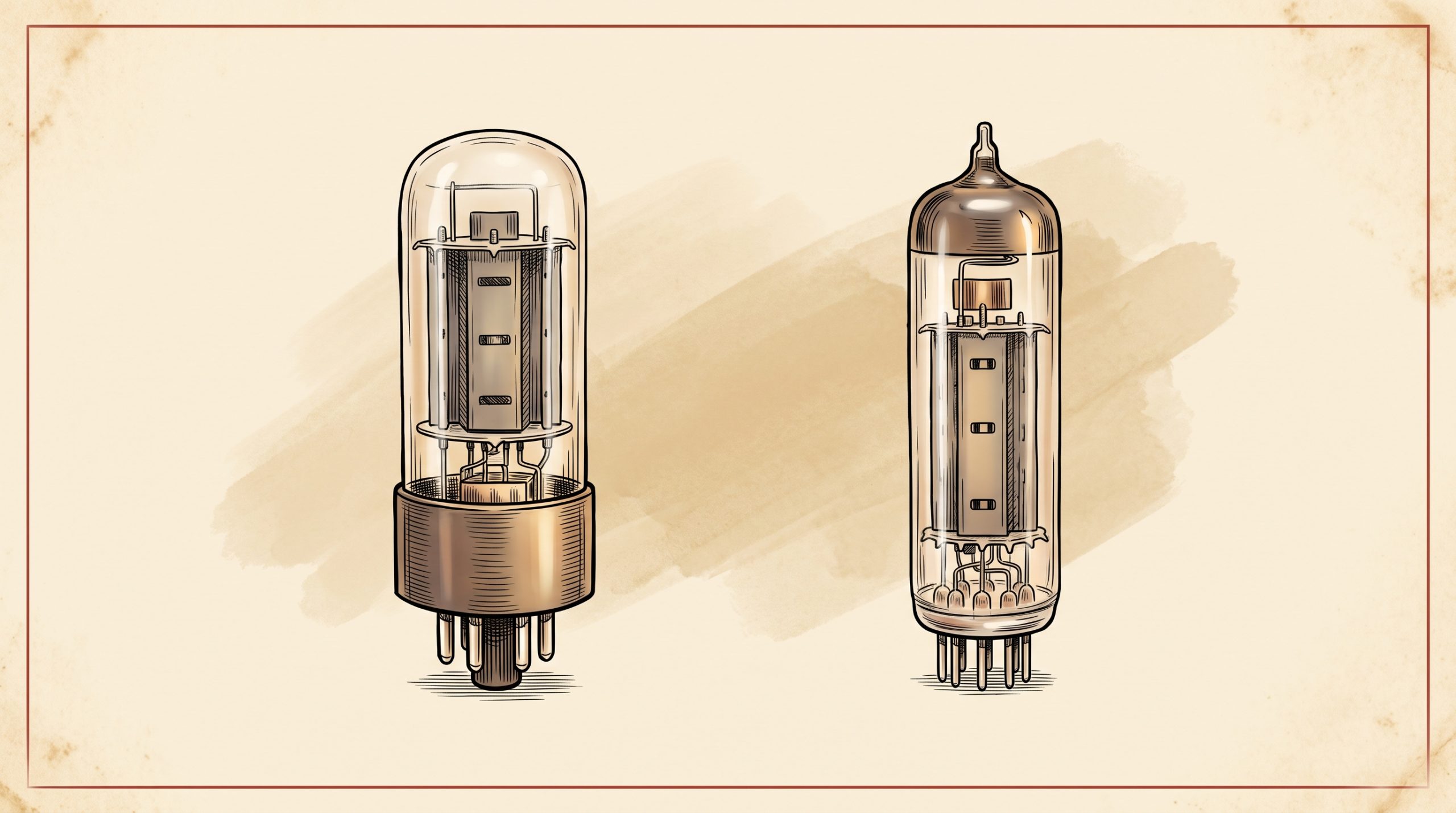
- 6V6: beam tetrode, octal socket (8-pin), 14W max plate dissipation, Ken-Rad origin 1936
- EL84: true pentode, noval socket (9-pin), 12W max plate dissipation, Philips origin 1954
- 6V6 canonical amps: Fender Champ, Princeton, Deluxe Reverb, tweed Deluxe
- EL84 canonical amps: Vox AC15, AC30, Marshall 18W combo
- Not interchangeable: different pin configurations, different sockets, different OT requirements
- EL84s commonly run over Philips’ 300V plate spec in production amps, shorter tube life in high-voltage builds
- 6BQ5 is the American RETMA name for the EL84, identical tube, different label
- NOS 6V6s: $30–$150 each depending on manufacturer (GE gray-plate lowest around $30–$60; RCA blackplate and Sylvania run $90–$150 in the current market); NOS Mullard EL84s: $50–$150+ each
Manufacturer History and Origins
The 6V6, An American Original (1936)
Ken-Rad introduced the 6V6 in 1936 as a radio receiver output tube (RCA followed shortly after and became one of its best-known manufacturers), and it quickly became one of the most-produced American tubes of the mid-20th century. Fender adopted it in the late 1940s for the tweed Champ and Princeton, and it stayed in the lineup through the entire blackface and silverface eras. The tube’s construction as a beam tetrode gives it four active elements: cathode, control grid, screen grid, and anode, with beam-forming plates instead of a true suppressor grid. That internal structure directly shapes its even-order harmonic output and natural compression behavior.
Primary American manufacturers during the NOS era included RCA, GE, Sylvania, Raytheon, and Tung-Sol. Each factory had slightly different construction tolerances, and experienced amp techs can often hear the differences between a Sylvania “black plate” 6V6GT and a late-production GE. Modern production comes from Electro-Harmonix and Sovtek (both Russian), JJ Electronic (Slovakia), and Mullard-branded reissues. The JJ 6V6S runs a noticeably stiffer, higher-current design that handles elevated plate voltages better than some vintage equivalents, documented in the JJ Electronic product specifications.
The EL84, A European Pentode (1954)
Philips introduced the EL84 in 1954, and Vox put it in the AC15 within four years. The “EL” designation follows the European RETMA coding system: E for 6.3V heater, L for output pentode. It’s a true pentode, meaning it has five active elements: cathode, control grid, screen grid, suppressor grid, and anode. That suppressor grid is what separates it from a beam tetrode and contributes to its higher transconductance and brighter high-frequency response.
The historical benchmark is the Mullard Blackburn “Longplate” EL84, manufactured at the Blackburn, Lancashire plant through the mid-1960s. Longplates are widely regarded as the reference standard for EL84 tone, tighter, more extended bass than the later shortplate variants. Siemens, Telefunken, and Mazda also produced highly regarded EL84s in the NOS era. Modern production options include JJ EL84 (consistent, slightly darker voicing), Electro-Harmonix EL84 (brighter, closer to vintage Mullard character), and Sovtek EL84 (reliable, midrange-forward). For a deeper look at the EL84’s history and current production rankings, the EL84 tubes guide covers the full picture.
Datasheet Specs Side by Side
The numbers tell the real story. Most forum debates about 6V6 vs EL84 stay at the “American warm vs British bright” level without going into the actual operating parameters. Those parameters explain why the tonal differences exist.
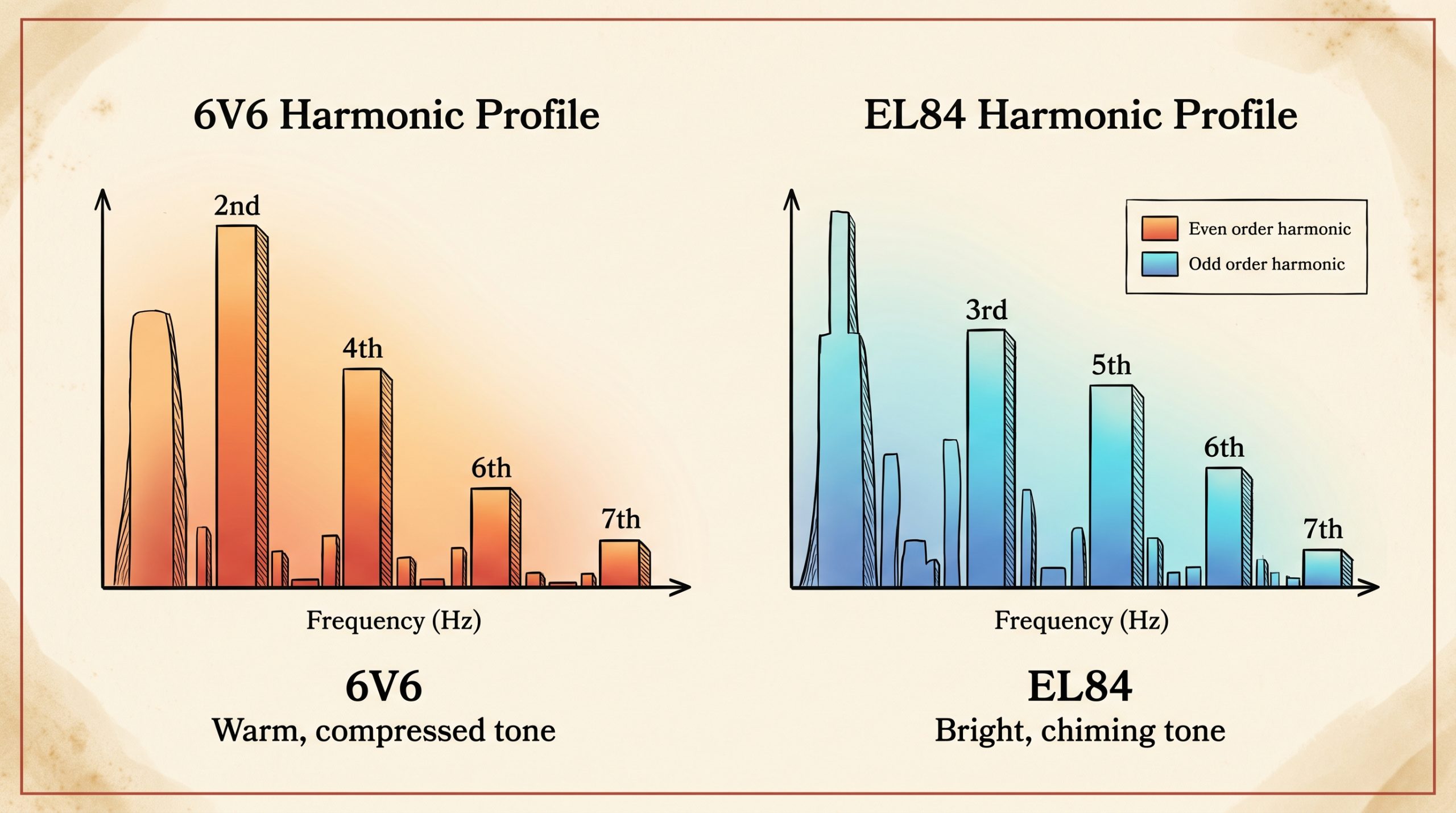
| Specification | 6V6GT | EL84 |
|---|---|---|
| Tube Type | Beam Tetrode | Pentode |
| Year Introduced | 1936 | 1954 |
| Origin | USA (Ken-Rad) | Netherlands (Philips) |
| Socket Type | Octal (8-pin) | Noval (9-pin) |
| Heater Voltage | 6.3V | 6.3V |
| Heater Current | 450 mA | 365 mA |
| Max Plate Voltage (spec) | 315V (RCA) | 300V (Philips) |
| Max Plate Dissipation | 14W | 12W |
| Max Screen Voltage | 285V | 300V |
| Typical Output (pair, Class AB) | 14–18W | 17–22W |
| Plate Resistance (rp) | ~52kΩ | ~38kΩ |
| Transconductance (Gm) | ~3,900 µmhos | ~11,250 µmhos |
| Typical Bias Target | 225–250V plate, ~12–15mA/tube | 300–330V plate, 40–45% dissipation |
The transconductance gap is significant. At 11,250 µmhos, the EL84 is roughly three times more sensitive to input signal changes than the 6V6. That’s a primary reason why EL84 amps respond differently to picking dynamics and why they clip earlier. The plate resistance difference (38kΩ vs 52kΩ) also directly determines the output transformer primary impedance each tube requires, a point covered in the output transformer section below.
One more critical note: both tubes are routinely run above their datasheet plate voltage specs in production amp designs. Fender blackface circuits ran 6V6s at 350–420V. Vox AC30s push EL84s to 340–370V. Neither is within Philips’ or RCA’s published maximums. The 6V6 handles that stress more tolerantly, which matters for tube life.
Tone Character, Where the Real Difference Lives
The 6V6 Sound, American Compression and Warmth
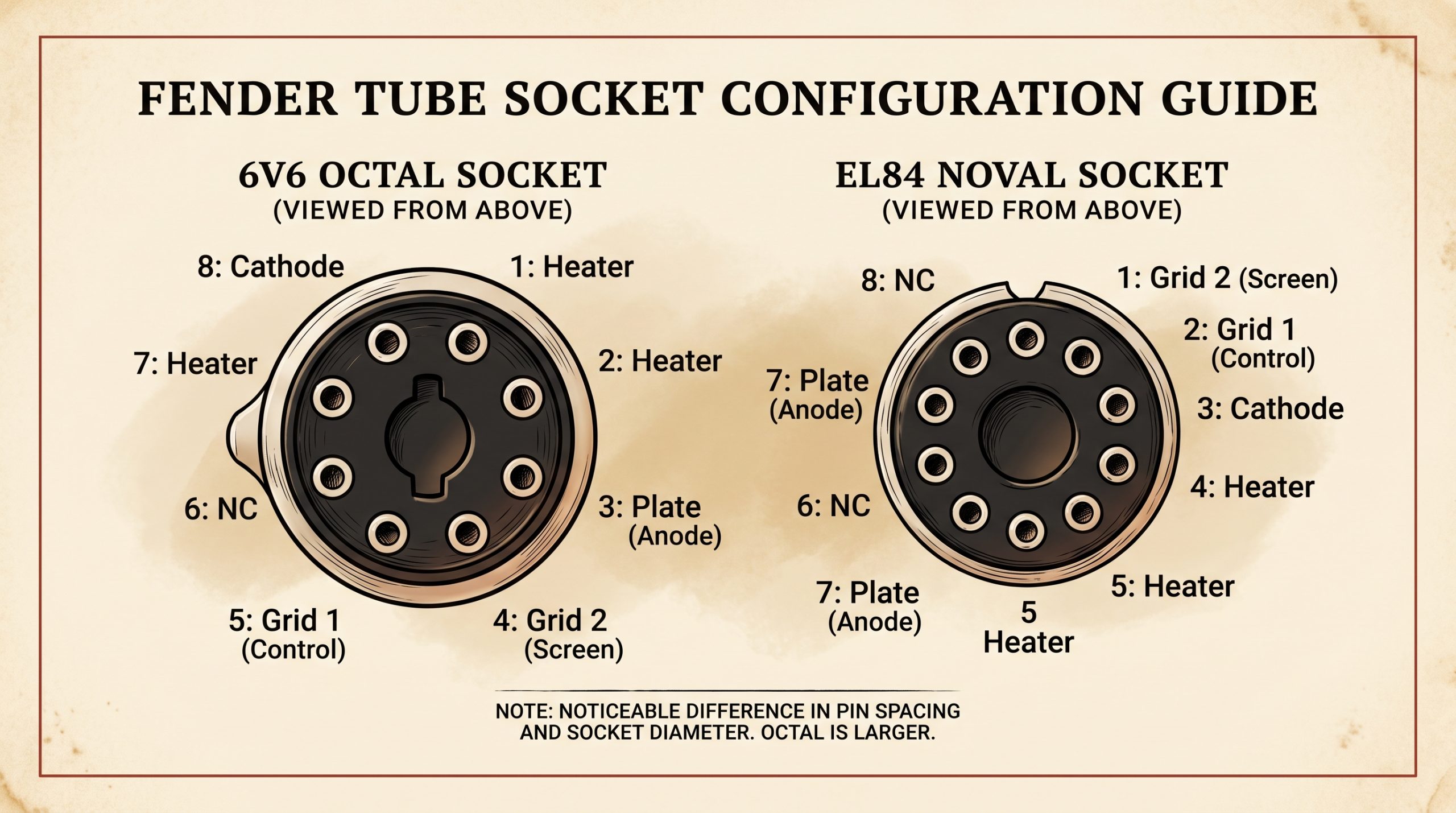
The beam tetrode construction produces primarily even-order harmonics (2nd and 4th) when driven into saturation. Even-order harmonics are the “musical” ones, intervals that are octaves and thirds above the fundamental. The result is a breakup character that sounds warm, compressed, and vocal rather than aggressive. Players describe it as “giving” under heavy picking, which is accurate: the output sags and compresses as the tube saturates rather than hardening up.
Fender circuit implementations define the 6V6 canon. The 5F1 Tweed Champ (1956–1964) runs a single 6V6GT in Class A at about 5 watts, producing a dark, smooth overdrive that turns woolly when pushed hard. The 5E3 Tweed Deluxe (1955–1960) uses a cathode-biased pair of 6V6GTs at roughly 12 watts in near-Class-A operation. The AB763 Deluxe Reverb (1964–1967) switches to fixed-bias operation and brings the output up to around 22 watts, with notably more clean headroom and a stiffer, spanky attack. Each circuit extracts a different character from the same tube type. For circuit codes, production dates, and serial number ranges across these models, the Fender tube amp dating reference covers every era from tweed through silverface.
The 6V6’s compression is a studio asset. At low volumes, it behaves like a soft limiter on guitar transients, smoothing out attack peaks without killing sustain. Nashville session guitarists defaulted to 6V6 amps on country and Americana records for exactly this reason. You’re not fighting the amp to stay in the track.
The EL84 Sound, British Chime and Harmonic Complexity
The true pentode construction generates higher-order odd harmonics (3rd and 5th) alongside the even-order content. Those odd harmonics are what give the EL84 its sharp, present, complex quality at the edge of breakup. Some ears find it aggressive; others find it harmonically rich. Both descriptions are accurate depending on how hard you’re pushing the amp.
The high transconductance (11,250 µmhos) means the EL84 is physically more reactive to input signal changes. It doesn’t compress into the signal the way the 6V6 does. It pushes back. At equivalent volumes, there’s less sag and more articulation. The treble emphasis isn’t just an EQ characteristic, it’s built into the tube’s operating parameters. Mic an EL84 amp on-axis at full power and you’ll hear why engineers typically prefer a slightly off-axis position: the top end can get into ice-pick territory fast.
The canonical EL84 reference is the Vox AC30 (1959–present), running four EL84s in cathode-biased Class A push-pull at approximately 30 watts. The Beatles, Tom Petty, Radiohead, and Brian May all used AC30s on major recordings. The Marshall 18W combo (1965–1968) runs a pair of EL84s at approximately 325–345V plate voltage for around 18 watts, with a noticeably faster and brighter breakup than the same wattage from a 6V6 pair.
Clean Headroom Comparison
The EL84 clips earlier relative to its wattage rating. A fixed-bias 6V6 pair in an AB763 Deluxe Reverb has more usable clean headroom than an EL84 pair at similar rated wattage. That’s not a flaw in the EL84’s design; it’s the expected behavior of a high-Gm tube running near its screen voltage ceiling. For a clean pedal platform, the 6V6 fixed-bias circuit wins. For edge-of-breakup playing where you want the amp working with your pick attack, the EL84 is the better tool.
Operating Conditions and Reliability
Voltage Tolerance, Why It Matters for Longevity
This is the practical reliability question. The 6V6 runs at 350–420V in most blackface and silverface Fender circuits, technically over RCA’s 315V plate maximum, but within a range that production 6V6s have handled reliably for decades. The EL84 in a Vox AC30 runs at 340–370V, which is similarly over Philips’ 300V spec. The difference is in how each tube tolerates that stress over time.
EL84 screen grids are more susceptible to thermal stress in push-pull configurations running near or over voltage spec. Screen grid failure is the most common EL84 failure mode in high-voltage AC30 circuits. The diyAudio community’s long-running thread on 6V6 vs EL84 voltage tolerance documents this consistently: the 6V6 handles real-world voltage abuse more tolerantly than the EL84 in comparable conditions. Some amp designers address this by using the EL84 in triode mode (via screen grid strapping), which reduces plate voltage stress and extends tube life at the cost of output wattage.
In fixed-bias push-pull designs, the 6V6 generally outlasts the EL84 when both are run above spec. Not by a dramatic margin in well-designed circuits, but reliably so.
Which Tube Runs Hotter?
At the standard 40–45% of maximum plate dissipation target, the EL84 is biased to approximately 4.8–5.4W per tube and the 6V6 to approximately 5.6–6.3W. In cathode-biased Class A operation, thermal stress is roughly equivalent. The EL84’s lower max dissipation spec (12W vs 14W) means there’s less thermal headroom before things get uncomfortable. Fixed-bias 6V6 circuits actually have more margin to work with at equivalent output levels.
Output Transformer Design and Its Effect on Each Tube’s Character
This gets skipped in most 6V6 vs EL84 comparisons, and it’s critical. The tubes don’t operate in isolation. Each one requires a specific output transformer primary impedance to transfer power efficiently to the speaker.
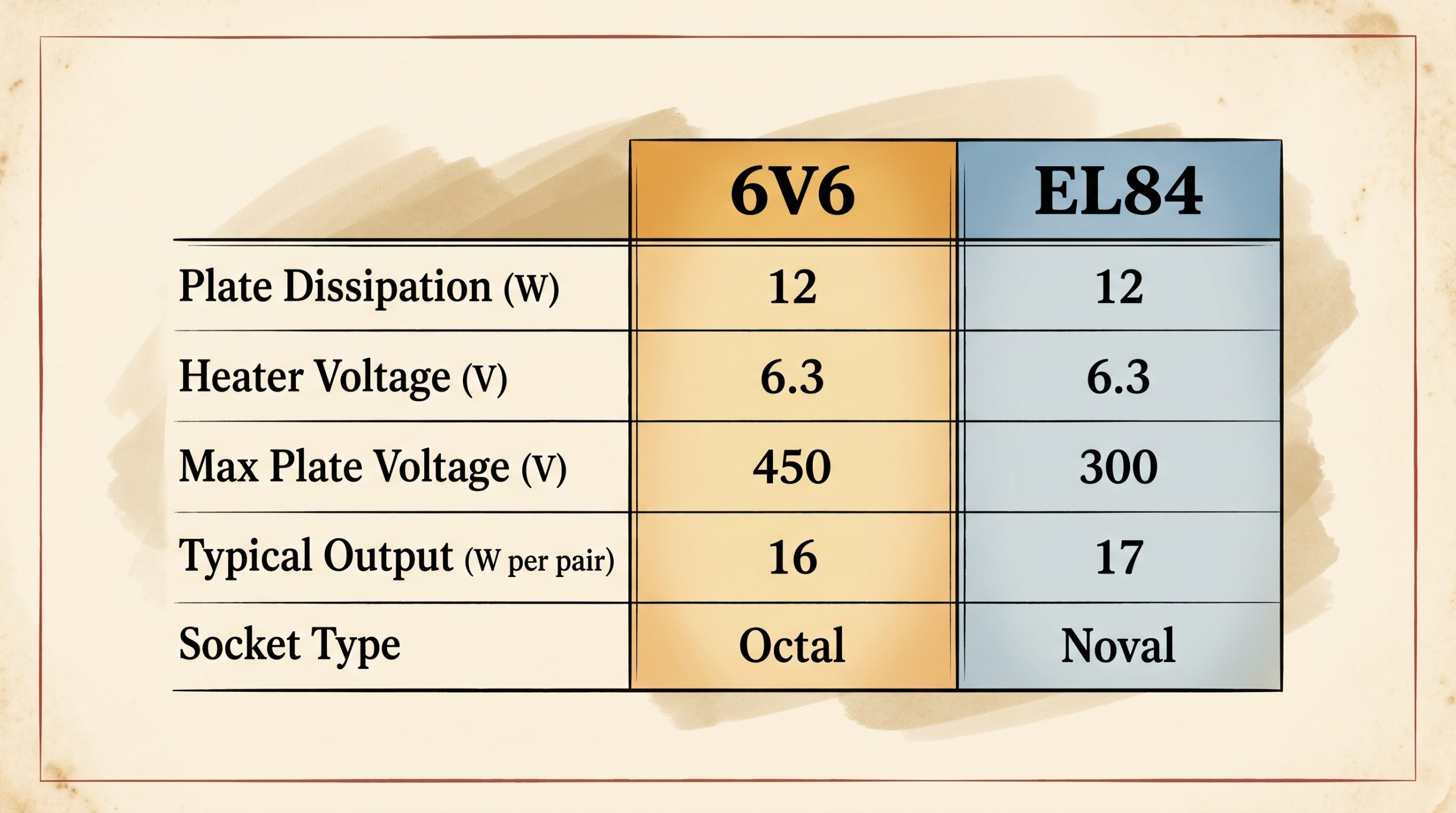
The 6V6’s plate resistance (~52kΩ) requires a push-pull OT primary in the 5kΩ–8kΩ range. The EL84’s lower plate resistance (~38kΩ) requires a higher primary impedance, typically 8kΩ–10kΩ, to match correctly. Run an EL84 through a 6V6-spec OT and you’ll hear compressed, dark tone that doesn’t sound like either tube at its best. Run a 6V6 through an EL84-spec OT and it turns harsh and thin.
The practical implication: the “6V6 sound” and “EL84 sound” you’re chasing aren’t just about the tube. They’re the complete system, tube, operating voltages, bias configuration, and output transformer working together. Buying a 6V6-based amp and swapping in EL84s through a DIY adapter won’t give you Vox chime. It’ll give you a compromised version of both, optimized for neither. According to VHT, who developed a dedicated 6V6-to-EL84 adapter for their Special 6 amp, the adapter is specifically engineered to account for these system-level differences, not just pin compatibility, as documented at Premier Guitar.
Cathode-Biased vs Fixed Bias and How It Changes the Debate
Both tubes appear in both bias configurations, but the dominant pairings matter for understanding their tonal signatures.
The 6V6 in fixed-bias operation (Fender AB763 Deluxe Reverb, AB763 Super Reverb) runs harder, delivers more clean headroom, and has a stiffer, more immediate attack. The 6V6 in cathode-biased operation (5E3 Tweed Deluxe) compresses earlier and behaves more like a Class A design, with that familiar wooly saturation when pushed.
The EL84 is most commonly found in cathode-biased designs (Vox AC15, AC30, most 18W Marshall derivatives). Cathode bias reduces effective plate voltage, pushes the operating point toward Class A, and adds a degree of warmth and compression that narrows the tonal gap with the 6V6. A cathode-biased EL84 design sounds meaningfully warmer and more compressed than a fixed-bias EL84 push-pull circuit running the same tubes at higher voltage.
Fixed-bias EL84 circuits are rarer but do exist. They run harder, expose more of the tube’s chime and harmonic complexity, and widen the tonal gap between EL84 and 6V6 noticeably. If you want maximum EL84 character, fixed-bias push-pull is where it lives. If you want a warmer EL84 experience that moves toward 6V6 territory, cathode-biased is the path.
Tube Substitutes and Replacements
What Tubes Can Replace the EL84?
The closest direct substitutes are the 6BQ5 (the American RETMA designation for the same tube, identical construction, different labeling convention), the 7189 (a higher plate-voltage rated variant designed for 400V plate applications, genuinely useful in high-voltage circuits that stress standard EL84s), and the 7189A. The CV4109 is a Mullard military-spec EL84 equivalent. None of these require circuit modifications.
Modern production ranking for reliability and tone: JJ EL84 is consistent and slightly darker than vintage Mullard references; Electro-Harmonix EL84 runs brighter and closer to vintage Mullard character; Sovtek EL84 is reliable with a midrange-forward voicing. Current JJ EL84 datasheet specifications are available at JJ Electronic’s product page.
EL84 territory ends there. EL34, 6L6, and 6V6 are not socket-compatible and not substitutes without complete circuit redesign.
What Tubes Can Replace a 6V6?
The 6V6GT, 6V6GTA, and 6V6GTB are all variants of the same tube. Direct drop-ins. The GTA and GTB designations indicate higher-rated construction, making them good choices for circuits pushing plate voltages above 400V.
The 6L6 is the common “upgrade” substitution in 6V6 circuits for more headroom and a stiffer response. Not a direct drop-in. It requires re-biasing, draws more heater current (900 mA vs 450 mA per tube), and can stress output transformers sized for 6V6 operation. The sonic and practical tradeoffs are covered in detail in the 6V6 vs 6L6 comparison.
EL84, EL34, and 6CA4 tubes cannot substitute for the 6V6 in any standard configuration. Different sockets, different operating points, different everything.
Are 6V6 and EL34 Interchangeable?
No. Both use octal sockets, which creates the confusion. But the pin wiring is different, the operating voltages are completely different (EL34s typically run 400–500V plate in guitar-amp service, though the tube itself is rated to an absolute maximum of 800V, vs. 315–420V for 6V6s), and the output transformer requirements don’t overlap. A 6V6-to-EL34 swap requires a new output transformer, different bias circuitry, and different screen voltage supply. For a full breakdown of how EL34s compare against the broader pentode family, the EL84 vs EL34 article covers the British pentode comparison in detail.
Recording Context, Which Tube Works Better in a Studio?
At bedroom and studio volumes (1–5 watts), the 6V6’s compression becomes a direct recording advantage. It behaves like a built-in soft limiter on guitar transients, rounding off pick attack peaks without flattening sustain. You get a recorded tone that sits in a mix with minimal fuss. That’s not a coincidence. Most classic country and Americana session recordings from the 1950s through the 1970s used 6V6-based amps (tweed Champ, Deluxe Reverb) precisely because they translated easily to tape without fighting the engineer.
The EL84’s higher-order harmonics translate differently. At edge-of-breakup volumes, the harmonic complexity adds natural presence without requiring EQ correction. The 3rd and 5th harmonic content occupies upper-mid frequencies that cut through a dense mix. British Invasion recordings, jangle pop, and 1990s indie rock all exploited this. The caveat is microphone placement: EL84 amps require more careful mic positioning to avoid ice-pick treble response. A few degrees off-axis usually solves it, but you’ll notice it in ways you generally won’t with a 6V6 amp.
For home recording at low volumes specifically, the 6V6’s compression is more forgiving and more immediately useful. For tracking at higher volumes where you want the amp contributing harmonic content to the recording, the EL84 delivers more complexity with less work. Current production 6V6GT specs and noise ratings can be verified at the Electro-Harmonix 6V6GT product page.
Which Tube Should You Choose?
Define your target tones first, then work backward to the tube. These aren’t better or worse relative to each other, they’re the sonic signatures of two different continents’ approaches to small-amp design. That said, the choice often comes down to a few practical factors.
| If You Want… | Choose… |
|---|---|
| Warm, compressed, vocal breakup | 6V6 |
| Bright, chimey, harmonically complex overdrive | EL84 |
| More clean headroom per watt | 6V6 (fixed bias) |
| Edge-of-breakup sensitivity to pick dynamics | EL84 |
| Better tube longevity in high-voltage circuits | 6V6 |
| Classic American Fender tones | 6V6 |
| Classic British Vox tones | EL84 |
| Bass guitar amplification | 6V6 |
| Studio recording at low volumes (compression priority) | 6V6 |
| Studio recording at edge-of-breakup (harmonic complexity) | EL84 |
If you’re shopping for a production amp rather than building one, the tube choice has already been made by the circuit designer, and the output transformer, bias configuration, and power supply are all optimized around it. Knowing which tube is inside tells you a great deal about what the amp was designed to do. A 6V6 amp was built around compression, warmth, and American clean-to-dirty behavior. An EL84 amp was built around sensitivity, chime, and harmonically rich breakup that starts early and stays complex as you push it harder. Neither tube is the wrong answer. They’re just different answers to the same question about what a small amp should do when it’s working hard.
Frequently asked questions
Are EL84 and 6V6 interchangeable?
No. The EL84 uses a 9-pin noval socket and the 6V6 uses an 8-pin octal socket. The pinouts are completely different, the operating voltages are different, and the output transformer impedance requirements don't match. Swapping one for the other requires a new tube socket, a different output transformer, different bias circuitry, and different screen voltage supply. They are not drop-in substitutes under any circumstances, even with an adapter, unless the amp was specifically engineered to support both configurations.
What tube can replace an EL84?
The closest direct replacements are the 6BQ5 (the American RETMA designation for the identical tube), the 7189 (a higher plate-voltage rated variant useful in high-voltage circuits), and the 7189A. The Mullard CV4109 is a military-spec EL84 equivalent. All of these are pin-compatible direct substitutes. No other common power tube replaces the EL84 without significant circuit modifications.
What tubes can replace a 6V6?
The 6V6GT, 6V6GTA, and 6V6GTB are all variants of the same tube and are direct substitutes without any circuit changes. Some technicians substitute a 6L6 in 6V6 circuits for additional headroom and a stiffer response, but this requires re-biasing, draws significantly more heater current, and can stress output transformers sized for 6V6 operation. EL84 and EL34 tubes cannot replace a 6V6 in any standard configuration.
Are 6V6 and EL34 interchangeable?
No. Both tubes use octal sockets, which causes confusion, but the pin wiring is different and the operating voltages are substantially higher for EL34s. EL34s typically run at 400–500V plate voltage in guitar-amp service (the tube is rated to an absolute maximum of 800V); 6V6s are rated to 315V and commonly run to 420V in production amps. Output transformer primary impedance requirements are also completely different. A 6V6-to-EL34 conversion requires a new transformer, new bias circuitry, and new screen voltage supply.
Are EL84 tubes good for guitar amps?
Yes, genuinely. The EL84 defines the Vox AC30 sound used by some of the most recorded guitarists in history. Its bright, harmonically rich breakup is among the most distinctive of any power tube in production. The main reliability concern is that many production amps (including the AC30) run EL84s above Philips' 300V plate spec, which shortens tube life compared to 6V6s in similarly over-spec Fender circuits. Modern production tubes from JJ and Electro-Harmonix are generally reliable when biased correctly and the amp's B+ voltage is within a reasonable range.