Contents
- 01A Brief History of the Fender Champ (1948-Present)
- 02Circuit Numbers, Specs, and Era Classification
- 03The Fender Champ Schematic: What Makes It Sound That Way
- 04Who Used a Fender Champ?
- 05Fender Champ Reissues: Which Version Is Right for You?
- 06The Fender Champ Kit: Build Your Own 5F1
- 07Buying a Vintage Fender Champ: What to Inspect
- 08Are Fender Champs Still Made Today?
- 09Frequently Asked Questions About the Fender Champ
- 10Who Should Own a Champ Today
Most players assume a 5-watt amp is a bedroom toy. The Fender Champ spent decades proving that wrong. Eric Clapton tracked lead guitar on Layla through one. Bruce Springsteen has been associated with Fender Champ use in studio recording contexts. Engineers mic’d it up, cranked the single volume knob, and captured power-tube compression that larger amps simply can’t replicate at recordable levels. The circuit is almost offensively simple. That simplicity is exactly the point.
- Topology: single-ended Class-A, cathode-biased output stage
- Classic 5F1 circuit: 12AX7 preamp, single 6V6GT output, 5Y3GT rectifier
- Output power: approximately 4.5-5 watts (5F1 and AA764 eras)
- Original production span: 1948-1982 (Champion 800 through final silverface)
- Current production: Fender ’57 Custom Champ, hand-wired 5F1 spec, MSRP ~$1,299.99
- At breakup volume, a stock 5F1 exceeds comfortable apartment levels
- Tweed 5F1 examples: $900-$1,800 depending on condition and originality
- Fender Champ 12, Champ 25, and Champ XD are NOT single-ended Class-A tube amps, different topology entirely
- Speaker impedance matters: 5F1 output transformer is wound for 8 ohms; silverface Oxford ran 3.2 ohms, confirm before swapping speakers
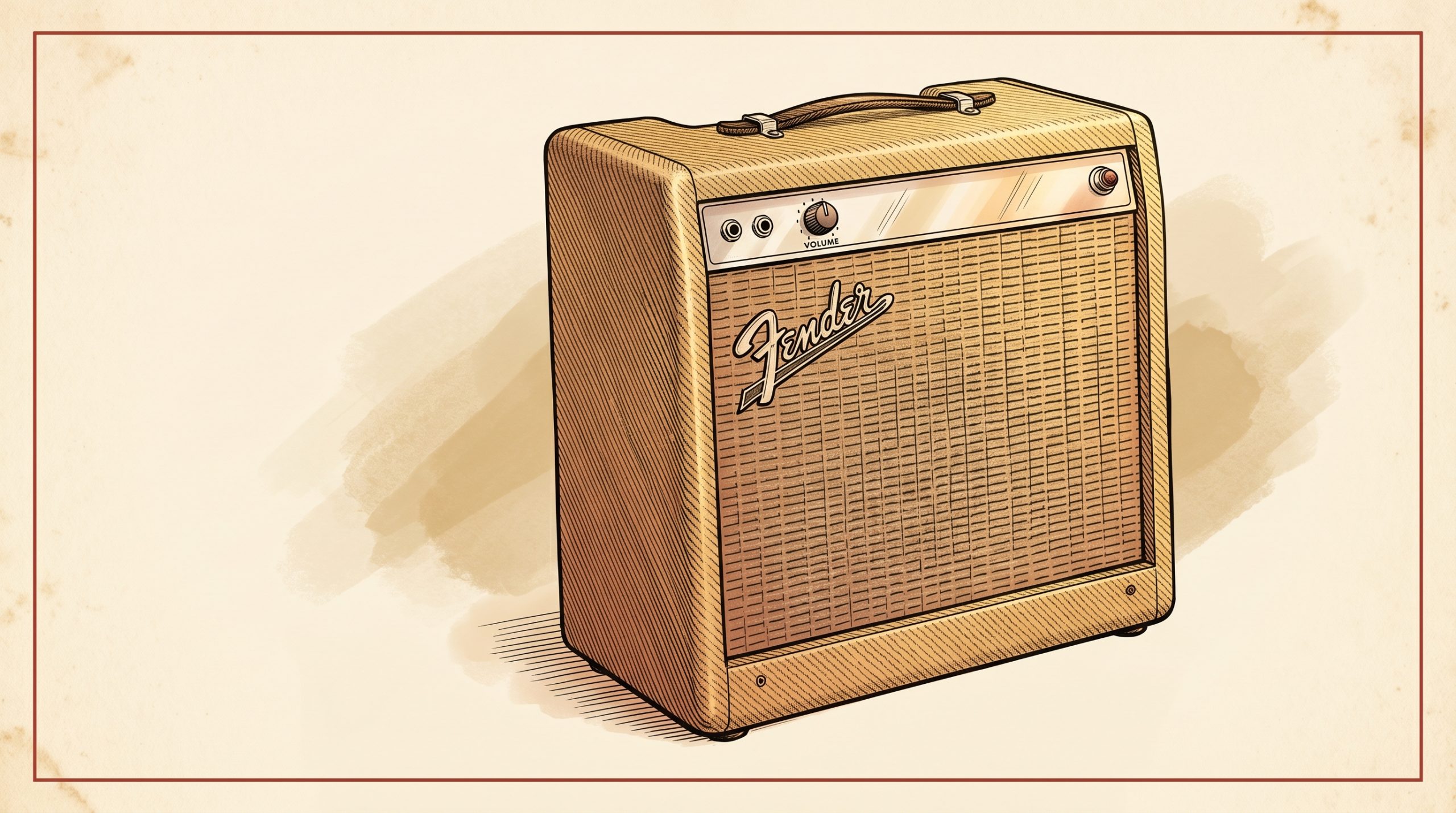
A Brief History of the Fender Champ (1948-Present)
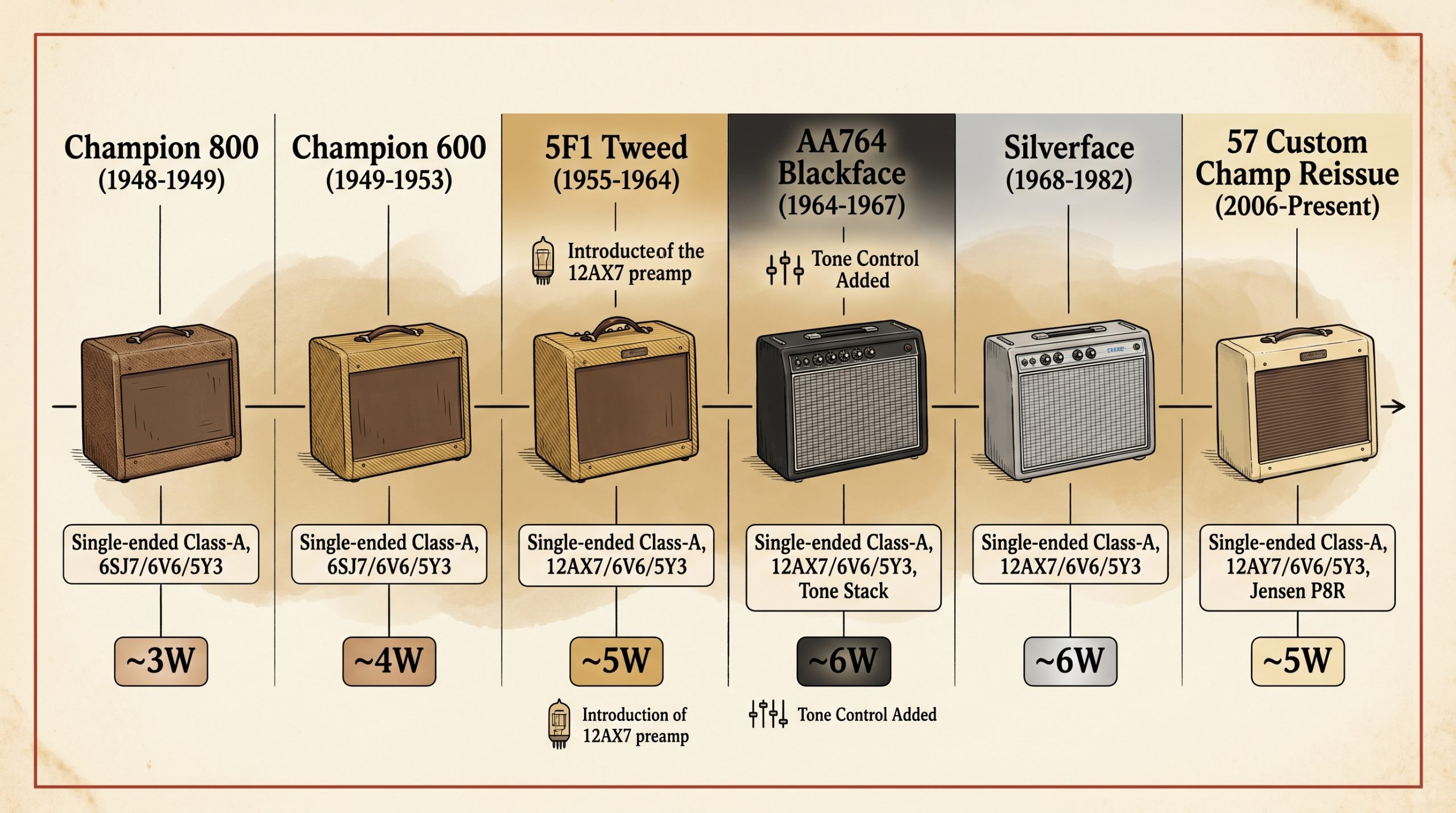
The story starts before anyone called it a Champ. The Champion 800, produced from 1948 to 1949, was a 4-watt single-8″ combo that Fender built when Leo was still figuring out what a guitar amp could be. It ran a simple single-ended circuit and established the template every Champ after it would follow.
The Champion 600 replaced it from 1949 to 1953. Same basic concept, slightly evolved. This model name gets revived decades later with the Fender Champ 600 reissue (2006-2009), a budget PCB-based tribute that became popular among amp modders.
The model that defines the Champ’s reputation is the 5F1, produced from 1955 to 1964 in tweed covering. This is the fender tweed champ everyone talks about. One knob. No tone control. A 12AX7, a 6V6, and a 5Y3 rectifier. The circuit is so stripped down that understanding it is practically a prerequisite for amp building. Greg Gagliano’s 20th Century Guitar Magazine research documented the 5F1 production timeline in detail, and Teagle and Sprung’s Fender Amps: The First Fifty Years remains the definitive print source for production year verification.
In 1964 the Champ moved to blackface cosmetics with the AA764 circuit, gaining a tone control for the first time. Production ran through 1967. Then came the CBS era and the silverface transition in 1968, which continued until 1982. Early silverface Champs use the same AA764 circuit under different cosmetics. Later models saw small value changes and different OEM speaker sourcing, but the fundamental topology held.
One thing never changed across any of these eras: the Champ never received reverb or tremolo during its original production run. That deliberate simplicity became its greatest asset, particularly for studio work where a clean, direct signal chain was the goal.
Reissues have appeared regularly since. The Fender Champ 600 (2006-2009) offered budget access to the cosmetic lineage. The Fender ’57 Custom Champ, currently in production as of 2026, is a hand-wired 5F1-spec reissue at approximately $1,299.99 MSRP. Other models bearing the Champ name include the Champ 12 (1987-1992), Champ 25 and Champ 25 SE (early 1990s), and the digital Champ XD (2007-2012). Those later models are covered in the reissues section below, with an important caveat: several of them are not tube amps at all.
Circuit Numbers, Specs, and Era Classification
The 5F1: The Canonical Tweed Champ
The 5F1 is the circuit that earned the Champ its reputation. Production ran from 1955 to 1964 in tweed cosmetics. Here are the specs without padding:
| Specification | 5F1 Value |
|---|---|
| Circuit number | 5F1 |
| Era | Tweed (1955-1964) |
| Output tube | 6V6GT (single) |
| Preamp tube | 12AX7 (single) |
| Rectifier | 5Y3GT |
| Output power | ~4.5-5W |
| Speaker (OEM) | Jensen P8T, 8″ (8 ohm) |
| Output transformer ratio | ~2,700 ohm plate-to-8 ohm |
| Negative feedback loop | None |
| Controls | Single volume knob |
| Bias method | Cathode bias (self-biasing) |
That missing negative feedback loop is worth your attention. It’s one reason the 5F1 barks when pushed in a way that feels almost vocal. More on this in the schematic section below.
The AA764: Blackface Champ
The blackface Champ ran the AA764 circuit from 1964 to 1967. Cosmetically it got the black panel treatment and Fender’s new “tail” logo. Tonally the main addition is a tone control, which gives you slightly more shaping flexibility than the 5F1’s single-volume setup. The output tube, power rating, and speaker size stayed the same at a single 6V6GT pushing roughly 5 watts through an 8″ Oxford or CTS driver.
Collector values for blackface Champs sit below tweed equivalents but aren’t cheap. Clean, original examples change hands in the $700-$1,400 range. The AA764 circuit itself is very close to the 5F1 aside from the added tone stack and a few component value tweaks.
Silverface Champ Variants
The silverface run from 1968 to 1982 is longer than most players realize. Early silverface Champs are functionally AA764 circuits under different cosmetics, complete with the transitional “drip edge” grille trim on 1968-1969 models. Later CBS-era production introduced different OEM speakers: Oxford, Utah, and CTS units appeared depending on availability and production date.
Mojotone’s documentation of silverface Champ speakers notes the Oxford 8EV was a common late-run driver at 3.2 ohms, which differs from the 8-ohm Jensen spec of the 5F1. If you’re replacing a speaker in a silverface Champ, verify impedance against your specific output transformer before swapping. Some late silverface models had altered circuit values; the chassis stamp and tube chart date codes are your best tools for pinning down the specific variant.
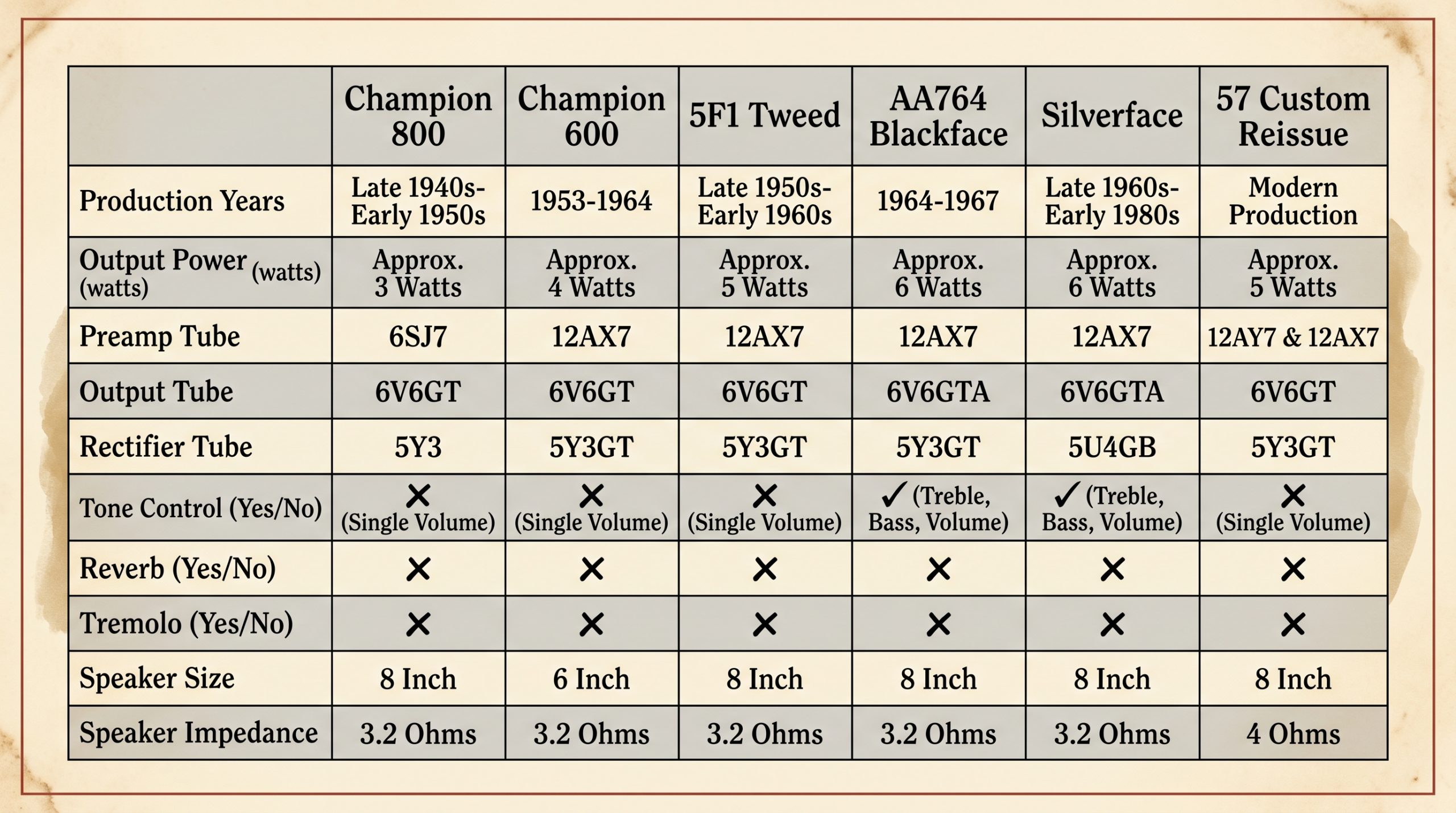
Era Comparison at a Glance
| Era | Circuit | Years | Output Tube | OEM Speaker | Power | Tone Control | Current Market Value |
|---|---|---|---|---|---|---|---|
| Tweed | 5F1 | 1955-1964 | 6V6GT | Jensen P8T (8 ohm) | ~5W | No | $900-$1,800 |
| Blackface | AA764 | 1964-1967 | 6V6GT | Oxford or CTS 8″ | ~5W | Yes | $700-$1,400 |
| Silverface | AA764 / variants | 1968-1982 | 6V6GT | Oxford, Utah, or CTS 8″ | ~5W | Yes | $400-$900 |
| Reissue (’57 Custom) | 5F1-spec | 2012-present | 6V6GT | Weber 8″ alnico (4 ohm) | ~5W | No | ~$1,299.99 new |
The Fender Champ Schematic: What Makes It Sound That Way
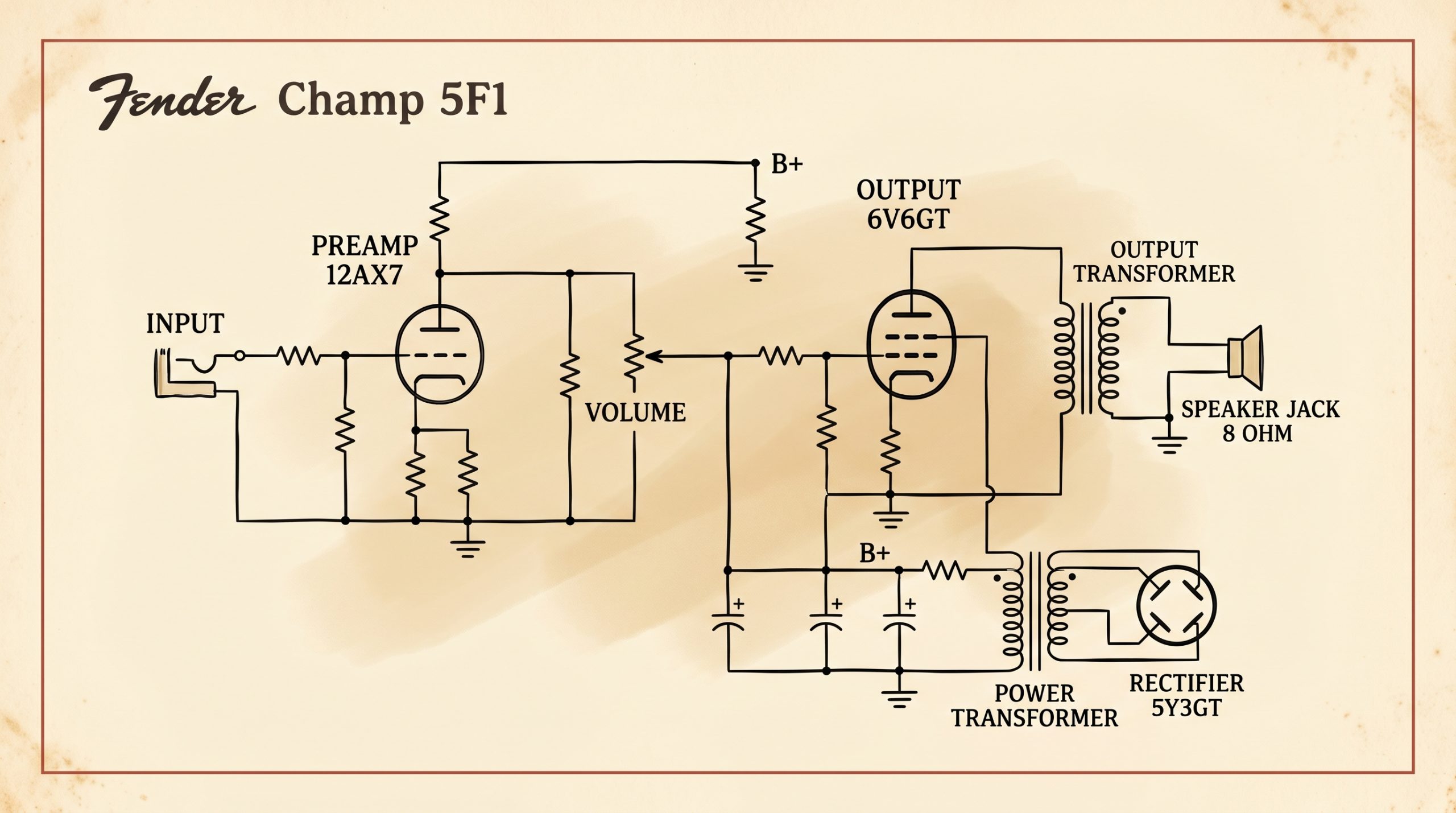
The 5F1 schematic is genuinely one of the simplest tube amp circuits ever put into commercial production. Understanding it isn’t just an academic exercise. It directly explains why the amp sounds the way it does.
The signal path is short. Guitar input hits a 12AX7 triode for preamp gain, then goes straight to the 6V6GT output tube. There’s no phase inverter because there’s no push-pull output stage. It’s a single tube doing single-ended work. That topology generates predominantly even-order harmonics when the output stage saturates, which most ears perceive as musical compression rather than harsh distortion. Spongy compression is the result, not ice-pick treble.
The cathode bias arrangement means the 6V6 sets its own operating point through a shared cathode resistor. No fixed bias adjustment is required. No bias pot to drift. The tube ages, the operating point shifts slightly, and the amp compensates on its own. Practical for both the original owner in 1958 and the hobbyist working on one today.
The 5Y3 rectifier tube introduces supply voltage sag under transient load. Hit a chord hard and the B+ voltage momentarily drops, compressing the signal naturally. This is part of the Champ’s dynamic feel that a solid-state rectifier replacement removes. Not great if you want touch sensitivity. Worth keeping the 5Y3 original.
Moving from 5F1 to AA764 adds a tone control stage between preamp and output. This introduces a minor gain-stage change and loads the preamp slightly differently. The AA764 also makes small component value tweaks that tighten the low end marginally, though the core topology stays single-ended Class-A throughout.
The official Fender schematic archive at fender.com/support includes both the 5F1 and AA764 diagrams. Cross-referencing with the indexed versions at schematicheaven.net is useful for detailed component value research.
If you want to understand what a 12AX7 is doing in that first gain stage, the tube’s amplification factor of 100 and its interaction with the following circuit is covered in detail in the 12AX7 tube replacement and buyer’s guide.
Who Used a Fender Champ?
The recording history here is well-documented. Eric Clapton’s isolated guitar tracks on the Layla sessions used a 5F1 tweed Champ cranked to breakup. Bruce Springsteen has been associated with Fender Champ use in studio recording contexts. Keith Richards has been documented using small, cranked combo amps for studio recording, with the Champ among them. Stevie Ray Vaughan and Neil Young are both cited in vintage amp research as users of small single-ended combos in studio contexts, the Champ included.
The reason engineers kept reaching for it is straightforward. Position a microphone 3 to 6 inches from the 8″ speaker cone with the volume knob between 7 and 10, and you capture natural power-tube compression with almost zero room bleed. The amp’s low output means it doesn’t overpower the room. You get the saturation without the SPL problem.
Premier Guitar’s review of the ’57 Custom Champ notes that it combines the best characteristics of the tweed generation into one of the most recorded amplifiers in history. At 15 lbs, it’s among the most portable all-tube combos in current production.
No reverb. No tremolo. No channel switching. Zero footprint in a signal chain that already has a lot going on. That’s why producers kept calling for it.
Fender Champ Reissues: Which Version Is Right for You?
Fender ’57 Custom Champ (Current Production)
This is the one to buy if you want a new amp that accurately reproduces the 5F1 experience. Model number 8160500100. Hand-wired point-to-point construction on a lacquered tweed cabinet with solid pine sides. Tubes are a 12AY7 preamp, single 6V6 output, and 5Y3GT rectifier. (The original 5F1 used 12AX7; the reissue uses 12AY7 as the factory-installed period-correct preamp tube.) The speaker is an 8″ Weber Special Design alnico unit rated at 4 ohms. Output is approximately 5 watts.
The 4-ohm Weber is a departure from the original Jensen P8T’s 8-ohm load. Fender wound the output transformer to match accordingly. Don’t swap in an 8-ohm aftermarket speaker without confirming your transformer’s secondary impedance first.
Current MSRP sits at $1,299.99 through Fender authorized dealers. That’s a real number for 5 watts, and it generates predictable debate. What you’re paying for is hand-wired construction, period-correct cosmetics, and a circuit that hasn’t been value-engineered for manufacturing efficiency. For a recording guitarist who wants the real thing new, it’s justifiable.
Fender Champ 600 (2006-2009)
Budget reissue based on the Champion 600 cosmetics. PCB construction, not hand-wired. 5 watts through a 6″ speaker rather than the 5F1’s 8″. Street price at release was approximately $199. The Champ 600 became popular as a modding platform because its low cost makes it low-risk to experiment on. Upgraded speakers, tube swaps, and circuit mods have all been documented extensively by the DIY amp community. Used examples typically trade in the $100-$200 range depending on condition and any modifications.
Fender Champ 12 (1987-1992)
Here’s where the Champ name starts drifting from the original concept. The Champ 12 delivers 12 watts and includes channel switching, which is already a departure. More importantly, the preamp section is solid-state. The power section uses tubes, but this is not a single-ended Class-A design. It doesn’t break up the same way, it doesn’t compress the same way, and it’s a different amplifier that happens to share a brand name.
That said, the Champ 12 has its own following for players who need more clean headroom than the 5F1 offers. Used prices run $150-$350. Not a vintage collectible, but a functional amp.
Fender Champ 25 and Champ 25 SE
Produced in the early 1990s. Twenty-five watts, solid-state throughout. Includes reverb. Not a tube amp in any meaningful sense. The Champ 25 and Champ 25 SE appear regularly on used-gear sites with descriptions that can mislead buyers who associate the Champ name with tube circuitry. If you’re searching for a fender champ tube amp and see a Champ 25 in the results, pass on it unless you specifically want a solid-state practice amp with reverb. Used pricing: $75-$150.
Fender Champ XD (2007-2012)
Digital modeling, 16 amp voices, 5 watts output through a single 8″ speaker. Solid-state power section. The Champ XD is Fender’s attempt to offer beginners variety at a low price point. It has nothing in common with the 5F1 circuit beyond the name and the speaker size. Used examples trade for $80-$150. Fine for a beginner wanting to explore sounds without commitment, but don’t confuse it with any version of the original Champ.
Reissue Comparison
| Model | Years | Power | Speaker | Amp Type | Construction | Street Price (Used) | Best For |
|---|---|---|---|---|---|---|---|
| ’57 Custom Champ | 2012-present | 5W | 8″ Weber alnico | All-tube, single-ended | Hand-wired P2P | ~$1,299.99 new | Recording, authentic 5F1 tone |
| Champ 600 | 2006-2009 | 5W | 6″ speaker | All-tube | PCB | $100-$200 | Modding platform, budget tube |
| Champ 12 | 1987-1992 | 12W | 12″ speaker | SS preamp, tube power | PCB | $150-$350 | More headroom, channel switching |
| Champ 25 / 25 SE | Early 1990s | 25W | 10″ or 12″ | Solid-state | PCB | $75-$150 | Practice, reverb included |
| Champ XD | 2007-2012 | 5W | 8″ speaker | Digital modeling | PCB | $80-$150 | Beginners, tone variety |
The Fender Champ Kit: Build Your Own 5F1
The 5F1 is the most popular beginner tube amp building circuit in the DIY community. Simple reason: it uses the fewest components of any Fender circuit ever commercially produced. If you can solder and you understand basic high-voltage safety, the 5F1 is your starting point.
Several suppliers offer purpose-built 5F1 kits. Mojotone and Tube Depot both offer kits with pre-drilled chassis, transformers, and component sets. Ceriatone and Weber have offered variants as well. What’s typically included: chassis, transformers (power and output), turret board or eyelet board, resistors, capacitors, pots, and hardware. What you source separately: the cabinet, speaker, tubes, and speaker cable.
Estimated build cost ranges from $250 to $500 depending on component quality. Choosing higher-grade capacitors and a quality speaker pushes you toward the top of that range. The result is functionally comparable to a ’57 Custom Champ at roughly one-third the price if you factor in your labor.
Skill level required: intermediate. You need basic soldering competency and a clear understanding of tube amp safety practices. Tube amp circuits carry 300V or more on the filter capacitors even after the amp is unplugged and the power cord is pulled. Discharge filter caps with a bleed resistor before touching any internal components. This isn’t optional advice.
The 5F1’s popularity as a building circuit also means the documentation is exceptional. Wayback Machine archives of Greg Gagliano’s 20th Century Guitar Magazine research include period-accurate component value documentation that helps kit builders cross-reference against original production specs.
Buying a Vintage Fender Champ: What to Inspect
Dating your Champ starts with two things: the tube chart inside the cabinet and the EIA codes on the speakers and transformers. The tube chart uses a two-letter date code: the first letter represents the year, the second represents the month. QA, for example, decodes to 1967, January (Q = 1967 in Fender’s dating system). This is covered in depth in the Fender tube amp serial number and dating guide, which also walks through transformer and speaker EIA codes.
For speakers, EIA codes follow the format manufacturer-year-week. Common original Champ speakers: Jensen (EIA prefix 220), Oxford (465), CTS (137). A speaker stamped 220-224 would decode to Jensen, 1962, 24th week. A non-original speaker doesn’t kill the deal, but it affects value and sometimes affects the amp’s output transformer loading.
What to inspect physically before buying any vintage Champ:
- Filter capacitors: electrolytics over 30 years old should be replaced. A Champ that hasn’t been re-capped is not necessarily dangerous, but it’s not performing at spec either
- Output transformer: check for continuity and listen for hum. A failed output transformer is the most costly single repair on these amps
- Speaker cone: check for tears, delamination at the surround, or voice coil rub (push the cone gently and listen for scraping)
- Circuit modifications: flip the chassis and look at the underside. Non-original components, added wiring, or removed cathode bypass caps are all visible signs of modification
- Tube complement: original RCA or Sylvania 6V6GT tubes add collector value. Current-production tubes indicate at least a partial tube replacement history
Current market pricing for original production Champs: 5F1 tweed ($900-$1,800), blackface ($700-$1,400), silverface ($400-$900). Condition, originality, and whether the amp has been serviced all move prices within those ranges. Non-original speakers or output transformers push toward the bottom of each range.
Are Fender Champs Still Made Today?
Yes. The Fender ’57 Custom Champ is current production as of 2026, available through Fender authorized dealers at approximately $1,299.99. It’s part of Fender’s ’50s Collection and sits just below Custom Shop territory in terms of build quality and price. Point-to-point hand-wired construction, 5F1 spec circuit, lacquered tweed cabinet. The full product spec sheet is available at fender.com/products/57-custom-champ.
The Champ 600 and Champ XD are discontinued but available used. Boutique builders including Mojotone, Victoria Amp Company, and smaller one-person shops also produce 5F1-spec handwired alternatives, often with premium components and custom cabinet options, at similar or slightly higher price points than the ’57 Custom.
The ’68 Custom Vibro Champ Reverb, also in Fender’s current lineup, takes the Champ platform further by adding hall reverb and a 10″ speaker. It’s a related but distinct amp: not a 5F1 circuit, closer in layout to the silverface Vibro Champ with modern additions.
Who Should Own a Champ Today
Across more than 75 years of continuous production history, the Champ’s circuit has barely changed because it didn’t need to. The 5F1 does one thing with unusual precision: it delivers natural, warm clean tones that transition into compressed, even-harmonic breakup as the single volume knob climbs. No reverb, no tremolo, no second channel. If that sounds limiting, it probably isn’t the right amp for your primary stage setup. But for a recording guitarist, a home player with a good attenuator, or someone building their first tube amp from a kit, the Champ’s simplicity is the whole argument. Vintage examples reward careful inspection and proper dating, and the Fender Princeton Reverb is worth considering alongside it if you need a little more headroom or want onboard reverb without leaving the small-combo format. If you’re ready to buy vintage, start with the dating tools before you commit to any specific chassis.
Frequently asked questions
Who used a Fender Champ amp?
Eric Clapton is among the most documented Champ users, with the 5F1 tweed used during the Layla sessions for isolated lead guitar tracks. Bruce Springsteen has been associated with Fender Champ use in studio recording contexts. Keith Richards, Stevie Ray Vaughan, and Neil Young have all been cited in connection with Champ use in studio settings. The amp's cranked power-tube compression at recordable volumes made it a common choice from the 1950s through the 1980s and beyond.
Are Fender Champs still made today?
Yes. The Fender '57 Custom Champ is in current production as of 2026. It's a hand-wired, point-to-point 5F1 reissue with a Weber alnico 8" speaker, priced at approximately $1,299.99 through authorized Fender dealers.
Is the Fender Champ too loud for bedroom playing?
The 5F1 runs approximately 5 watts, which sounds quiet on paper. It isn't. At the volume level where the 6V6 starts compressing and the amp opens up tonally, a Champ exceeds comfortable apartment volume in most situations. A power attenuator addresses this, though it changes the dynamic feel. The Champ 600 with its 6" speaker is a more practical bedroom option. If breakup tone at low volume is your priority, the attenuator route is worth the investment.
What's the difference between the tweed Champ and the blackface version?
The tweed 5F1 has a single volume knob and no tone control. The blackface AA764 adds a tone control and makes minor component value changes. The 5F1 has no negative feedback loop, contributing to its raw compressed character when pushed. The AA764's added tone stack loads the preamp differently and gives slightly tighter bass response. Both are single-ended Class-A 5-watt designs with the same tube complement.
What tubes does a Fender Champ use?
The classic 5F1 uses three tubes: a single 12AX7 in the preamp, a single 6V6GT in the output stage, and a 5Y3GT rectifier. The '57 Custom Champ reissue uses the same three-tube configuration with 12AY7 as the factory preamp tube rather than 12AX7. The 6V6 is cathode-biased, so there's no bias adjustment procedure when replacing it. Swapping rectifiers from 5Y3GT to a solid-state equivalent removes the sag characteristics and stiffens the feel significantly.