Contents
- 01What Is the Fender Tone Master Princeton Reverb?
- 02Fender Tone Master Princeton Reverb Specifications
- 03Controls and Features Walkthrough
- 04How Does It Sound?
- 05Tone Master Princeton Reverb vs. '65 Princeton Reverb Reissue
- 06Firmware, Updates, and Long-Term Ownership
- 07Pricing, Availability, and Used Market
- 08Who Should Buy the Fender Tone Master Princeton Reverb?
- 09Frequently Asked Questions
- 10Is the Fender Tone Master Princeton Reverb Worth It?
At 19.9 pounds, the Tone Master Princeton Reverb weighs roughly half what a loaded ’65 Princeton Reverb Reissue tips the scale at. That single number tells you most of what you need to know about why this amp exists. It’s not a budget amp. It’s not a compromise amp. It’s a deliberate engineering choice: strip out the tubes, the physical spring tank, the GZ34/5AR4 rectifier, and the transformer, replace them with proprietary DSP, and hand the gigging musician something that fits in the overhead bin without the chiropractor bill.
- Type: DSP-powered solid-state combo, emulating AA1164 blackface Princeton Reverb circuit
- Output: 50W physical amp stage simulating 12W tube performance; attenuated settings down to 0.1W
- Speaker: Jensen C10R 10″, 8Ω (standard production version)
- XLR output with three cab simulation modes: flat, SM57, Royer R-121
- Mute switch for silent DI recording
- Still in current production as of 2026; street price around $1,099.99, with used units running $500–$700
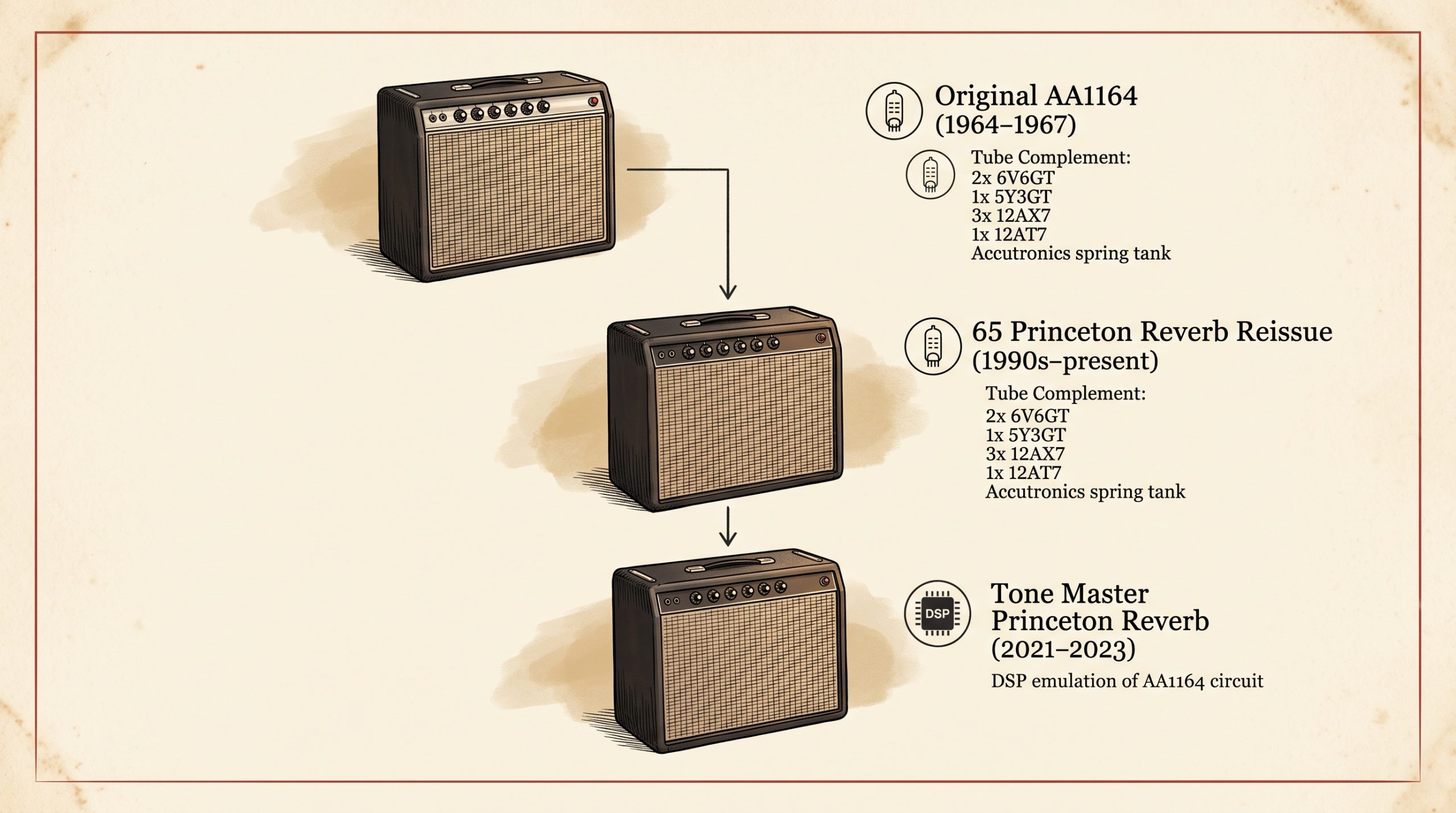
- Weighs 19.9 lbs vs. ~34 lbs for the ’65 Princeton Reverb Reissue
- No GZ34/5AR4 rectifier sag, no physical spring tank, these are DSP emulations, not the real components
- Marketing uses “Class-A” language; this is not a Class-A tube circuit, it’s a solid-state DSP amp
What Is the Fender Tone Master Princeton Reverb?
The Blackface Legacy It’s Built On
The original Princeton Reverb entered production in 1964 under the AA1164 circuit designation, right at the heart of Fender’s blackface era. Two 6V6GT power tubes, a GZ34/5AR4 rectifier, three 12AX7 preamp tubes, one 12AT7, and a physical Accutronics spring reverb tank. The AA1164 ran through the blackface era and into early silverface production (1968–1969) before the AB1270 circuit revision arrived. When Fender reissued the Princeton Reverb in the 1990s as the ’65 Princeton Reverb Reissue, they based it on that same AA1164-era circuit. That reissue, still in production today, is the direct tube baseline the Tone Master was designed to emulate. It’s not modeled on a specific vintage original. It’s modeled on the reissue, which is itself a faithful reproduction of the AA1164 topology. That distinction matters when you’re evaluating how accurate the DSP translation is.
The Princeton Reverb’s appeal has always been about the intersection of just enough headroom and just enough breakup. At roughly 12–15 watts RMS from the tube version, it stays clean at bedroom volumes and starts to bark when pushed past noon on the volume knob. The single-speaker format keeps the footprint small. It’s been a working musician’s amp for sixty years for exactly those reasons.
For a deeper look at how to date and identify original blackface Princeton Reverbs by chassis stamp and tube chart, the Fender tube amp serial number and dating guide covers transformer EIA codes, date codes, and model identification across all production eras.
Where the Tone Master Line Fits
Fender launched the Tone Master series with the Twin Reverb and Deluxe Reverb, then expanded to include the Super Reverb and Princeton Reverb. The design philosophy across the line is consistent: same front-panel knob layout as the tube original, same general cabinet dimensions, same control names, zero menus. The Fender Tone Master Deluxe Reverb established the template, strip the internals, keep the interface. The Princeton follows the same approach at a smaller scale.
According to reviews documented at Guitar World, the Tone Master Princeton delivers a near-indistinguishable tonal and playing-feel experience compared to the tube version, with the key advantages sitting in the rear-panel feature set that no tube Princeton Reverb has ever offered.
Fender Tone Master Princeton Reverb Specifications
Full Spec Sheet
Fender’s own product documentation (fender.com) lists the physical amp stage at 50 watts into 8Ω, calibrated to simulate 12-watt tube amp performance at maximum power setting. This is a key technical point: the amp is not a 12-watt solid-state amplifier in the traditional sense. The 50W solid-state output stage is attenuated and shaped by the DSP to behave like a 12W tube amp at full power, with lower settings simulating a progressively more attenuated tube amp response.
| Specification | Detail |
|---|---|
| Amplifier Type | Solid-State DSP (proprietary Fender modeling process) |
| Physical Output Stage | 50W into 8Ω (calibrated to simulate 12W tube amp performance) |
| Power Settings | Full (12W simulated), plus multiple attenuated levels down to 0.1W |
| Speaker | 1×10″ Jensen C10R, 8Ω |
| Controls | Volume, Treble, Bass, Reverb, Speed, Intensity |
| Effects | Spring Reverb (DSP), Sine-Wave Tremolo (DSP) |
| Inputs | 1× ¼” Instrument Input |
| Outputs | 1× Balanced XLR (line/DI), 1× ¼” External Speaker |
| XLR Cabinet Modes | 3: No Cab Sim, SM57 Mic Sim, Royer R-121 Mic Sim |
| Mute Switch | Yes (rear panel, silences speaker while XLR stays active) |
| Weight | 19.9 lbs (9.03 kg) |
| Impedance (Speaker Out) | 8Ω minimum |
| Production Years | 2021–present |
| Country of Manufacture | China |
| MSRP (at launch) | $899.99 USD |
Note: an FSR (Factory Special Run) version of the Tone Master Princeton Reverb exists with a Jensen C10R in a Wine Bordeaux/Wheat finish, confirming the Jensen C10R as the standard speaker complement across the production run. Some third-party retailer listings reference a Celestion A-Type 12″, this specification appears to be inaccurate based on Fender’s own product documentation.
Circuit Architecture Notes
The “Class-A” language in some Tone Master marketing materials describes the emulation target (the original Princeton Reverb’s tube topology), not the physical amplifier circuit. The Tone Master Princeton is not a Class-A solid-state amplifier in any conventional sense. It uses a multi-stage DSP modeling process to replicate the harmonic content, compression characteristics, and transient response of the AA1164 circuit. There is no output transformer, no rectifier tube, and no physical filter capacitors handling the power supply sag that defines the tube Princeton’s dynamic response at high volumes.
Power scaling is achieved entirely in the DSP domain, not through a resistive load box or reactive attenuator as you’d find with passive tube amp attenuators. This means there are no insertion-loss artifacts, no frequency response coloration from the attenuator itself, and no added impedance loading on an output transformer that doesn’t exist. The tradeoff: the spongy compression of a GZ34/5AR4 rectifier under load has no physical analog here. It’s emulated, not generated.
Controls and Features Walkthrough
Front Panel Controls
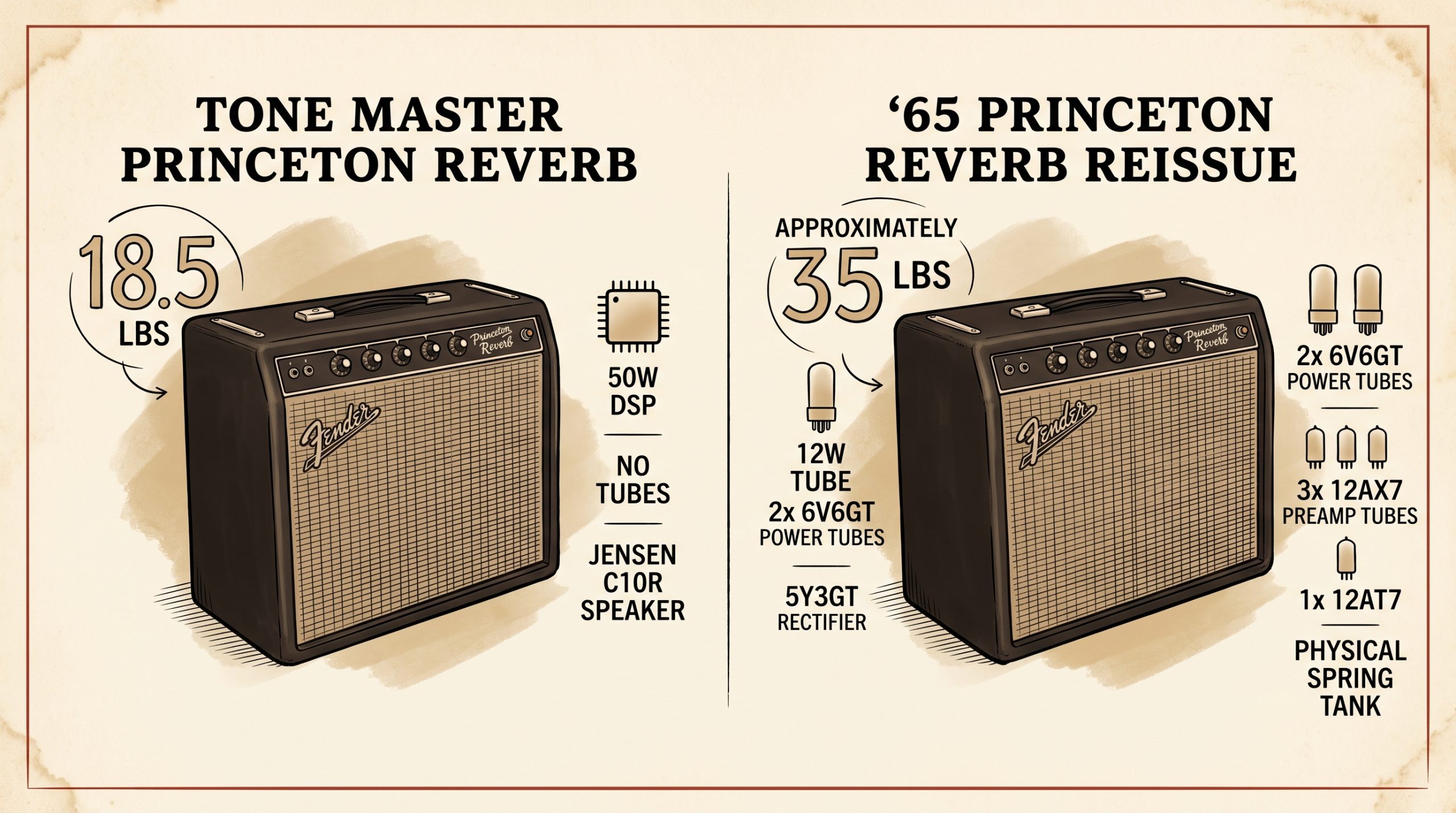
The front panel matches the ’65 Princeton Reverb Reissue knob-for-knob. Volume controls both input gain and the onset of the breakup character modeled into the DSP. Treble and Bass run a passive EQ emulation; the original blackface Princeton Reverb AA1164 uses a simpler tone stack than the Deluxe Reverb or Super Reverb, and the Tone Master’s DSP reflects this, the EQ sweep is deliberately limited in range, which is correct to the source circuit.
Reverb depth covers the same range as the tube version’s spring tank. Speed and Intensity handle the tremolo. The original AA1164 uses an optical (photocell) tremolo circuit, which produces a smooth, sine-wave-like modulation rather than the choppier bias tremolo found in some earlier Fender circuits. The DSP models this specifically, producing a tremolo character that stays round and even across the speed range rather than pulsing hard at the waveform peaks.
Rear Panel Features
This is where the Tone Master Princeton diverges from any tube amp in the Princeton line. Four controls on the rear panel that no AA1164-based circuit has ever offered.
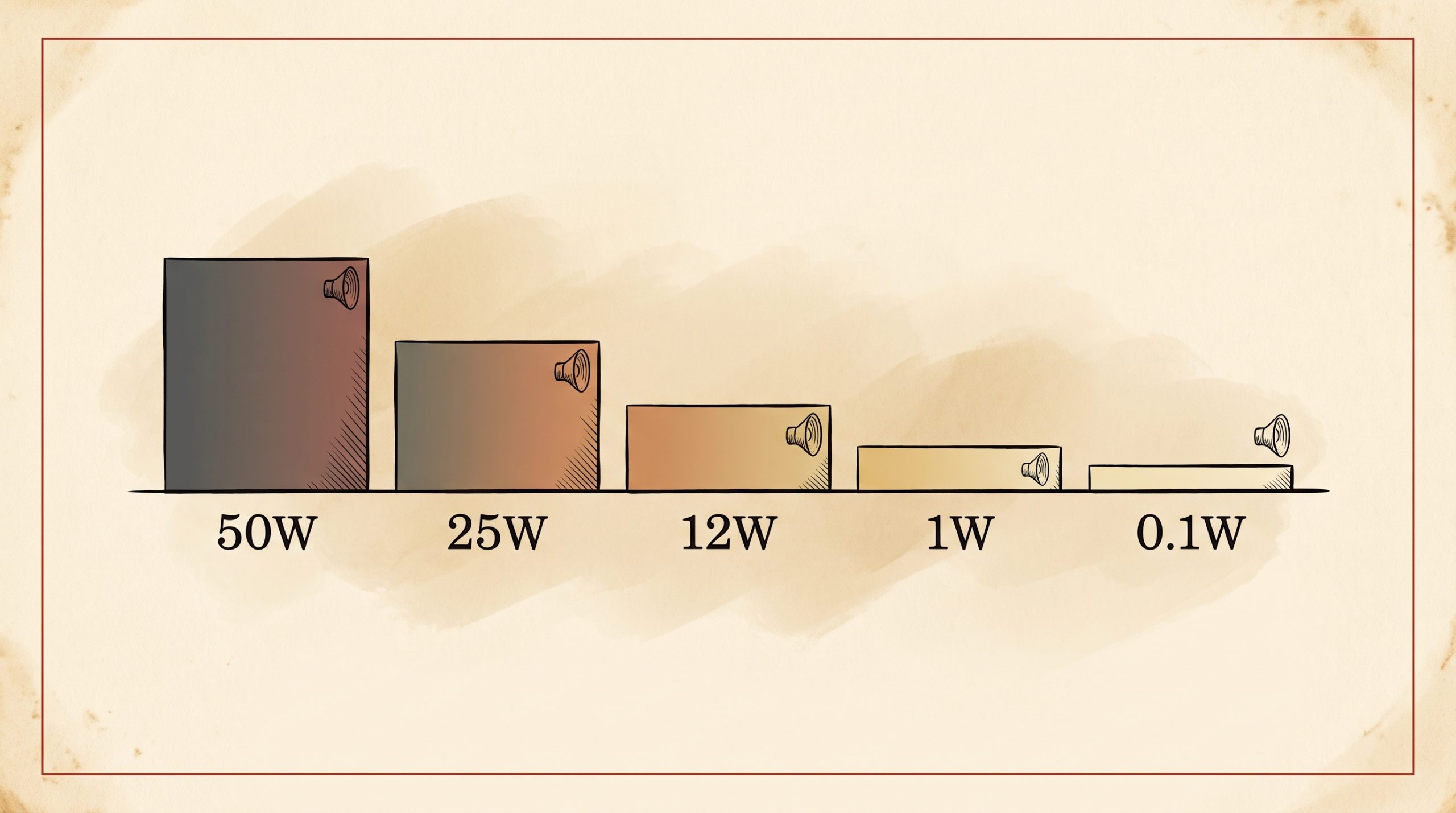
The power level selector gives you full power (12W simulated) and multiple attenuated settings down to roughly 0.1W. Practical breakdown:
- Full power: stage volume, cuts through a band at rehearsal or a small club
- Mid-range settings: home practice, small recording room with the speaker running
- Lowest settings (0.1W range): apartment playing at 11pm without complaints
The XLR balanced output runs three cab simulation modes. No cab sim sends a flat signal useful for recording interfaces running third-party IRs or routing to a full-range PA. The SM57 mode simulates the on-axis close-mic position that defines the classic live Fender sound, present, slightly forward in the upper mids, what most FOH engineers expect when they see a Princeton pointed at them. The Royer R-121 mode gives you the ribbon character: warmer, natural high-frequency rolloff, less aggressive transient, better for recording contexts where the track needs to sit back in a mix without EQ work.
The mute switch silences the internal speaker entirely while keeping the XLR output active. Fully silent direct recording with no cab bleeding into room mics. No extra load box, no reactive attenuator, no additional gear in the chain. Not great for players who rely on speaker resonance coupling back into the guitar’s pickups, but excellent for controlled studio tracking.
The external speaker jack accepts 8Ω minimum. Running an external cab while the internal Jensen C10R is also connected puts both speakers in parallel. Confirm impedance math before connecting, running below 8Ω on the output stage puts you outside the design spec.
What Stays Identical to the Tube Version
Same knob layout. Same labeling. Same footswitch jack accepting the standard Fender 2-button (reverb/tremolo bypass) footswitch used by the ’65 Princeton Reverb Reissue. No menus. No presets. No firmware-accessible tone shaping. This is the most deliberate design choice in the Tone Master series, and it’s the right one. You pick up the amp, plug in, and adjust four knobs. Done.
How Does It Sound?
Clean Tone Character
At full power, the Tone Master Princeton produces clean headroom that matches the tube version closely through the low and mid frequencies. The DSP modeling captures transient response and pick attack well, single-note runs through a Telecaster bridge pickup retain the spanky attack that the Jensen C10R and the AA1164-based gain structure produce in the tube version. Where the difference becomes audible is in the upper harmonic content at high volumes. The absence of a GZ34/5AR4 rectifier means no voltage sag on hard pick attacks. The tube version’s rectifier drops supply voltage fractionally under load, which produces a very brief, subtle compression at the note’s attack onset. The Tone Master doesn’t do this. It doesn’t sag. Players who track the difference in single-note feel will notice it; most will not.
The Jensen C10R is a ceramic-magnet speaker, voiced warmer and with less upper-midrange presence than the alnico Jensen C10Q used in some Princeton Reverb special-run variants over the years. It’s a competent match for the amp’s voiced character and keeps the overall sound from going ice-pick at higher treble settings.
Breakup and Overdrive Response
The Tone Master Princeton responds to pedals well. Overdrive and fuzz in front of the amp behave consistently with how they’d behave into a tube Princeton. The DSP input stage is designed to react to pedal output levels in a way that triggers the modeled gain structure, not a flat-response solid-state input. Running a Tube Screamer-type pedal into the amp at full power produces a compression and harmonic saturation character that’s convincingly Princeton-like. Fuzz pedals, particularly high-output germanium designs, respond with appropriate bloom and dynamic sensitivity.
Worth noting. There’s no impedance-reactive output stage here. Some players who run impedance-sensitive fuzz circuits (germanium transistor fuzzes designed for direct amp input impedance interaction) may notice a slightly different feel compared to driving the high-impedance input of a tube preamp stage directly. Most fuzzes won’t care.
Reverb and Tremolo Quality
The spring reverb emulation is one of the stronger DSP spring models in this price range. The decay tail has appropriate drip and wash without going synthetic or over-bright. It’s not identical to an Accutronics 4EB2C1B tank vibrating in a real box, because nothing digital is. But at stage volumes, blended at reasonable reverb settings, it’s convincing. The tremolo emulation is smooth across the Speed range, correctly replicating the optical character of the AA1164 circuit rather than the choppier bias tremolo of earlier Fender designs. No artifacts, no wavering pitch from a worn photocell, consistent across temperature changes.
Live Gig Performance
At 19.9 lbs, this is a one-trip-from-the-car amp. The ’65 Princeton Reverb Reissue runs around 34 lbs. For a small-to-mid-sized club gig, 12W simulated into the Jensen C10R is plenty of stage volume for mic’d applications, and the XLR output gives the FOH engineer a clean, hum-free signal with appropriate cabinet character already dialed in. No warm-up time. Consistent from the first note.
Studio and Recording Use
Silent recording via the XLR plus mute switch is the Tone Master Princeton’s clearest practical advantage over any tube Princeton. No 60-cycle hum from a tube amp’s power supply. No room noise from a reverb tank hanging in a live cabinet. The noise floor is significantly lower, which matters in dense production where the amp track needs to sit clean in the mix without noise gating. DSP latency in the Tone Master series is documented well under 1ms, which is below the threshold of perception in any live or recording context.
Tone Master Princeton Reverb vs. ’65 Princeton Reverb Reissue
This is the comparison search driving most traffic to this topic. Direct side-by-side.
| Feature | Tone Master Princeton Reverb | ’65 Princeton Reverb Reissue (Tube) |
|---|---|---|
| Power Output | 50W physical / simulates 12W tube | ~15W RMS (6V6 tubes) |
| Circuit | DSP emulation of AA1164 | AA1164 blackface reissue |
| Weight | 19.9 lbs | ~34 lbs |
| Speaker | Jensen C10R 10″ | Jensen C10R 10″ (same speaker as Tone Master) |
| Power Tubes | None | 2× 6V6GT |
| Rectifier | None (digital) | GZ34/5AR4 (sag characteristic) |
| Preamp Tubes | None | 3× 12AX7, 1× 12AT7 |
| Reverb Tank | DSP emulation | Physical Accutronics spring tank |
| Power Scaling | Multiple settings, 0.1W to 12W simulated | Fixed (~15W) |
| XLR DI Output | Yes, 3 cab sim modes | No |
| Silent Recording | Yes (mute switch) | No (requires load box) |
| Tube Maintenance | None required | Retube every 1–3 years |
| MSRP (launch) | $899.99 | $1,149.99 |
| Warranty (Fender) | 2 years | 2 years |
The Case for the Tone Master
The weight argument is real. Touring or gigging musicians dealing with back, shoulder, or joint issues will find the roughly 14-pound difference between these two amps meaningful over a multi-night run. Add the silent recording capability, the variable power scaling without an external attenuator, and the lower entry cost, and the Tone Master Princeton makes a strong practical case. No tube biasing, no retubing every year or two, no rectifier replacement. You plug it in, and it performs consistently at 90°F and 40°F alike.
The Case for the Tube Version
The GZ34/5AR4 rectifier sag is real and it doesn’t translate perfectly to DSP. Players who use the Princeton Reverb specifically for that slight dynamic compression on hard rhythm playing will notice its absence in the Tone Master. The physical spring reverb tank is an acoustic device mounted in a live box; it interacts with the cabinet resonance in ways no DSP has fully replicated. The tube Princeton also holds resale value better, it has direct circuit DNA connecting it to sixty years of blackface production history, which the Princeton Reverb model guide documents across all production variants from the original AA1164 through the current reissue. That lineage means something on the used market and to long-term collectors.
Firmware, Updates, and Long-Term Ownership
Firmware Updates
Fender released firmware updates for the Tone Master series following their respective launches. Updates addressed DSP algorithm refinements and power level calibration accuracy. Firmware is applied via USB connection using the Fender Tone app, note this is a separate application from the Fender Tone editor used for Mustang GT/LT series. To check the current firmware version on a used unit, the Fender Tone app will report the installed version on connection. Fender’s support documentation at fender.com/support maintains the firmware update process for the Tone Master line.
Serviceability and Long-Term Reliability
No tubes means no retubing cost and no bias adjustments. That’s a real annual savings for a regularly gigged amp. Solid-state output stages have significantly lower failure rates than output transformer and power tube combinations under identical thermal stress. What does fail in solid-state amps over time: electrolytic capacitors. A well-built solid-state amp typically sees its first electrolytic capacitor degradation at 15–25 years depending on thermal cycling. Not an issue for a current-production amp now, but worth tracking long-term. The DSP board itself is the primary serviceability question. If the DSP module fails out of warranty, availability of that specific Fender proprietary board determines whether the amp is repairable. This is a legitimate long-term concern for any proprietary digital platform, and it’s honest to name it.
Pricing, Availability, and Used Market
New and Street Pricing
The Tone Master Princeton Reverb launched around $899.99 MSRP in 2021. As of 2026 it remains in current production, part of Fender’s ongoing Tone Master lineup alongside the Deluxe Reverb, Twin Reverb, and Super Reverb models. Street pricing at authorized dealers runs around $1,099.99 as of 2026, reflecting a typical price increase since launch rather than any discontinuation or scarcity premium.
Used Market
For buyers who prefer to shop used rather than buy new, pricing runs approximately $500–$700 USD depending on condition and included accessories. When buying used, inspect all three XLR cab sim modes individually, mode switching is done via a rear-panel button and all three positions should produce audibly different output. Confirm the power level selector steps cleanly through all settings. Check the Jensen C10R for speaker rattle; the C10R is not a heavy-duty speaker and used examples that saw stage volume regularly may show cone deterioration at the surround. The footswitch jack is a standard ¼” TRS, verify it accepts a footswitch without crackling, as jack oxidation is common on amps that sat in storage.
Who Should Buy the Fender Tone Master Princeton Reverb?
Ideal Player Profiles
- Gigging musicians who need to carry their own backline and have back or shoulder concerns, the weight advantage is the primary purchase driver for this group
- Studio session players who need authentic Fender clean tone on tracks without the noise floor of a tube amp or the room bleed of a live speaker
- Players who want a plug-and-play amp with no tube maintenance, no bias checks, and consistent performance
- Amp collectors who want a modern-feature companion to a vintage Princeton Reverb without risking the original on road gigs
Who Should Look Elsewhere
Players who specifically chase the GZ34/5AR4 rectifier sag and compression on hard strumming will find the Tone Master Princeton a slightly different animal in the feel department. Not worse, just different. Vintage purists who require the acoustic resonance of a physical spring reverb tank won’t find it here either. Players looking for onboard presets, effects loops, or deep tone-shaping menus should look at the Tone Master Pro or the Mustang GT series, the Princeton Tone Master offers no such features by design.
Is the Fender Tone Master Princeton Reverb Worth It?
It does a specific job exceptionally well. For the gigging musician who has run a tube Princeton Reverb for years and now wants the same front panel, the same tonal character, and half the weight, the Tone Master Princeton delivers. The XLR output with cab simulation is genuinely useful on stage and in the studio, covering use cases that require a separate load box and DI on a tube amp setup. The silent recording mode alone represents a workflow improvement for session work that tube Princeton owners have historically solved with expensive external equipment.
What it gives up is also real. No GZ34/5AR4 sag. No acoustic springs. No transformer-reactive output stage feel under a cranked volume knob. These aren’t marketing abstractions, players who have built their technique around that specific tube Princeton dynamic response will feel the difference, particularly at high-volume breakup where the rectifier’s voltage droop normally adds that last layer of compression. It’s a legitimate tradeoff, not a flaw.
In the broader Princeton Reverb family, from the original 1964 AA1164 blackface production through the silverface run, into the 1990s reissue, and now to the Tone Master, this amp represents a distinct branch rather than a straight evolution. Whether it becomes historically significant in its own right depends partly on how DSP modeling ages as a technology and partly on how long Fender continues the current production run — both remain open questions. For players evaluating it now on its own terms, at a street price around $1,099.99 new (or $500–$700 on the used market), it’s one of the more practical gigging amp purchases available in the blackface-voiced 1×10″ category.
Frequently asked questions
What is the difference between the Fender Princeton Reverb and the Tone Master Princeton Reverb?
The '65 Princeton Reverb Reissue uses an all-tube AA1164-based circuit with two 6V6GT power tubes, a GZ34/5AR4 rectifier, and a physical Accutronics spring reverb tank. The Tone Master Princeton Reverb replaces all of this with a DSP-powered solid-state platform, cutting weight from approximately 34 lbs to 19.9 lbs and adding a balanced XLR output with three cab simulation modes, a variable power attenuator, and a mute switch for silent recording. Both the tube version and the Tone Master remain in current production as of 2026.
Is the Fender Tone Master Princeton Reverb still being made?
Yes. As of 2026, the Tone Master Princeton Reverb remains part of Fender's current Tone Master lineup, sold new through authorized dealers at a street price around $1,099.99. Fender has also released the Tone Master Pro, a separate multi-channel, multi-amp modeling platform, but that did not discontinue the Princeton Reverb model. A used market also exists, generally in the $500–$700 range for earlier units.
Can the Tone Master Princeton Reverb be used silently for recording?
Yes. Engaging the rear-panel mute switch silences the internal speaker while keeping the balanced XLR output fully active. The XLR output offers three cab simulation modes, flat with no cab sim, a Shure SM57 simulation, and a Royer R-121 ribbon mic simulation, making it a complete silent DI solution without any additional gear in the chain.
What speaker does the Fender Tone Master Princeton Reverb use?
The standard production Tone Master Princeton Reverb ships with a Jensen C10R 10" speaker at 8Ω. This matches the Jensen C10R used in the current '65 Princeton Reverb Reissue — unlike the Deluxe Reverb and Twin Reverb Tone Masters, the Princeton Reverb's tube counterpart has never shipped with a 12" speaker. An FSR version in a Wine Bordeaux/Wheat finish also uses the Jensen C10R.
Does the Tone Master Princeton Reverb accept external speaker cabinets?
Yes. The rear-panel external speaker jack accepts 8Ω minimum impedance. Connecting an external cabinet while the internal Jensen C10R is also connected runs both speakers in parallel, confirm the combined impedance stays at 8Ω or above before connecting to avoid operating the output stage outside its design specification. Unlike tube amps, there is no output transformer to damage from impedance mismatch, but staying within the 8Ω minimum is still important for the solid-state output stage.