Contents
- 01What Is the Fender Tone Master Twin Reverb? Heritage Context
- 02Fender Tone Master Twin Reverb Specs, Full Technical Breakdown
- 03Controls, Features, and the XLR DI
- 04Fender Tone Master Twin Reverb Review, How Does It Actually Sound?
- 05Fender Tone Master Twin Reverb Blonde, What's Different?
- 06Tone Master Twin Reverb vs. Alternatives, Who Should Buy What?
- 07Frequently Asked Questions, Fender Tone Master Twin Reverb
- 08The TCguitar.com Verdict, Is It the Right Amp for You?
What Is the Fender Tone Master Twin Reverb? Heritage Context
To understand what Fender modeled, you need to know the source material. The Tone Master Twin Reverb targets the AB763 blackface circuit specifically, not the silverface revision that followed in 1967, and not the earlier AA763 that preceded it. That specificity matters, because the AB763 represents the Twin Reverb circuit in its most refined form before Fender made cost-driven changes during the CBS era.
The Original Twin Reverb It Models, Blackface AB763 Circuit
The AB763 circuit ran from late 1963 through 1967 in the blackface era. Its tube complement consisted of four 6L6GC power tubes, four 12AX7 preamp tubes, and two 12AT7s handling phase inversion and reverb driver duties. That combination, operating at the voltages Fender specified, produced 85 watts RMS. The Tone Master’s matched 85-watt rating is not coincidental. Fender’s design team deliberately spec-matched the output figure to the original.
Original speaker complement in early AB763 production was two Jensen C12N drivers (12-inch, 8-ohm, 50 watts each). Production reality, as documented in Greg Gagliano’s research for 20th Century Guitar Magazine, shows Oxford, Utah, and CTS speakers appearing in Twin Reverbs depending on production year and supplier availability. The Jensen C12N is the reference point, but chassis-stamped units from 1965 and 1966 frequently left the factory with alternatives. You can cross-reference production year by transformer codes and tube chart ink stamps using the Fender tube amp serial number guide as a dating reference.
The original Twin Reverb weighed approximately 67 pounds. Stage-loud but back-breaking. That weight figure is the practical reason the Tone Master line exists.
The blackface era ran from 1963 through 1967. The silverface AA769 and AA270 variants followed, with circuit revisions continuing through 1981. Fender’s current tube Twin Reverb traces its lineage through this entire run. The Tone Master targets only the blackface window.
Why the AB763 Is the Modeling Target
The AB763 circuit is widely considered the definitive Twin Reverb configuration: maximum clean headroom, lush spring reverb, and optical tremolo that warbles authentically at slow speeds. The 6L6GC power tubes at AB763 operating voltages produce a stiff, spanky attack in the clean range that defined countless recordings from the mid-1960s onward.
For players who want the AB763 circuit in context with other blackface designs, the Fender Pro Reverb guide covers the shared AB763 circuit architecture across the blackface lineup, which helps clarify how the Twin differs from its smaller siblings in the same circuit family.
Fender Tone Master Twin Reverb Specs, Full Technical Breakdown
DSP Engine and Processing Architecture
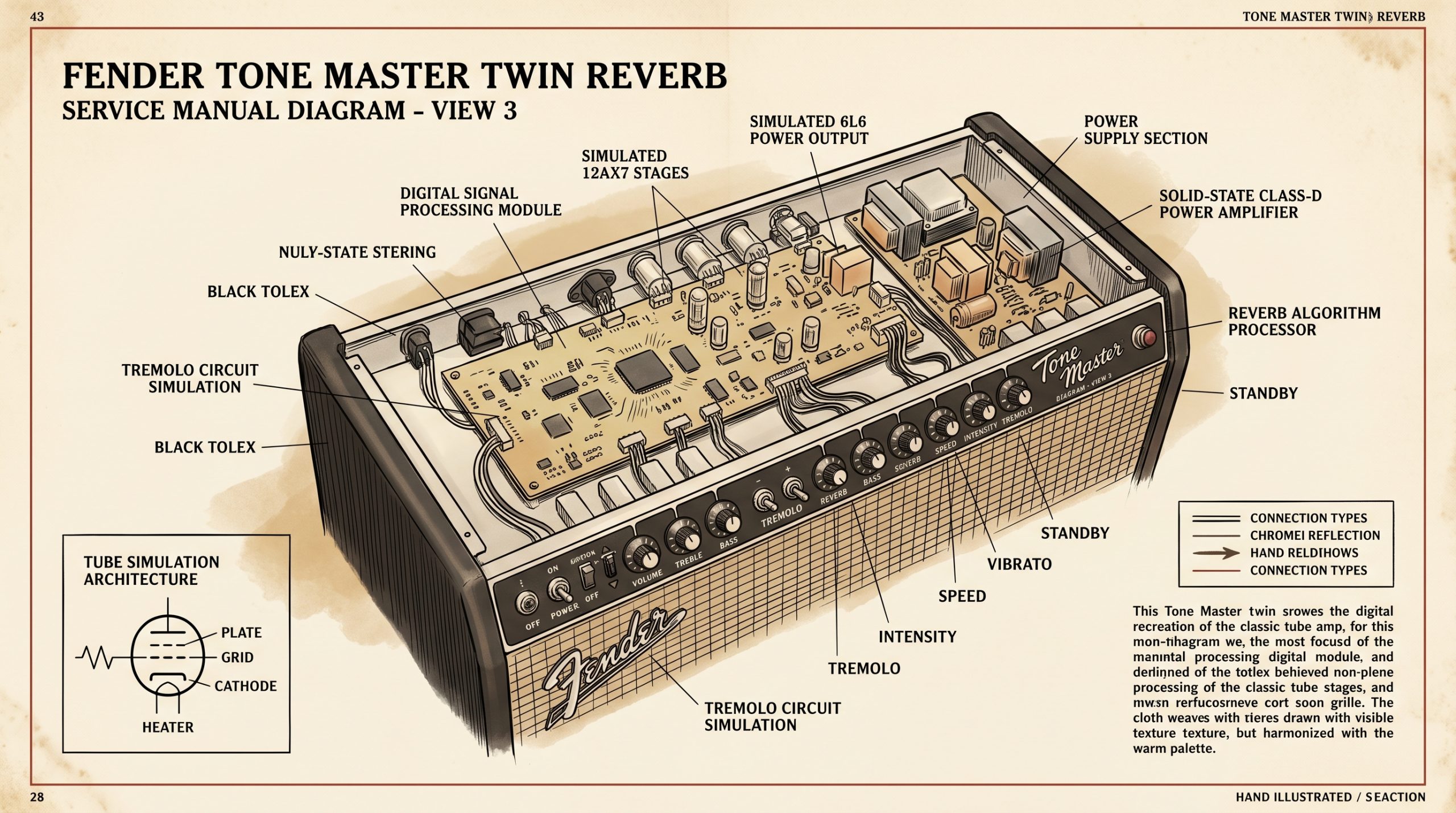
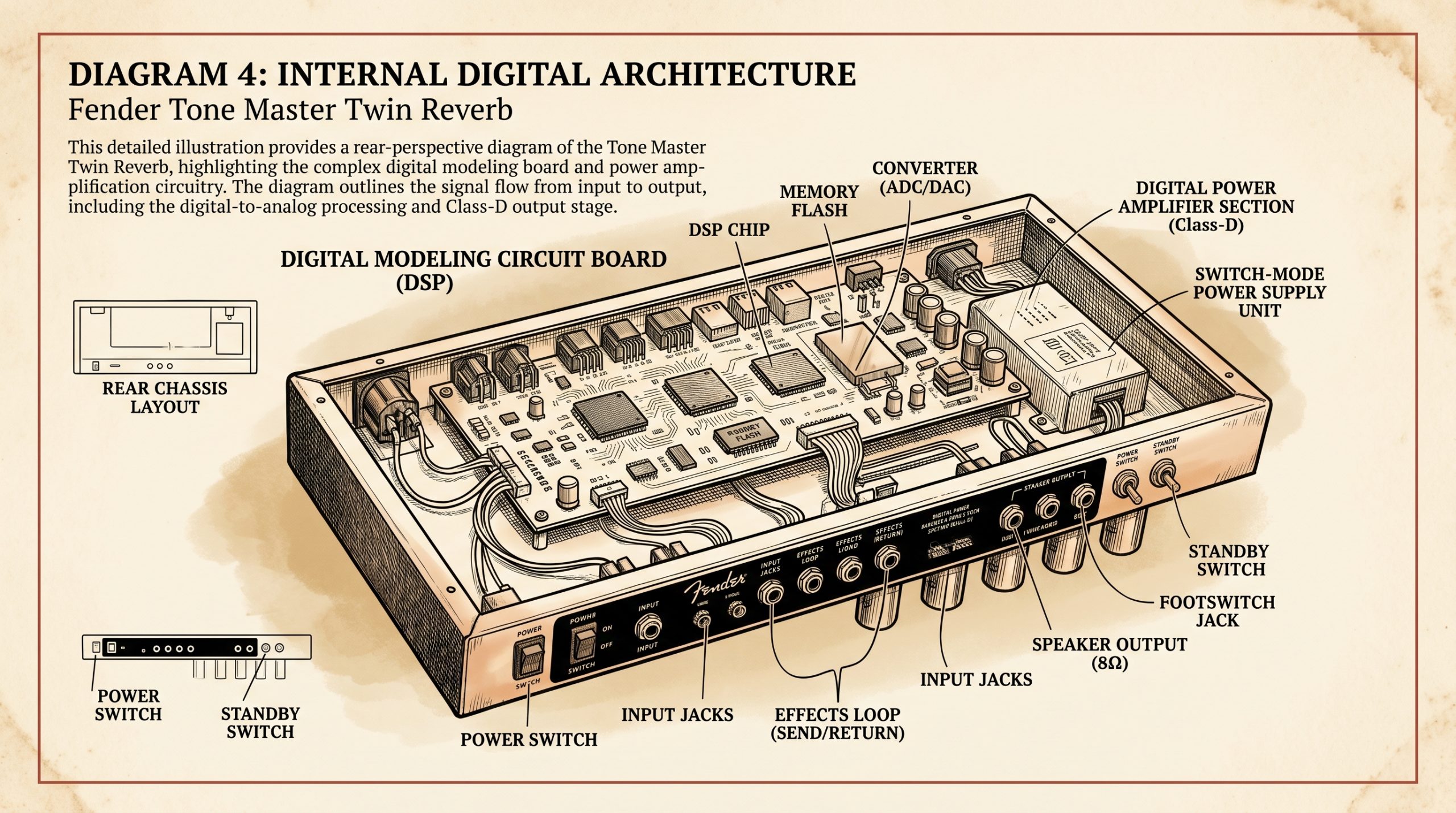
The Tone Master Twin Reverb runs a quad-core DSP processor, and the core allocation is specific. Core one handles amp modeling: impedance behavior, capacitance response, and power amp compression (tube sag) simulation. Cores two and three are dedicated exclusively to convolution reverb processing. Core four handles tremolo. That dedicated allocation matters because convolution reverb is computationally expensive, and giving it two cores means the reverb decay isn’t competing for processing cycles with amp modeling calculations.
The modeling approach is circuit-level, not impulse-response-only. Fender models the electrical behavior of the AB763 preamp and power section, including component-level interactions. IR loading is part of the speaker simulation layer, but the amp behavior itself is computed dynamically.
Output power sits at 85 watts RMS into the internal 4-ohm load, attenuable to 22W, 5W, 1W, or 0.2W via a front-panel rotary switch. This is not a resistor pad. Each wattage setting re-models the power amp behavior independently, meaning the amp’s dynamic compression and sag characteristics are recalculated at each level. At 0.2 watts in a bedroom, you’re not just hearing a quieter version of the 85-watt signal. You’re hearing Fender’s model of how the circuit would behave at that power level. Not perfect, but meaningfully more accurate than a simple attenuator inline with the signal path.
Physical Specifications
| Spec | Tone Master Twin Reverb | Original Blackface Twin Reverb (AB763) |
|---|---|---|
| Power Output | 85W RMS (solid-state Class D) | 85W RMS (4× 6L6GC tube) |
| Speaker Complement | 2× Jensen N-12K neodymium (current production) / 2× Celestion G12-65 Heritage (2019 launch) | 2× Jensen C12N (12″, 50W), Oxford, Utah, CTS used in production |
| Weight | 33 lbs (14.97 kg) | ~67 lbs (30.4 kg) |
| Cabinet Dimensions | 26.5″ × 19.75″ × 10.5″ | 26.75″ × 19.75″ × 10.5″ |
| Power Attenuation | 85W / 22W / 5W / 1W / 0.2W | None (stock) |
| Channels | 2 (Normal + Vibrato) | 2 (Normal + Vibrato) |
| Reverb Type | Convolution digital (IRs from real Twin Reverb spring tank) | Spring tank |
| DI Output | Yes (XLR, cab simulation toggle) | No |
| Price (MSRP 2023–2024) | $1,399.99 | N/A (vintage market) |
| Production Start | 2019 | 1963 (AB763 revision: late 1963) |
Speaker Deep Dive
The 2019 launch units shipped with Celestion G12-65 Heritage speakers (12-inch, alnico magnet, 8 ohms each, wired in parallel for a 4-ohm total load, rated 97dB sensitivity at 1W/1m). Current production units on Fender’s product page list Jensen N-12K neodymium speakers instead. If you’re buying new, verify which speaker complement is in the unit you’re purchasing. If you’re buying used, the 2019 through early-run models will have the Celestion alnico drivers, which some players prefer for their warmer midrange and softer high-frequency rolloff. The neodymium Jensen N-12K drivers are lighter and produce a brighter, more present top end. Both work, but they’re different sounding tools.
Controls, Features, and the XLR DI
Front Panel Walkthrough
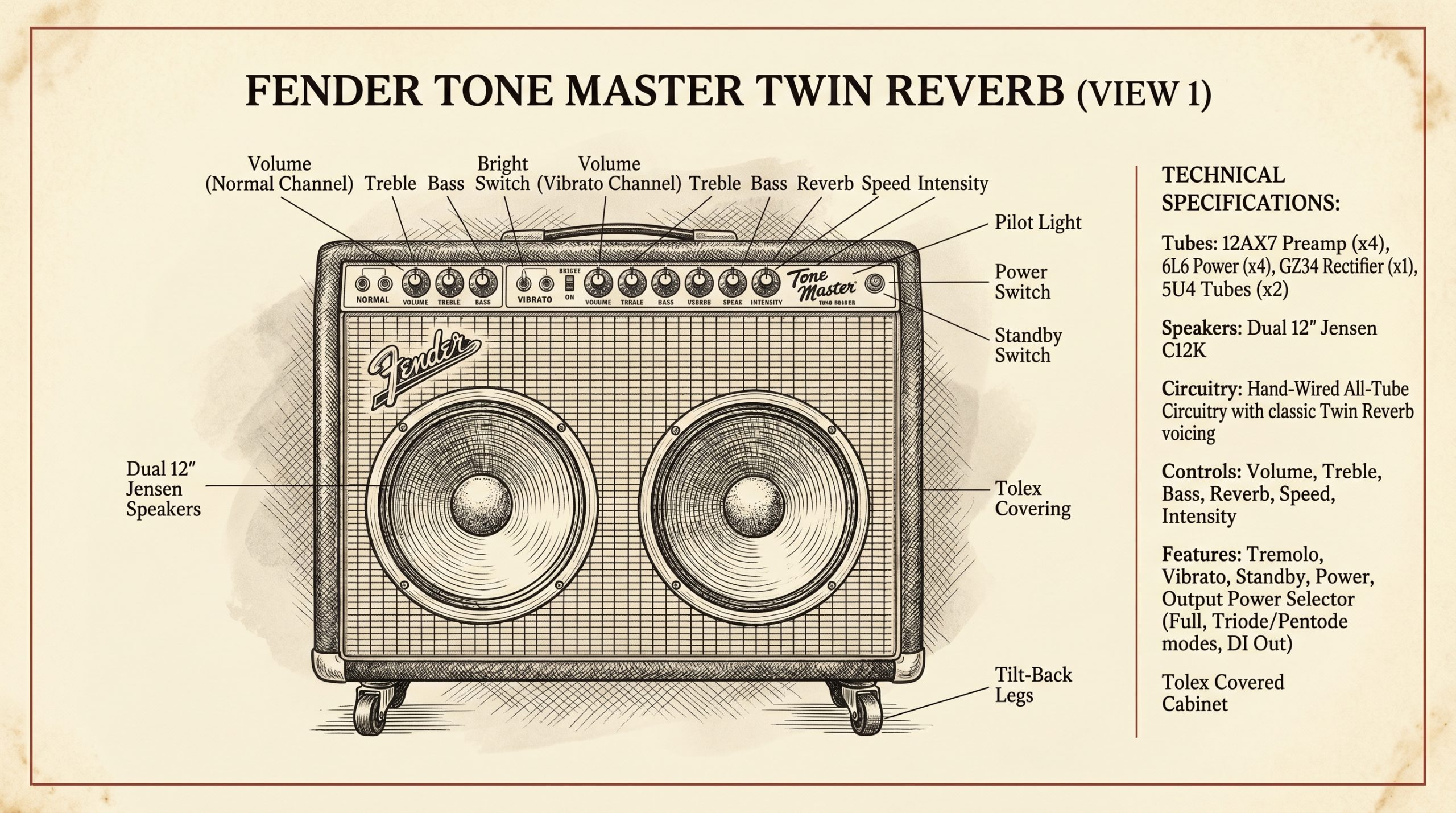
The control layout mirrors the original Twin Reverb panel closely. Two channels: Normal and Vibrato. Each channel has its own Volume, Treble, Middle, and Bass controls, plus individual Bright switches matching the AB763’s topology. Shared controls cover Reverb depth, Tremolo Speed, and Tremolo Intensity. The power attenuation rotary sits on the front panel, selectable between 85W, 22W, 5W, 1W, and 0.2W without opening the cabinet or touching anything on the rear panel. A standby switch is present, retained for feel and workflow familiarity even though there are no tubes requiring a warm-up period. Cosmetically deliberate on Fender’s part.
Rear Panel and the XLR Cabinet-Simulated DI
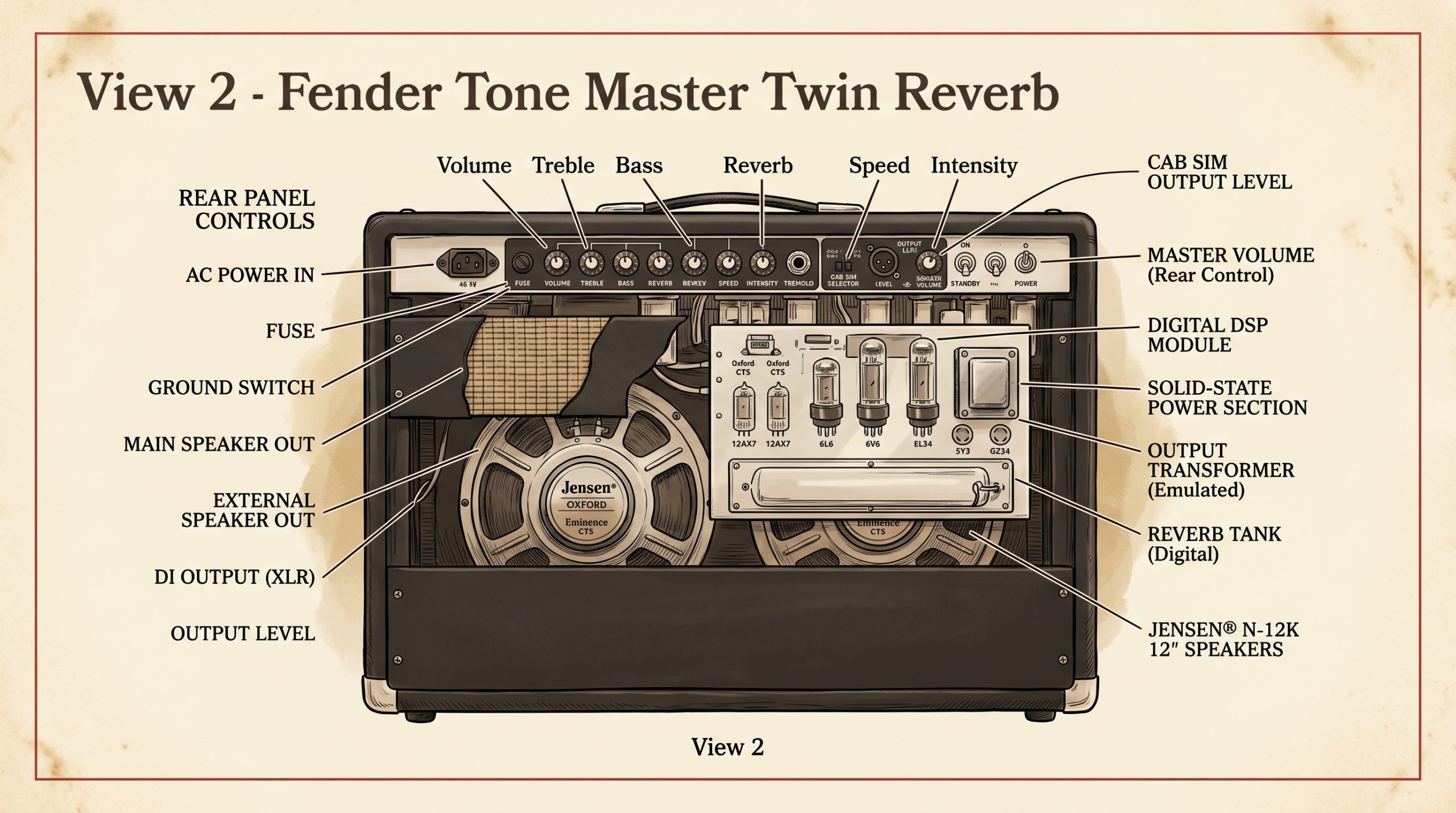
The rear panel includes the XLR DI output with a cab simulation on/off toggle. The signal is post-amp model and post-speaker simulation when the toggle is on, making it usable straight into a PA or interface without an additional cab IR plugin in the chain. A ground lift switch is included on the DI, which handles the hum issues that show up in certain venues with ground loop problems. External speaker output accepts 4-ohm or 8-ohm loads. The footswitch jack takes Fender’s standard 2-button footswitch (reverb on/off and vibrato on/off), the same type used across several Fender blackface-inspired models. No effects loop. That matches the original AB763 by design, but it’s worth knowing upfront if your pedal board relies on a series loop.
Firmware Updates and Known Fixes
A USB port on the rear panel enables firmware updates via Fender’s website. This is directly relevant if you’ve read early reviews (2019 production) and are comparing notes with current units. Post-launch firmware addressed tremolo rate accuracy at slow speed settings, reverb decay behavior refinement, and minor DSP timing fixes. If your Tone Master Twin Reverb sounds slightly off from early impressions, checking the firmware version is the first diagnostic step, not a hardware issue. Download and update procedure is documented on Fender’s support pages at fender.com/support.
Fender Tone Master Twin Reverb Review, How Does It Actually Sound?
Clean Headroom, The Core Promise
At 85 watts into two 12-inch drivers, the Tone Master stays clean at volumes where most combo amps are already breaking up. That’s the Twin Reverb’s defining characteristic, and the Tone Master replicates it accurately. Warm clean tones with a stiff bass response and a slightly dark character at moderate treble settings, which aligns with feedback from players on the Canadian Guitar Forum noting the amp can sound a little dark when treble controls sit below 5 or 6. Bump the treble into the 6-to-7 range and the top end opens up without getting ice-pick bright.
At 0.2 watts for bedroom use, the tonal character holds better than a tube amp through a power attenuator, because the DSP isn’t fighting the physics of a resistive load sapping frequencies unevenly. Players who’ve used the attenuation feature consistently report the amp retains its personality at low volumes in ways that passive attenuators on tube amps often don’t. The spongy compression character shifts at each wattage level, but that’s by design, not a flaw.
Reverb Quality, Convolution vs. Spring Tank
The two dedicated reverb processing cores pay off audibly. Convolution reverb using impulse responses captured from an actual Twin Reverb spring tank produces decay behavior, pre-delay accuracy, and stereo bloom that’s significantly more convincing than the algorithmic reverb found in most digital amps. It’s the closest thing to a tube spring tank you’ll find in a solid-state combo at this price point.
One limitation worth naming honestly: there’s no physical spring clunk when the amp gets bumped on stage. The real spring tank rattles dramatically when knocked. The Tone Master doesn’t. Some players find that absence reassuring. Others miss it as a tactile cue that something real is happening inside the cabinet. Neither response is wrong.
Tremolo, Optical Circuit Modeling
The AB763’s optical tremolo used a light-dependent resistor paired with a light bulb to create the speed modulation, and the non-linear variation of that LDR-based circuit produces the characteristic “warble” at slow speeds that players chase. The Tone Master’s tremolo modeling preserves that warble behavior rather than substituting a clean sine-wave LFO. Reddit threads covering a year of Tone Master use consistently note the tremolo as a standout feature: the amp breaks up nicely when pushed, and backs off smoothly when you roll back the guitar volume. The tremolo character held through multiple sessions that converted pedal-dependent players into amp-only players.
Where Players Have Complaints
Direct about the cons. Early production units had tremolo rate accuracy issues at the slowest speed settings, running slightly fast compared to the original optical circuit. Firmware updates addressed this. Some users report DI output level inconsistency when switching between attenuation levels during a set, requiring a gain adjustment at the board. The feel difference from real tubes is real: pick attack dynamics respond differently, and players accustomed to the way a 6L6GC power section compresses under a hard pick stroke will notice the difference within a few minutes. Most adjust within one or two sessions. A few don’t, and they return it. There’s no effects loop, which is a genuine omission for pedalboard-heavy players even if it’s historically accurate to the original design.
Fender Tone Master Twin Reverb Blonde, What’s Different?
Blonde Variant Specs and Cosmetic Differences
Introduced in 2023, the Blonde variant uses blonde tolex with an oxblood grille cloth, matching the visual language of Fender’s early-1960s transition period before the blackface era standardized the black tolex and silver grille combination. The hardware switches to chrome. Electronically, it is identical to the black version: same DSP engine, same circuit modeling target (AB763 blackface), same attenuation options, same speaker complement. There are zero sonic differences between the black and blonde versions.
The cosmetic note worth calling out: historically, blonde tolex with oxblood grille cloth places a Fender amp in the 1961 through 1963 window, which predates the blackface era the Tone Master actually models. It’s a visual callback to the brownface/blonde transition era sitting in front of a blackface circuit simulation. Collectors and purists will notice. Most working players won’t care, and it looks sharp on a stage regardless.
Is the Blonde Worth the Premium?
The Blonde launched at roughly $100 to $150 above the black version at retail. On the used market, Reverb.com sales data from 2024 shows blonde examples averaging $50 to $100 above equivalent-condition black units. That’s a real premium, but a small one relative to the total price. If the blonde finish fits your aesthetic, the premium is modest. If you’re buying purely for function, the black version is the same amp for less money. Simple as that.
Tone Master Twin Reverb vs. Alternatives, Who Should Buy What?
| Amp | Type | Weight | Power | Street Price (2025–2026) | Best For |
|---|---|---|---|---|---|
| Fender Tone Master Twin Reverb | DSP Solid-State | 33 lbs | 85W | ~$1,399 | Twin sound, gigging light |
| Fender Twin Reverb (Tube, current production) | Tube | 64 lbs | 85W | ~$1,899 | Authentic tube feel, studio tracking |
| Fender Tone Master Deluxe Reverb | DSP Solid-State | 23 lbs | 22W | ~$1,199 | Smaller venues, home use, pedal platform |
| Roland JC-120 Jazz Chorus | Solid-State | 51 lbs | 120W | ~$1,299 | Pristine clean, stereo chorus effects |
| Boss Katana-100 MkII 2×12 | DSP Solid-State | 43 lbs | 100W | ~$699 | Budget-conscious players, effects-heavy rigs |
Tone Master Twin Reverb vs. Tone Master Deluxe Reverb
The practical differences between these two come down to volume ceiling and portability. The Twin runs 85 watts into two 12-inch drivers and stays clean well past small-club volume. The Deluxe Reverb runs 22 watts into a single 12-inch driver and begins compressing and adding character at lower volumes, which some players prefer for recording and smaller gigs. If your stages run loud and you need headroom to cut through a drum kit and bassist without a PA, the Twin is the tool. Coffee shops, rehearsals, home recording setups, or venues with full PA support where the amp is purely a monitor: the Deluxe is lighter, cheaper, and easier to manage. The full breakdown of the Deluxe model’s specs and circuit context is covered in the Fender Tone Master Deluxe Reverb guide.
Used Market Pricing
The Tone Master Twin Reverb’s used market range on Reverb.com as of 2024 runs from approximately $750 to $1,100 depending on condition, production run, speaker complement, and whether the factory footswitch is included. Units with the original Celestion G12-65 Heritage alnico speakers (2019 through early production) sometimes command a small premium from buyers specifically seeking the alnico character. When buying used, check four things: confirm the firmware version via the USB port, inspect the speaker surrounds for cracking or separation, verify the XLR DI output functions at all attenuation levels, and cycle through the attenuation switch positions to confirm clean switching without dropout. Celestion speaker spec details are documented at celestion.com for reference against what’s in the cabinet.
The TCguitar.com Verdict, Is It the Right Amp for You?
The Tone Master Twin Reverb makes its strongest case for three types of players: gigging musicians who need stage-loud Twin Reverb headroom without loading a 67-pound cabinet into a van twice a week, home recordists who want a quality amp signal into a DAW via XLR without micing a cabinet, and players with back or physical limitations for whom a 33-pound 2×12 is the practical ceiling. At $1,399 MSRP versus approximately $1,899 for the current tube Twin Reverb, the Tone Master costs less and includes features (built-in DI, attenuation, firmware updatability) that the tube version doesn’t offer.
Players who should look elsewhere: those who play expressively at the edge of power amp compression and rely on tactile tube response for dynamic control, boutique amp collectors for whom the tube experience is non-negotiable, and players whose rigs depend on an effects loop. The 6L6GC tube complement of the original AB763 circuit, and what drives its particular character, is worth understanding before deciding, and the 6L6 tube guide covers the power tube behavior that the Tone Master is working to replicate. If the weight is the problem and the clean headroom of a blackface Twin is the goal, the Tone Master Twin Reverb solves both.
Frequently asked questions
Is the Fender Tone Master Twin Reverb good?
For the right player, yes. It delivers the clean headroom and reverb character of the blackface AB763 Twin Reverb circuit without the 67-pound weight or the maintenance requirements of four 6L6GC power tubes. Players consistently rate it highly as a pedal platform, and the cab-simulated XLR DI makes it genuinely useful for direct recording and live FOH use. Players who rely heavily on the physical feel of tube power amp compression under hard pick strokes may find the dynamic response less satisfying than a real tube amp, but most gigging players working at stage volumes report adapting quickly.
How many watts is the Fender Tone Master Twin Reverb?
The Tone Master Twin Reverb outputs 85 watts RMS, matching the original blackface AB763 Twin Reverb's rated output exactly. That figure is attenuable to 22W, 5W, 1W, or 0.2W via the front-panel rotary switch, with the DSP engine recalculating power amp behavior at each setting rather than simply dropping voltage through a resistive pad.
What are the most common Fender Tone Master Twin Reverb problems?
The most documented issues are: early-production tremolo rate running slightly fast at slow speed settings (addressed in post-launch firmware updates, downloadable via USB from Fender's support site), a perceivable difference in pick attack dynamics compared to a tube amp (inherent to the technology, not a defect), and the absence of an effects loop (a design choice matching the original AB763, but a genuine limitation for some pedalboard setups). No widespread hardware failure modes have been documented across production runs. Reliability in gigging conditions is generally reported as better than tube equivalents, since there are no power tubes to fail mid-set.
What speakers does the Fender Tone Master Twin Reverb use?
2019 launch production used two Celestion G12-65 Heritage speakers (12-inch, alnico magnet, 8 ohms each, wired in parallel for a 4-ohm load). Current production units listed on Fender's product page specify Jensen N-12K neodymium speakers instead. If the speaker complement matters to you, verify which version is in the specific unit before purchasing, particularly on the used market. The original blackface AB763 Twin Reverb used Jensen C12N drivers as the factory reference, with Oxford, Utah, and CTS substitutions appearing in production depending on year and supplier.
Has the Fender Tone Master Twin Reverb been discontinued?
As of mid-2026, the Tone Master Twin Reverb remains in active production. Fender has continued firmware support for the model and expanded the Tone Master line with additional variants. Production status can change without advance notice, as documented across Fender's amplifier history (the Fender amp dating cheatsheet covers discontinuation patterns across decades of Fender production), so checking current availability at an authorized dealer is the reliable confirmation method.