Contents
- 01What Is the Fender Harvard Amp?
- 02Fender Harvard Specs and Circuit Breakdown
- 03Fender Harvard Tone and Playing Feel
- 04Identifying and Dating a Fender Harvard
- 05The Fender Harvard Schematic: Understanding the Circuit
- 06Fender Harvard Clones and Modern Alternatives
- 07The Fender Harvard Reverb II: A Different Animal
- 08Buying a Fender Harvard Today: Market Guide
- 09Frequently Asked Questions: Fender Harvard Amp
- 10The Harvard's Legacy: Why It Matters Now
Ten watts. One channel. Three inputs. No tremolo, no reverb, no frills. The 5F10 Harvard shipped in 1955 for $99, more than a Princeton, less than a Deluxe, and it never sold in the numbers Fender hoped for. That slow sales history is exactly why a clean, original example now commands prices that would make the amp’s original buyers choke. It’s a circuit that fell between categories in its own era but fits almost every modern use case: recording amp, rehearsal amp, low-stage-volume gig amp. The Harvard has a specific tonal character, a specific circuit topology, and a specific place in the tweed lineup that no other Fender amp quite duplicates.
- Circuit numbers: 5F10 (1955–1961), 6G10 (1962–1963)
- Output power: approximately 10 watts RMS (5F10); slightly lower on 6G10
- Output tubes: 2 × 6V6GT (5F10, fixed bias); single 6V6 (6G10, cathode bias)
- Preamp tube (5F10 only): 6AT6 (or 6AV6); phase inverter/driver tube (5F10 only): 12AX7, both triode sections (not a 6T6, see discrepancy note below). The 6G10 drops this separate preamp tube entirely — see 6G10 section
- Speaker: 1 × 10″ Jensen P10R, 8 ohms
- Rectifier: 5Y3GT tube (main B+) with a selenium rectifier in the bias supply (5F10)
- Original retail price (1959): $99, between the $79 Princeton and $129 Deluxe
- All-original 5F10 market value (2024–2025): approximately $2,000–$4,000+
- The “Fender Harvard Reverb II” is a 1980s solid-state amp, completely unrelated to the tweed circuit
- Selenium rectifier in the 5F10 bias circuit degrades with age, confirm replacement history before buying
What Is the Fender Harvard Amp?
A Brief Production History
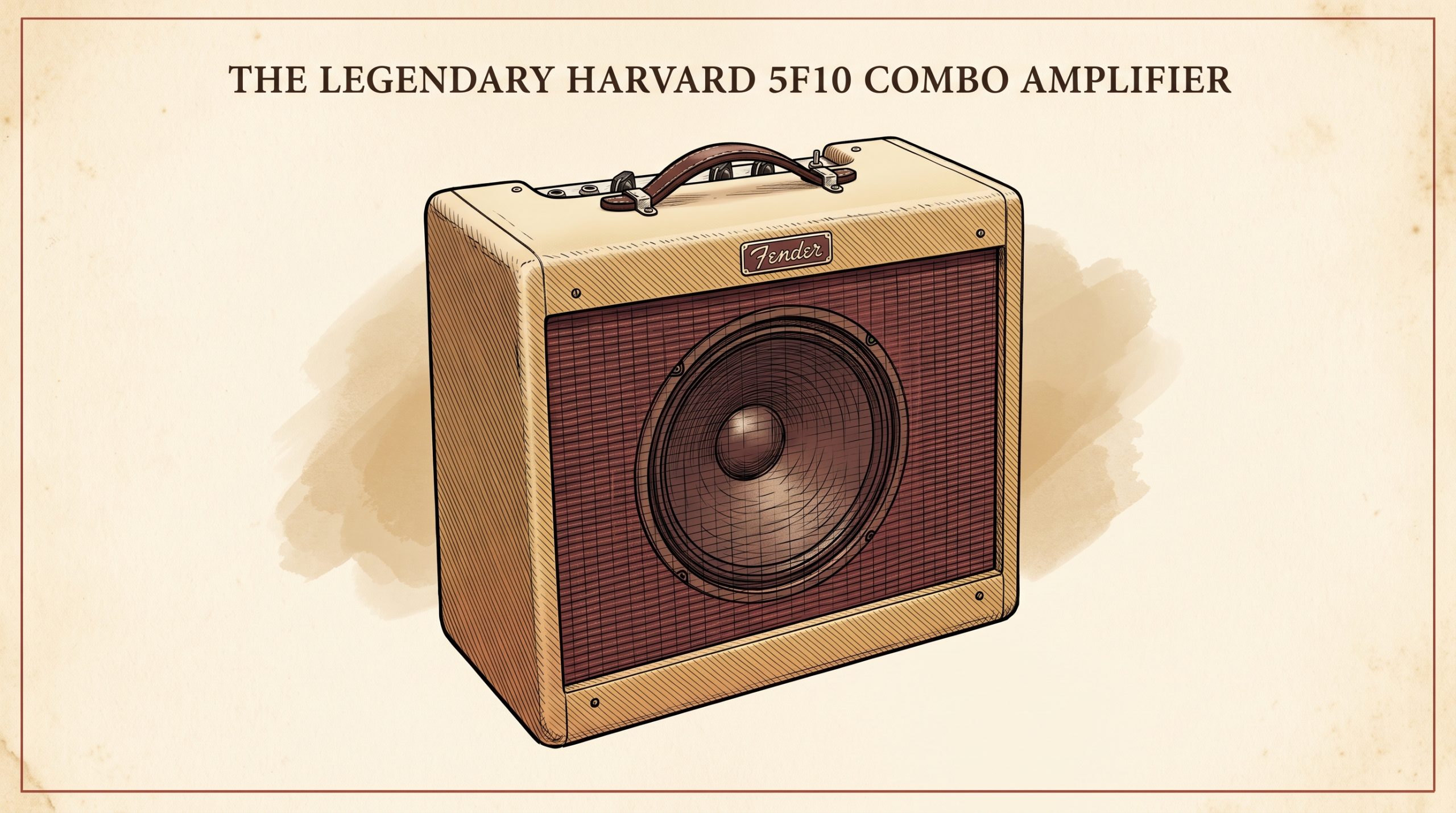
Fender introduced the Harvard in 1955 as part of the narrow-panel tweed lineup refresh that also established the Tremolux and Bandmaster in their familiar form. The Harvard ran through two circuit revisions: the 5F10 from 1955 to 1961, followed by the 6G10 from 1962 to 1963. Fender discontinued it entirely in 1963 as the blackface era arrived, and it never returned in original tweed form. No Fender Custom Shop reissue. No vintage reissue series entry. Gone.
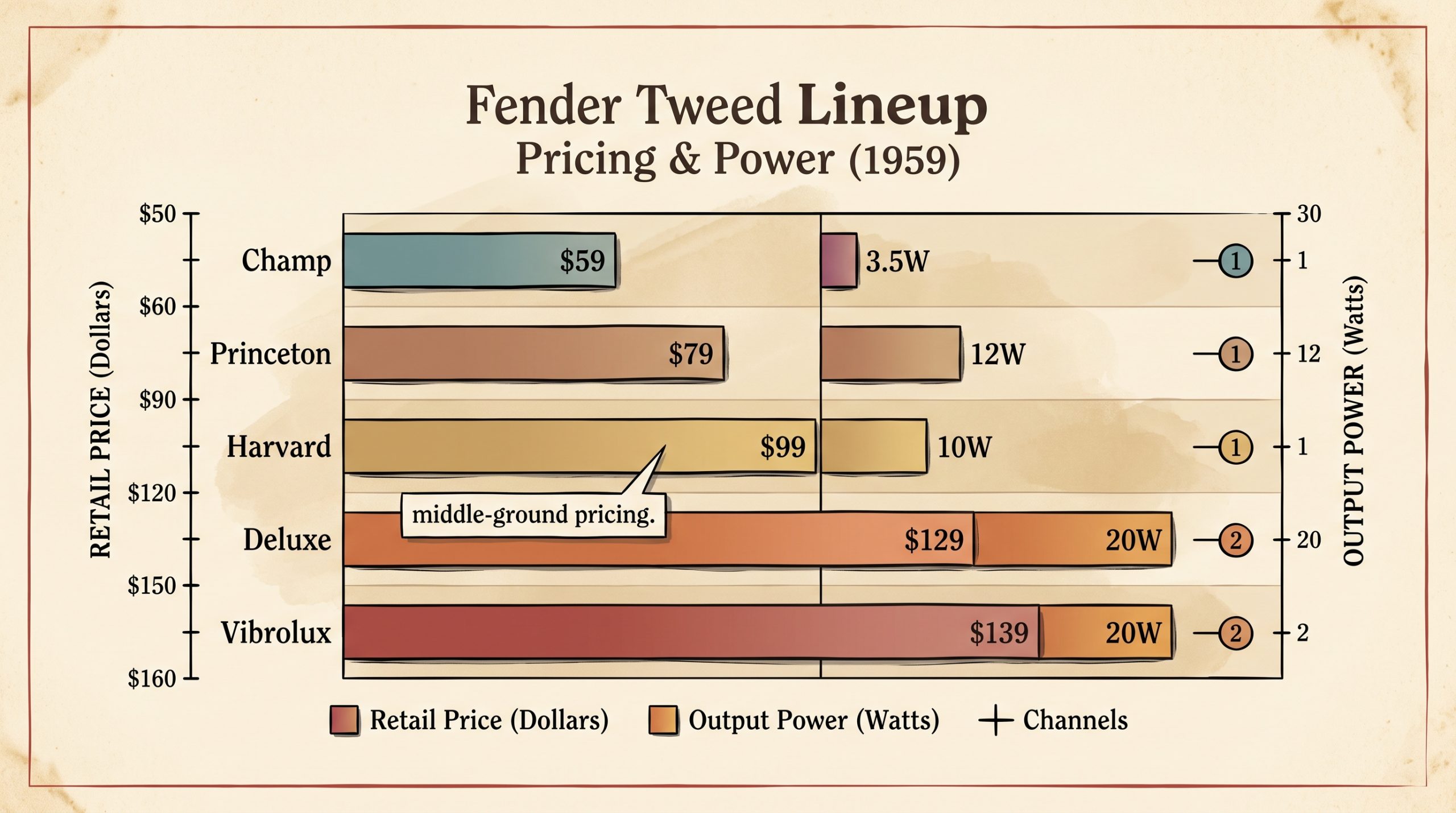
Total production numbers were modest compared to the Princeton and Deluxe, the Harvard’s positioning in the lineup worked against it commercially. At $99, it cost more than a Champ and a Princeton but less than the Deluxe, and buyers either went smaller to save money or stretched to the Deluxe for more power and two channels. That middle-ground pricing kept sales relatively low, which now translates directly into scarcity and collector value.
The 1959 retail price ladder, as documented in period Fender catalogs and cited by Dave Hunter at Vintage Guitar Magazine, placed it exactly here: Champ at $59, Princeton at $79, Harvard at $99, Deluxe at $129, Vibrolux at $139.
Where It Fits in the Tweed Family
The Harvard isn’t a small Deluxe. It isn’t a big Princeton. Its circuit topology is its own thing, sharing more DNA with the later brown and blackface Princeton circuits than with the 5E3 Deluxe. One useful way to think about it: the Harvard is roughly a Vibrolux without the tremolo circuit, running the same phase-inverter topology and similar output stage in a slightly smaller box. For anyone researching the full tweed era lineup, the Tweed Fender Amps identification and value guide covers how the Harvard fits into the broader narrow-panel production sequence alongside the Tremolux, Bandmaster, and Super.
It’s a single-channel amp with volume and a treble-cut tone control. That’s it. No second channel to muddy the decision-making, no effects to route around. Players who want to understand what a fixed-bias 6V6 pair sounds like at 10 watts through a 10-inch Jensen, this is the reference point.
Fender Harvard Specs and Circuit Breakdown
5F10 Circuit (1955–1961): Core Specifications
| Spec | 5F10 Harvard |
|---|---|
| Circuit Number | 5F10 |
| Production Years | 1955–1961 |
| Output Power | Approximately 10 watts RMS |
| Output Tubes | 2 × 6V6GT |
| Bias Type | Fixed bias, non-adjustable |
| Rectifier | 5Y3GT (main B+) + selenium rectifier (bias supply) |
| Preamp Tube | 6AT6 (or 6AV6) |
| Phase Inverter | Split-load (cathodyne) with driver stage — both triode sections of a 12AX7 |
| Speaker | 1 × 10″ Jensen P10R, 8 ohms |
| Controls | Volume, Tone (treble-cut) |
| Channels | Single, three inputs |
| Cabinet Dimensions | 16½″ × 18″ × 8¾″ |
| Cabinet Covering | Tweed (olive stripe) |
| Grillcloth | Oxblood with gold stripe |
| Handle | Flat brown leather |
| Knobs | Black chicken head |
| Logo | Cabinet-mounted script |
6G10 Circuit (1962–1963): What Changed?
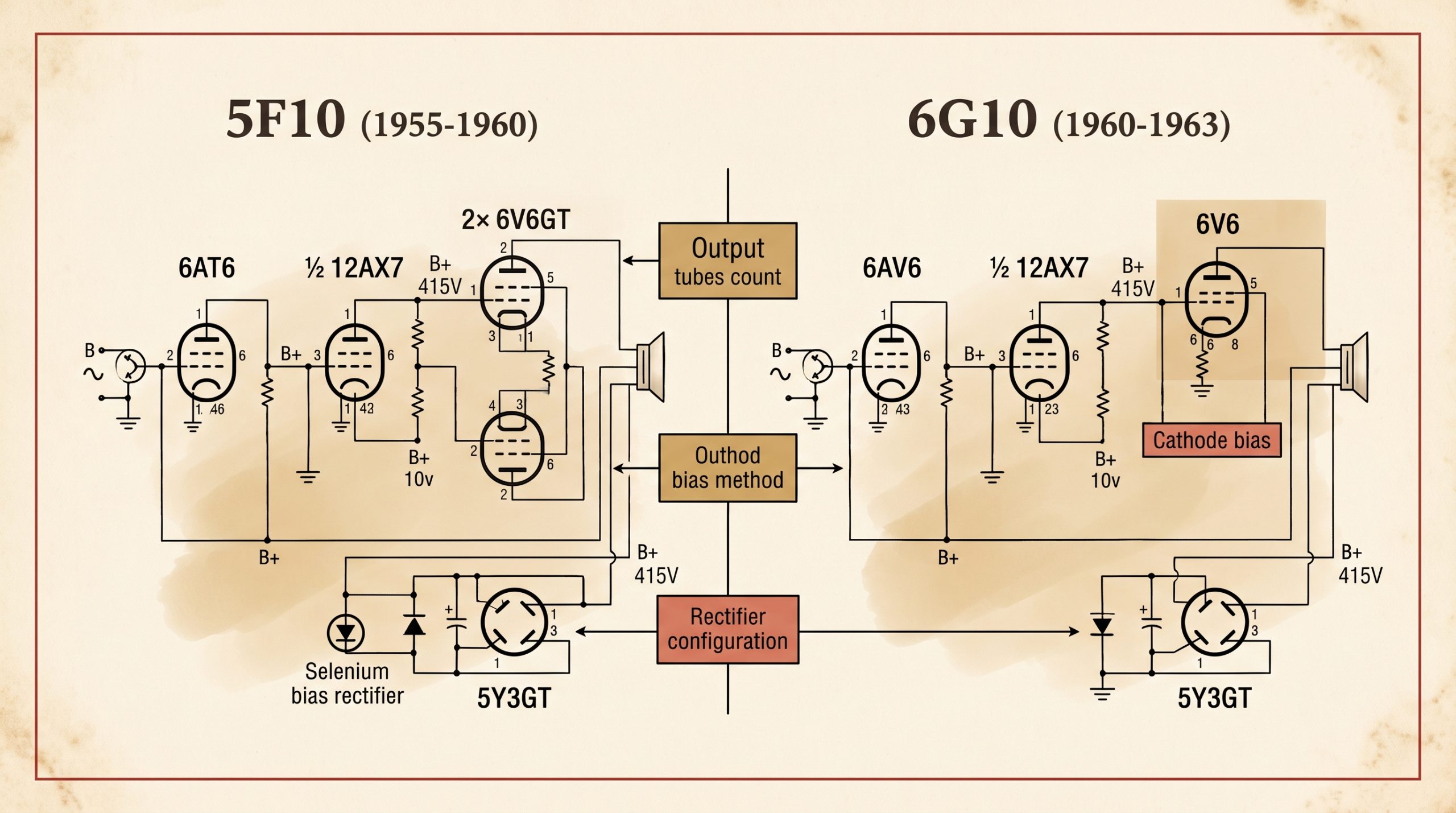
The 6G10 revision shifted the output stage from fixed bias to cathode bias and reduced the output tube count to a single 6V6 in most documented examples. As documented in the Mojotone Fender Field Guide entry for the Harvard, the 5F10 runs two 6V6GTs at fixed bias while the 6G10 uses cathode bias. That’s a meaningful tonal shift: cathode bias introduces more natural compression, a slightly softer attack, and more sag at high volumes. The 5F10’s fixed-bias configuration stays tighter and punchier throughout the volume range. The 6G10 was produced only in 1962 and 1963, in small numbers, and some examples were built from leftover Princeton 5F2-A chassis and cabinet stock — one reason it’s regarded as the rarest of Fender’s production tweed amps. That Princeton-chassis origin isn’t just cosmetic: the factory 6G10 schematic shows the 6AT6/6AV6 preamp tube dropped entirely, with a single 12AX7 handling both preamp gain stages ahead of the lone 6V6GT — the same signal path as the Princeton 5F2-A, not simply a bias-and-tube-count trim on the 5F10 circuit.
Preamp Circuit Deep Dive
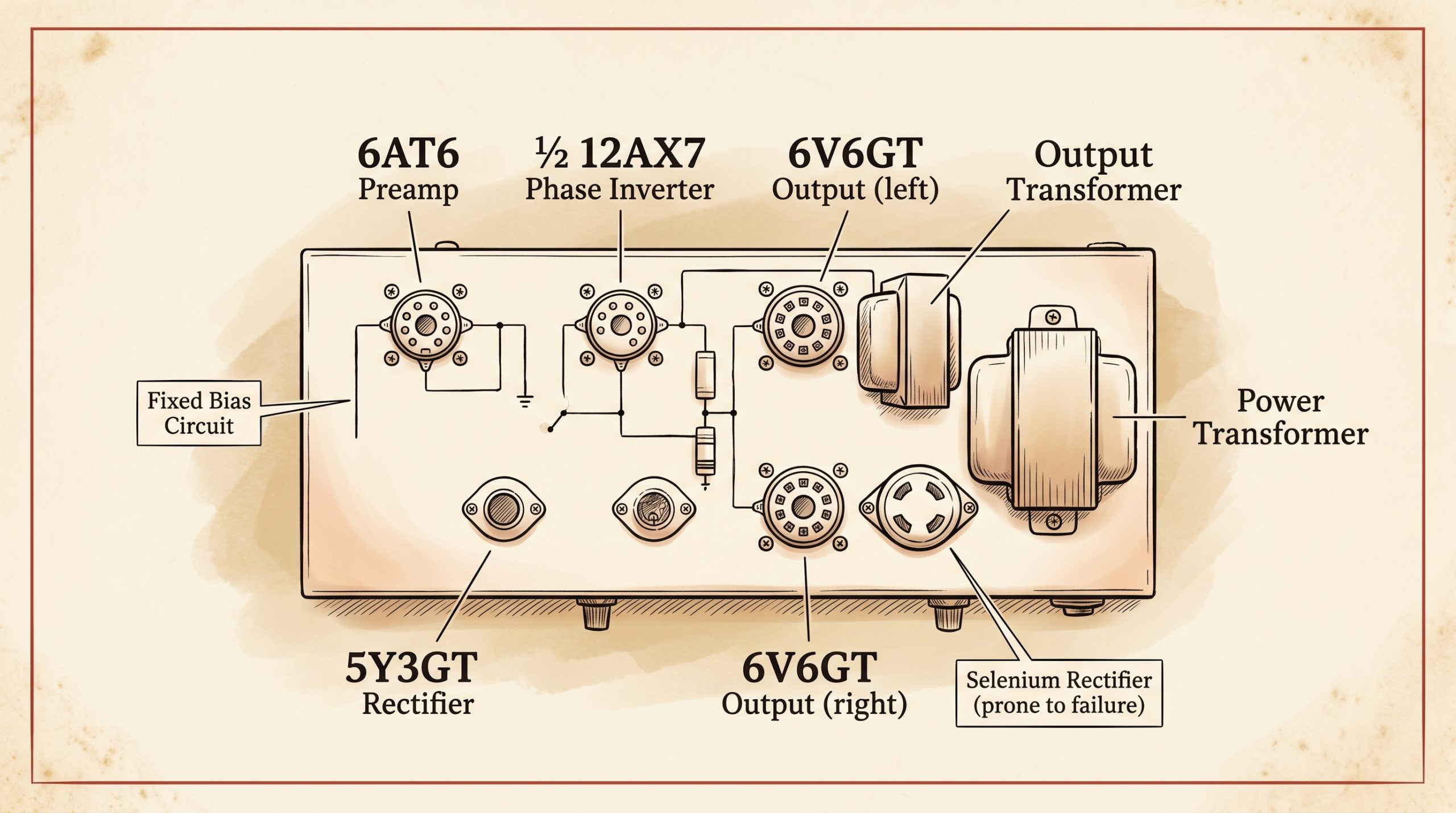
The 5F10 uses a single gain stage feeding into the phase inverter, which makes it simpler than the 5E3 Deluxe’s two-stage preamp. That gain stage uses a 6AT6 (or its functional equivalent, the 6AV6), a single-triode tube, rather than the 12AY7 used in the Deluxe. The 6AT6 runs lower gain than the 12AY7, which shifts the Harvard toward cleaner headroom before overdrive kicks in.
From there, the signal goes into a 12AX7 — both triode sections are used, one as a driver stage and the other as the split-load cathodyne inverter itself — the same split-load cathodyne phase inverter topology that Dave Hunter at Vintage Guitar Magazine describes as used by “everything shy of the Bassman and high-powered Twin” in the narrow-panel era. This shared driver-plus-cathodyne topology also appears in the Tremolux, Bandmaster, and Super of the same period. This is what makes the Harvard fundamentally distinct from the Princeton, which is a single-ended (Class A, one 6V6) design with no phase inverter stage at all — not merely a simpler push-pull variant.
One important discrepancy to flag: Vintage Guitar Magazine’s 5F10 spec listing calls out a “6T6” as the initial preamp tube. Mojotone’s field guide lists “6AV6 or 6AT6.” These are not the same tube. The 6AT6 and 6AV6 are functionally equivalent single-triode tubes and can be treated as direct substitutes. The 6T6, by contrast, is a beam-power pentode, a completely different device. The Mojotone listing aligns with original Fender service documentation; the “6T6” reference in Vintage Guitar appears to be a misidentification or a transcription error. If you’re sourcing a replacement preamp tube for a 5F10, use a 6AT6 or 6AV6, not a 6T6.
For more on how the 6V6GT output tubes contribute to the Harvard’s character at different bias points, the 6V6 tube guide covers the relevant plate dissipation specs and tonal implications of fixed versus cathode bias in Fender circuits.
The Selenium Bias Rectifier: A Noteworthy Detail
The 5F10 used a selenium rectifier in the bias supply circuit, not in the main B+ path. The 5Y3GT tube handles the main plate voltage rectification. The selenium rectifier’s job in this context is providing the negative bias voltage for the fixed-bias output stage. Selenium rectifiers were common in mid-1950s designs but they degrade over time, particularly when stored for extended periods. A failed selenium rectifier in the bias circuit can push the output tubes out of correct bias range, either running them too hot (shortened tube life, potential for output transformer damage) or too cold (thin tone, loss of output). The characteristic sign of a degrading selenium unit is a sulfurous smell when the amp is powered up.
Modern restoration practice replaces the selenium rectifier with a silicon diode plus a small dropping resistor (typically 47–100 ohms) to approximate the original voltage drop, since silicon diodes have lower forward voltage than selenium stacks. Before buying any original 5F10, confirm the selenium rectifier’s status or replacement history with the selling tech.
Fender Harvard Tone and Playing Feel
What Does the Harvard Sound Like?
Ten watts through a Jensen P10R is more useful than it sounds on paper. It’s loud enough to hold its own in a small rehearsal room, controlled enough to mic in a recording context without blowing the session. The Harvard’s clean headroom sits between the Princeton and the Deluxe, it breaks up later than a single-6V6 Princeton, earlier than a 15-watt cathode-biased Deluxe. The 5Y3GT rectifier contributes sag at higher volumes, and the fixed-bias output stage keeps the low end stiff. Spanky attack, tight bass response, and a top end that doesn’t thin out as the volume climbs. Community documentation on The Gear Page confirms the character: “A Harvard has more spank and stays tighter as you increase volume. It certainly will break up as you increase the gain, though.”
The tone control is a treble-cut design, interactive with volume. At lower settings it rolls off the top end noticeably. Run it fully clockwise (wide open) with the volume at three-quarters and the Harvard produces that spanky, glassy clean tone that single-coil players reach for. Roll back the tone knob and the character warms up considerably without going muddy. P-90s respond well to this circuit. Humbuckers work, but the high-end roll-off of the tone stack combined with a humbucker’s reduced treble output can make things darker than intended at lower tone settings.
Harvard vs. Princeton vs. Deluxe: Tone Comparison
| Characteristic | Harvard 5F10 | Princeton 5F2-A | Deluxe 5E3 |
|---|---|---|---|
| Output Power | Approx. 10W | Approx. 4.5W | Approx. 15W |
| Output Tubes | 2 × 6V6GT | 1 × 6V6GT | 2 × 6V6GT |
| Bias Type | Fixed | Cathode | Cathode |
| Phase Inverter | Cathodyne (split-load) | N/A (single-ended, no PI stage) | Cathodyne |
| Speaker | 10″ Jensen P10R | 8″ Jensen | 12″ Jensen P12R |
| Channels | 1 | 1 | 2 |
| Tremolo | No | No | No |
| Approx. Breakup | Medium-high volume | Low-medium volume | Medium volume |
| Clean Headroom | High (for size) | Low | Medium |
| Low-End Character | Stiff, punchy | Soft, compressed | Loose, bloomy |
Why the Harvard Stayed Tight
Fixed bias in the 5F10 is the defining characteristic. Cathode-biased amps like the 5E3 Deluxe generate their bias voltage internally via a shared cathode resistor, which means the output tubes react dynamically to the signal, producing that spongy compression and bloom that players associate with tweed Deluxe breakup. The Harvard’s fixed-bias circuit keeps the output stage operating at a set quiescent point regardless of signal level. Less bloom. More punch. The low end stays stiff even when pushed hard.
Compared to the Vibrolux (which it’s frequently discussed alongside), the Harvard is punchier and tighter at stage volumes. The Vibrolux adds tremolo and slightly different topology; the Harvard trades that for a more direct, punchy response. For anyone wanting a direct comparison against the 5E3, the 5E3 Tweed Deluxe guide covers the cathodyne PI topology in detail, which the Harvard shares while arriving at a different result through its bias configuration.
Identifying and Dating a Fender Harvard
Visual Identification Cues by Era
Both the 5F10 and 6G10 share the narrow-panel tweed cabinet format: tweed olive stripe covering, oxblood grillcloth with gold stripe, top-mounted control panel, black chicken head knobs, and a cabinet-mounted script logo (not panel-mounted). The flat brown leather handle distinguishes it from later strap-handle designs. Three inputs on the panel, two bright, one normal. Controls are Volume and Tone only. No other knobs.
The cabinet-mounted script logo is a useful identification point. If the logo is on the cabinet face (not on the control panel), that’s correct for the Harvard. Any panel-mounted logo points to cosmetic modification or a different model entirely.
Date Code References
EIA speaker codes on the original Jensen P10R follow the format 220-YYWW (Jensen’s EIA code is 220). A code reading 220-842 translates to Jensen, 1958, week 42. Transformer EIA codes follow the same logic, Triad and Schumacher codes are commonly found on Harvard transformers from this period. Tube date codes on original 6V6GT, 5Y3GT, and 6AT6 production tubes from RCA, GE, and Sylvania typically appear as a three-character code stamped on the tube base or printed on the label.
Chassis serial number ranges and the tube chart inside the cabinet back are the primary dating references. The tube chart location (inside the rear cabinet panel) often carries a date code in letter-number format: the letter indicates the month (A = January, B = February, and so on) and the number indicates the year. An “HF” code, for example, indicates June of 1958, consistent with a late-period 5F10. For a full breakdown of Fender EIA date code methodology across all tweed-era models, the Fender tube amp serial number and dating reference covers the complete system.
Common Originality Red Flags
Replaced selenium bias rectifier is the most common modification and not necessarily a negative, it’s actually the correct restoration step. The concern is whether it was done properly with an appropriate dropping resistor. A raw silicon diode substitution without the resistor will shift the bias voltage and may require re-biasing the output stage. Re-coned or replaced Jensen P10R speakers are frequent. Check the cone stamp: original Jensen P10Rs carry a date code stamped on the cone perimeter. Non-original output transformers affect value significantly; verify EIA codes against known Triad/Schumacher transformer date ranges. Re-tweed jobs are identifiable by uniformly fresh-looking tweed without the characteristic oxidation and wear patterns that develop over six-plus decades of aging.
The Fender Harvard Schematic: Understanding the Circuit
Where to Find the Harvard Schematic
Mojotone hosts both the Harvard 5F10 and Harvard 6G10 schematics through their Fender Field Guide resource, a reliable starting point for tech reference. The Mojotone Harvard field guide page links both schematic PDFs directly. Schematicheaven.net also hosts the 5F10 schematic as part of its Fender archive, searchable by model number. Always cross-reference both sources, since scan quality varies.
Key Circuit Nodes to Know
Expected B+ voltage on a properly functioning 5F10 runs approximately 300–330V at the output tube plates. The fixed bias supply should deliver approximately -35V to -38V to the 6V6GT grids (per the factory schematic and real-world builds, both of which measure in this range), depending on the specific tubes installed and the condition of the selenium rectifier (or its replacement). Grid resistors on the 6V6GTs are typically 220k ohms per the original schematic. The cathodyne PI uses matched resistors on the plate and cathode legs, imbalance here affects output power and tone. The tone stack is a single capacitor and resistor network acting as a treble-cut filter; its relatively simple topology means component aging has an outsized effect on the frequency response.
For Amp Techs: Common Failure Points
The selenium rectifier in the bias supply is always the first checkpoint. Always. Replace with a 1N4007 silicon diode plus a 47-ohm to 100-ohm dropping resistor, measure the resulting bias voltage and set output tube bias appropriately. Power supply electrolytic capacitors are standard service items on any amp of this age. The 6AT6 preamp tube (5F10 only — the 6G10 has no separate preamp tube socket) is less common on the used market than a 12AX7 but remains available; the 6AV6 is a direct functional substitute if 6AT6 stock is limited. Output transformer spec for the 5F10 is approximately 8k ohms primary to 8-ohm secondary, verify against the schematic before sourcing a replacement. Not great to source generic transformers here; spec-matched replacements from Mojotone or Mercury Magnetics preserve the original tone character.
Fender Harvard Clones and Modern Alternatives
Why Build or Buy a Harvard Clone?
Original 5F10s command $2,000–$4,000+ for all-original examples. Player-grade or modified units run from $1,200. That pricing puts the circuit out of reach for many players who want the tonal character without the collector-market premium. The clone market addresses this directly, and the Harvard’s straightforward circuit makes it approachable for intermediate-level amp builders.
Notable Harvard Clone Builders and Kits
Mojotone supplies turret board kits, component sets, and transformers spec’d for both the 5F10 and 6G10 circuits. Turret board construction is the historically accurate approach and generally preferred by builders who want component layout to match the original. PCB clone approaches exist but vary in their fidelity to the original circuit’s spatial layout. Key spec markers for a faithful 5F10 clone: fixed bias output stage, 6AT6 or 6AV6 preamp tube, cathodyne phase inverter, 5Y3 rectifier, and a Jensen P10R or equivalent 10-inch speaker. Any of those substitutions shifts the character away from the original.
Closest Production Alternatives (No Clone Required)
The brown Princeton 6G2 is the most frequently cited alternative, including in the r/GuitarAmps community, which notes directly that “the closest amp to the tweed Harvard/Vibrolux is the brown Princeton 6G2 circuit.” The 6G2 shares topological DNA with the Harvard’s later development direction. The Victoria Amps 518 is a Harvard-inspired circuit from a builder with a strong reputation for tweed accuracy. The Fender Blues Junior sits at a similar wattage and speaker size point but uses a completely different topology (EL84 output tubes, PCB construction) and doesn’t replicate the fixed-bias 6V6 character. Worth considering for players who want bedroom-friendly volume in a small combo, but it’s a different amp. The Fender Vibrolux guide is useful context here, since the Harvard and Vibrolux are the two narrow-panel tweed amps most frequently compared, and most frequently confused.
The Fender Harvard Reverb II: A Different Animal
What Is the Fender Harvard Reverb II?
The Fender Harvard Reverb II (also called the Harvard Reverb 2) is not a tweed-era amplifier. Not even close. It’s a mid-1980s solid-state design from Fender’s “II Series” lineup, a product line that included the Champ II, Princeton Reverb II, and several other models that carried familiar names into entirely different circuit territory. The Harvard Reverb II shares only a name with the 5F10 and 6G10. No tube output stage, no fixed-bias 6V6s, no cathodyne phase inverter. Solid state throughout.
If you’re searching for a Fender Harvard Reverb or Fender Harvard Reverb 2 and expecting the tweed circuit, you’re looking at a completely different product. Buyers on used-amp marketplaces occasionally list Harvard Reverb II units as “vintage Fender Harvard amps.” They’re not the same thing, and the price difference between an original 5F10 and a used Harvard Reverb II reflects that gap correctly.
Harvard Reverb II Specs at a Glance
The Harvard Reverb II was produced in the mid-1980s as part of the II Series, ran solid-state circuitry with built-in reverb, and was positioned as an affordable practice/small gig amp in the era when Fender was producing largely solid-state lineups. Current used market values for the Harvard Reverb II run well under $300 for working examples, a fraction of tweed Harvard pricing. Players seeking the II Series for budget practice use will find it functional. Players seeking the tweed circuit’s tonal character won’t find it here.
Buying a Fender Harvard Today: Market Guide
Pricing data below reflects the 2024–2025 used market. Vintage amp values fluctuate; treat these as reference ranges rather than fixed figures.
Current Market Values (5F10 and 6G10)
| Condition | Circuit | Approximate Price Range |
|---|---|---|
| All-original, fully working | 5F10 | $2,000–$4,000+ |
| Player grade / some mods | 5F10 | $1,200–$2,000 |
| All-original, fully working | 6G10 | $1,500–$3,000 |
| Player grade / some mods | 6G10 | $900–$1,500 |
| Project / non-working | Either | $600–$1,000 |
Factors that push prices toward the top of those ranges: original Jensen P10R with verifiable date code, original output and power transformers with matching EIA codes, original tweed with natural aging (not a re-tweed job), original tubes (even if non-functional), and documented professional service history including proper selenium rectifier replacement.
What to Check Before Buying
Confirm the circuit version by comparing the physical layout against the 5F10 or 6G10 schematic before paying. EIA codes on the speaker and transformers should align with known production dates for the circuit version being sold. Selenium rectifier status is critical: ask the seller directly whether it’s been replaced and whether a dropping resistor was used. If unknown, budget for a proper service before the first power-up.
Test the amp at both bedroom volume and pushed into early breakup if possible. An original 5F10 in correct operating condition produces that spanky, tight clean tone at lower volumes and transitions predictably into overdrive as you climb the volume knob. Anything that sounds ragged, thin, or uneven at low volumes before the amp is pushed warrants investigation before purchase.
The Harvard’s Legacy: Why It Matters Now
The home-recording and low-watt amp revival of the last two decades has caught up to what the Harvard always was. Ten watts into a 10-inch speaker is close to ideal for mic’d studio work: enough output to develop tube and speaker character, controlled enough to dial in at reasonable levels without sacrificing tone. The fixed-bias 6V6 pair at this scale is a configuration that current Fender production doesn’t replicate in any reissue model. The Princeton Reverb Reissue runs cathode bias. The Blues Junior uses EL84s. The Vibro Champ is 5 watts, single-ended. The Harvard’s specific combination, fixed bias, push-pull 6V6 pair, cathodyne PI, 10-inch Jensen, exists only in original production examples and in faithful clones built specifically to that spec.
A Fender Harvard reissue would make commercial sense given current market appetite for small, recording-friendly tube amps. Fender hasn’t done it, which means the original production run remains the only factory source. For players who want that tonal character without the collector-market pricing, the DIY clone route via Mojotone components or a reputable boutique builder is the practical path. For players who want the real thing, verifying originality carefully before purchase, particularly the speaker, transformers, and bias rectifier history, is the work that protects both the investment and the tone.
Frequently asked questions
How many watts is a Fender Harvard?
The Fender Harvard produces approximately 10 watts RMS from its two 6V6GT output tubes in the 5F10 circuit configuration. The 6G10 revision runs cathode bias with a single 6V6 and outputs slightly less. Both circuits sit between the Princeton (approximately 4.5 watts) and the Deluxe (approximately 15 watts) in output level.
What is the difference between the Fender Harvard and the Fender Deluxe?
Both use 6V6GT output tubes, but the Harvard 5F10 runs fixed bias for a tighter, punchier response while the 5E3 Deluxe uses cathode bias for softer, more compressed breakup. The Deluxe uses a 12-inch speaker and two channels; the Harvard uses a 10-inch Jensen P10R and a single channel. Output power is approximately 15 watts for the Deluxe versus 10 for the Harvard. The cathodyne phase inverter is shared, but the preamp gain staging differs: the Harvard uses a single-triode 6AT6 where the Deluxe uses a 12AY7.
What is a Fender Harvard worth today?
All-original, unmodified Fender Harvard 5F10 combos with original Jensen P10R speakers and transformers typically sell in the $2,000–$4,000+ range depending on condition and originality verification. Player-grade examples with modifications or replaced components are available from approximately $1,200. The 6G10 circuit commands slightly lower prices than the 5F10 in equivalent condition. Pricing fluctuates with the vintage amp market; verify recent sold listings on Reverb before making an offer.
What is the difference between the Fender Harvard 5F10 and 6G10?
The 5F10 (1955–1961) uses two 6V6GT output tubes at fixed bias, with a selenium rectifier in the bias supply circuit and a separate 6AT6/6AV6 preamp tube ahead of the 12AX7. The 6G10 (1962–1963) transitions to cathode bias with a single 6V6, removing the selenium rectifier from the bias path and dropping the separate preamp tube — its single 12AX7 does the entire preamp job, essentially the same signal path as the Princeton 5F2-A chassis it was built from. Tonally, the 5F10 is tighter and punchier with stiffer bass response; the 6G10 produces softer compression and more sag at volume. Collectors generally favor the 5F10 for its unique fixed-bias character, which no current production Fender reissue replicates.
Is the Fender Harvard Reverb II the same as the original Harvard?
No. The Fender Harvard Reverb II (also called the Harvard Reverb 2) is a mid-1980s solid-state amplifier with reverb, part of Fender's II Series lineup. It shares only the name with the original 1955–1963 tweed Harvard. It has no circuit lineage, no tube output stage, and no tonal relationship to the 5F10 or 6G10. Used market values for the Harvard Reverb II are a fraction of original tweed Harvard pricing.