Contents
- 01What Is the EL84 Tube? History, Origin, and Manufacturer Background
- 02EL84 Datasheet Specs: The Numbers That Define the Tone
- 03Class-A Operation: Why the EL84 Sounds the Way It Does
- 04The Best EL84 Tubes: Brand-by-Brand Reviews
- 05EL84 Amps: Which Amplifiers Use This Tube?
- 06Biasing EL84 Tubes: What Technicians and DIYers Need to Know
- 07FAQ: EL84 Tubes
- 08Where to Buy EL84 Tubes and What to Look For
- 09The Short Version
Most players assume EL84 power tubes belong exclusively to British amps. That’s only half right. The tube powered the Vox AC30 through the British Invasion, yes, but it also ended up in Fender’s Pro Junior starting in 1993 and the Blues Junior shortly after. Two very different amp philosophies, same output tube. The reason comes down to the EL84’s particular electrical character: a low plate dissipation rating that pushes into saturation early, producing the compressed, chimey, harmonically rich quality that makes Class-A single-ended and push-pull circuits feel alive in a way a pair of 6L6s in Class AB simply doesn’t replicate.
This guide covers everything from exact datasheet specs and pinout to brand-by-brand reviews, bias targets for common EL84 amps, and the one question most competitor guides skip entirely: why does this tube sound the way it does?
- Type: 9-pin (Noval/B9A) power pentode, European designation
- American equivalent: 6BQ5 (RETMA), direct substitute, identical electrically
- Max plate voltage: 300V (standard EL84); 400V for 7189/7189A variants
- Max plate dissipation: 12W (7189A: 13.2W)
- Heater: 6.3V at 760 mA
- Common operation: Class A, single-ended (~5.7W) or push-pull Class A/AB (~17W)
- NOS Mullard, Amperex, Telefunken pricing: $150–$230+ per tube (2026 market)
- Vox AC30 runs plates at ~340V, above standard EL84 spec; tube selection matters
- Cathode-biased EL84 amps (Pro Junior, AC30 reissues) do NOT require bias adjustment after retubing with matched pairs, no tech visit needed
- EL84 and 6BQ5 are the same tube with different naming conventions, not different designs
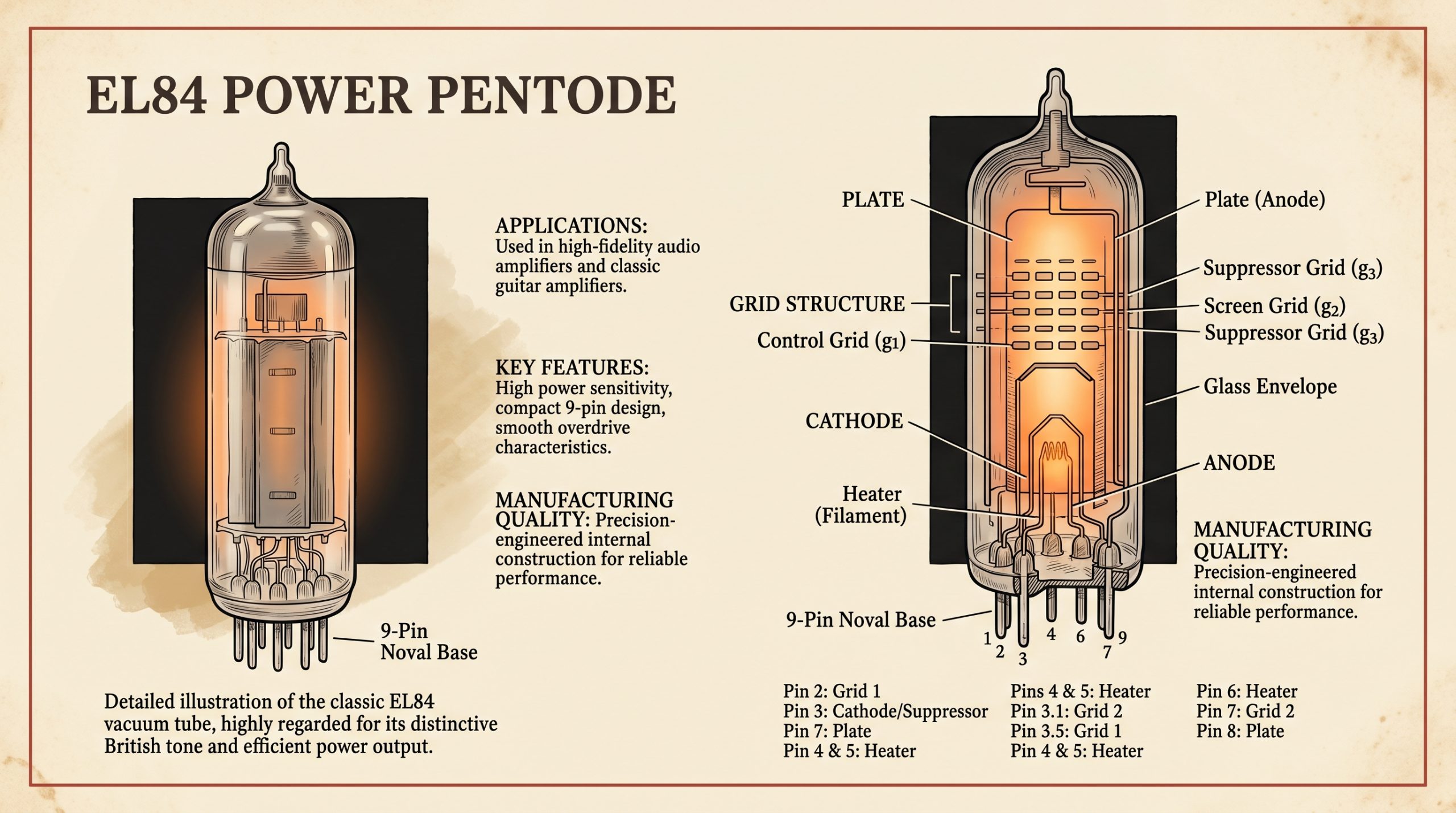
What Is the EL84 Tube? History, Origin, and Manufacturer Background
Development in the Early 1950s
Philips and its UK subsidiary Mullard jointly developed the EL84 vacuum tube, with the earliest datasheet records dating to November 1953 (confirmed in the archived Philips/Mullard tube data documentation). The design goal was practical: produce a compact, cost-effective power pentode on the 9-pin Noval base that could replace larger, more expensive octal output tubes like the 6L6 and EL34 in consumer audio equipment. The “EL” designation follows the European IEC system for output pentodes; it doesn’t stand for a specific manufacturer or factory.
Early adoption came through hi-fi manufacturers. Dynaco, Eico, and Fisher all built integrated amplifiers around the EL84 vacuum tube in the mid-to-late 1950s. Then Vox entered the picture. The AC15 (1958) and the redesigned AC30 (1960, now with four EL84s replacing the original EL34-powered 1959 version) put the EL84 in front of millions of listeners, permanently bonding the tube’s compressed, harmonically saturated character to the sound of British amplification. By the time the Beatles toured America in 1964, those AC30s running four EL84 power tubes per amp were carrying the defining guitar tones of a generation.
Fender didn’t adopt the EL84 until 1993, when the Pro Junior was introduced. The choice wasn’t accidental. The tube’s natural compression and warm Class-A character suited a small, affordable combo with a modest chassis. Not the Fender formula. But it worked. The Blues Junior followed, also running EL84 power tubes, and both remain in production today.
The American Equivalent: 6BQ5 and 7189
The 6BQ5 is the RETMA-system designation for the same tube. Electrically identical to the EL84, it simply reflects American naming conventions and appears in US-manufactured hi-fi gear from the same era. Drop one in where the other was, and nothing changes.
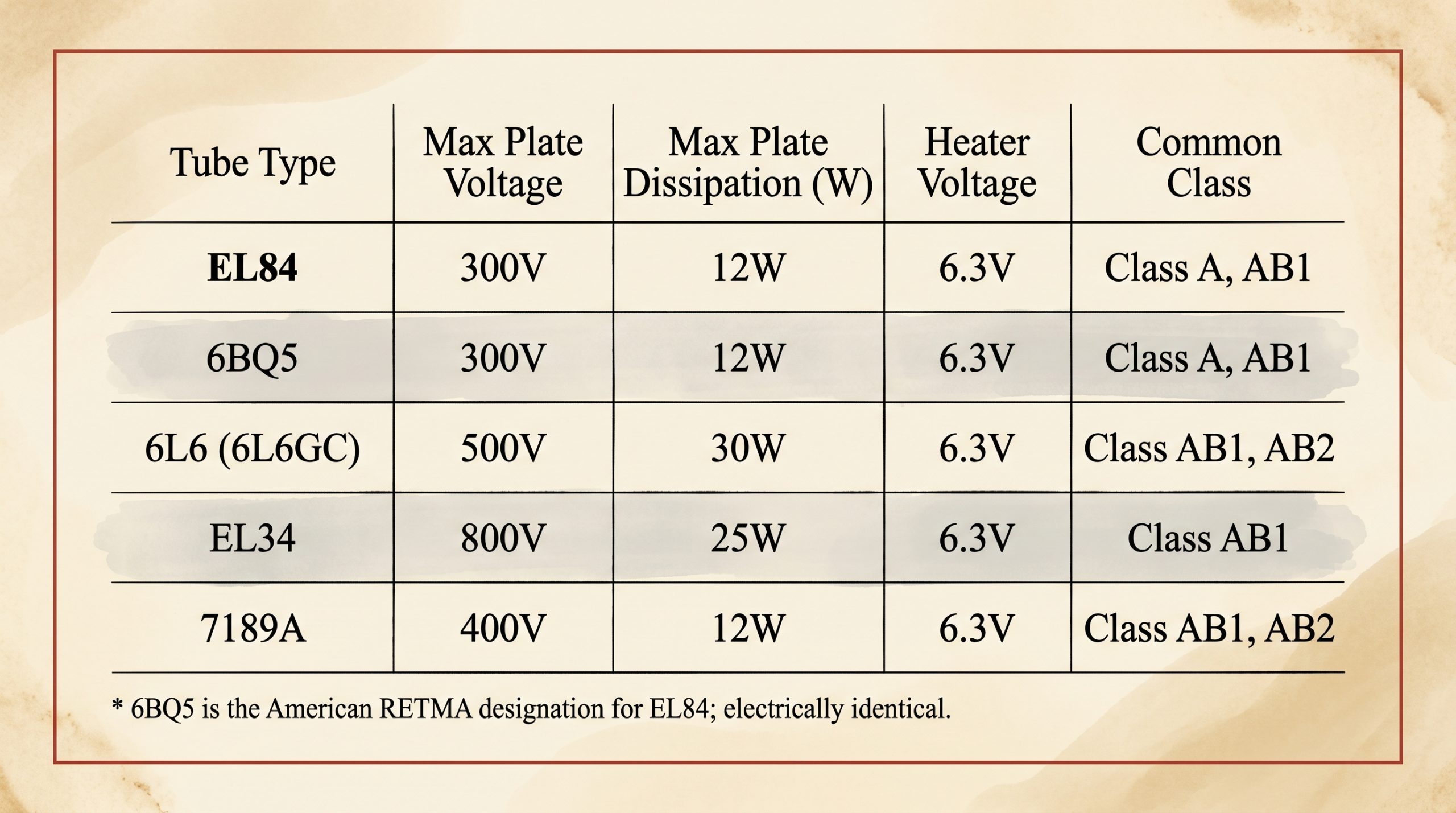
The 7189 is a different matter, though not by much. It shares the same basic circuit behavior but carries a higher plate voltage rating of 400V versus the standard EL84’s 300V ceiling. The 7189A pushes further still, rated at 13.2W plate dissipation rather than 12W. These designations originated in military and industrial specifications requiring more robust operation. For guitar amp use, the 7189 matters most in circuits that run plates above 300V, including the Vox AC30 at its roughly 340V operating point.
Eurotubes has documented that the JJ EL84 tolerates plate voltages up to 400VDC in testing, making it a practical substitute for 7189-rated positions as long as the 12W plate dissipation ceiling is respected.
| Tube Designation | Origin | Max Plate Voltage | Max Plate Dissipation | Notes |
|---|---|---|---|---|
| EL84 | Europe (IEC) | 300V | 12W | Standard designation |
| 6BQ5 | USA (RETMA) | 300V | 12W | Direct equivalent |
| 7189 | USA (mil-spec) | 400V | 12W | Higher voltage rating |
| 7189A | USA (mil-spec) | 400V | 13.2W | Ruggedized variant |
| 6P14P | Soviet Union | 300V | 12W | Russian military equivalent; 6P14P-EV is the ruggedized sub-variant |
EL84 Datasheet Specs: The Numbers That Define the Tone
Key Electrical Specifications
The EL84 tube datasheet from the original Philips/Mullard documentation establishes the following operating parameters. These numbers are worth knowing, not just for reference, but because they explain exactly why the tube behaves the way it does in a guitar circuit.
| Parameter | Value |
|---|---|
| Heater voltage | 6.3V AC/DC |
| Heater current | 760 mA |
| Maximum plate voltage | 300V |
| Maximum screen grid voltage | 300V |
| Maximum plate dissipation | 12W |
| Transconductance (Gm) | ~11.3 mA/V at typical operating point |
| Amplification factor (µ) | ~19–21 |
| Plate resistance (rp) | ~38 kΩ |
| Typical output, Class A, single-ended | ~5.7W |
| Typical output, Class AB, push-pull pair | ~17W |
| Typical anode current (Ia) at 250V | 48 mA |
Premier Guitar’s coverage of power tube characteristics notes that the EL84 typically produces around 6 watts of output while dissipating 12 watts at its rated operating point, which is a relatively low efficiency ratio, and that’s precisely what creates the saturation and spongy compression players love about Class-A EL84 circuits.
The full EL84 datasheet archives at Frank’s Electron Tube Data Sheets include the complete family of operating curves from the original Philips documentation for anyone doing circuit design or restoration work.
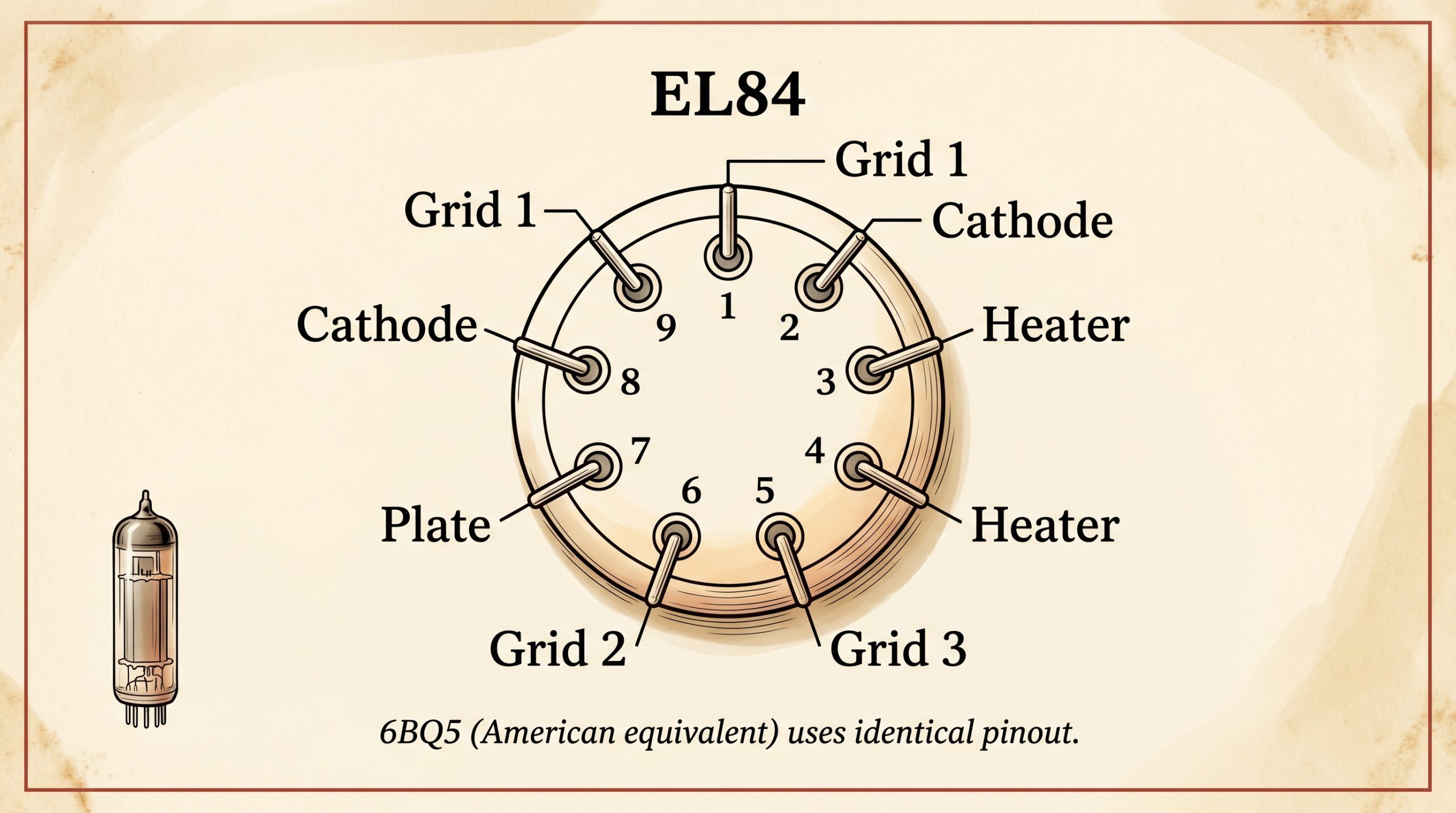
EL84 Pinout: All 9 Pins Labeled
The EL84 uses the Noval (B9A) 9-pin base. This is the same socket family used by 12AX7 preamp tubes, which is why EL84 power stage amps tend to have compact, efficient chassis layouts. Each pin carries a specific function, and knowing the pinout matters if you’re building, repairing, or adapting a circuit.
| Pin | Function |
|---|---|
| 1 | Not connected (internal metal shield in some NOS tubes, Mullard, Amperex) |
| 2 | Heater (6.3V) |
| 3 | Plate (Anode) |
| 4 | Screen Grid (G2) |
| 5 | Control Grid (G1, signal input) |
| 6 | Not connected |
| 7 | Cathode |
| 8 | Heater (6.3V) |
| 9 | Suppressor Grid (G3, internally connected to cathode in most production tubes) |
Pin 1’s connection to an internal metal shield in some NOS Mullard and Amperex examples is worth flagging for hi-fi restoration work, where noise floor matters more than it does in a guitar amp. In most guitar amp applications, pin 1 is simply an open connection and causes no issues either way.
Class-A Operation: Why the EL84 Sounds the Way It Does
Class A vs. Class AB: What Changes in the Circuit
Class A means the output tube conducts current across the entire 360 degrees of the signal cycle. It’s always on. No crossover point. No period where the tube idles below conduction, which means no crossover distortion and a much more linear transfer of the input signal, at least until the tube saturates. Class AB operation, by contrast, has each tube in a push-pull pair conducting slightly more than 180 degrees, enough to avoid the hard crossover notch of true Class B, but not enough to keep both tubes running continuously. More efficient. Less heat. And a different distortion character when the signal gets loud.
The EL84 in a Vox AC30 or Fender Pro Junior runs in true Class A. That operating mode produces predominantly even-order harmonics, second and fourth harmonic content, which listeners and players perceive as warm bloom, musical compression, and a quality that’s often described as the amp “breathing” with the playing dynamics. Compare that directly to 6L6 tubes running Class AB in a Fender Bassman or Twin Reverb, where the character is cleaner, with more headroom and a stiffer bass response before things break up. Neither is wrong. They’re different tools. But the 6L6’s Class AB character and the EL84’s Class A saturation are genuinely distinct sonic experiences rooted in circuit physics, not just tube geometry.
In practical terms, Class A EL84 circuits typically bias the tube at 40–50 mA plate current at roughly 250V for standard operating points, though amps like the AC30 and Pro Junior run the plates somewhat hotter. More on that in the biasing section below.
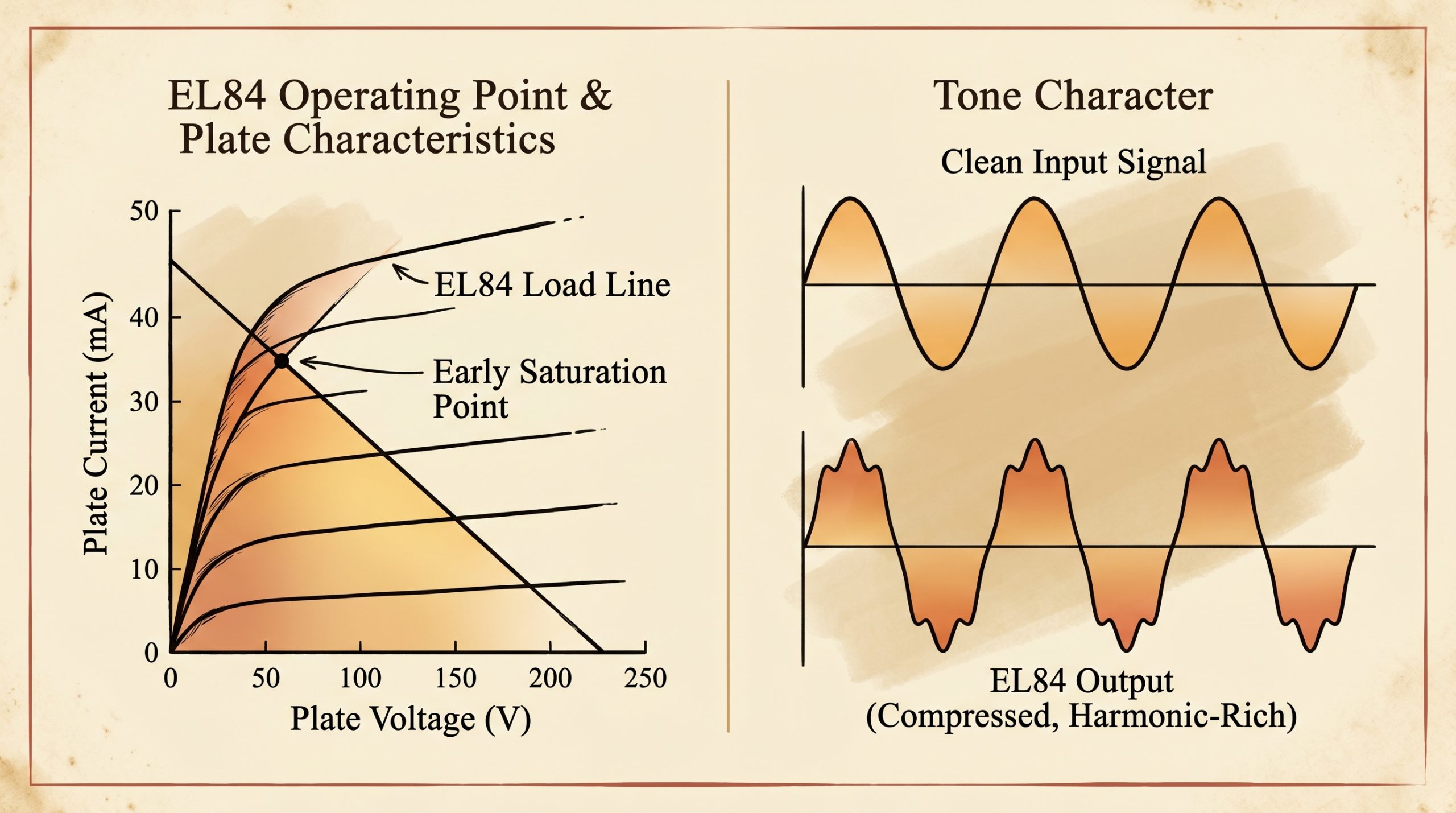
The EL84 and Natural Compression
Here’s the key number: 12 watts maximum plate dissipation. That’s modest. A 6L6GC handles 30W. An EL34 handles 25W. When an EL84 reaches its thermal operating ceiling, it saturates early relative to those larger tubes, and that saturation is the source of the spongy compression and spanky attack that defines the tone. The amp barks when pushed in a way that higher-dissipation tubes simply don’t replicate at equivalent volume levels.
This is why a Vox AC30 feels alive at bedroom-friendly volumes in a way that a 100-watt head doesn’t. Four EL84s at 12W each gives the AC30 a theoretical ceiling of 48W dissipation before any individual tube clips, but in practice the push-pull Class A configuration means each tube is working at capacity well before the amp’s rated 30W output. The result: earlier saturation, more compression, more harmonic content. That’s not a flaw. That’s the design.
The same logic applies to the Fender Pro Junior at roughly 15 watts from two EL84s. As documented in coverage of the Pro Junior’s circuit, the tube complement choice directly shapes the amp’s character, it doesn’t behave like a shrunken Deluxe Reverb. It behaves like a small Class-A EL84 amp, which is its own thing entirely.
The Best EL84 Tubes: Brand-by-Brand Reviews
JJ EL84: Best Overall for Reliability and Tone
Manufactured at the JJ Electronic factory in Čadca, Slovakia, the JJ EL84 has become the standard recommendation for most EL84 guitar amps. The tonal character sits between the Philips and Mullard vintage European references: strong midrange definition, chimey highs that don’t ice-pick, and tight low end that doesn’t get wooly under heavy picking. Eurotubes’ testing places the JJ EL84 tonally in that Philips/Mullard range while testing reliably up to 400VDC on the plates, which makes it suitable for the AC30’s above-spec operating environment.
Mike Zaite of Dr. Z Amplification, as documented on Eurotubes’ product page, describes the JJ EL84 as long-lasting with increased power output, headroom, and “balls” for rock tone. Matching tolerances are tight: plate current matched to ±1 mA and transconductance matched within a consistent window after a 24-hour burn-in. Not many current-production tubes offer that level of factory matching. for push-pull amps where imbalanced tubes create DC offset problems on the output transformer.
Mullard EL84 (Reissue): NOS Tone in a Modern Tube
The original Mullard Blackburn factory EL84 remains the historical benchmark against which every other EL84 is measured. Smooth, warm, vocal midrange. Slightly rolled-off top end compared to the JJ. Second-harmonic content that’s genuinely musical rather than just “soft.” If you’ve heard the phrase “warm clean tones” applied to an EL84 amp, somebody was probably thinking about vintage Mullard character.
The current reissue is manufactured in Russia under Mullard brand licensing. Not the same as original Blackburn production, the bottom end is softer, and the definition is less precise. But it’s consistent, more affordable than NOS examples, and closer to the original character than most alternatives. Best application: classic British crunch tones in AC15 restorations or vintage hi-fi circuits like the Quad II.
Sovtek EL84: Budget Workhorse
The Sovtek EL84, produced at the Saratov (Reflektor) plant in Russia, runs brighter and more forward in the upper midrange than either the JJ or Mullard reissue. Less compression at equivalent drive levels. Runs cooler at idle. Batch-to-batch consistency requires more selective matching. Not a bad tube, just a different one. For budget retubing of a practice amp where cost matters more than tonal nuance, it’s fine.
Worth separating from the 6P14P-EV, which is the Soviet military ruggedized variant. The 6P14P-EV runs harder, produces more headroom, and sags less than a standard Sovtek EL84. Different character. Some players actively seek that extra stiffness; others want more sag. Know which one you’re buying before you order.
Tung-Sol EL84: High Output, Modern Character
New Sensor Corporation’s Tung-Sol EL84 pushes higher output than average and extends the high-frequency response past where the JJ or Mullard reissue tends to roll off. More aggressive breakup. Closer to Marshall-adjacent territory than classic Vox chime. Runs close to the 12W plate dissipation ceiling at rated conditions, caution in hot-biased circuits where the tube doesn’t have much thermal headroom to spare.
Best match: players who want more drive and output from their EL84 amp without changing the fundamental circuit. Not wrong for a Pro Junior that’s being used for rehearsals rather than bedroom practice.
Electro-Harmonix EL84: Balanced and Predictable
Also from New Sensor Corporation. More neutral character than the Tung-Sol, slightly warmer than the Sovtek. Technicians tend to reach for these when they want a predictable baseline: the EH EL84 doesn’t surprise you in any direction. Consistent from batch to batch. If you’re retubing a customer’s amp and want a no-drama result, these deliver. Not the most characterful choice for a boutique build, but reliable.
Gold Lion EL84: Premium Tier
Premium selected and matched production from New Sensor. The Gold Lion EL84 comes closest to NOS British character among current-production options: pronounced harmonic richness, smooth compression response, and a top-end quality that doesn’t get harsh when the amp is pushed. The price reflects the selection and matching process. For players with high-end amps and recording contexts where every nuance matters, the price-per-tube is justified. For a practice amp. Probably not.
| Brand | Origin | Tone Character | Reliability | Price Range | Best For |
|---|---|---|---|---|---|
| JJ EL84 | Slovakia | Mid-focused, chimey, tight bass | Excellent | $$ | All-around, Dr. Z, Pro Junior, AC30 |
| Mullard EL84 (reissue) | Russia | Warm, smooth, vocal mids | Good | $$$ | Vintage British tone, AC15 restoration |
| Sovtek EL84 | Russia | Bright, forward upper mids, less compression | Good | $ | Budget retubing, practice amps |
| Tung-Sol EL84 | Russia | High output, extended highs, aggressive | Good | $$ | Drive-focused players, rehearsal use |
| Electro-Harmonix EL84 | Russia | Neutral, balanced, predictable | Very Good | $$ | Reliable baseline replacement |
| Gold Lion EL84 | Russia (premium selected) | Rich harmonics, NOS-adjacent | Excellent | $$$$ | Boutique amps, recording applications |
EL84 Amps: Which Amplifiers Use This Tube?
Classic British EL84 Amps
The Vox family defines the EL84 amp category. The AC4 runs a single EL84 in a simple single-ended circuit. The AC10 uses a pair in push-pull. The AC15 and AC30 are the benchmark models: the AC15 runs two EL84s, and the AC30 runs four in push-pull Class A, producing approximately 30 watts. Critically, the AC30 operates its EL84 power tubes at roughly 340V on the plates, above the standard 300V maximum spec. This is why tube selection matters specifically for AC30 owners, and why the JJ EL84’s tested 400V tolerance makes it a common recommendation for that circuit.
The Marshall 18-watt model (produced 1965–1968) also uses two EL84s in push-pull and is often overlooked in EL84 discussions dominated by Vox. More aggressive character than a Vox, but still distinctly different from Marshall’s 6CA4/EL34-based larger heads. The Orange Tiny Terror is the modern EL84 classic: 15 watts, cathode biased, compact. A straightforward EL84 tube amplifier that stays true to the format’s strengths.
American EL84 Amps: Fender’s Choices
The Fender Pro Junior, introduced in 1993, runs two EL84 power tubes in push-pull at roughly 330V on the plates, producing approximately 15 watts. Self-biasing (cathode bias) circuit, no bias adjustment needed when swapping matched pairs. The Pro Junior was Fender’s deliberate move toward a compressed, warm Class-A character in a small-chassis combo, departing from the 6V6-based approach of the Princeton and Deluxe series. If you’re retubing a Pro Junior and want to understand how production years affected the circuit, the Fender amp dating reference covers chassis identifiers across the Pro Junior’s production run.
The Fender Blues Junior also runs two EL84 power tubes, but with fixed bias, requiring a bias check after changing tube brands. Blues Junior plate voltage sits around 310V, slightly lower than the Pro Junior, with a target plate current of approximately 25–28 mA per tube. Both amps prove that the EL84’s character isn’t exclusively British territory.
Hi-Fi EL84 Applications
The EL84 vacuum tube has a parallel life in hi-fi that predates its guitar amp adoption. The Dynaco SCA-35 and ST-35 integrated amplifiers used EL84s throughout the late 1950s and 1960s. The Quad II monoblocks are considered some of the finest EL84-based hi-fi amplifiers ever produced. More recently, Manley Labs’ Stingray integrated amplifier runs EL84 output tubes, the same amp referenced in Eurotubes’ JJ EL84 documentation where the tube’s effect was described as transforming the amp’s character toward a “darker and richer” presentation. That broader application context matters: it means a wider range of NOS and current-production options exist for EL84 users than for more guitar-specific output tubes.
Biasing EL84 Tubes: What Technicians and DIYers Need to Know
Fixed Bias vs. Cathode Bias in EL84 Circuits
Many EL84 amps use cathode bias, also called self-biasing. In a cathode-biased circuit, the operating point adjusts automatically as the tube ages or is replaced, within a reasonable range. The Vox AC30 (reissue), Fender Pro Junior, and Marshall 18-watt all use cathode bias. The practical consequence: when you swap matched pairs or matched quads from the same brand, no adjustment is needed. Install the tubes, let them warm up for 30 minutes, and you’re done.
Fixed bias circuits are different. They require a technician to adjust the bias pot after a tube change, especially when switching between brands with different idle current characteristics. The Fender Blues Junior runs fixed bias. Not difficult to set, but don’t skip it. Misbiased EL84s in a fixed-bias circuit either run cold (less compression, less output, ice-pick treble) or hot (shortened tube life, increased chance of tube failure). Neither is where you want to be.
Target Bias Numbers for Common EL84 Amps
| Amp | Bias Type | Plate Voltage | Target Plate Current | Notes |
|---|---|---|---|---|
| Vox AC30 (reissue) | Cathode (self-biasing) | ~340V | Self-correcting | Runs hot; use robust tubes rated for 340V+ (JJ EL84, 7189). No bias adjustment needed with matched quads. |
| Fender Pro Junior | Cathode (self-biasing) | ~330V | Self-correcting | No adjustment needed with matched pairs |
| Fender Blues Junior | Fixed | ~310V | ~25–28 mA per tube | Check after retubing, especially when switching brands |
| Marshall 18W | Cathode (self-biasing) | ~320V | Self-correcting | Matched pairs strongly recommended |
| Orange Tiny Terror | Cathode (self-biasing) | ~325V | Self-correcting | No adjustment needed; matched pairs preferred |
The AC30’s ~340V operating point bears repeating. Standard EL84 spec lists 300V maximum. Vox runs 40 volts over that. This isn’t a mistake, it’s a deliberate circuit choice that contributes to the AC30’s particular compressed, saturated character. But it does mean tube selection is critical. The JJ EL84’s tested 400V tolerance makes it one of the few current-production options that handles the AC30’s demands without running close to its failure threshold. If you’re using standard Sovtek EL84s in an AC30, expect shorter tube life. Probably 500–1,000 hours rather than 1,500–3,000.
Where to Buy EL84 Tubes and What to Look For
Matched vs. Unmatched
Always buy matched pairs for push-pull EL84 amps. Always. Unmatched tubes in a push-pull circuit create imbalanced signal halves: one tube handles more of the amplification cycle than the other, which introduces DC offset across the output transformer windings and asymmetric distortion that doesn’t sound musical. Quality suppliers match on plate current to ±1 mA (JJ’s standard) and transconductance within roughly 5%. The matching cost is minimal. The consequences of skipping it aren’t.
For quads (AC30 and similar four-tube amps), buy factory-matched quads, not two pairs mixed from different batches. Batch variation between matched pairs from different production runs can still produce imbalances in a four-tube circuit.
New Production vs. NOS
NOS Mullard, Amperex, and Telefunken EL84s represent the tonal benchmark, and the market knows it. Prices run $150–$230+ per tube depending on brand, condition, and seller. Untested NOS from eBay is a gamble. Tested and graded NOS from established tube dealers (TubeDepot, Upscale Audio) costs more for good reason.
For most guitar amp applications, new production JJ EL84 or Gold Lion EL84 deliver performance-per-dollar ratios that make NOS hard to justify outside of high-end hi-fi or boutique recording amp contexts. The preamp tube choice in an EL84 amp often shapes the tone more dramatically than the difference between a good new-production EL84 and NOS, particularly in cathode-biased circuits where the output stage is already doing most of the tonal work. Spend wisely: matched JJ or Gold Lion EL84 power tubes plus a well-chosen 12AX7 in the phase inverter position will outperform expensive NOS power tubes behind a mediocre preamp stage.
For anyone sourcing tubes and wanting to verify pricing and availability across current suppliers, TubeDepot’s EL84 catalog carries the full current-production range with matched options across all major brands.
The Short Version
The EL84 is a 12W, 9-pin power pentode that produces its distinctive compressed, chimey, harmonically saturated character specifically because of its low plate dissipation and Class-A operating mode. It reaches thermal saturation early relative to larger output tubes, and that saturation is the tone. Both classic British circuits (Vox AC15, AC30) and American designs (Fender Pro Junior, Blues Junior) use it for exactly that reason. For most guitar amp retubing, matched JJ EL84s handle the full range of EL84 circuits reliably, including the demanding AC30 operating environment, while Gold Lion EL84s are worth the premium for recording or boutique amp contexts where NOS-adjacent tone justifies the cost. Cathode-biased amps need no bias adjustment after a matched tube swap. Fixed-bias amps do. That single distinction prevents the most common retubing mistakes.
Frequently asked questions
What kind of tube is an EL84?
The EL84 is a miniature 9-pin (Noval/B9A base) power pentode vacuum tube rated at 12 watts plate dissipation and 300V maximum plate voltage. It operates as an output tube in the power amplifier stage, taking the amplified signal from preamp tubes (typically 12AX7s) and driving the output transformer and speaker. Its American RETMA-designation equivalent is the 6BQ5.
What is the difference between EL84 and 6BQ5?
There is no electrical difference. EL84 follows the European IEC tube naming convention for output pentodes; 6BQ5 follows the American RETMA system. Both designations describe the same tube with identical pinouts, voltage ratings, and characteristics. They are direct substitutes in any amplifier circuit without modification.
Can I replace EL84 tubes with 7189 tubes?
In most cases, yes. The 7189 carries a higher plate voltage rating (400V versus the EL84's 300V) and will operate normally in standard EL84 circuits. It's actually a desirable upgrade in amps running plates above 300V, particularly the Vox AC30 at its ~340V operating point. The 7189A adds a slightly higher plate dissipation rating of 13.2W versus 12W, offering additional thermal headroom. Current-production JJ EL84s test reliably to 400VDC on the plates, making them a practical modern alternative for 7189-rated positions.
How long do EL84 tubes last?
In a cathode-biased Class-A circuit under normal use, EL84 power tubes typically deliver 1,000–3,000 hours of service. Amps running the tubes hot, the Vox AC30 at ~340V is the primary example, will see shorter life, often 500–1,500 hours depending on tube brand and play intensity. Signs of wear include increased background noise, loss of output level, and inconsistent breakup character where the amp once broke up smoothly.
Do I need to rebias my amp when replacing EL84 tubes?
If your amp uses cathode bias, which covers the Fender Pro Junior, Vox AC30 reissues, Marshall 18W, and Orange Tiny Terror, no bias adjustment is needed when installing matched pairs or matched quads. The cathode bias circuit is self-correcting within the normal operating range of matched tubes from any brand. If your amp uses fixed bias, such as the Fender Blues Junior, have a technician set the bias after any tube change, and especially when switching between tube brands.