Contents
- 01What Are EL84 and 6L6 Tubes? A Quick Manufacturer History
- 02EL84 vs 6L6: Full Datasheet Specs Compared
- 03The Core Tone Difference: What Each Tube Actually Sounds Like
- 04Class-A vs Class-AB: Why Amplifier Class Matters as Much as the Tube
- 05EL84 vs 6L6: Bias, Voltage, and Amp-Building Considerations
- 06EL84 vs EL34 vs 6L6: Where Does Each Fit?
- 07Interchangeability: Can You Swap EL84 and 6L6?
- 08Which Tube Is Right for Your Playing Style?
- 09Frequently Asked Questions: EL84 vs 6L6
- 10Where to Start
Most players treat the EL84 vs 6L6 question as a simple “British vs American” choice. That framing isn’t wrong, but it misses the real story. The difference between these two tubes isn’t just tonal preference. It’s architecture, operating class, voltage rails, output transformer requirements, and bias topology. They aren’t two flavors of the same thing. They’re fundamentally different tools that happen to share the same job description.
Understanding why the EL84 compresses earlier, cuts through a dense mix more easily, and breaks up at lower volumes requires looking at the datasheet numbers, not just listening impressions. Same goes for understanding why the 6L6 stays cleaner longer and produces that authoritative low-end extension that country and clean blues players depend on.
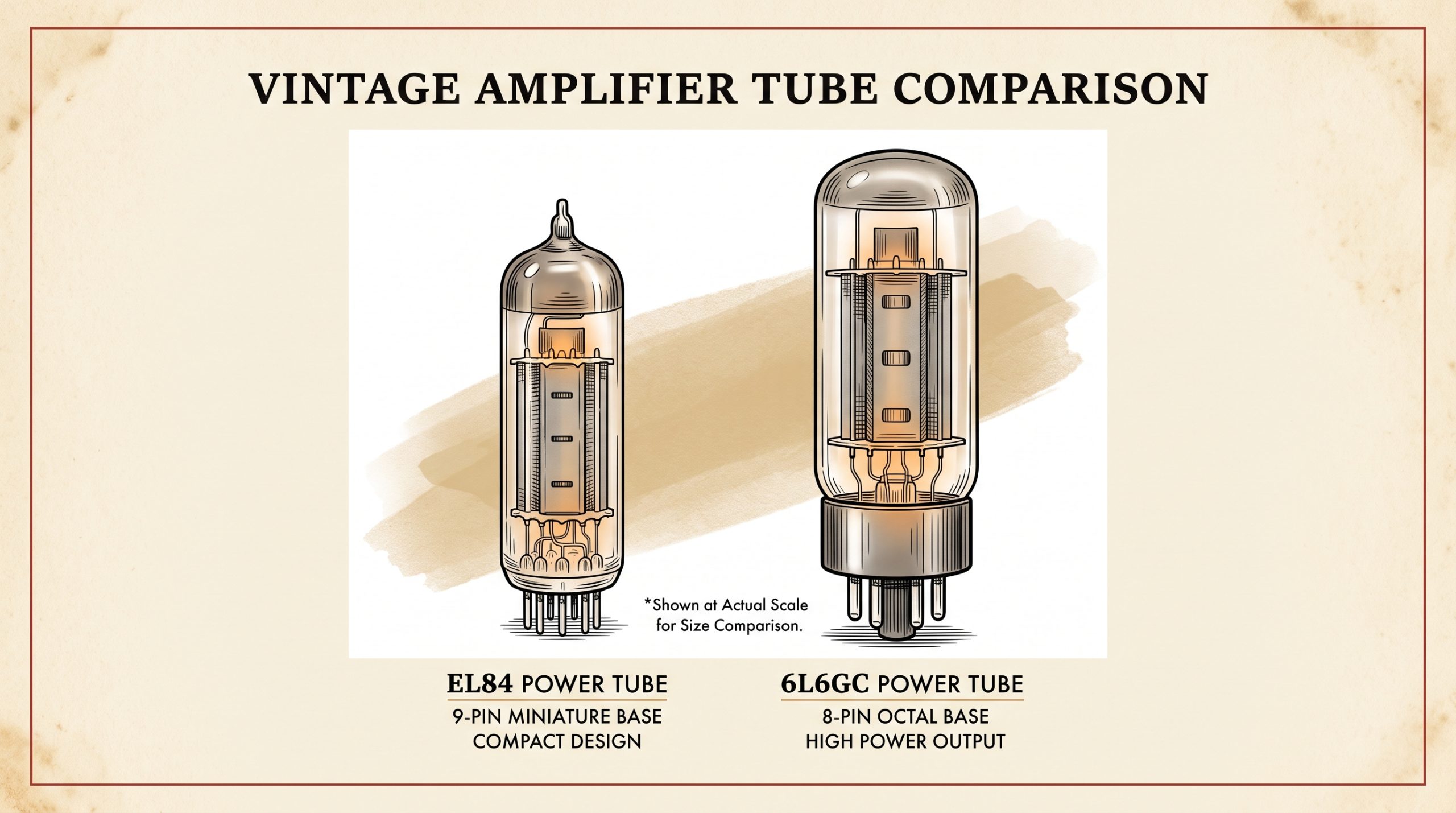
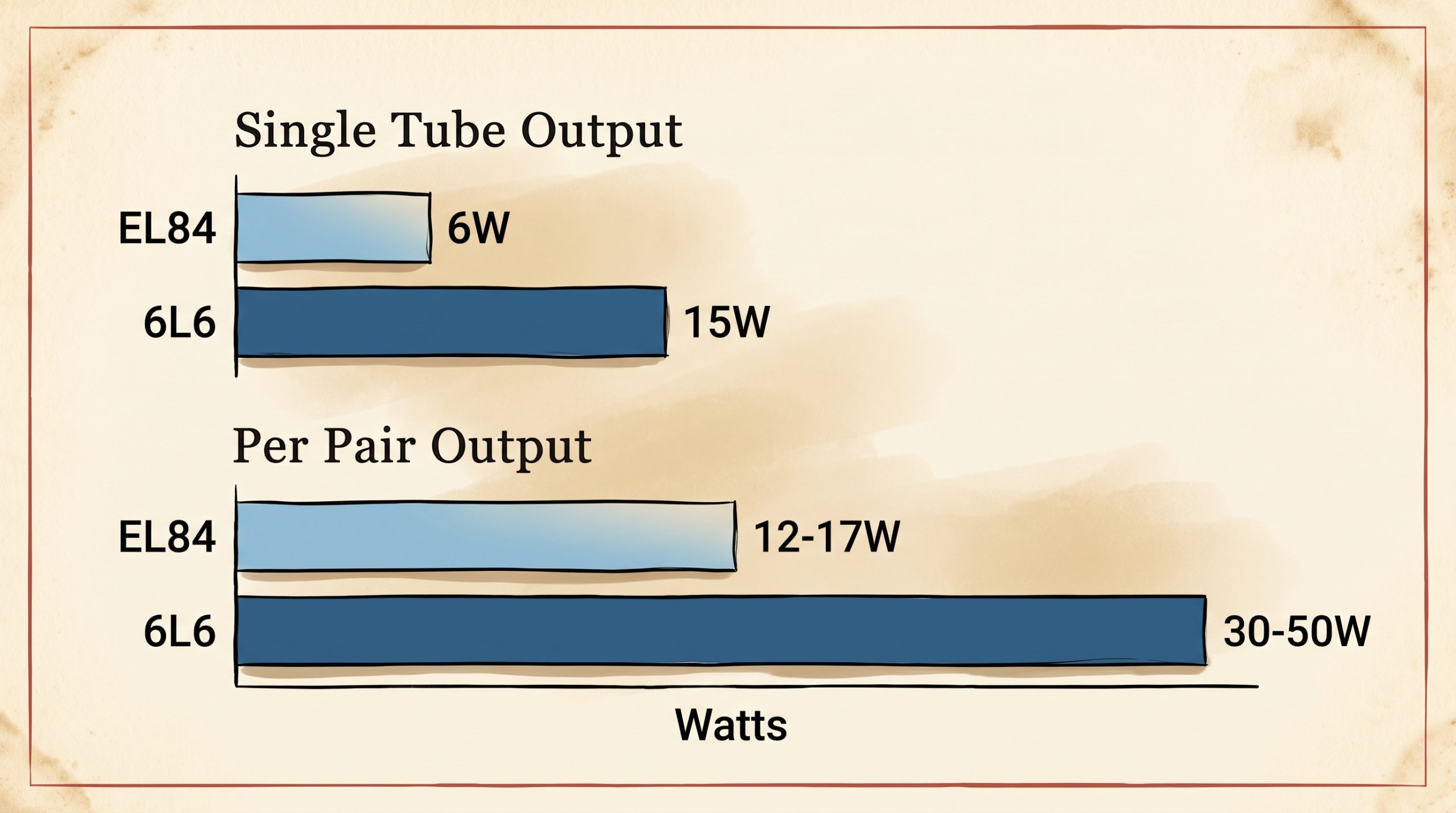
- EL84: 9-pin Noval socket, 300V max plate, 12W plate dissipation, 11-17W per pair
- 6L6GC: 8-pin Octal socket, 500V max plate, 30W plate dissipation, 30-50W per pair
- EL84 is also designated 6BQ5 (US RETMA), direct swap, same pinout
- 6L6 direct variants: 5881 (lower voltage), 6L6GC (modern standard), 6L6WGB (military)
- EL84 and 6L6 are NOT interchangeable, different pinout, different voltage, different output transformer requirements
- EL84 amps are typically cathode-biased (self-adjusting); most 6L6 amps use fixed bias requiring periodic adjustment
- EL84’s 12W plate dissipation ceiling means shorter tube life when pushed hard at high plate voltages
- Famous EL84 amps: Vox AC15, AC30 Top Boost, Marshall 18W combo
- Famous 6L6 amps: Fender Twin Reverb (AB763), Fender Bassman (5F6-A), Fender Super Reverb (AA763)
What Are EL84 and 6L6 Tubes? A Quick Manufacturer History
EL84 Origins: Philips, Mullard, and the British Sound
Philips introduced the EL84 around 1953. Mullard’s Blackburn factory in the UK picked it up for mass production through the mid-to-late 1950s, and that manufacturing lineage is where the “British tone” association comes from. The tube’s compact 9-pin Noval envelope suited the relatively small chassis of the early Vox AC15, and its ability to produce meaningful harmonic saturation at modest plate voltages made it attractive to British amplifier designers who weren’t chasing American-style clean headroom.
In the United States, the same tube was designated 6BQ5 under the RETMA numbering system. That’s a direct swap, same pinout, no modification required. Key original manufacturers include Mullard Blackburn, Amperex (Netherlands), Telefunken (Germany), and Sylvania (US). Current production equivalents come from JJ Electronic, Sovtek, Electro-Harmonix, and the Tung-Sol reissue line. JJ Electronic’s EL84 datasheet lists the current production specification baseline most builders reference today.
The higher-voltage variant, the 7189/7189A, uses the same 9-pin pinout but is rated for 400V plate operation. Worth knowing if you’re pushing an EL84 amp hard.
6L6 Origins: RCA, GE, and the American Sound
RCA introduced the 6L6 in 1936. That makes it one of the longest-continuously-produced audio tubes in history. Not a pentode, strictly speaking. The 6L6 is a beam-power tetrode, using beam-forming plates to suppress secondary emission rather than a suppressor grid. That architectural difference has real tonal consequences covered in the tone section below.
Major original production runs came from RCA, GE, Sylvania, and Tung-Sol. The 6L6G (“coke bottle” envelope) was the original form factor. The 6L6GC arrived as the modern ruggedized standard with a higher 30W plate dissipation rating. The 5881, covered in detail in the 5881 vs 6L6 comparison, is a military-spec variant rated conservatively at 23W plate dissipation and 400V maximum plate voltage.
Leo Fender’s preference for the 6L6 was deliberate. The tube’s extended headroom and tight low-end response aligned with his “clean until you want it loud” design philosophy. Fender circuit codes from the Teagle & Sprung “Fender Amps: The First Fifty Years” reference confirm the 6L6GC appeared in virtually every high-power Fender design from the late 1950s through the silverface era and beyond.
EL84 vs 6L6: Full Datasheet Specs Compared
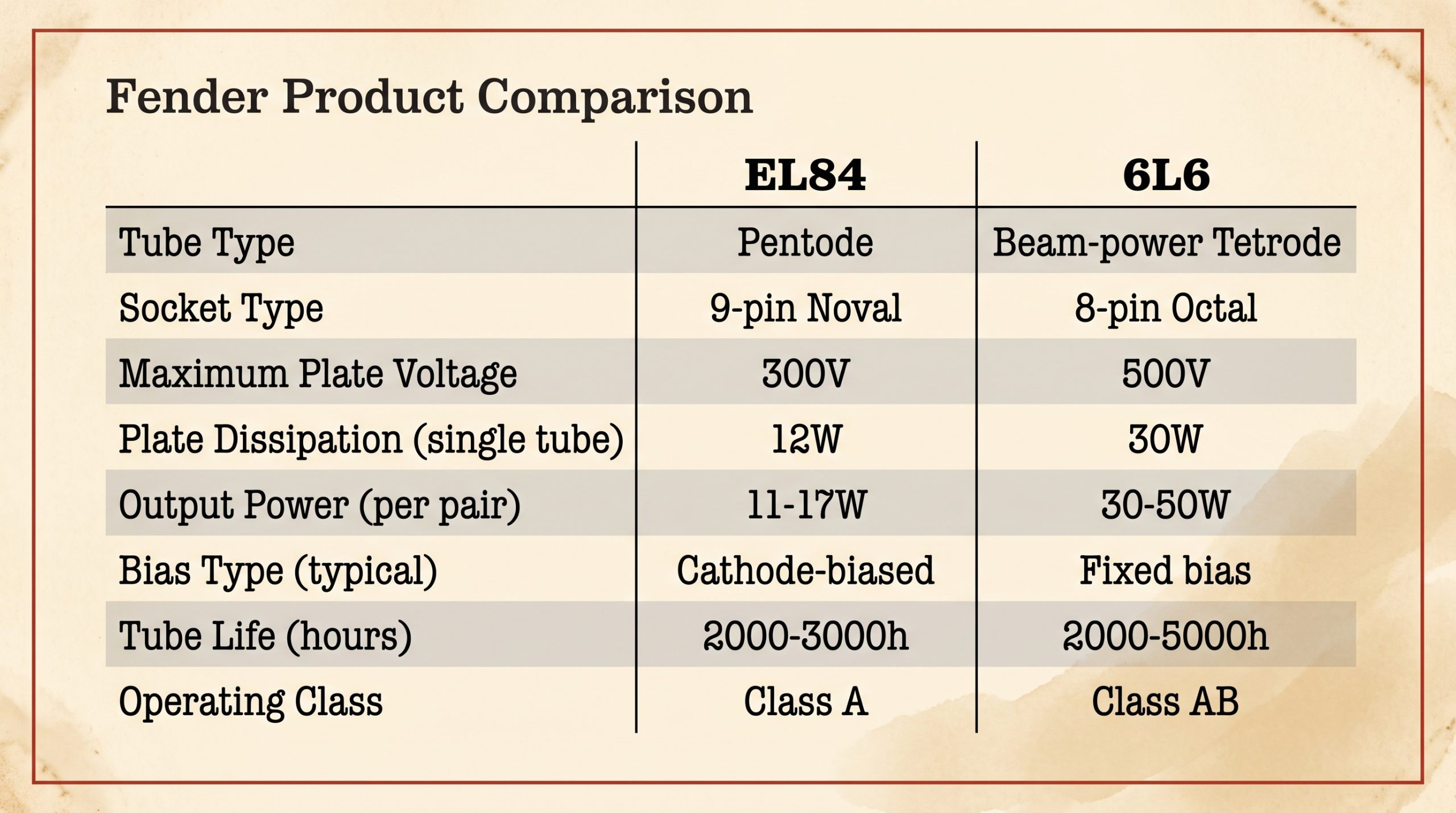
This is where most forum threads and tone-comparison articles fall short. Impressions are useful. Numbers are more useful. The table below pulls from manufacturer datasheet specifications, cross-referenced against the TubeData.info archive and the Tung-Sol production spec sheets.
| Specification | EL84 / 6BQ5 | 6L6GC |
|---|---|---|
| Tube Type | Small-signal pentode | Beam-power tetrode |
| Plate Voltage (max) | 300V | 500V |
| Plate Voltage (typical guitar amp) | 250-285V | 350-460V |
| Screen Voltage (max) | 300V | 450V |
| Plate Dissipation (max) | 12W | 30W |
| Transconductance (gm) | 11.3 mA/V | 6.0 mA/V |
| Typical Bias Current (per tube) | 48-55 mA | 35-70 mA |
| Heater Voltage / Current | 6.3V / 0.76A | 6.3V / 0.9A |
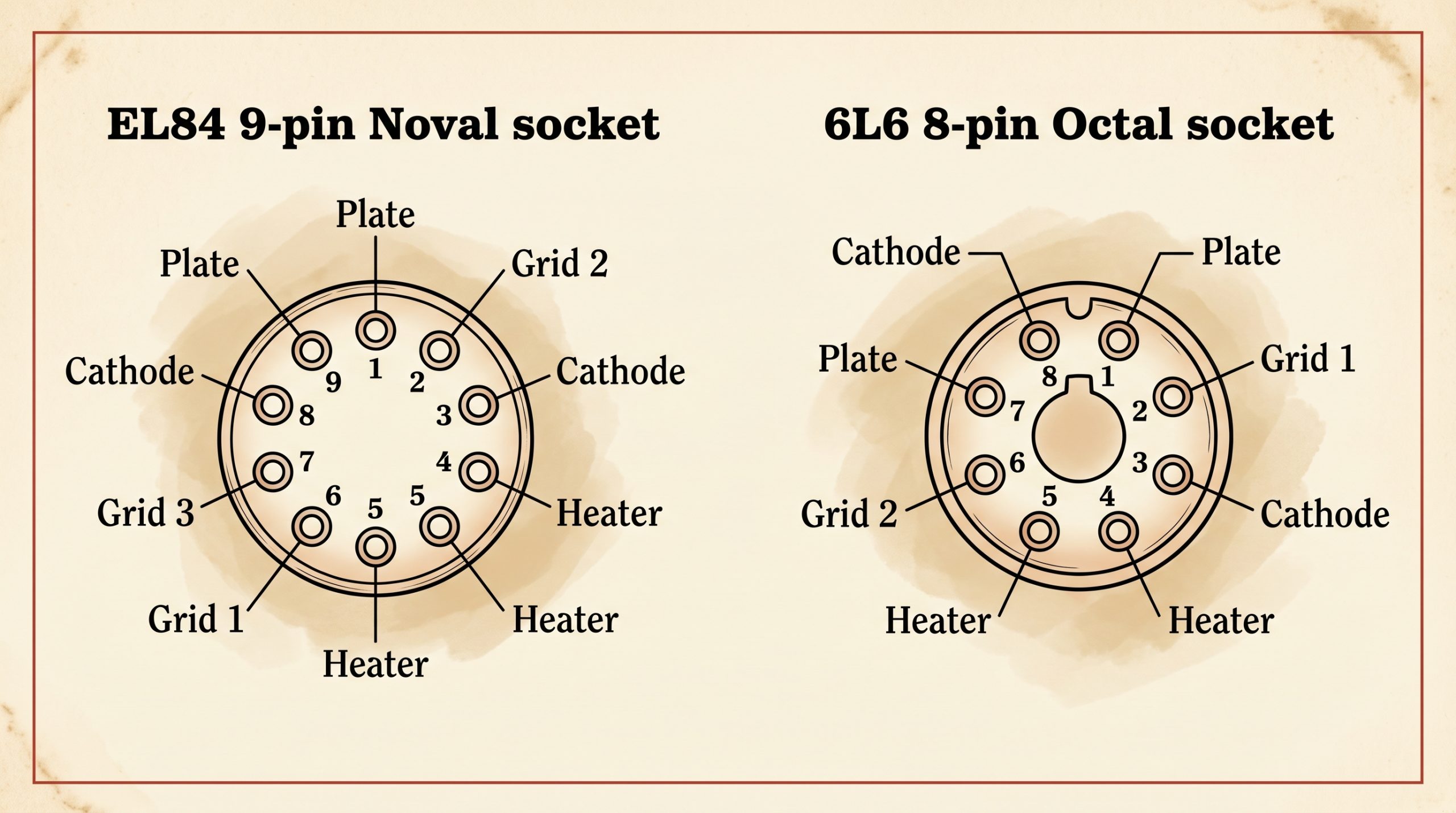
| Pinout | 9-pin Noval (B9A) | 8-pin Octal |
| Typical Output Power (per pair) | 11-17W | 30-50W |
| Class of Operation (guitar amps) | Class-A or Class-AB | Class-AB |
The transconductance difference matters more than it looks on paper. At 11.3 mA/V, the EL84 responds roughly twice as fast to input signal transients as the 6L6 at 6.0 mA/V. That’s a real physical reason why EL84 amps feel “touchier” under a pick, not just subjective impression. The 6L6’s 30W plate dissipation ceiling also requires a more robust output transformer to handle the heat and current swing. Push a pair of EL84s past 285V for extended sessions and you’ll shorten tube life noticeably. The 6L6GC at 450-460V plate voltage is operating well within its design envelope.
One more critical note on interchangeability. The 9-pin Noval base of the EL84 physically won’t fit an 8-pin Octal socket. No adapter, no modification. These are different tube families.
The Core Tone Difference: What Each Tube Actually Sounds Like
EL84 Tone Character: Mid-Forward, Compressed, Harmonically Aggressive
The EL84’s frequency emphasis sits in the upper midrange, roughly 1-4kHz, with present and extended highs. That’s the “chime” players associate with a Vox AC30. It’s partly the tube’s high transconductance amplifying transient edges, and partly a consequence of the output transformer designs typically used in EL84 circuits. The two are usually designed together.
Breakup is early and harmonically rich. The EL84 compresses sooner than a 6L6 under heavy pick attack, producing a sag that feels responsive and musical rather than limiting. Bass response is comparatively tight and smaller below around 100Hz. Don’t expect deep low-end extension. What you get instead is a midrange that barks when pushed, with highs that shimmer without becoming ice-pick treble at moderate gain settings.
Mark Bartel of Tone King, whose amplifier designs span multiple output tube families, describes EL84 tubes as having “more harmonic content in the upper midrange,” citing their “midrange chime, shimmer and glassy top end” as the tube’s best characteristics. His observations, documented at Reverb’s feature on power tube tone, align with the datasheet numbers. Higher gm, lower plate voltage, earlier saturation.
In a mix, EL84 amps tend to cut through more easily than their rated wattage suggests. A 15W EL84 combo can sit alongside a 40W 6L6 amp in a band context and hold its own in perceived presence, precisely because that upper-mid frequency emphasis sits where the human ear is most sensitive.
6L6 Tone Character: Wide, Open, Clean Headroom
The 6L6 sounds bigger. That’s the shortest accurate summary. Extended lows, smooth highs, and a midrange that doesn’t push forward aggressively. Compared to an EL84, the frequency response feels scooped, but it’s less a scoop and more a wide, even distribution with genuine bass extension below 80Hz that the EL84 simply can’t match.
Breakup character is softer and rounder when it does arrive. The 6L6 stays clean much longer than an EL84 at equivalent volumes, and when it does compress, the compression is gentler. That’s partly tube architecture (beam-power tetrode vs pentode) and partly the higher plate voltage headroom. A 40W 6L6 amp at band volume feels significantly cleaner than a 15W EL84 amp in the same room at the same perceived loudness.
That headroom is exactly why the 6L6 dominates country, clean blues, and pedal-driven rock. If you want your overdrive pedal to be the sole source of distortion, you need an amp that won’t contribute its own character on top. A 6L6 platform, run clean, gives you that stable, neutral foundation. Think SRV through a Super Reverb, or Brad Paisley’s tight, spanky attack through a blackface Fender platform.
EL84 vs 6L6 in a Band and Recording Context
In a dense band mix with multiple guitars, bass, and drums, the EL84’s upper-mid emphasis helps it occupy its own frequency space without competing with bass frequencies. Less low-end means less mud. The 6L6 sits wider in a stereo mix and works better for studio recordings where you want a “fat” guitar bed that fills the spectrum without competing with vocal presence frequencies.
Mic placement differences are real. EL84 amps often respond well to a single SM57 placed at the speaker cone edge, with the close placement capturing that upper-mid character cleanly. 6L6 amps frequently benefit from a blend of close and room microphones, particularly when recording in an acoustically decent space, because the lower-frequency content carries more room information.
Class-A vs Class-AB: Why Amplifier Class Matters as Much as the Tube
This is the angle that most tone comparisons skip entirely, and it explains more of the “feel” difference than tube type alone.
What Is Class-A Operation?
In Class-A, the output tube conducts current for the full 360 degrees of the input cycle. The plate current flows constantly. The bias point is set so the tube never cuts off, regardless of signal swing. Result: primarily even-order harmonic distortion (2nd and 4th harmonics) that most listeners describe as musical and sweet. Efficiency is low, roughly 20-25% theoretical maximum, which means more heat and shorter tube life. The Vox AC15, AC30 Top Boost, and Marshall 18W combo all run their EL84s in Class-A.
What Is Class-AB Operation?
Class-AB is a push-pull arrangement where each output tube conducts slightly more than 180 degrees of the cycle. There’s a brief crossover region where both tubes are transitioning, and crossover distortion becomes a design concern that circuit topology has to manage. The 6L6GC in a Fender Twin Reverb (AB763) or Bassman (5F6-A) runs Class-AB. Efficiency climbs to 50-60%, more power per unit of plate dissipation, cooler operation, and more output from the same hardware. The harmonic character shifts toward odd-order content (3rd and 5th harmonics) at higher drive levels, which most players associate with a more aggressive clipping character when the amp is pushed hard.
If you’re identifying circuit codes on a vintage amp, the Fender tube amp serial number and dating guide covers transformer codes, chassis stamps, and circuit code identification across the full Fender production run, which is useful for confirming which circuit variant you’re actually working with before pulling tubes.
Why This Explains the “Feel” Discrepancy
Players consistently describe EL84 amps as “touchier,” more pick-sensitive, and more immediate. That’s Class-A operation combined with high transconductance. The tube reacts faster to input transients. There’s no push-pull crossover region to transit. The 6L6 Class-AB amp, with its push-pull arrangement, adds a layer of headroom and dynamic linearity before the tubes begin contributing harmonic content. That’s why it feels “bigger under the fingers” at similar volumes.
| Playing Style | Better Choice | Why |
|---|---|---|
| Blues / classic rock lead | EL84 | Early harmonic saturation, pick sensitivity, spongy compression |
| Country / clean rhythm | 6L6 | Extended clean headroom, tight low end, spanky attack stays clean |
| Heavy crunch via pedals | 6L6 | Stable platform, doesn’t add its own distortion on top of pedals |
| Bedroom / low-volume playing | EL84 | Reaches satisfying breakup at lower SPL, bedroom-friendly volume |
| Bass guitar | 6L6 | More low-end extension, handles lower-impedance load more robustly |
| Dense band mix | EL84 | Upper-mid emphasis cuts through without additional EQ work |
| Studio recording (wide stereo) | 6L6 | Fuller frequency image sits well in sparse arrangements |
EL84 vs 6L6: Bias, Voltage, and Amp-Building Considerations
Biasing EL84 Amps
Most EL84 guitar amplifiers use cathode bias, sometimes called self-biasing. No bias pot, no test equipment, no periodic adjustment. A cathode resistor (typically 130-150 ohms for a pair of EL84s) sets the idle current automatically. Swap tubes from a reputable manufacturer and the amp self-adjusts within the design’s tolerance range.
Fixed-bias EL84 designs exist in hi-fi contexts but are rare in guitar amplifiers. If you’re building or modifying an EL84 circuit, keep the plate voltage below 300V for reasonable tube longevity. Pushing to 315-330V is done in some high-voltage Vox variants, but tube life shortens noticeably. Screen voltage is a harder limit. Screen resistors (typically 1k ohm at 1W minimum) are not optional. The EL84 screen grid is fragile at voltages above 300V, and unprotected screen nodes are a common failure point in poorly maintained EL84 circuits.
Biasing 6L6 Amps
Fixed bias is standard in 6L6 guitar amplifiers. That means periodic adjustment with a bias probe when you replace tubes. The standard target is approximately 70% of maximum plate dissipation for conservative, long-life operation. On a 6L6GC (30W plate dissipation maximum), that works out to 21W idle per tube. If you prefer more output and more tone at the expense of tube life, a hot bias target of 25W per tube is commonly used.
Fender’s own factory specification for blackface-era 6L6 amps ran conservatively. The Fender service documentation for the AB763 Twin Reverb specifies idle current readings around 35mA at approximately 450V plate voltage, which works out to roughly 15.75W per tube. That’s well below the 70% target, and it’s a key reason original blackface Fender tubes lasted as long as they did in heavy use.
Screen voltage matters on 6L6 amps too. The 6L6GC handles up to 450V screen, but 5881 variants derate to 400V maximum. If you’re substituting 5881s into an amp designed for 6L6GC, verify the screen voltage on the schematic first. And re-bias after any tube swap. 6L6 amps don’t self-adjust the way cathode-biased EL84 circuits do.
Output Transformer Requirements
This is the hard wall between EL84 and 6L6 swappability. A pair of EL84s works optimally with a primary impedance around 8k ohms plate-to-plate. A pair of 6L6s runs best in the 6.6k ohm range, with practical designs spanning 4k-8k ohms depending on the target output power and plate voltage. The output transformers in EL84 amps and 6L6 amps are designed around fundamentally different voltage and current parameters. Dropping a 6L6 into an EL84 amp isn’t just a matter of an adapter socket. The entire power supply, output transformer, and bias topology would need redesign. Not a modification. A rebuild.
EL84 vs EL34 vs 6L6: Where Does Each Fit?
The secondary keyword question “EL84 vs EL34 vs 6L6” comes up constantly, and the answer benefits from a direct comparison. None of these three tubes are pin-compatible. None of them swap into each other’s sockets without significant circuit redesign. That point alone eliminates a lot of common forum confusion.
| Tube | Max Plate Voltage | Typical Power (pair) | Tone Character | Famous Amps |
|---|---|---|---|---|
| EL84 | 300V | 11-17W | Mid-forward, chime, early breakup, compressed | Vox AC15, AC30 Top Boost |
| EL34 | 800V | 50-100W | Aggressive mids, British crunch, raw upper harmonics | Marshall Plexi, JCM800, JCM900 |
| 6L6GC | 500V | 30-50W | Open, clean, extended lows, smooth highs | Fender Twin Reverb, Bassman, Super Reverb |
| 6V6GT | 350V | 14-25W | Warm, compressed, American clean with gentle breakup | Fender Deluxe Reverb, Princeton Reverb |
The EL34 vs 6L6 comparison deserves its own treatment, covered in depth in the 6L6 vs EL34 full comparison. The short version: EL34 has more mid-range aggression and a rawer clipping character at high drive levels; the 6L6 has more bass extension and cleaner headroom at the same plate voltage range. EL84 vs EL34 is a different matter entirely. The EL84 runs at 300V maximum. The EL34 runs at up to 800V. Not interchangeable. Not even close on voltage requirements.
The 6V6 row in that table is if you’re coming from a Fender Deluxe Reverb or Princeton Reverb context. The 6V6 and 6L6 share the 8-pin Octal base, and the relationship between them is covered in the 6V6 vs 6L6 comparison. Warmer and more compressed than the 6L6, at lower plate voltages, with the same fundamental American clean character at low to moderate drive levels.
Interchangeability: Can You Swap EL84 and 6L6?
No. Full stop.
The EL84’s 9-pin Noval base physically won’t mate with an 8-pin Octal socket. Beyond the mechanical impossibility, the operating voltage difference is substantial. An EL84 amp’s power supply is built around 250-285V plate voltage. A 6L6 needs 350-460V. The output transformer primary impedance and current handling specifications are different. The bias topology is different. There is no practical swap path between these two tube families in a guitar amplifier context.
Direct equivalents for the EL84 are limited to the 6BQ5 (identical tube, US designation) and the 7189/7189A (same Noval pinout, higher voltage rating). If someone offers you a “compatible” EL84 substitute on an Octal base, they’re selling you the wrong information.
For 6L6 substitutions, the practical options are the 5881 (lower voltage spec, verify screen voltage before running in a high-voltage circuit), the KT66 (close but not identical, check your output transformer’s primary impedance), and the 6L6WGB military version. The EL34 can substitute for 6L6 in some amps with re-biasing and confirmed screen voltage compatibility, but it’s not a plug-and-play swap and the tonal result changes significantly toward a more aggressive midrange character.
Which Tube Is Right for Your Playing Style?
Choose EL84 If You…
- Play Britpop, indie, jangly rock, or classic rock lead lines
- Want the amp itself contributing harmonic breakup at practice or recording volumes
- Value pick-attack sensitivity and harmonic complexity over clean headroom
- Record at home or in a close-mic’d studio environment
- Prefer compact, lower-wattage combos that reach satisfying tone at bedroom-friendly volume
Choose 6L6 If You…
- Play country, clean blues, pedal steel, or clean R&B
- Need stage-loud clean headroom that doesn’t collapse under heavy strumming
- Use overdrive or fuzz pedals and want the amp to be a neutral, stable platform underneath
- Play bass guitar or need extended low-frequency response and stiff bass response
- Gig in large rooms where fuller frequency coverage fills the space
The Hybrid Path
Some players run 6L6 Fender platforms with EQ settings that push upper mids forward, approximating the frequency emphasis of an EL84 amp without changing the amp’s fundamental character. Conversely, a compressor or clean boost pedal in front of an EL84 amp can approximate some of the “big” feel of a 6L6 stage without the headroom ceiling. Speaker choice, output transformer quality, and circuit topology all contribute equally to the final tone. The tube is one variable. Important, but one piece of a larger picture.
Where to Start
The EL84 vs 6L6 question has a clear answer once you know what you’re actually trying to accomplish. EL84 circuits deliver pick-sensitive, mid-forward tone with harmonic breakup at manageable volumes. They’re cathode-biased in most guitar applications, self-adjusting, and relatively low-maintenance. The 6L6GC delivers wider, cleaner, more authoritative tone with extended headroom, tight bass response, and a stable platform for pedals. It requires periodic fixed-bias adjustment and runs at higher plate voltages that demand more careful circuit design and maintenance attention. Neither tube is interchangeable with the other on any level, mechanical or electrical. The choice comes down to the tonal direction, the playing context, and the volume requirements of your specific situation. If you’re working backward from a specific amplifier rather than a tube preference, the amp’s circuit code and production era are worth identifying first using the Fender tube amp dating and identification reference, which covers circuit codes, transformer stamps, and era identification across the full Fender production timeline from tweed through silverface.
Frequently asked questions
What tubes are interchangeable with EL84?
The EL84 is directly interchangeable with the 6BQ5 (US RETMA designation) and the 7189/7189A (higher plate voltage variant with the same 9-pin Noval pinout). It is not interchangeable with 6L6, EL34, or 6V6 due to different socket types (9-pin Noval vs 8-pin Octal) and fundamentally different operating voltages. Any adapter claiming to bridge a Noval tube into an Octal socket for guitar amp use should be treated with serious skepticism.
What are the key differences between EL34, 6L6, and EL84 power tubes?
The EL84 is a low-voltage (250-300V plate), low-power pentode producing 11-17W per pair with mid-forward tone and early harmonic compression. The 6L6GC is a medium-to-high voltage (350-500V) beam-power tetrode producing 30-50W per pair with extended low end and clean headroom. The EL34 is a high-voltage pentode rated up to 800V plate, producing 50-100W per pair with aggressive mid-range punch and raw upper-harmonic content. None of the three share a compatible pinout. None are interchangeable without circuit redesign.
Can I replace EL34 with 6L6?
In some amplifiers, yes, with appropriate precautions. The 6L6GC handles up to 500V plate voltage, which overlaps with typical EL34 operating ranges in guitar amps (usually 400-450V plate). Re-biasing is required, and screen voltage must be verified against the 6L6GC's 450V screen maximum. The tonal result changes meaningfully: the 6L6 sounds cleaner, less mid-forward, and less aggressive in the upper harmonics than an EL34. Output transformer compatibility should be confirmed before operating. This is not a plug-and-play substitution.
Are EL84 tubes good?
Good for specific applications. The EL84 excels in low-wattage British-voiced amplifiers, home recording contexts, and any situation where musical harmonic saturation at lower volumes is the priority. The 12W plate dissipation ceiling and 300V maximum plate voltage make it less suited for high-power, high-headroom designs. Current production EL84s from JJ Electronic and Tung-Sol are reliable options; NOS Mullard and Amperex examples command premium pricing but offer a specific warmth in the upper harmonics that current production tubes approximate but don't identically replicate.
Which sounds better for recording, EL84 or 6L6?
Neither is universally better. EL84 amps record well with a single close-placed dynamic microphone and produce a cut-through midrange character that sits naturally in dense mixes without additional EQ. 6L6 amps often benefit from a blend of close and room microphones and produce a wider, fuller frequency image that suits sparse arrangements, stereo guitar parts, or country and blues tracks where low-end presence is part of the instrument's contribution. The recording context determines which tube family serves the track better.