Contents
- 01A Brief History of Two Power Tubes
- 02Datasheet Specs Compared, The Numbers Behind the Tone
- 03Tonal Character, What You Actually Hear
- 04Which Amps Use 6L6 vs EL34?
- 05What Actually Happens When You Swap Without Re-Biasing
- 06NOS vs. Modern Production, Does Brand Matter More Than Tube Type?
- 07Genre and Playing Style Matching Guide
- 08The Extended Power Tube Family
- 09Which Tube Should You Choose?
- 10FAQ, 6L6 vs EL34 Common Questions
- 11Sources
Two tubes. Two continents. Decades of argument. The 6L6 versus EL34 debate runs through every corner of guitar culture, from the blackface Fender Twin Reverb to the Marshall 1959 Plexi Super Lead, from country pickers in Nashville to hard rock bands in Birmingham. When someone asks about el34 vs 6l6, they’re really asking a deeper question: which sonic philosophy fits what they’re actually trying to play? This article covers the datasheet specs, the circuit-specific voltage risks, what actually happens if you swap without re-biasing, and a straight genre-matching guide so you leave knowing exactly which tube belongs in your rig.
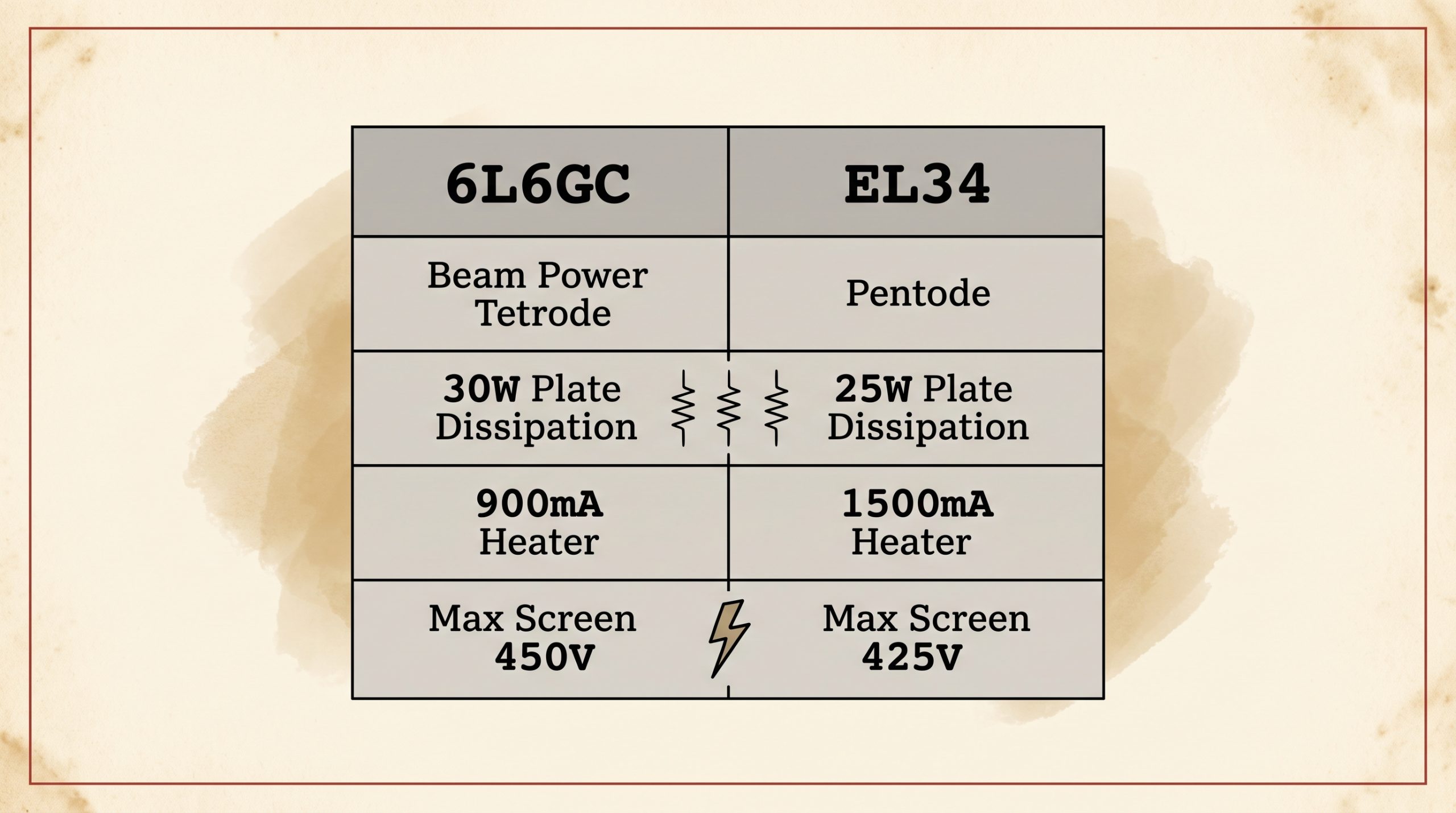
- 6L6GC: beam power tetrode, 30W plate dissipation, ~900 mA heater draw, max screen 450V
- EL34: pentode, 25W plate dissipation, ~1,500 mA heater draw, max screen 425V
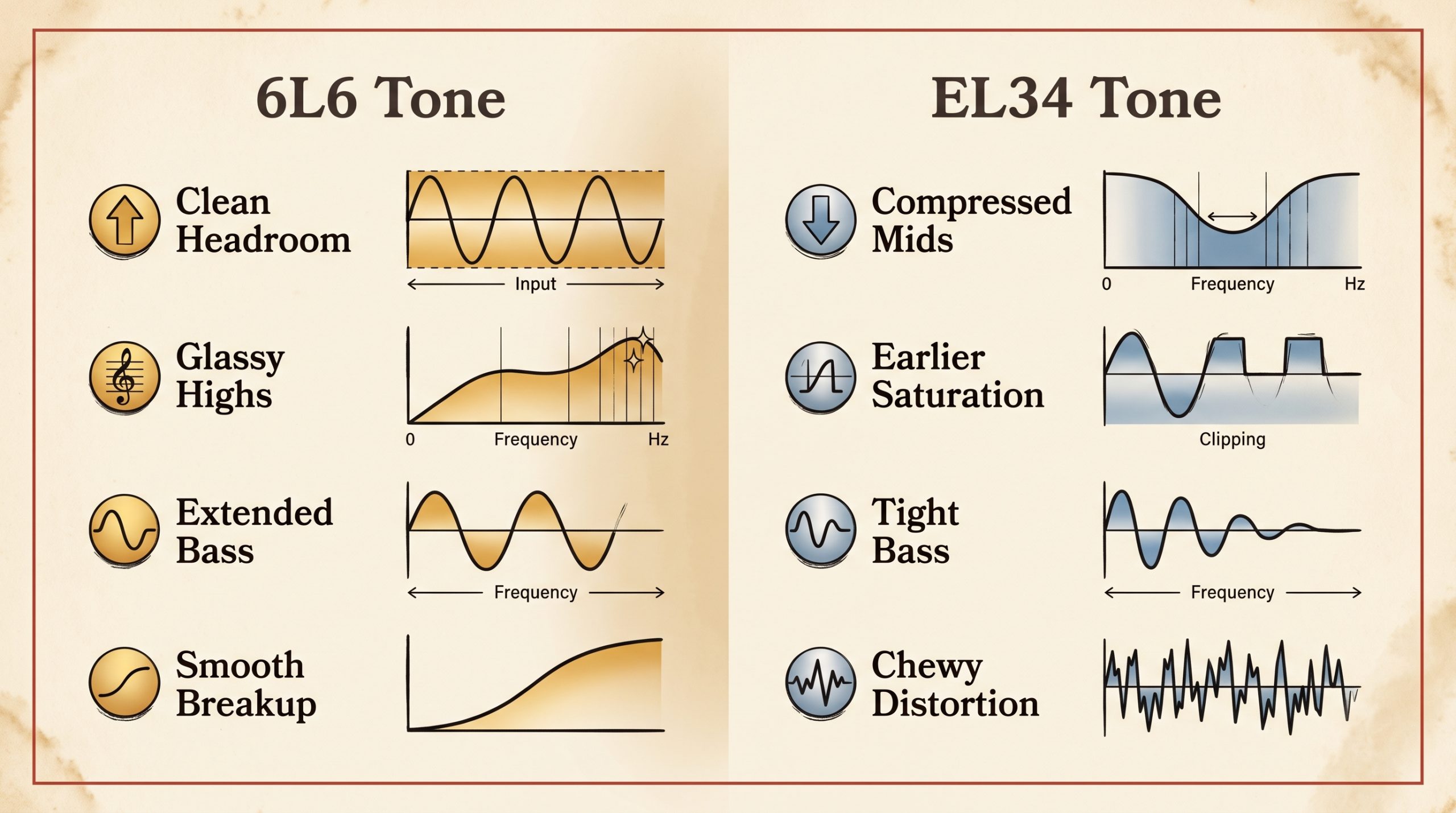
- 6L6 sound: clean headroom, glassy highs, extended and warm low end, smooth even-order breakup
- EL34 sound: compressed mids, earlier power amp saturation, tighter bass, chewier distortion character
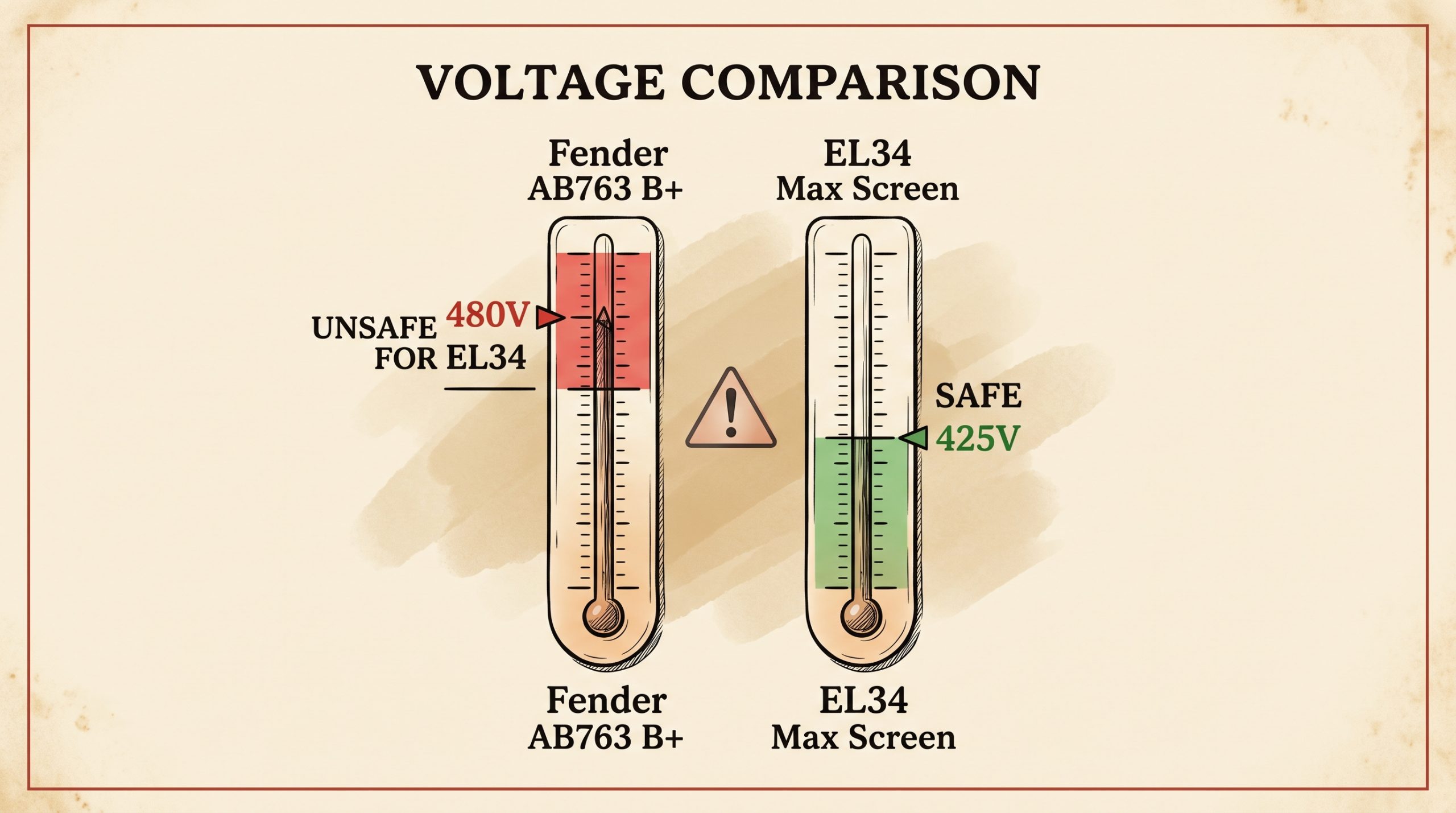
- EL34 screen voltage max (425V) is lower than Fender AB763 B+ (~460V), not a plug-and-play swap
- NOS Mullard EL34 matched quad: $400-$800+. JJ EL34 matched quad: $60-$90.
- The Vox AC30 uses EL84 tubes, NOT EL34, a very common and costly misidentification
- Never swap tube types without re-biasing, running EL34s on Fender B+ can exceed screen voltage ratings
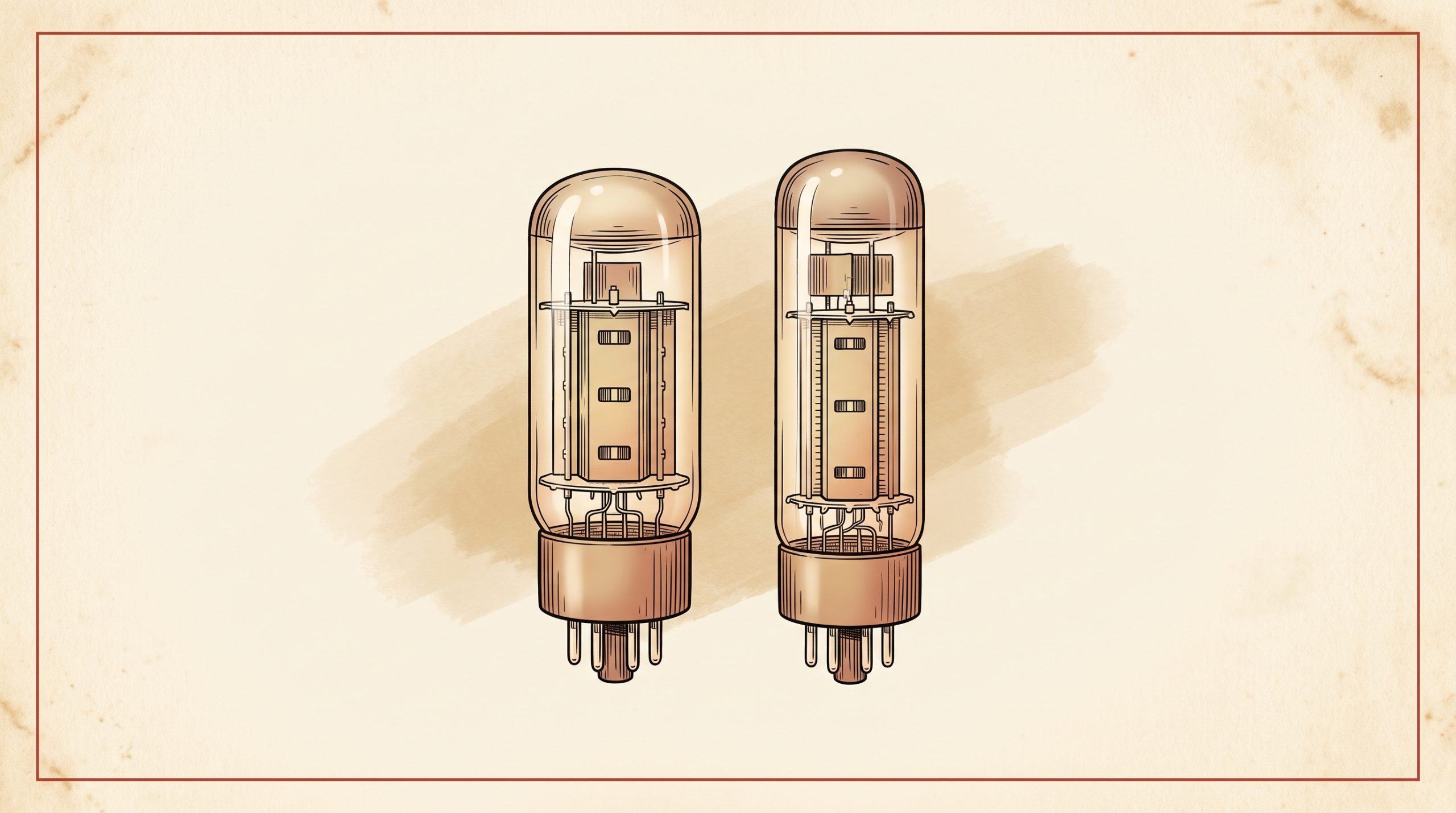
A Brief History of Two Power Tubes
The 6L6, Made in America, Built for Headroom
RCA engineer Otto Schade developed the 6L6 and it was patented in 1936, originally shipping in a metal envelope. The glass-envelope 6L6G followed in 1937, with subsequent revisions producing the 6L6GA and 6L6GB. The definitive guitar amp variant, the 6L6GC, arrived in 1956 and became the standard for high-power American amplification. Key NOS manufacturers include RCA, GE, Sylvania, and Tung-Sol. Current production comes from JJ Electronics, TAD, the Tung-Sol reissue line, and Electro-Harmonix.
Leo Fender’s circuit philosophy demanded clean, high-headroom amplification that could stay linear at stage volume. The 6L6GC’s square-law transconductance curve, higher plate dissipation, and relaxed screen voltage requirements made it a natural fit. The full 6L6 tube guide covers the complete variant history and modern replacement options in detail.
The EL34, Britain’s Answer, Built for Bite
Mullard introduced the EL34 in 1955 at their Mitcham, Surrey factory as part of the Philips group’s European tube program. The designation follows the Mullard-Philips (Pro-Electron) tube-naming convention: E indicates a 6.3V heater voltage, L indicates an output pentode, and 34 is the sequential type number within that class. Its closest relative is the KT77, which shares similar construction but uses beam-forming plates instead of a suppressor grid.
NOS sources include Mullard, Telefunken, Siemens, and Amperex. Current production options include JJ, Electro-Harmonix, the Mullard reissue, and Svetlana. Mullard’s xf2 and xf4 variants carry collector relevance beyond nostalgia. The xf2 in particular shows measurably smoother 3rd harmonic content than modern reissues, a point covered in the NOS section below. Jim Marshall adopted the EL34 largely because it was available and affordable in the UK, and its natural midrange push suited the rock guitar tones his customers were chasing. That’s it. No exotic engineering decision. Just geography and economics, with lasting sonic consequences.
For the complete manufacturing history and modern alternatives, the EL34 tube guide covers Mullard date codes, KT77 substitution, and current production rankings.
Datasheet Specs Compared, The Numbers Behind the Tone
Most forum debates about el34 vs 6l6 skip the datasheet entirely and jump straight to adjectives. That’s backwards. The voltage ratings, heater current, and transconductance figures directly determine which tube works in which circuit and why each one sounds the way it does.
Key Electrical Specifications
| Specification | 6L6GC | EL34 |
|---|---|---|
| Tube Type | Beam Power Tetrode | Pentode |
| Heater Voltage | 6.3V | 6.3V |
| Heater Current | 900 mA | 1,500 mA |
| Max Plate Voltage (Va) | 500V | 800V |
| Max Screen Voltage (Vg2) | 450V | 425V |
| Max Plate Dissipation | 30W | 25W |
| Typical Plate Current (Idle) | 70–90 mA | 65–70 mA |
| Transconductance (gm) | ~6,000 µmhos | ~11,000 µmhos |
| Typical Output Power (PP pair) | 50–60W | 50W |
| Nominal Bias Range | -40V to -55V | -28V to -43V |
Several numbers in that table shape tone directly. The EL34’s transconductance of ~11,000 µmhos versus the 6L6GC’s ~6,000 µmhos means the EL34 responds faster to pick attack. More transconductance equals a more immediate, reactive feel under your pick. That’s measurable, not marketing copy.
The heater current difference matters in vintage Fender iron. The EL34 draws 1,500 mA versus 900 mA for the 6L6GC. Swapping a Fender’s output transformer to accommodate EL34s isn’t just a bias adjustment; it’s a power transformer headroom question the original Fender PT wasn’t designed to answer. Not great for the transformer’s long-term health.
The screen voltage figures are the critical safety number. The EL34’s maximum screen grid voltage (Vg2) is 425V. The Fender AB763 B+ typically runs approximately 455–465V. That means the EL34’s screen rating is exceeded in a stock Fender circuit, which leads to screen grid failure over time. The 6L6GC’s 450V screen max is comfortably under that same B+. This is the structural reason why Fender circuits and EL34s aren’t natural partners.
On construction: the EL34 is a true pentode with a physical suppressor grid (g3) between the screen and plate. The 6L6GC uses beam-forming plates instead, which guide electron flow without an additional grid element. As the diyAudio community discussion documented, this difference in crossover behavior produces what’s sometimes called the “Marshall wiggle” in class AB operation: the EL34’s suppressor grid creates a slight non-linearity at the crossover point that contributes more 3rd harmonic content to its distortion character. The 6L6’s square-law curve, which Schade deliberately engineered for better AB push-pull linearity, produces less of that 3rd harmonic signature at equivalent output levels.
Bias Voltage Notes by Circuit
These aren’t generic estimates. They’re circuit-specific reference points.
Fender AB763 (blackface Twin Reverb, Super Reverb): B+ runs approximately 455–465V, typical 6L6GC bias in the range of -48V to -56V, idle current around 35 mA per tube. Marshall JMP 1959 Plexi Super Lead: B+ approximately 450–470V, typical EL34 bias -38V to -44V, idle 35–40 mA per tube.
These numbers underscore why the swap risk is real. If you want to trace circuit codes and production dates for Fender AB763-era amps, the Fender tube amp serial number and dating guide covers transformer codes, chassis stamps, and tube chart dating across all eras.
Tonal Character, What You Actually Hear
Mesa/Boogie’s own published position is worth acknowledging here: the preamp circuit is the cake, and the output tubes are the icing. That’s accurate as a general principle, especially in high-gain designs where preamp distortion dominates. But when circuit topology and gain structure are held constant, the tube type produces consistent, predictable tonal differences.
Low End
The 6L6 produces extended, warm, and slightly loose low end. The beam tetrode’s square-law plate curve generates less 3rd-order harmonic content in the bass region, keeping low frequencies articulate and full even at volume. Think of the Fender Twin Reverb’s bass response: round, deep, and unhysterical under heavy right-hand playing.
The EL34 gives you tighter, punchier bass. The pentode’s suppressor grid controls secondary emission differently, resulting in a more defined low-end character. The Marshall JCM800’s bass at matched SPL to a Twin Reverb is demonstrably tighter. Neither is wrong. They serve different musical purposes.
Midrange
This is where the 6l6 tubes vs el34 comparison becomes most audible to most players. The EL34’s defining characteristic is a pronounced upper midrange presence in roughly the 1 kHz to 3 kHz range. That emerges partly from the pentode plate characteristics and partly from the crossover behavior described above. Measurements in identical push-pull circuits consistently show the EL34 producing a midrange presence peak of approximately +3 to +4 dB relative to the 6L6GC. That’s enough to reshape the entire perceived character of an amp.
The 6L6 is scooped by comparison. Not absent in the mids, but relatively recessed in that upper-mid band. It’s a large part of why Fender’s clean tones carry that open, “American” quality.
High End and Treble Response
The 6L6GC extends further into the treble range, contributing to the glassy, bell-like clean tone that defines the blackface Fender sound. Sparkle without harshness at clean volumes. The EL34 is slightly rolled off at the very top compared to a 6L6, but the compressed midrange makes treble feel more aggressive once the tube is clipping. Pick attack character differs too: the 6L6 produces a longer sustain plateau before compression sets in; the EL34 spikes harder on the transient and compresses faster. Both useful. Depends on whether you’re fingerpicking jazz or doing power chord rhythm work.
Breakup and Distortion Character
The 6L6GC clips into predominantly even-order (2nd harmonic) distortion at mild overdrive, transitioning to odd-order content at hard clip. That even-order signature sounds smooth and vocal, the “singing” quality of a cranked blackface Fender or a pushed Bassman. The EL34’s crossover non-linearity drives more 3rd harmonic content into the distortion signature earlier in the clip cycle. That produces the characteristic “chewy,” slightly aggressive breakup of a hard-driven Marshall.
Mark Bartel of Tone King, as documented at Reverb.com, describes the contrast this way: the 6L6 produces a big, warm, balanced clean tone with creamier overdrive and thicker mids, while the EL34 carries a leaner low-end response with tight mids and crisp highs, coming across as comparatively meaner sounding. That’s a useful shorthand that holds up against the measurement data.
On headroom: a 6L6GC pair in fixed bias clips at higher SPL before producing audible harmonic distortion than a matched EL34 pair in the same configuration. Lower plate dissipation (25W vs 30W) and higher transconductance mean the EL34 saturates earlier. A 50W Marshall “feels” like it’s working harder at stage volume than a 50W Fender. That’s not imagination. That’s physics.
Which Amps Use 6L6 vs EL34?
Classic 6L6 Amplifiers, The Fender Lineage
The blackface era (1963–1967) represents the canonical 6L6GC sound in guitar amplification. Circuit codes like AB763, AA763, and AA165 document the specific design revisions across models during this period. Note that the Deluxe Reverb in the table below runs 6V6 tubes, not 6L6, it’s included for scale reference.
| Amp Model | Circuit Code | Years | Era | Power (6L6 pair) |
|---|---|---|---|---|
| Bassman | 5F6-A | 1958–1960 | Tweed | ~45W |
| Super Reverb | AA763/AB763 | 1963–1967 | Blackface | ~45W |
| Twin Reverb | AB763 | 1963–1967 | Blackface | ~85W |
| Dual Showman | AA763 | 1963–1967 | Blackface | ~85W |
| Deluxe Reverb* | AA763 | 1963–1967 | Blackface | ~22W (6V6, not 6L6) |
The Fender Twin Reverb guide covers the AB763 circuit in detail, including transformer codes, chassis stamp dating, and variant identification across the blackface and silverface eras.
Classic EL34 Amplifiers, The British Lineage
The Marshall JTM45 originally used KT66 tubes (a beam tetrode more closely related to the 6L6 family), transitioning to EL34 tubes from approximately 1966 onward as supply and cost favored the Mullard pentode. The canonical EL34 rock amp is the Marshall 1959 Plexi Super Lead (1965–1969). The JCM800 2203 and 2204 (1981–1989) continued the EL34 tradition into the high-gain era.
Hiwatt’s DR103 (1969–present) runs EL34 in class AB at ultra-high B+, producing what many consider the cleanest EL34 tone available in a production amp. The circuit demands and rewards matched, high-quality tubes.
One correction worth making directly: the Vox AC30 uses EL84 tubes. Not EL34. The confusion is persistent and understandable given that “EL” appears in both designations, but the EL84 is a physically smaller, 9-pin noval tube with entirely different operating parameters. The EL84 tube guide covers the distinction thoroughly, including why EL84 in class A produces a completely different compression character than EL34 in class AB.
What Actually Happens When You Swap Without Re-Biasing
This is the section that gets skipped in most el34 vs 6l6 discussions, and it’s the one that saves equipment.
Bias is set to establish a tube’s operating point at a specific idle current relative to its plate and screen voltages. When you change tube types, that operating point shifts. The circuit’s fixed negative bias voltage doesn’t automatically compensate.
Dropping EL34s into a stock Fender AB763 without re-biasing creates two separate problems. First, the screen voltage risk: Fender B+ at approximately 460V directly exceeds the EL34’s 425V screen grid maximum. That’s not a marginal overvoltage. Over operating hours, it degrades screen grids and shortens tube life, with failure often presenting as a sudden bright flash inside the tube. Second, the bias point: the EL34’s different transconductance and plate characteristics mean the existing bias voltage runs the tubes colder than optimal for that tube type. The result is harsh, sterile tone and compromised tube longevity.
Dropping 6L6s into a Marshall Plexi without re-biasing runs the tubes hot relative to the 6L6GC’s optimal operating point. Hot bias means red-plating under load, which risks damaging the output transformer and the tubes simultaneously. The tone shifts toward “sweeter” initially, but the reliability hit is not worth it. Always re-bias when changing tube types. Have a qualified amp technician evaluate screen resistor values before running non-stock tubes in vintage iron. Not optional.
NOS vs. Modern Production, Does Brand Matter More Than Tube Type?
Short answer: sometimes.
NOS GE 6L6GC and RCA 6L6GC tubes typically measure tighter gm matching (within ±3%) and run quieter noise floors than current JJ or Electro-Harmonix equivalents. In a recording studio context where tube noise is audible in the signal chain, that matters. The NOS Mullard xf2 EL34, still the reference point for the tube’s best performance, shows measurably lower microphonics and smoother 3rd harmonic content than the current Mullard reissue. That’s not audiophile mythology. It shows up on measurement equipment.
The counterpoint is equally real. A well-selected, properly matched set of JJ EL34s in a correctly biased amp is frequently indistinguishable from NOS in blind listening tests conducted at stage volume with a band. Modern production has improved substantially over the past fifteen years. The price gap is enormous.
A matched quad of NOS Mullard EL34s currently runs $400 to $800 or more depending on source and condition. A matched JJ EL34 quad runs $60 to $90. When comparing el34 tubes vs 6l6 tubes on a practical gigging budget, the modern production argument becomes hard to dismiss.
The practical recommendation splits by application. Studio or recording players who will hear every subtle tonal difference should investigate NOS, particularly GE 6L6GC for Fender circuits and Mullard xf2 EL34 for Marshall circuits. Gigging players who need tubes that can handle road conditions, get replaced without financial pain, and perform reliably night after night will find modern matched production sets the sensible call.
Genre and Playing Style Matching Guide
| Playing Style / Genre | Better Choice | Why |
|---|---|---|
| Vintage country / clean Telecaster | 6L6 | Extended high end, glassy cleans, spanky attack without compression |
| Blues (clean to mild OD) | 6L6 edge | Even-order harmonic breakup is more vocal and round |
| Classic rock (Marshall tones) | EL34 | Midrange compression, natural power amp saturation at stage volume |
| Heavy metal (modern high gain) | 6L6 | Tighter low end, better note definition under high preamp gain |
| Jazz (ultra clean) | 6L6 | Higher clean headroom, smooth clip onset, no unwanted midrange push |
| Alt rock / indie (AC/DC, Radiohead) | EL34 | Midrange grind, earlier power amp breakup at moderate volumes |
| Studio HiFi (single-ended) | EL34 | Designed for linearity in SE applications |
| HiFi (class AB push-pull) | 6L6 | Square-law curve optimized for AB crossover linearity |
On the metal question specifically: yes, 6L6 tubes are the dominant choice for metal amplification. The Mesa/Boogie Dual Rectifier, Peavey 5150, and the bulk of high-gain American designs run 6L6GC tubes. Tighter low end and higher clean headroom before power amp breakup means the preamp can push extreme gain levels without the bass turning to mush. EL34 in a high-gain context tends to add midrange congestion that works against the note definition metal requires. Some players prefer it. Most don’t.
The Extended Power Tube Family
The 6L6 vs EL34 debate doesn’t happen in isolation. Both tubes sit inside a broader family of output tubes that show up in classic guitar amplifiers.
| Tube | Type | Tone Character | Typical Amp | Max Plate Dissipation |
|---|---|---|---|---|
| 6L6GC | Beam Tetrode | Clean, glassy, extended bass | Fender, Mesa | 30W |
| EL34 | Pentode | Compressed mids, harmonic grind | Marshall, Hiwatt | 25W |
| KT88 | Beam Tetrode | Extended headroom, hi-fi clean | Marshall Major, HiFi | 42W |
| EL84 | Pentode | Chimey, class A compression | Vox AC15/AC30 | 12W |
| KT66 | Beam Tetrode | 6L6-like with more mids | JTM45, vintage HiFi | 25W |
| 6V6 | Beam Tetrode | Warm, compressed, spongy compression at low wattage | Fender Deluxe, Champ | 14W |
The EL84 guide covers the Vox AC15 and AC30 application in detail, including why that tube’s class A operation produces a character neither the 6L6 nor EL34 can replicate.
Which Tube Should You Choose?
Choose the 6L6GC if you play through a Fender or Mesa platform, prioritize clean American headroom, need tight bass response under high gain, or play country, jazz, or metal. The beam tetrode’s smooth even-order breakup and extended frequency response reward players who want the amp to stay clean until they decide it shouldn’t.
Choose the EL34 if you play through a Marshall or Hiwatt platform, want midrange grind baked into your power amp character, play classic or hard rock, or want natural power amp saturation at rehearsal volume rather than stage volume. The pentode’s faster compression and 3rd harmonic content at breakup define a musical category that the 6L6 simply doesn’t occupy.
The Mesa principle applies as a final check: the same 6L6GC in a blackface Fender Twin Reverb and a Mesa Dual Rectifier produces radically different results. Circuit design, speaker load, and output transformer characteristics shape the final tone as much as the tube itself. Know your platform, match the tube to it, re-bias properly, and the right choice becomes straightforward.
Sources
- RCA 6L6GC datasheet, original issue, tubedepot.com RCA 6L6GC datasheet
- Mullard EL34 datasheet, Philips components archive, Mullard EL34 datasheet at frank.pocnet.net
- Mesa/Boogie technical editorial: 6L6 vs EL34 power section discussion, mesaboogie.com Amplitudes blog
- Mark Bartel (Tone King) via Reverb.com News: power tube tonal characteristics, Tone King power tube guide at Reverb.com
Frequently asked questions
Can I swap EL34 tubes into my Fender amp?
Both tubes use an 8-pin octal base, so they physically fit the socket. However, it's not a plug-and-play swap. The Fender AB763 B+ voltage (~460V) exceeds the EL34's maximum screen grid voltage of 425V, which risks screen failure over time. The power transformer's heater winding wasn't designed for the EL34's 1,500 mA heater draw versus the 6L6GC's 900 mA. If you want to run EL34s in a Fender circuit, a qualified amp technician needs to evaluate screen resistor values, verify PT headroom, and re-bias the amp before you power up.
Are 6L6 tubes good for metal?
Yes. The 6L6GC is the standard power tube for American high-gain metal amplification. The Mesa/Boogie Dual Rectifier and Peavey 5150 both run 6L6GC output sections, and the reason is practical: tighter low end and higher clean headroom before power amp breakup allow the preamp to push extreme gain levels without bass frequencies turning to mush. EL34 tubes can work in a metal context but tend to introduce midrange congestion that works against the note definition most metal playing requires.
Do EL34 tubes break up earlier than 6L6?
Yes, measurably. Lower maximum plate dissipation (25W vs 30W for the 6L6GC) and higher transconductance (approximately 11,000 µmhos vs 6,000 µmhos) means the EL34 reaches power amp saturation at lower output levels. That's the physical reason why a 50W Marshall Plexi feels like it's clipping harder at rehearsal volume than a 50W Fender Twin Reverb at equivalent SPL. The EL34 simply runs out of headroom sooner, and that earlier saturation is a feature, not a defect, in the context of classic British rock tones.
What's the tonal difference between NOS and modern EL34 or 6L6 tubes?
NOS tubes often measure tighter gm matching, lower noise floor, and in the case of Mullard xf2 EL34 specifically, measurably smoother 3rd harmonic content and lower microphonics. Modern production has improved significantly over the past decade. JJ, TAD, and the Tung-Sol reissue line produce consistent, reliable tubes. For most gigging players running a properly biased amp, a well-matched modern set is the practical call. The NOS premium makes most sense in recording studio contexts where low noise floor and subtle harmonic differences actually reach a microphone.
Is the EL34 or 6L6 better for HiFi?
Context determines this. The EL34 was designed with minimal curvature for linearity in single-ended and class A push-pull applications, which is why it dominates single-ended HiFi builds. The 6L6GC's square-law plate curve, deliberately engineered by Schade for better crossover linearity in class AB push-pull, makes it the better choice for AB push-pull HiFi designs with minimal global feedback. Both tubes have legitimate HiFi applications. The circuit topology decides which performs better in a given design, not a general preference for one tube over the other.