Contents
- 01What Is a 6V6 Tube? History and Manufacturer Origins
- 026V6 Datasheet: Complete Technical Specifications
- 03The 6V6 in Fender Amplifiers: Circuit-by-Circuit Breakdown
- 046V6 Tube Equivalents and Substitutes
- 05Best 6V6 Tubes: Ranked for Guitar Amplifiers
- 066V6 Tube Comparison Table: Current Production at a Glance
- 07How to Buy 6V6 Tubes: Matched Pairs and What to Avoid
- 08Biasing 6V6 Tubes in Fender Amplifiers: Key Numbers
- 09FAQ: 6V6 Tubes
- 10Which 6V6 Should You Choose
Most players treat the 6V6 as a footnote to the more famous 6L6. That’s backwards. For anyone running a Champ, a Princeton Reverb, or a Deluxe Reverb, the 6V6 is the amp. It determines how the circuit breaks up, how the low end responds, and how long you’re playing before the plates start glowing the wrong color. Understanding the tube, not just its name, changes how you buy, bias, and maintain your amp.
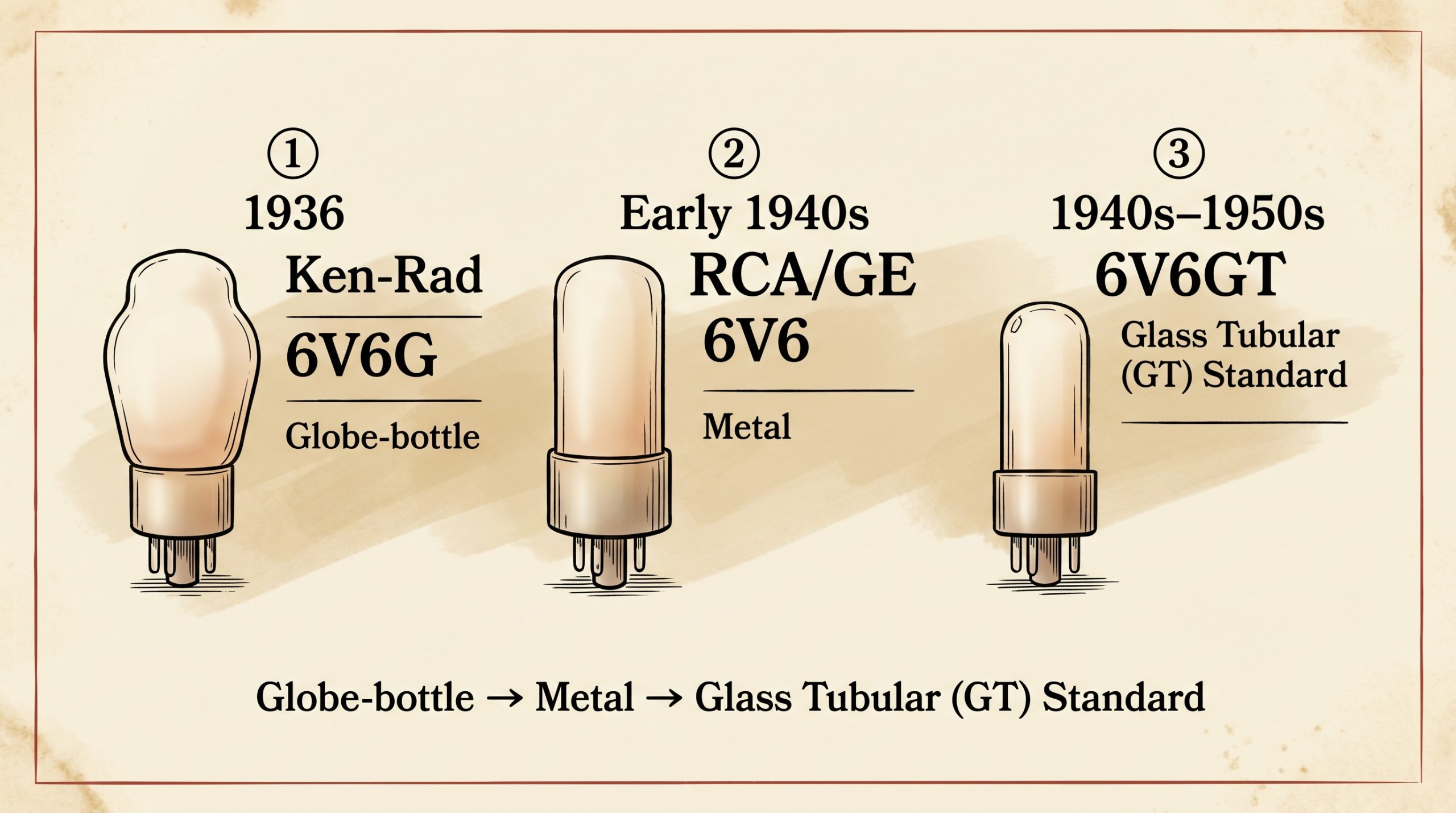
As Premier Guitar’s power tube guide notes, the 6V6 began as a metal-envelope tube in the 1930s before transitioning to the glass tubular (GT) variant in the 1940s, a form that became standard across guitar amplifiers for decades. Ken-Rad Tube and Lamp Corporation introduced the original 6V6G globe-bottle design in late 1936. RCA, GE, and Sylvania followed quickly, and the 6V6GT dominated production by the early 1940s. This guide covers the full picture: datasheet specs, pinout, every major Fender circuit that uses this tube, a ranked buyer’s guide to current production options, and bias targets so you’re not flying blind.
- Type: Beam-power tetrode, octal base (8-pin, US8A socket)
- Max plate dissipation: 14W (convection cooling)
- Output power: ~5W single-ended, 12–15W push-pull Class AB
- Heater: 6.3V AC/DC, 450 mA
- Key Fender circuits: 5F1 (Champ), AB763 (Deluxe Reverb), AA1164 (Princeton Reverb)
- Deluxe Reverb plate voltage often runs 415–430V, above the 315V comfort rating, tube life varies significantly
- NOS RCA/GE pricing: $80–$150 per tube (2026 market); matched pairs harder to source every year
- 6V6 and 6L6 share the octal socket but are NOT interchangeable without circuit modification
- Counterfeit or relabeled NOS tubes are common on eBay, buy from sellers who publish test methodology
What Is a 6V6 Tube? History and Manufacturer Origins
Birth of the 6V6: Ken-Rad to RCA (1936–1950s)
Ken-Rad Tube and Lamp Corporation introduced the 6V6G in late 1936. The “G” designation refers to the globe-bottle glass envelope, a rounded form typical of that era. RCA and GE entered quickly with metal-envelope variants, and by the early 1940s the 6V6GT (Glass Tubular) had become the standardized form factor. Narrower than the globe type, the GT envelope fit more chassis configurations and became the version you’ll find in virtually every Fender amplifier.
NOS manufacturer provenance matters to collectors and tone obsessives alike. The key names are RCA, GE, Sylvania, Raytheon, Tung-Sol (original U.S. production), Mullard, and Philips. Each factory produced tubes with slightly different internal construction. Blackplate RCA tubes from the 1950s are consistently sought for their warm, harmonically rich character. Gray plate variants, from both RCA and GE, are slightly less colored and often preferred for studio work where you want character without coloration.
Military variants are worth knowing, especially if you’re evaluating used tubes. The 6V6WGTA and 6V6WGTB designations indicate U.S. military ruggedized spec. The 7408 is a rare military variant with enhanced mechanical stability. All of them fit standard octal sockets. None of them require circuit changes to drop in.
The 6V6 in the Golden Age of Fender (1950s–1960s)
Fender used the 6V6GT across all four of its classic amplifier eras: tweed, brownface, blonde, and blackface. From the cathode-biased 5F1 Champ to the fixed-bias AB763 Deluxe Reverb, the tube’s relatively modest plate dissipation rating suited the output power range Fender was targeting for club and session work.
U.S. domestic 6V6 production began tapering off in the 1970s and largely wound down through the 1980s, as manufacturers shifted output tube production offshore. Soviet and Eastern European factories took over volume production. Today’s current-production market is dominated by three sources: JJ Electronic in Čadca, Slovakia; New Sensor Corporation (which produces tubes under the Tung-Sol, Electro-Harmonix, and Genalex Gold Lion labels) using the Reflektor factory in Saratov, Russia; and Tube Amp Doctor (TAD) in Germany, which sources from Reflektor with its own spec and quality control overlay.
6V6 Datasheet: Complete Technical Specifications
6V6 Pinout
The 6V6 uses a standard 8-pin octal base (US8A), the same socket family as the 6L6, EL34, and KT66. The pin assignments are:
| Pin | Function | Notes |
|---|---|---|
| 1 | Internal Shield / G3 | Connected internally in beam-power design |
| 2 | Control Grid (G1) | Signal input |
| 3 | Cathode (K) | Shared with beam-forming plates |
| 4 | Heater (H) | 6.3V |
| 5 | Heater (H) | 6.3V |
| 6 | Plate (P) | Output; high voltage present |
| 7 | Screen Grid (G2) | Connected to screen supply |
| 8 | Suppressor / Beam Plates | Internally connected to cathode |
One clarification worth making: the 6V6 is technically a beam-power tetrode, not a true pentode. The beam-forming plates direct electron flow to the anode in a way that suppresses secondary emission, performing the function a suppressor grid would in a pentode design. Some datasheets label it a “beam power pentode” for classification convenience. The functional behavior is pentode-like, but the construction is distinct.
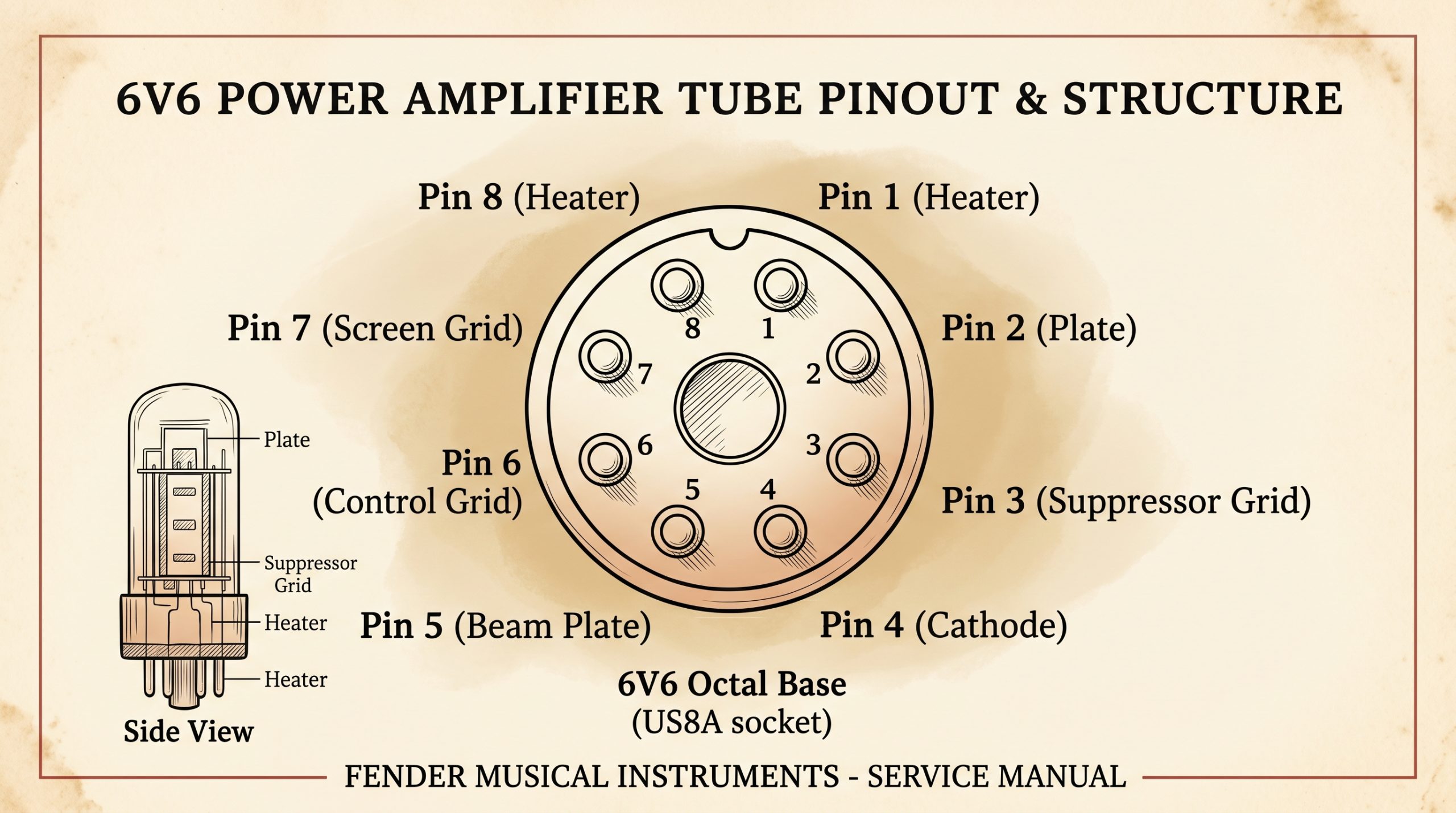
6V6 Tube Specifications
The following specifications are drawn from the RCA RC-30 Receiving Tube Manual, which remains the canonical reference for this tube family, cross-referenced against original Tung-Sol and GE datasheets available through period tube documentation archives.
| Parameter | Typical Value | Notes |
|---|---|---|
| Heater Voltage | 6.3V AC/DC | Standard octal heater |
| Heater Current | 450 mA | Per tube |
| Max Plate Voltage | 315V | Absolute max 350V on some rated variants |
| Max Screen Voltage | 285V | Per Tung-Sol original spec |
| Max Plate Dissipation | 14W | With convection cooling |
| Max Screen Dissipation | 2.2W | |
| Transconductance (Gm) | ~3,900 µmhos | Typical operating point |
| Plate Resistance (Rp) | ~22.5 kΩ | |
| Amplification Factor (µ) | ~87 | Estimated |
| Typical Output (SE) | ~5W | Single-ended, Class A |
| Typical Output (PP) | 14W | Push-pull, Class AB |
| Bias (SE, Champ 5F1) | 15–17 mA idle | Cathode-biased, 470Ω resistor |
| Bias (PP, Deluxe Reverb AB763) | 22–26 mA/tube | Fixed bias, ~-13 to -15V on G1 |
| Base | 8-pin Octal (US8A) | |
| Envelope | GT (Glass Tubular) | ~40mm diameter |
One important callout: the JJ 6V6S is designed to handle plate voltages above the standard 315V rating more reliably than most of its current-production competitors. JJ rates it slightly higher than the standard spec in practice, which is a meaningful advantage in Deluxe Reverb circuits where measured plate voltage routinely reaches 415–430V. More on that in the bias section below.
The 6V6 in Fender Amplifiers: Circuit-by-Circuit Breakdown
This is where things get specific. No other resource consistently ties 6V6 tube selection back to the actual circuit codes, production years, and operating conditions Fender used. That context matters because a Champ 5F1 and a Deluxe Reverb AB763 are both “6V6 amps,” but they treat the tube very differently.
Single-Ended 6V6: The Fender Champ
The Champ used a single 6V6GT in a cathode-biased, single-ended Class A output stage across its entire production run. Circuit codes progressed from 5C1 (1953–54) through 5D1 (1954–55), 5E1 (1955–56), and finally 5F1 (1957–1981), which became the most produced version and the template for modern reissues. You can verify the full production chronology using the Fender tube amp serial number and dating guide.
The 5F1 runs a 470Ω cathode resistor, setting idle current at roughly 15–17 mA. No bias adjustment is required. The cathode resistor does the work automatically. Plate voltage measures approximately 305V on a healthy specimen, comfortably within the tube’s rated limits. This is why Champs are comparatively gentle on 6V6s: the operating point is conservative, and tubes often last 3,000+ hours. Original speaker complement was a 6-inch Jensen P6V in early models, transitioning to an 8-inch Oxford or Jensen P8R in the 5F1. Output is approximately 5W RMS. For a complete look at the model history and circuit variants, the Fender Champ guide covers all versions in detail.
Push-Pull 6V6: The Fender Princeton and Princeton Reverb
The tweed Princeton used circuit code 5F2-A from 1956 to 1961 with cathode bias on a push-pull pair, producing around 4–5W. The blackface Princeton Reverb switched to fixed bias and a new circuit, AA1164, running from 1964 to 1967. The silverface AB1270 followed from 1968 to 1981.
The blackface AA1164 Princeton Reverb runs a push-pull 6V6 pair at approximately 12W RMS with a 10-inch Oxford or Jensen speaker. Fixed-bias circuits require re-biasing after every tube swap. The operating voltage on the Princeton Reverb is somewhat more manageable than the Deluxe Reverb, making it slightly less aggressive on tube longevity. The Fender Princeton Reverb guide covers the AA1164 and AB1270 circuits in full.
Push-Pull 6V6: The Fender Deluxe and Deluxe Reverb
The tweed Deluxe used circuit code 5E3 from approximately 1955 to 1960, running cathode bias and producing 15W from a push-pull 6V6 pair. This is a completely different animal from the blackface circuits: it compresses early, has a loose low end, and breaks up in a way that players have spent decades chasing.
The blackface Deluxe Reverb circuits (AA763, then AB763) run fixed bias and represent the most common 6V6 circuit you’ll encounter in the used market. The AA763 was produced in 1963–1964; the AB763 ran from 1964 through approximately 1967 and is the most discussed version. The silverface era followed from 1968, with early silverface units (1968–1971) retaining the AB763 circuit before transitioning to further circuit revisions. Production continued through 1981. Output is typically cited at 20–22W RMS with a 12-inch Jensen C12N (blackface) or Oxford (silverface). For the full reference on these circuits, the Fender Deluxe Reverb guide covers dating, circuit differences, and speaker history.
Here’s the critical detail that shortens tube life in Deluxe Reverbs: measured plate voltage on AB763 units routinely comes in at 415–430V, well above the 6V6GT’s 315V comfort rating and above the absolute maximum of 350V stated in many datasheets. Fender ran these tubes hard. Original production units survived it for two reasons: NOS tubes from RCA and GE were built with tighter tolerances and better materials, and players weren’t gigging their amps five nights a week. If you’re replacing tubes in a Deluxe Reverb today, this plate voltage reality is why the JJ 6V6S has built such a following. It’s engineered for it.
6V6 Tube Equivalents and Substitutes
Direct Equivalents and Military Designations
The 6V6GT designation is consistent across virtually all current-production brands. JJ calls their version the “6V6S” for manufacturing reasons, but it drops directly into any standard 6V6GT socket. No circuit changes, no socket adapters. Just swap and bias.
British military equivalents CV511 and CV509 (Genalex and Mullard production respectively) are electrically equivalent and highly collectible. The Soviet designation 6P6P (6П6П in Cyrillic) refers to the same tube built in Russian and Eastern European factories. Soviet NOS 6P6P tubes from the 1960s and 1970s represent decent value for players who want NOS character at lower prices than RCA or GE.
Military U.S. variants 6V6WGTA and 6V6WGTB are ruggedized drop-ins. The 7408 is rarer and commands a premium among collectors. The early globe-bottle 6V6G fits the octal socket but has a larger envelope diameter. Check chassis clearance before installing one in a Champ or Princeton chassis. Tight fit. Not always possible.
Near-Substitutes: What Won’t Work (and Why)
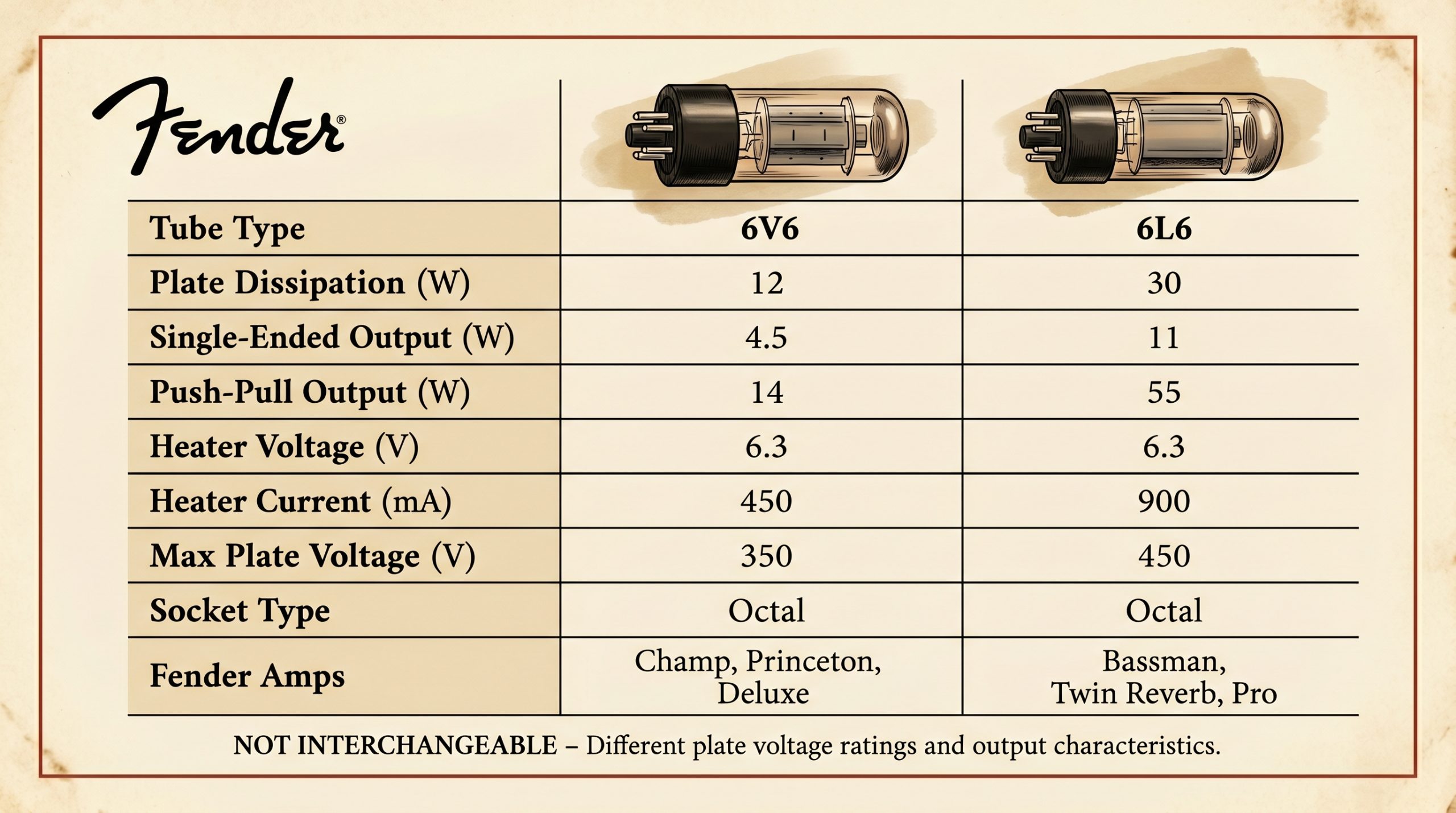
The 6L6GC shares the octal base with the 6V6. That’s where the interchangeability ends. The 6L6GC has a 30W plate dissipation rating, different screen voltage requirements, and a completely different operating bias point. Dropping one into a 6V6 circuit without modifying the power supply and bias network risks destroying the output transformer and the tube simultaneously. Not worth it.
The EL34 is an octal-base tube but uses a different pin configuration and completely different operating parameters. Not a swap. The EL84 is a 9-pin Noval base tube, physically incompatible. Here’s a clear reference comparison:
| Tube | Type | Max Plate Dissipation | Typical PP Output | Base | Classic Fender Use |
|---|---|---|---|---|---|
| 6V6GT | Beam Tetrode | 14W | 14W | Octal (US8A) | Champ, Deluxe, Princeton |
| 6L6GC | Beam Tetrode | 30W | 50–60W | Octal (US8A) | Super Reverb, Twin Reverb, Bassman |
| EL34 | Pentode | 25W | 35–50W | Octal (B8G) | Not standard Fender (Marshall, Hiwatt) |
| EL84 | Pentode | 12W | 17W | Noval (9-pin) | Not Fender (Vox AC15/AC30) |
The 6L6 vs. 6V6 question comes up constantly. For a detailed side-by-side treatment of both tubes across Fender circuits, the 6L6 tubes guide covers the Twin Reverb and Bassman side of the equation.
Best 6V6 Tubes: Ranked for Guitar Amplifiers
The evaluations below are based on documented user and technician feedback cross-referenced with build specifications, as reported across tube supplier reviews, amp tech forums, and manufacturer documentation. Test context: blackface Deluxe Reverb (AB763), Champ 5F1 reissue, single-coil and humbucker sources. Rated on clean headroom, breakup character, low-end tightness, reliability, and price-to-performance.
1. Tung-Sol 6V6GT (New Sensor / Reflektor): Best Overall
The current-production Tung-Sol 6V6GT is manufactured at the Reflektor factory in Saratov, Russia, under the New Sensor Corporation umbrella. The smoked glass envelope and robust internal structure make for a good-looking tube, but what matters is how it behaves at operating temperature.
Tone character is smooth, with overdrive that leans toward cream rather than crunch. Detailed highs without ice-pick treble. Controlled low end that doesn’t get flabby when pushed. In a Deluxe Reverb, the breakup is progressive and harmonically rich. The Tung-Sol handles the elevated plate voltage of AB763 circuits reasonably well, though it won’t outlast a JJ in that environment. Matched pairs are widely available from reputable suppliers. Pricing runs approximately $25–$30 per single tube, $50–$60 for a matched pair.
If there’s a weakness, it’s that players who want aggressive, spanky attack in a Princeton or Champ may find the Tung-Sol a touch polite. It’s a tube for players who want touch sensitivity and musical breakup, not a tube that barks when pushed hard from the jump.
2. JJ 6V6S: Most Reliable for High-Voltage Circuits
JJ Electronic, based in Čadca, Slovakia, produces the 6V6S (their designation for what is functionally a 6V6GT). The construction is noticeably heavier than competing brands. Thicker glass, more robust internal metalwork. That build quality translates to longevity, particularly in the 415–430V plate voltage environment of an AB763 Deluxe Reverb.
Tone character is punchy with a harder breakup edge than the Tung-Sol. Tighter low end. Slightly brighter top end. Some players describe the JJ as having a more “solid-state feel,” meaning it doesn’t compress and sag the way NOS tubes do. That’s a fair observation. But for a working amp that needs to survive three sets at 11 PM on a Thursday, that reliability matters more than vintage sag.
The JJ 6V6S Double-Mica variant adds extra mica spacers to reduce microphonics. Worth the small price premium for combo amps, where speaker-induced vibration can make a microphonic output tube audible as a ringing or singing resonance at certain frequencies. Not great in a combo without it. Very solid with it. Pricing: standard JJ 6V6S runs approximately $20–$25 per single; Double-Mica version approximately $25–$30. Matched pairs at $40–$50 for standard.
3. Electro-Harmonix 6V6EH: Budget Pick for Bright and Bold Applications
Also produced by New Sensor (same parent company as the Tung-Sol line, different voicing), the Electro-Harmonix 6V6EH runs brighter and more aggressive than the Tung-Sol. Clean headroom is good in single-ended configurations. It has presence and cut in a Champ-style amp where you want the single-coil to slice through a mix.
The trade-off is consistency. QC varies batch-to-batch more than JJ or Tung-Sol. Buy matched pairs from a supplier who publishes their test methodology and match tolerance. Pricing around $18–$22 per single makes it the value option in the current-production lineup. Worth it if you’re on a budget and replacing tubes in a practice amp. Less compelling in a studio Deluxe Reverb where you’re investing in tone.
4. Genalex Gold Lion CV511 / 6V6GT: Premium Tone Choice
The Genalex Gold Lion brand was revived by New Sensor and targets the premium segment. Gold pins, careful build quality, and a voicing that sits closer to British NOS character than any other current-production 6V6. Warm, harmonically rich, with a three-dimensional quality in push-pull circuits that other current-production tubes don’t quite match.
In a Deluxe Reverb or Princeton Reverb, the Gold Lion CV511 is the current-production choice for players who prioritize tone over budget. Pricing runs approximately $35–$45 per single, making matched pairs an investment. If your amp is going nowhere near a stage and you just want it to sound as good as possible, this is the tube. Not cheap. Worth it for the right application.
5. TAD 6V6GT-STR Redbase: Best NOS Replica
Tube Amp Doctor in Germany sources tubes from Reflektor but applies its own specification overlays and quality control. The 6V6GT-STR Redbase is designed explicitly to replicate the tonal character of RCA and GE NOS tubes using modern production methods. Balanced across the frequency spectrum, it doesn’t emphasize any particular characteristic but sits in the same ballpark as original Sylvania and GE gray plates.
The 6V6GTB-STR variant uses a smoked glass envelope, a visual and partial tonal nod to 1950s and 1960s Tung-Sol blackplate construction. TAD’s matching tiers are well-documented and consistent. Pricing starts around €34.90 for standard singles, up to €72.80 for premium matched variants. For vintage-accurate restorations or studio amps where you want NOS character without paying NOS prices, TAD is a strong option. Check the current catalog at Tube Amp Doctor’s official site.
NOS 6V6 Tubes: Are They Worth It?
For a touring amp that gets thrown in a van every weekend, current-production JJ or Tung-Sol makes more practical sense. NOS tubes are finite and irreplaceable. Using them in a circuit that runs 420V plate voltage is a calculated risk.
For a studio amp or a prized blackface Deluxe Reverb that you’re treating carefully, NOS RCA or GE is worth the premium. RCA 6V6GT blackplates fetch $90–$150 per tube (2026 market; tested ANOS examples from $80). GE gray plates run $30–$60 and offer a slightly cleaner, less colored sound. Sylvania 6V6GT tubes are articulate and detailed, approximately $100–$130 per tube (2026 market), excellent for studio use. Original Tung-Sol blackplate NOS from the 1950s is collectible and commands accordingly. Buy from established dealers who publish test results. Counterfeit NOS tubes, relabeled Chinese stock sold as American vintage production, are common enough on eBay and unvetted marketplace sellers to treat all “NOS” listings with healthy skepticism.
6V6 Tube Comparison Table: Current Production at a Glance
| Brand/Model | Tone Character | Best Application | Build Quality | Price (Single, approx.) | Buy Matched? |
|---|---|---|---|---|---|
| Tung-Sol 6V6GT | Smooth, creamy, harmonically rich | Deluxe Reverb, Princeton Reverb | Good | ~$27 | Yes (PP circuits) |
| JJ 6V6S | Punchy, tight, handles high voltage | Deluxe Reverb (high B+), combo amps | Excellent | ~$22 | Yes (PP circuits) |
| JJ 6V6S Double-Mica | Same as JJ + reduced microphonics | Combo amps, live use | Excellent | ~$27 | Yes |
| EH 6V6EH | Bright, aggressive, high headroom | Champ, bright amp applications | Fair–Good | ~$20 | Yes (PP circuits) |
| Genalex Gold Lion CV511 | Warm, 3D, premium character | Studio amps, premium rigs | Excellent | ~$40 | Yes |
| TAD 6V6GT-STR | Balanced, NOS-like voicing | Vintage-accurate restorations | Excellent | ~$38 | Yes |
How to Buy 6V6 Tubes: Matched Pairs and What to Avoid
Matching matters in push-pull circuits. In a balanced output stage like the AB763 Deluxe Reverb or AA1164 Princeton Reverb, the two output tubes pull current on opposite halves of the AC signal. If one tube draws significantly more current than the other, the result is asymmetric distortion, increased hum from the output transformer, and accelerated drift on the shared bias adjustment. A properly matched pair draws within ±1 mA of each other at a defined test point. That’s the standard reputable dealers use.
In a single-ended amp like the Champ 5F1, matching is irrelevant. There’s one tube. Buy a strong, healthy specimen from a seller who publishes the plate current measurement. That’s all you need.
Quad sets of 6V6 tubes are rarely relevant for Fender circuits, which use two output tubes in virtually all configurations. Quads are applicable for some boutique builders who run four 6V6s in Class AB. If you’re buying for a standard Fender, order a matched pair.
Red flags when buying: house-brand tubes sold without a stated match tolerance; sellers who describe tubes as “tested good” without publishing the measurement methodology or operating point used for testing; any “NOS” listing on an unvetted platform without tube tester output or documentation. Reputable suppliers for matched current-production 6V6 tubes include The Tube Store and TubeDepot, both of which publish their matching methodology.
Always re-bias your amp after installing new 6V6 power tubes, even if the tubes are rated as matched. Match tolerance tells you the tubes are close to each other. It doesn’t tell you they’ll idle at the same point as the set you just pulled. The bias pot needs to be set for the new tubes.
Biasing 6V6 Tubes in Fender Amplifiers: Key Numbers
Self-Biased Circuits: Champ 5F1 and Tweed Deluxe 5E3
Cathode-biased circuits don’t require manual adjustment. The cathode resistor sets the operating point automatically as the tube draws current. In the 5F1 Champ, the cathode resistor is 470Ω, setting idle current at approximately 15–17 mA. The 5E3 tweed Deluxe uses a different cathode resistor value and runs both output tubes off a shared cathode arrangement, which is part of why it has that characteristic spongy compression and asymmetric breakup.
If tone changes dramatically in a cathode-biased amp after replacing the tube, or if the tube runs red, suspect the cathode resistor and its bypass capacitor before assuming the tube is bad. Both components age and drift. Replace the resistor, replace the cap, install the new tube. In that order.
Fixed-Bias Circuits: Deluxe Reverb AB763 and Princeton Reverb AA1164
Fixed-bias circuits require manual adjustment after every tube swap. Full stop. The bias trim pot is located on the underside of the chassis in most Fender configurations, a single pot that adjusts the negative voltage applied to the control grids of both output tubes simultaneously.
Target idle current for AB763 Deluxe Reverb: approximately 22–26 mA per tube. Many technicians use 25 mA as a balanced warm bias target. To measure, use a bias probe (a socket adapter with a milliamp meter in series) or measure the millivolt drop across a 1Ω cathode resistor (1 mV across 1Ω equals 1 mA by Ohm’s Law). The negative grid bias voltage will typically sit around -13 to -15V at the correct current draw.
The plate voltage issue deserves a direct warning. AB763 Deluxe Reverb units routinely measure 415–430V at the plate. The RCA RC-30 manual rates the 6V6GT at 315V comfortable operating voltage with an absolute maximum of 350V in many datasheet versions. Fender ran these tubes above spec, which is why tube longevity in a gigged Deluxe Reverb varies so dramatically. Expect 1,000–2,000 hours of use in a high-B+ AB763 before the tubes start drifting. A conservatively run Champ 5F1 at 305V plate voltage will often see 3,000 hours or more from the same brand of tube. The amp you own determines the tube life you get. That’s the honest answer.
For preamp tube rolling guidance in the same amps, the 12AX7 tubes buyer and replacement guide covers every preamp tube position in blackface and silverface Fender circuits.
Which 6V6 Should You Choose
The 6V6 has a narrower power range than the 6L6 and a more limited set of applications, but within those applications, it’s the entire sound. From a 5-watt Champ’s warm, touch-sensitive single-ended output to a Deluxe Reverb pushing 22 watts of fixed-bias push-pull through a Jensen 12, this tube defines what small Fender amplifiers sound like. For most players, the Tung-Sol 6V6GT is the right call for tone, and the JJ 6V6S is the right call for longevity in a high-voltage circuit. NOS RCA or GE is the right call if you’re building a studio reference amp and you’re willing to source carefully. Whatever you choose, buy from suppliers who publish their match testing methodology, always re-bias a fixed-bias amp after installing new tubes, and keep an eye on the plate color the first few hours after a tube swap. That covers the basics. Everything beyond that is in the circuit.
Frequently asked questions
What is the difference between a 6V6 and a 6L6 tube?
The 6V6GT has a 14W plate dissipation rating and produces approximately 5W in single-ended or 14W push-pull configurations. It operates at plate voltages in the 250–315V range by specification. The 6L6GC has a 30W plate dissipation rating, produces 50–60W push-pull, and operates at significantly higher plate voltages. The 6V6 powers Fender's small-wattage amps: Champ, Princeton, Deluxe Reverb. The 6L6 powers the larger lineup: Super Reverb, Twin Reverb, Bassman. They share the octal socket but are not interchangeable without circuit modification.
Can I use a 6L6 instead of a 6V6?
Not without significant circuit modifications. The two tubes share an octal base, which creates a false sense of interchangeability. Operating bias points, screen voltage requirements, and expected plate current draw differ substantially. Dropping a 6L6GC into a circuit designed for 6V6s without adjusting the power supply and output transformer loading risks transformer damage and immediate tube failure. Some boutique builders design switchable 6V6/6L6 circuits with appropriate accommodations for both tube types, but that's a design intent built in from the start, not a field swap.
What is the best 6V6 tube for a Fender Deluxe Reverb?
For smooth harmonic breakup and musical overdrive, the Tung-Sol 6V6GT is the top current-production choice. For reliability in the AB763's elevated plate voltage environment (415–430V), the JJ 6V6S is the more practical pick for a gigged amp. For a studio amp or a carefully maintained blackface Deluxe Reverb, NOS RCA or GE gray plate tubes deliver the most authentic blackface tone. Always buy a matched pair. Always re-bias after installation.
How long do 6V6 tubes last?
Lifespan ranges from roughly 1,000 to 5,000 hours depending on operating voltage and bias point. In an AB763 Deluxe Reverb running 415–430V plate voltage, realistic expectations are 1,000–2,000 hours. In a Champ 5F1 at 305V with cathode bias, 3,000+ hours is common. Signs that output tubes are nearing end of life include glowing red plates (catastrophic bias drift), loss of output power, increased hum, and intermittent flashing inside the envelope. Red-plating is an emergency. Turn the amp off immediately if you see it.
What does "GT" mean in 6V6GT?
"GT" stands for Glass Tubular, describing the envelope shape. The tubular glass bottle is narrower and more cylindrical than the earlier globe-bottle "G" type, which has a rounder, bulbous envelope. Both types use the same octal socket and are electrically equivalent. The practical difference is physical clearance: a 6V6G (globe) has a larger-diameter envelope that may not fit in chassis with tight tube spacing. All current-production 6V6 tubes use the GT envelope. The globe type is NOS only and relatively rare.