Contents
- 01What Is the Fender Super Reverb?
- 02Fender Super Reverb History and Production Timeline
- 03Fender Super Reverb Specs: Complete Technical Reference
- 04The 4x10 Sound: Why the Super Reverb Sounds the Way It Does
- 05Famous Players and the Super Reverb's Musical Legacy
- 06Fender Super Reverb Variants and Related Models
- 07Buying a Fender Super Reverb: Vintage vs. Reissue vs. Digital
- 08Modifying and Maintaining Your Super Reverb
- 09Frequently Asked Questions About the Fender Super Reverb
- 10Is the Fender Super Reverb Right for You?
What Is the Fender Super Reverb?
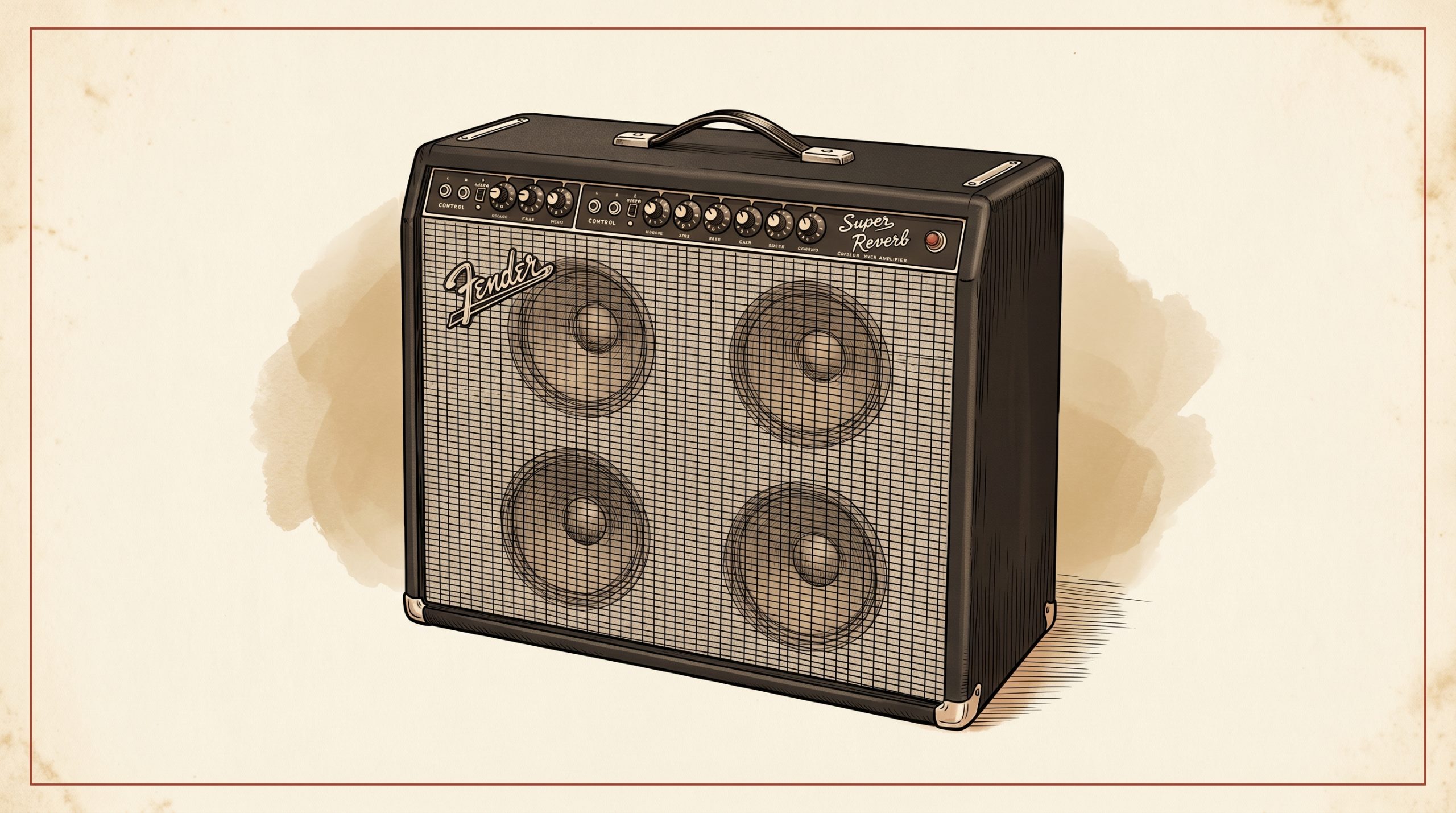
The Super Reverb is a two-channel, 40-watt combo with a Normal channel and a Vibrato channel. The “vibrato” label on the panel is Fender’s persistent misnomer. It’s tremolo. True vibrato (pitch modulation) wasn’t part of the circuit. The Vibrato channel carries all the good stuff: reverb, speed, intensity controls for the tremolo effect, and two inputs for high and low sensitivity. The Normal channel gets volume, treble, and bass. That’s it. Simple. Effective.
The amp’s lineage traces directly to the tweed-era 4×10 Bassman (circuit 5F6-A), which Fender produced through 1960. The blackface Super Reverb took that same four-10-inch speaker format into the reverb era, adding the onboard spring tank and the AB763 circuit that defined Fender’s most collected output stage. The Super Reverb isn’t just a Pro Reverb with extra speakers bolted in. The speaker load, the output transformer winding, and the acoustic coupling behavior of four cones working together make it a genuinely distinct instrument.
How the Super Reverb Fits in the Fender Combo Lineup
Here’s where the Super Reverb sits in the AB763 blackface hierarchy, comparing the primary specs across the reverb-equipped combos of the mid-1960s:
| Model | Watts | Speakers | Rectifier | Circuit |
|---|---|---|---|---|
| Princeton Reverb | 12W | 1×10 | 5U4GB | AA1164 |
| Deluxe Reverb | 22W | 1×12 | 5AR4 | AB763 |
| Vibrolux Reverb | 35W | 2×10 | GZ34 | AA964 |
| Super Reverb | 40W | 4×10 | GZ34/5AR4 | AB763 |
| Pro Reverb | 45W | 1×15 | 5U4GB | AA165 |
| Twin Reverb | 85W | 2×12 | Solid-state | AB763 |
The Super Reverb and Pro Reverb share nearly identical chassis and circuit topologies. Both run two 6L6GC output tubes and virtually the same preamp layout. The speaker configuration is the primary differentiator. A single 15-inch cone delivers extended low-end reach and a rounder midrange. Four 10-inch cones, wired series-parallel to a 2-ohm load, produce a tighter, more articulate bass response with faster transient attack and a more complex midrange character driven by inter-speaker acoustic coupling.
Fender Super Reverb History and Production Timeline
The Super Reverb ran from 1963 to 1982 across four distinct circuit generations. Understanding which circuit you’re dealing with matters for both tone and collector value.
Pre-CBS Blackface Era (1963-1965): Circuits AA763 and AB763
Fender introduced the Super Reverb in the 1963 catalog alongside the Vibroverb and other new reverb-equipped models. The very first examples used the AA763 circuit, a short production run from mid-1963 that’s genuinely rare today. By late 1963 and into early 1964, Fender revised the circuit to AB763. That’s the version everyone talks about.
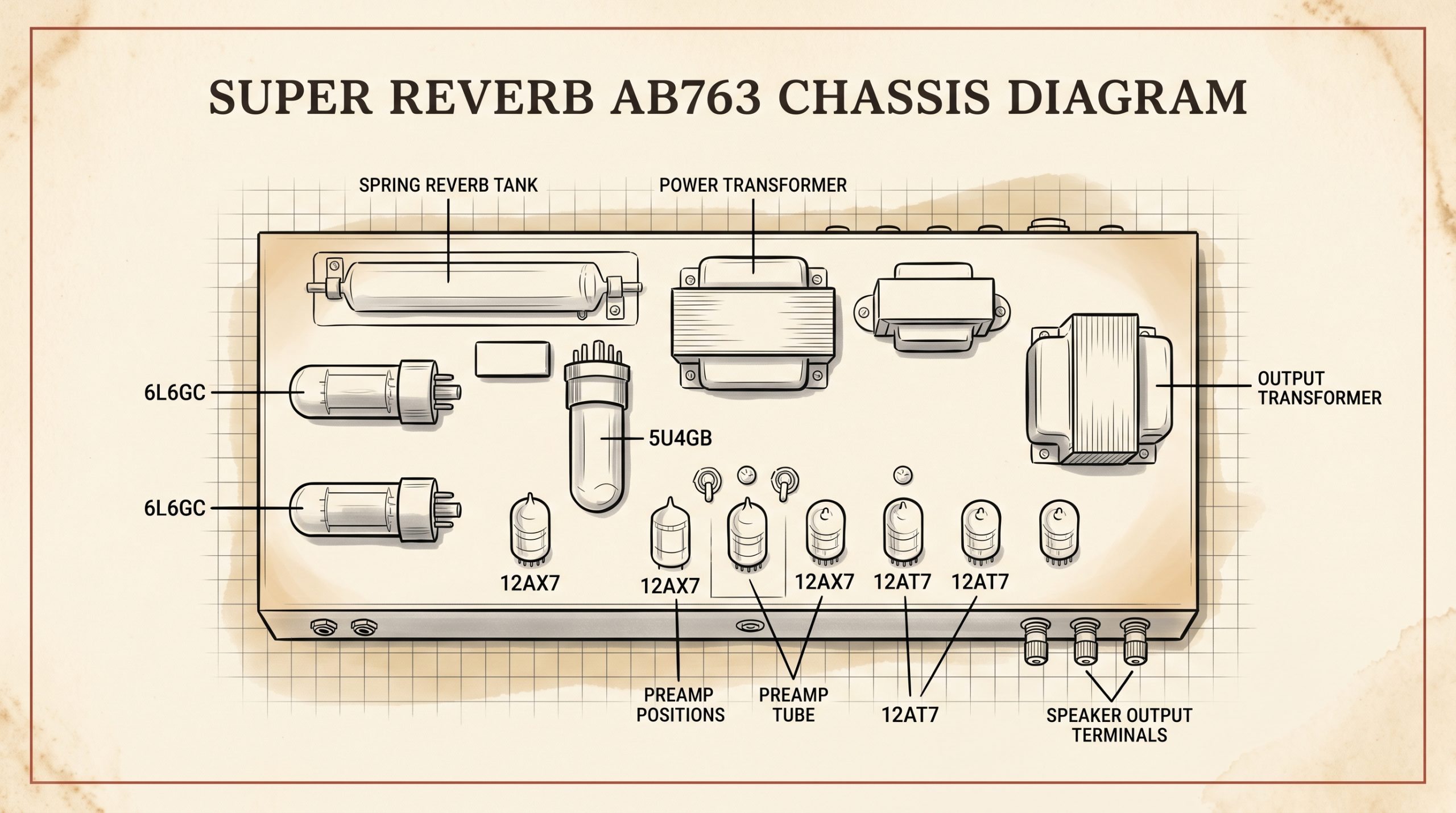
The canonical blackface Super Reverb tube complement: four 12AX7s in the preamp, two 12AT7s handling the reverb driver and phase inverter, two 6L6GCs in the output stage, and a GZ34 (5AR4) tube rectifier. That rectifier matters. It introduces voltage sag under load, a soft compression that feels like the amp is breathing with your playing. The output transformer is the 125A9A (Schumacher EIA code 606), wound for a 2-ohm primary load. Original speakers were Jensen C10N units, 8 ohms each, wired series-parallel to present that 2-ohm load to the transformer.
The “Blue Molded” Ajax coupling capacitors are characteristic of the blackface preamp. Carter Vintage’s listing documentation on a 1965 example specifically calls these out as intrinsic to the blackface sound. Don’t replace them unless they’re actually failing. Many technicians recap everything on sight. Unnecessary on these caps if they’re measuring correctly.
Original catalog price for a Super Reverb in 1965 was approximately $549.50. That bought you 40 watts, spring reverb, tremolo, and four Jensens. Not a bargain at the time. Absolutely one in retrospect.
To confirm whether a blackface-era example is genuine, the Fender tube amp dating guide covers transformer EIA codes, tube chart date stamps, and chassis stamp conventions across the full production run. Cross-reference the EIA code 606 on Schumacher transformers against the tube chart date before drawing any conclusions about originality.
The CBS Transition and Late Blackface (1965-1967)
CBS acquired Fender in January 1965. The Super Reverb circuit didn’t change immediately. Examples from 1965, 1966, and 1967 continued on the AB763 circuit with the same tube complement and output transformer. Cosmetically, they’re still blackface: black control panel, knobs with chrome tops, and the familiar silver-gray grille cloth.
Collector value for 1966 and 1967 examples tracks close to pre-CBS production. Circuit-identical. The primary variable is component sourcing: Jensen C10N speakers began giving way to Oxford 10L6 and CTS ceramic units from roughly mid-1965 onward. Those CTS alnico speakers, when original and intact, are a significant part of the amp’s tonal identity. Confirmed forum discussion among vintage dealer community consistently identifies original CTS alnicos as the right speaker for blackface Super Reverb tone. Don’t swap them unless they’re genuinely damaged.
Power transformer date codes to watch on these transitional units: EIA code 606 indicates Woodward-Schumacher. Other manufacturer codes you’ll encounter on Fender amps of this era include 776 (Triad) on transformers and 220 (Jensen), 137 (CTS), 465 (Oxford), and 285 (Rola) on speakers. The output transformer 125A9A from this period is factory-correct. Replaced output transformers are common on amplifiers that were gigged hard, and they affect both value and tone.
Silverface Era (1968-1982): Circuits AA270, AC568, and Beyond
The 1968 cosmetic refresh is immediately visible: brushed aluminum grille frame, silver grille cloth, and a “drip edge” transition piece running along the top of the cabinet. That drip edge appeared only on 1968 models and is a specific collector marker. Early silverface. Still desirable.
Circuit changes tracked with the cosmetic shift, but not uniformly:
- AA270 (1968-1969): The tube rectifier stayed, though Fender switched from GZ34 to 5U4GB on the silverface circuits. Sag and dynamic feel remain in the ballpark of the blackface, just with slightly more sag and a softer attack character. Some collectors consider early AA270 drip-edge examples tonally competitive with late AB763 production.
- AC568 (1969-1971): Solid-state diode rectifier replaced the tube. This is the change that players feel most acutely. Harder attack. Tighter low end. Less sag. Not worse, but different. Stiff bass response that suits certain playing styles well.
- 1972 onward: Master volume added (around 1974). Ultralinear output transformer introduced on some variants. Pull-boost switches appeared on later production. More controls, more options, less of the original simplicity.
The 1973 Super Reverb (a commonly searched year) falls in the solid-state rectifier, master volume era. Tonally a different experience from a 1965 AB763, but not without its own character, and considerably cheaper on the current market.
Fender discontinued the Super Reverb in 1982, roughly concurrent with the shift toward the Red Knob series and later platform changes.
| Years | Circuit | Rectifier | Master Vol | Approx. Output | Notes |
|---|---|---|---|---|---|
| 1963 | AA763 | GZ34/5AR4 tube | No | 40W | Rare, short production run |
| 1963-1967 | AB763 | GZ34/5AR4 tube | No | 40W | Canonical blackface, most sought-after |
| 1968-1969 | AA270 | 5U4GB tube | No | 45W | Drip-edge cosmetics, tonally near blackface |
| 1969-1971 | AC568 | Solid-state | No | 45W | Harder attack, less voltage sag |
| 1972-1982 | Various | Solid-state | Yes | 45W | Ultralinear variants, pull-boost switches |
Fender Super Reverb Specs: Complete Technical Reference
These specifications apply to the blackface AB763 circuit, the benchmark configuration. Silverface variants are noted where they diverge.
Blackface AB763 Full Specifications
| Parameter | Specification |
|---|---|
| Power output | 40W RMS (into 2-ohm load at clip) |
| Output tubes | 2x 6L6GC (fixed bias) |
| Preamp tubes | 4x 12AX7, 2x 12AT7 |
| Rectifier | GZ34/5AR4 (tube, blackface AB763); 5U4GB (silverface AA270/AB568); solid-state diodes (silverface post-1969) |
| Speaker configuration | 4x 10-inch, 8 ohms each, series-parallel = 2-ohm load |
| Original speakers | Jensen C10N (1963-1965), Oxford 10L6 / CTS alnico (mid-1965 onward) |
| Cabinet type | Open-back, pine |
| Output transformer | 125A9A (Schumacher, EIA 606) |
| Channels | 2 (Normal, Vibrato) |
| Controls (Vibrato ch.) | Volume, Treble, Bass, Reverb, Speed, Intensity |
| Controls (Normal ch.) | Volume, Treble, Bass |
| Inputs | 4 total (2 per channel: high and low sensitivity) |
| Weight | ~62-68 lbs depending on year and speaker complement |
| Cabinet dimensions | Approx. 26″ W x 20″ H x 10.5″ D |
| Speaker impedance selector | None. Fixed 2-ohm load. |
| Bias target | ~35mA per tube at ~460V plate voltage (per AB763 service manual) |
The weight is real. Sixty-two pounds minimum. Some examples with CTS speakers and period hardware push closer to 68. That number comes up constantly in vintage amp discussions, and it’s not exaggerated. Plan for a two-person load-in or invest in a decent amp cart if you’re gigging one regularly.
Where to Find the Fender Super Reverb Schematic
The AB763 schematic is available through Fender’s official service documentation archive. The circuit reveals several important topological choices: a long-tailed pair phase inverter, a cathode follower reverb driver stage, and an optocoupler-based tremolo circuit. The tremolo optocoupler is what produces the rhythmic volume modulation and, on older units, occasional ticking when the optocoupler ages. Carter Vintage’s documentation on a 1965 example specifically notes an added cap on the tremolo optocoupler as a common repair for this issue.
One point worth understanding: the AB763 schematic is shared across multiple Fender models. The Deluxe Reverb, Pro Reverb, and Super Reverb all use the AB763 topology. The differences lie in the output stage component values, power supply ratings, and speaker loads. Swap the output transformer and speaker configuration, and you’re tracing essentially the same preamp circuit across all three amps. That’s useful to know when sourcing replacement parts or comparing service documentation. You can cross-reference schematicheaven.net’s Fender service manual archive for the full AB763 drawing, available at schematicheaven.net.
The Fender amp dating cheatsheet is also useful here, particularly for cross-referencing transformer codes and production dates against the schematic revision you’re looking at.
The 4×10 Sound: Why the Super Reverb Sounds the Way It Does
Four 10-inch speakers aren’t simply “more” than one 12-inch. The physics are different enough to matter.
Total cone area is the starting point. Four Jensen C10N cones at roughly 78 square inches each give you approximately 314 square inches of total radiating surface. A single 12-inch speaker sits around 113 square inches. More air moved collectively, at lower excursion per cone, means the Super Reverb can produce high SPL with each individual speaker working well below its excursion limit. That translates to less distortion at moderate volumes and a cleaner headroom characteristic than a single larger speaker at the same power level.
Resonant frequency is the second piece. A typical 10-inch guitar speaker exhibits a free-air resonant frequency (Fs) in the 80-130Hz range depending on cone weight and surround stiffness. A 12-inch speaker commonly resonates in the 75-105Hz range. On average the 10-inch Fs sits higher, which contributes to the Super Reverb’s characteristic tight, punchy low end. It’s not thin. But it doesn’t have the deep, round low-frequency extension of a 1×15 Pro Reverb or a 2×12 Twin. The bass response is controlled, articulate, and immediate. Perfect for chord-melody work or single-note lines that need definition in a band context.
Cone breakup on a 10-inch speaker occurs at lower SPL than a 12-inch of comparable construction. That’s the source of the amp’s characteristic “hair” at moderate volume settings. Not full-on distortion. A complexity. A slight softening of the transient that makes single-note lines feel three-dimensional without losing clarity.
The open-back cabinet adds a rear-firing wave that interacts with room boundaries and creates a broader, more diffuse dispersion pattern than a closed-back design. Four speakers in close proximity also exhibit acoustic coupling effects that reinforce certain midrange frequencies differently than a single driver. The net result is a room-filling presence that players describe as the amp sounding bigger than its power rating suggests it should. Not wrong.
Speaker choice shifts the character noticeably. Jensen C10N originals deliver a clear, present top end with moderate bass weight. CTS alnico units run slightly warmer, with a more compressed breakup character. Oxford 10L6 ceramics are brighter and more aggressive. Any of these can be the “right” speaker depending on what you’re playing. If the originals are intact and functional, leave them alone.
Famous Players and the Super Reverb’s Musical Legacy
Stevie Ray Vaughan added a pair of Super Reverbs to his rig in 1983 to handle larger venues, running them alongside his Fender Vibroverb combos and Dumble Steel String Singer head. His amp tech Cesar Diaz replaced the stock Jensens with Electro-Voice speakers to handle Vaughan’s playing volume. That spongy compression of the Vibroverb’s 15-inch paired with the articulate midrange bark of the 4×10 helped define the Texas blues guitar sound of the mid-1980s. His dynamic picking technique maximized the amp’s sensitivity to attack variation in a way that amplifiers with less headroom couldn’t replicate.
Buddy Guy ran a Super Reverb in his early career. Stinging. Loud. The amp handles the sharp, aggressive attack of Chicago blues single-note lines without compressing them into mush at stage volume. Mike Bloomfield used Super Reverbs during the Electric Flag period and into his solo work, favoring the clean-to-edge-of-breakup dynamic range on Stratocaster and Les Paul alike.
Bonnie Raitt has used the amp extensively throughout her career, as has Greg Koch in contemporary work. Johnny Marr and Derek Trucks are also frequently associated with the Super Reverb on stage. Lowell George is often mentioned in Super Reverb discussions, but on the documentary record his primary touring rig from the mid-1970s onward was a custom Howard Dumble Overdrive Special Reverb (later played by Joe Bonamassa in 2024). His own 1976 Guitar Player interview describes the Dumble as “the best one I’ve ever played through” — assume Dumble unless a specific recording explicitly indicates otherwise.
The Super Reverb suits blues and roots-rock players specifically because of three things: dynamic headroom that rewards picking-hand dynamics, onboard reverb with a tube-driven character that’s warmer and less ringy than spring units in smaller Fenders, and speaker breakup that occurs gradually rather than abruptly. It’s a loud amp at minimum usable volume. Not a bedroom amplifier. Stage-loud from the first chord.
Fender Super Reverb Variants and Related Models
Did Fender Make a Super Reverb Head?
No. Fender did not produce a factory Super Reverb head as a standard catalog item. The Super Reverb was produced exclusively in combo format throughout its 1963-1982 run. Some players and shops have converted combo chassis to standalone head format, but these are non-factory modifications that affect both originality and resale value.
The closest factory head equivalents to the Super Reverb circuit in a head configuration are the Dual Showman (AB763-based) and various Bassman head models. The Fender Bassman history covers the shared lineage between the 4×10 tweed platform and the blackface era combos that descended from it. If you need the AB763 circuit in a separates rig, that’s the direction to research.
Fender Super Six Reverb (1970-1979)
Different amp entirely. The Super Six Reverb (circuits AA1069 and variants) was available as both a head and a 1×15 combo, using six 6L6GC output tubes to produce approximately 105 watts. The name similarity with the Super Reverb causes constant confusion in used market listings. They’re not related beyond the “Super” prefix.
The Super Six Reverb operates in a different power class with a different circuit topology. It’s a silverface-era amplifier with cosmetics and component choices from that period. Collectors don’t pursue it on the same trajectory as the blackface Super Reverb, and the tonal character is its own thing rather than a scaled-up version of the 4×10.
Fender Super Twin Reverb (1975-1982)
Another naming collision. The Super Twin Reverb is a 180-watt, 2×12 combo running six 6L6GC output tubes. Not comparable to the Super Reverb beyond sharing the Fender name and the “Super” prefix. The Super Twin Reverb is notable for its onboard distortion circuit, a feature that has no equivalent in the Super Reverb. It’s the most powerful Fender combo ever produced in the standard catalog. Loud enough to cause structural damage. A very different tool.
Fender ’65 Super Reverb Reissue (2001-Present)
Fender introduced the ’65 Super Reverb as part of the reissue series in 2001, following the earlier Deluxe Reverb RI and Twin Reverb RI launches. The circuit targets the AB763 topology with modernized components: a PCB layout rather than the original hand-wired eyelet board construction, current-production capacitors and resistors, and Jensen P10R reissue speakers (8 ohms each, wired series-parallel for the same 2-ohm load). The tube rectifier is a 5AR4 (same tube as the original GZ34, just a different naming convention). Output tubes are 6L6GC, same as the original. At 45 watts into the same speaker configuration, it’s the closest you can get to the blackface experience without buying a vintage example.
The Jensen P10R reissue speaker runs warmer than the original C10N. A bit more rounded in the upper midrange, slightly less present on the top end. Most players find it a reasonable trade for an amp that doesn’t require the maintenance anxiety of a 60-year-old original. The reissue weighs approximately 64 pounds. Same complaint, different decade.
Current street price for a new ’65 Super Reverb Reissue sits at approximately $1,999 (2024). Used examples in good condition typically trade in the $1,200-$1,700 range. Fender’s official specifications page at fender.com confirms the full current production specification.
Fender Tone Master Super Reverb (2021-Present)
Released in August 2021 and still in current production, the Tone Master Super Reverb is a DSP modeling amplifier built around Fender’s proprietary modeling engine rather than licensed technology from Fractal or Kemper. It models a mid-1960s blackface AB763 Super Reverb, specifically.
The practical appeal is straightforward: approximately 36 pounds. Roughly half the weight of any tube version. A 200-watt Class D digital power section drives four Jensen P-10R alnico speakers (the same model used in the tube reissue), with a six-step onboard power attenuator (45W, 22W, 12W, 5W, 1W, 0.5W of emulated tube output) and an XLR DI output with cabinet impulse response simulation for direct-to-PA or recording use without microphones.
The digital reverb and tremolo are accurate. They respond correctly. What’s harder to replicate is the interactive behavior between the tube output stage and the speaker cones under load: the way the speakers themselves contribute texture and compression as they approach excursion limits. That characteristic pushed-speaker saturation is the most technically difficult element to model convincingly. Reviews from Guitar World, Premier Guitar, and MusicRadar generally rate the Tone Master Super Reverb as a genuinely accurate-sounding replication of the blackface tone, with the weight savings as the dominant practical argument. At the ~$999 launch price (with used examples now available at $600-$850), the value case is stronger now than it was at introduction.
| Feature | Original AB763 (1964-67) | ’65 Reissue | Tone Master Super Reverb |
|---|---|---|---|
| Circuit type | Tube, hand-wired eyelet board | Tube, PCB | Digital modeling (DSP) |
| Output tubes | 6L6GC x2 | 6L6GC x2 | None (200W Class D) |
| Rectifier | GZ34/5AR4 tube | 5AR4 tube | None |
| Speakers | Jensen C10N / CTS alnico | Jensen P10R (reissue) | Jensen P-10R Alnico x4 |
| Weight | ~62-68 lbs | ~64 lbs | ~36 lbs |
| Reverb type | Spring (tube-driven) | Spring (tube-driven) | Digital emulation |
| Approx. price (2024) | $2,500-$6,000+ | ~$1,999 new | ~$600-$850 used |
| DI output / attenuation | No | No | Yes (XLR DI + 6-step attenuator) |
Buying a Fender Super Reverb: Vintage vs. Reissue vs. Digital
The vintage market for Super Reverbs is slightly softer than for Deluxe Reverbs and Princeton Reverbs of the same era. The reason is simple: weight and volume. As noted in discussions among the GuitarAmps community, Super Reverbs tend to go for somewhat less than comparably-dated smaller models, purely because fewer players want to deal with a 65-pound amp that’s stage-loud at the first click of the volume knob. That pricing differential is an opportunity for players whose needs the amp actually fits.
Vintage Super Reverb Price Guide (2024 Market Reference)
| Year / Variant | Typical Price Range (2024) | Condition Notes |
|---|---|---|
| 1963-1964 Pre-CBS AB763 | $3,500-$6,000+ | All-original commands full premium |
| 1965-1967 CBS Blackface AB763 | $2,500-$4,500 | Most commonly available vintage examples |
| 1968-1969 Silverface AA270 (drip edge) | $1,500-$2,800 | Drip-edge models at upper range |
| 1970-1975 Silverface | $900-$1,800 | More common, less collector demand |
| 1976-1982 Late Silverface | $700-$1,400 | Master volume; modifiable |
| ’65 Reissue (used) | $1,200-$1,700 | Condition and speaker originality dependent |
| Tone Master (used) | $600-$850 | Current production; strong used market |
What to Inspect When Buying Vintage
Speaker originality is the first thing to check. Pull the back panel and look at the EIA codes stamped on each speaker frame. The three-digit manufacturer code followed by a two-digit year and two-digit week gives you a production date. Speakers dated significantly later than the amp’s tube chart date indicate replacements. Replaced speakers don’t necessarily mean a bad amp, but they reduce originality value significantly and may indicate past overdriving or physical damage.
Transformer codes follow the same EIA format. Schumacher transformers carry the 606 prefix; the less common Triad transformers carry 776. On speakers, expect 220 (Jensen), 137 (CTS), 465 (Oxford), and 285 (Rola) as the most frequent manufacturer codes inside Fender amps of this era. An output transformer dated years after the amp’s production date suggests a previous repair. Output transformer swaps are common on heavily gigged amplifiers. The amp may still sound excellent, but the all-original premium doesn’t apply.
Check the tube chart date stamp inside the cabinet. That’s the closest thing to a factory birth certificate. Cross-reference it against the serial number using the Fender tube amp serial number and dating guide, which documents the full production ranges and helps identify inconsistencies between chassis stamps and component codes.
Red flags grille cloth that’s too bright and uniform (original gray salt-and-pepper cloth fades and yellows with age; fresh silver cloth usually means a replacement), particle board repairs to cabinet corners (original pine construction; particle board indicates damage repair), and any evidence of non-original wiring that goes beyond a re-cap. A properly executed re-cap using quality brands like F&T or Sprague Atom is a service item, not a deduction. Hacked wiring layout changes are a different matter.
Modifying and Maintaining Your Super Reverb
The Super Reverb is a robust platform that tolerates honest maintenance well. It doesn’t need to be babied, but a few items need attention on any amp that’s been sitting unused or gigged for decades without service.
Common Maintenance Items
- Electrolytic capacitor replacement: Electrolytic caps have a finite service life. On a blackface or early silverface unit that’s 50-plus years old, a re-cap is reasonable preventive maintenance regardless of whether the amp is currently working. Use F&T or Sprague Atom capacitors for period-correct performance. Cheap Chinese electrolytics are a false economy in a vintage circuit.
- Bias adjustment: The AB763 uses a fixed-bias output stage. Target approximately 35mA per output tube at approximately 460V plate voltage, per the original Fender service documentation. Check bias whenever output tubes are changed. Don’t skip this.
- Tube rectifier: The GZ34 (5AR4) is the correct rectifier for blackface AB763 Super Reverbs. Substituting a 5U4GB will soften the power supply, drop plate voltage slightly, and increase the voltage sag that defines silverface AA270 and AB568 feel. Some players prefer it. Know the tradeoff before swapping. Both GZ34 and 5U4GB are still in current production from JJ and can be sourced from tube suppliers including JJ Electronic.
- Speaker re-coning: Jensen C10N re-cone kits are available through several suppliers. CTS and Oxford re-cones are also achievable. Re-coning preserves the original frame and magnet, which matters for tonal character and collector value. A professionally re-coned original speaker is generally preferable to a replacement, assuming the re-cone quality is competent.
Popular Modifications
Speaker upgrades are the most common modification. Weber 10A125 drivers are voiced specifically to approximate the Jensen C10N character and work well in the Super Reverb cabinet. Eminence Legend 1058 speakers push the low end further and add mass to the midrange, which suits players who want more thump from the 4×10 configuration.
Silverface-to-blackface conversion is a well-documented modification, particularly for AA270 and AC568 circuit amplifiers. The primary changes involve removing the bright cap from the volume control circuit, restoring the original bias network configuration, and addressing any component value differences introduced in the silverface revision. The cosmetic changes (grille cloth, faceplate trim) are optional and reversible. The circuit changes are more involved. This isn’t a weekend beginner project. Budget for a technician who knows the AB763 circuit if you haven’t done it before.
Adding a master volume to a non-master-volume blackface Super Reverb is possible. The approaches vary, with the Ken Fischer and Allen Amplification methods being well-regarded in the vintage amplifier community. Any master volume addition to a factory non-master amp should be done in a way that’s reversible, preserving the original wiring. Full information on specific implementation is available through the Aiken Amplification technical library at aikenamps.com.
Is the Fender Super Reverb Right for You?
The Super Reverb earns its reputation honestly. Warm clean tones with genuine headroom, a reverb that sits in the mix rather than on top of it, tremolo with a smooth, organic pulse, and a 4×10 dispersion pattern that fills a room without pointing all the sound at one spot on the wall. That’s what it does well. What it doesn’t do: high gain, quiet practice, easy load-in. The tube versions have no attenuation and no DI output. Minimum usable volume on the Vibrato channel is genuinely loud. That’s a real limitation for anyone without a stage to play on regularly.
Blues players, country pickers, and roots-rock guitarists who need stage volume without a PA return stack consistently get more from this amp than almost anything else in the Fender catalog. If the weight is a dealbreaker, the Tone Master version is worth investigating at its current used pricing, with the understanding that the digital reverb and tremolo, while accurate, don’t interact with your playing quite the way a tube-driven spring tank does. If you want the real thing in a smaller package, the Deluxe Reverb runs the same AB763 preamp circuit at 22 watts through a single 12, with meaningful weight and volume reductions. Different amp, but the circuit lineage is identical where it counts.
Frequently asked questions
What is a Fender Super Reverb?
The Fender Super Reverb is a 40-watt, 4x10 combo amplifier produced by Fender from 1963 to 1982. It runs two 6L6GC output tubes, onboard spring reverb and tremolo (labeled "vibrato" on the panel), and four 10-inch speakers wired series-parallel to a 2-ohm load in an open-back pine cabinet. It was produced in blackface (1963-1967, circuit AB763) and silverface (1968-1982, circuits AA270, AC568, and later variants) versions, with the '65 Super Reverb Reissue in current production since 2001.
Did Stevie Ray Vaughan use a Super Reverb?
Yes. Stevie Ray Vaughan added a pair of mid-1960s blackface Super Reverbs to his live rig in 1983 and ran them alongside his Fender Vibroverb combos and Dumble Steel String Singer head. His amp tech Cesar Diaz replaced the original Jensens with Electro-Voice speakers to handle Vaughan's playing volume. The Super Reverb's dynamic headroom and speaker breakup character matched his hard-picking, touch-sensitive playing style. He ran the amp at high volume with the speakers contributing their own compression and texture, a playing approach that rewards the 4x10 configuration specifically.
Did Fender make a Super Reverb head?
No. Fender did not produce a standard-production Super Reverb head. The Super Reverb was made exclusively as a combo throughout its production run. The similarly-named Fender Super Six Reverb was available as a head, but it's an entirely different amplifier with six 6L6GC output tubes, approximately 105 watts of output, and a distinct circuit topology. Don't confuse the two based on name similarity alone.
How much does a Fender Super Reverb weigh?
Original blackface and silverface Super Reverbs weigh approximately 62-68 lbs depending on year and speaker complement. The '65 Reissue comes in at approximately 64 lbs. The Tone Master Super Reverb, Fender's digital modeling version, weighs approximately 36 lbs, roughly half the weight of the tube originals. Weight is the most consistently cited drawback of the Super Reverb in real-world use, and it's worth taking seriously before committing to one as a gigging amp without a dedicated crew.
What's the difference between the blackface and silverface Super Reverb?
The blackface Super Reverb (1963-1967, circuit AB763) uses a GZ34 (5AR4) tube rectifier that introduces moderate voltage sag under load, producing a balanced, dynamic playing feel with a defined attack. The silverface circuits transitioned first to a 5U4GB tube rectifier on the AA270 and AB568 (producing softer attack and more sag), then to a solid-state rectifier from the AC568 onward in 1969, producing a stiffer, tighter attack response with virtually no sag. Cosmetically, silverface models feature brushed aluminum grille trim and silver grille cloth versus the plain black panel and gray grille cloth of the blackface. Early silverface models from 1968-1969 (the "drip edge" transition period, circuit AA270) retained the tube rectifier and are often considered tonally close to the blackface by players and collectors.