Contents
- 01What Is the Fender Hot Rod Deluxe?
- 02A Brief History of the Fender Hot Rod Deluxe
- 03Fender Hot Rod Deluxe Specs: Full Technical Breakdown
- 04Fender Hot Rod Deluxe Schematic and Circuit Overview (PR246)
- 05Fender Hot Rod Deluxe Sound and Tone
- 06Hot Rod Deluxe III vs. IV: Which Version to Buy
- 07The Hot Rod Deluxe Tweed Edition
- 08Buying a Used Fender Hot Rod Deluxe
- 09Tube Upgrade Guide for the Hot Rod Deluxe
- 10Fender Hot Rod Deluxe vs. The Competition
- 11Common Modifications and Upgrades
- 12Fender Hot Rod Deluxe: Frequently Asked Questions
- 13Is the Fender Hot Rod Deluxe Still Worth It in 2026?
Most players assume the Hot Rod Deluxe is basically a blackface Deluxe Reverb with a gain channel bolted on. It isn’t. The PR246 circuit borrows the blackface tone stack topology but departs significantly in its gain staging, rectification, and reverb recovery design. That distinction matters when you’re shopping used, choosing tubes, or trying to understand why the Drive channel sounds nothing like a pushed AB763. What the Hot Rod Deluxe actually is, is one of the most practical 40-watt gigging platforms Fender has ever produced, and one of the best-selling production tube amps in the industry — a status Fender’s own former Director of Product Development for Amplifiers, Shane Nicholas, repeatedly highlighted during his 25 years overseeing the line.
- Circuit: PR246 (modern production, blackface-lineage tone stack)
- Power: 40 watts RMS, Class AB, solid-state rectified
- Tubes: 3x 12AX7, 2x 6L6GC (solid-state reverb driver, no 12AT7)
- Speaker (Gen IV): Celestion A-Type 12″ (50W, 8 ohm)
- Drive channel: functional but divisive; better as a pedal platform
- Weight: approximately 41 lbs; single top handle only
- Bias: required after output tube replacement; Gen I-III requires chassis access
- Filter caps on Gen I/II units: budget for a recap on anything over 15 years old
What Is the Fender Hot Rod Deluxe?
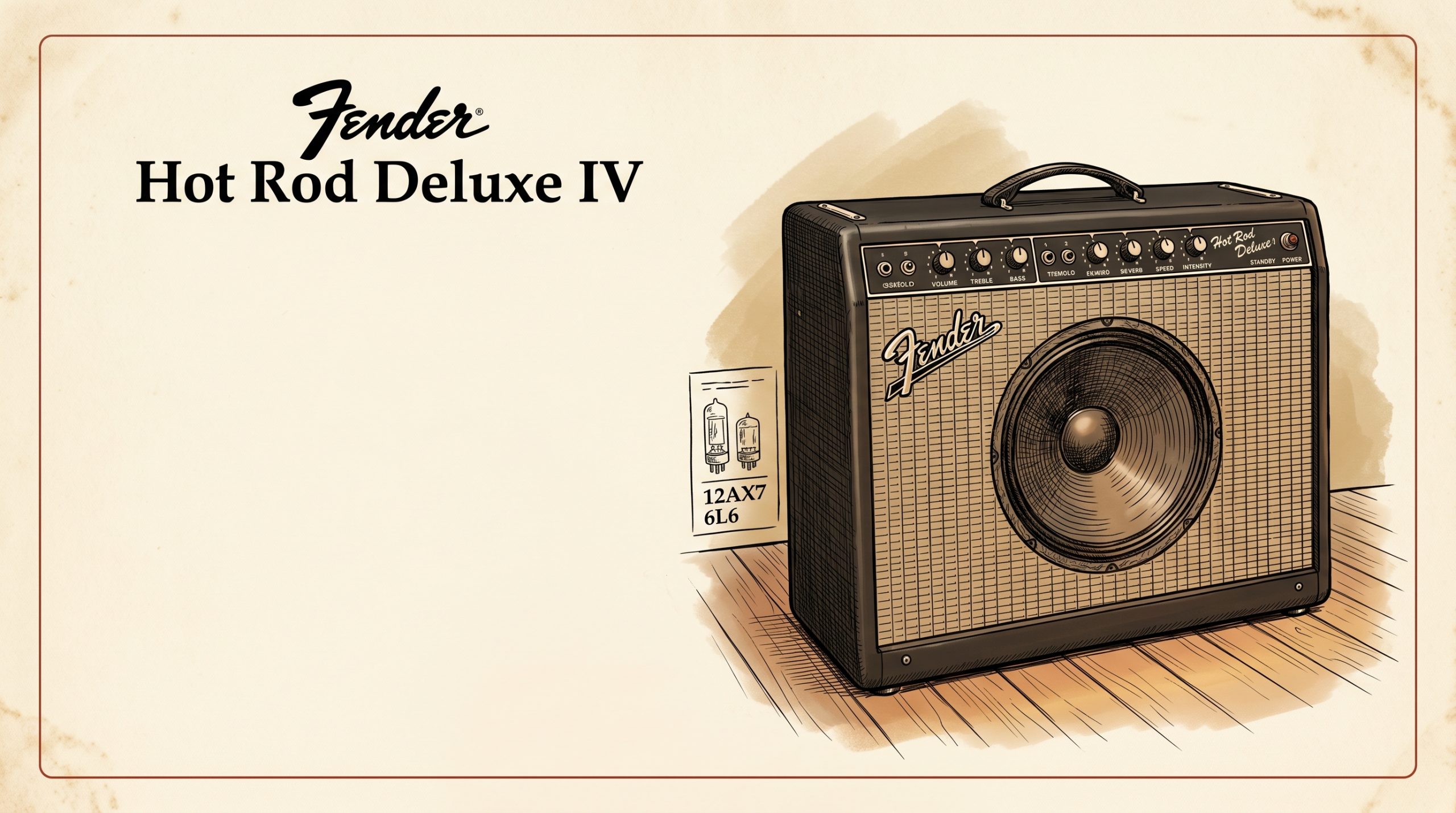
The Hot Rod Deluxe is a three-channel, open-back, 1×12″ combo amplifier running 40 watts through a pair of 6L6GC output tubes. It’s not a reissue and it’s not a modified vintage circuit. Fender designed it from the ground up in 1996 as an affordable, road-ready tube amp with clean tones drawing from the blackface era alongside factory gain channels that no vintage circuit ever offered. The PR246 designation is Fender’s internal model code, distinct from vintage designations like the AB763 (the shared blackface Fender circuit, used across the Deluxe Reverb, Super Reverb, Twin Reverb, and others), though the tone stack geometry will feel familiar to anyone who has spent time with a Deluxe Reverb.
As documented at Premier Guitar, the Hot Rod Deluxe has become ubiquitous across virtually every genre, valued for versatility that few single-speaker combos at this price can match.
At a Glance: Core Specs
| Spec | Detail |
|---|---|
| Circuit Designation | PR246 |
| Introduced | 1996 |
| Current Version | Hot Rod Deluxe IV (+ 30th Anniversary Edition) |
| Power Output | 40 watts RMS |
| Speaker (Gen IV) | 12″ Celestion A-Type (50W, 8 ohm) |
| Preamp Tubes | 3x 12AX7 (V1 input/clean, V2 Drive channel, V3 phase inverter) |
| Power Tubes | 2x 6L6GC |
| Rectifier | Solid-state (not tube rectified) |
| Channels | 3: Clean, Drive, More Drive |
| Reverb | Real spring tank with solid-state driver and recovery (op amp ICs) |
| Effects Loop | Series: Preamp Out / Power Amp In |
| Impedance Options | 4 ohm, 8 ohm, 16 ohm |
| Weight | Approximately 41 lbs (Gen IV) |
| Dimensions (HxWxD) | 18″ x 24″ x 10.5″ (approx.) |
A Brief History of the Fender Hot Rod Deluxe
Origins in 1996: Why Fender Built It
By the mid-1990s, vintage blackface Fender combos had climbed well out of reach for working musicians. An original blackface Deluxe Reverb in playable condition was already fetching $700 to $1,000 or more on the used market, and the Deluxe Reverb Reissue (introduced in 1993) was priced as a premium product. There was a significant gap: players who wanted real 6L6 tube tone at gig volume without a four-figure outlay had limited options.
Fender’s answer was the Hot Rod Series, launched in 1996 with two models released simultaneously: the Hot Rod Deluxe (1×12″, 40 watts) and the Hot Rod DeVille (2×12″ or 4×10″, 60 watts). Both used the PR246-family circuit architecture. The design brief was explicit: deliver the core clean tone DNA of the blackface era at an accessible street price, and add practical gain channels that the vintage circuits never had. The name “Hot Rod” refers to the factory gain staging. Not a modification. A deliberate design choice.
To identify when a specific unit was built, transformer EIA codes (formatted 606-YYWW, where YY is the two-digit year and WW is the production week) are the most reliable method, as documented in the Fender tube amp serial number and dating guide.
The Version Timeline: Generation I Through IV
| Version | Years Produced | Key Changes |
|---|---|---|
| Hot Rod Deluxe (I) | 1996–2003 | Original PR246 circuit; Eminence Special Design 12″ speaker; silver control panel |
| Hot Rod Deluxe II | 2003–2012 | Revised voicing; updated grille cloth options; Eminence speaker retained |
| Hot Rod Deluxe III | 2012–2015 | Celestion A-Type 12″ speaker introduced; revised preamp voicing; smoother Drive channel character |
| Hot Rod Deluxe IV | 2015–present | External bias test points added; further Drive channel refinement; warmer Clean channel voicing |
| 30th Anniversary Edition | 2026 | Premium cosmetics, commemorative features, revised speaker complement; $1,299.99 MSRP |
| Tweed Edition | Periodic limited runs | Tweed vinyl covering, wheat grille cloth; identical PR246 circuit underneath |
Generation I and II units are the most common on the used market by a wide margin. They’re capable amps, but units over 15 years old warrant inspection of filter capacitors before purchase. More on that in the used-buying section below.
Fender Hot Rod Deluxe Specs: Full Technical Breakdown
Power Stage and Tubes
The output section runs two 6L6GC power tubes in fixed-bias Class AB configuration. Fixed bias means you can’t simply drop in new output tubes and walk away. The bias must be set after any output tube replacement, targeting approximately 26 to 28 milliamps per tube at a plate voltage of roughly 450 to 470 VDC. The specific target is documented in the PR246 schematic available through Fender’s support documentation. Stray outside that range and you’re either cooking the tubes or running them cold and losing headroom.
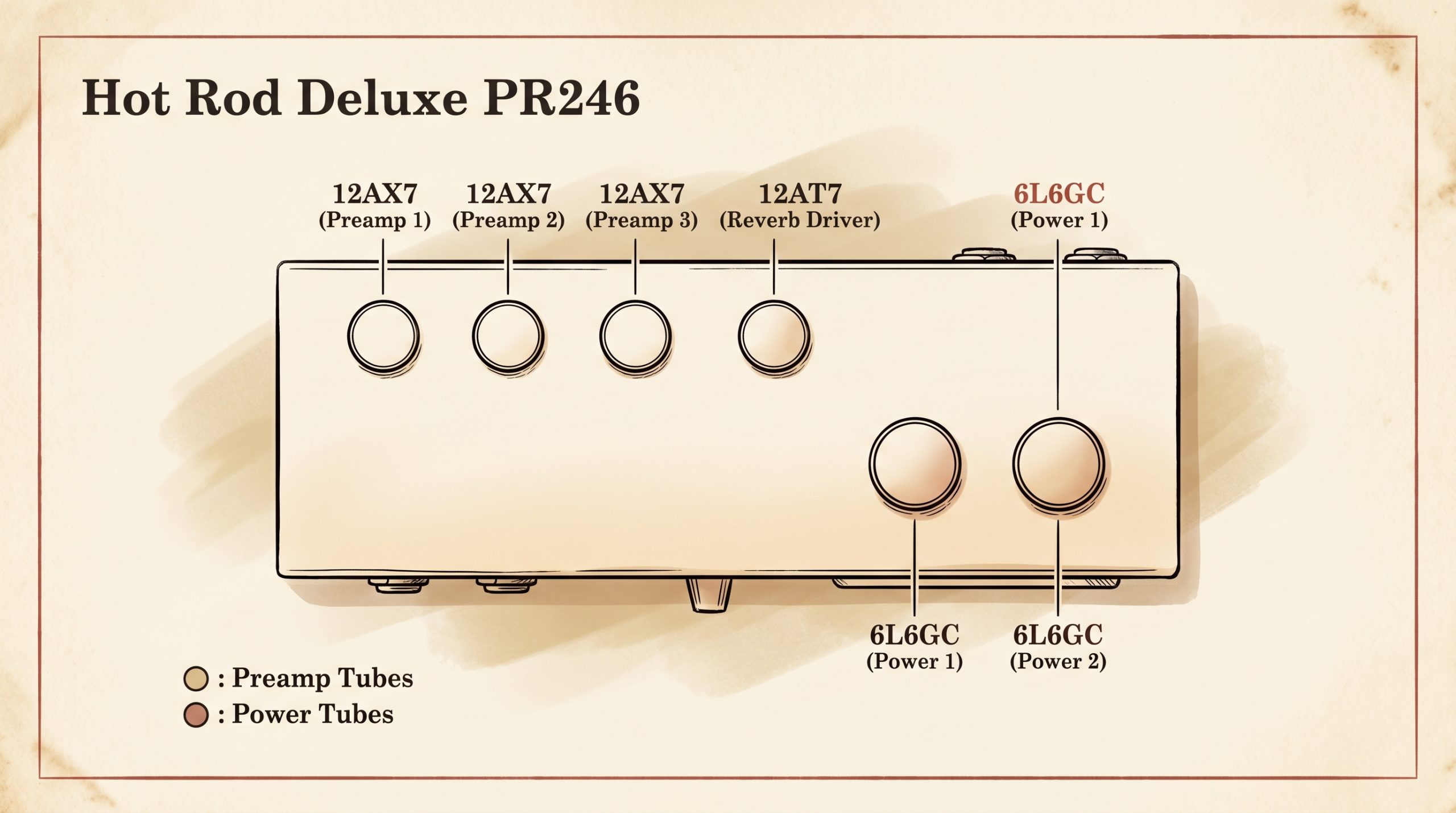
The preamp section uses three 12AX7 tubes. V1 handles the clean and drive input stage and is the highest-priority upgrade position for tone. V2 feeds the Drive channel gain stages. V3 serves as the phase inverter. There is no V4 preamp tube. Despite the otherwise all-tube preamp and power architecture, the reverb driver and recovery circuits on the PR246 are solid-state, built around op amp ICs feeding a real spring tank. The same is true of the effects loop. Solid-state rectification means there’s no sag or compression from a tube rectifier either. The amp is stiff. That’s part of why the clean channel has such dependable, punchy headroom.
One common misconception: players familiar with vintage Fender circuits sometimes expect tube-rectifier spongy compression from the Hot Rod Deluxe. That’s not what this amp does. No sag. Tight, immediate response. That works in the amp’s favor on the clean channel and for pedal use.
Speaker: The Eminence to Celestion Evolution
Generation I and II units shipped with an Eminence Special Design 12″ (50W, 8 ohm). Warm, with a relaxed American voicing and a somewhat polite top end. Generation III and IV moved to the Celestion A-Type 12″ (50W, 8 ohm), which tightens the low end noticeably and adds more midrange articulation. Neither is wrong. The Eminence suits players who want that classic loose, warm Fender character. The Celestion suits players who need more definition in dense band mixes.
Speaker swapping is one of the most popular modifications on this platform. Common choices include the Jensen P12N (vintage warmth, slightly compressed character), the Celestion G12-65 (British texture with American headroom), and the WGS Retro 30 (tight American voice with extended low-mid punch). The cabinet is 1×12″ open-back, which means rear projection affects room monitoring significantly on stage. Worth factoring in when positioning the amp.
Controls, Channels, and Signal Path
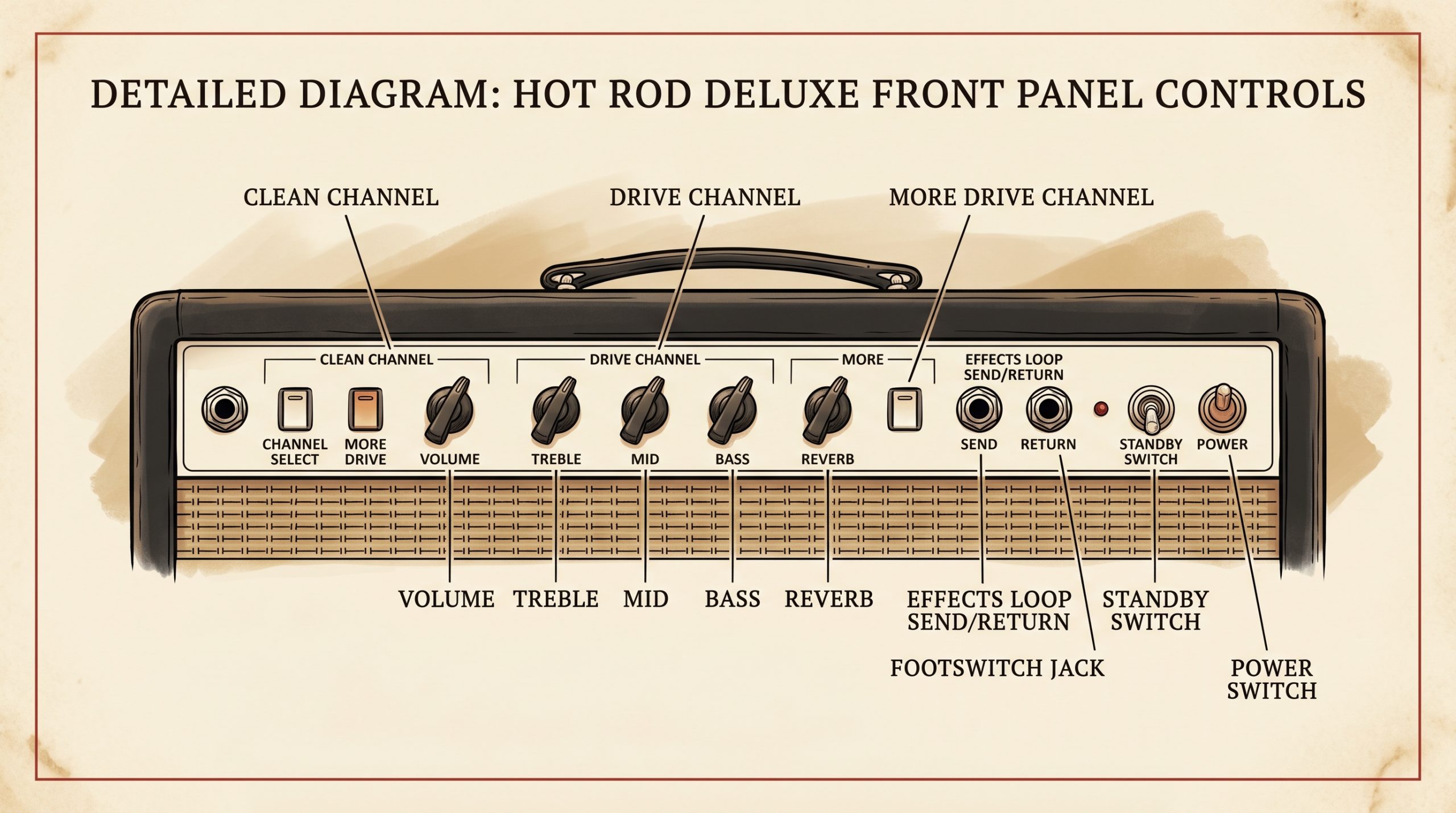
The top-mounted control layout covers: Volume (Clean channel), Drive, Master (for Drive and More Drive channels), Treble, Bass, Middle, Presence, and Reverb. The Normal/Bright switch engages a treble and upper-mid boost that’s genuinely useful for humbucker guitars and actively counterproductive on already-bright single-coils. Channel Select toggles between Clean and Drive from the front panel or via the optional 2-button footswitch. More Drive is a footswitchable additional gain stage on top of Drive.
The series effects loop (Preamp Out / Power Amp In) is solid-state buffered with op amp ICs. It works reliably with standard instrument levels and quality cables. It’s particularly useful for time-based effects like delay and reverb, keeping them post-preamp where they belong.
Weight, Dimensions, and Portability
The Hot Rod Deluxe IV weighs approximately 41 lbs (18.6 kg). That puts it heavier than the Blues Junior at 31 lbs and lighter than the Hot Rod DeVille 212 IV at approximately 55 lbs. The single top handle is a legitimate ergonomic grievance for gigging musicians who haul gear repeatedly. No side handles. For regular transport, a quality amp cover and a hand truck solve most of the problem. The open-back 1×12″ cabinet is compact enough that it fits in most car trunks without the contortion required by a 2×12″.
Fender Hot Rod Deluxe Schematic and Circuit Overview (PR246)
Understanding the PR246 Circuit
PR246 is Fender’s internal designation for the Hot Rod Deluxe circuit. It is not a direct descendant of any vintage Fender circuit. The tone stack geometry draws from blackface topology, specifically the Baxandall-adjacent treble/bass/mid arrangement familiar from the AB763 Deluxe Reverb, but the signal path to and from that tone stack differs significantly in the Hot Rod Deluxe’s Drive channel.
The solid-state rectifier has already been mentioned. It’s worth adding: the phase inverter in the PR246 is a long-tailed pair design, which is consistent with blackface-era Fender circuits. The master volume sits after the phase inverter, which has a specific implication covered in the modifications section below.
The official PR246 schematic is available through Fender’s service documentation. Techs reference voltage markers at the plate of V1 (typically around 200 to 230VDC), the output transformer primary plate voltage (450 to 470VDC), and the cathode resistors of the output tubes for bias measurement. Common failure points visible in the schematic include the main filter capacitors (C15, C17 on most revisions), the reverb driver op-amp section, and the output transformer secondary. If a used unit hums excessively at idle, start with filter caps before assuming transformer failure.
How the Drive Channel Actually Works
This is where the “basically a blackface with a boost” misconception causes the most confusion. The Drive channel in the PR246 uses cascaded 12AX7 gain stages. Not a single pushed stage like a blackface running hot. Cascaded stages. That architecture has more in common with British gain circuit design than with anything Fender was doing in 1965.
The result is a high-gain preamp stage feeding into the Fender tone stack. It doesn’t behave like a blackface pushed to breakup, which is open, harmonically rich, and dynamically responsive. The Drive channel compresses earlier, clips differently, and has a fizzy top-end character that many players find less musical than simply running a good overdrive pedal into the Clean channel. Not broken. Just designed for a different purpose than some buyers expect.
More Drive engages an additional gain reduction stage via footswitch. Most players bypass it entirely. It’s most applicable for very high-gain sounds, but even there, the tone stack doesn’t particularly flatter that much saturation. Your mileage will vary based on guitar and pickup output.
Fender Hot Rod Deluxe Sound and Tone
The Clean Channel: Where This Amp Earns Its Reputation
Exceptional clean headroom. That’s the short answer. At 40 watts through a 12″ speaker, the Hot Rod Deluxe stays clean well into stage-loud territory. Volume 4 to 5 is where the clean channel begins to develop natural breakup, and that’s with a hot humbucker. Single-coils hold clean tone even further. For country, pop, jazz, blues, and studio work, this is one of the most useful clean tones available under $1,000.
Touch sensitivity on the clean channel rewards playing dynamics in a way the Drive channel doesn’t. Dig in and the amp responds. Back off your picking attack and it cleans up immediately. That responsiveness, combined with the spring reverb (one of the genuinely excellent features of this amp), makes the clean channel a platform that punches well above the price point.
The Bright switch deserves attention. On a Stratocaster or Telecaster, it can tip the balance toward ice-pick treble at higher volumes. With humbuckers or P-90s, it’s often essential for presence and cut. Dial it by guitar, not by habit.
The Drive Channel: An Honest Assessment
Divided opinion. Deserved. The Drive channel’s cascaded gain structure produces a compressed, harmonically consistent lead tone that some players find perfectly functional and others find too fizzy and one-dimensional for expressive playing. Both responses are valid.
What the Drive channel does well: medium-gain rock and blues at Drive settings between 4 and 6, especially when the tone stack is used to roll off some top-end brightness. What it doesn’t do well: clean up dynamically, produce open vintage-style breakup, or respond to picking nuance the way the clean channel does.
The most practical use of the Drive channel, confirmed by widespread player experience documented across gear forums and in budget guitarist reviews, is as a platform for stacked overdrive pedals. Set the Drive channel to a moderate gain level and push it with a Tubescreamer or Klon-style pedal, and it barks when pushed in a way that’s genuinely usable for rock. On its own at high gain settings, the fizzy top end becomes difficult to tame regardless of EQ adjustments.
Reverb, Touch Sensitivity, and Pedal Compatibility
The spring reverb is a genuine highlight. Although the driver and recovery circuits are solid-state (built around op amp ICs rather than a 12AT7 tube like the vintage AB763 amps), the spring tank itself is the real deal and produces lush, natural decay with a classic splash characteristic. Better than most reverbs at this price point. Better than many at twice the price.
Pedal compatibility is arguably this amp’s single strongest selling point after the clean tone. The clean channel’s headroom, neutral-to-warm EQ response, and predictable behavior make it a reliable host for virtually any overdrive, fuzz, modulation, or time-based effect. The series effects loop keeps time-based effects post-preamp where they produce cleaner trails.
Recommended Settings for Common Genres
These starting points are based on documented player experience across multiple production versions:
| Genre / Use | Settings | Notes |
|---|---|---|
| Clean Country / Pop | Vol 4, Treble 6, Mid 5, Bass 5, Presence 4, Reverb 3, Bright ON | Works well with Telecaster; back off Bright with hot single-coils |
| Blues Clean | Vol 5, Treble 5, Mid 6, Bass 6, Presence 3, Reverb 4, Bright OFF | Let the guitar’s volume knob control breakup |
| Drive Channel (Rock) | Drive 5, Master 4, Treble 5, Mid 4, Bass 5, Presence 5 | Add Tubescreamer in front for better definition |
| Pedal Platform | Clean Vol 4, Treble 5, Mid 5, Bass 6, Presence 3, Bright OFF | Let the pedal handle gain; keep the amp clean and full |
| Studio / Recording | Vol 3-4, Treble 5, Mid 6, Bass 5, Presence 2, Reverb 2-3 | Mic close to center cap; roll back Presence to avoid room reflections |
Hot Rod Deluxe III vs. IV: Which Version to Buy
This comparison targets one of the most searched questions about this amp. The answer isn’t complicated, but the details matter depending on whether you’re buying new, buying used, or working with what you already have.
| Feature | Hot Rod Deluxe III | Hot Rod Deluxe IV |
|---|---|---|
| Production Years | 2012–2015 | 2015–present |
| Speaker | Celestion A-Type 12″ | Celestion A-Type 12″ |
| Clean Channel Voicing | Slightly brighter | Warmer, fuller low-mid response |
| Drive Channel | Tighter, more compressed top end | More open, reduced high-frequency fizz |
| Bias Access | Internal chassis access required | External bias test points (much easier) |
| Reverb | Spring tank, solid-state driver | Spring tank, solid-state driver (improved pan/tank mounting) |
| Typical Used Price | $400–$550 in good condition | $550–$750 used; ~$899–$999 new |
| Best For | Budget-conscious used buyer comfortable with tech access | New purchase, easy maintenance, warranty coverage |
Should You Buy the III Used or the IV New?
The IV wins on bias accessibility. External test points make routine maintenance straightforward, which matters when output tubes eventually need replacement. The voicing changes are real but subtle. Most players wouldn’t distinguish them blind in a band context. For a new purchase, the IV makes obvious sense.
For a used purchase, the III at $400 to $450 in good condition represents strong value. Verify that the Celestion A-Type is intact (check for cone tears and voice coil rub), confirm the reverb tank is working with a gentle shake test, and budget around $40 to $65 for a fresh retube if the history is unknown. A clean Gen III at that price is a reliable gigging amp.
Generation I and II units are viable for players comfortable with older components and basic maintenance. The original Eminence speaker has a warm character that some players prefer. Just budget for a recap on any unit that hasn’t had filter cap service in the last decade. Caps on a 20-year-old amp running 470VDC are not a question of if but when.
The Hot Rod Deluxe Tweed Edition
What Makes It Different (and What Doesn’t)
The Tweed Edition applies tweed vinyl covering and wheat grille cloth as an aesthetic homage to Fender’s 1950s tweed amplifiers. It looks the part. The execution is genuine: the tweed wrapping is well-applied, the grille cloth proportion suits the cabinet dimensions, and the overall presentation is convincing as a vintage-inspired piece.
Under the cosmetics, it’s the same PR246 circuit. Same output tubes. Same gain channels. Same spring reverb. The Tweed Edition does not sound like a tweed Bassman or a tweed Deluxe. It sounds like a Hot Rod Deluxe, because it is one. If you’re purchasing a Tweed Edition expecting the saggy, warm, low-headroom character of actual 1950s tweed Fender circuits, that expectation won’t be met.
Buy it if you want the looks. The cosmetics are well-executed and the amp underneath is identical to the standard IV. Limited-edition cosmetic variants often hold resale value better than standard production models on the used market, which is a reasonable secondary consideration if you plan to resell eventually. Worth it for aesthetics. Not a tonal upgrade.
Buying a Used Fender Hot Rod Deluxe
Typical Used Market Prices by Generation
| Version | Condition | Typical Price Range (USD) |
|---|---|---|
| Hot Rod Deluxe I (1996–2003) | Good, working | $250–$400 |
| Hot Rod Deluxe II (2003–2012) | Good, working | $300–$450 |
| Hot Rod Deluxe III (2012–2015) | Good, working | $400–$550 |
| Hot Rod Deluxe IV (2015–present) | Like new / near-mint | $550–$750 |
| Tweed Edition | Good, working | $500–$700 |
Reverb.com’s completed listings (searchable via the Reverb price guide) confirm Gen I units in the $323 to $510 range as a baseline, with condition and included accessories affecting final price significantly. Gen II units trending slightly above that, and Gen III/IV commanding a meaningful premium for the Celestion speaker and updated circuitry.
Pre-Purchase Inspection Checklist
- Tubes: Ask when last retubed. Test for noise and microphonics. Budget $40 to $65 for a budget retube set (2x 6L6GC, 3x 12AX7) or $80 to $130 for premium branded tubes. Output tubes require biasing after replacement.
- Filter capacitors: On Gen I/II units over 15 years old, budget $100 to $150 for a tech recap. Bulging or leaking caps visible through the chassis are an immediate flag.
- Speaker cone: Push gently on the cone near the surround. Should move smoothly with no scraping. Scraping indicates a shifted voice coil and a necessary speaker replacement or recone.
- Output transformer: Power on, standby off, listen at idle for hum. Some low hum is normal. Excessive hum before any guitar input suggests failing filter caps or, less commonly, OT issues.
- Reverb tank: Gentle lateral shake produces a clear spring splash through the speaker. No sound from the reverb circuit points to a failed tank, a broken RCA connector, or a failed op-amp on the reverb driver board.
- Effects loop: Insert a cable into the Preamp Out and Power Amp In jacks, bypassed. Significant noise or tone loss indicates dirty jacks or a failing preamp tube in the loop signal path.
- Footswitch jack: Test channel switching. The footswitch jack is a common wear point on heavily gigged units.
Best Places to Buy Used
Reverb.com offers the largest selection and built-in buyer protection, with seller feedback providing meaningful risk signal. Guitar Center’s used section allows in-store playability testing before purchase, which is worth the potential price premium on an amp you can’t return easily. Local Craigslist and Facebook Marketplace listings typically offer the lowest prices and the highest risk. Bring a guitar and a cable. eBay’s buyer protection covers shipping damage claims, but tube amps are inherently vulnerable to shipping stress. Check for seller packing history before buying a tube amp sight unseen.
Tube Upgrade Guide for the Hot Rod Deluxe
Which Tubes to Swap First
| Position | Stock Tube | Recommended Upgrade | Tonal Impact |
|---|---|---|---|
| V1 (input / clean and drive) | 12AX7 | Telefunken ECC83 (NOS) or JJ ECC83S | Highest priority: cleaner signal path, lower noise floor, improved clean channel transparency |
| V2 (Drive channel gain) | 12AX7 | Tung-Sol 12AX7 | Tighter gain structure, reduced fizz on Drive channel upper frequencies |
| V3 (phase inverter) | 12AX7 | Mullard 12AX7 reissue | Warmer, smoother top end; subtle improvement in clean channel bloom |
| V4 / V5 (output) | 6L6GC | JJ 6L6GC or Tung-Sol 6L6GCM-STR | JJ: tighter, more controlled low end; Tung-Sol: more open, slightly warmer midrange |
Note: the PR246 has no 12AT7 tube. The reverb driver and recovery circuits are solid-state, so there is no V4 preamp tube position to upgrade as you would find on a vintage Fender Deluxe Reverb. JJ Electronic publishes tube datasheets for the ECC83S and 6L6GC at their official specification pages, useful for confirming electrical compatibility before ordering. Start with V1 if budget is limited. That single substitution produces the most audible improvement per dollar on this platform. Work outward from there as budget allows.
Biasing After a Retube
Biasing is required after replacing output tubes (V4/V5). It is not required after swapping preamp tubes (V1 through V3). The Hot Rod Deluxe IV’s external bias test points make this straightforward: connect a multimeter to the test points, power the amp fully (not standby), and adjust the bias trimmer to read approximately 26 to 28 milliamps per tube. Consult the PR246 schematic for the exact trim pot location and current spec for your specific revision.
On Gen I, II, and III units, bias access requires chassis removal. If you’re not experienced with high-voltage tube amp service, this is a tech job. The plate voltage on the Hot Rod Deluxe runs 450 to 470VDC. That’s lethal at the wrong contact point even with the amp powered off and filter caps retaining charge. Not a job to rush.
Fender Hot Rod Deluxe vs. The Competition
| Amp | Power | Speaker | Channels | Weight | Street Price (new) | Best For |
|---|---|---|---|---|---|---|
| Fender Hot Rod Deluxe IV | 40W | 12″ Celestion A-Type | 3 | 41 lbs | ~$999 | Versatile gigging, pedal platform |
| Fender Blues Deluxe Reissue | 40W | 12″ Eminence | 2 | 42 lbs | ~$999 | Vintage blues, warm clean purists |
| Fender Blues Junior IV | 15W | 12″ Celestion A-Type | 1 | 31 lbs | ~$699 | Small venues, studio, bedroom-friendly volume |
| Fender Deluxe Reverb Reissue | 22W | 12″ Jensen C-12K | 2 | 42 lbs | ~$1,199 | Vintage-accurate AB763 tone, lower stage volume |
| Marshall DSL40CR | 40W | 12″ Celestion V-Type | 2 (4 modes) | ~50 lbs | ~$999 | British gain tones, high-gain lead work |
| Vox AC30C2 | 30W | 2×12″ Celestion G12M | 2 | ~71 lbs | ~$1,499 | Chimey British clean, EL84 compression |
When to Choose the Hot Rod Deluxe Over Alternatives
Choose the Hot Rod Deluxe over the Blues Junior when you need more clean headroom at gigging volumes, specifically in venues where mic’ing is inconvenient or unavailable. Fifteen watts is bedroom-friendly volume territory and small rehearsal rooms. Forty watts is stage-loud without PA support at most small-to-medium club gigs.
Choose it over the Deluxe Reverb Reissue when budget is a factor and you need the onboard gain channel, or when you play styles beyond vintage blues and country. The Deluxe Reverb Reissue is the better amp for vintage-accurate blackface tone, documented in detail in the Fender Deluxe Reverb complete guide. But it costs around $200 more new and delivers less practical versatility for modern playing contexts.
Choose it over the Marshall DSL40CR when clean Fender tone is your primary identity and you rely on pedals for gain. The DSL40CR has better standalone high-gain performance. The Hot Rod Deluxe has better clean tone for American-voiced playing.
Common Modifications and Upgrades
The Most Popular HRD Mods
The speaker swap is the single highest-impact modification available on this platform. A Jensen P12N produces a warmer, more vintage American character with slightly compressed dynamics. A WGS Retro 30 delivers a tighter, punchier response with better low-end definition in a full-band context. A Celestion G12-65 leans toward British texture while retaining American headroom. All three are popular choices with well-documented results across amp modification communities.
The Drive channel voicing capacitor change is the most commonly attempted circuit modification. Adjusting the value of the coupling capacitor in the Drive channel gain path (referencing the PR246 schematic for the specific component) can reduce the harshness of the high-frequency response. This mod is documented on amp-focused forums and is within reach of intermediate solderers with schematic reading ability. Not a beginner mod.
One important limitation of the PR246 circuit is the master volume placement. It sits after the phase inverter, which means you can’t achieve genuine power-tube saturation at low volumes by turning the master volume down. The power tubes are seeing a lower signal level, not working harder. If power-tube breakup at bedroom volumes is a priority, an external attenuator is the correct solution. Not a tone control setting.
Fender Hot Rod Deluxe: Frequently Asked Questions
What tubes does the Fender Hot Rod Deluxe use?
The Hot Rod Deluxe uses three 12AX7 preamp tubes (V1 input/clean, V2 Drive channel, V3 phase inverter) and two 6L6GC output tubes. Unlike the vintage AB763 Deluxe Reverb, the PR246 does not use a 12AT7; its reverb driver and recovery are solid-state op-amp circuits feeding a real spring tank. A complete retube therefore runs about $40 to $65 for a budget set or $80 to $130 for premium branded options such as JJ, Tung-Sol, or Mullard reissues. Output tubes require professional biasing after replacement. Preamp tube swaps do not require biasing.
How much does the Fender Hot Rod Deluxe weigh?
The Hot Rod Deluxe IV weighs approximately 41 lbs (18.6 kg). This makes it heavier than the Blues Junior at 31 lbs and meaningfully lighter than the Hot Rod DeVille 212 IV at approximately 55 lbs. The amp ships with a single top handle, which is a common ergonomic complaint among gigging musicians who carry it unassisted over any significant distance. A quality amp bag with padded shoulder strap is a practical accessory investment.
What is the difference between the Hot Rod Deluxe III and IV?
The Hot Rod Deluxe IV added external bias test points for significantly easier output tube maintenance, revised the Clean channel voicing to a slightly warmer, fuller response, and refined the Drive channel to reduce the high-frequency harshness reported by some Generation III users. Both versions use the Celestion A-Type 12″ speaker and the same PR246 circuit topology. The sonic differences are real but subtle. The bias access improvement is the more practically significant change for regular amp maintenance.
Is the Fender Hot Rod Deluxe good for pedals?
Yes. The Hot Rod Deluxe is one of the most widely recommended pedal platform amps at its price point. The Clean channel has enough headroom to stay clean at gigging volumes while pedals handle gain shaping, and the neutral-to-warm EQ stack responds predictably to overdrive, fuzz, modulation, and time-based effects. The series effects loop provides a clean insertion point for delay and reverb post-preamp. Tubescreamer and Klon-style drives in front of the Clean channel is a particularly well-regarded combination on this amp.
What is the Fender Hot Rod Deluxe circuit number?
The Fender Hot Rod Deluxe carries the circuit designation PR246. This is Fender’s internal model code and appears on official schematic documentation. It is distinct from vintage Fender circuits such as the AB763 (the shared blackface Fender circuit, used across the Deluxe Reverb, Super Reverb, Twin Reverb, and others). The PR246 draws from blackface tone stack topology but incorporates solid-state rectification, cascaded gain stages in the Drive channel, and a modern reverb recovery circuit that have no equivalent in vintage Fender designs.
Is the Fender Hot Rod Deluxe Still Worth It in 2026?
Who It’s Right For
Gigging guitarists who need reliable clean headroom at stage volume without PA support. Pedal enthusiasts who want a blank-canvas clean platform with predictable EQ behavior. Players covering country, blues, pop, and rock without wanting to carry multiple amps. Studio musicians who need a dependable 40-watt Fender clean tone that records consistently.
Who Should Look Elsewhere
Players chasing vintage-accurate blackface tone will be better served by the Deluxe Reverb Reissue, which stays truer to the AB763 circuit and character. Heavy rock and metal players wanting saturated, high-gain lead tones won’t find them here without significant pedal assistance. Apartment and bedroom players will find 40 watts excessive for low-volume practice. And players specifically seeking power-tube saturation at low volume need either a lower-wattage amp or an attenuator in the chain.
Final Ratings
| Category | Rating |
|---|---|
| Clean Tone | 5 / 5 |
| Drive Channel | 3 / 5 |
| Spring Reverb | 4 / 5 |
| Build Quality | 4 / 5 |
| Value (New) | 4 / 5 |
| Value (Used) | 5 / 5 |
| Pedal Friendliness | 5 / 5 |
| Overall | 4.1 / 5 |
Used, the Hot Rod Deluxe represents some of the best value in production tube amps at any price. A clean Generation III at $450 or a Generation IV at $600 delivers a legitimate 40-watt 6L6 clean tone with spring reverb and a practical gain channel in a road-tested package. New, at $999, it faces stiffer competition, but it remains the most versatile amp at that price point for players who prioritize clean headroom and pedal compatibility over vintage-accurate circuit topology. If the Drive channel concerns you, budget $15 for a used Tubescreamer and don’t look back. The clean channel will do the rest.