Contents
- 01What Is the Fender Tone Master Deluxe Reverb?
- 02Fender Tone Master Deluxe Reverb Specs and Features
- 03Fender Tone Master Deluxe Reverb Review: How Does It Actually Sound?
- 04Fender Tone Master Deluxe Reverb Blonde vs. Black
- 05Fender Tone Master Deluxe Reverb Problems: Known Issues and Limitations
- 06Fender Tone Master Deluxe Reverb vs. Tube Deluxe Reverb: Head-to-Head
- 07Buying a Used Fender Tone Master Deluxe Reverb
- 08The Tone Master Deluxe Reverb as a Recording Tool
- 09The Tone Master Through the Lens of Vintage Fender DNA
- 10Is the Tone Master Deluxe Reverb Still Worth Buying in 2026?
- 11Frequently Asked Questions About the Fender Tone Master Deluxe Reverb
- 12Who Should Buy the Tone Master Deluxe Reverb
The short answer: it’s a digitally modeled amplifier that replicates the blackface Fender Deluxe Reverb’s AA763/AB763 circuit using a 100-watt Class D output stage to simulate 22 watts of 6V6 tube behavior. It’s not a tube amp. At matched volume levels, most players can’t reliably tell the difference in a blind test. At full stage volume with the amp pushed hard, the differences become more apparent. Whether that matters to you depends entirely on how you play.
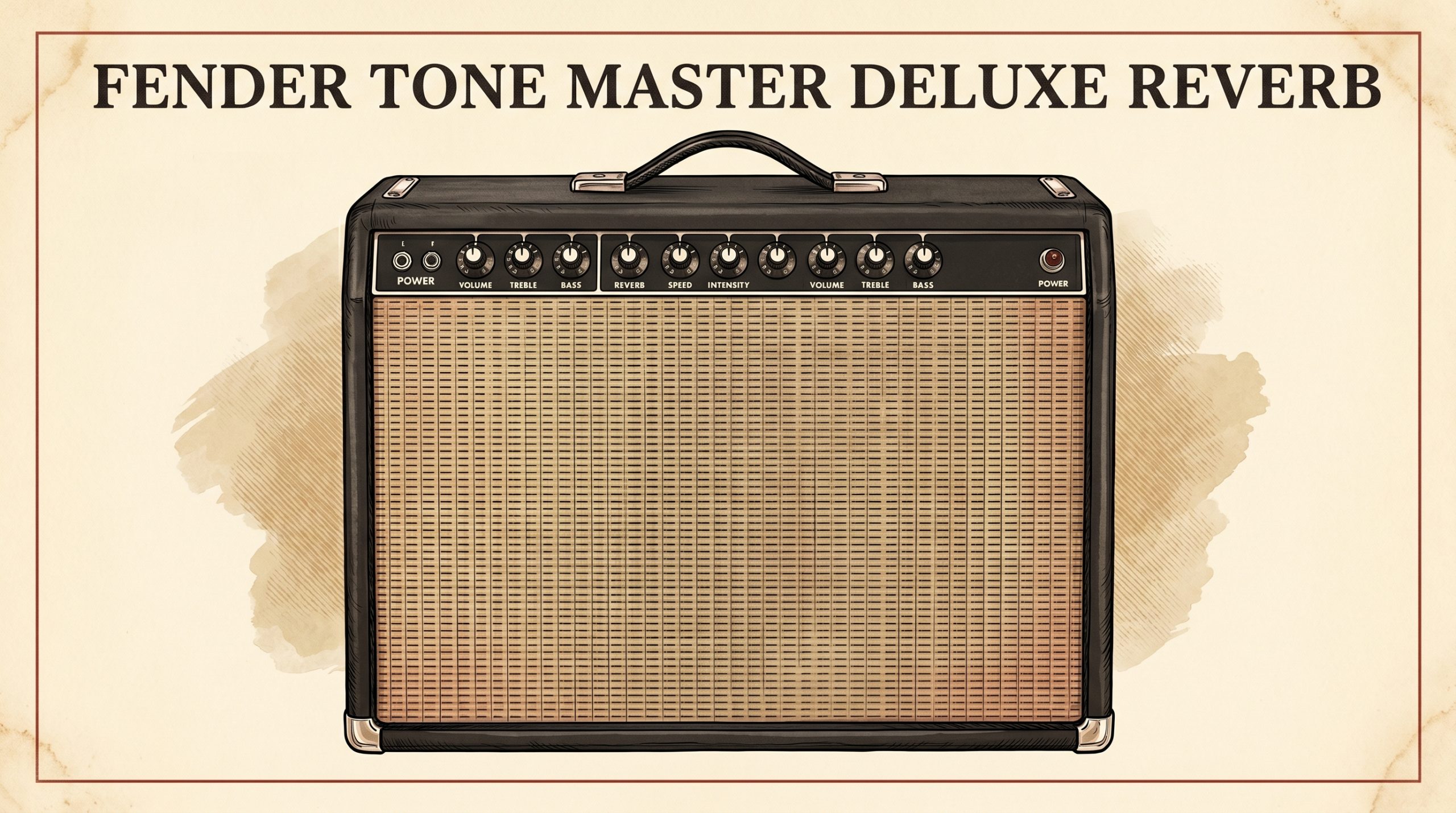
What Is the Fender Tone Master Deluxe Reverb?
The Original Amp It Models
The Tone Master Deluxe Reverb targets one specific amp: the blackface Fender Deluxe Reverb produced between 1963 and 1967. Circuit designations AA763 (1963-1964) and AB763 (1964-1967) define this era. The original ran two cathode-biased 6V6GT power tubes, four 12AX7/7025 preamp tubes, two 12AT7 tubes (reverb driver and phase inverter), and one GZ34/5AR4 rectifier tube through a 1×12″ Oxford 12K5 speaker. Two channels (Normal and Vibrato), an Accutronics Type 4 spring reverb tank, and a fixed 22-watt output defined the platform. No presence control, no master volume, no effects loop. Just the circuit doing its thing.
That design, documented extensively in Greg Gagliano’s research published in 20th Century Guitar Magazine between 1997 and 2000, became one of the most studied and reproduced Fender circuits in history. For a deeper look at the original amp’s history, circuit variants, and current value, the complete Fender Deluxe Reverb guide covers the blackface and silverface production runs in detail.
What Makes the Tone Master Different
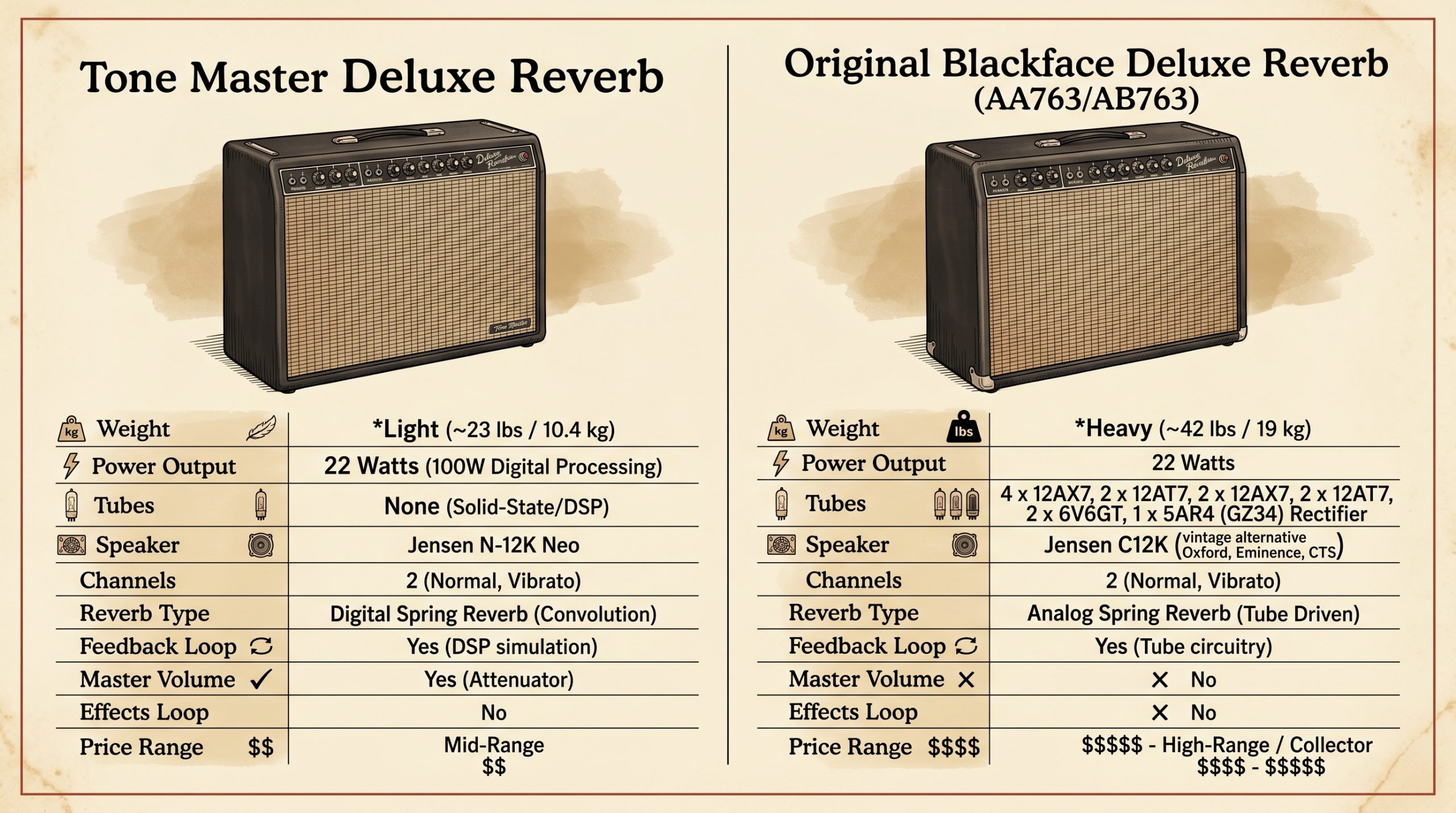
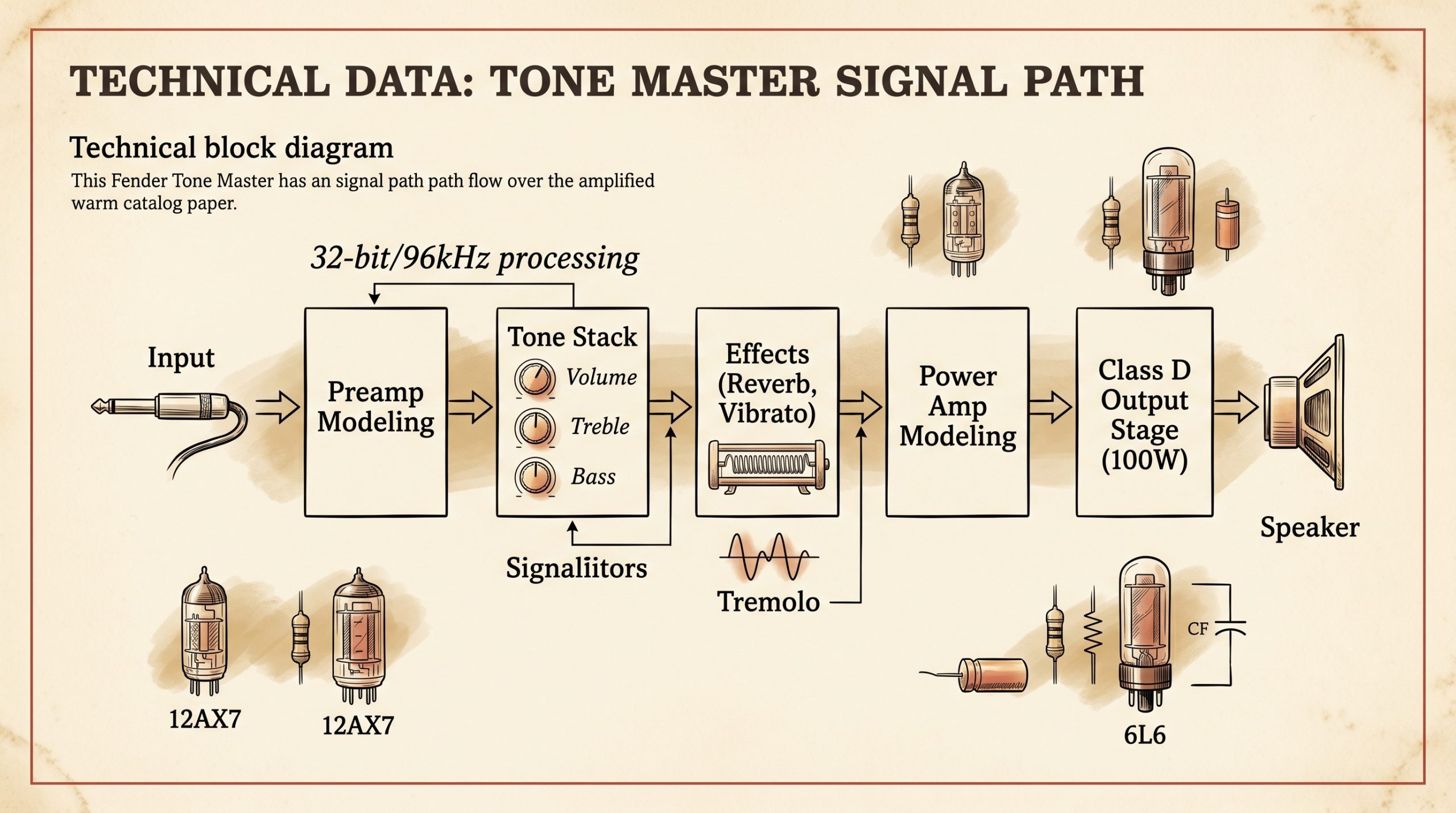
Fender introduced the Tone Master Deluxe Reverb in 2019 at a launch MSRP of $999.99. The current street price sits at $1,399.99 for the black version. The DSP engine runs at 32-bit/96kHz processing, while the power stage is a 100-watt digital amplifier designed to provide the headroom and dynamic range that the original 22-watt tube circuit exhibits. Weight comes in at approximately 23 lbs, compared to roughly 42 lbs for the tube-powered ’65 Deluxe Reverb Reissue. That 19-lb difference is significant over a career of load-ins. The cabinet is solid pine, which contributes to both the light weight and the structural integrity.
According to Premier Guitar’s assessment of the amp at premierguitar.com, the Tone Master Deluxe Reverb delivers a highly accurate emulation of the classic blackface circuit’s performance characteristics, using the 100-watt Class D output stage to simulate the original 22-watt 6V6-powered amp’s dynamic behavior while remaining lightweight and competitively priced.
Fender Tone Master Deluxe Reverb Specs and Features
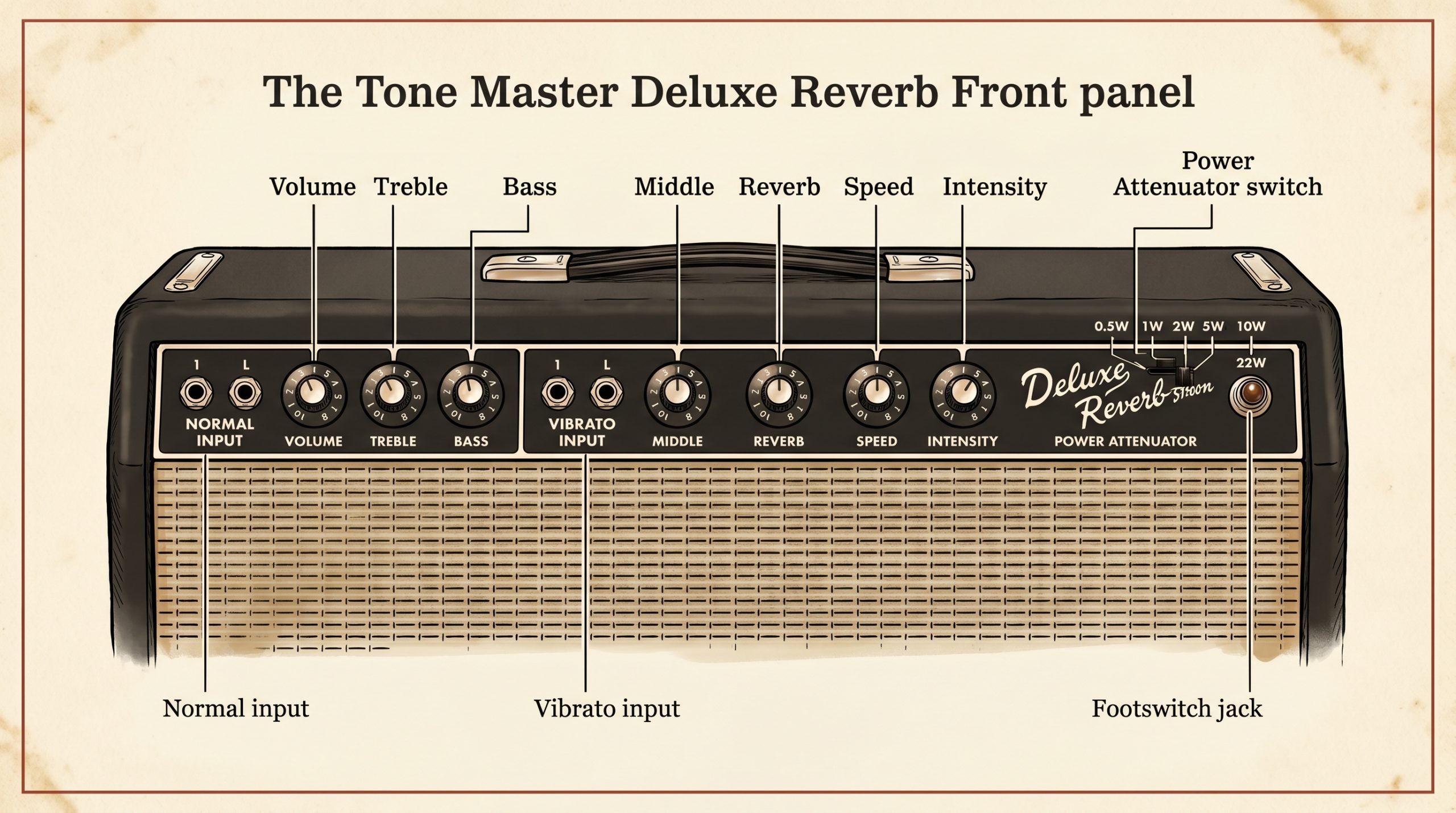
Complete Technical Specifications
A note on current production: Fender updated the Tone Master Deluxe Reverb in recent production runs. The current model ships with a Jensen N-12K neodymium speaker (replacing the original Eminence Tone Master 12) and a 6-way power attenuator switch with additional stepped settings. The specifications table below reflects current production alongside the ’65 Deluxe Reverb Reissue for direct comparison.
| Specification | Tone Master Deluxe Reverb (Current) | ’65 Deluxe Reverb Reissue (Tube) |
|---|---|---|
| Amplifier Type | Solid-state / Digital modeling | Tube (2x 6V6GT, 4x 12AX7, 2x 12AT7, 1x GZ34/5AR4) |
| Output Power | 22W (modeled); 100W digital stage | 22W (tube) |
| Speaker | 1×12″ Jensen N-12K neodymium | 1×12″ Jensen C-12K ceramic |
| Channels | 2 (Normal, Vibrato) | 2 (Normal, Vibrato) |
| Reverb Type | Digital (spring-modeled) | Mechanical spring tank (Accutronics) |
| Weight | ~23 lbs (10.4 kg) | ~42 lbs (19 kg) |
| Dimensions (H x W x D) | 17.5″ x 18.5″ x 9.75″ | 17″ x 20″ x 9.5″ |
| Attenuator Steps | 6-way (0.2W through 22W) | None (fixed 22W) |
| DI Output | XLR (cab-simulated) | None |
| Cabinet Finish Options | Black tolex / Blonde tolex | Black tolex / Blonde tolex |
| MSRP (current) | $1,399.99 | $1,149.99 |
| Made In | Mexico | Mexico |
Key Features Explained
Power Attenuator (current 6-way switch): The attenuator steps from full 22W down through intermediate settings to 0.2W. At 0.2W, you’re in genuine bedroom-friendly volume territory. At 5W, you’ve got a workable stage-monitor level with PA support. At 22W, the amp behaves as intended, delivering the full modeled output. Each step down involves DSP-level voicing adjustments, not just a simple voltage divider, which is why some players report slight character shifts between settings. More on that in the problems section below.
XLR DI Output with Cab Simulation: This is the feature that separates the Tone Master from virtually every comparable tube combo at this price. The built-in cab simulation models a 1×12″ closed-back cabinet IR. You can run straight to a mixing board, an audio interface, or a PA system without a microphone. For working musicians who record and gig regularly, this single feature justifies serious consideration.
Normal vs. Vibrato Channel: The Normal channel carries no reverb or vibrato. It’s voiced slightly warmer and darker. The Vibrato channel adds reverb, tremolo (labeled “vibrato” per original Fender terminology), and runs a brighter voicing with more presence. On the original tube circuit, this difference traces back to the additional preamp gain stage and reverb recovery circuitry in the Vibrato channel.
Jensen N-12K Neodymium Speaker: The Jensen N-12K is a neodymium-magnet driver, which contributes significantly to the weight reduction. Neodymium magnets deliver comparable field strength to traditional ceramic or alnico magnets at a fraction of the weight. The N-12K runs at 8 ohms impedance. This is a custom-spec driver developed for this application; see Jensen Speakers’ product documentation for technical driver specifications.
Fender Tone Master Deluxe Reverb Review: How Does It Actually Sound?
First Impressions and Clean Tones
The clean tone character sits exactly where you’d expect from a blackface Deluxe Reverb reference: forward midrange, warm low end that’s firm without being flabby, and a presence peak that makes single-coil pickups bark when pushed. Strats and Telecasters are the natural pairing here. The Vibrato channel at volumes 3 through 6 captures the compression behavior of the original circuit at those settings reasonably well, with the amp beginning to breathe and respond to pick dynamics.
At low attenuator settings (0.2W and 1W), the Tone Master exhibits slightly earlier perceived breakup than the full-power setting would suggest. This is an artifact of the DSP voicing rather than a flaw. The amp is modeling the behavior of a pushed 6V6 circuit, and at bedroom levels it’s approximating what that sounds like rather than literally driving the output stage. That’s a design decision with practical benefits. It means you get spanky attack and harmonic content at apartment-friendly volumes.
Overdrive and Breakup
At full power with the Vibrato channel cranked, the Tone Master produces a warm, compressed breakup tone that reads convincingly as overdriven blackface clean. It’s not stiff. Not sterile. A Tube Screamer in front adds the expected midrange push and tightens the low end cleanly. Fuzz pedals work fine, input impedance is not an issue. A clean boost into the Normal channel gets you close to the edge of breakup with good touch sensitivity at lower volumes.
Where the Tone Master doesn’t land the same as the tube version is at extreme high-volume push. The spongy compression from 6V6 power tube sag, the output transformer’s iron saturation, and the resulting intermodulation harmonic bloom when the real circuit is working hard, these are physical phenomena. The DSP models the sonic result, but the tactile feel under your fingers at those levels is different. It’s a more consistent experience, which some players will prefer and others will find less inspiring. Honest answer: at open-stage volume in a band context, most players won’t notice. Solo at full chat in a quiet room, tube players will notice.
Reverb, Vibrato, and Tremolo Quality
The digital spring reverb is convincing at moderate settings. Reverb 3 to 5 on the dial gives you the characteristic bloom and decay of the original Accutronics tank. What it doesn’t do is splash and drip the way a mechanical tank does when the amp gets jostled or driven hard. The reverb is too well-behaved. No self-oscillation at extreme settings, no tank slap from cabinet vibration coupling. For most players this is a reliability improvement. For surf purists, it’s a trade-off.
Tremolo (labeled vibrato on the panel, per Fender’s original terminology) is warm and organic-sounding through the full rate and depth range. Country chicken-picking with a light tremolo, classic surf settings, and soul-rhythm textures all work well. The rate range covers slow ambient pulse through choppy stutter convincingly.
Who Is This Amp For?
Gigging musicians who need reliable blackface tone, a DI option for direct-to-board scenarios, and an amp that doesn’t require a physio appointment after load-in. Working session players and home studio musicians who want to record without microphones. Players with back injuries or physical limitations for whom a 42-lb combo is simply not practical.
Who should look elsewhere: collectors (this amp has no collector value and is unlikely to appreciate), players who push amps to full volume in loud contexts and prioritize tube feel above all else, and purists for whom the mechanical spring reverb drip is non-negotiable. The Tone Master is a performance tool. Not a museum piece. Those are different things.
Fender Tone Master Deluxe Reverb Blonde vs. Black
Cosmetic and Historical Context
The blonde tolex finish on the Tone Master Deluxe Reverb references Fender’s Blonde and Brownface cosmetic era from roughly 1961-1963. Important distinction: the original blonde Deluxe from that period used the 6G3 “Brown Deluxe” circuit, a distinctly different design from the blackface AA763/AB763 that the Tone Master models. The blonde Tone Master looks like a Brownface amp but sounds (by design) like a blackface amp. That’s purely a cosmetic choice by Fender, not a circuit variation. Don’t let the finish mislead you about what’s happening inside.
The black version carries the silver-black control panel and silver/wheat grille cloth that defines the blackface cosmetic era. The blonde version uses a gold control panel and oxblood grille cloth. Both are period-accurate references to their respective eras, even though the circuit inside models the blackface period regardless of finish.
Spec Differences Between Finishes
The electronics are identical across both finishes except for the speaker. The black version uses a Jensen N-12K neodymium speaker; the blonde version uses a Celestion Neo G12 Creamback. Same DSP engine, same attenuator, same XLR output. The price difference is cosmetic premium only.
| Feature | Tone Master Deluxe Reverb (Black) | Tone Master Deluxe Reverb (Blonde) |
|---|---|---|
| Cabinet Tolex | Black | Blonde |
| Grille Cloth | Silver/Wheat | Oxblood |
| Control Panel | Black/Silver | Gold |
| Electronics | Identical | Identical |
| Speaker | Jensen N-12K neodymium | Celestion Neo G12 Creamback |
| Typical Street Price | $1,399.99 | $1,449.99-$1,499.99 |
| Production Status | Current, standard | Limited/Periodic runs |
The blonde version’s oxblood grille cloth is worth inspecting carefully on used examples. It tears more easily than the silver wheat cloth on the black version, and replacement grille cloth in that color is harder to source. If you’re buying used, check the grille corners closely. The tone is similar but not identical due to the speaker difference, so this is an aesthetic and availability decision with a minor tonal component.
Fender Tone Master Deluxe Reverb Problems: Known Issues and Limitations
Reported User Issues
The most consistently reported issue across user forum discussions on The Gear Page, Harmony Central, and Reddit’s r/guitar is internal cooling fan noise. The fan is audible in quiet studio and bedroom settings, particularly at 0.2W attenuator settings. It’s not loud enough to be captured on a microphone at normal recording distances, but it’s noticeable in a silent room. Players sensitive to ambient noise in recording environments should audition the amp at low attenuator settings before purchasing.
A second commonly reported observation is a tonal character shift between attenuator settings, not just volume change. The jump between 1W and 5W is the most noted. This isn’t a defect. The DSP is adjusting voicing at each power level to model how a real tube amp’s character changes as the circuit is driven differently. But if you’re expecting a purely linear volume knob behavior, the result can feel inconsistent.
The absence of an effects loop limits post-preamp pedal routing. This matches the original circuit’s design (the original Deluxe Reverb also had no effects loop), but modern players who rely on post-preamp time-based effects will feel this limitation. It’s not a defect. Just a constraint to know before buying.
Some users report tonal thinning when running the XLR output direct into lower-quality audio interfaces that don’t handle the cab-simulated signal cleanly. Impedance mismatch between the Tone Master’s XLR out and budget interfaces can introduce a brittle quality. Running through a quality DI box or into an interface input rated at 600 ohms or higher resolves this.
What Isn’t a Problem (Correcting Common Misconceptions)
“It sounds digital” is the most common criticism from players who haven’t spent time with it. Andy Martin’s blind ABX comparison video, widely cited in user discussions, shows that at matched volume levels the two amps are genuinely difficult to distinguish on audio playback. Input impedance is spec-correct for pedal use, so complaints about pedal compatibility are generally unfounded. Tube replacement cost savings are real: a standard retube cycle for a Deluxe Reverb runs $50-$150 depending on tube brand and whether you include matched power pairs and selected preamp tubes. Over five to ten years of ownership, that adds up.
Long-Term Reliability Notes
No output tubes to replace. No rectifier tubes. No bias adjustment intervals. Capacitor lifespan in digital amplifiers typically runs 15-20 or more years with normal use under reasonable temperature conditions. There is no user-accessible firmware update mechanism on the standard Tone Master Deluxe Reverb, which is a limitation compared to Fender’s Tone Master Pro (2023) and some competitors in the modeling space. What ships is what you run, indefinitely.
Fender Tone Master Deluxe Reverb vs. Tube Deluxe Reverb: Head-to-Head
Weight and Portability
23 lbs vs. 42 lbs. That’s the core of the portability argument. Removing 19 lbs from a combo is roughly the weight of a second small practice amp. For a gigging musician doing multiple shows per week, loading in and out of venues, carrying up stairs, and packing into vehicles, that weight difference has genuine quality-of-life implications. The Tone Master is manageable in one hand with a cabinet handle. The tube DRRI requires two-handed or over-shoulder carrying for most players.
Sound Comparison: The Honest Take
At matched volume levels at or below 70dB SPL, the Tone Master and tube version are ABX-indistinguishable to most players in controlled testing. This is well-documented in community blind tests. At high volume with the amp pushed into its output stage behavior, the tube version’s 6V6 compression, output transformer saturation, and physical speaker cone resonance interaction produce a texture the DSP approximates but doesn’t fully replicate. The touch sensitivity difference is real. The tube amp responds more dynamically to pick attack at high volumes. The Tone Master is more consistent, which reads as either “reliable” or “flat” depending on your playing style and what you’re listening for.
Reverb is the other area where the mechanical advantage of the tube amp shows. A real spring tank splashes, drips, and self-oscillates in ways the digital model tracks but doesn’t perfectly mirror.
Price Comparison: New and Used Market
| Category | Tone Master Deluxe Reverb | ’65 Deluxe Reverb Reissue | Vintage Blackface (AA763/AB763) |
|---|---|---|---|
| Output | 22W (digital) | 22W (tube) | 22W (tube) |
| Weight | ~23 lbs | ~42 lbs | ~38-40 lbs |
| Maintenance Cost | Minimal | $50-$150 per retube cycle | High (NOS tubes, caps, transformers) |
| XLR DI Out | Yes | No | No |
| Power Attenuation | 6-step built-in | None (mod required) | None (mod required) |
| New Price | $1,399.99 | $1,149.99 | N/A (vintage market) |
| Used Price (2025–2026) | $650-$900 | $700-$950 | $1,800-$3,500+ |
| Spring Reverb | Digital (modeled) | Mechanical tank | Mechanical tank |
| Collector Value | Low | Moderate | High |
The vintage pricing range assumes original AA763 or AB763 examples in playable original condition. Date codes on original transformers and speakers, along with chassis stamps, determine where a specific amp lands within that range. Dating an original blackface Deluxe Reverb requires checking the transformer EIA codes alongside the tube chart date stamp, as covered in the Fender tube amp serial number and dating guide.
Buying a Used Fender Tone Master Deluxe Reverb
What to Inspect Before Buying Used
Check all attenuator positions before committing. Each step should switch cleanly with no crackle, dropout, or audible noise artifact. Test the XLR output directly into an interface or through a DI box. Inspect the speaker grille cloth and tolex corners for wear, paying particular attention on blonde examples where oxblood cloth tears more easily at the corners. Power the amp on and listen for internal fan noise level at 0.2W. Excessive mechanical noise from the fan may indicate dust accumulation in the cooling path or early bearing wear, though this is uncommon.
The Jensen N-12K is a purpose-built driver for this application. Replacement availability is good through Fender service channels and Jensen directly, but pricing should be factored into any negotiation if the cone shows damage.
Fair Used Price Ranges (2025–2026 Market)
Excellent condition (near new, minimal cosmetic wear): $850-$950. Good condition (functional, minor tolex wear at corners): $700-$850. Fair condition (functional, cosmetic issues, original box missing): $600-$700. Skip units listed “as-is” without attenuator functionality confirmation. The attenuator switch is the most-used mechanical component on this amp and the most likely point of wear.
Reverb.com provides sold listing history that lets you verify current market pricing before negotiating. GuitarCenter’s used department offers a return window advantage. Facebook Marketplace can surface the lowest prices but carries the highest transaction risk with no buyer protection.
The Tone Master Deluxe Reverb as a Recording Tool
Using the XLR Output Effectively
The signal chain for home recording is as simple as it gets: Guitar into Tone Master, XLR out to audio interface. The built-in cab simulation models a 1×12″ closed-back cabinet response. Gain staging matters here. Set your interface input trim to avoid clipping, targeting peaks around -12 to -18dBFS before hitting the DAW track. The Tone Master’s XLR output runs at a line-level signal that most modern interfaces handle cleanly on their XLR/line inputs.
If the built-in cab simulation doesn’t match your preference, you can bypass it and run into an external IR loader (Two Notes Torpedo units, Logidy EPSi, or software-based IR convolution in your DAW) for more flexibility. Running a neutral flat signal from the amp’s XLR output into a convolution reverb plugin loaded with a custom 1×12″ IR gives you full control over the virtual cabinet character without affecting the amp’s direct speaker sound.
Live Sound Applications
Most sound engineers at mid-size venues have seen DI-only guitar setups, but communicating speaker-off operation clearly during soundcheck avoids confusion. At the 5W attenuator setting with PA support, the Tone Master works as a personal stage monitor while the XLR feed handles the main mix. This allows the front-of-house engineer to control the guitar level independently from your stage volume. Running wet/dry configurations with the Tone Master as the dry signal and a second amp handling post-effects returns is also viable for players who use extensive time-based processing.
The Tone Master Through the Lens of Vintage Fender DNA
How Accurately Does It Model the Original Circuit?
The original AA763 and AB763 Deluxe Reverb circuits share several characteristics that shaped the amp’s voice: cathode-biased 6V6 power tubes with global negative feedback from the output transformer to the phase inverter, a single-stage reverb recovery circuit, and a specific midrange peak in the preamp EQ that gives the amp its forward, present character. The Tone Master captures the midrange voicing convincingly, the reverb decay envelope well, and the vibrato waveshape accurately.
What physical modeling cannot replicate: output transformer core saturation at high flux density, the interaction between the speaker cone’s mechanical resonance and the amp’s output impedance, and the progressive aging behavior of tubes as cathode emission declines over hundreds of hours. These are physical processes, not signal characteristics. No amount of DSP can fully substitute the tactile feedback loop between a hot 6V6 and your right hand at high volumes. Set that expectation correctly and the Tone Master performs well on every front that matters for most players in most situations.
Era Classification Reference
The Tone Master models the blackface era specifically. The AA763 circuit appeared in production from 1963 to approximately late 1964. The AB763 followed from 1964 through 1967, when Fender’s transition to silverface cosmetics began under CBS management. The silverface Deluxe Reverb (AA1164 circuit and variants) ran through 1982. The Tone Master targets the blackface period, not the silverface. If you’re looking to understand the circuit code differences and how to identify which era a given amp belongs to, the Fender amp dating cheatsheet breaks down transformer codes and tube chart stamps by era.
Is the Tone Master Deluxe Reverb Still Worth Buying in 2026?
The Competitive space Has Changed
When Fender launched the Tone Master line in 2019, the competition in this specific niche (single-model digital-analog hybrids with period-accurate cosmetics and no menu diving) was thin. Since then, the space has shifted. The Fender Tone Master Pro (2023) adds multi-model DSP, an effects loop, and MIDI control at a significantly higher price point. Boss Nextone amps offer more tonal flexibility. The Yamaha THR30II targets home use at a lower price.
None of these directly replicate what the Tone Master Deluxe Reverb does: one specific amp, analog-style controls, no menus, no presets, no modeling complexity. The simplicity is a feature. It operates like a Deluxe Reverb, not like a modeling platform. That remains a legitimate differentiator in 2026.
Value Proposition in 2026
New at $1,399.99, the Tone Master Deluxe Reverb now costs $250 more than the tube ’65 Deluxe Reverb Reissue at $1,149.99. That price gap has narrowed from launch pricing, and it makes the new-unit purchase harder to justify purely on cost. The weight advantage, the XLR output, and zero tube maintenance costs remain real advantages. Used at $650-$900, the value case is substantially stronger. A used Tone Master with no maintenance costs, full functionality, and 5-plus years of production refinement behind it competes very favorably against a used tube DRRI that may need a re-cap and fresh output tubes.
For gigging musicians who need lightweight, reliable, DI-capable blackface tone at a used price under $900, this remains the most practical single option in its class. Tube purists who prioritize the physical interaction of a hot 6V6 circuit at high volumes should budget for a used ’65 DRRI or look seriously at a clean original blackface example if their playing demands that specific feel. Both are legitimate positions. They answer different needs.
Who Should Buy the Tone Master Deluxe Reverb
The Fender Tone Master Deluxe Reverb is a well-executed, purpose-built tool for players who need blackface Deluxe Reverb tones without the weight, maintenance overhead, or microphone dependency of a tube combo. Its build quality is solid (the pine cabinet is light but sturdy, as documented in user reports across multiple review sources), its XLR output is genuinely useful, and the Jensen N-12K speaker in current production models delivers clean, detailed response. The tube feel at pushed high volumes isn’t fully there. The digital reverb doesn’t drip and splash like a mechanical tank. Accept those limits going in and the Tone Master earns its place in a working rig. Look at used examples in the $700-$850 range for the strongest value, or buy new if the warranty and current Jensen N-12K speaker matter to your decision. The Fender product page at fender.com has current production specs and finish availability.
Frequently asked questions
How much does the Fender Tone Master Deluxe Reverb weigh?
The Fender Tone Master Deluxe Reverb weighs approximately 23 lbs (10.4 kg). The tube-powered '65 Deluxe Reverb Reissue weighs roughly 42 lbs (19 kg). The nearly 20-pound weight difference is the primary practical argument for the Tone Master among working gigging musicians, particularly those doing frequent load-ins or touring.
What is the difference between the Fender Tone Master Deluxe Reverb Blonde and the Black version?
The blonde and black Tone Master Deluxe Reverb versions are electronically equivalent except for the speaker. The black version uses a Jensen N-12K neodymium speaker; the blonde version uses a Celestion Neo G12 Creamback. Both share the same DSP engine and attenuator. The cosmetic differences: the blonde version uses blonde tolex, oxblood grille cloth, and a gold control panel, while the black version uses black tolex, silver/wheat grille cloth, and a black/silver panel. The blonde typically costs $50-$100 more and is produced in limited periodic runs rather than as a standard stocking item.
What are the most common problems with the Fender Tone Master Deluxe Reverb?
The most consistently reported issue is internal cooling fan noise at low attenuator settings (0.2W, 1W), which is audible in quiet studio environments. A second common observation is a tonal character shift between attenuator steps (particularly 1W to 5W) that goes beyond simple volume reduction. The amp also lacks an effects loop, which limits post-preamp pedal routing. These are design trade-offs, not manufacturing defects. Players recording in quiet rooms should audition the amp at low settings before purchasing.
Is the Fender Tone Master Deluxe Reverb good for recording?
It's one of the most recording-friendly combos in its price class. The built-in XLR DI output with cabinet simulation allows direct recording to an audio interface without microphones, acoustic treatment, or sound isolation. The signal models a 1x12" closed-back cabinet response. For players who need to record at any hour without disturbing neighbors, the combination of the 0.2W attenuator setting and the direct XLR out removes nearly every obstacle from the recording signal chain.
How does the Fender Tone Master Deluxe Reverb compare to the original tube Deluxe Reverb?
At matched volume levels in typical playing and recording scenarios, the Tone Master is ABX-indistinguishable from the tube version to most players. At high volumes with the amp pushed hard, the tube version's 6V6 sag, output transformer saturation, and mechanical spring reverb behavior produce textures the DSP approximates but doesn't fully replicate. Touch sensitivity at high volumes favors the tube version. Practicality, weight, DI capability, and maintenance cost favor the Tone Master. Which matters more depends on where and how you play.