Contents
- 01What Are These Tubes? A Fast Primer
- 025751 vs 12AX7: Spec Comparison
- 03Does Lower μ Actually Sound Different? The Gain Stage Math
- 04Is the 5751 a Drop-In Replacement for the 12AX7?
- 05Where to Use a 5751 in a Fender Amp: Position Matters
- 065751 Manufacturer Guide: Which Brand to Buy
- 07The Preamp Tube Gain Family: Where the 5751 Fits
- 08When Should You Use a 5751? (And When Shouldn't You?)
- 09Frequently Asked Questions
- 10Which Tube Should You Choose
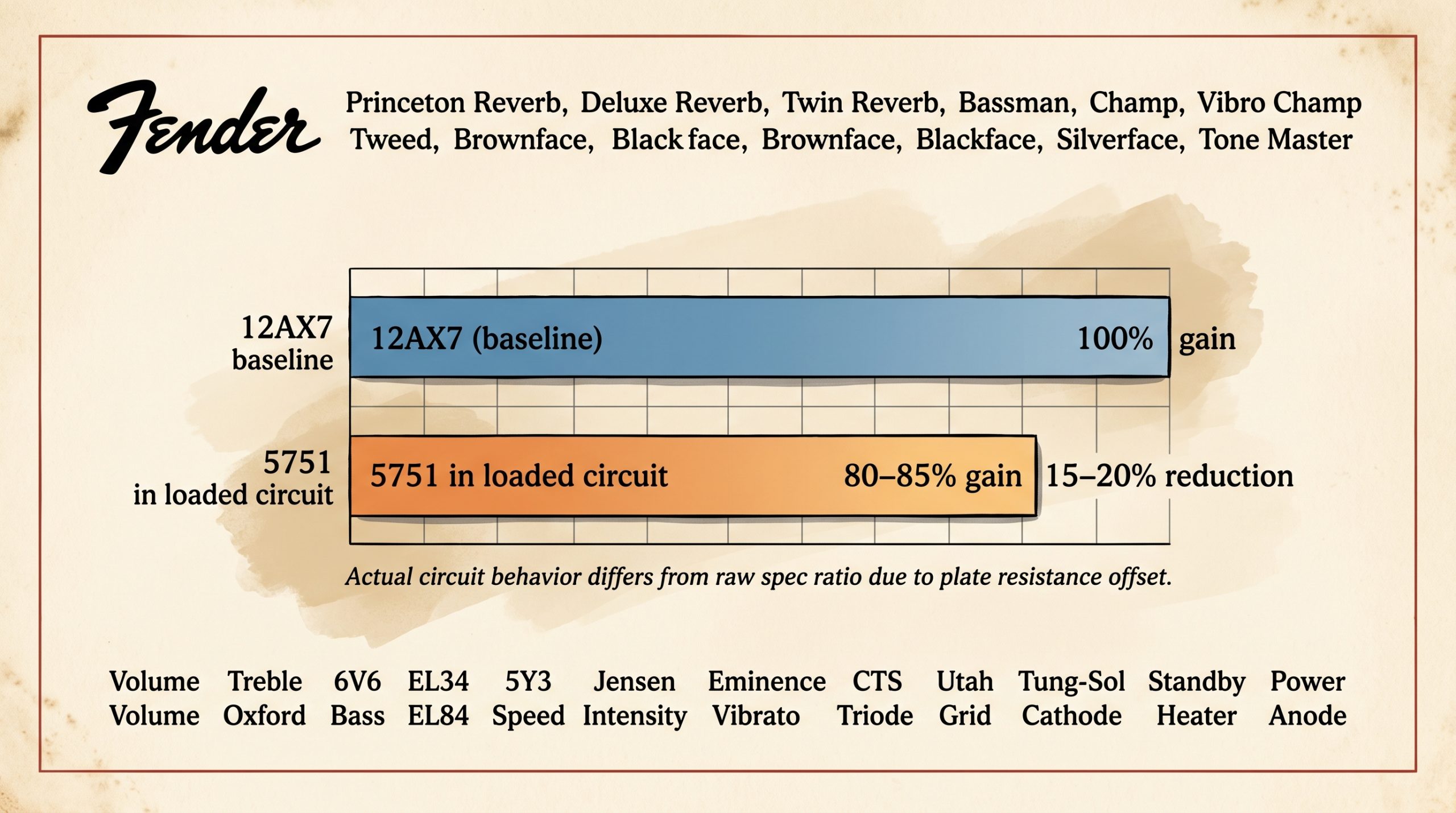
Most players assume swapping a 5751 for a 12AX7 cuts your amp’s gain by 30 percent, based on the raw amplification-factor ratio (70 versus 100). That estimate turns out to be close to the mark. In a real loaded circuit, the 5751’s slightly lower plate resistance only partially offsets the drop in amplification factor, so the actual gain reduction lands closer to 25 to 30 percent rather than being dramatically softened. What you get isn’t the same as a preamp gain-pot cut. You get a shift in breakup threshold, a smoother harmonic character, and a quieter noise floor. All from a plug-in swap that costs less than a guitar cable.
- Amplification factor: 5751 = μ70 / 12AX7 = μ100
- Transconductance (gm): 5751 ≈ 1,200 µmhos vs 12AX7 ≈ 1,600 µmhos — lower, but still much closer than the 12AT7’s 5,500 µmhos
- Pinout: same 9-pin B9A noval socket, direct drop-in
- Heater voltage: identical (12.6V or 6.3V)
- Heater current: 5751 draws 175 mA vs 150 mA at 12.6V, not a concern in any stock Fender amp
- Build standard: 5751 is military/JAN spec, typically lower noise and tighter tolerance
- Best position: V1 (first preamp stage) for maximum impact
- NOS GE and Sylvania examples: $60 to $120+ per tube
- Current-production Tung-Sol 5751: $25 to $35 street price
- Real-world gain reduction in a loaded circuit: approximately 25-30%, close to the raw µ-ratio estimate — the 5751’s lower plate resistance only partially offsets its lower amplification factor.
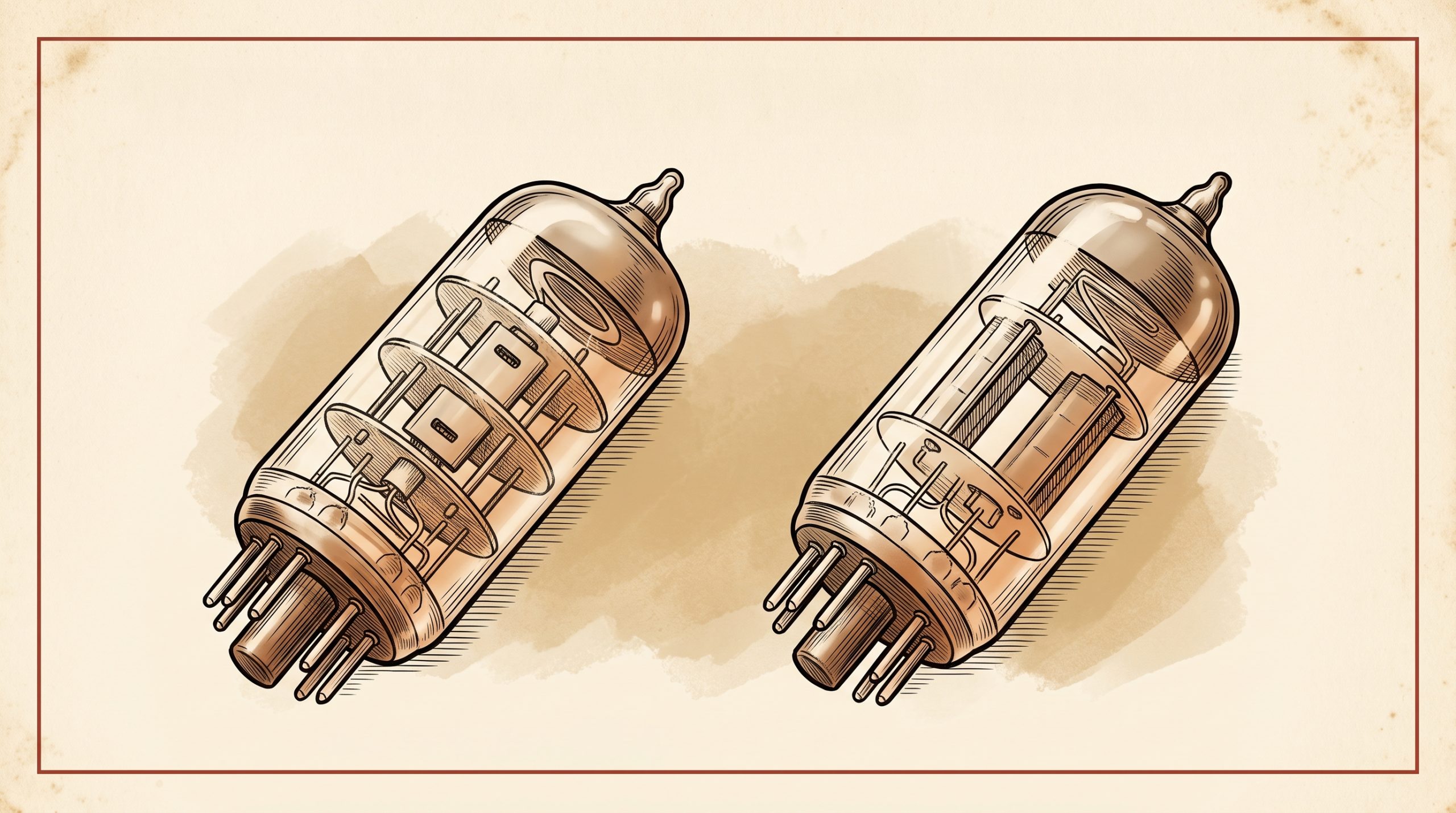
What Are These Tubes? A Fast Primer
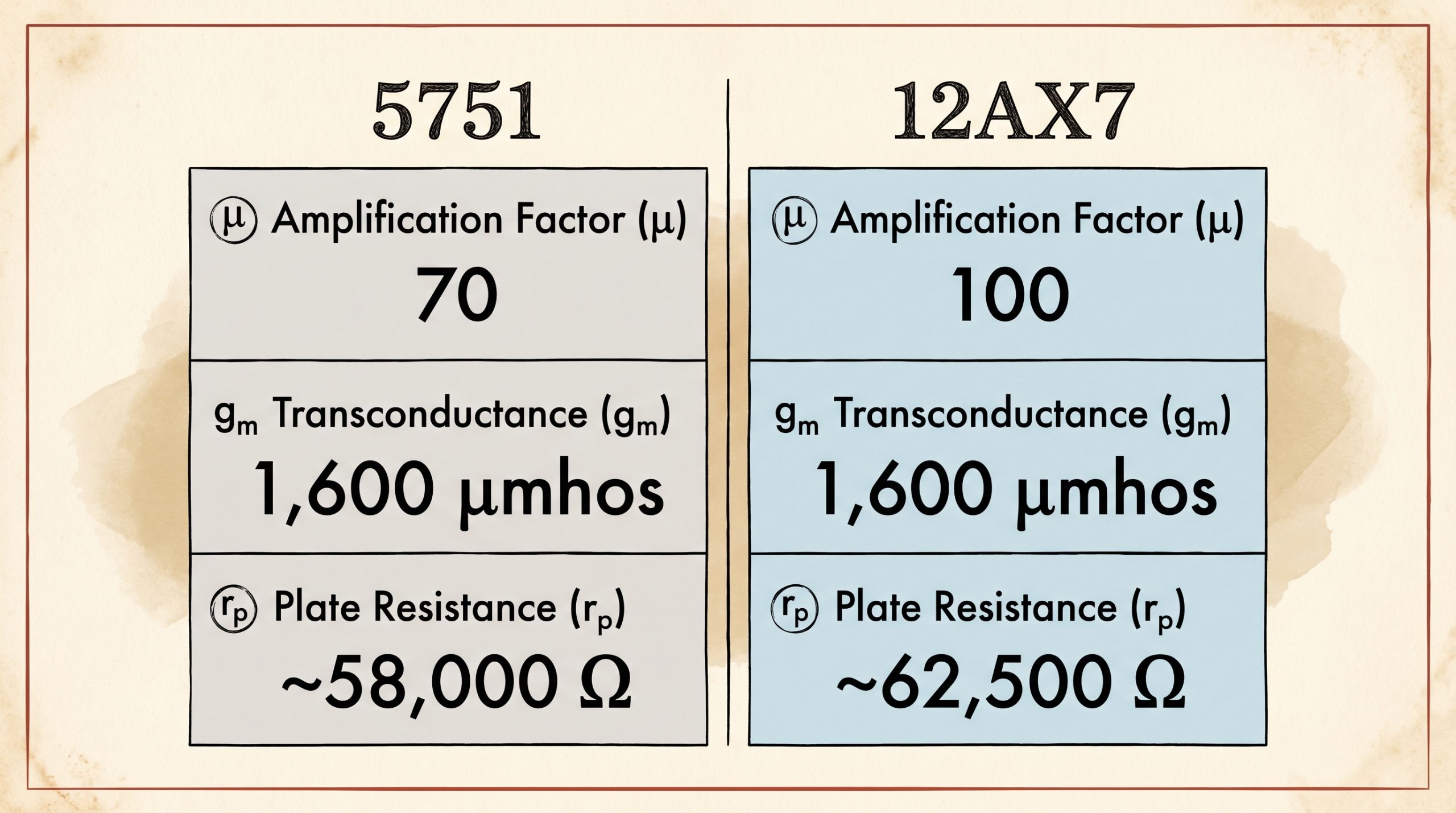
The 12AX7: The Default Preamp Tube
The 12AX7 (European designation ECC83) is a dual-triode, high-gain preamp tube introduced in the late 1940s. It became the industry standard for guitar amplifier preamp circuits by the mid-1950s and never really ceded that position. Key electrical specs from the original RCA datasheet: amplification factor (μ) of 100, transconductance (gm) of 1,600 µmhos, and plate resistance (rp) of roughly 62,500 ohms. Every Fender blackface and silverface preamp circuit you’ll encounter, from the Deluxe Reverb to the Twin Reverb, uses the 12AX7 (or its quieter commercial variant, the 7025) as the factory-correct V1 tube. For a full breakdown of 12AX7 variants and construction, the 12AX7 complete buyer and replacement guide covers every production era.
The 5751: The Military-Spec Alternative
The 5751 was developed to U.S. military JAN (Joint Army-Navy) specifications in the late 1950s, designed for applications where reliability, long service life, and low noise were non-negotiable. It’s also a dual triode on the same 9-pin B9A noval base as the 12AX7, which makes it a direct plug-in substitute. The critical datasheet numbers: μ = 70, gm ≈ 1,200 µmhos, rp = approximately 58,000 ohms. That gm figure is the detail most forum posts get wrong. The 5751 has meaningfully lower gain than a 12AX7, and its transconductance runs somewhat lower too (roughly 1,200 µmhos versus the 12AX7’s roughly 1,600 µmhos) — but it’s still far closer to the 12AX7’s than the 12AT7’s 5,500 µmhos or the 12AY7’s roughly 1,500 µmhos, which is why it behaves so predictably as a drop-in.
5751 vs 12AX7: Spec Comparison
| Specification | 12AX7 / ECC83 | 5751 |
|---|---|---|
| Amplification Factor (μ) | 100 | 70 |
| Transconductance (gm) | 1,600 µmhos | ~1,200 µmhos |
| Plate Resistance (rp) | 62,500 Ω | 58,000 Ω |
| Heater Voltage | 12.6V / 6.3V | 12.6V / 6.3V |
| Heater Current (12.6V) | 150 mA | 175 mA |
| Pinout (Base) | B9A (Noval) | B9A (Noval) |
| Direct Substitution | Reference | Yes, no rewiring |
| Build Standard | Commercial | Military / JAN spec |
| Typical Noise Floor | Higher | Lower |
The heater current difference (175 mA vs. 150 mA at 12.6V) is worth flagging for boutique or custom amp builds with a marginal power transformer. In any standard Fender production amplifier, it’s a non-issue. The transformer runs well within spec.
Does Lower μ Actually Sound Different? The Gain Stage Math
Why μ Doesn’t Tell the Whole Story in a Real Circuit
Here’s where most forum explanations fall short. The amplification factor is a theoretical maximum, not the voltage gain you actually get out of a triode stage. The real-world formula for a loaded triode stage is: voltage gain = μ × (Rp / (Rp + rp)), where Rp is the plate load resistor in the circuit and rp is the tube’s internal plate resistance.
Run those numbers for a typical blackface Fender preamp stage, where Rp is commonly around 100,000 ohms. With a 12AX7 (rp = 62,500 Ω): gain ≈ 100 × (100,000 / 162,500) = approximately 61.5. With a 5751 (rp = 58,000 Ω): gain ≈ 70 × (100,000 / 158,000) = approximately 44.3. That’s a reduction of about 28 percent in this specific example, and the exact figure varies somewhat with the load resistor values in a given circuit. The key point: the 5751’s lower rp only partially compensates for its lower μ, so the real-world gain drop lands close to the raw amplification-factor comparison, not dramatically below it as sometimes claimed.
Subtle. Not dramatic. That’s the feature.
Where You Hear the Difference
The perceptible effects in a guitar amp context break down predictably. The signal clips later, so you get more clean headroom at moderate volumes. The harmonic character shifts toward lower odd-order content, which many players describe as smoother or sweeter breakup when the amp does clip. Effectively, the clean-to-dirty boundary moves up a few dB. You’re not changing the character of your amp’s overdrive, you’re changing when you arrive at it.
Some forum discussions describe the 5751 as having “a little less mids” and “more of a Fender feel.” That’s a perceptual observation, not a datasheet characteristic. The frequency response curves between the two tubes are nearly identical. The tonal perception shift comes from the change in breakup threshold and harmonic balance, not from any EQ difference baked into the tube’s electrical specs.
Is the 5751 a Drop-In Replacement for the 12AX7?
Yes. Full stop. The 5751 was designed from the outset as a ruggedized, lower-noise alternative to the 12AX7 in military electronics; interchangeability with the 12AX7 socket was intentional, not incidental. Same 9-pin noval base, same heater voltage options, no bias adjustment required. You pull the 12AX7, you seat the 5751, you’re done.
This swap is safe and reversible in any standard Fender amplifier circuit regardless of era. No modifications, no consultations with a technician, no risk to the amp — the pinout and heater voltage are identical to the 12AX7’s, so the tube seats and lights up the same way regardless of what was originally in the socket. One caveat: on tweed-era circuits like the 5E3 Deluxe, the factory V1 tube usually isn’t a 12AX7 at all. It’s a lower-gain 12AY7 (μ ≈ 44), so if your amp still has its original tweed-spec tube complement, dropping in a 5751 there is a gain increase relative to stock, not the gain reduction described above — check your amp’s tube chart before assuming otherwise. The slightly higher heater current draw (175 mA at 12.6V vs. 150 mA) is well within the headroom of every production Fender power transformer documented in original service documentation. The only edge case where it’s worth checking is a custom or boutique build with an unusually small power transformer, and that situation will be obvious from the transformer’s published current rating.
Where to Use a 5751 in a Fender Amp: Position Matters
This is the information that separates a useful tube swap from a random experiment. Position matters. A lot.
V1: The High-Impact Position
V1 is where your instrument signal enters the preamp section. The signal is at its weakest here, which makes V1 the most sensitive position to tube character. Swapping a 5751 into V1 produces the most noticeable reduction in preamp drive and input sensitivity of any tube position in the amp. This is your first swap. Always.
In the AB763 blackface Fender circuit, used in the Deluxe Reverb, Super Reverb, Vibrolux Reverb, and Pro Reverb, V1 is the instrument input triode. The Fender Deluxe Reverb guide covers the AB763 layout in detail, including the full tube complement and which positions handle signal processing vs. reverb and tremolo functions. If your blackface Deluxe breaks up before you want it to, a 5751 at V1 is the first place to look. Same logic applies to the Twin Reverb (AB763 circuit) and the Super Reverb. For identifying which circuit revision your specific amp runs, a Fender tube amp serial number and date code reference can confirm the chassis date and corresponding factory schematic.
V2: Tone Stack Driver and Phase Recovery
Less dramatic. V2 typically handles phase recovery or tone stack driving in most blackface circuits. A 5751 here has a subtler effect on overall gain, and can smooth out some harshness before the signal hits the tone controls. Not the priority swap, but a reasonable second experiment after you’ve assessed V1.
The Phase Inverter Position: A Different Swap Entirely
The long-tailed-pair phase inverter in most blackface Fenders (commonly labeled V6 on Fenderguru and Ampbooks schematics, though V-numbering varies by source) ships from the factory with a 12AT7, not a 12AX7-family tube — and the reverb-driver socket next to it (commonly V3) is also a 12AT7. Because the stock 12AT7 already has a lower amplification factor (μ = 60) than a 5751 (μ = 70), dropping a 5751 into either of those sockets isn’t a gain-reduction move the way it is at V1 or V2. Relative to the stock tube it’s a mild gain increase, and it changes the phase inverter’s balance and clipping behavior in ways that don’t map onto the V1 experiment. Some techs do run a full 12AX7 in the phase inverter socket deliberately, to push the power tubes harder, but that’s the opposite effect from the “subtler, cleaner” swap this guide is about. Leave the phase inverter and reverb driver sockets alone unless you’re following a specific mod recipe for your exact amp, and do your 5751 experimentation at V1.
Reverb Driver and Recovery Tubes
Not worth the investment here. The reverb driver and recovery positions in the Fender reverb circuit are designed around specific gain requirements for the reverb tank. Lower gain at these positions has minimal tonal upside and can actually affect reverb return level. Leave these positions alone and focus your 5751 budget on V1.
5751 Manufacturer Guide: Which Brand to Buy
Vintage New-Old-Stock (NOS) Options
GE 5751 (JG / Black Plate / Triple Mica): The reference-grade NOS 5751. Triple-mica construction means superior vibration resistance, which matters for V1 where microphonics are most audible. Extremely low noise floors, tightly matched triode sections, and a service life spec that outran most commercial applications they were built for. Collectors and recording engineers treat GE triple-mica 5751s as the premium option in this category, and prices reflect that. Expect $60 to $120 or more per tube on the current vintage market, with condition and date codes affecting pricing significantly.
Sylvania 5751 Gold Brand: Slightly warmer character than GE by most accounts; also triple-mica construction; highly regarded in both guitar amp and recording applications. Second only to GE in collector esteem. Harder to find in matched, tested condition.
RCA 5751: Less common in the vintage market. Smooth and musical, character similar to Sylvania. A legitimate NOS option when GE and Sylvania examples aren’t available at reasonable prices.
Raytheon 5751: Military surplus stock; excellent reliability; tonally neutral. Not the most discussed NOS 5751 among guitarists, but a solid tube if you come across tested examples.
Current-Production 5751s
Tung-Sol 5751 (New Production): Manufactured by the Electro-Harmonix factory in Russia under the Tung-Sol brand. The most widely available current-production 5751 and the standard recommendation for players who want the gain reduction without the NOS price tag. Street price runs $25 to $35. Well-regarded as a practical entry point. For current production specs, Electro-Harmonix publishes tube specifications directly.
JJ 5751: Made in Slovakia by JJ Electronic. Reliable and consistent; some players find it slightly brighter than NOS references. Lower price point than Tung-Sol in some markets. JJ’s manufacturing quality control has been consistently documented as solid across their preamp tube line. JJ Electronic’s tube catalog lists current production specs.
What to Look For When Buying
Matched sections matter. Both triodes inside a 12AX7 or 5751 should test within roughly 10 percent of each other for best performance. If you’re buying for V1, specify low-noise and low-microphonics grade. Triple-mica construction in NOS tubes is worth the premium if you’re using the amp for recording. For stage use, current-production Tung-Sol is a practical and reversible starting point. Not precious. Easy to replace.
The Preamp Tube Gain Family: Where the 5751 Fits
Understanding the 5751 is easier when you see the full gain ladder. The 12AT7 vs 12AX7 comparison covers the phase inverter end of this spectrum in detail, but here’s the full picture relevant to V1 substitution:
| Tube | μ (Gain Factor) | gm (µmhos) | Common Use | Notes |
|---|---|---|---|---|
| 12AY7 | 44 | 1,500 | Original Fender tweed V1 (5E3 Deluxe) | Large drop; tweed-character clean |
| 12AT7 / ECC81 | 60 | 5,500 | Phase inverters, reverb drivers | Different gm; not ideal as V1 sub |
| 5751 | 70 | ~1,200 | 12AX7 sub, V1 gain reduction | Closest gm to the 12AX7; the subtle headroom swap |
| 12AX7 / ECC83 | 100 | 1,600 | Standard preamp, default V1 | Industry baseline |
| 7025 | 100 | 1,600 | High-quality 12AX7 variant | Same spec, quieter commercial construction |
The reason the 5751 is the preferred subtle V1 swap is right there in the gm column. The 12AT7 drops gain further than the 5751, but its transconductance (5,500 µmhos) is dramatically different, which changes the tube’s behavior in a circuit designed for a 12AX7. The 12AY7 pairs a lower μ with a lower gm too, making it a more significant tonal shift. The 5751 sits in the ideal position: enough gain reduction to be useful, and a gm (~1,200 µmhos) close enough to the 12AX7’s (~1,600 µmhos) that circuit behavior stays predictable — unlike the 12AT7’s much higher gm.
When Should You Use a 5751? (And When Shouldn’t You?)
Use the 5751 If…
- Your amp breaks up too early at the volume levels you need for your playing situation
- You want more clean headroom from a blackface-era Fender without adding a master volume circuit
- You’re recording and want to push the amp louder before preamp clipping occurs
- You run pedals into a clean amp and need to preserve pedal dynamics rather than stacking pedal gain with preamp gain
- You want a quieter, lower-noise V1 tube for studio work or live use in quiet environments
Stick With the 12AX7 If…
- You specifically want the amp to overdrive at lower volumes and the current breakup point is a feature, not a problem
- You’re playing a low-wattage amp where natural power-amp breakup is the goal and preamp gain is part of reaching it
- You’re chasing the exact vintage spec of a particular documented circuit configuration
- You want maximum input sensitivity (useful for passive pickups with lower output)
The $25 Experiment
This is the lowest-risk, most reversible tone modification in guitar amplification. Plug-and-play. No soldering, no biasing, no tools beyond pulling a tube. If you don’t like the result, the 12AX7 goes back in. Tube swap experiments that cost $25 and require no technical skill are rare. This one genuinely delivers audible results.
Which Tube Should You Choose
The 5751 vs 12AX7 decision comes down to a single question: do you want more clean headroom before breakup, or do you want your amp behaving exactly as the original circuit spec intended? If it’s headroom, the 5751 belongs at V1. The gain reduction in a loaded circuit is real, audible, and consistently described as cleaner and smoother without fundamentally altering the character of the amp. Start with a current-production Tung-Sol 5751 at $25 to $35. It’s a legitimate electrical 5751 and a practical way to assess whether the swap works for your playing situation before spending $80+ on NOS GE triple-mica examples. If you like the result and want to push the quality ceiling, that’s when the NOS hunt becomes worth the effort. For matching the right tube to specific Fender preamp positions across different era circuits, the Fender amp dating and circuit quick-reference gives you the production details needed to know exactly what circuit your amp runs.
Frequently asked questions
Is a 5751 the same as a 12AX7?
No. The 5751 uses the same 9-pin pinout and heater voltage as the 12AX7 and is a direct drop-in replacement, but it has a lower amplification factor (μ = 70 vs. 100). It was designed to military specifications, making it generally more rugged and lower-noise than commercial 12AX7 production runs. Same socket, different spec.
What type of tube is the 5751 equivalent to?
The 5751 is functionally equivalent to the 12AX7 for substitution purposes, sharing the same pinout, heater voltage, and transconductance value. It is not electrically equivalent to the 12AT7 (μ = 60, gm = 5,500 µmhos) or 12AY7 (μ = 44), which have substantially different transconductance values and different operating characteristics beyond simple gain reduction. When someone asks what tube to use in a 12AX7 socket, the 5751 is the correct answer. The 12AT7 is not.
What is a 5751 tube?
The 5751 is a dual-triode vacuum tube originally manufactured to U.S. military (JAN) specifications in the late 1950s and throughout the 1960s. It was designed for applications in military electronics where reliability, tight tolerances, and long service life were requirements, not preferences. Its popularity among guitarists developed later, as players discovered the combination of lower gain, lower noise, and superior build quality relative to commercial 12AX7 production of the same era. Original 5751 datasheet specifications are available through tube datasheet archives for reference.
Will a 5751 work in any amp that uses a 12AX7?
In virtually all production guitar amplifiers, yes. The identical pinout and heater voltage mean no wiring changes are needed. The only edge-case caution is the slightly higher heater current draw (175 mA vs. 150 mA at 12.6V), which is irrelevant in any standard Fender production amplifier. If you're using a custom or boutique build with an unusually marginal power transformer, verify the transformer's heater current headroom against the published spec before committing to the swap.
Which position in my Fender amp should I try the 5751 first?
V1, the first preamp position, which handles your raw instrument signal before any gain staging, tone shaping, or effects processing. This is where the gain reduction from a 5751 has the most audible impact on your overall headroom and breakup threshold. Try V1 first, live with the result for a few sessions, then decide whether you want to explore other positions.