Contents
- 01The Origins: Where These Tubes Came From
- 02EL34 vs KT88: Datasheet Specs Compared
- 03How They Actually Sound: Sonic Character Breakdown
- 04Can You Actually Swap EL34 for KT88 (or Vice Versa)?
- 05EL34 vs KT88 in the Context of Other Power Tubes
- 06Which Amps Use EL34 vs KT88?
- 07Current Production Tubes: Best EL34 and KT88 Available Today
- 08FAQ: EL34 vs KT88 Common Questions
- 09Which Tube Should You Choose?
Twenty-five watts versus forty-two watts of plate dissipation. That single number gap explains most of what separates these two tubes. But the full story runs deeper than headroom math. The EL34 and KT88 were engineered at different factories, for different purposes, in different decades, and when you drop either of them into a push-pull power stage, you’re inheriting all of that design history whether you know it or not.
Swapping power tubes isn’t just a maintenance call. It’s a decision about tonal character, breakup behavior, and dynamic response. The same amp chassis that barks with midrange compression through a pair of EL34s can open up into a clean, full-range powerhouse with a matched quad of KT88s. Or it can kill a transformer. The difference depends on understanding what each tube actually demands electrically, not just sonically.
This guide covers the datasheet specs, the design heritage, the real-world sound differences, and the practical rules for safe swapping. The EL34 vs KT88 question shows up in both guitar and hi-fi contexts, and the answer isn’t the same in both cases.
- EL34: pentode, 25W plate dissipation, 6.3V heater, idle bias approx. -30 to -50V in typical fixed-bias guitar amps (design-dependent)
- KT88: beam tetrode, 42W plate dissipation, 6.3V heater, idle bias approx. -35 to -45V
- Both use octal (8-pin) bases: physically pin-compatible
- Bias requirements differ enough to matter: never swap without a full rebias
- KT88 can stress output transformers and power supplies designed for EL34 duty
- KT77 is the practical middle-ground: EL34 pinout and bias range, KT88-leaning sound
- Installing KT88 into an EL34 amp without rebias risks red-plating or tube failure
- Classic EL34 amps: Marshall 1959 Super Lead, Hiwatt DR103, Mesa Dual Rectifier
- Classic KT88 amps: Marshall Major (1967-1974), McIntosh MC275
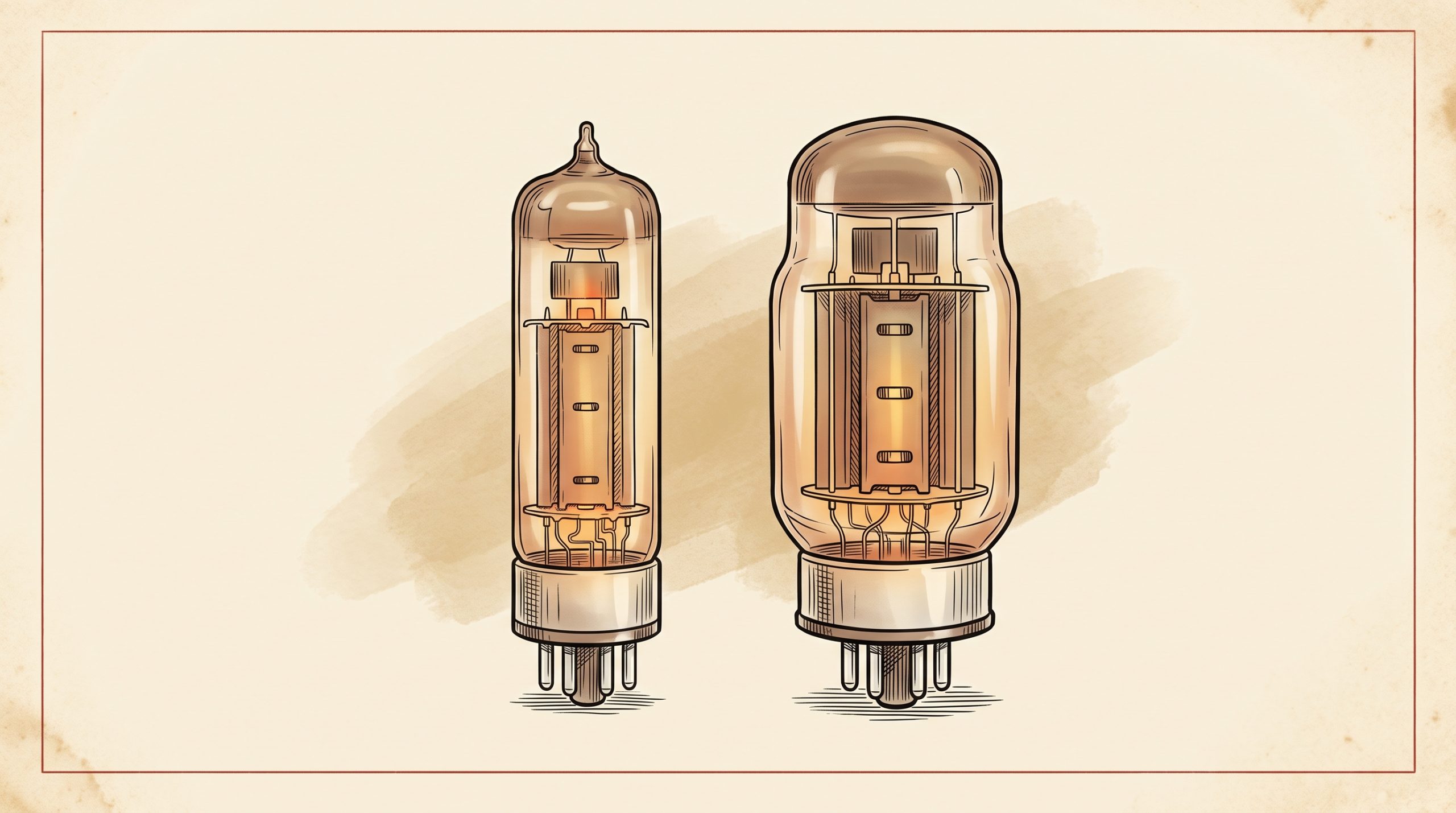
The Origins: Where These Tubes Came From
EL34: Mullard’s Blackburn Factory and the Birth of a Rock Tube
Mullard developed the EL34 at their Blackburn factory in Lancashire, UK, around 1953-1954, with commercial availability following in 1954. The designation follows European convention: “E” signals a 6.3V heater, “L” identifies it as an output pentode, and “34” is the sequence number in the series. Clean, logical, European.
What Mullard built for hi-fi audio became the defining tube of British guitar amplification within a decade. Marshall adopted the EL34 for the 1959 Super Lead from 1965 onward, cementing its association with classic rock tone. Hiwatt ran it in the DR103 Custom 100. Vox used it in later AC30 variants. The tube turned up across European hi-fi manufacturers simultaneously, including Telefunken in Germany, Amperex in the Netherlands, and Siemens, all producing their own versions with distinct internal construction and slightly different sonic characters.
Original NOS production from those manufacturers now commands serious collector prices. If you’re building out a vintage set, the EL34 tubes breakdown at TCguitar covers current production options against the NOS benchmark in detail.
KT88: GEC Hammersmith and the Hi-Fi Powerhouse
The KT88 came from an entirely different tradition. General Electric Company (UK), operating out of their Hammersmith works, introduced the KT88 in 1956. “KT” stands for Kinkless Tetrode, a beam power tetrode design that GEC developed to minimize the kink in the tetrode characteristic curve. Not a pentode. Electrically and topologically distinct from the EL34, even though both end up in the same octal socket.
GEC designed the KT88 for high-fidelity audio amplifiers, and that lineage shows in its measured, wide-bandwidth character. The guitar world adopted it more slowly. Marshall’s Major amplifier (1967-1974) remains the most prominent guitar-world application, though hi-fi manufacturers like McIntosh and Dynaco made it famous in living rooms first.
The GEC factory closed in the 1980s. Modern production comes from Electro-Harmonix, Tung-Sol, Gold Lion (New Sensor manufacturing), and Shuguang in China. The Genalex Gold Lion branding, which originally identified GEC production tubes, now covers New Sensor’s premium KT88 line. As documented at Reverb’s amplifier tone guide, the KT88 falls somewhere between the EL34 and the American 6550 in overall character, and it’s commonly used as a 6550 substitute without dramatic tonal differences in most circuits.
EL34 vs KT88: Datasheet Specs Compared
Most discussions of these tubes stay at the level of “the EL34 has more mids.” That’s true, but it doesn’t explain why, and it doesn’t tell you anything useful when you’re holding a soldering iron. The datasheet numbers do both.
| Specification | EL34 | KT88 |
|---|---|---|
| Tube Type | Pentode | Beam Tetrode |
| Heater Voltage | 6.3V | 6.3V |
| Heater Current | 1.5A | 1.6A |
| Max Plate Voltage (Va) | 800V | 800V |
| Max Plate Dissipation (Pa) | 25W | 42W |
| Max Screen Voltage (Vg2) | 500V | 600V |
| Max Screen Dissipation | 8W | 8W |
| Transconductance (gm) | ~11 mA/V | ~11.5 mA/V |
| Typical Plate Current (pair) | 100-150mA | 120-160mA |
| Typical Output Power (Class AB1, pair) | ~35W | ~50W |
| Typical Idle Bias Voltage (Vg1) | -30 to -50V (design-dependent) | -35 to -45V |
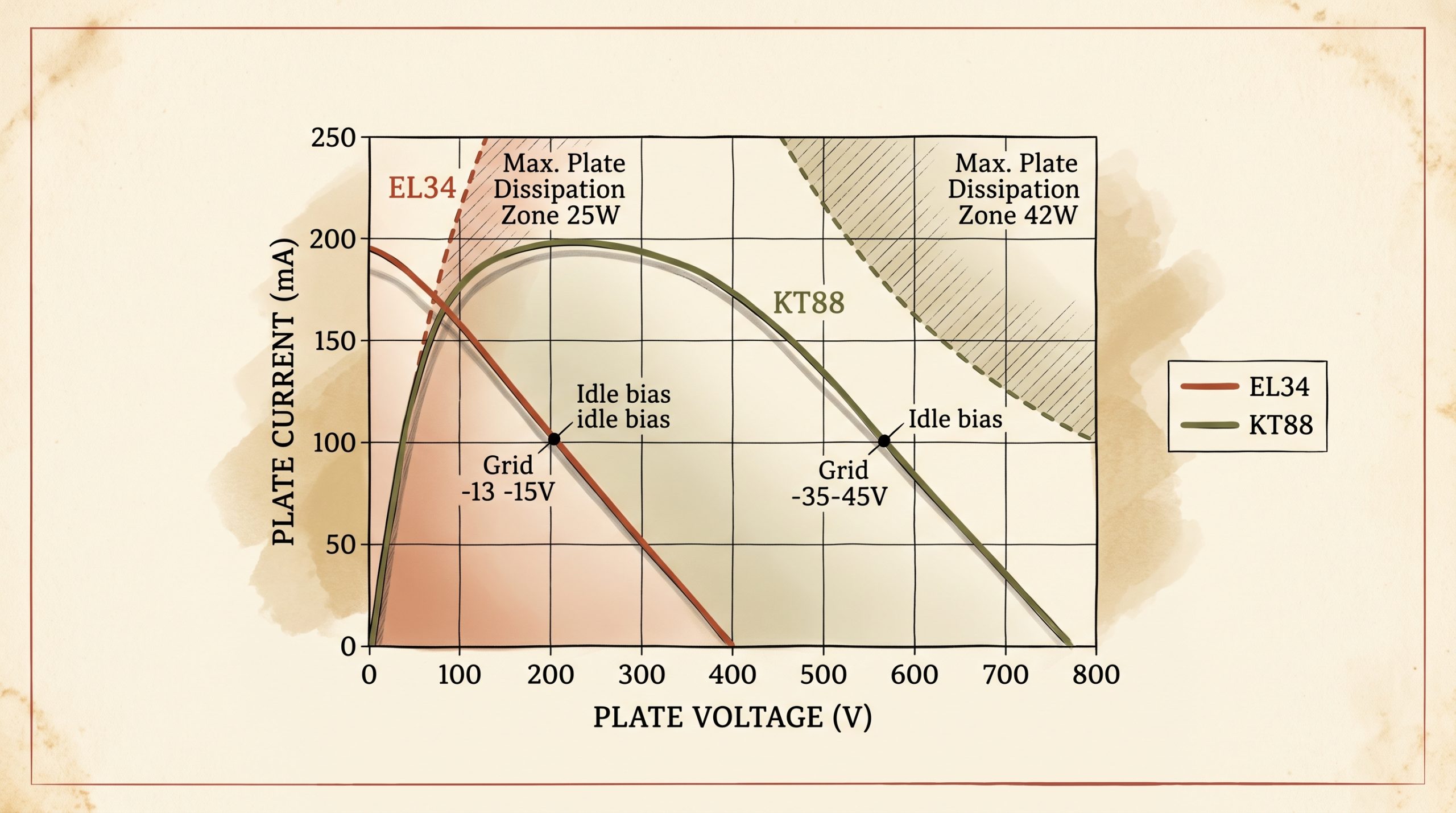
The plate dissipation gap (25W vs 42W) is the most consequential number on that chart. More plate dissipation means the KT88 can absorb more power before it clips, which translates directly into later breakup, more usable clean range, and a higher ceiling before the power stage starts contributing harmonic distortion. A matched pair of KT88s in Class AB produces around 50 watts. A matched EL34 pair in the same topology produces around 35. That’s not a subtle difference on stage.
Transconductance is nearly identical (11 vs 11.5 mA/V), which is why the tubes behave similarly in terms of gain. The real divergence shows up in bias voltage. In typical fixed-bias guitar amp circuits, EL34 output stages commonly run -30V to -50V of negative grid bias (Marshall techs often set -37V to -42V), while KT88 output stages typically run -35V to -45V. The exact figure for either tube depends on the amp’s specific plate and screen voltage design rather than being a fixed tube spec, but the difference is real enough, combined with the KT88’s higher target idle current, that blind swapping between these tube types is genuinely dangerous. An EL34 dropped into a KT88 circuit without rebias will run extremely cold. A KT88 dropped into an EL34 circuit without rebias will red-plate. Neither outcome is good for the tubes or the amp.
How They Actually Sound: Sonic Character Breakdown
EL34 Sonic Signature
The EL34 is a midrange-forward tube. That upper-mid presence, centered roughly around 1-3kHz, produces the characteristic “bark” that makes an EL34-loaded Marshall cut through a loud stage mix without the player doing anything special. Push the volume past halfway and the power stage starts to compress in a way that feels responsive rather than limiting. Soft clipping. Even-order harmonics. The kind of overdrive that doesn’t fight the player.
Bass response is tight but can feel slightly lean compared to bigger output tubes. That’s not a deficiency in high-gain contexts, where flabby low end creates mud. But if you’re playing clean jazz or country where extended bottom-end authority matters, the EL34 can feel thin by comparison. Genres where EL34 thrives: classic rock, British crunch tones, blues that wants to bark when pushed, compressed drive sounds.
KT88 Sonic Signature
The KT88 is a different proposition. Wide, relatively flat frequency response. Extended low-end authority. High clean headroom ceiling. The beam tetrode topology contributes to faster transient response and a more transparent, “hi-fi” character compared to the EL34’s pentode compression.
Guitar players who’ve run both describe KT88 tones as “big, clean, and powerful.” That’s accurate. The tradeoff is that the midrange emphasis the EL34 provides almost for free requires deliberate EQ work from a KT88. You won’t get the natural vocal quality of an EL34 mid-push without reaching for tone controls. Where the KT88 earns its place: jazz clean tones, country, high-headroom studio work, hi-fi applications where transparency matters more than character.
Head-to-Head in the Same Circuit
When both tubes run through an identical push-pull Class AB circuit, the character difference is immediately audible. KT88 sounds bigger and rounder from note one, with more low-end weight and extended air at the top. The EL34 sounds more focused and immediate. It enters its gain compression earlier in the volume sweep, producing harmonic content at levels where the KT88 is still producing clean output.
The midrange divergence mentioned in Audiogon’s long-running discussion thread on this topic (documented at forum.audiogon.com) consistently comes back to topology. Pentodes inherently produce a more peaked, colored frequency response compared to beam tetrodes. The EL34’s pentode design emphasizes mids structurally. The KT88’s kinkless tetrode design reduces that coloration by design, because it was engineered for hi-fi neutrality from the start. Neither character is superior in the abstract. They’re different tools.
Can You Actually Swap EL34 for KT88 (or Vice Versa)?
Electrical Compatibility: What the Specs Tell You
Both tubes run 6.3V heaters. Both use an octal (8-pin) base. They are physically pin-compatible, meaning a KT88 will drop into an EL34 socket and make contact. That’s where the easy compatibility ends.
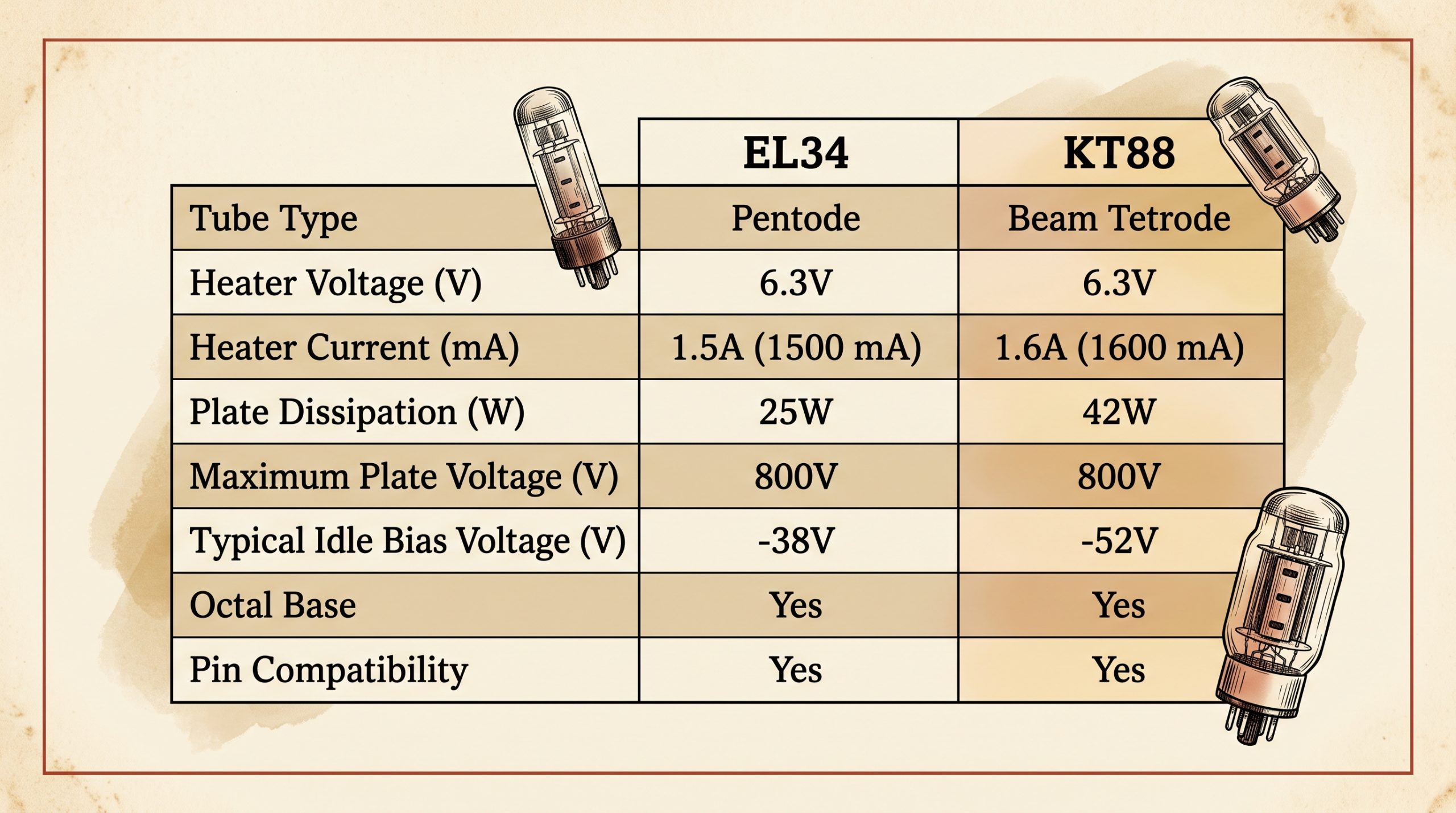
Bias voltage requirements differ enough that a rebias is mandatory. In typical fixed-bias guitar amp circuits the EL34 idles in roughly the -30V to -50V range and the KT88 in roughly the -35V to -45V range, but the specific number for either tube depends entirely on the amp’s plate voltage, screen voltage, and target idle current — it’s a circuit design choice, not a fixed tube spec. If a KT88 goes into an EL34 amp without a full rebias, the tube runs cold, output power drops, and tonal character suffers. If bias is set wrong in the other direction (not enough negative voltage for the tube now installed), the tube runs too hot, risking red-plating and rapid tube failure.
Never drop KT88 into an EL34 amp without a full rebias. Full stop.
Transformer Headroom Considerations
The KT88 draws more heater current (1.6A vs 1.5A per tube), produces significantly more output power, and places greater demands on the power supply. Output transformers in EL34-designed amps are typically rated for the power levels an EL34 produces. Asking one to handle 50W from a KT88 pair when it was wound for 35W from EL34s creates stress that can show up as transformer saturation, reduced bass response, or eventual failure in a marginal unit.
Output transformer primary impedance for EL34 pairs typically runs 3.4k to 8k ohms. KT88 pairs work best in a similar range, generally 4k to 8k ohms, so the impedance matching isn’t dramatically misaligned. The power delivery is what changes. A stout transformer in a high-quality EL34 amp may handle the substitution fine. A budget transformer in a lower-spec amp may not. The rule of thumb: KT88 into an EL34 amp is a risky swap without a qualified technician’s sign-off. EL34 into a KT88 amp is more forgiving electrically, though sonically underwhelming because the amp’s headroom and dynamics were built around the KT88’s capabilities.
The KT77 Middle Ground
The KT77 addresses a specific question that comes up constantly: can you get KT88-leaning tone without the bias and transformer concerns of an actual KT88 swap? Largely, yes. The KT77 is a beam tetrode on the same octal base as the EL34, with heater and bias requirements close enough to the EL34 that most circuits accept it with little or no rebias. Plate dissipation sits at roughly 25-30W depending on the specific reissue datasheet, between the EL34’s 25W and the KT88’s 42W.
Sonically, the KT77 leans toward the KT88 character rather than the EL34. More extended bass, slightly less midrange coloration, a touch more headroom before breakup. It doesn’t fully replicate the KT88’s full-range authority, but it gives EL34 amp owners a practical path toward that direction without electrical risk. If you want the midrange compressed bark, stay with EL34. If you want a wider, cleaner character and your amp uses EL34s, the KT77 is worth considering. See the broader 6L6 vs EL34 comparison for context on how these European tube families map against the American alternatives.
EL34 vs KT88 in the Context of Other Power Tubes
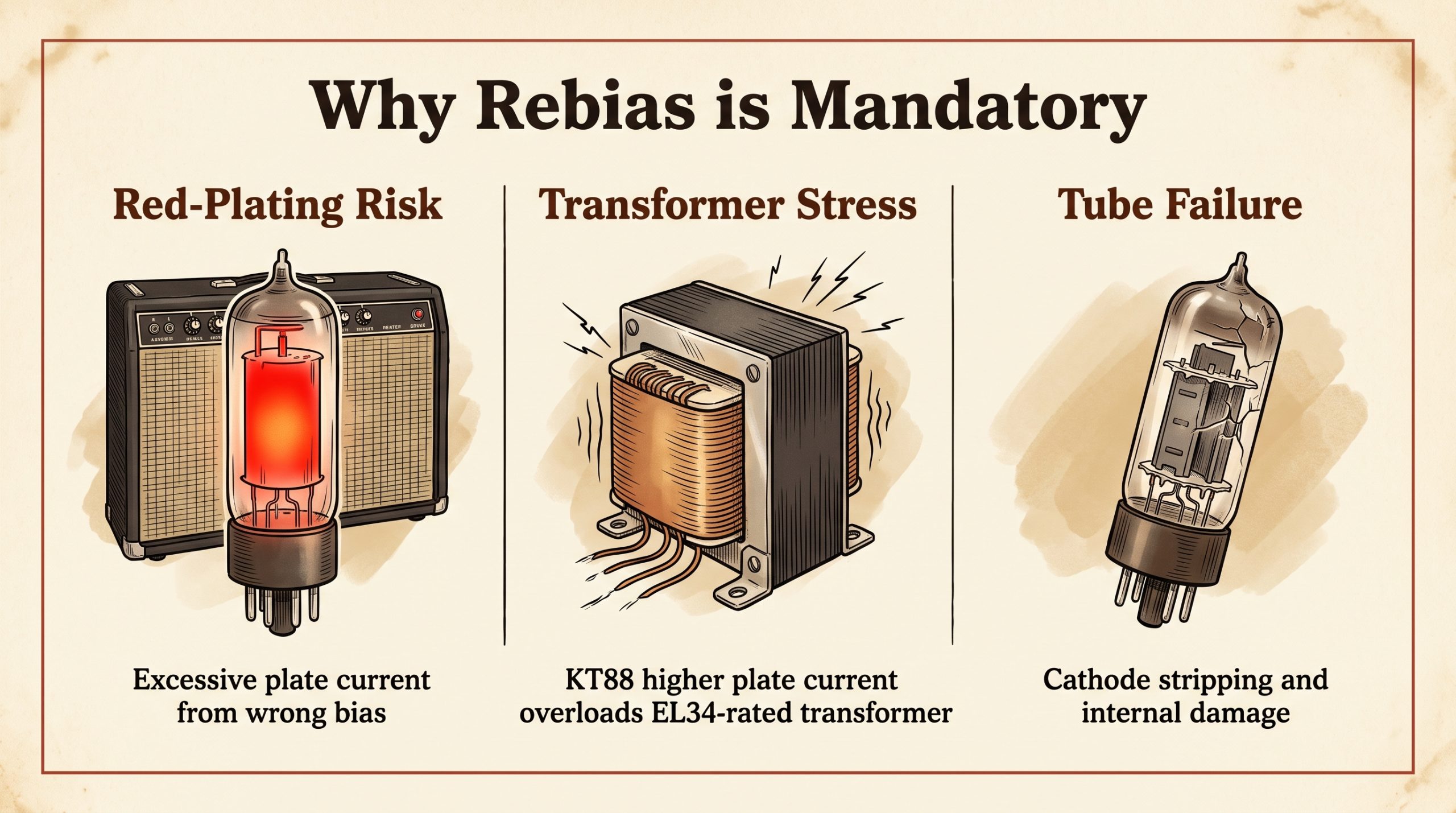
These two tubes don’t exist in isolation. Understanding where they sit relative to the broader power tube family helps clarify the decision, particularly for players coming from Fender backgrounds where 6L6s and 6V6s are the baseline reference.
| Tube | Type | Max Plate Dissipation | Sound Character | Common Use |
|---|---|---|---|---|
| EL34 | Pentode | 25W | Midrange forward, compressed, harmonic | Marshall, Hiwatt, Vox |
| KT88 | Beam Tetrode | 42W | Full-range, clean headroom, hi-fi neutral | Marshall Major, McIntosh, hi-fi |
| 6L6 | Beam Tetrode | 30W | Warm, slightly scooped mids, extended bass | Fender, Mesa/Boogie |
| 6550 | Beam Tetrode | 35W | Similar to KT88, slightly harder attack | Ampeg, hi-fi amplifiers |
| KT77 | Beam Tetrode | 25-30W | EL34/KT88 hybrid character, wider bass than EL34 | Drop-in EL34 substitute |
| 300B | Triode | 36W | Liquid, ultra-linear, low output power | Single-ended audiophile |
The KT88 and 6550 are close relatives but not identical. Both are high-dissipation beam tetrodes with similar pinouts, and both turn up in high-powered push-pull circuits. The KT88 generally reads as slightly warmer and more “European” sounding than the 6550’s harder, more assertive character. In practice, they’re close enough that many amps accept either with only minor bias adjustment, but treat them as similar rather than identical.
The 6L6, as covered in depth at the 6L6 vs EL34 comparison guide, sits closest to the KT88 in terms of beam tetrode topology and mid-scoop tendency, but at lower dissipation ratings. It’s the American answer to the European tube sound, and the divergence between Fender and Marshall tones maps almost exactly onto the 6L6 vs EL34 split.
Which Amps Use EL34 vs KT88?
Classic EL34 Amplifiers
The EL34’s adoption list reads like a history of British rock amplification. The Marshall 1959 Super Lead, built from 1965 through 1981, ran EL34s and defined the sound of amplified electric guitar for a generation. The Marshall JTM45, after its early years with KT66 tubes, shifted to EL34s in later versions post-1965. The Hiwatt DR103 Custom 100, favored by Pete Townshend, pushed EL34s into a different headroom register than Marshall’s approach. Mesa/Boogie produced an EL34 variant of the Dual Rectifier for players who wanted the European character in an American high-gain chassis.
Vox’s AC30 history is more complicated, with the power section going through multiple output tube configurations across production years, including EL84s in many standard versions. However, some four-output variants used EL34s. The tube’s association with any loud, harmonically complex, midrange-forward British amp is well-earned regardless.
Classic KT88 Amplifiers
Marshall’s KT88 guitar amp, the Major, ran from 1967 to 1974. Two hundred watts into four KT88s, producing a cleaner, more headroom-oriented sound than the Super Lead. It’s a rare amp today and frequently overlooked, but it demonstrates what the tube does in a guitar context: more clean power, less midrange personality.
In hi-fi, the KT88’s resume is more extensive. The McIntosh MC275 became one of the most respected stereo amplifiers ever built, partly on the strength of KT88 output sections. Leak and Radford amplifiers in the UK built their reputations on KT88 performance. Dynaco used KT88s in modified versions of their ST-70 platform.
For the TCguitar readership: the KT88 never entered standard Fender production. Fender’s power tube history runs primarily through 6L6s and 6V6s in the blackface and silverface eras. Players researching vintage Fender amps can use the Fender tube amp serial number and dating guide to identify original tube specs by year and circuit code across the full production run.
Current Production Tubes: Best EL34 and KT88 Available Today
Best Current EL34 Options
New Sensor manufactures the Mullard EL34 Reissue under license, and it’s one of the more consistent options available today in terms of matching and longevity. The Tung-Sol EL34 runs warmer and biases slightly differently than the Mullard reissue, with a softer top end that suits cleaner applications. JJ’s EL34 delivers a harder, slightly brighter character and a reputation for mechanical reliability. Electro-Harmonix’s version sits between the JJ and Tung-Sol in overall tonal balance.
None of these exactly replicate original Mullard, Telefunken, or Amperex NOS stock. That’s not a criticism. They’re good modern tubes. But if you’re chasing the specific sound of a 1968 Mullard from Blackburn, the current production options are approximations. Worth knowing going in.
Best Current KT88 Options
The Gold Lion KT88 (New Sensor) carries the original Genalex branding and comes closest to the original GEC character in most documented comparisons. Consistent matching. The Tung-Sol KT88 offers reliable performance across a wide bias range, and it’s a practical choice for amps where exact GEC replication isn’t the goal. Psvane’s KT88 represents boutique Chinese production with careful construction and genuine sonic claims, at higher prices than the New Sensor options. Shuguang’s KT88 is the affordable baseline: functional, consistent, not exceptional.
For push-pull circuits, always buy matched pairs or matched quads. Mismatched output tubes in push-pull operation create asymmetrical clipping, increased even-order harmonic distortion, and potential DC offset in the output transformer. Tung-Sol’s datasheet documentation and matched-pair grading methodology are available through authorized distributors for reference on acceptable matching tolerances.
Which Tube Should You Choose?
Choose the EL34 if you want classic British midrange character, earlier harmonic breakup, and compression that makes a 35W amp feel and sound bigger than its spec sheet suggests. It’s the right call for classic rock, blues that wants to get dirty before noon on the volume knob, and any application where midrange presence and early clip onset are part of the intended sound. The EL34 rewards players who use the power amp as part of the tone, not just as amplification.
Choose the KT88 if you need clean headroom, extended bass authority, and a more transparent platform that doesn’t color the signal the way a pentode does. It’s the choice for jazz players who need a stage-loud clean tone that stays clean, studio applications where the amp is a power stage under a preamp-level signal chain, and audiophile circuits where neutrality is the goal.
If you’re in EL34 territory but want to move the character slightly toward the KT88 side without electrical complexity, the KT77 is the practical first step. Bias it in as a normal EL34 swap, listen to what it does to the bottom end and the midrange peak, and decide from there whether you want to go further. Always have bias verified by a technician when changing between tube types, regardless of how similar the datasheets look. The numbers in the table above tell you everything you need to know about why that step matters.
Frequently asked questions
Can I use KT77 instead of EL34?
Yes. The KT77 is a beam tetrode on the same octal base as the EL34 with near-identical heater and bias requirements. It's a drop-in replacement in most EL34 circuits with little or no rebias required. Sonically, the KT77 leans toward KT88 character rather than EL34, producing more extended bass and slightly less midrange coloration than a true EL34. If you want to move your EL34 amp toward a cleaner, fuller tone without transformer or bias concerns, the KT77 is the practical path to try first.
What is the equivalent to the KT88?
The closest equivalent is the American 6550, which shares the same octal pinout, similar plate dissipation (35W vs 42W for the KT88), and comparable operating voltages. In most circuits, they're close enough to substitute with minor bias adjustment. The KT88 generally sounds slightly warmer and more "European" in character compared to the 6550's harder, more forward attack. The KT90 and KT120 are modern developments in the same beam tetrode family with even higher dissipation ratings for high-powered designs.
What do KT88 tubes sound like?
KT88 tubes produce a wide, relatively neutral frequency response with extended low-end authority, high clean headroom, and fast, transparent transient response. Compared to EL34, there's less midrange coloration and significantly later overdrive onset. Guitar players who've used both describe KT88 tones as "big, clean, and powerful," though not lacking character. In hi-fi terms, the KT88 delivers more of what the signal source provides without adding much of its own personality. That's a strength in audiophile contexts and a limitation in high-gain rock applications where midrange character is part of the intended sound.
Which amps use KT88 tubes?
The most notable guitar amplifier purpose-built for KT88s is the Marshall Major (1967-1974), a 200W head that delivered more clean headroom and less midrange compression than the EL34-loaded Super Lead. In hi-fi, the McIntosh MC275, Dynaco ST-70 in modified versions, and numerous Leak and Radford amplifiers from the UK built their reputations on KT88 performance. The tube never entered mainstream Fender production, which stayed with 6L6s and 6V6s throughout the blackface and silverface eras.
Is it safe to swap EL34 tubes into a KT88 amp?
Physically, yes. The octal pinout is identical, so the tubes will seat and make contact. Electrically, it's a significant mismatch without rebias. KT88 circuits typically run somewhat deeper negative grid bias voltage (-35 to -45V) than EL34 circuits (commonly -30 to -50V, design-dependent). Installing EL34s in a KT88-biased circuit set toward the deep end of that range will cause them to run very cold, reducing output power and changing the tonal character substantially. A qualified technician should reset the bias before committing to the substitution. Running the swap without addressing bias won't instantly destroy anything, but you won't get accurate performance from the EL34s at those bias settings.