Contents
- 01Why This Comparison Still Matters
- 02A Brief History of the 6L6 Family
- 035881 vs 6L6: The Specs That Actually Matter
- 04Tonal Character: What Your Ears Will Actually Notice
- 05Interchangeability: When the Swap Is Safe and When It Isn't
- 06Which Amps Were Originally Designed for the 5881
- 07Where the 5881 Fits in the Beam Tetrode Family
- 08Buying Guide: Current Production Options
- 09Frequently Asked Questions
- 10Same Family, Different Jobs
Most forums will tell you the 5881 and 6L6 are the same tube with a different label. That’s wrong. Close, but wrong. The distinction matters the moment you drop a pair of 5881s into a high-B+ amp that was engineered around the 6L6GC’s headroom ceiling, and it matters again when you realize most tubes sold as “5881” today aren’t actually spec’d like the original military-spec part at all. The situation has layers.
What follows untangles the actual datasheet differences, explains why the 5881 was built differently in the first place, and tells you exactly when the swap is fine and when it’ll shorten the life of your output transformer.
- Same octal pin configuration: direct physical plug-in swap
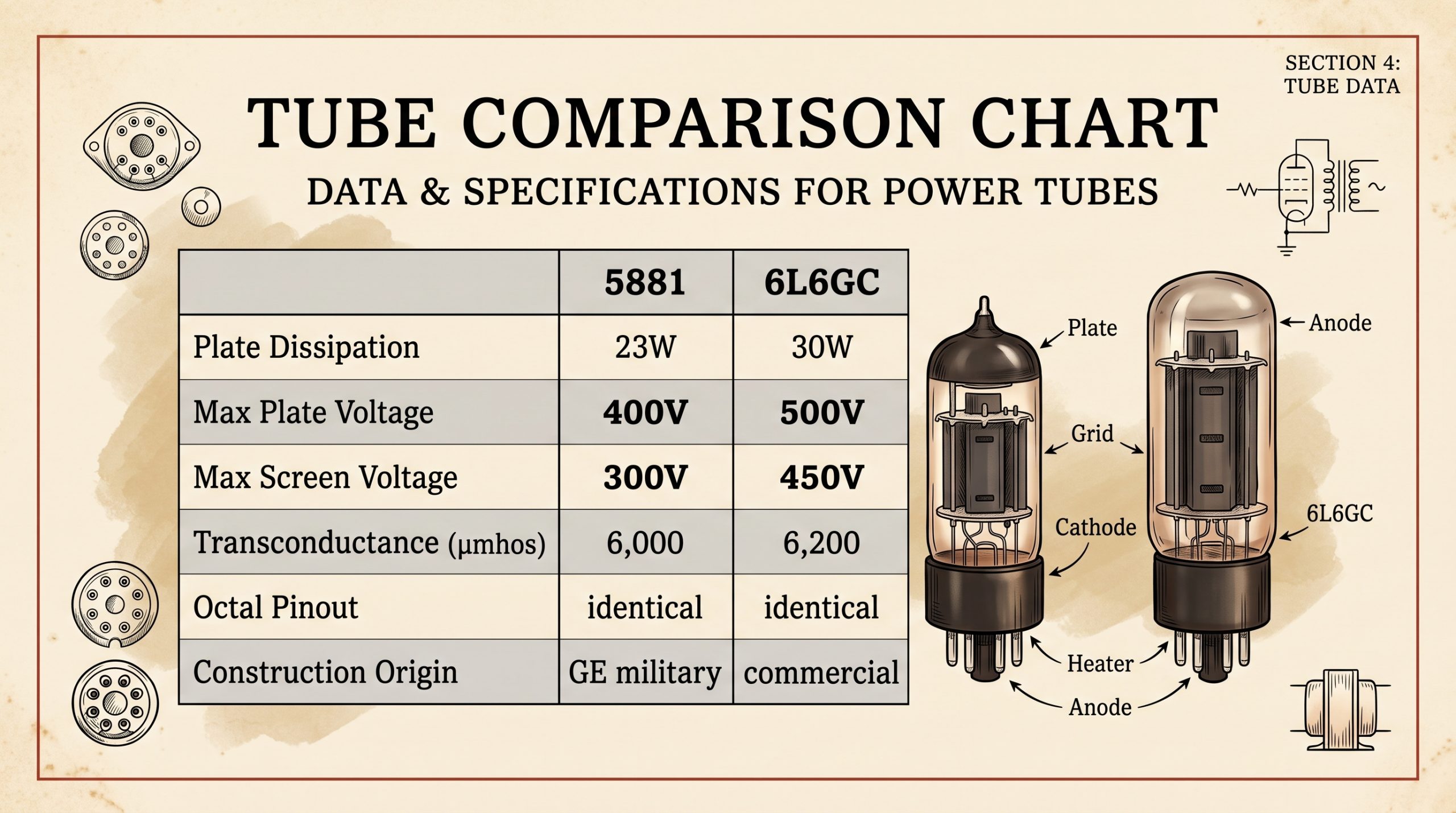
- 5881 plate dissipation: 23W (JAN military spec, conservative de-rating)
- 6L6GC plate dissipation: 30W (commercial spec, 1956 onward)
- 5881 max plate voltage: 400V, borderline in many blackface Fender circuits
- Screen voltage limit on 5881 is 300V vs. 450V on 6L6GC, the overlooked danger
- Modern “5881” production tubes (JJ, Tung-Sol, EH) are electrically rated to 6L6GC specs, the original spec distinction is now mostly a vintage-market issue
- Always rebias after any power tube swap in a fixed-bias amplifier. Non-negotiable.
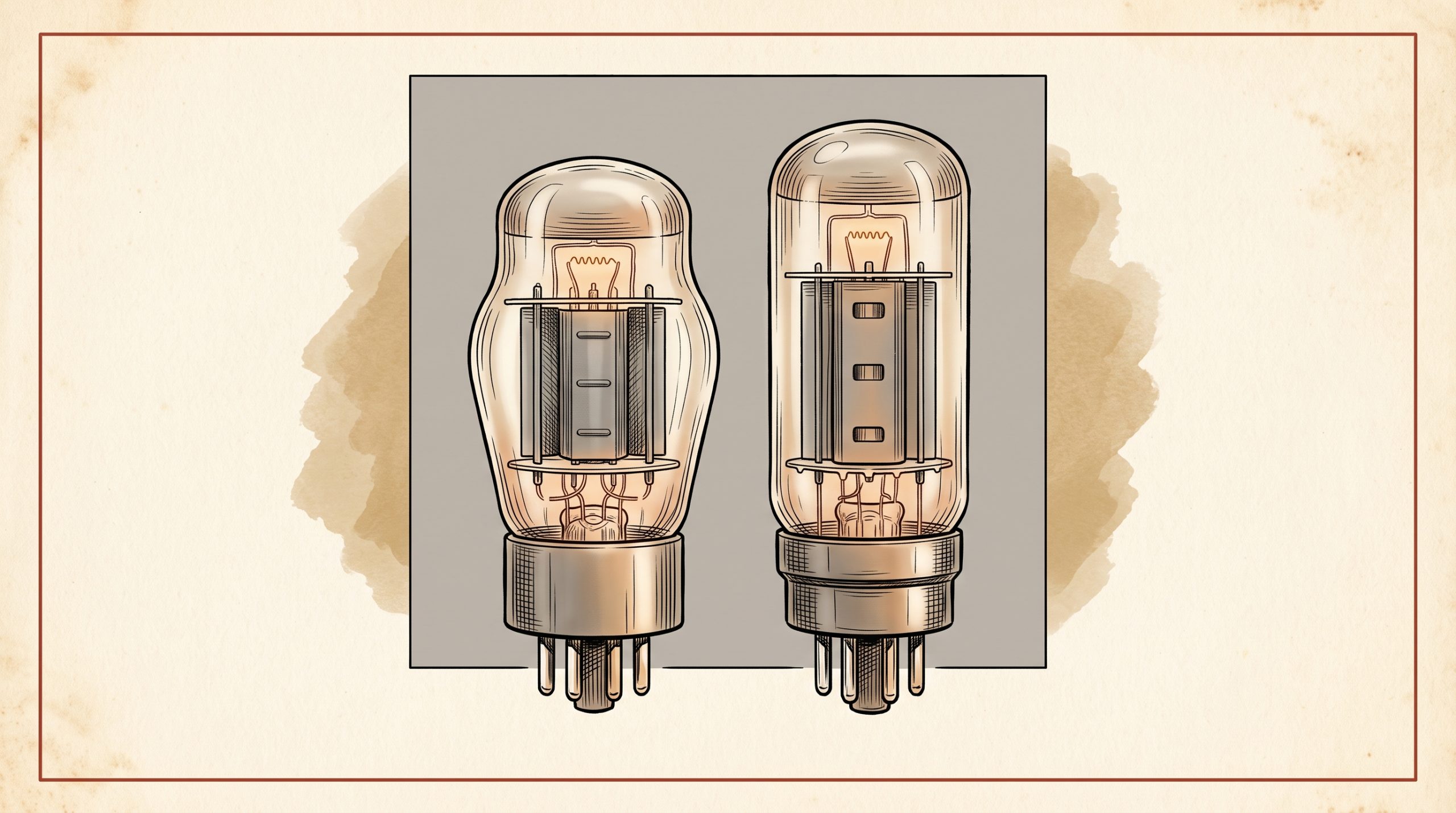
Why This Comparison Still Matters
Gear forums have been arguing about this since the mid-1990s. The typical exchange goes: someone asks if 5881s and 6L6s are interchangeable, three people say yes, one person says “technically no,” and nobody cites a datasheet. The confusion has persisted for good reason. The tubes are close enough for casual substitution in a lot of circuits. But “close enough” has limits, and those limits show up as dead screens, stressed output transformers, and tubes that fail six months into regular gigging.
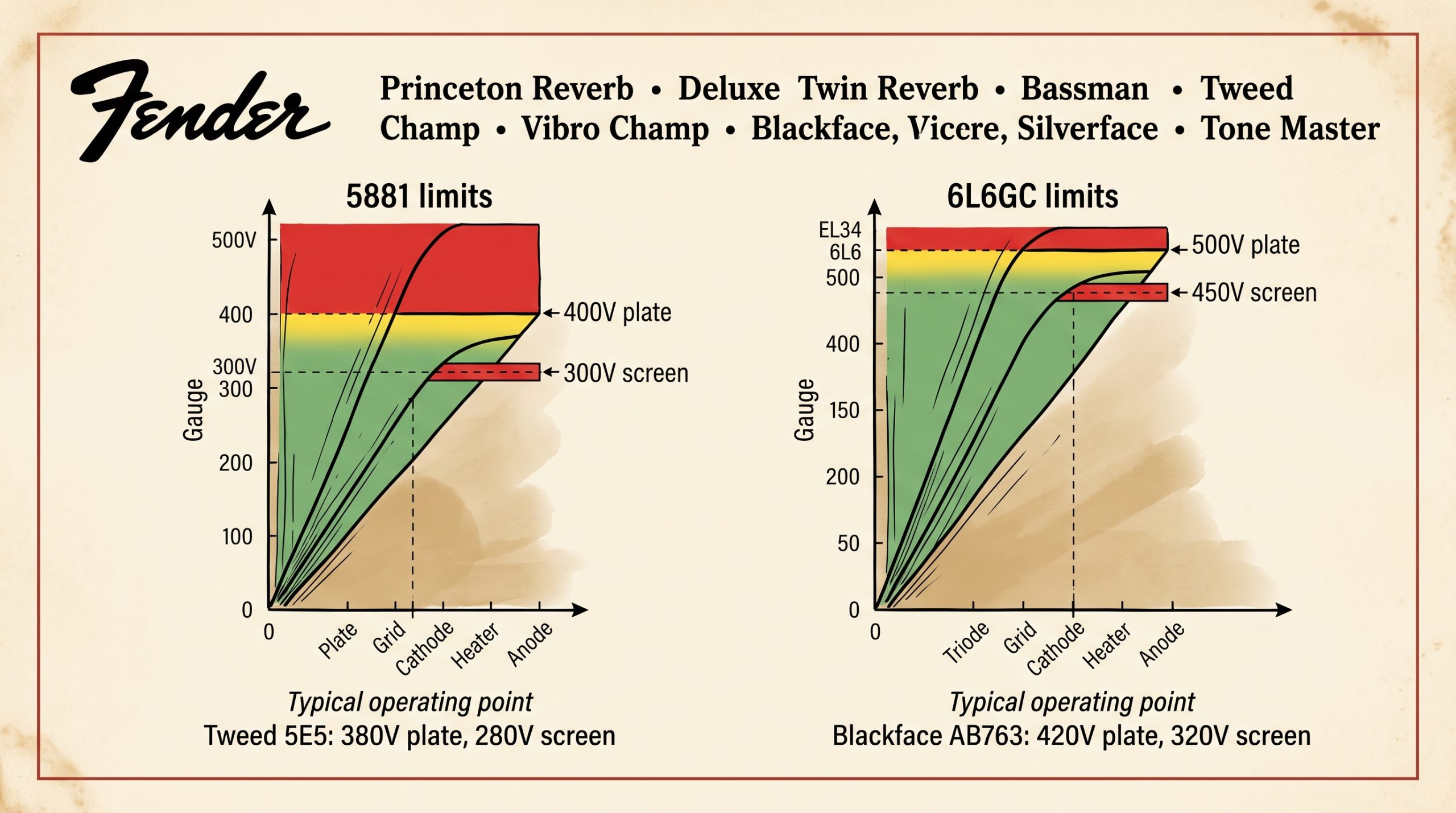
The stakes are concrete. Fender’s tweed-era circuits (the 5E5 Pro, 5F4 Super) were engineered around the 5881’s 400V plate ceiling and 23W dissipation budget. Fender’s blackface circuits (AB763, AA769) were engineered around the 6L6GC’s 500V plate ceiling and 30W headroom. Those aren’t interchangeable design assumptions. For anyone dating or restoring a vintage Fender, the Fender tube amp dating reference covers how to identify which circuit revision your amp actually uses before buying replacement tubes. That’s accurate as far as it goes. It doesn’t go far enough.
A Brief History of the 6L6 Family
RCA’s Original 6L6 (1936): The Metal Envelope Era
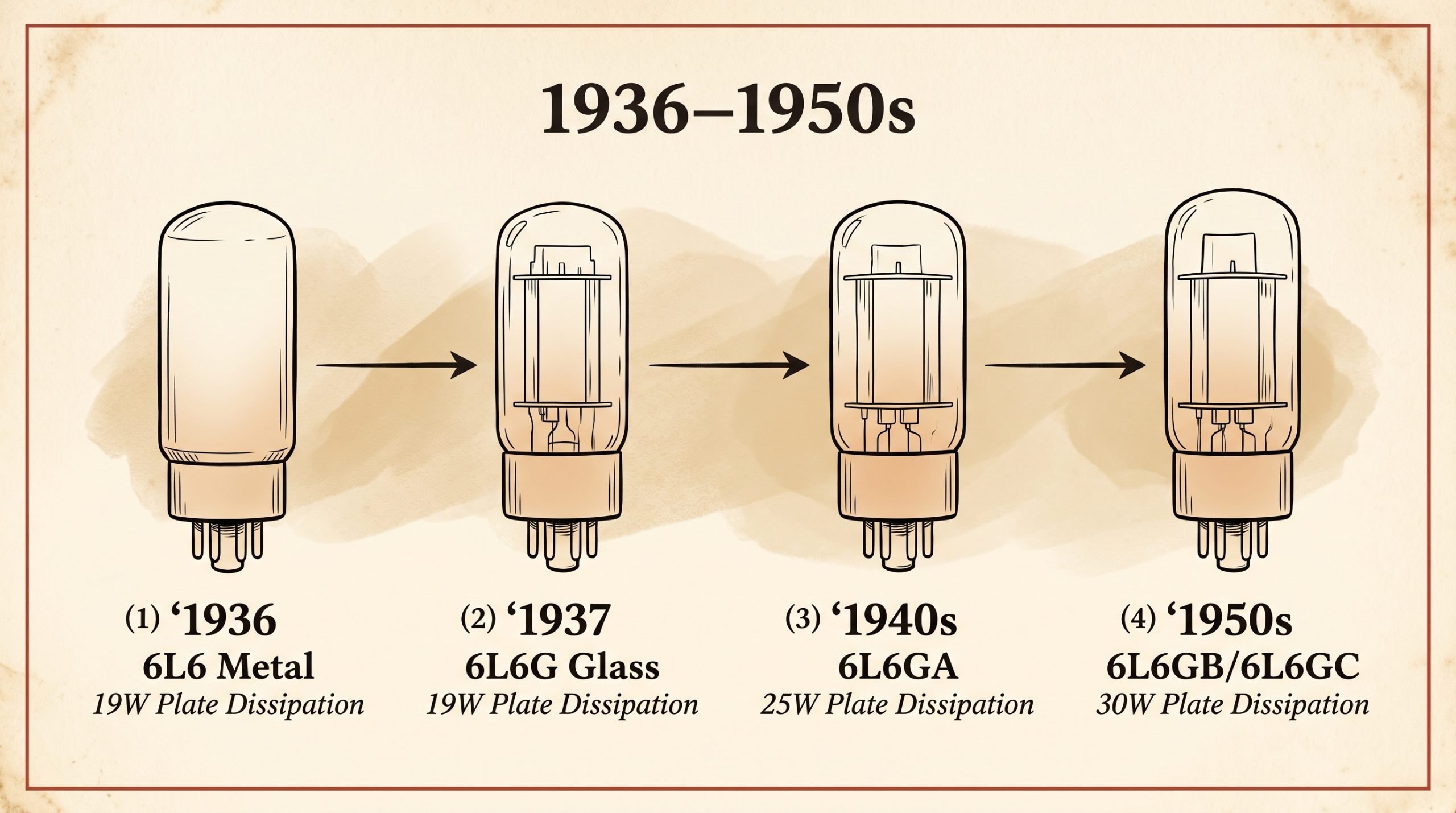
RCA introduced the 6L6 in 1936. Radio and public address applications were the target, not guitar amplifiers. The original came in a metal envelope on an octal base, rated at 19W plate dissipation with a maximum plate voltage of 360V and transconductance around 6,000 µmhos. Nearly every beam power tetrode topology since descends from this design. That’s not an overstatement. The 6L6 established the template.
The 6L6G, 6L6GA, 6L6GB: Glass Arrives, Power Climbs
The 6L6G followed in 1937 with a glass “coke bottle” envelope. Same electrical specs, better thermal radiation from the plate structure. The 6L6GA was a minor construction revision, electrically interchangeable with the 6L6G. Then came the 6L6GB, and this one matters for the 5881 comparison: 25W plate dissipation and a 400V maximum plate voltage. The 6L6GB represents the first meaningful power-handling bump in the family.
| Variant | Year | Envelope | Plate Dissipation | Max Plate Voltage |
|---|---|---|---|---|
| 6L6 (original) | 1936 | Metal | 19W | 360V |
| 6L6G | 1937 | Glass (ST) | 19W | 360V |
| 6L6GA | 1940s | Glass | 19W | 360V |
| 6L6GB | Early 1950s | Glass | 25W | 400V |
| 5881 | Early 1950s | Glass (ruggedized) | 23W | 400V |
| 6L6GC | 1956 | Glass (larger) | 30W | 500V |
The 5881: An Industrial and Military Deviation
The 5881 was introduced in the early 1950s under a JAN (Joint Army-Navy) designation, which tells you the intended use case immediately. This wasn’t a consumer audio product. It was built for industrial and military applications where mechanical reliability under vibration, temperature extremes, and rough handling mattered more than squeezing every last watt out of the design. Like most JAN-spec tubes, the 5881 was never a single-manufacturer product: RCA, GE, Sylvania, Westinghouse, and Tung-Sol all produced 5881s to the same military specification, and Tung-Sol is generally credited with originating the ruggedized design for the US military before other manufacturers picked up production.
The 5881’s internal construction reflects that priority. Heavier mica spacers. Tighter construction tolerances on the electrode assembly. A ruggedized envelope. The rated plate dissipation came in at 23W, which sits below the contemporaneous 6L6GB’s 25W. That’s not because the tube couldn’t have been built hotter. It’s because military procurement philosophy routinely de-rated components to roughly 80% of their actual capacity ceiling, ensuring reliable operation across the full service life rather than peak performance at the edge of the spec. A tube rated at 23W in JAN service was typically capable of sustaining 28-29W before problems emerged in controlled conditions. The de-rating was deliberate. Conservative by design.
Maximum plate voltage on the original 5881 datasheet: 400V. Screen voltage maximum: 300V. Those numbers become important when you start matching the tube to specific amplifier circuits.
The 6L6GC: The Final Form (1956 Onward)
GE and Sylvania pushed the design further in 1956 with the 6L6GC. Larger plate structure, 30W dissipation, 500V maximum plate voltage. This is the tube most guitarists mean when they say “6L6,” full stop. Fender’s blackface and silverface circuits (AB763, AA769, AA1069) were engineered around the 6L6GC’s headroom and voltage tolerance. The 6L6GC’s fuller spec envelope is why those amps could push 40-50W clean from a pair before the power section started compressing. For more on the full 6L6 history and variants, the 6L6 tubes guide covers the complete picture from RCA metal cans through modern production.
5881 vs 6L6: The Specs That Actually Matter
Full Datasheet Spec Comparison
| Specification | 5881 (Military JAN Spec) | 6L6GC (Commercial Spec) | Notes |
|---|---|---|---|
| Plate Dissipation (max) | 23W | 30W | Key headroom difference |
| Screen Dissipation (max) | 4.5W | 5W | Minor, but relevant in high-screen-voltage amps |
| Plate Voltage (max) | 400V | 500V | Critical for amp matching |
| Screen Voltage (max) | 300V | 450V | The often-ignored danger spec |
| Cathode Current (max) | 100mA | 150mA | Affects bass control and transient handling |
| Transconductance (gm) | ~5,500 µmhos | ~6,000 µmhos | Affects sensitivity, minor difference |
| Plate Resistance (rp) | ~22.5kΩ | ~22.5kΩ | Near identical |
| Heater Voltage | 6.3V | 6.3V | Identical |
| Heater Current | 0.9A | 0.9A | Identical |
| Pin Configuration | Octal | Octal | Direct plug-in swap |
Original manufacturer datasheets (RCA, GE, Sylvania, and Tung-Sol all produced 5881s to the JAN spec) are the primary reference here. One critical note for anyone shopping today: current production tubes labeled “5881” from JJ, Tung-Sol, and Electro-Harmonix are typically rated to 6L6GC specifications, not original 5881 specs. The label has become a style designation more than a technical one. More on that below.
What These Numbers Mean at the Amp Level
A matched pair of 5881s in a Class AB push-pull circuit produces roughly 40-45W before clipping. The same circuit with a matched pair of 6L6GCs produces 50-55W. That’s a 10-15% difference in output power, and it means the 5881 hits output transformer saturation earlier at the same B+ voltage. Not dramatically earlier. But audibly earlier in the right context.
Bias targets differ too. A 5881 biased at 70% of maximum idle dissipation sits at approximately 13.8-16.1W per tube, which corresponds to around 30-35mA plate current at typical B+ voltages. A 6L6GC biased at the same 70% ceiling sits at 18-21W per tube, typically 35-45mA depending on the B+ rail. Drop 5881s into an amp set up for 6L6GCs without adjusting bias and you’re likely over-dissipating the 5881s right from power-up.
The Screen Voltage Factor: The Hidden Danger Nobody Mentions
Plate dissipation gets all the attention. Screen voltage tolerance deserves equal focus. The original 5881 spec puts maximum screen voltage at 300V. The 6L6GC tolerates 450V on the screen grid. That 150V gap is significant.
Fender’s Dual Showman and Super Reverb push 450-475V at the plate in stock form, with screen voltages that can approach or exceed 400V depending on the specific build. That’s within 6L6GC spec. It’s well over what the original 5881 was rated for. Running vintage-spec 5881s in high-B+ amps doesn’t just risk earlier compression; it accelerates screen grid failure. The screen goes first, usually quietly, and then the tube tests weak and you wonder why the amp sounds flat.
Tonal Character: What Your Ears Will Actually Notice
Where the 5881 Sounds Different (And Why)
The 5881’s lower headroom ceiling produces compression earlier in the power amp stage at equivalent plate voltages. That compression reads as warmth. It also reads as spongy compression on attack and a subtle midrange emphasis that isn’t an EQ change, it’s a compression artifact. Pick hard into a 5881-loaded amp at medium volume and the transient softens slightly. The note blooms instead of barks.
High-frequency “softness” follows from the same cause. The reduced plate current ceiling limits how hard the output transformer can be driven on fast transients, which rounds the top end perception. Not ice-pick treble. More of a vintage-smooth quality.
Where the 6L6GC Sounds Different (And Why)
More clean headroom. That’s the short version.
The 6L6GC’s higher cathode current ceiling gives the power section more control authority over the output transformer’s bass winding, producing tighter, stiffer bass response. Pick attacks are more defined. The “Fender blackface clean” sound is specifically a 6L6GC characteristic: the spanky attack, the bell-like clarity, the way chords stay articulate at stage volume. The AB763 Twin Reverb runs four 6L6GCs for exactly that reason. The headroom is the point.
Which One Sounds Better? The Honest Answer
Depends entirely on the application. A small combo pushed to medium volume? The 5881’s earlier compression is a feature. It adds character the circuit wouldn’t have at clean settings. A Twin Reverb serving as a pedal platform at stage volume? You want the 6L6GC’s headroom. The compression that makes a small amp sing turns a large amp mushy.
Interchangeability: When the Swap Is Safe and When It Isn’t
When the Swap Is Safe
Any amp running a B+ voltage below 400V with screen voltages below 300V can safely use original-spec 5881s. Tweed circuits are the easy case. The 5E3 Deluxe Reverb runs B+ around 340-360V. Fine for either tube. The 5E5 Pro was designed with 5881s at B+ voltages in the 370V range. Also fine. Those circuits have comfortable margin.
| Amplifier | Circuit Code | Approximate B+ | Recommended Tube | Notes |
|---|---|---|---|---|
| Fender 5E3 Tweed Deluxe | 5E3 | ~340V | 6V6 (original), either 6L6 variant | Low-voltage circuit, wide tolerance |
| Fender 5E5 Pro | 5E5 | ~370V | 5881 (original spec) | Designed around 5881 headroom |
| Fender 5F4 Super | 5F4 | ~370V | 5881 (original spec) | Classic tweed crunch at 5881 ceiling |
| Fender Deluxe Reverb (blackface) | AB763 | ~420V | 6L6GC preferred | Borderline for vintage 5881 spec |
| Fender Super Reverb | AB763 | ~440V | 6L6GC only | Over 5881 plate voltage rating |
| Fender Twin Reverb | AB763/AA769 | ~450-475V | 6L6GC only | Well above 5881 ceiling |
When You Must Rebias
Any tube swap in a fixed-bias amplifier requires rebiasing. That applies regardless of whether you’re going from 5881 to 6L6GC, 6L6GC to 5881, or new old-stock to current production of the same nominal type. Target idle dissipation at 60-70% of maximum plate dissipation:
- 5881: 60-70% of 23W = 13.8 to 16.1W per tube
- 6L6GC: 60-70% of 30W = 18 to 21W per tube
Calculate idle dissipation as: plate voltage multiplied by plate current. That’s the number you’re managing. Running either tube at 80% or above idle dissipation is asking for shortened life and unpredictable failure.
The Modern “5881” Problem: What You’re Actually Buying Today
This is the under-reported story in this corner of the market, and it changes the practical significance of this whole comparison.
The JJ 5881 is electrically rated to 6L6GC specifications. The Tung-Sol 5881 reissue physically resembles the vintage military-spec envelope but carries 6L6GC-level ratings. The Electro-Harmonix 5881 explicitly states “equivalent to 6L6GC” in the product description. If you buy a tube labeled “5881” today from any of the major current producers, you are almost certainly getting a 6L6GC in a different-shaped glass envelope. The original spec distinction between 5881 and 6L6GC has largely evaporated at the production level. Not a myth. Not a scandal. Just how the market settled.
The practical implication: for modern amps, the 5881-vs-6L6GC debate is mostly about physical fitment and tonal preference, not safety margins. For vintage amp restoration using NOS tubes, the original spec distinction is real and worth respecting.
Which Amps Were Originally Designed for the 5881
Fender Circuits That Shipped with 5881s
The tweed era is where the 5881 lives in Fender’s history. The tweed-era Fender amp identification guide covers the full production context, but the key circuits using 5881s are:
- 5E5 Pro Amp (tweed, 1955-1960): two 5881s, approximately 26W output, B+ around 370V. Purpose-designed around the 5881’s headroom budget.
- 5E7 Bandmaster (tweed, 1956-1960): two 5881s, same general voltage architecture as the 5E5.
- 5F4 Super Amp (tweed, 1958-1960): two 5881s, approximately 30W, the circuit that produces the classic tweed crunch character that players still chase.
Non-Fender Notable Users
The Marshall JTM45 originally specified 5881 or KT66 tubes in early UK production runs. The transition from 5881/KT66 to EL34 wasn’t just a component substitution; it fundamentally shifted Marshall’s tonal identity toward the aggressive mid-forward character associated with British rock. Early Ampeg designs also used 5881s before adopting the 7027 for higher-voltage applications.
Where the 5881 Fits in the Beam Tetrode Family
| Tube | Type | Max Plate W | Max Plate V | Sound Character | Common In |
|---|---|---|---|---|---|
| 5881 | Beam Tetrode | 23W | 400V | Warm, compressed, mid-forward | Tweed Fender |
| 6L6GC | Beam Tetrode | 30W | 500V | Clean, articulate, tight bass | Blackface/silverface Fender |
| EL34 | Pentode | 25W | 500V | Aggressive mids, compressed | Marshall, Hiwatt |
| KT66 | Beam Tetrode | 25W | 500V | Warm, hi-fi, articulate | JTM45, hi-fi |
| EL84 | Pentode | 12W | 300V | Bright, chiming, compressed | Vox AC15/AC30, Pro Junior |
The EL34 vs 6L6 comparison covers the British-vs-American power tube divide in full. The EL84 guide explains why that tube’s Vox sound sits in a chemically different category from the entire 6L6 family.
Buying Guide: Current Production Options
| Brand/Model | Label | Actual Spec Tier | Best For |
|---|---|---|---|
| Tung-Sol 5881 | 5881 | 6L6GC-equivalent | Vintage envelope look, modern reliability |
| JJ 5881 | 5881 | 6L6GC-equivalent | Budget, durable, consistent matching |
| Tung-Sol 6L6GC STR | 6L6GC | Full 6L6GC | High-headroom blackface rigs, clean platforms |
| JJ 6L6GC | 6L6GC | Full 6L6GC | Tight, modern response, affordable |
| Svetlana 6L6GC (SED) | 6L6GC | Full 6L6GC | Hi-fi and audiophile-grade applications |
| Electro-Harmonix 5881 | 5881 | 6L6GC-equivalent | Classic appearance, full modern ratings |
NOS tubes labeled 5881 do appear on eBay and vintage parts dealers, but the NOS market carries real risks: relabeled stock, misrepresented test data, end-of-life tubes sold as “tested good.” Without a calibrated tube tester reading and a traceable provenance, the premium for genuine GE or RCA NOS 5881s is hard to justify for anything except a museum-correct restoration. Tung-Sol’s current-production 5881 reissue and JJ Electronic’s power tube lineup are documented with published datasheets and available matched.
Same Family, Different Jobs
The core distinction is concrete: 23W and 400V against 30W and 500V. That gap was meaningful in 1955 when Fender was designing tweed circuits around the 5881’s headroom budget, and it was meaningful again in 1963 when the blackface circuits pushed B+ voltages that the original 5881 wasn’t rated to sustain. The forum consensus that “they’re the same” holds up well enough for current-production tubes, where manufacturers have effectively converged on 6L6GC specs under both labels. For vintage amp restoration, the original specification distinction matters and is worth preserving: a 5E5 Pro restored with correctly-spec’d 5881s will behave the way its circuit was designed to behave, compressing at the voltages Fender intended. Drop in a set of high-spec 6L6GCs and the headroom margin shifts, the breakup character changes, and you’ve altered the designer’s intent without necessarily improving the result. Match the tube to the circuit, rebias after any swap, and understand that the label on a modern production tube tells you less than the datasheet does.
Frequently asked questions
Are 5881 and 6L6 interchangeable?
Yes, with caveats. The 5881 and 6L6GC share identical octal pin configurations and can be physically swapped in most amplifiers. Because the original 5881 carries a lower maximum plate voltage (400V vs. 500V) and lower plate dissipation (23W vs. 30W), running vintage-spec 5881s in amps with B+ voltages above 400V risks premature screen failure and shortened tube life. Current-production tubes sold as "5881" are typically rated to 6L6GC specs, which largely eliminates that concern. Always rebias after any power tube substitution in a fixed-bias amp.
What is the equivalent of a 5881 tube?
The closest modern equivalent is the 6L6GC, and current production "5881" tubes from JJ, Tung-Sol, and Electro-Harmonix are electrically rated to 6L6GC specifications. In terms of original vintage power ratings, the 5881 most closely parallels the 6L6GB: both are rated at 23-25W plate dissipation with a 400V plate voltage ceiling. The 6L6GC is a step up from either in raw headroom.
Which amps use 5881 tubes?
Vintage Fender tweed-era amplifiers from 1955-1960 shipped with 5881s as the factory power tube, including the 5E5 Pro, the 5F4 Super Amp, and the 5E7 Bandmaster. Fender never used the 5881 in the Princeton; that amp ran 6V6 tubes throughout its production. Early Marshall JTM45 production also specified 5881s before the transition to EL34s changed the amp's character entirely. Many current boutique builders specify 5881-labeled tubes for tonal reasons, though those tubes are typically 6L6GC-equivalent by modern production specs.
What is the difference between a JJ 5881 and a JJ 6L6GC?
Despite the different labels, the JJ 5881 and JJ 6L6GC are electrically near-identical. JJ rates the 5881 to 6L6GC power levels. The primary practical difference is physical profile: the 5881 uses a shorter, narrower envelope that can affect fitment in amps with tight tube socket clearance or chassis-mounted sockets with limited vertical clearance. In terms of tone and longevity in a properly biased amp, the difference is minimal compared to matching quality, which matters more than the label.
Does the 5881 sound warmer than the 6L6GC?
The perception of warmth traces back to earlier onset of power compression, not a fundamentally different harmonic character. A 5881 in a given circuit hits its dissipation ceiling sooner, generating slightly more 2nd and 3rd harmonic content at equivalent volumes. That added harmonic density reads as warmth. In high-headroom circuits designed around the 6L6GC, a 5881 substitution sounds noticeably softer and more compressed. Whether that's "warmer" or just "less clean" depends entirely on what you're after.