Contents
- 01What Is the Fender 5E3 Tweed Deluxe?
- 02Original Specs and Circuit Breakdown
- 03The 5E3 Sound, What Does It Actually Do?
- 04Famous Players and Studio History
- 05The 5E3 Schematic, Key Circuit Points for Builders
- 06Building Your Own, 5E3 Kits, Cabinets, and Clones
- 07Popular 5E3 Mods, What Works and What Doesn't
- 08The Fender '57 Custom Deluxe, The Official Reissue
- 09Dating and Identifying a Vintage 5E3
- 10FAQ, Fender 5E3 Tweed Deluxe
- 11Why the 5E3 Became the Most Cloned Amp in History
Three knobs. Four inputs. One 12-inch speaker. The 5E3 circuit shouldn’t be this influential, but it’s become the entry point for DIY amp builders, a studio secret weapon for decades of session players, and the design benchmark behind more than 50 boutique manufacturer clones. Understanding why requires looking at both the circuit and the culture that grew up around it.
- Circuit designation: 5E3 (sixth Deluxe iteration)
- Production years: 1955–1960 (Narrow Panel tweed era)
- Output: 12–15W, cathode-biased push-pull, 2x 6V6GT
- Preamp tubes: 2x 12AY7 (V1, V2); Rectifier: 5Y3GT
- Speaker: 1x 12″ Jensen P12R or P12Q (alnico), 8 ohms
- Controls: Volume (Normal), Volume (Bright), Tone, no reverb, no tremolo
- Vintage originals: $3,000–$8,000+ depending on originality
- Fender ’57 Custom Deluxe reissue: ~$2,299 street price (2026)
- 5E3 kit builds: $250–$600 depending on supplier and completeness
- Not truly Class A, cathode-biased push-pull is technically Class AB, though biased toward the Class A end
- Replaced transformers significantly reduce vintage value, always check EIA codes before buying
What Is the Fender 5E3 Tweed Deluxe?
Circuit Designation and Era Classification
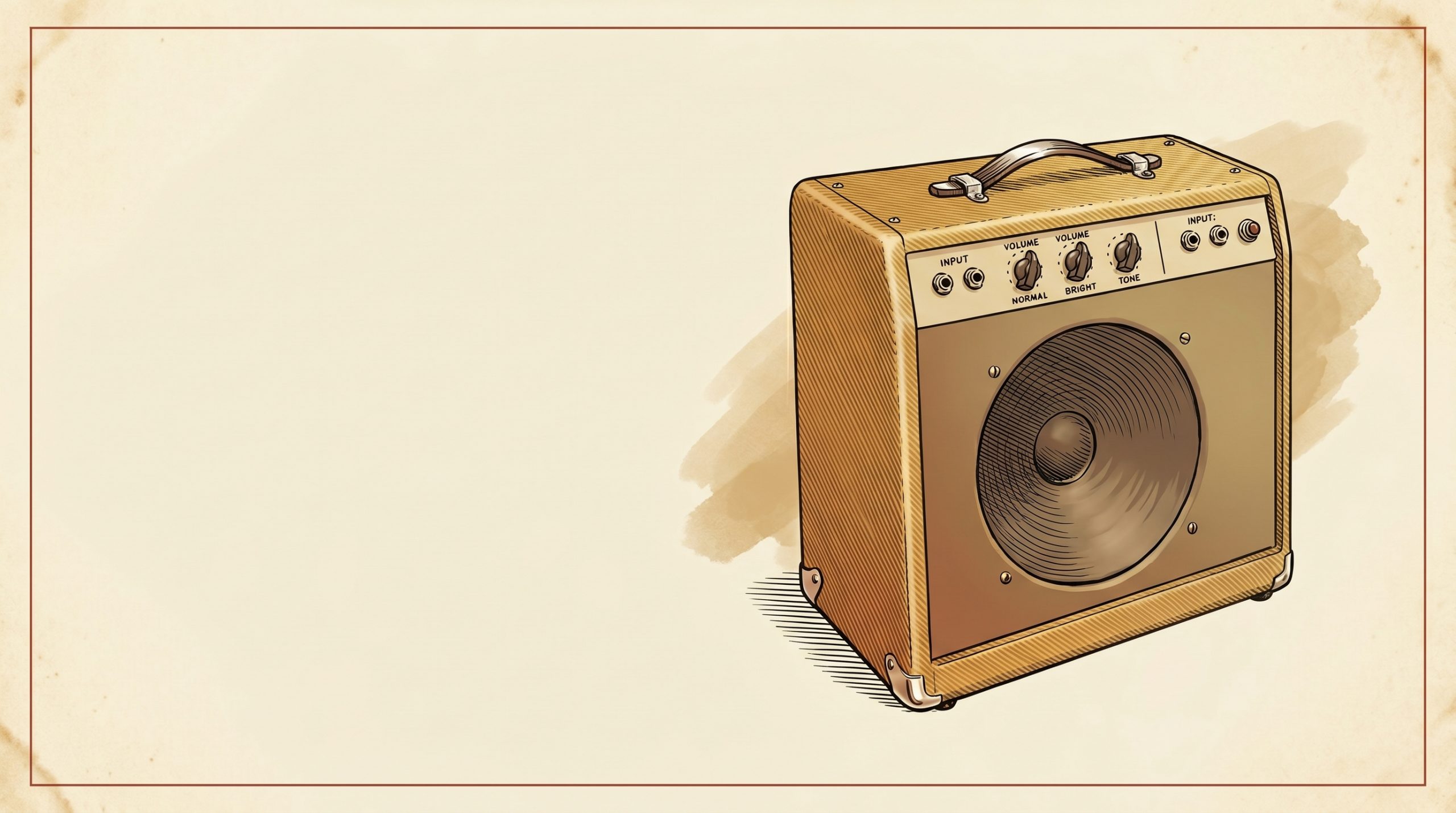
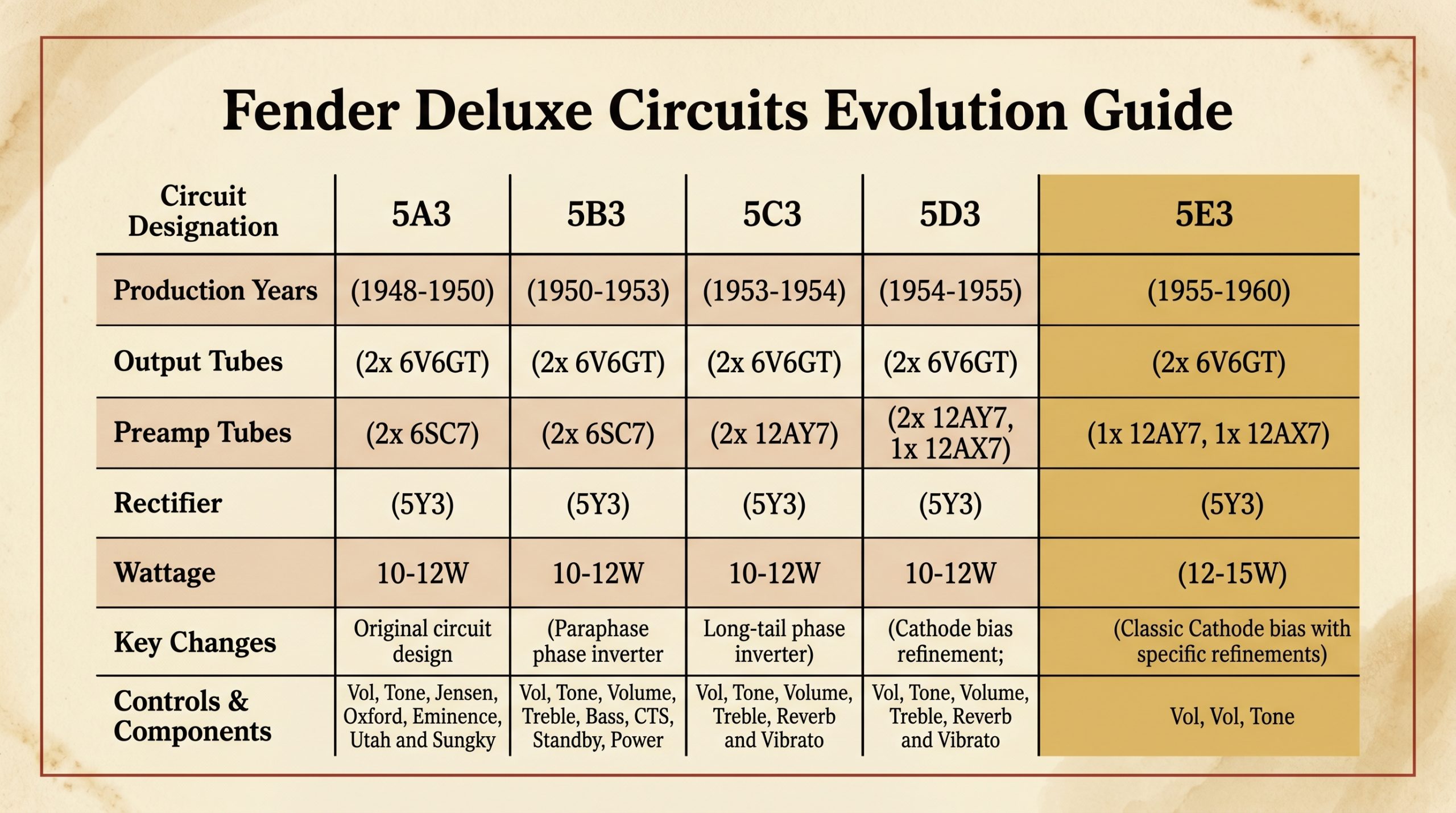
Fender’s Deluxe went through several circuit revisions before landing on the 5E3. The lineage runs 5A3, 5B3, 5C3, 5D3, then 5E3, each suffix marking a design refinement. The 5D3 (1954) was the first Deluxe to use 9-pin preamp tubes, setting the stage for what became the 5E3. Fender never called it the “5E3 Tweed Deluxe” in period literature, the official model name during production was simply the “Deluxe Amplifier.” The circuit code is an internal Fender designation. Production ran from 1955 through 1960, placing it squarely in the Narrow Panel tweed era, visually distinct from the earlier Wide Panel designs by the reduced strip of tweed between the speaker grille and cabinet top. That visual difference matters when buying vintage, it places the amp’s manufacture date immediately.
Original Specs and Circuit Breakdown
Core Specifications
| Spec | Detail |
|---|---|
| Circuit Number | 5E3 |
| Wattage | 12–15W (varies by bias point and tube condition) |
| Class of Operation | Cathode-biased push-pull (see Class A/AB note below) |
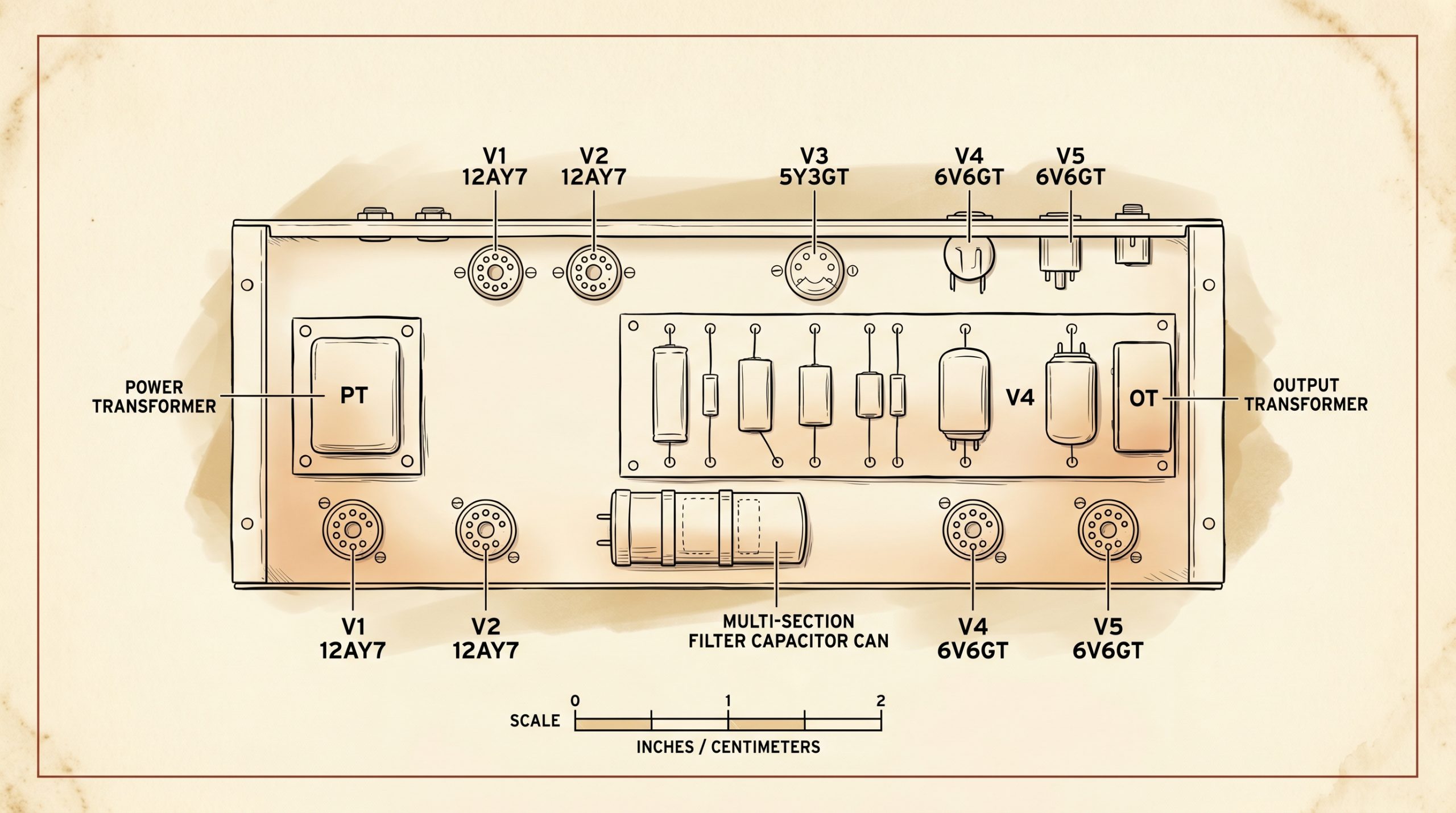
| Output Tubes | 2x 6V6GT |
| Preamp Tubes | 2x 12AY7 (V1, V2) |
| Rectifier Tube | 5Y3GT |
| Original Speaker | 1x 12″ Jensen P12R or P12Q (alnico), year-dependent |
| Speaker Impedance | 8 ohms |
| Channels | 2 (Normal and Bright), each with High/Low inputs |
| Controls | Volume (Normal), Volume (Bright), Tone |
| Cabinet | Narrow Panel, lacquered tweed-covered pine |
| Output Transformer Primary Impedance | ~8k ohms plate-to-plate |
| Typical Plate Voltage | 300–320V DC (healthy unit) |
| Idle Current Per Output Tube | ~25–30mA |
| Production Years | 1955–1960 |
The Class A vs. Class AB Debate
This one comes up constantly. The 5E3 uses cathode bias rather than fixed bias, which means it naturally runs the output tubes hotter and closer to Class A operation. But push-pull topology with two 6V6s is still technically Class AB by definition. No negative feedback loop is present anywhere in the circuit, a deliberate omission that makes the amp feel immediate, responsive, and slightly wild. The combination of cathode bias and zero NFB produces the spongy compression and bloom that define the 5E3’s feel. Call it Class A in character. Just don’t call it Class A on a spec sheet.
The Channel Coupling Mechanism
This is the genuinely unusual part of the circuit, and it’s worth understanding if you’re building or buying one. Both channels share a single tone control, positioned post-volume in the signal path. They’re also AC-coupled to each other at that point. When both channels are in use simultaneously (achieved by jumping them with a patch cable), the signal from each channel’s volume stage bleeds into the other before hitting the tone stack. The result is a richer, more complex overdrive texture that can’t be replicated by simply cranking a single channel. This coupling was a practical consequence of Fender’s cost-reduction approach, not intentional design genius, but the sonic result has been pursued by builders and players for seventy years. Good accident. Possibly the best one in guitar amp history.
The 5E3 Sound, What Does It Actually Do?
Clean Tones and the Sweet Spot
Don’t expect blackface-style clean headroom here. Breakup begins around volume 3–4 on either channel, which puts full clean output at roughly 85–90 dB, low enough for tracking in a home studio without requiring heavy attenuation. At bedroom volumes, the 5E3 delivers a glassy, slightly scooped clean tone with strong pick attack sensitivity. That’s a function of the 12AY7 preamp tubes (lower gain than 12AX7s) and the cathode bypass cap configuration. The “bloom” people describe, that sense of notes swelling slightly after the initial attack, is cathode bias compression doing its job. The 5Y3GT rectifier tube adds another layer of sag under hard picking. Not tight. Not stiff. Exactly what studio engineers wanted when micing a guitar in a small room.
Overdrive Character and Harmonic Profile
The 5E3’s natural overdrive produces predominantly even-order harmonic content with asymmetric clipping. That translates to a warm, vocal breakup rather than the harder, odd-order character of fixed-bias designs. The tone control interacts with gain staging in a way that’s different from most amps, rolling back tone doesn’t just reduce treble, it changes the feel of the overdrive. According to Amp Man at Premier Guitar, the 5E3 circuit is prone to flabbiness at high volumes, though several targeted modifications address this without gutting the amp’s character. The 5Y3GT rectifier sags under high-demand transients, softening bass attacks and creating that “barks when pushed” quality players associate with recorded tweed tone. Don Felder used this combination for the Hotel California sessions and subsequently documented it across multiple interviews, specifically citing a mid-1950s Narrow Panel Deluxe paired with a ’59 Les Paul as his primary studio sound. Larry Carlton’s ES-335 work through a period Deluxe follows the same logic.
The Jumping Channels Technique
Jumping means running a short patch cable from the High input of one channel into the High input of the other, then plugging your guitar into the Low input of either channel. Both volume controls are now active simultaneously, and because of that shared tone stack coupling described above, you’re feeding two slightly phase-shifted signals together at the tone stage. The result is fuller through the midrange with more complex harmonic content in the overdrive. A common starting point: Bright channel volume at 6–7, Normal channel volume at 4–5. Adjust from there based on your guitar’s output. The interaction is sensitive. Small moves make a noticeable difference.
Famous Players and Studio History
The Recording Studio Context
By the mid-1960s, recording studios in Los Angeles had accumulated tweed Deluxes the same way they accumulated Telefunken microphones, because they worked. When a guitarist arrived with a Marshall stack, house engineers would steer them toward a small combo for overdubs. The physics are straightforward: a 12–15 watt amp pushed to natural breakup produces cone distortion and harmonic content that translates predictably through a close-miced speaker, without requiring massive SPL that bleeds into other tracks or fatigues the tracking room. Don Felder’s documentation of the 5E3 as his core studio instrument on Hotel California is specific and consistent across multiple sources. Larry Carlton’s studio recordings from the same period, ES-335 through a period Deluxe, establish the same pattern. Neil Young’s affinity for low-wattage Fender combos from the tweed era is documented in interviews spanning decades. Billy Joe Armstrong of Green Day is a well-documented 5E3 user in live and studio contexts.
Why Low Wattage Equals Big Studio Tone
Loud amps in small rooms create acoustic problems that equalization can’t fix. A 5E3 at 12 watts, pushed to breakup at manageable SPL, lets a recording engineer place a single SM57 or Royer ribbon at the cone’s edge and get a consistent, repeatable sound across multiple takes. The amp doesn’t need acoustic treatment or isolation beyond basic gobos. Speaker cone breakup at 90 dB sounds virtually identical to speaker cone breakup at 110 dB to a microphone three inches away, but the lower SPL makes the engineer’s job much easier. That practical recording advantage, combined with the circuit’s harmonic character, is why so many session players kept beat-up tweed Deluxes on hand well into the 1980s.
The 5E3 Schematic, Key Circuit Points for Builders
Where to Find the Official 5E3 Schematic
The 5E3 schematic is public domain and available through multiple verified sources. Schematicheaven.net hosts the original Fender documentation alongside dozens of other tweed-era circuits. Fender’s own support documentation archive includes it as well. You need both the schematic (electrical values and topology) and the layout (physical component placement) to build correctly. The layout determines grounding paths, lead dress, and physical proximity of components, all of which affect hum, oscillation susceptibility, and signal integrity in ways the schematic alone won’t show.
Critical Circuit Values
A few values matter more than others for tone and feel. The plate load resistors on V1 and V2 set the gain of each preamp stage, stock values are 100k ohm on the plates. The cathode bypass capacitor on V1 (stock value: 25µF) boosts midrange and gain; removing it reduces gain and opens up clean headroom noticeably. The 100pF bright cap across the Bright channel’s volume control adds top-end sparkle at lower volume settings and rolls out as the pot rotates toward full (a standard Fender trick that also appears in blackface circuits). Output transformer primary impedance runs approximately 8k ohms plate-to-plate on a correctly spec’d unit, aftermarket transformers from Mercury Magnetics or Heyboer that hold this value tightly are worth the cost on a serious build.
Common Misreadings by First-Time Builders
The 5E3 uses a unique grounding scheme that catches new builders. Ground connections that appear identical on the schematic have specific physical locations on the chassis that matter for hum rejection. Floating grounds in the wrong position introduce 60-cycle hum that’s difficult to trace after the fact. The power supply filtering is minimal by design, two stages of RC filtering before the preamp supply. Adding extra filter capacitors reduces sag and changes the amp’s feel significantly. That might be desirable on a modified build, but it’s not a default improvement. Read the layout carefully before populating the board.
Building Your Own, 5E3 Kits, Cabinets, and Clones
5E3 Kit Comparison
| Kit Manufacturer | Kit Type | Approx. Price Range | Includes Cabinet | Board Type | Skill Level |
|---|---|---|---|---|---|
| Mojotone 5E3 | Complete kit | $499–$599 | Optional add-on | Turret board | Intermediate |
| Weber Kits | Component kit | $350–$450 | No | Eyelet board | Intermediate |
| Ceriatone | Partial or full | $300–$500 | Optional | PCB or hand-wired | Beginner–Intermediate |
| Trinity Amps | Complete kit | $500+ | Yes | Tag board | Intermediate |
| Tube Depot | Component kit | $250–$400 | No | Eyelet board | Advanced |
Prices shift regularly, verify current pricing directly with each supplier before ordering. The Mojotone 5E3 is consistently the benchmark recommendation for first builds, largely because the documentation is thorough, the turret board tolerates rework better than PCB, and component quality is consistent. Ceriatone PCB versions are a reasonable shortcut for builders more comfortable with soldering than circuit theory.
5E3 Cabinet Specifications
Original 5E3 cabinet dimensions run approximately 20 inches wide by 17 inches tall by 9.5 inches deep. Construction is pine, typically 3/4-inch finger-jointed, covered in lacquered tweed. The speaker baffle is slightly angled, this isn’t aesthetic; the angle affects internal volume and resonant frequency in ways that contribute to the low-end character. Modern reproduction cabinets from Mojotone, Mojo Musical Supply, and Avatar replicate these dimensions closely. A correctly dimensioned cabinet matters more on a 5E3 than on higher-wattage designs because the small enclosure is an active part of the sonic picture at this power level.
Notable Commercial 5E3 Clones
The boutique amp market has produced a substantial catalog of 5E3 derivatives. Victoria Amplifier Company’s 20112 is a faithful circuit reproduction with period-correct construction. Clark Amplification’s Tyger and the TopHat Club Royale both trace their topology directly to the 5E3. The Swart AST is a looser derivative, taking the cathode-bias push-pull format in a different direction. The common thread across all of them is the starting point: the 5E3’s circuit complexity is accessible enough for a competent builder to complete in a weekend, yet deep enough to reward years of refinement. That accessibility is the engine behind the clone culture.
Popular 5E3 Mods, What Works and What Doesn’t
Modifications Worth Considering
The most useful structural mod is adding a standby switch. The stock 5E3 has none, the amp goes directly from off to full power with no idle period for the rectifier and output tubes. A standby switch extends tube life meaningfully, especially for output tubes running at cathode-bias voltages. The addition is straightforward: a SPST switch in series with the B+ supply after the first filter cap. No circuit changes required beyond that.
Tube substitution comes up constantly. Swapping the stock 12AY7s for 12AX7s (as covered in the 12AX7 tube guide) raises preamp gain significantly and shifts the overdrive character toward harder, more aggressive clipping. It’s a well-documented mod that produces predictable results. Whether those results improve the amp depends on what you’re after. The stock 12AY7 character is part of what makes the 5E3 sound like a 5E3 rather than a generic overdriven combo.
Removing the V1 cathode bypass capacitor reduces gain and opens up more clean headroom before breakup. Useful for players who want the amp’s feel and compression without committing to overdrive at every volume setting above 4. Output transformer upgrades, Mercury Magnetics and Heyboer are the most-cited options, tighten bass response and extend frequency range. Worth the investment on a long-term build.
Mods to Avoid
Adding a master volume via a simple pot in the signal path kills the natural compression the circuit generates between the preamp and output stages. The 5E3’s feel at pushed volumes comes from the interaction between gain stages and the output section reacting to them. Interrupt that, and you’ve got a muffled, limp version of the amp at low levels and a confused one at high levels. Similarly, chasing extra headroom by over-filtering the power supply removes the rectifier sag that defines the amp’s physical playing feel. Wrong goal for this circuit.
The Fender ’57 Custom Deluxe, The Official Reissue
Reissue Specs vs. Original 5E3
| Spec | Original 5E3 (1955–60) | Fender ’57 Custom Deluxe (Current) |
|---|---|---|
| Wattage | ~12–15W | 12W |
| Output Tubes | 6V6GT | 6V6 |
| Preamp Tubes | 2x 12AY7 | 2x 12AY7 |
| Rectifier | 5Y3GT | 5Y3GT |
| Speaker | Jensen P12R or P12Q (alnico) | Eminence Special Design 12″ alnico |
| Construction | Hand-wired | Hand-wired |
| Circuit | Original 5E3 | 5E3 (Fender “Pure Vintage” claim) |
| Price | $3,000–$8,000+ (vintage market) | ~$2,299 street |
Is the Reissue Worth It vs. a Quality Clone?
The Fender ’57 Custom Deluxe delivers what it promises: a hand-wired 5E3 circuit at a price point that doesn’t require hunting the vintage market. The Eminence alnico speaker is a legitimate point of debate. Some players find it too mid-focused for home use, preferring to run the amp into an external cabinet with Celestion A-Type or Celestion Blue speakers, which adds cost and defeats some of the portability argument. The “Fender tax” question is real. A well-executed Mojotone 5E3 kit build, properly voiced and set up, can equal the reissue tonally at roughly half the price, if you’re willing to build it. The reissue buys you Fender QC, warranty support, and stronger resale value. A boutique clone from Victoria or Clark buys you arguably superior components and construction. Neither is wrong. They’re answering different questions.
Dating and Identifying a Vintage 5E3
Key Identification Markers
Dating a vintage 5E3 requires cross-referencing multiple date codes, since no single source is conclusive. Potentiometer codes follow the BBYWW format: manufacturer code, year (two digits), week (two digits). Common EIA supplier codes on period Fenders include 304 (Stackpole), 134 (IRC), and 140 (Centralab). A pot coded 304-637 would be Stackpole, 1963, week 7, but that date is for the pot, not the amp. Speaker EIA codes run in XXXYYWW format. Jensen’s EIA code is 220, so a speaker coded 220-5823 is Jensen, 1958, week 23. Transformer codes follow similar logic: Schumacher used EIA code 606, Triad used their own series numbering. The Fender tube amp serial number and date code reference covers the full format breakdown across all eras. Cross-reference at least three separate date codes, pots, speaker, and transformers, before drawing a conclusion about manufacture year.
Red Flags When Buying Vintage
Replaced transformers are the single largest value deduction on a vintage 5E3. Original Triad or Schumacher iron correctly dated to the production period is essential for a collector-grade example. Non-original speakers are common and relatively forgiving from a value standpoint, the Jensen P12R and P12Q were frequently replaced even during the amp’s working life. A documented re-cap is acceptable and often desirable. Cabinet repairs and tweed condition matter aesthetically and affect pricing, but neither compromises playability or period authenticity the way replaced transformers do.
Why the 5E3 Became the Most Cloned Amp in History
The Simplicity Factor
Three controls means three variables to understand. The schematic fits on a single sheet. Parts cost for a functional build runs under $400 with careful sourcing. Every component swap, tube substitution, capacitor value change, speaker swap, produces an audible and predictable result. That combination makes the 5E3 the ideal learning platform for anyone interested in how tube amplifiers actually work. It’s not dumbed-down. It’s efficient.
The DIY Community’s Role
Forum communities on TDPRI, The Gear Page, and DIYAudio have recommended the 5E3 as a first build for over twenty years. The documentation ecosystem that grew around this recommendation is now enormous, build logs, component comparison threads, mod discussions, and completed amp galleries number in the thousands. More documentation means more confident builders, which means more builds, which means more documentation. The feedback loop accelerated through the 2000s and hasn’t slowed. Estimated commercial clones on the current market number over 50 boutique manufacturers by most forum tallies, not counting kit builds and one-off shop builds.
Cultural Legacy and the Pedal Effect
The 5E3’s influence extends beyond physical amplifiers. Tweed-voiced pedals, the Fulltone OCD, J. Rockett Boing, and numerous others, exist specifically to approximate the harmonic character of a pushed 5E3 into a clean amplifier. That entire product category is a consequence of this one circuit being unavailable, unaffordable, or too loud for a given player’s context. The amp defined a tonal target that the industry has been chasing in miniaturized form ever since. For anyone working through Fender’s tube amp history, the 5E3 is where the tweed era’s logic becomes completely clear, and the Fender amp dating cheat sheet is a practical companion for placing any specific example in its production context. A functional 5E3 build, whether original, reissue, or kit, remains one of the most direct ways to understand what drove six decades of boutique amp design philosophy.
Frequently asked questions
How many watts is a Fender 5E3 Tweed Deluxe?
The 5E3 is typically rated at 12–15 watts, though actual output varies based on tube condition, bias point, and supply voltage. Because of cathode bias and the absence of negative feedback, the amp feels more dynamic and responsive than raw wattage implies. It's stage-loud in quiet to moderate environments but won't cut through a loud drummer without amplification support.
What is the difference between the 5E3 and the Fender '57 Custom Deluxe reissue?
The Fender '57 Custom Deluxe is a current-production hand-wired reissue of the 5E3 circuit. Key differences include the speaker (Eminence alnico vs. original Jensen P12R or P12Q), component sourcing, and the rectifier tube (current production uses 5Y3GT, matching the original). The circuit topology is a faithful 5E3 reproduction. Street price is approximately $2,299 new (2026) vs. $3,000–$8,000-plus for a verified all-original vintage example.
What tubes does a Fender 5E3 use?
The stock 5E3 runs two 12AY7 preamp tubes (V1 and V2), two 6V6GT output tubes, and a 5Y3GT rectifier. The 12AY7 has a lower amplification factor (mu=44) than a 12AX7 (mu=100), which contributes to the amp's relatively gentle gain structure and smooth overdrive onset. Swapping to 12AX7s increases gain substantially and changes the character of the overdrive, audible, but not universally an improvement.
What is the best 5E3 kit?
The Mojotone 5E3 is the most consistently recommended option for first builds, offering turret board construction, well-sourced components, and detailed build documentation. Weber and Ceriatone offer well-regarded alternatives at various price points. Turret and eyelet board construction is preferable to PCB for a 5E3 build because it tolerates rework easily and more closely replicates the hand-wired topology of the original.
Is the Fender 5E3 a Class A amplifier?
Not by strict definition. The 5E3 uses a cathode-biased push-pull output stage, technically Class AB, but biased toward the Class A region. The absence of negative feedback and the soft, compressive feel lead many players and writers to describe it as "Class A in character." The distinction matters more for builders understanding bias and dissipation limits than for players assessing tone.