Contents
- 01What Is the Fender Tone Master Super Reverb?
- 02Specs at a Glance
- 03The Original Blueprint: The AB763 Circuit
- 04Tone and Playing Experience
- 05Modern Features the Original Never Had
- 06Fender Tone Master Super Reverb vs. Original Super Reverb
- 07Who Is the Fender Tone Master Super Reverb Actually For?
- 08Where to Find the Fender Tone Master Super Reverb
- 09Frequently Asked Questions: Fender Tone Master Super Reverb
- 10Final Verdict
Thirty-six pounds. That’s the number that gets most players to stop scrolling. The original blackface Super Reverb tips the scale at 62 to 68 lbs. depending on speaker load and cabinet condition, and every gigging guitarist who’s hauled one up a flight of stairs knows exactly how that feels the next morning. The Fender Tone Master Super Reverb targets that specific problem directly, without asking you to give up the 4×10 open-back voice that made the original worth carrying in the first place.
- Platform: Solid-state digital DSP modeling, not a multi-model modeler
- Circuit modeled: AB763 blackface Super Reverb (1963–1967 era)
- Power output: 45W with six scalable settings down to 0.5W
- Speakers: 4× 10″ Jensen P-10R alnico (factory installed)
- Weight: 36 lbs. (16.3 kg) vs. ~62–68 lbs. for a tube original
- XLR line out with 8 selectable cabinet IRs built in
- Street price new: ~$1,599 USD; used market ~$650–$850
- Power scaling reduces SPL output, it does NOT replicate tube power amp compression
- This models the blackface AB763 specifically, NOT the silverface AA270 or AA1069 circuits
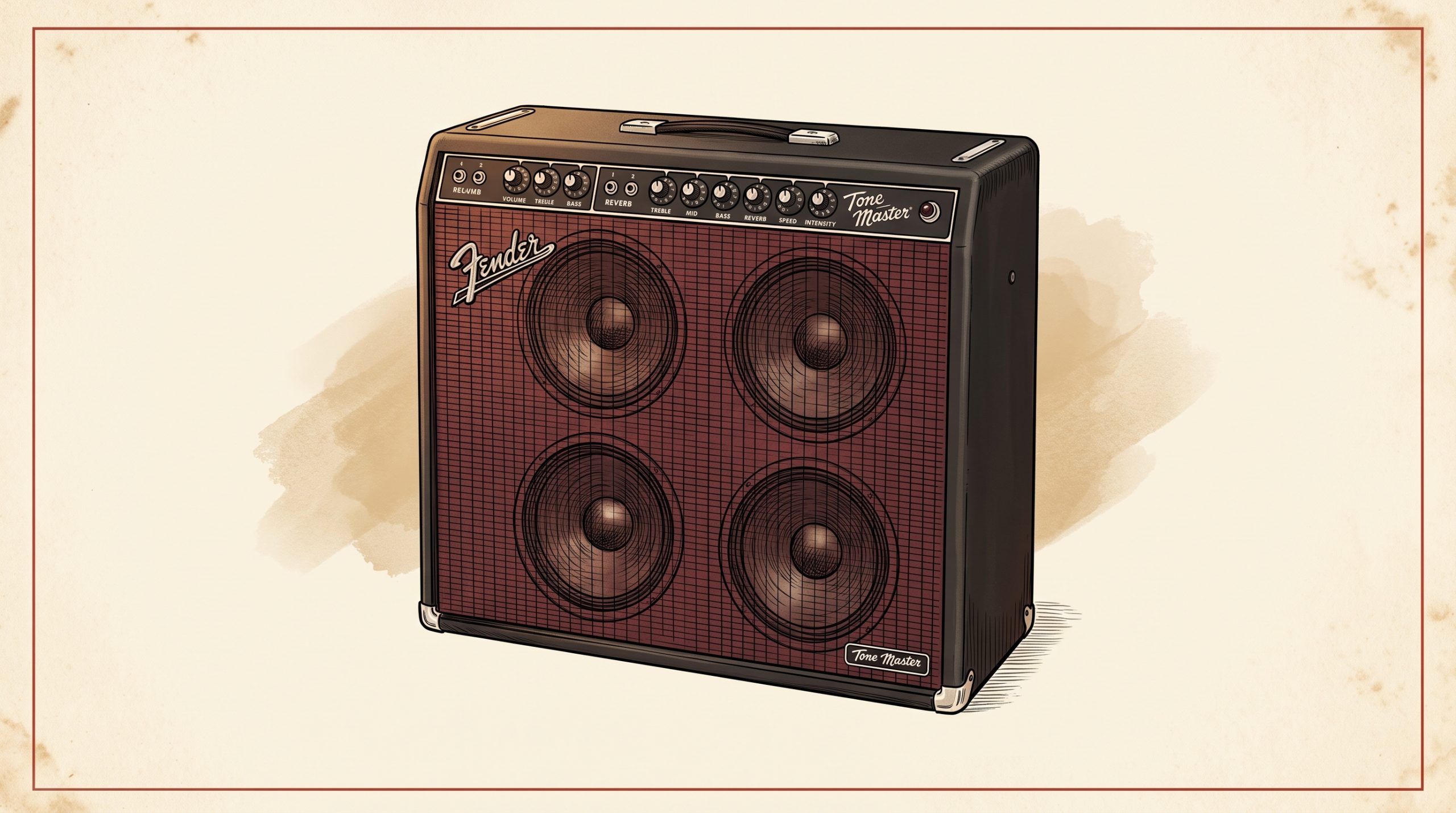
What Is the Fender Tone Master Super Reverb?
The Original It’s Based On
The blackface Fender Super Reverb ran from 1963 to 1967 under the AB763 circuit designation, the same core topology shared across the blackface family that also produced the Deluxe Reverb, Pro Reverb, and Twin Reverb. Production continued in silverface form through 1982, but those later models used the AA270 and AA1069 circuits, which introduced changes including modified bright cap filtering and, on the latest iterations, a master volume. The Tone Master models the original blackface AB763 specifically, not those later variants.
In original tube form, the Super Reverb ran 40 watts from two 6L6GC output tubes into a 4×10 open-back cabinet loaded with Jensen C10R alnico speakers (blackface era), with later production units receiving Oxford and CTS ceramic variants depending on the production date. The tube complement was: 4× 12AX7, 2× 12AT7 in the preamp, plus a 5AR4 (GZ34) rectifier tube responsible for the characteristic voltage sag that defined the amp’s dynamic feel. The vintage Super Reverb buyer’s guide covers those production details and what to look for on original examples.
Fender also issued a ’65 Super Reverb reissue starting in 2001, so buyers researching the Tone Master may encounter three distinct versions in the used market: the vintage originals, the reissue tube amp, and the Tone Master solid-state version introduced in 2021.
The Tone Master Line: Single-Model Fidelity
The Tone Master philosophy is narrow by design. Unlike the Kemper, Quad Cortex, or Line 6 Helix, the Tone Master series commits entirely to one amplifier per unit. No patch switching. No profiling other amps. One circuit, modeled as deeply as Fender’s engineering team could manage. The Super Reverb joined the Tone Master lineup in 2021, following the Deluxe Reverb and Twin Reverb versions that launched the series in 2019. If you want sounds that go beyond the blackface Super Reverb voice, this isn’t the tool for that job. But if the blackface 4×10 clean sound is what you’re after, the focused approach pays off in authenticity.
Specs at a Glance
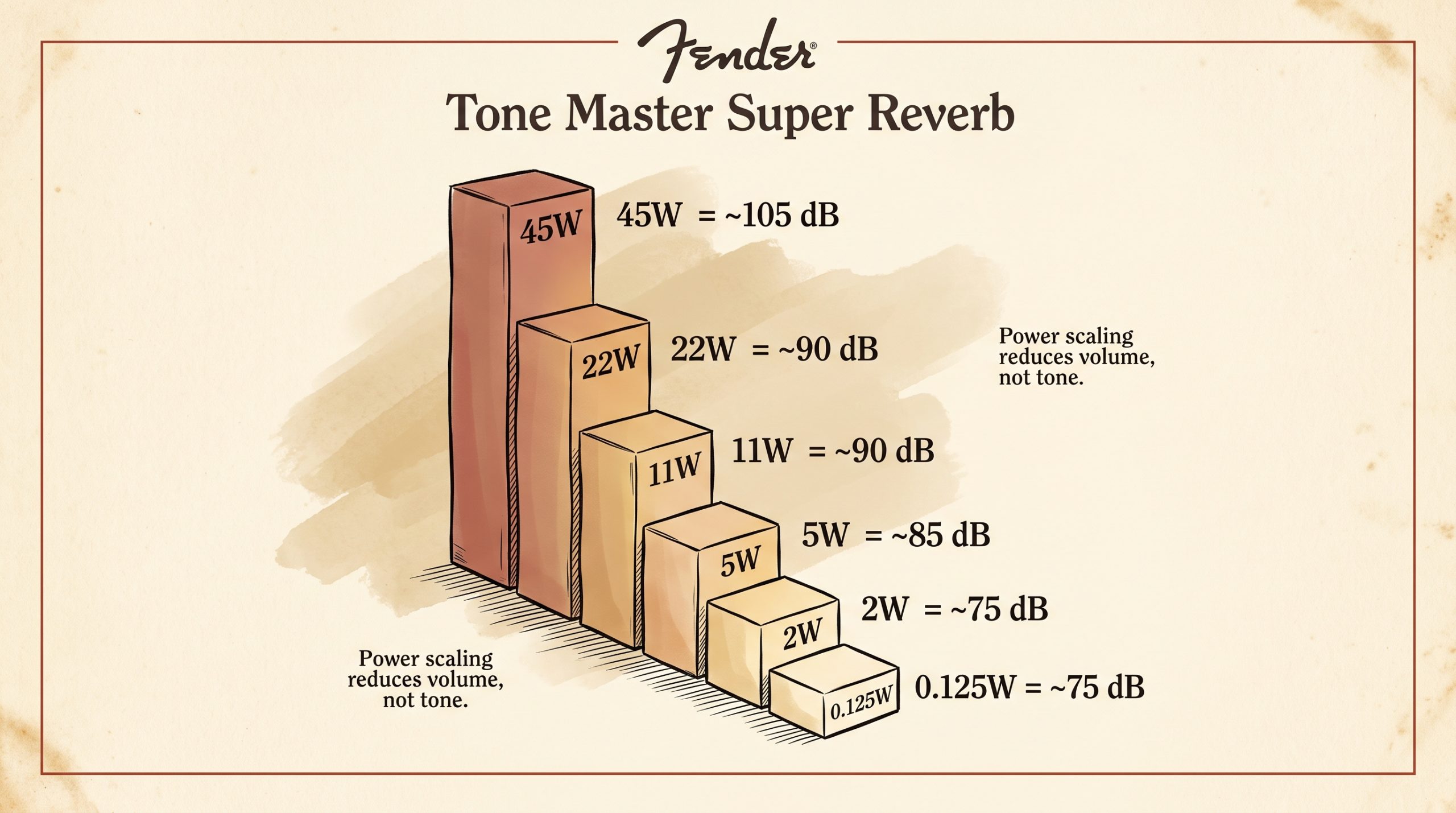
The weight reduction is significant enough that it deserves its own row in any spec comparison, but so does the XLR output, the power scaling range, and the differences in rectifier topology. Here’s the full picture:
| Spec | Tone Master Super Reverb | Original AB763 Super Reverb (Tube) |
|---|---|---|
| Power Output | 45W solid-state, scalable to 0.5W | 40W (2× 6L6GC) |
| Preamp | Digital DSP | 4× 12AX7, 2× 12AT7 |
| Rectifier | Solid-state | 5AR4 (GZ34) tube rectifier |
| Speakers | 4× 10″ Jensen P-10R alnico | 4× 10″ Jensen C10R alnico (original blackface) |
| Weight | 36 lbs. (16.3 kg) | ~62–68 lbs. (28–31 kg) |
| Dimensions (H×W×D) | 24.75″ × 25.125″ × 10.5″ | ~24.75″ × 25.125″ × 10.5″ |
| Controls | Volume, Treble, Bass, Middle, Reverb, Vibrato Speed/Intensity | Volume, Treble, Bass, Middle, Reverb, Vibrato Speed/Intensity |
| Channels | 2 (Normal, Vibrato) | 2 (Normal, Vibrato) |
| Line Out | XLR with IR cab sim (8 IRs) | None |
| Power Scaling | 45W / 22W / 12W / 5W / 1W / 0.5W | N/A (attenuator required) |
| MSRP (new) | ~$1,599 USD | $2,500–$5,000+ (clean vintage examples) |
| Circuit Reference | Models AB763 blackface | AB763 (blackface) / AA270–AA1069 (silverface) |
That ~29-lb. reduction is the headline differentiator for most buyers. The Jensen P-10R alnico speakers on the Tone Master are factory-installed rather than aftermarket retrofits, which is for anyone inspecting a used example.
The Original Blueprint: The AB763 Circuit
Blackface Era History (1963–1967)
The blackface Super Reverb emerged from Fender’s 1963 circuit redesign, establishing the AB763 circuit designation that would define Fender’s most sought-after amp topology. Greg Gagliano’s research published in 20th Century Guitar Magazine (archived via the Wayback Machine at web.archive.org) documented the specific dating and circuit transition points across this era in detail, and the production records align with Fender service documentation showing the AB763 as a shared platform across multiple blackface models.
The circuit features a long-tail-pair phase inverter, a cathode-follower tone stack, and tube rectifier sag generated by the 5AR4 (GZ34) rectifier, which produces the characteristic voltage compression under load that players describe as “spongy” or “blooming” at the attack. The vibrato circuit uses an optical photocell design, technically a pitch modulation (vibrato) rather than amplitude modulation (tremolo), despite the “Vibrato” channel label being a historic Fender naming quirk that persists to this day. The DSP in the Tone Master is modeling all of these specific behaviors, not a generic “Fender blackface” approximation.
Why 4×10? The speaker array creates a distribution of cone area and acoustic dispersion that a single 12-inch driver simply doesn’t produce. The midrange spread, the way the low-end blooms differently from a 1×12 or 2×12, and the slight phase complexity between four drivers in an open-back cabinet are distinct enough that the Super Reverb carved out its own identity within the blackface lineup. If you need a reference for dating your own Super Reverb or identifying which circuit revision you have, the Fender tube amp dating guide covers the transformer EIA codes and chassis stamp sequences used to narrow down production years across the full run.
What “Blackface” Specifically Means Here
The visual ID on a genuine blackface Super Reverb: black anodized aluminum control panel, silver grille cloth on an oxblood or later wheat-colored cabinet, and the Fender block logo. The silverface transition beginning in 1968 shifted the panel finish to a brushed silver aluminum face with a blue/silver grille cloth, and circuit changes followed through the AA270 and eventually AA1069 designations.
The silverface variants added a notch filter in the bright channel on some versions, and later silverface production introduced a master volume that changed the amp’s gain structure. These aren’t necessarily worse, but they’re different, and most players and collectors regard the AB763 as the most musically interactive and dynamically responsive circuit variant. The Tone Master targets that version specifically, which matters when you’re setting expectations against someone else’s silverface Super Reverb at a rehearsal.
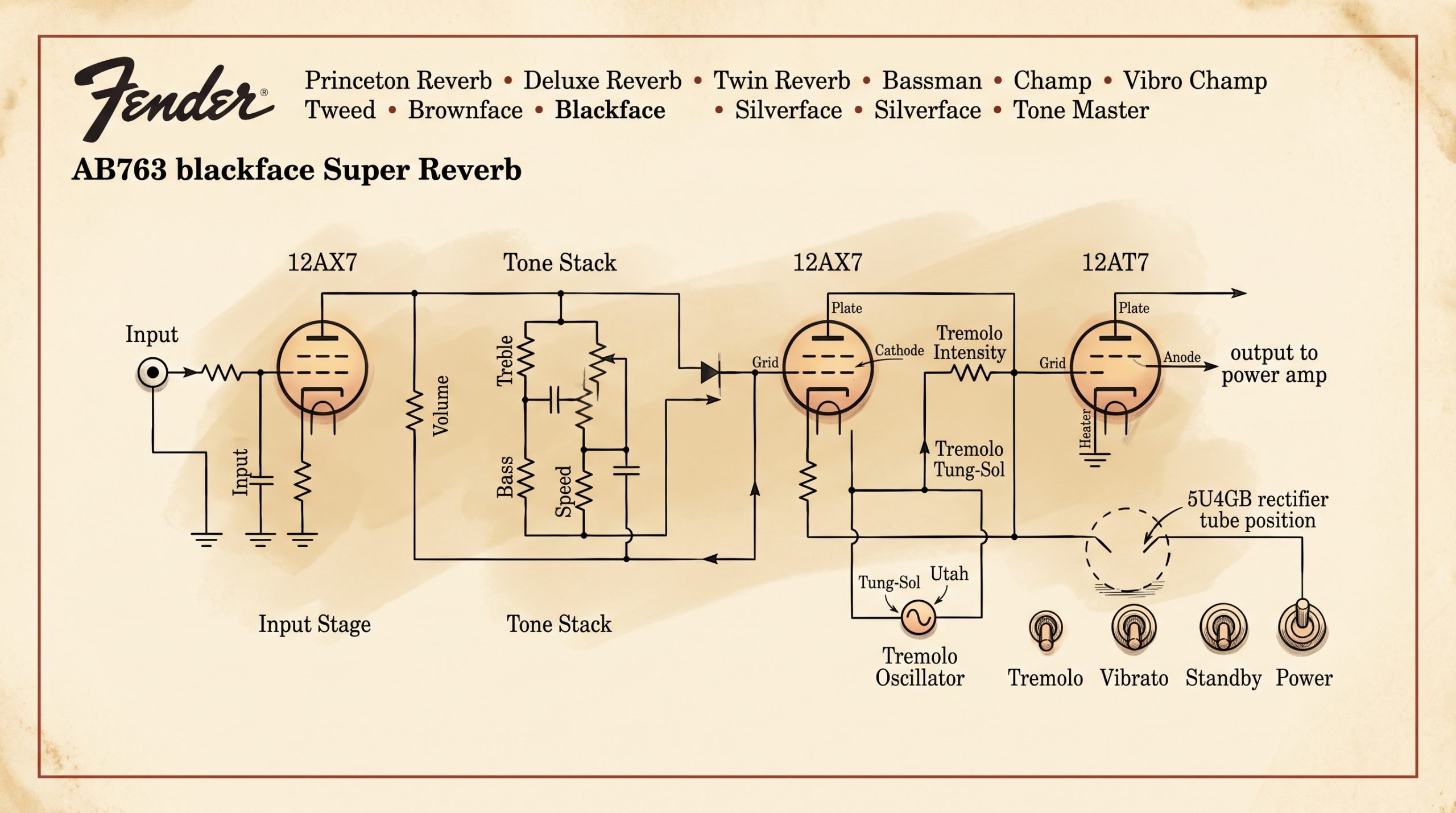
Tone and Playing Experience
First Impressions and Clean Tone
The core identity of the blackface Super Reverb is glassy, bell-like highs with a controlled low-end that the 4×10 array distributes differently than a single larger driver. On the original AB763, the volume sweet spot for that edge-of-breakup spank hits around 5 to 6 on the dial. The Tone Master replicates that perceived character at reduced wattage settings via power scaling, so bedroom players can access the tone without getting complaints from the neighbors. Not a perfect simulation of tube power amp compression. But usable and consistent.
The middle control on the AB763 is notably interactive. It doesn’t just cut and boost in a flat linear sense; it interacts with the bass and treble settings in ways that passive tone stacks do, and the Tone Master captures this behavior convincingly. For reference blackface clean tone, the settings that surface most often in documented use: Volume around 4, Treble 6, Bass 4, Middle 5, Reverb 3. From there, the amp stays clear and full without getting ice-pick treble on the upper strings.
Reverb and Vibrato Circuit Modeling
The original Super Reverb used a 2-spring Accutronics reverb tank (Type 4AB3C1B) that produces the characteristic “drip” decay, a longer and slightly darker wash than the smaller tanks found in the Deluxe Reverb. The Tone Master’s digital reverb captures the decay length convincingly at moderate settings. Push the reverb past 5 and the original’s tank would start to contribute its own mechanical character in ways that digital approximation gets close to but doesn’t fully replicate.
The vibrato circuit on the original is optical, meaning the speed and depth modulate pitch rather than volume, and it pulses in a way that interacts with the reverb tail when both are engaged. The Tone Master models this behavior, and at moderate speed and intensity settings the interaction sounds right. Fast and deep settings are where digital vibrato circuits tend to diverge from the optocoupler behavior of the original, though most practical playing settings fall well within the Tone Master’s convincing range.
Overdrive and Edge-of-Breakup Behavior
This is where honest differentiation matters most. The Tone Master Super Reverb’s digital power section does not generate tube power amp compression, rectifier sag, or output transformer saturation. Those physical behaviors in an original AB763 create a dynamic response that feels different under your pick hand, especially at higher volumes where the amp starts to push back. The Tone Master models the preamp-stage breakup character well, but the feel at high power levels diverges from a tube original.
Power scaling helps the headroom equation at lower volumes, but reducing a solid-state amp’s power setting cuts speaker excursion and overall SPL output. It doesn’t make the solid-state power section behave like a tube amp being pushed. That’s a key distinction that most reviews skip over entirely.
As a pedal platform, the Super Reverb is historically prized for its wide dynamic range and clean headroom that lets overdrive pedals define their own character into the front end. The Tone Master performs well in this role. The clean headroom on the Vibrato channel accepts a wide drive pedal range without adding unwanted compression from the amp side, which is exactly the behavior working pedalboard players need.
The 4×10 Speaker Difference
The Tone Master ships with four Jensen P-10R alnico speakers from the factory. These are not the Jensen C10R ceramics that shipped on many original blackface Super Reverbs, but alnico P-10Rs are a legitimate vintage-adjacent choice with softer cone breakup and a slightly warmer low-end response than the ceramic-magnet variants. The open-back cabinet design does its share of the work, too. Rear-firing frequencies interact with the room, creating the kind of ambient fill and diffusion that a closed-back cabinet won’t produce. The combination of four 10-inch drivers in an open-back enclosure gives the Super Reverb its sense of dimension and low-mid bloom regardless of whether the power section is tubes or DSP.
Modern Features the Original Never Had
Power Scaling: Six Settings Explained
The rear-panel power selector offers six output levels: 45W, 22W, 12W, 5W, 1W, and 0.5W. Practical use cases across those tiers:
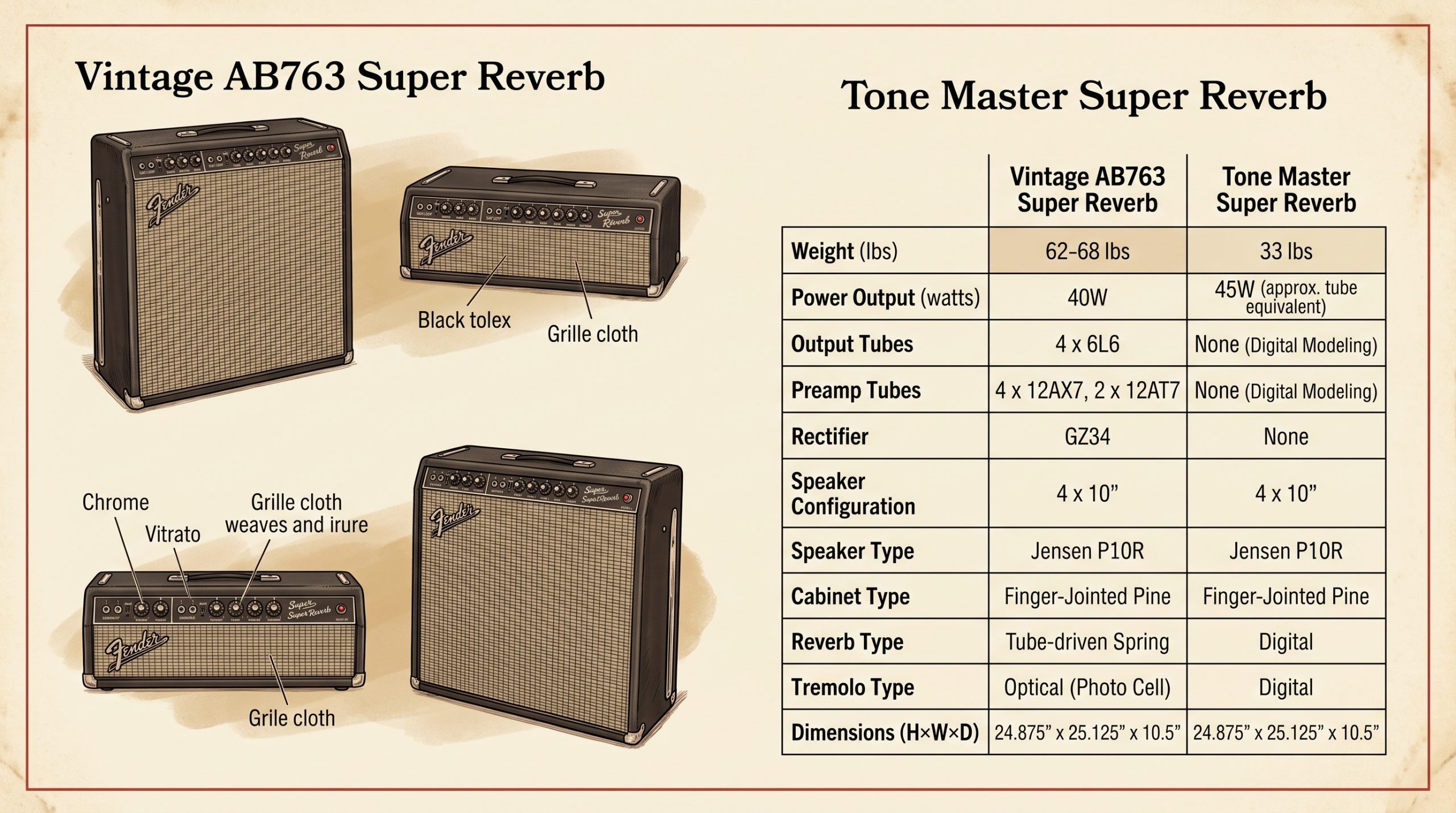
- 45W: Full stage volume with a band. PA support or miced cabinet.
- 22W: Medium-size rehearsal room or smaller stage. Still stage-loud.
- 12W: Small rehearsal space or recording room without full attenuation.
- 5W: Practice at home with some room sound.
- 1W: Late-evening apartment practice. Audible but manageable.
- 0.5W: Near-silent recording. DAW tracking without mic bleed concerns.
The critical caveat repeated here because most reviews skip it: power scaling on a solid-state amplifier is not the same mechanism as a tube amp being operated at lower B+ voltage or through a power attenuator. What the power scaling does is reduce the signal level delivered to the speakers, which cuts SPL and speaker excursion. It does not generate the sag and compression that a tube amp’s power section produces when pushed. For players whose tone depends on that physical power amp behavior, the Tone Master’s scaling is useful for volume management, but it’s not a substitute for tube feel.
XLR Line Out with Impulse Response Cabinet Simulation
The rear XLR output carries a cab-simulated signal with 8 selectable impulse responses built in, covering variations including 4×10 open-back and closed-back cabinet configurations. This makes the Tone Master Super Reverb a complete direct-recording solution without additional hardware. Connect XLR to FOH at a gig, or run directly into a DAW input for recording without placing a microphone in front of the cabinet.
For comparison: running a vintage tube Super Reverb direct for recording requires a speaker load box (typically $150–$400), an external IR loader ($100–$300), and the IRs themselves. The Tone Master’s built-in XLR/IR path replaces that entire chain. Not a minor convenience for working studio players.
Speaker-defeated mode allows silent recording with the XLR output active and the internal speakers bypassed. Practically useful for late-night sessions or studio environments where cabinet bleed is a problem.
No Maintenance: The Practical Reality
An original blackface Super Reverb running its 6L6GC output tubes will need re-tubing every two to five years depending on use intensity, and a matched pair of quality 6L6GCs runs $80 to $150 or more at current prices. Add professional re-biasing service if you’re not doing it yourself, and the ongoing maintenance cost of a working vintage or reissue tube Super Reverb adds up over a decade of regular gigging.
The Tone Master has no tubes to replace. No re-biasing. No “bad tube night” at a gig where channel two stops working forty minutes before showtime. The failure modes of a digital amp are different from a tube amp, and in regular use the digital platform wins the reliability comparison. Not glamorous. Effective.
Fender Tone Master Super Reverb vs. Original Super Reverb
Andy Martin’s side-by-side comparison video on Reverb.com is the most widely cited blind test of the Tone Master Super Reverb against an original tube Super Reverb, and the conclusion was that differences at stage volume were minimal. That documented result is consistent with the Tone Master performing well in the clean and edge-of-breakup range where most 4×10 Super Reverb players actually operate.
| Factor | Tone Master Super Reverb | Vintage Blackface Super Reverb (AB763) |
|---|---|---|
| Price | ~$1,599 new | $2,500–$5,000+ (clean examples) |
| Weight | 36 lbs. | 62–68 lbs. |
| Maintenance | None (solid-state) | Periodic tube replacement and biasing |
| Tonal Authenticity | Very close at practical volumes; power amp behavior differs | Reference standard |
| Collectibility | None | High; appreciating asset in clean condition |
| Direct Recording | Built-in XLR/IR out | Requires external load box and IR loader |
| Power Scaling | Six levels, down to 0.5W | Full power only without attenuator |
| Gig Reliability | High (no tube failures) | Moderate (tube amp failure modes) |
Used Tone Master Super Reverbs appear regularly on Reverb.com and eBay in the $650 to $850 range for clean examples from 2021 to 2023 production. That pricing sits significantly below both a clean blackface original and a new Tone Master. If you find one used, check the firmware version against Fender’s current release (available at fender.com’s Tone Master update page), test the XLR output with a known cable, and confirm the Jensen P-10Rs haven’t been swapped. Replacement Jensen P-10Rs are available through authorized Fender parts dealers and Jensen’s own distribution network.
The Tone Master Deluxe Reverb is worth comparing if you’re deciding between Tone Master models, as the Deluxe runs lighter still and covers a different part of the headroom spectrum.
Who Is the Fender Tone Master Super Reverb Actually For?
The weight factor is the entry point for most buyers, and it’s worth naming it directly rather than burying it. The gigging guitarist who spent their thirties hauling a real Super Reverb and now has a back that makes that impractical is the primary audience. That’s not a stereotype; it’s the demographic pattern that shows up across every forum thread about this amp.
Beyond the weight argument, the home recordist gets a genuine recording solution with the built-in XLR/IR path. No mic placement decisions, no room treatment required. Run the XLR direct and the cab simulation handles the rest.
The working cover band musician gets consistent, reliable tone night to night with no variables introduced by tube condition. No night where the amp sounds different because a tube is starting to fail.
The Tone Master Super Reverb is not the right choice for players who need multiple amp sounds in one box. A Helix, Kemper, or Quad Cortex handles that job better. It’s also not for the collector who wants a vintage instrument that appreciates in value. And players whose core tone depends heavily on power amp tube compression and output transformer saturation at volume will hear the gap between the Tone Master and an original tube Super Reverb most clearly.
One amp that looks like a blackface Super Reverb, sounds like one at stage volumes, and won’t require a chiropractor visit after load-in. That’s the honest proposition here.
Where to Find the Fender Tone Master Super Reverb
New units are available through Fender authorized dealers including Guitar Center and Sweetwater at street prices of approximately $1,599. Fender’s own dealer locator at fender.com/pages/find-a-dealer lists current authorized stock locations. The Tone Master line experienced production pauses in 2022 to 2023, so availability can fluctuate; if a dealer shows it in stock, that’s worth acting on. Used market pricing on Reverb.com and eBay currently runs $650 to $850 for clean examples with original speakers and functioning XLR output.
Final Verdict
The Tone Master Super Reverb makes three things genuinely easier: carrying the amp, recording direct, and maintaining it over years of regular use. The blackface AB763 clean voice transfers convincingly into the DSP platform, and the Jensen P-10R alnico speakers and open-back 4×10 cabinet do real acoustic work regardless of what’s driving them. The limitations are honest and consistent: the power amp feel at high volumes diverges from tube behavior, power scaling is an SPL management tool rather than a tube compression simulator, and the amp does one thing only. No multi-model flexibility. None intended.
For guitarists who want the authentic blackface 4×10 voice without the physical and financial demands of a vintage AB763 Super Reverb, the Fender Tone Master Super Reverb makes a compelling and well-engineered case. If your tone philosophy requires the specific feel of tubes under load at volume, go find a clean original and budget for the maintenance and the chiropractor. Both are valid choices. They just answer different questions.
Frequently asked questions
How much does the Fender Tone Master Super Reverb weigh?
The Fender Tone Master Super Reverb weighs 36 lbs. (16.3 kg). An original blackface tube Super Reverb weighs approximately 62 to 68 lbs. depending on speakers and cabinet condition. That approximately 29-lb. reduction is the most cited practical advantage of the Tone Master version among working gigging players.
What circuit does the Fender Tone Master Super Reverb model?
The Tone Master Super Reverb models the mid-1960s blackface Fender Super Reverb, specifically the AB763 circuit produced from 1963 to 1967. This is the same circuit family as the blackface Deluxe Reverb, Pro Reverb, and Twin Reverb. It does not model the silverface variants (AA270 or AA1069 circuits) that followed after 1968.
Does the Fender Tone Master Super Reverb sound like a real tube amp?
At practical playing volumes, the Tone Master Super Reverb is widely regarded as a convincing reproduction of the blackface AB763 clean tone. Andy Martin's documented side-by-side blind comparison on Reverb.com found minimal audible difference at stage volume. The primary divergence from tube behavior occurs at high power levels where tube rectifier sag, output tube compression, and output transformer saturation create dynamic feel that the DSP approximates but does not fully replicate. For clean and edge-of-breakup playing, the gap is narrow enough that most listeners won't identify it in a live mix.
What are the power settings on the Fender Tone Master Super Reverb?
The rear-panel power selector offers six output levels: 45W, 22W, 12W, 5W, 1W, and 0.5W. These settings reduce speaker output and SPL across the range from full stage volume down to near-silent practice. Note that they control output level in a solid-state circuit, not tube power amp compression; the feel under the pick hand at low power settings is different from a tube amp being attenuated.
Is the Fender Tone Master Super Reverb discontinued?
As of this writing, the Tone Master Super Reverb remains listed as an active product on fender.com. Availability has fluctuated since 2022 due to production pauses in the Tone Master line generally. Used examples appear regularly in the $650 to $850 range on Reverb.com and eBay. Checking Fender's authorized dealer network for current stock is the most reliable way to confirm availability of new units.