Contents
- 01What Is the Fender Champ 12?
- 02Fender Champ 12 Specifications
- 03Tonal Character, What Does the Champ 12 Actually Sound Like?
- 04Production History and Identifying Your Champ 12
- 05Champ 12 vs. the Broader Red Knob Champ Family
- 06Buying Guide, What to Look for on the Used Market
- 07Frequently Asked Questions
- 08Why the Champ 12 Deserves More Attention
Most players shopping for a small tube combo walk right past the Champ 12 at a garage sale or vintage shop, assuming anything with red knobs from the late 1980s isn’t worth the hassle. That’s a mistake. The Champ 12 is a genuine all-tube American combo, built at Fender’s Corona, California facility in its early production years and later at Fender’s Ensenada, Mexico plant, during a period when the company was actively rebuilding its reputation after the CBS years. It’s versatile, repairable, and chronically underpriced.
- Production: 1987–1992, Fender Corona, California (~1987–1990) then Ensenada, Mexico (~1990–1992)
- Power: 10–12 watts RMS, all-tube signal path
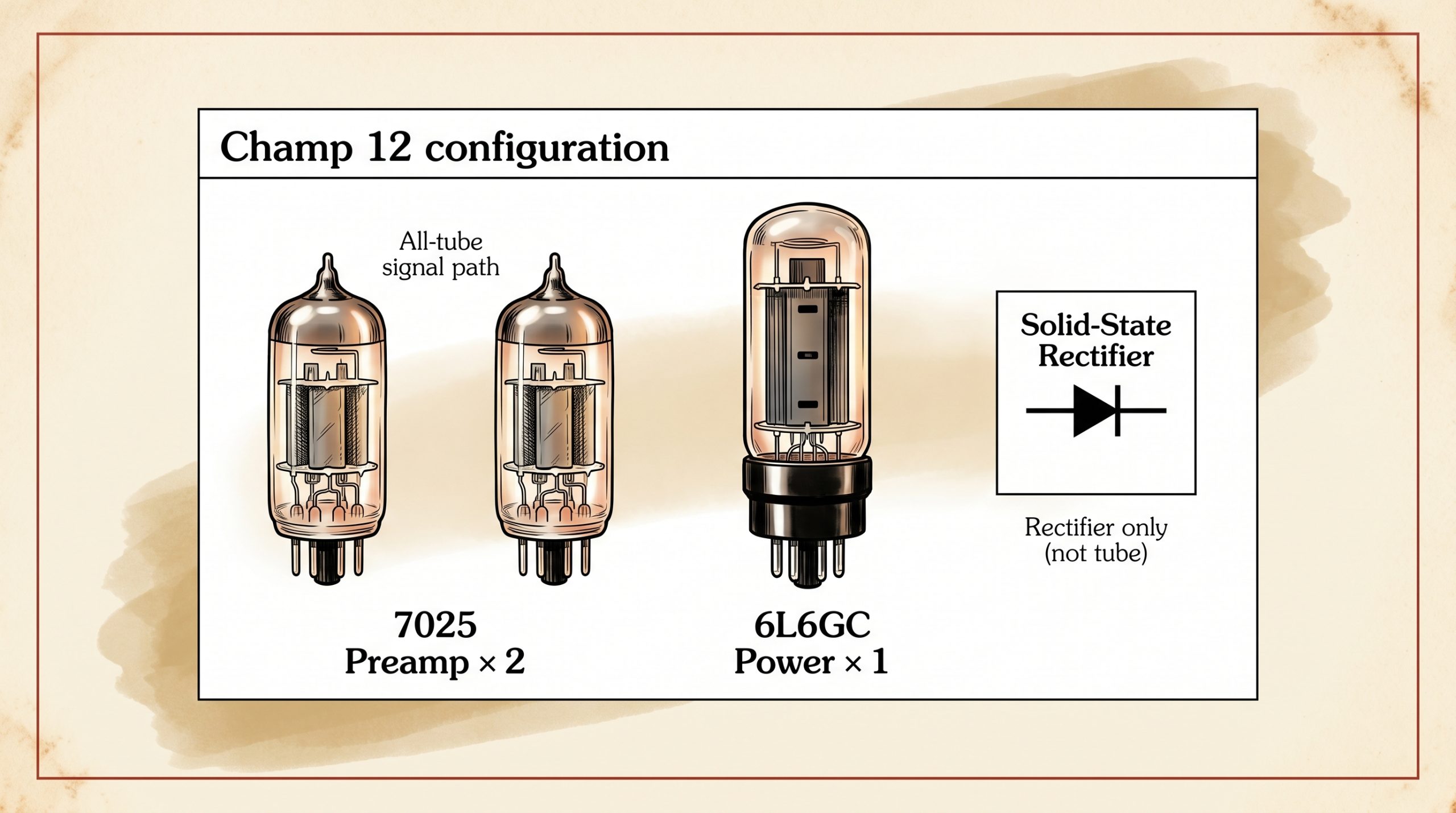
- Tubes: 2× 7025 (12AX7 equivalent) preamp, 1× 6L6GC power
- Bias: Cathode bias, no re-biasing required after power tube swap
- Rectifier: Solid-state diode (not tube, this is the source of “hybrid” confusion)
- Speaker: 1×12″ Fender Special Design Blue Label, 8 ohm
- Channels: Clean + Overdrive, plus spring reverb
- Circuit era: Red Knob family, no traditional AA/AB letter designation
- Weight: approximately 28–29 lbs, heavier than it looks
- Used market: $250–$450 standard; snakeskin tolex examples command $500+
- NOT a hybrid amp, the signal path is fully tube-driven; only the rectifier is solid-state
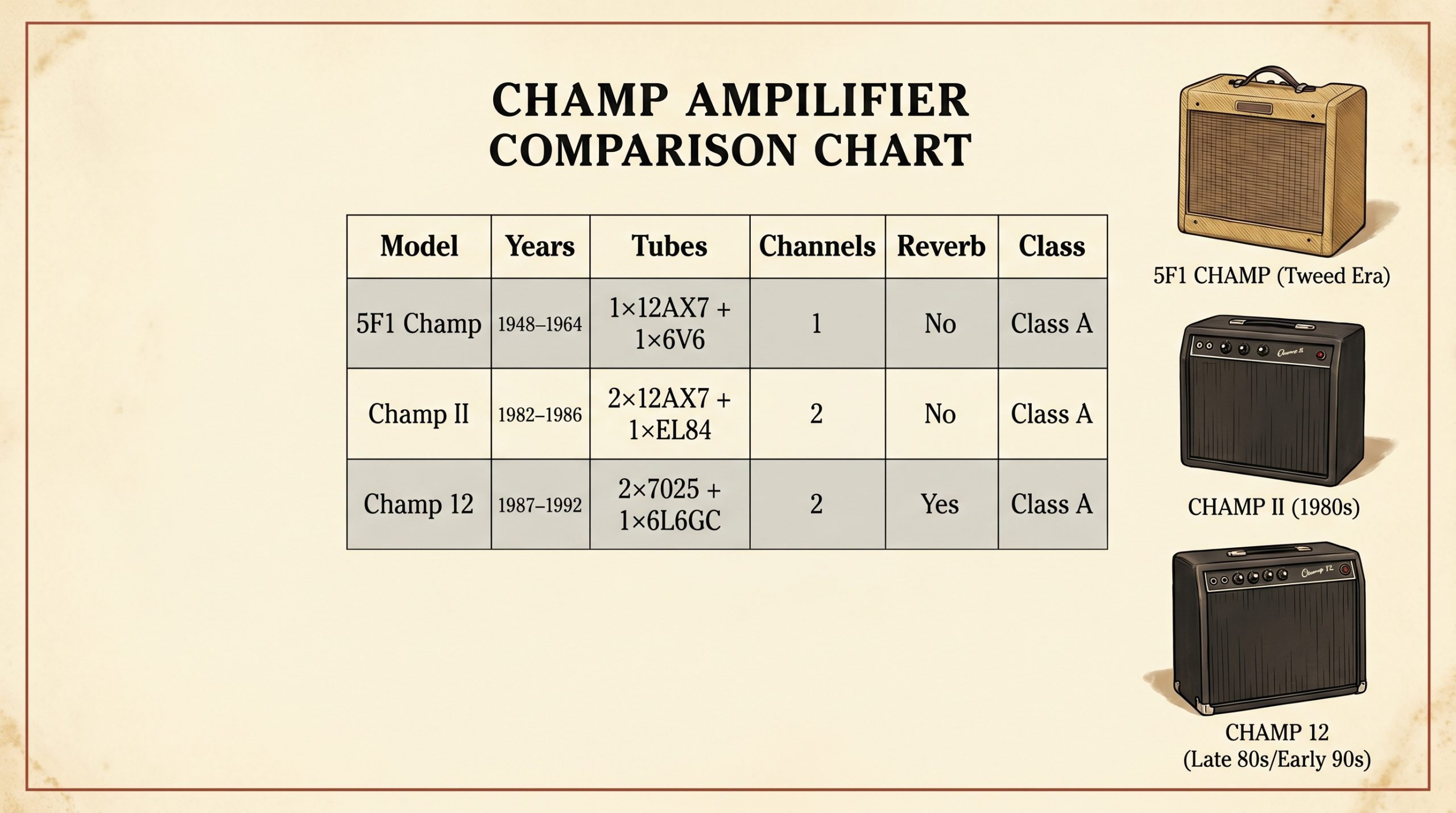
- Champ 25 and Champ 25 SE look similar but run a solid-state preamp ahead of a tube power section (2× 6L6GC), different animals entirely
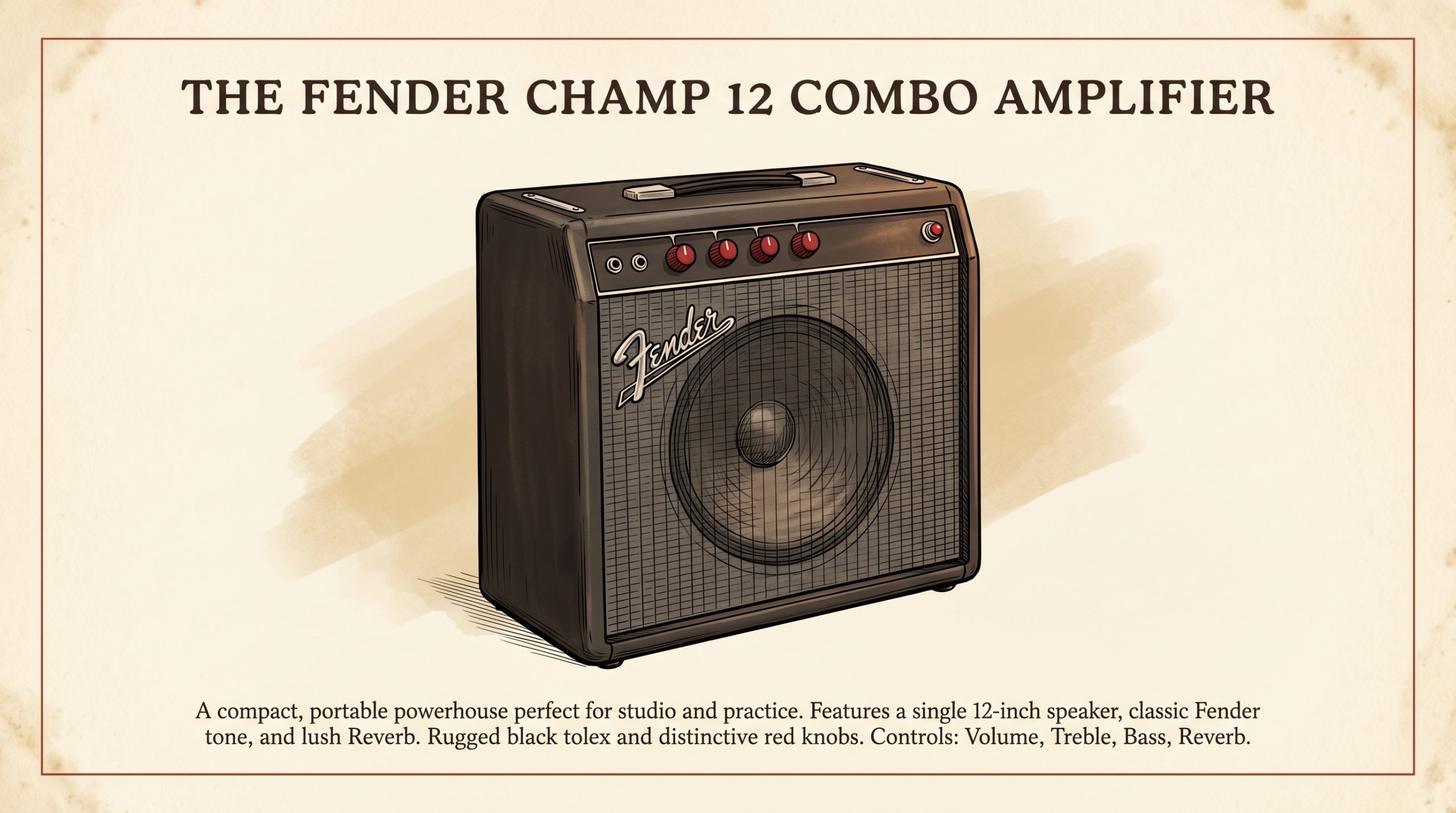
What Is the Fender Champ 12?
The Red Knob Era in Fender History
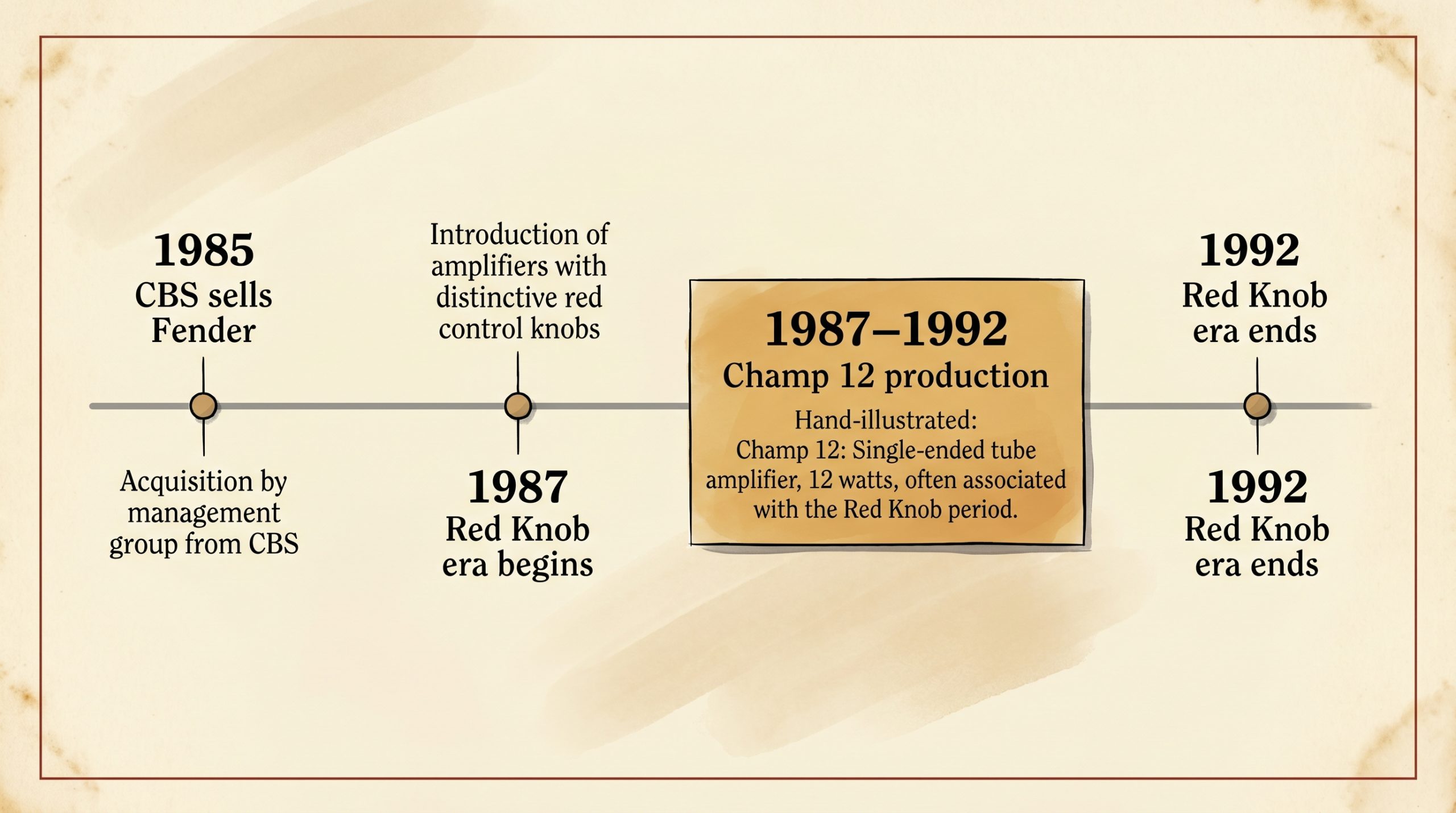
Fender’s Red Knob era spans roughly 1987 to 1992, landing squarely in the company’s post-CBS rebuilding period under new ownership. CBS sold Fender in 1985, and the reconstituted company spent several years reestablishing US manufacturing and updating the product line. The amps that came out of that push get unfairly lumped in with the later CBS decline, but they were built by a company that was actively trying to prove something. The Red Knob family includes the Champ 12, the Super Champ (a different circuit from the earlier blackface-derived Super Champ), the Princeton Chorus, and several Stage Lead models. These are US-made in their early runs (with later Champ 12 production shifting to Fender’s Ensenada, Mexico plant from around 1990), generally solid amps that have been undervalued because they don’t carry a blackface or tweed pedigree.
Where the Champ 12 Fits in the Champ Lineage
The Champ name goes back to 1948. From the original tweed 5F1 through the brownface, blackface, and silverface variants, the Champ was always a single-ended Class A amp: one preamp tube, one power tube, no reverb, no frills. The Champ II in the early 1980s added a fourth control (master volume) and a pull-boost mid switch but stayed single-channel; the two-channel, reverb-equipped model from that same 1982 refresh was actually the separate Super Champ. The Champ 12 breaks from all of that. It’s a two-channel amp with spring reverb, a 6L6GC push-pull capable output (though the cathode bias keeps it from running fully hard), and a cabinet large enough for a 12-inch speaker. Think of it as a Champ in name and spirit, not in circuit architecture.
The “hybrid” label that follows this amp around online is misleading. The signal path is entirely tube-driven. What’s solid-state is the rectifier. That’s a meaningful distinction because a solid-state rectifier produces stiffer, more immediate response compared to a tube rectifier’s characteristic sag. The Champ 12 doesn’t sag like a tweed Champ does. It doesn’t have that spongy compression under heavy picking. What it has is punchy, immediate response from a genuinely tube-driven circuit. Not the same thing. Worth knowing before you buy.
For a broader look at where the Champ 12 sits in the full Fender Champ lineage, the Fender Champ history guide covers every model from the 5F1 tweed through the modern reissues.
Fender Champ 12 Specifications
Circuit and Tube Complement
The Champ 12 doesn’t carry a traditional Fender circuit code like AB763 or AA864. The Red Knob era used model-based part numbers rather than the alphanumeric circuit designations of the blackface and silverface periods. The schematic is publicly available through Fender’s service documentation and has been archived at schematicheaven.net for years. If you’re troubleshooting or planning mods, pull the schematic before touching anything inside.
| Spec | Detail |
|---|---|
| Power Output | 10–12 watts RMS |
| Preamp Tubes | 2× 7025 (mil-spec 12AX7 equivalent) |
| Power Tube | 1× 6L6GC |
| Bias Method | Cathode bias (self-biasing) |
| Rectifier | Solid-state diode |
| Speaker Impedance | 8 ohms |
| Circuit Designation | Red Knob family, no AA/AB letter code |
Speaker and Cabinet
The stock speaker is a Fender Special Design “Blue Label” 12-inch unit rated at 8 ohms. It’s warmer and less sensitive than the Jensen P12R or Oxford units that appeared in vintage Fender combos, which contributes to the Champ 12’s softer top end at bedroom volumes. The cabinet is particle board rather than the solid pine construction of vintage Champ models, which affects both weight and resonance characteristics. It’s heavier than you’d expect for a 12-watt amp, coming in around 28 to 29 pounds.
Tolex options across the production run included black (most common), red, white, grey, and snakeskin. The snakeskin variant is the rarest and commands a noticeable collector premium in good cosmetic condition. Grill cloth is dark gray across all variants, with a grill-mounted raised chrome and black script logo.
Control Panel, Front and Rear
| Panel | Controls / Features |
|---|---|
| Front | Input 1, Input 2, Treble/Middle Boost switch, Bass, Volume (clean channel), Gain, Drive (OD channel), Reverb, Tape In (L/R) |
| Front | 1V Line Out, Headphone Out |
| Rear | Fuse holder |
There’s no effects loop, which is a common complaint from players who want to run time-based effects post-preamp. The 1V line out partly compensates for recording applications, letting you capture the preamp signal directly. Mojotone’s field guide documentation notes the Champ 12 has always had a strong reputation as a studio amp specifically because of this feature.
One often-overlooked detail: there’s a reverb trim pot located inside the chassis tray, behind the input jacks. No soldering required to access it, just a small screwdriver. The factory-set reverb send level is conservative, and adjusting this trim pot can dramatically improve reverb usability at lower volume settings. Most used examples have never had it touched.
Knob color varies by production period. Most examples you’ll encounter have the red knobs that give the era its nickname, but earlier production units may have black knobs. Both are original.
Tonal Character, What Does the Champ 12 Actually Sound Like?
Clean Channel Performance
The clean channel is where this amp earns its reputation. The Treble/Middle Boost switch and Bass control give you enough shaping to dial in anything from a glassy, spanky attack to a fuller, more rounded clean tone. At lower volumes, the bright cap on the Volume control creates an ice-pick treble issue that TDPRI forum users have noted for decades, backing off the treble becomes necessary if you’re playing at bedroom levels. Push the volume past 6 or 7 and the brightness smooths out naturally as the amp starts working harder.
The 6L6GC in cathode bias configuration behaves differently from a fixed-bias push-pull 6L6 setup like you’d find in a Super Reverb or Twin Reverb (the Deluxe Reverb, by contrast, runs 6V6 power tubes, not 6L6GC). It runs at lower plate voltage, compresses slightly under load, and breaks up earlier. Not as early as a 5F1 tweed Champ, but earlier than a blackface Deluxe. The clean headroom ceiling is real but not punishing, small venues and rehearsals are within reach.
Engineers who’ve used the Champ 12 as a studio amp often ran it clean with effects added in post. As documented at Mojotone’s Fender field guide, the amp’s combination of genuine tube response, small cabinet size, and 1V line out made it a practical choice for tracking situations where a Twin Reverb would have been overkill.
Overdrive Channel Performance
The Gain and Drive controls interact in a two-stage way: Gain sets input sensitivity into the overdrive circuit, Drive controls the clipping level. High Gain with moderate Drive gets you a compressed, medium-crunch texture. Low Gain with Drive cranked produces a looser, more open distortion character. It’s not a blackface-clean Fender overdrive. It’s closer to an 80s Marshall-adjacent crunch, which makes sense given the era it was designed in.
Not a bad overdrive. Just a specific one. Players expecting the breakup character of a 5E3 tweed Deluxe will be disappointed. Players who want something that cuts through a rehearsal mix with moderate gain will find it perfectly adequate.
For pedal platform use, the clean channel is the stronger choice. It responds well to transparent overdrive pedals and doesn’t fight you tonally. The clean channel’s tube sensitivity makes it a natural fit for touch-responsive playing when you’re running an overdrive pedal rather than the amp’s built-in gain stage.
Reverb
The spring reverb tank is appropriately sized for the cabinet, which means shorter and drier than what you’d hear from a full-size Twin Reverb or Deluxe Reverb tank. At the factory trim setting, reverb can be nearly inaudible at lower volumes, that’s the trim pot issue mentioned above. Once calibrated correctly, it produces a usable splash of room ambience rather than a deep, lush surf reverb. Appropriate for the amp’s size. Don’t expect it to do what a Super Reverb does.
Production History and Identifying Your Champ 12
The Champ 12 ran from 1987 to 1992, five production years split across two Fender facilities. Fender’s Fullerton plant closed in 1985 when CBS sold the company, so no Champ 12 production occurred there. Early production (1987 through approximately 1990) came out of Fender’s Corona, California facility; production then shifted to Fender’s Ensenada, Mexico plant for the remainder of the run. That matters for provenance and for parts research, later examples carry Mexico-made hardware even though they share the same Red Knob-era circuit and cosmetics.
Serial Numbers and Dating Within the Production Window
Red Knob era Fender amps use a serial number format with an “E” prefix followed by a numeric sequence, though exact formatting can vary across the production window. For any dating questions beyond the serial number, the EIA codes on the transformers and speaker frame are your most reliable reference. The EIA manufacturer code, followed by a year and week stamp, can narrow the production date to within a few weeks of when the speaker was installed. The Fender tube amp serial number and dating reference covers EIA code reading methodology in full, including how to interpret transformer and speaker stamps across all Fender eras.
Tolex and Cosmetic Variants by Production Period
Early production units are more likely to appear in black tolex with black knobs. As the Red Knob name solidified across the product line, red knobs became standard. Special cosmetic runs, white, grey, red, and snakeskin, appear throughout the production window, though which specific years or markets received each finish is not fully documented in publicly available Fender records. If you encounter a non-black example, EIA codes are the most practical way to approximate the production year rather than relying on finish color alone.
The snakeskin variant is the rarest and most sought-after cosmetically. Prices for snakeskin examples in intact condition typically run 20 to 40 percent above comparable standard-tolex examples. Authenticate by checking that the grill cloth, logo, and hardware all match production spec, replacement grills and mismatched logos are common on amps that have been refurbished over the years.
Confirming a Champ 12 vs. Other Red Knob Models
The visual tells: the Champ 12 has a single 12-inch speaker, red (or early-production black) unnumbered knobs, and a front-panel headphone out and line out. The Super Champ of this era uses a 1×10 configuration. The Princeton Chorus has two speakers and stereo chorus controls. If the nameplate says Champ 12 and the cabinet houses a 12-inch driver, you’re in the right place. Pull the chassis and count tubes: two 7025 in the preamp positions and one 6L6GC in the power tube socket confirms it.
Champ 12 vs. the Broader Red Knob Champ Family
The secondary keywords “fender champ 25” and “fender champ 25 se” come up regularly alongside the Champ 12 in search, and the distinction matters practically. These are different circuits with different tonal results.
| Feature | Champ 12 | Champ 25 | Champ 25 SE |
|---|---|---|---|
| Power | 12W | 25W | 25W |
| Circuit Type | All-tube signal path | Hybrid: solid-state preamp, tube power amp | Hybrid: solid-state preamp, tube power amp |
| Preamp Tubes | 2× 7025 | None (solid-state preamp) | None (solid-state preamp) |
| Power Tubes | 1× 6L6GC | 2× 6L6GC + 1× 12AX7 (phase inverter) | 2× 6L6GC + 1× 12AX7 (phase inverter) |
| Speaker | 1×12″ | 1×12″ | 1×12″ |
| Channels | 2 (Clean + OD) | 2 | 2 |
| Reverb | Spring reverb | Yes | Yes |
| Production Era | 1987–1992 | 1992–1994 | 1992–1994 |
| Tolex Options | Black, Red, White, Grey, Snakeskin | Black | Black |
| Typical Used Price | $250–$450 | $100–$200 | $100–$200 |
The Champ 25 and Champ 25 SE offer more headroom and higher output wattage courtesy of their 2× 6L6GC tube power section (both actually run a solid-state preamp ahead of that tube power amp, not the reverse). For anyone specifically after a fully tube-driven signal path, preamp gain stages included, the Champ 12 is the only all-tube option in the Red Knob Champ family; the Champ 25 and 25 SE still deliver genuine tube power-amp compression and speaker interaction, just without tube preamp gain staging ahead of it. The price gap on the used market reflects this accurately. The core mod points documented in that guide and in community discussions include bright cap removal or substitution on the Volume control (which tames that low-volume ice-pick treble issue), tone stack voicing adjustments to shift the mid-frequency response, and reverb driver circuit tweaks to improve reverb audibility across the volume range. These modifications require intermediate electronics knowledge. If you’re not comfortable with live voltages inside a tube amp, a qualified amp tech can execute all of them in a single service appointment.
The Effectrode knowledge base covers a “Champ Deluxe” transformation approach along similar lines, documenting specific component changes that bring the amp’s character closer to a blackface Deluxe Reverb voicing. Paired with a speaker upgrade, the results can be substantial.
Reverb Trim Pot Adjustment
This one requires no soldering. The trim pot sits inside the chassis tray, accessible behind the input jacks. Setting it higher than factory default gives the reverb significantly more presence at normal playing volumes. It’s the first adjustment worth making on any Champ 12 that comes home with a disappointing reverb response. Takes about five minutes.
Tube Rolling
Any 12AX7 or ECC83 is compatible with the 7025 positions. JJ ECC83S runs smooth and slightly warm. The Tung-Sol 12AX7 reissue adds clarity and detail at the top end. Mullard reissue 12AX7 tends toward a rounder, more compressed response. For the 6L6GC position, cathode bias means you can swap tubes without re-biasing. JJ 6L6GC is the workhorse choice, reliable and affordable. Electro-Harmonix 6L6 opens up the top end slightly compared to the JJ. NOS Sylvania 6L6GC commands a price premium but delivers a notably cleaner, more three-dimensional tone if you can find a tested example. The 6L6 tube guide covers all the major current-production and NOS options in detail, with datasheet specs and Fender circuit application notes.
Speaker Upgrade
The stock Blue Label is a functional speaker but not an inspiring one. Popular replacements in the community include the Celestion Vintage 30 (tighter bass response, prominent 3kHz presence), the Weber Blue Dog (closer to an alnico Jensen character, warmer and more sensitive than the Blue Label), and the WGS Veteran 30 as a budget-friendly Vintage 30 alternative. The 8-ohm impedance requirement is the only hard constraint. Any of these will open up the amp’s top end more than any circuit modification.
Buying Guide, What to Look for on the Used Market
Current Used Market Value
Standard black tolex examples in working condition are currently running $250 to $450 depending on tube condition, cosmetic state, and whether recent service has been done. Non-working examples showing up for modders or rebuilders typically fall in the $100 to $175 range. Snakeskin tolex examples in intact cosmetic condition command $500 or more. Community data from Reverb and forum pricing threads puts the average working example closer to $300 to $350, making the Champ 12 one of the better-value all-tube US combos on the used market right now.
What to Inspect Before Buying
- Tubes: Ask when they were last replaced. Test all three: 2× 7025 and 1× 6L6GC. A weak or gassy 6L6GC is the most common cause of hum or unstable behavior.
- Speaker: Check the Blue Label cone for tears and verify there’s no recone history (reconed stock speakers rarely sound as good as originals).
- Reverb function: Send a signal and listen for reverb response. Dead reverb usually means a loose tank connection or failed driver tube, both fixable but worth negotiating on price.
- Tolex condition: The original tolex on these amps is thinner than vintage Fender examples. Corner peeling is common. Cosmetic issues don’t affect tone but do affect resale value.
- Output transformer: Audible hum under load that doesn’t resolve with a tube swap is the warning sign for transformer issues. Output transformer failure is the most significant repair cost on this model.
- Line out jack: Confirm functionality if you’re buying it for studio use. A dead line out is a solder joint problem, usually minor.
- Knobs: Confirm the red knobs are original. Replacements are common and cosmetically inconsistent with original production.
Why the Champ 12 Deserves More Attention
The Red Knob era stigma is essentially a market inefficiency. The Champ 12 is all-tube, two-channel, spring reverb-equipped, and repairable by any competent amp tech with access to the publicly available schematic (early units are US-made; later units, from roughly 1990 on, were built at Fender’s Ensenada, Mexico plant). It checks the same boxes that vintage hunters claim to care about. The only thing it doesn’t have is a tweed cabinet and a pre-CBS serial number, and those things affect collectibility, not playability.
Genuine sleeper. Players who care about what an amp sounds like rather than what it’s worth at resale have been finding these for years, dropping in a Weber or Celestion speaker, adjusting the reverb trim pot, and walking away with a compact, versatile tube combo for under $400. The overdrive channel is period-correct rather than timeless, but the clean channel at working volume is legitimate. The community notes from TDPRI and r/ToobAmps bear this out consistently: great cleans when pushed, reverb that needs calibration out of the box, and a pedal platform that responds well to touch-sensitive playing.
For players who want to understand how the Champ 12’s tube complement behaves compared to other Fender power sections, the 12AX7 tube buyer’s guide covers preamp tube behavior, gain staging, and current-production versus NOS options across all the major brands used in Fender circuits. It pairs well with the 6L6 guide linked above if you’re planning a tube rolling session on a new acquisition.
Output transformer hum is the one repair cost to budget for on older examples. Everything else on these amps, tubes, caps, reverb tank connections, is routine maintenance on a forty-year-old circuit. Budget $50 to $100 for a basic service on a used example and you’ll have an amp that runs reliably for another decade.
Frequently asked questions
Is the Fender Champ 12 a tube amp?
Yes. The Champ 12 is an all-tube amplifier in its signal path, using two 7025 (12AX7 equivalent) preamp tubes and a single 6L6GC power tube. The rectifier is solid-state, which is the source of the common "hybrid" misclassification online. The audio signal itself runs entirely through tubes from input to speaker output.
What are the Fender Champ 12 specs?
The Champ 12 produces 10 to 12 watts RMS through a 1×12-inch Fender Special Design Blue Label speaker (8 ohm). It features two channels, clean and overdrive, plus spring reverb, a headphone output, and a 1V line out. Preamp tubes: 2× 7025. Power tube: 1× 6L6GC, cathode biased. Rectification is solid-state. No effects loop. Knobs: Volume, Treble/Middle Boost switch, Bass, Gain, Drive, Reverb.
What years was the Fender Champ 12 produced?
Production ran from 1987 to 1992, all five years falling within the "Red Knob" era, the post-CBS period following Fender's 1985 ownership transition. Early units (roughly 1987 through 1990) were built at Fender's Corona, California facility; production then shifted to Fender's Ensenada, Mexico plant for the remainder of the run. No production occurred at the earlier Fullerton facility, which closed in 1985 before the Champ 12 was developed.
How does the Fender Champ 12 compare to the Champ 25 and Champ 25 SE?
The Champ 12 is an all-tube design at 12 watts, tube preamp and tube power amp both. The Champ 25 and Champ 25 SE are hybrid designs with 25 watts of output, a solid-state preamp feeding a genuine tube power amp (2× 6L6GC). They're louder and better suited to high-clean-volume practice situations. If you want a fully tube-driven signal path from input to speaker, the Champ 12 is the correct choice among the three; if tube power-amp response alone is what matters to you, the Champ 25 and 25 SE deliver that too. Typical used prices reflect the difference: Champ 12 runs $250 to $450, while Champ 25 models typically sell for $100 to $200.
Can the Fender Champ 12 be used for gigging?
Yes, with caveats. At 12 watts through a 12-inch speaker, it's stage-loud enough for small venues, quiet rehearsal situations, and recording. The 1V line out also opens it up for direct studio tracking without miking the cabinet. Community users on Reddit's r/ToobAmps have consistently described it as loud enough for gigs with a clean, touch-responsive response that holds up under playing dynamics. It won't compete with a Twin Reverb in an open rehearsal room, but it doesn't need to.