Contents
- 01What Is the GZ34 / 5AR4 Rectifier Tube?
- 02GZ34 / 5AR4 Datasheet Specs and Technical Specifications
- 03Manufacturer History: Who Made the GZ34?
- 04Current Production GZ34 / 5AR4 Tubes: Brand-by-Brand Breakdown
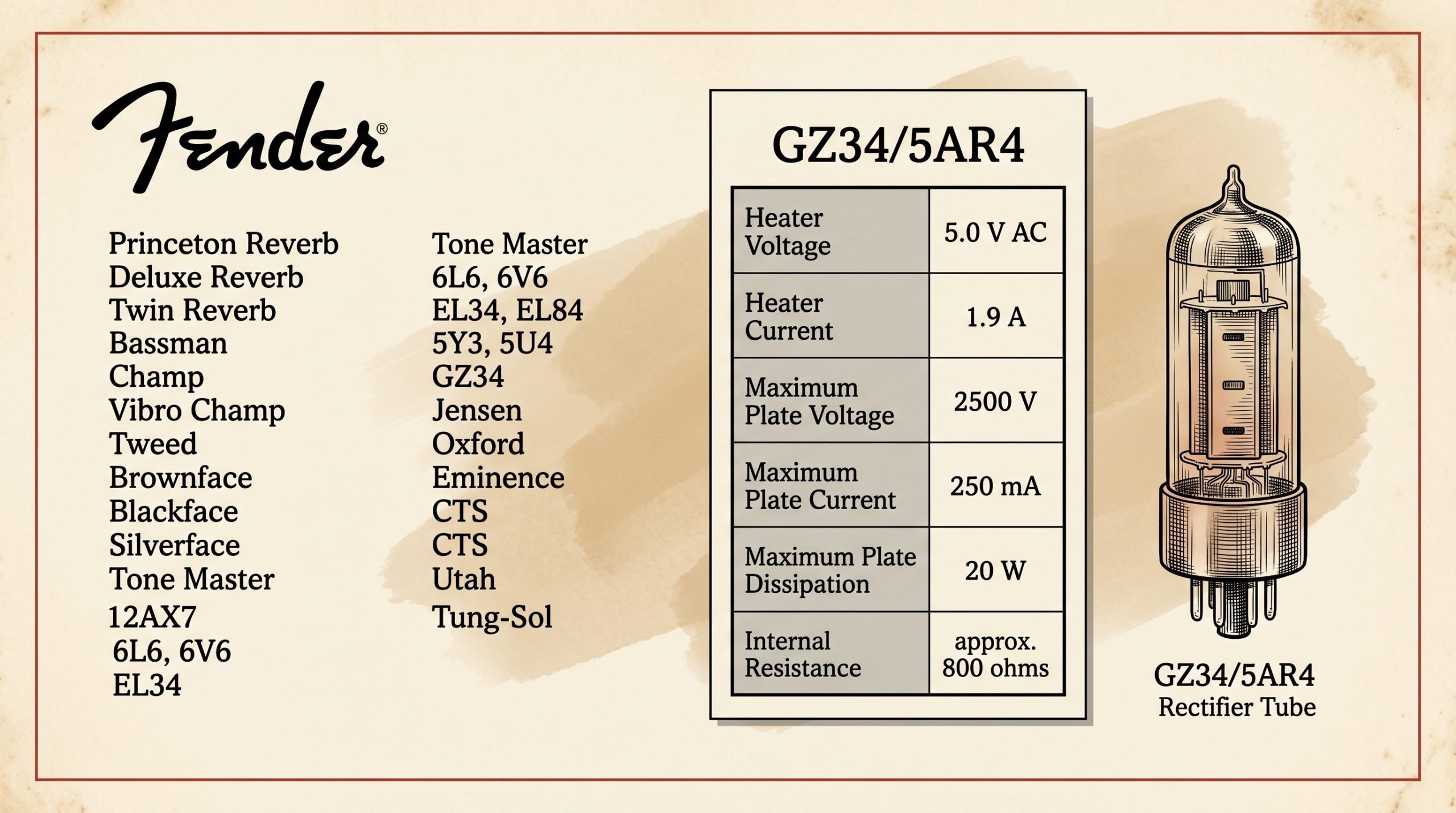
- 05GZ34 / 5AR4 in Fender Amplifiers: Which Amps Use This Tube?
- 06GZ34 vs. 5AR4: Is There Actually a Difference?
- 07GZ34 / 5AR4 Equivalents and Substitutes
- 08How to Select, Test, and Replace Your GZ34 / 5AR4
- 09NOS vs. Current Production: Is a Vintage Mullard GZ34 Worth It?
- 10Frequently Asked Questions
- 11Which GZ34 Should You Choose
The GZ34 (also designated 5AR4 in the American RETMA system and U77 in British military spec) is the factory-correct rectifier for most Fender blackface and silverface circuits producing 40 watts or more. It’s a full-wave, indirectly heated octal rectifier developed by Mullard in the UK around 1955-1956, and its moderate internal resistance is a large part of why blackface Fenders feel the way they do under the pick. This guide covers the full picture: electrical specs, manufacturer history, current production comparisons, Fender fitment, and what happens when you substitute it.
What Is the GZ34 / 5AR4 Rectifier Tube?
Naming and Designation Explained
Three names, one tube. The GZ34 designation follows the European IEC/Philips naming system, where “G” denotes the tube type class, “Z” indicates a rectifier function, and “34” is the type number within that class. The 5AR4 designation is the American RETMA equivalent, assigned after American manufacturers began producing the same design post-1958. The U77 is the British Ministry of Defence spec designation used in military and broadcast applications. All three are electrically identical, same pinout, same heater ratings, same maximum current. There is no performance difference based on which designation is printed on the label.
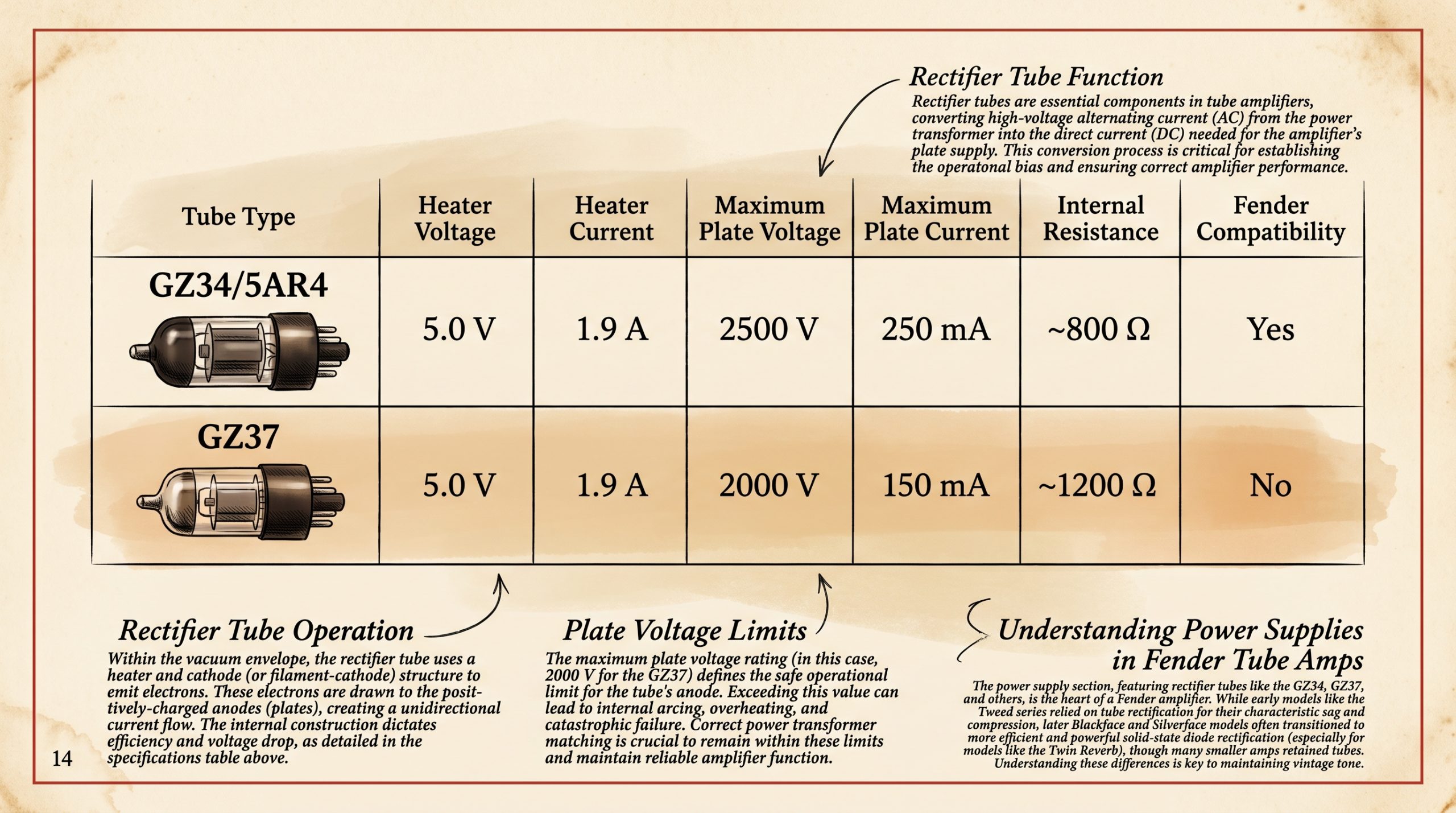
One tube to watch out for: the GZ37. It looks similar and shares the octal base, but it carries different ratings and isn’t a straightforward drop-in for GZ34 sockets in standard Fender circuits. Don’t assume the “GZ3” prefix means compatibility.
Where You’ll Find It
In the guitar amp world, the GZ34/5AR4 is the rectifier in many of Fender’s larger blackface and silverface circuits — but not all of them. The Super Reverb (AA763 in 1963–64, AB763 from 1964 onward), the AA165 Pro Reverb, and several Showman variants left the Fender factory with a GZ34 in the rectifier socket. The Twin Reverb is the notable exception among Fender’s biggest blackface amps: despite sharing the AB763 platform, it uses solid-state rectification from the factory, not a GZ34, because its 85W output stage draws more sustained current than a tube rectifier can reliably supply. It also appeared throughout the hi-fi world in amps from Leak, Quad, Radford, and Dynaco, which matters because the tube’s design was optimized for high-quality audio reproduction, not just raw power delivery. That hi-fi lineage is part of why it has softer, more controlled voltage sag than many rectifiers designed purely for industrial applications.
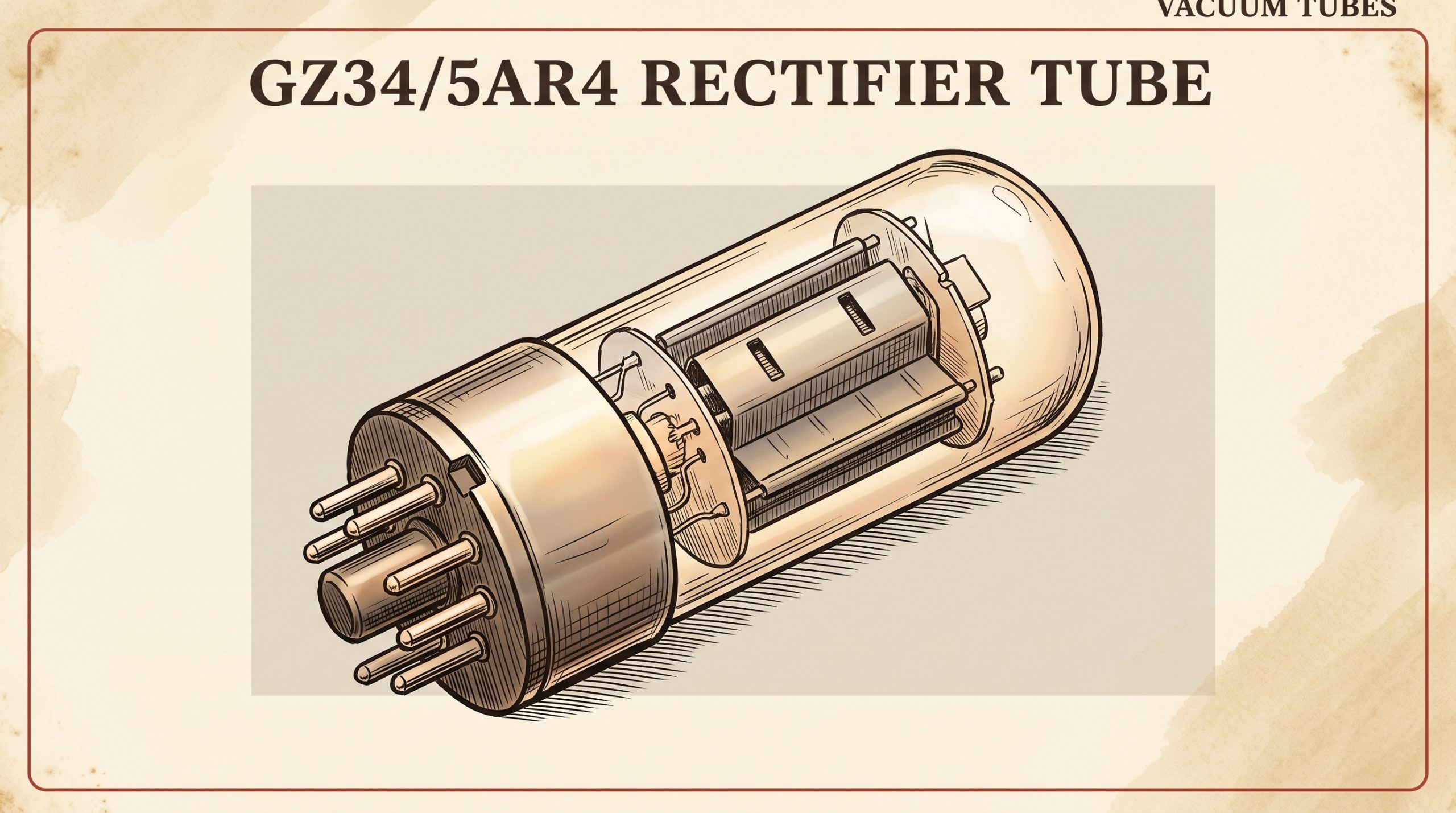
The indirectly heated cathode design means the tube takes roughly 15-20 seconds to reach operating temperature before it passes significant current, with some sources citing a slower ramp of up to 30 seconds depending on the specific tube and circuit. That gradual warm-up provides a built-in soft-start that protects filter capacitors, an effect that differs meaningfully from other rectifier types used in guitar amplifiers.
GZ34 / 5AR4 Datasheet Specs and Technical Specifications
Key Electrical Ratings (Mullard Original Datasheet Values)
The original Mullard GZ34 datasheet, published circa 1956 and cross-referenced by Sylvania and GE under the 5AR4 designation after 1958, establishes the following electrical ratings. Frank’s Electron Tube Data Sheets archives the complete original specification at frank.pocnet.net.
| Parameter | Value |
|---|---|
| Tube Type | Full-wave, indirectly heated rectifier (twin diode) |
| Base | Octal (8-pin) |
| Heater Voltage | 5.0V AC |
| Heater Current | 1.9A |
| Peak Inverse Voltage (PIV) | 1,550V |
| Max DC Output Current | 250 mA |
| Max DC Output Voltage (capacitor input filter) | ~450V |
| Max DC Output Voltage (choke input filter) | ~350V |
| Plate Dissipation | 13.5W per plate |
| Internal Plate Resistance (approx.) | ~80–90 ohms (NOS Mullard); ~60–70 ohms (current production) |
| Typical No-Load Voltage (cap. input) | ~475V |
| Typical Voltage Drop per Plate | ~10–15V |
What These Numbers Mean for Your Amp
The 250 mA maximum DC output is the most practically important rating. Most single-rectifier Fender circuits in the blackface era draw somewhere between 160-200 mA at full output, which means the GZ34 is running comfortably within its envelope in normal use. It’s not being pushed. That headroom contributes to its longevity in these applications.
The internal plate resistance, roughly 80-90 ohms in NOS Mullard examples, is where the “feel” of the rectifier comes from. Under heavy load (hard picking, loud playing), that resistance causes the B+ supply voltage to dip momentarily before recovering. That dip is what players call sag. It softens the attack slightly, compresses the transient, and gives the amp a spongier, more dynamic response. Forum measurements on the diyAudio forum confirm the GZ34’s plate resistance sits around 80 ohms in full-wave configuration, versus roughly 40-50 ohms for a solid-state rectifier drop-in. That difference of 30-40 ohms is audible in a well-tuned blackface circuit. Not subtle.
Bias and Voltage Notes for Common Fender Applications
In GZ34-equipped circuits like the AB763 Super Reverb, B+ at the output tube plates typically falls in the 440-490V range, depending on model and transformer tolerances. These numbers assume original-spec filter capacitors rated for at least 500V. If you pull the GZ34 from one of these tube-rectified circuits and install a solid-state rectifier plug, B+ can climb 30-50V higher than the tube-rectified baseline. That’s not a problem the circuit was designed for. Bias must be re-checked after any rectifier type change, and filter cap ratings should be confirmed before running extended sessions with solid-state rectification. The Twin Reverb is a different case: it ships from the factory with solid-state rectification already, so there’s no GZ34 in that circuit to begin with.
For circuit-level reference on the AB763 platform, the Fender Super Reverb guide covers B+ behavior and bias procedures specific to that chassis.
Manufacturer History: Who Made the GZ34?
Mullard (UK), The Originator
Mullard’s Blackburn factory in Lancashire developed and began producing the GZ34 around 1955-1956. Production at Blackburn ran from approximately 1956 through the mid-1970s, making it one of the longer-running tube production runs at that facility. The Blackburn factory used a date coding system that serious NOS buyers learn to read: the factory code “B” is followed by a year digit and quarter letter (A, B, C, or D). A tube stamped “B7C1” came from Blackburn, manufactured in 1957, third quarter. These date codes appear on the tube’s base or etched into the glass. Earlier Blackburn production (1957-1963) used short-plate construction; later versions moved to long-plate construction, which some collectors argue behaves slightly differently under load.
Two getter types appear in Mullard GZ34 production: the square getter (earlier) and the D-getter (later). The square getter variants are the most sought-after among NOS collectors and command the highest prices. The higher internal resistance of NOS Mullard examples, roughly 90 ohms versus 60-70 ohms in current production, produces measurably more sag under load, which translates to a more responsive, “juicier” feel at the playing surface of a blackface Fender.
Amperex (Netherlands / USA)
Amperex manufactured GZ34 tubes under the Philips corporate umbrella, making them electrically close relatives of the Mullard design. The brown-base F33 variant produced between approximately 1958 and 1963 is the variant most discussed in collector circles. It has a slightly different construction internally and is often described as having a more “open” character compared to Mullard, less compressed sag, more immediate. Anecdotal. But consistent enough across enough amp technicians’ experience to be worth knowing. Amperex NOS in tested condition typically runs $100-250 depending on the variant and test results.
Sylvania / GE / RCA (USA, 5AR4 Designation)
American manufacturers adopted the 5AR4 designation under RETMA standards and began producing the type in volume after 1958. Electrically identical to the Mullard spec, but with different cathode coating materials in some production runs. The Fender factory, per documented spec sheets, referenced the GZ34 designation directly, NOS pulls from Fender amps of the blackface era are more likely to be Mullard or Mullard-adjacent than American-branded tubes. Sylvania and GE 5AR4 examples are solid performers and represent a more accessible NOS price point, typically $40-80 for tested examples.
Matsushita / National (Japan)
Matsushita became an OEM supplier to Fender during the mid-1970s silverface production period, and their GZ34 turns up in many amps from that era. The Matsushita tube is reliable and well-built, with slightly lower internal resistance than NOS Mullard, which means marginally less sag and a slightly tighter feel. It isn’t a “lesser” tube in any meaningful way. For players who want NOS but don’t need the maximum Mullard sag, Matsushita is a solid buy at a lower price than Mullard or Amperex equivalents. It’s a legitimate option, not a consolation prize.
Current Production GZ34 / 5AR4 Tubes: Brand-by-Brand Breakdown
Current production options cover a wide range of price points and sonic characters. The key variable across brands is internal resistance, which determines how much the B+ sags under load. Lower internal resistance means tighter feel, higher B+, less compression. Higher internal resistance means more sag, lower B+ under load, more classic Fender feel. The Genalex Gold Lion’s measurements show it gets closest to NOS Mullard behavior of anything currently manufactured.
| Brand | Designation | Origin | Price Range | Sag Character | Reliability | Best For |
|---|---|---|---|---|---|---|
| JJ Electronics | JJ GZ34 | Slovakia | $25–$32 | Moderate | High | Reliable everyday use |
| Sovtek | Sovtek 5AR4 | Russia | $25–$32 | Low-moderate | High | Tight feel, more headroom |
| Mullard (new prod.) | Mullard GZ34 | Russia | $55–$75 | Moderate | Good | Mid-tier NOS-adjacent tone |
| Genalex Gold Lion | GZ34 / U77 | Russia | $60–$75 | Higher | Good | Closest to vintage Mullard character |
| Tung-Sol | 5AR4 | Russia | $45–$55 | Moderate | Good | Balanced option |
| Electro-Harmonix | 5AR4 | Russia | $25–$35 | Low | High | Tight, near solid-state feel |
JJ GZ34, The Reliable Everyday Choice
JJ Electronics manufactures their GZ34 in Cadca, Slovakia, and it’s the most widely recommended current production option for good reason. Slightly lower internal resistance than Mullard NOS translates to marginally less sag, but not enough to fundamentally change the character of a blackface Fender. It’s consistent batch to batch, fails gracefully rather than catastrophically, and is available everywhere. For a regularly gigged amp, this is the practical call. JJ’s spec documentation is available directly at jj-electronic.com.
Sovtek 5AR4, The Tight, Punchy Option
The Sovtek 5AR4 has the lowest internal resistance of the current production lineup. That means the least sag, the highest B+ under load, and the tightest attack. Some players want exactly that, a blackface Deluxe Reverb or Super Reverb with the dynamic compression dialed back, more clean headroom, a more immediate response. That’s what the Sovtek delivers. Worth knowing: swapping from a NOS Mullard to a Sovtek in the same circuit can raise B+ by 20-30V, which makes a bias check non-optional.
Genalex Gold Lion GZ34 / U77
Made at the Reflektor plant in Saratov, Russia, the Genalex Gold Lion is the current production tube that most closely approximates NOS Mullard sag behavior. Its internal resistance measurements sit closer to the NOS Mullard range than any other current production option. Not identical. But closer. For players who want vintage-correct feel without paying NOS prices or gambling on aged glass, the Gold Lion is the recommendation. It sells under both the GZ34 and U77 designations, same tube either way.
New Production Mullard GZ34
Upscale Audio notes explicitly that the new production Mullard GZ34 “is not going to sound like a NOS Mullard.” That’s an honest caveat worth repeating here. It’s manufactured in Russia (Reflektor-adjacent production), not at the original Blackburn facility, and internal construction differs from the original. It’s a good mid-tier tube. Reliable, decent sag character, reasonable price. Just don’t buy it expecting the NOS experience at a discount.
GZ34 / 5AR4 in Fender Amplifiers: Which Amps Use This Tube?
Blackface Era Fender Amps Using GZ34 (1963–1968)
The GZ34 became the standard rectifier across Fender’s higher-powered blackface circuits as the AB763 platform rolled out in 1963. For dating and serial number verification on any of these models, the Fender tube amp serial number guide covers transformer codes, chassis stamps, and tube chart dating across the full blackface and silverface production run.
| Amplifier | Circuit Number | Production Years | Era | Notes |
|---|---|---|---|---|
| Twin Reverb | AB763 | 1963–1967 | Blackface | 85W — solid-state rectifier from the factory, NOT GZ34 (see note below) |
| Super Reverb | AA763 (1963–64) / AB763 (1964–1967) | 1963–1967 | Blackface | 40W, GZ34 standard |
| Showman (Piggyback Head) | AA763 (1963) / AB763 (1964–1967) | 1963–1967 | Blackface | 85W head version |
| Pro Reverb | AA165 | 1965–1967 | Blackface | 40W 2×12 combo |
| Bandmaster Reverb | AA768 | 1968 | Transitional | Bridge between blackface/silverface |
| Vibroverb (Blackface) | AA763 | 1964 | Blackface | 40W, limited production |
Silverface Era Usage (1968–1981)
The GZ34 carried over into early silverface production largely unchanged. Many silverface circuits through the early-to-mid 1970s are electrically close to their blackface predecessors and continue to spec the GZ34. Matsushita became the primary OEM source during this period. By the late 1970s, Fender began transitioning some models to solid-state rectifiers as a cost reduction measure, a change that raised B+ and removed the soft-start protection from those circuits. Amps from that later period may need filter cap inspection if they’ve never been serviced.
Why Fender Chose the GZ34 Over the 5U4 or 5Y3
The 5Y3GT maxes out at 150 mA DC output. That’s fine for a Champ or a tweed Deluxe, but it would be throttled hard in a 40-watt or 85-watt circuit drawing 160-200 mA. The GZ34’s 250 mA ceiling gives those larger circuits room to breathe. The 5U4G has plenty of current capacity but higher internal resistance and more sag than Fender wanted for the cleaner, higher-headroom blackface voicing. The GZ34 sits in the middle: enough current for the bigger circuits, enough sag for dynamic feel, but controlled enough to keep things clean at moderate volumes. That balance is exactly what the blackface circuits were built around. The Fender Pro Reverb guide has specific notes on how the AA165 circuit uses that headroom in the context of the 2×12 platform.
GZ34 vs. 5AR4: Is There Actually a Difference?
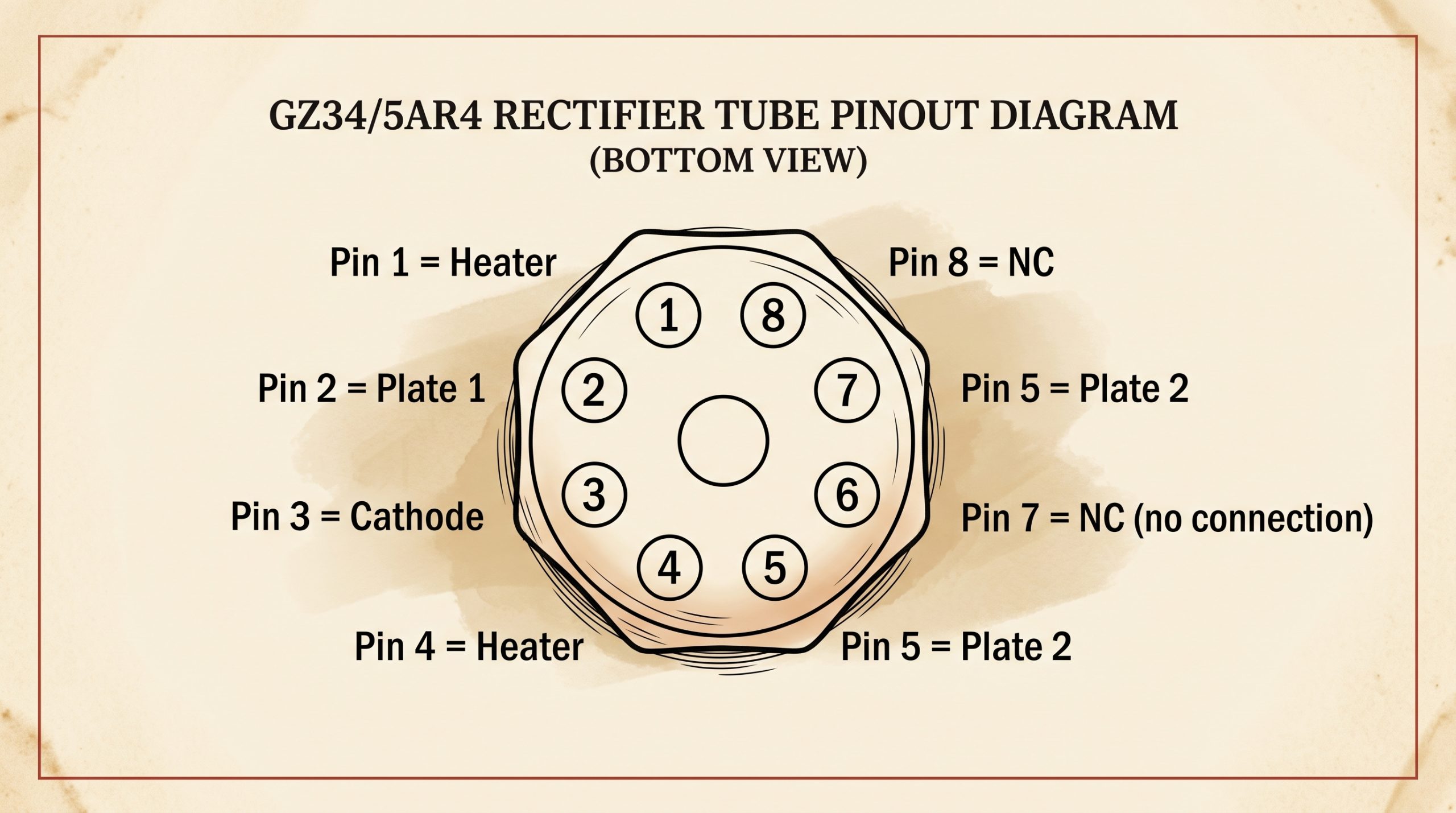
No. The GZ34 and 5AR4 are the same tube with different regional naming conventions. GZ34 is the European IEC/Philips designation. 5AR4 is the American RETMA/JEDEC designation. U77 is the British military designation. All three share identical pinout, identical heater ratings (5.0V / 1.9A), identical maximum current (250 mA), and identical PIV ratings (1,550V).
Practically, this means any tube labeled GZ34, 5AR4, or U77 drops directly into any socket calling for any of the three designations. No adapter, no circuit modification, no bias adjustment required by the name change alone. The only variable is which manufacturer made the tube and what internal resistance it has, which is a brand question, not a designation question.
GZ34 / 5AR4 Equivalents and Substitutes
Direct Equivalents (Drop-In, No Modification)
GZ34, 5AR4, and U77 are all direct drop-in equivalents. Any tube carrying one of those three designations from any manufacturer is a direct replacement for any of the others. Full stop.
Partial Equivalents (Similar but Not Identical)
| Tube | Compatibility | Notes |
|---|---|---|
| GZ37 | Not recommended | Higher voltage rating, different operating characteristics; not a straightforward swap |
| 5U4G / 5U4GB | Usable in some circuits | Higher current capacity, significantly more sag, lower output voltage; check power transformer ratings |
| 5Y3GT | Lower-power circuits only | 150 mA max output, will cause problems in circuits drawing 160+ mA; not suitable for Twin or Super Reverb |
| 5AR4 (any brand) | Direct drop-in | Same tube, different label |
| Solid-state rectifier module | Electrically compatible | Raises B+ 30–50V; bias check required; sag character eliminated |
Should You Use a Solid-State Rectifier Replacement?
It’s not a crazy idea in the right context. Eliminating the rectifier tube removes one failure point on a gigged amp and raises B+ slightly for more clean headroom. Some players want that. The downsides are real though: the 30-50V B+ increase stresses filter caps that may already be original, raises plate voltage on the output tubes beyond their designed operating point, and eliminates the soft-start protection that the GZ34’s warm-up period provides. Output tube life can suffer. Filter caps can suffer. And you lose the dynamic compression that makes a blackface Fender feel elastic under the pick. For a vintage amp in original condition, the GZ34 is the right choice. Solid-state makes more sense in a custom build or a heavily modified circuit designed around that higher B+.
How to Select, Test, and Replace Your GZ34 / 5AR4
Signs Your GZ34 / 5AR4 Is Failing
A dying rectifier doesn’t always fail dramatically. More often it drifts. The first sign is usually the amp feeling louder or cleaner than usual at the same settings, that’s B+ rising as the rectifier weakens, which drives the output tubes harder. Red-plating output tubes can follow, because elevated B+ without a corresponding bias adjustment puts those tubes under excessive stress. Other symptoms: intermittent cutouts under load, crackling or popping on startup that isn’t coming from the preamp section, and microphonic ringing that increases with amp age.
The most definitive visual sign. Look at the getter, the silver mirror-like deposit on the inside of the glass. On a healthy tube it’s bright silver and well-defined. On a failed or failing tube, it turns white or cloudy. White getter means the tube’s vacuum seal has been compromised and air has entered the envelope. That tube is done. Pull it immediately.
Testing Your GZ34 / 5AR4
Mutual conductance testers like the Hickok 539C or Amplitrex AT1000 can test rectifier tubes accurately. Emission testers give a less precise reading but are adequate for a pass/fail assessment. What you’re looking for is an emission reading above 70-80% of the “good” reference value on whichever tester you’re using. A tube testing at 50% or below should be replaced before it causes downstream problems.
In-amp testing is simpler. With a DMM set to DC voltage, measure B+ at the first filter cap after the rectifier. Cold reading immediately after the standby switch goes off should be low, climbing over 15-20 seconds as the cathode heats. A rectifier that conducts at full voltage before the cathode is warm is either solid-state or failing, indirectly heated GZ34 behavior should show a deliberate, gradual voltage rise. If B+ hits full value in under 5 seconds, the rectifier is worth testing on a bench tester.
How Often to Replace
NOS Mullard examples, when used in an amp that isn’t being abused, can last 10,000+ hours. Current production tubes are more variable: 2,000-5,000 hours is a reasonable expectation for JJ or Sovtek in regular use. For a gigged amp playing 3-4 nights a week, replacing the rectifier every 3-5 years is reasonable maintenance. Less often in a home or studio amp. More often if you’re driving the amp hard at high volume consistently. The rectifier is cheap insurance compared to what it protects, filter caps and output tubes are considerably more expensive to replace.
NOS vs. Current Production: Is a Vintage Mullard GZ34 Worth It?
The NOS Price Reality
Tested NOS Mullard Blackburn GZ34 examples with documented date codes run $200-350 as of 2026 (rare early metal-base and low-serial variants can exceed $1,000) — a meaningful jump from the roughly $80-200 range often quoted from older, 2010s-era listings, as collector demand has pushed NOS rectifier prices up substantially. NOS Amperex F33 (1958-1963 production) typically starts around $100 and climbs from there; verify current listings before buying, as this specific range has not been independently re-confirmed against 2026 data. NOS Sylvania and GE 5AR4 examples are more accessible at $40-80 for tested pulls. Matsushita NOS sits in a similar range to Sylvania, $40-70 for solid examples.
Sonic Differences: Real or Placebo?
Measurable. Not imaginary. The documented internal resistance difference between NOS Mullard (~90 ohms) and current production JJ (~60-70 ohms) produces a real B+ differential of 10-20V in the same circuit. That 10-20V translates to a tangible difference in how the amp compresses and responds on the pick, particularly when playing at edge-of-breakup levels where dynamic feel matters most. It’s not a massive difference, but it’s consistent and repeatable enough that experienced amp techs hear it reliably.
The practical counter-argument: a NOS Mullard GZ34 failing on stage at 11pm is more expensive than the cost of a NOS tube. Current production tubes are more predictable in failure mode and easier to replace on short notice. For studio work or home use where you control the environment and aren’t gambling on a tube’s age and history, NOS makes sense. For live work, current production is the sensible call.
The 6L6 tube guide covers how output tube selection interacts with the rectifier’s B+ delivery, relevant reading if you’re adjusting multiple tube positions at once.
Which GZ34 Should You Choose
For most players running a blackface or early silverface Fender, the JJ GZ34 is the starting point: reliable, consistently built, available anywhere, and priced low enough that keeping a spare on hand isn’t a hardship. If vintage-correct sag character is the priority and budget allows, the Genalex Gold Lion GZ34/U77 gets you closer to NOS Mullard behavior than anything else currently manufactured. NOS Matsushita or Sylvania 5AR4 examples from reputable sellers with test results give you original-era glass at reasonable prices. Save the NOS Mullard budget for a studio amp you can monitor closely. For anything going on a stage regularly, current production is simply the more practical choice, a failed rectifier on the second set is a problem that good tube selection can prevent.
Frequently asked questions
What is the equivalent of a GZ34 rectifier tube?
The GZ34 is directly equivalent to the 5AR4 (American designation) and U77 (British military designation). All three are electrically identical and can be substituted freely without circuit modification. Partial substitutes include the 5U4GB, which produces more sag and lower output voltage, and the 5Y3GT, which is only suitable for lower-current circuits below approximately 150 mA draw. The GZ37 is not a recommended substitute despite looking similar.
Is the Matsushita GZ34 any good?
Yes, it's a reliable and well-built tube. Matsushita was an OEM supplier to Fender during the 1970s silverface production run, so these tubes have a direct pedigree connection to original Fender production. They have slightly lower internal resistance than NOS Mullard examples, which means marginally less sag and a slightly tighter feel. They're mechanically durable and represent solid value as NOS alternatives, typically running $40-70 for tested examples, considerably less than Mullard or Amperex NOS.
What is the difference between GZ34 and 5AR4?
No electrical difference exists. GZ34 is the European IEC/Philips naming designation; 5AR4 is the American RETMA/JEDEC designation for the same tube. They share an identical octal pinout, identical heater ratings (5.0V / 1.9A), identical maximum DC output current (250 mA), and identical peak inverse voltage (1,550V). Any tube labeled GZ34 is a direct drop-in for any socket calling for a 5AR4, and vice versa.
What Fender amps use the GZ34 / 5AR4?
The GZ34/5AR4 is the factory rectifier in most higher-powered Fender blackface and early silverface circuits, including the Super Reverb (AA763 in 1963–64, AB763 from 1964–1967), Pro Reverb (AA165), and Showman (AA763 in 1963, AB763 from 1964–1967). It also appears in the Bandmaster Reverb (AA768) and the 1964 blackface Vibroverb (AA763). The Twin Reverb is a notable exception: despite sharing the AB763 platform with the Super Reverb, it uses solid-state rectification from the factory, not a GZ34, because its 85W output stage needs more sustained current than a tube rectifier reliably supplies. Mid-to-late 1970s silverface variants may have transitioned to solid-state rectifiers depending on the specific model and production date, a tube chart or chassis stamp inspection will confirm the original spec for any specific chassis.
Can I replace a GZ34 with a solid-state rectifier?
Drop-in solid-state rectifier modules are available and will physically fit the GZ34 socket. However, eliminating the tube rectifier raises B+ by 30-50V in most Fender circuits, which requires a bias check and can stress filter capacitors and output tubes that were designed around lower operating voltages. You'll also eliminate the dynamic sag that defines the feel of the blackface circuit. It's a viable modification in some contexts, but it's not a neutral swap, it changes how the amp behaves under load in ways that matter.