Contents
- 01What Is the Fender Vibroverb?
- 02A Tale of Two Vibroverbs: The 1963 vs. 1964 Models
- 03Comparison Table: 1963 Brownface vs. 1964 Blackface Vibroverb
- 04Why the Vibroverb Disappeared
- 05Identifying an Original Vibroverb: Dating and Authentication
- 06The Reissues: Fender's Attempt to Bring It Back
- 07Comparison Table: All Four Vibroverb Versions
- 08The Vibroverb Sound: What Makes It Different
- 09The Vibroverb and Stevie Ray Vaughan
- 10Buying a Fender Vibroverb Today
- 11Frequently Asked Questions
- 12The Vibroverb's Place in Fender History
- Production years: 1963 (brownface 6G16) and 1963-1964 (blackface AA763)
- First Fender amp with both spring reverb and tremolo onboard
- Brownface spec: ~35W, 2×10″ Oxford speakers, GZ34 tube rectifier, bias-vary tremolo
- Blackface spec: ~40W, 1×15″ JBL D130F or Oxford/Utah, solid-state rectifier, optical tremolo
- Estimated production: ~600 brownface units, ~1,200-1,500 blackface units
- Vintage pricing: $6,000-$12,000+ for 6G16; $4,500-$9,000+ for AA763 (2024 market)
- Reissue pricing: $1,800-$2,500 used for the ’63 reissue; $2,000-$3,200 for ’64 Custom
- The ’63 Vibroverb Reissue uses a single 15″ speaker, NOT the original 2×10″ configuration
- JBL D130F in a brownface (6G16) chassis = wrong speaker, parts amp indicator
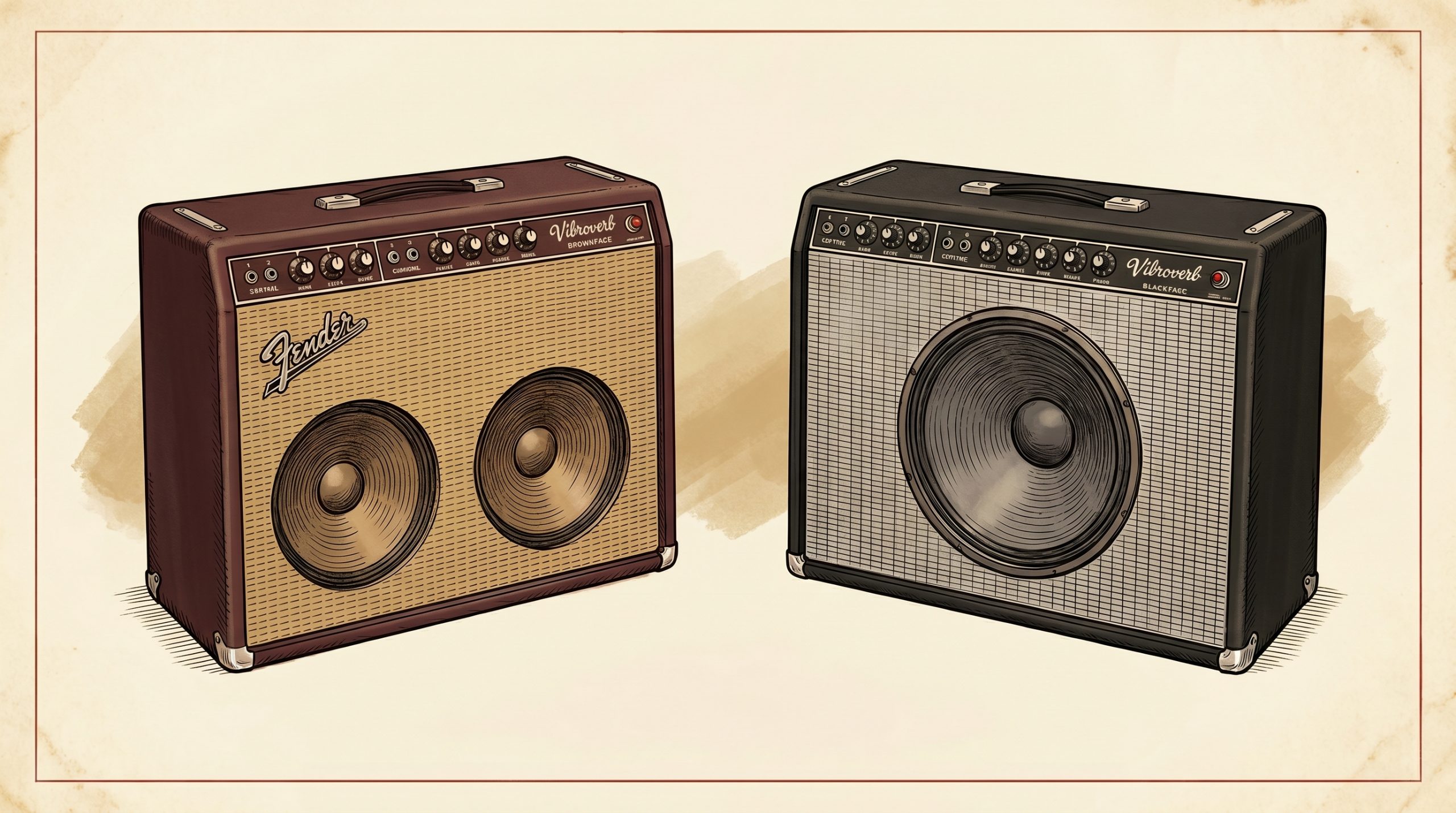
What Is the Fender Vibroverb?
The Vibroverb sits at a specific crossroads in Fender’s timeline: right at the transition from the warm, compressed brownface era into the brighter, more open blackface era. Fender built two entirely distinct amplifiers and called them both Vibroverb. They share a name and the distinction of being the first Fender amps with reverb and tremolo together, but the 6G16 and the AA763 are meaningfully different circuits with different speakers, different rectifiers, and different tremolo topologies.
The production window was short. By 1965, the Vibroverb was gone, quietly dropped as Fender rationalized its catalog. It left no direct successor. For roughly two decades, it was a footnote. Then Stevie Ray Vaughan started touring with a blackface AA763, and the retroactive demand ignited. Prices climbed. Reissues followed. Today the Vibroverb is among the most collected vintage Fender combos on the market, which is striking for an amp most players in 1964 walked right past.
A Tale of Two Vibroverbs: The 1963 vs. 1964 Models
Buying or researching a Fender Vibroverb without knowing which version you’re dealing with is a real problem. The two amps sound different, cost different amounts, and have entirely different speaker configurations. Here’s the full breakdown.
The 1963 Brownface Vibroverb (Circuit: 6G16)
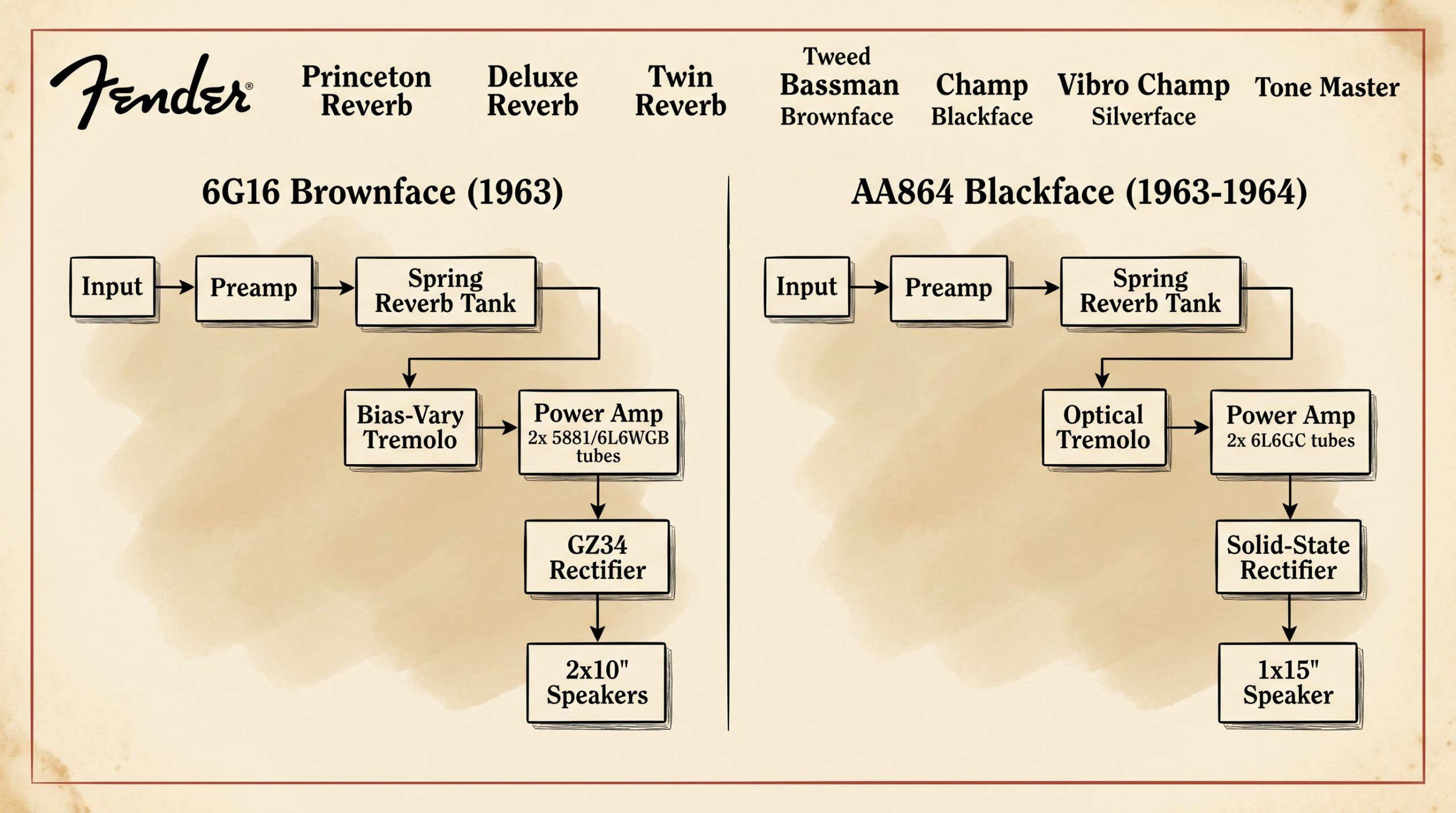
The 6G16 is the rarer of the two. Production estimates based on serial number research suggest around 600 units left the Fullerton factory across approximately 12-14 months in 1963. Oxblood brown tolex, wheat grille cloth, and chicken-head knobs identify it visually at a glance.
The power section runs two 5881/6L6WGB power tubes (later production switched to 6L6GC) with a GZ34 tube rectifier. That GZ34 is not a minor detail. Tube rectification introduces natural compression and sag under load, the same quality that makes a cranked Princeton Reverb feel so responsive. At ~35 watts, the 6G16 isn’t a quiet amp, but it breaks up earlier and with more compression than its blackface sibling. Headstrong Amplifiers’ Wayne describes this as a “soft 35 watts” that’s never harsh or overly stiff. That’s accurate.
Six 12AX7 preamp tubes handle all preamp stages, phase inverter, and reverb driver. The reverb circuit itself is unique to this model: a coupling circuit architecture that Fender never reproduced in any other production amp. The treble control is tapped at 70k ohms, consistent with other brown and blonde era amps, and this dramatically shifts the mid structure compared to the standard blackface taper. The result is a warmer, more mid-forward voicing. The tremolo uses bias-vary modulation, where the power tube bias is modulated directly to create the effect. Organic. Pulse-like. Deeply interactive with the power section.
Speaker complement: two 10″ Oxford drivers, rated 25 watts each. Not a 15. Not a 12. The 2×10″ configuration gives the brownface Vibroverb faster transient response, tighter low end, and a wider stereo-like image compared to a single large driver. The Music Emporium’s listing documentation for a 1963 6G16 describes it as ticking “so many boxes” for its unique combination of the 35-watt power section, 2×10″ format, distinct reverb circuit, and bias-vary tremolo. That’s a fair summary.
The 1964 Blackface Vibroverb (Circuit: AA763)
The AA763 is the one Stevie Ray Vaughan played. More units were built, estimated at 1,200-1,500 through its 1963-1964 production window, but it’s still extremely rare by any standard. Black tolex, silver grille cloth, and black panel with skirted knobs separate it visually from the brownface immediately.
Power output climbs to ~40 watts through two 6L6GC power tubes. The rectifier changes to solid-state diodes. No sag. Stiffer feel. More headroom. The solid-state rectifier is part of what makes the AA763 a better platform for high-volume clean tones: it doesn’t compress under the attack the way the GZ34 does. You can hit it hard and it stays clean longer.
The tremolo circuit changes too. Where the brownface uses bias-vary modulation, the AA763 uses an optical circuit (LDR/photocell). Smoother, more “watery,” more of a shimmer. Classic Texas blues tremolo territory. The treble control uses the standard blackface taper, which is brighter and more mid-scooped than the 70k brownface equivalent.
Speaker configuration: a single 15″ driver. Most desirable is the JBL D130F, a high-efficiency (rated around 100dB sensitivity at 1W/1m) driver with extended high-frequency response and significant low-end authority. Some production examples shipped with Oxford or Utah 15″ drivers depending on availability. JBL-equipped examples command a substantial premium, typically 30-50% above the market rate for equivalent Utah or Oxford units. The 15″ format gives the AA763 a completely different tonal character from the brownface: louder apparent low end, more open high-frequency extension, and the kind of air-moving presence that makes sense of SRV running his at 8-10 on the volume dial.
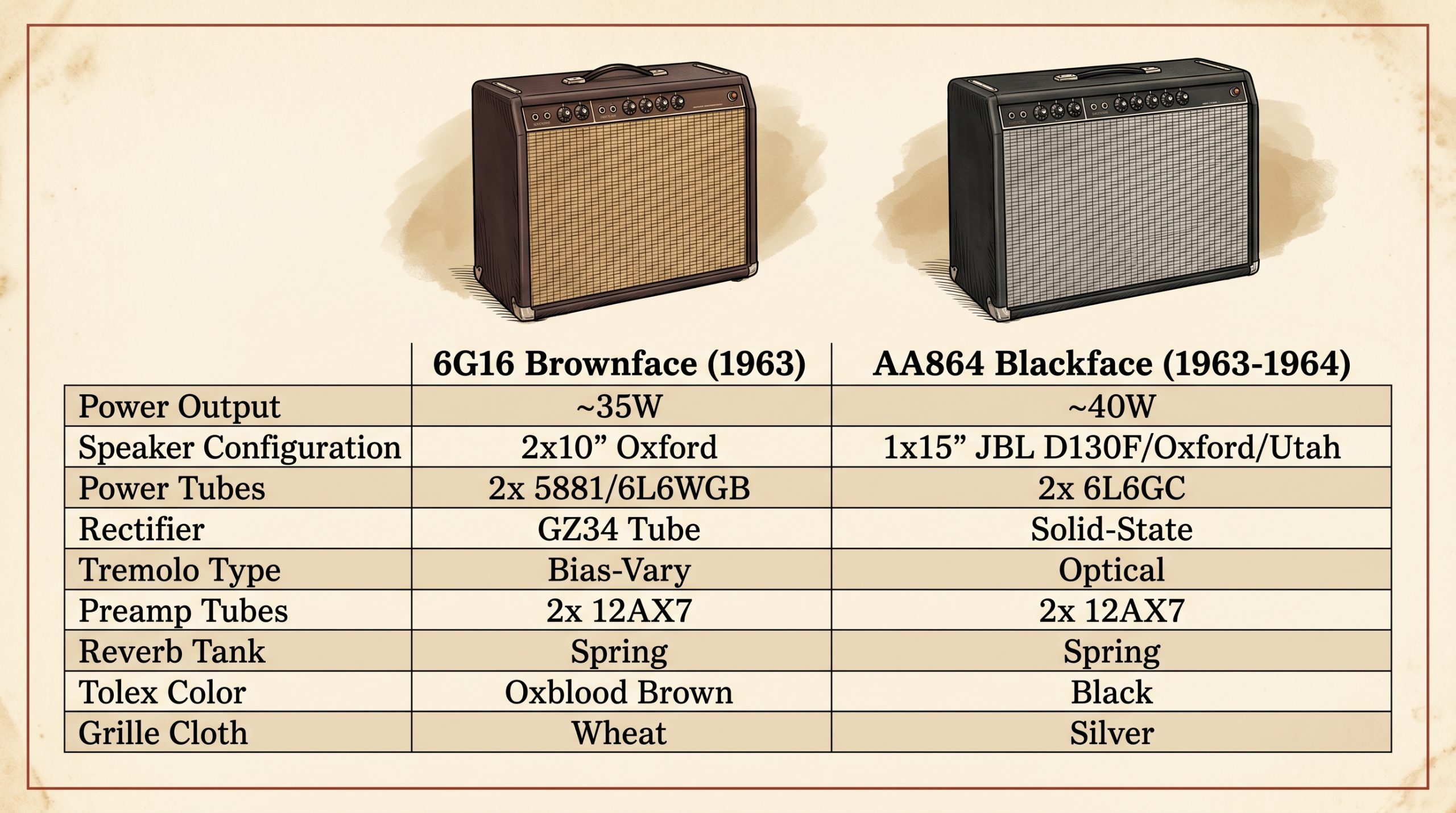
Comparison Table: 1963 Brownface vs. 1964 Blackface Vibroverb
No other source collects both versions’ full specs in one place. Here’s the complete side-by-side.
| Spec | 1963 Brownface (6G16) | 1964 Blackface (AA763) |
|---|---|---|
| Era | Brownface | Blackface |
| Circuit # | 6G16 | AA763 |
| Production Years | 1963 | 1963-1964 |
| Est. Units Made | ~600 | ~1,200-1,500 |
| Power Output | ~35W | ~40W |
| Power Tubes | 5881 / 6L6WGB (later 6L6GC) | 6L6GC |
| Rectifier | GZ34 (tube) | Solid-state diode |
| Preamp Tubes | 6x 12AX7 | 3× 7025 + 3× 12AT7 |
| Speaker Config | 2×10″ Oxford | 1×15″ JBL D130F / Oxford / Utah |
| Tremolo Type | Bias-vary | Optical (LDR/photocell) |
| Treble Taper | 70k ohm (mid-forward) | Standard blackface (brighter) |
| Tolex | Oxblood/brown | Black |
| Grille | Wheat | Silver |
| Vintage Value (2024) | $6,000-$12,000+ | $4,500-$9,000+ |
Condition matters enormously on both. JBL-equipped AA763 examples sit at the top of that range. All-original brownface examples with intact tolex and grille cloth push toward $12,000 on the current market. Parts amps with replaced speakers or modified circuits land well below these figures.
Why the Vibroverb Disappeared
An amp this good, this historically significant, shouldn’t have been discontinued after 18 months. The reasons are practical and commercial, not sonic.
By 1964-1965, Fender was rationalizing its lineup. The Super Reverb, a 4×10″ combo with reverb built on the blackface platform, covered similar power and reverb territory at lower production cost. The Super Reverb was easier to manufacture, used existing speaker tooling in larger quantities, and fit more naturally into Fender’s established size categories.
The Vibroverb’s 1×15″ speaker format created internal friction. Retailers reportedly found the 15″ configuration harder to sell for guitar applications, with bass associations pulling buyers toward the bigger Bassman and Dual Showman for bass and the 2×12″ or 4×10″ combos for guitar. The Pro Reverb and Bassman occupied adjacent territory. The Vibroverb had no clean lane in the catalog.
So Fender dropped it. Quietly. No announcement.
The revival came through an unlikely route. Stevie Ray Vaughan’s visibility in the early 1980s with his 1964 blackface AA763 created retroactive demand that the vintage amp market hadn’t priced in. By the late 1980s, AA763 values were climbing sharply. The 6G16 followed. Demand eventually justified reissue programs, and Fender re-entered the market with the ’63 Vibroverb Reissue in 1990.
Identifying an Original Vibroverb: Dating and Authentication
Buying a vintage Vibroverb without verifying authenticity is a significant financial risk. The tools for verification are accessible if you know where to look. No competitor covers this section in useful depth, so here’s the full picture.
Tube Chart Date Codes
The tube chart is rubber-stamped or ink-stamped on a paper label inside the back cabinet panel. Fender’s date code uses a two-letter system: the first letter represents the year, the second represents the month.
Year letters relevant to the Vibroverb: N = 1963, O = 1964. Month letters run A through L for January through December. So a tube chart reading “NA” dates to January 1963, placing it in early brownface production. A code reading “OD” dates to April 1964, consistent with late blackface production.
Cross-reference the tube chart code against the expected circuit. A 6G16 should show N-codes. An AA763 can show N or O codes depending on production timing. If the tube chart date and the stated circuit don’t align, ask questions before buying.
For a complete reference on reading Fender date codes across all models and eras, the Fender tube amp serial number and dating guide covers every letter-code combination with production year mapping.
Speaker EIA Codes
The EIA (Electronics Industries Association) code is stamped on the speaker frame. The format is: manufacturer code, year, week number.
- Oxford: EIA manufacturer code 465 (e.g., 465-318 = Oxford, 1963, week 18)
- JBL: EIA manufacturer code 73
- Utah: EIA manufacturer code 328
A speaker date code within 3-6 months of the tube chart date is a strong provenance indicator. Red flag: a JBL D130F in a 6G16 brownface chassis. Wrong. Brownface Vibroverbs came with Oxford 10″ drivers, not JBL 15″ units. That combination signals a parts amp or modified unit, not an original.
Transformer EIA Codes
The output transformer sits on the right side of the chassis viewed from the rear. Common suppliers for this period include Schumacher (EIA code 606) and Triad (EIA code 022). Transformer date codes within six months of the tube chart code suggest an unmodified chassis. Mismatched transformer dates, especially from a different decade, are a common sign of a parts amp assembled from multiple donor units.
Note that the 6G16 and AA763 use different output transformer impedances. A swapped transformer from the wrong model isn’t just a dating problem. It’s a functional problem that will affect tone and speaker load matching.
Visual ID Checklist
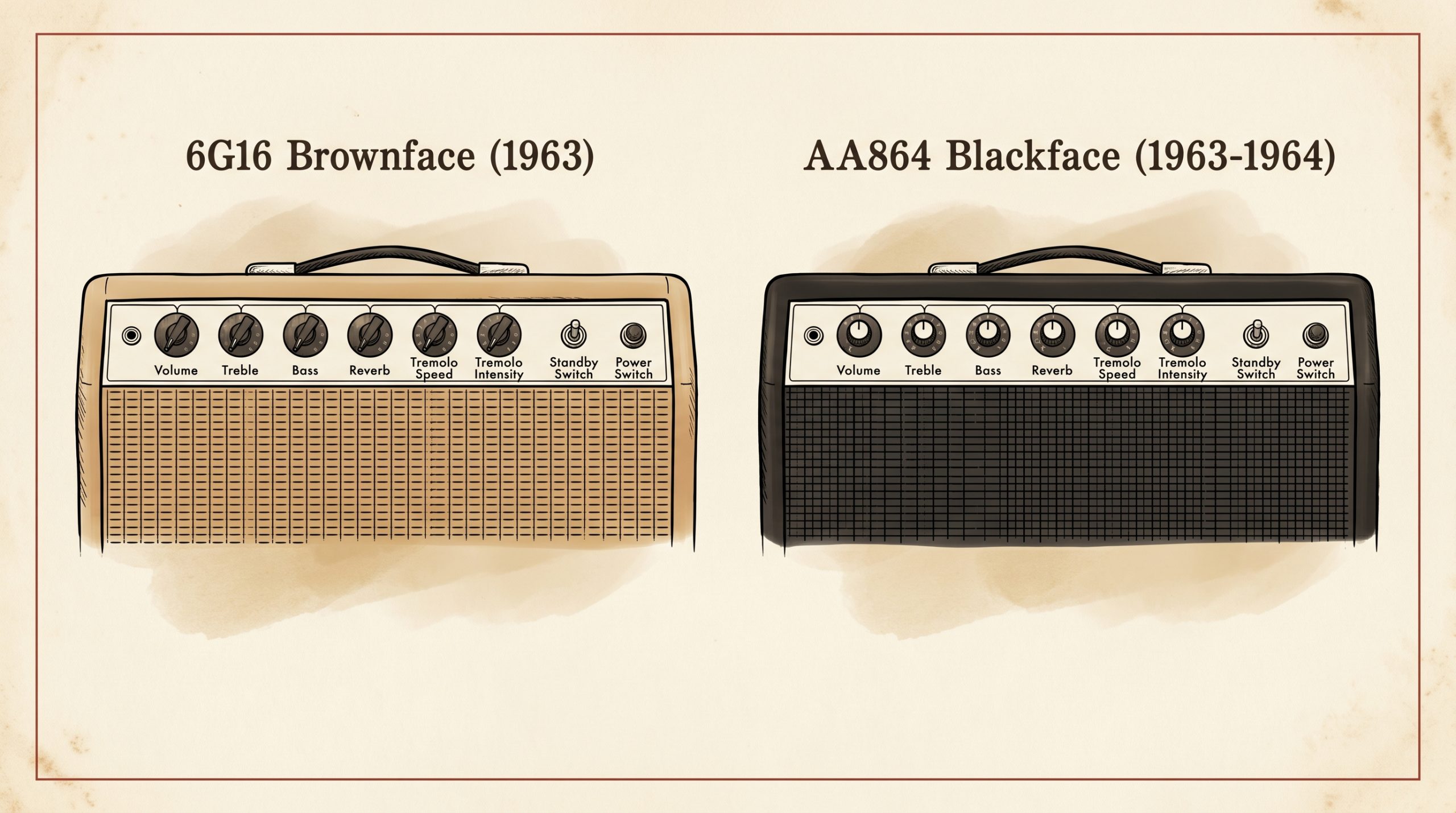
- Control panel color: brown (6G16) vs. black (AA763)
- Knob type: chicken-head (6G16) vs. black skirted (AA763)
- Speaker grille: wheat cloth (6G16) vs. silver cloth (AA763)
- Tolex: oxblood/brown (6G16) vs. black (AA763)
- Faceplate logo: block “Fender” lettering (6G16) vs. transitional script (AA763)
- Speaker complement: two 10″ drivers (6G16) vs. single 15″ (AA763)
The Reissues: Fender’s Attempt to Bring It Back
Two reissues exist, covering both original versions. They’re not identical to the originals, and the differences matter more than the marketing materials suggest.
The Fender ’63 Vibroverb Reissue (1990-present, various runs)
Fender launched the ’63 Vibroverb Reissue in 1990 as part of its Vintage Reissue series, responding directly to collector demand accelerated by the SRV era. The amp is based on the 6G16 brownface circuit, retains the GZ34 tube rectifier, and uses the bias-vary tremolo topology of the original. Early production runs used hand-wired point-to-point construction. Later production switched to PCB layout. The hand-wired early units command a premium on the used market, and for good reason: they’re closer to the original assembly method.
Power output is ~40 watts in the reissue, a slight deviation from the original’s soft ~35W. The tube complement matches the original broadly: two 6L6GC power tubes and six 12AX7 preamp tubes, with the GZ34 rectifier retained.
Here’s the critical caveat that competitors consistently underemphasize: the ’63 Vibroverb Reissue uses a single 15″ speaker, not the original 2×10″ configuration. The original Fender owner’s manual for the ’63 Vibroverb Reissue notes that the speakers used are reproductions of the originals made by the Oxford Speaker Company, but production runs have shipped with Eminence and Jensen reissue 15″ drivers depending on the year. The 1×15″ vs. 2×10″ distinction isn’t cosmetic. It fundamentally changes transient response, the tonal spread, and the bass character of the amp. Buyers expecting the original’s 2×10″ feel from the reissue will find a different-sounding instrument. Wonderful clean tones and lush reverb and tremolo, yes. But not a 2×10″ Vibroverb.
Current street pricing: $1,800-$2,500 used, $2,199-$2,499 new when available.
The Fender ’64 Vibroverb Custom (Limited Production)
The Fender ’64 Vibroverb Custom is based on the AA763 blackface circuit and has appeared in limited production runs rather than as a standard catalog item. Construction is hand-wired, with a closer premium component spec than the standard reissue line. Power output is ~40W through two 6L6GC power tubes, 3× 7025 + 3× 12AT7 preamp tubes, and solid-state rectification, faithful to the original. Some production runs include a Jensen C15N reissue driver; premium versions have been spec’d with JBL-style drivers.
The key differences from the ’63 reissue are circuit-level. Blackface voicing means brighter, more headroom, more scoop in the mids. Optical tremolo instead of bias-vary. Solid-state rectifier instead of GZ34. Stiff feel. It’s the amp for players chasing the SRV blackface tone, not brownface compression.
The ’64 Custom is harder to find on the used market. Expect $2,000-$3,200 depending on condition and speaker spec, with JBL-equipped examples at the top of that range.
Reissue vs. Original: Should You Buy One?
For players who want the Vibroverb tone on a working stage rig, the reissue is the rational choice. Serviceable, giggable, significantly less expensive than an original, and tonally in the right neighborhood. The compromises, mainly the speaker configuration change in the ’63 and the PCB construction in later runs, are real but workable.
For collectors, the originals are the only meaningful option. The brownface 6G16 and blackface AA763 are not replicated in full by any reissue. Not great substitutes for investment-grade purchases. But the reissues democratize a tone that was otherwise locked behind a $6,000-$12,000 price tag. That’s not nothing.
Comparison Table: All Four Vibroverb Versions
| Spec | ’63 Original (6G16) | ’63 Reissue | ’64 Original (AA763) | ’64 Custom |
|---|---|---|---|---|
| Circuit Base | 6G16 | 6G16-based | AA763 | AA763-based |
| Construction | Hand-wired | PCB (later runs) | Hand-wired | Hand-wired |
| Power Tubes | 5881/6L6WGB | 6L6GC | 6L6GC | 6L6GC |
| Rectifier | GZ34 | GZ34 | Solid-state | Solid-state |
| Speaker | 2×10″ Oxford | 1×15″ Eminence/Jensen | 1×15″ JBL/Oxford | 1×15″ Jensen/JBL-style |
| Tremolo | Bias-vary | Bias-vary | Optical (LDR) | Optical (LDR) |
| Voicing | Warm, mid-forward | Warm, mid-forward | Bright, open | Bright, open |
| Est. Price (2024) | $6,000-$12,000+ | $1,800-$2,500 | $4,500-$9,000+ | $2,000-$3,200 |
The Vibroverb Sound: What Makes It Different
The Vibroverb’s reputation isn’t just about rarity or famous users. The circuits themselves do things that other Fender amps of the same era don’t.
The Brownface Voice
The GZ34 tube rectifier contributes spongy compression that’s load-dependent. Hit the amp with a hard strum and the power supply sags slightly, adding natural compression and bloom to the attack. The bias-vary tremolo modulates the power tube operating point directly, creating a pulse-like throb that interacts dynamically with whatever you’re playing. The 2×10″ speaker configuration produces faster transient response than a single 15″, with tighter, better-defined bass and a spatially wider sound field.
The 70k treble taper adds real mid-presence to the control. Standard brownface and blonde amps share this characteristic. The result: a fundamentally different EQ structure than you’d get from a blackface Deluxe Reverb or Princeton Reverb on the same setting. Warmer cleans, earlier natural breakup, more mid-forward character at all volume levels. Barks when pushed past 6. Natural compression rather than headroom.
The Blackface Voice
The solid-state rectifier in the AA763 changes the feel completely. Stiff attack, linear response, extended headroom. You can push this amp loud before it starts to color the signal. The optical tremolo smooths the modulation character into something more watery and shimmering, the classic Texas blues swirl. The 15″ JBL D130F’s high efficiency and extended low-frequency response means the amp fills a room in a way the 2×10″ brownface simply doesn’t.
Spanky attack. Glassy highs from the JBL’s extended top end. A clean platform that takes pedals extremely well. One forum contributor on the Telecaster Guitar Forum noted the Vibroverb runs “much louder, tighter, and fuller-sounding” than a Deluxe Reverb, and “in a completely different league” compared to a Princeton. That’s the 15″ and the higher wattage doing their work.
Vibroverb vs. Super Reverb: Why Stevie Chose the 15″
The Super Reverb’s 4×10″ configuration and similar power rating make it an obvious comparison point. Both amps are blackface, reverb-equipped, and in the same power tier. The sonic differences are real. The 15″ driver in the Vibroverb moves more low-end air with a different emphasis than four 10″ drivers. SRV’s aggressive picking attack, typically described as among the hardest strum forces in blues guitar history, paired well with the 15″‘s extended low-mid response. The lower midrange emphasis from the 15″ complements the single-coil output of his Stratocasters without the 4×10″ spread of the Super Reverb. The Fender Super Reverb buyer’s guide covers the 4×10″ circuit in full for comparison.
The Vibroverb and Stevie Ray Vaughan
SRV primarily used a 1964 Fender Vibroverb, circuit AA763, with the original 15″ JBL D130F speaker. He acquired it in the early 1980s and used it as a primary amp throughout his peak touring years, often running it alongside a Dumble Overdrive Special and vintage Bassman heads. The amp was not heavily modified. Stock circuit, careful tube selection. Volume typically set at 8-10 to achieve natural power amp saturation from the 6L6GC pair.
The Vibroverb’s 15″ JBL D130F speaker produces the low-end foundation that SRV’s tone is built on. High-efficiency driver, extended bass response, clear high-frequency articulation. Running that combination at near-full output with Stevie’s aggressive right-hand attack produced the natural power amp compression and bloom that defines his lead sound on recordings from 1982 onward.
The provenance of surviving examples claimed to be “SRV’s Vibroverb” is contested. The amp was reportedly damaged or stolen at some point, and the chain of custody for various candidates has been debated by collectors and biographers. What’s documentable is SRV’s influence on collector values: the AA763’s market price trajectory maps almost directly to his rising profile through the 1980s and the demand spike following his death in 1990.
Buying a Fender Vibroverb Today
If you’re searching “fender vibroverb for sale” right now, here’s what you actually need to know before spending serious money.
Original Vintage Pricing (2024 Market)
The 1963 brownface 6G16 runs $6,000-$12,000 or more depending on originality, cosmetic condition, and speaker status. The 1964 blackface AA763 runs $4,500-$9,000, with JBL-equipped examples consistently at the upper end of that range. Original, uncracked tolex with intact grille cloth adds value. Re-tolexed examples drop. Recapped chassis without documentation or with wrong-era caps are a gamble on how much the tone has drifted from original spec.
Premium multipliers: original JBL D130F in correct-date AA763 adds 30-50% to baseline. Matching date codes across tube chart, speaker, and transformers. Complete original cosmetics with no replaced hardware. All-original brownface examples with intact oxblood tolex and wheat grille cloth are genuinely rare at this point.
Where to Buy
Reverb.com carries the most liquid vintage amp inventory. Search terms “fender vibroverb,” “fender vibroverb 1964,” and “fender vibroverb 1963” will surface current listings. For vetted high-value originals, Chicago Music Exchange, Retrofret, and Vintage and Rare all handle Vibroverbs regularly with verified provenance documentation. The Vintage Guitar Magazine price guide provides a useful independent baseline before entering any negotiation.
Always request a tube chart photo, EIA code photos from both speakers and the output transformer, and any service records before purchase. A seller who can’t produce these on a $7,000 amp is a seller to approach cautiously.
Red Flags When Buying
- Mismatched speaker EIA codes (wrong manufacturer for the circuit, or codes from a different decade)
- Replaced output transformer without documentation or with obvious wrong-era date codes
- Missing original tube chart or illegible date code
- Refinished tolex hiding structural cabinet damage
- “All original” claim with obviously replaced control knobs, jack hardware, or handle
- JBL D130F in a brownface chassis (wrong speaker, wrong circuit, parts amp indicator)
- Chassis and cabinet from different production periods (check serial number alignment)
The Vibroverb’s Place in Fender History
Two distinct amplifiers. One name. An 18-month production window that produced fewer than 2,100 units total across both versions. The Vibroverb occupies a specific position: first to combine reverb and tremolo on a Fender chassis, brief enough in production to become genuinely rare, and famous enough through association to command collector prices that few amps from this era can match. The brownface 6G16 offers compressed, mid-forward warmth with bias-vary tremolo that no other Fender production amp exactly replicates. The blackface AA763 offers the high-headroom, JBL-driven, optically shimmering tone that defined an era of Texas blues. The reissues bring both circuits into reach for working players who can’t justify spending $7,000 on a stage amp. For anyone tracking a vintage example down for purchase, verifying tube chart date codes, EIA speaker stamps, and transformer codes against the Fender amp dating reference before committing money is the difference between acquiring a legitimate original and overpaying for a parts amp with a convincing story.
Frequently asked questions
What Vibroverb did Stevie Ray Vaughan use?
Stevie Ray Vaughan used a 1964 Fender Vibroverb, circuit designation AA763, equipped with a 15" JBL D130F speaker. He ran it at high volume settings, typically 8-10 on the volume dial, to achieve natural power amp saturation from the 6L6GC pair. The amp formed the foundation of his live rig alongside a Dumble Overdrive Special and vintage Fender Bassman heads throughout the early-to-mid 1980s.
What is the difference between the 1963 and 1964 Fender Vibroverb?
The 1963 Vibroverb (circuit 6G16) is a brownface amp producing approximately 35 watts through a GZ34 tube rectifier, with two 10" Oxford speakers and bias-vary tremolo. It has a warm, compressed, mid-forward character. The 1964 Vibroverb (circuit AA763) is a blackface amp producing approximately 40 watts through a solid-state rectifier, with a single 15" speaker (usually JBL D130F) and optical tremolo. It's brighter, has more headroom, and is the version associated with Stevie Ray Vaughan's Texas blues tone.
How many Fender Vibroverbs were made?
Fender has not published official production figures, but estimates based on serial number research suggest approximately 600 brownface 6G16 units were built during 1963, and approximately 1,200-1,500 blackface AA763 units were produced through 1963-1964. Both versions rank among the rarest vintage Fender combos by production volume, which is the primary driver of their collector value.
Is the Fender '63 Vibroverb Reissue worth buying?
For players, yes. The Fender '63 Vibroverb Reissue delivers the core circuit topology of the original: GZ34 tube rectifier, bias-vary tremolo, brownface voicing, and warm clean tones with natural compression when pushed. The main compromise is the speaker configuration. The reissue ships with a single 15" driver, not the original's 2x10" Oxford arrangement. That change meaningfully affects transient response and tonal spread. It's a different-sounding amp from the original in that respect, but it's a genuinely capable instrument at a fraction of the original's cost.
What is the circuit number for the Fender Vibroverb?
The 1963 brownface Vibroverb uses circuit designation 6G16. The 1964 blackface Vibroverb uses circuit designation AA763. Both circuit numbers appear on the tube chart inside the amp cabinet. They're essential for authentication, schematic lookups on resources like Schematic Heaven, and for matching replacement components to original spec.