Contents
- 01What Is the Fender Blues Junior? Circuit, History, and Era Classification
- 02Full Specifications: Fender Blues Junior IV
- 03Generation-by-Generation Breakdown: Blues Junior I Through IV
- 04Blues Junior Finish and Limited Edition Variants
- 05Tube Complement: What's Inside the Blues Junior
- 06The Blues Junior Schematic: PR 295 Circuit Architecture
- 07Fender Blues Junior Review: How Does It Actually Sound?
- 08Buying Guide: New vs. Used Fender Blues Junior
- 09Fender Blues Junior Serial Number Lookup and Dating Guide
- 10Blues Junior vs. The Competition
- 11Modifications: Getting More From Your Blues Junior
- 12Frequently Asked Questions
- 13Which Blues Junior Should You Choose
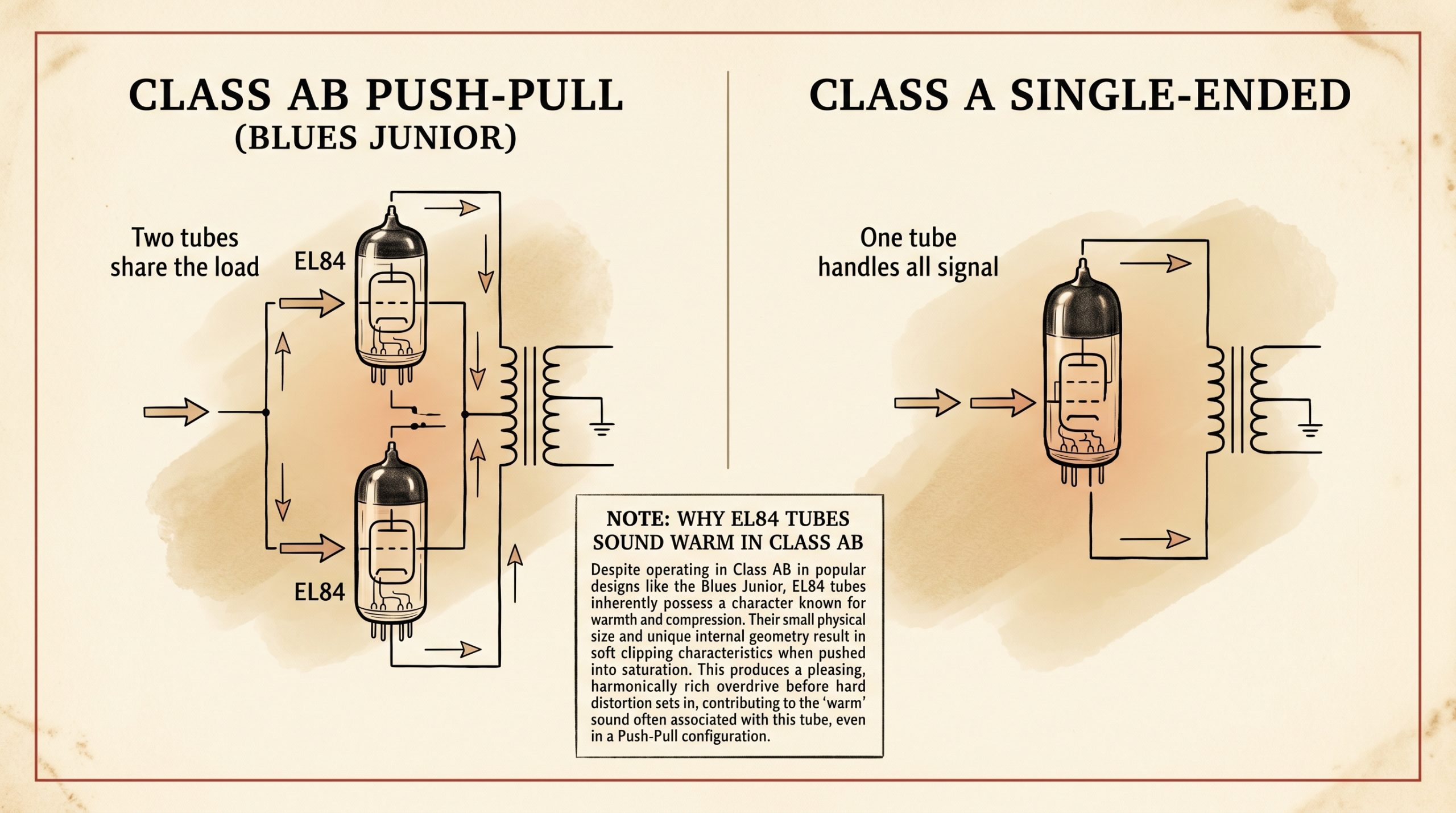
Most players assume the Blues Junior is a Class A amp. Fender’s own marketing has nudged that assumption along for years. It’s not true. The Blues Junior runs a Class AB push-pull output configuration with two EL84s. What creates the confusion is the EL84 tube itself: it’s warm, compressed, and chimey in a way that feels like Class A, especially compared to the 6V6-driven amps most Fender players are used to. Single-ended Class A requires one output tube doing all the work. That’s not what’s happening here. Understanding that distinction actually makes the Blues Junior more interesting, not less. Over a million units. Four generations. Tweed, tolex, lacquered, and limited runs. There’s a reason it’s still in production.
- Circuit: PR 295, Class AB push-pull (NOT Class A)
- Power: 15 watts RMS through a 12″ speaker
- Tubes: 3x 12AX7 preamp, 2x EL84 power
- Weight: 31.5 lbs (14.3 kg) across all current variants
- Made in Ensenada, Mexico (FMIC Mexico facility)
- Four generations: I (1995), II (2001), III (2010), IV (2022)
- Street price: ~$699 (black tolex) to ~$839 (lacquered tweed)
- Used III in good condition: $280–$380 depending on variant
- Class A claims in listings and marketing are inaccurate, this is Class AB
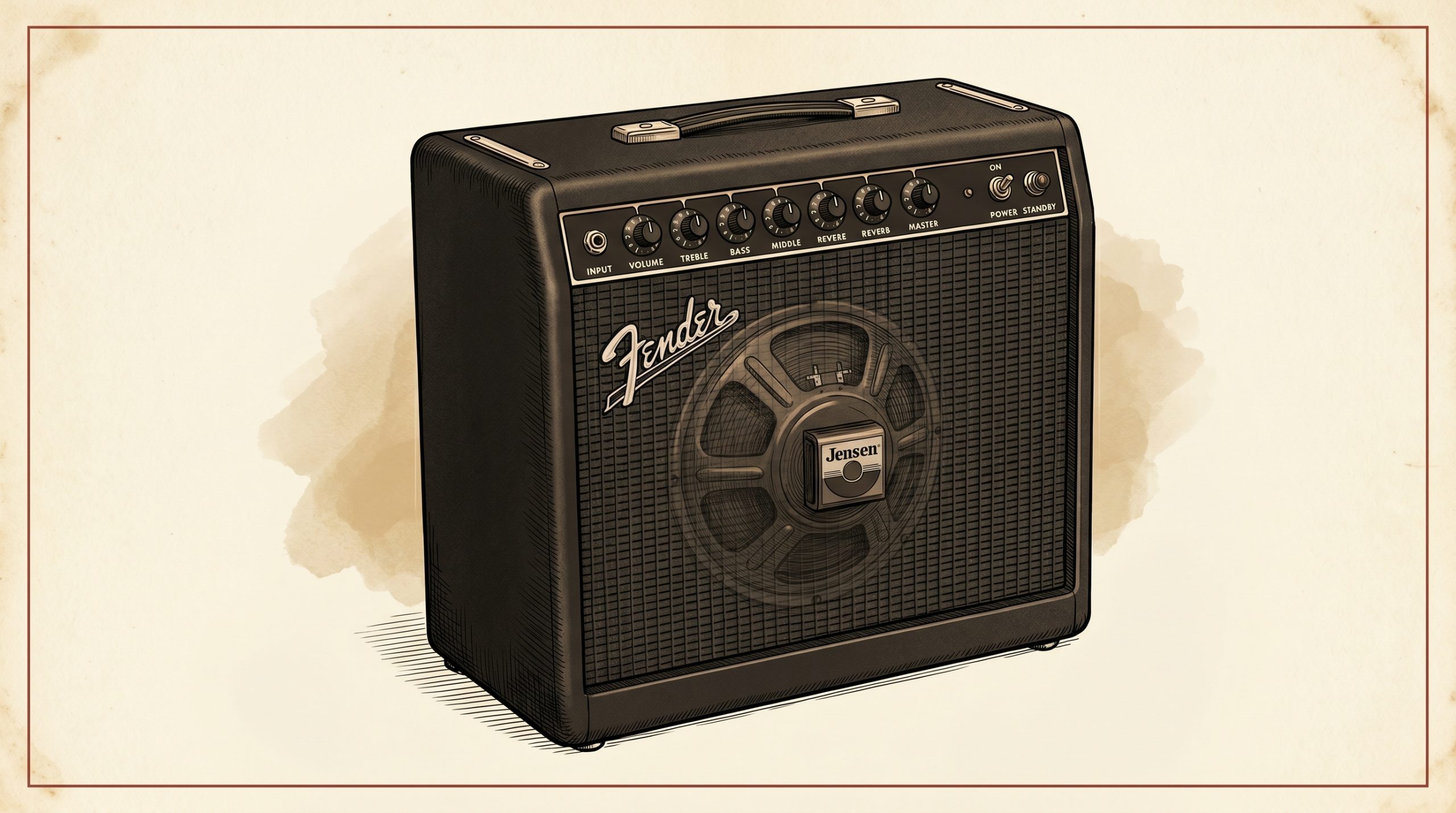
What Is the Fender Blues Junior? Circuit, History, and Era Classification
Circuit Number and Production History
The Blues Junior carries circuit designation PR 295 across all generations, though internal revisions between generations are significant enough to affect tone, reliability, and serviceability. Fender launched the amp at the 1995 NAMM show, produced in the Ensenada, Mexico facility that has been the source of most modern Fender production since the early 1990s. This is not a reissue and it’s not vintage-derived in the literal circuit sense. The output section uses EL84 tubes, which appear in almost no other Fender production amp, putting the Blues Junior in its own category within the Fender lineup.
Generation tracking matters here because the used market is full of all four variants:
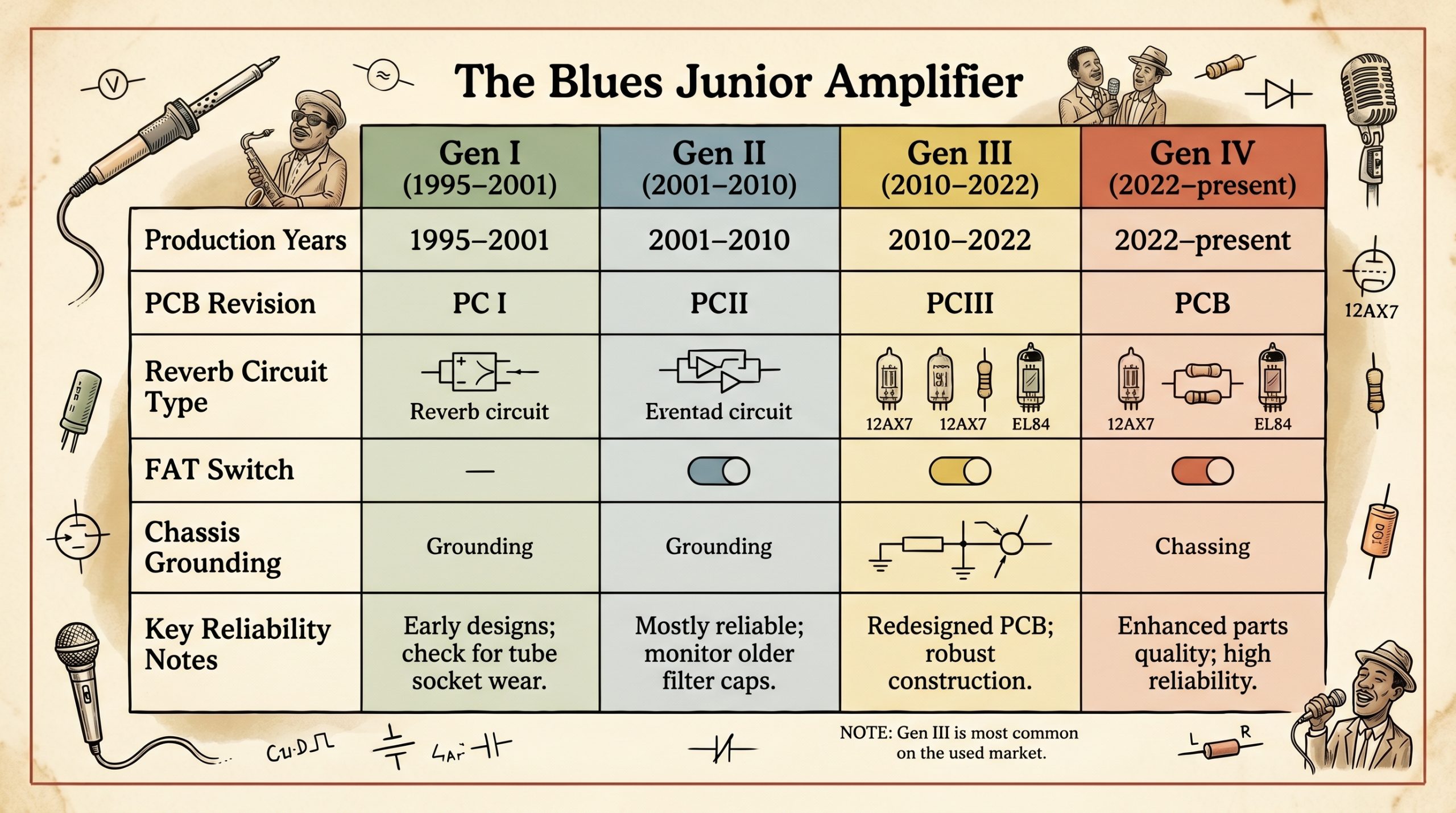
- Blues Junior I (1995–2001): Original PR 295, initial PCB layout, reputation for running hot
- Blues Junior II (2001–2010): Revised PCB, improved component placement, better reliability
- Blues Junior III (2010–2022): Most common on the used market, revised reverb circuit, tighter low end
- Blues Junior IV (2022–present): Modified preamp circuitry, redesigned reverb tank, updated FAT switch voicing, revised chassis grounding
Why the Blues Junior Matters in the Market
Estimates of total production exceed one million units globally, placing the Blues Junior among the top three best-selling tube combo amps ever built. That’s not a marketing figure; it’s the practical reality you’ll encounter shopping used Fender gear anywhere in the world. The target player is the working gigging musician who needs a tube amp under 35 lbs, with enough clean headroom for a small venue and enough gain on tap to ditch a dedicated overdrive pedal if needed. It’s also become the default pedal-platform recommendation in the sub-$800 range. Worth knowing before you assume it’s just a student amp.
Full Specifications: Fender Blues Junior IV
| Specification | Blues Junior IV |
|---|---|
| Power Output | 15 watts RMS |
| Output Tubes | 2x EL84 |
| Preamp Tubes | 3x 12AX7 |
| Speaker (Standard) | Celestion A-Type, 12″, 50W, 8 ohms |
| Speaker (Tweed) | Jensen C-12N, 12″, 50W, ceramic |
| Reverb | Spring reverb (redesigned tank in IV) |
| Channels | 1 (with FAT switch, footswitchable) |
| EQ | Bass, Mid, Treble (3-band) |
| Controls | Volume (Gain), Bass, Mid, Treble, Master, Reverb |
| External Speaker Out | 1x 8-ohm jack |
| Dimensions | 18″ W x 16″ H x 9.5″ D |
| Weight | 31.5 lbs (14.3 kg) |
| Cabinet | Birch plywood |
| Output Impedance | 8 ohms |
| Circuit Number | PR 295 |
| Made In | Ensenada, Mexico |
| MSRP (2026) | $699–$839 depending on finish |
At 31.5 lbs, the Blues Junior lands in a practical range for working musicians. The Vox AC15 comes in lighter at 26 lbs, and the Fender Deluxe Reverb reissue runs 42 lbs. If your back is a factor, this is the Fender to consider.
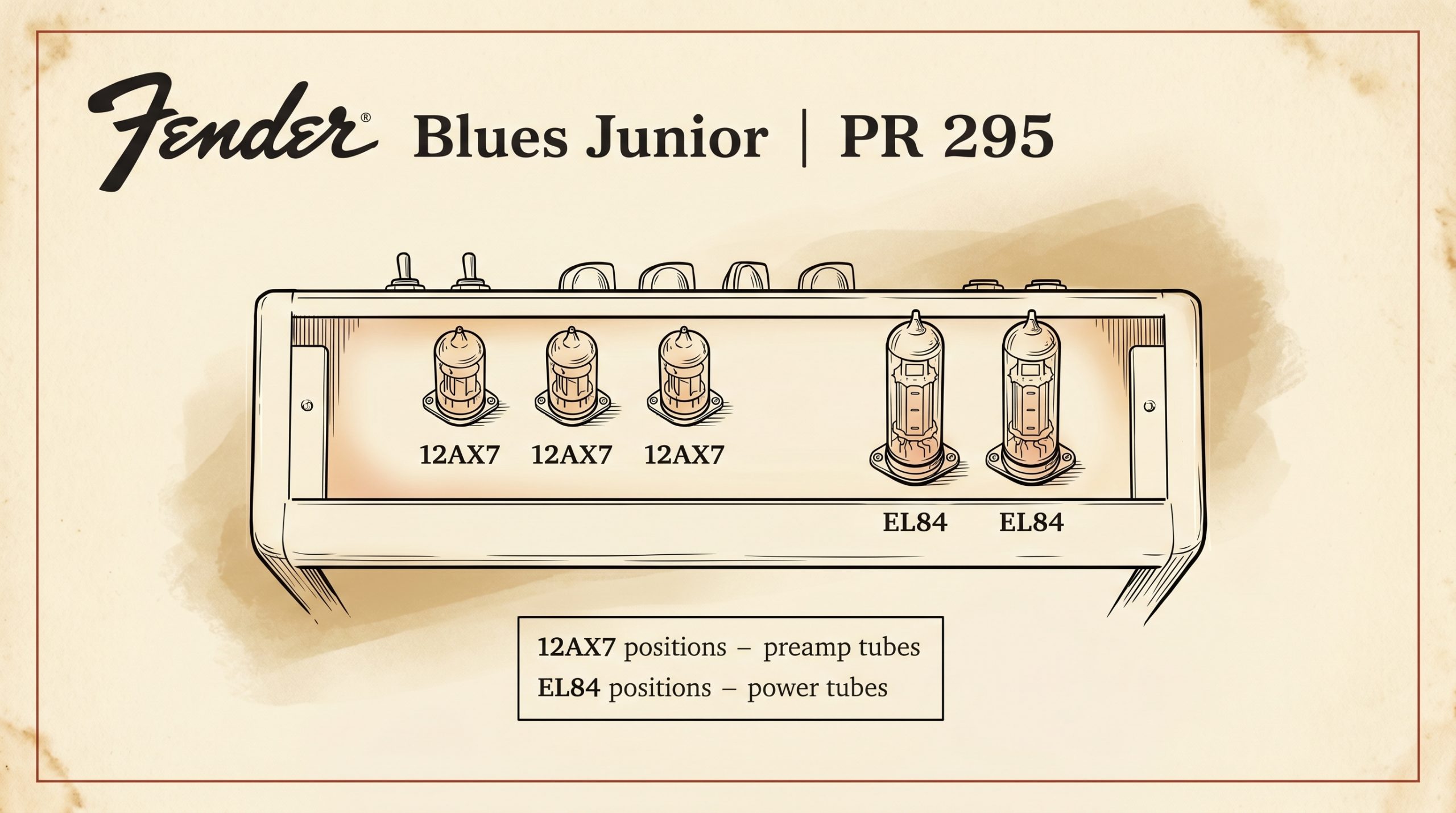
Generation-by-Generation Breakdown: Blues Junior I Through IV
Blues Junior I (1995–2001): The Original PR 295
The first-generation Blues Junior introduced the core circuit that all subsequent versions are built on: three 12AX7 gain stages feeding into a 3-band EQ, master volume, and a pair of EL84s in Class AB push-pull configuration. PCB-based construction from the start, with a fixed-bias output stage rather than the cathode-bias arrangement common in vintage Fender small combos. Early units developed a reputation for running hot due to the factory bias spec, which contributed to PCB trace cracking near heat-generating resistors and output transformer area components. The original speaker was a budget Fender-branded OEM 12-inch ceramic. Gen I units in working condition are the least expensive on the used market, but they’re also the most likely to need PCB inspection before you trust them at a gig.
Blues Junior II (2001–2010)
Fender addressed the Gen I reliability issues with a revised PCB layout and improved component placement in the second generation. The speaker remained a Fender-branded ceramic 12-inch, but the overall build quality improved noticeably. Gen II units are popular with modders specifically because the relatively clean PCB layout gives a competent tech enough room to work. If you’re buying a Blues Junior specifically to modify it, a clean Gen II is a good starting point. Not great for stock purists, but practical for builders.
Blues Junior III (2010–2022): The Most Common Used Market Version
The third generation is what you’ll find most often shopping used today. Fender revised the reverb circuit and tightened the low-end response, producing a cleaner, more articulate clean tone than the earlier versions. Tweed variants of the III came stock with a Jensen C-12N speaker, while some production runs included Celestion speakers depending on the market. The weight settled at approximately 31 lbs in the third generation. A used Blues Junior III in good condition runs $280–$380 for the standard black tolex version; tweed variants command $320–$420. Inspect the reverb tank carefully when buying used. Internal springs break from drops, and a damaged tank produces either no reverb or an unpleasant metallic rattle. An easy fix, but worth knowing before you pay asking price.
Blues Junior IV (2022–Present): Current Production
The current Blues Junior IV (released 2022) is a meaningful step forward from the III, not just a cosmetic refresh. Key circuit changes include modified preamp circuitry for smoother gain staging, a redesigned spring reverb tank with warmer and longer decay, updated FAT switch voicing, and revised chassis grounding that addresses a ground-loop hum issue some Gen III users encountered. The standard version ships with a Celestion A-Type speaker; the tweed variant retains the Jensen C-12N. Guitar World’s 30th Anniversary review noted a particularly impressive full-bodied midrange response attributed to these preamp circuit tweaks. At $699 new, the IV represents genuine value for a tube amp in this configuration.
Blues Junior Finish and Limited Edition Variants
Standard Black Tolex
The base model arrives in black tolex with silver grille cloth, the Celestion A-Type 12-inch speaker, and a black control panel. Street price sits at approximately $699. This is the gigging workhorse version; the tolex is durable if not especially refined, and the Celestion A-Type speaker delivers more headroom and slightly brighter response than the Jensen in the tweed version.
Fender Blues Junior Tweed and Lacquered Tweed
The lacquered tweed version uses genuine tweed fabric finished with nitrocellulose lacquer, not vinyl. This is the actual material and process, not a cosmetic approximation. Hardware differences are significant: chrome control panel, vintage-style pointer knobs, brown and gold grille cloth. The speaker is the Jensen C-12N (12-inch, 50W, ceramic), which delivers a more vintage-voiced, slightly compressed character compared to the Celestion A-Type in the standard version. Street price for the lacquered tweed runs approximately $839. The tonal difference between the two versions is real but subtle at bedroom volumes; it becomes more apparent when you push the amp into the gain range, where the Jensen responds with a slightly earlier and warmer breakup.
Limited Edition and Special Run Models
Fender has produced a range of FSR (Fender Special Run) and limited edition Blues Junior variants over the years, including Wine Red, Cream, two-tone finishes, and anniversary editions. The 30th Anniversary Blues Junior IV, for example, ships with a Celestion G12M-65 Creamback speaker, which pushes the tone toward a warmer, more compressed British character than either the Celestion A-Type or Jensen stock options. Some LTD models represent cosmetic changes only; others include meaningful speaker or component upgrades. Check the specific model spec sheet before paying a premium. Guitar Center and independent dealers both run exclusive FSR versions periodically.
Tube Complement: What’s Inside the Blues Junior
Preamp Tubes: 3x 12AX7
All three preamp slots use 12AX7 dual triodes, the standard high-gain preamp tube with an amplification factor of 100. Stock tubes vary by production year: early units shipped with Groove Tubes-branded 12AX7s; current production typically includes Chinese-made tubes. The V1 position (first gain stage) is the most sensitive to tube quality and microphonics. If you’re going to upgrade one tube, start there. A Mullard reissue, JJ ECC83, or Tung-Sol 12AX7 in V1 will have the most audible impact. V2 handles the second gain stage; V3 serves as the phase inverter for the Class AB push-pull output stage. The reverb circuit in the PR 295 is transistor-driven. A full preamp retube runs $40–$60 in parts.
Power Tubes: 2x EL84
The EL84 is the sonic DNA that makes the Blues Junior sound unlike other Fender amps. Where most Fender designs use 6V6 tubes (warmer, rounder, more American-voiced), the EL84 brings a chimier, more compressed, mid-forward character. You can read a full breakdown of the tube’s characteristics in the EL84 tubes guide, but the short version is this: expect more upper-midrange bite and a spongy compression that the 6V6 doesn’t produce. Gen I through Gen III Blues Juniors use a fixed-bias output stage that requires bias adjustment when you replace power tubes. Plate voltage runs approximately 250V in stock configuration. Recommended power tube options include JJ EL84, Sovtek EL84, and Electro-Harmonix EL84. Budget approximately $25–$40 for a matched pair.
Should You Re-Tube a Blues Junior?
Preamp tubes last 5–10 years under typical use. Power tubes, gigging regularly, need replacement every 1–3 years. A DIY retube (full set, all five tubes) costs $40–$80 in parts. For Gen I–III units with fixed bias, add a professional bias check after replacing power tubes; a tech’s time typically runs $60–$100 depending on your area. Don’t skip the bias check on fixed-bias variants after replacing power tubes. Running an unbiased pair too hot shortens tube life and can cause output transformer damage over time. Not worth the risk.
The Blues Junior Schematic: PR 295 Circuit Architecture
PR 295 Circuit Overview
The PR 295 is a single-channel design with cascaded gain stages: two 12AX7 stages handle amplification before the signal hits the 3-band EQ stack and master volume, then feeds into the EL84 output section. Early generations (I–III) used a fixed-bias output stage, which is atypical for vintage small Fender combos (the 5E3 tweed Deluxe and blackface Princeton Reverb both use cathode bias). The spring reverb uses an Accutronics-style 3-spring tank; the IV revised this tank for longer and warmer decay compared to the Gen III unit.
The FAT switch engages a mid-boost filter in the preamp section. It cuts the high-pass filter and introduces approximately 3dB of low-midrange boost. Effective for warming up single-coil pickups or adding sustain to a clean bluesy lead tone. The FAT switch is footswitchable via the included single-button footswitch. The PR 295 shares some preamp topology DNA with the blackface Princeton Reverb, but the EL84 output section is a distinct departure from traditional Fender architecture. Schematic archives for the PR 295 are available at SchematicHeaven for reference.
Known Weak Points in the PR 295 Circuit
PCB trace failure near heat-sensitive resistors in the output section is the most common fault in Gen I and Gen II units. The fix is straightforward for a tech: jumper wires bridging the cracked traces. The stock speaker output jack develops crackle with age due to the PCB-mount design. Ground loop hum affected some Gen III units; Fender addressed this in the IV with revised chassis grounding. None of these issues make the Blues Junior unreliable by modern standards. They’re worth knowing when buying used.
Fender Blues Junior Review: How Does It Actually Sound?
Clean Tones
With a humbucker-equipped guitar, the Blues Junior stays clean up to approximately 5–6 on the Volume (gain) control. Single coils give you a bit more headroom: 7–8 before significant breakup. The character is bright, glassy, and articulate. It leans toward blackface clean more than tweed warmth. The reverb improved noticeably from the III to the IV: warmer, less washy at higher settings, and less prone to that metallic “splash” quality that plagued some earlier Blues Junior reverb tanks under hard playing.
Overdrive and the FAT Switch
Preamp overdrive is mid-forward, slightly compressed, and smoother than a Marshall-style crunch. It barks when pushed, particularly with the FAT switch engaged and a single-coil bridge pickup. That combination is genuinely excellent for Chicago blues or Southern rock rhythm work. Break-up happens around 6–7 on the gain control with low-output single coils; high-output humbuckers can push into overdrive much earlier. The FAT switch is the real personality dial on this amp. Try it both ways before settling on a setting.
As a Pedal Platform
This is where the Blues Junior’s reputation is most deserved. Tube-screamer-style overdrives, germanium fuzzes, analog chorus, spring reverb supplements (yes, some players add external reverb to a Blues Junior’s already-good reverb), tape delay: all of it responds well. The limitation to know is headroom. At 15 watts with the preamp gain opened up, a high-output overdrive pedal can push the amp into preamp saturation quickly. The fix is simple: use the master volume to control stage level and keep the gain lower, giving the pedals more clean headroom to work into.
Volume and Stage Viability
15 watts through a 12-inch speaker is stage-loud in small-to-medium venues without PA support. The Blues Junior is louder in practice than its wattage suggests, partly due to the speaker’s output efficiency and the EL84 output stage behavior under load. Compared to the Vox AC15 at the same wattage, the Blues Junior typically registers louder at the same volume setting. Bedroom use is workable: the master volume at 1–2 keeps levels manageable, but the tone is best from 3–4 upward on the master. At the lowest settings it sounds thin and closed. Plan for that if apartment practice is your primary use case.
Buying Guide: New vs. Used Fender Blues Junior
What to Look for When Buying Used
Run through a quick checklist before buying any used Blues Junior. Tube rattle at idle suggests a failing preamp tube: tap each tube gently with a pencil while the amp is at low volume and listen for microphonic ring. Reverb tank damage is common in amps that have been gigged or transported without a cover: a broken spring produces either silence or an unpleasant metallic clatter when you strike a note. Speaker cone tears are visible with a flashlight through the grille. For PCB inspection, remove the chassis (four screws on the cabinet) and examine the area near the output transformer and heat-generating resistors for cracked traces or cold solder joints. If you’re not comfortable doing this yourself, a $25 tech inspection is cheap insurance.
Used Market Price Guide (2026)
| Generation | Condition | Typical Price Range |
|---|---|---|
| Blues Junior I | Good | $200–$280 |
| Blues Junior II | Good | $220–$300 |
| Blues Junior III | Good | $280–$380 |
| Blues Junior III Tweed | Good | $320–$420 |
| Blues Junior IV | Excellent | $450–$550 |
| Blues Junior IV Tweed | Excellent | $550–$650 |
A used Blues Junior III in verified working condition represents the best value in the lineup for most players. You’re getting the mature version of the PR 295 circuit at roughly half the price of a new IV. The IV’s improvements are real, but they’re incremental. If you can evaluate a used III in person and it checks out, the price difference buys a good speaker upgrade and a fresh set of tubes. Avoid Gen I units unless the price is low enough to absorb a PCB repair if needed.
Fender Blues Junior Serial Number Lookup and Dating Guide
How to Read a Blues Junior Serial Number
Blues Junior serial numbers follow the standard Fender Mexico format established when FMIC moved production to Ensenada in the early 1990s. The serial number appears on a paper label on the back panel or as a chassis stamp. The format uses an “MX” prefix followed by a two-digit year code and sequential production number. For example: MX21012345 decodes as Made in Mexico, 2021, unit number 012345. Fender adopted a two-letter dating code in 1990; the quality assurance label inside the cabinet sometimes carries additional date information. The Fender tube amp serial number dating guide covers the full MX prefix format with year-code tables for cross-referencing production dates across all Mexico-built models.
Dating by Internal Components
Because the Blues Junior is modern production, EIA date code analysis is less critical here than with vintage 1950s-1970s Fenders. Still useful for identifying NOS dealer stock, refurbished units sold as original, or verifying a claimed production year. The output transformer and speaker both carry EIA stamps on their frames. The standard format is manufacturer code (3-5 digits) followed by year and week of manufacture. The Jensen C-12N in tweed variants carries its own EIA frame stamp. PCB revision codes printed directly on the circuit board offer a quick visual confirmation of generation: Gen I, II, III, and IV PCBs differ in layout enough that a photo reference helps identify them at a glance. Fender’s official support documentation at fender.com/support includes serial lookup tools for current production models.
Blues Junior vs. The Competition
| Amp | Watts | Output Tubes | Weight | Street Price | Best For |
|---|---|---|---|---|---|
| Fender Blues Junior IV | 15W | 2x EL84 | 31.5 lbs | ~$699 | Pedal platform, blues, clean |
| Vox AC15C1 | 15W | 2x EL84 | 26 lbs | ~$699 | Chime, jangle, indie |
| Fender Princeton Reverb (RI) | 12W | 2x 6V6 | 27 lbs | ~$1,199 | Studio, vintage clean |
| Fender Deluxe Reverb (RI) | 22W | 2x 6V6 | 42 lbs | ~$1,499 | Gigging, full-band volumes |
| Marshall DSL20CR | 20W | 2x EL34 | 33 lbs | ~$699 | Rock, higher gain |
Blues Junior vs. Princeton Reverb: Which Fender Should You Buy?
These two amps are frequently compared because they’re similar in wattage and cabinet size, but they’re meaningfully different instruments. The Princeton Reverb uses 6V6 output tubes with tube rectification, producing a warmer, rounder, more traditional American Fender voice with stiff bass response and spanky attack on clean settings. You can find the full spec breakdown in the Fender Princeton Reverb guide. The Blues Junior’s EL84s produce a chimier, more compressed response with more gain on tap from the preamp section. The Princeton is more collectible and significantly more expensive both new and used. The Blues Junior has better stock reverb for gigging and more flexibility as a pedal platform. If budget is a constraint, the decision makes itself. If you’re spending Princeton Reverb money, be honest about whether you want vintage Fender character or a practical gigging tool.
Modifications: Getting More From Your Blues Junior
The Blues Junior’s PCB construction means modifications require intermediate soldering skills at minimum. That said, it’s one of the most modded small amps in production history, and the mod community around it is well-documented.
The most impactful single modification is a speaker swap. The stock Celestion A-Type in the standard version is competent but not inspiring to everyone. Popular alternatives include the Eminence Cannabis Rex (warmer, more compressed), the WGS G12C, and the Celestion Alnico Blue for players willing to spend for premium tone. The Jensen C-12N already in the tweed version is a good baseline; if you own a standard version, the Jensen is a worthwhile upgrade.
Billm Audio (billmaudiomod.com) produces the industry-standard Blues Junior modification kit, covering a bias trim pot for precise plate dissipation adjustment on fixed-bias units (Gen I–III), a presence control, and a midrange voicing shift. These are well-documented and widely used modifications that address the amp’s known tonal limitations without compromising the core circuit. Running the bias slightly cooler at 60–65% plate dissipation (vs. the factory 70%) extends power tube life and cleans up the gain character on fixed-bias Gen I–III units.
Reverb tank replacement is another effective upgrade: swapping the stock tank for a longer 4FB3A1B unit improves reverb decay length and reduces the “splashy” quality that some players find objectionable at medium reverb settings.
Which Blues Junior Should You Choose
If you’re buying new, the Blues Junior IV at $699 is the version to get. The reverb improvement alone justifies choosing it over a remaining Gen III in new-old-stock inventory. If you want the tweed aesthetic and the Jensen C-12N, the $839 lacquered tweed is a real sonic upgrade, not just a cosmetic one. On the used market, a verified Blues Junior III in clean condition for $300–$380 is the practical value choice; put the difference toward a speaker upgrade and a fresh set of tubes. Avoid Gen I units unless the price is low enough to absorb a PCB repair if needed.
High-gain players, bedroom-only players on a strict budget, and players who need maximum clean headroom at loud stage volumes should look elsewhere. The Blues Junior is a specific tool that does its job exceptionally well. Know what that job is before you buy, and it won’t disappoint.
Frequently asked questions
Is the Fender Blues Junior a true Class A amp?
No. Despite marketing language and widespread forum belief, the Blues Junior runs in Class AB push-pull configuration. True Class A requires a single-ended output stage where one tube handles the full signal cycle. The Blues Junior uses two EL84s in push-pull, which is Class AB. The EL84's inherently compressed, warm character is often associated with Class A amplifiers, which is likely the source of the persistent misconception. The tonal association is understandable; the technical claim is incorrect.
What is the difference between the Blues Junior III and Blues Junior IV?
The Blues Junior IV, released in 2022, features modified preamp circuitry producing smoother gain staging and improved transitions from clean to overdrive. The spring reverb tank was redesigned for warmer tone and longer decay. Chassis grounding was revised to address ground-loop hum present in some Gen III units, and the FAT switch voicing was updated. Cosmetically, the III and IV are nearly identical. Most players who've compared both directly consider the IV a genuine improvement over the III, particularly in the reverb quality and gain staging smoothness.
How much does a Fender Blues Junior weigh?
The Fender Blues Junior IV weighs 31.5 lbs (14.3 kg) across current production variants including both the standard black tolex and the lacquered tweed versions. By comparison, the Vox AC15 comes in at approximately 26 lbs, while the Fender Deluxe Reverb reissue weighs 42 lbs.
What tubes does the Fender Blues Junior use?
The Blues Junior uses 3x 12AX7 preamp tubes and 2x EL84 power tubes. The EL84 output tubes are the primary tonal differentiator from other Fender designs. Almost every other Fender tube combo uses 6V6 output tubes; the EL84's brighter, more compressed, chimier character makes the Blues Junior sound noticeably different from a Deluxe Reverb or Princeton Reverb despite sharing the same brand and price segment.
Is the Fender Blues Junior a good amp for beginners?
For a beginner who already knows they want tube tone in the Fender tradition, yes: the controls are simple, the built-in spring reverb sounds good out of the box, and the amp will grow with a player's skill level for years. For a beginner on a tight budget who wants maximum versatility across genres, a modern modeling amp offers more at a lower price. The Blues Junior is a deliberate, somewhat specific-sounding amp. Players who connect with Fender's clean voice and want a long-term instrument will find it excellent value. Players who aren't sure what they want may find it limiting.