Contents
- 01What Is the 5Y3 Rectifier Tube?
- 025Y3 Datasheet Specifications
- 03The 5Y3 in Fender Amplifiers
- 04Understanding Rectifier Sag, What the 5Y3 Actually Does to Your Tone
- 055Y3 Tube Equivalents and Variant Names
- 06GZ34 vs 5Y3, What's the Actual Difference?
- 07Current Production vs. NOS, Which 5Y3 Should You Buy?
- 08How to Replace a 5Y3 Rectifier Tube
- 09Frequently Asked Questions About the 5Y3 Tube
- 105Y3 at a Glance, Key Takeaways
- 11Sources
The 5Y3 rectifier tube converts AC from your power transformer into the DC voltage your amp’s tubes actually run on. It does that job at lower voltages and with more internal resistance than heavier-duty rectifiers like the GZ34, and that internal resistance is exactly what produces the “sag” feel those tweed Fender amps are known for. If you’re working on a vintage Fender from the tweed era, or just want to understand why your amp feels different from someone else’s with a solid-state rectifier, the 5Y3 is where that conversation starts.
- Type: directly heated, full-wave vacuum rectifier, octal (UX8) base
- Heater: 5.0V AC, 2.0A
- Max DC output: 125 mA (resistive load), 100 mA (capacitive load)
- Typical B+ output in Fender circuits: 285–350V DC depending on load
- Primary Fender use: 5F1 Champ, 5E3 Deluxe, 5F2-A Princeton, 5F4 Super (tweed era)
- Direct equivalents: 5Y3G, 5Y3GT, 5Y3WGTB, 6087
- GZ34 swaps into the same socket but raises B+ by 30–60V, check filter cap ratings first
- Current production: JJ 5Y3S (~$22–$27), Sovtek 5Y3GT (~$26–$30); NOS RCA black plate runs $45–$80+
- Modern production 5Y3 tubes tend to drop less voltage than 1960s NOS, sag and bloom are less pronounced
What Is the 5Y3 Rectifier Tube?
Basic Function and Role in a Tube Amp
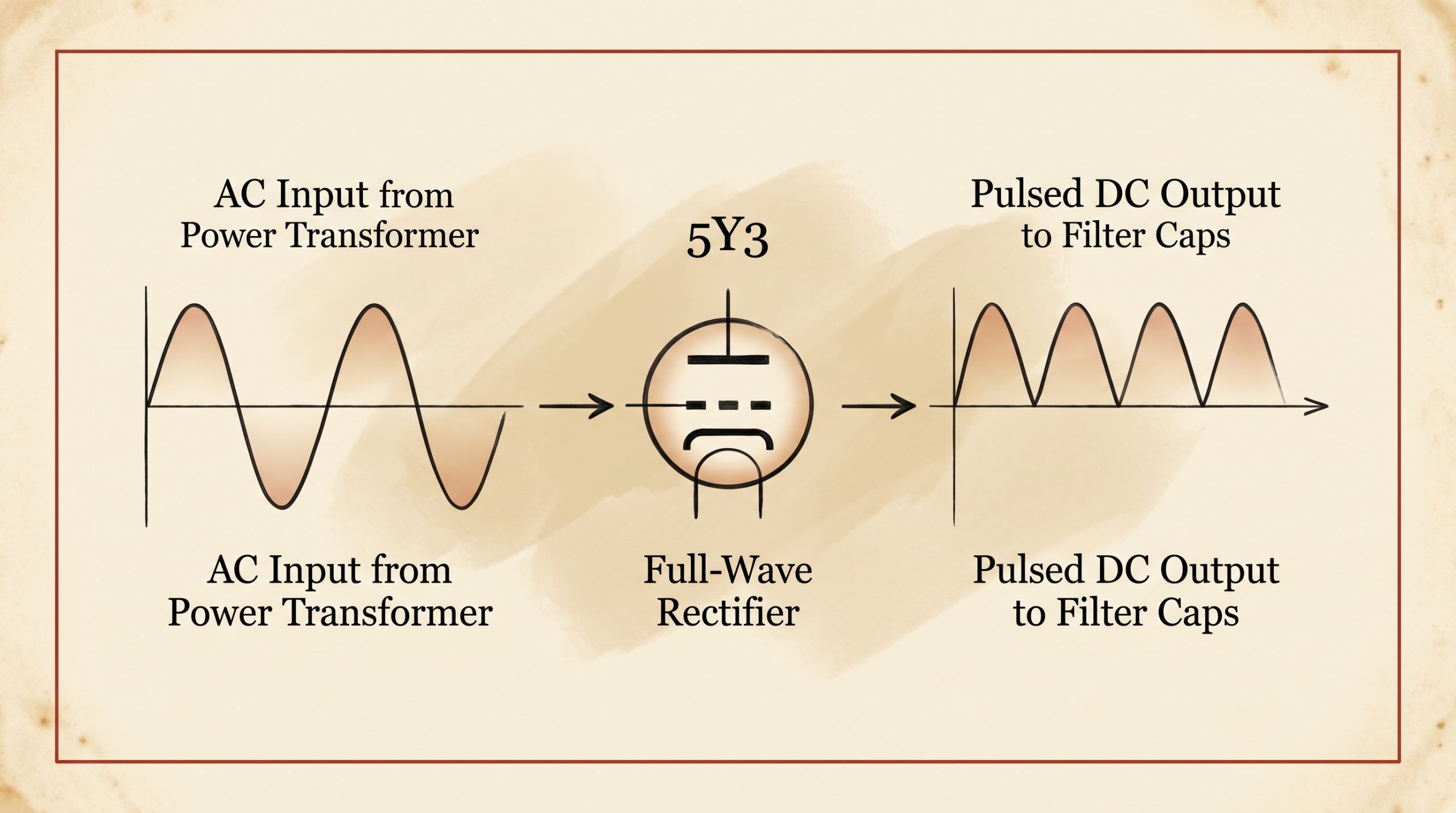
Every tube amplifier needs a power supply, and that power supply starts with rectification. Your power transformer outputs AC voltage. Your tubes need DC. The rectifier tube bridges that gap.
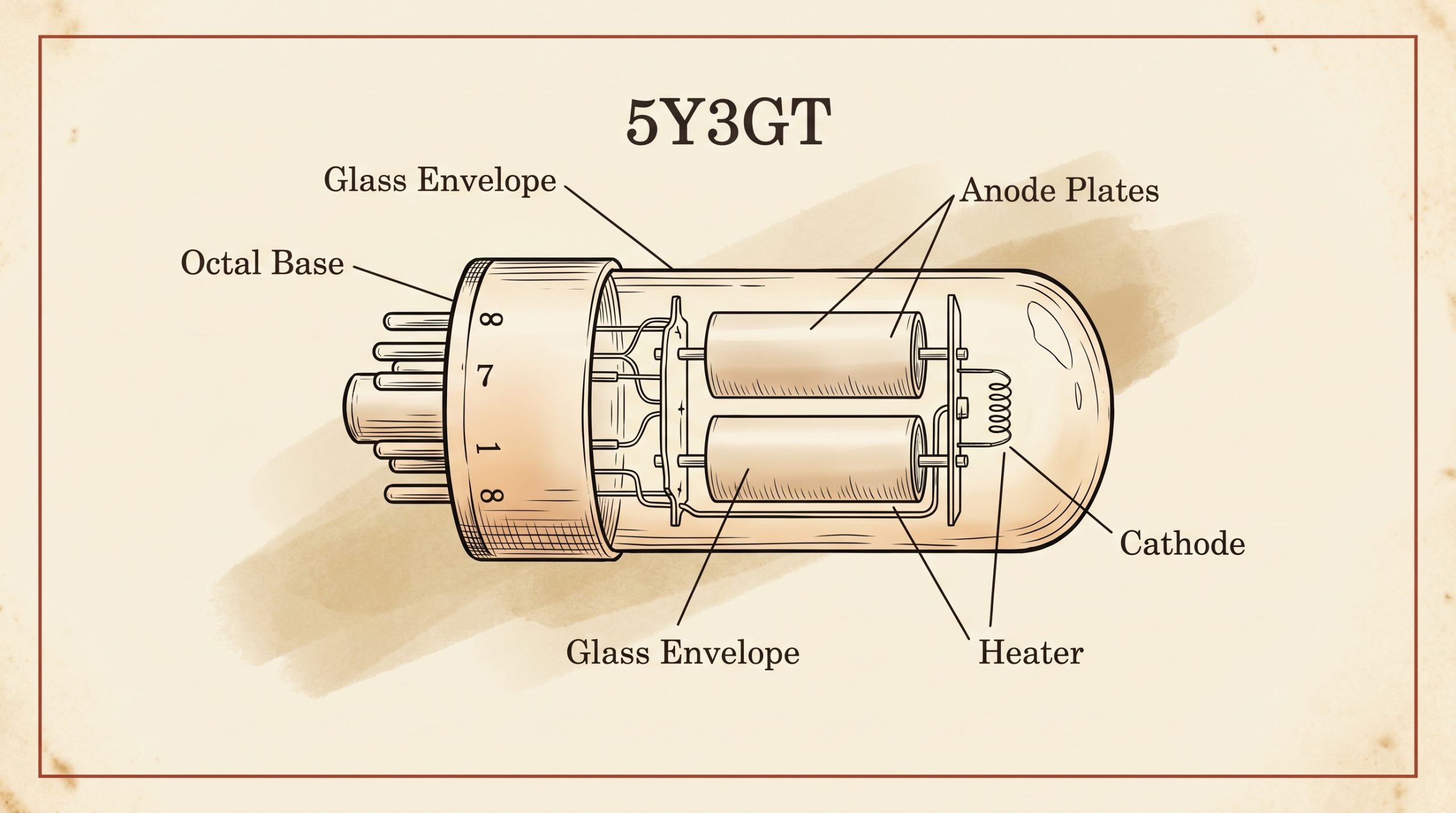
The 5Y3 is a full-wave rectifier, meaning it uses both halves of the AC sine wave, not just one. Inside the glass envelope, there are two anode plates (one for each half of the AC cycle) connected to the secondary winding of your power transformer. Both plates share a single cathode. During each half-cycle, one plate conducts and passes current through the cathode to the output. The result is pulsed DC, which your filter caps then smooth into the relatively stable B+ voltage your preamp and power tubes run from.
This is completely separate from what your 12AX7 preamp tubes or 6V6 power tubes do. The rectifier doesn’t amplify anything. It’s a power conversion component, but the way it performs that conversion has a direct effect on how your amp responds under load. That’s the part most explanations skip over.
Where the 5Y3 Sits in the Rectifier Hierarchy
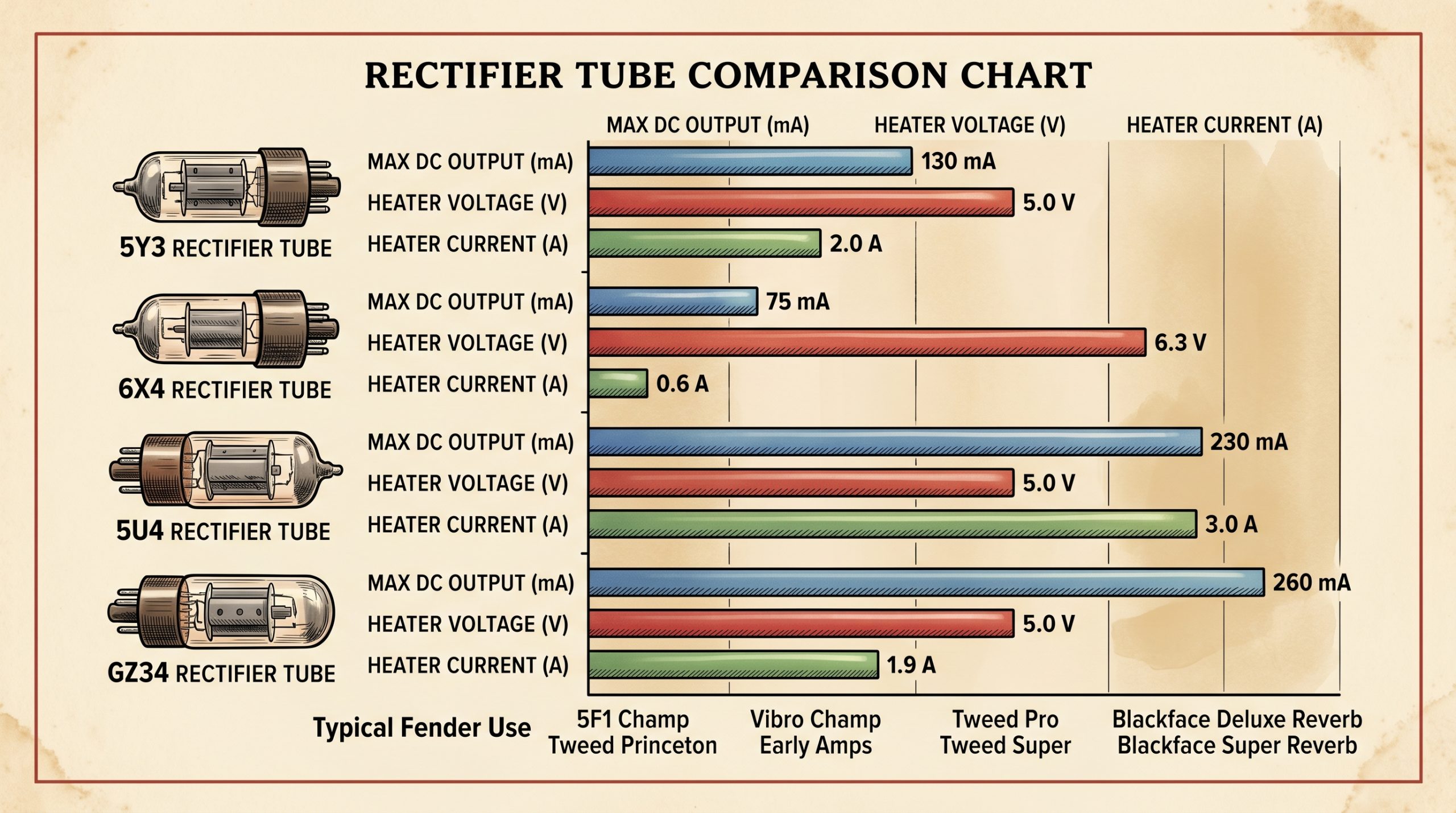
Think of vacuum rectifiers in terms of current capacity and robustness. The 6X4 is a smaller, miniature-based tube used in very low-power circuits. The 5Y3 steps up from there: it handles 125 mA maximum DC output and fits the standard octal socket. Above it sits the 5U4 (275 mA capacity, 5V/3A heater, used in higher-powered tweed circuits) and the GZ34/5AR4 (250 mA, used in blackface-era Fenders). The 5Y3 is firmly the “small amp” rectifier, matched by design to the current demands of 6V6GT-based circuits in single-ended and push-pull configurations up to about 15–18 watts.
5Y3 Datasheet Specifications
Key Electrical Specifications
The specifications below are drawn from the RCA RC-30 datasheet and corroborated by the TAD 5Y3GT/6087 technical data sheet and the original Philips/Mullard ET-T965 documentation. The TAD spec sheet specifically describes the 5Y3 as a “directly heated cathode” tube with an oxide cathode construction, note that some older writeups incorrectly describe it as indirectly heated. The filamentary (directly heated) construction is confirmed across all primary source documents.
| Parameter | Value |
|---|---|
| Heater Voltage | 5.0V AC (±8%) |
| Heater Current | 2.0A (±10%) |
| Max Plate Voltage (each plate) | 350V AC RMS |
| Max Peak Inverse Voltage | 1,400V |
| Max DC Output Current (resistive load) | 125 mA |
| Max DC Output Current (capacitive load) | 100 mA |
| Approximate Internal Resistance | 50–130Ω |
| Cathode Type | Oxide, directly heated (filamentary) |
| Base | Octal (UX8) |
| Envelope | GT (glass tubular) |
| Military Equivalent | 6087 |
The RCA datasheet’s rating chart presents the relationships between maximum AC voltage input and maximum DC output graphically. The key practical constraint for guitar amp use is the 350V AC RMS per plate limit, exceeding this risks plate damage and catastrophic rectifier failure. Most small Fender tweed circuits run well within this envelope, which is why the 5Y3 was such a cost-effective choice for those designs.
5Y3 Pinout Diagram and Socket Wiring
The 5Y3GT uses a standard 8-pin octal base. Pin orientation is referenced from the bottom of the tube, with the keyway (index notch) facing toward you, reading clockwise from pin 1.
| Pin | Function | Notes |
|---|---|---|
| 1 | No connection (NC) | Unused |
| 2 | Heater / Filament | 5V AC winding, one side |
| 3 | No connection (NC) | Unused |
| 4 | Anode 1 (Plate 1) | AC input from transformer secondary, leg 1 |
| 5 | No connection (NC) | Unused |
| 6 | Anode 2 (Plate 2) | AC input from transformer secondary, leg 2 |
| 7 | No connection (NC) | Not internally connected (present only for octal-base mechanical stability) |
| 8 | Heater / Filament (also the cathode) | 5V AC winding, other side. The 5Y3 is directly heated, so the filament doubles as the cathode: DC output to the B+ rail (via filter caps) is taken from this pin, or from the transformer’s 5V winding center tap, not from a separate cathode pin. |
The 5Y3GT is a directly heated rectifier, meaning the filament itself serves as the cathode rather than a separate cathode structure — pin 7 carries no internal connection, and the B+ DC output is taken from pin 8 (or from the transformer’s 5V winding center tap), not from a dedicated cathode pin. One thing to confirm before swapping any rectifier tube: pins 2 and 8 require a dedicated 5V AC heater winding on your power transformer. This winding is separate from the 6.3V winding that runs your preamp and power tubes. In any amp designed for the 5Y3, this 5V winding is already present, but if you’re building or modifying a circuit, you can’t share the 6.3V winding for a 5Y3 rectifier. The GZ34 also requires 5V at 1.9A on this winding, so that spec matches closely if you’re considering a swap.
The 5Y3 in Fender Amplifiers
Tweed-Era Fender Circuits Using the 5Y3
The 5Y3 was essentially Fender’s default rectifier for any amp under roughly 20 watts during the tweed era. As Greg Gagliano’s research documented in the TCG Magazine amp series (1997–2000, archived via the Wayback Machine), the tweed production runs from 1948–1960 relied heavily on inexpensive, reliable rectifier designs matched to the current draw of the power stage. The 5Y3 fit that brief exactly. For a full breakdown of circuit codes, production year ranges, and chassis stamps from this era, the Fender tube amp dating reference covers all the tweed production variables in one place.
Key Fender circuits that used the 5Y3 as their rectifier tube:
| Amp Model | Circuit Code | Approx. Years | Approx. Watts | Power Tubes |
|---|---|---|---|---|
| Tweed Champ | 5F1 | 1956–1964 | 4–5W | Single 6V6GT |
| Tweed Deluxe | 5E3 | 1955–1960 | 12–15W | Dual 6V6GT |
| Tweed Princeton | 5F2-A | 1955–1960 | 4.5W | Single 6V6GT |
| Tweed Super | 5F4 | 1955–1960 | ~16W | Dual 6L6GC |
| Tweed Bassman (early) | 5F6 / 5F6-A (pre-’58) | 1955–1958 | 45W | Quad 6L6GC |
One important note on the Bassman: by 1958–1960, the 5F6-A Bassman had moved to the GZ34 in many examples, as the quad 6L6GC power stage demanded more current capacity than the 5Y3 could comfortably deliver long-term. The Fender 5E3 Tweed Deluxe guide covers the specific circuit variants in more detail, including how the rectifier choice affects the 5E3’s B+ supply and characteristic feel.
Why Fender Chose the 5Y3 for Small Amps
Several practical factors converged. The 5Y3’s 5V/2A heater requirement is economical: a small transformer winding handles it without the larger iron needed for the 5U4’s 5V/3A draw. The 5Y3’s lower current capacity, 125 mA versus 250–275 mA for heavier-duty rectifiers, matched the modest current draw of single 6V6GT or dual 6V6GT power stages. And critically, the tube’s internal resistance sits high enough to produce meaningful sag without making the amp feel uncontrolled or loose. That’s the sweet spot for a 10–15 watt combo.
B+ Voltage in Real Fender Circuits
This is where things get specific, and where most generic 5Y3 writeups fall short. The B+ voltage in your amp isn’t just a function of your transformer secondary. It’s a function of your rectifier’s internal resistance, your filter caps, and your total current draw. With a 5Y3 installed:
- Fender 5F1 Champ: approximately 310–330V DC at the first filter cap
- Fender 5E3 Tweed Deluxe: approximately 315–350V DC depending on load and tube condition
- Fender 5F2-A Princeton: approximately 295–325V DC at the B+ node
Swap a GZ34 into any of those circuits and B+ climbs 30–50V immediately. That doesn’t sound like much. But those extra volts push your output tubes higher on the load line, shift the bias point, and stress filter caps that were rated for the lower voltage the 5Y3 produces. It also reduces sag dramatically, which changes how the amp feels under hard picking. Higher B+ isn’t automatically better. It depends entirely on what you need the amp to do.
Understanding Rectifier Sag, What the 5Y3 Actually Does to Your Tone
What Is Rectifier Sag?
Sag is a momentary voltage drop at the B+ supply that happens when you hit the strings hard. Physics first: when your output tubes demand a spike of current (at the pick attack), that current spike flows through the rectifier’s internal resistance. Voltage drop equals current times resistance (V = IR). With 50–130Ω of internal resistance in a 5Y3, a 50 mA current spike produces a 2.5–6.5V drop. That drops your B+ momentarily, which drops your output tube’s operating point, which compresses the transient.
The result: your attack softens slightly and then the voltage recovers, giving a “blooming” quality to sustained notes. The amp feels like it’s breathing with you. Not weak. Responsive.
Contrast that with a solid-state rectifier diode (internal resistance near 0Ω). The B+ holds rock-solid regardless of current demand. Every transient hits at full force. That’s tighter and louder at the same transformer voltages, but the give is gone.
Sag as a Tonal Tool
Forum discussions on The Gear Page and Amp Garage have documented that EL34-based single-ended circuits drawing around 80 mA will cause quite significant voltage loss across a 5Y3, useful in some contexts, potentially limiting in others. The effect is most audible when you’re playing near the amp’s rated output. At bedroom-friendly volumes, sag from a 5Y3 versus a solid-state rectifier is barely perceptible. At stage-loud levels with a 5E3 Deluxe, the difference in feel is substantial: the 5Y3 gives the amp that spongy compression on attack, while a solid-state diode makes the same circuit feel stiff and forward.
Modern current-production 5Y3 tubes generally drop less voltage than their 1960s NOS counterparts. Sag and bloom are less pronounced from a new JJ 5Y3S compared to a 1950s RCA black plate. Not wrong. Just different.
How the 5Y3 Compares in Sag to Other Rectifiers
The 5Y3’s internal resistance (~50–130Ω) sits meaningfully higher than the GZ34/5AR4’s (~50–75Ω) under most operating conditions. The 5U4 overlaps in the moderate-sag zone. Solid-state bridge rectifiers effectively have zero resistance and zero sag. That hierarchy, 5Y3 being saggier than GZ34 at equivalent voltages, is the core reason Fender blackface amps moved to the GZ34. Tighter, louder, more clean headroom for gigging. The tweed amps kept the 5Y3 and the character that came with it.
5Y3 Tube Equivalents and Variant Names
Direct Equivalents and Variant Designations
Several variant names show up in old documentation, dealer listings, and amp schematics. They all refer to electrically compatible tubes that drop straight into the same octal socket.
| Designation | Notes |
|---|---|
| 5Y3GT | Standard glass tubular version, most common current and NOS form |
| 5Y3G | Older ST (“coke bottle”) glass envelope, electrically identical, earlier construction |
| 5Y3WGTA | Military-spec (JAN) version, higher reliability rating, tighter tolerances |
| 5Y3WGTB | Military-spec, black plate variant, the TAD RT513 is based on this construction |
| 6087 | GE 5-Star military designation, same manufacturing line as 5Y3WGTB, different market label |
| 5Y3S | JJ Electronics’ current production designation for their 5Y3-equivalent tube |
| JAN-CHY 5Y3WGTA | Joint Army Navy spec, made by CHY, ruggedized for military applications |
The 5Y3G in the ST glass shape is electrically identical to the 5Y3GT. Older, rarer, and often pricier for collector reasons rather than tonal ones. The 6087 and 5Y3WGTB are from GE’s High-Reliability Series. Tube Amp Doctor notes that both types came from the same manufacturing line, just labeled differently for separate markets. Military variants (JAN designation) were built to tighter quality tolerances and higher shock/vibration specs. For a guitar amp, that translates to more consistent performance and potentially longer service life, not a different sound character per se.
The full tweed-era context for these variants sits within the broader tweed Fender amp era guide, which covers how component sourcing and circuit revisions evolved across 1948–1960 production.
GZ34 vs 5Y3, What’s the Actual Difference?
Head-to-Head Electrical Comparison
| Spec | 5Y3GT | GZ34 / 5AR4 | 5U4GB |
|---|---|---|---|
| Max DC Output Current | 125 mA | 250 mA | 275 mA |
| Max Plate Voltage (each) | 350V AC RMS | 450V AC RMS | 550V AC RMS |
| Heater Voltage | 5V AC | 5V AC | 5V AC |
| Heater Current | 2.0A | 1.9A | 3.0A |
| Internal Resistance (approx.) | 50–130Ω | 50–75Ω | 35–80Ω |
| Typical B+ Output | 285–340V | 340–400V | 330–390V |
| Sag Character | Moderate | Low | Moderate to High |
| Typical Fender Use | Tweed small amps | Blackface / silverface | Large tweed circuits |
| Socket | Octal | Octal | Octal |
At equivalent current draw, the 5Y3 produces significantly more voltage drop than the GZ34. That’s the core of the gz34 vs 5y3 comparison: same socket, very different behavior under load. The GZ34’s lower internal resistance holds B+ higher and steadier. For high-headroom clean tones, that’s exactly what you want. For the spongy, giving feel of a tweed Champ or 5E3 Deluxe barking when pushed, the 5Y3 is the right tool.
Can You Swap a GZ34 Into a 5Y3 Amp?
Technically, yes. Same socket, and the heater current draw is close enough (GZ34 draws 1.9A vs. 5Y3’s 2.0A) that the 5V transformer winding handles either without issue. But there’s a real risk here that’s worth taking seriously.
Plugging a GZ34 into a circuit designed for a 5Y3 raises B+ by 30–60V. If your filter caps are rated for, say, 350V DC and you were previously running 320V with the 5Y3, you’re now pushing 360–380V DC through caps that may not handle it safely. Same concern for your output tubes’ plate dissipation, they’re now sitting at a higher operating voltage without any change to the bias resistors.
Not recommended without checking filter cap voltage ratings and verifying output tube operating point. If the caps have headroom and the circuit tolerates the higher B+, some players find the GZ34 swap in a 5E3 gives a tighter, louder response. But that’s a modification, not a plug-and-play swap.
GZ34 vs 5Y3, Which Is Right for Your Amp?
If your amp shipped with a 5Y3, use the 5Y3 family. The circuit was designed around that B+ voltage, those filter cap ratings, and that output tube operating point. Chasing more headroom with a GZ34 swap on a 5F1 Champ doesn’t make much sense anyway, it’s a 5-watt amp. The sag is part of the sound.
If you’re working on a blackface-era amp that calls for a GZ34 (like a Deluxe Reverb AB763), stick with the GZ34. The 5AR4 vs 5Y3 question in that context has a clear answer: the blackface circuit’s B+ supply was designed for GZ34 voltages. A 5Y3 will drop that B+ enough to change the bias operating point in ways that weren’t intended and could cause the output tubes to run cold.
Current Production vs. NOS, Which 5Y3 Should You Buy?
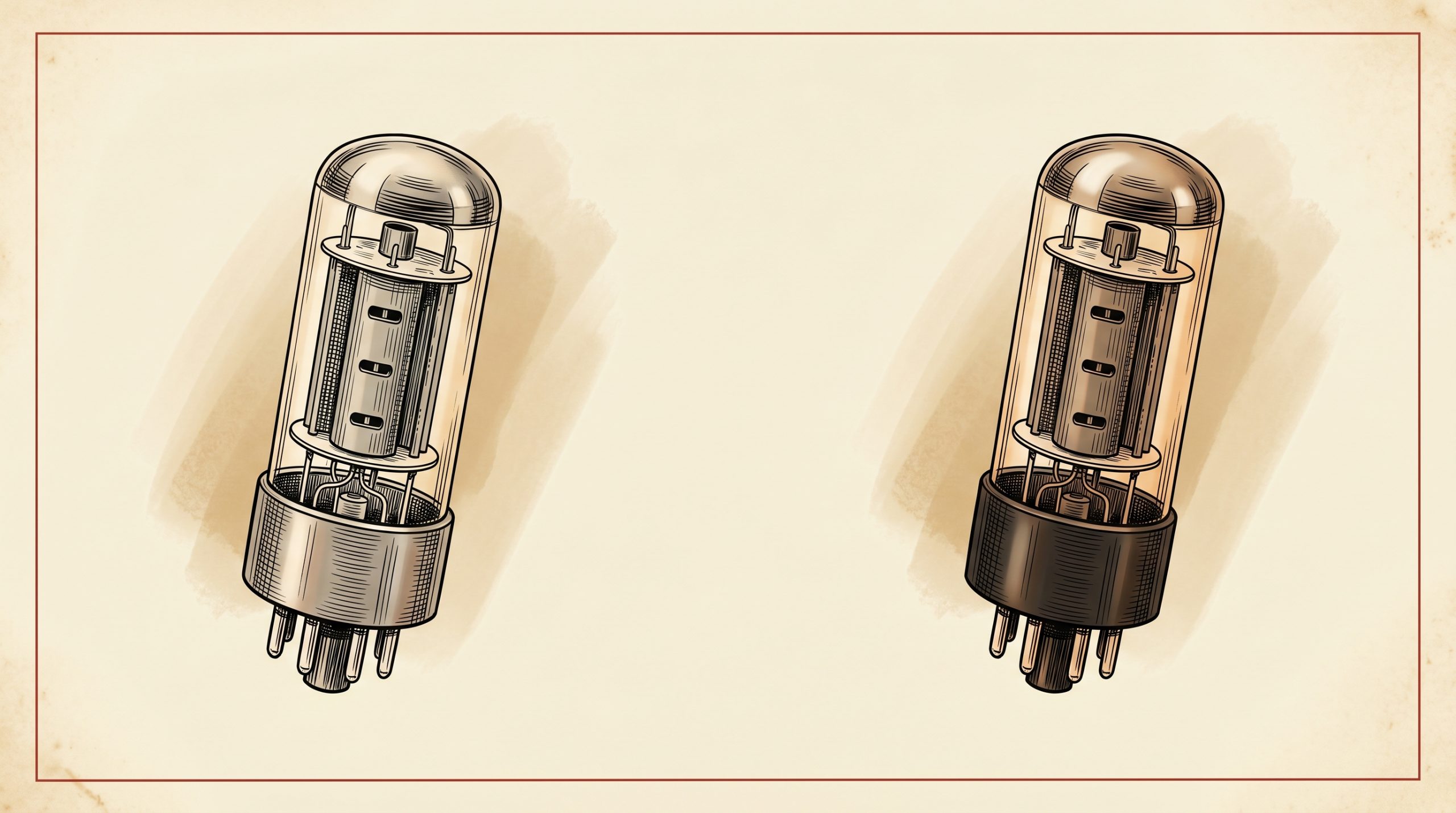
Current Production 5Y3 Tubes
Two options dominate current production:
JJ 5Y3S (JJ Electronic, Slovakia): The most widely stocked current-production option. JJ’s internal construction differs slightly from NOS designs, but reliability is generally solid. Street price runs $22–$27. Plenty usable. Just don’t expect NOS-level bloom from it.
Sovtek 5Y3GT (Russia): A reliable budget option. Runs approximately $26–$30 at most dealers. Performance is functional; it won’t win comparisons against NOS RCA but it won’t let you down in a working amp either.
No shame in running current production. They work.
NOS (New Old Stock) 5Y3 Options
RCA 5Y3GT (black plate, USA, 1950s–early 1960s): The benchmark NOS 5Y3. Black plate construction, tight tolerances, and the voltage sag behavior most associated with vintage tweed sound. Tube Amp Doctor lists these (as S5Y3-RCA) at €59, and the vintage US market equivalent runs $45–$80 depending on testing and source. Worth it for a reference-quality build or restoration.
Sylvania 5Y3GT: Common NOS, reliable, often found re-labeled under CBS branding from the 1960s–70s. Tube Amp Doctor notes that their NOS USA stock is “mostly made by Sylvania and CBS.” Solid performer, typically $40–$55 tested.
GE 6087 / 5Y3WGTB (GE 5-Star, USA): Military-spec ruggedized construction. More consistent than standard commercial-grade NOS, slightly different sag character due to tighter internal resistance tolerance. Both 6087 and 5Y3WGTB came from the same GE manufacturing line per Tube Amp Doctor documentation. ~$45–$65 tested.
Tung-Sol 5Y3GT (USA NOS): Sought after for vintage feel and typically good sag behavior. Prices run $50–$80 depending on condition and seller.
What to Look for When Buying a Used 5Y3
Three things to check before installing any used rectifier tube:
- Tube tester reading: Measure mutual conductance against spec. A 5Y3GT testing below 60–70% of rated emission is marginal and will produce inconsistent B+ voltage.
- Visual inspection: Internal darkening near the plates or cathode indicates cathode emission loss. Cracks in the glass are an obvious reject. Some internal getter flash (silvery deposit on the glass dome) is normal and doesn’t indicate a problem.
- Short test: This one is non-negotiable. A shorted rectifier tube passes AC directly to your B+ rail and can destroy filter caps instantly. Any decent tube tester checks for shorts. Don’t skip it.
How to Replace a 5Y3 Rectifier Tube
Step-by-Step Replacement Notes
Safety first. Filter capacitors in tube amplifiers store lethal charge even after the amp is unpowered. If you’re not familiar with discharging filter caps safely, take the amp to a qualified technician. This is not an exaggeration.
Assuming you’re comfortable working on tube amps:
- Power down the amp completely and allow caps to discharge (minimum 30 minutes unpowered, or discharge with a resistor-on-probe method).
- Locate the rectifier socket. In most tweed Fender amps, the rectifier tube sits nearest the power transformer, often at the rear of the chassis.
- Pull the old 5Y3 straight out, no twisting needed for octal tubes. A firm, even pull releases the tube from the socket pins.
- Align the keyway (notch on the tube base) with the socket’s matching gap, then press the new tube firmly and evenly into place.
- Power up in stages: if your amp has a standby switch, bring the amp to standby first and allow tubes to warm for 30–60 seconds before bringing the standby switch to play.
One important distinction from output tube swaps: replacing a rectifier tube does not require re-biasing. The rectifier doesn’t have a bias adjustment. Your output tube bias may shift slightly due to the new tube’s B+ voltage behavior, but unless you’re changing rectifier types (say, from a 5Y3 to a GZ34), the shift is minimal and within normal operating variance for matched 6V6 tubes. If you are changing rectifier types, check output tube plate voltage before playing.
5Y3 at a Glance, Key Takeaways
The 5Y3GT is a directly heated, full-wave octal rectifier running on a 5V/2A heater winding. It’s rated for 125 mA DC output at up to 350V AC RMS per plate, parameters that fit small-to-mid tweed Fender circuits precisely. In practice, it delivers 285–350V DC at your B+ rail depending on circuit load, roughly 30–60V lower than a GZ34 in the same transformer circuit. That voltage difference is the mechanical basis for the sag and compression those amps are known for.
- Standard rectifier in the 5F1 Champ, 5E3 Tweed Deluxe, 5F2-A Princeton, and early 5F4 Super
- Internal resistance 50–130Ω produces moderate sag, more than GZ34, less than some 5U4 examples
- Direct equivalents: 5Y3G, 5Y3GT, 5Y3WGTB, 6087, JAN-CHY 5Y3WGTA
- Current production options: JJ 5Y3S (~$22–$27), Sovtek 5Y3GT (~$26–$30)
- NOS benchmark: RCA black plate 5Y3GT (1950s–early 1960s, $45–$80 tested)
- GZ34 swaps into the same socket but raises B+ by 30–60V, not interchangeable without circuit verification
- Modern production 5Y3 tubes drop less voltage than 1960s NOS, sag is less pronounced from new tubes
If you’re restoring or maintaining a tweed Fender and the rectifier needs replacing, start with a tested NOS 5Y3GT if the budget allows, or a JJ 5Y3S if you need something reliable and affordable today. Either way, confirm the tube shorts-free before installation. A shorted rectifier is the one failure mode that can take other components with it, and a 30-second tester check is cheap insurance.
Sources
- RCA RC-30 Radiotron Designer’s Handbook, 5Y3GT datasheet specifications. Available via frank.pocnet.net (5Y3G RCA datasheet PDF).
- TAD 5Y3GT/6087 High Performance Full Wave Rectifier Tube technical data sheet, electrical characteristics, cathode type confirmation. Available via Tube Amp Doctor product documentation.
- Philips/Mullard ET-T965 tube data (5Y3-GT), pinout and rating chart corroboration.
- Greg Gagliano, Devin Riebe, Greg Huntington, tweed-era Fender amp circuit research, 20th Century Guitar Magazine (1997–2000), archived via the Wayback Machine TCG Magazine archive.
- Teagle, John and John Sprung. Fender Amps: The First Fifty Years. Hal Leonard, 1995, production era and circuit code documentation.
- Reverb.com / Premier Guitar, rectifier tube function and Fender amp context, as documented at reverb.com.
Frequently asked questions
How does a 5Y3 rectifier tube work?
The 5Y3 is a full-wave vacuum rectifier with two anode plates connected to opposite ends of your power transformer's secondary winding. During each half-cycle of AC, one plate conducts through the shared cathode, producing pulsed DC at the output. Both halves of the AC cycle are used, hence "full-wave." The tube's internal resistance (50–130Ω) causes the output voltage to sag under heavy current demand, the mechanism behind the characteristic compression in tweed-era Fender amps. Filter capacitors downstream smooth the pulsed DC into the stable B+ voltage your preamp and power tubes require.
Are rectifier tubes interchangeable? Can I use a GZ34 instead of a 5Y3?
They share the same octal socket and similar heater requirements, so physically the swap works. But a GZ34 will raise your B+ voltage by 30–60V compared to a 5Y3 in the same circuit. That extra voltage can stress filter capacitors rated for the lower 5Y3 voltages, shift output tube operating points beyond intended parameters, and strip out much of the sag that defines the amp's feel. It's possible in some circuits with sufficient component headroom, but it should be treated as a deliberate modification with careful component verification, not a routine tube swap.
What is the difference between 5Y3, 5Y3G, and 5Y3GT?
The 5Y3G uses an older ST-shape ("coke bottle") glass envelope. The 5Y3GT uses a glass tubular (GT) envelope, the standard modern form. Both are electrically identical and completely interchangeable. The envelope shape reflects manufacturing era, not performance differences. 5Y3WGTB and 6087 add military-spec ruggedization but remain electrically compatible with the standard 5Y3GT socket and circuit.
What does the 5Y3 do for tone?
The 5Y3 creates rectifier sag: a momentary B+ voltage drop under pick attack transients, caused by the tube's internal resistance. The result is a soft, compressed feel on hard picking that releases into a blooming sustain. It's most audible at stage-loud volumes near the amp's rated output. At low volumes, the effect is minimal. The sag is a primary reason players associate the 5E3 Tweed Deluxe and 5F1 Champ with a particular "give" that solid-state rectified amps don't replicate.
What is the military equivalent of the 5Y3GT?
The 6087 (GE 5-Star) and 5Y3WGTB are the military-rated equivalents, both from GE's High-Reliability Series. Per Tube Amp Doctor documentation, both types were manufactured on the same production line, the difference is market labeling. The JAN-CHY 5Y3WGTA is a Joint Army Navy spec variant built to tighter tolerance and higher shock/vibration ratings. All three are electrically compatible with standard 5Y3GT circuits and drop straight in.