Contents
- 01What Is the Fender Hot Rod DeVille?
- 02Circuit Overview and Specs
- 03Fender Hot Rod DeVille 212 vs. 410, Which Configuration Is Right for You?
- 04Hot Rod DeVille vs. Hot Rod Deluxe, Full Comparison
- 05Tonal Character, What Does the Hot Rod DeVille Actually Sound Like?
- 06Modifications, Upgrades, and Taming the DeVille
- 07Reliability, Common Issues, and What to Check When Buying Used
- 08The Hot Rod DeVille ML, Michael Landau Signature Model
- 09Is the Fender Hot Rod DeVille Still Worth Buying in 2026?
- 10Quick Specs Reference, Fender Hot Rod DeVille IV
- 11FAQ, Fender Hot Rod DeVille
The Hot Rod DeVille sits at the top of Fender’s Hot Rod series, delivering more headroom, more speaker coverage, and more stage volume than its smaller sibling. Where the Hot Rod Deluxe gives you 40 watts through a single 12″, the DeVille pushes 60 watts through either two 12s or four 10s. It’s a gigging amp first. Always has been. Since its introduction alongside the Hot Rod Deluxe in 1995, it’s become one of the most widely used club and stage amplifiers in the American market, turning up in country, blues, rock, and worship rigs the world over.
- Output: 60W RMS, fixed bias, solid-state rectifier
- Power tubes: 2x 6L6GC; preamp: 3x 12AX7
- Configurations: 212 (2×12″, Gen IV current production); 410 (4×10″, Gen III only, discontinued)
- Production start: 1995; current generation: IV (2012-present, 212 only)
- Weight: ~50-55 lbs (212 IV); not a carry-in-one-trip amp
- Used pricing: $350-$650 depending on generation and condition
- Drive channel draws consistent criticism at high gain settings, best used as a clean platform with pedals
- Plate voltage (~460V) exceeds safe operating range for most standard 6V6 tubes, tube swaps require a tech
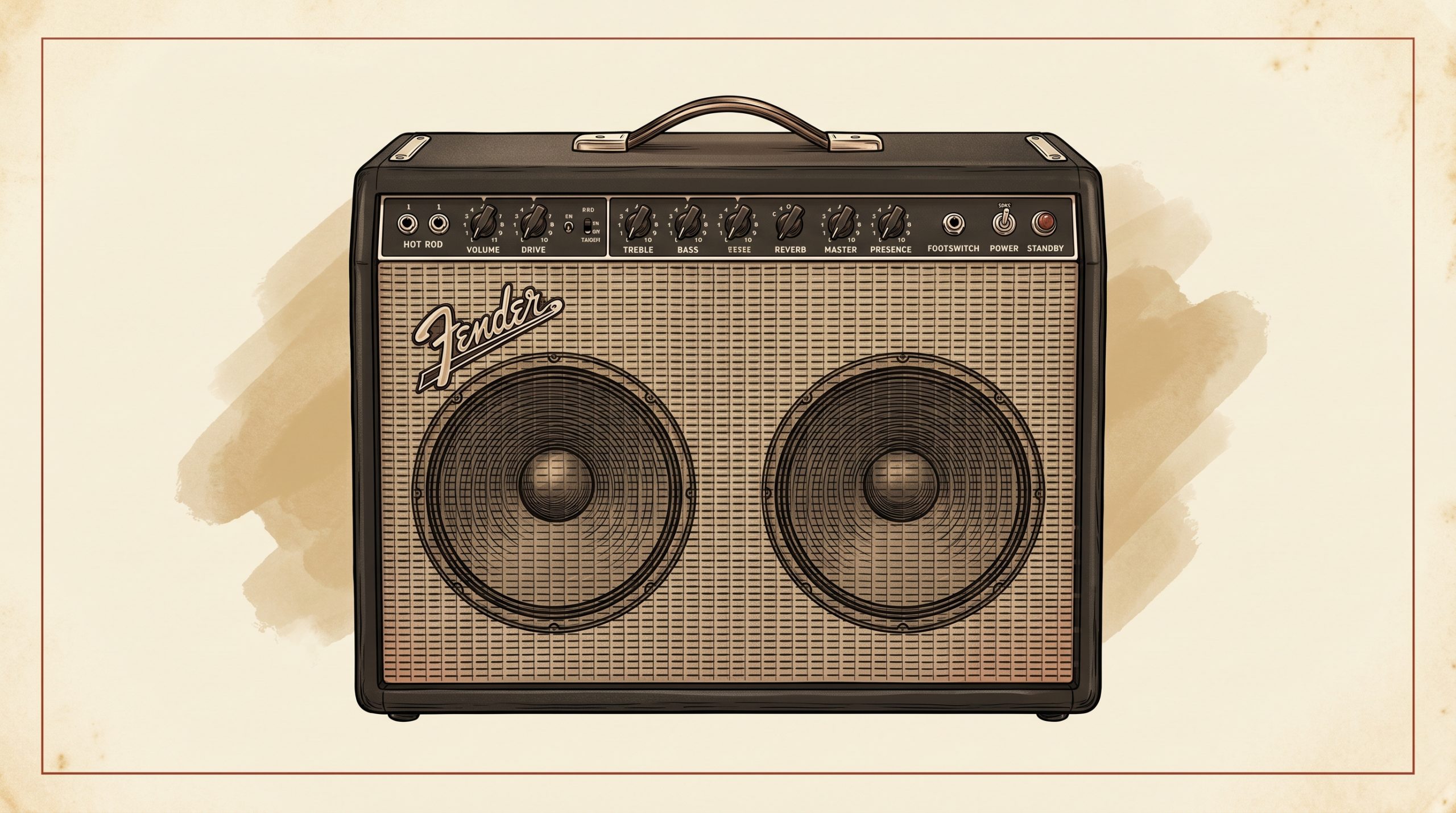
What Is the Fender Hot Rod DeVille?
The Hot Rod Family, Where the DeVille Fits
The Hot Rod series grew out of Fender’s Blues DeVille and Blues Deluxe, introduced around 1993. Those amps established the basic circuit architecture: a two-channel layout with a clean channel and a cascaded gain drive channel, PCB construction, spring reverb, and a series effects loop. Fender refined that platform in 1995 and relaunched it as the Hot Rod Deluxe and Hot Rod DeVille, bumping up specs and pushing both amps toward a broader gigging audience.
The positioning has been consistent since day one. The Hot Rod Deluxe is the portable option: 40 watts, one 12″, 43 lbs. The DeVille is the stage option: 60 watts, more speakers, more volume, more weight. Both share the same fundamental circuit. The DeVille just does everything bigger. It handles rehearsal, gigging, and recording equally well, though recording at full output requires either a good room, serious mic placement discipline, or an attenuator in the signal chain.
Production History and Model Generations
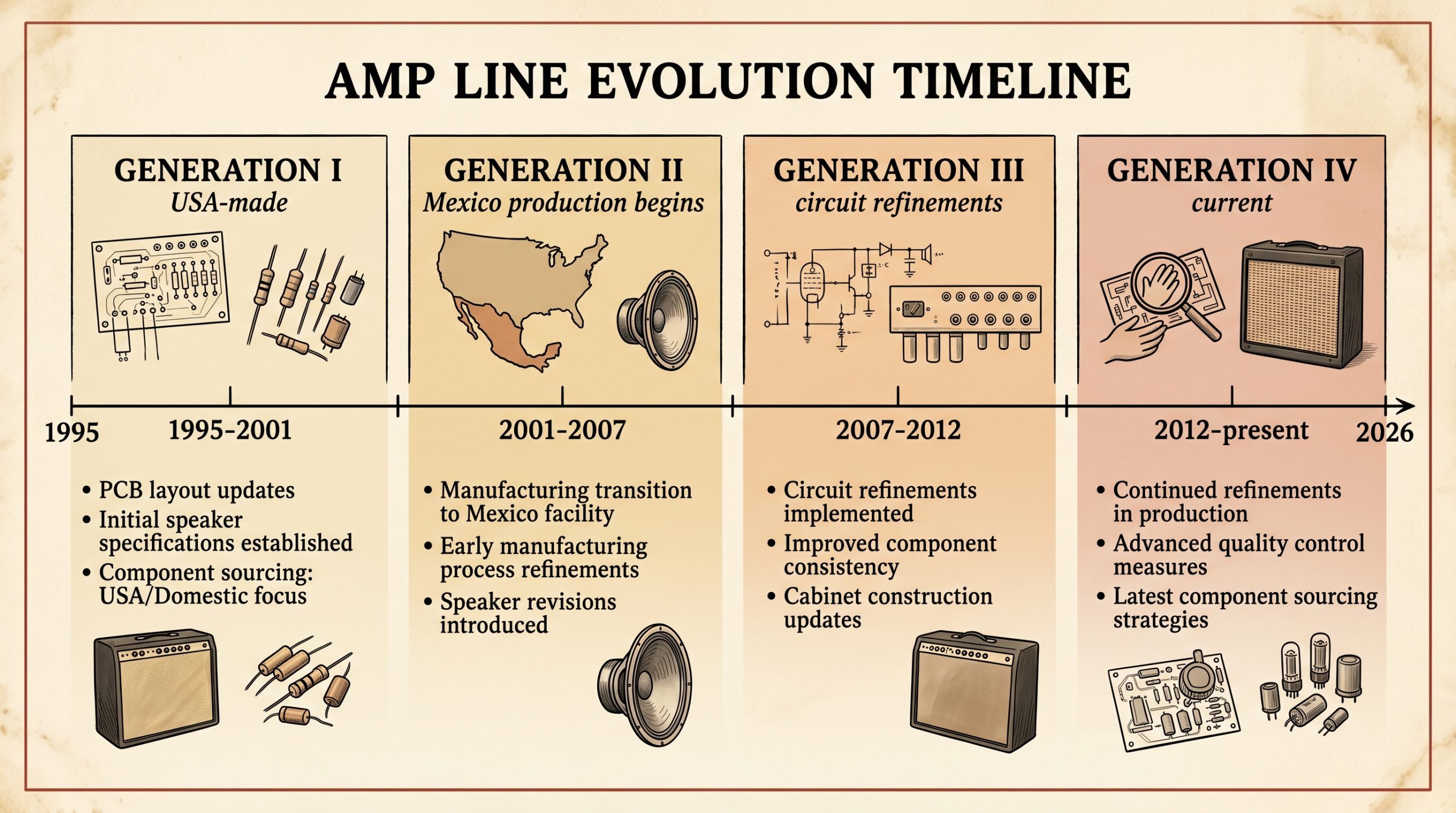
The Hot Rod DeVille launched in 1995 and has run through four distinct generations.
- Generation I (1995-2001): Original production run, largely USA-made, established the core circuit and cosmetics
- Generation II (2001-2007): Minor PCB layout updates and cosmetic revisions; some production shifted to Mexico during this period
- Generation III (2007-2012): Additional circuit refinements, updated speaker choices in some configurations
- Generation IV (2012-present, 212 only): Current production model (212 configuration only; the 4×10″ 410 configuration was not continued into Gen IV), updated cosmetics, revised component sourcing, most reliable generation from a build-quality standpoint
Country of origin varies by production year. Early Gen I units carry USA chassis stamps, while later production shifted to Ensenada, Mexico, a common pattern across Fender’s working-amp lineup during the mid-2000s and beyond. It doesn’t affect the circuit materially, but it matters for collectors and is when dating a used example. For help pinning down a specific production year from chassis stamps or date codes, the Fender tube amp serial number guide covers the relevant documentation methods.
Circuit Overview and Specs
Circuit Topology and Lineage
One thing worth getting straight upfront: the Hot Rod DeVille is not a blackface or silverface circuit. It shares no direct design lineage with the AB763 Deluxe Reverb, the AA764 Princeton Reverb, or any of the classic late-1960s Fender topologies. The Hot Rod series represents a clean-sheet modern design developed in the early 1990s, built around a different set of priorities, primarily high output, channel switching, and effects loop integration rather than the minimalist single-channel architecture of the vintage lineup.
The topology is two-channel: a Clean channel and a Drive channel with a selectable “More Drive” mode for additional gain. The Drive channel uses a cascaded preamp gain stage (think of it as stacking triode stages for compression and saturation), which behaves very differently from the power amp saturation that characterizes tweed and blackface distortion. This distinction matters a lot when evaluating how the amp breaks up. You’re getting preamp-stage overdrive, not output transformer saturation.
Construction is PCB-based throughout. Not point-to-point. This is relevant for serviceability: trace damage is a real risk if the board sees heat stress or rough handling, and cold solder joints near tube sockets are a known failure mode on older units. A qualified tech can work on these amps without much trouble, but it’s not the same repair experience as working on an old tweed or a hand-wired boutique amp.
Power Stage and Output
The DeVille runs two 6L6GC power tubes in a push-pull configuration. Fixed bias. The bias spec targets approximately 35-38mA per tube at roughly 460V plate voltage, putting each tube at around 70% of maximum plate dissipation. That’s within spec, but it means the amp is running its tubes reasonably hard, budget for a retube and bias service every two to three years under regular gigging use.
The rectifier is solid-state, a diode bridge. No tube rectification, no voltage sag under load. This is a significant tonal distinction from tweed-era Fenders. When you push a 5Y3-rectified Tweed Deluxe, the power supply sags and the amp compresses in that distinctive, cushioned way. The DeVille doesn’t do that. At full output it hits hard and stays stiff. Some players love this quality. Others find it unforgiving. It’s not a defect, it’s the design.
Output transformer primary impedance runs approximately 4kΩ for the two-tube push-pull configuration. The internal speaker load is 4Ω (both configurations). The external speaker jack, as noted in the original Fender service documentation archived at fmicassets.com, requires an 8Ω external cabinet when used with the 212 configuration.
Controls and Features
The control layout is straightforward. Clean channel gets Volume, Treble, Bass, and Middle. Drive channel gets its own Volume and a Drive knob. Shared controls cover Master Volume, Presence, and Reverb. Channel selection and reverb on/off are both footswitchable via the included two-button footswitch.
The effects loop is series, buffered, running at instrument level (-10dBV). It works well with standard pedals. Not ideal for studio-level gear without a line matching interface. The Presence control operates in the negative feedback loop, which means it’s adding upper harmonic content rather than just boosting treble frequencies, a useful distinction when you’re dialing in how the amp cuts through a live mix.
Fender Hot Rod DeVille 212 vs. 410, Which Configuration Is Right for You?
Note on configurations: The 4×10″ Hot Rod DeVille (410) was produced through Gen III (last production approximately 2016-2017) and was not continued into Gen IV. The 212 IV is the only new-market option. The 410 remains widely available on the used market; both configurations are covered below for used-market reference.
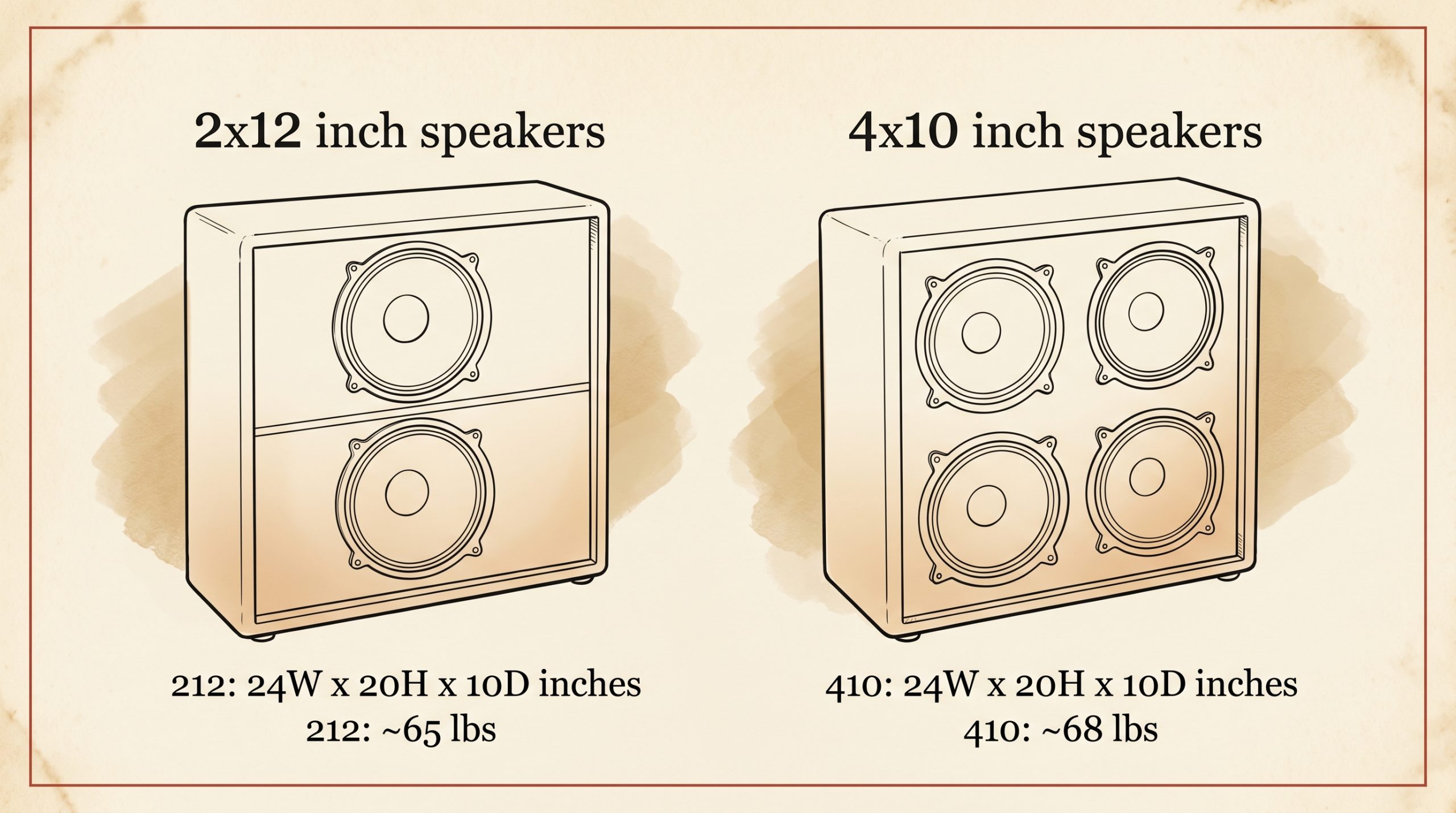
Fender Hot Rod DeVille 212 (2×12″)
The current Hot Rod DeVille 212 IV ships with two Celestion A-Type 12″ speakers, wired at 8Ω each for a combined 4Ω load. Earlier generations used a range of drivers depending on production year: Jensen P12N in some early runs, Eminence-sourced speakers in others. The Generation IV speaker choice settled on Celestion, which aligns with a broader Fender move toward British-voiced drivers in their higher-output combos.
The 212 cabinet measures approximately 24″ wide by 19.5″ tall by 10.5″ deep. Weight sits around 50-55 lbs. Not light. The tonal character trends toward a full, rounded low end, a more focused midrange response, and a smoother top end than the 410 configuration. It handles humbuckers especially well, the low-end extension doesn’t turn to mud the way a bright 10″ configuration can with a thick PAF-style pickup. Single coils work equally well here, producing that clean glassy quality the DeVille’s clean channel does best.
Fender Hot Rod DeVille 410 (4×10″, Gen III, discontinued)
The 410 loads four Fender Special Design 10″ speakers. Early generations used Jensen MOD 10-35 drivers or equivalent Eminence-sourced units. The four-speaker configuration creates a broad dispersion pattern that’s genuinely different from the 212 in a live setting, you feel it differently on stage and the audience hears it more evenly across a wider area.
Tonally, the 410 runs brighter and snappier. More pronounced upper midrange, more articulate attack, a bit less body in the low end. It echoes the character of the classic Bassman 4×10 configuration (documented in the Fender Bassman guide), and it’s no accident that country players gravitate toward this configuration. The spanky attack of a Telecaster through the clean channel of a 410 DeVille is a genuinely distinct sound. Users on the Seymour Duncan forum have noted that the 410 configuration evokes the old Bassman character, particularly on the clean channel.
Cabinet dimensions run approximately 26″ wide by 19″ tall by 10.5″ deep. Weight: approximately 50 lbs (Gen III). Slightly wider than the 212. The 410 was discontinued after Gen III; used examples range from $300 to $600. Neither is easy to move solo.
Comparison Table: 212 vs. 410 Side by Side
| Spec | Hot Rod DeVille 212 | Hot Rod DeVille 410 (Gen III, discontinued) |
|---|---|---|
| Output Power | 60W RMS | 60W RMS |
| Speaker Config | 2x Celestion A-Type (12″) | 4x Fender Special Design (10″) |
| Cabinet Load | 4Ω | 4Ω |
| Weight | ~50-55 lbs | ~50 lbs (Gen III) |
| Tonal Bias | Full, rounded, warm | Bright, snappy, articulate |
| Best For | Rock, blues, recording | Country, roots, vintage styles |
| Street Price (new, 2026) | ~$999-$1,099 | Discontinued (used: ~$300-$600) |
| Used Price Range | $350-$650 | $300-$600 |
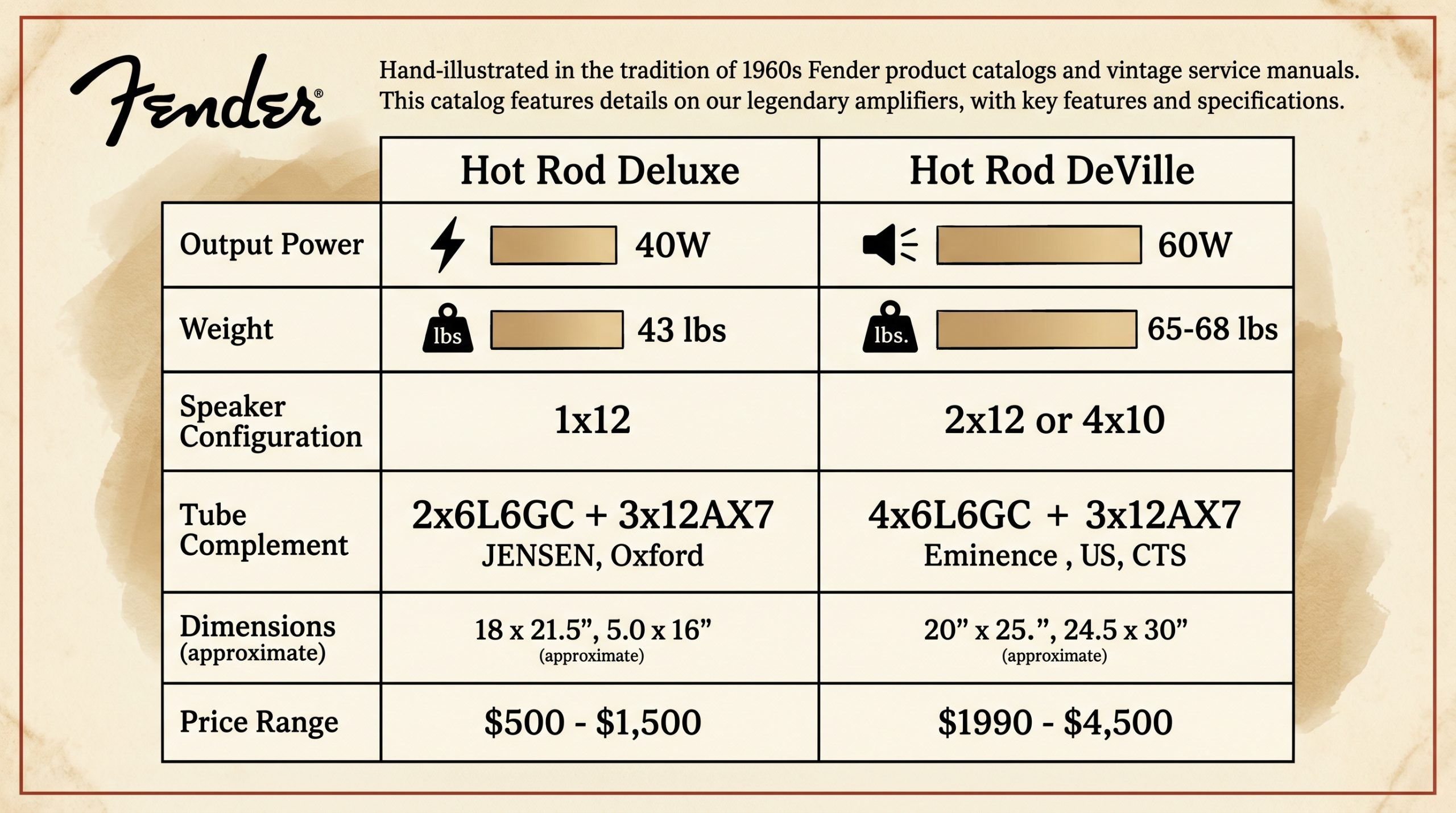
Hot Rod DeVille vs. Hot Rod Deluxe, Full Comparison
Spec-for-Spec Breakdown
| Spec | Hot Rod DeVille 212 | Hot Rod Deluxe IV |
|---|---|---|
| Output Power | 60W | 40W |
| Power Tubes | 2x 6L6GC | 2x 6L6GC |
| Speaker Config | 2×12″ | 1×12″ |
| Reverb | Yes (spring) | Yes (spring) |
| Effects Loop | Yes (series) | Yes (series) |
| Weight | ~50-55 lbs | ~43 lbs |
| Channels | 2 (Clean/Drive) | 2 (Clean/Drive) |
| Best Suited For | Gigging, larger venues | Practice, studio, small gigs |
| Street Price (new) | ~$999-$1,099 | ~$699-$799 |
The 20-watt power difference is less significant in practice than the speaker complement difference. The theoretical SPL gap between 40W and 60W is only about 1.75 dB. But the DeVille’s two 12″ drivers (or four 10″ drivers on the Gen III 410) move significantly more air than the Deluxe’s single 12″. That translates to perceived loudness that’s more than the math suggests. On an outdoor stage or a loud rehearsal, you’ll hear the difference clearly.
A review at guitar.com notes that the Deluxe has a thicker midrange with a chewier overdrive texture and more compressed dynamic response compared to the DeVille’s cleaner, more extended sound. If you play smaller venues, record at home, or need something you can load in without a second trip to the car, the Deluxe is the right call. If you need to fill a stage without running through the PA, the DeVille earns its place. Neither amp is inherently better. They solve different problems.
Tonal Character, What Does the Hot Rod DeVille Actually Sound Like?
Clean Channel
This is where the DeVille excels. The clean channel has exceptional headroom, at 60 watts with two 6L6s and a stiff solid-state rectifier, it stays clean at volumes that would push a smaller amp well past breakup. The tonal profile runs extended on the low end, slightly scooped through the mids compared to a blackface Deluxe Reverb, and glassy up top. It doesn’t have the warm, compressed character of a 5F6-A Bassman running near full output, but that’s not what it’s designed to do.
Single-coil guitars through the clean channel are outstanding. A Stratocaster or Telecaster produces that spanky, articulate, bell-like clean that’s associated with American tube amp design. Humbuckers work equally well but lean toward the fuller side, if you’re playing PAF-wound pickups through the 212 configuration, the extended bass response fills out nicely without getting muddy.
The Presence control is worth spending time with. Because it operates in the negative feedback loop rather than as a simple tone stack control, raising it adds bite and upper harmonic content in a way that helps the amp cut through a band mix. Setting Presence somewhere between 4 and 7 on the dial typically finds the sweet spot for live use with single coils.
Drive Channel, Strengths and Weaknesses
The drive channel is the most consistently criticized aspect of the Hot Rod DeVille, and the criticism is legitimate, but it needs context. The gain structure uses cascaded preamp triode stages to generate distortion. This produces saturation that’s happening at relatively low signal voltages, early in the circuit, without the output transformer and power supply interaction that makes tweed and blackface overdrives feel organic and dynamic. At higher gain settings, the result can be fizzy and harsh, with an ice-pick high-end character that gets fatiguing fast.
That said, at moderate gain settings, blues crunch, classic rock bite, country lead, the drive channel is usable and has genuine character. The “More Drive” mode engages an additional cascaded gain stage, pushing into medium-high gain territory. It’s still not a high-gain amp. Don’t use it for metal.
The most practical takeaway from years of user feedback: treat the DeVille as a clean platform and run your dirt from pedals. A transparent overdrive pedal into the clean channel will outperform the built-in drive channel in almost every application. This isn’t a design failure, it’s the same choice many players make with Fender blackface amps.
Volume Scaling and the “Too Loud” Problem
The loudness issue is real. With a solid-state rectifier and fixed bias, the DeVille hits full output abruptly and stays there. There’s no gradual sag, no cushioning as the amp works harder. The useful Master Volume range for most players in a band context is roughly 2-5 on the dial before stage volume becomes problematic. Below 2, the amp can sound thin. Above 5, you’re competing with the drummer in most rooms. See that discussion at Premier Guitar’s attenuator guide for specific recommendations on the DeVille configuration. The Weber MiniMass, THD HotPlate, and Fryette Power Station are all compatible choices, connected via the speaker output jack.
Modifications, Upgrades, and Taming the DeVille
Speaker Swaps, The Highest-ROI Upgrade
On a used DeVille with stock speakers, a speaker swap is the single most effective upgrade you can make. The stock drivers are efficient but can be brittle in the upper mids under the drive channel. Options worth considering for the 212 configuration (match at 8Ω per speaker for 4Ω total load):
- Celestion Vintage 30: 100dB sensitivity, 60W, prominent mid-peak around 3kHz. Smooths out the drive channel considerably and adds warmth without losing clarity on the clean channel.
- Jensen C12N: 97dB sensitivity, vintage-voiced with a strong association with blackface-era Fender character. Adds bloom and that slightly soft, rounded top end.
- WGS Veteran 30: Budget-conscious Vintage 30 alternative. Slightly less refined but a meaningful improvement over stock at a lower price point. Worth it.
- Eminence Governor: Vintage British character, works especially well with single coils, pairs nicely with the clean channel’s extended bass response.
For the 410, speaker swapping is more complex and expensive (four drivers), but even swapping just two of the four to different voicings can meaningfully shift the character of the amp.
Power Tube Swaps
The 6V6 swap that comes up repeatedly in DeVille discussions deserves a straightforward technical answer. Substituting 6V6 tubes for the stock 6L6GC reduces output and adds warmth and spongy compression. The problem is plate voltage. The DeVille runs approximately 460V on the plates. Most standard 6V6 tubes are rated to a maximum of 350-400V. Running standard 6V6s at 460V shortens their life significantly and risks tube failure.
The JJ 6V6S is rated to handle up to approximately 450V and is the most commonly cited safer option for this application, but even then, you’re right at the edge of the spec. A qualified technician should handle this swap and re-bias the amp afterward. Fixed-bias amps don’t self-adjust when you change the power section.
KT66 tubes are a more reliable path to a tonal shift. They handle higher plate voltages comfortably, produce fuller low end and slightly compressed clipping compared to 6L6s, and require a re-bias to approximately 35mA per tube. EL34 or KT77 substitutions are possible with correct biasing and produce a brighter, more aggressive character with a harder breakup edge. Always confirm the output transformer can handle the current draw before committing to a power tube substitution outside the stock spec.
Drive Channel Mods
The fizzy character of the drive channel at high gain settings can be partially addressed through component-level modifications: tone stack capacitor swaps to reduce the midrange scoop, and gain stage resistor adjustments to tighten up the saturation characteristic. These are not plug-and-play modifications. PCB traces on modern Fender production amps require careful temperature control and technique during soldering. Not a beginner job. Consult a qualified amp tech who has worked on Hot Rod series PCBs before.
Attenuators
For players who want to push the amp’s natural compression and tone at lower volumes, a power attenuator is the cleanest solution. Weber MiniMass, THD HotPlate, and Fryette Power Station all integrate cleanly with the DeVille. Use the speaker output jack (not the internal speaker) when running an attenuator, and match the attenuator’s impedance rating to the speaker load. For the 212 configuration, that’s 4Ω internal or 8Ω via the external jack.
Reliability, Common Issues, and What to Check When Buying Used
Why Are Used Hot Rod DeVilles So Affordable?
High production volume over 30 years means there are a lot of used DeVilles on the market. Supply is strong, which keeps prices down. Beyond simple supply and demand, the amp carries a reputation that suppresses demand: it’s heavy, it runs loud at low dial settings, and the drive channel turns off players who tried it expecting something it wasn’t designed to deliver.
That reputation creates a genuine opportunity. A 60-watt all-tube American combo in functional working order for $400-$600 is hard to match at that price point. The PCB construction and component quality are not boutique-tier, but they’re solid enough to run reliably for decades with basic maintenance. The platform works.
Common Failure Points to Inspect Before Buying
- Filter capacitors: Gen I and II amps (1995-2007) may have capacitors approaching end of life. Symptoms include audible hum, reduced low-end authority, or soft output. Budget for a recap on any unit from this era without known service history.
- PCB cold solder joints: Common near the power tube sockets due to heat cycling over years of use. Look for intermittent crackling or signal dropout that changes with temperature.
- Effects loop jacks: Oxidation on the effects loop send and return jacks causes signal dropout or tone changes even when no patch cables are plugged in. Clean with DeoxIT before diagnosing further.
- Reverb tank connections: Check the cable connections at both the reverb tank input and recovery side. The tanks themselves rarely fail; the connections are the weak point. Distorted reverb or dropout at the Telecaster Guitar Forum has been traced to this consistently.
- Power tube bias drift: Fixed-bias amps need periodic bias checks. If tubes haven’t been serviced in two or more years, budget $75-$150 for a retube and bias service at a qualified tech.
- Speaker voice coil rubbing: On the 212, check both 12″ drivers individually by pushing gently on the cone with the amp off. Any scraping indicates a damaged voice coil that needs replacement before the amp is gigged.
Generation-by-Generation Reliability Notes
Gen I units (1995-2001) are the oldest and most likely to need a full recap and component refresh. They’re also the most likely to be USA-made. Gen II (2001-2007) brought PCB refinements but shares the cap concern for any unit now 18 or more years old. Gen III and IV (2007-present) are more reliable from a components-age standpoint and represent the safest used purchase. A Gen III or IV with documented tube service history and clean cosmetics is about as reliable a used amp buy as you’ll find at the price.
The Hot Rod DeVille ML, Michael Landau Signature Model
Fender released the Hot Rod DeVille ML as a limited production signature model, first appearing in 2016 and revived in subsequent years. It differs from the standard DeVille IV in a few meaningful ways. The tone stack is custom-voiced for smoother mids and reduced harshness on the drive channel, addressing directly the main criticism of the standard model’s gain circuit. The ML ships with Celestion V-Type (G12V-70) speakers in the 212 configuration, which run warmer than the standard Celestion A-Type drivers, delivering a smoother top-end response and reduced tendency toward high-end harshness on the drive channel.
Cosmetically, the ML leans toward a vintage aesthetic with tweed-era design nods. Michael Landau’s documented use case is a clean platform for pedals, which is consistent with the amp’s broader strengths. The drive channel improvements make the ML more usable out of the box for players who do want some built-in gain.
On the used market, ML models typically carry a $200-$300 premium over comparable standard IV units. If the drive channel is central to how you play and you’re buying used, the ML is worth hunting for at that price difference. If you’re running pedals exclusively into the clean channel, the premium is harder to justify.
Is the Fender Hot Rod DeVille Still Worth Buying in 2026?
Who It’s Best For
The DeVille makes the most sense for gigging players who need reliable, loud, all-tube American clean tone without boutique amp pricing. Country, blues, classic rock, and worship music players who run their dirt from pedals are the natural audience. The clean channel is genuinely excellent at stage volumes where smaller combos start to struggle. A well-set-up DeVille with a good overdrive pedal in front of it covers an enormous amount of musical ground.
Who Should Look Elsewhere
If your primary use case is bedroom playing or home recording without an attenuator, the DeVille isn’t the right tool. The volume floor is simply too high for comfortable home use. The Hot Rod Deluxe at 40 watts and 43 lbs is still loud, but substantially more manageable. For truly bedroom-friendly volume with tube character, the Blues Junior at 15 watts and 29 lbs is the practical choice in the Fender lineup.
High-gain players won’t find what they need here. The circuit isn’t designed for hard rock or metal gain levels, and no amount of tweaking the drive channel changes its fundamental character. For that application, look elsewhere entirely.
New vs. Used Buying Recommendation
A new Hot Rod DeVille IV at approximately $999 comes with a full warranty and known service history, zero hours, fresh tubes, biased at the factory. That’s a reasonable value proposition for a player who gigs regularly and needs reliability insurance. On the used side, a Gen III or IV unit in good condition for $400-$600 is genuinely strong value. Inspect per the checklist above, budget $100-$150 for a professional tube check and bias service if the service history is unknown, and you’ll have a professional-capable 60-watt combo at a fraction of boutique amp prices. Avoid Gen I or II units without documented service history unless you’re prepared to invest in a full recap and component refresh, the amps are repairable and worth servicing, but factor that cost into the purchase price.
Quick Specs Reference, Fender Hot Rod DeVille IV
| Spec | Detail |
|---|---|
| Output Power | 60W RMS |
| Power Tubes | 2x 6L6GC (fixed bias) |
| Preamp Tubes | 3x 12AX7 |
| Rectifier | Solid-state (diode bridge) |
| Speaker (212) | 2x Celestion A-Type (12″, 8Ω each) |
| Speaker (410) | 4x Fender Special Design (10″) |
| Total Speaker Load | 4Ω (internal) |
| External Speaker Jack | 8Ω (per Fender service documentation) |
| Channels | 2 (Clean / Drive with More Drive mode) |
| Reverb | Spring (Accutronics-style tank) |
| Effects Loop | Series, buffered, -10dBV |
| Plate Voltage (approx.) | ~460V |
| Idle Bias Target | ~35-38mA per tube |
| Weight (212) | ~50-55 lbs |
| Weight (410) | ~50 lbs (Gen III, discontinued) |
| Production Start | 1995 |
| Current Generation | IV (2012-present, 212 only) |
Frequently asked questions
When did the Fender Hot Rod DeVille come out?
The Fender Hot Rod DeVille was introduced in 1995 alongside the Hot Rod Deluxe as part of Fender's Hot Rod series redesign of their earlier Blues DeVille platform. It has been in continuous production through four generations, with the current Hot Rod DeVille IV (212 configuration) introduced in 2012 and remaining in production as of 2026.
What is the difference between the Hot Rod DeVille 212 and 410?
Both configurations run the same 60-watt circuit with identical power and preamp tube complements. The 212 uses two 12-inch Celestion A-Type speakers for a fuller, warmer, more rounded sound that suits rock, blues, and recording applications. The 410 uses four 10-inch Fender Special Design speakers for a brighter, snappier response with more pronounced upper mids, a character that works particularly well for country and roots styles. Note that the 410 configuration was only produced through Gen III (discontinued before Gen IV); the 212 is the only new-market option for current production.
Why are Fender Hot Rod DeVilles so cheap used?
The used market has significant supply after 30 years of continuous production at high volume. Demand is also suppressed by the amp's reputation: it's heavy at around 50-55 lbs, it runs loud even at low dial settings, and the drive channel draws consistent criticism from players who expected blackface-style breakup and got solid-state-rectified preamp gain instead. For players who understand what the amp does well, specifically the clean channel as a pedal platform, the used market pricing represents genuine value. A functional 60-watt all-tube combo for $350-$600 is hard to beat in this segment.
Can you run 6V6 tubes in a Fender Hot Rod DeVille?
Technically yes, but with a critical caveat. The DeVille's plate voltage measures approximately 460V. Standard 6V6 tubes are rated to 350-400V maximum, which makes running them in this circuit a real reliability risk. The JJ 6V6S is rated to handle approximately 450V and is the most commonly cited safer option for this specific application. Any power tube substitution in this amp requires a re-bias by a qualified technician, the DeVille runs fixed bias, so it won't self-adjust after a tube change. Check the actual plate voltage of your specific unit before committing to any 6V6 swap.
What speakers are in the Fender Hot Rod DeVille 212 IV?
The current Hot Rod DeVille 212 IV ships with two Celestion A-Type 12-inch speakers, each rated at 8Ω and wired for a combined 4Ω load. Earlier generations used different drivers depending on production year, including Jensen and Eminence-sourced units. The Celestion A-Type is a warm-voiced British driver with good sensitivity and a smooth top end that complements the clean channel's character well. Speaker specifications are confirmed on the Fender Hot Rod DeVille 212 IV product page.