Contents
- 01What Is the EIA 606 Code?
- 02How to Read a Fender Transformer Date Code
- 03Format Variations: Dashed vs. Non-Dashed
- 04Where to Find the Code on the Amp
- 05Using Multiple Transformers to Pinpoint the Date
- 06Era-Specific Date Code Patterns by Amp Era
- 07Cross-Referencing: Transformer vs. Tube Chart vs. Serial Number
- 08Schumacher Electric: Who Actually Made Fender Transformers
- 09When the Codes Don't Agree: Conflict Resolution
- 10Spotting Replacement Transformers: Authentication Red Flags
- 11Frequently Asked Questions
- 12Wrapping Up
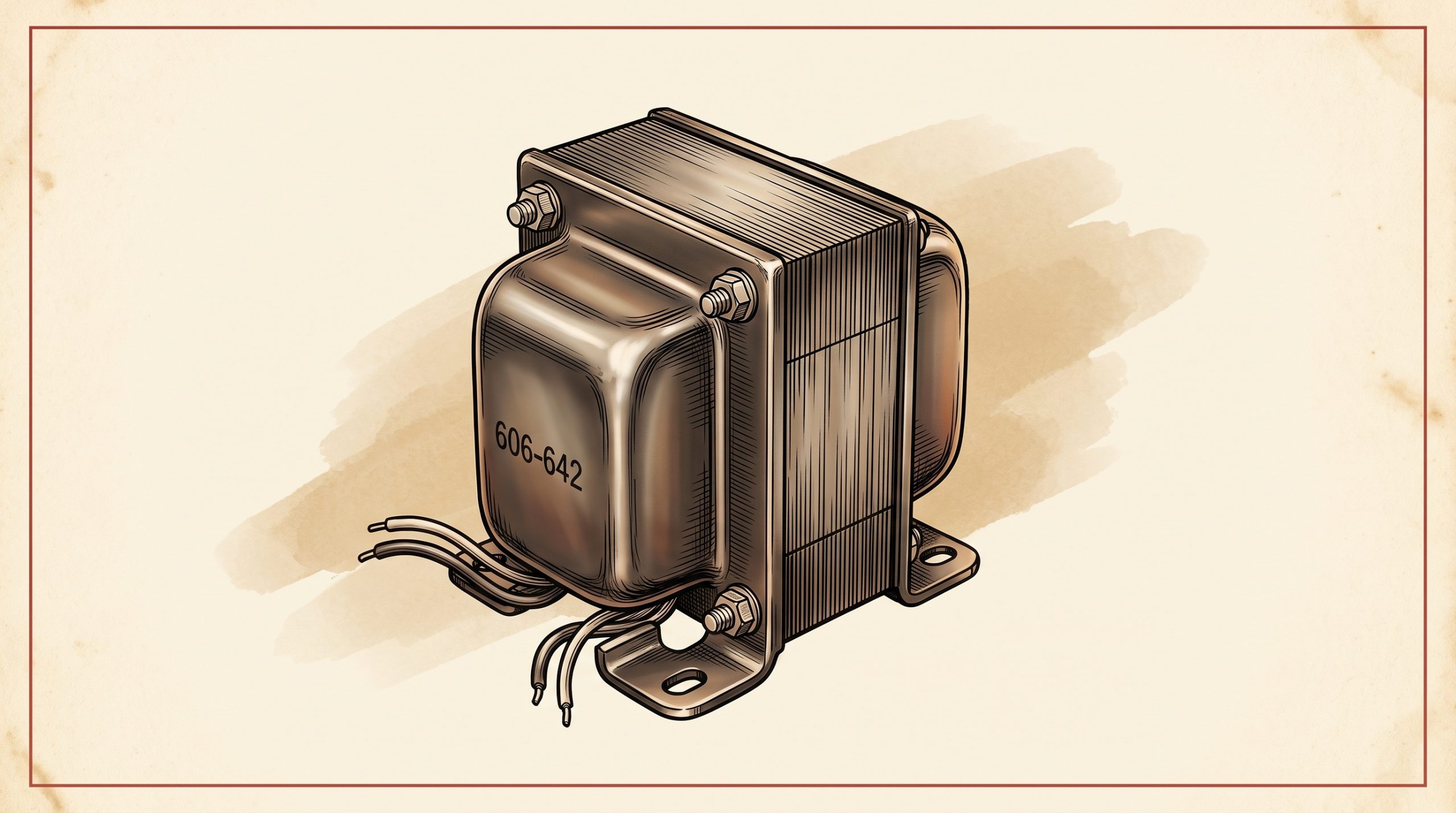
Transformer date codes are often the most reliable way to date a vintage Fender amp, particularly for silverface models built after mid-1967 when Fender stopped stamping tube charts. The code is printed or stamped directly on the power transformer, output transformer, choke, and reverb transformer of most post-tweed Fenders. The catch: the year portion is only one digit, so “6” could mean 1956, 1966, or 1976. This article shows you exactly how to crack the ambiguity and get a confident manufacture date from any transformer on your bench.
What Is the EIA 606 Code?
EIA Standard 606 Explained
EIA stands for Electronic Industries Alliance, formerly the Electronic Industries Association. Starting in the late 1940s, the organization maintained a voluntary date-coding standard adopted widely across US electronics manufacturing. Component makers stamped their assigned EIA manufacturer code followed by abbreviated production date information, giving service technicians and supply chain managers a traceable production record without access to internal factory logs.
The system shows up throughout vintage Fender amps. Speaker cones carry EIA codes too: 220 for Jensen, 465 for Oxford, 137 for CTS. The transformer codes work on the same principle, just with a different prefix. The Fender amp dating cheat sheet covers all of these code families in one quick-reference table if you need to cross-check multiple components at once.
Why Fender Used EIA Codes
Fender didn’t wind its own transformers. The company sourced them from outside vendors, primarily Schumacher Electric Corporation, and those vendors stamped their own EIA codes as part of standard production practice. Fender didn’t need to create a separate dating system. The codes were already there, baked into the component by the supplier, and they’ve been helping collectors date amps ever since.
One important clarification: the “606” prefix is not a generic EIA standard number. It’s specifically Schumacher Electric’s registered manufacturer identifier. Every transformer with a 606 prefix came out of Schumacher’s facility. Not Fender’s. Not a generic parts house. Schumacher.
How to Read a Fender Transformer Date Code
The Basic Code Structure
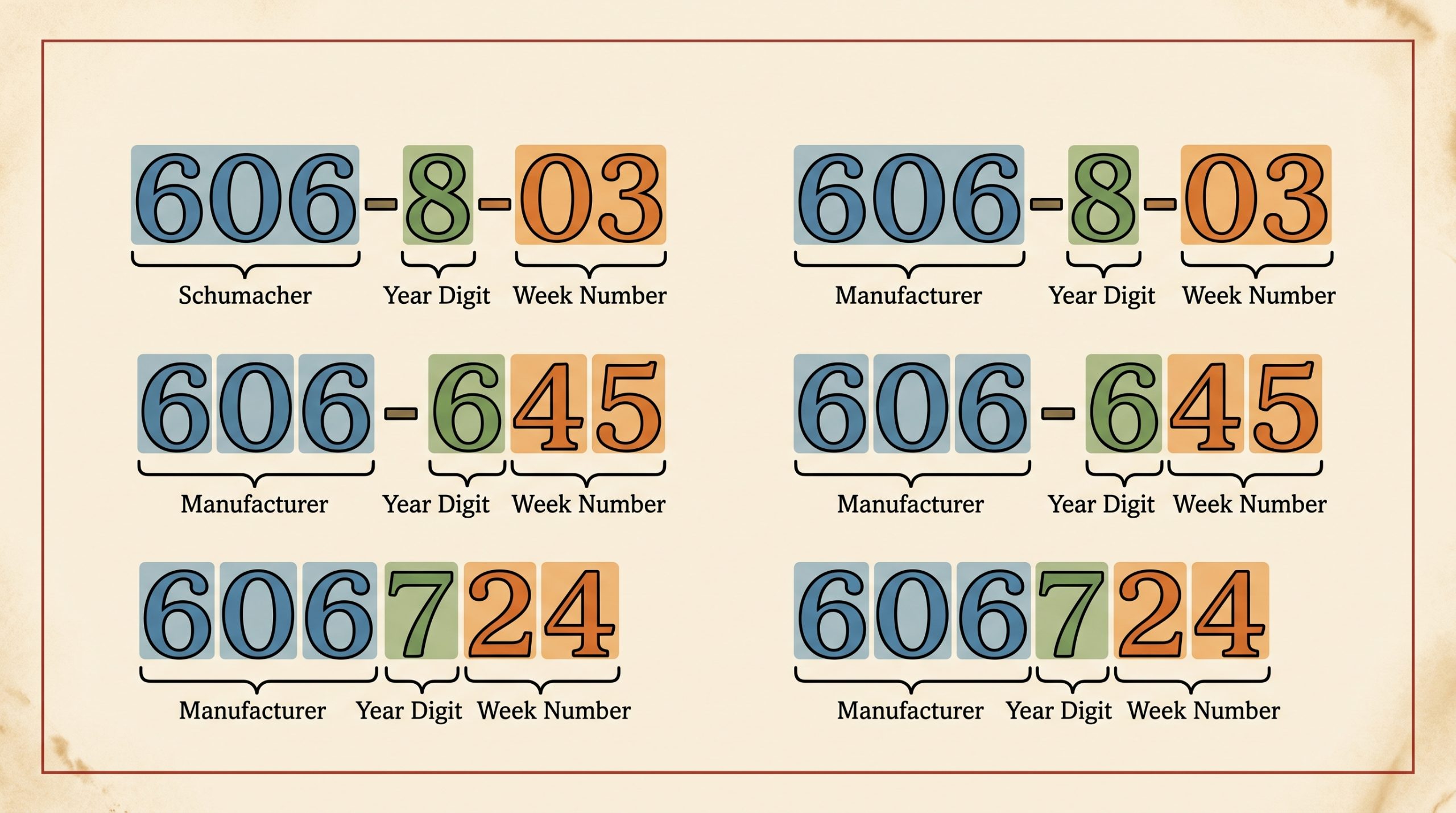
Three formats appear across the vintage production run, all encoding the same information:
| Format | Example | Common Era |
|---|---|---|
| Dashed, three-part | 606-8-03 | Late 1950s to mid-1960s |
| Dashed, two-part | 606-645 | Mid-1960s to early 1970s |
| Undashed, run-together | 606724 | Late 1960s through 1980s |
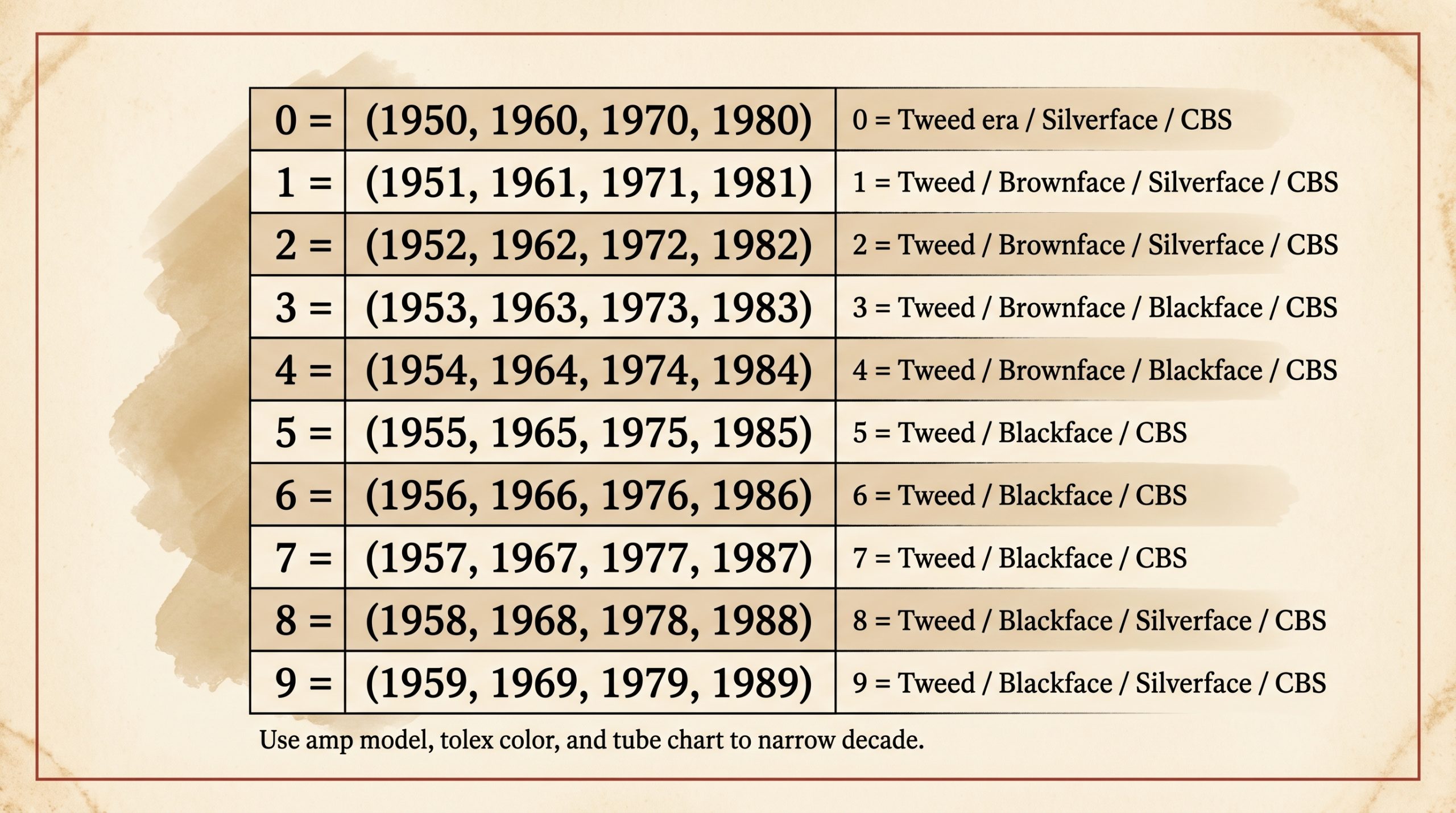
Every format breaks down into three segments. The “606” prefix identifies Schumacher Electric. The next single digit is the last digit of the production year. The final two digits are the week of the year, numbered 01 through 52. As the Hoffman Amplifiers forum documents in its EIA 606 thread at EL34 World, “the first X represents the year” and “the second and third Xs represent the week of the year.” The decade ambiguity is the reader’s job to resolve using context from the amp itself.
Step-by-Step Decoding Walkthrough
Three real-world examples, worked through completely:
Example 1: 606-645
Year digit: 6, so 1956, 1966, or 1976.
Week: 45, which falls in early November.
On a blackface-cosmetic amp, that 6 is almost certainly 1966. On a silverface, 1976. Not complicated once you know the era.
Example 2: 606724
Year digit: 7, so 1967 or 1977.
Week: 24, which falls in mid-June.
A silverface Vibrolux with this code on its power transformer was built no earlier than mid-June of that year. Serial number context resolves which decade.
Example 3: 606-8-03
Year digit: 8, so 1958, 1968, or 1978.
Week: 03, which is the third week of January.
On a tweed-era amp, 1958 is the obvious read. On a silverface, 1968 or 1978 depending on circuit codes and serial number prefix.
Week-Number to Calendar Month Reference
This table converts the two-digit week number into an approximate calendar month. No competitor currently publishes this in a clean format, so here it is:
| Week Numbers | Approximate Month |
|---|---|
| 01–04 | January |
| 05–08 | February |
| 09–13 | March |
| 14–17 | April |
| 18–22 | May |
| 23–26 | June |
| 27–30 | July |
| 31–35 | August |
| 36–39 | September |
| 40–43 | October |
| 44–47 | November |
| 48–52 | December |
Week 53 occasionally appears in certain calendar years. It’s not a stamping error. It falls in the last days of December and can be treated as a late-December date for practical purposes.
Format Variations: Dashed vs. Non-Dashed
Why Two Formats Exist
The dashed format (606-X-XX or 606-XXX) was the earlier production convention and remained dominant through roughly the mid-1960s. The run-together format (606XXX) became standard through the late 1960s and 1970s. The transition wasn’t clean or simultaneous across all transformer types. On the same amp, the power transformer might carry a dashed code while the output transformer uses the run-together format. This doesn’t indicate anything unusual about the amp’s history. It’s a labeling convention difference from the supplier, not a sign of replaced components.
Functionally, both formats encode identical information. There is no difference in accuracy or reliability between them.
The Rare Two-Digit Year Format
A small number of transformers from the 1967-1969 production window use a two-digit year variant. The code might look like 606-6827, where “68” is the year (1968) and “27” is the week. Uncommon. Mostly confined to certain production runs from that transitional period.
If you’re looking at a six-digit code after the “606-” prefix, check whether the first two digits form a plausible two-digit year (65, 66, 67, 68, 69) before reading the first digit as a single-digit year code. A code of 606-6724 on a silverface amp from the late 1960s likely decodes as 1967, week 24, not year-digit 6, week 724 (which is nonsensical anyway).
Where to Find the Code on the Amp
The Four Transformer Locations
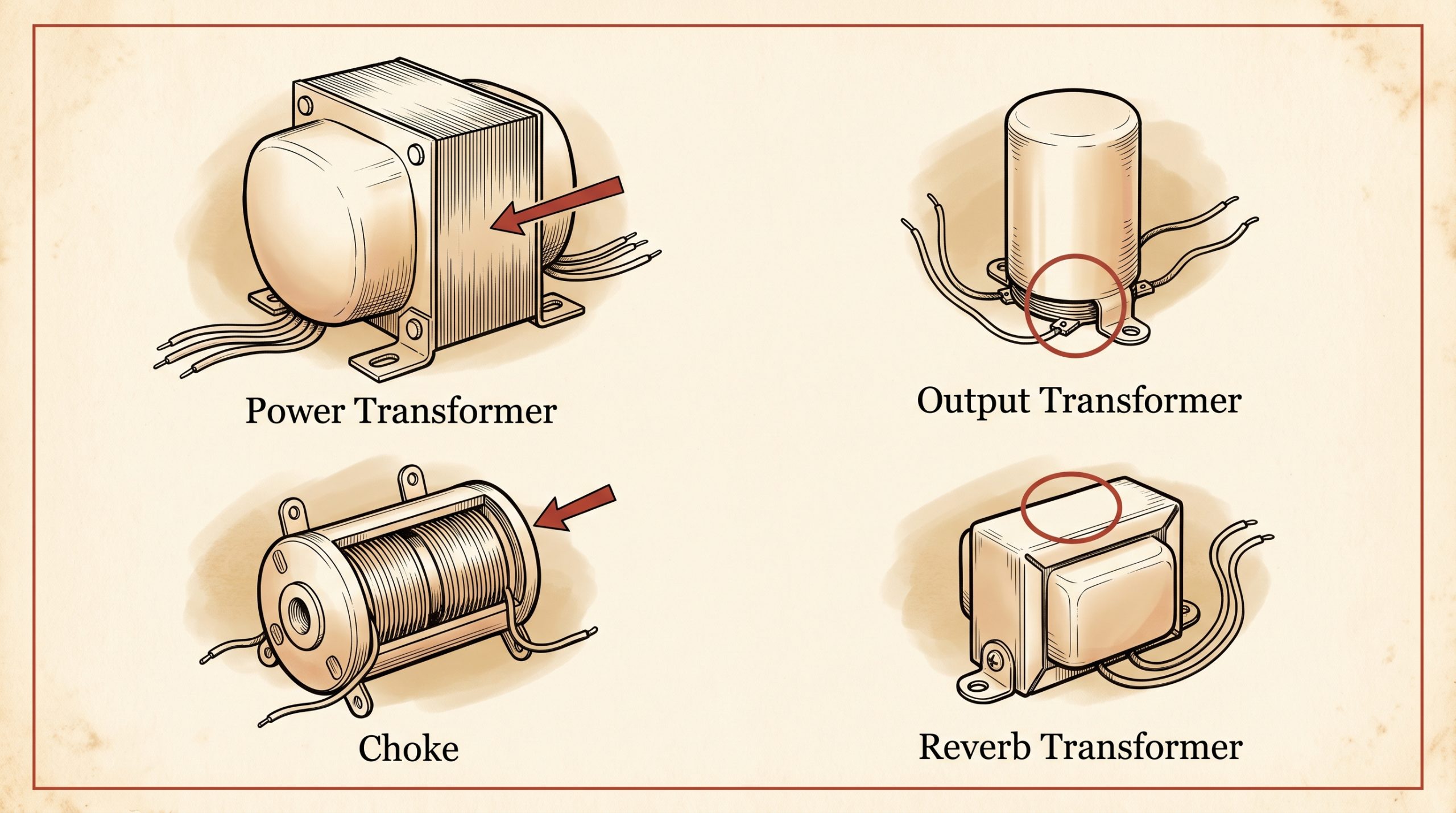
Most reverb-equipped Fenders carry four transformers, each with its own date code stamp:
- Power Transformer (PT): The largest transformer, mounted on the top plate of the chassis. This is the primary dating source and the first code to read.
- Output Transformer (OT): Mounted adjacent to the PT on most models. Secondary dating reference, usually within a few weeks of the PT code.
- Choke: Present on most Fender circuits, including non-tremolo models. Smaller unit, sometimes tucked close to the filter cap board near the rear of the chassis.
- Reverb Driver/Recovery Transformer: Present only on reverb-equipped models (Princeton Reverb, Super Reverb, Twin Reverb, Pro Reverb, and others). It’s the small transformer positioned near the reverb tank connection point.
Non-reverb models (Champ, Bassman, tweed-era amps) will have only two or three transformers. Read every one you can find and record all the codes before drawing conclusions.
Practical Access Notes
Codes are stamped on the bell ends of the transformer cores or printed on paper labels wrapped around the transformer body. Ink-stamped codes may be partially obscured by decades of grime, oxidation, or paint overspray from a cabinet refinish. A flashlight and a cotton swab dampened with isopropyl alcohol will clean most codes without damaging them. Go gently.
Never remove the transformers just to read the codes. Chassis removal from the cabinet is sufficient on nearly every Fender combo and head design. The codes are accessible from the underside of the chassis with the amp safely resting on its back.
Using Multiple Transformers to Pinpoint the Date
Why Multiple Codes Matter
Schumacher supplied transformers in production batches. Fender purchased inventory that could sit in a warehouse for weeks before chassis assembly began. Normal. Expected. On any given amp, the four transformers will typically show dates within four to twelve weeks of each other. An occasional outlier six or more months earlier than the rest almost always indicates warehouse stock, not a replaced part. A single outlier that is significantly later than all others is a different story, covered in the conflict-resolution section below.
The “Latest Code Sets the Floor” Rule
The amp couldn’t have been assembled before all its components existed. That’s the logic. The transformer with the latest date code establishes the earliest possible assembly date for the amp. For production models, Fender typically assembled chassis within weeks to a few months after transformer delivery, so the latest code usually puts you within one quarter of the actual build date.
Worked Example: Silverface Super Reverb
| Transformer | Code | Decoded |
|---|---|---|
| Power Transformer | 606-427 | Week 27, 1974 (mid-July) |
| Output Transformer | 606-429 | Week 29, 1974 (late July) |
| Choke | 606-433 | Week 33, 1974 (mid-August) |
| Reverb Driver | 606-441 | Week 41, 1974 (mid-October) |
The latest code here is week 41 of 1974, approximately mid-October. This amp was assembled no earlier than mid-October 1974 and most likely during a late-1974 or very early 1975 production run. Four consistent codes spanning 14 weeks. No red flags. This is exactly what an all-original amp looks like.
Era-Specific Date Code Patterns by Amp Era
Tweed Era (1950-1960)
EIA 606 codes are less consistent on tweed-era transformers. Many early units carry unstamped or non-standardized markings, particularly from the first half of the 1950s. When codes are present, decade disambiguation is straightforward: a year digit of “5” on a tweed amp with a 5E3 or 5F6-A circuit code is 1955, not 1965. The cosmetic style and circuit designation together eliminate any ambiguity. Confirmed circuit codes for this era include the 5E3 (Deluxe), 5F6-A (Bassman), and 5E4 (Super).
Brown and Blonde Era (1960-1963)
EIA 606 codes become consistent and standardized during this window. The dashed format (606-X-XX) is essentially universal for 1960-1963 production. Year digits in play are 0 (1960), 1, 2, and 3. Decade disambiguation is again simple: no brown or blonde cosmetic amp is from the 1970s. Circuit codes for reference: 6G2 (Princeton), 6G3 (Deluxe), 6G15 (Reverb Unit).
Blackface Era (1963-1967)
The most thoroughly documented era for transformer codes. Year digits run from 3 through 7, and decade disambiguation is clean for most of the run. Any transformer with a “6” digit is 1966, not 1976, on a blackface-cosmetic amp. The overlap point comes at year digit “7”: blackface amps with week codes above approximately week 38 of 1967 may be transitional silverface builds assembled before the cosmetic change took full effect on the production line.
Tube charts are present on blackface amps through roughly mid-1967, which makes cross-verification straightforward for most of this era. The master reference for dating and authenticating blackface serial numbers is the Fender tube amp serial number guide, which covers transformer codes alongside tube chart letters and serial prefixes in a single integrated framework. Circuit codes to know: AA1164, AB763, AA864.
Silverface Era (1967-1981)
No tube chart date codes after approximately mid-1967. Transformer codes become the primary dating method for this entire era. The decade problem is real here: year digits 7 through 0 repeat, covering both the late 1960s and late 1970s. Serial number prefix context is required to resolve the decade. Year digit “7” might be 1967 or 1977. Year digit “0” might be 1970 or 1980.
Some silverface amps from the late 1960s and 1970s carry an exact date stamp (day, month, year) ink-stamped inside the chassis on the component side. Check for this before relying solely on transformer codes. If it’s there, it’s your most precise data point. Circuit codes by sub-era: AA270 (early silverface), AA1069 (mid silverface), AA1172 (master volume series).
Cross-Referencing: Transformer vs. Tube Chart vs. Serial Number
The Three Dating Methods at a Glance
| Method | Available On | Accuracy | Decade-Specific? |
|---|---|---|---|
| Tube Chart Letter Code | Tweed through blackface (to mid-1967) | Plus or minus one month | Yes |
| Transformer EIA 606 Code | All post-tweed Fenders | Plus or minus two months | No, requires context |
| Chassis Serial Number | All eras | Plus or minus one year | Yes |
| Interior Ink Date Stamp | Some silverface (late 1960s to 1970s) | Exact date | Yes |
How to Use All Three Together
Start with the serial number. It establishes the decade without ambiguity. Then read the tube chart if your amp was built before mid-1967, which gives you year and month. Cross-check against the transformer codes: they should agree within one to three months. If you’re working on a silverface with no tube chart, the serial number sets the decade and the transformer codes give you the week and year within that decade. That combination gets you to within a calendar quarter on virtually any vintage Fender.
The Fender amp serial number lookup organizes serial prefixes by era and model, which is the fastest starting point for the decade disambiguation step.
Tube Chart Letter Code Quick Reference
| Letter | Year | Letter | Month | |
|---|---|---|---|---|
| A | 1951 | A | January | |
| B | 1952 | B | February | |
| C | 1953 | C | March | |
| D | 1954 | D | April | |
| E | 1955 | E | May | |
| F | 1956 | F | June | |
| G | 1957 | G | July | |
| H | 1958 | H | August | |
| I | 1959 | I | September | |
| J | 1960 | J | October | |
| K | 1961 | K | November | |
| L | 1962 | L | December | |
| M | 1963 | |||
| N | 1964 | |||
| O | 1965 | |||
| P | 1966 | |||
| Q | 1967 |
As documented at VintageFenderAmpRepair.com, a tube chart stamped “OB” indicates 1965/February. “HH” is 1958/August. Clean, consistent, and reliable through the end of the blackface production run.
Schumacher Electric: Who Actually Made Fender Transformers
Schumacher’s Role as Fender’s Primary Supplier
Schumacher Electric Corporation, based in Chicago, Illinois, was Fender’s primary transformer supplier from the late 1950s through the silverface era and into the early CBS period. EIA manufacturer code 606 is Schumacher’s exclusive registered identifier. Schumacher wound power transformers, output transformers, chokes, and reverb transformers to Fender’s printed specifications. They weren’t a generic parts house: they built to Fender’s own winding specs, which is why original Schumacher units retain value among collectors doing restorations.
Are All 606 Codes Schumacher?
Yes. The 606 prefix is exclusively Schumacher’s EIA registration. Full stop. Replacement transformers from Mercury Magnetics, Magnetic Components Inc., or Classictone will not carry a 606 prefix. That absence is an authentication indicator when you’re evaluating an amp for originality. After Fender moved to offshore manufacturing in the early 1980s, 606-stamped Schumacher codes become rare on new production, which makes their presence (or absence) a useful era marker on its own.
Other EIA Manufacturer Codes on Vintage Fender Amps
| EIA Code | Manufacturer | Component Type |
|---|---|---|
| 606 | Schumacher Electric | Transformers |
| 220 | Jensen | Speakers |
| 465 | Oxford | Speakers |
| 137 | CTS | Speakers and potentiometers |
| 285 | Rola | Speakers |
| 67 | Eminence | Speakers |
When the Codes Don’t Agree: Conflict Resolution
Common Mismatch Scenarios and What They Mean
Scenario A: One transformer is significantly earlier than the others. This is almost always warehouse stock. Schumacher produced in volume batches and Fender maintained inventory. A transformer dated four to six months earlier than the rest is not a red flag. More than twelve months is worth a closer look, but still not automatically suspicious on its own.
Scenario B: One transformer is significantly later than the others. Different situation entirely. If three transformers cluster within six weeks of each other and the fourth is six months or more later, that outlier was replaced at some point in the amp’s service life. It doesn’t affect playability, but it does affect collector value and should be disclosed in any sale listing.
Scenario C: Transformer dates suggest a different era than the cosmetic style. Example: silverface cosmetics but transformer codes reading 1966. This is either a transitional-era build (late 1967, before cosmetics fully changed) or the amp’s faceplate has been replaced. Cosmetic re-facing was common service work in the 1970s and 1980s. The serial number is the tiebreaker here. Fender’s own documentation at support.fender.com confirms that post-1990 amps include QA sticker date codes, which helps rule out very late refacing situations.
The “One Replacement, Rest Original” Rule
Three consistent codes within six weeks of each other plus one outlier equals one replaced transformer. Simple. Document the anomaly with photos and disclose it clearly. That transparency protects a seller and gives a buyer confidence in the data. Not great for maximum collector value, but it’s the honest call.
Spotting Replacement Transformers: Authentication Red Flags
What to Look For
Several physical and code-based indicators point to non-original transformers:
- Non-606 prefix: Mercury Magnetics carries no EIA stamp. Magnetic Components Inc. uses a different prefix entirely. Classictone units are similarly identifiable as non-Schumacher. All are legitimate and sometimes sonically superior replacements, but they’re not original.
- Mismatched bell-end dimensions: Replacement transformers often have slightly different profiles from the original Schumacher units. Visible side-by-side if you know what factory spec looks like.
- Fresh solder at mounting hardware: Recent removal and reinstallation leaves evidence around mounting bolts and on transformer lead connections. Look for shiny solder that doesn’t match the rest of the aged joints under the chassis.
- Date code wildly out of era: A “606-945” (week 45, 1999) on a blackface amp is conclusively a replacement. No argument.
Acceptable vs. Problematic Replacements
| Situation | Collector Impact | Playability Impact |
|---|---|---|
| OT replaced with Schumacher NOS, same spec | Moderate value reduction | None |
| PT replaced with Mercury Magnetics | Moderate value reduction | Often improved headroom |
| Both PT and OT replaced | Significant value reduction | Varies by spec match |
| All transformers replaced | Major value reduction | Playable but not original |
Wrapping Up
The full decode method in one pass: identify the EIA 606 prefix (Schumacher), read the single year digit, read the two-digit week, use the amp’s serial number and cosmetic era to assign the correct decade, and convert the week number to a calendar month using the table above. Read all four transformers on the amp and use the latest code as the earliest possible build date. Cross-check against the tube chart if one is present. Discrepancies between codes point toward replaced components, not dating errors.
| Code Segment | What It Means | Example |
|---|---|---|
| 606 | Schumacher Electric (manufacturer) | Always present on original Fender transformers |
| Next 1 digit | Last digit of production year | 6 = 1956, 1966, or 1976 |
| Final 2 digits | Week of production year (01-52) | 45 = approximately early November |
| Full code: 606-645 | Schumacher, year ending in 6, week 45 | Approximately November 1966 on a blackface amp |
If you’re working through a full authentication and need to combine transformer codes with serial number ranges and tube chart letters in one place, the Fender amp dating cheat sheet puts all three methods on a single reference page organized by production era. That’s the fastest way to cross-check everything once you’ve pulled the individual codes from your amp.
Frequently asked questions
How do you date a Fender transformer?
Read the EIA 606 code stamped or labeled on the transformer body. The digits after "606" break into a single year digit followed by a two-digit week number. The year digit is the last digit of the production year (a "6" could be 1956, 1966, or 1976), so you'll need to establish the decade from the amp's cosmetic era, circuit code, or serial number prefix. Once the decade is set, the code gives you a production date accurate to within roughly two weeks.
How do I tell what year my Fender amp was made?
Use three methods together. If your amp was built before mid-1967, start with the two-letter date code on the tube chart (first letter = year, second letter = month). Then read the EIA 606 transformer codes on all four transformers and verify they agree. For silverface amps without tube charts, the serial number establishes the decade and the transformer codes give you the specific year and week. Some silverface chassis also carry an exact ink date stamp inside the component side of the chassis, which is the most precise dating method when present.
What does "606" mean on a Fender amp transformer?
"606" is the EIA-registered manufacturer code for Schumacher Electric Corporation, the Chicago-based company that wound transformers for Fender from the late 1950s through the 1970s. It is not a Fender part number, a model code, or a generic EIA designation. It identifies Schumacher as the maker, full stop. Every transformer stamped 606 came out of Schumacher's facility.
Can transformer date codes be faked?
Physically stamping a false date code is possible but uncommon in practice. More frequently encountered is the installation of period-correct Schumacher transformers salvaged from a different (lower-value) amp to make a stripped or incomplete unit appear more original. This is why all four codes need to be read and cross-referenced against each other and against the serial number. Four consistent codes that also align with the serial number date range provide strong authentication. One or two codes in isolation are less conclusive.
What if my transformer has no date code?
Pre-tweed and early tweed transformers frequently carry no EIA stamp. Some replacement units also lack codes. In these cases, fall back on the tube chart date code if the amp predates mid-1967, cross-reference the serial number, and use cosmetic era identification as supporting context. Absence of an EIA code alone doesn't confirm a replacement, particularly on amps from before 1955.