Contents
- 01Spec Comparison at a Glance
- 02A Brief History of Both Amps
- 03The Core Technical Differences That Drive the Tone
- 04How They Sound: Tone Character Compared
- 05Real-World Gig Scenarios
- 06Vintage Buying Guide
- 07Famous Players: Who Used What and Why
- 08Modifications and Upgrades
- 09Which Amp Fits Your Playing
- 10Frequently Asked Questions
- Pro Reverb circuit codes: AA165 (blackface, running change to AB668), AA1069 / AA270 (silverface)
- Twin Reverb circuit codes: AB763 (blackface, 1963-1967), AC568 / AA769 / AA1270 (early silverface, 1968-1972)
- Output power: 40W RMS (Pro Reverb) vs 85W RMS blackface / 100W silverface master-volume era (1972-1976) / 135W silverface ultralinear era (1976-1981) (Twin)
- Rectifier: GZ34 tube (Pro Reverb) vs solid-state diode bridge (Twin Reverb)
- Output tubes: 2x 6L6GC (Pro Reverb) vs 4x 6L6GC (Twin Reverb)
- Weight: Pro Reverb approx. 50 lbs blackface; Twin Reverb approx. 67 lbs blackface (estimates vary across sources by speaker configuration)
- Vintage blackface pricing: Pro Reverb $1,800-$3,500 / Twin Reverb $1,500-$3,200 (market varies by originality)
- Myth: The Pro Reverb is just a quieter Twin. False. The rectifier type creates fundamentally different playing feel, not just volume.
- Myth: Early silverface amps are tonally inferior. AA1069 Pro Reverb (1968-1972) is circuit-identical to the blackface AA165 and often undervalued.
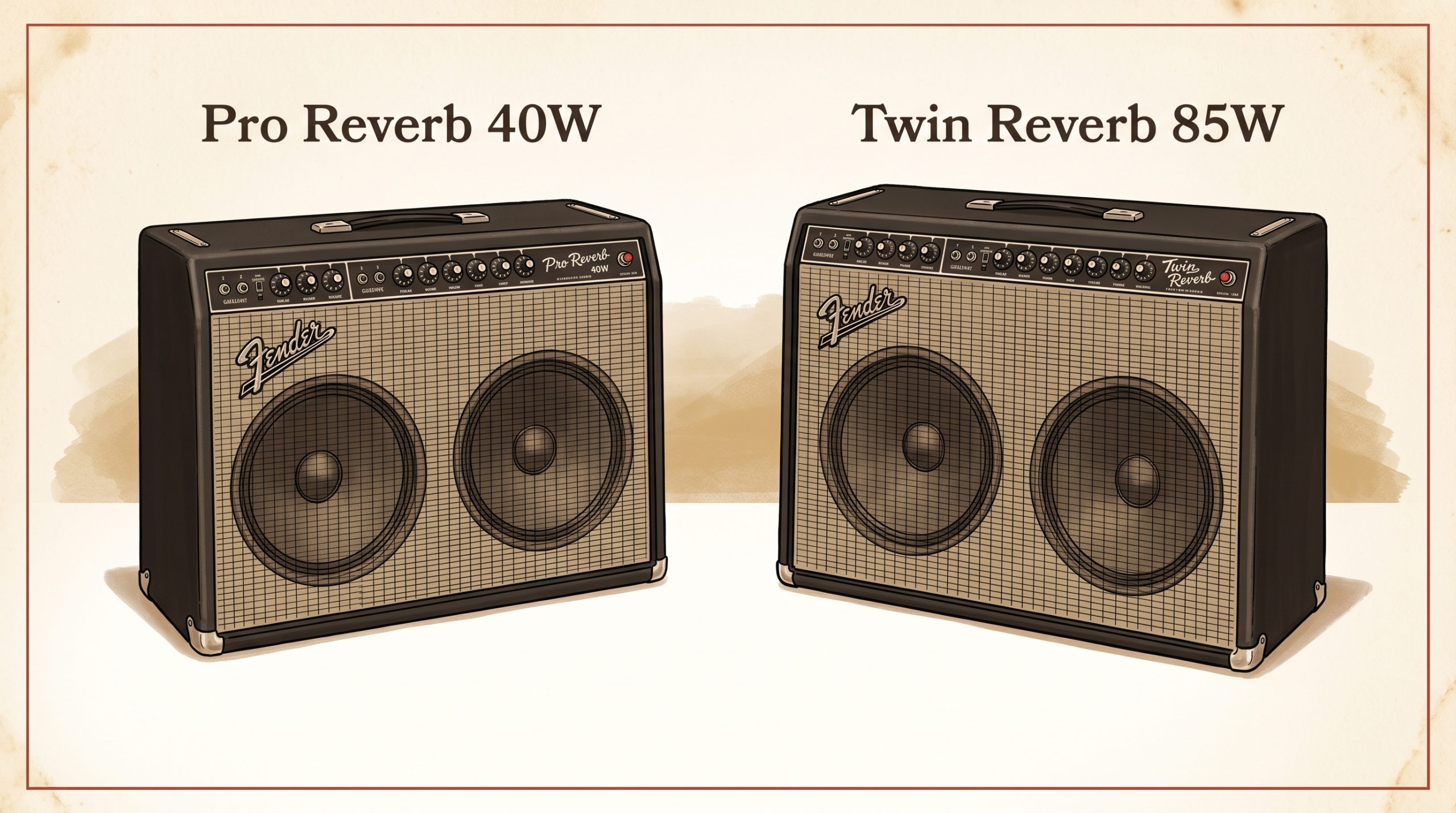
Spec Comparison at a Glance
Before going deeper, here’s the full side-by-side data. Both blackface and silverface variants are covered below, because the circuit shift between eras isn’t cosmetic, it’s electrical.
| Spec | Pro Reverb | Twin Reverb |
|---|---|---|
| Circuit (Blackface) | AA165 | AB763 |
| Circuit (Silverface) | AA1069 / AA270 | AC568 / AA769 / AA1270 (early SF) |
| Production Years | 1965-1982 | 1963-Present |
| Output Power | 40W RMS | 85W RMS (BF) / 100W (SF master-volume era, 1972-1976) / 135W (SF ultralinear era, 1976-1981) |
| Output Tubes | 2x 6L6GC | 4x 6L6GC |
| Rectifier | Tube, GZ34 / 5AR4 | Solid-state diode bridge |
| Preamp Tubes | 4x 12AX7, 2x 12AT7 | 4x 12AX7, 2x 12AT7 |
| Original Speakers | 2x 12″ Jensen C12N or Oxford | 2x 12″ Jensen C12N / JBL D120F (optional) |
| Approx. Weight (BF) | ~50 lbs | ~67 lbs |
| Output Transformer | Smaller OT, contributes to sag and early saturation | Larger OT, stiff and efficient at full draw |
| Channels | Normal + Vibrato | Normal + Vibrato |
| Street Value (Vintage BF) | $1,800-$3,500 | $1,500-$3,200 |
The silverface era adds meaningful circuit wrinkles that affect both amps differently:
| Silverface Difference | Pro Reverb | Twin Reverb |
|---|---|---|
| Early SF Circuit (1968-1972) | AA1069, virtually identical to AA165 | AC568 through 1969, then AA769 (1969-70) and AA1270 (1970-72), running changes |
| Visual ID Change | Added mid control on AA1069 | Silver grille, drip edge cosmetics |
| Mid-1970s Change | AA270 circuit, output stage updates | Master volume added (1972), ultralinear output transformer added later (1976-77) |
| Ultralinear OT | Not applied | Applied from 1976-77, changes character significantly, raises output to 135W |
| Master Volume Version | Not standard | Added 1972, introduces additional gain stage and raises output to 100W |
A Brief History of Both Amps
The Twin Reverb: Fender’s Flagship (1963-Present)
The Twin Reverb arrived in 1963 running the AB763 blackface circuit, positioned at the top of Fender’s combo lineup. The design goal was headroom above everything else. Country pickers, jazz players, and session musicians needed an amp that stayed clean at stage volume without breaking a sweat. Fender delivered exactly that: four 6L6GC output tubes, solid-state rectification for zero voltage sag, and a transformer spec large enough to handle the full output stage draw without compression.
The silverface transition hit in 1968. Circuit AC568 brought minor changes initially, running further to AA769 (1969-70) and AA1270 (1970-72) before the master-volume update in 1972 and the ultralinear output transformer modification in 1976-77 meaningfully altered the character of late silverface Twins. Production was high throughout both eras, which is why clean Twin Reverbs still show up regularly at fair prices despite their flagship status. Original Jensen C12N speakers carry EIA code 220-xxx, and factory JBL D120F-equipped examples command premium prices today. Dating either amp accurately starts with the tube chart circuit code stamped inside the back panel, cross-referenced against chassis and transformer codes. The Fender tube amp serial number and date code reference covers the full EIA transformer code decoder for both Schumacher (606-xxx) and Oxford (465-xxx) units.
The Pro Reverb: The Overlooked 2×12 (1965-1982)
The Pro Reverb came later, introduced in 1965 after the reverb and vibrato feature set was already established across the blackface lineup. Circuit AA165 (running change to AB668). It sat between the Deluxe Reverb and the Twin in Fender’s hierarchy, which sounds like a comfortable middle position but translated to lower production numbers throughout its run. Fewer units were made. That relative rarity isn’t widely understood, which is part of why the Pro Reverb is routinely underpriced compared to its blackface siblings.
The silverface AA1069 (1968-1972) is circuit-identical to the AA165 and visually distinguishable by the added mid control on the panel. These early silverface examples frequently sell at a discount relative to their blackface counterparts despite sounding essentially the same. The full Pro Reverb production history, circuit evolution through AA270, and chassis stamp identification details are covered in the Fender Pro Reverb model guide.
The Core Technical Differences That Drive the Tone
Output Power: 40W vs. 85W and What It Actually Means
The wattage gap sounds dramatic. It isn’t, at least not the way most players think about it. Doubling power produces roughly 3dB of additional volume. The Twin Reverb’s 85W puts it approximately 3.3dB louder than the Pro Reverb’s 40W at equivalent settings. In a room, that’s a noticeable difference, but not the “twice as loud” margin many expect. What changes more meaningfully is where each amp begins to compress and saturate.
A 40W amp pushed to full output reaches its electrical limits well before an 85W amp driven to the same SPL. At a given volume level where the Pro Reverb is starting to bark when pushed, the Twin Reverb still has roughly 6dB of clean headroom remaining. That’s the practical difference: the Pro breaks up earlier at useful stage volumes, and the Twin holds clean tone in situations that would push the Pro into compression. Neither outcome is wrong. They’re just different tools.
Rectifier Type: Tube GZ34 vs. Solid-State Diodes
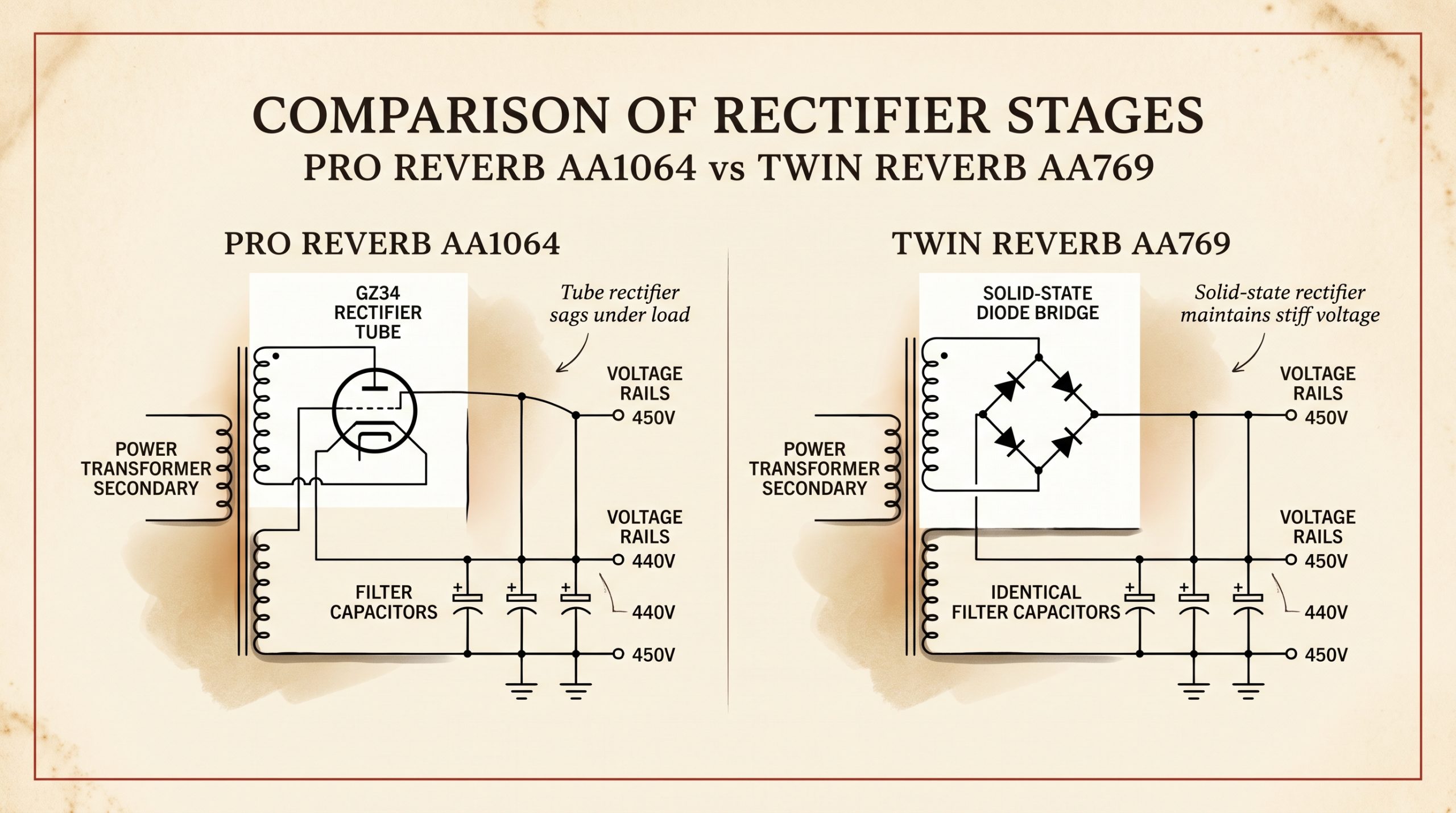
This is the tonal difference most forum discussions underexplain, and it matters more than the wattage gap. The Pro Reverb uses a GZ34 (also designated 5AR4) tube rectifier. The Twin Reverb uses solid-state diodes. Not a subtle distinction.
A tube rectifier introduces voltage sag under transient load. When you hit a hard chord, the rectifier tube can’t deliver current instantaneously. Supply voltage drops briefly. The output stage receives slightly less voltage during that transient, producing a characteristic compression and harmonic softening on the pick attack. That “give” is what players describe when they say an amp feels alive under the fingers. Spongy compression and a three-dimensional clean tone that responds to how hard you dig in.
Solid-state diodes in the Twin deliver current instantly. No sag, no compression, no soft transient response. The attack is tight and defined, the bass is stiff, and the overall feel is more hi-fi and controlled. That stiffness makes the Twin an excellent pedal platform because drive pedals behave predictably into a flat, uncompressed power supply. The GZ34 in the Pro Reverb is rated at 250mA maximum current, which pairs correctly with the two-tube 6L6GC output stage. Scaling up to four 6L6GC tubes would exceed that rating, which is exactly why the Twin runs solid-state rectification. The physics dictated the design. For a detailed breakdown of how rectifier tube selection affects sag behavior across GZ34, 5AR4, and 5Y3 variants, the GZ34/5AR4 rectifier guide covers the full electrical picture.
Practically: the Pro Reverb feels more like a vintage tweed in responsiveness. The Twin feels more like a studio monitor with tubes. Both descriptions are compliments, for different applications.
Output Transformer Differences
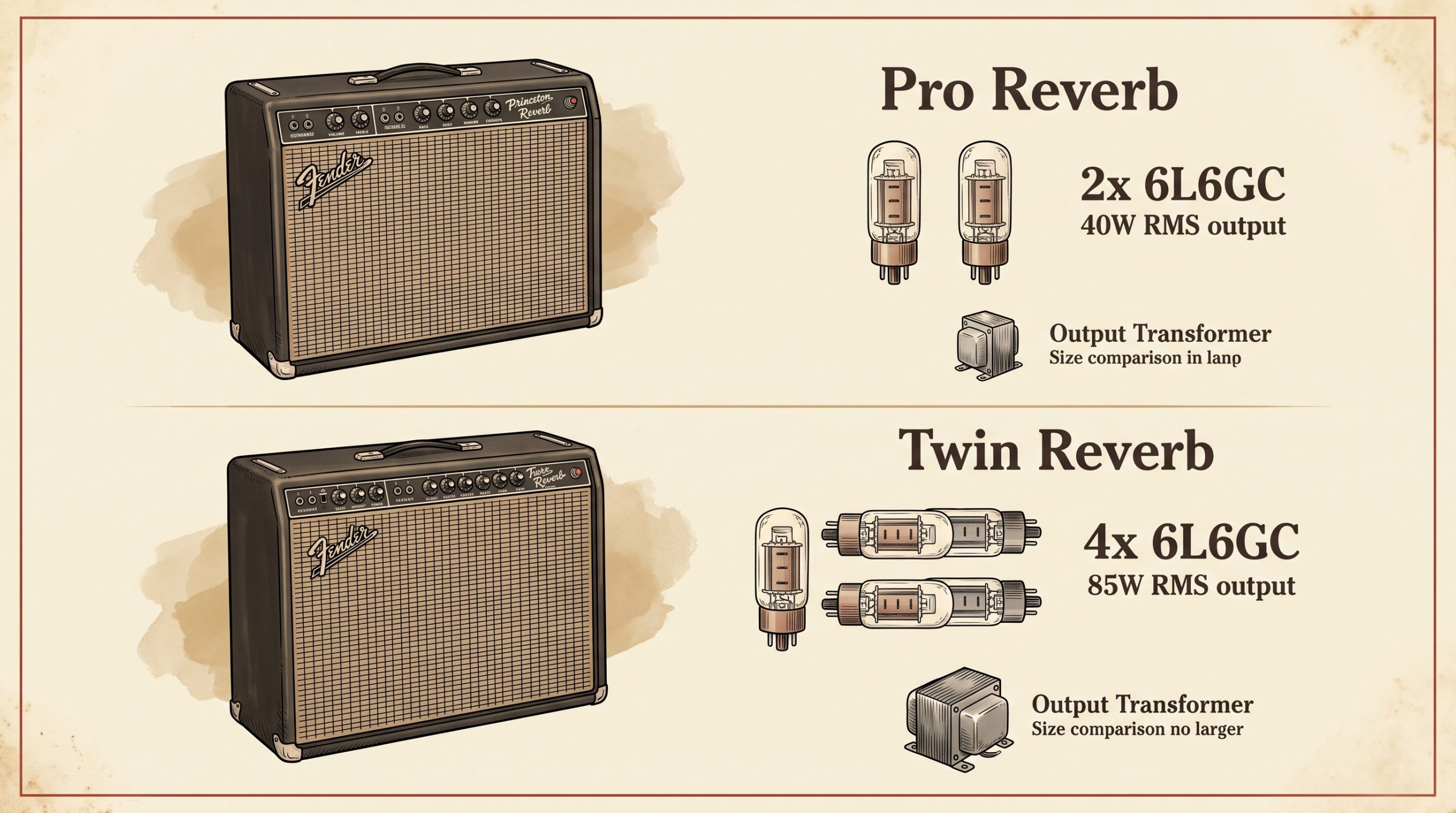
The Pro Reverb’s smaller output transformer contributes to earlier saturation and a looser distortion character when pushed. It’s not sized to handle four output tubes, so it reaches its limits more readily with two, adding a degree of musical compression at the transformer stage before the speaker even comes into play.
The Twin’s larger, higher-spec OT handles the four-tube output stage efficiently. Less compression, tighter response, more linear power delivery. When shopping vintage examples, transformer EIA codes are critical for confirming originality. Schumacher transformers carry 606-xxx codes, Oxford Electric transformers carry 465-xxx. Mismatched or replaced transformers affect both collector value and the amp’s electrical character.
Same Cabinet, Different Results
Both amps use an open-back 2×12 cabinet with nearly identical external dimensions. Both shipped with Jensen C12N or Oxford 12T6 speakers from the factory. The electronics, not the cabinet or speakers, account for the tonal differences between them. Swapping identical speaker sets into both amps doesn’t erase the rectifier and transformer gap. It doesn’t even come close. Speaker swaps change the presentation; the electronics change the feel.
How They Sound: Tone Character Compared
Clean Tone
The Twin Reverb’s clean tone is crystalline and glassy with a wide frequency spread. Tight bass, extended highs, very little coloration from the power supply. Players who want pristine clean headroom at volume consistently gravitate here. Country pickers in particular rely on that stiff, articulate response. The downside is that the Twin can feel unforgiving if you want the amp itself to contribute character at manageable volumes. It won’t.
The Pro Reverb produces a warmer low end, a slightly elevated midrange presence, and a softer transient response at the same dial positions. That’s the rectifier sag doing its job. The result is a clean tone with more apparent warmth and dimensionality, though at the cost of some of the crystalline definition the Twin delivers. Forum consensus documented at The Gear Page consistently describes the Twin as “harder sounding with less give” and the Pro as warmer with more natural mid presence. That tracks with the electrical explanation above.
Breakup and Overdrive Character
Push the Pro Reverb’s volume dial past 5 or 6 and the amp begins to compress and saturate with harmonic complexity. The GZ34 sag, the smaller output transformer, and 40W ceiling combine to create a layered breakup that rewards players with dynamic technique. Back off the pick attack and you get clean. Dig in and the amp opens up.
Not subtle. Very usable.
The Twin Reverb requires significantly higher volume to reach natural breakup, or a drive pedal doing the work upstream. That’s not a flaw for players who want a clean platform for external drive circuits. For players who want the amp itself to provide overdrive at club volumes, the Twin demands either a committed push at stage volume or a box in front of it.
Reverb and Vibrato
Both amps use the same Accutronics spring reverb tank design and optocoupler-based vibrato circuit in their blackface configurations. No meaningful tonal difference between the two in these respects. The circuits are functionally identical. The reverb decay, splash character, and vibrato warble are the same on both platforms.
Pedal Compatibility
The Twin Reverb is the industry standard clean pedal platform for a reason. Stiff power supply, wide frequency response, high headroom, minimal coloration. Overdrive, fuzz, modulation, and delay pedals all behave predictably because the amp doesn’t assert its own compression or sag into the signal chain. Complex pedalboards sound exactly as intended.
The Pro Reverb works well with drives and fuzzes that benefit from amp interaction. Germanium fuzz circuits in particular respond interestingly to rectifier sag. Some cascaded drive setups, however, interact unpredictably with the Pro’s softer power supply. Worth testing before committing if you run a complex board. Both amps present a 4-ohm output load matched to their respective 2×12 cabinet configurations, so impedance matching isn’t a variable that distinguishes them.
Real-World Gig Scenarios
Small Venues and Recording Studios
The Pro Reverb wins this category. At club volumes, the amp achieves natural compression and harmonic complexity at dial positions that don’t require hearing protection. Recording engineers working with vintage Fenders often prefer the Pro Reverb’s character precisely because the amp sounds “already happening” at 4 or 5 on the dial. The 50-pound weight is still significant for load-in, but the weight advantage over the Twin adds up fast across multiple gigs per week.
The Twin Reverb is noticeably heavier than the Pro Reverb, with vintage listings and amp-tech community estimates generally putting the gap somewhere in the 10-to-30-pound range depending on speaker choice and production year, without requiring any additional floor space, since the cabinet dimensions are nearly identical. That weight difference is real on stairs and at 1am after a four-set gig.
Large Stages and Live Performance Without Mic Support
The Twin Reverb’s domain. Headroom, projection, and clean definition at volumes where a Pro Reverb would be pushed well past its natural breakup point. Country players, jazz guitarists, and classic rock rhythm players who need to fill a room without a PA system have historically reached for the Twin for this reason. The 85W ceiling and solid-state rectifier deliver clean tone at volumes where most 40W amps have long since given up.
Pedal-Heavy Boutique Rigs
Twin Reverb, consistently. The stiff power supply means your Klon, your Strymon, and your four-stage modulation chain all sound exactly like themselves. The Pro Reverb can host a pedalboard, but the rectifier sag interacts with cascaded high-gain stages in ways that aren’t always predictable. If your tone lives in the pedals, give the pedals a flat surface to work with.
Blues, Classic Rock, and Touch-Sensitive Playing
The Pro Reverb is the sleeper pick here. Its dynamics and pick-attack response put it in tweed Deluxe territory for feel, at a fraction of tweed pricing, with the added reverb and vibrato circuits that the tweeds never had. Players who build their tone around dynamic technique consistently find the Pro Reverb responds in ways the Twin Reverb simply can’t replicate at equivalent volumes.
Vintage Buying Guide
Blackface vs. Silverface: Which Era to Buy
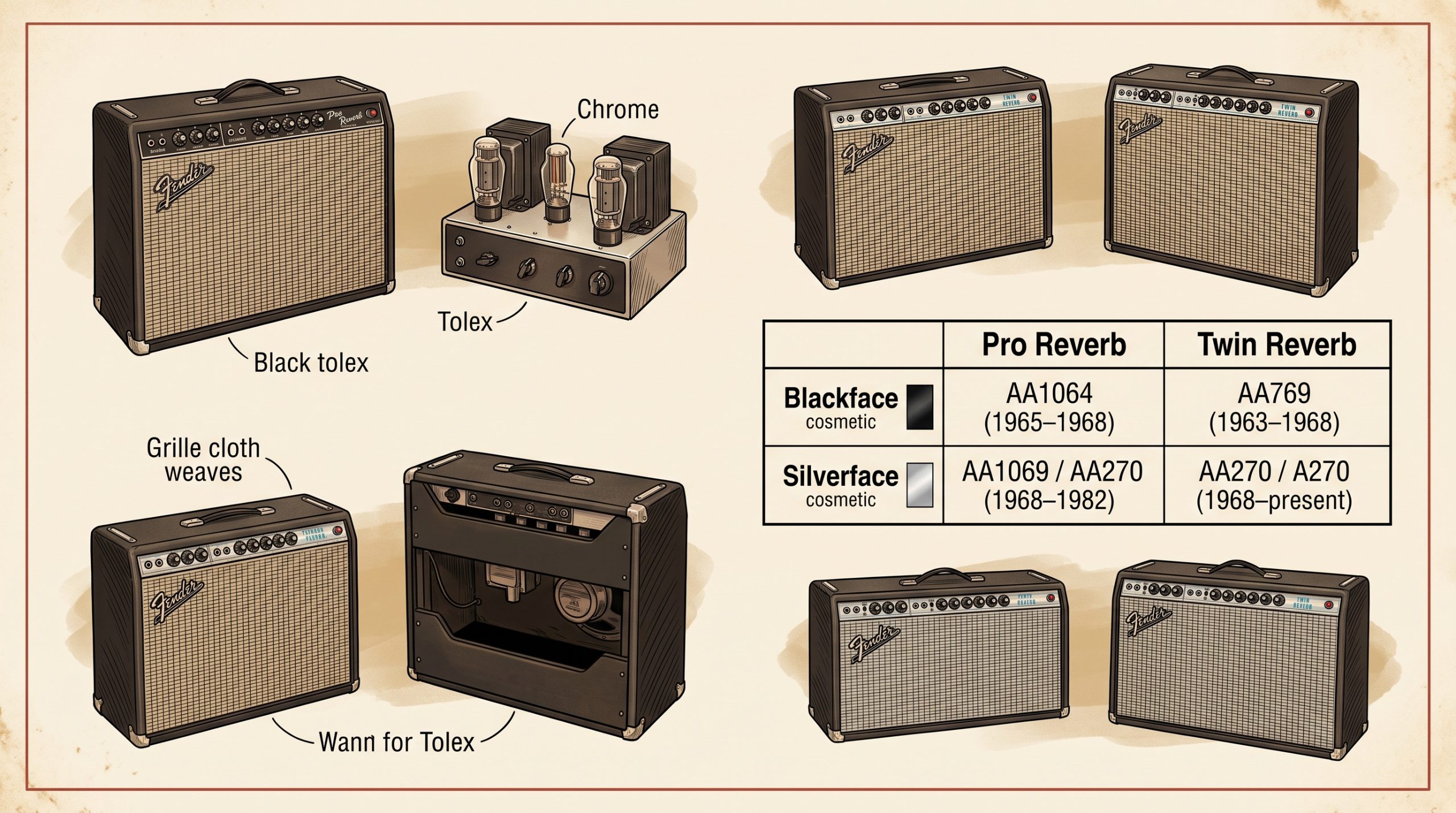
Blackface examples (Twin Reverb 1963-1967; Pro Reverb 1965-1967) carry the highest collector values and are the most discussed in vintage circles. But early silverface amps from 1968-1972 are often circuit-identical to their blackface predecessors and routinely sell at a discount. The AA1069 Pro Reverb and early AC568/AA769 Twin Reverb are not lesser amps. They’re the same circuits in different cosmetic clothes, and the market hasn’t fully priced that parity in.
Late silverface amps (1973-1982) are a different story on the Twin side. The ultralinear output transformer modification (1976-77) changes the Twin’s character meaningfully, and the master volume versions (added 1972) add a gain stage that alters the circuit topology. Late silverface Pro Reverbs don’t carry the same ultralinear transformer change and hold their character closer to the original design through the late production run.
Circuit identification: look for the AB763 (Twin blackface), AA165 (Pro blackface), or AA1069 (Pro early silverface) stamp on the tube chart inside the back panel. That code is the most reliable single identifier for circuit generation. Cross-reference it with chassis date codes using the Fender amp dating cheatsheet for quick-reference code tables.
Speaker Condition and Date Codes
Original Jensen C12N speakers carry EIA code 220-xxx. Oxford 12T6 units carry 465-xxx. The six-digit EIA stamp encodes the manufacturer (first three digits) and the production year and week (final three digits). For both amps, verifying that speaker codes match chassis date codes is a basic originality check. A 1965 Pro Reverb chassis with 1972 speaker stamps tells a story. Reading those stamps accurately is covered in the Fender speaker EIA date code guide.
Transformer Authenticity
Replaced output or power transformers affect collector value and audible character. Check OT and PT for EIA code matching: Schumacher 606-xxx, Oxford 465-xxx, Triad codes for their production period. A transformer swap isn’t always disclosed by sellers, and it’s one of the more common undocumented modifications on vintage Fenders. Originality matters for value. It also matters for sound, since aftermarket transformers don’t replicate the spec of the originals exactly.
Pricing Realities
The Pro Reverb paradox is real. It’s the rarer amp, produced in lower volume across both eras, yet it frequently prices below the Twin Reverb because the Twin carries more name recognition. Blackface Pro Reverbs in good original condition typically trade between $1,800 and $3,500. Blackface Twin Reverbs, despite higher supply, overlap that range at $1,500 to $3,200 for comparable condition. A clean, all-original Pro Reverb at the low end of that range represents a genuine buying opportunity for players who’ve done the research.
Famous Players: Who Used What and Why
Did Jimi Hendrix Use a Twin Reverb?
Hendrix’s primary live rig was Marshall stacks, consistently documented across his touring career from 1967 onward. Fender amplifiers appear in some early-career and studio contexts, but the Twin Reverb wasn’t a primary instrument in his recorded or live work. Crediting Hendrix’s tone to a Twin Reverb misattributes his sound and doesn’t hold up against documented session records or gear retrospectives from engineers who worked with him.
Did Kurt Cobain Use a Twin Reverb?
Yes, among a rotating selection of amplifiers. Cobain used Fender Twin Reverbs in studio contexts during the Nevermind sessions, where the amp’s clean headroom provided a usable platform for the heavy distortion pedals he ran in front of it. The Twin’s stiff, flat response was part of what made it work in that application. It wasn’t his only amp, but it was a documented part of his recording setup.
Leo Fender’s Favorite Amp
Leo Fender famously wasn’t a guitarist, which shaped his design philosophy considerably. His preference for clean, accurate amplification with high headroom explains why the Twin was engineered the way it was. Later in life, he reportedly favored the amplifiers developed under his G&L and Music Man tenures, which continued his preoccupation with clean reproduction over coloration.
SRV and the Vibroverb
Stevie Ray Vaughan’s primary studio and small-venue amp was the 1963 brownface Vibroverb (circuit 6G16), a 2×10 circuit that predates the blackface lineup’s 1×15-equipped 1964 successor. It’s a different instrument entirely from either amp discussed here. The full history of that circuit and why it suited Vaughan’s style is covered in the Fender Vibroverb model guide.
Modifications and Upgrades
Converting a Twin Reverb to Lower Power
Some players install a pull-power switch or bias modification to run two of the Twin’s four output tubes, dropping output to approximately 40-45 watts. It gets the Twin closer to Pro Reverb wattage on paper. It does not replicate tube rectifier sag. The solid-state diode bridge remains in the circuit. Important distinction: lower wattage alone doesn’t produce the feel of a GZ34 rectifier. You’ll get earlier tube saturation at lower volume, but the stiff power supply character remains.
Adding a Tube Rectifier to a Twin Reverb
Not a standard modification, but electrically possible with rewiring. Players who’ve done this report a dramatic change in feel toward the Pro Reverb’s compressed, touch-sensitive character. It’s a useful experiment for understanding exactly what the rectifier contributes to the playing experience, though it requires competent amp work and reduces the Twin’s output stage supply voltage.
Speaker Upgrades for Both Amps
Both amps present a 4-ohm total load from two 8-ohm speakers wired in parallel. Replacement speakers must match that impedance. Common upgrades include JBL D120F (a factory option on Twin Reverbs, changes the character toward tighter, more efficient, more hi-fi), Weber California (designed to approximate vintage Jensen tone), and Eminence Legend (more efficient, higher power handling). Installing JBL D120Fs in a Pro Reverb is a widely documented modification that shifts the amp toward tighter bass and increased projection. Changes the character significantly. Worth trying before buying.
Which Amp Fits Your Playing
The Pro Reverb is the more practical amp for most players who aren’t filling large unmic’d rooms: lighter, earlier natural breakup, better recording behavior at manageable volumes, and genuinely rarer despite the lower price tag. Its GZ34 rectifier gives it a responsiveness that no amount of drive pedals can replicate in a solid-state-rectified amp. If your playing rewards dynamic technique and you’re working at club volumes or in a studio context, the Pro Reverb is the amp the market hasn’t fully discovered yet. The Twin Reverb is the right call if you need clean headroom at stage volume above all else, run a complex pedal rig that needs a stable, uncolored power supply, or play in genres where the amp’s transparency is an asset rather than a limitation. Both amps hold their value, both sound quintessentially American, and either one will outlast most of the gear around it with basic maintenance.
Frequently asked questions
What is the main difference between the Pro Reverb and Twin Reverb?
Output power and rectifier type. The Pro Reverb runs 40W through a GZ34 tube rectifier, which introduces voltage sag and gives the amp a compressed, touch-sensitive character. The Twin Reverb runs 85W through solid-state diodes, producing a stiffer, cleaner response with dramatically more clean headroom. Same 2x12 cabinet format, fundamentally different electrical behavior and playing feel.
Is the Pro Reverb louder than the Deluxe Reverb?
Yes. The Pro Reverb's 40W into two 12-inch speakers gives it noticeably more volume and headroom before natural breakup compared to the Deluxe Reverb's 22W into a single 12-inch. The additional speaker cone area also contributes to projection and low-end response. For players who've outgrown the Deluxe Reverb at rehearsal volume but don't need Twin-level headroom, the Pro Reverb sits in a useful middle position.
Why is the Pro Reverb rarer than the Twin Reverb?
Production volume. The Twin Reverb was Fender's flagship combo and sold in significantly higher numbers throughout the blackface and silverface eras. The Pro Reverb occupied a niche middle position in the lineup and was produced in smaller quantities. That relative scarcity isn't reflected consistently in current market pricing, which makes clean original Pro Reverbs an undervalued find for buyers who know what they're looking at.
Can a Pro Reverb replace a Twin Reverb for live gigs?
For mic'd stages, yes, without meaningful compromise. Many professional players use blackface and silverface Pro Reverbs in live contexts with microphones and PA support. For large unmic'd rooms where the amp needs to project to the back row on its own, the Twin's extra headroom is often necessary. The Pro Reverb is genuinely loud at 40W through two 12-inch speakers, but the Twin's 85W ceiling provides a margin the Pro can't match at extreme volume.
What years are the best-sounding Pro Reverbs and Twin Reverbs?
Blackface examples are most sought-after: Twin Reverb AB763 (1963-1967) and Pro Reverb AA165 (1965-1967). Early silverface amps through 1972, running the AA1069 (Pro) and early AC568/AA769 (Twin) circuits, are largely identical to their blackface counterparts and frequently available at lower prices. Late silverface Twin Reverbs with the ultralinear output transformer (post-1976) represent a different-sounding amp. Late silverface Pro Reverbs are less affected by that particular change and remain closer to the original circuit character through the end of production.