Contents
- 01Quick-Reference Comparison
- 02The History Behind Each Circuit
- 03The Critical Technical Differences
- 04Tone and Feel: What You Actually Hear
- 05Which Is the Better Pedal Platform?
- 06Which Princeton Reverb Is Right for You?
- 07Specs, Tubes, and Maintenance Notes
- 08FAQ: Princeton Reverb '65 vs '68 Common Questions
- 09Which Princeton Reverb Fits Your Setup
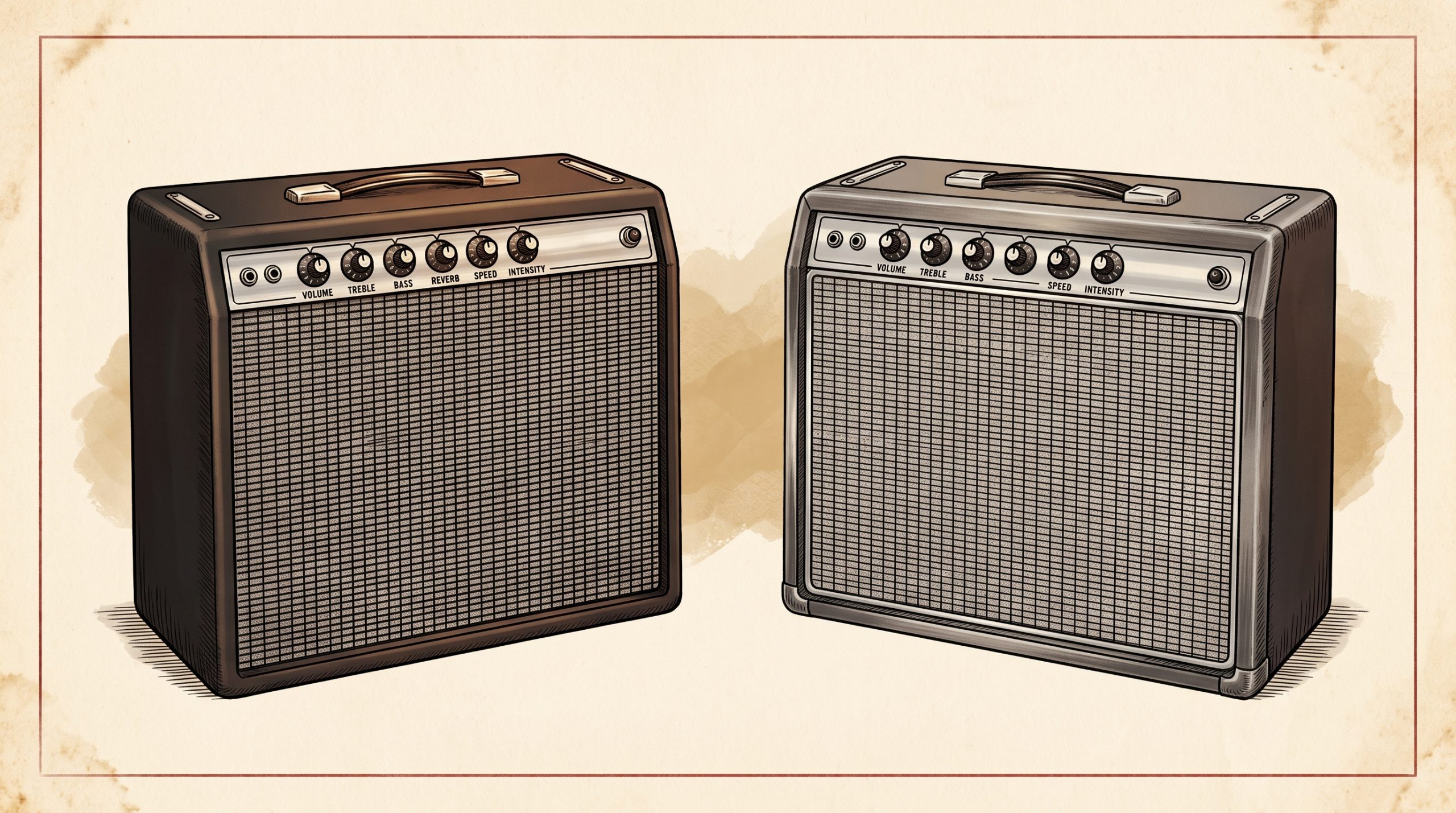
This covers the AA1164 circuit in detail, explains what Fender actually changed in the ’68 Custom design, and gives you a concrete framework for matching each amp to your playing style and pedalboard. If you’re deciding between these two production reissues, circuit behavior is the whole story.
Quick-Reference Comparison
Here’s the full spec breakdown before getting into the technical details.
| Spec | ’65 Princeton Reverb Reissue | ’68 Custom Princeton Reverb |
|---|---|---|
| Circuit Number | AA1164 | Modified (no official Fender circuit number) |
| Era Classification | Blackface (1964–1967 original) | Silverface-inspired / Custom |
| Original Production Years | 1964–1967 (reissue 1994–present) | 2013–present |
| Power Output | ~12W RMS | ~12W RMS |
| Power Tubes | 2x 6V6GT | 2x 6V6GT |
| Rectifier | 5AR4 (tube) | 5AR4 (tube) |
| Preamp Tubes | 3x 12AX7, 1x 12AT7 | 3x 12AX7, 1x 12AT7 |
| Speaker | 10″ Jensen C-10R (8Ω) | 10″ Celestion Ten 30 (8Ω) |
| Negative Feedback Loop | Yes (standard AA1164 NFB) | Significantly reduced (not eliminated) |
| Tone Stack | Standard blackface bass/treble | Modified, altered midrange voicing |
| Reverb Character | Long, washy, splashy decay | Darker, more restrained reverb tail |
| Tremolo | Yes | Yes |
| Weight | ~34 lbs | ~34 lbs |
| Street Price (2024) | ~$1,199 | ~$1,149 |
The History Behind Each Circuit
The AA1164 Circuit: Blackface Princeton Reverb (1964–1967)
The circuit designation AA1164 is Fender’s internal schematic code (AA revision, finalized November 1964), introduced as the company transitioned from brownface to blackface cosmetics. Unlike the Deluxe Reverb and Twin Reverb, which use the AB763 designation, the Princeton Reverb carries its own distinct circuit code. That code appears on original chassis stamps from the 1964–1967 production run, and it defines the Princeton Reverb that became the benchmark for compact Fender clean tone: tight low end, present upper mids, and a bright but non-aggressive treble character. As documented in Greg Gagliano’s 20th Century Guitar Magazine research series (1997–2000), the blackface era represents the moment Fender’s amp designs reached their most refined state before CBS cost-cutting began altering both cosmetics and circuits.
The reissue launched in 1994 as part of Fender’s Vintage Reissue Series and has remained in production since. Current production ships with a Jensen C-10R speaker, an 8-ohm ceramic-magnet driver that leans toward a warmer, vintage-voiced character consistent with the original amp. The circuit itself remains largely faithful to the original AA1164 schematic, and for a deeper look at dating the original production run, the complete Princeton Reverb guide covers chassis stamps and tube chart codes by year.
The ’68 Custom Circuit: What “Modified” Actually Means
Fender introduced the ’68 Custom Princeton Reverb in 2013 as part of its Custom Series lineup. The silverface cosmetics are genuine: drip-edge grille cloth, the brushed silver/black control panel, the era-appropriate aesthetic. What’s not genuine is any claim that this amp faithfully replicates a 1968 Princeton Reverb circuit. It doesn’t. Fender used the silverface visual as a starting point and then applied proprietary modifications to the tone stack and signal path. Most significantly, they significantly reduced the negative feedback loop (though didn’t eliminate it entirely).
There is no published Fender circuit designation number for the ’68 Custom the way AA1164 exists for the blackface version. It’s a purpose-built design with a specific tonal intent. Premier Guitar notes that the ’68 Custom’s circuit modifications, while departing from vintage accuracy, were deliberately engineered for compatibility with modern effects pedals and a more contemporary base tone. That’s a fair characterization of what Fender was targeting. Not a vintage clone. A purposeful revoicing.
The Critical Technical Differences
Negative Feedback Loop: The Most Important Difference Nobody Talks About
Most forum comparisons between these two amps describe the difference as “brighter vs. darker” or “more headroom vs. earlier breakup.” That’s accurate at a surface level, but it misses the underlying mechanism. The negative feedback loop is where this comparison actually lives.
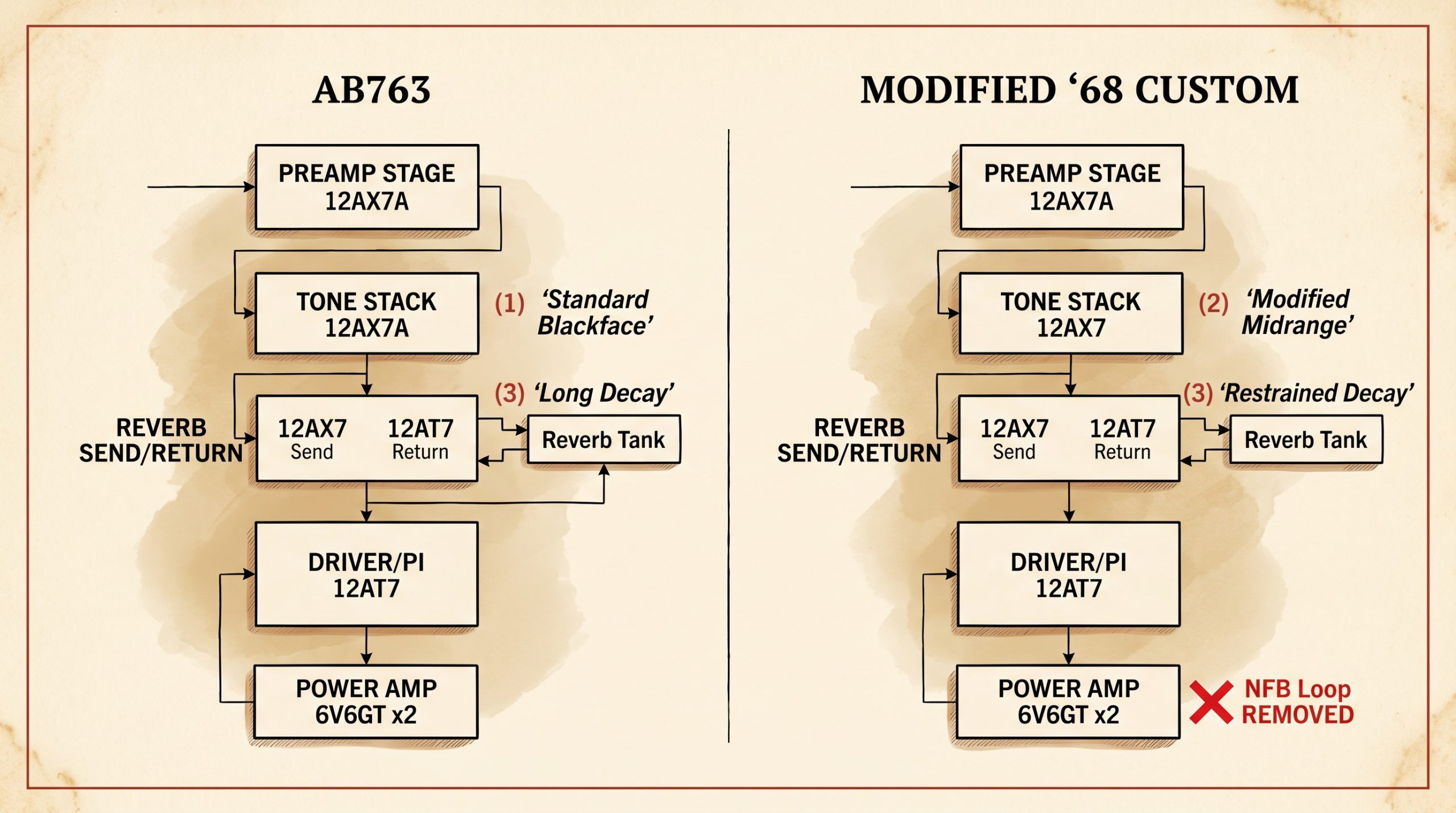
In the AA1164 circuit, a portion of the output signal is routed back out-of-phase to the phase inverter. This feedback tightens the amp’s response across the board: it increases clean headroom, reduces harmonic distortion at moderate volumes, controls the low-end response, and stabilizes the output impedance. The ’65 Princeton Reverb Reissue uses this standard AA1164 NFB configuration.
The ’68 Custom significantly reduces the NFB loop. That change cascades through every aspect of how the amp behaves:
- Power amp breakup arrives earlier at any given volume setting
- Touch sensitivity increases noticeably, the amp compresses under picking attack in a way the ’65 doesn’t
- Low-end response becomes looser and warmer, less controlled
- Output impedance rises slightly, which affects how the amp damps the speaker cone
This is why the ’68 Custom “feels different” at matched volume settings. It’s not an EQ curve change. It’s a fundamental alteration to how the circuit responds to your playing. Boutique amp builders have used reduced or eliminated NFB as a deliberate design choice for decades precisely because of these dynamic characteristics.
Tone Stack Differences: The Modified Midrange Voicing
The AA1164 tone stack uses Fender’s standard blackface configuration: a Bass control and Treble control interacting around a fixed midrange scoop. That scoop, centered roughly in the 400–800Hz range, is a defining characteristic of the blackface sound. It’s what gives the ’65 PRRI that scooped, glassy quality that sits well under single-coil clarity.
The ’68 Custom’s modified tone stack shifts the mid-frequency shelving point and alters the interactive curve between bass and treble. The result is measurably more low-mid warmth in the 250–500Hz range. Neither amp has a dedicated midrange knob, so you can’t dial out this difference on the ’68 Custom; it’s baked into the passive network values. If you’re coming from a humbucking guitar and find the ’65 PRRI too scooped or bright-edged, that character is structural, not adjustable.
Reverb Character Differences
Both amps use an Accutronics-style spring reverb tank driven by the 12AT7 tube in the V4 position. The reverb circuit architecture is similar in both cases. The difference in reverb character comes from the amp’s overall voicing, not a complete reverb circuit redesign.
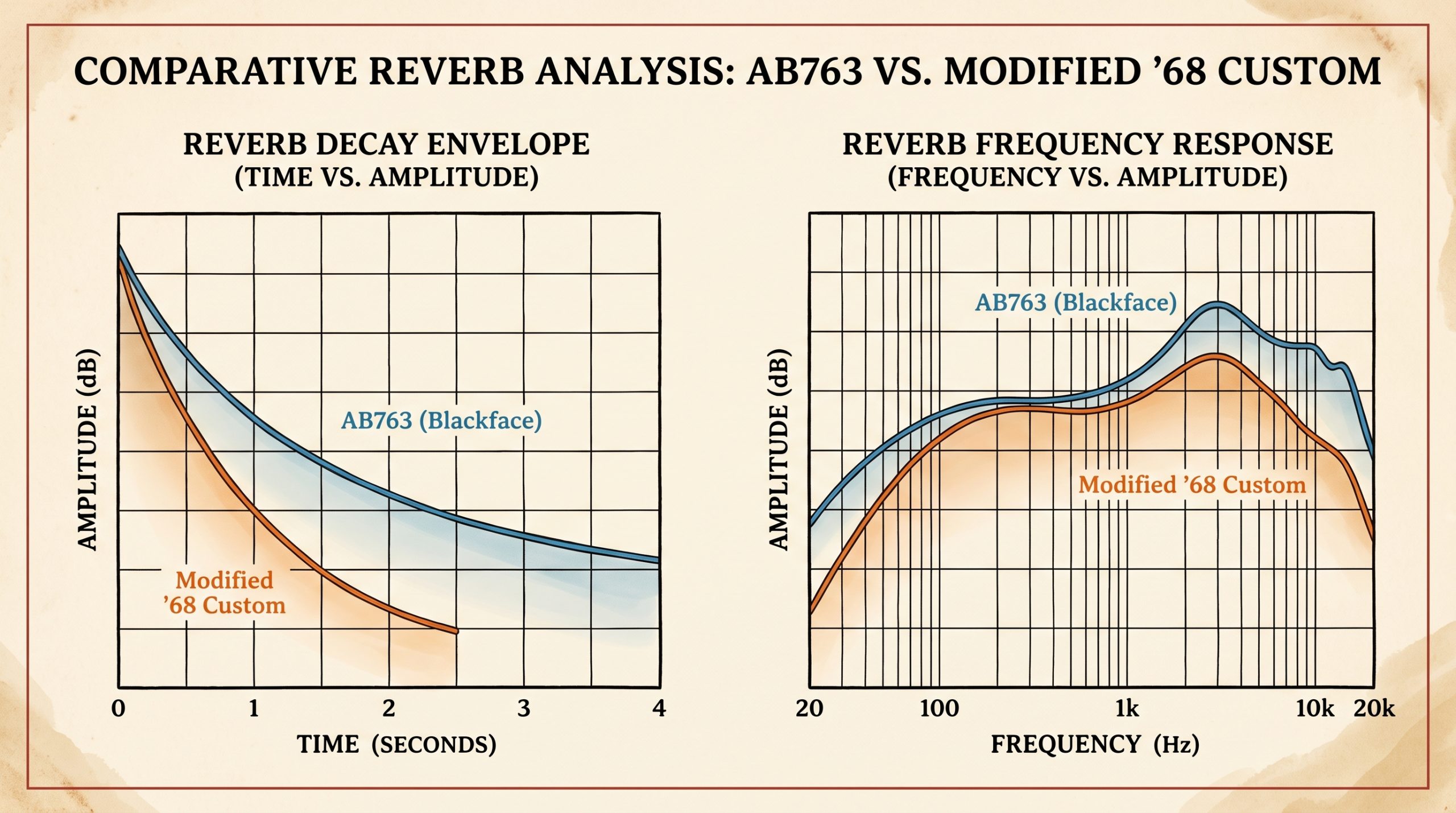
The AA1164 reverb in the ’65 PRRI produces the long, washy, splashy decay that defines vintage blackface reverb. At max settings it borders on surf territory, that dripping, cavernous wash that requires careful dial management in a band context. The ’68 Custom’s reverb tail is darker and more restrained by comparison, consistent with the amp’s overall lower-treble voicing. Neither is better. They’re different tools for different aesthetics.
Tone and Feel: What You Actually Hear
Clean Tone Character
The ’65 Princeton Reverb Reissue delivers classic blackface sparkle. Tight bass response, present upper mids, a glassy top end that rewards single-coil pickups. The NFB loop keeps the tone defined and controlled even as you push the volume. Strats and Teles into this amp produce the clean-with-bite character that earned the original Princeton Reverb its long recording history. It holds clean tone longer than the ’68 Custom at any given volume dial position.
The ’68 Custom’s clean tone is rounder and warmer. Fuller low-mids, reduced upper-mid presence by default. It doesn’t bite the way the ’65 does. With humbucking pickups especially, this is often the better starting point since the amp doesn’t accentuate the already-reduced high-frequency content of a neck PAF the way the ’65 might. The spongy compression that starts appearing well before the volume is maxed gives even clean playing a sense of give that the ’65 doesn’t replicate.
Both amps begin breaking up in the upper volume range, roughly the 3 to 5 o’clock zone, but the ’68 Custom gets there noticeably earlier.
Breakup and Overdrive Character
When the ’65 PRRI breaks up, it’s tight. The compression is firm, the crunch is defined, and the saturation stays articulate at moderate gain levels. Classic blackface crunch. The NFB loop keeps the distortion controlled even as the power amp saturates.
The ’68 Custom’s breakup is looser and more dynamic. Earlier onset, more touch-sensitive response, a warmer harmonic structure that compresses under your pick attack rather than resisting it. For players who want the amp contributing grit and character at lower volumes without pedals, this is a meaningful advantage. The ’65 makes you work harder, volume-wise, to get into that territory.
Not great for small apartments if you want natural breakup. That’s the ’65’s honest limitation. The ’68 Custom reaches usable saturation at bedroom-to-rehearsal volumes more readily.
Volume and Headroom Comparison
Both amps measure approximately 12W RMS. Same power tubes, same rectifier, same power transformer spec. On paper they’re identical. In practice, the ’65 PRRI holds clean tone approximately 10 to 15 percent higher on the volume dial due to the NFB loop tightening the available headroom. The ’68 Custom’s perceived saturation threshold is lower at any matched dial position, which can feel like it’s “louder” or more saturated even though the actual wattage is equivalent. For small venue gigging with a single 10-inch speaker, both amps are appropriate stage tools. The difference in breakup onset is more relevant for recording or bedroom use than for live volume levels.
Which Is the Better Pedal Platform?
How the NFB Loop Affects Pedal Interaction
This is where circuit behavior has direct practical consequences for a pedalboard-first player.
An amp with an active NFB loop, like the AA1164/’65 PRRI, presents a tighter, more stable input environment for incoming pedal signals. The amp’s own gain structure is controlled and neutral. Overdrive and fuzz pedals retain more of their own character because the amp isn’t adding significant coloration of its own. The result is a more transparent platform where pedals do what they’re supposed to do predictably.
An amp with significantly reduced NFB, like the ’68 Custom, introduces more of its own coloration and compression into whatever signal arrives from a pedal. The amp adds warmth and sag on top of the pedal’s character. That interaction can be wonderful with certain combinations and problematic with others. It’s a less predictable environment for complex pedalboards.
This distinction is widely discussed among players in online amp communities and aligns with Fender’s own language: the ’65 PRRI’s tighter gain structure is generally described as the more neutral platform, while the ’68 Custom’s voicing is often described as better suited to players who want amp-plus-pedal interaction rather than pedal-into-transparent-amp behavior.
Pedal Type Pairings by Amp
| Pedal Type | ’65 Princeton Reissue | ’68 Custom Princeton Reverb |
|---|---|---|
| Transparent overdrive (TS-style) | Excellent: preserves mid-hump character | Good: amp adds warmth on top |
| High-gain distortion | Tight, controlled, articulate | Can get muddy in low-mids |
| Fuzz (vintage germanium) | Great: amp stays clean under fuzz character | Excellent: amp sag and fuzz interact naturally |
| Boost pedals | Pushes amp into defined natural crunch | Hits breakup faster with more sag |
| Clean boost for solos | Ideal: headroom margin gives room | Risk of pushing into unintended breakup |
| Reverb and delay pedals | Clean amp tail preserves wet signal clarity | Darker amp base creates warmer ambient wash |
Which Princeton Reverb Is Right for You?
Choose the ’65 Princeton Reverb Reissue If…
- You want the historically accurate AA1164 blackface circuit and the tone it’s associated with
- You play primarily clean tones and rely on pedals for drive and saturation
- You want the most transparent, neutral pedal platform available at this wattage
- Your main guitars are single-coil Strats or Teles and you want the top-end sparkle those pickups produce
- You record and need a defined, articulate amp voice that sits cleanly in a mix without additional EQ
- You want the closest production-available approximation to an original 1964–1967 Princeton Reverb
Choose the ’68 Custom Princeton Reverb If…
- You want natural power-amp breakup at lower, apartment-friendly or rehearsal volumes
- You prefer a warmer, darker base tone with more low-mid presence
- You play humbucking guitars and want to avoid adding more top-end emphasis on top of already-bright pickup characteristics
- You want the amp itself contributing compression and saturation as part of your tone rather than relying entirely on the pedalboard
- You play blues, classic rock, or roots styles where amp sag and dynamic response are musical tools
- The drip-edge silverface aesthetic matters to you visually
Specs, Tubes, and Maintenance Notes
Tube Complement: Both Amps Identical
The tube complement is the same in both reissues, which simplifies maintenance and keeps replacement costs equivalent.
| Position | Tube | Function |
|---|---|---|
| V1 | 12AX7 | First preamp gain stage |
| V2 | 12AX7 | Second preamp / tone stage |
| V3 | 12AX7 | Phase inverter |
| V4 | 12AT7 | Reverb driver |
| V5–V6 | 2x 6V6GT | Output power tubes (matched pair) |
| V7 | 5AR4 | Tube rectifier |
Both amps use a cathode-biased 6V6 output stage. No bias adjustment is required when swapping matched 6V6 pairs, which makes routine tube replacement straightforward. A common upgrade path is swapping the stock Chinese 12AX7 preamp tubes for JJ ECC83S or Mullard reissue 12AX7s, which tend to add warmth and reduce microphony. The 6V6 tube guide covers matched pair selection and what to look for in NOS versus current production options if you’re considering an output tube upgrade.
Speaker Notes
Current production of the ’65 PRRI ships with a Jensen C-10R: a 10-inch, 8-ohm, 40-watt ceramic-magnet driver that many players consider warmer and more period-correct. The ’68 Custom ships with the Celestion Ten 30: a 10-inch, 8-ohm, 30-watt driver that’s reasonably neutral but not particularly vintage-voiced.
Common speaker upgrades for the ’65 PRRI include the Jensen C-10Q, Weber 10A125, and Eminence Legend 1058, which offer alternate vintage-flavored voicings within the same general character as the stock Jensen. For the ’68 Custom, the Celestion Alnico Blue (10-inch version) and WGS G10C are frequently cited in the builder and repair community as complementary matches for the amp’s warmer voicing. Speaker swaps on either amp are among the most cost-effective modifications available and don’t affect resale value the way circuit mods do.
Which Princeton Reverb Fits Your Setup
The gap between these two amps isn’t cosmetic. It’s largely the negative feedback loop, and that circuit difference determines breakup onset, pedal transparency, bass tightness, and dynamic feel across the whole amp. The ’65 PRRI is the historically accurate AA1164 blackface circuit: bright, articulate, neutral enough to let a pedalboard do its job cleanly. The ’68 Custom is a purpose-built revoicing that prioritizes natural amp compression and earlier saturation over clean headroom.
If you run a clean amp with drive pedals, the AA1164 circuit in the ’65 wins that comparison without much argument. If you want the amp contributing its own character before the pedals do, the ’68 Custom’s reduced-NFB voicing is a genuine advantage rather than a compromise. The same debate plays out at higher wattages too: the Fender Deluxe Reverb ’65 vs ’68 Custom comparison covers the same circuit logic applied to a 22-watt platform, and if you’re weighing wattage alongside circuit preference, the Princeton Reverb vs Deluxe Reverb breakdown addresses what that extra 10 watts actually costs you in breakup response and portability.
Frequently asked questions
What is the main difference between the '65 and '68 Custom Princeton Reverb?
The '65 Princeton Reverb Reissue uses the original AA1164 blackface circuit, which includes a negative feedback loop that produces a brighter, tighter, and cleaner-headroom tone. The '68 Custom uses a Fender-modified circuit that significantly reduces the NFB loop (though doesn't eliminate it entirely), resulting in earlier power-amp breakup, more touch-sensitive dynamic response, and a warmer, darker base voicing with more low-mid presence. Both amps share the same tube complement and approximately the same wattage but ship with different stock speakers, so the differences are mostly circuit behavior and voicing.
Is the '68 Custom Princeton Reverb actually a silverface circuit?
No. The '68 Custom uses silverface-era cosmetics as its visual starting point, but it does not replicate a 1968 Princeton Reverb circuit. Fender applied proprietary modifications, most importantly significantly reducing the negative feedback loop and altering the tone stack, that make it a distinct design rather than a faithful silverface reissue. There is no published Fender circuit designation for the '68 Custom equivalent to the AA1164 code. Calling it a silverface reissue is technically inaccurate, and the amp's tonal behavior reflects deliberate engineering choices that don't align with either strict blackface or silverface specifications.
Which Princeton Reverb is better for pedals?
The '65 Princeton Reverb Reissue is generally the stronger pedal platform. Its AA1164 negative feedback loop keeps the amp's own character neutral and controlled, which allows overdrive, fuzz, and modulation pedals to behave more predictably. The '68 Custom's reduced-NFB voicing adds its own compression and warmth to the signal chain, which can work well with some pedal combinations but can color others unexpectedly, particularly high-gain distortion pedals that may end up sounding muddy through the '68 Custom's fuller low-mid response.
Does the '68 Custom Princeton Reverb break up earlier than the '65?
Yes. The significant reduction of the negative feedback loop in the '68 Custom is the primary reason it reaches power-amp saturation earlier at a given volume dial position. It's not a wattage difference (both measure approximately 12W RMS) but a circuit behavior difference. Players specifically seeking natural amp breakup at lower, more manageable volumes will find the '68 Custom reaches that character more readily. The '65 PRRI holds clean tone roughly 10 to 15 percent higher on the dial before saturation becomes apparent.
Can a '65 Princeton Reverb Reissue be modified to sound like a '68 Custom?
Yes. Removing or reducing the NFB resistor in the AA1164 circuit is a well-documented and reversible modification that pushes the '65 PRRI toward the '68 Custom's dynamic character. A qualified amp technician can also adjust tone stack component values to shift the midrange voicing. That said, many players choose to simply purchase the '68 Custom rather than modify the '65, which preserves the original circuit's integrity and keeps the '65 PRRI's resale value intact. Modifications, even reversible ones, can affect what a vintage-correct reissue is worth to a future buyer.