Contents
- 01Quick Specs at a Glance
- 02A Brief History of Both Amps
- 03Circuit Differences Explained
- 04The Sound: What Each Amp Actually Does
- 05Volume, Loudness, and Gigging Reality
- 06Modifications and Upgrade Paths
- 07Princeton Reverb vs Deluxe Reverb: The Reissues
- 08Studio Recording Behavior: Princeton vs Deluxe
- 09Which One Should You Buy?
- 10Frequently Asked Questions
- 11Final Verdict
- Princeton Reverb: AA1164 circuit, ~12–15W, 2x 6V6GT, 5U4GB rectifier, 10″ speaker, ~26 lbs
- Deluxe Reverb: AA763/AB763 circuit, ~22W, 2x 6V6GT, GZ34 rectifier, 12″ speaker, ~42 lbs
- Both produced during the blackface era: Princeton Reverb 1964–1967, Deluxe Reverb 1963–1967
- Princeton: 1 channel, bass/treble only tonestack, “scooped” voicing by design
- Deluxe: 2 channels (Normal + Vibrato), full bass/middle/treble EQ on Vibrato channel
- Vintage pricing: Princeton Reverb $1,500–$2,500+, Deluxe Reverb $2,000–$4,000+ depending on condition
- Reissue pricing: PRRI ~$1,099–$1,199 new, DRRI ~$1,299–$1,399 new (2024)
- The Deluxe’s bright cap is always engaged on the Vibrato channel, which can produce ice-pick treble on brighter guitars at low volumes
- The ’65 Princeton Reverb Reissue (PRRI) uses a tube 5AR4 rectifier per current Fender spec — different from the original AA1164’s 5U4GB, a legitimate circuit deviation worth knowing
Quick Specs at a Glance
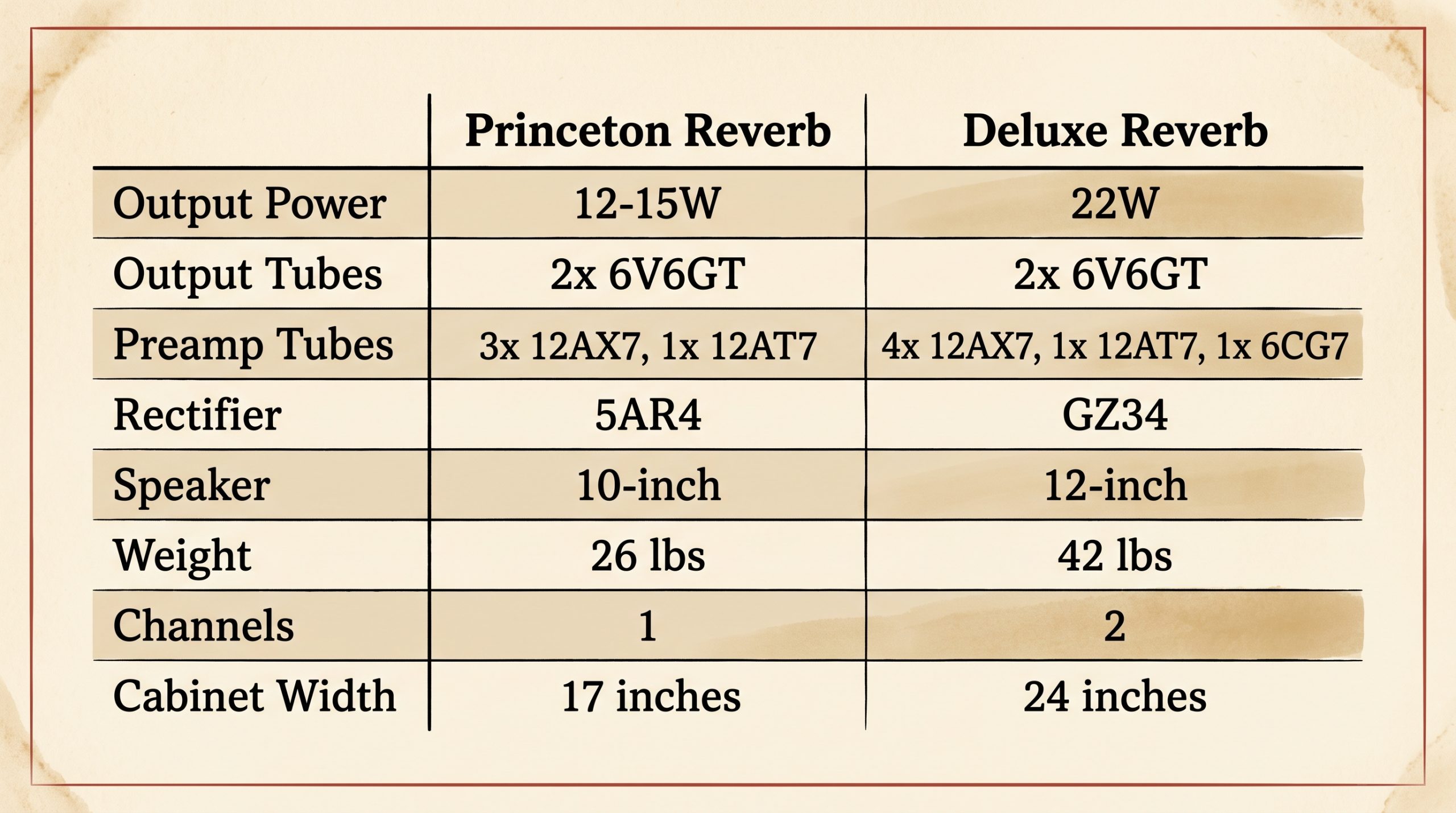
When players search fender princeton reverb vs deluxe reverb, they usually start with specs. Here’s the full picture side by side. Both amps share the same output tube type, which surprises a lot of people, and the wattage difference comes down to transformer design and supply voltage, not tube selection.
| Feature | Princeton Reverb | Deluxe Reverb |
|---|---|---|
| Era Classification | Blackface | Blackface |
| Production Years (blackface) | 1964–1967 | 1963–1967 |
| Circuit Number | AA1164 | AA763 / AB763 |
| Output Power | ~12–15W | ~22W |
| Output Tubes | 2x 6V6GT | 2x 6V6GT |
| Preamp Tubes | 3x 12AX7, 1x 12AT7 | 4x 12AX7, 2x 12AT7 |
| Rectifier Tube | 5U4GB | GZ34 (5AR4) |
| Original Speaker | 10″ Oxford 10J4 or Jensen C10Q | 12″ Jensen C12Q (1963–1965) or Oxford 12K5 (1966–1967) |
| Channels | 1 | 2 (Normal + Vibrato) |
| Cabinet Dimensions (approx.) | 17″W x 15″H x 8.5″D | 24″W x 18″H x 9.5″D |
| Cabinet Material (original) | Pine | Pine |
| Weight | ~26 lbs | ~42 lbs |
| Original U.S. Retail Price (1965) | ~$169.50 | ~$239.50 |
| Reissue Model | ’65 Princeton Reverb Reissue (PRRI) | ’65 Deluxe Reverb Reissue (DRRI) |
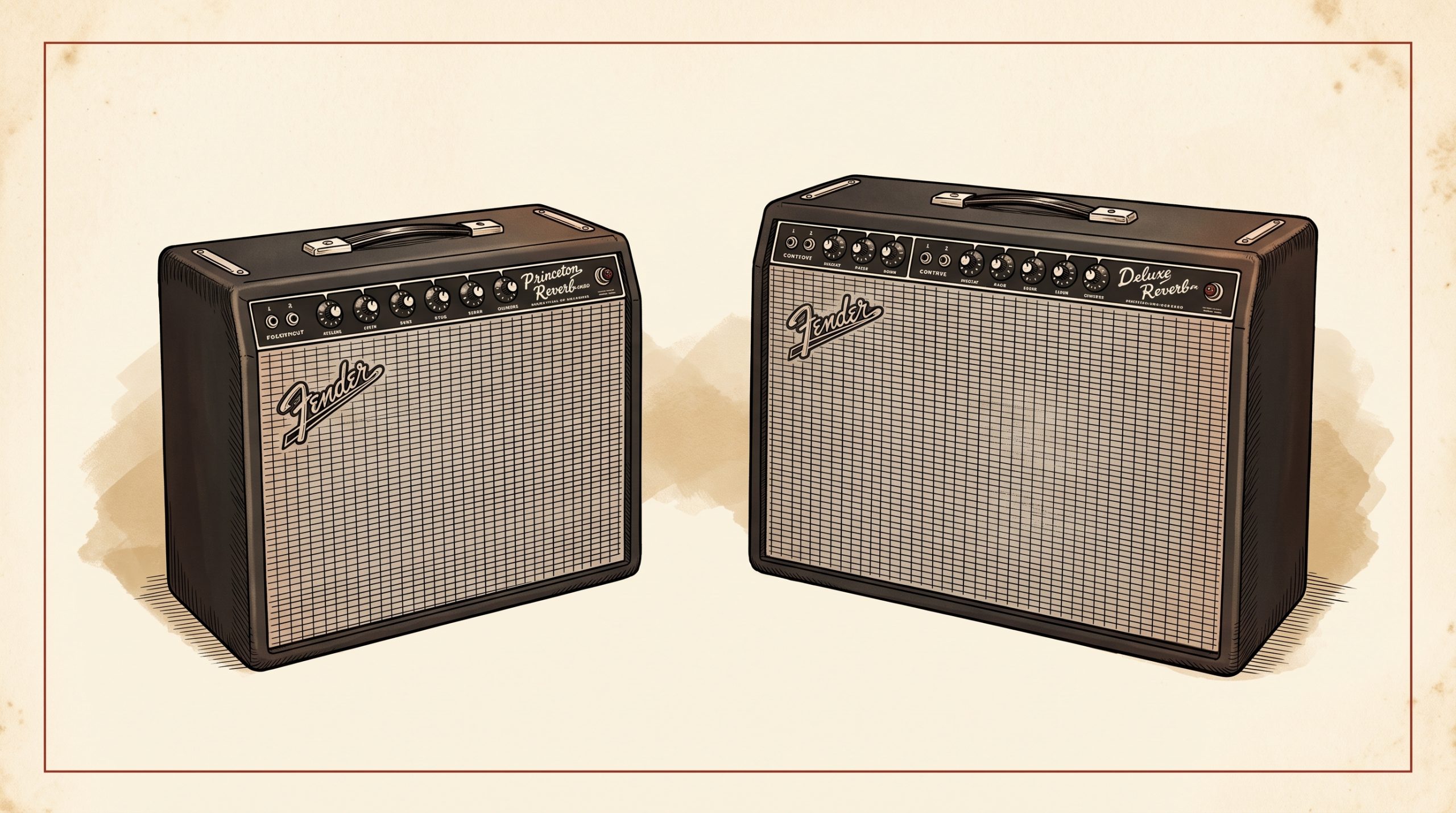
A Brief History of Both Amps
The Princeton Reverb: Fender’s “Small But Serious” Blackface
The Princeton Reverb entered production in 1964 as part of Fender’s full blackface lineup refresh. Its immediate predecessor was the non-reverb Princeton, which went through brownface (6G2) and early blackface (AA964) iterations before gaining a reverb and tremolo circuit for the first time with the AA1164. That addition changed the amp’s character substantially. What had been a basic practice combo became a complete, studio-capable tool.
Original speaker complement depended on production date. Early AA1164 units shipped with Oxford 10J4 speakers (EIA code 465-xxx). Later runs used Jensen C10Q speakers (EIA code 220-xxx). For detailed dating by transformer code and tube chart, the Fender tube amp serial number and date code reference covers the full identification methodology.
The Deluxe Reverb: Fender’s Studio Standard
The Deluxe Reverb arrived slightly earlier, in 1963, initially as circuit AA763 before transitioning to AB763. That circuit revision is subtle: the AB763 introduced a change to the bias supply resistors and minor component substitutions. Most players and technicians consider the two circuits tonally near-identical. The reissue (DRRI) is based on the AB763 specification.
Original speakers were most commonly Jensen C12Q (EIA code 220-xxx) through 1965, with Fender transitioning to the Oxford 12K5 (EIA code 465-xxx) for 1966–1967 production. The Deluxe Reverb’s larger cabinet, longer reverb pan, and additional preamp gain stage gave it a fuller character that made it a fixture in Nashville session recording for decades. Its two-channel architecture (Normal and Vibrato) gave players tonal options that the single-channel Princeton simply doesn’t offer. The complete Deluxe Reverb model guide covers the full AA763 vs AB763 distinction in more depth.
Circuit Differences Explained
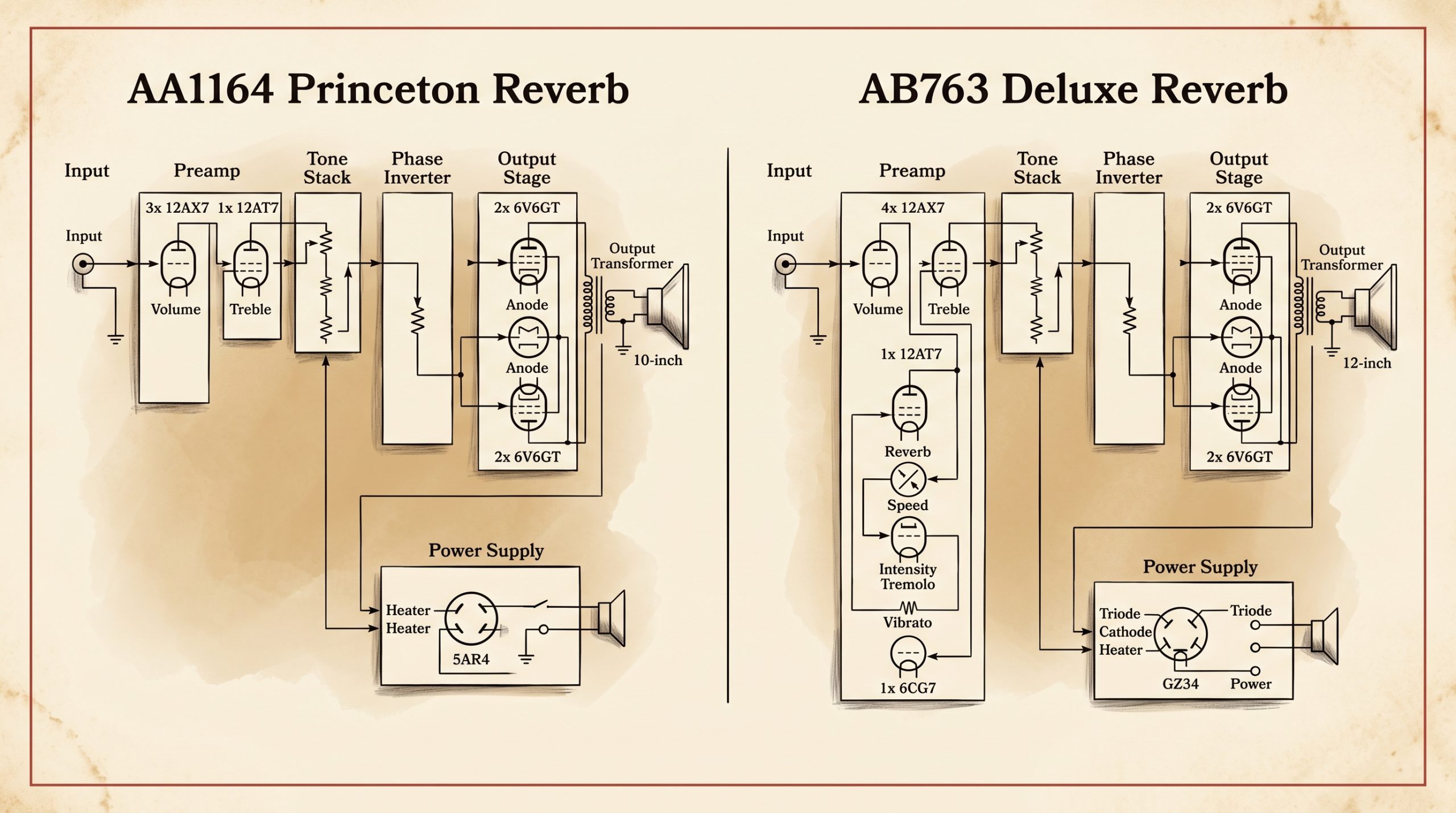
Both amps share the same output tube type: a pair of 6V6GT beam-power tetrodes. That fact confuses a lot of people. If it’s the same tubes, why does the Deluxe push roughly 22 watts while the Princeton tops out at 12–15? The answer lives in the power supply and transformer stack, not the tubes themselves.
Output Stage: Same Tubes, Different Power Supplies
The Princeton Reverb runs its 6V6GTs at approximately 340V DC on the plates. The Deluxe Reverb hits approximately 415–420V DC at the plates. That 75–80V difference, delivered through a larger power transformer with more current capacity, is what separates 15W from 22W. The tubes are doing the same job; the Princeton is simply working with less fuel.
The two amps don’t even share a rectifier type. The Deluxe Reverb uses a GZ34 (5AR4), while the Princeton Reverb uses a directly-heated 5U4GB, a tube with a higher internal voltage drop and more sag under load than the GZ34. Combined with the Princeton’s smaller power transformer and lower B+ voltage, that adds up to noticeably more rectifier sag under load. That sag is the “give” you feel when you dig in hard. It’s not a flaw. It’s what makes the Princeton feel so responsive under your pick. The Deluxe’s larger transformer, higher B+ voltage, and indirectly-heated GZ34 mean the supply rail stays stiffer, which translates to better clean headroom but a less elastic feel at the attack transient. Output transformer primary impedance also differs between the two, directly affecting damping factor. The Princeton’s lower damping factor contributes to its softer, more compressed low end compared to the Deluxe’s tighter bass response.
Preamp Topology: Where the Voicing Diverges
The Princeton Reverb preamp uses 3x 12AX7 and 1x 12AT7 (reverb driver). The Deluxe Reverb preamp uses 4x 12AX7 and 2x 12AT7: one 12AT7 handles the reverb driver duty, the other is the phase inverter, while the tremolo oscillator runs on one of the 12AX7 stages. That extra 12AX7 gain stage in the Deluxe adds tonal complexity and fullness before the signal reaches the phase inverter. It’s one reason the Deluxe sounds “bigger” even at low volumes, independent of speaker size.
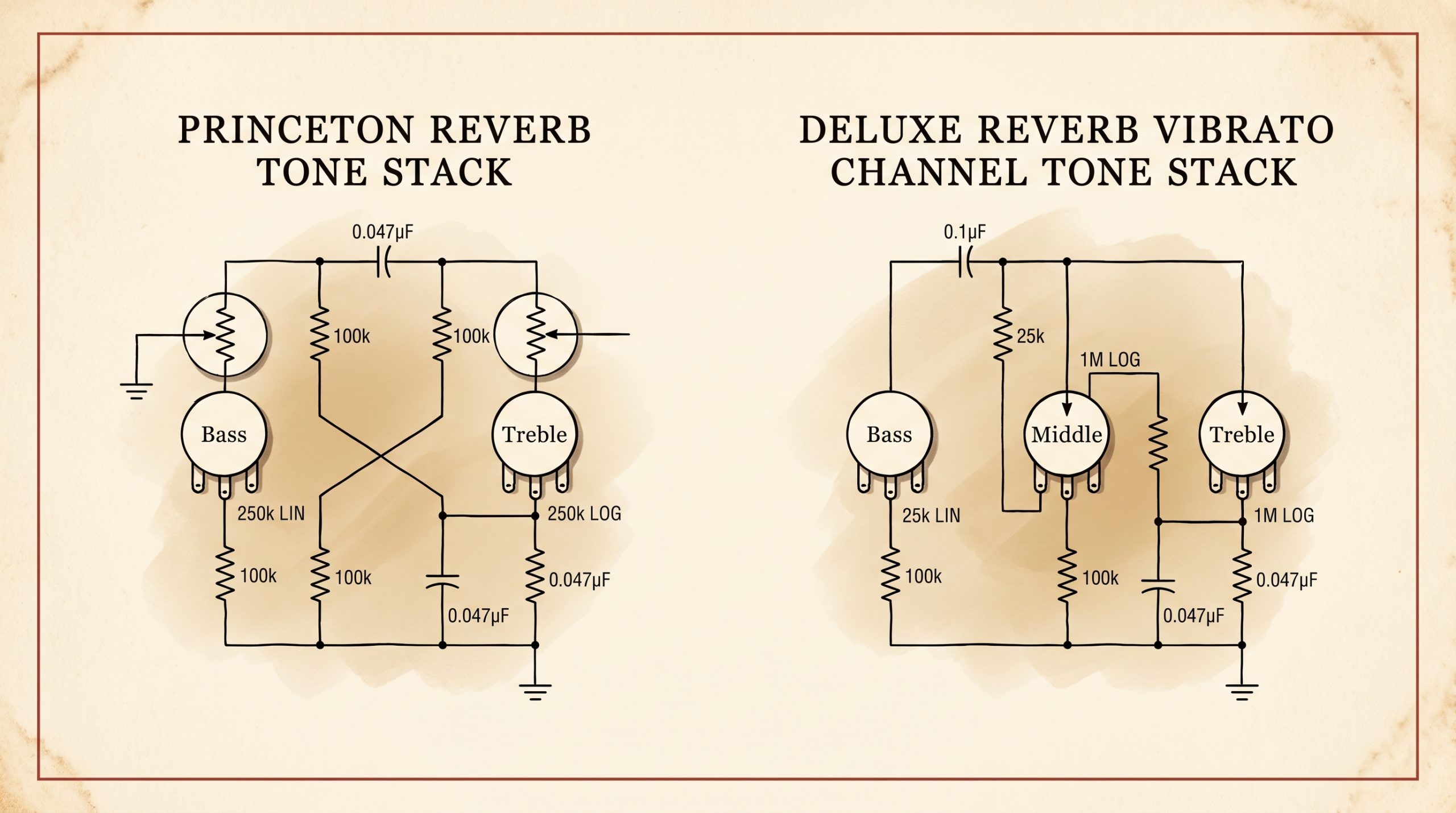
The tonestack difference is equally significant. The Deluxe Reverb’s Vibrato channel gives you bass, middle, and treble controls. The Princeton has bass and treble only. That missing midrange control isn’t an accident: the Princeton’s tonestack is fixed at a slight mid-scoop by the component values Fender chose. You can’t dial that mid-scoop out. It gives the Princeton its “glassy,” “sweeter” clean tone character that many players love, but it also means the amp sits in a mix differently than the Deluxe. The Deluxe lets you push mids forward for cut in a band context; the Princeton doesn’t, without external EQ.
According to Premier Guitar’s analysis of both circuits at fenderguru.com contributor Jens Mosbergvik’s primer, the Deluxe Reverb’s Vibrato channel also features a bright cap that the Normal channel lacks, giving the Normal channel a smoother, warmer character. Worth knowing before you buy, particularly if you play a Strat with new single-coils.
Reverb Circuit: Why They “Wash” Differently
Both amps use spring reverb tanks of the Accutronics type and a 12AT7 reverb driver. The Princeton’s reverb pan is a shorter, lighter unit that produces a brighter, more “splashy” reverb. Surf-adjacent, even at moderate settings. The Deluxe’s reverb pan is longer and heavier, producing a deeper, lusher bloom that’s earned the amp its reputation as a studio reverb workhorse. The Deluxe’s reverb recovery also feeds into a fuller downstream signal path, which deepens the perceived “wet” dimension further.
The Sound: What Each Amp Actually Does
Princeton Reverb Sound Character
The Princeton’s clean tone is glassy, immediate, and slightly scooped in the mids. Natural breakup starts somewhere around volume 4–5 on most units. That’s the 6V6s and lower B+ voltage conspiring to produce a soft, compressed clip that most players describe as “vocal.” It’s not harsh. It barks when pushed but never gets ugly about it.
The 10″ speaker keeps the low end tight and focused. There’s less “bloom” in the bass than you get from a 12″, which is part of why the Princeton sits in studio mixes so cleanly. It doesn’t fight other instruments for low-end space. The reverb is bright and splashy, and the tremolo circuit produces a slightly more pronounced, “choppy” throb at equivalent speeds compared to the Deluxe. Country and roots players love that. Fingerpickers love the natural compression. Recording guitarists love the fact that great tone arrives at civilized volumes.
Is a Fender Princeton Reverb a good amp? Unambiguously yes. It’s one of the finest-sounding small combos Fender ever produced, with an extensive studio recording pedigree and a circuit refined enough that boutique builders have spent decades copying it.
Deluxe Reverb Sound Character
The Deluxe holds together longer. Clean headroom extends to around volume 5–6 before the 6V6s start compressing noticeably. The 12″ speaker produces more low-end extension and a more “open” room-filling quality. The cleans and in-betweens sound fuller, deeper, and less boxy than the Princeton, and the reverb is significantly lusher. The Deluxe earns its reputation as the more versatile blackface Fender.
Two channels give you options. The Normal channel is darker and drier, useful for jazz-adjacent clean tones. The Vibrato channel is where most players live: that’s where the reverb, tremolo, and full three-band EQ reside. The tremolo on the Deluxe has a smoother, more wave-like feel compared to the Princeton’s choppier throb. Not better or worse. Different.
Head-to-Head Tone Comparison
| Parameter | Princeton Reverb | Deluxe Reverb |
|---|---|---|
| Clean headroom | Moderate, breaks up earlier (~vol. 4–5) | Higher, stays cleaner longer (~vol. 5–6) |
| Breakup character | Soft, compressed, vocal | Fuller, slightly brighter edge |
| Reverb quality | Bright, splashy, “surf” | Deep, lush, three-dimensional |
| Tremolo feel | Pronounced, choppy throb | Smooth, wave-like pulse |
| Low-end response | Tight, focused, limited extension | Fuller, more bass extension |
| Cut in a band mix | Sits well without crowding | More mid-forward presence available |
| Recording direct sound | Sweet, focused, needs less room management | Fuller, more dimensionality, excellent close or room-mic’d |
Volume, Loudness, and Gigging Reality
How Much Louder Is the Deluxe Reverb, Really?
The math first. Going from roughly 15W to 22W represents approximately 1.7dB of headroom in purely acoustic terms. Even accounting for speaker sensitivity differences between the 10″ and 12″ drivers, real-world SPL estimates put the Princeton Reverb at around 97–100dB at 1 meter and the Deluxe Reverb at approximately 100–103dB. That’s not a dramatic volume difference. You won’t hear it across a loud rehearsal room.
What you will notice is the headroom difference. At identical volume knob positions, the Princeton will be well into natural compression territory while the Deluxe stays clean. The Deluxe isn’t simply louder, it stays cleaner longer. For a player who wants sparkly, uncompressed cleans in a live context, that matters a lot more than raw SPL numbers suggest.
Speaker upgrade caveat: a Princeton Reverb fitted with a 12″ speaker (a common baffle modification) gains 1–2dB from the larger cone area plus whatever efficiency gain the new speaker brings. A high-efficiency 12″ like a Weber 12A150 or Eminence Cannabis Rex can meaningfully close the gap with a stock Deluxe.
Context-Based Decision Framework
| Playing Context | Princeton Reverb | Deluxe Reverb |
|---|---|---|
| Bedroom / home practice | Better choice | Louder than most rooms need |
| Studio recording (close mic’d) | Excellent | Excellent |
| Studio recording (room mic’d) | Smaller, more intimate room sound | Superior room-filling character |
| Small venue / coffeehouse (no PA) | Works well with pedals | Preferred for headroom |
| Medium venue (with PA support) | Works well | Works well |
| Full band, loud drummer, no PA | Marginal | Better headroom reserve |
| Pedal platform | Excellent | Excellent |
Modifications and Upgrade Paths
Princeton Reverb Common Mods
The 10″ speaker is the first thing most Princeton owners change. A Jensen C10Q reissue keeps the original voicing tight and accurate. A Weber 10A125 adds slight warmth without muddying the top end. Both are bolt-in replacements. No modification required.
The 12″ speaker conversion is more involved: it requires routing or replacing the speaker baffle board, but the mod is fully reversible if you keep the original baffle. A Princeton Reverb with a 12″ speaker sits in meaningfully different territory, both in perceived volume and low-end weight. Many players describe it as a lighter, more portable path to Deluxe Reverb territory.
Tube rolling changes the character noticeably. A 5751 (70% gain, same pinout as 12AX7) in the V1 position reduces overall preamp gain and opens up more clean headroom at higher volume settings. Swapping to 6L6 output tubes is possible but requires re-biasing and a check that the output transformer’s primary impedance handles the different load. Not a beginner project. Worth noting: the reissue (PRRI) ships with a tube 5AR4 rectifier per current Fender spec, not the original AA1164’s 5U4GB — swapping a 5AR4-equipped PRRI to a 5U4GB gets closer to the original amp’s sag characteristics, though the two circuits weren’t designed around the same rectifier. The full Princeton Reverb guide covers production run differences in detail.
Deluxe Reverb Common Mods
Speaker upgrades are equally popular here. The Weber Michigan 12A150 and Eminence Cannabis Rex are both frequently recommended replacements for the DRRI’s stock Eminence speaker. Both add warmth and reduce the slight hardness that some players report in the stock DRRI at louder volumes.
Re-biasing is the single most impactful non-invasive modification on the Deluxe Reverb. DRRI units frequently leave the factory biased conservatively cold. Setting the output stage to approximately 70% of maximum plate dissipation produces more bloom, better compression, and a warmer overall tone. Any competent technician can do this in under an hour.
Tube rolling: a 12AY7 in the V1 position reduces preamp gain and buys more clean headroom on the Vibrato channel. Useful for players using the amp as a pedal platform who want more dynamic range before the amp’s own gain circuit kicks in. The 6L6 output tube swap (same caveat as above regarding transformer load) shifts the Deluxe toward a slightly cleaner, stiffer character, though it’s a more common mod on the Princeton where the voltage headroom difference is less critical.
Princeton Reverb vs Deluxe Reverb: The Reissues
’65 Princeton Reverb Reissue (PRRI)
The PRRI is Made in USA (Corona, CA) and captures the AA1164 circuit topology on a PCB rather than the original point-to-point wiring. Component quality is solid. The stock speaker is a 10″ Jensen C10R (per current Fender spec), a departure from the mix of Oxford and Jensen drivers used across the original AA1164 production run. The rectifier is also a factory departure from the original: current PRRI production uses a tube 5AR4 rather than the AA1164’s original 5U4GB. Street price ranges from approximately $1,099 to $1,199 in 2024.
’65 Deluxe Reverb Reissue (DRRI)
The DRRI has gone through several speaker iterations since its introduction. Current production ships with a Jensen C12K reissue, which is a significant improvement over early DRRI versions that came with an Eminence driver. The AB763 circuit is faithfully reproduced on PCB. Limited Edition hand-wired versions using point-to-point construction and the AB763 circuit specification have been produced and represent the closest factory-available match to an original blackface unit. Street price for standard DRRI runs approximately $1,299 to $1,399 in 2024.
Are the Reissues Worth It Compared to Vintage Originals?
Vintage blackface Princeton Reverbs currently trade in the $1,500 to $2,500+ range depending on originality, speaker condition, and cosmetic state. Blackface Deluxe Reverbs start around $2,000 and climb past $4,000 for clean, all-original examples. The reissues capture approximately 85% of the character at a fraction of the cost. The hand-wired Limited Edition models close the gap further. For players who want the experience without the anxiety of gigging a 60-year-old amp, the reissues are a completely reasonable path.
Studio Recording Behavior: Princeton vs Deluxe
Close-Mic’d Recording (1–3 Inches from Speaker)
The Princeton’s close-mic sweet spot falls between volume 4 and 6, where the 6V6s begin compressing naturally. The result is a warm, focused midrange character that sits well under single-note leads and fingerstyle parts without demanding a lot of EQ work in the mix. The slight mid-scoop in the fixed tonestack actually works in the amp’s favor here: it produces a naturally “mix-ready” tone that doesn’t crowd other instruments.
The Deluxe’s close-mic sweet spot is volume 5 to 7. The 12″ speaker produces a fuller, slightly more three-dimensional sound at the capsule, with more low-mid content that engineers often find easier to shape into a finished mix. Both amps are excellent close-mic’d. The Princeton requires less room management to achieve a clean, focused result.
Room Mic’d Recording (3–10 Feet)
Here the Deluxe wins. The 12″ speaker moves more air and produces a substantially richer room sound. A ribbon microphone placed 6 feet from a Deluxe captures a significantly fuller, more three-dimensional bloom than the same mic at the same distance from a Princeton. That’s physics, not preference.
The Princeton with a room mic produces a smaller, more intimate character. That can actually be an advantage in dense arrangements where a smaller amp sits in the mix without competing for space. It’s not that the Princeton sounds bad with a room mic. It just sounds like a smaller amp. Which is what it is.
Recording at Apartment-Friendly Volumes
This is where the Princeton earns its studio reputation. Its earlier breakup means you reach genuinely good, naturally compressed tones at lower actual SPL. The Deluxe needs more volume to access its natural compression zone. In a quiet recording environment, that can be a real problem.
Both amps respond well to a power attenuator (Weber Mass or Fryette Power Station are the most common pairings). The Princeton tends to preserve its character more naturally through attenuation, partly because its simpler output stage interacts with the attenuator’s load more predictably. The Deluxe through an attenuator is still excellent; just be aware the feel changes more noticeably as you drop SPL significantly.
Which One Should You Buy?
Buy the Princeton Reverb If…
- You play primarily at home or in small studio environments
- You want natural tube compression and breakup at manageable volumes
- Portability matters: 26 lbs vs 42 lbs is a real quality-of-life difference on a gig
- Your preferred genre favors a glassy, slightly scooped clean tone
- You run pedals as your primary dirt source and want a neutral, responsive platform
- Budget is a factor: the PRRI runs $100–200 less than the DRRI new
- You’re a recording guitarist prioritizing great natural breakup tones without waking neighbors
- You want to explore the 12″ baffle mod as a potential headroom upgrade later
Buy the Deluxe Reverb If…
- You need more clean headroom in live contexts, especially without PA support
- The lush, three-dimensional reverb character matters to your playing style
- You gig on small-to-medium stages and want a stage-loud amp that holds together
- Two channels give you useful tonal variety (Normal vs Vibrato for different parts)
- Your genre favors warm, mid-forward clean tones: Nashville, blues, jazz
- You room-mic your amps and want the fuller acoustic presence a 12″ driver provides
- You want the most tonally versatile blackface Fender available
- Weight isn’t a concern and you’re not regularly hauling the amp up stairs
The Surprising Third Option
A Princeton Reverb with a 12″ speaker conversion is the middle ground a significant number of players land on after trying both amps. It’s lighter than a Deluxe, still runs on the same AA1164 circuit, and gains meaningful low-end extension and sensitivity from the larger cone. It’s not quite a Deluxe Reverb. But it’s closer than you’d expect from a 15W amp. For players who need more stage volume than a stock Princeton delivers but don’t want 42 lbs on a Wednesday night gig, it’s a real option. If you want something with genuinely more clean headroom than either of these, the Fender Vibrolux Reverb sits one tier up in the blackface lineup at 35W with two 10″ speakers and is frequently overlooked in this conversation.
Final Verdict
The princeton reverb vs deluxe reverb question doesn’t have a wrong answer, only wrong context. The Princeton is a boutique bedroom and studio gem that rewards players who work within its natural breakup zone and value portability above all else. The Deluxe is the more versatile working-band amp, with the clean headroom, lush reverb, and two-channel flexibility that makes it the go-to blackface Fender for session work, small-to-medium stages, and room-mic’d recording. If you’re still uncertain after working through this comparison, narrow it down by your loudest regular playing context and your tolerance for the Deluxe’s extra 16 lbs. Both amps have earned their reputation honestly, and both will outlast every amp you’ve owned that doesn’t have tubes in it.
Frequently asked questions
Is a Fender Princeton Reverb a good amp?
Yes, without qualification. The AA1164 circuit is one of the most thoughtfully voiced small combo designs Fender produced during the blackface era. The combination of natural 6V6 compression at reasonable volumes, the bright and splashy spring reverb, and the sweet, scooped clean tone has made it a studio staple for decades. It's appeared on countless professional recordings. The reissue (PRRI) captures the essential character at an accessible price point. If your playing environment is a studio, home recording setup, or small stage with PA support, it's hard to argue for a fundamentally different amp.
Is a Princeton Reverb loud enough to gig?
Context-dependent. For small venues with PA support, absolutely. A Princeton Reverb producing 97–100dB at 1 meter is more than sufficient when the house system handles front-of-house projection and you're using the amp as a stage monitor source. Without PA support and against a drummer playing without restraint, it gets marginal. A speaker upgrade (higher-efficiency 10" or a 12" baffle conversion) and strategic microphone placement can extend its usefulness. An attenuator paired with the amp dialed up for tone, then attenuated for SPL management, is another path. Not ideal for loud stages without support, but perfectly stage-worthy in most practical gigging scenarios.
How much louder is a Deluxe Reverb than a Princeton Reverb?
In raw SPL terms, approximately 2–3dB at maximum output, accounting for speaker sensitivity differences. That's less than most players expect. The more meaningful difference is headroom: the Deluxe stays clean at volume settings where the Princeton is already compressing. So the Deluxe doesn't simply sound louder; it sounds cleaner at the same volume level. For players who need sparkling, uncompressed clean tones in a live context, that headroom difference is significant even if the raw decibel gap isn't dramatic.
What is the difference between the AA763 and AB763 Deluxe Reverb circuits?
The AA763 is the earlier blackface circuit, produced roughly from 1963 into 1964. The AB763 followed with a change to the bias supply resistor network and a few minor component value adjustments. The tonal difference between the two, to most players and technicians, is negligible. Both circuits share the same fundamental topology, gain staging, and tonestack design. The Fender '65 Deluxe Reverb Reissue (DRRI) is based on the AB763 specification. For practical purposes, both versions deliver the same character, and dating a specific example by transformer codes and tube chart is the most reliable method for confirming which circuit you have.
Can I put a 12" speaker in a Princeton Reverb?
Yes. The modification requires replacing or routing the original 10" speaker baffle board to accept a 12" driver. Most players commission a new baffle from a local cabinet builder or purchase a pre-cut replacement, keeping the original baffle intact for a reversible mod. Popular 12" choices for this conversion include the Weber 12A150, Eminence Cannabis Rex, and Jensen C12K reissue. The conversion adds low-end extension, increases perceived volume through larger cone area and higher speaker efficiency, and moves the Princeton meaningfully closer to Deluxe Reverb territory in terms of stage presence, though the underlying AA1164 circuit character remains intact.