Contents
- 01What Is the 5U4 Rectifier Tube? A Technical Overview
- 02Manufacturer History, Who Made the 5U4?
- 03Which Fender Amplifiers Used the 5U4 Rectifier Tube?
- 045U4 vs. 5AR4 (GZ34), What's the Real Difference?
- 05Tonal Character, What Does the 5U4 Sound Like?
- 06Buying a 5U4 Rectifier Tube Today, NOS vs. Current Production
- 07Frequently Asked Questions
- 08Is the 5U4 Right for Your Amp?
Think of the 5U4 as the heavy-lifter of the vintage Fender rectifier family. Where the 5Y3 handled the lighter current demands of the Champ and tweed Deluxe, the 5U4 and its variants (5U4G, 5U4GA, 5U4GB) stepped in wherever the circuit needed more headroom, the Bassman, the tweed Twin, the Pro. It draws more filament current than either the 5Y3 or the 5AR4, produces a lower B+ voltage under load, and delivers that familiar elastic sag that defines the feel of the best tweed-era circuits.
This guide covers what the 5U4 actually is technically, which Fender amps used it and why, how it stacks up against the 5AR4/GZ34, and what your options are if you need one today.
What Is the 5U4 Rectifier Tube? A Technical Overview
Tube Type, Construction, and Design
The 5U4 is a directly heated (filamentary) full-wave rectifier. That distinction matters. Directly heated means the filament itself acts as the cathode, there’s no separate cathode sleeve. The result is faster warm-up and a slightly different thermal behavior compared to indirectly heated rectifiers. It uses two plates internally to handle both halves of the AC waveform, producing pulsating DC that the amp’s filter caps then smooth out.
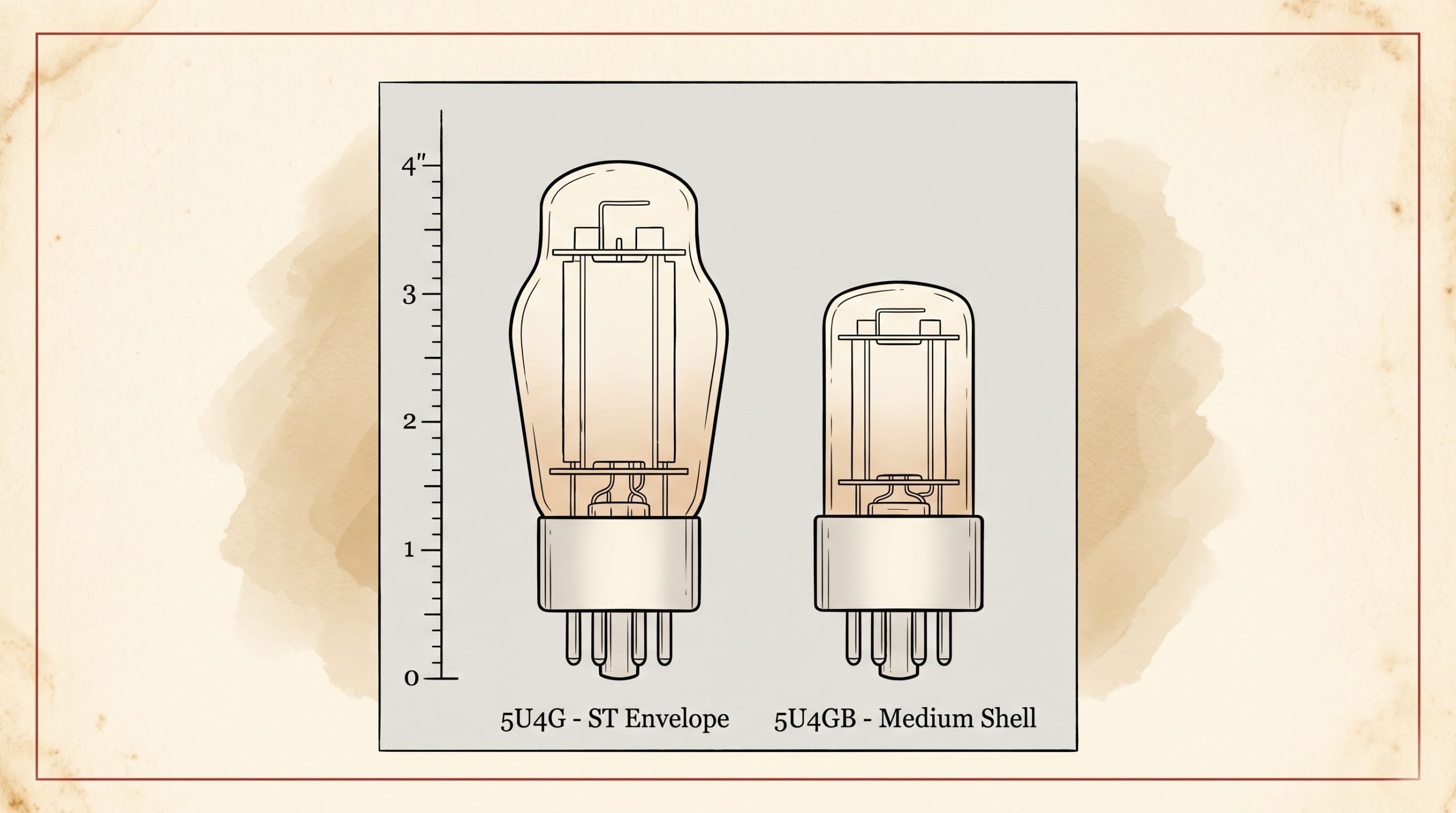
The base is octal (8-pin). Original 5U4G production uses the tall ST “coke bottle” envelope, the same silhouette you’ll recognize from RCA and Sylvania NOS stock. The later 5U4GB revision uses a shorter, more compact medium shell closer in size to a 6L6 power tube. MESA’s own product documentation flags this directly: the 5U4GB is similar in size to a 6L6, so take care not to install it in a power tube socket when swapping both types at once.
The 5U4 shares the same octal pinout as the 274B audio rectifier, a fact if you’re exploring NOS options in the audiophile market (documented at VinylSavor’s tube of the month reference).
5U4 Datasheet Specs at a Glance
The following specs are drawn from the GE and RCA published datasheets, available via Frank’s Electron Tube Data Sheets. Note the higher internal voltage drop compared to the 5AR4, that drop is the mechanical source of the “sag” players talk about.
| Parameter | 5U4G / 5U4GA | 5U4GB |
|---|---|---|
| Filament Voltage | 5.0V | 5.0V |
| Filament Current | 3.0A | 3.0A |
| Peak Inverse Voltage (PIV) | 1550V | 1550V |
| Max DC Output Current | 275mA | 275mA |
| Max AC Plate Voltage (each plate, capacitor-input filter) | 450V RMS | 450V RMS |
| Voltage Drop Under Load (approx.) | ~44–50V | ~40–50V |
| Envelope | ST “Coke Bottle” | Compact / Medium Shell |
| Base | Octal | Octal |
That 40–50V drop under load isn’t a flaw in the design. It’s the exact characteristic that separates tweed-era feel from the tighter response of 5AR4-equipped brownface and blackface circuits. Note that Fender guitar amps use a capacitor-input filter (the rectifier feeds a filter cap directly, not a choke), so the 450V RMS capacitor-input rating is the relevant one for guitar-amp applications, not the higher 550V RMS figure sometimes quoted for choke-input operation, which pairs with a lower 225mA current rating that no guitar-amp circuit uses.
Variant Designations: 5U4G, 5U4GA, 5U4GB, and 5AS4
All four designations are electrically interchangeable in virtually every application. The 5U4G is the original, tall ST-envelope version. The 5U4GA introduced minor construction updates with no change to electrical ratings. The 5U4GB brought a more compact envelope and improved manufacturing reliability. The 5AS4 is a cross-reference designation that appears in some American and European substitution guides, same tube, different label. If your amp’s schematic calls for any one of these, any of the others will drop straight in.
Manufacturer History, Who Made the 5U4?
The major NOS (New Old Stock) manufacturers include RCA, GE, Sylvania, Raytheon, Mullard, Amperex, and Philips. Among collectors, RCA and Sylvania USA production are widely considered the gold standard. RCA examples tend to run slightly warmer and rounder; Sylvania stock has a marginally tighter, more defined character. Both are excellent. Neither is cheap.
Soviet-era production from Winged “C” (SED) is a different story in the best possible way. SED continued manufacturing the 5U4-G in both grey plate and black plate versions, and they’re still available from reputable dealers. The black plate version commands a premium (around $59 from thetubestore.com at the time of writing) and is widely regarded as the best non-USA NOS option on the market today.
Current production comes primarily from two sources: JJ Electronics (Slovakia) with their 5U4GB, and Electro-Harmonix with the 5U4GBEH. Both are reliable, consistently spec’d, and priced in the $24–26 range. MESA offers their own quality-controlled 5U4GB at around $39, factory spec for MESA rectifier-equipped circuits. The Preferred Series 274B/5U4G, also available through thetubestore.com, bridges the gap between audiophile and guitar-amp applications for players who want a step up from standard current production.
A word on buying: always purchase from a dealer who tests tubes before shipping. A failed rectifier under power can stress or damage your output transformer. Not a risk worth saving $5 over.
Which Fender Amplifiers Used the 5U4 Rectifier Tube?
The 5U4 was Fender’s rectifier of choice for any early-tweed-era design where the 5Y3 couldn’t handle the current demand. The 5Y3 maxes out well below the 5U4’s 275mA rating, fine for a 5W Champ or a 15W tweed Deluxe, not enough for the higher-powered multi-speaker circuits. When Leo Fender’s engineers needed more headroom, they went to the 5U4.
This was primarily an early-to-mid tweed-era story. As Fender’s higher-powered circuits evolved through the later 1950s, most of the amps most closely associated with the classic “narrow panel” tweed sound (including the final, most celebrated Bassman revision) had already switched to the 5AR4/GZ34, which offered tighter response and slightly higher B+ output. By the time the AB763 and AA763 blackface circuits were in production, the 5U4 had long exited the Fender lineup. You can trace that transition using the Fender tube amp serial number and dating reference, which maps circuit codes across all production eras.
Tweed Era Fender Amps Using the 5U4 (1952–1960)
| Amp Model | Circuit Code | Production Years | Era | Speaker Complement |
|---|---|---|---|---|
| Fender Bassman (1×15) | 5B6 | 1952–1954 | Tweed (TV-front) | 1×15″ Jensen P15N |
| Fender Twin | 5E8-A / 5F8-A | 1955–1960 | Tweed | 2×12″ Jensen P12N |
| Fender Pro | 5E5 / 5E5-A | 1955–1959 | Tweed | 1×15″ Jensen P15N |
| Fender Bandmaster | 5E7 | 1955–1959 | Tweed | 3×10″ Jensen |
| Fender Super | 5E4-A / 5F4 | 1955–1960 | Tweed | 2×10″ Jensen P10R |
Of the 5U4-equipped Bassman circuits, the original 5B6 (1952–1954) is the clearest example, a simple single-15″ combo built specifically for Fender’s first dedicated bass amp application. The far more famous 5F6-A (1958–1960), the narrow-panel 4×10 circuit that directly inspired Jim Marshall’s JTM45, actually runs a GZ34/5AR4 tube rectifier, not a 5U4, its lower internal resistance and tighter, faster-recovering sag is part of what gives the 5F6-A its specific dynamic signature. For a full circuit breakdown of both eras, the Fender Bassman complete reference guide covers the 5B6 and 5F6-A schematics in detail alongside production chronology and value data.
The broader tweed context matters too. The 5U4 wasn’t operating in isolation, it was part of an entire design philosophy built around tweed-era Fender amp construction where component choices from power transformers to speaker selection all contributed to a cohesive sonic and tactile result.
Voltage and Bias Context in Fender Circuits
In a 5U4-equipped tweed circuit, B+ voltage runs measurably lower than the same design would produce with a GZ34/5AR4 installed, a function of the rectifier’s higher internal resistance limiting peak current draw from the power transformer’s high-voltage secondary. When the output tubes demand sudden current during a hard-picked note, the 5U4 can’t deliver it instantaneously, the voltage sags, the amp compresses, and the note blooms.
Swapping a 5AR4 into a circuit designed for a 5U4 raises B+ voltage by approximately 20–40V. That might not sound like much. In practice it shifts the output tube operating point, increases stress on filter capacitors, and changes the entire feel of the amp, tighter, stiffer, less elastic. Always measure B+ with a meter before and after any rectifier substitution. Re-bias your output tubes if the voltage shift exceeds 10–15V.
5U4 vs. 5AR4 (GZ34), What’s the Real Difference?
The 5AR4 and GZ34 are the same tube. GZ34 is the European designation, used most famously by Mullard in their Blackburn production. Both share the octal base and 5V filament of the 5U4, but the similarities end there. The 5AR4 is an indirectly heated rectifier with lower internal resistance, which means less voltage sag, faster response, and a higher B+ output voltage compared to the 5U4 in the same circuit.
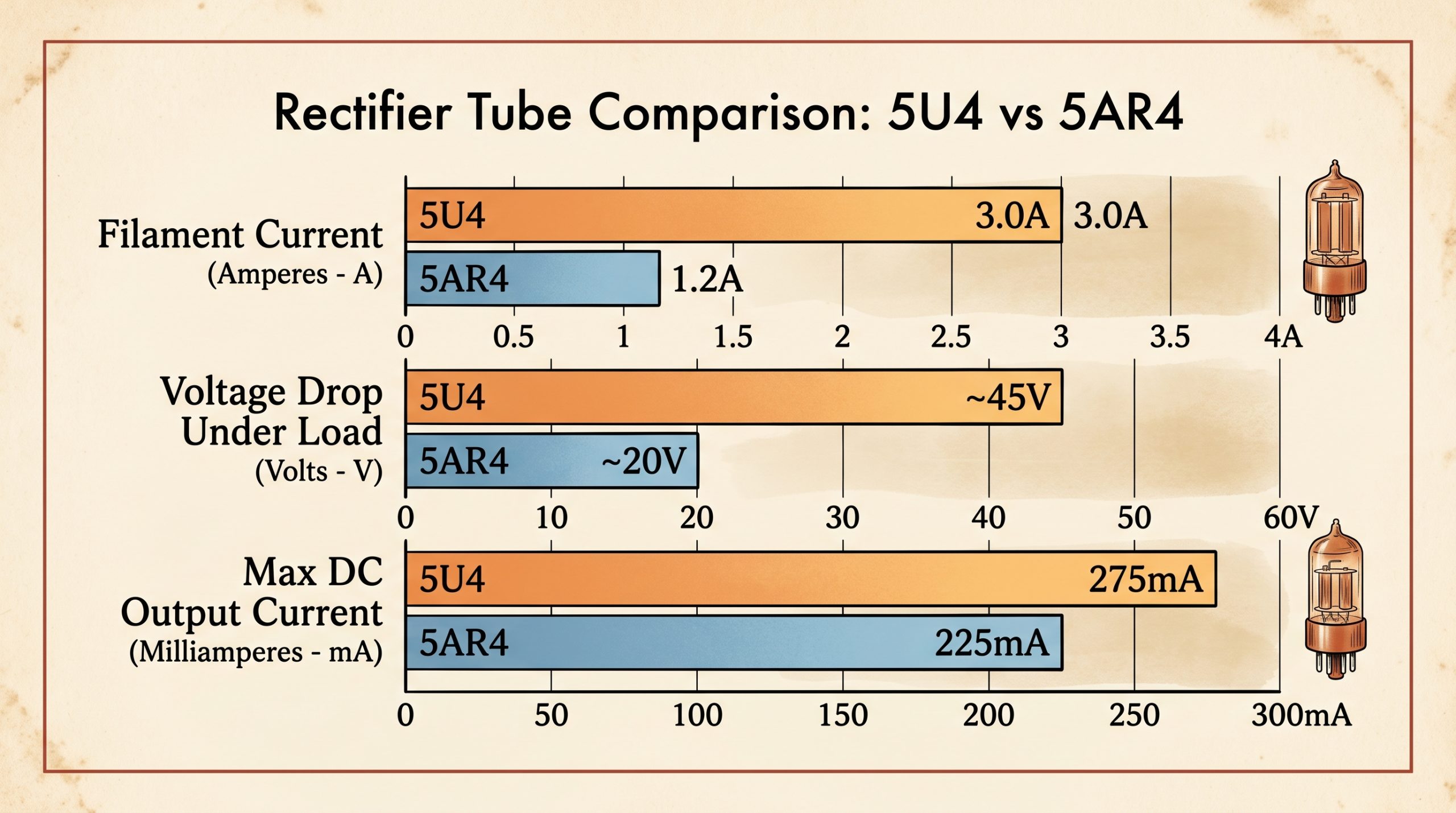
| Characteristic | 5U4 / 5U4GB | 5AR4 / GZ34 |
|---|---|---|
| Heater Voltage | 5V | 5V |
| Heater Current | 3.0A | 1.9A |
| Max DC Output Current | 275mA | 250mA |
| Internal Resistance (approx.) | Higher (~80–120Ω) | Lower (~50–70Ω) |
| Voltage Drop Under Load | ~40–50V | ~10–25V |
| B+ Voltage Output | Lower | Higher (~20–40V more) |
| Sag Character | Pronounced, elastic, compressed | Moderate, tighter, quicker recovery |
| Typical Fender Era | Tweed (early-to-mid 1950s) | Tweed (late 1950s), Brownface, Blonde, Blackface |
| Heating Type | Directly heated (filamentary) | Indirectly heated |
| Direct Swap? | Same pinout, always verify B+ voltage before and after | |
The heater current difference is significant for one practical reason: the 5U4 draws 3.0A from your power transformer’s 5V filament winding. If you’re running a 5AR4-designed circuit (rated for 1.9A on that winding) and decide to swap in a 5U4, confirm your transformer’s filament winding can handle the extra 1.1A demand before you power up. In the other direction, swapping 5AR4 into a 5U4-designed circuit, the filament winding handles it easily, but your B+ will climb.
Community voltage drop data confirms the spread: GZ34 drops approximately 10V under load; 5U4GB drops approximately 50V at its rated current. That 40V difference is audible, playable, and in the right circuit, desirable.
As Reverb and Premier Guitar contributors have noted, different rectifier tubes produce meaningfully different output voltages that directly affect amp performance, the choice of rectifier isn’t passive, it shapes how the entire circuit behaves dynamically (as documented in Reverb’s rectifier reference article).
Tonal Character, What Does the 5U4 Sound Like?
The honest answer: the 5U4 doesn’t change your tone so much as it changes your feel. The frequency response of a well-biased tweed circuit stays recognizable regardless of which 5V octal rectifier is installed. What changes is the dynamic behavior.
Under hard single-note picking, the attack softens slightly, not by much, but enough to round off the very front edge of the pick transient. Then the note blooms. That two-stage response (soft attack, then sustained body) is the textbook description of rectifier sag, and the 5U4 produces more of it than either the 5AR4 or a solid-state rectifier. Under heavy chord strumming, there’s noticeable compression that keeps the amp from feeling harsh or brittle at volume. Notes decay more gradually.
This doesn’t make an amp sound “dark.” The 5U4’s influence is dynamic, not tonal. A 5U4-equipped tweed circuit still has the spanky attack and stiff bass response Fender tweed circuits are known for, the sag is layered on top of that, not instead of it.
The lower B+ voltage that comes with the 5U4 also means the output tubes operate slightly further into their compression region at given volumes. Earlier breakup at lower stage volume. More bloom. Less headroom. If you’re chasing the feel that defined Keith Richards’ early Stones sessions or Clapton’s John Mayall Bluesbreakers tone, the rectifier is part of that equation, though it’s worth noting the specific circuit most tied to that lineage, the 5F6-A that Marshall reverse-engineered, ran a GZ34 rather than a 5U4.
One more distinction worth drawing: the 5Y3 is even saggier and lower-current than the 5U4, appropriate for smaller tweed amps like the Champ and the tweed Deluxe where output tube current demands are modest. The 5U4 sits in the middle of the sag spectrum, more compressed than the 5AR4, tighter and more current-capable than the 5Y3.
Buying a 5U4 Rectifier Tube Today, NOS vs. Current Production
Current production options are reliable and well-priced. None of them are excuses. The JJ Electronics 5U4GB runs about $24–25 from most dealers and offers consistent, tight-tolerance manufacturing, a solid choice for any tweed-era Fender. The Electro-Harmonix 5U4GBEH sits at approximately $25–26 and is equally widely available. MESA’s 5U4GB is factory-spec for MESA rectifier-equipped circuits and runs around $39, worth it if you’re running a Mark-series or Rectifier-series head and want factory parity.
For NOS purists:
- RCA 5U4G (USA): The benchmark. Expect $40–80+ depending on testing and condition. The warm, elastic character that defines classic tweed response.
- Sylvania 5U4G (USA): Slightly tighter than RCA, still excellent. Similar price range.
- Winged “C” (SED) Grey Plate: Around $40, excellent Soviet-era production, widely recommended on forums (see thetubestore.com 5U4 selection page for current availability).
- Winged “C” (SED) Black Plate: Around $60, the most sought-after non-USA NOS option. Worth the premium for a vintage circuit.
One technical reminder before purchasing: the 5U4 draws 3.0A of filament current. Confirm your amp’s power transformer 5V filament winding is rated for this draw before installing. On a circuit originally designed for a 5U4, the 5B6 Bassman, the tweed Twin, this is already accounted for. On a circuit designed for a 5AR4 (1.9A), it’s not.
Is the 5U4 Right for Your Amp?
The 5U4 is a specific choice, not a universal upgrade. If your amp was originally designed around one, check the schematic’s rectifier socket and cross-reference your circuit code against the tweed-era table above, then running a correct-spec 5U4GB is simply maintaining the design intent. If you’re in a 5U4-equipped circuit and want to experiment with the 5AR4 for a tighter, higher-headroom feel, that’s a valid and reversible experiment, provided you measure B+ and re-bias. Going the other direction, from a 5AR4-designed blackface or brownface circuit to a 5U4, requires confirming your 5V winding can handle 3.0A of filament draw, not all can.
Understanding your rectifier is one of the lowest-cost ways to meaningfully change how your vintage Fender amp feels under the fingers. The 5U4 remains one of the most interesting choices in that group, directly heated, higher drop, more sag, and sonically tied to the earliest, simplest tweed circuits Fender ever produced. If you want to dig further into how circuit codes, transformer date codes, and production eras connect across the full Fender catalog, the Fender amp dating cheatsheet is a practical next stop.
Frequently asked questions
Are rectifier tubes interchangeable?
Tubes with the same octal base and 5V filament can sometimes be swapped, but they aren't electrically equivalent. The 5U4, 5AR4, and 5Y3 all share the same pinout and heater voltage but produce meaningfully different B+ voltages under load and draw different filament currents. The 5U4 draws 3.0A; the 5AR4 draws 1.9A. Always measure B+ voltage before and after any rectifier swap, and confirm your power transformer's 5V winding is rated for the heater current of the tube you're installing. Re-bias your output tubes if B+ shifts more than 10–15V.
What is the difference between the 5U4G, 5U4GA, and 5U4GB?
All three are electrically interchangeable. The 5U4G is the original version with the tall ST "coke bottle" envelope. The 5U4GA introduced minor construction revisions with no change to electrical ratings. The 5U4GB features a more compact medium-shell envelope and improved manufacturing reliability, it's the variant in current production from JJ and Electro-Harmonix. Same pinout, same filament specs, same current ratings across all three. Drop any one in where another is called for.
Can I replace a 5U4 with a 5AR4 (GZ34) in my Fender amp?
Physically yes, same octal base, same 5V heater voltage, and your 5V filament winding can handle the 5AR4's lower 1.9A draw easily. Electrically, the 5AR4's lower internal resistance will raise your B+ voltage by approximately 20–40V compared to the 5U4. In some amps this is within safe operating margins; in others it stresses filter capacitors and shifts the output tube operating point. Measure B+ after swapping. Re-bias output tubes as required. Don't skip this step.
Which Fender amps originally came with a 5U4 rectifier tube?
The 5U4 was used in early-to-mid tweed-era Fender amplifiers including the original 5B6 Bassman (1×15, 1952–1954), the tweed Twin (circuit codes 5E8-A and 5F8-A), the tweed Pro (5E5 and 5E5-A), the tweed Bandmaster (5E7), and the tweed Super (5E4-A and 5F4). The later, far more famous 5F6-A Bassman (1958–1960) that inspired the Marshall JTM45 actually uses a GZ34/5AR4 tube rectifier, not a 5U4. By the brownface and blonde eras, most designs had transitioned to the 5AR4. The blackface era (AB763, AA763, and related circuit codes) uses the 5AR4/GZ34 throughout.
What is the best current-production replacement for a vintage 5U4G?
The JJ Electronics 5U4GB and Electro-Harmonix 5U4GBEH are both solid current-production choices with consistent specs and good availability in the $24–26 range. For a step up without going full NOS, the Winged "C" (SED) grey plate 5U4-G offers excellent Soviet-era construction at around $40. The gold standard for vintage character remains genuine USA NOS RCA or Sylvania 5U4G stock, expect to pay $40–80+ for tested examples in good condition.