Contents
- 01Spec-by-Spec: Vibrolux Reverb vs Deluxe Reverb
- 02Circuit Numbers, Production History, and Era Classification
- 03The Core Tonal Differences: What You Actually Hear
- 04Use Case Breakdown: Which Amp Fits Which Situation
- 05Blackface vs Silverface: Which Era to Buy?
- 06The Specs Competitors Miss: Transformers, Tubes, and Impedance
- 07What Players and Forums Actually Say
- 08Should You Consider the Alternatives?
- 09Frequently Asked Questions
- 10Vibrolux or Deluxe Reverb: Which One Fits Your Rig
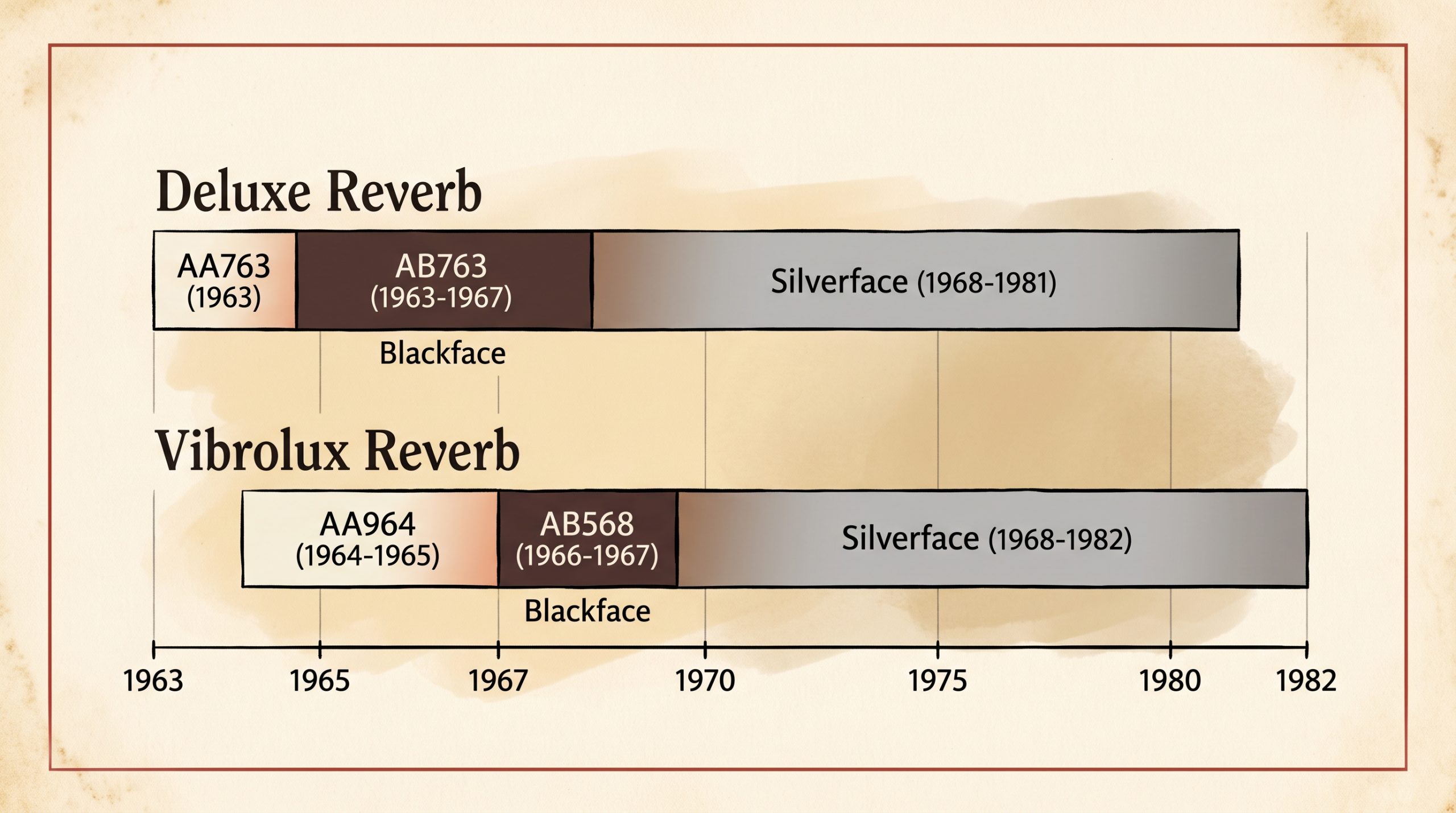
- Deluxe Reverb circuit: AB763 (blackface), AA763 (transitional 1963)
- Vibrolux Reverb circuits: AA964 (1964-1965), AB568 (1966-1967)
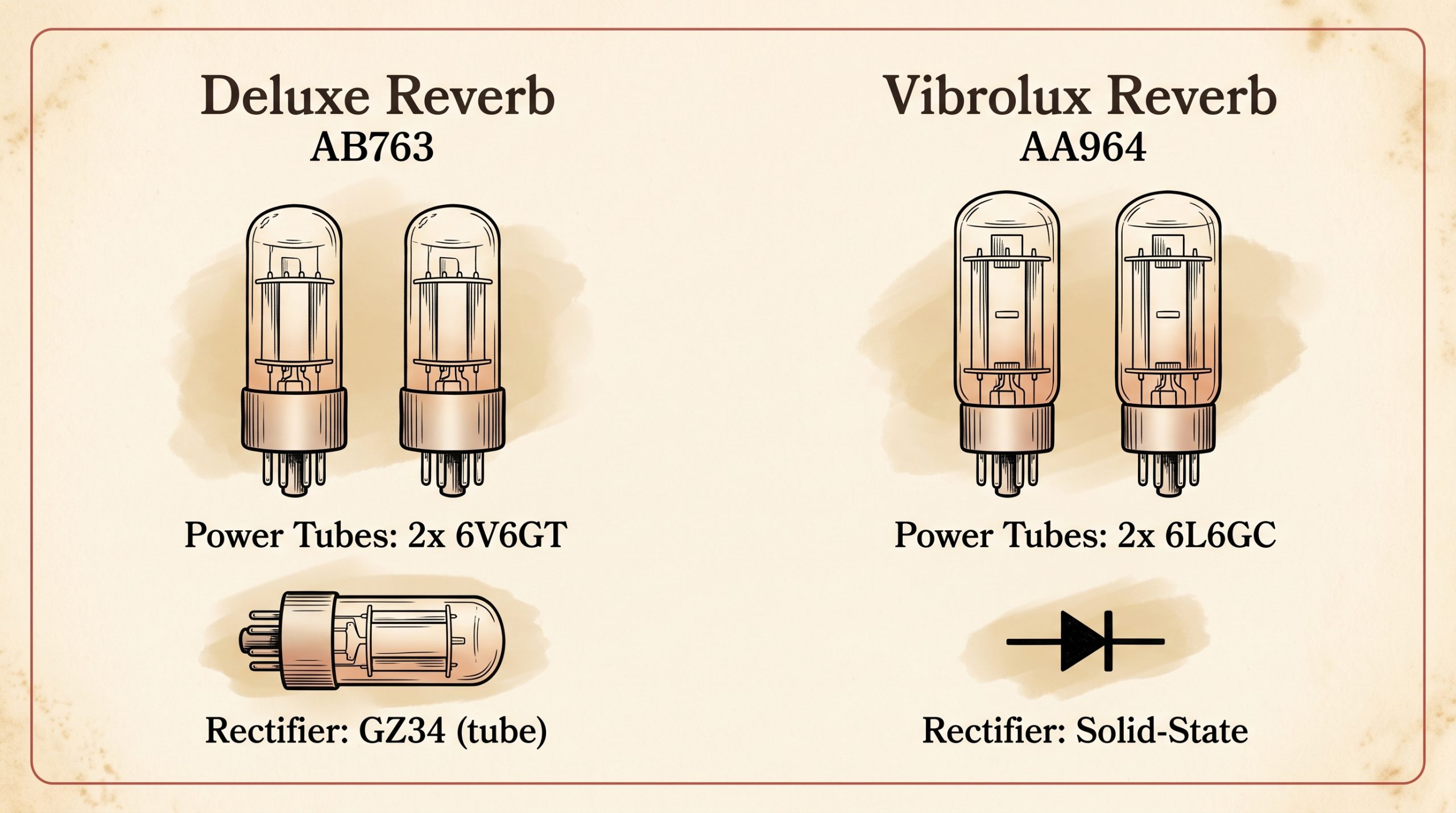
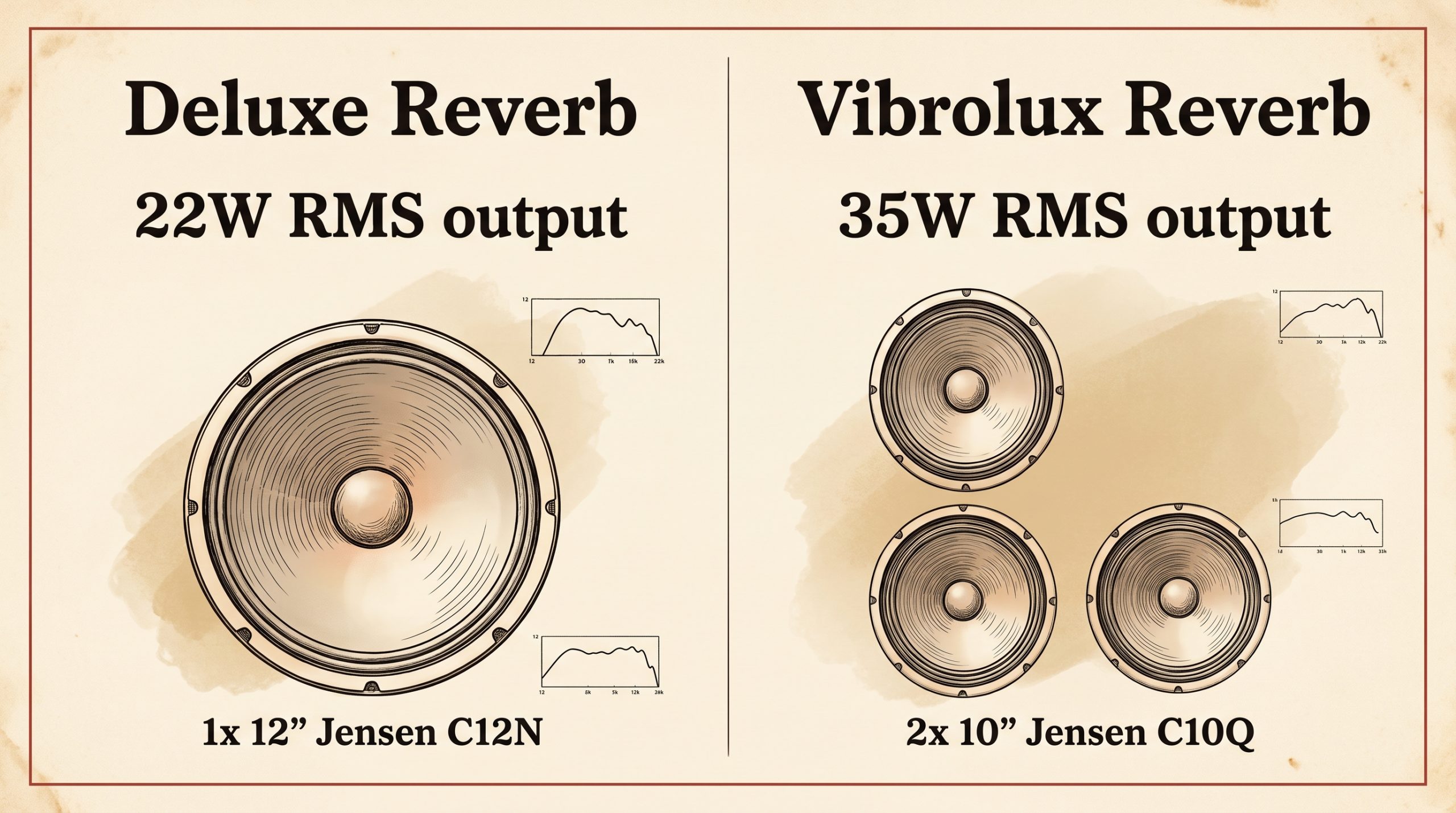
- Deluxe Reverb output: ~22 watts RMS, 2x 6V6GT, 1×12″ speaker
- Vibrolux Reverb output: ~35 watts RMS, 2x 6L6GC, 2×10″ speakers
- Deluxe Reverb rectifier: GZ34 tube (blackface); 5U4GB tube on later silverface (never solid-state from the factory)
- Vibrolux Reverb rectifier: GZ34 tube rectifier from factory on AA964 (not solid-state)
- Blackface Deluxe Reverb used market: $1,800-$3,200
- Blackface Vibrolux Reverb used market: $2,200-$4,000
- Vibrolux weighs ~41 lbs; Deluxe Reverb weighs ~33 lbs
- The “Vibrolux” (non-reverb brownface/blonde era) is a different amp entirely. Don’t confuse it with the Vibrolux Reverb.
- Output transformers are NOT interchangeable between DR and VR without modification
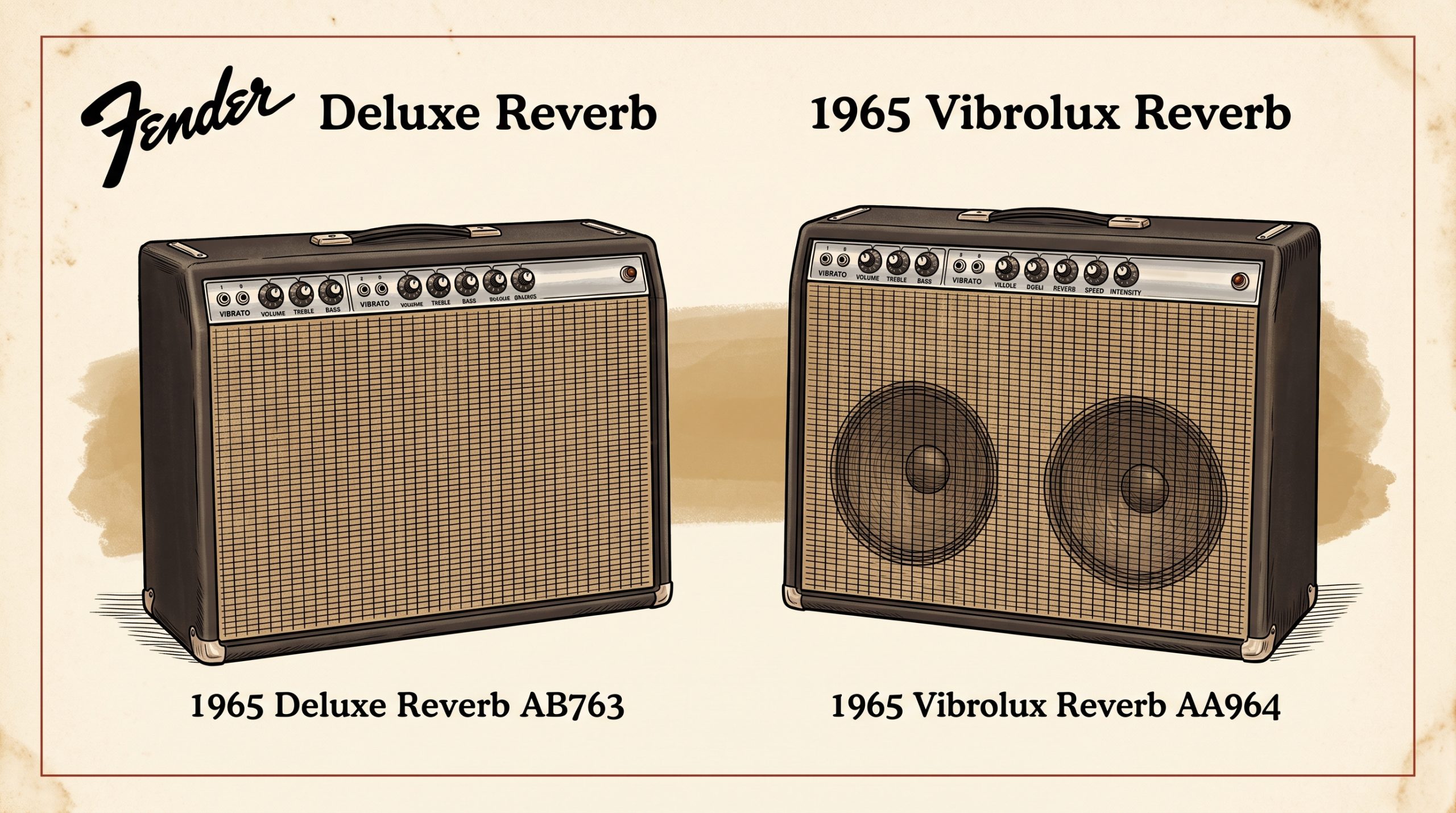
Spec-by-Spec: Vibrolux Reverb vs Deluxe Reverb
The table below covers the full specification split. These aren’t approximate numbers pulled from forum posts. They come from the original Fender service documentation and Teagle and Sprung’s Fender Amps: The First Fifty Years, the most thorough primary reference for production history and circuit dating on these models.
| Spec | Fender Deluxe Reverb | Fender Vibrolux Reverb |
|---|---|---|
| Primary Circuit Number | AB763 | AA964 / AB568 |
| Production Years (Blackface) | 1963-1967 | 1964-1967 |
| Production Years (Silverface) | 1968-1981 | 1968-1982 |
| Rated Output | ~22 watts RMS | ~35 watts RMS |
| Power Tubes | 2x 6V6GT | 2x 6L6GC |
| Speaker Configuration | 1×12″ | 2×10″ |
| Original Speaker (Blackface) | Jensen C12N / Oxford 12K5 | Jensen C10Q / Oxford 10L5 |
| Preamp Tubes | 4x 12AX7, 2x 12AT7 | 4x 12AX7, 2x 12AT7 |
| Rectifier | GZ34 tube (early BF); 5U4GB tube (late) | GZ34 tube (AA964 factory) |
| Channels | Normal + Vibrato | Normal + Vibrato |
| Reverb | Yes | Yes |
| Tremolo | Yes | Yes |
| Cabinet | Open-back, pine (BF) | Open-back, pine (BF) |
| Weight | ~33 lbs | ~41 lbs |
| Typical Used Price (Blackface) | $1,800-$3,200 | $2,200-$4,000 |
Circuit Numbers, Production History, and Era Classification
Fender Deluxe Reverb: AB763 and the AA763 Transition
The AB763 is the reference blackface Deluxe Reverb circuit, covering the bulk of 1963 through 1967 production. A short run of 1963 examples carried the transitional AA763 designation before Fender finalized the AB763 layout. The difference is minor and rarely affects tone. Both use identical tube complements and the same basic signal path.
Power output on the AB763 sits at 22 watts RMS into 8 ohms. The two 6V6GT output tubes run at approximately 420V plate voltage, which keeps them well within their operating range but close enough to clip with moderate input signal. The GZ34 tube rectifier on early blackface examples introduces a small amount of voltage sag under dynamic playing. That sag contributes to the compressed, “bloomy” feel the Deluxe Reverb is known for. You can read more about how the GZ34’s sag characteristics compare across models in the Fender tube amp dating reference, which covers transformer and tube chart codes for precise era identification.
The silverface transition arrived in 1968, initially as a cosmetic change. The most functionally significant circuit modification came around 1972, when Fender introduced an ultralinear output transformer winding. That change reduced output transformer saturation and altered the amp’s breakup character. Early silverface examples (1968-1971) are nearly circuit-identical to blackface. Original speakers: Jensen C12N (EIA code 220-637) on most blackface examples, with Oxford 12K5 (EIA code 465-series) also appearing throughout the run.
Fender Vibrolux Reverb: AA964 and AB568
The Vibrolux Reverb entered production in 1964 under the AA964 circuit designation. It ran through 1965, then received minor component value updates in the AB568 circuit that carried through the remainder of the blackface era into 1967. The functional difference between AA964 and AB568 is small enough that most players and technicians treat both as equivalent for tonal purposes.
One detail that’s frequently misreported: the AA964 uses the same GZ34 tube rectifier as the Deluxe Reverb, not a solid-state rectifier. Both amps get the same rectifier-driven voltage sag under hard picking. The tighter, more immediate feel players notice from the Vibrolux Reverb comes from its higher plate voltage and 6L6GC power tubes, not from a different rectifier topology.
Rated output is approximately 35 watts RMS, though some sources list 40 watts (that figure reflects peak rather than continuous RMS power). The two 6L6GC output tubes run at roughly 460-480V plate voltage, requiring more input signal to reach clipping than the 6V6GT at lower plate voltage. Original speakers are Jensen C10Q (EIA code 220-625) or Oxford 10L5. Weight comes in around 41 lbs, noticeably heavier than the Deluxe Reverb at 33 lbs.
One naming caution worth flagging: the “Vibrolux” without the “Reverb” suffix is a different amp entirely. The earlier brownface and blonde Vibrolux models (pre-1964) ran different tube complements and had no reverb circuit. If you’re shopping vintage, confirm “Vibrolux Reverb” on the grille badge and chassis stamp before assuming you’re looking at the right amp.
The Core Tonal Differences: What You Actually Hear
Clean Headroom: Where the 13-Watt Gap Actually Lives
Thirteen watts of additional power between the Vibrolux Reverb and Deluxe Reverb translates to roughly 2.5 dB of additional clean SPL at the speaker. That’s perceptible, but it’s not the full story. Headroom isn’t just wattage. It’s the interaction of plate voltage, power tube characteristics, and speaker sensitivity working together.
The 6L6GC requires meaningfully more input signal to enter clipping than the 6V6GT. This is independent of wattage rating. At equivalent volume knob positions, the Deluxe Reverb on its Vibrato channel begins generating significant harmonic distortion around 4-5. The Vibrolux Reverb at the same setting stays relatively clean. At 95 dB SPL (a typical small club monitor level), a blackface Deluxe Reverb on the Vibrato channel is already generating 3-5% THD. The Vibrolux Reverb at the same SPL typically measures under 1% THD. That’s a real difference with real consequences for how your clean tone survives a loud stage.
Breakup Character: 6V6 vs 6L6 Overdrive
When the Deluxe Reverb clips, it clips in a particular way — the classic 6V6 vs 6L6 divide. The 6V6GT’s breakup is early, compressed, and rich in even-order harmonics. Touch-sensitive. Bloomy. Push it past 5 and it barks when pushed with a hard pick attack, then softens into smooth compression on lighter playing. That interaction between the player’s dynamics and the amp’s response is a big part of why the Deluxe Reverb has been a studio constant since the mid-1960s.
The Vibrolux Reverb’s 6L6GC breakup arrives later and sounds different when it gets there. More open. Less compressed. The bass definition holds together better at the point of clipping, which is part of why the Telecaster Guitar Forum consensus consistently describes the VR as “tighter and cleaner at the same volume.” When you do push a VR into natural power tube saturation, it takes more volume to get there, and the resulting character suits players who want grit with more low-end stability underneath it. Not better. Different.
Speaker Configuration: Why 2×10 Sounds Different from 1×12
The physics matter here. Two 10-inch drivers combine for approximately 157 square inches of cone area. A single 12-inch driver covers approximately 113 square inches. The 2×10 configuration in the Vibrolux Reverb moves more air, plain and simple.
Combined resonant frequency also differs. Two 10-inch drivers have a higher combined resonant frequency than a single 12-inch, which pulls bass response up slightly and adds midrange punch. The result is a tighter low end and a faster transient attack from the VR compared to the DR’s rounder, more extended low-mid bloom. The Jensen C10Q used in the blackface Vibrolux Reverb has a lighter cone than the C12N in the Deluxe Reverb, adding upper-midrange presence and a slightly scooped character relative to the DR’s more balanced midrange emphasis. Both cabinets are open-back, but the wider VR cabinet disperses sound more broadly on stage, which can help even coverage in smaller rooms with low ceilings.
According to Premier Guitar, the Vibrolux’s appeal lies specifically in the balance between attack and responsiveness of its lightly driven 10-inch speakers, a characteristic that distinguishes it from both the larger 4×10 Super Reverb and the single-speaker Deluxe Reverb (as noted in their coverage of the blackface reverb family at premierguitar.com).
Use Case Breakdown: Which Amp Fits Which Situation
Home Practice and Studio Recording
Advantage goes to the Deluxe Reverb. Not close. The DR reaches its natural power tube saturation zone at volumes that are manageable in a home or studio environment. Recording engineers reach for it repeatedly because it can “sing” at controllable SPL levels without requiring a load box or attenuator to get a usable sound. The 6V6GT breakup is musical at relatively low output levels, and the single 12-inch speaker produces that round, mid-focused tone that sits well in a mix.
The Vibrolux Reverb at home often stays frustratingly clean unless you’re running pedals or using an attenuator. If you run a high-quality attenuator into the VR, note that you lose some of the 2×10 “air” and projection that defines its character. The amp is designed to perform at stage volumes. At bedroom levels, you’re getting its clean platform without the full sonic character the speaker pair produces under power.
Small Club and Bar Gigs (Under 200 Capacity)
The Vibrolux Reverb’s additional headroom shines when you need clean tone in a live band context without PA support. At the volume levels a small club gig demands, the DR can struggle to stay clean in a loud band mix. That can be a feature for players who want natural amp overdrive as part of their core tone, but it’s a liability for players who want pedals controlling the dirt while the amp stays open and clear.
The 2×10 configuration projects forward evenly in smaller rooms with low ceilings, and the tighter bass response cuts through a band mix more definitively than the DR’s low-mid bloom. The Telecaster Guitar Forum consensus captures this accurately: the Vibrolux “is capable of louder volumes than a Deluxe” and “does hold up closer to 10 on the dial.” The Deluxe Reverb in a loud band context typically benefits from a clean boost pedal to compete with a drummer, which some players prefer as a deliberate tone choice.
Pedal Platform Performance
Clean pedal platform. That’s the Vibrolux Reverb’s strongest use case. Players running overdrive and fuzz into a clean amp favor the VR because the pedal controls the gain structure while the amp provides a stable, open, detailed foundation. The amp’s clean headroom means your pedal’s character comes through without the amp’s own compression coloring or compressing the signal further.
The Vibrolux Reverb’s higher clean headroom is relevant here, not a rectifier difference — both amps use the same GZ34 tube rectifier. If you want your right-hand attack faithfully reproduced through your overdrive pedal before the power section starts compressing it, the VR’s added headroom works in your favor. The Deluxe Reverb as a pedal platform works well at lower volumes but its earlier onset of natural compression can interact with pedal gain in complex ways at stage levels, sometimes blurring the pick attack that high-gain players are trying to preserve.
Blackface vs Silverface: Which Era to Buy?
Blackface (1963-1967): The Benchmark
The AB763 Deluxe Reverb and AA964/AB568 Vibrolux Reverb represent the definitive versions of both amps. Blackface examples used carbon composition resistors, Mallory and Sprague capacitors, and Jensen or Oxford speakers. Lower filter capacitor values in the blackface DR circuit contribute to that characteristic sag and compression feel. These aren’t audiophile myths. They’re documented component choices visible on original schematics available through Fender’s service documentation archives.
Identification cues: black anodized control panel, “skirted” aluminum knobs, the “tail” or “transition” logo on the grille. For transformer dating, look for Triad or Schumacher EIA codes. Output transformer date codes should fall within one to two years of the chassis date code. A mismatch doesn’t automatically disqualify an amp, but it warrants investigation. See the Fender amp transformer date code decoder for reading EIA 606 codes on both OT and PT covers. Blackface examples command a 20-40% price premium over comparable silverface versions in the current market.
Silverface (1968-1982): The Practical Alternative
Early silverface production (1968-1971) used circuits nearly identical to blackface. Worth noting. Both the Deluxe Reverb and Vibrolux Reverb from this period are frequently overlooked value finds for players who want the tone without the blackface price premium.
The Deluxe Reverb’s later silverface production (post-1972) introduced the ultralinear output transformer, which reduced output transformer saturation and changed the breakup character. If you’re buying a silverface DR specifically for its tone, prioritize pre-1972 examples. The silverface Vibrolux Reverb maintained a relatively stable circuit throughout its run. The AB568 circuit carries over largely intact into the silverface era. A 1969-1971 silverface Vibrolux Reverb in solid condition represents genuine value versus blackface examples.
Identification: polished aluminum control panel, flat-top “chicken head” knobs, drip edge grille trim on 1968-1969 transitional examples. The drip edge transitional models have their own following in the collector market.
The Specs Competitors Miss: Transformers, Tubes, and Impedance
Most comparison articles stop at wattage and speaker count. These details matter for anyone buying, maintaining, or modifying either amp.
Output transformer differences. The Deluxe Reverb’s output transformer is wound specifically for 6V6 operation at lower plate voltages (around 420V). The Vibrolux Reverb’s output transformer handles 6L6GC plate voltage in the 460-480V range. These transformers are not interchangeable without significant modification. Swapping an output transformer without accounting for impedance ratios and plate voltage ratings will damage tubes or the transformer. Don’t do it.
Impedance wiring. The Vibrolux Reverb’s 2×10 cabinet wires two 8-ohm speakers in parallel to present 4 ohms at the output jack, matching the VR’s output transformer. This matters for speaker swaps. Replacing the stock 10-inch speakers with 16-ohm drivers in parallel would present 8 ohms at the output, mismatching the transformer and stressing the output section. Always verify driver impedance before swapping speakers in the VR. The Deluxe Reverb’s single 12-inch driver is a straightforward 8-ohm load.
Bias voltage and plate current. The DR biases 6V6GT tubes typically at 25-30mA per tube at approximately 420V plate voltage. The VR biases 6L6GC tubes at 35-45mA per tube at 460-480V. Always check and set bias after retubing either amp. Dropping in a fresh matched pair without biasing is one of the most common causes of premature output tube failure on both models. Original Fender service documentation specifies these figures, and they remain the reference point for any competent technician. For decoding the tube chart, speaker stamps, and transformer codes that help verify an amp’s production date, the Fender amp dating cheat sheet covers EIA date codes across both blackface and silverface eras.
Preamp gain structure. Both amps use essentially identical preamp topology: Normal and Vibrato channels sharing reverb and tremolo circuits. The tonal character difference begins at the phase inverter and power section, not the preamp. Players looking to EQ one amp to sound like the other will hit a wall at the power section. Different tubes. Different plate voltage. Different output transformer. The preamp is where they’re the same. Everything after the phase inverter is where they diverge.
EIA speaker codes to verify: Jensen C12N in the blackface DR carries code 220-637. Jensen C10Q in the blackface VR carries code 220-625. Oxford 12K5 and 10L5 fall under the 465-series prefix. Date codes on original speakers should align within one to two years of the chassis date code. A speaker date code significantly later than the chassis stamp suggests a replacement. Not a deal-breaker, but a negotiating point. The Fender amp speaker date code guide covers the full decoding method for Jensen, Oxford, and CTS stamps.
What Players and Forums Actually Say
The forum consensus across The Gear Page, the Telecaster Guitar Forum, and Reddit’s r/ToobAmps is consistent enough to synthesize usefully. The Gear Page discussion describes the Deluxe Reverb as “a bit more midrangey” with “a bit less clean headroom,” while the Vibrolux has “a bit punchier low-end” and more clean headroom. The Telecaster Guitar Forum puts it more directly: the Vibrolux “is more punchy, tighter and at the same volume much cleaner” and “does hold up closer to 10 on the old dial.” Reddit consensus follows the same pattern: players who want amp breakup lean toward the DR, players who want headroom for pedals or loud stages lean toward the VR.
The forum debate often conflates “which sounds better” with “which works better for my situation.” These are different questions. Neither amp is objectively superior. The Deluxe Reverb is a better answer if you want the amp itself to be the primary gain source at manageable volumes. The Vibrolux Reverb is a better answer if you want clean headroom and pedal responsiveness in a gigging context. Context determines the answer every time.
Price reality check (2024-2025 market): Blackface Deluxe Reverb examples with original transformers and speakers typically run $1,800-$3,200 depending on condition and originality. Blackface Vibrolux Reverb examples run $2,200-$4,000 for the same reasons. Silverface equivalents from the 1968-1971 transitional period run 20-40% less. That price gap should factor into the decision for anyone buying primarily for tone rather than collector value.
Should You Consider the Alternatives?
Fender Pro Reverb: The Middle Path
If you want more headroom than the Vibrolux Reverb and a fuller low end than either amp in this comparison, the Pro Reverb delivers. It runs approximately 40 watts into two 12-inch speakers using an AB763 circuit variant shared with the Deluxe Reverb. More headroom. More low-end authority. Heavier. Less common on the used market, which makes finding a clean example harder. The Fender Pro Reverb guide covers the full circuit history, AA165 and AB668 revisions, and current market value in detail.
Princeton Reverb: When Less Is More
The Princeton Reverb runs 12-15 watts into a single 10-inch speaker with 6V6 power tubes. Breaks up earlier than the Deluxe Reverb. Beloved for studio recording and small-room use where even the Deluxe Reverb is too loud before it opens up. If the Deluxe Reverb’s breakup point is still too loud for your use case, the Princeton Reverb answers that. The Princeton Reverb vs Deluxe Reverb comparison breaks down the circuit differences, speaker character, and when each amp makes sense.
’68 Custom Vibrolux Reverb (Discontinued Reissue)
Fender’s ’68 Custom Vibrolux Reverb covered the Vibrolux Reverb format in reissue form, adding a “Custom” voice channel not present on the original AA964 circuit. As of 2026 it has been discontinued and is no longer listed for sale new by Fender or its major authorized dealers; used and remaining new-old-stock units are the only way to find one now. The circuit differences from the original are real, and the stock Celestion speakers didn’t replicate the Jensen C10Q character out of the box. As a sonic recreation of a blackface AA964, it was close but not identical. Players wanting new-production reliability in this format today will need to shop used or consider a different current-production Fender combo instead.
Vibrolux or Deluxe Reverb: Which One Fits Your Rig
The choice comes down to a single honest question: do you want the amp to drive itself, or do you want it to stay out of the way while your pedals do the work? The Deluxe Reverb answers the first question. It reaches a satisfying, touch-sensitive breakup at volumes that work in a studio or small rehearsal room, it weighs 8 pounds less than the Vibrolux, and it costs less on the used market. The Vibrolux Reverb answers the second question. Its 6L6GC power section and higher plate voltage stay clean longer, its 2×10 configuration punches forward more definitively in a live mix, and it keeps tracking picking dynamics cleanly well past the point where the Deluxe Reverb has already started to compress. If you gig regularly without PA support and run pedals for gain, the Vibrolux Reverb is the more practical tool. If your playing happens primarily at home or in the studio and you want the amp itself to provide compression and harmonic saturation, the Deluxe Reverb delivers that at lower volume levels and lower cost. A 1969-1971 silverface example of either amp represents solid value when condition and originality check out, with circuits nearly identical to blackface at a meaningfully lower price point.
Frequently asked questions
Is the Vibrolux Reverb louder than the Deluxe Reverb?
Yes. The Vibrolux Reverb is rated at approximately 35 watts RMS versus the Deluxe Reverb's 22 watts RMS. In decibel terms, that's roughly 2 dB of additional SPL, perceptible but not dramatic on its own. The more significant real-world difference is clean headroom: the Vibrolux stays cleaner at higher volumes due to both higher wattage and the 6L6GC power tubes requiring more input signal to reach clipping than the 6V6GT tubes in the Deluxe Reverb.
Can you use a Vibrolux Reverb at home?
Yes, but it's not the ideal home amp. The VR's higher clean headroom means it rarely reaches natural power tube breakup at home volumes. Players who want natural amp overdrive at bedroom levels will find the Deluxe Reverb much more satisfying for that purpose. For players using pedals for gain and wanting a clean, open platform, the VR works well at lower volumes. If you're running an attenuator, note that some of the 2x10 "air" that defines the VR's character is lost at reduced output levels.
What is the circuit number for the blackface Deluxe Reverb?
The definitive blackface Fender Deluxe Reverb uses the AB763 circuit, produced from 1963 to 1967. A small number of 1963 examples carry the transitional AA763 designation. The silverface era began in 1968 with cosmetic changes, and the ultralinear output transformer modification arrived around 1972, representing the most significant functional circuit change of the silverface run.
Are the Vibrolux Reverb and Deluxe Reverb speakers interchangeable?
Not directly. The Deluxe Reverb uses a single 12-inch speaker presenting 8 ohms at the output jack. The Vibrolux Reverb uses two 10-inch speakers wired in parallel. Each driver is 8 ohms, combining to 4 ohms total, which matches the VR's 4-ohm-rated output transformer. If you swap the VR's drivers, both replacement speakers must be 8-ohm units to maintain that 4-ohm load. Using 16-ohm drivers in parallel in the VR would present 8 ohms, an impedance mismatch that reduces power transfer and can stress the output transformer and tubes over time.
Which is better for blues: Vibrolux or Deluxe Reverb?
Both work well for blues. The Deluxe Reverb's earlier breakup and compressed 6V6GT character suit players who want natural amp saturation at moderate volumes, think small club with the amp miked. The Vibrolux Reverb suits blues players who want a clean platform for overdrive pedals or who play louder stages and need headroom before clipping. Players who dig into their guitar and want the amp to respond with dynamic compression will prefer the DR. Players who want consistent clean response that faithfully tracks pick dynamics will prefer the VR. Neither is the wrong answer for blues.