Contents
- 01Quick-Reference Spec Comparison
- 02Origins and Circuit Lineage
- 03Power, Headroom, and the Volume Question
- 04Speaker Configurations and What They Mean
- 05Who Plays What: Famous Users and Their Contexts
- 06Silverface Era: What Changed and Does It Matter?
- 07Which One Should You Buy? A Decision Framework
- 08Hot Rod Deluxe vs. Super Reverb: A Brief Digression
- 09FAQ: Super Reverb vs. Deluxe Reverb
- 10Which Amp Belongs on Your Stage
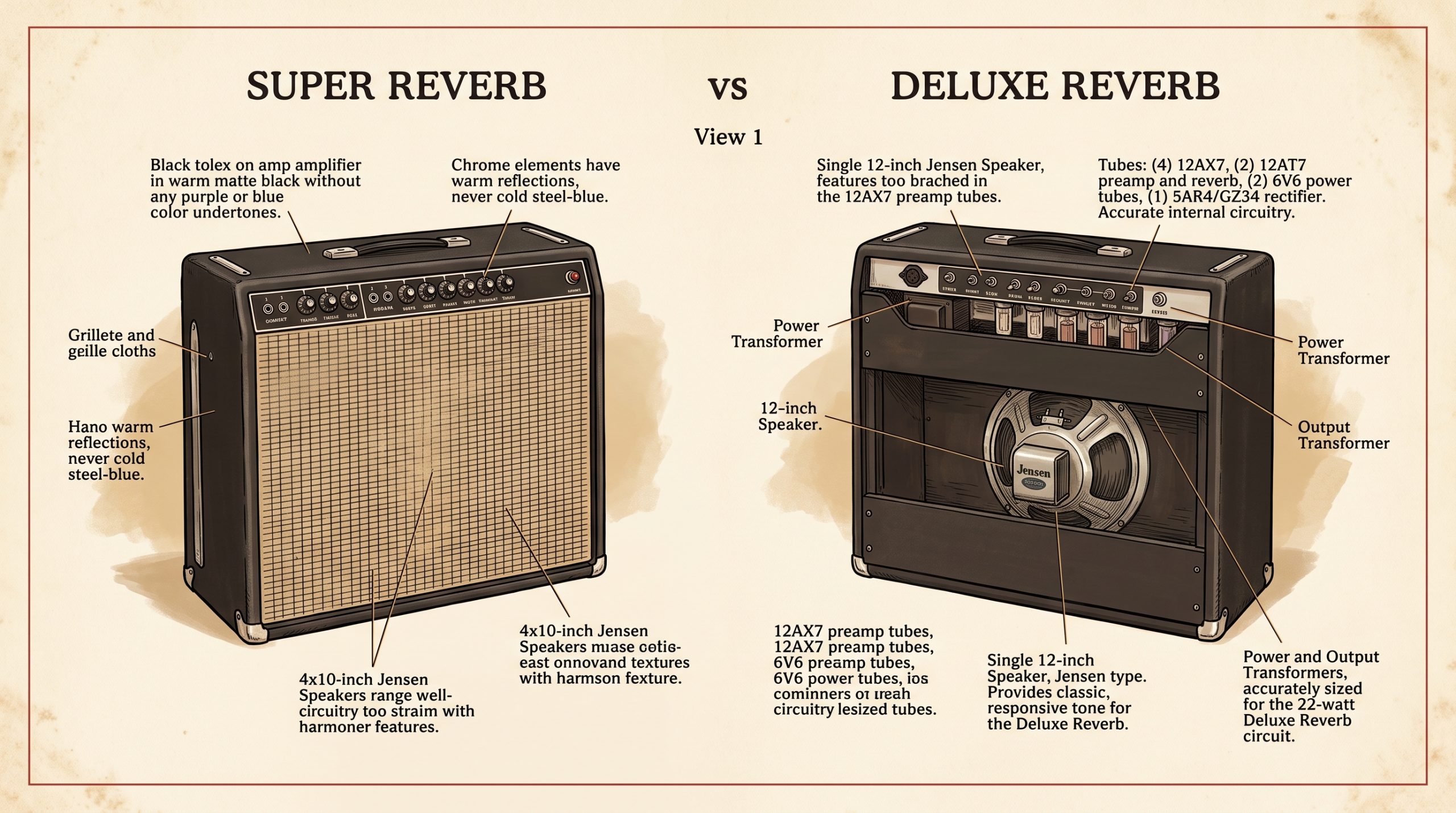
Quick-Reference Spec Comparison
| Spec | Fender Super Reverb | Fender Deluxe Reverb |
|---|---|---|
| Circuit Number | AA763 / AB763 | AA763 / AB763 |
| Era Classification | Blackface 1963-1967 / Silverface 1968-1981 | Blackface 1963-1967 / Silverface 1968-1981 |
| Rated Output Power | ~40W RMS | ~22W RMS |
| Power Tubes | 2x 6L6GC | 2x 6V6GT |
| Preamp Tubes | 4x 12AX7, 2x 12AT7 | 4x 12AX7, 2x 12AT7 |
| Rectifier | GZ34 (tube) | GZ34 (tube) |
| Speaker Complement | 4×10″ (Jensen C10N or Oxford 10L6) | 1×12″ (Jensen C12N or Oxford 12K5) |
| Total Speaker Cone Area | ~314 in² | ~113 in² |
| Cabinet Type | Open-back combo | Open-back combo |
| Channels | 2 (Normal + Vibrato) | 2 (Normal + Vibrato) |
| Controls | Volume, Treble, Bass, Reverb, Speed, Intensity | Volume, Treble, Bass, Reverb, Speed, Intensity |
| Approximate Weight (Blackface) | ~62 lbs | ~42 lbs |
| Original MSRP (approx. 1965) | ~$399 | ~$239 |
The AB763 designation replaced the earlier AA763 with adjusted negative feedback loop values and revised bias points. Sonically, AB763 translates to a slightly tighter, more controlled response in the low-end, and most collectors consider it the definitive blackface circuit. The Deluxe Reverb AA763 debuted in 1963; AB763 revisions appeared across the lineup by approximately 1964. Our Fender tube amp dating reference covers how to confirm which circuit revision you’re looking at using chassis stamps and transformer codes.
Origins and Circuit Lineage
Shared DNA: The AB763 Circuit
Both amps trace directly to the same fundamental blackface circuit topology developed under Leo Fender’s direction at Fullerton, California. The AB763 revision tightened the negative feedback loop and adjusted bias points compared to AA763, delivering a slightly firmer feel and more defined transient attack. That tightness is audible. It’s one reason early silverface amps on AB763-equivalent circuits are often considered comparable to true blackface units by players who care about tone over cosmetics.
Where the Circuit Diverges
The power transformer tells the story immediately. The Super Reverb runs a heavier PT to supply the 6L6GC pair’s higher current demands. The output transformer is wound for the 4×10″ speaker load, typically presenting a 2-ohm or 4-ohm impedance depending on wiring configuration. The Deluxe Reverb’s OT is wound for a single 8-ohm or 16-ohm 12-inch speaker. These are not interchangeable components.
Both amps use a GZ34 tube rectifier, but the Super Reverb’s heavier B+ supply runs the GZ34 closer to its operating limits under heavy load. That contributes to the Super’s characteristic voltage sag when pushed, a soft compression that experienced players specifically seek out. The phase inverter is a long-tail pair in both amps, though driver resistor values differ slightly between the two. Minor differences. Big sonic consequences.
One practical angle worth covering before you buy: authenticating an original blackface Super Reverb or Deluxe Reverb using EIA date codes. Jensen speakers carry a six-digit EIA stamp on the frame. The first three digits identify the manufacturer (220 = Jensen, 465 = Oxford), and the final three digits encode the year and week of manufacture. A Jensen C10N stamped 220-637 dates to the 37th week of 1966 (the single year digit 6 has to be cross-referenced against the amp’s blackface-era cosmetics to pin down the decade). Oxford 10L6 speakers follow the same EIA 606 standard. Cross-referencing speaker codes, transformer codes, and chassis stamps is the most reliable way to verify originality. The Fender amp speaker date code guide walks through the full decoding process for Oxford, Jensen, and CTS stamps across the blackface era.
Power, Headroom, and the Volume Question
Why 40W Doesn’t Sound Twice as Loud as 22W
The decibel scale is logarithmic. A 3dB increase in output level is perceptibly louder to the ear; a 10dB increase is perceived as roughly double the volume. The Super Reverb’s power advantage over the Deluxe translates to approximately 2.6dB in actual output level. Noticeable. Significant on stage. But not the dramatic chasm the wattage gap implies when you read the numbers on paper.
Where the Super’s real advantage lives isn’t in the wattage figure. It’s in cone area. Four 10-inch speakers produce a total radiating surface of approximately 314 square inches. The single 12-inch speaker in the Deluxe contributes roughly 113 square inches. Nearly three times the moving air. That physical mass of displaced air creates the Super’s characteristic room-pressurizing push, a quality that watts-per-watt comparisons entirely miss.
Breakup Threshold: The Critical Practical Difference
The Deluxe Reverb begins meaningful power-amp saturation at approximately volume 5-6 in a loud rehearsal context. For many players, that’s the sweet spot. Spanky attack, vocal compression, the 6V6’s characteristic bloom. The Super Reverb, by contrast, is already at or approaching drummer-level stage volume before it starts to compress in any meaningful way.
That’s the crux of this debate. If you want organic power-amp drive at volumes you can actually manage, the Deluxe wins by default. If you need clean headroom and physical authority at band-level volumes, the Super isn’t a preference, it’s the correct tool. Two different jobs.
The 6V6 vs. 6L6 Tonal Character Split
The 6V6GT runs at a maximum plate voltage of approximately 315V in most Fender applications. The Deluxe Reverb typically biases its 6V6 pair at around 410V on the plates, well above the tube’s 315V nominal maximum rating, with each tube drawing approximately 22-28mA. At those operating points, the 6V6 compresses early and produces a mid-forward, vocal quality when pushed. Players describe it as “sings when it breaks up.” Accurate.
The 6L6GC tolerates up to 500V on the plate. The Super Reverb runs its pair at approximately 420-450V, biased to roughly 35-40mA per tube. More headroom. Extended low-frequency response. Cleaner transient attack on picked notes. According to the Fender Amp Primer published at Premier Guitar (Premier Guitar), the Deluxe Reverb’s transformer specifications are specifically calibrated to support the 6V6 pair at those elevated-for-a-Deluxe plate voltages, delivering 22 watts in a package that consistently surprises players expecting less output from such a compact cabinet.
Speaker Configurations and What They Mean
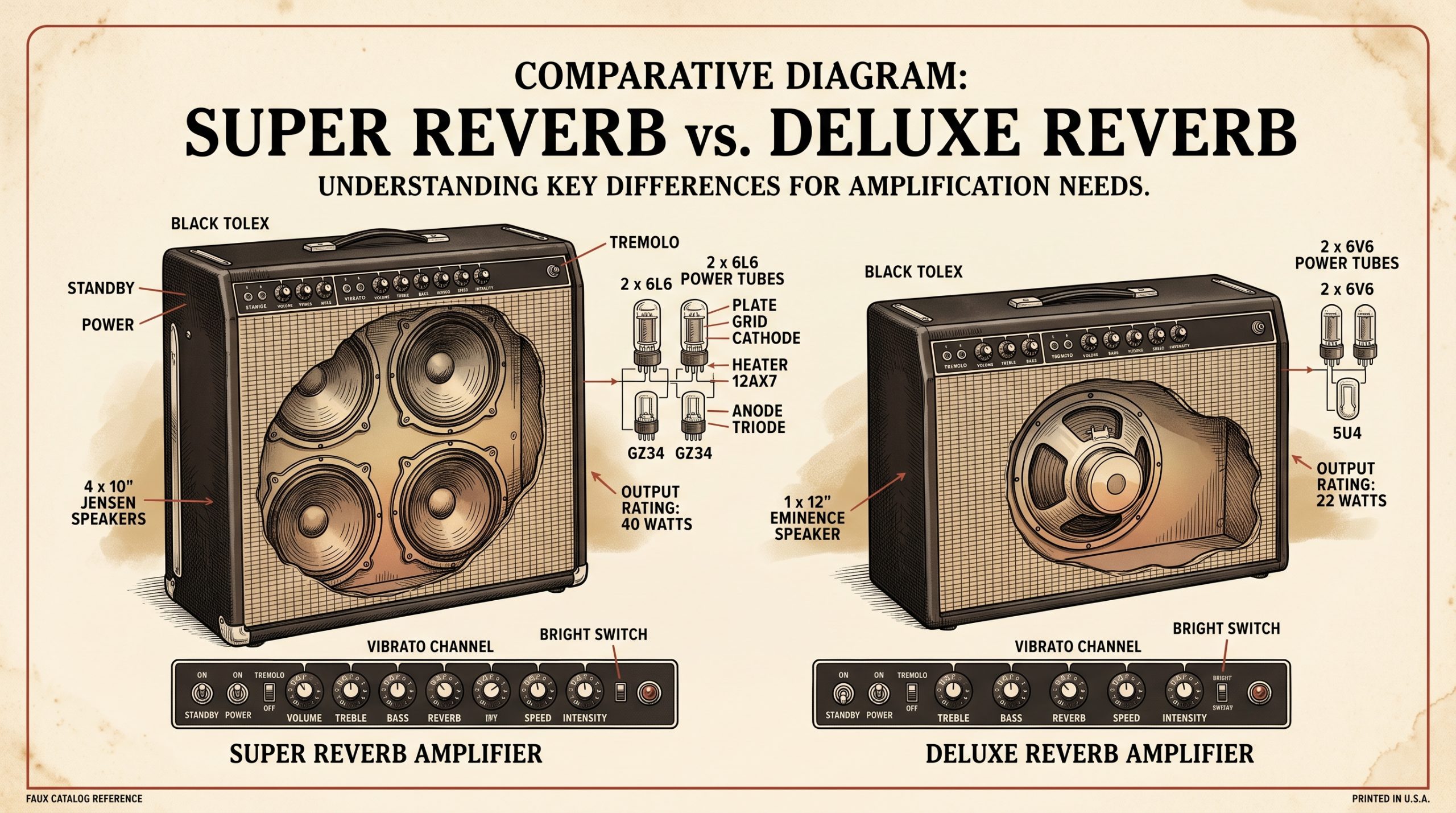
The 4×10″ Array Advantage
Four 10-inch speakers create a dispersion pattern that throws sound further into a room with less off-axis falloff than a single 12-inch driver. Each speaker in the Super Reverb handles approximately 10 watts nominal, keeping each driver well within its comfort zone. Less individual speaker distortion. Tighter collective response. The Jensen C10N, the standard blackface complement, carries a 25-watt rating with a sensitivity specification of approximately 97dB at 1W/1m, making it one of the more efficient drivers Fender used in this era.
The Oxford 10L6 (an alternate OEM complement on some units) runs slightly warmer with a less extended high-frequency response. Identifiable by the Oxford EIA prefix 465 in the speaker stamp. Neither is definitively better; they’re voiced differently, and period-correct Super Reverbs appear with both.
The 4×10″ array produces a characteristic three-dimensional bloom and spatial spread. Hard to quantify. Immediately audible when you stand in front of one.
The 1×12″ Simplicity of the Deluxe
The Jensen C12N factory-installed in the blackface Deluxe Reverb carries a 50-watt rating and a sensitivity of approximately 95dB/1W/1m. Single speaker, focused coherent beam, faster transient response in isolation. No inter-speaker cancellation artifacts. In a controlled recording environment, the Deluxe’s focused dispersion is genuinely easier to work with than four sources spread across a baffle. One microphone, dialed in. Done.
That recording advantage is real. The Super’s 4×10″ array typically requires either blending multiple microphone positions or choosing one off-center placement that captures the array’s blend rather than a single driver’s character. Not complicated, but it demands more attention than placing one microphone in front of one speaker.
Speaker Replacement Considerations
For the Super Reverb, players replacing worn or damaged speakers have found solid results with the Eminence Legend 1058, the Weber 10A125 (available in ceramic or alnico), and the WGS G10C/S. For the Deluxe Reverb, the Jensen C12K reissue, the Celestion G12H-75 Creamback, and the Weber 12A125 each represent a different tonal character while remaining appropriate load matches for the AB763 output transformer.
Original Jensen C10N speakers in working condition add measurable value to a blackface Super Reverb. Don’t recone them unless the cone is physically destroyed. A competent vintage speaker shop can often clean, re-gap, and restore a distorting original driver without touching the cone.
Who Plays What: Famous Users and Their Contexts
Notable Super Reverb Players
Bonnie Raitt used a Super Reverb extensively as a stage amp for much of her career, particularly from the 1970s onward, though more recent gear reports show her live rig has since shifted toward other amplifiers. Her slide tone on the Super Reverb, clean headroom with a fat 4×10″ bottom end, helped define how serious blues players thought about the model. Jimmie Vaughan’s association with Super Reverb-style tones during the Fabulous Thunderbirds era reinforced the amp’s reputation as a working-band tool for single-coil players who need to cut through without breaking up. Stevie Ray Vaughan ran Super Reverbs in his backline on select occasions alongside his Vibroverbs, though the Vibroverb was his primary reference point for that era.
Notable Deluxe Reverb Players
Neil Young’s preference for smaller Fender combos is well documented. The Deluxe Reverb appears in his setup at various points across his career. Eric Johnson has used a Deluxe Reverb in specific studio and smaller venue contexts, particularly where bedroom-friendly volume wasn’t a requirement but stage-loud headroom wasn’t needed either. Mark Knopfler has worked with various blackface Fender combos of the Deluxe type throughout his career.
The practical case for the Deluxe is simple: 42 pounds versus 62 pounds. Twenty fewer pounds over the course of a career is a meaningful quality-of-life difference. Not dramatic. Worth noting.
Silverface Era: What Changed and Does It Matter?
In 1968, CBS-era Fender transitioned the cosmetics from black to silver aluminum trim. The circuit changes matter more than the cosmetics. The Super Reverb received an Ultra-Linear output stage option on some silverface units, along with pull-boost switches on later models. These changes altered the amp’s character in ways that divide players: the Ultra-Linear mode adds a global negative feedback path that tightens the output but reduces the classic sag that Super Reverb players specifically want. Not an improvement. Different.
The Deluxe Reverb silverface transition was similarly cosmetic in the early years (1968-1969), with circuit changes becoming more pronounced as the decade progressed. Some late silverface Deluxe Reverb models use different coupling capacitor values that shift the low-frequency response. The AB568 circuit, introduced on some silverface models, features different bias points and altered tone stack values that produce a different feel than the AB763 original.
Practical buying guidance: blackface originals from 1963-1967 command significant premiums on the vintage market. Early silverface units from 1968-1969, particularly those verifiably on AB763-equivalent circuits, are frequently the value buy for players who want the tone without the collectible price. A chassis date code, transformer EIA code, and speaker code cross-check can confirm whether a silverface is running the original circuit topology. The Fender amp dating cheat sheet provides a fast cross-reference for transformer codes across both eras.
Which One Should You Buy? A Decision Framework
| Your Situation | Recommended Amp | Reason |
|---|---|---|
| Recording at home or small studio | Deluxe Reverb | Reaches useful tones at manageable SPL; easier to mic |
| Small club gigs, no PA support | Deluxe Reverb | Sufficient headroom for most small rooms |
| Medium bar gigs, full band, no PA | Super Reverb | Clean headroom; cuts through live mix without breaking up |
| Large venue, need stage presence | Super Reverb | 4×10″ dispersion and physical authority carry the room |
| Single-coil, clean country or Tele tones | Super Reverb | Headroom plus sparkle from efficient Jensen 10s |
| P-90 or humbucker, driven blues | Deluxe Reverb | Power-amp sag plus 6V6 bloom at band-appropriate volumes |
| Weight or portability is a priority | Deluxe Reverb | ~20 lbs lighter; significantly easier to transport |
| Budget is the primary constraint | Deluxe Reverb | Typically lower cost on the vintage and used market |
The “is the Deluxe Reverb too loud for home use?” question deserves a straight answer: yes, if you’re trying to reach power-amp saturation at home volumes. The Deluxe’s best tones happen at volumes that are still genuinely loud for a bedroom or apartment. A Weber Mass or THD HotPlate attenuator can address that, or a Princeton Reverb may simply be the more practical tool for home recording contexts. The Princeton’s 12-15 watts and 6V6 complement get you into similar tonal territory with a more forgiving volume threshold.
Both the 65 Super Reverb Reissue and the 65 Deluxe Reverb Reissue faithfully reproduce the AB763 circuit topology with modern components. For players who want the character without hunting the vintage market, the reissues are a legitimate entry point. Original Fender schematic documentation for both models is archived at Schematic Heaven and confirms the component values in both the vintage and reissue circuits.
Hot Rod Deluxe vs. Super Reverb: A Brief Digression
The Hot Rod Deluxe is a 40-watt amp, matching the Super Reverb’s power rating on paper. Not the same amp. The Hot Rod Deluxe uses a channel-switching circuit with a solid-state rectifier option and is voiced for gain-channel versatility rather than clean headroom and vintage character. The Super Reverb’s 40 watts is push-pull 6L6GC with GZ34 tube rectifier sag; the Hot Rod Deluxe’s 40 watts is cleaner and more clinical in its delivery.
Which Amp Belongs on Your Stage
The decision comes down to one question: at what volume does the amp sound its best, and does that volume match where you actually play? The Super Reverb’s peak character lives at volumes that fill a medium-to-large room without PA support. It’s got the clean headroom, the 4×10″ physical authority, and the 6L6 extension that makes it the correct tool for that job. Bring a roadie, or develop a tolerance for loading. The Deluxe Reverb’s peak character lives at volumes that are achievable at a loud rehearsal or a small club, where the 6V6 compression and power-amp sag are accessible without drowning out conversation. Neither amp is a compromise. They’re optimized for different stages, and the vintage market reflects that clearly in pricing. Know your stage, then buy accordingly.
Frequently asked questions
What is the main difference between the Super Reverb and Deluxe Reverb?
The fundamental difference is the power stage and speaker configuration. The Super Reverb runs 40 watts through two 6L6GC tubes into four 10-inch speakers. The Deluxe Reverb runs 22 watts through two 6V6GT tubes into a single 12-inch speaker. In practice, that means the Super stays clean with physical authority at band volumes while the Deluxe compresses into power-amp saturation at volumes a typical player can manage without ear protection.
Is the Deluxe Reverb too loud for home use?
For bedroom or apartment use, yes, if your goal is reaching the amp's best tones at power-amp saturation. Those tones happen at volumes that are genuinely loud for home contexts. An attenuator solves the problem mechanically but changes the feel. A Princeton Reverb is worth serious consideration for home players who want blackface 6V6 character at more forgiving volume levels. The Deluxe is better described as a small-venue amp than a home amp.
Who uses a Fender Super Reverb?
Bonnie Raitt is closely associated with the Super Reverb, having used it extensively for much of her career, though her more recent live rig has moved toward other amplifiers. Jimmie Vaughan's Fabulous Thunderbirds era tone is closely associated with the amp's 4x10" 6L6 character. Stevie Ray Vaughan ran Super Reverbs in his backline on select occasions, though his primary reference points were Vibroverbs and Dumbles. Session and touring players in blues, country, and classic rock have consistently chosen the Super Reverb when they need clean headroom with 4x10" spread at stage volume.
What Vibroverb did SRV use?
Stevie Ray Vaughan's primary Vibroverb was a 1963 Fender Vibroverb, a brownface-transitional model running a single 15-inch speaker at approximately 40 watts. That's a distinct amp from both the Super Reverb and Deluxe Reverb, with its own circuit topology and tonal character. SRV's backline varied considerably by era and venue. It included Dumble Overdrive Specials, multiple Vibroverbs, and Super Reverbs in rotation, rarely a single amp in isolation. The Fender Vibroverb guide covers the brownface and blackface production differences in detail.
What was Leo Fender's favorite amp?
There's no single documented statement establishing one definitive "favorite amp" for Leo Fender. He's on record praising the Vibroverb's reverb circuit specifically, amp historian Richard Smith has called it among the best reverb sounds Fender ever produced, and separate tweed-era accounts credit the 5F4 Super as an early favorite of his. The Super Reverb and Deluxe Reverb covered in this comparison were commercial flagships built for a broad market rather than personal-favorite designs, though both represent the AB763 circuit at its most refined.
Can I use a Super Reverb in the studio?
Yes. The Super Reverb records exceptionally well for vintage blues, country, and classic rock work. The 4x10" array requires more thought in microphone placement than a single 12-inch speaker. Common approaches include blending two microphones on adjacent speakers, placing a single microphone slightly off-center to capture the natural blend of the array, or choosing one driver that's particularly well-voiced and treating it as the primary source. Some engineers prefer the Deluxe for tracking specifically because its focused single-speaker dispersion is easier to control in a live room. Both approaches work. The Super's 4x10" spread can produce a noticeably three-dimensional recorded sound that's harder to achieve with a single driver.