Contents
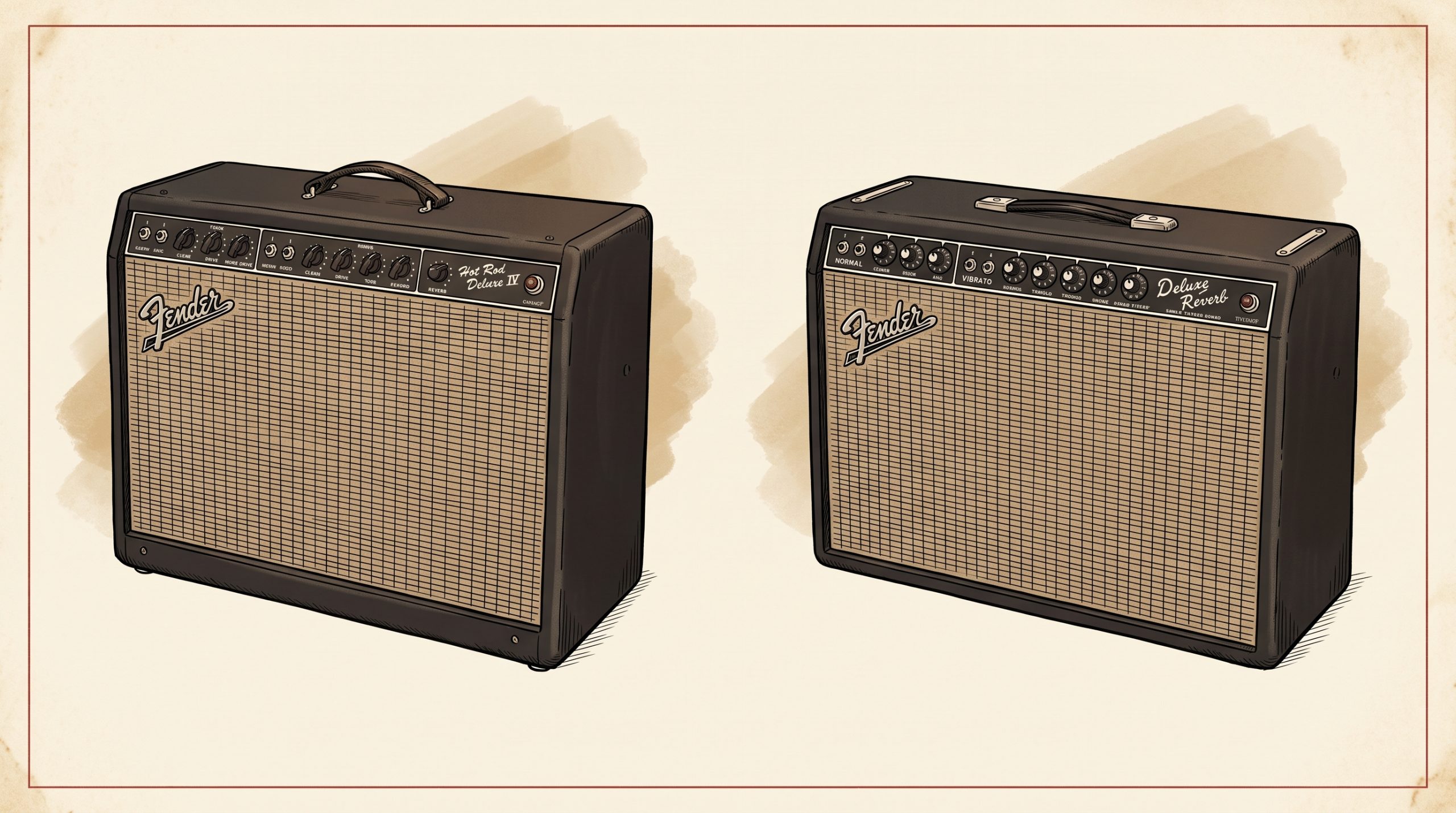
- Hot Rod Deluxe IV: 40W RMS, 3 channels, 2x 6L6GC, 3x 12AX7 preamp, solid-state rectifier, digital reverb, no tremolo
- ’65 Deluxe Reverb Reissue: 22W RMS, 2 channels, 2x 6V6GT, 4x 12AX7 + 2x 12AT7 preamp, 5AR4 tube rectifier, spring reverb, tremolo
- Both: 1×12 open-back combo, 8-ohm speaker output
- Price gap is real: HRD IV runs ~$1,049-1,100 new; DR Reissue runs ~$1,785-1,849 new
- HRD IV weighs 41 lbs; DR Reissue weighs 42 lbs. Neither is a featherweight.
- HRD IV has a series effects loop; DR Reissue has no effects loop
- The HRD IV’s reverb is digital, not a spring tank. The “drip” and organic decay of the DR cannot be replicated by the Hot Rod’s reverb circuit.
- Early Hot Rod Deluxe I/II/III units had documented PCB cold-solder joint failures; the HRD IV (2015-present) largely addressed these issues
- DR Reissue holds resale value significantly better: roughly 15-20% depreciation vs. 30-40% for the HRD
Specs Side by Side
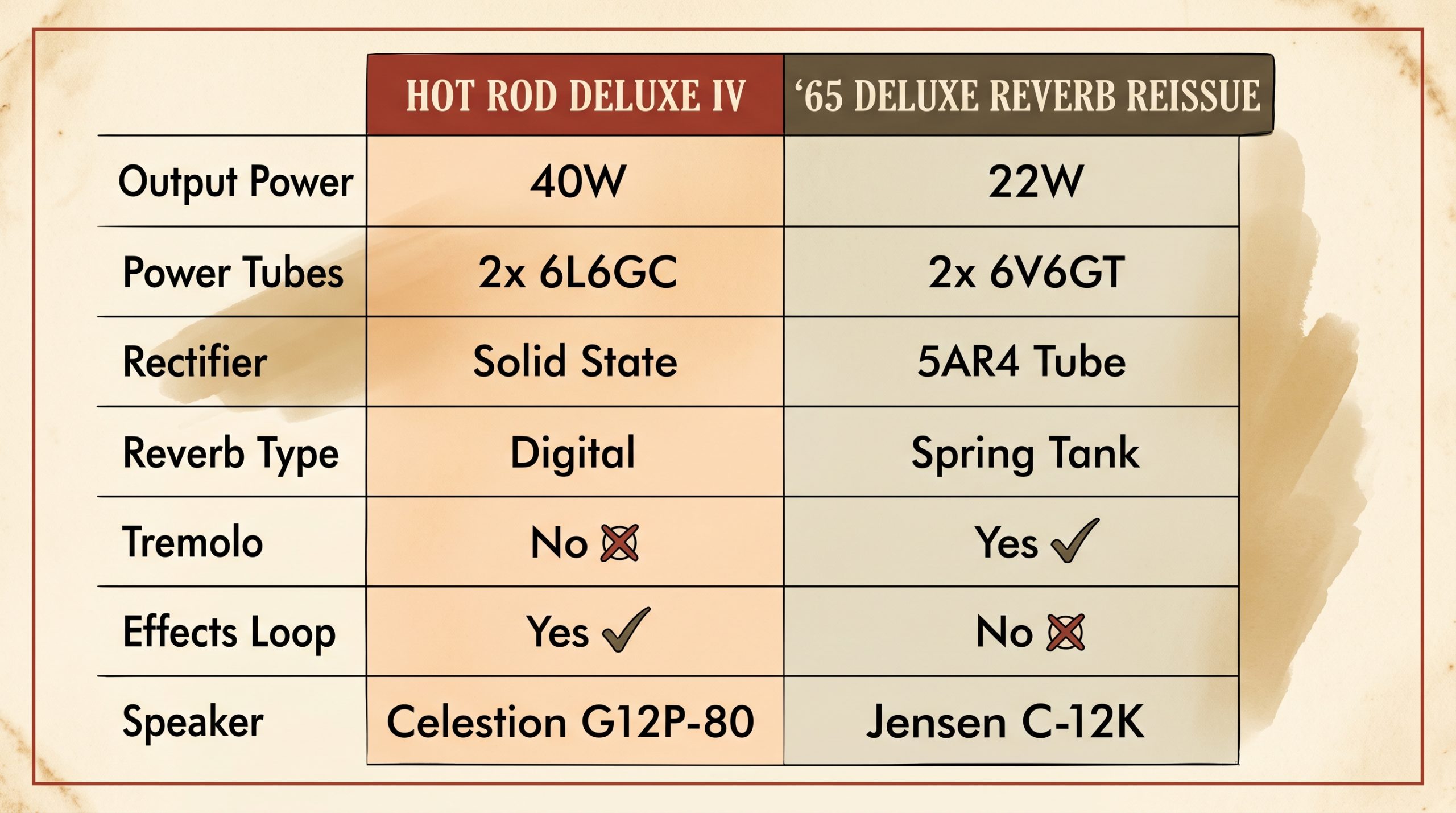
Before getting into tone and circuit character, a direct spec comparison makes the differences concrete. The table below covers the Hot Rod Deluxe IV (current production as of 2015) against the ’65 Deluxe Reverb Reissue (current production, updated 2009).
| Spec | Hot Rod Deluxe IV | ’65 Deluxe Reverb Reissue |
|---|---|---|
| Output Power | 40 watts RMS | 22 watts RMS |
| Channels | 3 (Clean, Drive, More Drive) | 2 (Normal, Vibrato) |
| Power Tubes | 2x 6L6GC | 2x 6V6GT |
| Preamp Tubes | 3x 12AX7 | 4x 12AX7 + 2x 12AT7 |
| Rectifier | Solid state | 5AR4 (GZ34) tube rectifier |
| Speaker | 12″ Celestion A-Type | 12″ Jensen C-12K |
| Cabinet | Open-back | Open-back |
| Effects Loop | Yes (series, buffered) | No |
| Reverb Type | Digital | Spring tank (Accutronics) |
| Tremolo | No | Yes (Vibrato channel) |
| Weight | 41 lbs | 42 lbs |
| Street Price (new) | ~$1,049-1,100 | ~$1,785-1,849 |
| Circuit Architecture | Modern PCB | Hand-wired (reissue) |
| Era Classification | Modern (post-1996) | Blackface reissue (original: 1963-1967) |
Design Heritage and Circuit Lineage
This is where most forum discussions stall out. Knowing the specs is useful; understanding why those specs exist tells you which amp belongs in your setup.
Fender Deluxe Reverb: Blackface DNA
The original Deluxe Reverb ran from 1963 through 1967 on the AB763 circuit (the most common blackface variant, also shared with the Princeton Reverb, Vibroverb, and Super Reverb of the same era). Original production units left the factory with Oxford 12K5 or Jensen C-12N speakers depending on the build date, and transformer codes stamped with EIA prefix 606 (Schumacher) on output and 465 (Oxford) on speakers confirmed by chassis markings documented in Greg Gagliano’s research published in 20th Century Guitar Magazine between 1997 and 2000 (archived at the Wayback Machine). The silverface era followed in 1968, transitioning through circuit revisions AB868, AA1172, and AA1270 until production ended in 1981.
The reissue arrived in 1993 and received a voicing update in 2009. It tracks the original AB763 circuit closely, with a 5AR4 tube rectifier that introduces the slight power supply sag under hard picking attack. That sag is the mechanical cause of blackface “bloom”: the amp compresses slightly on the initial transient, then opens back up. Not a flaw. A feature baked into the circuit design. For a deeper look at how circuit codes and EIA stamps help date and identify Fender amps across eras, the Fender tube amp serial number and dating guide covers the full methodology.
Fender Hot Rod Deluxe: Modern Fender’s Commercial Workhorse
The Hot Rod Deluxe launched in 1996. Not a blackface derivative. Not a reissue. A clean-sheet design built around 6L6GC power tubes, a solid-state rectifier, and three gain channels intended to give working players a do-everything stage amp at an accessible price point. Four production generations have shipped: HRD I (1996-2003), HRD II (2003-2010), HRD III (2010-2015), and the current HRD IV (2015-present).
Speaker choice changed across generations. HRD I and II shipped with the Eminence Legend 1258, a warmer, more mid-forward speaker. The HRD IV ships with the Celestion A-Type, which is brighter and more scooped in the low-mids. The PCB architecture also evolved: the early HRD I through III had known cold-solder joint problems on the filter cap board that caused intermittent failures in the field. The HRD IV revision addressed these structural reliability issues. The complete Hot Rod Deluxe model guide covers each version’s circuit changes in detail.
According to Guitar World’s review of the Fender Hot Rod Deluxe 30th Anniversary edition (guitarworld.com), that special variant features a more open clean sound compared to the standard Hot Rod Deluxe, making it particularly well-suited as a pedal platform, with reverb controlled via a single dedicated knob.
Tone Character: How They Actually Sound Different
Spec tables don’t bark. Let’s get into what each amp actually does when you plug in.
Clean Tones
The Deluxe Reverb breaks up earlier. On the Vibrato channel, you’re pushing into harmonic saturation by volume 4-5 on a Strat or ES-335. That’s not a weakness; that’s the design intent. The 6V6GT power tubes run closer to their operating limit at the voltages the AB763 circuit delivers, producing warm clean tones with a slightly compressed, harmonically rich character that many players describe as “blooming.” You don’t just hear it. You feel it in the pick attack.
The Hot Rod Deluxe stays clean considerably longer. The 6L6GC tubes handle more headroom, and without a tube rectifier compressing the power supply, the clean channel stays clear and stiff well past volume 5. Tighter bass response. More scooped overall. Less coloration. That’s what makes it a reliable pedal platform for players who want the amp to stay out of the way and let external gain stages do the work.
The Gear Page discussion thread on this comparison (November 2024) puts it well: the HRD is louder, a lot louder, and it feels different. The DR has prettier cleans and is less in your face. That forum consensus matches what the circuit differences predict.
Breakup and Overdrive
The Deluxe Reverb has no drive channel. Natural breakup only. Pushing the Normal channel into mild clipping produces even-order harmonic distortion, the kind that sits well in a mix and responds dynamically to picking intensity. Back off the guitar volume, you’re clean. Dig in, the amp responds. It pairs exceptionally well with low-to-medium gain overdrive pedals precisely because it isn’t adding its own gain-stage coloration on top.
The Hot Rod Deluxe has three channels. The Clean channel is the most useful of the three. The Drive channel is functional for single-coil players looking for a pushed crunch. The More Drive channel is a consistent source of player complaints: aggressive, compressed, and prone to crossing into “fizzy” territory at higher settings. Many HRD owners simply stop using More Drive entirely and run the amp as a two-channel combo with a pedalboard for gain. That’s not a knock; it’s just an honest description of how the amp gets used in practice.
Reverb and Modulation
Spring reverb vs. digital reverb. This single difference matters more than the wattage gap for certain players. The Deluxe Reverb Reissue uses a genuine Accutronics long-spring tank (Type 4 in the reissue). The drip, the splash on loud transients, the organic decay that cuts through a mix without sounding processed. That character is native to the spring tank’s physical behavior and can’t be fully replicated by a digital circuit. The Hot Rod Deluxe’s digital reverb is functional. It’s not unpleasant. But it’s also not the same thing, and players who rely on reverb as a core tonal element will notice the difference immediately.
The Deluxe Reverb also includes a true bias-modulating tremolo circuit on the Vibrato channel (Fender labeled it “vibrato” historically, but the circuit produces amplitude tremolo). The Hot Rod Deluxe has no tremolo whatsoever. For rockabilly, surf, and classic country players, that omission is a dealbreaker.
Volume, Wattage, and Real-World Loudness
The 40W vs. 22W gap is real, but the math isn’t what most players expect. Doubling wattage produces approximately 3 dB of additional perceived loudness. Going from 22W to 40W is roughly 2.6 dB louder. Not twice as loud. Not dramatically louder on a stage. The difference is audible, but it’s not the gap you’d expect from the numbers alone.
The more meaningful factor is how each amp gets loud. The Hot Rod Deluxe’s 6L6GC tubes running off a solid-state rectifier stay stiff and clean at higher volumes. More SPL before compression. The Deluxe Reverb’s 6V6GT tubes running through the 5AR4 rectifier start compressing earlier and more gently, making the amp feel “spongy” at higher volumes and responsive at lower ones.
Practical estimate: the DR Reissue reaches audible natural breakup at approximately 85-90 dB SPL, which is loud rehearsal volume but not stage-loud. The HRD IV’s clean channel requires approximately 95-100 dB SPL to reach equivalent tube saturation. That 10 dB gap is the reason bedroom players often find the Deluxe Reverb more satisfying at low volumes even though it’s the less powerful amp.
| Playing Environment | Better Choice | Why |
|---|---|---|
| Bedroom / home practice | ’65 Deluxe Reverb | Natural breakup at lower volumes |
| Small venue / bar gig (no PA) | Hot Rod Deluxe | Headroom, volume reserve |
| Recording studio (miked) | ’65 Deluxe Reverb | Natural compression, spring reverb |
| Large venue with PA support | Either | Both mic well; personal preference applies |
| Country / classic rock | Hot Rod Deluxe | Tight 6L6 clean headroom |
| Blues / jazz / rockabilly | ’65 Deluxe Reverb | Bloom, sag, spring reverb, tremolo |
Tubes, Speakers, and Components in Detail
Tube Complement Breakdown
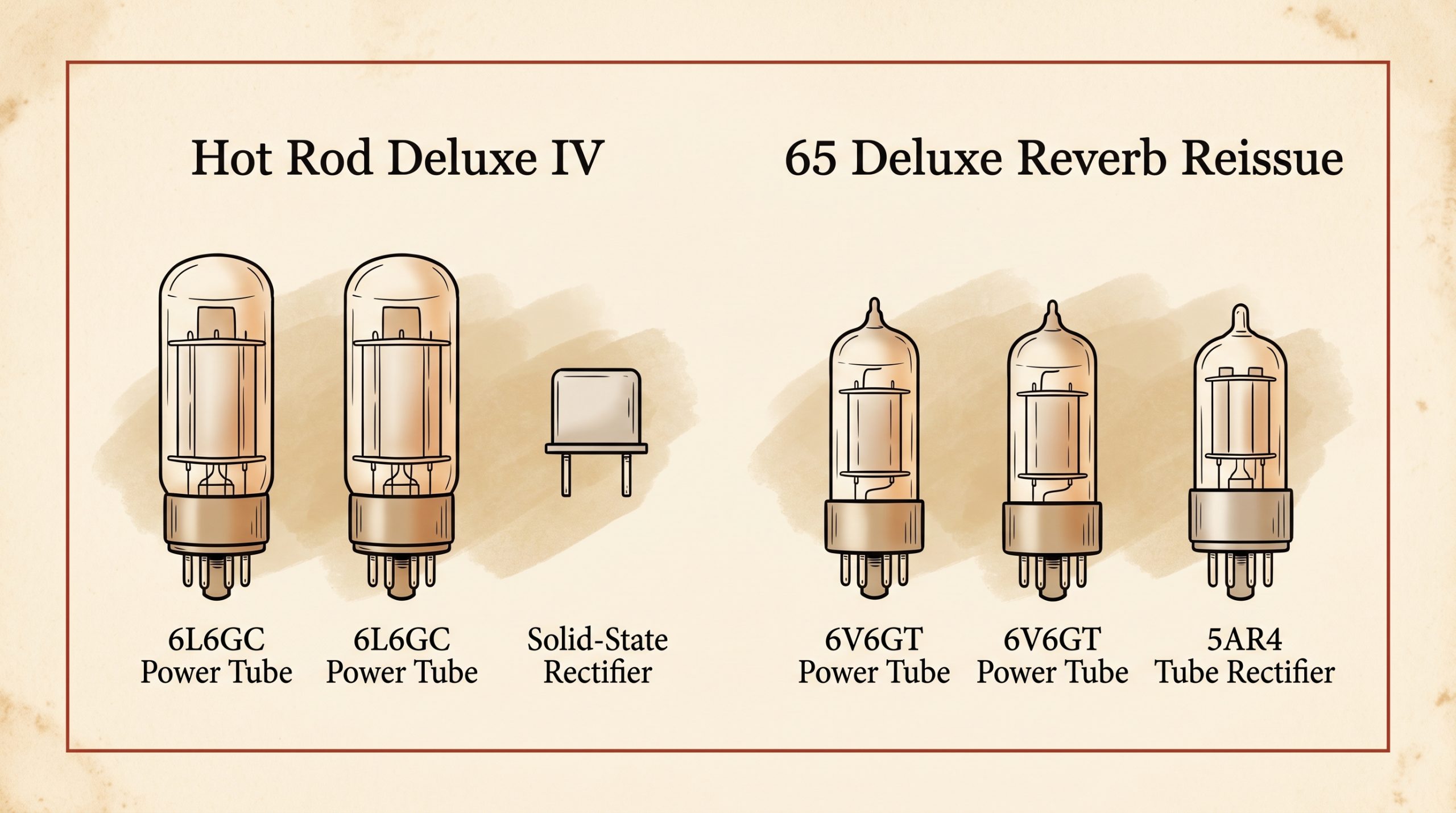
The ’65 Deluxe Reverb Reissue runs: 2x 6V6GT power tubes (fixed bias on the reissue, consistent with the original AB763 circuit), six preamp-position tubes — 4x 12AX7 (input/gain stages and tremolo oscillator) and 2x 12AT7 (reverb driver and phase inverter — in the AB763 family, the reverb-driver and phase-inverter positions are always 12AT7, never 12AX7) — and a 5AR4 (GZ34) tube rectifier. Idle current per power tube typically runs around 25 mA. Fender’s official spec sheet for the reissue is available at fender.com.
The Hot Rod Deluxe IV runs: 2x 6L6GC power tubes (fixed bias, typically 35-40 mA per tube idle), 3x 12AX7 preamp tubes, and a solid-state diode bridge rectifier. It also includes a series effects loop (buffered, not true bypass) for inserting rack effects or time-based pedals after the preamp stage. Fender’s HRD IV product page at fender.com lists the complete spec set.
Speakers
The DR Reissue’s Jensen C-12K (50W, 8 ohm, ceramic magnet) leans bright with a slightly forward midrange presence. It complements the 6V6 warmth well but can get edgy with humbucker guitars at higher volumes. Common upgrade targets include the Eminence Legend 1258 for a warmer character, or a Weber 12A150 for a more vintage Jensen C-12N voicing.
The HRD IV’s Celestion A-Type speaker sits warmer and more scooped than the Jensen. It handles the 6L6’s extended low-end better than the earlier Eminence units that shipped in HRD I and II, but many players still swap it for a Jensen C-12N or WGS Veteran 30 to bring back some midrange presence. Speaker swaps are one of the most effective ways to adjust the Hot Rod Deluxe’s character without touching the circuit.
Not a great stock speaker for pedal-heavy players. Worth the upgrade cost.
Price, Value, and Long-Term Ownership Cost
Street prices at current production: the Hot Rod Deluxe IV runs approximately $1,049-1,100 new; the ’65 Deluxe Reverb Reissue runs $1,785-1,849 new. That’s roughly $700-750 difference. On the used market, HRD IV units trade at $350-500 depending on condition and generation; DR Reissue units hold at $650-900. The DR’s resale curve is noticeably flatter. Depreciation on the DR runs approximately 15-20% from new; the HRD typically depreciates 30-40%.
Tube replacement costs differ too:
| Service Item | Hot Rod Deluxe IV | ’65 Deluxe Reverb Reissue |
|---|---|---|
| Power tube pair | 6L6GC pair: ~$30-60 | 6V6GT pair: ~$25-50 |
| Rectifier tube | N/A (solid state) | 5AR4 (GZ34): ~$20-35 |
| Bias adjustment (tech labor) | ~$40-80 | ~$40-80 |
| Estimated total re-tube cost | ~$70-140 every 2-5 years | ~$85-165 every 2-5 years |
The DR costs slightly more to re-tube because of the rectifier. Not dramatically more. The bigger ownership cost difference is the initial purchase price and the resale recovery when you eventually move on. Players who tend to sell amps within a few years generally recoup more of their investment on the DR.
Which Amp Should You Buy?
Here’s the honest breakdown by player type.
Choose the Hot Rod Deluxe IV if:
- You need a loud, clean amp for gigging without PA support and can’t mic up every show
- You want a built-in drive channel for occasional crunch tones (country, bar-band rock, classic rock)
- Budget is the primary constraint and you’re comfortable getting gain from pedals
- You use a lot of rack effects or time-based pedals and want that series effects loop in the signal chain
Choose the ’65 Deluxe Reverb Reissue if:
- Authentic blackface Fender tone and natural amp breakup are the priority
- Spring reverb and tremolo are core to your sound (rockabilly, surf, blues, classic country)
- You record frequently and need natural amp compression without external processing
- You’re playing a Gretsch, ES-335, Telecaster, or Stratocaster through a clean amp and letting the guitar do the talking
- You plan to resell within a few years and want to recover more of your investment
Consider neither if:
- You primarily practice at home and need bedroom-friendly volume with natural breakup. At that volume requirement, the Fender Princeton Reverb or the Blues Junior will serve you better than either of these amps. Both will produce usable tube compression at volumes that won’t irritate a household.
The Hot Rod Deluxe vs Deluxe Reverb question ultimately resolves around one variable: do you need the amp to be the tone source, or do you need it to be a neutral platform for pedals and guitars? The Deluxe Reverb is the tone source. The Hot Rod Deluxe is the platform. Both are legitimate answers depending on what you’re building.
For blues, jazz, and rockabilly players with single-coil or semi-hollow guitars, the Deluxe Reverb is the historically and tonally correct choice. The complete Fender Deluxe Reverb model guide covers original blackface production, silverface changes, reissue circuit details, and current value ranges in full. For country, bar-band rock, or pedal-heavy players who need a loud, reliable stage platform at a lower price entry, the Hot Rod Deluxe IV earns its position in the lineup.
Frequently asked questions
Is the Hot Rod Deluxe too loud for home use?
At 40 watts with a solid-state rectifier, the Hot Rod Deluxe is louder than necessary for most home environments, and won't produce natural tube breakup at low volumes. The clean channel is usable at lower volumes, but you'll need pedals to get driven tones quietly. For home players who want amp-driven breakup, the 22-watt Deluxe Reverb reaches usable natural saturation at significantly lower SPL, thanks to its 6V6GT tubes and 5AR4 rectifier sag.
Does the Hot Rod Deluxe have spring reverb?
No. The Hot Rod Deluxe uses a digital reverb circuit. The Fender '65 Deluxe Reverb Reissue uses a genuine long-spring Accutronics reverb tank. This is a meaningful tonal difference: the spring tank produces the characteristic drip and organic decay associated with classic Fender tone. The digital circuit in the HRD is functional, but it doesn't replicate the physical behavior of a spring tank, particularly on loud transients and quick picking passages.
What is the Hot Rod Deluxe IV and how is it different from earlier versions?
The Hot Rod Deluxe IV, introduced in 2015, is the fourth production revision of the Hot Rod Deluxe line. It features a revised Clean channel voicing (brighter, more scooped compared to HRD III), a Celestion A-Type speaker replacing the Eminence units in earlier generations, and improved PCB construction addressing the cold-solder joint reliability failures documented in HRD I through III production. The Drive channel character is broadly similar to the HRD III. If you're buying used, confirming the generation matters for reliability reasons.
Can the Fender Deluxe Reverb keep up with a drummer?
Yes, the 22-watt Deluxe Reverb is generally loud enough for rehearsal with a moderate drummer, though in high-volume contexts (loud drummer, hard rock band) it may need microphone support to cut through. Professional players have used the Deluxe Reverb on major stages for decades when DI'd or mic'd through a PA. The amp's natural compression actually helps it sit in a band mix at high volumes in ways that a stiffer, louder amp sometimes doesn't.
What's the difference between the Hot Rod DeVille and the Deluxe Reverb?
The Hot Rod DeVille is a higher-powered (60-watt) version of the Hot Rod series, available in 2x12 and 4x10 configurations, while the Deluxe Reverb is a 22-watt blackface-circuit combo. The DeVille delivers significantly more headroom and stage volume than either the HRD Deluxe or the DR, at the expense of weight and blackface tonal character. It shares the Hot Rod Deluxe's modern PCB architecture, solid-state rectifier, and digital reverb. The Fender Hot Rod DeVille guide covers channel layout, speaker configurations, and use cases in full.