Contents
- 01Blackface DNA: Shared Heritage, Different Missions
- 02Spec-by-Spec Breakdown
- 03The Speaker Story: 4×10″ vs 2×12″
- 04Tone Stack Deep Dive: The .022µF vs .047µF Difference
- 05Volume, Headroom, and the Loudness Question
- 06Breakup Character: Where Each Amp Starts to Sing
- 07Notable Artists: Who Chose What and Why
- 08Gigging and Practicality: The Real-World Test
- 09Which Should You Buy: Decision Framework
- 10Frequently Asked Questions
Forty watts or eighty-five. That gap sounds minor on paper. In a rehearsal room at volume, it’s the difference between an amp that starts to bark when pushed and one that refuses to break a sweat. The Super Reverb and Twin Reverb share enough DNA to confuse a buyer at a glance: same grille cloth generation, same tube complement, same Fender reverb tank, same AB763 circuit family. But they’re tuned differently, voiced differently, and built for different jobs. Understanding those differences at the schematic level, not just the speaker count, is what makes this comparison worth doing properly.
- Both amps: 4× 6L6GC output tubes, AB763 blackface circuit family, Fender spring reverb, vibrato/tremolo
- Super Reverb: ~40–45W RMS, 4×10″ Jensen C10N speakers, ~314 in² total cone area, approx. 50 lbs
- Twin Reverb: ~85W RMS, 2×12″ Jensen C12N speakers, ~226 in² total cone area, approx. 68 lbs
- Tone stack midrange cap: Super Reverb .022µF vs Twin Reverb .047µF, a key tonal difference most buyers overlook
- Plate voltage differential: Super Reverb ~425V vs Twin Reverb ~460V, explaining the power gap despite identical tube count
- Twin Reverb is approximately 3–4 dB louder in real-world SPL; Super Reverb’s larger cone area partially compensates
- Blackface Twin Reverbs typically command higher prices on the vintage market than equivalent-condition Super Reverbs
- The Super Reverb has MORE total speaker surface area than the Twin Reverb, counterintuitive but confirmed by the math
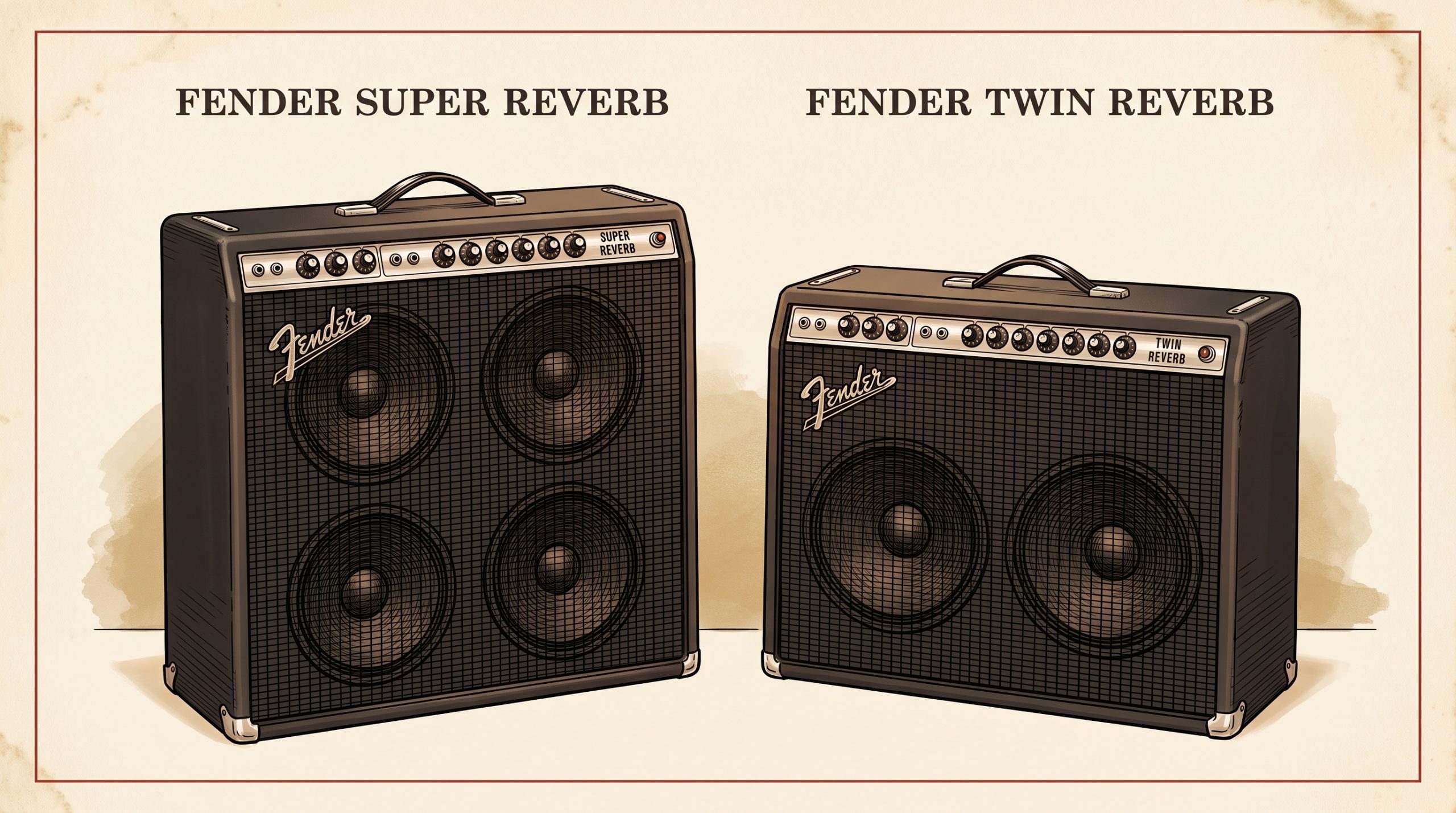
Blackface DNA: Shared Heritage, Different Missions
Era Classification and Production Timeline
Both amps belong to the blackface era, which Fender produced from 1963 through 1967 before CBS-era changes pushed production into the silverface period starting in 1968. The Super Reverb launched with the AA763 circuit in 1963, transitioning to the AB763 by 1964. The Twin Reverb followed the same arc: AA763 through early 1964, then AB763 for the remainder of the blackface run. That shared AB763 prefix is precisely why buyers sometimes treat these as interchangeable. They’re not. The prefix indicates a circuit family, not a circuit copy. Schematic-level differences in plate voltage, tone stack voicing, and output transformer design separate these two amps in ways that matter on stage and in the studio.
The blackface era remains the reference point for a simple reason: post-1967 silverface revisions introduced master volume controls, modified bias points, and component substitutions that changed the character of both amps. Greg Gagliano’s research for 20th Century Guitar Magazine documented these production shifts in detail, and the consensus among collectors and technicians is consistent: the AB763 blackface versions represent the clearest expression of what Fender intended each amp to do. You can verify chassis stamps, transformer codes, and tube chart dates using the Fender tube amp serial number and dating guide to confirm whether a given example is a genuine blackface or an early silverface with a cosmetic resemblance.
What They Share
Four 6L6GC output tubes. That’s the headline spec connecting these two amps. Both also run a complement of 12AX7 preamp tubes and a 12AT7 handling phase inverter and reverb driver duties. Both use Fender’s long-spring reverb tank (Accutronics-type), and both include an onboard modulation circuit: vibrato on the Super Reverb, tremolo on the Twin Reverb. The difference is subtle but for players chasing a specific effect character. Point-to-point turret board construction on both means repairs and modifications are straightforward compared to later PCB-based designs. Cabinet aesthetics, control layout, and grille cloth all fall within the same blackface-generation standard. Same family. Different members.
Spec-by-Spec Breakdown
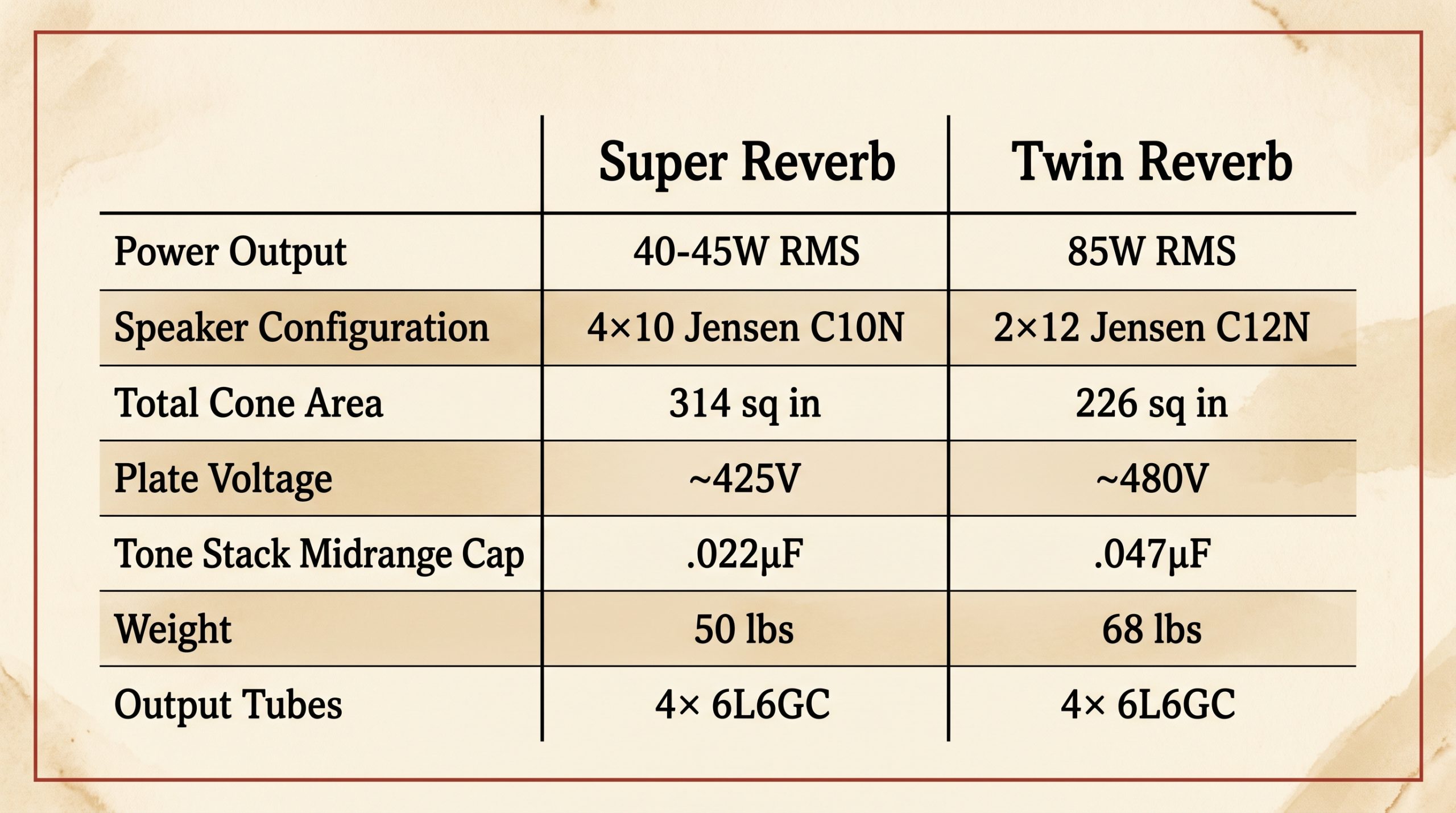
| Specification | Super Reverb (AB763) | Twin Reverb (AB763) |
|---|---|---|
| Circuit Number | AB763 | AB763 |
| Production Years (Blackface) | 1963–1967 | 1963–1967 |
| Power Output | ~40–45W RMS | ~85W RMS |
| Output Tubes | 4× 6L6GC | 4× 6L6GC |
| Plate Voltage (approx.) | ~425V | ~460V |
| Speaker Configuration | 4×10″ | 2×12″ |
| Original Speakers | Jensen C10N | Jensen C12N (JBL D120F optional) |
| Total Speaker Surface Area | ~314 in² | ~226 in² |
| Approximate Weight | ~50 lbs | ~68 lbs |
| Midrange Cap | .022µF | .047µF |
| Cabinet Orientation | Horizontal/wide | Horizontal/wide |
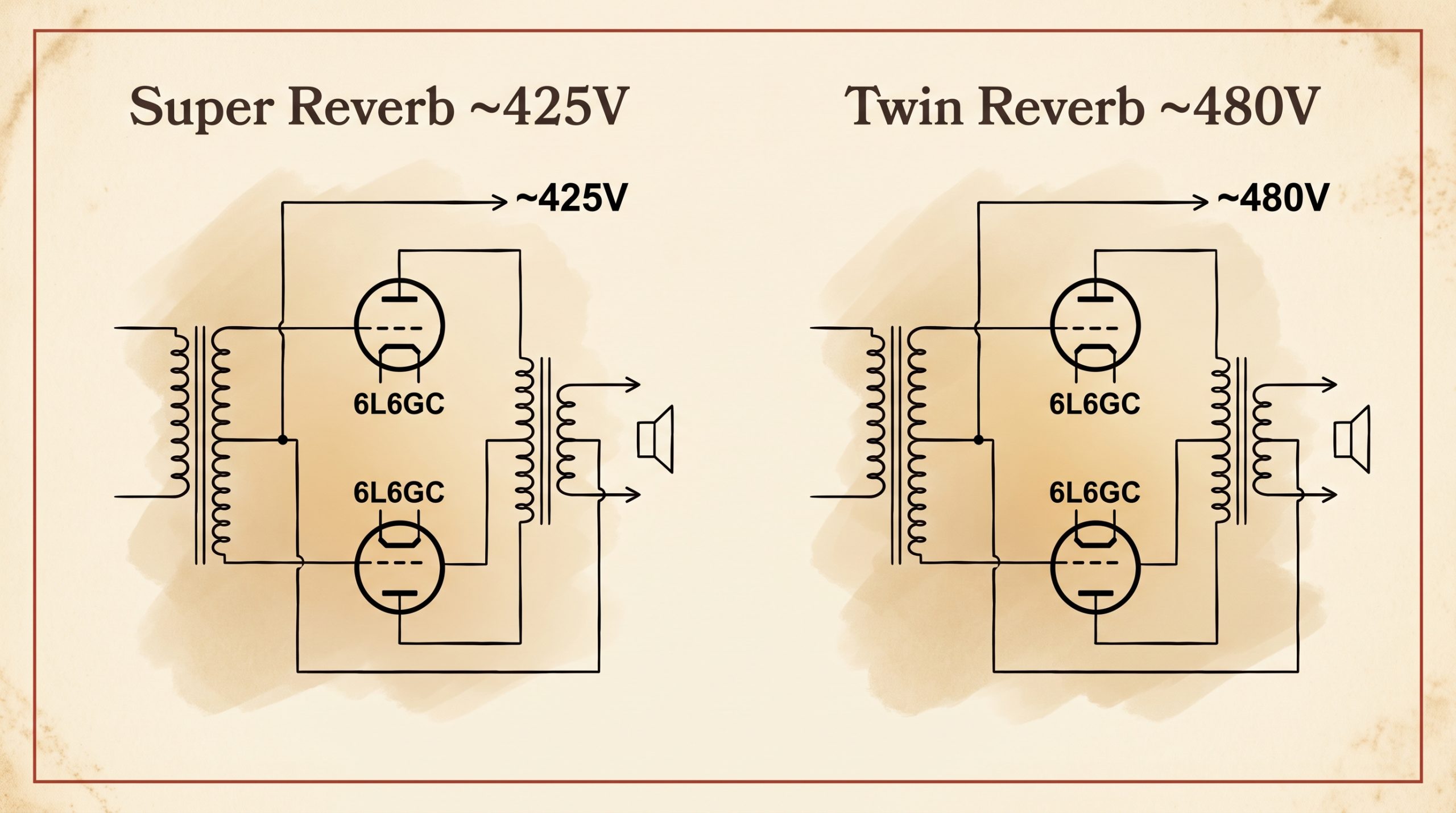
The power disparity despite an identical four-6L6GC tube complement comes down largely to plate voltage. The Super Reverb’s output transformer runs the tubes at approximately 425V; the Twin’s runs closer to 460V. Higher plate voltage means more headroom, more clean power, and a higher threshold before the output stage compresses. It’s not about tube count. It’s about how hard the circuit is pushing those tubes. That roughly 35-volt difference, combined with differences in output transformer design between the two models, accounts for most of the wattage gap between the two amps.
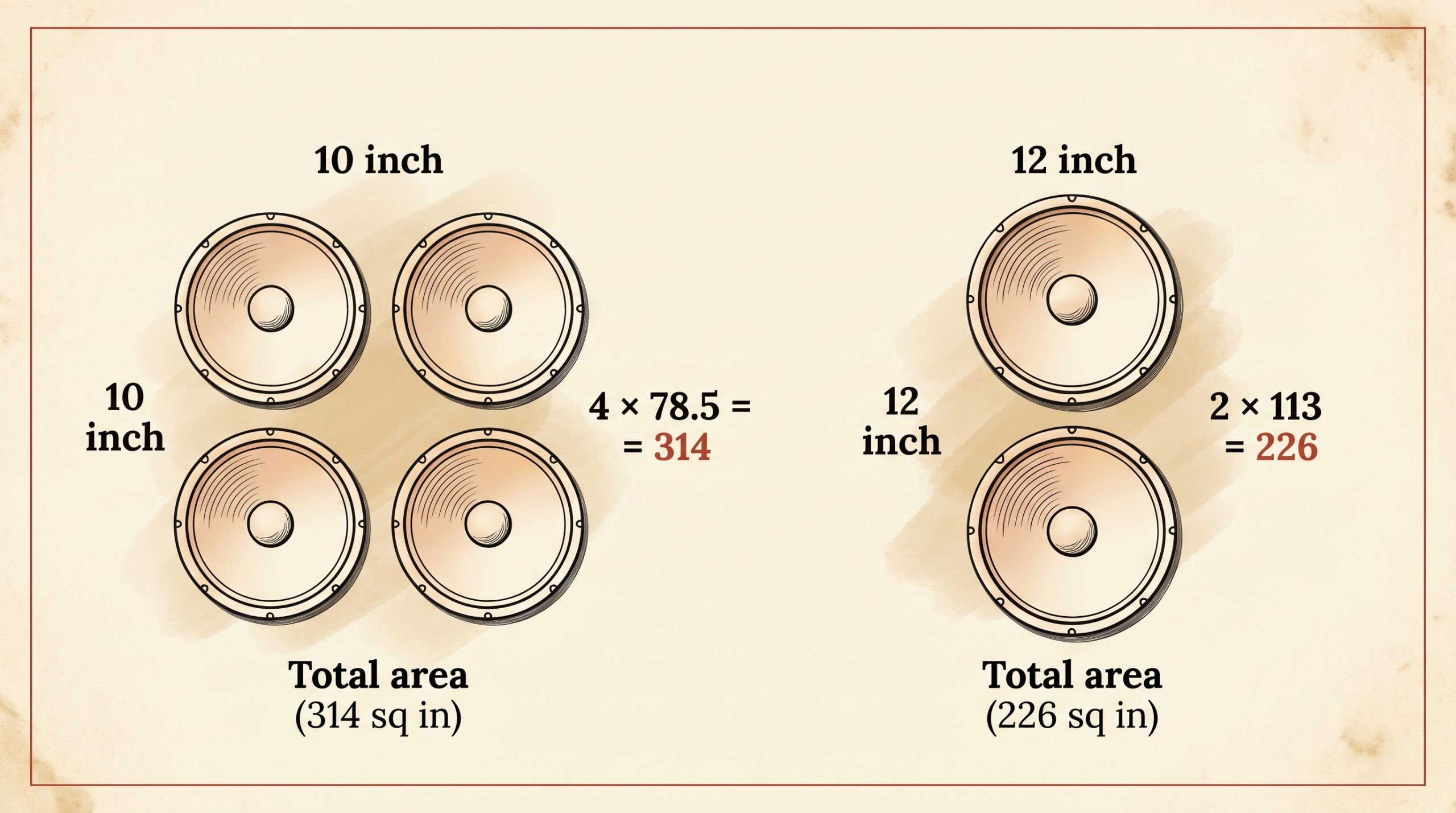
The speaker surface area figure surprises most players when they first see it. Four 10-inch speakers outrun two 12-inch speakers by a meaningful margin: 314 in² versus 226 in². That’s more cone area moving air in the Super Reverb cabinet, which directly affects how the amp feels at volume and how it projects in a room. Weight is also worth flagging here: 18 pounds lighter on the Super Reverb is a real gigging consideration when you’re doing a third load-in of the week.
The Speaker Story: 4×10″ vs 2×12″
Surface Area vs Cone Behavior
The math is worth doing explicitly because the result is counterintuitive. A 10-inch speaker has a cone radius of approximately 5 inches. Area equals π × r², so one 10-inch cone covers roughly 78.5 in². Four of them: 314 in². A 12-inch speaker has a radius of approximately 6 inches, giving roughly 113 in² per cone. Two of them: 226 in². The Super Reverb moves more total air. Not great for Twin Reverb mythology, but accurate.
More cone area at lower excursion per speaker changes the compression character. Each of the Super Reverb’s four Jensen C10Ns is doing less individual work to produce a given SPL than each of the Twin’s two C12Ns. Less excursion per cone means the cones compress earlier, more evenly, and more gradually as volume increases. That distributed compression is part of why players describe the Super Reverb as “blooming” when pushed rather than clipping abruptly. It feels organic. The 10-inch cone also responds faster to transients, producing a tighter, more percussive attack compared to the longer-excursion, rounder-feeling 12-inch cone.
Original Speaker Specs: Jensen C10N vs Jensen C12N
The Jensen C10N fitted to the original Super Reverb is rated at 25 watts with a ceramic magnet and approximately 97 dB/1W/1m sensitivity. The Jensen C12N in the Twin Reverb is rated at 50 watts, also ceramic magnet, with approximately 97.5 dB/1W/1m sensitivity. That modest sensitivity advantage on the Twin’s speakers, combined with the higher wattage rating, contributes to the Twin’s real-world SPL advantage. The optional JBL D120F in some Twin Reverb configurations pushed sensitivity higher still and stiffened the cone significantly, delivering an amp that would stay clean at volumes most players can’t actually use indoors without ear protection.
Replacement speaker choices matter more on these amps than the spec sheets suggest. Weber Ceramic 10s, Eminence Legends, and Jensen reissue C10Ns are commonly fitted in Super Reverbs. The Twin platform handles a wider range of 12-inch options, from Celestion G12H30s for a warmer character to JBL reissues for extreme headroom. Original Jensen C10Ns in good condition are increasingly scarce; when dating and sourcing original-spec speakers, the EIA date code stamped on the speaker basket is the primary verification tool, as documented at the Fender amp speaker date code reference.
How Speaker Config Shapes the Room
The Super Reverb’s horizontal cabinet casts sound across a wider dispersion pattern. Four speakers arrayed side by side spread the frequency content differently than the Twin Reverb’s two speakers, mounted side by side in its own wide, low-profile cabinet. In practice, this means the Super Reverb tends to fill a room more evenly at stage level: you hear yourself better on a loud stage without needing to crank the amp past the breakup threshold. The Twin’s two-speaker array projects more narrowly and forward, which translates to better long-throw projection in larger venues but can make on-stage monitoring harder in club settings. Both respond well to standard SM57 close-miking, but the four-speaker grid of the Super Reverb gives a sound engineer more mic placement options and averaging points.
Tone Stack Deep Dive: The .022µF vs .047µF Difference
This is the spec that doesn’t make the Reddit threads but explains a lot of what players are actually hearing. The midrange capacitor in the AB763 tone stack sets the center frequency of the characteristic Fender mid-scoop. Change that cap value and you move the notch.
The Super Reverb uses a .022µF midrange cap. That shifts the notch upward in frequency, preserving more energy in the upper-bass and lower-midrange region. The result is a tone with more apparent thickness and fundamental weight, even with the midrange control backed off. It sits in a full band mix with less adjustment required because the frequencies that carry body and warmth are less aggressively scooped.
The Twin Reverb uses a .047µF midrange cap. That creates a deeper, wider mid-scoop: the classic “Fender scoop” taken further. The sound is glassier, more open-sounding when played clean in isolation. Against a full band, though, it can disappear into the mix at similar volume levels compared to the Super Reverb.
This is why players reliably describe the Super Reverb as “warmer” or “thicker” than the Twin even when running the same guitar and the same settings. It’s not the speakers alone. It’s the tone stack. A .022µF cap versus a .047µF cap is a small component with a consequential impact on where the amp sits in a mix.
Volume, Headroom, and the Loudness Question
Yes. The Twin Reverb is significantly louder than the Super Reverb. Not slightly. Approximately 3–4 dB louder in real-world SPL, which corresponds to the ear perceiving it as meaningfully more powerful. The math works like this: doubling power gives you approximately 3 dB SPL increase. Eighty-five watts versus forty-five watts is close to doubling. Add the slight speaker sensitivity advantage on the Twin side and the gap stays real even accounting for the Super Reverb’s larger total cone area.
The Super Reverb’s 314 in² of cone area partially compensates. It’s the reason forum discussions that frame these as “the same general loudness” aren’t entirely wrong in a live-room context: the Super Reverb pushes more air and projects more broadly. But it doesn’t overcome the wattage differential. Not quite.
What this means in practice: the Super Reverb will cover most club stages without PA support comfortably. Venues under 300–400 capacity, moderate stage volumes, typical band mixes. The Twin Reverb is a different category of amp: it’s a venue amplifier. It fills theaters, outdoor stages, and large club rooms without being mic’d. At bedroom or studio volumes, both are overkill in a room-filling sense. Both need a volume attenuator or careful mic placement to be bedroom-friendly. Neither is a quiet amp.
Session players and recording engineers have historically favored the Super Reverb for studio work specifically because its breakup threshold falls within a usable range. It starts to give natural compression and harmonic saturation at a volume a studio can manage. The Twin frequently has to be captured louder than is practical to hear what makes it special.
Breakup Character: Where Each Amp Starts to Sing
The Super Reverb begins its natural breakup somewhere in the 6–7 range on the volume dial with a typical single-coil guitar. Spongy compression first, then the onset of even-order harmonic saturation as the four small cones start to compress simultaneously. Players describe it as “blooming.” It’s a gradual, touch-sensitive transition that rewards dynamic playing: dig in hard and it pushes back. Back off and the clean tones open up again.
The Twin Reverb, in a live setting, may never break up naturally for most players. It simply has too much clean headroom. That’s not a flaw. It’s a design feature that makes the Twin the superior pedal platform of the two. A Boss DS-1 into a Twin Reverb hits a stable, uncolored foundation and returns exactly what the pedal is designed to give. A DS-1 into a Super Reverb at volume is interacting with an amp that’s already compressing, which adds another variable to the signal chain.
Neither approach is wrong. One amp rewards interaction; the other rewards control. Know which one you’re buying before you spend vintage prices on either.
Notable Artists: Who Chose What and Why
Fender Super Reverb in the Wild
Neil Young used blackface Super Reverbs as core studio tools across several classic recordings. The 4×10 configuration suited his approach to controlled amp interaction at recording-level volumes. Buddy Guy’s Chicago blues approach to dynamics also found a natural home in the Super Reverb’s touch-sensitive compression character.
Stevie Ray Vaughan is frequently cited in Super Reverb discussions. The documented picture is more layered: SRV ran blackface Super Reverbs as part of his live rig during mid-career touring, typically in combination with a blackface Vibroverb and custom Dumble amplifiers. The Fender Vibroverb guide covers the 1×15 configuration SRV favored as his primary amp, which provides useful context for understanding where the Super Reverb sat in his overall rig rather than treating it as his signature amp in isolation. The exact Super Reverb units varied by tour, and no single “SRV Super Reverb” has been definitively catalogued as a fixed rig component the way his Vibroverbs have.
Fender Twin Reverb in the Wild
Kurt Cobain did use a Twin Reverb. He ran it as a clean platform, most reliably documented in combination with a Boss DS-1 distortion pedal — notably on the Bleach sessions, tracked through Jack Endino’s Twin Reverb — using the Twin’s extreme clean headroom as a stable foundation for high-gain pedals. A ProCo Rat also featured in his broader pedal chain, though it’s less consistently documented as specifically paired with the Twin Reverb rather than his other amps. That’s a textbook use case for what the Twin Reverb does best: it stays out of the way and lets the pedals define the character.
Eric Clapton’s clean periods leaned on the Twin’s glassy, scooped voicing. Mike Campbell running pedals into a Twin in Tom Petty’s live rig is another well-documented example of the amp deployed as exactly the blank canvas it’s designed to be. The amp’s consistency across volume levels, noted in forum discussions on TDPRI and elsewhere, makes it reliable for players who need to trust that sound is going to repeat every night.
Gigging and Practicality: The Real-World Test
Eighteen pounds matters. It doesn’t matter once; it matters on the fifteenth load-in. The Super Reverb at approximately 50 lbs is manageable for a working guitarist. The Twin Reverb at approximately 68 lbs falls into a weight class that most players eventually start organizing their schedule around. Two-hand carry with a partner, or a proper amp dolly. Not a casual haul.
Both cabinets use the same low, wide combo format typical of blackface-era Fender amps, though the Super Reverb’s four-speaker baffle is somewhat larger overall. Stage placement tends to be easier for the Super Reverb in club settings where floor space is limited: it fits on most amp risers, it doesn’t block sight lines, and its wide dispersion means you can angle it slightly and still get good coverage. The Twin Reverb’s narrower two-speaker array projects more directly forward, which can suit larger stages where you’re standing further from the amp.
Maintenance cost is symmetrical: both run the same four 6L6GC output tubes, same preamp tube complement, same basic circuit architecture. A re-cap on either costs roughly the same in parts and labor. The one practical maintenance difference is speaker count: replacing four Jensen C10Ns costs more than replacing two C12Ns, and finding four matched originals in good condition is harder than finding a pair.
Which Should You Buy: Decision Framework
| If You… | Choose… |
|---|---|
| Play clubs and small venues regularly | Super Reverb |
| Rely primarily on pedals for overdrive | Twin Reverb |
| Want natural amp breakup and touch sensitivity | Super Reverb |
| Need maximum clean headroom at any volume | Twin Reverb |
| Gig regularly and value portability | Super Reverb |
| Record in a studio and need manageable breakup levels | Super Reverb |
| Play country or surf and want pristine, glassy cleans | Twin Reverb |
| Play blues or classic rock and want amp interaction | Super Reverb |
| Play theaters, outdoor stages, or large venues without PA | Twin Reverb |
On the vintage market, blackface Super Reverbs have historically traded at lower price points than equivalent-condition blackface Twin Reverbs, which makes the Super Reverb a stronger value proposition for players whose use case it fits. Verify current pricing against recent sold listings on Reverb.com and eBay completed sales at the time of purchase, since vintage Fender amp values shift with market conditions and condition variables. Both amps have current production reissues from Fender, with the Fender Super Reverb full model guide and the Twin Reverb guide covering the reissue specifications and how they compare to original AB763 production examples.
Reviewers across multiple publications, including Premier Guitar’s in-depth retrospective on the 1965 Super Reverb, describe it as one of the most respected large-format Fender amps for its natural, transparent tone and genuine headroom. The Tone Master Super Reverb exists as a lighter-weight solid-state alternative, though at a meaningfully different price-to-character trade-off compared to an original blackface example. Neither reissue version captures every dimension of the original AB763 circuit, but both are significantly more accessible on the road than a vintage amp that can’t be replaced.
For confirming whether a candidate amp is a genuine blackface or a silverface masquerading as one, consult the five-step Fender amp dating method, which covers tube chart codes, transformer EIA stamps, chassis markings, and speaker date codes in a field-usable format. Fender’s own original service documentation for the AB763 circuit is archived at Schematicheaven.net and remains the primary reference for verifying correct component values against what’s in a given chassis.
These two amps are not interchangeable despite their shared heritage. The Super Reverb is a gigging guitarist’s amp: portable enough to load in regularly, loud enough for most club stages, and voiced to reward players who use their picking dynamics to drive the amp. The Twin Reverb is a platform: a stable, powerful, headroom-rich foundation for anyone whose tone comes primarily from pedals, or who needs to fill a large room without PA support. Knowing which job you’re actually hiring the amp for makes the choice straightforward.
Frequently asked questions
Is a Twin Reverb louder than a Super Reverb?
Yes. The Twin Reverb produces approximately 85 watts versus the Super Reverb's 40–45 watts, translating to roughly 3–4 dB more SPL in real-world use. The Super Reverb's larger total speaker surface area (approximately 314 in² vs. 226 in²) partially closes the gap in perceived loudness but doesn't overcome the wattage differential. In practical terms: both are stage-loud, but the Twin Reverb is in a different category for large venues and outdoor stages.
What Super Reverb did SRV use?
Stevie Ray Vaughan used blackface-era Fender Super Reverbs as part of his live rig during his mid-career touring years, typically running them alongside a blackface Vibroverb and custom Dumble amplifiers. The specific units varied by tour, and no single Super Reverb has been documented as a fixed, permanent rig component the way his Vibroverbs have. His primary blackface Fender sound is more closely associated with the Vibroverb's 1×15 configuration than with the Super Reverb's 4×10 array.
What is the difference between the Twin Reverb and Super Reverb?
The core differences are power output (85W vs. 40–45W), speaker configuration (2×12 vs. 4×10), plate voltage (~460V vs. ~425V), and tone stack midrange capacitor (.047µF vs. .022µF). These differences combine to make the Twin Reverb a louder, cleaner, more scooped-sounding amp suited to pedal platforms and large venues, while the Super Reverb is a touch-sensitive, naturally compressing amp that breaks up sooner and sits more warmly in a full-band mix.
Did Kurt Cobain use a Twin Reverb?
Yes. Cobain used a Fender Twin Reverb as a clean foundation, most reliably documented running a Boss DS-1 distortion pedal into it — notably on the Bleach sessions, tracked through Jack Endino's Twin Reverb. A ProCo Rat also featured in his broader pedal chain, though it's less consistently documented as specifically paired with the Twin Reverb. The Twin's extreme clean headroom made it ideal as a stable base for high-gain pedal stacking: the amp itself didn't color the drive character, which meant the pedals defined the distortion sound without amp-level breakup adding unpredictability.
Can a Super Reverb replace a Twin Reverb for live use?
For most club and mid-sized venue situations, yes. The Super Reverb is loud enough to hold its own on a stage without PA support in venues up to roughly 300–500 capacity, depending on the band's overall volume and monitoring setup. For large theaters, outdoor stages, or situations where the amp needs to project into a large room without reinforcement, the Twin Reverb's additional headroom and output power give it a real advantage. If your stage volume is moderate and you're being mic'd, the Super Reverb is the more practical choice in almost every respect.