Contents
- 01Quick Answer: Which One Should You Buy?
- 02What They Share: The Same Preamp, the Same DNA
- 03Spec-by-Spec Comparison
- 04The Real Difference: 40W Into One Speaker vs. 60W Into Two
- 05Portability and the Gigging Reality
- 06The DeVille 212 vs. DeVille 410
- 07The Mod Question
- 08The Broader Hot Rod Family
- 09What the Community Agrees On
- 10FAQ: Hot Rod Deluxe vs DeVille
- 11Wrapping Up
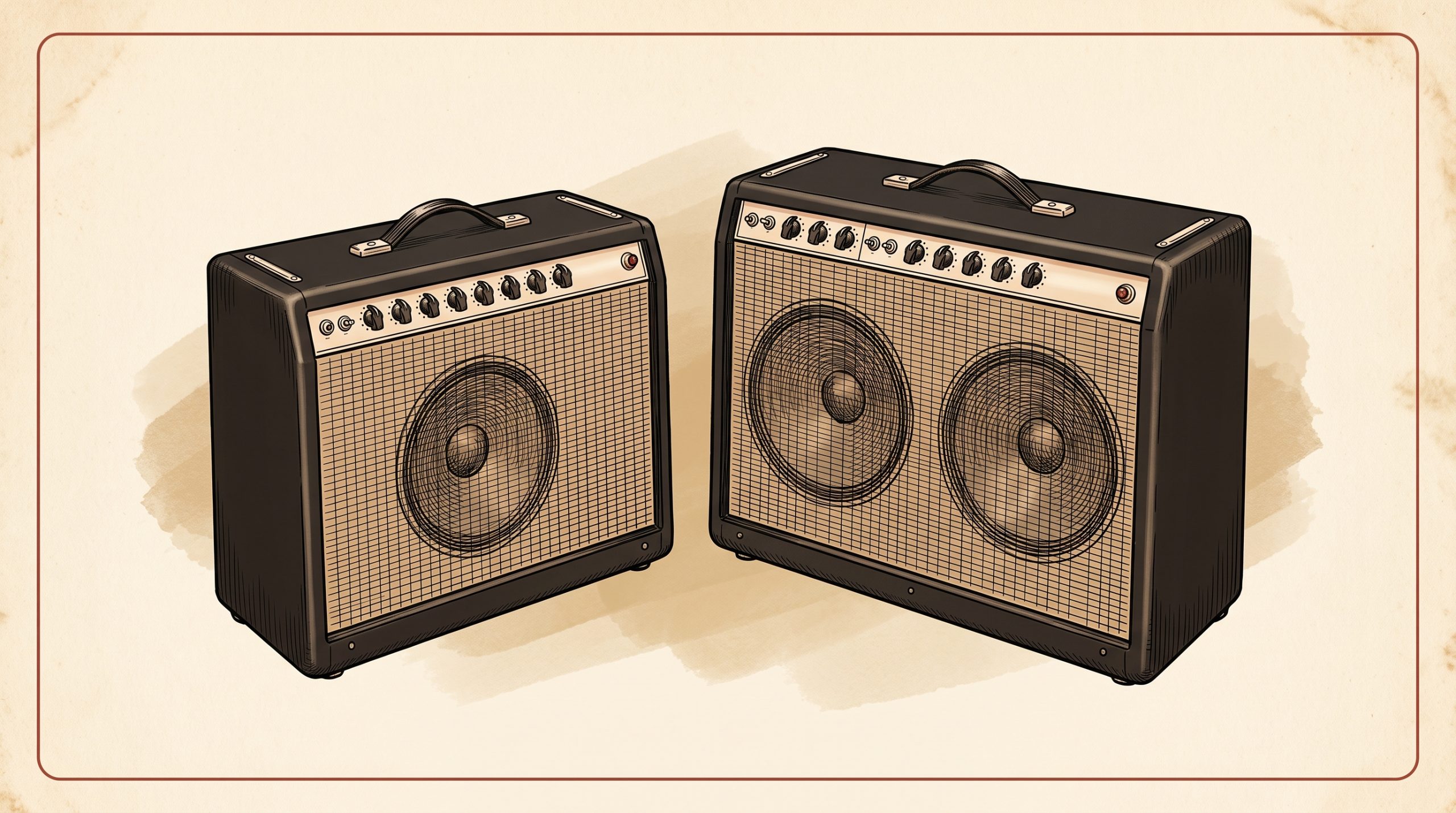
The Fender Hot Rod Deluxe and Hot Rod DeVille share an identical three-channel preamp circuit and control layout, but diverge in power amp configuration and speaker complement: the Deluxe runs 40 watts through a single 12-inch speaker, while the DeVille runs 60 watts through two 12-inch speakers (212) or four 10-inch speakers (410), producing greater headroom and stage volume at the cost of added weight and size. According to Fender’s product announcements documented at Reverb News, the Hot Rod Deluxe and Hot Rod DeVille launched together in 1996 as part of the same Hot Rod series rollout, both designed to give players extra gain on tap without requiring a boutique amp budget. The core voice is the same. The question is how much of it you need, and whether you want to carry the extra weight.
Quick Answer: Which One Should You Buy?
If you want the short version, here it is.
- Buy the Hot Rod Deluxe if: you play small-to-medium venues, value portability, want to push the amp into natural breakup at lower volume levels, or need something that fits in a car trunk without a second pair of hands.
- Buy the Hot Rod DeVille if: you play large stages, need clean headroom at gigging volumes, run a heavy pedalboard and want the amp to stay transparent, or you’re in a loud band where a single 12 gets swallowed.
Both amps share the same preamp circuit, so the core voice is genuinely identical. This article focuses on the 212 DeVille for a direct format comparison against the Deluxe. The 410 variant is addressed separately below. If you’re weighing the Hot Rod Deluxe against the Blues Deluxe, the Fender Blues Deluxe guide covers that comparison in detail.
What They Share: The Same Preamp, the Same DNA
Circuit Overview and Topology
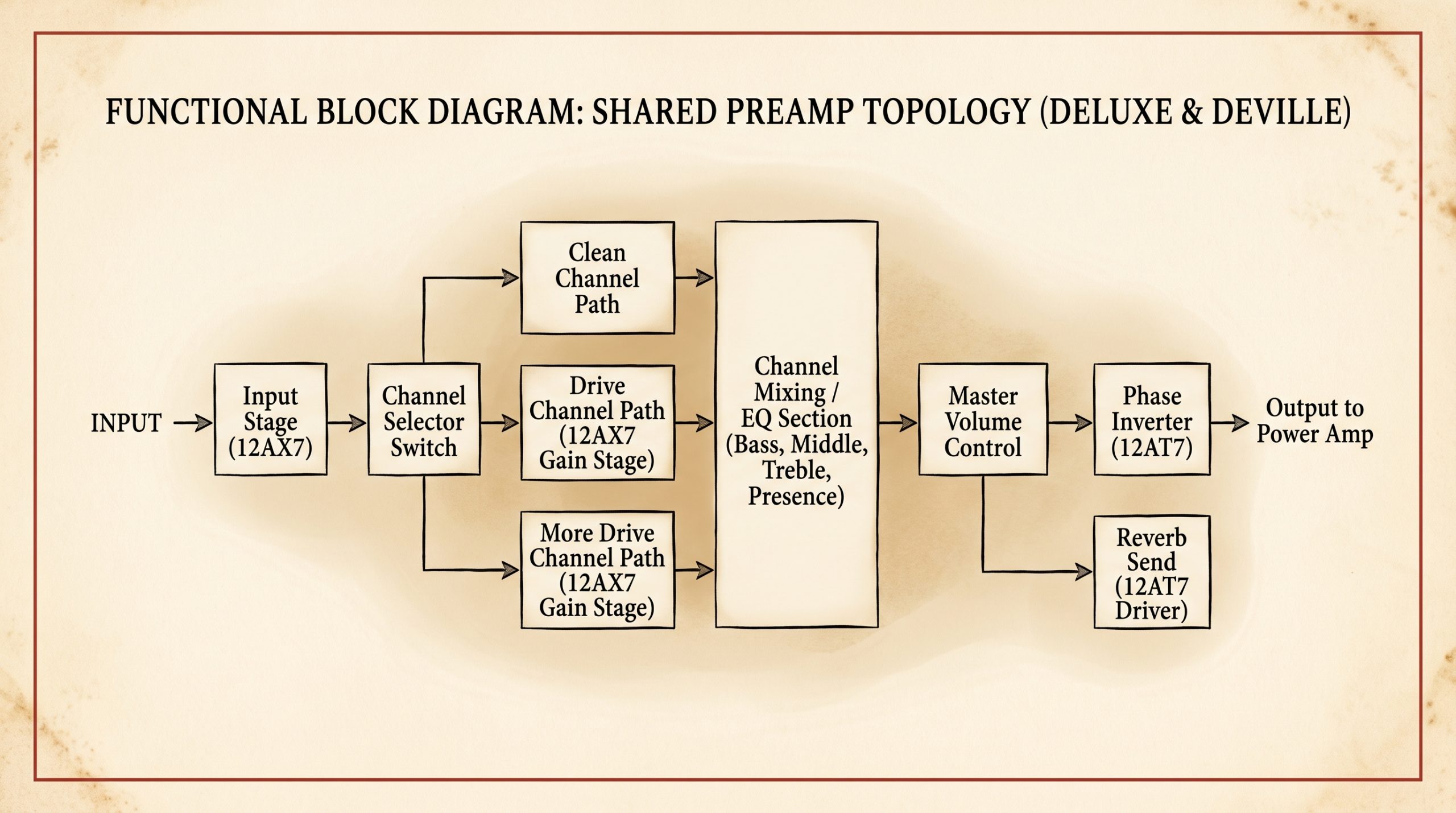
Both amps run a PCB-based three-channel preamp: Clean, Drive, and More Drive. The tube complement is identical across both models. You get three 12AX7s in the preamp positions, one of which serves as the phase inverter, and two 6L6GC power tubes. There’s no 12AT7 in either circuit: reverb driver, reverb recovery, and the effects loop are all solid-state op-amp circuits, not tube-driven. The DeVille’s extra 20 watts don’t come from additional power tubes. They come from a higher-spec output transformer winding. Same tube count. Different iron.
The spring reverb tank is an Accutronics-style design on both models. Controls are shared: Volume, Treble, Bass, Middle, Presence, Reverb, and Master Volume. The EQ section is shared across channels, which is a real limitation if you want drastically different voices between Clean and Drive. Both amps include Hi and Lo input jacks. Both have a series effects loop. Neither carries a traditional Fender circuit designation in the AA763 or AB763 tradition. These are modern PCB-based designs, not circuit descendants of the blackface era.
For a deeper look at the individual model, the Fender Hot Rod DeVille guide covers the full spec history and speaker options across all four generations.
Generation History (Gen I through Gen IV)
Both amps have gone through four documented production generations. Understanding which generation you’re looking at matters, especially on the used market. Gen I and II US-made examples carry a small premium with some buyers, though the circuit differences between generations are modest.
- Gen I (1996-2003): Original US production. Jensen and Eminence speakers depending on the model and year. Tweed-styled aesthetic with lacquer-coated cabinet.
- Gen II (2004-2010): Subtle component revisions. Mexico production introduced on some units during this period. Speaker specs varied.
- Gen III (2010-2015): Celestion G12P-80 installed in the Deluxe. Minor cosmetic changes. Still MIM on most production runs.
- Gen IV (2018-present): Solid pine cabinet (replacing the prior plywood construction), Celestion A-Type speakers, ivory chicken-head knobs, lightly-aged silver grille cloth, steel-reinforced strap handle. Preamp updated for better overdrive definition and smoother reverb voicing. The Gen IV Deluxe shed approximately 1.52kg versus its predecessor; the DeVille dropped roughly 1.72kg, both thanks to the pine cabinet swap.
The US vs. Mexico production debate runs hot on forums. Country of origin doesn’t reliably indicate build quality across these generations. Both facilities have produced solid and problematic units. Serial number research via the Fender tube amp serial number guide can help pin down exact production year and origin if you’re evaluating a used example.
Spec-by-Spec Comparison
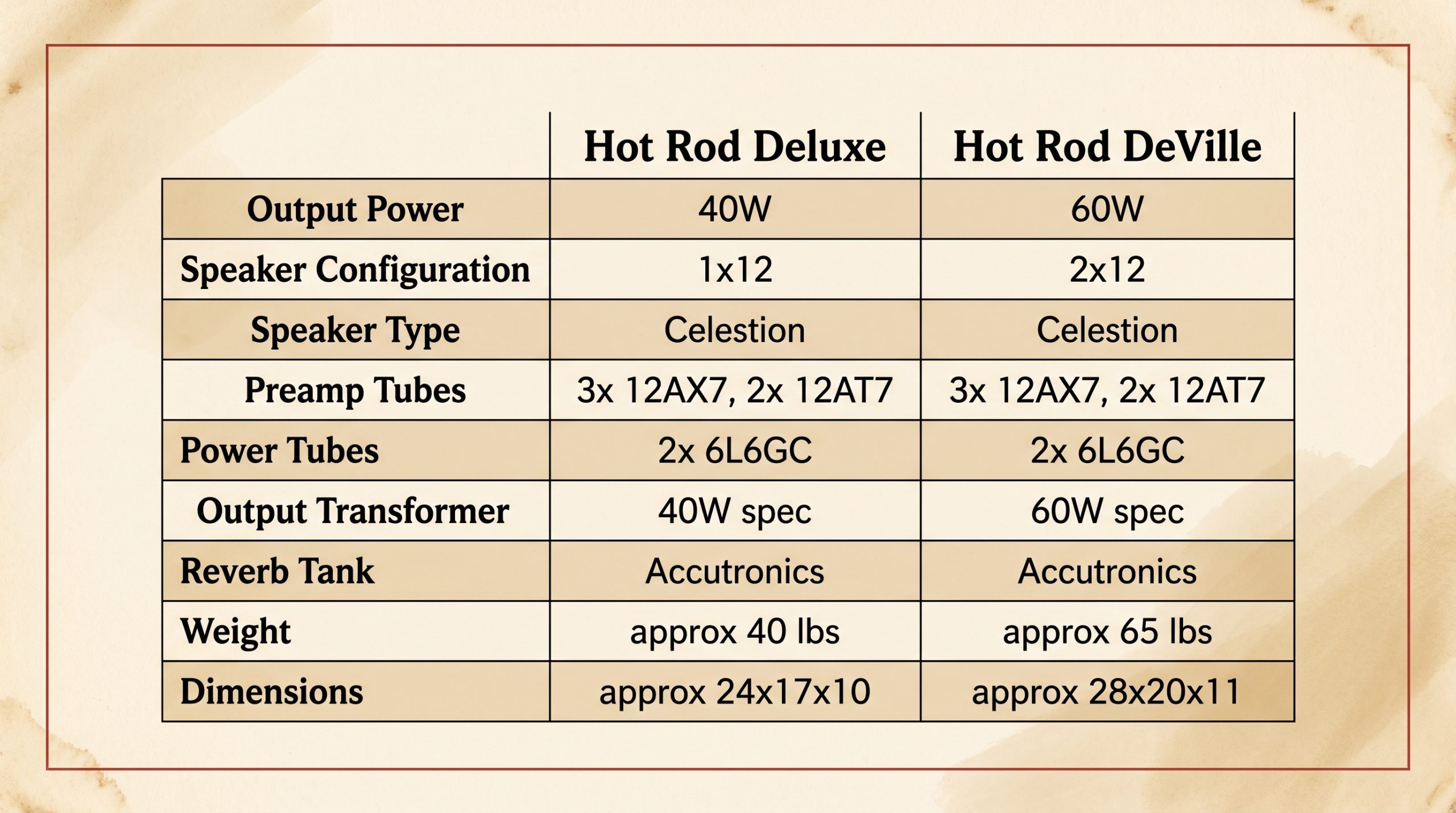
| Spec | Hot Rod Deluxe IV (1×12) | Hot Rod DeVille 212 IV (2×12) |
|---|---|---|
| Output Power | 40 watts RMS | 60 watts RMS |
| Power Tubes | 2x 6L6GC | 2x 6L6GC |
| Preamp Tubes | 3x 12AX7 (incl. phase inverter) | 3x 12AX7 (incl. phase inverter) |
| Speaker(s) | 1x 12″ Celestion A-Type (8Ω) | 2x 12″ Celestion A-Type (8Ω each) |
| Cabinet | Solid Pine | Solid Pine |
| Channels | 3 (Clean, Drive, More Drive) | 3 (Clean, Drive, More Drive) |
| Reverb | Spring (Accutronics-style) | Spring (Accutronics-style) |
| Weight | ~42 lbs (19 kg) | ~52 lbs (24 kg) |
| Dimensions (H x W x D) | 18″ x 24″ x 10.5″ | 20″ x 24″ x 10.5″ |
| Impedance | 8Ω | 4Ω internal (2x 8Ω wired in parallel); external jack accepts 4Ω or 8Ω |
| Effects Loop | Yes (series) | Yes (series) |
| Origin (Gen IV) | Mexico | Mexico |
| Street Price (approx.) | ~$999 USD | ~$1,199 USD |
The $200 street price gap between the two is worth noting. At that differential, the DeVille delivers meaningfully more stage capability. It’s not a rip-off. Whether the extra weight and size justifies the extra headroom is a gig-dependent question.
The Real Difference: 40W Into One Speaker vs. 60W Into Two
Headroom and Clean Ceiling
This is where the two amps diverge in practice. The DeVille’s 20 extra watts plus the addition of a second speaker produce a significantly higher clean ceiling. The math is useful here: doubling the speaker count adds approximately 3dB of perceived volume. The 20-watt increase adds roughly another 1 to 1.5dB on top of that. In practice, you’re looking at 4 to 5dB more usable clean volume before the DeVille starts to compress and break up.
That’s not a subtle difference on stage. It’s the difference between a Deluxe that’s starting to bark when pushed and a DeVille that’s still delivering warm clean tones at the same volume level.
The Deluxe’s lower clean ceiling isn’t a flaw for everyone. Players who want the amp itself to color the tone at moderate stage volumes will find the Deluxe’s natural compression and spongy compression character preferable. Country and funk players running a clean pedalboard into the amp’s clean channel will typically reach for the DeVille.
Natural Breakup Characteristics
Neither amp is a natural breakup machine on its Clean channel at anything approaching a reasonable volume. Getting clean-channel saturation on either model requires volume levels that will clear a room. Both rely on the Drive channel for dirt. That said, the Deluxe will get there first due to lower output and the single-speaker load. When the DeVille finally does break up, the fuller bass coupling from the second speaker gives the saturation a wider, fuller character. Barks when pushed. Both of them do. The Deluxe just barks louder relative to the volume knob position.
Speaker Dispersion and Stage Presence
A 2×12 cabinet creates wider horizontal dispersion than a 1×12. On a large stage, this means the DeVille fills more of the room without PA support. A single 12 is more directional, punching a tighter beam toward the front of the room. The practical implication: the DeVille sounds bigger in the venue, while the Deluxe often translates better to tape or digital capture because the tighter image is easier to place in a mix.
This is one of those real-world tradeoffs that doesn’t show up in the spec sheet.
Low-End Response
The DeVille’s larger cabinet volume and second speaker interaction produce more low-end authority. The bass is fuller and more room-filling. Community discussions at Harmony Central have described the DeVille’s low-end as being capable of rattling picture frames off walls, which isn’t an exaggeration at gigging volumes. The Deluxe feels tighter and more focused through the low mids, which some players prefer for cut and clarity, particularly in dense band mixes where a woofy low end can fight the kick drum for space.
Portability and the Gigging Reality
Weight Across Generations
The Gen IV Deluxe weighs approximately 42 lbs. That’s a one-person carry, and it fits in most car trunks without rearranging your gear. Heavy. Not brutal. The Gen IV DeVille 212 comes in around 52 lbs. Two-person carry recommended. Hatchback or van territory for most players. For reference, a Fender Blues Junior weighs around 31 lbs and a blackface Twin Reverb weighs considerably more still. The DeVille sits in a middle zone: heavier than you want to carry alone, lighter than a Twin but still not easy on the back after a three-set night.
Not great. If you gig four nights a week, the Deluxe wins on that metric alone.
Venue Suitability
| Venue Type | Hot Rod Deluxe | Hot Rod DeVille 212 |
|---|---|---|
| Small bar/club (50-100 cap) | Ideal | Often too much volume, harder to control |
| Medium venue (100-300 cap) | Works well when mic’d | Ideal, fills the room without PA support |
| Large stage (300+ cap) | Needs mic support to compete | Strong performer, good natural coverage |
| Studio recording | Easier to push into usable tones at lower levels | Harder to run at volume; needs attenuation |
| Home or rehearsal practice | Manageable, especially at low-volume settings | Overkill for most home situations |
The DeVille 212 vs. DeVille 410
Both DeVille variants run the same 60-watt circuit with the same tube complement. The configuration difference changes the character meaningfully. The 410 delivers a tighter, more defined low end with a chimier top end, characteristic of the classic Fender four-ten sound familiar from blackface Super Reverbs. The 212 has a fuller midrange and a more modern feel. It’s also easier to find matched speaker pairs for when it’s time for an upgrade.
The USA vs. Mexico production debate applies to both variants across different generations. Neither country of origin is a reliable quality predictor. Early US-made units have a following on the used market, but documented component changes between generations matter more than the flag on the back panel. Both the 212 and 410 have been produced at both facilities at various points.
The Mod Question
Most Common Mods on Both Amps
The Hot Rod series has a substantial mod ecosystem, which is one reason these amps have stayed relevant for 25+ years.
Speaker swap: The single most impactful upgrade on either amp. Stock Celestion A-Types are a genuine improvement over previous-generation speakers, but there’s still headroom for a better match to your playing style.
- Deluxe options: Celestion Creamback (warmer, more compressed), Jensen C12N (brighter, spanky attack), Eminence Legend 1258 (balanced, budget-friendly)
- DeVille 212 options: Matched pair of WGS Retro 30s, Celestion G12H-75 Creambacks (note: you’ll need two matched speakers, which adds to cost)
Tube rolling: The stock Chinese 6L6s and 12AX7s are functional but not spectacular. Common upgrades include JJ 6L6GC or Tung-Sol 6L6STR in the power positions. In V1, a Mullard reissue 12AX7 is a popular swap for noise reduction and a slightly rounder top end. The 6L6 tube guide covers the main options with measured specs. Worth reading before you spend money on NOS stock.
Fromel mod / Bill M mod: Both address the Drive channel’s ice-pick treble and harshness at higher gain settings. These are documented PCB-level modifications that improve the Drive channel’s usability significantly. They’re commonly referenced across forum communities for both the Deluxe and the DeVille.
Bias adjustment: Both amps are fixed-bias designs. Bias should be checked and adjusted after any power tube swap. Published bias targets differ by model: approximately 26–28mA per tube (52–56mA per pair) on the Deluxe, and approximately 35–38mA per tube (70–76mA per pair) on the DeVille. Confirm the spec for your specific amp and tube set with a qualified tech.
Cabinet damping: Adding acoustic damping material inside the solid pine cabinet reduces low-frequency resonance that some players find excessive, particularly on the DeVille where cabinet volume amplifies the effect.
Which Amp Takes Mods Better?
The Deluxe is the more commonly modded of the two. Lower purchase price means the investment in mods represents a smaller percentage of total cost. It’s also lighter on the bench and easier to flip open for work. The DeVille follows the same mod logic, but speaker swaps cost more since you’re sourcing a matched pair. If you’re planning to mod heavily, the Deluxe is the more economical entry point.
The Broader Hot Rod Family
Understanding where the Deluxe and DeVille sit within the full Hot Rod series helps contextualize the choice.
- Blues Deluxe: 40W, 1×12, but voiced warmer and bluesier. Less aggressive Drive channel. More compression on the clean side. A different tool from the Hot Rod Deluxe despite sharing the format.
- Blues DeVille: 60W with the same speaker options as the Hot Rod DeVille, but paired with the Blues Deluxe preamp voicing. Softer, warmer, less aggressive.
- Hot Rod Deluxe III vs. IV: The Gen III used a Celestion G12P-80, which many players described as congested in the low mids. The Gen IV A-Type is brighter and more open-sounding. Noticeable upgrade. The Blues Deluxe guide covers the Blues-series voicing differences in detail if you’re comparing across the full family.
The Hot Rod and Blues series share physical formats but don’t share preamp voicing. Swapping within the family without understanding that distinction leads to buyer’s remorse.
What the Community Agrees On
Forum consensus and Reddit discussions across multiple threads consistently land in the same place. Deluxe owners describe it as “enough amp” for most real-world gigs and value the portability and earlier-breakup character. DeVille owners cite clean headroom and stage volume as the decisive factor, and most use the amp as a pedal platform running a relatively clean signal from the amp itself. Players who switched from a Deluxe to a DeVille most commonly cite needing more clean headroom at louder gigs. Players who went the other direction, DeVille to Deluxe, most commonly cite weight and “too much amp for the rooms I actually play.”
One claim that circulates in forum discussions deserves a correction: the idea that “the Deluxe is every bit as loud as the DeVille” is only true at maximum volume with the Drive channel engaged. The DeVille achieves meaningfully higher SPL before breakup on the clean channel. That gap is the whole point of the comparison.
Wrapping Up
The Hot Rod Deluxe and DeVille are the same amp in two different packages, and that’s both their strength and the source of most buyer confusion. If portability and earlier natural breakup matter to you, the Deluxe is the right call. It fits in a car alone, it works in small rooms, and its lower clean ceiling becomes an asset when you want the amp to contribute to the tone. If you play stages where a 1×12 gets lost, run a heavy pedalboard, or need the clean channel to stay clean at full band volume, the DeVille’s extra 20 watts and second speaker deliver meaningfully more headroom and stage presence. Both amps have a strong price-to-performance argument against boutique alternatives at two or three times the cost, and both have a well-documented upgrade path via speaker swaps, tube rolling, and PCB mods. The Fender tube amp dating reference is useful if you’re buying used and want to confirm which generation you’re actually looking at before committing.
Frequently asked questions
Is the Hot Rod Deluxe or DeVille better?
Neither is objectively better. The Deluxe is better for small venues, portability, and players who want earlier natural breakup at moderate volumes. The DeVille is better for large stages, high-headroom clean tones, and use as a pedal platform. Both run the same preamp circuit, so the core voice is identical.
What is the actual difference between the Hot Rod Deluxe and DeVille?
Output power (40W vs 60W), speaker complement (1x12 vs 2x12 or 4x10), cabinet dimensions, and weight (approximately 42 lbs vs 52 lbs). The preamp topology, tube complement, channel structure, and control layout are functionally identical across both models.
Is the Hot Rod DeVille louder than the Hot Rod Deluxe?
Yes, by roughly 4 to 5dB of usable clean volume. The gap comes from both the higher wattage and the additional speaker. At full volume with the Drive channel engaged, the difference narrows considerably since both amps are being pushed past their clean ceiling.
Which Hot Rod amp works better with pedals?
The DeVille, because its higher clean headroom keeps the signal transparent at gigging volumes. The Deluxe can absolutely be used with pedals, but it will start to add its own color and compression at higher stage volumes, which may or may not work depending on your rig.
What's the difference between the Hot Rod DeVille 212 and 410?
Same 60-watt circuit, different speaker configuration. The 212 uses two 12-inch speakers and produces a fuller midrange response. The 410 uses four 10-inch speakers and delivers tighter, chimier lows with the classic Fender four-ten character. Speaker upgrade sourcing is easier and cheaper for the 212 since you're finding a pair rather than a matched quad.