Contents
- 01What Is a Silverface Fender Amp? (Definition and Era Overview)
- 02How to Identify a Silverface Fender Amp
- 03Key Silverface Fender Amp Models: Specs, Circuits, and Character
- 04Silverface vs. Blackface: What Actually Changed?
- 05Common Silverface Fender Amp Modifications
- 06Silverface Fender Amp Values and What to Look For When Buying
- 07The Silverface Reputation: Are They Really Inferior to Blackface Amps?
- 08Frequently Asked Questions: Silverface Fender Amps
- 09Which Silverface Fender Amp Is Right for You?
Most players assume silverface Fender amps are simply worse blackface amps in different clothes. That’s wrong, and the truth is more interesting. The silverface era spans 13 years and three meaningfully different internal generations. An early 1968 Deluxe Reverb is electrically almost identical to a 1966 blackface model. A 1977 Twin Reverb with the Ultra-Linear output stage is a genuinely different amplifier. Lumping them together is like saying all CBS Fenders are the same because they share a logo.
This guide covers the full silverface period: how to identify and date these amps using tube chart codes, EIA speaker and transformer stamps, and circuit numbers; what actually changed between the blackface and silverface eras (and when); model-by-model specs for the Champ, Deluxe Reverb, Twin Reverb, Bassman, and Super Reverb; common modifications with realistic cost estimates; and current market values including the drip-edge premium most sellers don’t explain clearly.
- Production years: 1968-1981 (cosmetic transition began mid-1967)
- Three internal sub-eras: Drip Edge (1967-1969), Mid-Period (1969-1973), Late CBS (1973-1981)
- Identification markers: brushed aluminum panel, blue-silver grille cloth, letter date code on tube chart
- Tube chart date format: two letters, first = year, system ends at S=1969 (most silverface amps from 1970 onward have unstamped charts), second = month (A=Jan)
- Early silverface values: $400-$2,500 depending on model and condition
- Drip-edge models command 15-30% premium over standard silverface pricing
- Myth: all silverface amps are inferior to blackface, early models (1968-1972) share near-identical circuits
- Blackface conversion mods reduce collector value, store original components before any circuit work
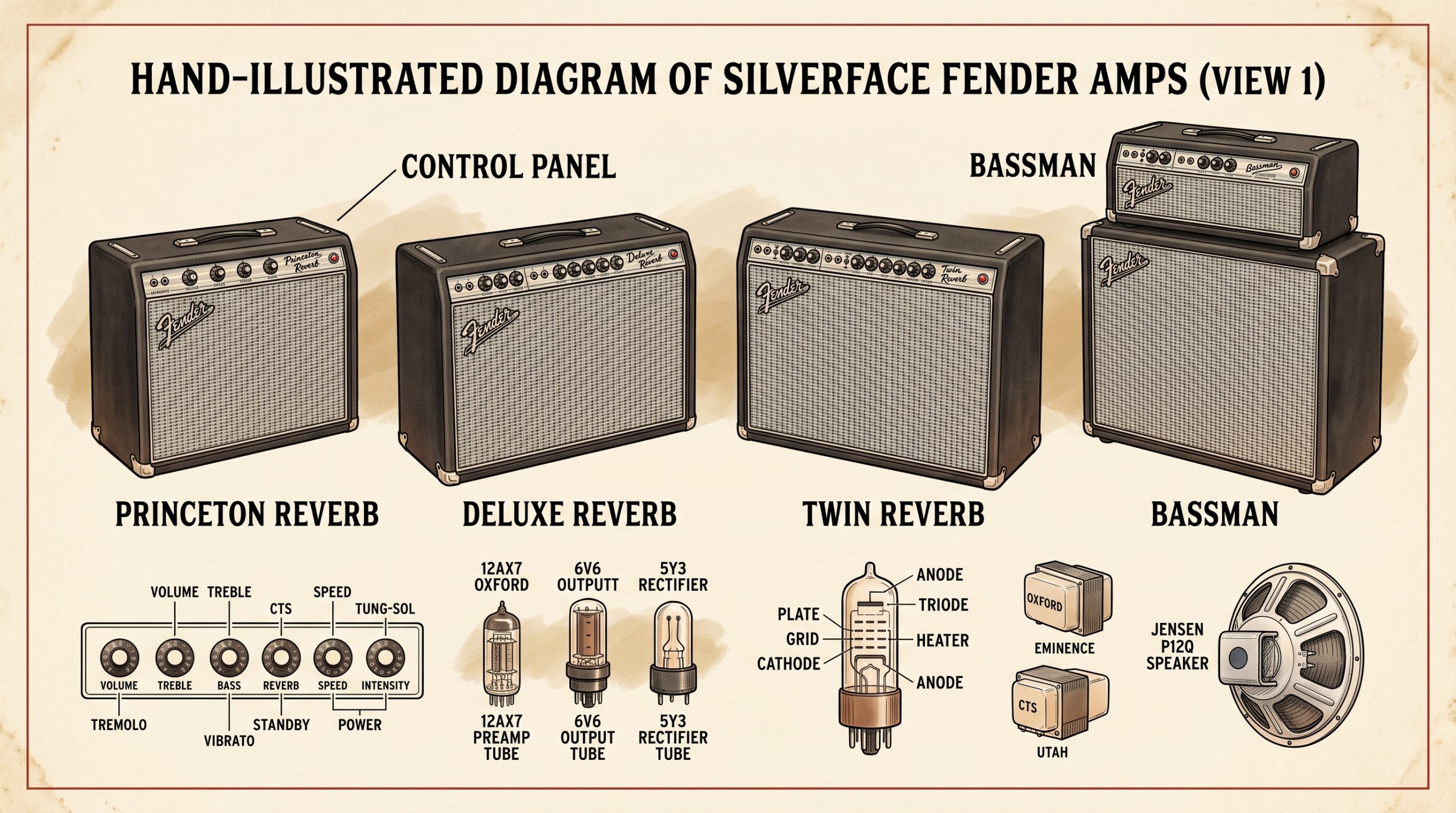
What Is a Silverface Fender Amp? (Definition and Era Overview)
CBS acquired Fender in January 1965. The cosmetic changes didn’t arrive immediately, but by mid-1967 the new brushed aluminum control panel was rolling out across the lineup, replacing the black anodized blackface panel that had defined Fender’s look since 1963. The grille cloth shifted from gold or wheat to a blue-silver sparkle weave. The full silverface lineup was in place by early 1968, and it stayed that way until Fender’s CBS ownership wound down and production ended in 1981.
What most guides miss is that “silverface” describes three genuinely distinct production periods, not a single era:
- Drip Edge / Transitional (1967-1969): The aluminum grille surround had a distinct “drip edge” lip around the front baffle. Circuits in this window were the closest to blackface spec, sometimes running identical component values. These are the most collectible silverface models.
- Mid-Period (1969-1973): First notable circuit departures appear. Bias points shifted, output transformer impedance changed on some models, and Fender began modifying the presence control circuit. Tonal differences from blackface are real but subtle on most models.
- Late CBS Era (1973-1981): Master Volume controls arrived, Ultra-Linear output stages appeared on larger amps, and pull-boost features were added. These are the models that earned the silverface its controversial reputation. They’re legitimately different amplifiers, not just rebranded blackface circuits.
The CBS-era corporate context matters here. Fender’s new ownership pushed for cost reduction, reliability improvements for a broader market, and features that looked good in catalogs. The Master Volume made sense commercially. The Ultra-Linear output stage was meant to improve efficiency. Whether those goals aligned with what guitar players wanted is a separate question, and the answer depends heavily on which year you’re talking about.
How to Identify a Silverface Fender Amp
Dating and authenticating a silverface amp accurately requires checking multiple data points together. No single code tells the whole story, but transformer codes, speaker stamps, and the tube chart date code cross-referenced against each other will lock down a production window to within a few months. Greg Gagliano’s research published in 20th Century Guitar Magazine (1997-2000, archived via the Wayback Machine) established this multi-point method as the standard approach for field authentication.
Date Codes: Transformers and Speakers (EIA Codes)
Every speaker and transformer in a vintage Fender carries an EIA source-date code stamped into the component housing. The format is a manufacturer code followed by a year digit and a two-digit week number. An Oxford speaker stamped 465-8-20 breaks down as: Oxford (465), 1968, week 20. The transformer equivalent follows the same logic, with codes on the bell housing. For a more detailed breakdown of reading these codes on both speakers and transformers, the Fender amp transformer date code guide covers the full EIA 606 system.
| Manufacturer | EIA Code | Common Use |
|---|---|---|
| Oxford | 465 | Speakers, silverface era ubiquitous |
| Jensen | 220 | Speakers, transitional and early silverface |
| CTS | 137 | Speakers, mid and late silverface |
| Utah | 328 | Speakers, Champ and smaller combos |
| Eminence | 67 | Speakers, late CBS era |
| Schumacher | 606 | Transformers, primary silverface supplier |
Locate speaker codes on the rear of the magnet. Transformer codes are stamped on the bell housing, typically on the top or side. A complete authentication cross-references the speaker date code against the tube chart date and the chassis serial number prefix. When all three align within a plausible production window, you have a solid date range.
Tube Chart Dating (Letter Codes)
The tube chart is glued to the inside rear panel of the cabinet. On amps assembled through 1969 it carries a two-letter date code stamped in ink or branded in: the first letter indicates the year, the second indicates the month (A = January, B = February, through L = December). A stamp reading RC dates assembly to March 1968. The letter-year system effectively ends after 1969 (S = 1969), so it only helps with the earliest transitional silverface units, most amps assembled from 1970 onward shipped with an unstamped tube chart.
| Code Letter | Year |
|---|---|
| O | 1965 |
| P | 1966 |
| Q | 1967 |
| R | 1968 |
| S | 1969 |
| none | System effectively ends — 1970-onward tube charts are typically unstamped |
One important caveat: the tube chart date reflects assembly date, not sale date. Amps sometimes sat in Fender’s warehouse or at distributors for months before reaching a customer. The tube chart date is the earliest possible date of manufacture, not a precise purchase timestamp. The full Fender tube amp serial number and dating guide cross-references chassis serial prefixes against these tube chart codes for a more complete picture.
Circuit Board and Schematic Identification
The circuit number is also stamped on the tube chart, directly below or adjacent to the date code. This is the most direct way to identify which generation of circuit you have in a given amp.
| Model | Blackface Circuit | Early Silverface | Late Silverface |
|---|---|---|---|
| Champ | AA764 | AA764 (1968-1972) | AA1164 (1973-1981) |
| Deluxe Reverb | AB763 | AB763 / AB868 | AA1270 |
| Twin Reverb | AB763 | AA769 | AA270 (Ultra-Linear) |
| Bassman (head) | AA165 | AA371 | AA270 |
| Super Reverb | AB763 | AB568 | AA270 |
| Princeton Reverb | AA1164 | AA1164 | AA1164 |
The 1972-1973 boundary is the critical inflection point. That’s when Master Volume controls began appearing, output transformers changed on the larger models, and the Ultra-Linear output stage arrived on the Twin Reverb. An amp with a V or later year code (1973 onward) needs closer inspection of those specific circuit nodes before you can call it “basically blackface.”
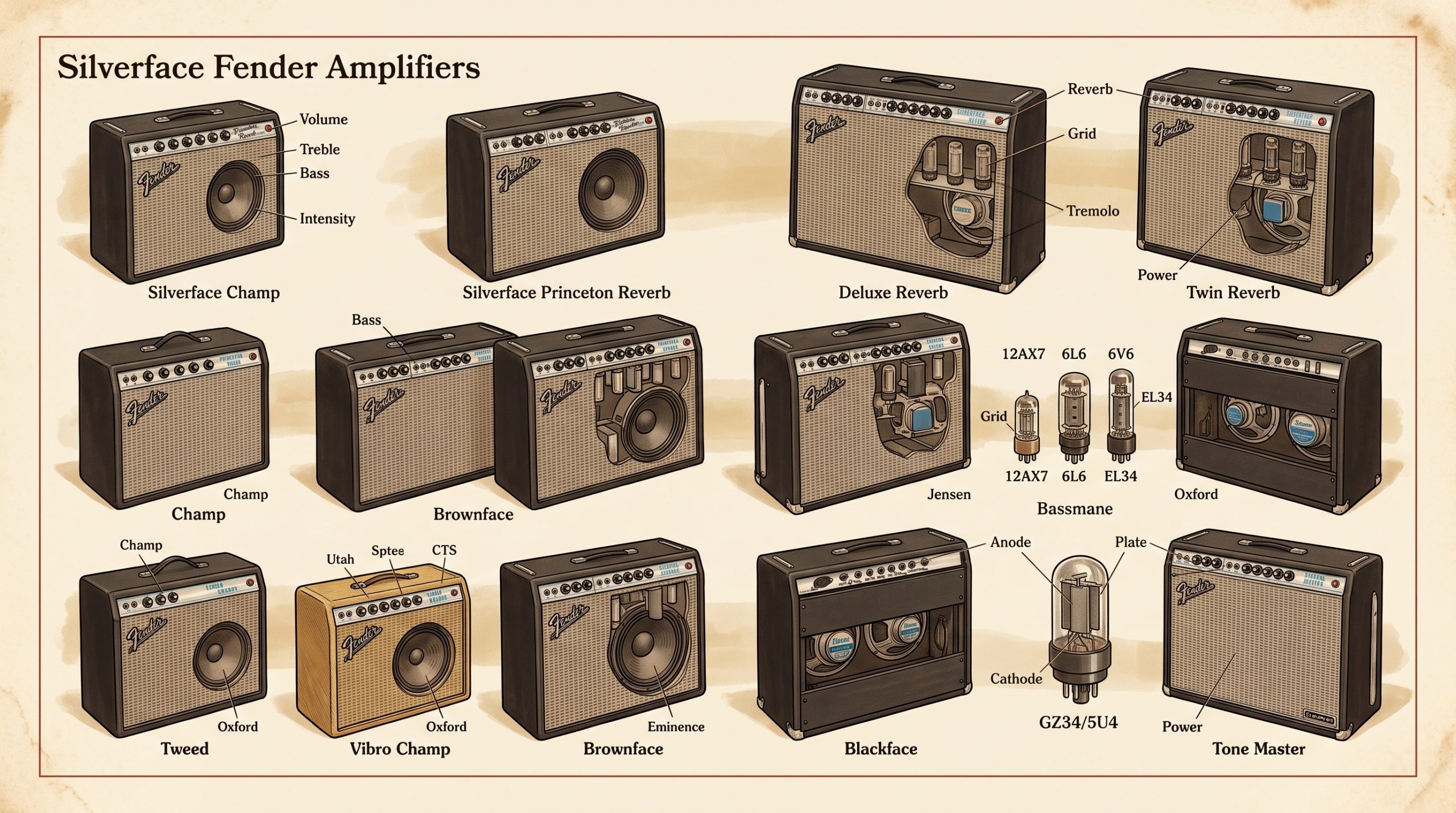
Physical and Hardware Identification Cues
Beyond the codes, the hardware tells its own story. The drip-edge aluminum grille surround, a distinctly lipped trim piece around the front baffle, appeared on 1967 through approximately 1969 models and is the single quickest visual indicator of a transitional-era amp. It disappeared by 1969-1970, replaced by a flat aluminum trim.
Knob styles shifted too. Early silverface models carried black “chickenhead” style knobs similar to the blackface era. Silver-top knobs arrived mid-period. The Fender logo badge changed profile across the production run, and cabinet Tolex saw variation between the standard black and a silver-black two-tone version on some models. None of these cosmetic markers override the EIA codes and tube chart for dating purposes, but they’re fast field identifiers when you’re at an estate sale with ten minutes to make a decision.
Key Silverface Fender Amp Models: Specs, Circuits, and Character
Fender Champ (Silverface), 1968-1981
The silverface Champ is a 6-watt single-ended combo running one 6V6GT output tube and a 12AX7 preamp tube. No reverb, no tremolo, that’s the Vibro Champ variant. The standard Champ ran an 8-inch Oxford or Utah speaker at 8 ohms. Circuit numbers split cleanly: AA764 from 1968 through 1972 (functionally identical to the blackface AA764), then AA1164 from 1973 onward.
For home recording, the Champ is difficult to beat in this price range. It breaks up at conversation-level volumes, takes pedals well when clean, and the 8-inch speaker keeps the low end tight rather than flabby. It’s also the easiest silverface amp to service, with a minimal component count and a layout that makes a full recap straightforward. The full model history and production details are in the Fender Champ amp guide.
Fender Deluxe Reverb (Silverface), 1968-1981
The silverface Deluxe Reverb is a 22-watt push-pull combo running two 6V6GT output tubes. Preamp complement is four 12AX7 and two 12AT7 tubes. Early production used a GZ34 tube rectifier, transitioning to solid-state rectification as the CBS era progressed. Speaker is a 12-inch Oxford, Jensen, or CTS depending on production year.
Drip-edge Deluxe Reverbs (1967-1969) running the AB763 circuit are functionally near-identical to their blackface predecessors. The post-1973 AA1270 circuit amps have altered bias points and output transformer changes that produce a marginally stiffer response, not bad, just different. For club-volume clean tones with room for edge-of-breakup dynamics, the Deluxe Reverb hits a practical sweet spot regardless of sub-era. Comprehensive circuit documentation is in the Fender Deluxe Reverb complete guide.
Fender Twin Reverb (Silverface), 1968-1981
The silverface Twin Reverb runs 85 to 100 watts through four 6L6GC output tubes into two 12-inch speakers, typically Oxford or CTS, with JBL D120F as a period-correct upgrade option. Early circuit: AA769. Post-1973: AA270 with the Ultra-Linear output stage.
At 85 watts, the silverface Twin Reverb is among the most powerful amps Fender built in this era, though opinions on the Ultra-Linear circuit vary significantly among players and technicians. The Ultra-Linear stage produces a stiffer, less compressed response than the blackface AB763 circuit. Stage-loud clean headroom is exceptional. The Master Volume addition post-1973 added controllable overdrive at lower stage volumes, which has earned the late Twin a following among players who couldn’t otherwise get usable overdrive from an 85-watt amp without removing the roof from the venue.
Fender Bassman (Silverface), 1968-1981
The silverface Bassman ran as a head, typically paired with a 2×12 or 4×10 cabinet. Circuit: AA371 early, AA270 late. Power is 50 watts from four 6L6GC output tubes. The blackface predecessor was the AB165 circuit, which is a different animal from the celebrated 5F6-A tweed Bassman, a distinction worth keeping straight when shopping.
As a guitar amp rather than a bass amp, the silverface Bassman has a genuine cult following among blues and rock players who want 50 watts of headroom in a portable head format without paying Twin Reverb prices. It barks when pushed and has a stiffness through the bass register that works well with single-coil guitars. Full production history from tweed to silverface is in the Fender Bassman amp guide.
Fender Super Reverb (Silverface), 1968-1981
The Super Reverb delivers 45 to 50 watts through four 6L6GC output tubes into four 10-inch speakers, typically Oxford, CTS, or Eminence depending on era. Circuit: AB568 early, AA270 late. The 4×10 configuration gives it a punchy, detailed midrange with a tight low end that a single 15 or 12 can’t replicate.
Among players chasing clean headroom with genuine reverb integration and full-spectrum response, the Super Reverb consistently appears near the top of the list. It’s genuinely heavy, don’t underestimate that, but for certain applications it’s hard to argue against. The drip-edge AB568 examples represent some of the most desirable silverface amps in the full lineup.
Silverface Model Comparison Table
| Model | Watts | Output Tubes | Speaker Config | Early Circuit | Late Circuit | Approx. Current Value |
|---|---|---|---|---|---|---|
| Champ | 6W | 6V6 x1 | 1×8″ | AA764 | AA1164 | $400-$800 |
| Princeton Reverb | 12W | 6V6 x2 | 1×10″ | AA1164 | AA1164 | $700-$1,200 |
| Deluxe Reverb | 22W | 6V6 x2 | 1×12″ | AB763 | AA1270 | $900-$1,800 |
| Super Reverb | 45W | 6L6 x4 | 4×10″ | AB568 | AA270 | $1,200-$2,500 |
| Bassman (head) | 50W | 6L6 x4 | Head | AA371 | AA270 | $600-$1,400 |
| Twin Reverb | 85-100W | 6L6 x4 | 2×12″ | AA769 | AA270 | $800-$1,800 |
Silverface vs. Blackface: What Actually Changed?
The transition didn’t happen all at once. Verified documentation from period production shows the silverface cosmetics began rolling out around September 1967, but the schematic changes started in May 1968 and varied by model. Cosmetic changes and circuit changes were not simultaneous events, and treating them as if they were causes a lot of confusion on the used market.
For the drip-edge transitional period (1967-1969), the circuit differences from blackface were minimal. Phase inverter grid leak and cathode resistor values were often identical. The grille cloth was different. The panel was different. The amp inside was often the same. Paying a blackface premium for a drip-edge silverface because you spotted the aluminum panel without checking the tube chart circuit code is an easy mistake to make and an expensive one.
The meaningful circuit departures arrived in stages:
- Output transformer impedance changes (post-1972): Affected damping factor and speaker interaction, contributing to the tighter, less “spongy” feel of late silverface models compared to blackface.
- Presence control modification: The presence network was altered across multiple models, producing a different high-frequency response curve that many players describe as slightly less interactive with output tube distortion.
- Bias point adjustments: Factory bias settings shifted toward cooler operation, a cost and reliability decision that reduced output tube wear at the expense of some of the warm compression blackface amps are known for.
- Ultra-Linear output stage (post-1973 Twin Reverb and Super Reverb): A genuine circuit architecture change, not just a component value tweak. Produces more headroom and less natural compression. Some players love it. Others don’t.
- Master Volume addition (1973 onward): Changed the gain structure fundamentally on models where it appeared, adding a second gain stage that has its own tonal character.
Honest assessment: an early silverface amp is close enough to a blackface that most players couldn’t reliably identify it in a blind test at volume. A 1977 Twin Reverb with the AA270 Ultra-Linear circuit is meaningfully different. Both statements can be true simultaneously.
Common Silverface Fender Amp Modifications
The Blackface Conversion Mod
A blackface conversion reverts component values in the preamp and output sections to AB763 or AA764 specification. This typically means changing capacitor values in the presence and tone circuits, adjusting bias resistors, and sometimes modifying the output transformer load line if the silverface unit’s transformer differs from spec.
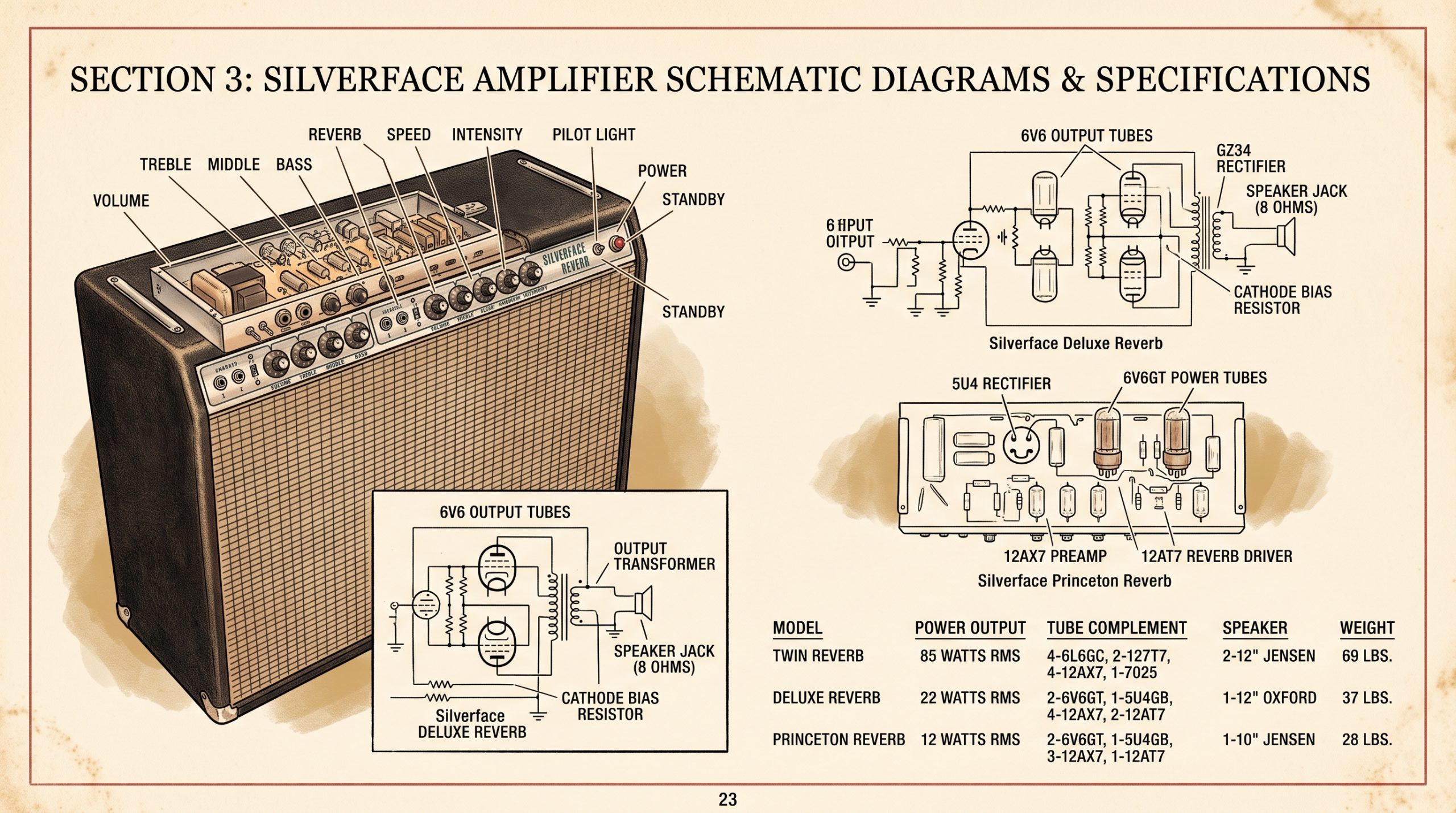
Where it makes practical sense: post-1973 Twin Reverb and Super Reverb models with the AA270 circuit. The circuit departure there is substantial enough that the mod produces a noticeable change. Where it’s marginal: early silverface Champ (the AA764 circuit is already identical to blackface), Princeton Reverb (the AA1164 ran through both eras unchanged).
Estimated cost: $150-$300 for parts and labor from a competent technician. Not a beginner job on a Twin Reverb. Keep all original components in a labeled bag, modding does reduce collector value, and future buyers may want to restore original spec.
Capacitor Recap (Restoration vs. Modification)
Electrolytic capacitors degrade over time. Most silverface amps are now 45 to 55 years old, and a recap is maintenance, not modification. Symptoms include increased hum, reduced low-frequency response, and unstable bias. A competent recap using quality parts (F&T, Sprague Atom, or JJ electrolytics) should run $80-$200 depending on the model’s cap count. On a late silverface Twin Reverb with a complex power supply, budget toward the higher end. On a Champ, it’s a quick job. This should be considered standard practice on any silverface amp you plan to use regularly.
Speaker Upgrades
Original Oxford and Utah speakers are increasingly difficult to find in full working condition. Before swapping, document everything: photograph the speaker label, record the EIA code, and consider having the original reconed by a specialist if it’s blown. A working original speaker adds measurable value to the amp.
If replacement is unavoidable, popular choices include Weber California (Oxford-voiced), Eminence Legend series (warm clean tones, controlled treble), and Celestion Vintage 30 (though that’s a significant tonal shift from Fender’s original voiced character). Match impedance to the original spec before installing anything.
Bias Adjustment and Output Tube Upgrades
Factory silverface bias settings ran cool, a reliability-focused decision from the CBS engineering team. A correct bias adjustment to appropriate plate dissipation (around 70% of maximum rated plate dissipation is a common target) will open up the amp’s natural compression and warm clean tones considerably. This is straightforward work for a technician with a bias probe and a DMM.
Compatible output tube alternatives with good track records in silverface circuits: JJ 6V6S and Tung-Sol 6V6 for smaller models; JJ 6L6GC and Sovtek 5881 for the larger amps. Confirm your technician rebias after any tube swap. Tube datasheets from JJ Electronic and Tung-Sol list plate dissipation ratings for reference.
Silverface Fender Amp Values and What to Look For When Buying
Value in silverface amps tracks originality more than era, with a few predictable premiums layered on top.
Original speakers in working condition add roughly 20-30% over a replaced-speaker equivalent. Original NOS tubes (Sylvania, RCA, GE) are worth documenting and preserving, a full set of RCA black-plate 6L6GCs in a Twin Reverb adds real money. Original Schumacher transformers with matching EIA codes add confidence to the buy. Original tolex and grille cloth in clean condition pull a premium from collectors who want display-quality pieces as much as players.
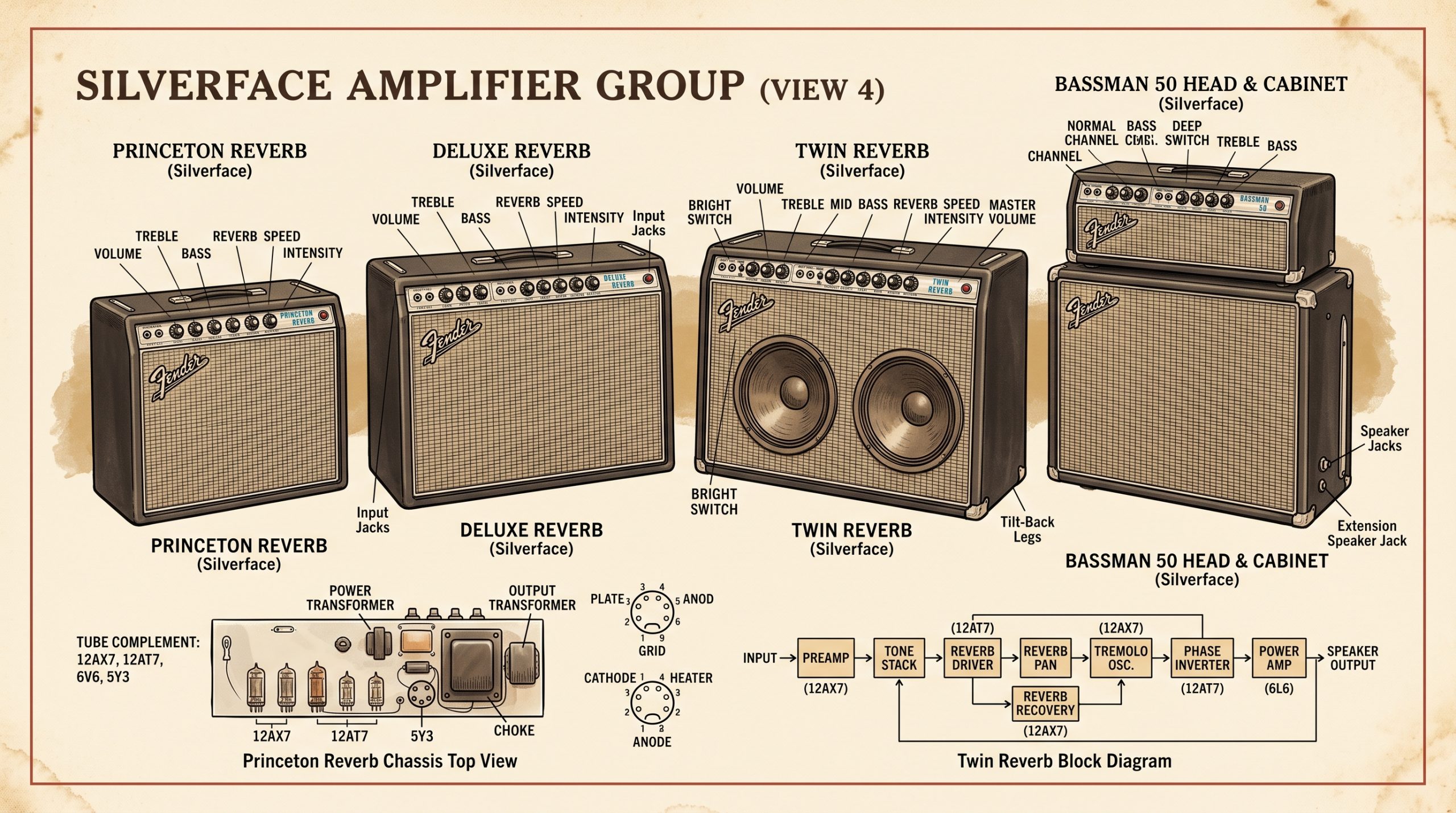
The drip-edge premium is real and worth understanding before you buy or sell:
| Model | Standard Silverface Value | Drip Edge Premium | Unmodified Premium |
|---|---|---|---|
| Champ | $400-$800 | +10% | +5-10% |
| Deluxe Reverb | $900-$1,800 | +15-25% | +10% |
| Twin Reverb | $800-$1,800 | +15-20% | +10% |
| Super Reverb | $1,200-$2,500 | +20-30% | +15% |
Red flags when buying: re-covered cabinets (check seams at the corners for mismatched tolex texture), replaced output transformers (verify EIA codes against production date, a 1969 transformer in a “1968” amp needs explaining), crackling or dead channels (factor a $150-$300 recap into your offer), and non-original tube sockets. A blackface-modded silverface is worth more to a player and less to a collector. Know which buyer you are before you offer full price for either.
The Silverface Reputation: Are They Really Inferior to Blackface Amps?
The “CBS era = inferior” narrative has outlived its usefulness as a blanket statement. It contains real truth for the 1973-1981 period on specific models. It’s just wrong for most pre-1973 production.
Countless working guitarists relied on silverface amps throughout the 1970s simply because they were the current production Fender models sitting in music stores, from bar-band players to session musicians tracking major-label records with silverface Champs and Deluxe Reverbs. The idea that every silverface amp is a compromised blackface amp waiting to be “fixed” misses the point of what these amps actually do.
Early silverface amps (1968-1972) are undervalued relative to their actual performance. The circuit similarity to blackface is well-documented, the prices are lower, and the parts availability is identical. That’s a practical advantage, not a consolation prize.
Late silverface amps (1973-1981) are niche. The Master Volume models genuinely produce overdrive at volumes that don’t require hearing protection, which has its own value in a rehearsal context. The Ultra-Linear Twin Reverb has a stiff clean response that certain players prefer for pedal platforms. Not great for everyone. Exactly right for some.
The silverface era produced a lot of amplifiers over 13 years. Treating all of them as second-tier alternatives to blackface amps misses the actual history and leaves real value on the table for players willing to look more carefully. Teagle and Sprung’s Fender Amps: The First Fifty Years documents this production history in detail and remains the primary reference for era-level research.
Which Silverface Fender Amp Is Right for You?
Home recording with natural breakup at low volumes: the silverface Champ is the clear answer. It’s the easiest to service, the most affordable entry point, and the 6-watt single-ended circuit does exactly one thing very well. Club gigging with clean-to-edge-of-breakup tones: a silverface Deluxe Reverb, ideally a drip-edge or early AB763 example, gives you 22 watts of headroom with the reverb and tremolo integrated rather than bolted on as an afterthought. Big clean headroom for a loud stage or pedal platform: a silverface Twin Reverb or Super Reverb. Budget entry point into the silverface world: a late silverface Bassman head or Princeton Reverb, both of which regularly trade below the Deluxe Reverb price point with comparable circuit quality. Whatever you’re buying, check the tube chart date code, verify the EIA codes on the transformer and speaker, confirm the circuit number, and budget $150-$250 for a proper service before you gig with it. A well-maintained silverface amp will work as hard as you do.
Frequently asked questions
What is a Fender silverface amp?
A Fender silverface amp is a tube amplifier produced by Fender from approximately 1968 to 1981 under CBS ownership. The name comes from the brushed aluminum control panel that replaced the black anodized "blackface" panel from the 1963-1967 era. Models include the Champ, Princeton Reverb, Deluxe Reverb, Twin Reverb, Super Reverb, and Bassman, among others.
When did Fender switch from blackface to silverface?
The cosmetic transition to silverface began around September 1967. The new look was fully implemented across the lineup by early 1968. Circuit changes followed separately, with schematic revisions beginning in May 1968 and rolling out model by model through the early 1970s. The cosmetic switch and the circuit changes were not simultaneous events.
Are silverface Fender amps good?
Yes, with appropriate context. Models produced from 1968 to 1972 share circuits nearly identical to the revered blackface era and deliver comparable performance at lower prices. Models from 1973 to 1981 differ more meaningfully due to the Master Volume addition and Ultra-Linear output stage on larger models, but they have genuine uses and a dedicated following among players who need controllable overdrive at lower volumes.
What is the best silverface Fender amp?
It depends entirely on application. For home recording and bedroom-friendly volume, the silverface Champ is difficult to beat: 6 watts, a single 6V6, and natural breakup at low levels. For club gigging with clean-to-edge-of-breakup dynamics, the silverface Deluxe Reverb covers most situations in one amp. For maximum clean headroom on a loud stage, the silverface Twin Reverb or Super Reverb delivers. The Super Reverb adds the 4x10 configuration's midrange punch if that's your priority.
How do I date my silverface Fender amp?
Start with the tube chart inside the rear panel, if it's stamped, the letter-year dating system effectively ended after 1969 (R = 1968, S = 1969 for the last transitional units), so most silverface amps from 1970 onward shipped with an unstamped chart. For those, cross-reference the EIA source-date code on the speaker magnet and the transformer bell housing, along with cosmetic era markers like the drip-edge grille and knob style. Those data points together will place your amp within a reliable production window. The full method, including serial number cross-referencing, is covered in the Fender tube amp dating reference.